




Abstract
The current study examined predictors of undergraduate science students’ intentions to attend graduate school and participate in undergraduate research. We used social cognitive career theory to test our hypothesized model using a sample (N = 411) of life science and physical science majors and examined basic interests in these disciplines as mediating variables. Among life science majors, results of structural equation modeling indicated that microbiology interest mediated the relationship between scientific self-efficacy (SSE) and graduate education intentions (GEIs) and the latter variable also mediated the relationship between microbiology interest and undergraduate research intentions (URIs). The model for physical science majors did not provide a good fit to the data, therefore path coefficients associated with this model were not interpreted. Implications for counseling interventions based on patterns of career intention formation in the life and physical sciences are discussed.
Keywords
Careers in scientific research are increasingly important considering the challenges of tackling global problems such as climate change, food and water security, and cyber security (National Science Board, 2015). Individuals with advanced scientific knowledge and skills are needed to solve such complex problems. Acquiring the skills to meet these challenges often requires pursuing an education beyond the baccalaureate degree. Fortunately, employment in many of the occupations that focus on answering these difficult scientific questions is projected to grow in the next decade. According to the U.S. Bureau of Labor Statistics (2018), occupations in the life and physical sciences are projected to increase by 10% between 2016 and 2026.
A critical step for undergraduate students intending to pursue graduate education in science, technology, engineering, and mathematics (STEM) fields is to participate in faculty-mentored research. Numerous studies demonstrate the value of undergraduate research experiences to students’ gains in research skills, knowledge about research careers, identification as a scientist, and aspirations for graduate education (see Laursen, Hunter, Seymour, Thiry, & Melton, 2010). Much of the science career development literature examines how individual difference factors such as personality (e.g., Reed, Bruch, & Haase, 2004; Roe, 1961), work preferences (e.g., Ferriman, Lubinski, & Benbow, 2009), ability (Park, Lubinski, & Benbow, 2008), and vocational interests (e.g., Lubinski & Benbow, 2006) shape the career development of scientists, but few studies have investigated how social cognitive (i.e., intrapersonal) processes influence intentions and actual decisions to continue one’s training beyond the baccalaureate degree (Adedokun, Bessenbacher, Parker, Kirkham, & Burgess, 2013; Byars-Winston, Branchaw, Pfund, Leverett, & Newton, 2015). In the present study, we focus on the processes that specifically shape intentions to both pursue graduate education and participate in undergraduate research within the context of the interest and choice model of social cognitive career theory (SCCT; Lent, Brown, & Hackett, 1994) for a sample of undergraduate life and physical science majors.
Theoretical Framework
SCCT explains several psychological processes by which people arrive at academic/career-related decisions and actions. Accordingly, Lent, Brown, and Hackett (1994) conceptualized three interlocking models—explicating interest development, choice, and performance—which take into account the dynamic interplay between environment, individual differences, and self-referent appraisals of past and future behavior in determining career-related outcomes. Given our interest in graduate education intentions (GEIs) and undergraduate research intentions (URIs), we focused on SCCT’s interest and choice model in this study. The interest model asserts that people develop interest in an activity to the extent that they possess self-efficacy or the appraisals one forms about his or her capability to carry out the actions needed to meet a standard of performance (Bandura, 1997). Similarly, people are more likely to find a potential career choice interesting worthy of further exploration if they can expect to be rewarded either socially, intrapersonally, or financially for engaging in activities that are relevant to that career (i.e., outcome expectations). In turn, the choice model posits that interest gives rise to the adoption of particular goals or intentions 1 that organize and direct behavior toward a desired outcomes.
The SCCT model has been well applied to STEM domains in the career development literature (Fouad & Santana, 2017). Studies consistently suggest that STEM career intentions are largely derived from self-efficacy beliefs (e.g., Byars-Winston, Estrada, Howard, Davis, & Zalapa, 2010; Fouad & Smith, 1996), outcome expectations (e.g., Lent et al., 2001; Lent, Lopez, & Bieschke, 1993), and interests (e.g., Flores & O’Brien, 2002; Navarro, Flores, Lee, & Gonzales, 2014). Powerful evidence of the causal relationships among these constructs in STEM disciplines has been reported in longitudinal studies demonstrating reciprocal relationships between both self-efficacy and outcome expectations (Lent, Sheu, Gloster, & Wilkins, 2010) and interest and intentions (Grigg, Perera, McIlveen, & Svetleff, 2018). With regard to the current research, recent studies using SCCT have suggested that research self-efficacy is positively associated with both intentions to attend (Tate et al., 2015) and actually enroll in (Byars-Winston et al., 2015) graduate school.
Setting a goal of attending graduate school is an example of a distal intention because the goal cannot be realized for several months or years while the student completes his or her undergraduate education requirements. Thus, it is reasonable to believe that undergraduate students would establish a distal intention of attending graduate school and subsequently engage in near term or proximal activities that are instrumental to achieving this goal. This raises the question of which proximal intentions students formulate and pursue in service of such a distal objective. A common and effective activity in preparing for graduate school is to participate in undergraduate research. Undergraduate research involvement has been shown to increase the likelihood of obtaining an advanced degree (Carter, Mandell, & Maton, 2009; Lopatto, 2007; National Academies of Sciences, Engineering and Medicine, 2017; Russell, Hancock, & McCullough, 2007) because it fosters the development of important analytical and communication (e.g., scientific writing) skills while socializing students into the community of scientific professionals (Hunter, Laursen, & Seymour, 2006).
One could argue that intentions to conduct undergraduate research precede intentions to pursue a graduate education because research involvement can promote interest, efficacy, and expectancy beliefs relative to careers in science. However, we contend that the opposite causal sequence is also compelling and is more consistent with SCCT propositions. According to SCCT, performance attainments are theorized to be the final outcome of the career development process, functioning as a direct consequence of intention implementation and serving as a feedback mechanism for the continued growth of self-efficacy (Lent et al., 1994). Intentions to participate in undergraduate research correspond closely with choice actions in the SCCT framework because they reflect behaviors that are proximal to the career development process. Thus, because SCCT posits that choice actions are direct antecedents of performance attainments and proximal intentions are more strongly associated with performance than distal intentions (Bandura & Simon, 1977; Latham & Seijts, 1999), it seems logical that URIs would sequentially follow distal GEIs in a model involving both variables.
Researchers have measured STEM career intentions in relation to particular disciplines, such as engineering (e.g., Lent et al., 2003, 2005), mathematics (e.g., Gainor & Lent, 1998; Lent et al., 1993), and computer science (e.g., Lent, Lopez, Lopez, & Sheu, 2008). Investigating the quality of conceptualized models within specific groups and comparing them to those of other groups (e.g., Byars-Winston & Rogers, 2019; Navarro et al., 2014) is critical to advancing theory development. Undergraduate science majors represent a diverse array of disciplines and corresponding career fields that carry their own unique sets of external contingencies, opportunities, and incentives (e.g., labor market trends) that may have differential effects on student motivation. Other researchers have focused on science more generally as the domain of career intentions. Measuring science intentions in a general way is necessary when the career maturity of the population of interest necessitates a broad focus, as is often the case with adolescents (e.g., Fouad & Smith, 1996) and individuals who are career undecided. However, among individuals who have narrowed their focus to a particular career path (e.g., declared an academic major), it is important to measure intentions at a level correspondent with the context in which a given behavior is to occur, as doing so should lead to more accurate predictions of performance (Ajzen, 2012). Declaration of an academic major within the first or second year of college clearly signifies a student’s narrowing of interest in a specific subject area. Identifying particular interest areas and gauging the extent to which students are interested in those areas are critical to determining whether they will ultimately develop intentions to attend graduate school and conduct undergraduate research. These developmental factors should also be taken into account when measuring interest within the SCCT framework, and thus, we investigate the relation of GEIs and science career intentions. Here, we examine how the collective effects of self-efficacy, outcome expectations, and interest operate to influence undergraduate students’ intentions to pursue career pathways in scientific research.
Present Research
Strong motivation and persistence are critical to enduring the lengthy training needed to develop the specialized skills that graduate programs in scientific research require. Therefore, the primary purpose of the current study was to investigate the factors that may give rise to the intentions of undergraduate science students to continue their scientific training beyond a bachelor’s degree and to engage in scientific research as undergraduates. Theoretical and empirical advances in this area are critical in helping counselors to develop evidence-based interventions that help their clients reach their career goals. Some research in the SCCT literature has examined students’ intentions to attend graduate school (e.g., Tate et al., 2015), but researchers have yet to investigate students’ intentions to continue their graduate education in scientific research specifically. Existing measures of science career intentions typically refer to science in such broad terms that their items often reflect both academic and occupational behavior, as well as a wide range of requirements regarding vocational skill and preparation (e.g., requisite degrees ranging from associate’s to doctoral). Thus, a secondary objective of the current research was to evaluate the construct validity of a measure designed to tap students’ intentions to attend graduate school. We sought to meet this objective by validating the GEI measure against an established measure of science career intentions using a multiple indicator, multiple causes (MIMIC; Jöreskog & Goldberger, 1975) modeling approach. Finally, given our interest in measuring these SCCT constructs at local rather than global levels, a third objective of the current research was to further establish the construct validity of the Basic Interest Marker (BIM) items for life and physical science domains of interest specifically (Liao, Armstrong, & Rounds, 2008).
In sum, we reasoned that science students are likely to first develop intentions to attend graduate school then seek out undergraduate research activities as a means of achieving this goal. Thus, GEI should be an antecedent of URI. These mediation effects were tested on separate samples of life science and physical science majors within a structural equation modeling (SEM) context. Mueller and Hancock (2008) have noted that post hoc model modification is appropriate if it is done in an exploratory manner. To our knowledge the factor structure of the BIM scales has yet to be examined, therefore we treated analyses of these scales conducted during the construct validation and measurement model testing steps as exploratory processes. All predicted relationships were expected to be positive in valence. Our hypotheses were as follows:
Method
Participants
Participants consisted of 612 college science majors recruited from a large predominantly White public university in the Midwestern U.S. cases for participants who did not meet the inclusion criteria of majoring in a life or physical science were removed from the sample, along with cases that were missing values on all items (n = 149). A total of 201 cases were removed, resulting in a final sample of 411. To assess potential causes of missing data among the remaining cases, we dichotomized each of the endogenous variables (not missing = 0; missing = 1) and regressed them on each set of predictors associated with them in the SEM. Results of the logistic regression analyses were all nonsignificant (p values ranged from .11 to .90), thus supporting the assumption that missing data were missing at random.
In terms of gender, 68.4% of the final sample identified as female and 31.6% identified as male. Age ranged from 18 to 39 (M = 19.69, SD = 2.07). Reported ethnicities were as follows: 78.8% White, 10.5% Asian/Asian American, 4.1% Latino(a), 3.2% multiracial, 2.4% Black/African American, 0.5% Arabic/Arab American, 0.2% Native American, and 0.2% identified as other. In terms of academic major, 35.7% reported majoring in biology, 20.7% in animal science, 12.2% in biochemistry, 9.7% in environmental science, 7.1% in chemistry, 5.8% in physics, 3.4% in geology, 2.2% in atmospheric science, 2.2% in health and disease, and 1.0% in planetary science. The life science group comprised students majoring in biology, animal science, and health and disease (n = 240) and the physical science group comprised students majoring in chemistry, biochemistry, environmental science, physics, geology, atmospheric science, and planetary science (n = 171). Most participants were first-year students (40.6%), followed by sophomores (23.8%), seniors (19.0%), and juniors (16.5%).
Measures
Life science interest (LSI)
Students’ interest in the life sciences was measured using the 10-item Life Science Scale of the 31 BIMs (Liao et al., 2008). The BIMs reflect vocational interests that are measured at an intermediate level of a three-tiered taxonomic structure. Respondents are asked to rate their interest in a given vocational activity using a 5-point Likert-type scale ranging from 1 (strongly dislike) to 5 (strongly like). Example LSI items include “identify and classify bacteria” and “collect plant samples.” Convergent validity has been demonstrated through a significant positive correlation (r = .63) with the Science Basic Interest Scale (BIS) of the Strong Interest Inventory (Donnay, Morris, Schaubhut, & Thompson, 2005). Liao et al.’s findings offered strong support for the internal reliability (α = .92) of the life science items.
Physical science interest (PSI)
PSI was measured using the 12-item Physical Science Scale of the BIMs (Liao et al., 2008). Respondents rate their interest in several types of science activities using a 5-point Likert-type scale ranging from 1 (strongly dislike) to 5 (strongly like). Example items include “test chemical reactions” and “study why earthquakes occur.” Evidence of convergent validity has been shown through a significant positive correlation of the Physical Science BIM with the Science BIS of the Strong Interest Inventory (r = .62; Donnay et al., 2005). The development of the science BIM yielded an internally consistent set of items (α = .92; Liao et al.).
SOEs
The 10-item Math/SOEs Scale (Lent et al., 1991) was used to assess participants’ perceptions of the consequences of pursuing a bachelor’s degree in science. The term “math” was omitted from the stem statement; thus, participants were asked to respond to the following prompt, “Graduating with an undergraduate degree in science will likely allow me to…” Responses are made on a Likert-type scale ranging from 0 (strongly disagree) to 9 (strongly agree) to items such as “do exciting work.” Cronbach’s α coefficients between .90 and .93 have been found in past research (Lent et al., 1991; Lent et al., 1993, 2003).
SSE
Students’ self-efficacy beliefs were measured using the Scientific Self-Efficacy Scale (SSES; Chemers, Zurbriggen, Syed, Goza, & Bearman, 2011). The SSES is a 14-item questionnaire which taps confidence in one’s ability to perform such tasks as generating research questions, analyzing data, and interpreting results. An example item includes “use scientific language and terminology.” Items are rated on a 5-point Likert-type scale from 1 (not at all confident) to 5 (absolutely confident). Item scores have exhibited excellent internal consistency reliability in both undergraduate (α = .94) and graduate student (α = .95) samples (Chemers et al., 2011).
GEIs
Four items were developed by the first author to assess participants’ intentions to pursue an education beyond the baccalaureate degree. Participants are asked to rate the items on a Likert-type scale ranging from 1 (strongly disagree) to 5 (strongly agree). These items were (a) “I intend to learn more about graduate programs in scientific research in the future” (Item 1), (b) “I intend to continue my education in scientific research beyond my undergraduate degree” (Item 2), (c) “I intend to apply to graduate programs in scientific research in the future” (Item 3), and (d) “My goal is to be accepted into a graduate program in scientific research in the future” (Item 4). Additional psychometric properties of the 4 items are reported below in the Results and Discussion sections.
Science career intentions
The academic subject matter scales specific to science (Smith & Fouad, 1999) were used to measure intentions to enter a science career. The scale comprised 3 items tapping science intentions (e.g., “I am determined to use my science knowledge in my future career”). Items are rated on a Likert-type scale ranging from 1 (strongly disagree) to 5 (strongly agree). Research employing a multitrait–multimethod approach yielded support for the reliability (α = .87) and construct validity of the scales’ scores (Smith & Fouad, 1999).
URIs
A 3-item scale used in previous research (Deemer, Thoman, Chase, & Smith, 2014) was used to measure participants’ intentions to participate in undergraduate research. Participants are asked to respond to the anchor question “How likely would you be to…?” on a Likert-type scale ranging from 1 (not likely at all) to 5 (very likely). The 3 items were (a) “pursue undergraduate research opportunities,” (b) “volunteer to work in a faculty research lab,” and (c) “volunteer to work on a faculty member’s research team.” Deemer et al.’s findings supported the internal consistency of these intention scores (α = .93).
Procedure
The study proceeded after the university’s institutional review board approved the study under exempt status. All data were collected during the spring 2016 semester. We requested the Registrar’s office to send a recruitment e-mail to all undergraduate students in the university’s colleges of science and agriculture. The agriculture college was included because it houses both animal science and biochemistry majors. The recruitment e-mail contained a brief description of the study and a link to an informed consent page.
Data Analysis
Before testing our hypotheses, we sought to examine the psychometric properties of the newly developed GEI measure and further establish the construct validity of the BIMs for life science and physical science (Liao et al., 2008). For the analysis of the GEI measure, we used an MIMIC modeling approach to simultaneously examine the construct’s factor structure and assess whether it exhibits convergent validity through its relationship with an established measure of science career intentions. Science career intentions were therefore estimated as an observed predictor of GEI. We also used MIMIC modeling for the BIMs analysis in order to determine whether there were significant differences between life and physical science majors in the types of basic interests they endorse. If detected, such differences would be interpreted as evidence of the differential validity of the two constructs. Latent factors reflecting the two interest types were separately regressed on a dummy-coded predictor representing students’ science majors (life science = 0, physical science = 1). Cronbach’s α tends to underestimate true reliability in the population (Green & Yang, 2009), thus for all measures we computed coefficient omega (ω), which represents the proportion of variance explained by the factor loadings relative to the factor’s total variance (McDonald, 1978). Mplus Version 7.3 (Muthén & Muthén, 1998–2014) was used for all analyses with robust maximum likelihood as the estimation method.
We used the model χ2 test, comparative fit index (CFI), root mean square error of approximation (RMSEA), Tucker–Lewis Index (TLI), and standardized root mean square residual (SRMR) to evaluate model fit. Because the MIMIC models were rather simple in nature, we chose not to use the RMSEA to evaluate these models because this index tends to perform poorly in models with few df (Kenny, Kaniskan, & McCoach, 2015). Values of .90 and higher are considered acceptable for the TLI and CFI (Hu & Bentler, 1999), and values of .08 or less for RMSEA and SRMR indicate acceptable fit (Browne & Cudeck, 1993; Hu & Bentler, 1999). The sample size for the physics group model was somewhat small by SEM standards. However, SEM models tested on samples smaller than 200 can perform well provided the model is not overly complex (Kline, 2011), the factor loadings are sufficient in strength, and the predictors account for sufficient variation in the dependent variables (Wolf, Harrington, Clark, & Miller, 2013). Therefore, to simplify the structural models, we created parcels for the SSE and SOE measures using an item-to-construct balancing method (Little, Cunningham, Shahar, & Widaman, 2002). Item parcels were used for both the life and physical science models. Estimates of indirect effects were obtained using a bootstrapping approach with 1,000 resamples of the data. The hypotheses were then tested by constructing 95% bias-corrected confidence intervals around the estimates.
Results
Testing the MIMIC Models of GEIs and Science Interests
Estimation of the GEI MIMIC model provided an excellent fit to the data, χ2(5, N = 401) = 27.95, p < .001, CFI = .99, TLI = .98, SRMR = .01. Standardized factor loadings ranged from .89 to .98; thus, all 4 items were retained for the substantive analyses. Science career intentions (β = .41, p < .001) emerged as a significant positive predictor of GEI. The composite reliability of the science career intentions measure was good (ω = .85).
We then tested the LSI and PSI models. Before including the covariates in the MIMIC models, we explored the unconditional structure of the latent interest variables. The single-factor model of LSI was a poor fit to the data, χ2(35, N = 400) = 1,319.14, p < .001, CFI = .45, TLI = .29, SRMR = .17. Inspection of the item content suggested that scores might cluster around factors loosely representing animal behavior and physiology interest (ABPI; Items 1–5), botany interest (BI; Items 8 and 9), and microbiology interest (MBI; Items 6, 7, and 10). However, we did not include BI in the reformulated model because 2 items were thought to be insufficient to provide conceptual coverage of the construct. We therefore estimated a two-factor MIMIC model with correlated residuals for Items 2 and 3. The revised model produced an improved fit to the data with fit indices indicating a mediocre to adequate fit to the data, χ2(24, N = 400) = 151.13, p < .001, CFI = .92, TLI = .89, SRMR = .06, as the CFI and SRMR values were within acceptable ranges but TLI was not. Standardized factor loading ranged from .52 to .88 for ABPI and from .53 to .90 for MBI. Science major was a significant negative predictor of ABPI (β = −.42, p < .001) and MBI (β = −.12, p = .023), indicating that life science majors reported significantly greater interest in these areas than their counterparts in physical science.
Next, we estimated the single-factor model of PSI. The model fit the data poorly, χ2(54, N = 402) = 1,083.03, p < .001, CFI = .69, TLI = .62, SRMR = .10; therefore, we once again looked to the items’ content to determine whether physical science is a multidimensional construct. We identified three clusters of interests: physics and astronomy interest (PAI; Items 1, 3, 4, 5, and 6), chemistry interest (CHMI; Items 2, 7, and 9), and earth science interest (ESI; Items 8, 10, and 11). Item 12 does not appear to measure interest in a specific physical science (“take a course in the physical sciences”); therefore, it was removed from the analysis. Estimation of a three-factor MIMIC model with correlated residuals for Items 3 and 6 resulted in an improved fit to the data, χ2(48, N = 401) = 278.44, p < .001, CFI = .93, TLI = .90, SRMR = .07. Standardized factor loadings ranged from .69 to .90 for PAI, .76 to .85 for CHMI, and .69 to .95 for ESI. Science major was a significant positive predictor of PAI (β = .41, p < .001), CHMI (β = .36, p < .001), and ESI (β = .18, p < .001), thus indicating that physical science majors were more interested in these disciplines than life science majors.
Testing the Structural Models of URIs
Before testing the substantive hypotheses, we examined the measurement models to establish their factorial structure. The fit of the life science model to the data was acceptable, χ2(309, N = 240) = 660.98, p < .001, CFI = .92, RMSEA = .07 (90% CI [.06, .08]), TLI = .91, SRMR = .06. Standardized factor loadings ranged from .74 to .94 for URI, .73 to .90 for SOE, and .73 to .83 for SSE. As Table 1 indicates, the composite reliabilities of all measures met or exceeded .80. The fit of the measurement model for physical science majors was also acceptable, χ2(384, N = 171) = 743.16, p < .001, CFI = .91, RMSEA = .07 (90% CI [.06, .08]), TLI = .90, SRMR = .06. Standardized factor loadings ranged from .84 to .97 for URI, .75 to .86 for SOE, and .69 to .76 for SSE. The composite reliabilities of the measures were quite good, as all ω coefficients met or exceeded .84 (see Table 2).
Zero-Order Correlations, Descriptive Statistics, and Reliabilities for the Life Science Model Variables.
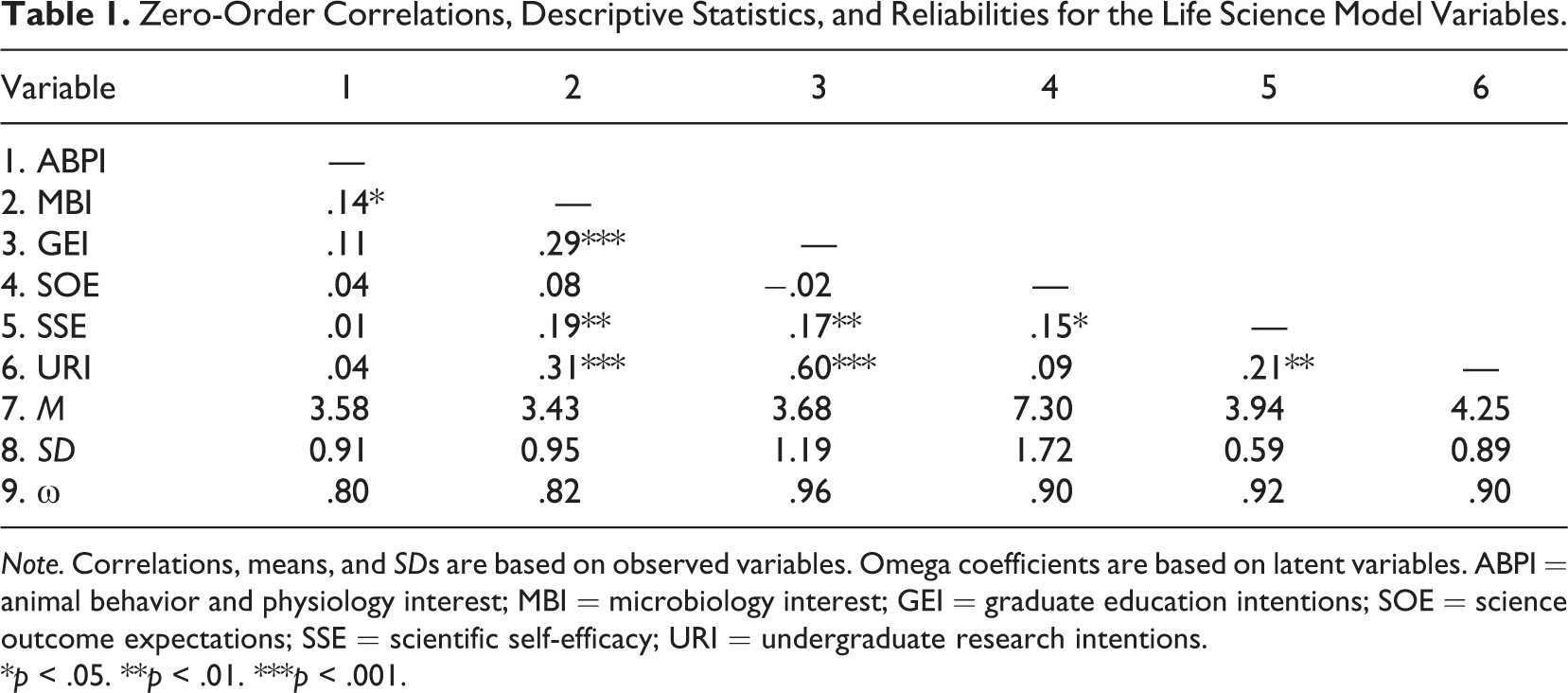
Note. Correlations, means, and SDs are based on observed variables. Omega coefficients are based on latent variables. ABPI = animal behavior and physiology interest; MBI = microbiology interest; GEI = graduate education intentions; SOE = science outcome expectations; SSE = scientific self-efficacy; URI = undergraduate research intentions.
*p < .05. **p < .01. ***p < .001.
Zero-Order Correlations, Descriptive Statistics, and Reliabilities for the Physical Science Model Variables.
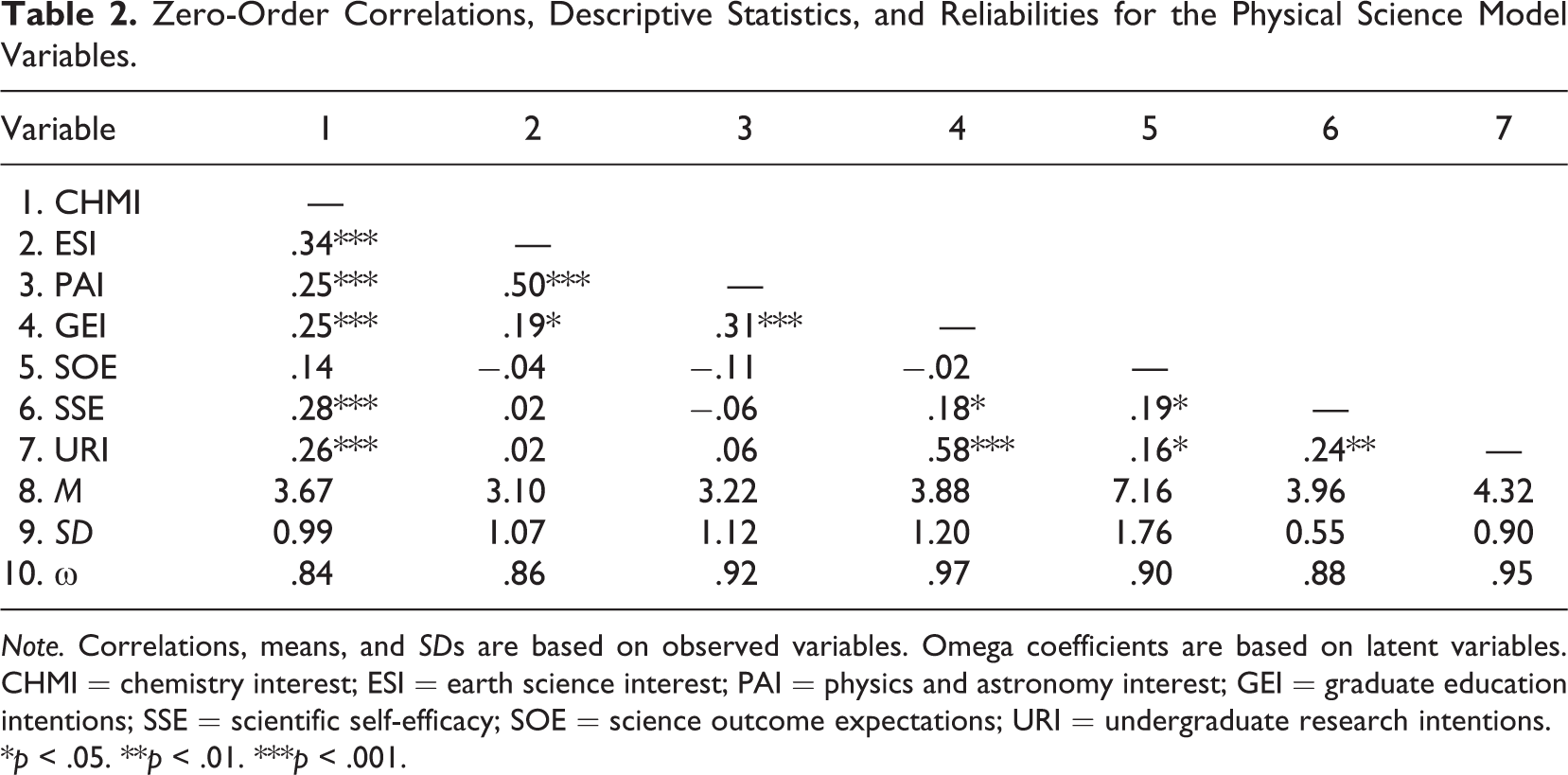
Note. Correlations, means, and SDs are based on observed variables. Omega coefficients are based on latent variables. CHMI = chemistry interest; ESI = earth science interest; PAI = physics and astronomy interest; GEI = graduate education intentions; SSE = scientific self-efficacy; SOE = science outcome expectations; URI = undergraduate research intentions.
*p < .05. **p < .01. ***p < .001.
The structural models depicting factors contributing to the rise of undergraduates’ intentions to pursue graduate education and to engage in scientific research were then estimated. The life science model was tested first. Results indicated the model provided an acceptable fit to the data, χ2(310, N = 240) = 663.19, p < .001, CFI = .92, RMSEA = .07 (90% CI [.06, .08]), TLI = .91, SRMR = .06. Standardized path coefficients are displayed in Figure 1. Several paths were not significant, including all paths originating from SOE, the paths from SSE to ABPI, GEI, and URI, and the paths from ABPI to GEI and URI. SSE was significantly and positively related to both SOE (β = .18, p = .008) and MBI (β = .18, p = .011), and GEI was strongly and positively related to URI (β = .54, p < .001). Results were significant for two of the indirect pathways, as a mean standardized estimate of .18 (95% CI [.10, .27]) was obtained for MBI → GEI → URI, and an estimate of .06 (95% CI [.01, .13]) was obtained for SSE → MBI → GEI. The fit of the physical science model to the data was poor as none of the fix index values met recommended thresholds, χ2(387, N = 171) = 816.94, p < .001, CFI = .89, RMSEA = .08 (90% CI [.07, .09]), TLI = .88, SRMR = .11. This was due to a number of nonsignificant relationships in the model. In light of the poor model fit and limited number of significant paths, we do not report results of direct and indirect relationships here.
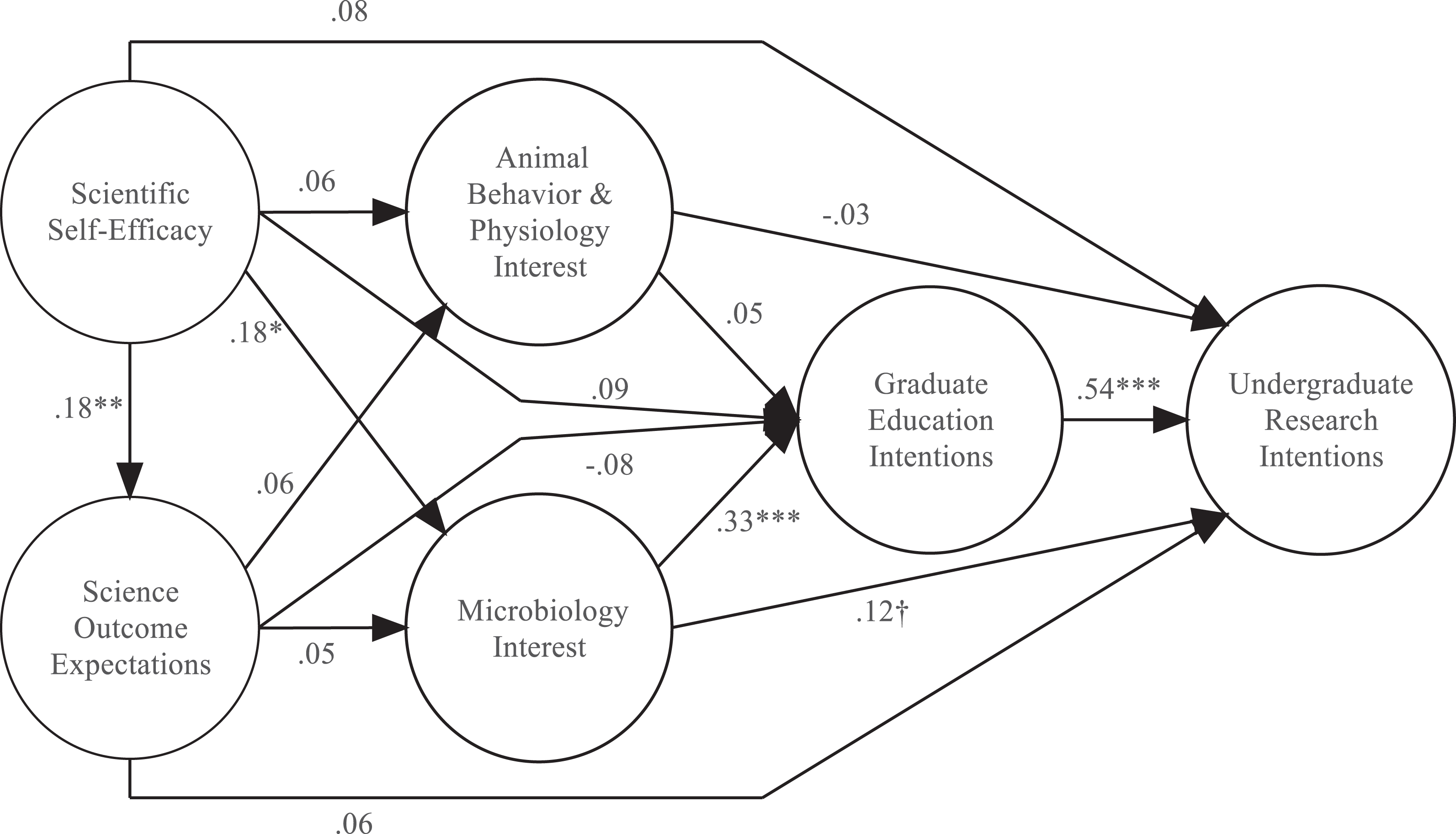
Structural model of life science interest and career intentions. † p < .08. *p < .05. ***p < .001.
Discussion
Our study contributes to the career development literature by extending the application of SCCT to undergraduate students’ intentions to pursue career pathways in scientific research and to engage in such research as undergraduates. MIMIC modeling was used to establish the construct validity and reliability of a new measure assessing students’ intentions to pursue graduate education in scientific research. This approach was also used to further evaluate the psychometric properties of Liao, Armstrong, and Rounds’s (2008) life and physical science BIMs. Although Liao et al.’s findings suggested these BIMs are unidimensional constructs, our findings provided support for a multidimensional structure reflecting specific interests in animal behavior and physiology, microbiology, chemistry, earth science, and physics and astronomy. These interests were then specified as by-products of SSE and SOEs and precursors of GEI and URI in the hypothesized SCCT models. We found partial support for models employing both sociocognitive inputs (i.e., SSE and SOE) and all of the interest types revealed in the MIMIC modeling analyses. Although our hypotheses were not fully supported, the current findings offer important insights into the relationship between social cognitive processes and the development of specific career interests and intentions among undergraduate science students. We limit our discussion of the findings to the life science model considering the poor fit of the physical science model to the data.
Congruent with SCCT propositions, science self-efficacy was significantly and positively related to SOEs and interests in the life science model. This is consistent with the abundance of research supporting the SCCT-related links from self-efficacy to outcome expectations and interests across STEM domains (i.e., Byars-Winston et al., 2010; Lent et al., 1993, 2001, 2008; Flores et al., 2014). However, our first two hypotheses were not supported as neither SSE nor SOEs were directly related to GEI. This finding runs counter to SCCT and previous SCCT STEM-related research (i.e., Byars-Winston et al., 2010; Flores et al., 2014; Fouad & Smith, 1996) that has demonstrated research self-efficacy is directly predictive of enrollment in PhD and MD programs among life science students (Byars-Winston et al., 2015). It may be that this null finding resulted from the way in which SSE was conceptualized and measured. That is, we measured self-efficacy for research-related tasks (Adedokun et al., 2013), whereas previous studies have tended to focus on self-efficacy beliefs related to the completion of academic requirements in science majors (e.g., Luzzo, Hasper, Albert, Bibby, & Martinelli, 1999; Smith & Fouad, 1999). We note that, however unexpected, this finding is supported by previous research with engineering students (Navarro et al., 2014).
Increases in basic science interests were also indirectly related to increases in URI but only for microbiology interests. Thus, we obtained only partial support for Hypothesis 3. This represents a departure from previous research documenting robust relations between not only interests and goal-related outcomes, but interests and their sociocognitive antecedents as well (Lent et al., 2018). Perhaps students who reported interest in animal behavior and physiology were premedicine or preveterinary medicine majors and were therefore more oriented toward applied science careers in clinical practice. In contrast, the study of microbes and genetics would be more consistent with basic science (Villarejo, Barlow, Kogan, Veazey, & Sweeney, 2008). This possible explanation is consistent with McGee and Keller’s (2007) study that revealed five distinguishing factors among science undergraduates pursuing applied science or basic science careers—namely curiosity to discover the unknown. The indirect science interest–URI relationships in our SCCT models highlight the need for additional study into predictors of STEM career intentions to do research versus use research, including attending to the role of value orientation in STEM career goals (Thoman, Brown, Mason, Harmsen, & Smith, 2015). Future research on sociocognitive factors related to basic interests in the social and behavioral sciences would also shed light on important career development processes in this population as well.
SSE’s links with the intention variables were indirect to GEI via its relation with microbiology interest in the life science model, thus providing partial support for Hypothesis 4. The indirect influence of self-efficacy in this model supports SCCT propositions. The current findings also support the conceptual link between GEI and URI in the life science domain. Interestingly, SOE appeared to play a less significant role in the SCCT model than anticipated. Whereas SCCT posits that outcome expectations should have both direct and indirect relations to goal intentions via its relation with interest, SOE was unrelated to each of its predicted outcomes in the life science model. Thus, Hypothesis 5 was not supported. Although these findings run counter to SCCT theory and previous research with college biology majors (Byars-Winston et al., 2010), research focused on engineering students also found that outcome expectations were unrelated to interests (Navarro et al., 2014) and goal intentions (Lent et al., 2005; Navarro et al., 2014) in both cross-sectional and longitudinal studies with culturally diverse samples. Whereas we measured outcome expectations for completing a science bachelor’s degree, measuring outcome expectancies for the value of a science graduate degree or for pursuing a scientific research career may yield significant outcome expectations–GEI relations. The unique aspects of individual STEM fields and our mixed findings across domains necessitate more research to investigate the role of outcome expectations within the career development processes for those with goals to pursue careers in scientific research.
Taken together, our findings confirm the importance of underlying social cognitive processes in goal formation and suggest that these processes may unfold differently for undergraduate science students depending on their sub disciplines within STEM. Certainly, the findings of the present research highlight differences within the life science domain in students’ STEM-related goals.
Limitations and Implications for Future Research
We highlight several limitations of the present study and future research to address them. First, the sample for each study included undergraduate science majors across all educational levels. Given that students who have completed 3 or 4 years of undergraduate science education may be more committed than those who have only completed 1 or 2 years, the inclusion of students across educational levels may have obscured the strength of the relations among the model variables and thus, limited the explanatory variance of GEI and URI. Second, this study was cross-sectional in nature, thus limiting our ability to test temporal relations within the hypothesized model. Maxwell and Cole (2007) have noted that mediation models that are tested using cross-sectional data tend to be biased. Instead, employing a cross-lagged panel model would have allowed us to measure the variables and test the stationarity of the path coefficients over several time points. Longitudinal studies with undergraduate science majors as they begin their undergraduate education are needed to determine whether interests and outcome expectations truly mediate relations between self-efficacy and intentions.
Third, the current samples came from a single, public, predominantly White institution in the Midwest that yielded a predominantly female sample. Samples of undergraduate science majors from multiple institutions in various U.S. geographic locations including those designated as minority-serving institutions will allow for further tests of model differences across gender, race/ethnicity, institutional type, and geographic region and identify SCCT factors that may facilitate the career goal attainment of more culturally diverse science students. Fourth, the role of contextual (e.g., perceived social supports or barriers) and other key variables (i.e., personality and affective traits) in understanding GEI and URI goal intentions were not considered in the current study. This is an important avenue to explore in future research given the moderating role that these factors often play in promoting the development of career interests and goals. Fifth, more study into the influence of learning experiences on both STEM-related self-efficacy and outcome expectations is warranted (Byars-Winston, Savoy, Diestelmann, & Hoyt, 2017) and could account for additional variance in these variables among undergraduate science majors. Finally, interests were measured in terms of specific STEM content domains, whereas other variables were measured at more general levels of specificity. This may explain the weak relations observed between interests and the other sociocognitive factors in the models. Future research in which these factors are measured more uniformly and within specific STEM populations (e.g., biology majors) would be useful.
Implications for Practice
The current findings offer important implications for practitioners working with college students in university settings. The extent to which we can make practice recommendations is limited to the science domains examined in the current study; therefore, it is important for practitioners to first help students clarify their specific occupational interests and objectives. For students majoring in the biological and earth sciences, focusing on supporting their science-related self-efficacy beliefs would appear to be a promising strategy. Clinicians could encourage students to create or identify opportunities to tap into Bandura’s (1997) sources of self-efficacy. For instance, they may focus on learning vicariously from other science students involved in undergraduate research and creating opportunities to receive peer encouragement and reinforcement toward pursuing a graduate STEM degree (Deemer, Marks, & Miller, 2017). Outside of the classroom, students could work to develop relationships with faculty mentors who could provide this same type of social support (Bakken, Byars-Winston, & Wang, 2006) along with their personal insights on how to navigate the process of preparing for graduate school.
Conclusion
The current study represents the only empirical effort to date that investigated the link between intentions to both attend graduate school and engage in undergraduate research within the SCCT framework. Our findings advance understanding of the specific interest constructs in two specific science domains that are informed by sociocognitive inputs and associated with undergraduate science students’ choice goals. Overall, the results highlight the importance of attending to influential factors in students’ intentions to pursue graduate education and undergraduate research, two critical variables in the development of a research science career.
Footnotes
Declaration of Conflicting Interests
The author(s) declared no potential conflicts of interest with respect to the research, authorship, and/or publication of this article.
Funding
The author(s) received no financial support for the research, authorship, and/or publication of this article.