




Abstract
Firms from a variety of industries regularly partner with Formula One racing teams to achieve marketing objectives on an international scale. The sponsored properties offer signals of brand foreignness/localness, country of origin, and the potential for highly visible achievements. Firms enter and exit brand partnerships with some of the world's most famous athletes and iconic teams, yet the partnership decision-making process remains opaque, particularly concerning the impact of geographic origin and team performance among other criteria, including macroeconomic conditions and brand-related factors. This study contributes a quantitative model that analyzes 53 years of data encompassing more than 3,000 sponsorships across six continents. The findings improve understanding of brand partnership continuity/dissolution by explicating a shared nationality effect and a link with sponsored organizational performance that is robust across three distinct eras of Formula One. In doing so, the study contributes to theory by completing the sponsorship performance cycle and distilling partnership limits with regard to brand foreignness. The theory and quantitative analyses are buttressed by interviews with brand decision-makers, excerpts from which also shape the discussion of managerial applications. Implications include efficiencies in partner prospecting that enhance the likelihood of enduring brand relationships in sponsorship-linked international marketing.
Keywords
Opportunities for brand partnerships through corporate sponsorship or celebrity endorsement have exploded with advances in digital media, and the trend is expected to continue (Wakefield, Wakefield, and Keller 2020). Brands allocated more than U.S. $77 billion to sponsorship in 2022, a figure expected to grow almost 9% annually to U.S. $116 billion by 2027 (KORE 2023). For clarity, a sponsoring brand refers to a commercial entity that engages in a formal promotional relationship with a sponsored property, which attracts an audience or maintains other assets desirable for marketing purposes. The most valuable of these sport properties are those delivering international audiences, such as the Olympic Games, FIFA World Cup tournaments, the UEFA Champions League, and Formula One Racing (F1; Richter 2022). The purpose of this study is to discern and analyze the factors involved in managerial decision-making to maintain or dissolve such international sponsor relationships. Specifically, how does the sponsoring brand's localness or foreignness to the sponsored property and that property's competitive performance influence marketing relationship continuity?
The cross-cultural appeal of sport and a consumer's desire for real-time viewing offer sponsors an international branding platform that attracts target markets (Mazodier, Henderson, and Beck 2018). However, such prime marketing opportunities come at a substantial price. For example, brands must pay top F1 teams more than U.S. $50 million annually for sponsorship rights, while the International Olympic Committee and association football (soccer) clubs with international followings—such as FC Barcelona—command sponsorship fees in the hundreds of millions for multiyear event and jersey/kit branding opportunities (Becker 2022; SportsPro Media 2022).
Marketing managers seeking to align their brand with a sport property face three key decisions: which property (i.e., event, team, or athlete/celebrity) to sponsor, how much to invest, and whether to extend or terminate existing sponsorships (Cornwell and Kwon 2020). Among other criteria, brand marketers must consider how the sponsorship can act as a signal that influences the perception of brand foreignness/localness (Mohan et al. 2018). The most high-profile sporting events are international in nature, yet sponsoring brands must still consider the property's region or country of origin (COO) (Jensen et al. 2021). On the other side of the relationship, administrators of the sponsored property face a similar decision set in terms of whom to pursue as prospective sponsors. Decision points include how to divide prospecting attention between domestic and foreign markets, how much support to allocate to particular sponsors, and whether the continuation of an existing sponsorship is desirable or reasonable to expect.
Given that modern sponsorship prospecting is no longer defined by geographic constraints, both brand managers and representatives of sponsored properties need sophisticated tools and analyses to efficiently allocate their resources toward securing durable, successful partnerships. For example, if an international commercial brand commits to a sponsorship within a particular international sport, how long should the stakeholders expect the marketing partnership to persist? Should the expected partnership duration be extended in cases of functional or nationality congruence (i.e., localness) between the brand and sponsored team? Or, conversely, are nationality mismatches preferred so as to leverage brand foreignness advantages in an international context (Özsomer 2012; Sharma 2011)? If the partner property is a team, how do expectations change if that team achieves an extraordinary performance, such as a championship season? Accurate answers to these questions provide each side of the partnership with valuable criteria for decision-making relative to future planning of sponsorship investments and acquisition. The contribution of the current study is new evidence of geographic considerations (e.g., localness/foreignness) and a sponsorship performance effect, which can provide guidance for brand managers and sponsored property executives regarding the optimal allocation of their partnership efforts. Accordingly, this study investigates the factors influencing the continuity of sponsorships within an international marketing platform—F1 motor racing—that features sponsoring brands from 28 countries and sponsored properties representing 20 nations.
In the following pages, we summarize the marketing literature that defines and examines sponsorship as a business-to-business (B2B) decision grounded in exchange theory. Next, we use signaling theory to explain how the sponsored property's geographic origin and sporting achievements relate to a sponsoring brand's decision to persist or exit the marketing relationship. We close the review by offering a description of the investigative context of F1, including the competitive structure, basic sponsorship economics, and geographic scope of an international sport watched by one in every 20 people worldwide (F1 2022). With the background established, we describe the methods employed, including the use of international, brand-related, and team-related variables. These variables are part of a multifactor event history model we build to analyze the propensity for F1 sponsorships to continue or be dissolved. We also describe interviews conducted with several stakeholders involved in international sponsorship decisions; throughout the article, we provide illustrative quotes from these conversations to contextualize the literature and the quantitative investigation within current industry practices. Turning to the results, we describe overall findings and influential factors, again framing the results primarily within the categories of international, brand, and team factors. Given the duration of data (53 years), we also examine results within three distinct eras. We conclude with a discussion of the implications, limitations, and extensions for future research.
Related Literature and Research Framework
Sponsorship Exchange and Signaling Theory
In an article that sparked a stream of related literature, Meenaghan (1983) defines sponsorship as a corporate contribution to a popular activity in exchange for exploitable commercial association. Accordingly, sponsorship is characterized as a B2B relationship based on exchange theory (Farrelly and Quester 2005). On one side of the exchange is a sponsoring brand that typically contributes a monetary fee, sometimes along with technical expertise or products. On the other side, the sponsored property provides a commercial association that is valuable to the sponsoring brand, particularly because of the desired audience affiliated with the property (Jensen, Cobbs, and Turner 2016). As exchange theory suggests, the objectives of each party are realized through a mutual commitment whereby each party's competitive position is enhanced by accessing the other party's resources (Barringer and Harrison 2000; Blalock and Wilken 1979). When a prospective sponsor (i.e., brand) and sport property reach agreement in negotiations of exchange, the resulting sponsorship acts as a manifestation of exchange theory in the sports marketplace (Jensen, Head, and Mergy 2020). The terms of agreement (i.e., cost/price), renewal of the partnership, and measurement of returns are each recognized in the literature as evaluations of the exchange relationship (Fortunato 2017; Jensen and Cobbs 2014; note inclusion in Table 1).
Overview of Literature.

Notes: “Intl.” refers to international factors; “Brand” refers to brand-related factors; “Team” refers to team-related factors.
For the sponsoring brand, the acquired resource is the commercial association with the sport property that acts as a brand signal to a desired audience. Signaling theory explains that the judicious use of signals that are consistent with a valued attribute, which is otherwise ambiguous, acts as a strong indication of possession of that attribute (Ross 1977). In the sponsorship context, by reflecting the attributes of the sponsored property onto the sponsored brand, a sponsor relationship acts as a signal to the brand's audience (Clark, Cornwell, and Pruitt 2002, 2009). The intention of the signal may be to convey brand quality, social virtues, descriptive facts, symbolic meaning, or functionality (Lin and Bruning 2024).
A collection of previous literature has investigated how brand and property decision-makers manage the B2B relationship based on three groups of factors that influence the signaling effects of sponsorship: international factors, brand-related factors, and property/team-related factors. The subsequent sections of the literature review expound on these three groups, which we also use to categorize variables within the “Results” and “Discussion” sections. In Table 1, we provide a catalog of the relevant published marketing studies that have employed one or more of these factors. These studies are further categorized by level of analysis—individual decision-makers or the macro market level (e.g., Gielens and Steenkamp 2007)—and whether the sponsorship was evaluated in terms of sponsorship costs/price, the renewal or termination of the B2B relationship, or return on investment (ROI).
International Factors
Nationality is often highly prominent in the context of international sporting competitions (Groza, Cobbs, and Schaefers 2012). As a result, when a brand sponsors a sporting property competing on an international scale, signals of COO and brand foreignness or localness can become highly salient to the sport's audience. That audience includes event attendees, broadcast viewers, and other stakeholders in either business-to-consumer (B2C) or B2B capacities (e.g., suppliers, media, and other sponsors; Cobbs and Hylton 2012). COO is a perception-based brand attribute that connects a country's image to product/service features such as low cost, durability, or high fashion (Diamantopoulos, Arslanagic-Kalajdzic, and Moschik 2020). A brand's perceived COO can be manipulated through signaling, given that brands’ true origins are often unknown by consumers (Samiee, Shimp, and Sharma 2005). As a result, an international sports environment offers sponsoring brands several different signaling opportunities for executing international marketing strategies, as captured in the following geographic signaling scenarios.
Signaling Scenario 1: shared COO. A brand could sponsor a property (e.g., team or event) that claims a shared COO with the brand, thereby reinforcing the country’s image as an attribute of the brand. Doing so may achieve a perception of brand localness within the domestic audience (and foreignness for the foreign audience), whereby the brand is tightly connected to the local culture (Mohan et al. 2018). Signaling Scenario 2: different COO but implying shared COO. A brand could sponsor a property claiming a different COO from the brand, but one that is related or desirable, thereby establishing an overlap of the images of the sponsoring brand and country. Given a consumer’s propensity to mistake a brand’s COO, it is feasible that many in the sporting audience could perceive that sponsorship to entail a shared COO akin to the first scenario (Balabanis and Diamantopoulos 2008). Signaling Scenario 3: different COO to enhance foreignness. A brand could sponsor a property claiming a different COO with the intention of enhancing perceived brand foreignness, which refers to brands that are known to originate from a foreign country but are marketed both locally and abroad (Azzari et al. 2023; Dimofte, Johansson, and Ronkainen 2008). While brand localness has advantages in a customer’s affect, perceived brand foreignness is associated with acceptance across markets, which implies greater quality and prestige (Özsomer 2012; Sharma 2011).
These examples illustrate theoretical advantages in sponsorship for all three geographic signaling scenarios, and prior studies demonstrate mixed results on this issue. On one hand, researchers have found evidence that a sponsor residing in the same area as the sponsored property (e.g., regional proximity) raises consumer perceptions of sponsorship fit (Woisetschläger, Backhaus, and Cornwell 2017). Likewise, the regional proximity of the sponsoring firm's headquarters and the sponsored property's home base has been associated with improved probability of the partnership's continuity (Jensen and Cornwell 2021; Jensen, Head, and Mergy 2020). On the other hand, sponsorships of shared nationality can entail higher costs and be viewed less favorably by investors, compared with sponsorships involving a brand from one country and a sporting property from another (Cobbs, Groza, and Pruitt 2012; Jensen et al. 2021). Therefore, we do not specify an expectation as to whether a shared nationality or continental region between the sponsoring brand and the sponsored property would enhance or detract from the likelihood of partnership renewal. This overview of international factors identifies how geographic signals within international sport sponsorship can be contingent on the marketing tactic employed. Another signaling effect—performance—is equally prominent but to date has received less scholarly attention.
Performance of the Sponsored Team
When considered collectively, prior studies have constructed a sponsorship performance cycle in team spectator sports (Figure 1). Having more sponsors with certain characteristics can contribute to team performance (Cobbs, Jensen, and Tyler 2022), better-performing teams generate more exposure and shareholder value for sponsors (Jensen and Cobbs 2014; Pruitt, Cornwell, and Clark 2004), and sponsors must contribute greater resources to align with better performing teams (Jensen et al. 2021). To complete this cycle, the current research asks whether teams with superior performance realize a lower probability of sponsor dissolution, despite the greater investment required. In other words, are sponsoring brands more likely to renew partnerships with higher-performing teams even if—as the literature suggests—continuation will require a greater commitment of resources? If accurate, such a finding would restart the performance cycle by enabling future performance through additional sponsorship support.

The Sponsorship Performance Cycle.
Theoretically, realizing this full sponsorship performance cycle should establish trust in the relationship and result in commitment to continuing the partnership (Farrelly and Quester 2003). However, such relationship continuity and the renewal of the sponsorship cycle are often elusive in practice, thereby indicating further complexity in the partnership decisions that form the basis of this study. For example, consider the following quotes from the perspectives of two executives from the same F1 team, in which one insists the team does not sell sponsorships based on performance, while his colleague notes the team's corporate partnerships do include performance payments from their sponsors. We don’t sell wins and losses, because it can be very well cyclical and you can be at the highest of highs and the lowest of lows based on how the team performs. (Eric Kwait, vice president of partnership development, Americas & APAC, McLaren Racing) There are a lot of partnerships, both with our team and just in the sport in general, that are performance-based. So a large portion of them could say [for example], a partnership is worth $5 million a year, but we get performance incentives if we finished first, second, third, or fourth. So if we finish first in the championship, they might owe a $2 million performance bonus; if we finish second, it might be $1.5 [million] and so on. Partners are trying to say, “Well, we know our partnership is more valuable the better you do, so we’re not going to pay $10 million a year if you come in eighth, but we’re willing to pay $10 million a year if you come in the top three.” (Brian Woerner, vice president of partnership development, Americas, McLaren Racing)
An executive from another team, quoted subsequently, claims that winning is not necessarily important to prospective sponsors with whom he has recently engaged; yet, an executive from a prominent sponsoring brand admits that his brand dissolved one team sponsorship due to a lack of performance while maintaining sponsorship of a team with greater on-track success. There is a trend [in recent years]. I spoke with a potential sponsor yesterday, and I wouldn’t say they couldn’t care less if we [at Haas F1] win—they want us to win—but they don’t want to be on a Mercedes [i.e., dominant team recently]. It's very weird. They want a come-up story, a good story, of a young team, old-style racing, and they want to be a part of that story. (Guenther Steiner, then team principal, Haas F1 Team) Williams [F1 team] had a tremendous amount of success for many, many years. We [at AT&T] became the title sponsor and they didn’t have much success while we were the title sponsor. And so it was hard to say as a brand that if we can do this for Williams, just think what we can do for you. … So our proof point was a little bit weak. All the while we were supplying services to Red Bull Racing, and as they started to climb and experience success, we transitioned from title sponsor of Williams over to a partner of Red Bull Racing in a marketing capacity. (Mike Hovey, senior manager, national sponsorships, AT&T)
Within these four quotes, we see that the sponsored sport properties are reluctant to emphasize on-track performance when proposing a sponsor relationship. However, both the team and sponsoring brand acknowledge that team performance is highly relevant to brand partnerships and can affect the expected investment and longevity of the sponsorship.
Empirical investigations of a sponsoring brand's investments in the sponsorship performance cycle are sparse, with only a few studies examining the contributions made by brands toward sponsored properties. As a foundation, Cobbs et al. (2017) illustrate how a sponsor's contribution of certain resources—either functionally congruent (i.e., related to competition) or monetary—perpetuated survival of the sponsored team, while contributions of operational resources (e.g., business or logistical services) were nonsignificant. In subsequent work, Cobbs, Jensen, and Tyler (2022) test a direct relationship between a sponsor's resource investments and team performance, thereby demonstrating that a sponsor's contributions of resources congruent to motor racing are associated with enhanced F1 team performance, but monetary or operational resource contributions have no effect on performance. Likewise, in the context of association football (soccer), the magnitude of monetary contributions from sponsors to teams is not necessarily associated with team performance, when controlling for other factors such as the promotional level of sponsorship (e.g., title, official, or supporting; Jensen et al. 2021).
Turning to the team's contributions to the cycle of sponsorship, two quotes from F1 team executives illustrate the role sporting performance can play in the returns to sponsoring brands: In some contracts, you will have a team performance bonus. So because you are more visible, because you are more successful, because then the car and the team is everywhere, the sponsor is more visible. So they pay an added fee to say thank you to the team, basically. … It might be an exit clause if the team doesn’t perform as well. (Guillaume Vergnas, senior business development manager, BWT Alpine F1 Team) Why does one corporate sponsor take one [team] brand over the other? Again, each [team] brand is telling its own story and is in a different position. Red Bull, Mercedes, Ferrari: they’re going to be talking about pedigree and history, and performance and winning, and all stuff that will make it easier for them to sell a sponsor. They don’t have to come up with other arguments; they’re going to be getting more media coverage, the brands will be on TV because they’re in the first places. (Peter Spartin, business operations, strategy, and commercial development, Aston Martin F1 Team)
Accordingly, several studies have explored potential links between the performance of the sponsored organization and returns from a brand's investments in sponsorship. These studies focus primarily on two means of return: (1) the amount of brand exposure delivered, or (2) the influence of the sponsorship on shareholder value. The exposure for sponsoring brands during live events or television programming—known as brand integration (Wiles and Danielova 2009)—is inherently valuable. It ensures the audience sees the brand, which is favorable for sponsorship in an age where traditional commercial opportunities are reduced within streaming video services such as Amazon Prime, Hulu, and Netflix (Dickenson and Souchon 2018). In the context of F1 racing, Jensen and Cobbs (2014) find that over a five-year period sponsors realized brand exposure valued at nearly $19 billion, but this advertising value equivalency (AVE) was dependent on sponsored team performance in terms of both points earned ($822,157 AVE/point) and wins ($26 million AVE/win).
In terms of shareholder value, Pruitt, Cornwell, and Clark (2004) demonstrate a positive stock price effect for publicly traded firms announcing sponsorships of teams higher in the standings in the North American stock car racing series (NASCAR), compared with sponsorships of worse performing teams. Likewise, examining sponsors of Indianapolis 500 winning teams, Cornwell, Pruitt, and Van Ness (2001) uncover 3% larger abnormal returns for sponsors with direct ties to the automobile industry. Other researchers find similar team performance effects for shareholders of sponsoring firms across a variety of sporting contexts (e.g., Clark, Cornwell, and Pruitt 2002).
Jensen, Wakefield, and Walkup (2023) explore the question of whether changes in sponsoring partners can enhance the performance of the sponsored organization. While switching sponsors did result in a statistically significant increase in resources for the sponsored property (and correspondingly, an increase in costs for sponsoring firms), the effect on performance over time was nonsignificant. In summary, evidence suggests that sponsored team performance is associated with brand partnerships that offer functionally congruent resources. Moreover, a team's enhanced performance can deliver returns to these sponsors in terms of brand exposure and shareholder value, but team performance is not necessarily priced into the sponsorship investment. Last, changes in sponsors do not necessarily affect team performance.
Hence, in general, the sponsorship performance cycle indicates that incentives align for high-performing teams and their sponsoring brands to persist in their commercial partnership. Yet, despite several recent investigations into managerial sponsorship decision-making, only one study to date has examined how a sponsored property's performance influences such decisions. In that study, conducted in the context of shirt (i.e., kit or jersey) sponsorships, Jensen (2021) finds that every point earned per game decreases the probability of sponsoring brands exiting the partnership by 54.4%. However, Jensen’s initial analysis is confined to one sport league in one specific geographic area. Thus, it does not simultaneously address the questions of international scope raised in the preceding section.
Brand-Related Factors and Control Variables
Perfect partnership continuity is rare in practice, even for the highest-performing teams (Van Rijn, Kristal, and Henseler 2019), and the zero-sum nature of sport means that a substantial portion of teams are not successful. Consequently, we need to look beyond geographic considerations and team performance for other criteria that may be associated with sponsorship renewal or dissolution in international marketing contexts. We discerned these criteria through extant sponsorship studies, such as those featured in Table 1, and through insights from the executives interviewed as part of this research. These additional factors include another team-related variable (clutter), groups of brand-related factors (i.e., brand equity, congruence, and accountability), and other control variables (i.e., economic conditions, industrial factors, and time-related factors).
Clutter
Within sponsorship, clutter is a characteristic of the sponsored property that refers to the preponderance of other sponsoring brands (Jensen and Cornwell 2017). When a sponsored property's portfolio of brand partners is particularly cluttered (i.e., large in number), brand managers may seek a cleaner sponsorship environment. Speaking on behalf of sponsoring brands in F1, an agency executive explained the contrasting motives inherent to sponsorship clutter: Kudos to the [F1 team] sales guys on the one side that can chop up [an industry sector] to that fine of a detail to be able to sell to all of those different types of companies … [but] it's a bit of a clutter problem that comes along with that many brands jumping in that are that similar. (Rick Cuellar, senior vice president at the sponsorship agency CSM Sport & Entertainment)
Accordingly, prior research has found that clutter has a negative effect on the ability of consumers to recognize and recall sponsoring brands (Breuer and Rumpf 2012; Cornwell, Weeks, and Roy 2005). It follows that a cluttered sport property increases the probability of the sponsoring brands exiting that partnership (Jensen and Cornwell 2017; Jensen et al. 2022). Turning to brand-related factors, congruence between the brand and the sponsored property, the equity of the brand itself, and managers’ financial accountability (i.e., publicly traded firms) have all been considered previously as partnership decision criteria.
Congruence
Congruence is perhaps the most frequently studied construct in the sponsorship literature (Fleck and Quester 2007). It is understood as a stakeholder's shared mental schema for the sponsoring brand and sponsored property based on image or functional associations (Simmons and Becker-Olsen 2006). While congruent partnerships often produce favorable consumer or investor reactions, the like-mindedness of brand and team managers that recognize the shared mental schema or functional compatibility may also contribute, both to partnership patience and to a reluctance to cut ties once engaged in a congruent sponsorship (Jensen and Cornwell 2017). Mike Hovey, the senior manager of national sponsorships for telecommunications giant AT&T, describes the allure of his brand's functional congruence to F1: So the proof point is if we, AT&T, can provide the [Red Bull F1] team this type of connectivity in an ever-changing environment of Formula One that travels all around the world from week to week, just think what we can do for your company [i.e., prospective AT&T corporate client].
Brand equity and financial accountability
Similarly, brand managers with a high degree of marketplace knowledge related to brand adoption, characterized as brand equity (Keller 1993), demonstrate a commitment to investing in their brand and may be less likely to exit sponsorships on a whim (Jensen, Head, and Mergy 2020). Meanwhile, brand managers with publicly owned corporations could experience more intense quarterly financial accountability and be tempted to cut high sponsorship costs. Yet, being publicly owned may serve as a proxy for distributed decision-making and firm size, whereby large public sponsors may be more likely to weather issues that would disproportionally influence the decision-making of smaller firms (Clark, Cornwell, and Pruitt 2002; Pruitt, Cornwell, and Clark 2004).
Control factors
In addition to factors specific to individual brands and properties, there are factors that influence teams and brands more broadly. For instance, external economic factors (e.g., inflation, macroeconomic growth) can contribute to the continuation or end of sponsorships, as Jensen and Cornwell (2017) and Van Rijn, Kristal, and Henseler (2019) find quantitatively and qualitatively in their respective studies of brand decision-making in international event sponsorship.
Likewise, overall industry growth or positive trends in product sector investment can enhance the probability of major sponsorships. Compared with other sectors, several industry categories have historically driven demand for sponsorship, including alcoholic and nonalcoholic beverages, automotive, apparel, banking, food, insurance, high technology, retail, telecommunications, and quick-service restaurant categories (ESP Properties 2016). Recall that categories functionally congruent to the sporting context, like the high tech and automotive sectors in motorsports (Cobbs, Jensen, and Tyler 2022), could be especially important to note for analysis of partnership decision-making in F1 racing.
Finally, a B2B orientation on the part of the sponsoring firm, which often requires a longer-term sales cycle, has also been connected to partnership longevity across multiple studies (Jensen and Cornwell 2021; Jensen et al. 2022). Brian Woerner, vice president at McLaren Racing, raised the importance of this factor in motorsports: A large part of what our partners get out of [a sponsorship] is that B2B network they have within the audience; so they want to be at the races. … That's one of the massive assets that you’ll never see publicly facing, but for most of our partners, as you can imagine, the B2B introductions, the hospitality, [and] the customer hosting experience is huge.
Research Framework
The literature described here, accentuated by the views of industry insiders, explicates numerous factors linked to the continuity of a sponsorship. This study contributes to our understanding of international brand decision-making by testing a link between a sponsored property's performance and continuity in brand partnerships, while accounting for several internationally relevant geographic factors and numerous other variables germane to international sport. Figure 2 depicts this conceptual model, which serves to visualize the influence of the various groups of factors across the decision-making process (e.g., Steenkamp and Geyskens 2014).

Research Framework.
In recognizing partnership renewal as a proxy for positive ROI (Jensen and Cobbs 2014), our model helps brand and property managers evaluate how sponsored team nationality and performance influences sponsorship ROI in an international marketing environment. Confirming a link to team performance would also close the loop inherent in the theoretical sponsorship performance cycle (Cobbs, Jensen, and Tyler 2022), thereby representing an important contribution to sponsorship theory. Thus, this research situated in F1 not only addresses a question of localness versus foreignness in international brand relationships, but also fills a gap in the sponsorship-linked marketing literature.
Formula One Racing
First contested as an international championship series in 1950, F1 deliberately selects host locations for its Grand Prix events that maximize international audience development and sponsorship interests, thereby growing the sport's emerging markets while recognizing its traditional European roots (Jensen, Cobbs, and Groza 2014). The 2022 F1 schedule spread 22 races across 20 different countries, each featuring a grid of 20 drivers from 15 different nationalities. Those drivers represent ten different F1 teams that themselves claim seven different countries of origin.
This international motorsport economy is supported through sustained international popularity. A cumulative TV audience of 1.55 billion viewers representing 445 million unique individuals watched F1 races during the 2021 season, including the 108.7 million viewers who tuned in for the season finale in Abu Dhabi (F1 2022). For context, the crown jewel of American sport, the Super Bowl, attracted 95.2 million viewers in 2021, with the majority of viewers watching from the United States (ESPN 2022). Conversely, the F1 audience is spread across six continents with more than 100 million cumulative domestic viewers in Brazil, the Netherlands, the United Kingdom, France, Germany, and Italy. Particularly strong growth markets include China, Indonesia, and the United States, where F1 race viewership has doubled since 2018 to more than 20 million viewers (F1 2022; Milligan 2022; Nielsen 2018). The consistently growing sponsor appetite to tell a brand story through F1 has created an opportunity for international marketing researchers to assess the impact of the sponsoring firm on the sponsored property, and vice versa (Van Everdingen, Hariharan, and Stremersch 2019).
F1 teams specialize in competitive operations as much as their capacity allows and outsource the rest, which is often achieved through strategic commercial partnerships that exchange promotional rights for technical and business expertise, in addition to considerable financial resources (Clough and Piezunka 2020). These corporate sponsorships fund up to 70% of team budgets, which swelled dramatically before budget caps were implemented (Jensen and Cobbs 2014). Top teams consistently generate annual revenues exceeding $450 million (Jensen et al. 2021), and the best drivers earn more than $50 million in annual salary (Knight 2022).
An F1 team's algorithm for success shares characteristics to that of more traditional business industries: organizations (i.e., teams) develop proprietary technology and knowledge, complement it with outsourced supplies and support sponsors, and manage integration to offer the most competitive product. In this sense, F1 provides a highly relevant and industry-agnostic case study to be used by international business leaders.
Method
In this article, we apply signaling theory and build on the sponsorship performance cycle from the marketing literature to explicate managerial decisions to engage or withdraw sponsor support on an international level. In addition to the review of literature and composition of a comprehensive quantitative model, we emphasize validity in practice through interviews with industry leaders.
Executive Conversations
To assess the practical relevance and applicability of our research question and design, we engaged in 11 conversations that included executives from various stakeholder groups (i.e., team, sponsor, agency) directly involved with F1 sponsorship. Six executives worked directly with F1 teams, two worked with an F1 sponsor, and three worked within marketing agencies that serve as supporting intermediaries between F1 teams and sponsors. The conversations took place in person or remotely between April and June 2022. To gather different perspectives, we recruited the initial respondents through purposeful convenience sampling, which involves identifying and selecting individuals that are especially knowledgeable about or experienced in a phenomenon of interest (Cresswell and Plano Clark 2011). We conducted further interviews based on referrals from the initial contacts (i.e., snowball sampling).
The conversations, which varied in length between 22 and 52 minutes, were semistructured based on questions from the established literature and the participant's professional role. Upon receiving the interviewee's informed verbal consent, including use of name and title, each interview was voice recorded and later transcribed word for word using Otter.ai, which generates text transcriptions using artificial intelligence and machine learning. Transcripts were reviewed multiple times, continuously looking for patterns in evidence and iterating identified themes (Braun and Clarke 2006).
The text data (quotations) generated by the conversations and shared within this article are intended to illustrate how our research questions and analysis are directly related to current practice within the field. Our work in this regard is not intended as a complete qualitative study of the phenomenon of F1 sponsorship, which is beyond the scope of this work. The remaining parts of the method describe construction of the quantitative model.
Dependent Variable
Investigating whether sponsored team performance influences partner brand decision-making requires data on F1 team performance and team sponsors over time, which we compiled according to the procedure detailed by Cobbs et al. (2017, p. 100). The initial sponsor data originated with ChicaneF1, which catalogs historical team and sponsor pairings (Davies and Lawrence 2021). We substantiated the data's reliability by cross-referencing with similar online and published sources (e.g., Schlegelmilch 2012; SportsPro Media 2007, 2013, 2014, 2015), updating our dataset as needed. Our data begin with the 1967 season, which is the dawn of significant F1 sponsorship; we chose 2019 as the final year to avoid the potential influence of the COVID-19 pandemic on sponsorship renewal decisions. Sponsoring firms included in the dataset represent some of the most valuable global brands in the world. Examples include airlines (Emirates, Korean Air), alcoholic beverages (Budweiser, Johnnie Walker), financial services firms (Santander, Royal Bank of Scotland), fashion brands (Hugo Boss, Michael Kors), tech firms (IBM, HP), auto manufacturers (Volkswagen, Fiat), telecommunications firms (Siemens, Vodafone), and consumer electronics brands (Philips, Samsung).
The model's dependent variable is whether a sponsorship continues into the next season. We captured this historically by adding a binary variable to each observation, where a value of 0 means that the team and brand maintained their partnership in the following year. A value of 1 captures the focal event: the failure of a partnership to continue into the next year. If a brand and team reengage after a gap of one or more years, we consider that a distinct sponsorship relationship. In total, the dataset includes 3,286 sponsorships across 8,339 observations (an average of 2.54 years per sponsorship). Each record is a unique combination of a team, a sponsoring brand, and the year for that season. For example, we capture Santander's sponsorship of Ferrari in 2010–2017 through eight observations, which are considered one sponsorship. The value of the dependent event variable in each year is 0 (i.e., the partnership did not dissolve), except for 2017, which has a value of 1 indicating that the sponsorship did not persist into 2018. Additionally, each record has several independent variables based on the predictor (international, brand, team-related factors) and control variables identified within the literature review.
Independent Variables
Our analysis incorporated several control and predictor variables to help elucidate the partnership decision-making process. We provide an overview and descriptive statistics for these independent variables in Table 2 and offer additional explanation within this section.
Descriptive Statistics for Independent Variables (N = 8,339).

International factors
Starting with Model 2 in Table 3, our models investigated a group of variables from prior studies that reflect international factors, including the continent of each sponsor's corporate headquarters, as well as sponsoring a domestic team or the presence of a domestic F1 event. Aligning with Cobbs, Groza, and Pruitt (2012), we use a binary variable to reflect regional proximity between the sponsoring firm and sponsored property, whereas 1 indicates that sponsor's home country was the same as the flag being flown by each F1 team (present in 26.7% of cases). The Grand Prix event calendar changes annually; thus we added a binary variable to denote whether a race was held in the same country as a sponsor's headquarters (e.g., Jensen, Cobbs, and Groza 2014).
Hierarchical Survival Analysis Modeling Results.

*p < .05. ** p < .01. ***p < .001.
Notes: Results from Cox proportional hazards model. Standardized coefficients are listed, with robust standard errors in parentheses.
Brand-related factors
In Model 3, the brand-related characteristics described previously were entered. Considering that congruence may influence the length of sponsorships (Jensen and Cornwell 2017; Jensen et al. 2022), we included a binary variable denoting whether the sponsoring brand was congruent based on categorization by two independent judges who are experts in the sponsorship-linked marketing literature and from different institutions than the authors. This approach was first established by Cornwell, Pruitt, and Clark (2005) and has also been employed across a number of sponsorship studies (e.g., Clark, Cornwell, and Pruitt 2009; Jensen 2021; Jensen and Cornwell 2017, 2021; Jensen and Smith 2024; Jensen et al. 2022; Mazodier and Rezaee 2013). As noted in Table 2, 62.4% of cases involved congruent sponsorship-brand pairings. This same interrater methodology was also utilized to categorize each sponsor as primarily B2B or B2C.
Given its role as an influential sponsorship-related outcome (Cornwell, Humphreys, and Kwon 2023; Cornwell, Roy, and Steinard 2001), brand equity was also represented in the model. We marked brands as having a high level of brand equity if the brand had ever been included in Interbrand's annual ranking of the 100 best global brands, which is the same approach utilized in several studies investigating the influence of brand equity in sponsorship (Jensen 2021; Jensen and Cornwell 2017, 2021; Jensen and Smith 2024; Jensen, Head, and Mergy 2020; Jensen et al. 2022; Mazodier and Rezaee 2013). Per Table 2, 10.3% of cases were classified as involving brands with high brand equity. We also indicated financial accountability by noting whether the sponsoring firm is publicly or privately owned, with 54.5% of cases involving publicly traded firms.
Team-related factors
With the potential for clutter to adversely affect brand partnerships (Jensen and Cornwell 2017; Jensen et al. 2022), our model included the total number of sponsors for each team in each year. On average, the sponsorship portfolios of an F1 team included approximately 23 brand partners (SD = 12.85). We operationalized the sponsored property's organizational performance by creating three variables based on the point system used by the Fédération Internationale de l’Automobile (FIA), the international governing body for motor sport. In a Grand Prix race, both drivers and constructors (i.e., teams) earn points based on their results; total points at the end of each season determine the top driver and top constructor (FIA 2023). Two of the variables in our model reflected historical performance since 1967: (1) the total championships won by each team's drivers prior to that season (Cobbs et al. 2017; Cobbs, Jensen, and Tyler 2022), and (2) each team's best historical position in the Constructors’ Championship prior to that season (Jensen and Cobbs 2014). To capture the potential influence of a recency effect on sponsor decisions, we included each team's total constructor points earned during each season (Cobbs et al. 2017; Cobbs, Jensen, and Tyler 2022; Jensen and Cobbs 2014).
Control variables
We controlled for a variety of previously identified factors by including a large selection of potentially confounding variables within our models. Our analyses considered this group of variables first, to ensure economic effects are controlled for throughout the analysis. In consideration of the potential influence of economic conditions on sponsor decision-making (e.g., Chang and Chan-Olmsted 2005), our models include the annual growth rate in gross domestic product (GDP) in each sponsor's home country for each year (World Bank Group 2020). We controlled for inflation based on changes in the Consumer Price Index (CPI), a universally accepted metric to measure changes in prices (e.g., Boskin et al. 1998). Also included was a group of industrial factors; these included binary variables signifying whether the sponsoring firms were in one of 11 focal industry sectors (e.g., retail, insurance), as well as variables to capture the firm's customer orientation (i.e., B2B/B2C). As noted in Table 2, 40.2% of observations involved a B2B firm as sponsor.
The long duration of the dataset spans different evolutions of the business practices for F1 and its teams. For example, F1 administration acquired commercial rights in 1996 in exchange for ongoing team payments, which altered how teams were supported financially by the series operator, and rule changes in 2010 included an inflated point distribution approach (see Cobbs et al. 2017; Cobbs, Jensen, and Tyler 2022). Following the approach used within previous scholarship, our models denote the F1 evolutions through binary variables capturing in which era the observation occurred, 1967–1995, 1996–2009, or 2010–2019, with the initial era serving as the reference variable. Noting these different eras is important, not only due to the institutional changes described, but also because the digital broadcast revolution occurred across these decades, which could impact brand partnerships in an international context (Wakefield, Wakefield, and Keller 2020).
Analytical Techniques
The method used in this study is survival analysis, traditionally used in academic fields such as public health and biostatistics to test the influence of covariates on a person's lifetime (Box-Steffensmeier and Jones 2004). Survival analysis is particularly effective for the analysis of longitudinal data for two main reasons. First, such models are robust to the presence of censored observations, or observations for which the final duration is unknown, given that they are currently ongoing. Second, it can analyze the effect of either time-invariant or time-varying covariates (Singer and Willett 2003). Marketing scholars have used survival analysis for numerous investigations, including the interpurchase times of a household item (Helsen and Schmittlein 1993), brand switching (Wedel et al. 1995), and the effects of a chief marketing officer's characteristics on new venture funding (Homburg et al. 2014).
Given no requirement for a priori parametrization of the baseline hazard function, the Cox proportional hazards model (Cox 1972) is the most versatile and widely utilized survival model. Box-Steffensmeier and Jones (2004) also recommend the Cox model when working with discrete data, which is the case in this study with events potentially occurring only once per year. In addition to coefficients for each covariate, which indicate whether the variable is either increasing or decreasing the probability of event occurrence (i.e., the end of the sponsorship), the Cox model also generates a hazard ratio for each variable. The hazard ratio is interpreted similarly to odds ratios in logit models: a variable with a hazard ratio greater than 1 reflects an increase in the probability of event occurrence, and a value below 1 reflects a decrease in the probability of event occurrence. Standard errors were clustered by sponsorship. As noted in the scalar form of the subsequent model, the Cox (1972) proportional hazards model contains no constant term (β0), which is absorbed into the model's baseline hazard function:
Results
The group of control variables—economic, industrial (i.e., controlling for high demand industries), and time-related factors—was the first entered into the model, which ensured they are controlled for throughout the analysis. As noted at the bottom of Table 3, this group of variables explained a statistically significant amount of variance in the probability of the dissolution of the agreement (χ2(16) = 270.85, p < .001). At each step of the hierarchical model building procedure, each subsequent group of variables also explained a significant amount of incremental variance when entered into the model, including international factors (χ2(7) = 39.03, p < .001), brand-related factors (χ2(3) = 119.30, p < .001), and, finally, team-related factors (χ2(4) = 227.89, p < .001). Variance inflation factors (VIFs) were analyzed to ensure that multicollinearity was not an issue within the model. The highest VIF (3.71) and the mean VIF (1.47) indicate multicollinearity was not a concern. The Akaike information criterion (AIC) and Bayesian information criterion (BIC) across all four models indicate that the best-fitting model is the final model (Model 4), which includes the team-related factors.
In this section, we review the influence of each set of factors (international, brand-related, team-related) on sponsorship dissolution, as well as the control variables. We also examine these effects over time based on the distinct eras included in the model.
International Factors
Focusing on Model 4, once all of the groups of variables have been entered, results in Table 3 indicate that sponsoring firms located in Asia and Africa did not have a significantly different likelihood of exiting F1 sponsorships, compared with those in Europe (noting that Europe was used as the continental reference variable given its role as the traditional home for F1 racing). However, sponsoring firms located in other locations were found to be significantly more likely to exit agreements, including Australia, North America, and South America. Hazard ratios indicate that firms headquartered in South America are 61.2% more likely to exit (HR = 1.61), while firms in Australia are 35.1% more likely (HR = 1.35) and those in North America are 7.1% more likely (HR = 1.07) to exit, compared with European firms. Brands from Africa showed an increased likelihood to exit sponsorships, but the effect was only significant in Model 3, and the sample included only 12 sponsors (.14%) headquartered in Africa.
In addition to the location of corporate headquarters, the potential influence of instances of domestically sponsored teams and domestic events were explored as potential international factors influencing brand decisions. Consistent with the findings of Woisetschläger, Backhaus, and Cornwell (2017), Jensen, Head, and Mergy (2020), and Jensen and Cornwell (2021), regional proximity to the sponsored property was found to reduce the probability of exit, with sponsors being headquartered in the same country as the sponsored team being 8.9% (HR = .91) less likely to exit partnerships. The variable indicating the existence of an F1 Grand Prix in the home country of a sponsoring firm was nonsignificant.
Brand-Related Factors
Each of the three measures in the brand-related block of variables (i.e., characteristics of the sponsoring brand that are known to influence sponsorship decisions) proved to be statistically significant predictors of partnership continuity. Sponsors rated as having high brand equity were less likely to exit their partnerships with F1 teams, which is consistent with past results (e.g., Cornwell, Roy, and Steinard 2001; Jensen and Cornwell 2017; Jensen, Head, and Mergy 2020). A high level of brand equity possessed by sponsors in this study reduced the probability of exiting by 17.9% (HR = .82). Congruence between the sponsor and the team also lessened the probability of partnership dissolution, with congruent sponsors being 9.9% (HR = .90) less likely to exit. Likewise, publicly traded firms were 17.8% less likely to exit their sponsorship relationships with F1 teams (HR = .82).
Team-Related Factors
Once we accounted for potentially confounding control variables (Model 1), international factors (Model 2), and brand-related factors (Model 3), we created Model 4 by adding team-related characteristics as the final group of variables. Clutter was found to be a statistically significant predictor of sponsorship dissolution, as has been found in previous studies (e.g., Jensen and Cornwell 2017; Jensen et al. 2022). The hazard ratio (HR = 1.0) indicates that every 10 sponsors added to a team's portfolio increases the probability of the sponsor exiting by 8.7%. If a team were to reach 100 sponsors (per Table 2, the largest sponsor portfolio in the dataset consisted of 59 sponsors), such a crowded roster would increase the probability of a sponsor exiting by 86.6%.
Following the guidance of past research, we used two variables to capture historical performance of the sponsored team prior to the focal season: total championships won by a team's drivers and the team's best historical finishing position in the constructor point standings. The hazard ratio for the driver championship variable (HR = .97) indicates that every title won over the team's history by its drivers reduces the probability of a sponsoring firm exiting a brand partnership with that team by 3.4%. Similarly, the hazard ratio for the variable reflecting historical achievement in the constructor point standings (HR = 1.02) indicates that as each team's best finish in the standings gets one spot worse (i.e., numerically higher), the probability that a sponsoring firm exits increases by 2.2%. Finally, we operationalized recent team performance through a variable that reflected a team's total constructor points earned during each season. The hazard ratio (HR = .99) indicates that every one point earned by the team reduces the probability of the sponsoring firm exiting at the end of the season by .09%.
To summarize the team-related results: the probability of sponsorship dissolution is lower for F1 teams (1) with better historical performance based on championships for either drivers or constructors, or (2) that scored more constructor points in the most recent season. These results were found after controlling for a range of economic, industrial, time-related, international, and brand-related factors. Based on this evidence, we can complete the theorized sponsorship performance cycle illustrated in Figure 1.
Control Variables
Results across the control variables indicate that while economic growth in a sponsor's home country is not significant, increasing inflation is a statistically significant predictor of sponsor retention, with a 1% increase in CPI reducing the probability a sponsor will exit by .03% (HR = .99). Across the 11 industry sectors for which we controlled in the model, only the high technology sector showed a statistically significant relationship with sponsorship dissolution. Consistent with past results from Clark, Cornwell, and Pruitt (2002), Van Rijn, Kristal, and Henseler (2019), and Jensen et al. (2022), tech firms were 9.9% (HR = .90) less likely to exit. Irrespective of industry sector, sponsors with a B2B orientation were no more or less likely to exit than those with B2C orientations.
Both time-related variables, which defined eras to control for longitudinal changes in F1 institutional systems around funding models and point allocations, were statistically significant and negative. This indicates that sponsorship relationships are less likely to terminate in the two most recent eras, compared with the baseline historical era. To understand how effects vary across eras, we next proceed to a segmented era analysis.
Effects Across Eras
Our analysis accounted for three institutional F1 eras: 1967–1995, 1996–2009, and 2010–2019. While the cutoff years are specific to institutional changes in F1 related to the current research, the broader marketing environment also evolved considerably throughout these decades. For example, the digital revolution unfolding since the mid-1990s vastly expanded brand partnership opportunities for international events (Wakefield, Wakefield, and Keller 2020). Given the development of marketing tools over the 53 years represented in this study, we conducted additional analyses based on the eras, which align with predigital (Era 1), early digital (Era 2), and neo-digital (Era 3) marketing periods. These era analyses enable an evaluation of effects over time, thereby producing a more nuanced perspective of historical, recent, or robust effects.
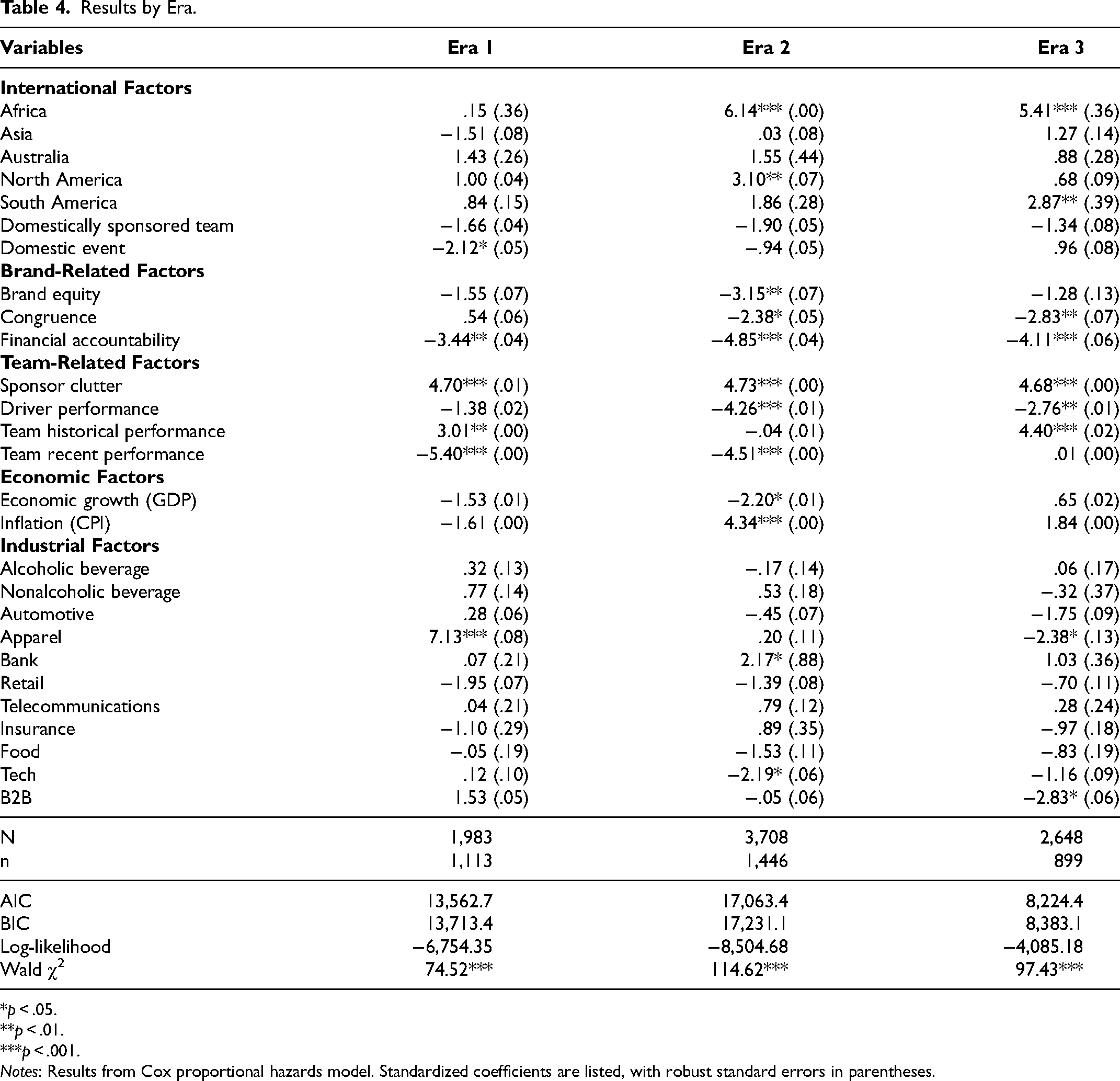
As indicated in Table 4, across all three eras, the group of organizational performance variables consistently explained a statistically significant amount of variance in the sponsors' decisions to exit or continue their agreements. From this evidence we conclude that the performance effect found in the initial investigation was robust and generalizable, regardless of the era in which the brand–team partnership was active. Interestingly, effects varied somewhat across the three eras for the individual variables that reflect historical and recent performance, providing further justification for an analysis across eras.
Results by Era.
*p < .05. **p < .01. ***p < .001.
Notes: Results from Cox proportional hazards model. Standardized coefficients are listed, with robust standard errors in parentheses.
In Era 1 (1967–1995), both the historic and recent team-related effects were significant. The historic team variable (i.e., the team's best finish in constructor point standings) indicates that finishing lower in the final standings increases the probability of sponsor exit by 1.39% (HR = 1.01). In addition, each constructor point earned in the recent season decreases the probability of sponsor exit by .46% (HR = .99). However, in this first era, the effect of a past title by a team's driver was nonsignificant. These findings indicate that, in the earliest era of F1 sponsorship, the team's historical and recent performances were more influential in sponsor decision-making than driver performance.
In Era 2, the effect of the driver's past performance became statistically significant, with each title decreasing the probability of sponsor exit by 4.4% (HR = .96). Similar to Era 1, improvement in the team's recent performance decreased the probability of the sponsor exiting, as each constructor point reduced the probability of exit by .31% (HR = .99). However, in Era 2, the influence of the team's historical performance waned and was nonsignificant.
In the most recent era (Era 3), the historical performances of both the team and its drivers were significant predictors of sponsor decision-making. In this era, a driver's title was influential, with each championship decreasing the probability of sponsor exit by 2.7% (HR = .97). In addition, the team's historical performance (which was nonsignificant in the preceding era) was a significant predictor of dissolution, with an effect equal to a 9.7% increase in the probability of exiting as the team's best historical finishing position worsens (HR = 1.09). In contrast, the measure of recent organizational performance was nonsignificant in Era 3.
In summary, when examined by era, results from the three variables characterizing dimensions of sponsored property performance imply that drivers’ achievements have become more influential in recent eras. This coincides with the evolution of digital marketing tools that allow for comprehensive character (i.e., driver) development and promotion. Meanwhile, as the history of F1 teams unfolded over decades, long-standing teams such as Ferrari, McLaren, and Williams were able to build their own iconic sporting brands that grew in partnership influence as eras progressed. More specifically, team historical performance has been emphasized when possible in recent eras to maintain continuity in sponsoring brand relationships. As stated by one team executive, the success “allows that partner to then go tell a publicly facing story about how they’re helping us win” (Eric Kwait, vice president of partnership development for McLaren Racing).
This era analysis also enabled examination of how international or brand-related effects found in the main model were either robust across eras or differed over time. As indicated in Table 4, some influences on decision-making were remarkably consistent. For example, clutter in a team's sponsorship portfolio increased the probability of sponsor exit across all three eras. Likewise, publicly traded firms were significantly less likely to exit F1 team sponsorships, contrary to speculation that the short-term, quarterly focus of public firms may induce rash decisions to cut costs by dissolving brand partnerships.
However, some variables became more influential over time, whereas others were statistically significant in early years but waned in influence in the more recent F1 eras. As the F1 schedule diversified and spread across more continents, many brands were doing the same. Accordingly, the effect of an event being held in a sponsor's home country diminished over time. This effect was significant in Era 1, yet there was a nonsignificant effect on partnership dissolution of a Grand Prix being held in a sponsor's home market across both Era 2 and Era 3. A “home” race is no longer a necessity for international F1 sponsors, which is good news for team executives scouring the world's markets for potential partners. Nonetheless, teams prospecting for sponsors in their home country are likely to be rewarded with partnership continuity in that sponsors of a domestic team (i.e., shared nationality between sponsor and team) equated to a lower likelihood of dissolving the sponsorship across all three eras, though this only reached statistical significance as part of the main model, which included all three eras.
Turning attention to international effects by era, we note two significant findings. When compared with sponsors based in Europe (the reference variable), sponsors from North America demonstrated a proclivity toward dissolving F1 team partnerships in Era 2. However, significantly higher dissolution rates for sponsors from South America appear in Era 3, again when compared with European sponsors. There are several plausible rationales for this pattern. In the recent era, F1 has emphasized growth in Asia and North America. To illustrate this geographic emphasis, the 1999 Grand Prix schedule featured only two events in Asia and one in North America, whereas the 2019 schedule included seven in Asia and three in North America (increasing to five in 2023). Meanwhile, South America has maintained just one annual Grand Prix during the last two decades. More Grand Prix events on a sponsor's home continent offer more opportunities to activate a team sponsorship, but they also may introduce the potential for agency conflicts for teams leveraging luxury event hospitality to influence sponsor decision-making agents (Clark, Cornwell, and Pruitt 2002; Cobbs, Groza, and Pruitt 2012).
The effects related to both congruence and a sponsor's B2B orientation have become more significant over time. Congruence was nonsignificant in Era 1 yet became significant during both Era 2 and Era 3, as shown in Table 4. Similarly, B2B firms were not more or less likely to exit during Eras 1 and 2, yet they became significantly less likely to exit F1 sponsorships in Era 3. Again, this pattern of increasing significance could be explained by the growing sophistication of marketing tools over time, which enables congruent and B2B brands to better articulate the relevance of their F1 partnerships to prospective customers. When examining industry sectors, tech firms appear less likely to exit over time. In Era 1, tech firms were more likely to exit partnerships compared with other sectors, although the effect was nonsignificant. That flipped in Era 2, where we saw a significant effect of tech firms being less likely to exit; the effect remained in that direction during Era 3, though it failed to reach significance.
Discussion
The purpose of this study is to illuminate the factors—inclusive of geographic origins and team performance—influential in managerial decisions to dissolve or continue brand partnerships on an international scale, thereby addressing a gap in studies focused on decision-making in such contexts (Cornwell and Kwon 2020). To achieve this purpose, we compiled 53 years of F1 sponsorship data involving more than 3,000 brand partnerships across six continents. This study builds on prior research (see Table 1), and by using a dataset ten times larger than those in earlier works, we were able to conduct comprehensive international and time-series analyses. The variables represented in our event history model were discerned from a thorough literature review focused on international brand partnerships and the sponsorship performance cycle (Cobbs, Jensen, and Tyler 2022), as well as 11 interviews with industry insiders.
Our analysis contributes an empirical demonstration of how a shared COO (i.e., localness), continental origin, and the sporting achievements of sponsored teams are connected to brand partnership continuity, in consideration of other key influences (e.g., brand-related characteristics). We also analyzed and discussed how these factors evolved across three eras. These contributions are important given that, on both sides of international sponsorship, managerial capacities for partnership solicitation and administration are limited, yet partnership possibilities are practically unlimited (Cobbs et al. 2017; Ireland, Hitt, and Vaidyanath 2002). Consequently, sponsored properties seek to establish multiyear partnerships and strategically craft their roster of sponsoring brands (Cobbs 2011), as illustrated by the following quote from a team executive: We don’t do any one-year deals, we don’t do two-year deals. Part of it is because some of these are so hard to evaluate. It's hard to evaluate a partnership and show a return on investment as is, and it's really hard to do that a year in. … Because of that reason, all of our deals are three, four, five-year partnerships. …. There are [team] brands like Ferrari that will make the most from sponsors. They might have three versus McLaren might have ten. (Brian Woerner, vice president of partnership development, Americas, McLaren Racing)
The results of our study inform international researchers keen to understand interorganizational marketing relationships, and they assist managers of sponsoring brands or sponsored teams in allocating their partnership resources efficiently. Generally, based on our longitudinal model, the most durable sponsorships in F1 are likely to occur between high-performing teams with limited clutter (i.e., small sponsorship rosters) and sponsors based in Europe or Asia that are publicly traded technology firms with high brand equity. Partnerships where the sponsor and team enjoy a shared COO are also advantageous to longevity, suggesting a benefit of brand localness in these B2B relationships, similar to experimental findings of Mohan et al. (2018). In reality, such a complete match is difficult to achieve, so the remaining discussion highlights a few factors from the model in greater nuance.
International Factors
Regarding sponsor location, the baseline was sponsors with European headquarters, which is also the historical home to F1. Apart from Asia, sponsors from the other continents showed a higher likelihood of partnership dissolution in at least one stage of the modeling, compared with Europe. Though recent sponsorships involving North American brands appear more stable than in past eras, the enhanced stability of team relationships with North American sponsors could be a reflection of the institution's (i.e., F1's) focus on the continent for future growth (Milligan 2022). At a country level, continuity is most likely between sponsoring brands and sponsored teams that share a nationality, despite the price premium and investor skepticism often associated with such relationships (Cobbs, Groza, and Pruitt 2012; Jensen et al. 2021). Brand managers seem to view the brand reinforcement of COO—signifying brand localness to domestic consumers while portraying brand foreignness to the international audience—advantageous enough to overcome the drawbacks highlighted in past literature.
These geographic variations by continent and country are factors to keep in mind for teams seeking sponsoring brands, but also for F1 administration as they continue to expand and stabilize the racing series internationally (Jensen, Cobbs, and Groza 2014). Moreover, future research employing experimental designs could move beyond speculation to discern causal chains within these international patterns of sponsorship, similar to Groza, Cobbs, and Schaefers (2012).
Brand-Related Factors
When examining relevant factors of the sponsoring brand, three characteristics stand out across eras, while two others are worth acknowledgment. Publicly traded firms are clearly more likely to continue F1 team partnerships, compared with private companies, and this effect was robust through all three eras. As stated previously, perhaps this effect serves as a proxy for firm size and F1 sponsorships are a smaller proportion of total marketing investments for their brand; therefore, patience in partnership building is more practical for a publicly traded sponsor. This same rationale could apply to the finding of greater longevity for deals that involve sponsors with high brand equity, when compared with deals with brands not evaluated as having high brand equity. This influence of brand equity, as well as that of congruence, was absent in prior domestic studies (Jensen 2021; Jensen and Cornwell 2021). Also, our analysis found that firms with sponsoring brands congruent with F1 were more apt to persist in their partnerships in the two most recent eras, likely because the parties involved have become increasingly savvy at leveraging that congruence through contemporary marketing channels to achieve partnership objectives (Cornwell, Weeks, and Roy 2005). As Guillaume Vergnas, senior business development manager for BWT Alpine F1 Team, said, “There's an easy direct application of their [sponsor] technology to the sport, so they can say, ‘[The team] actually got faster because we are helping them.’”
Note that this same idea of leveraging expertise applies to the finding that, compared with B2C firms, B2B firms in only the most recent era were more likely to persist in brand partnerships with F1 teams. In other words, industrial brands have improved at leveraging these marketing relationships over time (Cobbs 2011), which aligns with similar findings by Jensen and Cornwell (2021). Finally, a plethora of brand partners within the sponsored team's portfolio creates a cluttered branding environment, which is a drawback to partnership continuity across all three eras and matches previous findings (Jensen and Cornwell 2017). This creates a challenge to the large portfolio strategy of some F1 teams, as represented by the McLaren executive's quote near the beginning of the “Discussion” section.
Team-Related Factors
The effect of team performance on sponsor decision-making not only enriches the theory of a sponsorship performance cycle but is also particularly salient to managers. Our model proves a strong link between team performance and the renewal or exit of sponsors, even after accounting for a wide variety of control variables (e.g., economic conditions, sponsor industries), international and brand-related factors, and potentially confounding variables related to the team itself (e.g., number of sponsors). These empirical findings directly address the remaining question in the sponsorship performance cycle (see Figure 1; Cobbs, Jensen, and Tyler 2022); specifically, they confirm that enhanced team performance is indeed associated with a lower probability of sponsor dissolution.
In terms of the historical performance of a team's drivers, results revealed that having championship drivers supported by the team was a statistically significant predictor of sponsor renewal. For example, given that a past driver's title reduces the probability of a sponsor exiting by 3.4%, Mercedes employing Lewis Hamilton for six titles and Red Bull employing Max Verstappen for three titles reduces the probability of sponsors’ exit from partnerships with the Mercedes and Red Bull teams by 20.4% and 10.2%, respectively. Note that this retention effect is observed when controlling for the other aforementioned factors. In terms of historical team performance, a downgrade of the team's best position in the constructor standings by one position increases the probability of the team's sponsors to exit by 2.2%. In other words, a team that has only achieved fifth place in the Constructors’ Championship must tackle the challenge of a 10.8% greater probability of sponsorship dissolution, when compared with a team that has won a Constructors’ Championship in its history.
Finally, the model reveals a strong link between team performance in each season and the probability of sponsors exiting at the end of the year. The hazard ratio (HR = .99) indicates that every 100 points earned during the season reduces the probability of a sponsor exit by 9.2%. Considering that F1 teams regularly score anywhere from zero to more than 700 constructor points in a single season, such sponsorship contingency can be particularly assuring for high-performing teams and equally daunting for low performers. For example, the model suggests that higher-performing teams during the 2022 season, such as Red Bull (759 constructor points), Ferrari (554), and Mercedes (515), would enjoy a reduction in the probability of sponsor exit of 70.1%, 51.1%, and 47.5%, respectively, even when controlling for all other factors in the model.
In the high-profile world of international motorsports, these performance-based findings place an acute focus on organizational performance. Each sponsor lost represents not only the potential for millions of dollars in lost revenue for the team (Jensen et al. 2021), but also the exit of expertise that may contribute to team performance in other ways (Cobbs, Jensen, and Tyler 2022). Yet, sponsors' attention to on-track achievements in their marketing partnership decisions suggests these brand managers are aware of Jensen and Cobbs’s (2014) finding that each point earned by an F1 team significantly increased a sponsor's brand exposure value, and each win was worth approximately $26 million in sponsor exposure. Consequently, poor performance can result in reduced or detrimental signaling effects from their brand partnership.
Limitations and Future Research
This study takes a population perspective, including every F1 team spanning six decades of sponsorship in one of the world's most international sporting contexts. However, such a large scope raises limitations worth considering. This study is F1 specific, although the context may be somewhat generalizable for truly international marketing situations (Van Everdingen, Hariharan, and Stremersch 2019). Future researchers could replicate our analysis by testing the international factors and team performance effects in other sporting competitions, such as FIFA World Cup tournaments or the Olympic Games (e.g., Jensen and Cornwell 2017). While the longitudinal dataset involves thousands of brand partnerships, and our supplemental analysis of three eras indicates the effects over time (as called for by Ratten and Ratten 2011), such a broad perspective comes at the expense of nuance related to any specific team, sponsoring brand, or agreement. Like any sponsored property, each F1 team believes it has a unique story to sell to prospective brand partners. As a result, a team-by-team analysis in future research could discern insightful heterogeneity in organizational approaches to sponsorship management.
Finally, the commentary framing this research has assumed that the dissolution of partnerships signals an undesirable state—that one or both parties to the partnership are dissatisfied with the ROI they are achieving. While this assumption is generally supported in the literature (e.g., Jensen and Cornwell 2017) and we controlled for macroeconomic factors, we recognize that sponsorships end for other reasons. These include the dissolution of the team or brand itself, a merger and/or acquisition, changes in decision-makers, or a change in direction of marketing strategy unrelated to the returns from the current partnership (Cobbs et al. 2017). Nonetheless, this study moves forward the theory of the sponsorship performance cycle, provides ample empirical evidence of why international marketing partnerships are likely to persist or dissolve, and delivers insights for managers and decision-makers on both sides of sponsorship relationships.
Footnotes
Special Issue Editors
Rajeev Batra, Kelly Hewett, Ayşegül Özsomer, and Jan-Benedict E.M. Steenkamp
Declaration of Conflicting Interests
The author(s) declared no potential conflicts of interest with respect to the research, authorship, and/or publication of this article.
Funding
The author(s) disclosed receipt of the following financial support for the research, authorship, and/or publication of this article: This research was supported by an IBM Junior Faculty Development Award and the Morehead-Cain Program at the University of North Carolina at Chapel Hill.
