




Abstract
Firms are often encouraged to collaborate to draw on local partners’ expertise and insider status during internationalization. Appropriateness of alliances during international expansion depends on the type of exploratory search a firm pursues. During internationalization, firms engage with novelty in two distinct, yet often conflated, domains: institutional and product. Firms’ novelty-seeking in these two domains engages homegrown knowledge structures in contrasting capacities, which alters the conduciveness of local partnerships as a mechanism of internationalization. While reliance on local partnerships enhances the performance outcomes of institutional exploration, performance-enhancing product exploration requires internalized governance arrangements. Based on the export operations of firms from three emerging economies, the empirical results support the theorized relationships.
Internationalization involves interacting with new contexts and experimenting with new solutions that create variety in a firm's experiences. Knowledge assimilation and learning can enhance performance (Bartlett and Ghoshal 1989; Lu and Beamish 2004) given their potential for redeployment in other contexts (Eden 2009; Govindarajan and Trimble 2012) and recombination possibilities arising from the cross-fertilization of knowledge sources (Kogut and Zander 1993). Firms are often encouraged to initiate collaborations and draw from local partners’ expertise and insider status to deal with novelty in foreign markets and overcome the liabilities of foreignness (Zaheer 1995) and outsidership (Johanson and Vahlne 2009). However, despite extensive research, the role of local alliances in enhancing the performance consequences of novelty-seeking remains equivocal. Some studies suggest that partnering to engage with foreign markets interjects unfamiliar stimuli into the firm's interaction and dilutes the associated benefits, given the lower communication modality of interorganizational channels of knowledge transfer (Almeida, Song, and Grant 2002; Salomon 2006b) and socialization complications involved in cross-border relationships (Barkema, Bell, and Pennings 1996; Goerzen and Beamish 2005; Leonidou et al. 2014).
We argue that one reason behind these conflicting arguments is the conflation of international novelty-seeking or exploration in two distinct domains, despite their differential implications for the conduciveness of alliances to engage with foreign markets. Exploration is defined as creating variety in experience, embracing novelty and new knowledge, and trialing and experimenting with new ideas (Holmqvist 2004; March 1991). During international expansion, firms increase their variety of experiences and engage in novelty in two potentially related yet distinct domains. First, firms can pursue institutional exploration by expanding into institutionally and culturally heterogeneous countries, thereby bringing about the experience of operating under diverse “rules of the game” (North 1990, p. 3) and “programming of the mind” (Hofstede 1991, p. 5). Expansion across multiple institutional environments is an exploratory move, as it involves learning new concepts and translating them into commensurate strategies, practices, and procedures (Barkema and Drogendijk 2007; Kostova and Zaheer 1999; Palich and Gomez-Mejia 1999; Zahra, Korri, and Yu 2005).
Second, an internationalizing firm can explore its product domain by adapting its product offerings to foreign market conditions (Bratti and Felice 2012; Govindarajan and Trimble 2012; He, Brouthers, and Filatotchev 2012; Priem, Li, and Carr 2011; Salomon and Shaver 2005). Attentiveness to new market insights regarding product use, customer preferences, and competitive offerings, that is, “demand-side exploration” (Sidhu, Commandeur, and Volberda 2007, p. 21), can draw out new product ideas and responses from the firm's unique skill sets (Filipescu et al. 2013; Katila and Ahuja 2002; Miller 2003). From the perspective of organizational learning, responding to demand-side stimuli in foreign markets is a variety-increasing experience in which a firm embraces novel stimuli and experiments with new product ideas and solutions (Govindarajan and Trimble 2012; Sidhu, Commandeur, and Volberda 2007).
The literature often bundles these two forms of novelty-seeking (Ghoshal 1987), with the institutional diversity of firms’ markets sometimes taken as a proxy for exploratory behavior in the product domain (Kim, Hwang, and Burgers 1993). As an example, Lundan and Li (2019, pp. 42–43) argue that “institutional diversity exposes MNEs to multiple stimuli that provide them with diverse knowledge and broader learning opportunities … increasing the likelihood of innovation” (see also Dunning and Lundan 2010; Govindarajan and Trimble 2012; Hamel 1996; He, Brouthers, and Filatotchev 2012; Xie and Li 2018). While selling across institutionally diverse markets creates opportunities to embrace new ideas and experimentation in the product domain, pursuing these opportunities depends on deliberate organizational policies that vary substantially across firms exposed to a given level of institutional diversity (Dow 2006). Targeting institutionally heterogeneous markets does not necessarily imply that a firm proactively collects new insights from these markets to experiment with new products and offerings (Sidhu, Commandeur, and Volberda 2007, p. 21). 1
We argue that relying on alliances in foreign markets has contrasting effects on the performance outcomes of these explorative strategies because of the imprinting effect of homegrown knowledge structures (Redding 1980; Zahra, Korri, and Yu 2005). Product experimentation in export markets often involves connecting a new piece of information or market stimulus to a firm's existing body of technical knowledge to draw out new ideas. In this process, existing cognitive structures provide significance and meaning to further information or stimuli and enable value recognition and assimilation (Cohen and Levinthal 1990). By interposing firms’ interactions with foreign market stimuli, an alliance partner may fail to recognize the significance of customer feedback or a piece of information or may have less incentive to note, absorb, and transfer the information (Cavusgil, Yeoh, and Mitri 1995). Conversely, operating under heterogeneous institutional rules requires shifting across multiple rules, norms, and assumptions that regulate action and behavior in dissimilar environments. Here, the mental frameworks and schemas that evolve during accumulation of experience in the home context (DiMaggio 1997; Kogut 2005; Nooteboom 2009; Redding 1980; Zerubavel 1997) can interfere with the understanding of situations and the interpretation of new experiences (Zeng et al. 2013). Such an interference gives local alliances the instrumental capacity to decode the underlying structures of decision situations.
Therefore, we theorize that international alliances have contrasting impacts on the performance outcomes of exploratory behaviors in the institutional and product domains. We test our hypothesized relationships using survey data on the export operations of 197 firms from three emerging economies, namely, Brazil, Chile, and Mexico, which are a suitable context, given the primacy of exploratory motives in emerging economy firms’ (EEFs’) internationalization (Makino, Lau, and Yeh 2002) in both product (Anand et al. 2021; Li, Chen, and Shapiro 2009) and institutional (Cuervo-Cazurra and Rui 2017; Hitt et al. 2000) domains. The limited global exposure of EEFs and the prominence of exporting as a mode of interaction with foreign markets (Jonakin 2007; Luo and Tung 2007) make this mode of foreign market participation an important learning avenue for these firms (Blalock and Gertler 2004; Xie and Li 2018).
By examining the role of alliances in the performance implications of firms’ international strategies, our study contributes to several research streams. First, it enriches the literature on search and learning, which identifies the value of exploration as a valuable mechanism for firm growth but calls for more research that examines how organizational boundaries influence the success of these search strategies across different domains (Gupta, Smith, and Shalley 2006; Lavie, Stettner, and Tushman 2010; Su et al. 2022; Voss and Voss 2013). Second, theoretical rationales and empirical evidence on the relationship between product adaptation and firm performance are conflicting (Theodosiou and Leonidou 2003), with some studies supporting a positive relationship (Cavusgil and Zou 1994; Shoham 1999) and some finding a negative relationship (Kotabe and Okoroafo 1990; Szymanski, Bharadwaj, and Varadarajan 1993), whereas others report no significant association (Samiee and Roth 1992; Shoham 1996). Our results suggest that, in the context of export operations, these mixed findings can be reconciled by accounting for the degree to which a firm maintains an unmediated interaction with foreign markets. This unmediated interaction improves the knowledge inputs that feed into the product adaptation process, thereby recouping product adaptation costs and yielding a positive relationship between product adaptation and performance. We consistently demonstrate that the effect of product adaptation on performance can be either positive or negative, depending on the exporter's reliance on local intermediaries and partners. Finally, the learning-by-exporting literature has examined the learning effects of exporting, with individual studies lending support to either enhanced productivity (Damijan and Kostevc 2015) or product innovativeness (Liu and Buck 2007; Salomon and Shaver 2005) but not to both (Di Cintio, Ghosh, and Grassi 2020). Our results suggest that accrued benefits may depend on the exporter's reliance on local intermediaries, which can uphold growth and enhance productivity despite interposing exporters’ interactions with foreign market stimuli, thereby undermining product inventiveness.
Theory and Hypotheses
Exploration is associated with search and novelty and entails “variance-increasing activities, learning by doing, and trial and error” (Smith and Tushman 2005, p. 522). Exploration is often compared with exploitation, which aims at reliability and efficiency and is characterized by execution, focused attention, selection, and refinement (March 1991). Compared with exploitation, which focuses on current activities (i.e., variety-neutral or variety-reducing), exploration “creates variety in experience” (Holmqvist 2004, p. 70; McGrath 2001) through the processes of “concerted variation, planned experimentation, and trialing” (Baum, Li, and Usher 2000, p. 768; March 1991). Therefore, exploration and exploitation can be considered relative concepts situated at the polar opposites of a continuum (Sidhu, Commandeur, and Volberda 2007).
During internationalization, firms create variety in their experiences and engage in novelty in two distinct domains: institutional and product. In the institutional domain, countries are often clustered into distinctive zones based on the similarity of “principles and cognitive maps that guide managerial decision-making and practice” (Zahra, Korri, and Yu 2005, p. 134; see also Gupta, Hanges, and Dorfman 2002; Ronen and Shenkar 1985; Sullivan 1994). 2 A firm may restrict its international expansion to institutionally similar countries, enabling the building and refinement of its knowledge of a set of institutional principles and paradigms (Barkema, Bell, and Pennings 1996; Mitra and Golder 2002; Nachum and Song 2011; Palich and Gomez-Mejia 1999; Vachani 1991). For firms situated closer to the exploitation end of the exploitation–exploration continuum (i.e., low exploration), this allows internationalization to be managed with “the semi-automatic reproduction of firm routines, and the application of current concepts and objects and the linkage between them” (Barkema and Drogendijk 2007, p. 1135; Zahra, Korri, and Yu 2005). In contrast, in the pursuit of growth, a firm may span heterogeneous institutional environments. Dispersion across multiple institutionally dissimilar environments is variety-increasing and exploratory because operating in each environment requires learning new concepts, linking concepts in different ways based on various distinct rules, and translating them into commensurate strategies, practices, and procedures (Kostova and Zaheer 1999; Yiu and Makino 2002; Zeng et al. 2013).
In the product domain, internationalization exposes firms to external innovation triggers in foreign markets (Salomon 2006a). The firm can exercise a product standardization strategy in which products developed for the home market are extended to foreign countries, regardless of the market's features (Aulakh, Kotabe, and Teegen 2000). This involves minimum planned variation, experimentation, and trialing in the product domain and disregards (rather than embraces) novel foreign market stimuli, thereby situating the firm closer to the exploitation end of the continuum. 3 By contrast, responding to market stimuli in foreign markets through product adaptation is a variety-increasing experience in which a firm experiments with new product ideas and solutions. The resulting products and solutions enrich the firm's internal variety (McGrath 2001) and enable its later utilization to address similar or distinct market segments in various geographies (Govindarajan and Trimble 2012; Priem, Li, and Carr 2011). 4
To facilitate internationalization, a firm may rely on local partnerships and draw from expertise, embedded network positions, and resources in their respective environments rather than directly engaging with foreign markets and customers. Some strands of the literature suggest that such partnerships can assist internationalizing firms in accessing the knowledge of operations in local contexts (Makino and Delios 1996), overcoming the liability of outsidership (Sousa, Li, and He 2020), and building absorptive capacity overseas (Li and Fleury 2020). However, others argue that collaborative arrangements can subject foreign entrants to a process of double-layered acculturation (Barkema, Bell, and Pennings 1996; Leonidou et al. 2014) and degrade the firm's modality of interaction with foreign market stimuli (Almeida, Song, and Grant 2002; Salomon 2006b). This impedes the assimilation and transfer of valuable knowledge inputs, given local partners’ potentially distinct incentives and concentration (Cavusgil, Yeoh, and Mitri 1995; Doz and Hamel 1998, p. 138) as well as the lack of complementary knowledge required to appreciate the significance of knowledge inputs (Burgel and Murray 2000; Salomon 2006b).
Probing the nature of exploratory behavior in the product and institutional domains reveals interesting differences in their respective relationships with a firm's homegrown cognitive structures. While these knowledge structures enhance a firm's absorptive capacity to assimilate and respond to foreign market stimuli (i.e., product domain exploration), they are susceptible to negative knowledge transfer when interacting with multiple dissimilar institutional contexts. This affects the performance outcomes of relying on local alliances that mediate the engagement of a firm's knowledge structures with novelty in foreign markets. In the following two sections, we examine how local alliances affect the performance outcomes of institutional and product exploration owing to their different relationships with a firm's existing cognitive structure.
Institutional Exploration and Local Alliances
Institutional frameworks shape and govern economic behavior in an “enormous variety of ways” (North 1990, p. 34) to uphold regularity within societies (Greif 2006). Institutional arrangements (formal and informal) can schematize themselves by instilling shared frames of reference (Biggart and Beamish 2003), inducing convergent interpretations of a given situation (Barr and Glynn 2004; Schneider and De Meyer 1991), defining the norms of appropriateness and fairness in economic exchanges (Luo 2005), and interacting with authorities (Calhoun 2002; Guillen and Suarez 2005) and employees (Calori et al. 1997). These institutionalized frameworks imprint themselves (Kogut 2005) as a “collective programming of the mind” (Hofstede 1991, p. 5) and have a major impact on managers’ attitudes, beliefs, values (Hofstede 1991), and administrative heritage (Bartlett and Ghoshal 1989).
Remaining within institutionally similar countries not only enables the building on and refinement of a firm's knowledge of one set of institutional principles and paradigms but also bounds the possibility of confronting unknown principles or dimensions in a given situation (Palich and Gomez-Mejia 1999). However, expansion to multiple dissimilar institutional environments increases the likelihood of encountering discontinuity, wherein homegrown mental representations (and experiences in dissimilar contexts) interfere with the understanding of the new rules of the game that govern a given situation or decision in multiple heterogeneous environments.
Literature on absorptive capacity often conceptualizes a firm's past experience as a conduit for future learning by “providing a cognitive basis” for the interpretation and assimilation of new information (Cohen and Levinthal 1990, p. 128). From a broader perspective, prior experiences and existing cognitive structures lay “the groundwork (by analogy, a schema) for the processing of information” (Ackerman, Huang, and Bargh 2012, p. 461). However, these schemas can inhibit (rather than promote) new activities, particularly when they reflect the experiences accumulated under fundamentally different principles, rules, and norms. One way in which past experience can interfere with new activity is negative knowledge transfer, in which experience gained in one situation is transferred into a new situation “that appears to be similar on the surface, but is, in fact, fundamentally different” (Hoang and Rothaermel 2010, p. 738).
Cohen and Bacdayan (1994) illustrate this in the context of card games, where experience accumulation in one game with a given set of rules causes disadvantages for subjects after minor shifts in the game rules (despite explicit communications). Aggravating this effect, institutions contain tacit deep-seated dimensions (Kostova and Zaheer 1999; Xu and Shenkar 2002) whose decoding is often regarded as the primary source of difficulty for outsiders (Calhoun 2002; Cuervo-Cazurra, Maloney, and Manrakhan 2007; Johanson and Vahlne 1977). Understanding the local economy, politics, culture, and business customs and managing the interface with distribution channels and labor tends to have tacit components involving comprehension of unwritten norms, practices, and conditions and sufficient embeddedness in the host country's information network (Calhoun 2002; Kostova and Zaheer 1999; Makino and Delios 1996; Teece 2000; Zaheer and Mosakowski 1997). These tacit and deep-seated dimensions of institutional rules and understanding make their comprehension difficult for outsiders (Calhoun 2002; Petersen, Pedersen, and Lyles 2008; Xu and Shenkar 2002). For instance, Zeng et al. (2013, pp. 42–43) showed that operating in diverse and dissimilar cultures increases the likelihood of “drawing erroneous inferences from experience in one environment and applying it into other dissimilar environments.”
Under these circumstances, local partners embedded in their respective host environments’ cognitive systems and informational networks can lend their perspectives to the underlying structures of decision-making situations in various environments. Local partners’ perspective enables the firm to bridge toward understanding dissimilarities by “mapping from [local partner's] cognitive range (i.e., forms of thought) to [the firm's] domain of cognition (i.e., the notions [the firm] can make sense of) to insert to the [firm's] absorptive capacity” (Nooteboom 2001, p. 155). Bridging enables internationalizing firms to not only bypass heavy and time-consuming investments in learning about the basic categories of perception, interpretation, and evaluation in new environments but also focus their attention on particular decision situations (Nooteboom 2009).
The institutional dispersion of target contexts makes it increasingly difficult for a firm to internalize the capabilities and knowledge required to deal with potentially conflicting institutional expectations and rules (Casson 1979). Local partners are better equipped with the skills, capabilities, and access to negotiate with local governments and elites, manage the local labor force, and capitalize on their close relationships with local distributors and other exchange parties. By utilizing the embedded position of the local partners, their perspective on “collective understandings of the local people” (Yiu and Makino 2002, p. 671), and their network relationships, the internationalizing firm can establish a more constructive relationship with the various legitimizing environments and overcome its liability of foreignness and outsidership. Based on these results, we hypothesize as follows:
Product Exploration and Local Alliances
Exporting is often regarded as an avenue for growth (Hollensen 2014) to achieve economies of scale and capture subsequent efficiency accruals (De Loecker 2013, p. 1). However, a growing body of scholarship suggests that exporting facilitates access to diverse knowledge inputs that can inform a firm's product development (e.g., Aw, Chung, and Roberts 2000; De Loecker 2013; Grossman and Helpman 1993). For example, Bratti and Felice (2012) find that interaction with foreign markets allows Italian exporters to remain innovative despite the relative scarcity of formal research and development (R&D) investments. Similarly, Salomon and Shaver (2005, p. 433) show that exporters experience increasing innovativeness shortly after commencing to export, as they “access information that they would otherwise not be privy.”
Product development is driven by both supply-side technological factors and demand-side stimuli derived from interactions with new buyers (with different tastes and needs) and competitive landscapes (Adner and Levinthal 2001; Mowery and Rosenberg 1979; Priem, Li, and Carr 2011). Foreign market insights regarding product use, customer preferences, and customer feedback can draw new product ideas and responses from a firm's unique asymmetries and skill sets (Filipescu et al. 2013; Katila and Ahuja 2002; Miller 2003; Salomon 2006a). Learning about a new competitive landscape is another mechanism through which exports can provoke experimentation and variation in the product domain (Filipescu et al. 2013). New competitors and their offerings can feed a firm's product development efforts (Liu and Buck 2007), incentivize product modifications (Schmookler 1966; Tse, Yu, and Zhu 2017), and introduce alternative practices to the firm (Blalock and Gertler 2004; Salomon and Shaver 2005).
To interact with new buyers and create a new competitive landscape to induce product exploration, a firm should be willing to respond to foreign market stimuli and experiment with new solutions and product ideas in foreign markets (Aw, Roberts, and Xu 2011). To uphold efficiency and economies of scale, a firm can follow a global standardization strategy in which existing products developed for the home country are merely exploited in foreign markets (Aulakh, Kotabe, and Teegen 2000). In contrast, embracing and responding to foreign market stimuli is an instance of planned variation, experimentation, and trial (i.e., exploration) that manifests in the degree to which the firm adapts its offerings to foreign market conditions (He, Brouthers, and Filatotchev 2012).
Balancing the benefits of product adaptation with efficiency accruals of product standardization has been subject to theoretical and empirical interest with associated findings explained as “mixed” (Theodosiou and Leonidou 2003, p. 166) or “contentious and largely unresolved” (Hultman, Robson, and Katsikeas 2009, p. 17). Some studies support a positive relationship (Cavusgil and Zou 1994; Shoham 1999), whereas others maintain a negative (Kotabe and Okoroafo 1990; Szymanski, Bharadwaj, and Varadarajan 1993) or insignificant (Samiee and Roth 1992; Shoham 1996) association. We argue that one reason for these conflicting findings is overlooking the extent to which the exporting firm maintains close interaction with customers and the competitive landscape as a carrier of foreign market stimuli. To justify its additional costs and bring about favorable performance consequences, product adaptation must effectively absorb demand-side stimuli (and other knowledge inputs) and incorporate them into the adaptation process. Moreover, these hinge on the exporter's extent of direct and unmediated engagement with foreign markets, given the superiority of the firm (relative to intermediaries and export brokers) in not only identifying valuable demand-side knowledge inputs but also transferring them to be combined with complementary knowledge pieces (to uphold performance-enhancing product adaptation). 5
Unlike the case for institutional novelty, demand-side insights and product-related knowledge have multiple “common referents” and strong “common cognitive grounds” with firms’ current knowledge structures (Oddou, Osland, and Blakeney 2009, p. 185). Demand-side insights and new knowledge inputs gain meaning and significance through the lens of existing knowledge structures and expertise. Depending on these knowledge structures and asymmetries (Miller 2003), a given insight or knowledge input can contain combinative potential and stimulate further deliberation for some firms while becoming irrelevant or trivial for others (Kogut and Zander 1992). The functionality of existing knowledge structures diverges significantly from the capacity of negative knowledge transfers in institutional exploration, whereby experiences unfold (and must be deciphered) under heterogeneous rules that elude a priori identification. Contrastingly, in dealing with product-related knowledge, existing cognitive structures assist in assessing the significance and complementarity of new insights and facilitate subsequent assimilation and transfer (Ahuja and Novelli 2011). Relying on intermediaries and partners restricts direct communication with foreign markets and degrades the process of observing, recognizing, and assimilating valuable knowledge inputs (Burgel and Murray 2000). Intermediaries may fail to recognize the significance of various knowledge inputs and demand-side stimuli, and they may have less incentive to note and convey these insights (Cavusgil, Yeoh, and Mitri 1995; Doz and Hamel 1998, p. 138).
Even when intermediaries note and attempt to transfer these insights, the richness and embedded nature of the message can be lost because of the lower communication modality of the interorganizational channels of communication and knowledge transfer (Grant 1996; Kogut and Zander 1993; Sousa, Li, and He 2020). Salomon (2006b, p. 141), for example, argues that intermediaries “are more prone to misunderstandings when transmitting information, forgetting message details and failing to convey important pieces of information because they do not recognize the relevance.” Perhaps due to these, Di Cintio, Ghosh, and Grassi (2020, p. 99) find that the product innovation accruals of exporting disappear when the exporter relies on intermediaries as such intermediaries “act as barriers to acquiring knowledge on destination countries’ local demand, product preferences and foreign market conditions.” To preserve the richness and embedded nature of these knowledge inputs (and effectively feed them into the innovation process), firms should maintain closer links with their potential information conduits such as customers and competitors in foreign markets (Bai, Krishna, and Ma 2017; Salomon 2006b, p. 77). Thus, we hypothesize:
Methods
Setting and Instrument Design
The empirical context of this study is the export operations of EEFs. For these firms, exports remain the main medium of foreign market participation (Luo and Tung 2007). The limited prior global exposure of EEFs makes their internationalization an important vehicle for learning and innovation (Blalock and Gertler 2004; Xie and Li 2018). Furthermore, because these firms’ cognitive–cultural repertoires are typically shaped by a narrower range of learning experiences (Cuervo-Cazurra and Rui 2017; Hitt et al. 2000), their institutional exploration is more likely to involve learning new rules and frameworks. Data for our study were collected through surveys (in the local language) of firms in Brazil, Chile, and Mexico.
The target sample in each country comprises local firms involved in selling to international markets. As no single comprehensive directory of internationally oriented firms exists in these countries, the target sample for each country was compiled from various sources. Our target sample for Brazil was based on the Chamber of Commerce directory for exporting firms. We contacted our target sample of 357 manufacturing firms via phone to solicit the name(s) of the person(s) in charge of the company's export operations. Based on the collected information, 294 questionnaires were hand-delivered or faxed to the respondents (given a nationwide postal strike and sabotage), of which 69 complete responses (with respect to the variables of interest in this study) were returned, with an effective response rate of 23%.
In Chile, our target sample consisted of 180 manufacturing firms trading on the Bolsa de Comercio de Santiago. Given the concerns about the feasibility of the mail survey, MBA students at a local university hand-delivered the surveys and collected them upon completion. Sixty usable questionnaires (with respect to the variables of interest) were collected, with a response rate of 33%. In Mexico, executive MBA students from a major business school were responsible for identifying a Mexican firm and a senior manager responsible for the firm's export operations. Once all firms were identified, they were checked for nonrepetitiveness and active involvement in export activities. Subsequently, each student manually delivered the survey instrument to a key informant of the identified firm and collected the instrument from the informant. Of the 82 returned questionnaires, 68 were completed with respect to the variables of interest, with a response rate of 83%.
Our final sample consisted of 197 exporting firms originating from Brazil (69 firms), Chile (60 firms), and Mexico (68 firms). 6 Table 1 details the sample distribution across industries and summarizes the sample features across countries. All respondents held upper-management positions and had, on average, 10 years of experience with their firms and 6.3 years in managing export operations.
Key Sample Characteristics in Brazil, Chile, and Mexico.

Given the survey-based design of our study and the perceptual nature of our measures, common method bias could be a concern regarding the validity of our estimates (Baumgartner and Weijters 2021; Chang, Van Witteloostuijn, and Eden 2010; Podsakoff, MacKenzie, and Podsakoff 2012). We took procedural precautions to minimize common method variance during data collection. These included the placement of questions regarding dependent and independent variables and the use of Likert and semantic differential scales. Post hoc, we performed Harman's single-factor test. The results did not show a general factor accounting for most of the covariance between the dependent and independent variables. More importantly, the nature of our theorization (i.e., predicting moderation effects) provides additional credibility for the robustness of our findings against common method bias. Notably, common method variance is unlikely to distort the interaction effects (Kotabe, Martin, and Domoto 2003; Reinholt, Pedersen, and Foss 2011) because such complicated relationships are “in all likelihood, not part of the respondents’ theory-in-use” (Chang, Van Witteloostuijn, and Eden 2010, p. 180). As Siemsen, Roth, and Oliveira (2010, p. 470) statistically show, “there is no reason that common method bias would create an artificial interaction effect,” and, therefore, interaction effects cannot be artifacts of common method variance (Podsakoff, MacKenzie, and Podsakoff 2012, p. 543).
Measures
Dependent variable
International performance is measured using a three-item scale to quantify the extent to which exporting contributes to a firm's competitiveness, profitability, and sales growth. This accounts for not only profitability in export markets but also the contribution of exports to the firm's overall performance through learning and knowledge spillovers (Gao et al. 2010). Respondents were asked to indicate their level of agreement with each of the following statements on a five-point scale (1 = “strong disagreement,” and 5 = “strong agreement”): “Our export activities have made the firm more competitive,” “exports have contributed to the firm's sales growth,” and “export activities have contributed to the overall quality of management.” The coefficient alpha for international performance is .82.
Independent and moderator variables
Institutional exploration refers to the extent to which a firm is exposed to dissimilar and unrelated institutionalized expectations and norms in its target markets. This ensues from the multiplicity of these institutional environments and their variety and relatedness (Kostova and Zaheer 1999; Palich and Gomez-Mejia 1999).
7
We draw from research that clusters countries into distinct cultural zones, each representing a “unique cognitive map of the principles of management” (Ronen and Shenkar 1985, p. 332; see also Gupta, Hanges, and Dorfman 2002; Sullivan 1994; Zahra, Korri, and Yu 2005). Whereas remaining within a zone enables extrapolation from the past and limits the possibility of encountering unknown institutional rules and expectations (Palich and Gomez-Mejia 1999), dispersion across multiple zones increases the likelihood of encountering discontinuities, wherein current experiences in one environment can lead to erroneous inferences for other environments (Zahra, Korri, and Yu 2005). We use the entropy index to measure the spread of firms’ exports across different cultural zones, following Ronen and Shenkar (1985). Entropy (i.e., the reverse of the Herfindahl index) is “a conventional and widely accepted measure” of dispersion that has been used by Gomez-Mejia and Palich (1997, p. 315) and Sullivan (1994), among others, to operationalize dispersion across cultural zones.
Product exploration refers to the degree to which a firm adapts its product offering in foreign markets by understanding the local product use, customer preferences, and rival products (Sidhu, Commandeur, and Volberda 2007). We used a two-item scale to measure the firm's product exploration strategy. 8 Respondents were asked to evaluate, on a five-point scale, “the extent to which your firm standardized its: 1. product design and 2. product positioning in foreign markets.” These two items were reverse coded such that a high score reflected experimenting with new product ideas in foreign markets. The coefficient alpha for the two-item scale is .62.
Reliance on local alliances (RLA) refers to the extent to which a firm draws from its resources and those of its partners and intermediaries in foreign markets. Prior research, based on archival data (e.g., Nohria and Garcia-Pont 1991; Srivastava and Gnyawali 2011), often operationalizes firms’ RLA using a weighted count of a firm's number of alliances. In these weighting schemes, alliance weights increase by one point when progressing across neighboring alliance types (e.g., distribution arrangements and joint ventures). However, the researcher-defined types and weights have two disadvantages. First, the equal distance between all neighboring alliance types, which underpins the constant one-point weight increase, is difficult to justify. Second, the variance in the nature and value contributions of alliances categorized under a given title is overlooked.
To circumvent these issues, we employed a composite measure that incorporates firms’ number of foreign alliances (similar to prior studies) but relies on respondents to assess the overall value contribution of partners.
9
First, respondents provided a count of “the number of their firm's alliances in foreign markets (i.e., distributors, suppliers, joint ventures, etc.).” Second, respondents were asked to assess “the percentage of value contributed by the internal members of their parent firm (i.e., their parent, its fully owned subsidiaries, and majority-owned affiliates) in contrast with the value contributed by partner firms” (percentage ranging between 0 and 100). Having reverse-coded the latter item to reflect the value contribution of alliance partners, we followed the procedure explained by Sanders and Carpenter (1998) to integrate these two items. First, each item was standardized by dividing it by the sample maximum of that item (to be brought within the 0–1 range). The standardized items were then averaged to produce a composite scale that accounted for the multiplicity and depth/degree of foreign partners’ value contributions. With NFA representing a firm's number of foreign alliances and VCA representing the value contribution of these alliances, then the composite measure of RLA is computed as
Control variables
To account for potential confounding effects, we incorporated several firm-, industry-, and country-level controls into our empirical model. Firm size affects international performance through scale-related benefits and motivates certain export behaviors (Abdi and Aulakh 2018; Calof 1994). We measured firm size using the natural logarithm 10 of total sales and the natural logarithm of the number of employees, given their relationship with both export behavior (Calof 1994) and international performance (Hirsch and Adar 1974). International experience influences the relationship between exports and performance (Abdi and Aulakh 2018; Love, Roper, and Zhou 2016) and is measured by the number of years the firm has exported to foreign markets (square root). To control for firm-level intangible assets, which are known to have an impact on firms' international performance (Kotabe, Srinivasan, and Aulakh 2002), respondents were asked to compare their firm with “three major competitors” in terms of number of patents issued and customer loyalty on a five-point scale. In contrast to the commonly used expenditure-based operationalization of intangible assets (i.e., R&D and advertising intensities), these measures are industry-adjusted and account for the conversion of expenditures into intangible assets.
With respect to industry effects, we asked respondents to list the primary industries of their export products. As individual classification systems varied across countries, industries were classified independently by two people and coded into different industry groups. The set of export products fell into four broad industry groups (Industry 1: manufactured durables; Industry 2: manufactured nondurables; Industry 3: services; Industry 4: primary and agricultural-based products). We used two additional industry controls, the technological intensity of the industry, operationalized as the respondent's assessment of the pace of technological change in their firm's industry; and the industry growth rate, operationalized as the respondent's assessment of “industry growth rate,” to control for industry-specific confounding effects. Finally, we used two country dummies to control for any confounding effects emanating from the country of origin of the firms in our sample.
Psychometric Properties and Measurement Invariance
We used structural equation modeling to assess the quality of our measures. For convergent validity, we examined the loading of items on the underlying factors (e.g., Hair et al. 2010). Our lowest standardized factor loading is .62, which exceeds the .50 threshold recommended by Hair et al. (2010) and Carlson and Herdman (2012). To examine discriminant validity, we follow the recommendations of Rönkkö and Cho (2022) and Cheung and Wang (2017) and conduct a pairwise confirmatory factor analysis of our constructs. The maximum pairwise correlation between our constructs is .48, which is lower than the .70 cutoff recommended by Cheung and Wang. This is consistent with the pairwise correlations reported in Table 2, in which the maximum absolute value remains below .48. Rönkkö and Cho recommend the upper limit of the confidence interval around pairwise correlation among measures to be below .8 for the discriminant validity concerns to be safely dismissed. The highest upper limit of the confidence intervals around our pairwise correlations is .69, thereby supporting the discriminant validity of our measures.
Descriptive Statistics and Zero-Order Correlations.

Notes: Pairwise correlations with absolute values exceeding |.14| and |.18| are respectively significant at p < .05 and p < .01; N = 197.
To validate our measurement of reflective measures, we ran a model containing our latent variables. 11 The fit indices of this model were as follows: comparative fit index (CFI) = .97, Tucker–Lewis index (TLI) = .94, and root mean square error of approximation (RMSEA) = .06. Our model's CFI and TLI exceed the .9 threshold, while RMSEA does not exceed the .08 cap, which is broadly acknowledged as an acceptable level of fit (McDonald and Ho 2002).
Examining cross-country measurement invariance requires comparing the configural (i.e., overall factor structures) and metric (item and intercept loadings) equivalence of the measures across countries. Byrne (2008, p. 874) notes that “it is now widely accepted that the test for the equivalence of measurement error terms is overly restrictive and likely of least interest and importance.” Configural equivalence refers to the applicability of a stipulated factor structure across all countries. To examine configural equivalence, “the parameters of the baseline model [should be reestimated] within the framework of the multigroup model,” which allows the parameters to vary across groups (Byrne 2008, p. 873). The goodness-of-fit related to this multigroup parameterization indicates configurational equivalence. For all measures, the multigroup models demonstrated a very good fit (CFI and TLI > .99, RMSEA < .01), hence supporting the configurational equivalence of our measures across countries. Testing metric invariance involves examining whether the factor loadings of the items and intercepts vary across countries. For all latent variables, the differences between the models in which factor loadings were allowed to vary freely and those in which factor loadings were constrained (across groups) were nonsignificant (p > .27). As the restricted and nonrestricted models do not differ significantly, our measures also possess metric equivalence. Based on the configural and metric invariance, our measurement model is applicable across the three country samples.
Endogeneity Issues
Our estimation procedure involves regressing international performance on institutional and product exploration strategies and their interaction with RLA (Figure 1). Novelty-seeking in both the institutional and product domains may be endogenously determined. Furthermore, RLA can depend on the extent to which a firm engages in novelty-seeking in the institutional and product domains over its internationalization. We employ a three-stage least-squares estimator to correct for potential endogeneity issues (Greene 2012; Hamilton and Nickerson 2003). The first stage of this estimation procedure involves regressing exploration strategies on their identifying instrumental variables. In the second stage, we regress the RLA on the fitted values of exploration strategies (and other covariates) to obtain residuals free from the influence of exploration strategies (i.e., isolating exogenous variation). Finally, in the third stage, the fitted values of exploration strategies and RLA residuals (free from the influence of exploration strategies) were employed instead of endogenous values in the regression of international performance. This identification strategy is similar to those employed by Slotegraaf, Moorman, and Inman (2003), Poppo, Zhou, and Zenger (2008), and Abdi and Aulakh (2017).

RLA and Performance Consequences of International Exploration Strategies.
We build on two distinct drivers of international expansion to identify the instrumental variables that explain firms’ degrees of institutional and product exploration. Aggressive expansion across heterogeneous institutions can reflect the prioritization of sales growth, making it an appropriate identifying variable for institutional exploration. By contrast, product exploration is more likely to occur in internationalization inspired by catch-up incentives, making this a proper identifying variable for product exploration. Sales growth focus was operationalized using a two-item scale in which respondents indicated their agreement with the following statements (five-point Likert scale): “Our firm's motivation to enter foreign markets is (1) to increase our firm's worldwide sales and (2) to increase our global market share.” The catch-up/upgrading motive was measured using respondents’ agreement with the following two statements (five-point Likert scale): “Our firm's motivation to enter foreign markets is to (1) maintain a technological edge over competitors and (2) differentiate our products and services from those of other competitors.” The bivariate correlations in Table 2 show that growth and upgrading motives are negatively correlated (b = −.36, significant at p < .01) and are therefore sufficiently distinct.
The first-stage regression (left-hand columns of Table 3) shows the impact of the growth (b = .20, p < .01) and catch-up (b = .25, p < .01) motives on institutional and product exploration, respectively, to be significant, thus lending initial credibility to the relevance of these instruments. With respect to instrument strength, the F-statistics of instrument exclusion for the growth and catch-up motives were 19.7 and 9.1 (respectively), which were both significant at p < .01. Stock and Yogo (2005) suggest that first-stage F-statistics over 16.38 and 8.96, respectively, cap the size distortion of the Wald statistics (on the parameters of the regression) to 10%, that is, best practice, and 15%, the second-best critical value (Cameron and Trivedi 2005, pp. 190–91). Thus, our instruments demonstrated satisfactory strength, hence eliminating endogeneity with limited potential distortions in the statistical tests.
Instrumental Variable Regression of International Performance on Exploration Strategies.
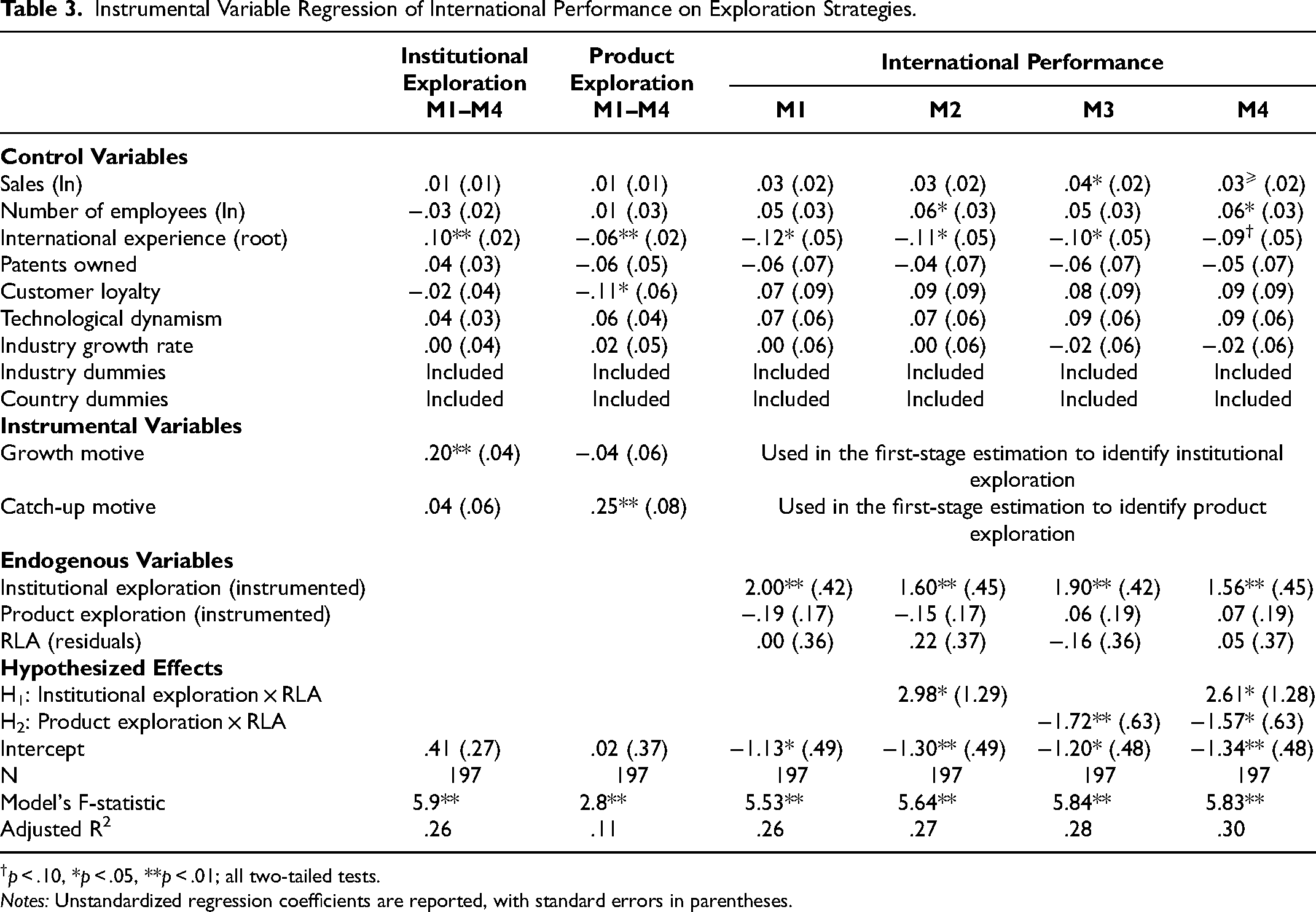
p < .10, *p < .05, **p < .01; all two-tailed tests.
Notes: Unstandardized regression coefficients are reported, with standard errors in parentheses.
With respect to instrument exogeneity, tests of overidentifying restrictions require the number of instruments to exceed the number of endogenous variables. To run these tests, we decomposed the growth and catch-up motives into their constituent items and ran tests for overidentifying restrictions on a model that used each of these items as an instrument (rather than the scales on which the items were used). For both institutional and product exploration, Sargan's test of overidentifying restrictions turned out to be insignificant (p = .48 and .47, respectively), thus supporting the exogeneity of the items employed in building our instruments. To assess the necessity of correcting for endogeneity, we ran the Wu–Hausman specification tests, which turned out to be significant for both exploration strategies (p < .01). This indicates that these novelty-seeking strategies are endogenously determined, and our instrumental variable estimation produces significantly different results than those produced without modeling endogeneity.
Results
Table 3 (right-hand-side models) reports the results of regressing international performance on institutional and product exploration strategies and RLA. To test our hypotheses, we proceed with four sequential models in which the interaction terms (i.e., institutional exploration × RLA and product exploration × RLA) are sequentially inserted into the regression analysis. All four models were significant (p = .00), with increasing adjusted R-square values while proceeding through consecutive models. Our moderation hypotheses imply various relationships between exploration strategies and international performance, depending on the level of RLA. As elaborated by Spiller et al. (2013) and Irwin and McClelland (2001), in moderated effects, the coefficient of lower-level terms (i.e., of product and institutional exploration and RLA) cannot be interpreted as the “main effect.” These “regression terms that authors sometimes interpret as ‘main effects’ are actually simple effects of an interacting variable in a product term when other variables in that product (interaction) term are coded as 0” (Spiller et al. 2013, p. 278). Given our mean-centering of interaction terms, zero values map into mean levels (i.e., institutional exploration, product exploration, and RLA are coded as 0 at their mean levels).
In particular, the coefficient of product exploration in the regression of international performance is nonsignificant across all models in Table 3, suggesting that the relationship between product exploration and international performance is indistinguishable from zero at the mean level of RLA. The moderated impact of product exploration implies various relationships between product exploration and international performance, wherein both the strength and direction of the relationship can change depending on the RLA level. Additionally, the relationship may be insignificant at certain moderator levels. In the case of product exploration, lower degrees of RLA (i.e., direct interaction with foreign markets) aid in the effective absorption and transfer of demand-side stimuli, thereby upholding performance-enhancing product adaptation at those levels of RLA (wherein additional costs due to undermined economies of scale are recouped by the effective incorporation of market stimuli). Contrastingly, higher levels of RLA can distort the absorption and transfer of demand-side stimuli and inhibit the materialization of the upsides that accrue from effective adaptation. Accordingly, it is not surprising that the impact of product exploration on performance is insignificant at the average RLA level (leading to a nonsignificant coefficient in Table 3). 12
We use Models 2 and 4 to examine how RLA moderates the impact of institutional exploration on performance. The coefficient of the moderating term (institutional exploration 

Marginal Effect of Institutional Exploration on Performance

Marginal Effect of Product Exploration on Performance
The solid line in Figure 2 tracks the marginal effect of institutional exploration at various RLA levels. One important addition (compared with Equation 1) is the dashed outer lines that represent the 95% confidence interval around the point estimates to capture the uncertainty regarding these estimates throughout the moderator range rather than merely at RLAmean ± SDRLA, as in the customary illustrations (Meyer, Van Witteloostuijn, and Beugelsdijk 2017).
The marginal effect of institutional exploration (solid line in Figure 2) remains positive throughout the RLA range. However, this positive relationship becomes statistically indistinguishable from zero at low RLA levels. When the RLA falls below .27, the 95% confidence intervals (outer dashed lines) start to include 0, suggesting that at low levels of the moderator (RLA < .27), the impact of institutional exploration on performance becomes insignificant. Both Figure 2 and Equation 1 support the idea that RLA augments the marginal effect of institutional exploration (on performance). This illustrates the significance of local partnerships in the performance consequences of institutional exploration. All else being equal, without sufficient support from local alliances and intermediaries, the positive performance consequences of institutional exploration diminish, as reflected in how the marginal impact of institutional exploration becomes nondistinguishable from zero at low RLA levels.
We use Models 3 and 4 to examine the inhibitive role of intermediaries in the product exploration–performance relationship. The coefficient of the moderation term (Product exploration × RLA) is negative (b = −1.72) and significant (at p < .01) in Models 3 and 4. Based on the coefficient of product exploration and this moderation effect, the relationship between product exploration and performance can be specified as
The solid line in Figure 3 tracks
Thus, higher RLA levels can shift the performance consequences of product exploration from significantly positive to significantly negative. This demonstrates the criticality of unmediated interactions with foreign markets (i.e., low RLA) in extracting positive performance consequences from product exploration strategies in international markets. Excessive RLA undermines the absorption and transfer of demand-side knowledge to effectively guide the adaptation process. This erodes the fruitfulness of adaptation costs (e.g., compromised scale) and leads to negative performance consequences from product adaptation.
Discussion
Much of the existing literature tends to bundle a firm's novelty-seeking in the institutional and product domains, with the former often taken as a proxy for the latter. We argue that institutional and product exploration can stem from different priorities in a firm's internationalization (growth and catch-up), causing the degree of product exploration to vary substantially at a given level of institutional diversity across the firm's targeted markets. The significance of this distinction is apparent from our finding that novelty-seeking strategies demand different approaches in terms of reliance on local partners and maintenance of unmediated interactions with foreign market stimuli. We show that aggressive expansion across heterogeneous institutional boundaries is enhanced by tapping into the absorptive capacity of partners, which enables the crossing of discontinuities in institutional principles without necessarily engaging in deep learning. By contrast, capitalizing on product-related insights and knowledge in foreign markets requires maintaining unmediated interactions with foreign markets to effectively absorb and transfer associated knowledge inputs. These findings have several theoretical and managerial implications.
Theoretical Implications
First, the conduciveness of local partnerships as a medium of interaction with foreign-based novelty has been subject to various conceptualizations and empirical evidence. Some strands of the literature conceptualize alliances and partnerships as conduits for learning (Hamel 1991; Inkpen and Tsang 2007; Zhang et al. 2010), tapping into local information flows (Cavusgil 1998; Sousa, Li, and He 2020) and building absorptive capacity overseas (Li and Fleury 2020). In contrast, others have argued that due to their “ability to use multiple mechanisms of knowledge transfer flexibly and simultaneously to move, integrate, and develop” knowledge, hierarchies are superior in facilitating the “flow of knowledge across borders” (Almeida, Song, and Grant 2002, p. 147). Thus, partnering to engage with foreign markets interjects the firm's interaction with foreign stimuli and dilutes the associated benefits, given the lower communication modality of interorganizational channels of knowledge transfer (Almeida, Song, and Grant 2002; Salomon 2006b) and socialization complications involved in cross-border relationships (Barkema, Bell, and Pennings 1996; Goerzen and Beamish 2005; Leonidou et al. 2014).
Our results support the idea that the auxiliary role of alliances in facilitating or inhibiting a firm's exploratory international search for foreign-based novelty depends on the knowledge type that determines the capacity in which a firm's homegrown knowledge structures are engaged with new knowledge. While partnerships and interfirm relationships are conducive to dealing with institutional novelty, they are not optimal for absorbing and capitalizing on various demand-side stimuli in foreign markets. In dealing with institutional novelties, the partner can act as a scaffold that brings new knowledge within reach, owing to its familiarity with the unknown paradigm. In these circumstances, the complications of relationship building and working with cross-organizational resources, that is, double-layered acculturation (Barkema, Bell, and Pennings 1996), can be offset by tapping into the partner's absorptive capacity. In contrast, demand-side insights and the new competitive landscape produce valuable inferences and insights about new product ideas only when combined with the firm's current knowledge structures and unique skill sets (Qin, Mudambi, and Meyer 2008). This gives the firm superior absorptive capacity and transfer prowess in dealing with demand-side knowledge (given the tacit and embedded nature of knowledge input). 14
Second, research on performance consequences of product (and in general, marketing-mix) adaptation has produced “mixed” results (Theodosiou and Leonidou 2003, p. 166) with the issue remaining “contentious and largely unresolved” (Hultman, Robson, and Katsikeas 2009, p. 17). At the conceptual level, standardization brings about economies of scale and efficiency accruals, while adaptation leads to greater customer satisfaction, product inventiveness, and learning. However, costs and upsides differ in one important respect: whereas costs accrue irrespective of the effectiveness of adaptation, the materialization of upsides (e.g., customer satisfaction and product learning) hinges on developing insights into the customer and incorporating these adapted designs. In this sense, a given degree of adaptation would lead to positive performance outcomes when market-related insights are effectively incorporated to recoup the additional design and manufacturing costs. Our results suggest that direct and unmediated interactions with foreign markets play a significant role in extracting potential performance benefits from product adaptation, given a firm's superior absorptive capacity in capturing demand-side stimuli and its superior capacity in transferring this knowledge to cross-fertilize technical knowledge. Admittedly, many studies have argued and provided empirical support for the superiority of direct interaction with foreign markets for the effective absorption of foreign market stimuli (Bai, Krishna, and Ma 2017; Di Cintio, Ghosh, and Grassi 2020; Salomon 2006b). However, the literature on the performance consequences of product adaptation has not paid sufficient attention to the associated implications of this effectiveness on the relationship between product adaptation and international performance. Our results suggest that these mostly unconnected streams of work have interesting implications for each other because direct engagement with foreign markets is necessary to extract favorable performance consequences from product adaptation.
Third, the extensive literature on international economics has examined the learning effects of exports and international trade in the form of enhanced productivity (De Loecker 2013; Wagner 2007) and product innovativeness (Bratti and Felice 2012; Filipescu et al. 2013; Grossman and Helpman 1991; Liu and Buck 2007). Traditionally, the literature overlooks the variations across export structures, with no differentiation between integrated and nonintegrated export arrangements (Bai, Krishna, and Ma 2017; Di Cintio, Ghosh, and Grassi 2020). Some studies in this vein have begun to distinguish between direct (i.e., direct interaction with customers) and indirect (i.e., through intermediaries) export arrangements, yet have often assigned a facilitative role to intermediaries. It is argued that intermediaries reduce fixed costs and information asymmetries, while facilitating market access (Ahn, Khandelwal, and Wei 2011; Bernard et al. 2007). Interestingly, a few studies find that the relationship between exports and product innovation disappears almost entirely under indirect exporting arrangements (Di Cintio, Ghosh, and Grassi 2020). Our findings allude to a reconciliation path for these conflicting conceptualizations of intermediary roles. Perhaps intermediary recruitment is more conducive to one set of export outcomes (i.e., enhanced productivity) than to another (i.e., product innovativeness). By facilitating access to markets and reducing information asymmetry, indirect exports support aggressive growth and are, therefore, more conducive to realizing economies of scale and productivity, often interpreted as process innovation (Kostevc 2005). However, intermediaries may degrade the process of absorbing and transferring information about customer preferences, feedback, competing products, and various knowledge inputs in foreign contexts that feed the firm's innovation processes (Campa and Guillen 1999; Di Cintio, Ghosh, and Grassi 2020). Differences in the functionality of various export structures may explain why some studies find support for only one set of conceptualized export outcomes (i.e., either enhanced productivity [Damijan and Kostevc 2015] or product innovativeness [Liu and Buck 2007; Salomon and Shaver 2005] rather than both), as they may have concentrated on the export structure that supports their unveiled outcome.
Managerial and Policy Implications
During the early stages of internationalization, firms are often risk averse and resource constrained, limiting their ability to invest in foreign markets. Meanwhile, newly internationalizing firms face the liability of foreignness in international markets. To overcome both resource constraints and the liability of foreignness, internationalizing firms tend to forge partnerships with host country firms. Our results suggest that managers should exercise caution when deciding the degree to which they rely on collaborative arrangements in foreign markets. In other words, when a firm internationalizes with the purpose of catching up and enhancing its product innovativeness (Anand et al. 2021; Bratti and Felice 2012; Salomon and Shaver 2005), alliances can act as barriers to the effective absorption and transfer of foreign market stimuli and intelligence. In this case, the internationalizing firm is better off making the investments in its own downstream infrastructure in the foreign market, even if the entry mode is costly. In contrast, foreign alliances are useful when internationalization is geared toward dealing with the institutional novelties of foreign markets. The multiplicity and dissimilarity of institutional contexts make it difficult for a firm to internalize knowledge and expertise to appreciate the deep-seated differences in expectations and rules in various contexts. Relying on alliance partners embedded in the local institutional context enables an internationalizing firm to navigate a foreign country's various regulatory and cultural norms.
Our study also has implications for local firms seeking to partner with exporting firms in foreign markets. These findings suggest that an important aspect of becoming a desirable local partner is understanding the internationalizing firm's motive to capture and effectively transmit information that responds to that motive. When internationalization is geared toward capitalizing on demand-side stimuli, it becomes critical for the local partner to build absorptive capacity and develop effective interpartner transmission channels to transfer market intelligence and customer feedback in their full richness. Given the complexity and situated nature of demand-side knowledge (e.g., see Salomon 2006b; Tyre and Von Hippel 1997), this may involve temporary hosting of an internationalizing firm's staff in target markets or temporary placement of a partner's sales personnel in technical departments of the internationalizing firm to build interpartner common ground and understanding (Santos, Doz, and Williamson 2004). Greater interactions and socialization would not only enhance the partner firm's absorptive capacity in appreciating and assimilating demand-side stimuli but also increase the modality of interfirm transmission channels for this type of information.
For policy makers, our results cast doubt on policy initiatives in some emerging economies that encourage the initiation of alliances and partnerships with the express purpose of building local capability (Li and Kozhikode 2009; Vonortas and Safioleas 1997). By contrast, our findings suggest that the performance outcomes of local partnerships are contingent on the purpose of firm internationalization. Interestingly, RLA turns out to be unfavorable when a firm intends to capitalize on foreign market stimuli and enhance its product inventiveness through foreign market expansion. Thus, home country policy makers should not impose foreign market-entry partnerships on their internationalizing firms; instead, they should give them the discretion to partner or integrate downstream activities based on their international strategic motivation.
Limitations and Future Research Directions
Our study is constrained in several ways. First, the empirical context of this study is restricted to international expansion through exports. Exporting is usually the first stage of a firm's internationalization process. As firms increase their international involvement through modes such as equity joint ventures, licensing, greenfield and acquisition foreign direct investment, and so on, the mechanisms of foreign knowledge transfer may differ from those of exporting firms. Future studies should examine the conduciveness of local partnerships in facilitating (or inhibiting) exploratory searches in other entry modes. These studies may also employ a more fine-grained treatment of reliance on partnerships to examine whether certain forms of interfirm arrangement have fewer inhibitory effects on the performance consequences of product exploration in foreign markets. Second, we study firms from Brazil, Chile, and Mexico, three emerging Latin American economies, where firm internationalization is driven by exploratory motives (Makino, Lau, and Yeh 2002) and exporting is the primary medium of firms’ contact with international markets, given the export promotion policies in such countries (Jonakin 2007). While these countries are geographically and culturally proximate, there is no apparent reason to suggest that the empirical support for our hypotheses is an artifact of the cultural or geographical origins of these companies. Our research does not revolve around any unique features of these countries, and we merely use these countries as instances of emerging economies wherein exploratory motives play a significant role in driving firms’ internationalization and exporting is the primary mode of interaction with foreign markets. However, in the absence of greater diversity in the national origins of our sampled firms, we cannot refute potential generalizability concerns as a limitation of our study.
Third, the existing research supports the impact of entrepreneurial orientation, willingness to change, and development culture on a firm's product exploration (Dayan et al. 2016). The potential moderating effects of these factors on the performance consequences of product exploration are another avenue for future research. Fourth, our measurement of product exploration is proxy based and mostly reflects a firm's degree of product adaptation in international markets. This provides a cross-section of the firm's product exploration efforts (to engage with foreign-based novelty) and does not capture any previous experimentation. Furthermore, the scale entails two items with scale reliability (alpha = .62) that marginally exceeds the minimum .60 recommended value (Pallant 2001). Unfortunately, our data limitations do not allow us to capture this concept in its full richness through additional items from a process perspective. Finally, the performance consequences of exploratory endeavors tend to unfold over time (March 1991) and therefore may not be fully captured in cross-sectional studies. In fact, we find that product exploration and learning (which are sometimes considered an integral part of EEFs’ internationalization) produce favorable performance consequences under low RLA. This may stem from potential lags in appropriating the performance gains of experimentation in the product domain that are not fully reflected in the narrow time frame of cross-sectional studies. Therefore, examining the long-term consequences of partnerships in materializing the benefits of exploratory search remains another avenue for future research. We hope that our differentiation between product and institutional exploration strategies will lead to further studies that align the structure of foreign operations with their intended purposes and the type of novelty sought by the firm (Clougherty, Duso, and Muck 2016).
Footnotes
Appendix: Customary Illustrations of Our Interaction Effects
This appendix provides a customary illustration of our two moderation effects. As explained in footnote 13, given the continuous nature of our moderator, we favored a more informative illustration in the main body of our text. Figure A1, Panel A, draws the relationship between institutional exploration and performance one standard deviation above (solid line) and one standard deviation below (dashed line) the average RLA. To capture the uncertainty of the point estimates, we draw the 95% confidence intervals around point estimates as indicated by capped spikes and bars. Consistent with Equation 1 (and Figure 2), at higher levels of RLA, institutional exploration has a more positive impact on a firm's international performance, illustrating the role of intermediaries and alliances in extracting favorable performance consequences from institutional exploration.
Figure A1, Panel B, draws the relationship between product exploration and performance at one standard deviation above (solid line) and one standard deviation below (dashed line) the average RLA, with 95% confidence intervals shown around the point estimates. Consistent with Equation 2 (and Figure 3), the dashed line shows how direct interaction with foreign markets (i.e., low RLA levels) allows the firm to extract positive performance consequences from its product exploration strategies in international markets.
Editor
Kelly Hewett
Associate Editor
Matthew Robson
Declaration of Conflicting Interests
The authors declared no potential conflicts of interest with respect to the research, authorship, and/or publication of this article.
Funding
The authors received no financial support for the research, authorship, and/or publication of this article.
