




Abstract
Although price increases are common in business-to-consumer and business-to-business (B2B) markets, research examining the consequences of price increases on financial performance outcomes in B2B contexts is scarce. This study takes a relationship perspective on price increases and examines how a portfolio price increase affects the financial performance of the customer relationship and whether and how this effect varies between international business customers from different cultures. Based on objective data from 966 international B2B customers of a chemical goods company, this study examines a large-scale field intervention. Results show that higher portfolio price increases, although rooted in an increase of upstream costs, bring more severe harm to B2B customers’ sales revenue than lower portfolio price increases. These consequences vary with customers’ cultures as B2B customers with culture-specific communal norms are more susceptible to the magnitude of portfolio price increases than customers without such norms. International B2B companies, therefore, need to refrain from implementing uniform price increases and should consider their business customers’ cultural origin when designing and implementing price increases.
Increasing prices of raw materials and the positive development of the price index in countries around the world diminish the profit margins of many industrial companies (Abdelnour et al. 2021). Although price increases reflect a plausible answer to higher input costs, they harm the attractiveness of the offering for customers and thereby lower future sales volumes (Homburg, Hoyer, and Koschate 2005; Homburg, Koschate, and Totzek 2010; Sen, Gürhan-Canli, and Morwitz 2001). Companies must therefore carefully consider how their customers react to price increases to prevent a situation in which desired profit gains lead to a harmful decrease in revenue.
Whereas extant research on price increases yields valuable insights for consumer goods markets (e.g., Homburg, Hoyer, and Koschate 2005), insights on effectively implementing price increases in international business-to-business (B2B) markets are limited. This is an important issue, as buying decisions differ between consumer markets and international B2B markets. First, in B2B markets, professional buyers decide for their companies. They focus more on objective price information, negotiate prices individually, and purchase only because of production or profitability needs (e.g., Forman and Lancioni 2002; Monroe, Rikala, and Somervuori 2015; Reid and Plank 2003). Second, customer relationships are more valuable assets in B2B markets as customers often purchase a portfolio of products in long-term relationships with suppliers (Palmatier, Scheer, and Steenkamp 2007; Schmitz et al. 2020). Third, while in international business-to-consumer (B2C) markets, prices are typically adjusted to national markets, more than 30% of B2B sales managers still deploy price increases uniformly (Brzoska and Biermann 2022). However, not accounting for heterogeneity across international customers reflects a serious issue in the implementation of price increases (Hamilton et al. 2021; Hazan et al. 2022).
Therefore, the goals of this study are to explore the consequences of the magnitude of price increases on B2B customers’ financial performance (in terms of sales revenue), and whether and how these vary across customers’ cultural contexts. To account for the relationship (instead of the transaction) emphasis in B2B business, we focus on a portfolio price increase (PPI) and its magnitude, which we define as the relative increase of prices paid for the portfolio of products that the customer purchases from the supplier.
In our conceptual model, we build on relationship norms to conceptualize the impact of PPIs on relationships with international B2B customers (e.g., Clark and Mills 1979). In line with B2C pricing theory, one may expect that a PPI for customers relying on exchange norms should harm sales revenues since customers only face additional costs. In contrast, customers who rely on communal norms (e.g., solidarity) may be more motivated to retain business after a PPI, especially if justified by higher input costs (Kahneman, Knetsch, and Thaler 1986). Whereas the consequences of price increases for consumers are evident, as they rely on either exchange norms or communal norms (e.g., Chen et al. 2018), evaluating price increases in B2B may be more complicated. B2B companies aim to maximize utility and follow exchange norms (Einhorn 1994), but their actions are conducted by individual B2B buyers who forge relationships with salespeople and, thus, may also rely on communal norms (Palmatier, Scheer, and Steenkamp 2007). Hence, B2B companies may rely on both exchange and communal norms when evaluating price increases. As lower PPIs are more likely to fall within B2B buyers’ price discretion, they can respond in line with communal norms, potentially buffering business losses. Yet, higher PPIs may exceed their price discretion or even violate communal norms, making buyers rely on exchange norms and reduce business. We suggest that the effect of the magnitude of PPIs and, thus, the application of communal norms depend on B2B customers’ cultures (Chen et al. 2018). Hence, we examine whether and how the effect of PPI magnitude on B2B customers' sales revenue varies across cultures.
To test our conceptual model, we rely on objective data from 966 international B2B customers of a chemical commodity goods company. In response to rising costs for raw materials, the company's management passed on these cost increases by calculating new target prices for products that were particularly affected by the cost increase and implemented a worldwide price increase for those products. As a result, customers were affected differently by the price increase depending on their product portfolio bought from the supplier, yielding a large-scale, quasi-experimental field intervention for our investigation. Whereas the price increase did not affect the product portfolios of some customers, it affected the product portfolios of other customers at heterogeneous levels. We build on longitudinal company records of one year before and one year after the intervention. To examine how the effect of the PPI differentiates between cultures, we rely on country-specific data on Hofstede's (1984, 2011) dimensions of long-term orientation, power-distance belief, and masculinity and matched this information to customer data.
Results of a robust difference-in-differences (DiD) multilevel model (customers nested in countries) with preintervention and postintervention data show that the magnitude of a PPI harms B2B customers’ sales revenues and that this effect varies with the cultural characteristics of the B2B customer's country. Specifically, B2B customers with culture-specific communal norms (high long-term orientation and low masculinity, as defined by Hofstede [1984]) react less negatively to lower price increases than B2B customers without such norms. Because of this buffer effect, the impact of higher PPI magnitude is more severe for these customers, and sales revenues decline more sharply with each percentage of higher prices.
Our findings provide important implications for research on international pricing, global account management, and export sales. First, previous research on price increases has predominantly focused on B2C markets (e.g., Homburg, Hoyer, and Koschate 2005; Lu et al. 2020) but remains limited in international B2B markets (e.g., Bruno, Che, and Dutta 2012). We account for the long-term nature of B2B relationships by adopting a relational perspective examining the impact of the average price increase for the entire product portfolio bought. This allows us to account for potential spillover effects of price increases on customers’ further purchases. Our results imply that, in most B2B commodity markets, even small PPIs do not increase sales revenues with the affected customer because the PPI hampers customers’ overall demand. Second, our results indicate differences in the financial consequences of price increases between B2C and B2B markets. According to the dual-entitlement principle, consumers should react less negatively to price increases if these are aligned to cost increases (e.g., Bolton and Alba 2006; Kahneman, Knetsch, and Thaler 1986). Our results imply that the dual-entitlement principle may not hold in B2B commodity contexts as PPIs, although being justified by cost increases, can harm B2B customers’ sales revenues. Third, we contribute to research on global customer account management and export sales, which has identified customers’ cultural values as a boundary condition explaining differences in business customers’ purchasing behavior (e.g., Habel et al. 2020). We advance this literature stream by revealing that B2B customers with culture-specific communal norms (i.e., long-term orientation and low masculinity) are more susceptible to the magnitude of PPIs. Thereby we identify that B2B customers' cultural-value based dimensions also affect their price-related purchasing decisions.
In addition, our findings provide valuable implications for international B2B companies, customer account managers, and salespeople. Our insights allow B2B companies to align pricing decisions with cultural conditions to buffer against negative effects on future growth. If price increases are inevitable (e.g., in response to raw material cost increases), global account managers may use our findings to identify business customers from susceptible cultures and initiate measures to strengthen relationships a priori or compensate for higher costs ex post.
Literature Review: Boundary Conditions of the Consequences of Price Increases
Table 1 provides an overview of previous research on the consequences of price increases. Compared with the consequences of price decreases (i.e., price promotions, discounts), the consequences of price increases have received relatively little attention in extant research. The main objective of previous research has been to explore whether the consequences of price increases are the opposite of the consequences of price decreases (e.g., Bruno, Che, and Dutta 2012; Han, Gupta, and Lehman 2001; Tarrahi, Eisend, and Dost 2016). Multiple studies have found support for this notion by finding that the occurrence (Bolton and Alba 2006; Homburg, Koschate, and Totzek 2010) and the magnitude (e.g., Bruno, Che, and Dutta 2012; Homburg, Hoyer, and Koschate 2005) of price increases can have negative consequences on price fairness perceptions and customer outcomes. However, in their work on the dual-entitlement principle, Kahneman, Knetsch, and Thaler (1986) revealed that customer reactions to price increases do not have to be the opposite of the positive consequences of price decreases because customers permit firms to pass on cost increases by increasing prices.
Review of Selected Studies on Price Increases.

Based on these findings, previous studies have identified further boundary conditions affecting how the occurrence and the magnitude of price increases influence customers’ price fairness perceptions and performance outcomes. These boundary conditions can be categorized into (1) the reason for the price increase and how it is communicated, (2) the relationship between the customer and the company, (3) the consumption context, and (4) customers’ characteristics. In addition, there are initial insights on (5) how the consequences of price increases differentiate between customers having different cultural backgrounds, and (6) only one study has investigated the consequences of price increases in B2B markets (Bruno, Che, and Dutta 2012). What remains unclear, and is particularly important for managers and salespeople serving international customers, is whether and how the consequences of price increases vary between B2B customers having different cultural backgrounds. In the following, we describe extant research on the consequences of price increases and the research gap the current study addresses.
First, multiple studies have expanded on the findings of Kahneman, Knetsch, and Thaler (1986), who show that price increases justified by higher upstream costs do not exert a negative impact on customers’ fairness perceptions. Bolton and Alba (2006) show that price increases that are aligned to cost increases are perceived as fairer, and Lu et al. (2020) show that the consequences of price increases differ between price increases implemented because of cost increases or higher demand and price increases that were implemented without providing a reason. Furthermore, price increases based on fair motives are perceived as fairer (Homburg, Hoyer, and Koschate 2005), and framing the communication of price increases as a percentage increase decreases the likelihood of future purchases to a higher extent (Homburg, Koschate, and Totzek 2010).
Second, several studies have focused on how customer–company relationships influence the consequences of price increases. Whereas the detrimental impact of higher price increases on customer retention is less negative in long-term customer relationships, this effect is more negative for customers having a broad relationship breadth (Dawes 2009). Furthermore, customers’ satisfaction with the company reduces the negative impact that the magnitude of price increases has on customer retention with the company (Homburg, Hoyer, and Koschate 2005), and the strength of salesperson–customer relationships leads to a greater customer sensitivity in their reactions to price increases (Bruno, Che, and Dutta 2012).
Third, the consequences of price increases differ between consumption contexts. The occurrence of a price increase that is not aligned with costs has a less negative impact on price fairness perceptions when it is for a service than when it is for a good (Bolton and Alba 2006). Further, in market environments in which price uncertainty is high, consumers are more likely to accept price increases (Han, Gupta, and Lehman 2001).
Fourth, further boundary conditions influencing the consequences of price increases are customer characteristics. Customers having higher deal proneness are more sensitive to both price increases and price decreases (Han, Gupta, and Lehman 2001), and customers’ income attenuates the negative effect of price increases on purchase intention (Homburg, Koschate, and Totzek 2010).
Fifth, there is initial evidence that the consequences of price increases differ between customers having different cultural orientations. Chen et al. (2018) conclude that customers’ fairness perceptions after price increases rooted in cost increases do not differ between both customers of collectivistic and individualist cultures and customers having an interdependent and independent self-construal. Thus, there is initial evidence that customers' individualism and independence do not influence the consequences of the occurrence of price increases. However, it remains unclear whether and how the consequences of the magnitude of price increases differ according to other cultural value-based dimensions.
Finally, the majority of studies researching price increases focus on B2C markets, yet there is a limited understanding of the consequences of price increases for business customers. Initial evidence shows that price increases harm purchase quantities and that business customers respond more strongly to price increases than to price decreases (Bruno, Che, and Dutta 2012). However, as B2B markets are highly diverse, further research is needed to understand how price increases influence B2B customers’ sales outcomes. Consequently, there is only limited research on price increases in B2B and their consequences for international B2B customers with different cultural backgrounds.
Conceptual Development
Overview
Figure 1 presents our conceptual model. We investigate how the magnitude of a PPI influences international business customers’ sales revenues in a B2B commodity market. To conceptualize the impact of PPIs with varying magnitudes, we refer to theory on relational norms (e.g., Clark and Mills 1979). We expect that individual buyers rely on communal norms when experiencing PPIs with lower magnitudes, potentially safeguarding against business reductions. However, PPIs with higher magnitudes likely limit buyers from relying on communal norms and pressure them to rely more on exchange norms in response to the price increase. These make them reduce business with the supplier. In consequence, we posit that in typical commodity contexts, characterized by higher price elasticities and lower switching costs, the magnitude of PPIs has a negative impact on B2B customers' sales revenue (H1). Importantly, we further examine how this proposed effect varies between customers from cultures that emphasize the development of communal norms (H2–H4), as indicated by the respective country's cultural dimensions. These cultural value-based dimensions (Hofstede 2011) should influence the extent to which business customers rely on communal norms or exchange norms when evaluating the magnitude of the PPI.

Conceptual Model.
B2B Buying Decisions and Relationship Norms
Relationship norms differ between exchange relationships and communal relationships. Whereas exchange relationships follow exchange norms that are characterized by a high self-interest among each party, communal relationships follow communal norms that are characterized by a concern for other parties in the relationship (e.g., Clark and Mills 1979). Our key rationale is that B2B customers evaluate price increases based on both exchange norms and communal norms because industrial buying decisions involve (1) the B2B customer company and (2) individual buyers employed by the company.
First, B2B customer companies are economic actors aiming to safeguard performance and increase profits. As a result, B2B companies should expect their buyers to rely on exchange norms to evaluate a price increase and to react in line with the economic principles of markets. According to these principles, higher prices should be associated with lower demand (e.g., Bolton and Lemon 1999; Einhorn 1994; Homburg, Hoyer, and Koschate 2005) because a price increase leverages the perceived overall (financial) costs of the business relationship and deteriorates the balance between perceived benefits and costs.
Second, B2B companies employ individual buyers with bounded rationality who develop personal relationships with the supplier’s salespeople (e.g., Monroe, Rikala, and Somervuori 2015). These individual buyers may also rely on communal norms to evaluate a price increase. The communal norms they rely on during interactions with representatives of the selling company make them more likely to accept price increases, such as those rooted in material cost increases, because they become more sensible and responsive to the supplier's need to remain profitable (Clark and Mills 1979). Thus, B2B customer companies should react to PPIs not only based on exchange norms but also based on communal norms, as individual buyers make decisions for their company and may be influenced by communal norms.
The Effect of the Magnitude of a Portfolio Price Increase on B2B Customer's Revenue
We expect that the magnitude of a PPI influences the impact of a PPI on sales revenue generated with a customer. Whereas PPIs with a lower magnitude enable B2B buyers to rely on communal norms when reacting to it, PPIs with higher magnitude should limit them in relying on communal norms, and oblige them to react in line with exchange norms. Therefore, the higher a price increase, the lower the customer demand should be (e.g., Bruno, Che, and Dutta 2012; Homburg, Hoyer, and Koschate 2005).
B2B buyers tend to apply communal norms when evaluating price increases as they aim to secure future cooperation with sales representatives of the supplier and the stability of their supply. However, higher PPIs likely pressure individual buyers to follow exchange norms in making their purchasing decision. This is because individual buyers of B2B companies only have limited autonomy to accept higher prices and are responsible for providing a rational justification for accepting higher prices (i.e., on the basis of objective criteria; e.g., Sheth 1973). Since a price increase is not associated with benefits for the customer, the higher the price increase, the more difficult a justification based on communal norms becomes, given that the benefit of maintaining these norms is difficult to objectively measure. Further, individual buyers need to ensure their company's economic success to protect their employment at the firm. That is, the higher the economic costs for their own company (resulting from higher price increases), the less (cf. more) likely may communal (cf. exchange) norms determine their purchasing decision. 1
According to exchange norms, a price increase puts the customer at a disadvantage. In response, the customer will likely decrease engagement in the relationship, harming the revenue generated with that particular customer. B2B customers may (1) stop further investments in the relationship, or (2) even reduce existing business conducted with the supplier. Regarding the first of these possibilities, customers who perceive business relationships as unbalanced or unfair may be less inclined to expand the relationship (e.g., Dwyer, Schurr, and Oh 1987) by increasing their existing business (up-buying) or to cross-buy other product categories from the company. Regarding the second possibility, higher prices may reduce the difference in costs to switch (e.g., search costs) and costs to maintain the relationship with the supplier, increasing the risks that customers switch and source substitutes from competitors (e.g., Morgan and Hunt 1994).
In the focal B2B commodity context, we expect customers’ hampered demand to outweigh the benefits from higher prices, resulting in lower sales revenues (i.e., price times demand). In these contexts, customers’ demand tends to decrease disproportionally to an increase in price (i.e., high price elasticities; e.g., Gallo 2015), as there is often a high supply for substitute products and more suppliers in the global market, which makes it more attractive for customers to switch business to alternative suppliers when confronted with higher costs. That is, price increases may not compensate for the losses in customers’ demand, and, as a result, sales revenues likely decline. 2 Concluding, we hypothesize:
Hofstede's Cultural Value-Based Dimensions as Contingency Factors Influencing Consequences of Price Increases
We build on Hofstede's (1984, 2011) cultural value-based dimensions to explore whether and how the effect of the magnitude of a PPI on customers’ sales revenue differs between customers’ different cultural backgrounds. Hofstede's (1984) operationalization of cultures has been adopted in numerous international marketing studies (e.g., Ahmadi et al. 2022; Dawar, Parker, and Price 1996; Nakata and Sivakumar 2001; Samiee and Jeong 1994; Søndergaard 1994) and has been used to explain differences in marketing communications and consumer behavior (e.g., Ahmadi et al. 2022; Bahadir and Bahadir 2020; Dwyer, Mesak, and Hsu 2005; Eisingerich and Rubera 2010; Kim 2020; Pick and Eisend 2016).
We suggest that the effect of the magnitude of PPIs on B2B customers’ sales revenue differs between customers from various cultural backgrounds because these differ in the extent to which they rely on communal norms and exchange norms to evaluate their relationship with the supplier (Brockner et al. 2005; Chen et al. 2018; Li and Cropanzano 2009; Shen, Wan, and Wyer 2011). Specifically, B2B buyers with culture-specific communal norms should be more susceptible to the magnitude of PPIs than B2B buyers without such norms. That is because B2B buyers with culture-specific communal norms should react less negatively to lower PPIs (than B2B buyers without culture-specific norms), as these allow them to react in line with their communal norms. Higher PPIs, in contrast, limit B2B buyers from relying on their culture-specific communal norms because they have less discretion to decide about the price based on their individual norms. Thus, although B2B buyers who rely on culture-specific communal norms should react less negatively to lower PPIs, their communal norms are unlikely to buffer their reactions to higher PPIs. Hence, the consequences of higher (vs. lower) PPI magnitude should be more negative (vs. positive) for customers relying on culture-specific communal norms.
Especially relevant for investigating differences in business customers’ relationship norms are customers’ short- versus long-term orientation, power distance, and femininity versus masculinity. These cultural value-based dimensions should influence whether B2B customers rely on culture-specific communal norms when evaluating price increases: Business customers from long-term-oriented societies engage in business relationships with a future orientation norm aiming for positive long-term outcomes (Minkov and Hofstede 2012). Customers from societies with low power distance have the norm that power is distributed equally in a business relationship (Begley et al. 2002; Lee, Pillutla, and Law 2000). Finally, customers from feminine societies rely on the norm of solidarity in cooperative relationships (Chiang and Birtch 2007). In the following, we hypothesize on why the consequences of lower (vs. higher) PPIs are more positive (vs. negative) for B2B customers relying on these culture-specific communal norms.
Short-Term Versus Long-Term Orientation
Long-term orientation describes the extent to which people exhibit a pragmatic future-oriented perspective rather than a short-term point of view (De Mooij and Hofstede 2010; Hofstede and Bond 1988). Compared with individuals in short-term-oriented societies, individuals in long-term-oriented societies are more likely to adapt their traditions to changed circumstances, have higher savings, and place lower importance on actions that reinstate their personal stability (De Mooij and Hofstede 2010; Hofstede 2011; Taras, Kirkman, and Steel 2010). Long-term-oriented B2B buyers should seek positive long-term outcomes in business relationships as they rely on their communal norm of future orientation (Minkov and Hofstede 2012).
Due to their future orientation, we expect long-term-oriented B2B customers to be more susceptible to the magnitude of price increases than short-term-oriented B2B customers. Long-term-oriented B2B buyers' future orientation should make them more willing to shoulder short-term losses due to price increases. That is because they prioritize the relationship over immediate cost savings and should more willingly invest in the relationship with the supplying firm to reap favorable long-term outcomes. However, with an increasing magnitude of PPIs, long-term-oriented B2B buyers are more limited in relying on their future orientation and have to follow exchange norms to a higher extent. There are two reasons for this: First, whereas lower price increases are less likely to threaten the long-term attractiveness of the mutual relationship so that long-term-oriented B2B buyers strive to preserve the relationship (e.g., Kaufmann and Stern 1988), higher PPIs significantly undermine the profitability of the customer company. As a consequence, the application of the communal norm of future orientation may have detrimental consequences for the B2B customer company itself. Second, higher price increases constrain B2B buyers from relying on their communal norm because they have limited discretion to react to the PPI in line with it. Thereby their reaction to higher PPIs becomes more similar to the reactions of B2B buyers having a short-term orientation, who tend to rely on exchange norms when evaluating business relationships. Hence, we expect that the effect of the magnitude of price increases on sales revenue is more negative for customers from long-term-oriented rather than short-term-oriented societies. Thus, we hypothesize:
Low Versus High Power Distance
Power distance reflects the extent to which individuals perceive it as acceptable that power is distributed unequally. In societies with a high power distance, subordinates expect to be told what they should do, and hierarchies are accepted as existential inequality (Hofstede 2011). High levels of inequality regarding power, distance, and wealth are more legitimate, and received outcomes are perceived as something that should not be questioned (Begley et al. 2002; Lund, Scheer, and Kozlenkova 2013). Compared with individuals in societies with a high power distance, individuals in societies with a low power distance value fairness to a higher extent and expect contracts to be fulfilled (Begley et al. 2002; Lee, Pillutla, and Law 2000).
For B2B buyers, the magnitude of a PPI indicates the extent to which a seller respects the balance of power in the relationship with the customer. Whereas lower PPIs signal to the B2B buyer that the seller accepts the buyer's power, higher PPIs might make the buyer question their legitimacy and perceive an imbalance of power. Hence, we expect that the effect of the magnitude of the PPI on B2B customers’ revenue is more negative for customers with a low power distance.
As buyers with a low power distance place higher importance on a balanced power distribution, value fairness to a higher extent, and expect to be heard, they should react less negatively to lower price increases than to higher price increases. Furthermore, when the magnitude of PPIs increases, B2B buyers with low power distance have less discretion to decide about the reaction to the price increase in line with their communal norm. B2B buyers with a high power distance, in contrast, should rely on communal fairness norms to a lesser extent and, thus, should be less susceptible to the magnitude of PPIs. Consequently, we expect that the effect of price increase magnitude on sales revenue is more negative for customers from low (rather than high) power distance cultures:
Femininity Versus Masculinity
Masculinity refers to the extent to which individuals value achievement, heroism, assertiveness, and material rewards (Hofstede 2011). Individuals in masculine societies admire the strong, value the continuity of personal relationships to a smaller extent, have lower solidarity, and care less for the weak (Hofstede 1994). In comparison, individuals in feminine societies prefer cooperation, modesty, caring for the weak, and quality of life (Hofstede 1994).
We expect B2B buyers from masculine societies to rely on self-interest and, thus, to react to price increases in line with the exchange norms of the customer company. In contrast, B2B buyers from feminine societies are more likely to place a higher value on communal norms and evaluate business relationships based on the degree of solidarity practiced. They are more likely to deviate from the exchange norms of the customer company and, therefore, should be more susceptible to the magnitude of PPIs. How B2B buyers from feminine societies react to price increases should depend on whether they evaluate the magnitude of the price increase to be in line with the norm of solidarity and, consequently, whether a cooperative reaction is adequate. B2B buyers from feminine societies may more likely express solidarity and sacrifice their own profits to ensure cooperation and care for the mutual business relationship. Hence, when facing a lower price increase, they may be more motivated to shoulder some of the suppliers’ financial burdens, such as higher upstream costs from an increase in raw material costs.
However, when the magnitude of the PPI increases, they might rely on their culture-specific communal norm to a lesser extent for two reasons. First, B2B buyers might react less cooperatively to higher PPIs because they might perceive them as less cooperative. Second, as their price discretion is limited, B2B buyers are limited in relying on their culture-specific communal norm. In consequence, we expect that the negative impact of the magnitude of PPIs on sales revenue is stronger for customers from feminine rather than masculine cultures:
In addition, Hofstede (2011) identified individualism, uncertainty avoidance, and indulgence as additional cultural value-based dimensions. These three dimensions are unlikely to account for culture-specific communal norms making B2B customers react differently to price increases. Individualism reflects the degree to which people in a society are integrated into groups (Hofstede 2011). Although individualism might account for different reactions to price increases that are implemented differently between groups (Bolton, Keh, and Alba 2010), communal norms are unlikely to differ between individualist and collectivist customers if there are no differences between groups. Further, uncertainty avoidance describes a society's tolerance for ambiguity (Hofstede 2011). Price increases lead to a novel and unknown situation for customers, which might make business customers in societies with high uncertainty avoidance feel more uncomfortable. However, as business customers can cope with the novel situation and reestablish stability by either accepting high prices to maintain the relationship with the supplier or by switching to another supplier to reestablish stability in terms of prices, communal norms relevant to their reaction to price increases are unlikely to differ between low and high uncertainty avoidance. In addition, indulgence refers to societies that value the freedom to enjoy human desires and to enjoy life (Ahmadi et al. 2022; Hofstede 2011). As we focus on B2B customers, indulgence is unlikely to influence customers’ reactions to price increases.
Empirical Study
Context
To test our conceptual model, we collected data from a leading European chemical company. The firm offers a broad variety of adhesives and composites for business customers across major industries, such as automotive, metal, industrial, packaging, construction, and consumer goods. It operates in over 120 countries worldwide, with key markets in Europe. Most product lines are typical commodity businesses, and few offerings are customized to fit individual business customers’ needs and demands. The firm generates approximately $16 billion in total revenue annually and employs approximately 50,000 employees worldwide.
In 2014, the company faced rising costs for raw materials, which then threatened the company's long-term profitability. In response, the company calculated new target prices for products that were particularly affected by the cost increase and implemented a worldwide price increase for those offerings. The price increase and the reason for it were communicated transparently and consistently to all customers. As a result, some customers were confronted with immensely increased prices for the portfolio bought from the firm, whereas others were less or not affected by the price increase, yielding a quasi-experimental research design. This unique research context allows us to investigate how price increases for product portfolios affect the future performance of business relationships with B2B customers across different cultures.
Sample
In 2016, we gathered longitudinal, archival data on 1,068 international B2B customers from one business unit over 24 months (12 months before the price increase that was implemented in January 2014, and 12 months after the price increase). Considering a period of 12 months after the price increase also accounts for potential delayed effects. That is, B2B customers may need time to find alternative suppliers before reducing business. We collected transaction data per customer, such as customer characteristics (name, legal form, origin country), data on the responsible sales rep, sales revenue generated from a transaction, sales volume, discounts provided, and material costs. Of all B2B customers in our sample, 585 customers experienced a price increase in at least one of the products purchased from the firm, whereas 483 customers did not experience price increases in any of the products purchased from the firm.
To generate a balanced sample, we drew a random sample of 483 B2B customers with a PPI (similar to a treatment group) and 483 B2B customers without a PPI (similar to a control group), yielding a final sample of 966 B2B customers. Note that our results replicate with the full sample of 1,068 customers, as well as matched samples (see the “Robustness Check” section). Customers in our sample are from 44 different countries (see Web Appendix A). To match cultural dimensions, we rely on the country in which the sourcing firm is located and operating.
Measures
We depict our concepts and measures in Table 2.
Overview of Key Measures.

Portfolio price increase
Methodologically, we differentiate between the occurrence of a PPI and its magnitude (PPIM). First, we coded a dummy variable accounting for whether a customer was subject to a price increase (PPI equals 1 if so, or 0 if the customer is in the control group), that is, whether any of the sourced products received a price increase. Second, if the customer was subject to a price increase, we measure the PPIM as the percentage increase in the prices for the product portfolio compared between the period before and the period after the price increase (see also Table 2).
Sales revenue
Sales revenue is measured as the amount of revenue generated by each customer in the respective period. We log-transformed sales revenues for the analysis.
Postimplementation period
All price increases were implemented at the same time. This allowed us to specify a variable indicating whether the observation lies before the time point of the price increase (POST coded as 0) or after the time point when the price increases were implemented (POST coded as 1).
Cultural dimensions
From the Hofstede research program, we gathered national-level indices on the cultural dimensions of long-term orientation, power distance, and masculinity for each country represented in our sample (indices ranging from 1 to 100; Hofstede 2011; Hofstede Insights 2022). Note that we control in our model for Hofstede's further cultural dimensions: individualism, uncertainty avoidance, and indulgence.
Control variables
As controls, we incorporated the GDP per capita for each country to control for national-level economic differences (World Bank 2022). We further included three sales growth trend variables reflecting the development of sales revenues before the price increases (Shi et al. 2017), dummy variables accounting for major product lines of the business unit, and dummy indicators to account for the sales rep assigned to the individual customer. To control for heterogeneity in business relationships before the price increase, we control for prior variability in transaction volume (variance of sales revenue per transaction), average prior discount rate (average percentage of discounts provided) (Schmitz et al. 2020), and prior interpurchase time (average count of months between transactions) (Reinartz and Kumar 2003). 3
Descriptive Statistics and Model-Free Evidence
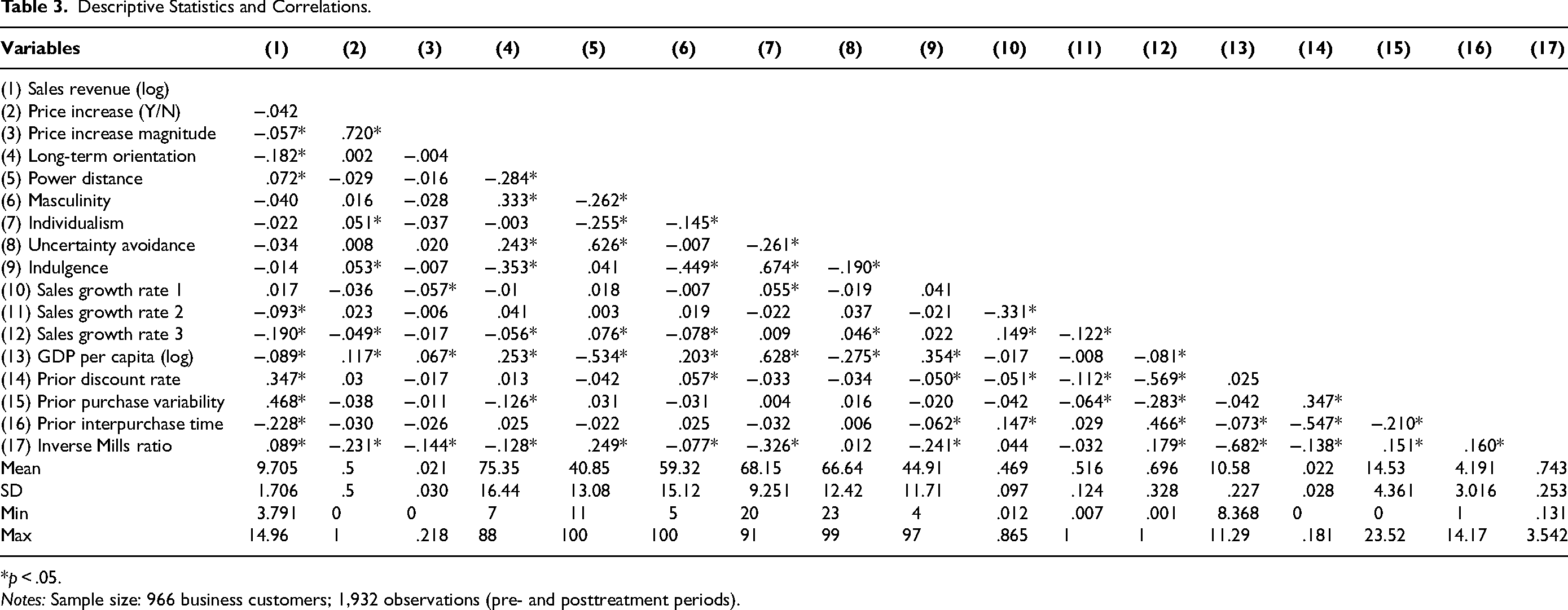
Table 3 depicts descriptive statistics and correlations. In Web Appendix B, we further illustrate that the control and treatment group customers are widely comparable across key characteristics of their business relationship. Figure 2 shows model-free evidence for the development of sales revenues generated with customers who experienced or did not experience a price increase. For this illustration, we differentiated the treatment group into customers who experienced price increases of low, medium, or high magnitude (according to a 33% percentile split). Customer revenues follow a common trend in the period prior to the price increase, satisfying a central identification condition of a DiD model (discussed subsequently). Notably, we also perceive first indications that higher price increases lead to lower sales revenues (H1).

Model-Free Results and Common Trend Analysis.
Descriptive Statistics and Correlations.
*p < .05.
Notes: Sample size: 966 business customers; 1,932 observations (pre- and posttreatment periods).
Procedure
To investigate the impact of a PPI (with varying magnitude) on future sales revenue generated with international B2B customers, we employ a series of DiD models (see Schmitz et al. 2020; Shi et al. 2017 for similar research designs). The DiD design has key advantages. First, by incorporating longitudinal data from before and after the price increase (treatment), as well as data from a group of treated subjects (customers with price increase) and control subjects (customers without price increase), the model enables us to establish strong causal inference for the impact of a price increase. Second, the model enables testing of average treatment effects, as well as heterogeneity in these effects, such as a varying magnitude of PPIs.
DiD model specification
To test how the magnitude of PPIs and customers’ culture affect B2B customers’ response to price increases, we specified two-period DiD models. Therefore, we generated the following terms: (1) an interaction between the occurrence of a PPI and the postintervention-period dummy (PPI × POST), reflecting the average treatment effect; (2) an interaction between the average treatment effect and PPIM (PPI × POST × PPIM), indicating the effect of PPIM (to test H1); (3) an interaction between the average treatment effect, PPIM, and each cultural dimension (PPI × POST × PPIM × CultureMod), indicating heterogeneity in the impact of PPIM based on customers’ culture (to test H2–H4); and (4) all relevant lower-order interactions. Note that we included the magnitude of price increase (PPIM) only in interaction terms of the average treatment effect, as values are only valid in the treatment condition; this is a common practice in DiD applications with heterogeneous treatment effects (see, e.g., Shi et al. 2017). Accordingly, a simplified conditional treatment effect model with one cultural dimension (e.g., long-term orientation) moderating the heterogeneous treatment effect may be written as
Nested data structure
Given that we investigate data of two periods from customers from different countries, our observations are nested within customers and within countries. To account for the nested data structure, we estimate our DiD models in a multilevel mixed-effects panel regression framework (mixed command in Stata v. 17) and specify cross-level interaction effects (Level 1: observations: pretreatment/posttreatment; Level 2: customers; Level 3: countries). Note that results also remain robust when estimating a random effects panel regression without accounting for the nested data structure.
Endogeneity account
The price increase was implemented for products affected by an increase in raw material costs. Hence, customers purchasing those products were subject to PPIs. We account for the potential selection bias by applying a Heckman selection correction (Heckman 1979) to our model. To predict the customers’ probability of receiving a price increase, we gathered and incorporated company data on material costs per transaction for the time frame before the PPI. Specifically, we calculated a growth rate of material costs for all products bought by each customer over a time frame of 12 months before the price increase. The growth rate in material costs satisfies the relevance condition, as it indicates the choice of products to be subject to a price increase; customers whose product portfolio exhibited higher growth in material costs may be more likely to receive a price increase. Further, it satisfies the exclusion restriction, as growth in material costs is not directly related to sales revenues generated with a customer, also supported by a weak correlation (r = .02). As further control variables, we included all key variables from our main equation, including the cultural dimensions and controls. Results of the first-stage probit regression show that the prior growth rate in material costs significantly increases the probability that the respective customer received a price increase (b = .070, p < .01). We compute and integrate the inverse Mills ratio as an additional control in our analysis. 4
Results
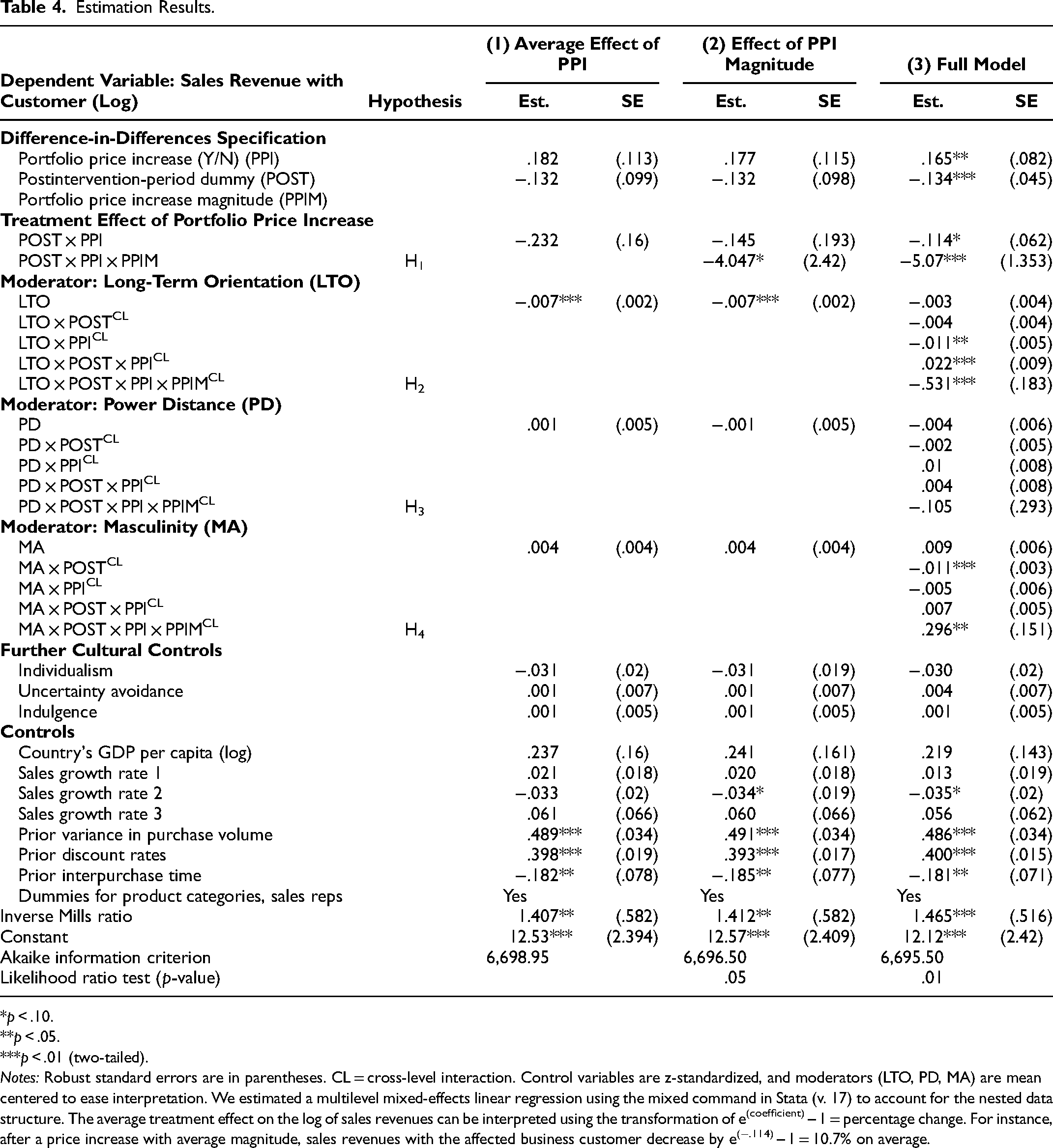
We estimated our models in Stata, version 17. Table 4 depicts estimation results, and Figure 3 illustrates how the impact of a PPI varies with price increase magnitude. In Figure 4, we then depict how the slope of price increase magnitude varies with cultural dimension. First, we find partial support for H1 that PPI magnitude has a negative impact on future sales revenues with a customer, as indicated by the interaction of the occurrence of PPI and its magnitude. The effect of PPI magnitude on future sales revenues is marginal significant in a model without higher-order interactions (see Model 2, b = −4.047, p < .10) and significant at an average level of the cultural dimensions (Model 3, b = −5.07, p < .01). Given our log-transformed dependent variable, the percentage of decrease in sales revenues can be calculated by the formula (e(Estimate) − 1) × 100. That is, an average price increase of 2.1% (sample average) yields a 10.6% decrease in sales revenues, averaged across cultures.

Impact of Price Increase Magnitude on Sales Revenue.

Marginal Effect Plots for the Impact of Price Increase Magnitude in Different Cultures.
Estimation Results.
*p < .10. **p < .05. ***p < .01 (two-tailed).
Notes: Robust standard errors are in parentheses. CL = cross-level interaction. Control variables are z-standardized, and moderators (LTO, PD, MA) are mean centered to ease interpretation. We estimated a multilevel mixed-effects linear regression using the mixed command in Stata (v. 17) to account for the nested data structure. The average treatment effect on the log of sales revenues can be interpreted using the transformation of e(coefficient) – 1 = percentage change. For instance, after a price increase with average magnitude, sales revenues with the affected business customer decrease by e(−.114) – 1 = 10.7% on average.
Second, regarding H2, we find a significant negative moderation between the average effect of a PPI, its magnitude, and long-term orientation (Model 3, b = −.531, p < .01). That is, in cultures with low long-term orientation, price increase magnitude attenuates the negative effect of a price increase and tends to have an increasing slope, although not being significant (bSlope_low = 3.652, p > .10). In cultures with high long-term orientation, a higher price increase magnitude strengthens the negative effect of a PPI (bSlope_high = −13.79, p < .01), in support of H2. Figure 4 shows that at high long-term orientation, a larger price increase has a much more negative impact on sales revenue than a smaller price increase, which can even benefit future sales revenue when it is below 1.9%.
Third, regarding H3, we do not find a significant interaction effect between the average effect of a PPI, its magnitude, and power distance (b = −.105, p > .10); thus, we reject H3. Figure 4 indicates that for customers with low power distance a higher PPI may decrease sales revenue to a higher extent than a lower price increase, yet the slope is not significantly different between customers with low or high power distance. In an additional analysis, we test a nonlinear interaction effect of price increase magnitude with power distance.
Fourth, regarding H4, we find a significant positive moderation between a PPI, its magnitude, and masculinity (b = .296, p < .05). That is, in cultures with lower masculinity, a higher price increase magnitude further strengthens the negative effect of a PPI on future sales revenues with a customer (bSlope_low = −9.554, p < .01). Figure 4 shows that customers from cultures with low masculinity are highly sensitive to even small price increases (>1.5%). Note that in cultures with high masculinity, price increase magnitude has no significant moderation effect (bSlope_high = −.009, p > .10).
We also tested for higher-order interactions between price increase magnitude and combinations of cultural dimensions, yet found no significant effects.
Robustness Check
As an alternative to our random sampling and to minimize potential differences among the treatment and control groups (see Web Appendix B), we matched one comparable B2B customer with a price increase to each B2B customer that did not exhibit a price increase, using propensity score matching (Li 2013). As matching criteria, we incorporated the three sales trend variables, customers’ prior purchase variability, prior interpurchase time, prior discount rate, and dummies for product lines purchased to capture potential differences in the previous business relationships of B2B customers of the treatment or control group. We employed nearest-neighbor matching without replacement in Stata (v. 17). Each B2B customer without a price increase is paired with the closest match regarding the previously mentioned characteristics. Rerunning the analysis on the matched sample yielded robust results (see details in Web Appendix D): the negative revenue effect of higher price increase magnitude (1) negatively interacts with long-term orientation (b = −.345, p < .01), (2) does not significantly interact with power distance (b = .059, p > .10), and (3) positively interacts with masculinity (b = .174, p < .05). Note that we also find consistent results when employing a more restrictive caliper matching, where only those customers whose propensity scores fall into a particular range are included, further reducing potential differences across groups. Hence, our findings are robust against potential differences between B2B customers with and without a PPI.
Additional Analyses
In an additional analysis, we investigate whether the magnitude of a PPI has a nonlinear interaction effect with power distance, instead of the proposed linear relationship (H3). To test this complex higher-order interaction in a parsimonious model and ease interpretation, we calculated three dummy variables indicating whether a customer was subject to a low, medium, or high PPI (each coded as 1; 0 if no price increase), determined by splitting the treatment group at the 33rd and 66th percentiles (see Web Appendix E for details). The three-way interactions between each price increase dummy, the postintervention-period dummy, and cultural dimension indicate how the effect of different PPIs varies with power distance. Results support a nonlinear interaction of price magnitude with power distance. At low power distance, a low price increase does not significantly affect sales revenues with the customer. However, a medium price increase and a high price increase reduce sales revenues at a similar level, although only the former effect is significant (b = −.513, p < .01). At high power distance, we only find a low price increase to significantly reduce (b = −.319, p < .05) sales revenues. We further elaborate on this finding in our discussion.
Discussion
Although price increases are a relatively common and often necessary step for many B2B companies, prior research investigating B2B customers’ reactions to price increases is relatively scarce. The current study investigates how the magnitude of price increases influences B2B customers’ sales revenue and whether and how this effect is moderated by business customers’ long-term orientation, power distance, and masculinity. In a quasi-field experiment with 966 business customers of an international chemical commodity company, we generated nuanced insights on the impact of the magnitude of PPIs on B2B customers’ sales revenue in international contexts. Table 5 provides a brief overview of the study's key results.
Overview of Key Results.
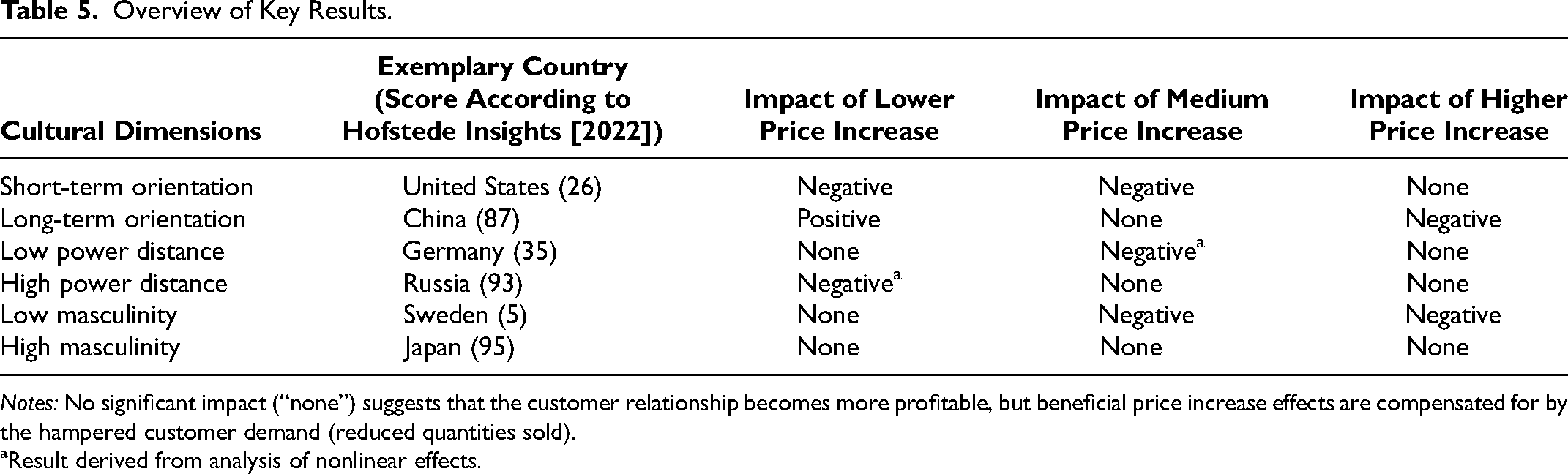
Notes: No significant impact (“none”) suggests that the customer relationship becomes more profitable, but beneficial price increase effects are compensated for by the hampered customer demand (reduced quantities sold).
Result derived from analysis of nonlinear effects.
Specifically, we identified three different avenues for the future development of business relationships depending on the cultural context. First, PPIs may decrease future revenues with a business customer. That is, customer demand is drastically hampered, and PPIs cannot compensate for the losses in purchase volume. For instance, we found that in cultures characterized by low masculinity (especially Nordic countries, such as Sweden [score 5]; Hofstede Insights 2022), high price increases are particularly harmful. A small price increase can harm future relationships with customer firms from countries that are short-term-oriented (rather than long-term-oriented), such as the United States (score 26). In the second scenario, PPIs have no significant impact on future sales revenue generated with a business customer. In this situation, a customer's demand is hampered, but the positive effect of price increases may still compensate for potential losses from purchase volume. Although the price increase does not yield growth in future sales revenues, higher prices per unit should result in higher profit with that particular customer (given that costs remain unchanged after the price increase). For instance, we found that customer firms from cultures characterized by high masculinity (e.g., Japan [score 95]; Hofstede Insights 2022) do not significantly reduce sales revenues when confronted with a high PPI. Still, the price increase likely renders those relationships more profitable. Third, in the best possible case, price increases enhance sales revenues with a customer. In a situation like this, customer demand is not tempered, and financial gains from higher prices raise sales revenues. We only found one condition in which sales revenues with a business customer truly increase in the aftermath of a (low) PPI, that is, in cultures with a high long-term orientation. Long-term-oriented cultures include Asian countries, such as China (score 87; Hofstede Insights 2022).
Theoretical Implications
Our study contributes to research on price increases and has important implications for B2B sales organizations and international customer account management. First, our study extends previous research on price increases by adding a relational B2B perspective. Prior research on price increases has focused particularly on B2C markets (e.g., Homburg, Hoyer, and Koschate 2005; Lu et al. 2020) and provides initial insights on the consequences of price increases in B2B markets for single-product price increases (Bruno, Che, and Dutta 2012). We advance these insights by investigating the consequences of the magnitude of PPIs on B2B customers’ sales revenue in a typical B2B commodity context. PPIs reflect a disruption of the relationship between the supplier and its customers as these are unlikely to be compensated for by suppliers granting concessions in other areas of the business relationship. We find that B2B customers react more negatively to PPIs with a high magnitude and that even low price increases can harm customers’ revenues.
We suggest that this finding is in line with the relational norms that B2B customers and their buyers apply when evaluating the price increase. In addition to exchange norms, individual buyers should rely on communal norms and, thus, react less negatively to low price increases. However, when price increases are high, they are more likely to exceed the buyers’ price discretion or might not be in line with communal norms. Therefore, high price increases limit B2B buyers’ reactions based on communal norms. Thereby our findings show that high PPIs can have detrimental effects on buyer–seller relationships and endanger customer–company relationships.
Second, our results indicate that the consequences of price increases differ between B2C and B2B markets. Extant research on price increases in B2C markets supported the dual-entitlement principle by showing that price increases that are aligned to cost increases are perceived as fairer by customers (e.g., Bolton and Alba 2006; Kahneman, Knetsch, and Thaler 1986). Our study provides first insights into the consequences of price increases that are aligned to cost increases in a B2B market and reveals that price increases, although these occur due to cost increases, can have detrimental effects on B2B customers’ sales revenue. Thereby our findings indicate that the dual-entitlement principle may only have limited validity in B2B markets. This can be explained by the differences in the relational norms that customers apply when they react to price increases. Customers who evaluate price increases based on communal norms are more likely to respond according to the dual-entitlement principle than customers who evaluate price increases based on exchange norms (Chen et al. 2018). In B2B markets, customers are companies that should respond to price increases rationally, so the reason for a price increase does not affect their response. Even though B2B customer firms employ individual human buyers who make the decisions, they have limited discretion to react to price increases in line with their communal norms. Therefore, our results indicate that the dual-entitlement principle is not unconditionally valid in B2B markets and that price increases have negative consequences even when they are rooted in cost increases.
Third, we contribute to research investigating how boundary conditions influence the consequences of price increases and thereby provide important implications for global account management and selling in international settings. Prior research on price increases has investigated multiple B2C-related boundary conditions affecting the consequences of price increases (e.g., Dawes 2009; Homburg, Koschate, and Totzek 2010; Lu et al. 2020). However, little is known about how B2B-related boundary conditions influence the consequences of price increases, thereby leaving managers unguided on whether and how to adapt price increases to different customer segments. A key boundary condition in B2B markets, in which companies often sell to customers from different countries and cultures, are customers’ cultural value-based dimensions. This study provides initial findings on how B2B customers’ cultural value-based dimensions influence the consequences of price increases. Importantly, our findings reveal that implementing price increases uniformly across countries having different cultural value-based dimensions can have undesired consequences. We suggest that B2B customers’ relationship norms account for these cultural differences. Specifically, the negative impact of the magnitude of PPIs on business customers’ sales revenue can be more pronounced if B2B buyers are more prone to react in line with communal norms instead of exchange norms. This is because B2B buyers who react to price increases by relying on communal norms should react less negatively when price increases are low (e.g., customers from cultures with high femininity). Our findings extend prior knowledge on price increases in B2B markets (Bruno, Che, and Dutta 2012) and on boundary conditions of the consequences of price increases and reveal that the implementation of uniform price increases across international business customers can be detrimental to a company's sales revenue because consequences of price increases differ between customers' cultural value-based dimensions.
These findings not only are important for research on price increases but also provide important implications for research on global account management and selling in international and export settings. This research remains scarce in exploring the role of customers’ cultural values in the strategic management of customers (e.g., Shi and Gao 2016; Shi et al. 2010). We advance this research stream by showing that B2B customers’ culture reflects an important factor that needs to be considered when a company increases its prices. Future research on how international sales organizations and their salespeople implement price increases, therefore, needs to consider that the consequences of price increases vary between customers’ cultural value-based dimensions. A potential avenue for further research could be to explore whether customers’ cultural values also explain differences in customer reactions if companies change further characteristics of their offering (e.g., product design, servitization).
Managerial Implications
To cope with cost increases for raw materials (e.g., Abdelnour et al. 2021; U.S. Department of Labor 2022), many companies adjust prices to remain profitable. Particularly in the focal B2B commodity sector, prices are exceptionally volatile (Vasishtha 2022). Our findings offer important implications for sales managers and salespeople of international B2B organizations on how to implement price increases while preventing undesired consequences.
First, we suggest that B2B sales managers need to be very careful when implementing price increases for international customer firms, even when the increases are justified by higher upstream costs. Our evidence from the B2B commodity sector suggests that the potential profit effects of higher prices may not outweigh losses in customers’ demand, particularly when price increases are high. Managers should carefully weigh the degree to which they place their financial burdens on customers by increasing prices or bearing them themselves, as long-term losses in highly valuable relationships could be more severe than shortcomings in profitability.
Second, international sales managers should rely on cultural value-based dimensions to segment customers as well. Although predominantly reflecting a segmentation variable for B2C markets, our findings provide further justification that cultural backgrounds are also decisive in influencing business customers. For instance, our results reveal that in markets wherein customers have a high long-term orientation, low price increases are an effective means of raising revenues; in cultures with low power distance, even a medium price increase can harm future sales revenues; and high price increases should be particularly avoided in markets in which the customers’ culture has low masculinity, as the price increases severely harm future sales revenues. Considering these matches prevents sales managers and salespeople from making the mistake of implementing price increases uniformly, and enables them to individually design price increases effectively to not only improve profit but also safeguard or increase sales revenues.
Third, finding that international B2B customers react very differently to price increases yields important implications for personal selling in international markets. On the one hand, sales managers should train international salespeople to be more sensitive to communal norms dominant in certain cultural contexts. For instance, when higher price increases violate norms of solidarity, salespeople may take the opportunity to offer appropriate compensation that confirms the norm (e.g., in terms of special treatments or particular service, if applicable). On the other hand, sales managers may consider compensating salespeople whose international customer relationships are threatened by company-wide price increases, particularly when price increases are strategically mandated. As indicated by this study, price increases have the power to dissolve trusted business relationships and hard-won achievements of salespeople, which may not only limit their financial income (if compensated on a variable basis) but may also result in dissatisfaction and inner withdrawal. Here, too, it is not to be expected that salespeople will be content with high price increases being justified on the basis of higher upstream costs.
Limitations and Future Research
Our study has certain limitations and provides avenues for future research. First, the price increase being investigated is rooted in an increase in costs. Hence, we are not able to differentiate between justified and unjustified price increases. In line with the dual-entitlement principle (Kahneman, Knetsch, and Thaler 1986), one may propose that unjustified price increases yield even stronger, negative effects on future sales revenues. To explore this matter and how it may be moderated by cultural dimensions, future research could directly compare justified and unjustified price increases and their consequences for international B2B customers.
Second, given data constraints, we were not able to differentiate products with or without a price increase by qualitative characteristics, such as their importance to customers’ value creation, substitutes in the market, or complementarities (e.g., Huber, Holbrook, and Kahn 1986; Wakefield and Inman 2003). One may assume that the demand-hampering effect of a price increase is likely related to customers’ switching costs, which are (among other factors) defined by the opportunities and costs to source alternatives. The effects that we have found in the B2B commodity context may be weaker if products are critical for customers and hard to substitute. Furthermore, while we investigate a single, typical B2B firm context (chemical commodity supplies), price increases may have different effects for supplying firms with different strategic orientations (e.g., cost leadership), from different industry setups (e.g., mono- or oligopolistic), or with different business models (e.g., complex, idiosyncratic business). While we expect these factors to have similar influences across cultures as they relate to transactional rather than communal factors, we still propose that future research investigate the potential moderating impact of product, business, and industry characteristics.
Third, we matched cultural dimensions according to the country of the sourcing firm and do not explicitly utilize the firm's headquarters as a reference. Although headquarters’ codes of conduct may influence customer decision making, the culture of the local buying team might be more important for investigating the impact of a price increase on local purchase decisions. Still, we conceive it as a promising future avenue to investigate whether our findings differ when the cultural dimensions of the sourcing firm and its headquarters match (or do not match).
Fourth, against our expectations, customers from cultures valuing communal norms sometimes react even more negatively to high price increases. We suggest that these buyers may not only apply communal norms to a lesser extent when facing high price increases, but may also feel that the supplier has violated their communal norms (such as solidarity in cultures of low masculinity). Accordingly, they may react with hostile, punitive actions against their supplier (e.g., Kaufmann and Stern 1988; Kumar, Scheer, and Steenkamp 1998) and reduce business with the supplier. Future research could investigate this unexpected result further.
Fifth, against our expectations, the magnitude of the PPI does not linearly strengthen the negative effect on sales revenue for business customers with low (compared with high) power distance. Instead, we find a saturation effect. That is, for customers with low power distance, sales revenues similarly decrease after a medium and a high price increase (see additional analysis). At this point, we can only make assumptions on the potential reasoning for this intriguing finding: On the one hand, a medium price increase may already cause a maximum (reasonable) retraction of business with the supplier. In this case, customers’ power distance could turn out to be a very sensitive moderating factor for the impact of price increases. On the other hand, the extent to which PPIs hamper demand may be less pronounced for these customers, and the positive profit impact of a higher price increase may fully counterbalance demand-hampering effects. We call for future research to investigate more deeply how customers from low power distance cultures react to PPIs to provide even more precise guidance for managers on international pricing decisions.
Supplemental Material
sj-pdf-1-jig-10.1177_1069031X231214160 - Supplemental material for Price Increases and Their Financial Consequences in International Business-to-Business Selling
Supplemental material, sj-pdf-1-jig-10.1177_1069031X231214160 for Price Increases and Their Financial Consequences in International Business-to-Business Selling by Maximilian Friess and Roland Kassemeier in Journal of International Marketing
Footnotes
Special Issue Editors
Nawar Chaker, Johannes Habel, Alex Zablah, and Kelly Hewett
Declaration of Conflicting Interests
The authors declared no potential conflicts of interest with respect to the research, authorship, and/or publication of this article.
Funding
The authors received no financial support for the research, authorship, and/or publication of this article.

Notes
References
Supplementary Material
Please find the following supplemental material available below.
For Open Access articles published under a Creative Commons License, all supplemental material carries the same license as the article it is associated with.
For non-Open Access articles published, all supplemental material carries a non-exclusive license, and permission requests for re-use of supplemental material or any part of supplemental material shall be sent directly to the copyright owner as specified in the copyright notice associated with the article.
