




Abstract
Accompanying the rising ethnic diversity of Western countries is a burgeoning number of mixed-ethnic unions and people with mixed-ethnic ancestry. These people do not fit neatly into one group or another. This ambiguity is compounded by the fact that their ethnic identity is affected by how they are perceived and labeled by others. Theories have been advanced to explain ethnic identity, and its corollaries for cognition, emotions, and consumer behaviors. However, aside from a handful of ethnographic studies, knowledge about how social identity of mixed-ethnic consumers is formed and shaped, and how it potentially affects consumer dispositions, remains largely uncharted. Using data gathered in three countries (Canada, United States, United Kingdom), and considering various ethnic mixture combinations, this article presents the development and validation of a multidimensional scale for measuring mixed-ethnic identity (MEI) and examines the relationships of the 13 MEI components to consumer dispositions commonly used to segment domestic and international markets. The consistency of the relationships between the MEI components and the established consumer dispositions are scrutinized. Implications for theory and practice are discussed.
So, there is this difference between “being Indian” “part time” versus “full time.” I am not quite one, but I am not quite the other. I’m a bit of both … but sometimes I am … neither? Yeah. I like the way that I am here, being half-Caucasian and half-Asian. But I think it's more that … I have the “best of both worlds.” But that also comes with the downside, which is that other people don’t really understand you as much as someone … that is not mixed. (F22, grad student)
The need to belong is a deep-seated and persistent human motivation, bringing forth a plethora of identity-laden effects (Markus and Kitayama 1991). Of relevance to marketing, these include effects on lifestyles, tastes, and styles; heightened sensitivity and attention to identity-related consumption stimuli; the enactment of rituals and behaviors consistent with expressing this identity; and focused attention toward autobiographical memories that are consistent with identity-relevant themes (Reed et al. 2012). Moreover, interpersonal communication and reference group influence are motivated by self-concept and social identities (Cleveland and Bartikowski 2023).
Yet, it is indeterminate how these identity effects operate for people with mixed-ethnic ancestry. Nearly all cross-cultural studies implicitly assume “that individuals have a monocultural disposition” (Lau-Gesk 2003, p. 301). There is nearly a void of research on individuals that are ethnically mixed at birth (Harrison and Thomas 2014; Yoo et al. 2016), and consequently little is known about the inculcation and expression of the social identities of mixed-ethnic (mixed-race 1 ) people, and the dispositional and behavioral consequences of these processes. For reasons that will become clear, the voluminous studies on immigrants and ethnic minority individuals acquiring a second/mainstream culture (Berry et al. 2006; Gunasekara et al. 2021; Peñaloza 2006) provide only limited insights. In social psychology, empirical studies on mixed-ethnic/race people have principally focused on a single group (e.g., Black/White), precluding generalizations to other ethnic combinations. In marketing, studies on complex social identities have almost exclusively focused on (1) how ethnic minority individuals negotiate and adapt to the mainstream society, (2) how bilingual consumers respond to product communications, and (3) how individuals navigate the global/foreign versus local (e.g., brand choice, positioning) distinction.
Investigating social identity beyond the lenses represented by the minority–majority, monolingual–multilingual, or local–global dichotomies is well warranted for three reasons highly relevant to international marketing. First, describing and contrasting groups in terms of ethnic binaries obscures the identification of important horizontal market segments, that is, consumer groups sharing similarities across country frontiers. From a societal perspective, the importance of ethnicity as a consumer characteristic has intensified as countries become more multicultural (Reed et al. 2012). At the same time, taboos against interracial unions have dwindled, and, consequently, mixed-ethnic couples and children of mixed heritage are witnessing exponential growth.
Extrapolating immigration and intermarriage trends, 21% of people in the United States could have multiple racial ancestry by 2050 (Waters 2000). Ethnically/racially mixed people are the fastest growing minority group in many countries—including the three under investigation—and the purchasing power of mixed-ethnic consumers is projected to grow much faster than national averages (Harrison, Thomas, and Cross 2017). Reflecting this pecuniary importance, mixed-ethnic individuals are attracting managerial attention (Lau-Gesk 2003). In view of burgeoning ethnic blending, and the advent of more complex social identities, the habitually monocultural criteria used to segment domestic and international markets should be reexamined. Yet, belying the global scope of this segment—and its size, when aggregated across ethnic combinations—international marketing research provides scant knowledge on the nature of mixed ethnicity.
Second, from a psychological perspective, unlike individuals of a solitary visible minority heritage who find sanctuary in their ethnic community, full assimilation with the mainstream society or subsumption within the minority community is unattainable because the mixed-ethnic person is seen as distinct from the mainstream and minority communities, rendering these individuals ethnically ambiguous. A person's self-ascribed identity is affected by how they are perceived by others (Peñaloza 2006), and as elucidated subsequently in this article, this influence should be even more potent for mixed-ethnic people. Mixed-ethnic individuals are thus twice minoritized (Shih and Sanchez 2005), potentially facing exclusion not only from the dominant mainstream but also from ethnic minority groups (Campion 2019). This impediment to belongingness has ramifications for psychological well-being and poses unique challenges in terms of how mixed-ethnic persons acquire and express their social identity (Woo et al. 2011). These challenges, in turn, affect culturally determined membership groups, which are known to wield powerful effects on consumer attitudes and behaviors (Reed et al. 2012).
Third, mixed-ethnic people straddle cultural boundaries, transferring marketplace information across groups, while transcending and fusing elements from their varied backgrounds. This inclusive position is “ultimately a unifying force in society” (Harrison, Thomas, and Cross 2017, p. 515). By innovating behaviors, mixed-ethnic consumers may be harbingers of trends, thereby exerting disproportionate influence on other consumers. This cultural bridging position holds implications for marketing theory and practice, not only in terms of segmentation, targeting, product positioning, and communication appeals, but also for understanding interpersonal exchanges of marketplace information and reference group influence.
According to Yoo et al. (2016), “one of the many reasons for the paucity of quantitative studies focusing on multiracial experiences is due to a lack of valid and reliable measures” (p. 200). This statement echoes sentiments expressed by Brumbaugh and Grier (2006) in their advertising research. They conclude that predicting the behavior of mixed-ethnic/race consumers is thorny, due to the lack of appropriate measures for mixed ethnicity. Although the social-psychology literature describes constructs that were designed to gauge similar concepts, these scales are unsatisfactory due to inadequate conceptual coverage, the inability to generalize to different ethnic combinations, and problems with measurement validation. This article is motivated by knowledge gaps concerning an international consumer group that researchers have largely overlooked despite its size, potential, and distinctiveness relative to other ethnic segments. From a theoretical perspective, measurement problems and the lack of empirical studies impede acquiring information about the nature of mixed-ethnic individuals—as a whole, and as subgroups comprising various ethnic combinations, and across countries—relative to mainstream majority population and monoethnic minority groups. From a managerial perspective, these problems thwart the ability of marketers to make predictions about the behavior of mixed-ethnic consumers. The lack of knowledge constrains the utility of mixed-ethnic identity (MEI) as an international marketing segmentation variable, at the cost of potentially forgoing marketing relationships with what constitutes the fastest-growing minority group in many countries.
Against this background, the present investigation incorporates a preliminary inductive, discovery research phase, as well as a deductive, etic generalizability phase. I first report on the development and cross-national validation of a multidimensional scale for measuring MEI. Second, I examine how MEI applies to an array of consumer dispositions commonly used to segment domestic and international markets, and which are pertinent for ascertaining the construct validity of my operationalization of MEI (Figure 1). These include domestic/ingroup proclivities (national identity, consumer ethnocentrism); ecumenical social dispositions (cosmopolitanism, identification with global consumer culture [GCC]); the outgroup orientation of xenocentrism; lifestyle and self-esteem indicators (religiosity, life satisfaction); and the consumption-focused traits (materialism and market mavenism). As third and fourth objectives, I examine the construct validity of the MEI scale across three countries—the United States, Canada, and the United Kingdom—and investigate the cross-national consistency of the relationships between the various MEI components and the nine dispositions.
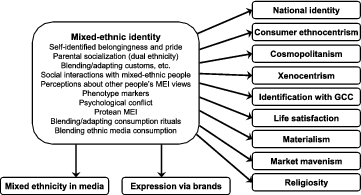
Research Framework.
In aiming to realize the preceding objectives, this work contributes to theory and practice in multiple ways. First, the conceptual development of the MEI construct provides novel contributions to international marketing theory by advancing our understanding of mixed ethnicity, and by charting a new direction for research on cultural mixing and identity. Second, by offering a reliable and valid MEI instrument, I provide a tool to enable comparisons across different ethnic mixtures and countries, to catalog MEI patterns, and to stimulate further research appraising the psychological, social, and managerial implications of mixed ethnicity. Finally, the insights generated will assist companies seeking to identify and engage with this rapidly expanding category of consumers.
Conceptual Development
Ethnic Identity and Mixed Ethnicity
Ethnicity is a social rather than a biological construct; it is chosen and assigned, instead of being an immutable quality (Phinney 1992). Studies on ethnic identity are based on one of three overlapping disciplinary perspectives: social identity/categorization theory (social psychology), acculturation and culture conflict (sociology and anthropology), and identity formation (developmental and counselling psychology) (Phinney and Ong 2007). According to social identity theory (Tajfel and Turner 1986), the social part of a person's self-concept derives from groups with which they affiliate. Feelings of belongingness drive people to develop attitudes and engage in behaviors in favor of their ingroup(s). The root of ingroup favoritism concerns the psychological need for positive distinctiveness of one's ingroup relative to outgroups. These groups are important sources of pride and self-esteem. Ethnic identity signifies one's sense of who one is, based on ethnic membership, indicating the sway that an ethnic group has on one's values, attitudes, and behaviors. Such identities are asserted through lifestyles, which, in turn, shape consumers’ attitudes, priorities, and behaviors (Cleveland, Papadopoulos, and Laroche 2011). Moreover, consumers respond more favorably to stimuli that are consistent with their accessible social identity and tend to repudiate identity-inconsistent stimuli (Reed et al. 2012). Identity-based attitudes are powerful as they are relatively impervious to counterpersuasion efforts by marketers. Thus, ethnicity and ethnic identity have a rich marketing legacy (Forehand and Deshpandé 2001) and have been associated with a plethora of personal and product-related dispositions, values, and orientations, as well as a swath of behaviors.
Ethnic identity is subjective and multidimensional (Phinney and Ong 2007). It builds on numerous aspects that represent boundaries of inclusion and exclusion among social groups (Oswald 1999), including self-identification and commitment/pride, a sense of common origin, importance and salience, adherence to values, observance of native customs, participation in ethnically relevant behaviors and experiences, language and media usage, and intraethnic interpersonal relationships (Cleveland, Papadopoulos, and Laroche 2022). The salience of ethnic identity is affected by its subjective importance, one's perception of distinctiveness, and situational relevance (Ashforth and Johnson 2001). The relative accessibility of an ethnic identity and its facets stems partly from environmental cues (Lau-Gesk 2003) and may be activated by exposure to symbols connected to ingroups and outgroups, and especially by the ethnic characteristics of other people in a given setting (Reed et al. 2012). Besides being a conscious process whereby individuals assess their relative (dis)similarity with other people, much self-categorization occurs unconsciously (Reed et al. 2012). Moreover, through acculturation and exposure to external groups, individuals can shift between identity loci (Askegaard, Arnould, and Kjeldgaard 2005). Thus, the strength of MEI may fluctuate as a function of social circumstances and, for this research, as a function of particular combinations of ethnic mixtures, and these could characterize the extent to which various aspects of MEI are perceived as relevant and practiced, across time and place.
Without proper tools for gauging MEI, ascertaining the applicability of conventional ethnic identity processes and aftermaths for individuals of mixed-racial/ethnic heritage is problematic, for two reasons. First, the accessibility of ethnic identity is generally more enduring for people that are ethnically dissimilar from the majority (McGuire 1984). Because mixed-ethnic individuals are visibly distinct from both the ethnic majority and minority communities comprising their ethnic heritage, self-identification is at least partly imposed, and likely to be more chronically accessible. Phenotype particularities and issues connected to racial dynamics (Helms 2007), for example, the perceptions of others in the mainstream and minority communities, must therefore also be considered.
Second, identification with two different groups can be troublesome because of potential conflicts in attitudes, values, and behaviors (Phinney and Ong 2007). Compared with their monoethnic counterparts, mixed-ethnic consumers face unique conflicts between personal and social self-definitions, as well as from those characterizations foisted by others (Shih and Sanchez 2005). When confronting complex social surroundings, people will seek out the group with which they feel most at ease. But how does this impulse apply to those that feel caught between ethnic communities, who lack ethnically similar role models and, potentially, suffer the experience of double rejection? A person having parents from two different races may elect to express a multiracial identity or a single-race identity (Woo et al. 2011). Alternatively, the person could fashion a unique, hybridized identity, affiliate with a cultural outgroup, or seek to transcend racial boundaries to identify as a human being. In sum, inclusionary–exclusionary ethnic boundaries create fundamental identity challenges for mixed-ethnic individuals (Harrison and Thomas 2014) and problematize the development of mixed-ethnic measures (Phinney and Ong 2007). Reviews by Burton (2000) and Harrison and Thomas (2014) confirm identity as the most researched multicultural marketing concept, but multiethnic identity “was absent from this literature” (Harrison and Thomas 2014, p. 43).
Demographic trends are highly compelling for research into mixed ethnicity. According to the 2021 Canadian census, about 7% of all married/common-law couples were mixed unions. These numbers are up from previous census periods, in which the proportions were 4.6%, 3.9%, 3.1%, and 2.6% of all couples in 2011, 2006, 2001, and 1991, respectively (Aathavan 2021; Statistics Canada 2021). U.S. Census Bureau data show that one out of six newlyweds in 2015 were married to a person of a different race, a fivefold increase from 1967 (when the U.S. Supreme Court annulled state laws banning interracial marriage), when less than 3% of marriages were ethnically mixed (Bialik 2017). The U.S. multiracial population grew by 164% between 2010 and 2021 (Rico, Jacobs, and Coritz 2023). The number of citizens in England and Wales reporting a mixed-ethnic background tripled between 2001 and 2021, accounting for 3% of the population and a larger share than any single minority ethnic group (Office for National Statistics 2022).
Existing Conceptualizations and Measures of MEI
Aside from ethnographic inquiries—primarily within anthropology, education, and social psychology (LaFromboise, Coleman, and Gerton 1993; Spickard 1989; Waters 2000)—and a handful of quantitative studies on multiracial peoples’ political ideologies (Masuoka 2008), empirical studies on mixed ethnicity are scarce. A scrutiny of the interdisciplinary literature revealed several scales that purportedly could be used to tap MEI. Rockquemore (1999) operationalizes biracial identity unidimensionally, with statements applying only to those that have partial African American ancestry (e.g., “I consider myself exclusively Black”). Focusing on Chinese Americans, Benet-Martínez and Haritatos (2005) created the bicultural identity integration scale comprising two facets (cultural distance, conflict). The scale is appropriate only for that specific population, to assess their perceptions of straddling two cultures, as opposed to the identity of people that are ethnically mixed from birth. Phinney's (1992) widely adopted multigroup ethnic identity measure (comprising self-identification/ethnicity, ethnic behaviors/practices, affirmation/belonging, and ethnic identity achievement dimensions) is designed for individuals that identify with an ethnic minority group and with mainstream American society, thus comprising scale measures that are unsuitable for people of ethnically mixed identities.
Recognizing the layered ethnic contexts enveloping mixed-ethnic individuals, in the field of counseling psychology, Yoo et al. (2016) developed the most comprehensive scale to date: the multiracial experiences measure (MEM). The MEM comprises five subscales: shifting expression, perceived racial ambiguity, creating third space, multicultural engagement, and multiracial discrimination. This conceptualization covers several pertinent facets of mixed ethnicity; however, there are issues regarding the construct validity of the measures. First, the MEM principally focuses on phenotype (visible, racial) differences. Second, the scale includes facets, such as “creating a third space” (including queries about specific multiracial organizations, literature, and events), that may not apply to some mixed-ethnic people given the variety of mixtures and the potential low density of people with similar mixtures. Third, several dimensions have inadequate content validity (e.g., a single statement for multiracial discrimination). Moreover, all measures begin with the stem “due to my multiracial background.” Repeating the same stem can contribute to a predictable response style, such as acquiescence (Baumgartner and Steenkamp 2001). Lastly and most importantly, their operationalization fails to cover the domain of the MEI construct, omitting measures for numerous key MEI themes uncovered in the literature, such as belongingness/pride, parental socialization, psychological conflict, and the blending/adaption of customs/activities, norms/values, and media.
I sought to delineate the dimensions of MEI from both psychological and sociocultural perspectives, respectively, because (1) different individuals, in part due to their varying ethnic composition, may emphasize different aspects of MEI and “it is not possible from observation to know what aspect a given individual will favor” (Haug 1998, p. 60), and (2) across places and throughout history, societal attitudes toward mixing have fluctuated enormously. There may be a disjunction between the group(s) with which the person self-identifies and those determined by their genotype (heritable genetics) and their phenotype (observed physical characteristics). Even where mingling is embraced, a mixed person faces the challenges of reconciling the identity bundles of each ethnic community (Epp and Price 2008), such as deciding which norms/values to emphasize (Cleveland, Papadopoulos, and Laroche 2022), which customs to practice (Shankar, Elliott, and Fitchett 2009), and which ethnic products to adopt (Demangeot and Sankaran 2012), all of which may be sensitive to the situation. Mixed-ethnic people thus face unique conflicts between personal and social definitions of themselves (Shih and Sanchez 2005). An ecological approach to studying mixed ethnicity is adopted here, recognizing the layered contexts enfolding mixed-ethnic persons, incorporating individual (e.g., phenotype, psychological), interpersonal (e.g., relationships), community (e.g., social setting), and behavioral (e.g., actions) factors that interactively affect identity choice (Yoo et al. 2016).
Preliminary Inductive Fieldwork
The discovery-oriented research phase had three objectives: (1) to clarify the nature of MEI and the corollaries for self-concept; (2) to achieve a better understanding of the formation, negotiation, evolution, and expression of MEI; and (3) to scrupulously sample the domain of MEI and supplement the conceptualization of MEI informed by the literature review. Each semistructured, biographical interview followed an emergent approach, whereby the pace and scope of the discussion evolved as a conversation between the researcher and the interviewee. The schedule of topics (self-perceptions, family history, social aspects, and consumer behavior) and questions (Web Appendix A) were designed to encourage storytelling. Twenty-four interviewees (22 Canadians, 2 Americans) were recruited through social media advertisements (Kijiji ads in ten Canadian cities, and ethnic communities’ Facebook sites). Eligible, consenting participants (17 female, 7 male; age range 18–40 years; Web Appendix A) were ethnically mixed, defined as having one biological parent that was from a visible ethnic minority (in the place where the research was conducted) and one White (Caucasian) biological parent. Interviewees represented the following ethnic mixtures, all paired with Caucasian: East Asian (e.g., Chinese, Japanese), Southeast Asian (e.g., Filipino, Malaysian), South Asian (e.g., Indian, Pakistani), and Black (e.g., Senegalese). Each interview session was recorded and lasted 90–120 minutes.
Consenting participants (compensated, U.S. $25) were posed a series of open-ended questions with follow-up questions and probes, covering four overarching themes: individual perceptions, family aspects and parental socialization, social aspects, and consumer behaviors connected to one's mixed heritage. The open-ended questions were inspired from the literature on ethnic identity and the primarily conceptual work on mixed ethnicity from the fields of social psychology, sociology, anthropology, education, and marketing. Two approaches were employed to analyze the verbal transcripts: (1) idiographic analyses (i.e., impressionistic readings, to identify recurrent psychological themes and behavioral tendencies), and (2) across-person analyses (triangulation of excerpts, to discover patterns across the episodes). These analyses included appraisals of the informants’ life stories (e.g., roles, histories, self-concept, identity/values, impressions of others, coping tactics) as well as links to consumer attitudes and behaviors. Three members of the research team transcribed and independently developed themes and coded patterns from the interview excerpts, supported in part by NVivo software.
As showcased in Web Appendix A, interviewees spoke about their mixed ethnicity in complicated ways, using both positive and negative terms. In scrutinizing the interview transcripts, it became clear that, in addition to psychological factors (e.g., self-esteem) and phenotype traits, MEI is strongly affected by social factors, including relationships with family, friends, and the community, as well as the perceptions of outsiders (including labeling and discrimination). Consequently, since MEI is subjective, multidimensional, relational, and context-sensitive, the operationalization must recognize how people themselves recognize and interpret their own mixed ethnicity across pertinent dimensions, from the perspectives of MEI and group formation, maintenance, and exchanges with other individuals and groups.
Operationalizing MEI
For this research, MEI represents the incorporation of a person's subjective perceptions of their mixed-ethnic ancestry into their self-concept, in terms of the relative importance and emotional significance attached to pertinent individual, interpersonal, community, and behavior factors. This self-constructed understanding is also informed by the perceptions of other people and evolves due to developmental and background factors. Triangulation of the interview data to uncover patterns (examples for each dimension are provided in Web Appendix A), in conjunction with the comprehensive literature review, informed ten a priori facets of MEI. Eight pertain to social psychology (self- and other-perceptions and characteristics) and customs of mixed-ethnic people (facets 1–8), and two pertain to consumer behavior aspects of MEI (facets 9 and 10). Following the convention of the ethnic/social identity literature (Phinney and Ong 2007), no a priori hierarchical sequencing is proposed among the various facets. Each facet, described subsequently, is prefaced with an illustrative interview excerpt. I’m proud that I’m half of “both sides,” like I always say, “best of both worlds.” (F23, office clerk)
Self-identified belongingness and pride in mixed-ethnic status. This facet denotes engagement (exploration and behavioral engagement with one's ethnic groups), clarity (a clear sense of and commitment to one's ethnic heritages), and pride (positive feelings toward one's mixed ethnicity). By instilling a sense of pride, self-identification provides a supportive context for the development of self-esteem, and for promoting connectedness to others with a mixed-ethnic background (Juang and Nguyen 2010). Most of the interviewees expressed such pride, although for many this opinion was realized only after a journey of identity ambiguity and conflict. One interviewee put it this way: “You know, I think as I grow older, I’m really trying to … like, self-actualize and practice radical self-love that requires me accepting all parts of my identity” (F21, student). Research on immigrant acculturation has found that while biculturalism is associated with identity confusion, competing loyalties, and clashing values, it also is linked to feelings of pride, uniqueness, and a perception of community (Benet-Martínez and Haritatos 2005) and provides a buffer against prejudice (Licsandru and Cui 2019). There were definitely many differences between the way that my dad was and how my mom was, because of their different backgrounds. My mom is … more lenient and my dad is more traditional. And that's also part of his culture versus my mom's culture. But they also worked together to make sure everything was like … balanced. They both wanted me to have knowledge about … both ethnic sides. (F22, grad student)
Parental socialization of dual ethnicity. Parents’ desire to impart to their children knowledge about their ethnic background plays a key role in the content and meaning children assign to their own ethnicity (Phinney et al. 2001). This form of ethnic socialization may refer to several processes, including the transmission of cultural values, knowledge, and practices; information preparing children for discrimination and helping them cope with it; cautionary messages instilling suspicion when interacting with other ethnicities; and/or communications discouraging ethnic differentiation and encouraging individual qualities or the adoption of mainstream societal traits (Hughes et al. 2006). Parents’ efforts to instill pride in their kids’ ethnic heritage helps them come to terms with their double identity (Askegaard, Arnould, and Kjeldgaard 2005). You can pick and choose what works and what doesn’t, from each of those [ethnic cultures], which is I think super cool. (M27, sales)
Blending and adapting customs (norms, values, and aesthetics/tastes). The blending of customs, norms, values, aesthetics, languages, and traditions varies from person to person and can be affected by several factors, including family dynamic, family ties, social interactions, residence (urban vs. rural), socioeconomic status, and education. People having mixed ethnicity could eventually form a distinct social group with their own set of traditions and cultural norms. This entails adapting and fusing elements from both ethnic heritages (Edwards et al. 2012; Rockquemore 1999), creating a cultural whole that is greater than the sum of its parts (Yoo et al. 2016). One of my friends in a ballet class was half-Ethiopian and half-Caucasian. … Actually, our teacher was mixed. She was half-Jamaican and half-Caucasian. Her mother was Black. And she was like, “Oh, my God, I can’t believe that there's two of you!” (F22, distribution)
Social interactions (engagement) with other mixed-ethnic persons. Cultural communities are important socialization agents as well as sources for cultural affirmation and expression (Cleveland, Laroche, Pons, and Kastoun 2009). Mixed-ethnic individuals likely have an affinity for and seek to bond with other mixed people, including those having different ethnic combinations, given similar life experiences. Interacting and developing friendships with other mixed-ethnic folk is deemed a resilient factor (Yoo et al. 2016), since a sense of belongingness enhances psychological well-being. Numerous interviewees stated that being able to interact and relate to other mixed-ethnic persons provided valuable social support, particularly during childhood, making the challenges of growing up mixed easier to bear (Shih and Sanchez 2005). I’m not sure if they’re [mainstream attitudes] changing, but there are definitely more mixed ethnic people out there. I guess that means in some way that mixed people are becoming more accepted. Or maybe people have to start being more accepting just because there are more and more of us mixed individuals out there. (F22, grad student)
Perceptions about other people's views toward mixed-ethnic persons. Historically, mixed-ethnic individuals have often been viewed negatively by members of mainstream society. Exogamous unions are increasingly accepted, yet in a recent Ipsos poll (Simpson 2019), 37% agreed that “immigration is a ‘threat’ to White Canadians.” Visible minority individuals often experience microaggressions (routine but subtle forms of racism/prejudice). Mixed-ethnic individuals may also experience “horizontal hostility” due to their perceived impurity, from monoethnic, minority-side members (Campion 2019). Since biracial identification can lead to confusion, conflict, and maladjustment, it can be more difficult for a mixed-ethnic individual to develop a positive self-concept (Abu-Rayya 2006). Yet, as the number of people having mixed ethnicity has increased, and as mainstream society becomes more accepting of multiculturalism, multiethnic identities are progressively viewed as healthy identity options, and research suggests they are indeed associated with positive psychological functioning (Binning et al. 2009; Shih and Sanchez 2005). Although most interviewees perceived that opinions about mixed-ethnic people (from both mainstream and ethnic minority community members) had improved since their childhood, many of them described feeling stigmatized by some members of one or both ethnic sides. Minority communities vary too regarding their openness to conjugal relationships with outside group, and some visible minority parents are not receptive to their children entering into such engagements (Simpson 2019; Spickard 1989). As one of my interviewees explained: “The older people would say: ‘What happened? Could your parents not find somebody in their own community?’” (M30, nurse). I mean, when people ask me about my background, I just immediately say that I am Indian. It really doesn’t bother me. I’m the oldest of all the siblings and I’m really the only one who is visibly brown. All my siblings are “pretty white,” despite of the fact that we all are half-and-half. (F28, chef)
Phenotype markers are self-beliefs about one's appearance, as well as impressions of others’ beliefs about resembling a mixed-ethnic person (“observed race” in the sociology literature: Rocha and Yeoh 2021). The appearance of mixed-race people is often ambiguous and changeable and is perceived differently (often, wrongly classified) depending on context, which results in mixed-race people being ascribed to a variety of different ethnicities, a phenomenon that Yoo et al. (2016) labeled “perceived racial ambiguity” (p. 200). My interviewees shared many experiences of getting stared at, being interrogated about their ethnic heritage, or being incorrectly classified by others. As per distinctiveness theory (McGuire 1984), individuals who are members of a minority group are apt to self-define on the trait that sets them apart from the majority, and “the everyday salience of race and racial classification is even more evident when looking at ‘mixed’ racial identities” (Rocha and Yeoh 2021, p. 879). The theory of reflected appraisals (Sims 2016) states that identity forms from internalizing the view of ourselves we think others hold of us, which explains how appearance (cues like skin tone, eye shape, nose width) influences identity for mixed-ethnic people (Harrison, Thomas, and Cross 2017). Yet the phenotypes of mixed-ethnic people can be read in multiple ways, depending on the observer. The degree to which a person accepts, rejects, or modifies an identity label is a function of that person's psychology interacting with societal attitudes and receptivity (Askegaard, Arnould, and Kjeldgaard 2005). Conflicted? Yes, I do feel that way quite often, even now, but especially, when I was growing up. When my mother dragged me to one direction and my father dragged me to another direction. It's very hard to please them both. And there's always a constant fight between the two to make them happy. Sometimes, I wish I was just “normal,” so I didn’t have to fight with them to make them happy. (M30, nurse)
Psychological conflict. Conflict arises when “the associations of one identity may interfere with the associations of another identity” (Reed et al. 2012, p. 313), and ensues from challenges of navigating multiple cultures (Harrison and Thomas 2014). The preceding interview excerpt showcases how a mixed-ethnic person described experiencing pressures from different communities for loyalties and behavioral norms. Due to ambivalent ethnicity, the conflicts are less likely to be between ethnic groups per se, and more likely to arise due to competing, internally held values, opinions, and expectations (Benet-Martínez and Haritatos 2005). Both the “social psychological and developmental perspectives suggest that a strong, secure ethnic identity makes a positive contribution to psychological well-being” (Phinney et al. 2001, p. 502). This state may be more difficult to achieve for people having mixed-ethnic heritage, since they are required to “reconcile their own self-concepts with the expectations of those around them” (Shih and Sanchez 2005, p. 572). Research has shown that when ethnic minority children are exposed to negative ingroup stereotypes, they tend to develop conflicting or negative feelings about their ethnicity (Phinney 1989). Yeah, I definitely feel “more white” when I’m around my Filipino family and “more Filipino” when I’m around my white family, or when I am around white people. (F23, office/clerk)
Protean mixed-ethnic identity. Perhaps more than any other cultural concept, mixed ethnicity demonstrates “the transient and permeable nature of … social and group boundaries” and “the powerful legacies and social impacts of categorisation and identification based along racial and ethnic lines” (Rocha and Yeoh 2021, p. 881). “Protean” means having varied forms or a shifting nature (Lifton 1999). MEI is instable across time, place, and situational circumstances like the setting (e.g., work vs. home), what types of people are around, and whether ethnicity is salient. This internal juggling act is viewed as a resilient factor (Yoo et al. 2016), in that shifting one's ethnic identity helps the individual cope with the demands of different social settings. Identity switching can also function as a mechanism for maintaining positive self-esteem. Multiethnic persons “contend with obstacles in their identity development process” that monoethnic individuals do not (Shih and Sanchez 2005, p. 571), such as the additional stress associated with deciding which ethnic identity to choose or suppress. Consequently, the formation of a positive identity is apt to be a longer journey for mixed-ethnic persons. I eat both like white food, or what people say is white food, and I eat Filipino food. … Sometimes I eat both like … my mom will make some “pancit,” like Filipino noodles, and I’ll have it with whatever you consider white food … like I do mix and match when it comes to that. (F44, automotive)
Blending and adapting consumption rituals and activities. As an expressive symbolic behavior, consumption is intrinsically communicative. Participating in consumption rituals and consuming symbolic products help establish group solidarity, by rendering cultural meaning into tangible forms. Symbolic self-completion theory (Wicklund and Gollwitzer 2013) posits that individuals use goods for corroborating or innovating identity. Mixed ethnicity may be expressed through products and brands uniquely blended or adapted, which are convenient for signaling social distinctiveness. Engaging in cultural rituals and activities helps bind mixed-ethnic people to others from their minority parent's ethnic community, while adopting practices from the majority side upholds the nonminority parent's traditions while easing integration with the mainstream society. As relayed by my interviewees, such blending is affected by several factors, including the type of ethnic combination, family dynamic, family ties, social interactions, location of residence, socioeconomic status, and education. Growing up, we alternated between watching Korean soap operas, and watching Canadian and American sitcoms. I didn’t always understand what was being said on the Korean shows, but sometimes there were subtitles. Today, of course, it is really easy [for me] to watch ethnic programming. (F18, student)
Blending ethnic media consumption. Media usage indicators have long served as a proxy measure for gauging ethnic identity, given that ethnicity not only affects media choices but is influenced by the images provided by mass media (Cleveland, Laroche, Pons, and Kastoun 2009). This dimension is straightforward, and bears resemblance to the ninth facet, except here it focuses on whether and to what degree media from both ethnic heritages are consumed.
Other dimensions were considered but not implemented. I considered assessing the blending of different languages; however, the interviews revealed that many informants were not fluent in their ethnic minority parent's language, especially when that parent was themself a second-generation immigrant. Likewise, I excluded the notion of a “third space” (Yoo et al. 2016) and formal multiracial associations (e.g., the Eurasian Association described in Rocha and Yeoh 2021) and participation in specific activities such as Loving Day, 2 given the breadth of ethnic combinations and the inapplicability of such entities/happenings for those individuals living in places with few other similarly mixed people.
Nomological Net of Consumer Behavior Constructs
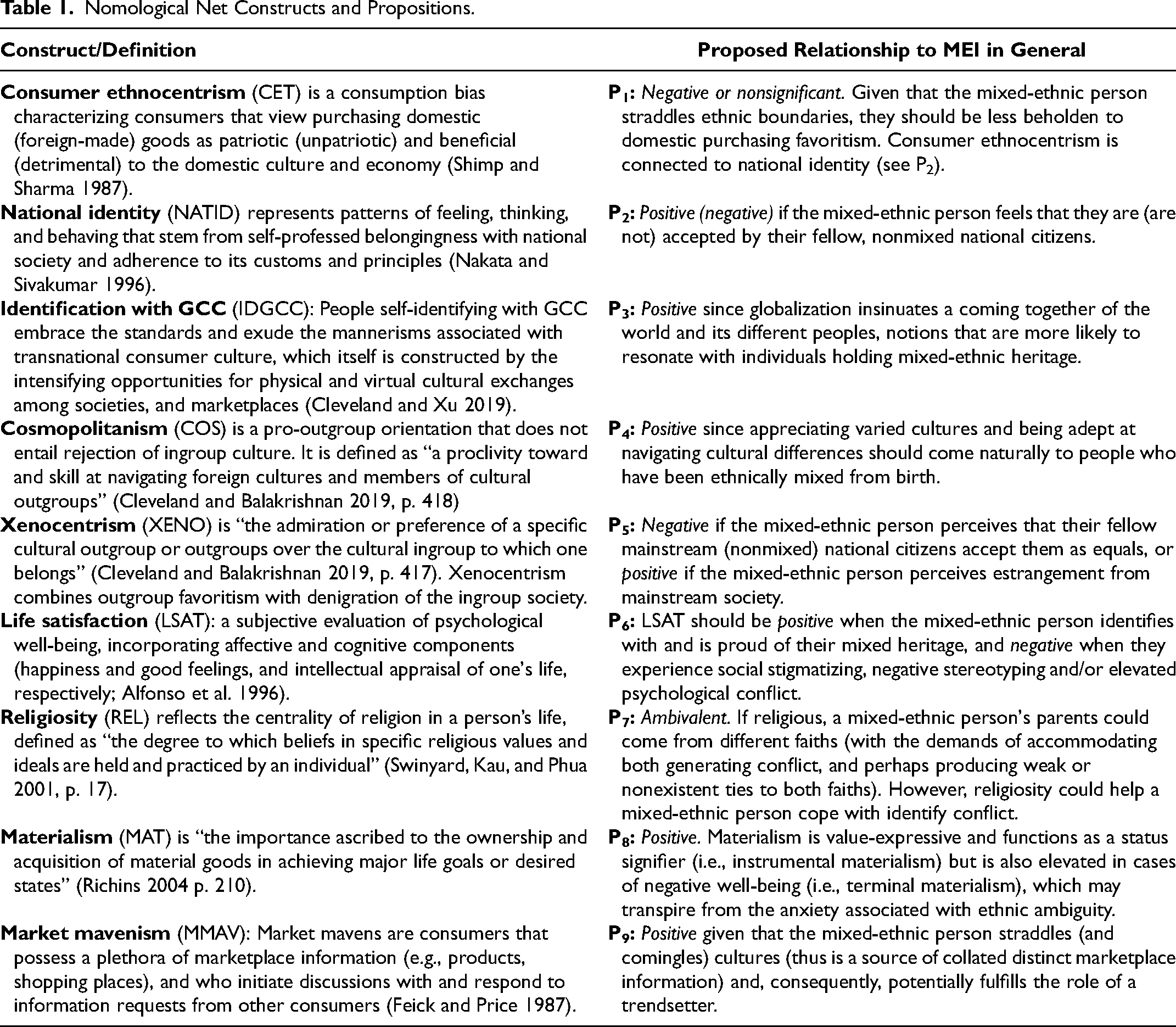
For appraising nomological validity, I examine the relationships of the MEI facets to nine constructs that are widely employed in the international marketing literature, due to their relevance to segmentation, consumer targeting, and brand positioning. Table 1 includes definitions for each construct and, due to space constraints, provides synopses of how each is informed by MEI (in a general sense, rather than for each of the composite dimensions, which are examined post hoc).
Nomological Net Constructs and Propositions.
Cosmopolitanism represents appreciation of different cultures and the ability to navigate through distinct cultural milieus. Since mixed-ethnic individuals straddle multiple groups, some of the positively valenced facets of MEI should stimulate cosmopolitanism. Mixed-ethnic individuals serve as cultural brokers, gathering marketplace information from various reference groups spanning different cultures. The acquisition of social and cultural capital by mixed-ethnic individuals should encourage the trait of market mavenism, while deterring parochial feelings toward domestic products (i.e., consumer ethnocentrism; Holt 1998). Regarding the former, mixed-ethnic individuals are potentially brand ambassadors, transferring marketplace information across cultural groups. Because consumers use products as a means of self-expression, and since the importance of material goods to express oneself has been shown to be higher among ethnic minorities (Cleveland 2022), I also predict a positive relationship to emerge between some MEI facets and materialism. Materialism transpires partially from self-protective impulses, as a potentially maladaptive way of reducing the negative psychological tension that ensues from threats to self-concept, such as those associated with an insecure identity (Rindfleisch, Burroughs, and Denton 1997).
Mixed-ethnic folk may experience a sense of alienation due to not being able to fully fit in with either cultural heritage. To cope, they may strive to ecumenically identify with the GCC (Askegaard, Arnould, and Kjeldgaard 2005) or find solace in religious faith. Alternatively, to supersede having to reconcile their ethnicities, a person may engage in hyperidentification with the national culture (i.e., national identity), presuming that they are accepted by their mainstream (nonmixed) peers, and potentially when they sense rejection or microaggressions due to being deemed ethnically inauthentic (i.e., ethnic invalidation) from members of their minority side (Campion 2019). Sensing disapproval from both mainstream and ethnic minority members may elicit xenocentrism, whereby the mixed-ethnic person may be enticed by one or more cultural outgroups (Cleveland and Balakrishnan 2019). Finally, successfully integrating one's “cultural halves” should be positively related to life satisfaction, especially when a mixed-ethnic person feels accepted by the majority and the minority.
Methodology
MEI Scale Development
The primary objective was to operationalize and validate a multidimensional MEI scale in accordance with best practices (Churchill 1979; Nunnally 1994). Three members of the research team independently made propositions about the components of MEI by scrutinizing the extant literature and interview transcripts. After developing conceptual definitions for each of the tentative facets, team members independently generated Likert-scale items that representatively sampled the domain of each facet. Two sources were used to accomplish this: (1) an immersive literature review of ethnic identity, acculturation, and mixed ethnicity, which inspired two-thirds of the initial measurement item set, and (2) the interview transcripts described previously, which stimulated the other third. The list was then further augmented with items submitted by five graduate students familiar with the ethnic identity literature, who were exposed to the MEI facet conceptual definitions. After item editing and pruning to remove redundant statements, I pretested the provisional randomly sequenced 221 measures for comprehension (Riefler, Diamantopoulos, and Siguaw 2012). I used a convenience sample of 20 Canadian mixed-ethnic undergraduate/graduate students, who were directed to flag problematic items and encouraged to provide commentary on the survey (and its instructions) and its constituent measures. With this feedback, 18 items were removed from the list, and minor vocabulary changes were made to a handful of measures.
The next steps were to collect data, to further refine the MEI item pool, to examine the reliability of the attendant MEI dimensions, and to assess construct validity of these dimensions within the nomological net of consumer dispositions, with samples drawn from three countries. The strength of relationships among the MEI facets, as well as their links to other variables, could differ across ethnic combinations and countries. Canada's policy of multiculturalism may abet Canadian national identity for mixed-ethnic individuals, insofar that they perceive Canada as a place that values ethnic diversity (Cleveland, Laroche, Pons, and Kastoun 2009). Britain's immigration philosophy has likewise evolved from an assimilationist “mother-country” perspective to one that recognizes multiculturalism (Ashcroft and Bevir 2018). In contrast, because the unofficial “melting pot” approach of the United States encourages assimilation, mixed-ethnic individuals may perceive exclusion from the mainstream, possibly diminishing national identity.
Sample Frame and Procedure
This research examines recent generations of mixed-ethnic individuals, rather than those from places where much of the population descends from earlier generations of mixing (e.g., mestizos in South America). Participants were recruited as members of Prolific panels in the United States, Canada, and the United Kingdom. I followed a two-stage process to identify respondents. In the first stage, I solicited participation from panel members having mixed-ethnic heritage, which was defined in the study blurb and in the letter of information. They were asked three dichotomous questions about their ethnic background and were compensated. Respondents passing all three screening questions were invited to record their unique Prolific identification. This identification was used to invite qualified respondents to participate in the main study. Eligible respondents had to have a mixed-ethnic background, whereby one parent was a member of a visible ethnic minority group (e.g., East Asian, South Asian, Black, Indigenous) and the other parent was White (Caucasian, not a visible minority). Respondents were assured of the anonymity of the report. Those providing consent were directed to the Qualtrics survey, which took approximately 30 minutes. Participants were compensated in the form of gift cards worth roughly U.S. $12.
Survey Measures
Three control measures (dichotomous yes/no verification of mixed-ethnic heritage, having one parent of a visible minority ethnicity and the other of Caucasian ethnicity), were followed by four open-ended questions concerning the ethnicity/country of birth of the participant's biological mother and father. Next, participants were exposed to four survey blocks containing the novel 203 statements for capturing each of the ten a priori facets of MEI, along seven-point Likert scales (1 = “strongly disagree,” and 7 = “strongly agree”). The sequencing of construct question blocks was altered across respondents, along with randomized exposure to the measures within four question blocks (approximately 50 per block) to minimize sequencing effects.
The next set of questions pertained to measures for materialism (Richins 2004; 9 items), cosmopolitanism (Cleveland, Laroche, and Papadopoulos 2009; 7 items), xenocentrism (Cleveland and Balakrishnan 2019; 10 items), consumer ethnocentrism (Klein 2002; 4 items), identification with GCC (Cleveland and Xu 2019; 8 items), national identity (Cleveland, Papadopoulos, and Laroche 2011; 11 items), religiosity (Plante and Boccaccini 1997; 10 items), satisfaction with life (Alfonso et al. 1996; 5 items), and market mavenism (Feick and Price 1987; 6 items). For this section, to minimize response fatigue, participants were randomly assigned to one of two series of construct measures, each containing roughly the same overall number of measures. Existing construct measures employed seven-point Likert scales.
Next were three questions whereby respondents could indicate—by a sliding scale, surreptitiously scored from 0 to 100—where they saw themselves in terms of (1) being an ethnic visible minority versus mainstream/nonminority, (2) being an ethnically mixed person versus nonmixed person, and (3) being a Caucasian/White person versus a visible minority/nonwhite person. This was followed with a single item taken from Steenkamp, De Jong, and Baumgartner's (2010) social desirability scale (“I never take things that don’t belong to me”) for gauging common method variance (CMV). Next were measures (1 = “highly disagree,” and 7 = “highly agree”) ascertaining impressions about the prevalence of mixed-ethnic individuals in media and advertising (three items) and pertaining to how respondents used products/brands to express their ethnic heritage (four items). The survey closed with demographic queries. For data quality, five attention check questions (e.g., “Attention check: Please select (1) strongly disagree”) were randomly embedded.
Analyses and Results
Sample Characteristics
After screening out ineligible respondents, incomplete surveys, and attention check failures, the overall sample (n = 645) was roughly evenly split along gender lines (56% female; 44% male). Overall, 54% (47%) of respondents reported that their mother (father) is a visible minority (a very small proportion [<1%] described both parents as minorities). There were 236 Americans (36% of the overall sample), 211 Canadians (33%), and 198 British (31%) respondents. Age distribution was as follows: 45%, <30 years; 30%, 30–49 years; 14%, 40–49 years; and 12%, 50+ years. Age skewed to the younger intervals, but this was expected given that mixed-ethnic unions have only recently become commonplace. In terms of educational attainment, 2% had less than high school education, 22% had graduated high school, 17% had attended vocational/technical college, and 40% and 18% held undergraduate and graduate degrees, respectively. As for country of origin, 78% were born in the United States, Canada, or the United Kingdom. Aggregated ethnic mixtures (all paired with Caucasian) were as follows: 36% East/Southeast Asian, 30% Black, 16% Latino, and 18% “Other” (e.g., Native American, Arab/Middle Eastern). Web Appendix B provides the samples’ demographic profiles.
Principal Components and Reliability Analyses
Principal components extraction (direct oblimin) rotation was performed on the 203 MEI items. The appropriateness of the data for factor analysis was upheld with the Kaiser–Meyer–Olkin test of sampling adequacy of .948 and significant Bartlett's test of sphericity (χ2(20,503) = 91,569, p < .001). Scree plots and eigenvalues (>1.0) informed the components meriting retention. At each round of factor analysis, one item was removed (due to weak or high cross-loadings). After 141 rounds, the 62 items retained loaded on 13 components (eigenvalues > 1.0) jointly accounting for 67.5% of the variance. Retained items, initial eigenvalues, and the variance extracted by each component appear in Table 2. A parallel analysis (O’Connor 2000) was subsequently run on the MEI scale items. Here, the raw data eigenvalues are calculated, and corresponding average eigenvalue means and the 95th percentiles were computed over 1,000 simulated data sets. The randomly generated eigenvalues are compared against those from the raw data. The first 13 raw data factor eigenvalues generated exceed both the generated means and the corresponding 95th-percentile random data eigenvalues, after which (cutoff point, the 14th raw data factor eigenvalue) the corresponding and mean percentile eigenvalue was larger. These findings agree with the Kaiser criterion approach described previously.
MEI Components and Item Loadings.
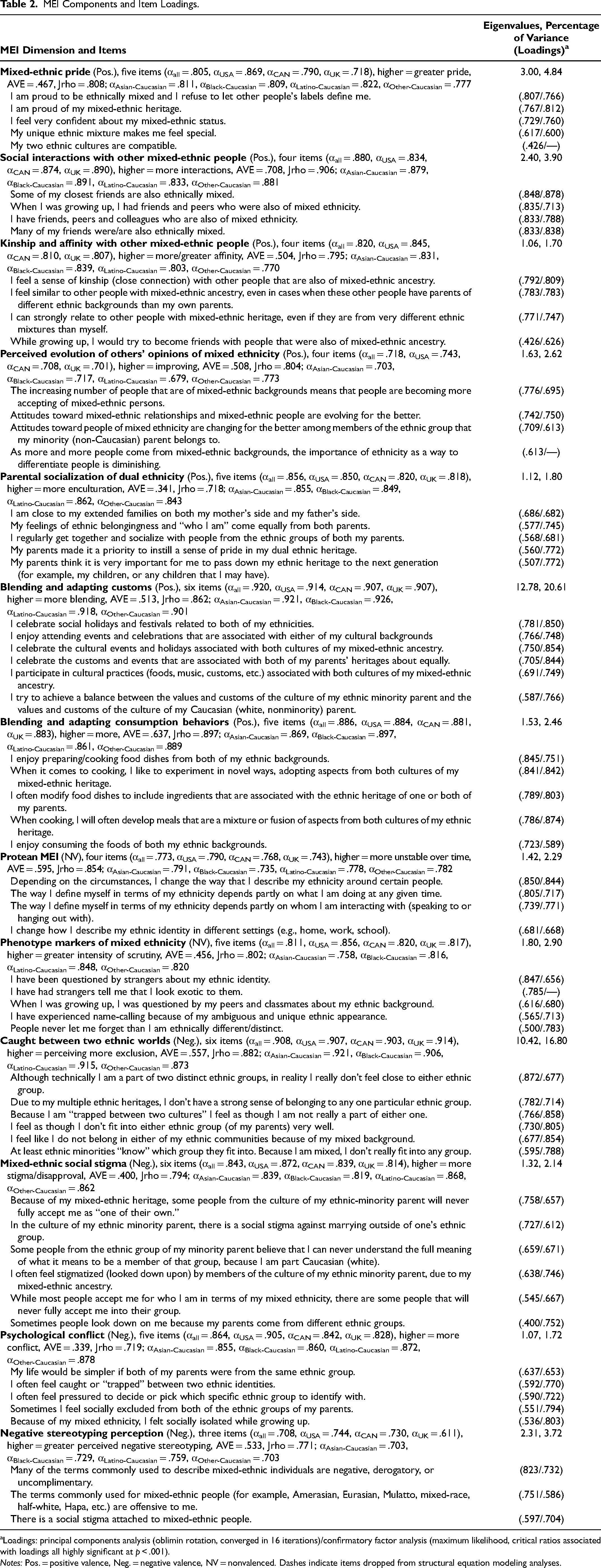
Loadings: principal components analysis (oblimin rotation, converged in 16 iterations)/confirmatory factor analysis (maximum likelihood, critical ratios associated with loadings all highly significant at p < .001).
Notes: Pos. = positive valence, Neg. = negative valence, NV = nonvalenced. Dashes indicate items dropped from structural equation modeling analyses.
Cronbach's alpha (ranges, .726–.912 for each country and .679–.926 for aggregated ethnic combinations), average variance extracted (AVE), and Jöreskog's rho (range, .718–.906) were calculated for each component (Table 2). Most MEI dimensions exceed or come very close to the .45 AVE threshold for newly developed scales, and all meet or exceed the recommended thresholds (Netemeyer, Bearden, and Sharma 2003) for Cronbach's alpha and Jöreskog's rho. Moreover, all item loadings were highly significant (p < .001) and greater than .50, with most loadings greater than .70. The first seven MEI components are positively valenced (Table 3), the eighth and ninth MEI components are nonvalenced, and the final four are negatively valenced. Thematic labels were affixed to each emerging MEI component, inspired by the statements comprised in each. Eight components resemble the ten dimensions posited a priori: “parental socialization of dual ethnicity,” “social interactions with other mixed-ethnic persons,” “phenotype markers,” “psychological conflict,” “protean MEI,” “blending and adapting customs,” and “blending and adapting consumption behaviors.”
Descriptive Statistics for MEI Components and Nomological Net Constructs.
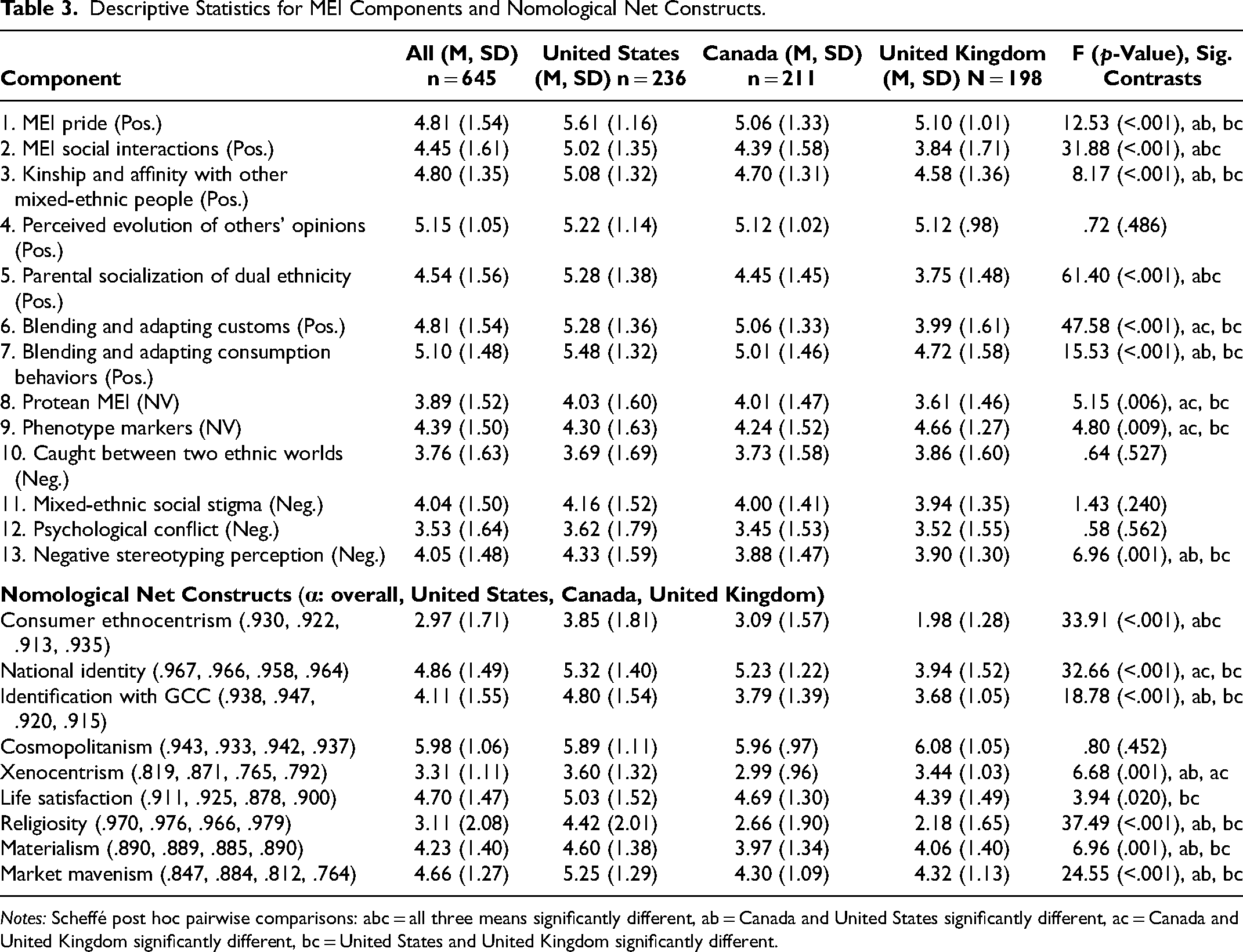
Notes: Scheffé post hoc pairwise comparisons: abc = all three means significantly different, ab = Canada and United States significantly different, ac = Canada and United Kingdom significantly different, bc = United States and United Kingdom significantly different.
Several of the conjectured dimensions split into distinct components. The items tapping “self-identified belongingness and pride” yielded three: (1) “MEI pride,” (2) “kinship and affinity with other mixed-ethnic persons,” and (3) “caught between two ethnic worlds.” The first component captures mixed-ethnic pride and confidence. The second encapsulates impressions of being connected to other people of mixed-ethnic ancestry, even with those having a different ethnic mixture. Relating to other mixed folk provides social support, making the struggle of growing up mixed easier to bear (Shih and Sanchez 2005). The third component, which is negatively valenced, expresses the perception of being caught between two groups and of not fitting well into or belonging with either one. As expressed by one interviewee: “We were, you know, not white enough and we were not Asian enough” (F21, student). Most interviewees voiced experiencing similar thoughts regularly, and several lamented that this feeling was exacerbated by the absence of societal role models with similar ethnic mixtures.
The a priori dimension of “other people's perceptions” of the mixed-ethnic person's cultural heritage yielded three components: “perceived evolution of other people’s opinions,” “mixed-ethnic social stigma,” and “negative stereotyping,” of which the latter two are negatively valenced. The first captures perceptions regarding whether mainstream attitudes are evolving in a positive direction, that is, progressively accepting toward mixed-ethnic relationships and people. Mixed-ethnic social stigma denotes perceived negative dispositions toward those that are mixed, from the ethnic minority community side of the mixed-ethnic person, whereas negative stereotyping captures perceptions about the undesirable labeling and categorizations held by some in mainstream society. Interviewees reported experiencing microaggressions (Campion 2019) from Caucasians, from the minority community, or both. Examples include “I know some pretty nasty phrases in Chinese for what I am. The idea of being … ‘a mixed-seed person’ has half-breed implications” (F34, media), and “There's this stereotype [held by Caucasians] that Asians are smart, but also, that Asians are cheap” (F34, broker/agent).
The a priori dimension “blending ethnic media consumption” did not emerge as a reliable factor. Web Appendix C lists the correlations among the MEI components. Some patterns include the significant positive correlations among all positively valenced components (1–7), the positive correlations among negatively valenced components (10–13), and the positive correlation between the nonvalenced components (8 and 9). Most findings carried over to the three subsamples. Although in some cases the positively versus negatively valenced components were inversely related, in other cases the relationships were nonsignificant or even positive, which is suggestive of the ambivalent feelings that many mixed-ethnic people hold toward their varied ethnic heritage and identity. Analyses revealed zero significant (p < .05) correlations of the 13 MEI facets to the social desirability item used for gauging CMV (p = .05), which is further assessed in a subsequent section. This item was also not significantly correlated with any of the nomological net constructs.
Next, the correlations of the MEI dimensions to the three sliding scales described in the methodology were examined. Due to space limitations, only key significant (p < .05) findings are elaborated. For the first sliding scale (ethnic minority [0] vs. mainstream/nonminority [100]), as expected, those perceiving themselves as ethnic minority were more apt to (1) feel kinship and affinity with other mixed-ethnic persons (r = −.157), (2) report phenotype markers (r = −.272), (3) express feelings of psychological conflict (r = −162), (4) sense a social stigma against mixed ethnicity (r = −.159), and (5) perceive negative stereotyping of mixed ethnicity (r = −.152). Those seeing themselves as part of the mainstream were more likely to sense that mainstream opinions about mixed-ethnic folk were becoming more positive (r = .111). Most of these results were repeated with the second sliding scale (ethnically mixed [0] vs. nonmixed [100]). Significant findings for the third sliding scale (Caucasian/White person [0] vs. visible minority/nonwhite) person [100]) were generally the obverse of those for the previous two scales: kinship and affinity (r = .152), phenotype markers (r = .315), caught between two worlds (r = .165), social stigma (r = .197), psychological conflict (r = .215), and negative stereotyping (r = .152). These results uphold the trait validity of the multidimensional MEI scale.
Country differences on the constructs are listed in Table 3, along with post hoc (Scheffé) pairwise comparisons. All host countries are English-speaking with long histories of immigration. Yet they differ along many aspects, including official policies with respect to assimilation versus multiculturalism, the preponderance of various minority groups, and the proportion of various Caucasian–visible minority mixtures (indicated in Web Appendix B). These societal differences likely explain some of the variation in mean scores for the MEI facets. The most striking differences were found for parental socialization of dual ethnicity, with U.S. mixed-ethnic folk having substantially higher scores than their Canadian and British counterparts. This was followed by the likelihood of blending and adapting customs, and MEI social interaction, again with U.S. respondents scoring highest on these latter two facets.
Web Appendix D details the correlations of MEI facets to the consumer constructs. Since these relationships are analyzed subsequently with a multivariate approach, comments are limited to a few patterns. Most bivariate correlations of the MEI dimensions to the constructs were significant, foretelling their importance in terms of informing mixed-ethnic consumers’ dispositions. Cosmopolitanism and identification with GCC, indicating cultural openness and attachment to GCC respectively, were strongly and positively associated with numerous (particularly, positively valenced) MEI facets. Xenocentrism—preference for an outgroup over any ingroup—was significantly positively correlated with the nonvalenced and, especially, the negatively valenced MEI dimensions. Compared with identification with GCC and cosmopolitanism, the correlation magnitudes of the various MEI dimensions to the domestic/mainstream ingroup dispositions of consumer ethnocentrism and national identity were less pronounced. These MEI facets largely played positive roles for national identity (e.g., parental socialization), and when participants expressed high MEI pride. As expected, life satisfaction was associated with higher scores on the positively valenced MEI dimensions. Religiosity, materialism, and especially market mavenism were positively predicted by the majority of MEI dimensions, especially positively valenced and nonvalenced facets. The few negative correlations were primarily found for national identity, with respect to feeling caught between two worlds, and phenotype markers.
Structural Equation Modeling Analyses
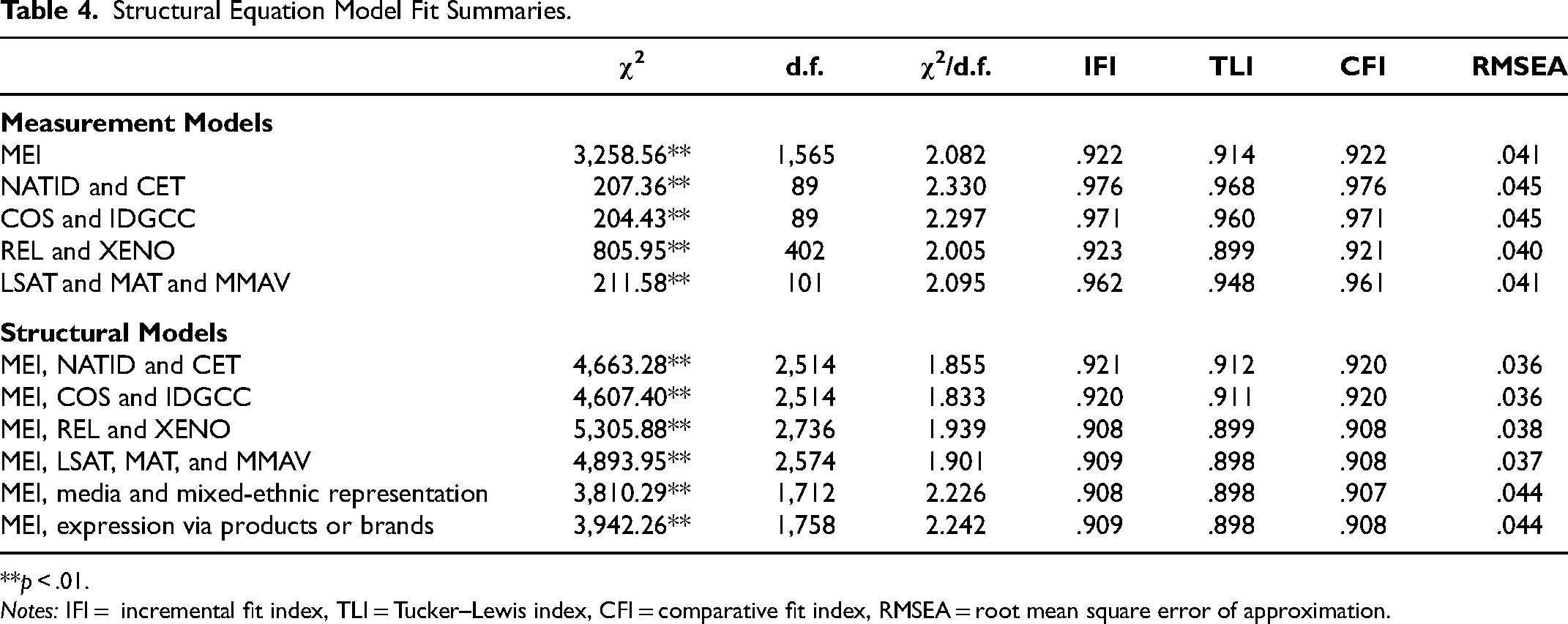
MEI items were next subjected to confirmatory factor analyses (maximum likelihood, AMOS-28). Considering the number of estimated parameters, after three indicators were dropped (one apiece for “others’ opinions,” “mixed-ethnic pride,” and “phenotype markers”) the measurement model (Table 4) yielded a good fit to the data according to Hu and Bentler’s (1999) criteria, with an adjusted chi-square test (χ2/d.f., values between 1 and 5 indicative of reasonable fit) of 2.082, a comparative fit index (CFI) of .922 (acceptable CFI > .90), and a root mean square error of approximation (RMSEA) of .041 (good fit indicated by values < .05). The AVEs for all dimensions are above the .45 threshold for new constructs (Netemeyer, Bearden, and Sharma 2003) with only 2 of 13 (negative stereotyping AVE = .458, social stigma AVE = .471) below .50. Upholding discriminant validity (Fornell and Larcker 1981), in all cases, the square root of the construct AVE (ranging from .677 [negative stereotyping] to .807 [MEI social interactions]) was greater than the correlation between that MEI construct and any other MEI construct. The highest correlation of an MEI facet with a nomological construct was .560 (parental socialization and identification with GCC), where the squared AVE (for parental socialization) was .718 (Web Appendix E).
Structural Equation Model Fit Summaries.
**p < .01.
Notes: IFI = incremental fit index, TLI = Tucker–Lewis index, CFI = comparative fit index, RMSEA = root mean square error of approximation.
The equivalence of the factor loading pattern was tested using the multigroup procedure (Byrne 2004). All factor loadings were revealed to be equivalent across the three countries, indicated by the nonsignificant chi-square difference (Δχ2(92) = 112.64, p = .071) between the unconstrained measurement model (χ2(4,695) = 7,375.07, p < .001, χ2/d.f. = 1.57) and the model in which factor loadings were constrained to be equal (χ2(4,787) = 7,487.71, p < .001, χ2/d.f. = 1.56). This provides evidence that all measures of MEI are operating in the same way for all three groups. As was found with the preliminary principal components analysis correlations (Web Appendix C), most correlations among the 13 MEI facets were significant, largely tracking the same patterns.
To assess the presence of CMV, another multigroup confirmatory factor analysis was estimated, using the preceding measurement model but with an additional common latent factor (CLF), whereby each item has a path to its own substantive factor and to an unobserved latent factor (Hulland, Baumgartner, and Smith 2018; Steenkamp and Maydeu-Olivares 2021). Compared with the baseline model without the CLF, this model has comparable fit (Δχ2/d.f. = .018, ΔCFI = .001, ΔIFI = .002, ΔTLI = .001, ΔRMSEA = .000), indicating that the amount of CMV in the data is negligible. Moreover, the average difference (Δ across 59 parameters) in the standardized regression weights (models with vs. without the CLF) was .055, with no Δ coefficients greater than .20 (Chin, Thatcher, and Wright 2012), suggesting that the measures are not affected by CMV.
To examine the nomological validity, 3 structural models were constructed for (1) national identity and consumer ethnocentrism, (2) identification with GCC and cosmopolitanism, (3) religiosity and xenocentrism, and (4) life satisfaction, materialism, and market mavenism. All four models 4 yielded fit statistics meeting or exceeding the recommended cutoff indices (Table 4). Prior to testing the structural models, the multigroup invariance procedure verified the equivalence of the factor loadings for the nomological construct measurement models. Comparing the fit of the unconstrained to the measurement-weights constrained models, three of the four measurement models were found to be invariant: national identity and consumer ethnocentrism (unconstrained χ2(267) = 457.85, p < .001, χ2/d.f. = 1.72 vs. constrained χ2(293) = 487.12, p < .001, χ2/d.f. = 1.66, Δχ2(26) = 29.28, p = .299), identification with GCC and cosmopolitanism (χ2(267) = 479.26, p < .001, χ2/d.f. = 1.80 vs. χ2(293) = 507.32, p < .001, χ2/d.f. = 1.73, Δχ2(26) = 28.06, p = .356), and life satisfaction, materialism, and market mavenism (χ2(303) = 487.13, p < .001, χ2/d.f. = 1.61 vs. χ2(329) = 513.62, p < .001, χ2/d.f. = 1.56, Δχ2(26) = 26.49, p = .436). For the remaining model (religiosity and xenocentrism), the difference between the unconstrained and measurement-weights constrained model was significant (χ2(402) = 805.95, p < .001, χ2/d.f. = 2.01 vs. χ2(434) = 864.28, p < .001, χ2/d.f. = 1.99, Δχ2(32) = 58.34, p = .003), indicating that this measurement model does not strictly hold across the three groups.
To identify the noninvariant parameters, separate models were tested for religiosity and for xenocentrism. Religiosity achieved invariance (χ2(402) = 805.95, p < .001, χ2/d.f. = 2.01 vs. χ2(420) = 829.62, p < .001, χ2/d.f. = 1.98, Δχ2(26) = 23.67, p = .166), but xenocentrism did not (χ2(402) = 805.95, p < .001, χ2/d.f. = 2.01 vs. χ2(426) = 840.60, p < .001, χ2/d.f. = 2.02, Δχ2(14) = 34.66, p = .002), meaning that one or more factor loadings for xenocentrism are not equivalent across the three groups, despite the achievement of configural invariance (i.e., satisfactory baseline model fit for each country). Identifying noninvariant parameters requires imposing equality constraints on the first measured parameter while removing the other constraints and testing whether there is a significant difference in model fit (Byrne 2004), then doing the same with the second parameter, and so forth. All eight retained parameters for xenocentrism were shown to be invariant across at least two samples. The findings for this construct should be interpreted with caution. Full measurement invariance commonly does not hold (Steenkamp and Baumgartner 1998), and, overall, the results are pleasing, particularly for the novel MEI measures.
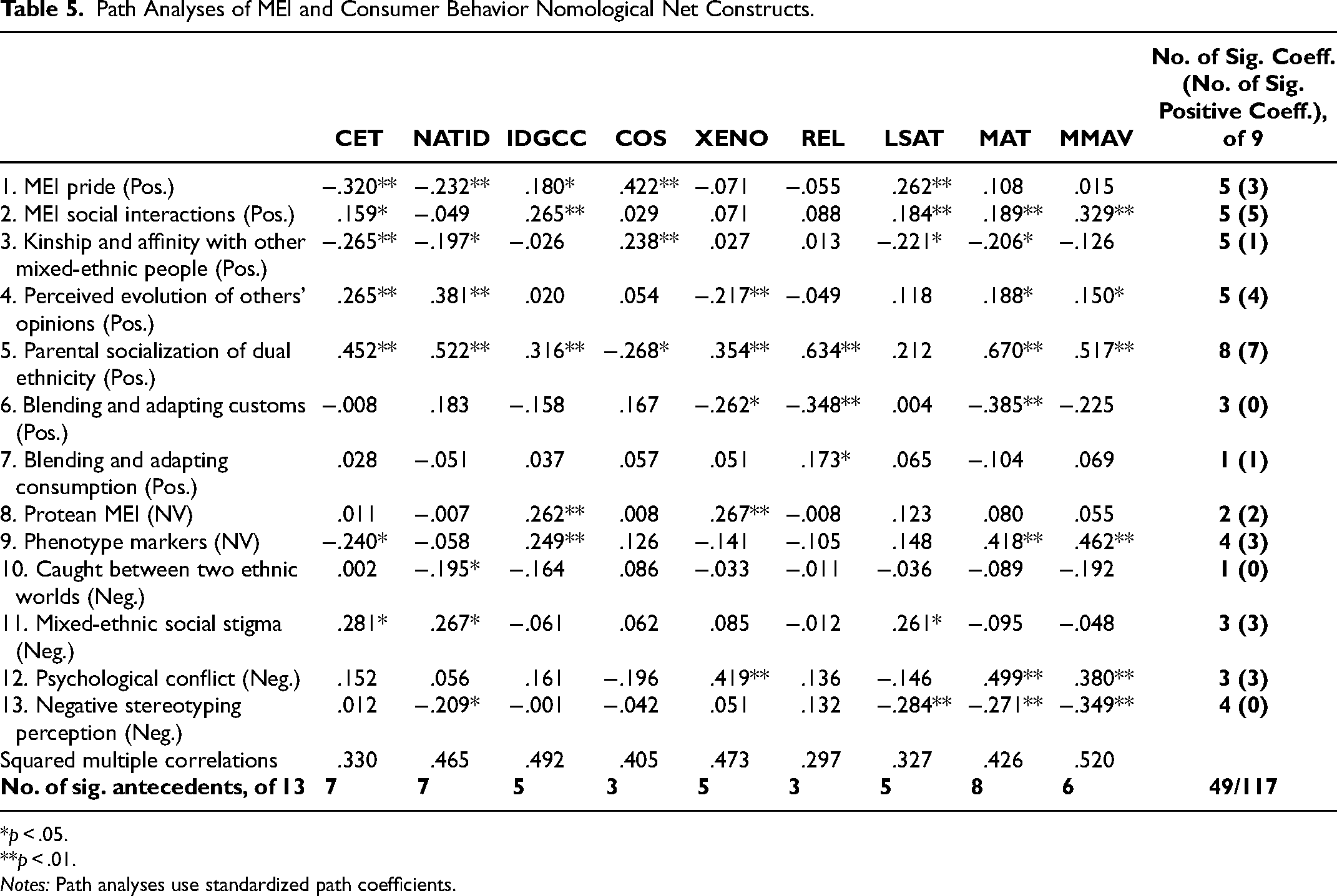
The standardized path coefficients (Table 5) disclose several patterns. First, all nine dispositions were shaped by multiple MEI facets, ranging from three (cosmopolitanism, religiosity) to eight (materialism). Second, the various MEI facets were variably prominent in terms of predicting the nomological constructs, with “parental socialization of dual ethnicity” appearing most often (for eight of nine constructs). Third, the roles played by each MEI facet were often nonmonotonic, for example, mixed-ethnic pride's positive effects on identification with GCC, cosmopolitanism, and life satisfaction; and the negative effect of this MEI facet on consumer ethnocentrism and national identity.
Path Analyses of MEI and Consumer Behavior Nomological Net Constructs.
*p < .05.
**p < .01.
Notes: Path analyses use standardized path coefficients.
Several similarities emerged for the dispositions of national identity and consumer ethnocentrism. Both sentiments were lessened with higher levels of mixed-ethnic pride and kinship/affinity with other mixed-ethnic persons. However, both were amplified when perceptions of social stigma against mixed-ethnic persons—applied by the ethnic minority side—were salient and elevated. Here, national identity may provide an option for belonging, and for decoupling from their ethnic inconsistency. As respondents sensed that attitudes toward mixed-ethnic persons were becoming more positive, they tended to have higher consumer ethnocentrism and national identity. Parental socialization turned out to have the strongest positive effect on consumer ethnocentrism and national identity. The remaining significant predictors were specific to either consumer ethnocentrism or national identity, for example, how phenotype markers reduced consumer ethnocentrism, and how negative stereotype perceptions—from the mainstream population—of mixed-ethnic persons lowered national identity. These latter findings are intuitive, as a person is likely to feel a degree of estrangement from their nation when they sense that others single them out for their distinct appearance or apply undesirable stereotypes. The negative relationship between national identity and being “caught between two worlds” provides indication of perceived marginalization, whereas the positive link between mixed-ethnic social interactions and consumer ethnocentrism is anomalous. Together, the MEI facets contributed 33% and nearly 47% of the variances for life satisfaction and national identity, respectively, and describe an ambiguous, complex relationship between these constructs and MEI.
The links of the various MEI facets to identification with GCC and cosmopolitanism were generally inconsistent, excepting the positive relationship with MEI pride. As social interactions with other mixed-ethnic persons increased, so too did respondents’ levels of identification with GCC, whereas a strong sense of kinship with other mixed-ethnic persons enhanced cosmopolitanism. Parental socialization of dual ethnicity contributed to instilling identification with GCC but surprisingly detracted from the inculcation of cosmopolitanism. Phenotype markers and the shifting (protean) expression of mixed ethnicity both predicted higher levels of identification with GCC. The MEI facets described 49%, nearly 41%, and 47% of the corresponding variances for identification with GCC, cosmopolitanism, and xenocentrism. Whereas cosmopolitanism signifies appreciation for cultural outgroups, xenocentrism denotes preference for a cultural outgroup over the ingroup. It is not surprising that the MEI antecedents for each were unique. Xenocentrism was enhanced by parental socialization, feelings of psychological conflict and a protean MEI. The perception of growing mainstream acceptance of mixed-ethnicity lessened xenocentrism. Xenocentrism was also less infused among those who were adept at blending/adapting consumption behaviors from both ethnic heritages.
Life satisfaction was a positive function of mixed-ethnic pride and mixed-ethnic social interactions, and was lessened by elevated perceptions of negative mixed-ethnic stereotyping. Perplexingly, life satisfaction was lower among those expressing kinship with other mixed-ethnic folk. Also contrary to expectations, higher levels of perceived mixed-ethnic social stigma—ensuing from the community of the ethnic minority parent—was associated with higher life satisfaction. As with the anomalous results for consumer ethnocentrism and national identity regarding the positive impact of mixed-ethnic social stigma on these constructs, this latter finding can be explained in terms of risk and resilience theory (Masten 2013). The theory suggests that while people encounter threats that negatively influence their well-being, some of these people demonstrate a remarkable ability to adapt and cope in response to these threats, positively sustaining their well-being. Religion is passed down through generations, and this was confirmed by the strong positive link between parental socialization and religiosity. Religiosity was enhanced by blending/adapting consumption behaviors—perhaps to fit into religious proscriptions—while being lessened by blending/adaptation of customs/values (potential causal ambiguity as religious orthodoxy may discourage such comingling). MEI facets accounted for nearly 33% and 30% of the variances in life satisfaction and religiosity.
Given its connections to status and identity signaling, it is not surprising that materialism was positively associated with MEI social interactions and phenotype markers. Materialism is linked to socialization and personality rather than to genetics (Cleveland, Papadopoulos, and Laroche 2022). Rindfleisch, Burroughs, and Denton (1997) observed that materialism in adult consumers is connected to their life experiences while growing up under different forms of family structures. Parents inadvertently inculcate materialistic values to their children—through gift exchanges and offering/withholding objects as rewards/punishments—and this was confirmed as materialism was strongly linked to parental socialization. Counterintuitively, materialism was muted among those engaged in blending/adapting customs/values as well as by mixed-ethnic kinship/affinity. These latter findings may be explained by the absorption and greater salience of traditional ethnic values that ostensibly conflict with materialism, which is portrayed as a moral transgression (Cleveland, Papadopoulos, and Laroche 2022). Consistent with the notion that materialism potentially signals negative well-being, materialism was exacerbated by psychological conflict. Yet the perception of negative stereotyping was inversely associated with materialism. This suggests that materialism is a coping mechanism for internal issues (e.g., low self-esteem from one's ethnic contradictions, and perhaps failure of fitting into majority/minority groups); however, materialism is not exacerbated by negative external attitudes. When external attitudes are becoming more positive, this appears to have a moderate positive effect on materialism, as evidenced by the positive coefficient for perceived evolution of others’ opinions. Of the nomological constructs, materialism was significantly associated with the most (eight) MEI facets, accounting for more than 42% of the variance in materialism.
Many findings for materialism repeated for market mavenism, which denotes the proclivity for sharing marketplace information. Market mavenism was enhanced by phenotype markers, parental socialization, and MEI social interactions. This has implications for understanding the reference group influences of mixed-ethnic persons. Market mavenism was more prevalent among those experiencing psychological conflict and when sensing improving mainstream opinions of mixed-ethnic folk. Market mavenism was lessened among respondents holding salient perceptions of negative mixed-ethnic stereotyping from mainstream societal members. The six significant MEI predictors accounted for 52% of the variance in market mavenism. Overall, MEI facets significantly predicted the nomological constructs in 49 out of a possible 117 instances (42%).
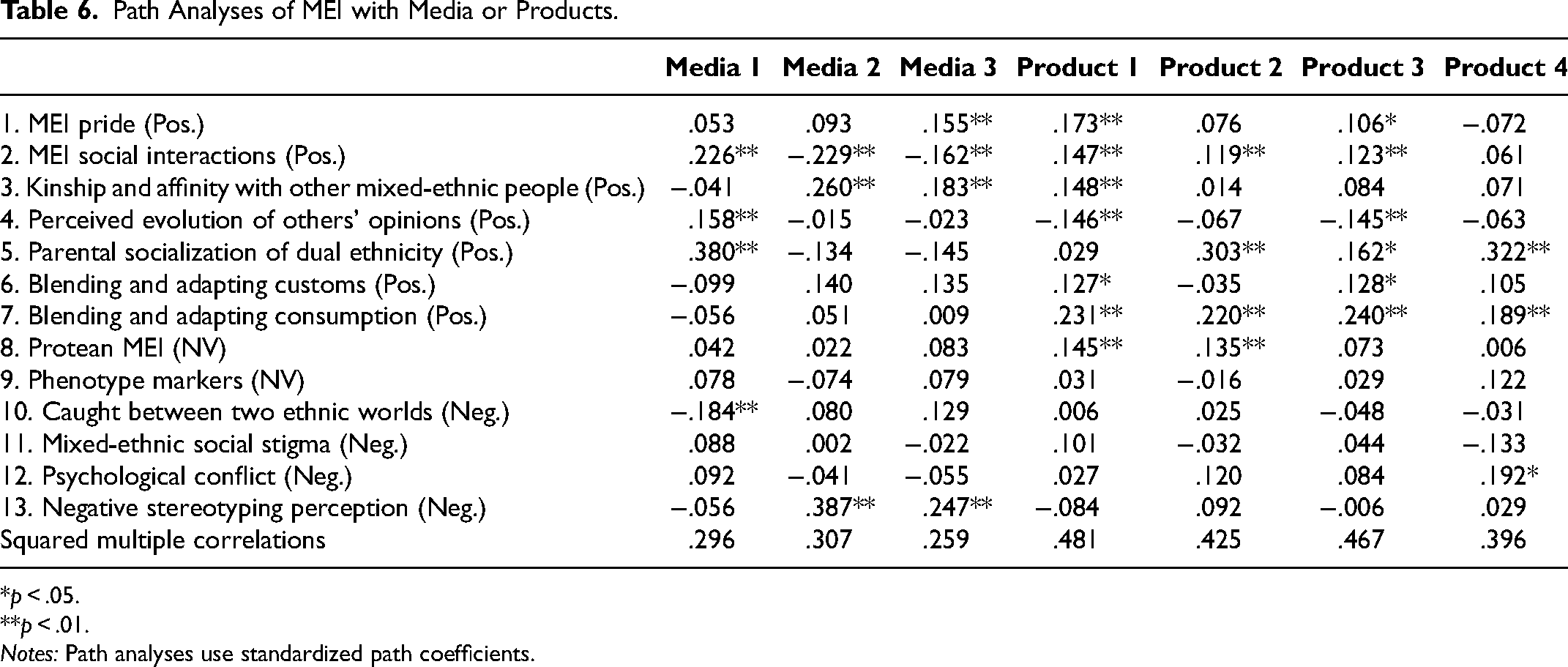
To further inspect how MEI contributes to explaining specific consumer attitudes and behaviors, two additional structural equation models were constructed. The first examined how MEI dimensions foretold impressions about the prevalence/lack of mixed-ethnic individuals in mainstream media and advertising (three items). The second scrutinized MEI predictors of the usage of products/brands for expressing mixed ethnicity to others (four items). Model fit indices for both were satisfactory (Table 4). Standardized path coefficients appear in Table 6. The proportion of variance accounted for by the various MEI facets ranged from nearly 26% to more than 48%. Four MEI facets were linked to the first media item (Media 1: “I see role models in the mainstream media today who are reflective of my own identity”). Respondents tended to express agreement the more that they engaged in social interactions with other mixed-ethnic folk, sensed improvements in mainstream attitudes toward about mixed-ethnic people, and were socialized by parents to celebrate their mixed ethnicity, and the less they felt “caught between two worlds.”
Path Analyses of MEI with Media or Products.
*p < .05.
**p < .01.
Notes: Path analyses use standardized path coefficients.
With three predictors, agreement with the second statement (Media 2: “I feel that mixed-ethnic people are underrepresented in the mainstream media”) rose when respondents were less likely to interact with other mixed-ethnic people (perhaps due to living in places with few other mixed people), when they felt a strong kinship/affinity with other mixed-ethnic folk, and when they sensed negative mixed-ethnic stereotyping. With four antecedents, results for the third item (Media 3: “I feel that mixed-ethnic people are underrepresented in advertising by companies”) were repeated from the previous media question, with one additional positive predictor, mixed-ethnic pride.
Four statements (Products 1–4) pertained to using products and brands to express mixed-ethnic status: “I use products (such as food and fashion) as a way of signaling (communicating) to others my mixed-ethnic status,” “I use brands as a way of expressing my mixed ethnicity,” “I often buy products or brands that are symbolic of my mixed-ethnic status,” and “I dress in a manner that is in accordance with the customs and norms of both my ethnic heritages.” Blending/adapting consumption behaviors from both cultures was a positive driver for all four. Mixed-ethnic social interactions positively predicted the likelihood of all but the fourth product item, whereas parental socialization was a positive driver for the last three items. Protean (shifting) MEI was positively associated with the first two product/brand statements. Respondents perceiving improving mainstream opinions about mixed-ethnic people were less likely to use products as a mechanism for mixed-ethnic expression and were consequently less apt to buy products symbolizing their mixed status. Blending/adapting customs from both ethnic heritages predicted using products to signal and brands to express (Products 1 and 3) mixed-ethnic status. The remaining significant MEI drivers were statement-specific, including the greater likelihood of using products to signal mixed-ethnic status when holding feelings of kinship/affinity with other mixed-ethnic folk. Psychological conflict was associated with a greater propensity to dress in such a way as to conform to the customs of both ethnic groups, reflecting the challenges of satisfying the normative expectations of both communities.
Discussion
Future population growth in most Western countries will come from non-White minority groups (Stefaniak and Wohl 2022). As mixed-race people constitute the fastest growing ethnic category in many Western countries (Harrison, Thomas, and Cross 2017), it imperative to understand how these individuals fit into established social categories (Shih and Sanchez 2005). Incorporating inductive and deductive research phases, and a cross-national sample of participants with many ethnic combinations, this study comprises the most comprehensive investigation of mixed-ethnic consumers to date. The article takes the discourse on social identity into an important new direction, substantively augmenting our understanding of an expanding worldwide segment of customers that international marketing scholars have largely overlooked. Despite the heterogeneity of the mixed-ethnic population, the findings establish that the facets of MEI and the corresponding outcomes are largely shared by multiracial individuals. The structure of MEI was supported by a combination of exploratory and confirmatory factor analyses across the three countries. Construct validity was further established through a nomological net of established consumer dispositions.
Theoretical Implications
Theories have been advanced to explain ethnic identity and its corollaries for cognition, emotions, and behaviors. The drive of consumers to comprehend who they are and to bond with social groups brings forth many identity-driven effects that have implications for psychological well-being, society, and consumer behavior. Throughout history, mixed-ethnic individuals were typically lumped in with their ethnic minority side (e.g., Chinese as opposed to Caucasian-Chinese), marked ambiguously as “Other,” or had their heritage fractionalized (whereby marking the person as “less than” impedes inclusion and imposes marginalization) (Rocha and Yeoh 2021). Such classificatory imposed labels have substantial effects on the self-definitions of individuals and groups, yet comprehending the nature and corollaries of mixed ethnicity necessitates examining how mixed-ethnic individuals themselves interpret their own ethnicity, from both self-identity and relational (i.e., group formation, maintenance, and interactions with other groups) perspectives (Peñaloza 2006). The challenges associated with complex identities across different ethnic combinations should not prevent scholars from examining multiethnic identity development and attempting to identify common elements that can be measured. The scale developed in this research enables researchers to quantify how individuals subjectively express their MEI along relevant facets. Echoing research on acculturation, ethnic minority identities, and the nascent empirical studies on mixed ethnicity, the findings confirm that MEI is a multidimensional phenomenon, comprising individual (psychological, physical), relational (interpersonal, community), and behavioral (customs, practices) aspects.
Corroborating inductive work by Benet-Martínez and Haritatos (2005), the interviewees described their mixed-ethnic heritage in complicated ways, using positive and negative language. The MEI scale maps out this equivocal and complex nature, with seven (four) positively (negatively) valenced components and two nonvalenced facets, providing a much more comprehensive representation of the concept than Rockquemore's (1999) unidimensional racial identity scale, or the bicultural identification scale developed by Benet-Martínez and Haritatos (2005), which covers two facets: cultural distance and conflict (conceptually similar to “caught between two worlds” and “psychological conflict” in the present study, respectively). These two scales were developed for specific monoethnic groups (Black Americans, Chinese Americans), whereas Phinney's (1992) multifaceted ethnic identity measure generalizes to monoethnic immigrants and minorities but not to people ethnically mixed at birth.
The MEM (Yoo et al. 2016) overlaps conceptually with several dimensions of the MEI scale: “perceived racial ambiguity” (phenotype markers), “shifting expressions” (protean MEI), “multicultural engagement” (the MEI differentiates “blending/adapting customs” from “blending/adapting consumption behaviors”), “multiracial discrimination” (mainstream and monoethnic aversions are distinguished with “mixed-ethnic social stigma” and “negative stereotyping,” respectively), and, loosely, with the notion of “creating a third space” (mixed-ethnic kinship/affinity). The novel MEI construct expands and improves on the MEM, respectively, by tapping important facets of MEI overlooked by the latter (mixed-ethnic pride, MEI social interactions, parental socialization, perceived evolution of others’ opinions, feeling caught between two ethnic worlds, psychological conflict), and by reducing emphasis on measuring statements concerned with visible racial differences while improving content validity.
Moreover, in support of concurrent criterion-related validity, the findings show that the dimensions of MEI are associated with an array of consumer constructs, demonstrating the scale's applicability for market segmentation and signaling the construct's suitability for product positioning and advertising spokesperson purposes. Regarding nomological validity, where significant, the association of MEI to these constructs largely confirmed my expectations.
Parental socialization of mixed ethnicity was a powerful driver of all but one nomological construct. This factor is likely more critical for mixed-ethnic individuals relative to their monocultural counterparts. Parents help their children come to terms with their ethnic ambiguity and enhance their children's skills at navigating between cultural spheres. Several of the ostensibly anomalous findings for consumer ethnocentrism and national identity can be explained by risk and resilience theory (Masten 2013). It appears that in response to mixed-ethnic individuals experiencing social stigma from the ethnic minority side—which should represent a risk to psychological well-being—some have acquired resilience, that is, the enhanced ability to cope and therefore sustain well-being (Yoo et al. 2016). The findings imply that resilience can promote feelings of national identity and, concomitantly, consumer ethnocentrism. These dispositions favor the employment of a local consumer culture positioning strategy (Alden, Steenkamp, and Batra 1999), particularly when coupled, as the findings show, with the perception of improving mainstream mixed-ethnic attitudes. Parental socialization was a prominent factor for both dispositions, testifying to an intergenerational effect. Yet national identity and consumer ethnocentrism were lessened among those expressing mixed-ethnic pride and a strong affiliation with the mixed-ethnic community.
Research on xenocentrism—subordinating or denigrating one's ingroup while preferring a foreign outgroup(s)—has lagged that of pro-ingroup dispositions (e.g., consumer ethnocentrism) and their obverses (e.g., cosmopolitanism). Mixed-ethnic individuals were historically marginalized and faced prejudice from the mainstream and—due to their “impure” bloodlines—from their ethnic community counterparts (Spickard 1989). Marginalization is offered as one explanation for xenocentrism (Cleveland and Balakrishnan 2019), and the findings show that for mixed-ethnic persons, outgroup identification is encouraged by psychological conflict, whereas it is stifled by improving mainstream mixed-ethnic attitudes. The positive links of MEI pride and kinship to cosmopolitanism signal that MEI represents a superordinate social category that subsumes its distinct ethnic constituents (Brumbaugh and Grier 2006).
Managerial Implications
The exponential growth of the mixed-ethnic population implies that international marketers should consider lessening their reliance on national or monoethnic frames of analyses. Increasing multiculturalism within countries has prompted numerous marketing scholars to question the practicality of vertical market segmentation. International marketers should consider practicing global or horizontal market segmentation, by identifying and serving similar groups of consumers regardless of country frontiers (Cleveland, Laroche, and Papadopoulos 2009). As minority individuals, mixed-ethnic consumers exhibit similarities with consumers from other ethnic groups. However, by virtue of spanning two ethnic cultures without perhaps ever being fully accepted by each, mixed-ethnic consumers’ complex, ambiguous status has consequences for self-definition and social membership, and for their endearment versus dislike of various ingroups and outgroups, both of which ultimately affect their dispositions and behaviors as consumers.
These consumers’ valuable role at the intersection of cultural boundaries has implications for market segmentation, targeting, brand positioning and personality, and communication strategies, and it informs the interpersonal exchanges of marketplace information by mixed-ethnic individuals. The three constructs with obvious connections to consumer culture—identification with GCC, materialism, and market mavenism—had much of their variance explained by the MEI dimensions. Predictably, having pride in one's mixed ethnicity and interacting with other mixed-ethnic persons were conducive to fostering identification with GCC, especially among those with distinguishing phenotypical traits, and among those whose MEI shifts according to the situation. These characteristics inform themes that could be leveraged for targeting mixed-ethnic individuals with a GCC positioning strategy (Alden, Steenkamp, and Batra 1999).
Inherently straddling cultures, mixed-ethnic individuals are valuable as market mavens, and much of the variance of this disposition was accounted for by the MEI components. The findings show that market mavenism is most likely to occur among mixed-ethnic persons that are distinguished by their phenotypical traits and, perhaps consequently, by those experiencing psychological conflict. The sharing of marketplace information was naturally encouraged by social interactions with other mixed-ethnic persons, although negative stereotyping perceptions from the mainstream population deterred market mavenism. These findings largely carried over to materialism. Material goods convey social status and serve as means for identity signaling (Richins 2004). This function was evidenced by the positive link to MEI social interactions and phenotype markers. Foundational for luxury consumption, material appeals are widely employed in brand positioning strategies. With its ties to low self-esteem and unhappiness, materialism has a darker side for vulnerable consumer groups. Materialism was substantially exacerbated by psychological conflict and was elevated for those with visibly different physical characteristics, potentially signaling marginalization. Yet supporting resilience, exposure to negative stereotyping diminished materialism.
Due their high cultural and social capital and their ability to traverse social worlds (Holt 1998), cosmopolitan consumers are trendsetters and early adopters, and therefore are highly attractive to marketers (Cleveland, Laroche, and Papadopoulos 2009). For mixed-ethnic individuals, cosmopolitanism was strongly associated with having pride in one's mixed heritage, and kinship with other mixed-ethnic persons. The themes of mixed-ethnic pride and kinship can be incorporated into brand communication strategies to attract cosmopolitan consumers of mixed-ethnic heritage and to benefit from the interpersonal influence these individuals have on others. Strebinger et al. (2018) find that multiethnic cues in advertising signal brand globalness and cosmopolitanism, suggesting that the appeal of multiracial imagery extends beyond the emerging segment of mixed-ethnic consumers. Mixed-ethnic imagery and spokespersons could be used by marketers “to communicate to a mass audience without offending or alienating their predominately white consumer base” (Harrison, Thomas, and Cross 2017, p. 515).
Indeed, a key practical implication relates to gauging the feasibility of mixed-ethnic spokespersons/models, to appeal not only to people having similar ethnic mingling but also to a broader swath of people. In the spirit of fostering inclusiveness and diversity, using mixed-ethnic spokespersons may be advantageous for international advertising and branding strategies, as these ethnically ambiguous people serve as signals of inclusiveness. The MEI scale helps pinpoint whether mixed-ethnic consumers could be grouped as a target market versus disaggregated, based on various combinations. It could be used to predict how mixed-ethnic consumers will respond in product choice and consumption contexts, and how they will respond to experimental stimuli involving manipulations of ethnic salience and content/copy of advertising appeals.
Limitations and Conclusions
As Harrison, Thomas, and Cross (2017) remark in their study of mixed-race advertising, investigating a topic where there is scarce existing research unavoidably generates as many questions as it addresses. Limitations of this research include the cross-sectional, nonexperimental design, and generalizability issues. The structure of the MEI dimensions needs verification in different languages and countries. The demonstrated variable impact of the MEI dimensions on the various dispositions implies that, depending on their research question, future investigators may elect to use a subset of the scale (e.g., dimensions pertaining to self vs. other perceptions, or behaviorally focused facets).
The relative importance and diagnosticity of MEI dimensions like MEI pride, psychological conflict, mixed-ethnic social stigma, and so forth could vary according to the prejudice faced by mixed-ethnic persons across countries, regions, and social classes. In Japan, the Hāfu (persons having one ethnic Japanese parent and one non-Japanese parent) have often been subjected to stereotyping and discrimination due to their “blood impurity” (Saberi 2015). However, and relevant to my “perceived evolution of others’ opinions” MEI dimension, it is important to note that societal attitudes can change rapidly. The antimiscegenation laws that existed in many U.S. states were only repealed in 1967. This body of research should extend into places where mixed-ethnic individuals face more severe prejudice as well as institutional and informal impediments to acceptance. Bell (1975) contends that ethnicity “is best understood not as a primordial phenomenon in which deeply held identities have to reemerge, but as a strategic choice by individuals who, in other circumstances, would choose other group memberships as a mean of gaining some power and prestige” (p. 171). Affirmation with one or another ethnic heritage may advance social opportunities and pecuniary interests, superseding the benefits of embracing one's objective ethnic amalgamation, particularly in places where social hierarchy is mirrored by ethnic stratification. As with mestizos in South America, the increasing predominance of exogamous unions and their progeny may ultimately create a unifying social identity (perhaps no matter what type of mixed-ethnic permutation) that is as coherent a group as one based on nationality or religious faith. Already this is happening in places like Hawaii, where more than 24% of the population is multiracial (Bernstein and De la Cruz 2009).
Ethnicity is contextually constructed (Askegaard, Arnould, and Kjeldgaard 2005). I believe that the intensity and diagnosticity of MEI, as well as its subcomponents, partially depend on social (i.e., the presence of other people, and what type of “others”) and behavioral situations, although this presumption requires empirical verification. Behavioral outcomes of MEI should be investigated, in terms of how the various MEI components relate to consumption priorities and brand preferences, and how mixed-ethnic consumption patterns influence or are a function of interpersonal and social norms. Being at the juncture of different cultures, mixed-ethnic individuals are perhaps even more liable than immigrants to blend customs and consumption activities. Whether they are indigenizing mainstream behaviors to fit into their ethnic-minority-side predilections, or whether they are altering minority rituals to accommodate majority-side trends or sensibilities, mixed-ethnic persons are likely to be at the genesis of novel adaptations in food (e.g., fusion cuisine), fashion, and entertainment. In doing so, mixed-ethnic individuals make an outsized contribution to the fabric and evolution of global consumer culture. Differences between nations may be waning, but with immigration and mixed-ethnic persons, within-nation diversity is rising.
Supplemental Material
sj-pdf-1-jig-10.1177_1069031X231212859 - Supplemental material for Within and Between Two Worlds: Conceiving, Measuring, and Applying Mixed-Ethnic Identity in Three Countries
Supplemental material, sj-pdf-1-jig-10.1177_1069031X231212859 for Within and Between Two Worlds: Conceiving, Measuring, and Applying Mixed-Ethnic Identity in Three Countries by Mark Cleveland in Journal of International Marketing
Footnotes
Acknowledgments
The author gratefully acknowledges the research support provided by the Social Sciences and Humanities Research Council of Canada, as well as the able assistance of Sam Ghebrai and Pankuri Malik, both of the University of Western Ontario.
Editor
Kelly Hewett
Associate Editor
Matthew Robson
Declaration of Conflicting Interests
The author declared no potential conflicts of interest with respect to the research, authorship, and/or publication of this article.
Funding
The author disclosed receipt of the following financial support for the research, authorship, and/or publication of this article: This work was supported by the Social Sciences and Humanities Research Council of Canada (grant number 435-2020-0467).

Notes
References
Supplementary Material
Please find the following supplemental material available below.
For Open Access articles published under a Creative Commons License, all supplemental material carries the same license as the article it is associated with.
For non-Open Access articles published, all supplemental material carries a non-exclusive license, and permission requests for re-use of supplemental material or any part of supplemental material shall be sent directly to the copyright owner as specified in the copyright notice associated with the article.
