




Abstract
Marketing products/services internationally entails a bold decision that has high-cost implications and significant performance consequences: Should the firm standardize or adapt its marketing strategy across borders? The dilemma is a seminal issue, and perhaps the most enduring in international marketing scholarship. However, despite the voluminous work on the topic, an ontological assumption induces inconclusive conceptualizations and impedes theoretical advancement. The author contends that a self-contained, atomistic representation of the standardization/adaptation decision is such an impediment. This work problematizes a portrayal of the decision as if it is taken following a detached, own judgment of broad environmental contingencies. In turn, the study builds on fit literature and promotes an alternative perspective that acknowledges relational imperatives for requisite theorizing. Hence, standardization/adaptation is framed as a coconstituted process toward relational fit, with international marketing strategies being contingent on the role of significant “others.”
Notwithstanding similar decisions by exporters, a typical entity within which international marketing (IM) decisions typically take place is the multinational corporation (MNC). As Katsikeas, Samiee, and Theodosiou (2006, p. 868) note, these decisions are “formulated at the headquarters, the subsidiary, or both,” with the backbone of those decisions being the standardization/adaptation (SA) dilemma—a strategic choice that has prevailed in the academic discourse for more than six decades (Lim, Acito, and Rusetski 2006; Mandler et al. 2021; Schmid and Kotulla 2011). To analytically capture this dilemma, SA scholars often treat the MNC as a decisional enclave—that is, they focus on its ability to unilaterally configure its marketing action through dispassionate cognitive processing of broad environmental forces (see Jun et al. 2014; Poulis 2020). Yet, meaning-making processes that precede and inform an SA decision are not confined within MNC boundaries. Rather, meaning-making is a social construct that is conditioned relationally rather than individually (Gulati, Lavie, and Madhavan 2011; Raffaelli and Glynn 2014). Nevertheless, even though IM scholars do a superb job in recognizing relationality (e.g., see export studies), SA scholars often mask the constitutive role of relationality in analytical designs. In turn, implicitly or explicitly, extant studies in SA emphasize the decisional primacy of a single manager or a team within the MNC.
Certainly, framing SA as a by-product of volitional assessment of geographically scattered contingencies serves an important purpose: it is a parsimonious abstraction that has enabled scholars to navigate through the clutter of IM practice. Yet, at the same time, it is an unduly lionized portrayal of SA that is not always accurate in practice. Either way, it is in line with the ontological presuppositions of the “substance” paradigm (see Thompson 2011). Namely, this self-containment promotes the notion of a solid, impervious MNC as the fundamentally existent entity that makes unilateral, identifiable decisions. This study revisits this assumption and contends that conceptualizing the MNC as a fixed decision-making entity does not enable a treatment of SA decisions as interactively emergent. Own volition and judgment undeniably matter—for example, an organizational posture that values extroversion (i.e., market-facing activities) and supports marketing products internationally is indeed important; De Brentani, Kleinschmidt, and Salomo 2010). However, SA decisions are unlikely to be thought of and crystallized within organizational and tightly closed boundaries, through individual judgment and “detached” cognition. Rather, leveraged interactions between entities yield variable benefits, shape relational expectations, and induce transactional commitments, which do not confine decisions within an MNC (Lee and Griffith 2019; Leung, Tse, and Yim 2020).
Therefore, this study addresses a gap. Namely, there is no explicit treatment of how relationality shapes SA. Alternatively put, the role of others remains opaque in the extant literature. Herein, “others” refers to, for example, customers, competitors, suppliers, market leaders, governmental authorities, organizational departments, supranational bodies, or business partners who are implicated with a focal decision because of contractual agreements, network participation, organizational structure, membership in peer communities, market interaction, and so on. Therefore, the research question that guides this study is: How do relational imperatives impact the SA decision that marketers must make? By shedding light on this question, I intend to advance debates linked to the contingency school in IM by showing empirically how SA strategies may be deployed relationally.
Two examples prove that a focus on relationality can succeed managerially. First, it is the attempt by MNCs to engage with social movements, institutions, or actors in a civil society (e.g., see Suarez and Belk [2017] on Fiat and FIFA in Brazil's 2014 World Cup). The aim of this interplay is to gain acceptance by particular groups and enable subsidiaries to secure legitimacy, especially in contexts where institutional voids make this legitimacy-gaining more challenging (Rana and Sørensen 2021). In turn, this interplay acts as a source of meaning for contingent marketing strategies. For example, it may lead to tailor-made products at the subsidiary level (e.g., adaptation as a means to attain cultural resonance and local approval) or to a uniform ethical profile for the organization (e.g., global standardization of moral identity as a means to gain customer endorsement). Second, it is the omnipresent power-laden relationships and asymmetries between marketing and nonmarketing departments in international firms (see Gnizy 2016). Those relational asymmetries may constrain preferred marketing actions, such as rejecting a required product adaptation asked for by a local subsidiary. This is an unwanted outcome of standardization-as-compromise that would not necessarily be in place if those relationships were absent.
Hence, in this article, SA decisions are not considered a unilateral fait accompli; they are collective, coconstituted arrangements shaped through extra- and intra-MNC relationality. Α firm's relational base shapes meaning, creates tensions, and generates compromises, which, in turn, induce SA practices. So, there is an inherent nexus between SA and the relational space in and around MNCs. The study empirically showcases this entanglement building on a firm's quest for fit, the cornerstone of the SA discourse (Katsikeas, Samiee, and Theodosiou 2006). In turn, it frames SA as the pursuit toward relational fit, that is, the inclination of MNCs to define their marketing strategies through a reflection on relation-laden sources of meaning (as opposed to the environmental perspective, which dominates the fit literature on SA). To achieve this, the article is structured as follows: First, a review of the SA literature reveals its arelational assumptions. Then, I discuss the empirical platform and the methods that were employed to investigate the relational ramifications of SA constitution. Next, findings from a case study enable me to craft a model and propositions, which shed light on the research question and showcase how relational imperatives enact fitting SA strategies in international markets. The study concludes with a discussion of its theoretical contributions, managerial implications, limitations, and suggestions for future research stemming from this project.
The Standardization/Adaptation Debate
Following six decades of research, three marketing strategies and requisite operationalizations in international markets can be identified: standardization, adaptation, and contingency approaches (Birnik and Bowman 2007; Schmid and Kotula 2011; Tan and Sousa 2013). Standardization is one extreme pole of the SA continuum and is defined as the deployment of a common offering across countries (Jain 1989; Schilke, Reimann, and Thomas 2009). The focus is on consistency, since similarity is assumed across countries. This perceived coherence of international markets is thought to be induced by consumer mobility, telecommunication advances, converging legal guidelines, and the technology-facilitated emergence of a global consumer culture that seeks the same products irrespective of cultural background and geography. Such a stance has been associated with several benefits for firms—for example, consistency enhances brand equity, allows for streamlined operations and simplified product management, and minimizes production costs (Griffith 2010; Schilke, Reimann, and Thomas 2009).
Adaptation is the other pole of the SA continuum, whereby offerings are tailored to different countries (Khenfer 2023; Miocevic and Zdravkovic 2020). The commonality of people and countries-as-markets is challenged due to persistent economic, cultural, and institutional differences between, for example, developed and developing nations (Jia, Rutherford, and Lamming 2016) as well as differences across the design categories of channel parameters, country mores, language, colloquialisms, marketing infrastructure, standards, and approval procedures (Bruce, Daly, and Kahn 2007; Chryssochoidis and Wong 2000). Empirical results have also supported the efficacy of adaptation in terms of sales growth (Leonidou, Katsikeas, and Samiee 2002), profitability (Calantone et al. 2004), export performance (Magnusson et al. 2013), and as an aid to mitigate liability of smallness in international small and medium-sized enterprises (SMEs) (Hollender, Zapkau, and Schwens 2017).
Moreover, SA literature has investigated internal factors. For example, a firm's international experience substantially moderates the relationship of SA and performance outcomes (Apetrei, Kureshi, and Horodnic 2015; Chung, Wang, and Huang 2012), whereas firm size (Chung 2003) or the selected foreign expansion path (from born globals to globalizing internationals; Gabrielsson, Gabrielsson, and Seppälä 2012) similarly impact SA and condition its performance consequences. Additionally, “soft dimensions” such as a firm's culture and degree of commitment (De Brentani and Kleinschmidt 2004) or the goal incongruity and sources of motivation toward international product launch (Xie, Song, and Stringfellow 2003) affect the form SA will take. Thus, in addition to external forces, internal ones make the SA dilemma an even more multidimensional and complex exercise.
The Contingency School
Given this complexity, contingent strategies due to mandatory (e.g., legal requirements) or discretionary (e.g., cultural dissimilarity) forces are the norm in recent SA research (Westjohn and Magnusson 2017). The contingency school posits that neither standardization nor adaptation are ideal arrangements; rather, what matters is the degree of fit with environmental contingencies (Hu et al. 2023; Slangen and Dikova 2014). This strategy/environment coalignment view prioritizes circumstances around an MNC while offering both efficiency and responsiveness (Fastoso and Whitelock 2012; Özsomer, Simonin, and Mandler 2023; Zeriti et al. 2014). Fit—a key concept in strategy formulation scholarship—is premised on marketing strategy as a context-bound phenomenon, one that cannot be deployed based on a priori, universal rules of thumb. Otherwise, we risk omitting critical factors while ignoring the fluidity of markets and the specificity of strategic concerns.
For example, as Lee et al. (2011) found, a customer education preannouncement and promotion discount pricing strategy enhanced new product performance in both the Taiwan and U.S. markets. Similarly, a preemption preannouncement strategy upset consumers in both countries. However, at the same time, Lee et al. identified cross-national differences, such as the variable receptiveness of the two markets with regard to the use of emotions in product launch. Therefore, concerns include several factors ranging from cost-related benefits associated with standardization (Hultman, Robson, and Katsikeas 2009) to cultural imperatives associated with adaptation (Zou and Cavusgil 2002). In other words, assuming away the context and promoting prescriptions about the a priori appropriateness of strategy-making has been replaced by a subtle observation: what matters is the fit between marketing strategy and contextual characteristics (Chung, Wang, and Huang 2012; Katsikeas, Samiee, and Theodosiou 2006).
As Table 1 shows, the contingency school has led to exceptional studies in, for example, cross-cultural word of mouth, entry and exit strategies, or global sourcing. There is a collective thrust permeating those studies; not only do they account for the heterogeneity in marketing managers’ perceptions, preferences, and goals, but they also caution that prescriptive strategies are likely to fail. Contrarily, it is context-sensitive fit (e.g., due to different consumers’ motivation) that enables firms to perform efficiently. Similarly, in SA, fit constitutes a major milestone with the contingency school, demonstrating that the historical “rivalry” between standardization and adaptation (as antecedents to performance) is unproductive. As Katsikeas, Samiee, and Theodosiou (2006) note, superior performance can result “only to the extent that there is fit between the environmental imperatives and the strategy being deployed” (pp. 869–70). Thus, fit seems to be a sine qua non of SA theorizing, with overreliance on a set of predefined, noncontingent variables being seriously challenged (Sadeghi, Rose, and Madsen 2021).
Fit/Contingency Studies in the Journal of International Marketing Since 2000.
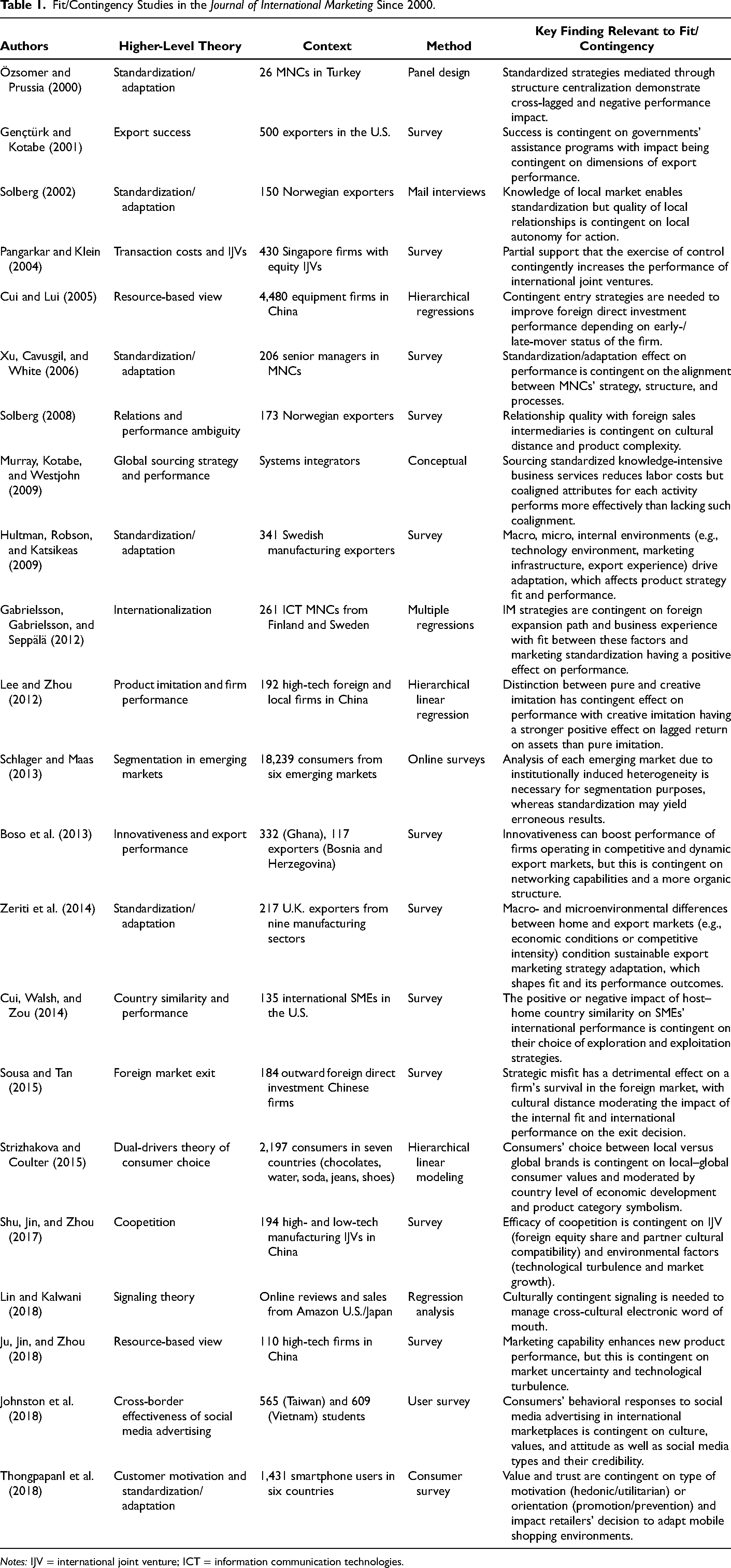
Notes: IJV = international joint venture; ICT = information communication technologies.
Three Features of Relevance
This study echoes the centrality of fit. However, its approach is different. While fit scholarship focuses on environmental features and adaptive matching, herein, fit is an ongoing process following relational imperatives. Thus, fit is not alignment with a fixed environment; it is not a matching contingency following a snapshot view of external reality. Rather, it is a meaning-making process through engagement with the expectations or practices of others. Given this caveat, three features of SA scholarship seem particularly relevant.
First, findings are mixed, fragmented, and inconclusive (Mandler et al. 2021; Tan and Sousa 2013), with calls for more studies to clarify the issue (Poulis 2020; Schmid and Kotulla 2011). This can be partly attributed to previous literature’s omission of relational dynamics. Certainly, one must acknowledge that rectifying shortcomings is an ongoing task in IM. However, in SA scholarship, this has almost exclusively taken place via measurement-centric adjustments (e.g., Filipe Lages, Abrantes, and Lages 2008; Schilke, Reimann, and Thomas 2009) and without a commensurate effort to question assumptions that remain unchallenged. Hence, this work revisits notions of detached SA action (Jun et al. 2014; Poulis 2020) and seeks to rejuvenate the field via problematization, a mode that occupies a marginalized space in extant scholarship.
Second, framing SA decisions as an exclusive intra-MNC task stands in contrast with relational perspectives. For example, in international business (e.g., behavioral theories of foreign direct investment; Aharoni, Tihanyi, and Connelly 2011), it is social relationships that determine not only investment decisions per se but also the form these decisions will take locally (e.g., within the MNC or externally with customers). This “how” of decisions is achieved through, for example, accumulated knowledge or psychological commitments that drive action toward specific directions, irrespective of managers’ volition and judgment. Furthermore, in IM, a prevalent example of this is the firm’s ties with social media users (i.e., a relational resource that enables MNCs to position their brands in local markets; Gao et al. 2018). Additionally, relational norms in business dyads—especially in distant, competitive contexts—may not only safeguard continuity of bilateral ties but also strengthen a firm's protection abroad (Obadia, Vida, and Pla-Barber 2017). For example, in China, a hard-to-penetrate context, relationality enables foreign firms to overcome liability of foreignness through leveraging a favorable momentum (Gao, Ren, and Miao 2018), enhanced control (Ju and Gao 2017), or collaborative schemes (Chu, Lai, and Wang 2020). Therefore, IM demonstrates that firms’ capability to venture abroad is not confined within their organizational boundaries. Rather, it is coshaped following relational ties with domestic institutions or foreign partners (Liu et al. 2013).
Nevertheless, in SA, voluntary, unilateral action dominates relevant conceptualizations, with IM strategy being the by-product of a manager's cognitive skills and their evaluative judgment of events in their environment (Tan and Sousa 2013; Zeriti et al. 2014). Certainly, one cannot deny the MNC's own role in determining SA; managers’ calculative intentionality indeed serves as a roadmap for fit/matching purposes. However, surmising SA appropriateness by portraying managers only as detectors of environmental imperatives is an unrealistic representation of practice. Importantly, treating MNCs as optimal configurators of fitting strategies does not shed light on the decision process. However, such an enactment approach is critical for theorizing purposes in marketing (see Chari et al. 2014).
Third, the aforementioned notion of processual “enactment” has epistemological ramifications (Birkinshaw, Brannen, and Tung 2011; Poulis 2020). A typical SA study abstracts contingencies and uses representational designs to capture fit. Yet, requisite scholarship lacks grounded investigations that embrace SA complexity (Andriopoulos and Slater 2013). Moving away from a representational model that reduces SA complexity to manipulable variables is important because doing so aids in understanding the logic of practice and, thus, the analytical richness of IM activity. Instead, extant scholarship relies on a priori, literature-based antecedents and consequences (i.e., the dominant deductive logic in SA; see Filipe Lages, Abrantes, and Lages 2008; Tan and Sousa 2013). This epistemological commitment may serve valid concerns (e.g., assessing covariance between selected variables), but it does not capture managers’ lived experience—a feature that is critical for elucidating “enactment.”
Therefore, extant SA scholarship is characterized by (1) theoretical stagnation and fragmentation, (2) unilateral assumptions of “detached” decision making, and, to a large extent, (3) an epistemological monoculture. As a response, this study revisits the concrete SA decisions labeled as “fit” and reconceptualizes them as the reflection of industry norms, of the MNCs’ commitments to others, or as the outcome of mimetic isomorphism. Essentially, the study illuminates the role of relationality in SA enactment, a pragmatic concern that remains unnoticed, presumably due to SA scholars’ ontoepistemological priorities.
Methodology
The study is based on a caveat: variance-laden epistemologies are not well-positioned to capture processual phenomena such as SA enactment. Arguably, research designs of a deductive nature are powerful for illuminating other concerns (e.g., SA as a contemporary snapshot). Nevertheless, they are less appropriate to assess contextual fluidity that culminates in contingent strategies or the meaning that coalesces into the fixed outcome that we a posteriori observe and label as SA. Thus, this study's ontoepistemological premises are couched in the process tradition, which posits the following (see Langley 1999; Langley et al. 2013): First, reality is characterized by a flow of events that, relationally, give rise to temporal outcomes. Second, to capture this fluid reality, one ought to adopt a nonrepresentational epistemology that is sensitive to and acknowledges this enactive and ephemeral constitution of events.
This translates to a theorizing premise: The literature may portray SA decisions as a stable outcome investigated at its realized stage, but, herein, IM decisions are seen as a developmental occurrence. The underlying dynamicity engendered in this observation implies something critical: how SA practices come about is discovered through a grounded investigation that elicits the meaning respondents ascribe to their lived experiences (Gioia 2021; Gioia, Corley, and Hamilton 2013). Hence, this study is not couched in the typical design of timeless propositions and confirmation of hypothesized causality, nor is it interested in predicting generalizable patterns, orientations associated with variance-oriented epistemologies that characterize SA and contingency themes (see Table 1). Instead, in line with Evers, Andersson, and Hannibal (2012) and Fletcher, Harris, and Richey (2013), qualitative case study research was chosen due to its analytical plasticity that enables contextual, enactive understanding (Andriopoulos and Slater 2013; Poulis, Poulis, and Plakoyiannaki 2013). Following Siggelkow (2007), I chose a single case study for its analytical depth and based on the need to illuminate how relational forces unfold and lead to SA. Indeed, it helped to surmise how and why relationality matters in SA constitution.
Data Collection
I aimed to identify a case that was as data-rich as possible. This means (1) a solid international presence, which allowed me to trace how forces impacting on SA unfold, and (2) a wide relational base, which allowed me to surmise the coconstituted nature of SA. The case is Dione (a pseudonym), an MNC offering training services in global maritime logistics. The sector is a multibillion-dollar industry transporting 90% of the world's trade. Training is a core part of the services called “ship management” in the industry, a major cost center that is linked to a key concern: safety (of cargo, vessel, environment, and people). Given this centrality, training firms have multiple relations with flag registries (a vessel's jurisdiction), charterers, shipowners (the clients), certification authorities, insurers, regulators, national authorities, professional associations, seafarers, and others. This study's analytical template is this relational structure and its effect on the constitution of a fitting service provision across countries.
The company serves clients from the world's major ship-owning states (e.g., Greece, Japan, Germany) through its European headquarters and five locations in Europe and Asia (masked as per Dione's request). Thus, Dione is a small/medium MNC. Yet, given its prestigious clientele and its ability to train approximately 1,500 seafarers monthly, Dione is seen as a big supplier of maritime training. It employs administrative, finance, and quality personnel, as well as instructors and on-call educators who deliver at regular intervals (e.g., engineers in between duties onboard). Partners are in several countries (e.g., equipment suppliers in Finland, banks in Singapore, technology firms in Japan), creating a wide web of relations that induces meaning, acts as a constraint, enables access to market, and inspires action; hence, these relations influence SA in varied ways.
Dione is routinely confronted with the SA dilemma, since its clientele can be overwhelmingly demanding due to safety concerns. To get a thorough understanding of its relationality, following Evers, Andersson, and Hannibal (2012), I selected participants from all hierarchical levels. Though SA may seem to be the territory of top management, it is enacted through deliberations, reciprocal sensemaking, tensions, conflicts, and consensus that also involve people at the operational forefront, such as middle managers. Therefore, the main instrument for data collection was semistructured interviews with senior and midlevel executives (Chetty, Karami, and Martín 2018; Herz and Diamantopoulos 2013).
Following literature suggestions and initial insights (Poulis, Poulis, and Plakoyiannaki 2013), interviews were guided by two themes: external and internal fit. First, Dione was asked to name external actors who influence its IM choices. Answers served as a probe to further explore the “how” and “why” behind each influence. For example, “how” refers to avoidance or imitation, and “why” revealed, for example, the role of institutionalized logics in the sector or the centrality of seafarers’ communities. Second, Dione was asked to comment on its intraorganizational relations. Similarly, probing questions allowed me to note the influence of sister subsidiaries as benchmarking or the influence of headquarters on local choices as compliance. Such examples enabled first-order coding (i.e., instances of SA strategies through relationality). Then, in line with Von Janda, Shainesh, and Hillebrand (2021), initial codes were summed up in second-order categories explicating types of relational fit (e.g., SA as compliance; Figure 1).
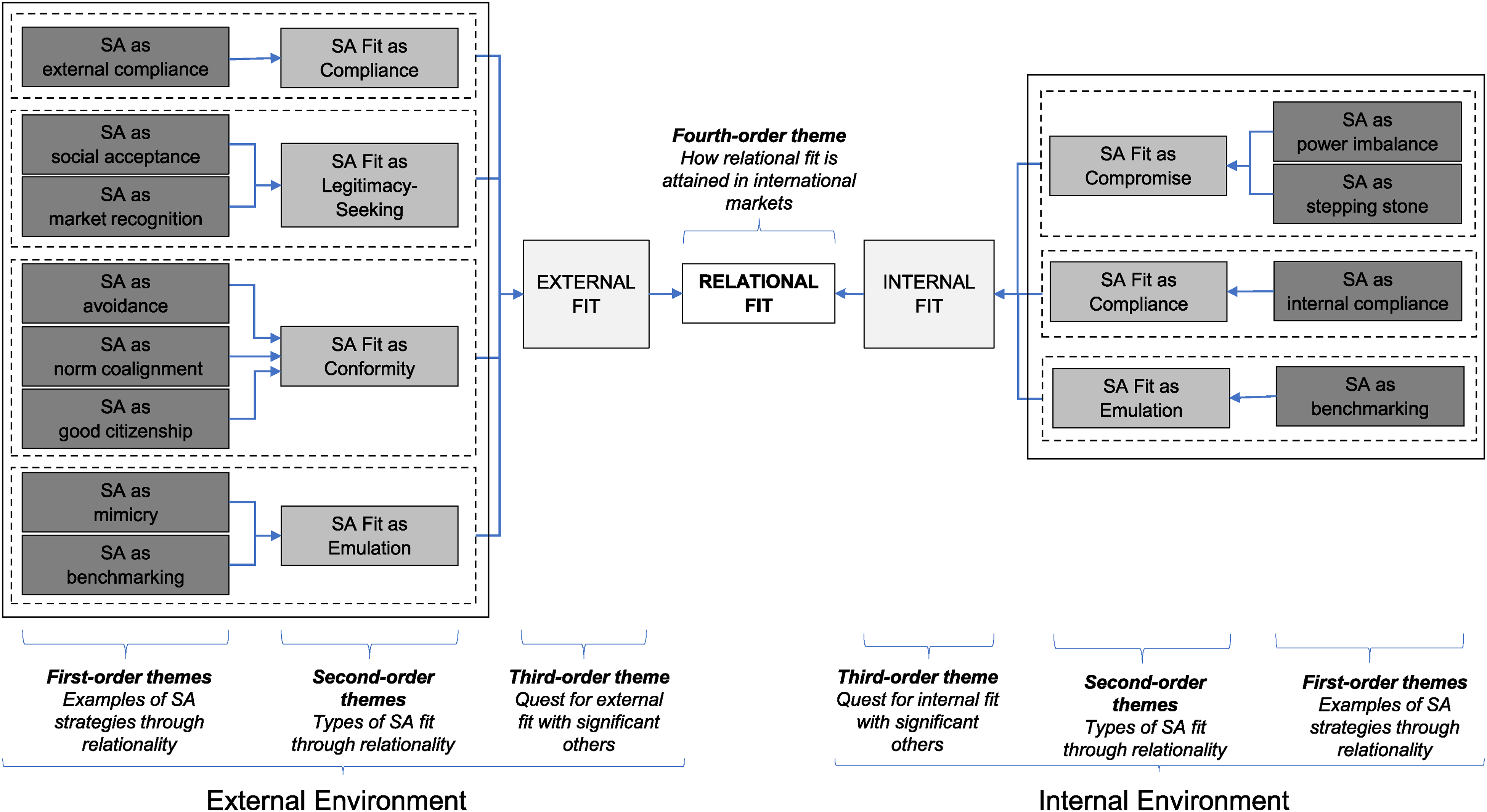
Data Structure.
Following studies with multiple data sources (Hutchinson et al. 2007; Von Janda, Shainesh, and Hillebrand 2021), this material was complemented with secondary data, archival records, emails, and my participation during meetings and workplace routines (e.g., calls with local directors). These helped triangulate data, enhanced trustworthiness through cross-checking arguments, enabled sectoral knowledge, provided analytical depth, corroborated the centrality of noted themes, and offered a hands-on understanding of others’ impact. I sought access to additional sources (to verify relations), but this was declined for reasons of confidentiality.
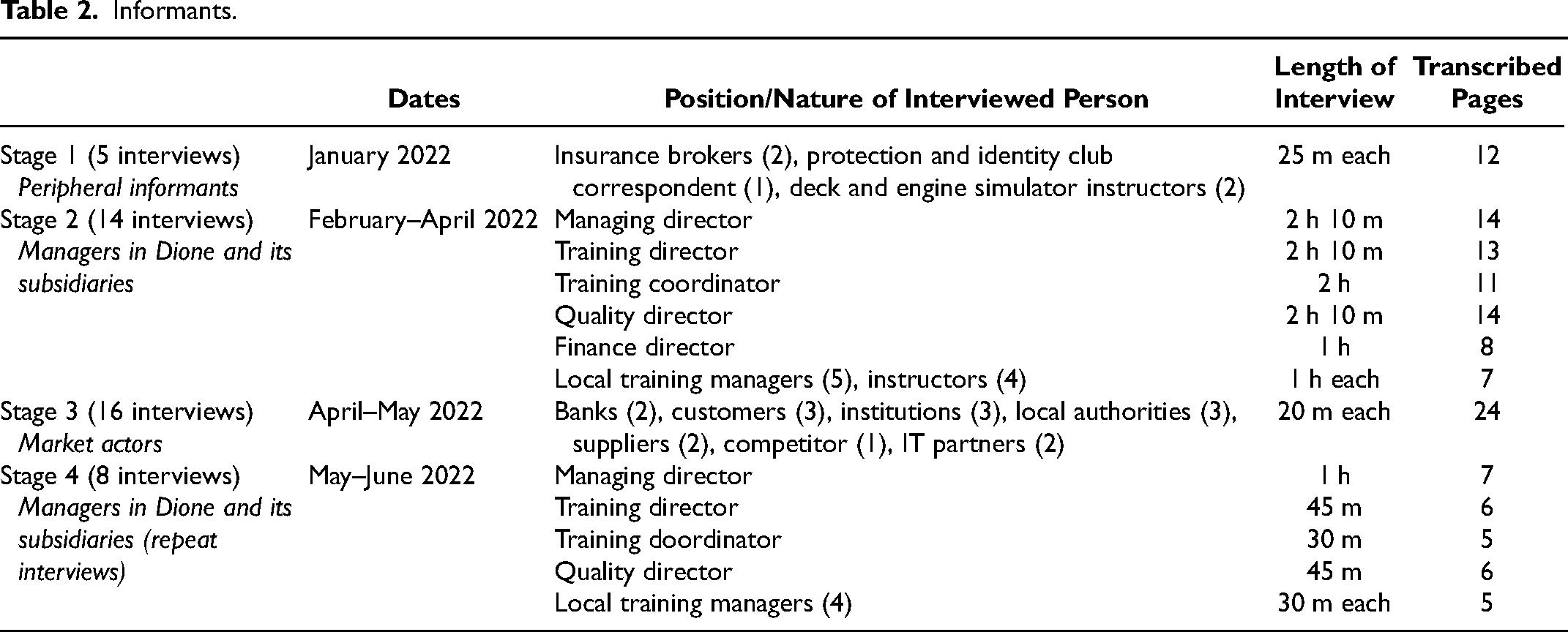
In total, 43 interviews were conducted across six months (Table 2). Stage 1 included peripheral informants following a convenience-sampling logic (i.e., interviewees are part of my network and demonstrate a solid sectoral understanding). These preliminary respondents offered (1) glimpses of initial themes for analysis such as fit as compliance and (2) an ex ante conceptualization of who is involved in relationships, which informed subsequent case and interviewee selection. Primary interviews at Stage 2 took place in Dione's premises or online (for subsidiaries). These constitute the primary material, and verbatim quotes were used to elucidate findings. Stage 3 involved market actors with whom Dione interacts (the former pinpointed by the latter) and seemed to be mostly influential for decision making. Next rounds of interviews were shorter, since they focused mainly on themes of Stages 1 and 2. Interviews at Stage 4 were conducted with Dione interviewees again. This helped me further explore the thematic areas that emerged in the first rounds and refined learning outcomes.
Informants.
Data Analysis
Data analysis revolved around the concepts of fit and relationality. Without ignoring the value of purely intraorganizational features (e.g., organizational proneness to novelty and adaptation), I chose to focus on relational instances for fit purposes. Moreover, like prior works (Chetty, Karami, and Martín 2018; Hutchinson et al. 2007), this study did not reduce the complexity of SA to predetermined, manipulable variables but rather aimed at embracing the factors that were inductively revealed during data collection.
Following relevant guidance (Gioia 2021; Gioia, Corley, and Hamilton 2013), respondents were treated as knowledgeable agents who provided the “raw material” for initial coding. Relationality stood out as critical since it induces SA outcomes, with first-order themes being extracted from field notes as examples. Then, following “a comprehensive compendium of 1st-order themes” (Gioia, Corley, and Hamilton 2013, p. 26) exemplified in quotes, theory-centered themes were developed. These were summed up in distinct types of internal and external influences linked to instantiations of fit. This data structure gave rise to relational fit as the core construct of the study and enabled me to craft propositions and a processual model. Thus, first-order examples gave empirical flesh to relational fit as follows: Internally, relational fit is understood as (1) compromise, (2) compliance, and (3) emulation. Externally, it is understood as (1) compliance, (2) legitimacy-seeking, (3) conformity, and (4) emulation.
Altogether, these instantiations frame SA as a quest for fit that extends beyond closed MNC boundaries and detached cognitive judgment. Specifically, Dione's configuration of SA is bound by the relational commitments that it has spawned, has inherited, or wishes to create. Such findings corroborate the centrality of fit and, via a four-order scheme (Figure 1), they help articulate how SA fit is attained relationally. Thus, contrary to a priori antecedents, emergent themes are empirically laden and reflect Dione's actual configuration of SA.
SA Decisions as a Coconstituted Process: Unpacking the Influence of “Others”
As shown in Figure 1, data lend themselves to a fourth-order scheme of firms striving for external and internal fit by, for example, emulating others. “Others” are either external agents (e.g., professional communities) or found within the MNC (e.g., sister subsidiaries). As noted subsequently, second-order themes may have opposing dimensions—that is, the same orientation (e.g., quest for compliance) may lead to both S and A depending on relational imperatives. For example, conforming to local standards imposed by a government may lead to agile forms of adaptation, whereas conforming with international regulations may push a firm toward greater standardization. Therefore, SA is not something that deterministically happens to MNCs. Rather, it is iteratively and reflexively coconstituted as a result of their participation in international bodies or local communities, or else it is inherently relational.
Quotes from primary respondents demonstrate how influences from a firm's relational web coconstitute fitting SA strategies. However, as important as the data structure in Figure 1 may be, “it nonetheless portrays only a static picture of very dynamic phenomena” (Gioia 2021, p. 26). Thus, the dynamism of the topic is offered in the form of propositions, with the first ones acting as hinges for the rest. However, propositions are only statements to guide further research and not hypotheses typically found in a covariance study. This would be against the study's processual nature, whose purpose is neither to measure selected variables nor answer “to what extent” types of questions. Rather, it is to portray how relational forces lead to what scholars observe as a fixed accomplishment (SA). Thus,
External Fit
Dione, in its effort to decide its marketing action, is in a constant state of considering multiple facets of its external relationships. For example, deliberations often take place with suppliers such as bankers or IT companies since the latter also serve many other customers or competitors of Dione. Therefore, the conduct of those mutual customers becomes known (e.g., through information sharing, hearsay or even gossip) and, in turn, facilitates a more informed SA decision. Thus, overall, externalities shape Dione's SA practices through reflexive deliberation and often, through opposing sources of impact. The managing director comments, Through them, we can understand the history and legacy of old and new customers alike. Have they been demanding or not; trustworthy when it comes to payments? How price-conscious are they? Do they deploy crewing operations in many more countries? … All the info around their past behavior, preferences, or idiosyncratic requirements may not necessarily determine what we will do in the future, but certainly it gives us a very good idea of what to expect, what to avoid, and how to proceed with our product strategies.
Type 1: SA as emulation
The first type of external fit of SA results from an attempt to emulate others in the professional community that Dione inhabits. This inclination to mimic or benchmark—as emulative instantiations of external fit—has a legacy that goes back to the early days of the company. Since the firm’s inception, imitating business practices or following standards that emulate market leaders’ initiatives was a source of sensemaking. Given this legacy, SA as emulation is not an external influence that sporadically impacts a firm. Rather, it is always in the firm’s preview or horizon, it constructs meaning, and, thus, it is engendered in Dione's actionable potential. In turn, SA as emulation is built on two first-order themes that reflect contemporary concerns but have historical antecedents: mimicry and benchmarking.
Emulation as mimicry
SA is often the effort to imitate the acts of more powerful or more legitimate competitors. For example, Dione was an early mover to a standardized international service only because a peer company did so as a first mover. Therefore, it was peer pressure from the industry community that dictated Dione’s standardized portfolio as well as the means it would use to offer that service to international clients across locations. X [a direct competitor] is known for their investment in technology to deliver their courses. So, they acquired this new simulation equipment for engine officers’ training … well, we had to adapt and do something about it, too. (Training coordinator)
Emulation as benchmarking
SA as emulation is also the effort to reach standards of professional competence dictated by market leaders. It is not passive imitation but rather a bold act of acknowledging others’ competence and reacting to meet or surpass it. For example, the market leader had launched a new training management system under which it had embedded its full curriculum. A benchmarking exercise led Dione to develop a similar training suite that would eliminate separate Excel files and stand-alone presentations. The new online system enables standardization, but it is also flexible enough to accommodate local adaptations following customers’ idiosyncratic requirements. We will launch it [the training suite] online and will be accessed seamlessly and in real-time from the ship, from ashore, from anywhere. … The core platform will be standardized for everyone, but of course individual elements will be adapted to each principal's
1
requirements according to their SMS [safety management system]. (Local training director)
Type 2: SA as conformity
SA is also the result of a conformity exercise. In this case, SA is not based on emulative tendencies but on an attempt to respond to two relational externalities (norm coalignment and good citizenship) and avoid another externality. Thus, essentially, SA mirrors what is commonly expected of a professional company in the sector.
Conformity as norm coalignment
In this case, SA comes about from an effort to coalign with industry norms. This conformity-seeking exercise reflects institutionalized logics and stems from participation in industry networks that have certain expectations. For example, a typical training entity in other sectors works under a fixed timetable and rigid scheduling. However, this is not the norm in shipping, where there is a 24/7 logic. Ocean-going vessels may be actively operating anywhere in the world at any time, and, during operational flow, events emerge and trainers may need, for example, to troubleshoot or guide trainees in real-time. Thus, there is a standardized service provision stemming from the need to coalign with industry norms. The norm in our industry is to offer after-sales support if and when needed in a standardized way. Thus, we may be offering our training services as per our scheduled timetable, but we are alerted on a 24/7, rotating basis. If I am not able to respond to a request for troubleshooting by one of our ex-students who is now onboard then, my colleague in X [sister subsidiary] will do so and vice versa. We have set up our schedules that way so as to be there when our clients need us.
Conformity as good citizenship
SA is also a quest to conform with expectations in networks such as local communities (e.g., seafarers). SA as good citizenship reflects a discretionary form of conformity, such as honors bestowed on current players from past leaders. For example, a company cannot ignore a certain legacy of responding to natural disasters affecting seafarers’ communities. Natural hazards are a usual occurrence in seafaring-oriented countries such as the Philippines, where typhoons or tsunamis require rebuilding villages and restoring local communities’ critical infrastructure. Traditionally, this is done through donations or fundraising events and is a sign of good citizenship that firms willingly embrace. According to Dione, this logic leads to many local adaptations and keeps the firm in business. It is rare for a newcomer to ignore such embeddedness and the relationships it needs to develop with local families. This leads to several adjustments in an otherwise standardized portfolio. The managing director comments, It is not that something obligatory makes us be more philanthropic. This is the dominant sentiment in our industry since its inception or at least since I can remember it … and I am old enough. [laughs] … And, if I may add, it has been and is like that rightly so. … For example, often, we proceed with a product strategy that offers discounted training packages to seafarers from affected areas or toward seafarers of an underprivileged background.
Conformity as avoidance
SA as external conformity also comes about by not following others’ activities that are seen as detrimental to a company's image or reputation. Still, this implies a proactive approach to conform to professional standards, though it does so by avoiding malpractices. For example, issuing fake documents to seafarers is a long-standing malpractice in global shipping. This is critical since seafarers’ documentation is not a tick-the-box exercise but a formality that reflects their competence and their ability to maintain safety onboard. Hence, the sector has conventions (e.g., Standards of Training and Certification of Watchkeeping) that prescribe minimum training standards for seafarers imposed by international regulations. In addition, many companies hold additional trainings to strengthen collective competence onboard even further. Yet, corruption—even in relation to this critical issue—prevails among some actors. As a response, Dione has standardized its service provision and product policies throughout the company. Unfortunately, several recruitment companies and training centers employ such malpractices of bribes and fake documents issuance, but for a training institution such as ours, this is the most sensitive issue. There is no lenience on that. Hence, we have established a standardized approach across all countries we operate from in terms of, e.g., class booking arrangements and issuance of certificates. Our product is thus delivered through uniform procedures that safeguard transparency and validity of the certificate. (Training director)
Type 3: SA as legitimacy-seeking
SA practices also reflect the need for Dione to attain external legitimacy through its actions. This serves as a sustainability mechanism and solidifies the company's status, which is among the highest in the market. Again, external audiences, which inspire and induce this legitimacy-seeking, include the wider communities in which Dione is embedded (e.g., seafarer-supplying countries) and other service firms that construct their collective identity through participation in relevant fora, events, membership clubs, and the like.
Legitimacy as social acceptance
SA in this case is an attempt to gain social acceptance and “extended” approval by wider communities or society at large. This is an imperative in shipping, one of the major employing industries of the world. After all, shipping is always in the spotlight due to past accidents and oil spills, which make the quest to be and appear legitimate heavy enough. What further aggravates the need for social acceptance is the fact that many shipping firms (namely, Dione's client base and major partners) are listed in (for example) the New York Stock Exchange, or charter their vessels with the world's major oil companies. Therefore, a high-quality standardized provision is induced by relationships that make up the status quo in the sector and actors that expect a positive public image for incumbents. Thus, standardization is driven by social acceptance, which, in turn, is seen as an imperative for reasons that relate to the status of firms in the eyes of multiple stakeholders. The training director notes, Therefore, our marketing actions across the countries we operate always need to be informed by this quest of ours and our clients for social approval. Especially when it comes to issues of safety onboard and environmental issues … we have to be actively present and demonstrate how our service provision entails modules that care about the cause in unconditional, standardized ways of the highest quality. … “Risk Assessment” is such a module, for example.
Legitimacy as market recognition
At the same time, SA is a means to showcase know-how and gain recognition of an advanced market status by peers, clients, and partners. There is a sense of reciprocity, too, that is, a belief that it is clients who made Dione what it is today. Namely, the status that Dione enjoys is achieved through its discerning clients who helped it improve, organize efficiently, and deliver services more effectively. Being in line with clients’ quality expectations and, thus, gaining recognition led to both standardization of services (related to universal operational standards of safety) and adaptation of elements related to tailor-made idiosyncratic requirements of certain clients. Therefore, there is a more creative spin in this type of legitimacy-seeking that is different from an effort to avoid the punitive ramifications of potential nonlegitimacy that was noted in the previous type. We seek recognition for this constant effort and, especially, by our clients since such a total quality and improvement orientation is not the norm. Often, we have to remind them what we do, to demonstrate our initiatives more forcefully since some things are not self-emergent; they require a lot of background effort—and lots of travels [laughs]—that remain unnoticed. We do it as a response to their expectations, and it is important for us to be recognized for this effort. (Managing director)
Type 4: SA as external compliance
Finally, for external fit, SA is seen as compliance with regulatory frameworks or customers’ demands. This is a form of SA resulting from industry participation and the need for compliance with (non)mandatory courses for each rank and vessel type. Again, the underlying reason is safety. On the one hand, institutional entities dictate what training centers should be offering. On the other, shipping firms ask for training services due to additional requirements that stem from their own experiences with people onboard, near misses, past accidents, or charterers’ demands. Therefore, compliance may be linked to regulatory authorities but also to nonmandatory yet critical requirements. With the latter, things are more creative and, often, firms such as Dione adapt content jointly with clients (usually safety departments). With the former, it is compliance that leads to standardization, a task that requires cooperation with competent authorities that impose and monitor rules. Some of the aspects of what firms such as ours do, e.g., safety-wise, are heavily standardized by virtue of their participation in the ship management community. As you know, shipping is one of the most safety-intensive industries and participation in it engenders certain actions that are expected to be in place by default. In fact, one is obliged to standardize and streamline their safety rituals and training routines such as drilling exercises and safety meetings onboard. (Quality director)
Internal Fit
At the same time, in Dione, there is an ongoing quest to fit with the relational imperatives of its internal environment. This perspective by no means contradicts the external one. Rather, there is an iterative process of liaising with internal others as well, with their expectations or ideas also coshaping SA strategies. Thus, this third-order category is not antagonistic to the other one. Rather, it serves as a complement that showcases the multiplicity of concerns that play out and eventually amalgamate into what we observe as the fixed SA outcome. The managing director notes, I never simply decide something when it comes to such important matters [deciding on the training portfolio]. I liaise with my colleagues; agree and disagree with them; I speak with external partners; I take advice from senior people whenever needed; I hear what a prospective client has to say. … I even recall my career's memories with all those people and ask myself: how would I have gone about it ten years ago? What about now?
Type 1: SA as emulation
The first type of internal fit is SA as emulation. Similarly, Dione's SA is developed through emulation within the organization.
Emulation as benchmarking
Local practices are shaped to be in line with innovative and visionary peers in Dione's multinational structure (e.g., colleagues in sister subsidiaries), which have demonstrated superior standards of practice. Other subsidiaries cannot ignore those advances, and hence they are “forced” to emulate them so as to be compatible with the expectations of top management at headquarters. The resultant standardization is thus a means to reach standards of excellence set by peers in Dione’s organizational structure. I know that X [peer/colleague in another country] developed a novel method of delivery following his participation in a “train the trainer” scheme administered by University X [masked for confidentiality purposes]. I have to do it, too—not as a pure imitation practice—but because it is indeed great and because I need to demonstrate that my delivery is on a par with the new standards set by the sister subsidiary. Otherwise, we will be constantly lagging in terms of what we are able to offer. (Local training director)
Type 2: SA as internal compliance
Moreover, SA is the result of a mandatory compliance with what headquarters dictate. Dione’s headquarters are equipped with a wide marketing knowledge that is not confined to one location only (as opposed to each subsidiary), are the recipient of rules and regulations by supranational bodies, and dictate the pace for Dione’s overall commercial strategy. Importantly, headquarters handle Dione’s budget and resources, leading to centralization of control. Therefore, headquarters spearhead operations as well as the design of marketing strategies, an outcome that is somehow expected given the wide knowledge base, resource endowment, and network of Dione's central office. This centralization leads to S or A strategies depending on the case. For example, it may lead to standardized service provision because new international rules dictate so, but it may also lead to more agile forms of adaptation following idiosyncratic requirements by clients. In either case, the decision is carried forward to subsidiaries for their internal compliance. When our MD sends out a message, we simply must comply. They [headquarters] know the rules better than us, they participate in wider industry networks in key positions, and they know additional aspects that we do not such as, e.g., budgeting and cost control. … Some of those decisions and directives may enable us to proceed to local adaptations to, e.g., fix things or they may impose even higher degrees of standardization of our service provision. It depends on the case. (Local training director)
Type 3: SA as compromise
SA may also come about as a result of compromises that take two forms: as power imbalance and as a stepping stone to achieve something else.
SA as power imbalance
SA is often the by-product of power games in the MNC. Sister subsidiaries, individuals across them, or whole departments may be aligned under a common organizational purpose. Nevertheless, they also have differing priorities and, often, varying orientations as well. For example, it is often the case that local directors feel the need to use a purely locally adapted marketing action. This does not stem from a sense of superiority or entitlement; rather, it stems from the perceived notion that they know local realities much better than anyone else in Dione. Yet, as is normally the case, some have more formal or symbolic power than others to impose their will. A local training director comments, In some cases, I can achieve that, and I adapt what needs to be locally adapted; in some other cases, I can’t, and I have to comply with standardized approaches irrespective of my will. It depends on who is at the other “end” and the power I have or not to circumvent those others’ recommendations and suggestions [implying the counterpart in this power exercise].
SA as stepping stone
SA is also an intermediate step—a temporary arrangement and compromise to later claim internal recognition and rewards through other forms of action. For example, local directors may prefer to adapt the module portfolio. However, they may temporarily compromise with a standardized decision they consider nonfitting. Distance and lack of control (e.g., over budget) hinder local adaptation, but patience seems to be a virtue. Eventually, headquarters “listen”; they realize what local directors insist on and why. If other solutions are promoted by other people for x, y, z reasons, then it is not always wise to insist. … Our desired service implementation may require a fitting timing, too so that people can more easily absorb our logic and come to terms with our local expertise. This is not as straightforward as it may sound. (Local training director)
The preceding actionable possibilities allow me to craft the following proposition:
Summary of SA Fit Strategies and a Model
Relational commitments may have a past origin (e.g., following an accident) but may reveal a future orientation, too (e.g., what we wish to become). Thus, they are neither forgotten nor are they distant possibilities of no contemporaneous value. On the contrary, their temporality coalesces into the present and infuses SA decision making with meaning. Otherwise, one would assume that, for example, memories of the past or idealization of a possible future have no bearing on the constitution of strategic decisions. Apparently, this stands in contrast with insights, which demonstrate that past sources or future prospects substantially influence current decisions (see Poulis, Poulis, and Jackson 2021). Hence,
Moreover, relations impact SA in facilitating or discouraging ways. They may be an impediment to desirable practices, such as following a quest for compliance with significant “others.” However, they may also inspire novel action through mimesis of more visionary others. Thus, relational embeddedness can be a facilitator of action or act as a stumbling block that influences SA through a “restrictive” logic. This is consistent with literature insights, which demonstrate the multidimensional (positive and negative) role of relational commitments for corporate choices and actionable purposes (Griffith and Zhao 2015). Therefore,
This is expected, since relational commitments have a legacy from which one cannot easily escape. Some relationships are fixed, enduring, or necessary and must be honored as they are marked both by social and professional elements. After all, Dione is embedded in industry fora and membership clubs, which peers inhabit. This is a constant source of knowledge, influence, and inspiration as well as avoidance or even relational detachment, which is consistent with literature on relations (Lee 2010). The training director notes, Yes, certainly, some suppliers or clients are an impediment to adapting our portfolio as ought to; they are definitely an impediment towards a better utilization of our resources. For example, we could develop many more and more versatile programs of study, but, given the commitments we have with them, we cannot. After all, as you may have realized already, our instructors, rooms, facilities are given and not endless.
Thus, relational commitments translate into specific SA acts. For example, depending on a training establishment's position in the industry, certain courses are offered in a standardized way and others are offered in adapted ways. A main driver behind such SA decisions is their participation in fora that include powerful actors in the shipping ecosystem (e.g., governments, insurance clubs, classification societies). Such actors have their own concerns (e.g., political ones), and their will is often imposed on other industry participants. Our linkages with people in X [institutional association body] are always a source of knowledge, of enablement and avoidance. We often know firsthand what has or not worked for others and this reciprocal sharing of information determines what we will eventually do or what we will avoid; what kind of relationships may need to be put on hold or stopped altogether. (Training director) After all, this is one of the major reasons of our participation in X; gaining access to information that will enable us to adapt our services promptly and accurately while standardizing others so as to be in line with what the industry expects. (Quality director)
Such impediments to preferred SA action are paramount, often unavoidable, and not up to discretionary judgment. Multiple counterparts must be considered, and a local manager's preference for adapted services is irrelevant in many cases. This does not mean that their ideas are “wrong” or uninteresting. On the contrary, their expertise and knowledge is profound and their ability to deliver is present. Nevertheless, relational priorities redirect limited resources elsewhere; namely, in modes of standardization that comply with relational imperatives stemming from the will of (inter)national authorities or powerful clients in relation to standards of training and certification, among others. A local training manager comments: What I may want to do is irrelevant in many cases. I have many ideas on how to structure our training portfolio but, at the end of the day, I have to bend the content, time of delivery, duration and even the classroom and its size according to X's guidelines or norms and expectations or in line with a principal's formal request.
Certainly, at times, relations are not anathema but a blessing, no matter how challenging their maintenance may be. For example, relations drive Dione to pay attention to market dynamics within the shipping ecosystem. Information exchange because of those relations (e.g., with port agents) allows Dione to know expected developments in relation to core parts of its service (e.g., about new regulations). Notwithstanding the challenges of responding accurately to such sources of information, a key aspect is anticipating those developments early enough. Hence, relationality enables Dione to adapt its product. It is not just the creation of the course per se that requires early acquired information. It is also, e.g., the need for module accreditation by relevant classification bodies. It is also related to planning in terms of adapting our equipment across each location; in order to finalize the allocation of rooms and room capacity optimization … without the info from those exchanges, we are doomed. (Managing director)
The last proposition concludes the analytical part of the study:
The propositions lead to a model summarizing case insights (Figure 2). As shown, participants at all levels were concerned with the fit of tactical or strategic decisions concerning S or A with the exigencies of context. However, as propositions indicate, this quest was induced by past (e.g., inherited), present, or future (e.g., desirable) relations. An important point then is that those relational temporalities are neither forgotten remnants of the past nor idealized arrangements of a distant future; they have contemporary relevance for SA purposes. For example, past relations may have perished. Nevertheless, they act as carriers of meaning since they may bring forth cherished legacies or unearth the relevance of entrenched memories. In turn, such meaning may be a catalyst that leads to standardized practices (e.g., in an attempt to protect that cherished legacy) while avoiding forms of adaptation associated with unfortunate past collaborations (e.g., when these are brought to memory). Therefore, past (at t − 1), and future (at t + 1) relationships are meaningful at the present time (t0), with this meaning being the mediating source demonstrating dual consequentiality: it enables/facilitates or impedes/constrains SA action through reflection on the value and relevance of those relations.

How Relational Imperatives Enact Fitting SA Strategies in International Markets.
Hence, the model is fundamentally different from extant SA studies: The latter represent SA as the result of internal and external factors that impact the contemporaneous SA decision linearly and following detached environmental scanning and own volition by managers. In contrast, this study promotes the prevalence of relationality as a meaning system around a focal firm that is not necessarily confined to a certain location or time. Namely, engagement with meaningful others across time has a substantial bearing in contemporary SA constitution, thus allowing this study to frame fit as a relational pursuit.
Discussion
Whether one subscribes to a relational framing is one issue. Yet, one cannot ignore the largely arelational treatment of decision making in extant SA scholarship. Problematizing this status is important. As shown, SA decisions are not fixed, volitional outcomes; they are embodiments of mutual conditioning. The latter implies strife and consensus, mimesis and progressive initiative, compliance and deviation. However, these paradoxical oppositions that shape SA are morphed within and across the MNC's value network; they do not take place within and by MNCs alone. This nuance redirects attention to relational dynamics that induce what we experience as a unilateral achievement (i.e., the SA decision itself).
Why Is a Relational Perspective Important for SA Scholarship?
Even though relational ties explain firms’ practices and an organization “derives its meaning and possibility of action from relations with other entities” (Raffaelli and Glynn 2014, p. 542), surprisingly, “how relational ties matter and how they may matter differently for different types of practices has received little attention” (Raffaelli and Glynn 2014, p. 541). This observation is no different in SA scholarship. Paradoxically, while the IM literature (e.g., see export studies) recognizes relational schemas and network embeddedness as highly important in international markets (Sichtmann and Von Selasinsky 2010), SA scholarship ignores this notion analytically (Jun et al. 2014; Poulis 2020). This imbalance must be restored for the following reasons.
First, marketing products internationally is more challenging since IM activity is associated with higher complexity and uncertainty compared with local endeavors (Gielens 2021). Thus, relationality acts as a risk-reducing mechanism facilitating access to foreign markets and enables disadvantaged firms to overcome their liability of foreignness and barriers to exporting (Darendeli and Hill 2016; Elg, Ghauri, and Schaumann 2015). Therefore, given the centrality of relations for performance, it is paradoxical that the SA literature represents action by focusing on MNCs’ own evaluative and actionable capacity. This addresses a parallel point, too: the SA debate has focused too much on MNCs’ need to adapt to host country requirements. Yet, another understanding is that MNCs adapt to their major global customers’ needs and requirements when they do business across countries. As the quotes in this article emphasized, major global customers automatically induce relational imperatives that cannot go unnoticed and, thus, spark this adaptive logic of “following your customer.” While this relational logic features profoundly in the internationalization literature, it features much less in SA research.
Second, dilemmatic strategic decisions—such as SA—are dispersed and inherently pervious to others’ influence. They normally require irreversible commitment of resources, which define performance for many years, but their efficacy is inherently messy and uncertain (Klingebiel and De Meyer 2013). Therefore, an MNC will seek to draw on diverse pools of knowledge to reduce ambiguity and enhance the likelihood of success. For this reason, it is surprising that what is revealed instantly in the literature is the outcome (i.e., the SA decision itself). Contrarily, this study highlights the value, relevance, and qualitatively distinct influence of relational pluralism on the making of this outcome. As I have shown, an unleashed discretionary decision is unlikely; SA is pragmatically coshaped through others, too. Given its strategic, dilemmatic nature, SA is dependent on imperatives that heavily involve competitors, local communities, institutional actors, their practices, and surroundings that induce meaning for all parties concerned. Therefore, assuming away others to attain analytical clarity in one's research design is a suboptimal representation of IM practices “out there.”
Third, SA is not a decision taken at a point in time. Rather, strategy constitution is gradually shaped following experiential learning, setbacks, and iterative phases of knowledge accumulation based on criteria adjustments (Bunz et al. 2017). These pools of resources are unlikely to be identified only within the MNC. They will also reside elsewhere and, over the years, the MNC will access (Poulis, Yamin, and Poulis 2012) or cocreate (Jun et al. 2014) its content through and with other firms, governments, institutions, suppliers, and so forth and in the form of capital infusion, channel stretching, information exchange, local reputation and know-how, and more (Hada, Grewal, and Chandrashekaran 2013; Styles, Patterson, and Ahmed 2008).
Fourth, when decisions are oriented toward seeking compliance or securing legitimization, isomorphic tendencies may prevail (Chan and Makino 2007; Fisher, Kotha, and Lahiri 2016). Dione inhabits fields such as seafarers’ communities and training associations—social spaces where meaning systems are collectively shared and acknowledged as common and binding (Greenwood et al. 2011). Such spaces are infused with specific logics, which are highly impactful. Yet, these logics are not an external feature waiting for one's matching abilities; marketing managers are not external, passive observers of them. Rather, they denote principles that are “lived” and dictate “how to interpret organizational reality, what constitutes appropriate behavior” (Thornton 2004, p. 70). Therefore, the decisional breadth available to an MNC is not the result of detached scanning and then, matching of contingencies. Rather, isomorphic tendencies ensue by virtue of its participation in the aforementioned fields. Thus, SA may stem from what those fields prescribe as “proper” conduct and norms, as desirable morality, and in order to attain legitimacy therein.
Last but not least, those others may operate under different value systems and operational standards (Sahlin and Wedlin 2008); they generate power imbalances in terms of partners’ transactional exchanges (e.g., MNCs and local governments; Elg, Ghauri, and Schaumann 2015; Jun et al. 2014). This divergence further aggravates relational imperatives for a focal MNC. For example, such complexity implies a reciprocal sensemaking process, which aims to build up consensus and shared understanding. Consequently, marketing action may be shaped as a result of mimesis, compliance, and so forth, with relational imperatives being inevitably reflected on MNCs’ choices (Heugens and Lander 2009; Raffaelli and Glynn 2014).
Contribution to Theory
Contrary to current orthodoxy, this study showed how SA is coconstituted. The simultaneous contexts in which MNCs construe meaning are carried over to them through joint experiences, common practices, or information sharing, with SA being enacted in messy, unintended but always relational ways. Thus, the study offers the following contributions:
Challenging SA as a Unilateral Accomplishment
Conventional wisdom portrays SA as the outcome of MNC's volition and judgment. This perspective is rooted in notions of rationality and agentic autonomy and is not negated here (see Aharoni, Tihanyi, and Connelly 2011). However, this study extends this monodimensional understanding and frames SA practices as mirroring an MNC's relational network. One's engagement with others is an omnipresent influence that is imprinted on their choices (Greenwood et al. 2011; Nonaka, Toyama, and Hirata 2008). Relationality then has a performative dimension that is often ignored in SA scholarship. The study argued about its theorizing value, showing that a web of actors and their practices are responsible for the coconstitution of SA as an ongoing pursuit toward relational fit. Either due to a quest for compliance with industry norms or following mimetic isomorphism, MNCs may resort to standardization; either due to deliberate deviance from practices followed by others or following reflection on competitors’ (mal)practice, MNCs may proceed to adaptation. Therefore, what shapes SA is the associated relationship and the meanings that it produces.
Problematizing the Centrality of Geography, Location, and Space
Geography, location, and space form the bedrock for many IM advances. Yet, by assigning ontological primacy to relationality, this study denotes something: influential meaning systems may be identified in spaces that are not necessarily associated with MNCs’ geographical presence. Such spaces may be locales of benchmark practices that powerful, more legitimate, or reputable firms inhabit; as such, they may impose norms of expected practice. They may also be spaces of symbolic or moral significance that indicate standards of excellence (Ansari, Fiss, and Zajac 2010; Sahlin and Wedlin 2008). The SA literature’s insistence on comparing same (enabling standardization) versus different (enabling adaptation) features across countries as clearly demarcated spaces implies a spatiotemporal fallacy: it confuses space/countries with institutional logics, entrenched norms, and meaning systems.
In contrast, Dione emphasizes that same/different dualisms mask possibilities for action, thus perpetuating the inconclusive polysemy of SA studies. As emphasized here, meaning-making may not coincide with space boundaries or countries since sources of meaning may be aspatial (e.g., virtual communities) or atemporal (e.g., originate in a long past as memories), may be spatially wider or narrower than countries (e.g., regional communities), or may be implicit, neither readily graspable nor observable (e.g., induced by professionalization standards). Yet, meaning systems are impactful and must be relationally understood for actionable purposes (Meyer, Mudambi, and Narula 2011). Therefore, SA studies that rely only on cross-national similarities/differences and matching orientations dictated by geography, boundaries, and space may likely offer a suboptimal understanding of how and why standardized or adapted strategies are pursued internationally.
Promoting Another Ontoepistemological Commitment for SA Research
Concurring that marketing strategy is shaped by the broader practices and belief systems in which we are embedded, I recognize that others (institutions, communities, partners, etc.) act as a bridge between established cultural, mental frameworks and the MNC; essentially being generators of meaning for the latter's decisions (Sandberg and Pinnington 2009; Shipilov, Greve, and Rowley 2010). Yet, to shed light on such processual enactment, another epistemological orientation may be needed. This study emphasized the strengths of qualitative research to elucidate both enactment and relationality, a largely underrepresented mode in SA research (Poulis 2020). Thus, it illustrates the value of a non-variance-based epistemology. The fixed identity of SA decisions as timeless, distinct “substances” is replaced with a narrative of situated attempts toward relational matching. As noted, representational modeling is a vehicle to address other concerns. Yet, grounded designs are particularly suited to explain meaning-making processes that translate into action by relationship-bound MNCs.
Therefore, a contribution is problematizing the compartmentalized way through which disjunctive theorizing views reality (the same/different SA dualism). Certainly, such an abstraction is coaligned with an orientation for generalization and prediction on concrete operationalizations. Yet, this study stresses a quite “heretic” point: often, there is a misalignment between the complexity we experience as researchers and the analytical tools that disjunctive theorizing offers for explanatory purposes. When reality is more complex, managers’ experiences may not squarely fit into the available operationalization tools that our scholarship gives us. Thus, epistemological conventions such as reliance on cross-sectional samples or variable-based aggregations may assume away much of what matters. To avoid such ruptures, this study suggests the use of grounded illustrations and nonrepresentational epistemologies. In turn, this affords an ontological vantage point: it enables accounting for the decisional complexity an IM scholar realistically encounters when entering fieldwork.
Therefore, an epistemological shift implies an ontological nuance. Namely, a processual perspective whereby SA decisions are observed not at their realized stage but at their enacting stage holds great promise to refresh the SA field beyond “distant” theorizing and incremental contributions (see Zeithaml et al. 2020). The former implies definitive concreteness, whereas the latter implies relational emergence, and this distinction seems to matter for theorizing. Thus, the study does not challenge the reification of SA decisions as unilateral accomplishments only because of epistemological concerns. It does so for ontological reasons, too, that is, omitting interactive dynamics may not enable researchers to illuminate the reality that deciding entities (MNCs) experience. Then, by interrogating the bracketing of others in SA decisions, the study opens up a largely uncharted theorizing territory on ontoepistemological grounds.
Refining the Notion of Fit in SA Scholarship
Notwithstanding their value, the article contributes by refining SA fit studies’ atomistic (MNC-enclaved) assumptions (e.g., Gabrielsson, Gabrielsson, and Seppälä 2012; Hultman, Robson, and Katsikeas 2009; Zeriti et al. 2014). Since firms are embedded in a value network and participation influences their decisions, the SA literature must capture this nuance accordingly. If we accept then that MNCs are inherently connected to their surroundings (e.g., industry), we should highlight how this involvement matters: it induces meaning and defines MNCs’ capacity to comprehend and act in fitting ways. Thus, this is one of the few studies that stress that fit is not sketched in a decisional void but is relationally attained. For example, marketing managers’ training in or awareness of practices already carried out by others signifies what is important, what course of action should be taken. Hence, the fit competence of IM professionals—that scholars appropriate in their designs—may be embodied by individuals (e.g., marketing directors). However, their capacity is constituted or revitalized socially, not individually (Sandberg and Pinnington 2009). This remark may advance fit scholarship and refine assumptions of voluntary judgment and unilateral action that dominate SA studies.
Managerial Implications
There is a nuance in the literature that warrants further scrutiny: a matching orientation implies that managers evaluate a fixed environment (usually, a host country) and respond to it through contingent fit schemas. Yet, as shown, such a perspective does not enable an explicit treatment of others. Instead, this study noted that SA is contingent on relations that their firm inherited, has spawned, or wishes to create. Relations engender commitments or induce normative pressures. Thus, congruence with predefined variables of a geographical context may be an unrealistic portrayal of marketing strategies in international settings. This is important, since practitioners who read the SA literature may be misled. Instead of expecting to act as individual evaluators and distant assessors of a nebulous context, they should acknowledge their environments as fleeting and flowing; often beyond their control; and marked by significant others’ preferences, biases, and objectives. Environmental factors notwithstanding then, “others” remind us that there is no preordered or inherent impulse toward fit. Rather, relations and their ensuing meaning may matter more. For example, preserving traditional norms in an MNC may be a glue that binds people together across distant locations. As such, it may impact the MNC as much as any external force that indicates adaptation, among other things. These tensions imply a delicate balance and raise three important questions for managers:
Who are the main relational counterparts that impact our SA practice? How do our objectives fit with their expectations, purposes, or practices? Should we revisit this relational (mis)fit and, if needed, can we do otherwise?
This study instantiated relational fit and exemplified it in SA types. Thus, it offers an alternative, hands-on appropriation of contingency themes beyond the current framing in SA literature. For example, Dione showed that fit may be an attempt to secure legitimacy. Thus, the context is not merely “out there” waiting for our scanning, decoding and configurational abilities. Rather, it is relational, social and, often, aspatial. It engenders meaning systems that are not locationally confined, may reside beyond host contexts, yet may impact SA in variable ways. Importantly, sources of meaning may come from the past (e.g., because of inherited relationality) or oriented toward the future (e.g., because of desirable relationality). In either case, they demonstrate contemporary relevance for actionable SA purposes.
The role of marketing managers then is to assess whether emulation, compliance, and so forth serve MNCs’ purposes. Often, relations engender commitments that people have been simply accustomed to living with; they influence action because of powerful norms of attraction and without any due consideration of alternative options. As such, relationality is not only consequential in performance-enhancing ways; it may also constrain progress or resist change. Thus, relations are nurtured and enhanced but may also be deconstructed and refined. For example, terminating a relation may be as important as its initiation. Hence, revisiting its relevance and value is an ongoing task that managers must perform before any evaluating an environment. Without such reflection, a strategy/environment alignment attempt (epitomized in SA, fit, contingency themes) is arelational and leads to a “naked” view of marketing realities.
Limitations and Future Research
While a case design offers the depth to illuminate a less understood phenomenon such as relational fit, it cannot offer generalizable lessons, nor can it claim representativeness. This limitation is important for one more reason: performance is a core element in fit studies. However, this study, given its epistemological commitment, is unable to provide performance-related insights that would not be erroneous. Since the goal is not to prove or generalize but to sensitize the IM community to relational fit, the study cannot comment on whether the pursuit of relational fit enhances performance. This requires another design (e.g., survey) and an empirical question that can be addressed only through further research and a wider sample.
Another limitation is related to industry type. As Brouthers and Brouthers (2003) note, service and manufacturing MNCs’ entry mode choices differ. The former is driven by people-oriented measures (behavioral uncertainty, trust propensity) and the latter by investment-based uncertainties (environmental uncertainty, risk propensity). Nevertheless, “although studies include service categories, few of them focus exclusively on the standardization/adaptation of services” (Mandler et al. 2021, p. 423) and “few studies draw systematic comparisons between services and products” (Mandler et al. 2021, p. 421). Thus, while relational fit may be intuitively linked to services (due to the role of personal interactions; Mandler et al. 2021), more studies are needed to contribute to future services SA research.
Overall, future SA studies, instead of stripping away situatedness and interaction effects, can show that situational interdependence has causal efficacy and is determination itself. As such, it merits empirical attention. Accepting this caveat unleashes a wide realm of theorizing opportunities through the analytical plasticity of processual means, and so on. Breaking away from the MNC as a decision-making hub, the study urges illustrations of others’ role in SA enactment with relevant questions being: How is SA decided beyond own volition, or conformity? Under which conditions is it shaped relationally and linked to performance? How is fit understood across industry types? Thus, further research is tasked with this study's main aspiration, which is to enable SA scholars to embrace the theorizing potential of relationality.
Conclusion
IM strategies have long been framed as a dualism: standardization versus adaptation. However, this disjunctive schema masks the complexities of strategy constitution. As shown, both S and A can take qualitatively distinct forms, through a variable quest for fit with significant “others.” This variability is shaped into something concrete, which we may typically understand as SA, yet it does so relationally through opposition, compromises, strife, consensus, or conformity. Thus, SA is not an unambiguous choice between two polar ends. Rather, the same forces, depending on relational imperatives, may lead to strategies that cannot be adequately captured in disjunctive terms. This study offered a new perspective on how fit is pursued and attained—that is, not as a static accomplishment but as an ongoing constitution toward relational fit. In turn, this enactive approach signposts the value of another epistemological orientation; namely, grounded modes may enable more nuanced explanations of SA. In essence, they help us understand SA as it is: a context-laden practice that is not deployed in a relational void. By extension, this challenges MNCs as entities that scan, evaluate, and decide marketing offerings based on own evaluative judgment. MNCs and their executives are relationally bound agents, and such a framing has to offer much to the SA discourse.
Footnotes
Editor
Kelly Hewett
Associate Editor
Matthew J. Robson
Declaration of Conflicting Interests
The author(s) declared no potential conflicts of interest with respect to the research, authorship, and/or publication of this article.
Funding
The author(s) received no financial support for the research, authorship, and/or publication of this article.
