




Abstract
This study examines the effects of content characteristics (i.e., informational and emotional characteristics), language, and nonverbal information on social media engagement (SME; i.e., likes, shares, and comments) in the context of global brands operating in an emerging market and implementing TikTok as a tool for social media marketing. The data set comprised 680 posts, 1,527,340 likes, 58,529 shares, and 18,743 comments collected from global smartphone brands’ TikTok accounts specifically targeting Indonesian consumers. The findings confirm that informational content mainly generates higher SME than emotional content. English and code-switched languages generally improve SME, whereas nonverbal information mostly has no significant effects. Furthermore, English and code-switched languages mainly have negative moderating effects on the relationship between content characteristics (both informational and emotional characteristics) and SME. Theoretically, this study provides a preliminary understanding of effective SME enhancement strategies for global brands targeting consumers on TikTok in emerging markets. Practically, the results of this research can provide guidelines for global brands engaging with consumers in emerging markets. These insights can also assist global brands in creating TikTok-famous content.
In analyzing the factors driving social media engagement (SME), brand managers should first broach the idea of digital content marketing (hereinafter termed “content marketing”). Rowley (2008, p. 522) conceptualized content marketing as “the management process responsible for identifying, anticipating, and satisfying customer requirements profitably in the context of digital content, or bit-based objects distributed through electronic channels.” Content marketing is consequential within the social media marketing (SMM) sphere. Before executing SMM and SME strategies, brand managers should identify and anticipate consumers’ preferences relating to social media content. This exploration may include learning about consumers’ preconditions regarding content characteristics, language, and nonverbal information. Brand managers should also consider the contexts of their targeted countries and the platforms they use for SMM because SMM is highly contextual. A success story in one country on a particular social media platform may be a failure in others (Wahid and Gunarto 2022). Once brand managers account for their consumers’ needs and wants by including pertinent elements (e.g., content characteristics, language, and nonverbal information) within particular circumstances (e.g., specific countries and social media platforms) in their SMM and SME equations, they can design their social media posts and deliver them to consumers. Satisfying consumers using relevant and formulaic social media content enhances the opportunities for brands to persuade consumers to participate in SME (e.g., liking, sharing, commenting; Li, Larimo, and Leonidou 2021). SME is imperative for brands because it influences business performance from vital angles, such as customer lifetime value (Meire et al. 2019), product consumption intention (Alhabash et al. 2015), word-of-mouth activities, brand awareness, and purchase intentions (Hutter et al. 2013). Therefore, this study examines the effects of content characteristics, language, and nonverbal information on SME in the context of global brands operating in an emerging market and implementing a short-video-based social media platform (i.e., TikTok) as a tool for SMM.
Content characteristics may include informational or emotional social media posts (Wahid and Gunarto 2022). In terms of language, brands may publish their social media content using foreign, local, or code-switched (i.e., a mixture of foreign and local) languages. Nonverbal information corresponds to media formats that may comprise photos, sounds, and other digital elements (Johnson, Bruner, and Kumar 2006). In formulating the conceptual argument of how these three variables can affect SME, this study draws on the theory of exchange (TE; Bagozzi 1978) and on uses and gratifications theory (UGT; Katz and Foulkes 1962). According to the TE (Bagozzi 1978), in a marketing exchange domain, the outcomes of an exchange (i.e., positive or negative outcomes) are independently or simultaneously influenced by three factors: (1) the characteristics of the actors involved in the exchange, (2) the object being exchanged, and (3) context of the exchange. Translated into content marketing, the exchange outcome is positive when social media users engage with the content disseminated by brands and negative when social media users ignore the content (Li, Larimo, and Leonidou 2021). The outcome is influenced by the actors’ characteristics (e.g., the customers’ interests and motivations when on social media), the object being exchanged (e.g., informational and emotional posts; see UGT-based social media studies, e.g., Dolan et al. 2016; Muntinga, Moorman, and Smit 2011), and the context in which the object is being exchanged (e.g., particular language and media formats; see social media research, e.g., Shahbaznezhad, Dolan, and Rashidirad 2021). In short, we argue that after customers’ traits are considered, SME is individually or simultaneously impacted by content characteristics, language, and nonverbal information. In investigating this argument, we propose the following two research questions: (1) Do content characteristics (i.e., informational and emotional characteristics), language, and nonverbal information influence SME in the context of global brands operating in an emerging market and implementing TikTok as a tool for SMM? (2) Do language and nonverbal information moderate the relationship between content characteristics (i.e., informational and emotional characteristics) and SME?
The answers to the research questions provide several significant contributions. First, they show the aspects that affect SME on TikTok in the context of global brand marketing in an emerging nation. Such insights can inform managers of relevant global brands about whether they need to consider content characteristics, nonverbal information, and language in their content marketing to maximize SME on TikTok. In other words, empirical evidence can assist global brands in sharing TikTok-famous content (i.e., content generating a high amount of SME). Second, this study is among the first to discuss TikTok in the domains of SMM and content marketing. Therefore, it provides an initial understanding of SME optimization on a short-video-based social media platform. Third, this study confirms the importance and complexities of language in international marketing on social media. Thus, the discoveries provide a caution and guidance for global brands regarding the use of language in their social media content.
Regarding facets that affect SME, several gaps in the SMM, content marketing, and international marketing literature must be addressed. First, although content marketing scholarship discusses the types of content characteristics and nonverbal information that can trigger SME (e.g., De Vries, Gensler, and Leeflang 2012; Moran, Muzellec, and Johnson 2020), the context of the studies does not include global brands’ social media accounts in specific target markets. Whereas Cvijikj and Michahelles (2013) and Schultz (2017) analyze how content characteristics and nonverbal information can influence SME from the perspective of global brands, these scholars inspect social media accounts that cater to global consumers. For instance, one of the global brands that Cvijikj and Michahelles examine is Starbucks. Instead of examining the Starbucks social media account in a particular market (e.g., Taiwan), the study involves the Starbucks Facebook page, which serves global consumers. Social media enables businesses to reach consumers globally, but to achieve success, global brands still need to implement more refined and better-coordinated SMM strategies in their targeted countries (Kim, Moon, and Iacobucci 2019). This approach is necessary because consumers’ social media use differs by culture and region (Lin, Swarna, and Bruning 2017). The demand for more specific strategies is even greater for global brands operating in emerging markets. To illustrate, an Old Spice campaign, which was driven by Twitter and YouTube, successfully boosted the brand's reach and sales in the United States in 2010. When exercised in the emerging market of India, the approach was a failure (see the discussion in Ilavarasan, Kar, and Gupta [2018]). Emerging regions are laborious for global brands’ social media marketers (Kim, Moon, and Iacobucci 2019). In addition to distinctions in consumer behavior and culture, the factors of broadband access costs, regulatory frameworks, and communication device affordability impede the development of SMM in developing countries (Ilavarasan, Kar, and Gupta 2018). Thus, the discoveries made in previous research discussing the SME of global brands (Cvijikj and Michahelles 2013; Schultz 2017) may be inapplicable for implementation in emerging nations. Accordingly, there is a need to research the influence of content characteristics and nonverbal information on SME in particular regions, especially in emerging markets.
In addition, the international marketing literature on social media has neglected language. In traditional marketing outside of social media, research proves that language plays an important role in the marketing activities and the outcomes of global brands. For example, Krishna and Ahluwalia (2008) suggest that foreign firms should be more cautious in implementing foreign, local, and code-switched languages in global markets where English is marginally spoken. Their investigation showed that language use depends on the products being marketed (e.g., necessities and luxury products), and it can affect slogan evaluations, sophistication, and belongingness. Research further shows that appropriate language use can improve friendliness, trust, brand liking, self–brand connections (Chang 2008), and brand recognition (Ahn and La Ferle 2008). Considering the significance of language and the pervasiveness of social media content spoken and written in various languages, it is surprising that the international marketing literature has not discussed the influence of language on the efficacy of the SMM strategies of global brands. This gap highlights the need to study language in the context of international marketing on social media.
Lastly, the content marketing literature lacks an examination of newer social media platforms. Prior studies (e.g., De Vries, Gensler, and Leeflang 2012; Shahbaznezhad, Dolan, and Rashidirad 2021) merely concentrate on Facebook and Instagram, and empirical research investigating content characteristics and nonverbal information on TikTok is nonexistent. Unlike Facebook, which is more text-based, and Instagram, which is more picture-based, TikTok is a short-video-based social media platform. Extant investigations claim that consumers perform SME dissimilarly on dissimilar social media. For instance, Coelho, De Oliveira, and De Almeida (2016) prove that content with promotional characteristics influences likes insignificantly and significantly on Facebook and Instagram, respectively. Shahbaznezhad, Dolan, and Rashidirad (2021) prove that consumers on Facebook prefer to comment on rather than like posts, whereas those on Instagram prefer the opposite. These distinctions accentuate the need to analyze TikTok. Studying content marketing on TikTok will improve our theoretical and practical understanding of the platform.
TikTok: A Short-Video-Based Social Media Platform
Birth, Growth, and Marketing Prospects
TikTok is a social media application that allows users to create, share, and watch short videos. The platform is owned by ByteDance and first appeared in 2017. TikTok is one of the fastest-growing social media platforms worldwide. Its number of global monthly active users increased by 45% within one year, from 689 million in 2020 to more than 1 billion in 2021 (Statista 2022b). Engagement also grew 15 times between 2017 and 2019, and confinement due to the COVID-19 pandemic intensified the consumption of TikTok content (Haenlein et al. 2020). Despite being a newcomer, TikTok has established itself as a key player in the social media game.
Lively and crowded, TikTok attracts many brands. Guess and McDonald's were among the earliest TikTok adopters, and they found success on the platform (Geyser 2019; Rendler-Kaplan 2019). Following this positive outcome, more brands have joined, and TikTok has evolved, becoming a powerful marketing tool. TikTok (2021) reports that numerous brands—including Gap, Target, Dove, and many others—are achieving desirable outcomes from using its platform for marketing purposes. Notably, Clinique's Almost Lipstick in the shade of Black Honey surfaced as a topic of conversation. People discussed the color as universally flattering, resulting in the hashtag #blackhoney, which generated more than 28.2 million views. This eventually led to high demand, and the lipstick was out of stock for several weeks in the stores of major beauty chains, such as Ulta and Sephora.
An Environment for Content Creation
To facilitate content creation, TikTok provides extensive built-in features, such as animation and special effects. However, the most crucial feature is sound, which can include voices, dialogue from movies, or songs. The sound feature has a function similar to hashtags. When users tap the “Discover” button on TikTok, it shows viral sounds on the platform. When users click on any sound link, all content using the pertinent sound is displayed. In addition, if users tap the circling black music button on the bottom right of a post, TikTok unveils all the content related to the sound.
The maximum length of TikTok videos is currently 10 minutes. Compared with YouTube, where the length is almost unlimited, TikTok videos are short. Such a constraint has significant implications for marketing-related content creation. Brands need to be creative and efficient in communicating their messages to consumers. There are various content alternatives that can fit the limited time frame, such as tutorials, which can be short but engaging. Fenty Beauty (@fentybeauty) is a great example of this type of content; beauty brands can share makeup tutorials in a short time frame. Another viable option is simply joining trends. Despite being similar to other forms of social media where users share various types of content (e.g., simple vlog style content, tutorials, and comedy sketches), TikTok is mostly loaded with cover-related posts, such as dances and memes, linked to specific sound snippets. When brands see trending content that uses particular sounds, they can reproduce the content with their own twist. Ryanair (@ryanair) is one brand that actively re-creates trends by having posts in which the brand's cabin crews dance to trending songs. This content has received high engagement. The Web Appendix shows screenshots of examples of TikTok videos.
The Need to Study TikTok
TikTok requires its own study because there is a massive theory–practice gap in relation to this platform in the content marketing literature. Although brands flood the platform in order to benefit from highly engaged consumers, research on the topic is absent. The lack of research is due to the fast pace and perpetual development of the social media sphere (Dwivedi et al. 2021). This condition causes theoretical advancement to fall behind technological implementation. Attempts to study TikTok will bridge this gap and expand our theoretical comprehension of TikTok's use for SMM. TikTok also requires in-depth study because empirical evidence helps brands avoid a “one-size-fits-all” approach in SMM (Haenlein et al. 2020). The architecture, audience, and culture of social media differ from one platform to another (Voorveld et al. 2018). Although research (e.g., Shahbaznezhad, Dolan, and Rashidirad 2021) analyzes factors driving SME, such research efforts focus only on Facebook and Instagram, and there is a demand for specific studies on TikTok. Unlike Facebook and Instagram, which are more text-based and picture-based, respectively, TikTok specializes in publishing short video content. Investigating aspects that influence SME on TikTok will enrich the SMM and content marketing literature. Practically, the findings from such an investigation can also guide brands in properly utilizing TikTok for their SMM.
Conceptual Framework and Hypothesis Development
Theory of Exchange and Uses and Gratifications Theory
The TE is based on the exchange concept (Bagozzi 1975a, b, 1978), and it can be applied in modern marketing settings (Friman, Rosenbaum, and Otterbring 2020), including content marketing on social media. The TE (Bagozzi 1978) posits that actors’ characteristics, the object(s) being exchanged, and the context in which an exchange occurs can independently or jointly influence the outcomes of an exchange. The characteristics of actors depend on who they are and may include the interests and motivations of the actors. The object of the exchange consists of the particular communication, information, and action transmitted in the exchange. Contextual variables may be the physical and social settings in which an exchange transpires. The outcomes of an exchange can be in the form of the rewards or punishment received by firms from customers (Bagozzi 1978).
In SMM, an exchange involves interactions between customers and brands that are typically interdependent and subject to others’ actions, aiming to produce quality relationships (Li, Larimo, and Leonidou 2021). The interdependence and contingency related to others’ actions signal that the exchange of content on social media can commence from firms or from customers. An exchange “from firms” means that firms initiate sharing of social media content and wait for customers’ responses. In contrast, an exchange “from customers” denotes that firms first identify customers’ content preferences and then design and share social media posts based on these insights.
This situation also indicates that the analysis of exchanges on social media can be viewed from firms’ or customers’ perspectives. In simpler words, research can investigate what social media posts do to customers (i.e., the firms’ standpoint) or inspect who the customers are and what their content preferences are (i.e., the customers’ viewpoint). This study examines exchanges from the viewpoint of customers, in line with content marketing's notion of aiming first to understand what customers want and need, and then providing valuable content based on this knowledge (Hollebeek and Macky 2019; Rowley 2008).
This research uses the TE as a theoretical lens because, as demonstrated by many social media and content marketing studies (Cvijikj and Michahelles 2013; Dolan et al. 2016; Muntinga, Moorman, and Smit 2011), the three factors influencing exchanges in the theory coexist and relate to one another in content marketing. Studies in the social media literature (Dolan et al. 2016; Muntinga, Moorman, and Smit 2011) show that customers’ motivations (i.e., actors’ motivations) for using social media determine the customers’ behavioral engagement (i.e., the outcome of the exchange) with the content shared by firms (i.e., the object being exchanged). In addition, social media research (Shahbaznezhad, Dolan, and Rashidirad 2021) confirms that contextual variables (e.g., nonverbal information) can have a direct impact on SME and can also moderate the relationship between firms’ social media content and SME.
UGT is germane to this topic because it is a framework applied to understand why and how people use certain media to gratify their needs (Katz and Foulkes 1962). UGT-based studies consider motivations to be gratifications sought when using certain media, and once the gratification needs are met, behavior manifests (Eastman 1979; Muntinga, Moorman, and Smit 2011; Rubin 1983). In brief, motivations can activate behavior (Dolan et al. 2016). As a customer-centric approach, UGT helps explain the characteristics of customers who consume content and eventually engage with the content (Dolan et al. 2016; Muntinga, Moorman, and Smit 2011). This study draws on the TE and UGT because they complement one another. Extant social media studies (Dolan et al. 2016; Muntinga, Moorman, and Smit 2011) rely on UGT as a theoretical lens to predict content that can influence SME. While UGT is useful, applying it alone has some limitations. The most apparent one is that those studies only inspect the direct relationship between content and SME. In reality, the outcome of an exchange cannot entirely be caused by customers’ characteristics and the object being exchanged (Bagozzi 1978). On social media, consumers receive content from brands through particular media and contexts. For example, consumers can engage with informational content through pictures or videos (Wahid and Gunarto 2022), and the content can be in English or in other languages. Thus, albeit practical, UGT needs an extension when it is implemented for SME research. Taking this limitation into account, this study draws on UGT to benefit from its usefulness in predicting SME on the basis of customers’ characteristics, and it also draws on the TE to take advantage of its three constructs that can influence the outcome of an exchange in content marketing.
Thus, in this research, the exchange outcome is captured through SME. The object being exchanged is operationalized through content characteristics (i.e., informational and emotional social media posts). Moreover, this study conceptualizes situational variables as language and nonverbal information. For actors’ characteristics, this research considers the type of brands being discussed. After considering the customer characteristics of the brands in this study, we argue that (1) content characteristics, language, and nonverbal information can each have direct impacts on SME, and (2) language and nonverbal information can have interaction effects with informational and emotional content in affecting SME.
Customers’ Motivation
Social media scholars (Dolan et al. 2016; Muntinga, Moorman, and Smit 2011) view users as one group of people in their UGT-informed studies. They contend that people generally use social media to satisfy their entertainment needs. As a result, social media users actively engage with entertainment content and passively engage with informational content. In reality, people have different needs. Some may use social media because they are information seekers, and therefore they may actively engage more with informational content than they do with emotional content. This condition is recognized by UGT scholars in relation to traditional media (Eastman 1979; Rubin 1983). Driven by this recognition, scholars have refined the theory by focusing on specific groups of people. One of the categories in Rubin's (1983) study is television viewers using television to learn or to seek information. Rubin finds that these viewers’ motivational patterns lead them to watch more news and interviews. Further, Eastman (1979) reveals that different lifestyle traits lead to varying motivations and behavior regarding television use. Following the UGT research tradition, this article attempts to refine the theory and its application in SMM studies by focusing on one specific customer group: the customers of high-involvement global brands (i.e., smartphone brands) residing in Indonesia.
In marketing, involvement can relate to price, risk, and information searches (Barreto and Ramalho 2019). In this sense, high-involvement products can be costly. When consumers buy the wrong high-involvement products, the loss (e.g., money, energy, time, and even identity) is significant; therefore, the risks are high (Cheung, Pires, and Rosenberger 2020). To reduce such risks, consumers intensively search for information before deciding to purchase high-involvement products (Barreto and Ramalho 2019). This intensive search for information to diminish risks is the customers’ motivation for engaging with brands’ content in this UGT-based study.
Social Media Engagement
Following Dolan et al. (2016, p. 265), in this research we conceptualize SME as follows: “behaviours go beyond transactions, and may be specifically defined as a customer's behavioural manifestations that have a social media focus [adapted], beyond purchase, resulting from motivational drivers.” Such a conceptualization is an adaptation from the notion of customer engagement of Van Doorn et al. (2010). It deems SME to be the consequence of customers’ motivations, in line with the theoretical foundation of UGT.
According to Dolan et al. (2016), from the lowest to the highest level of activity, behavioral SME constructs are as follows: consuming (e.g., viewing), contributing (e.g., liking and sharing), and creating (e.g., commenting). This investigation analyzes only the medium (i.e., contributing) and high (i.e., creating) activity levels of behavioral SME constructs. Accordingly, the output parameters in this study are the numbers of likes, shares, and comments. These metrics are valid and practical in the context of this research. On TikTok, figures for likes, shares, and comments are visible to the public (i.e., if the content is famous on TikTok, its popularity is apparent). Because most people follow the opinions of the crowd, high SME numbers may attract more consumers to like, share, and comment on a post (Moran, Muzellec, and Johnson 2020; Tafesse 2015). Extant SMM scholarship also reveals that the advantages of behavioral SME are manifold, such as enhanced purchase intentions, cost efficiency, sales, and customer lifetime value (Alhabash et al. 2015; Meire et al. 2019; Saboo, Kumar, and Ramani 2016; Tellis et al. 2019). These nonfinancial and financial benefits signify that SME rewards firms, which can lead to better business performance. Seeing rewards as the outcome of an exchange between firms and customers in this context is in accordance with the notion of the TE.
Content Characteristics
Content characteristics correspond to the quality or features of the content. Prior studies categorize various content characteristics, including pure brand-extended and brand-extended thematic content (Taiminen and Karjaluoto 2017); information-focused, emotion-focused, and commercial content (Tellis et al. 2019); high-arousal emotions and cognitive processing content (Kanuri, Chen, and Sridhar 2018); informational and entertaining content (De Vries, Gensler, and Leeflang 2012); and informational and emotional content (Meire et al. 2019). After reviewing the data, we found that the characteristics fall into two categories: informational and emotional content. In this study, informational content is operationalized as social media content that provides information, either relevant or irrelevant, on products in a nonpromotional manner, and emotional content is conceptualized as social media content that shares affect-laden messages that intend to evoke emotional responses.
This study also divides the common informational and emotional content categories into specific themes (e.g., in the emotional content category, there are the themes of dances and photo slideshows). This is because, notwithstanding having similar general characteristics, specific content topics may affect SME differently. Wahid and Gunarto (2022) find that topical social media posts with rational characteristics had contrasting effects on SME. The results of their study show that content with achievement and information significantly enhanced likes, whereas holiday and event-related coverage posts significantly decreased likes. Therefore—as suggested by Kanuri, Chen, and Sridhar (2018)—a fine-grained analysis of content characteristics can provide important practical guidelines for marketing on social media. Assigning content characteristics into singular topics will also provide a better theoretical understanding of SME.
Regarding the effects of content characteristics on SME, UGT scholars argue that specific groups of people have varying motivations that can cause them to have different behavior in their media use (Eastman 1979; Rubin 1983). Our research focuses on people who are the customers of high-involvement brands, and their motivations are to seek thorough information to reduce risks. Rubin (1983) confirms that information seekers consume informational television programs more than entertainment. Research on the social media and content marketing of high-involvement products supports this argument. For example, evidence confirms that informational content positively influences SME (Wahid and Gunarto 2022), whereas emotional content has no significant impact on SME (Cheung, Pires, and Rosenberger 2020; Wahid and Gunarto 2022). This finding follows the postulation of the TE, which is that to encourage the positive outcome of an exchange, the actors’ characteristics and the object being exchanged need to match one another (e.g., when consumers demand more information, brands should share more information; Bagozzi 1978). Therefore, given that the actors in the exchange are the consumers of high-involvement products, this study hypothesizes the following:
Language
In this research, “language” refers to the foreign, local, and code-switched language used by brands to deliver their messages in social media content in spoken and written formats. Previous research (e.g., Krishna and Ahluwalia 2008; Lin and Wang 2016) on advertising utilizes English to represent a foreign language. The local languages mixed with English include Indian (Krishna and Ahluwalia 2008), Spanish (Luna and Peracchio 2005), and Korean (Ahn and La Ferle 2008). In this study, the foreign language is English, its local counterpart is Indonesian, and the code-switched language is English–Indonesian.
In explaining the effects of language on SME, this article grasps insights from advertising literature. In essence, firms have two objectives in deploying language as an advertising tool: (1) to convey specific perceptions to consumers and (2) to deliver exhaustive information (Ahn and La Ferle 2008; Krishna and Ahluwalia 2008). Advertising literature suggests that when a firm's intention is to express a particular impression about brands and products, the firm should communicate their messages in foreign or code-switched languages. In India, Krishna and Ahluwalia (2008) find that English connotes sophistication, which causes Indian consumers to favor advertising materials in either English or mixed languages in the context of advertising of luxury products offered by multinational companies. Also, in an experimental study in Korea, Ahn and La Ferle (2008) prove that English brand names enhanced recall and recognition. Our study is generally analogous to that of Krishna and Ahluwalia in that the brands are global, the products are costly, and the consumers reside in a country where English is uncommonly spoken (i.e., Indonesia). Thus, the employment of foreign and code-switched languages may enhance the global nature and desirability of the high-involvement products in this research. Language may eventually help brands stimulate SME. Because the TE suggests that the production of positive exchange outcomes requires supportive contextual variables (Bagozzi 1978), brands should share social media posts either in English or in code-switched language (as opposed to local languages) to increase the SME of consumers. In other words, particularly in this study context, social media posts communicated in English and code-switched language will elicit higher SME than those communicated in Indonesian. Thus, this study expects the following:
If a firm's objective is to communicate information, then the firm should share messages in the local language. UGT research confirms that information seekers search for and consume information to learn and understand (Rubin 1983). A commonly spoken language (i.e., a local language) is likely to induce literal processes and cause the communication receiver to focus on the message content, which eventually increases understanding (Krishna and Ahluwalia 2008; Luna and Peracchio 2005; Myers-Scotton 2000). Unlike a local language, foreign and code-switched languages are inefficacious in transmitting literal meaning because their main function is to enhance perceptions. The advertising research of Ahn and La Ferle (2008) corroborates this proposition. They claim that although English brand names can improve brand recall and recognition, a local language is more gainful in imparting complete information in copy messages. In the context of this study, while the foreign and code-switched languages may be important in brands’ attempts to reflect particular qualities, delivering information in those languages may be imprudent for global high-involvement brands because the consumers of high-involvement products intensively search for product information in order to increase rewards and avoid losses. The use of foreign and code-switched languages may hamper these consumers’ objectives because of the consumers’ low proficiency in comprehending those languages. Eventually, the use of foreign and code-switched languages may discourage them from engaging with informational content on social media and decrease SME results. Therefore, foreign and code-switched languages may have significant and negative moderating effects on the relationship between informational content and SME. Bearing this in mind, we hypothesize the following:
Further, foreign and code-switched languages may strengthen the relationship between emotional content and SME. Foreign and code-switched languages have associations with perceptions (Luna and Peracchio 2005), such as perceptions of the sophistication of a particular brand (Krishna and Ahluwalia 2008). Because perceptions can positively influence emotions (Ladhari, Souiden, and Dufour 2017), the perceptions attached to foreign and code-switched languages may amplify the emotional appeal embedded in emotional content. Therefore, foreign and code-switched languages may have significant and positive moderating effects on the relationship between emotional content and SME. Consequently, we predict the following:
Nonverbal Information
Nonverbal information is widespread on social media. The core function of social media is sharing or communicating by means of nonverbal information, such as photos, videos, music, sounds, and other digital media formats. Germane to content marketing, the related literature (e.g., Cvijikj and Michahelles 2013; Moran, Muzellec, and Johnson 2020) investigates the effects of nonverbal information on SME, but the findings are irrelevant for content marketing on TikTok. In previous work, scholars (Moran, Muzellec, and Johnson 2020; Wahid and Gunarto 2022) discuss whether videos are more effective than other media formats (e.g., photos) in stimulating SME on social media, such as Facebook and Instagram. On TikTok, videos cannot be compared with other media formats because all posts on the platform are videos. Thus, regarding video-based social media platforms, such as TikTok, the question is more about what nonverbal information to include in a video rather than what types of nonverbal information are better than videos. Although nonverbal information is rich on TikTok, because of data limitations, the foci of this study are animations, music, and sounds.
High-involvement consumers may be indifferent to nonverbal information, such as animations, music, and sounds. Research discussing involvement in marketing suggests that high-involvement people are more open to informative input (Cheung, Pires, and Rosenberger 2020). Thus, for high-involvement people, messages are more effective in the form of texts as they can deliver comprehensive information (Petty and Cacioppo 1986). Nonverbal information is thus likely to be ignored. The TE agrees with this reasoning. According to the TE, contextual variables (such as communication media) can facilitate or inhibit an exchange (Bagozzi 1978). If the situational constraint is supportive, then the outcome of an exchange can be beneficial. Otherwise, an exchange is unlikely to occur. If consumers prefer texts to rich media formats, then providing them with content decorated with nonverbal information is likely to result in insignificant exchange outcomes. Empirical evidence from the content marketing literature confirms this relationship. For instance, in studying high-involvement brands on Instagram, Wahid and Gunarto (2022) reveal that no nonverbal information influences SME except Instagram's carousel format. They argue that the effect occurs only because of the carousel format's ability to convey thorough information with a low amount of distraction. Therefore, we expect the following:
In terms of the moderating role of nonverbal information on the relationship between emotional content and SME, we predict that the results will be equivalent to H5a. As previously discussed (and as supported by the UGT), emotional content already has no significant effects on SME because high-involvement consumers care more about informational messages. Therefore, although nonverbal information exists, high-involvement consumers remain uninterested. Thus, we propose the following:
Control Variables
This research controls for hashtags and influencers’ promotion of branded content. Hashtags function by grouping social media content within similar themes. This grouping allows users to access posts by subject (e.g., when a consumer on TikTok searches or clicks on #starbucks, all content with that hashtag will appear). Thus, by magnifying the content's exposure, hashtags may increase SME (Wahid and Gunarto 2022). In addition, Lou, Tan, and Chen (2019) confirm that influencer-promoted ads attract more likes and comments on Instagram than brand-promoted ads. Figure 1 displays the conceptual framework of this research.

Conceptual Framework.
Methodology
Research Contexts
The contexts of this SMM investigation are Indonesia, TikTok, and global smartphone brands. Indonesia has an immense population of 270.2 million (Statista 2021a), including 171.26 million internet users (Statista 2021b). Indonesians favor TikTok as their social media platform of choice. The platform has 92 million monthly active users, making it the largest TikTok user base in emerging markets (Statista 2022a). In terms of the smartphone industry, the primary players in Indonesia are Vivo, Oppo, Xiaomi, Realme, and Samsung (International Data Corporation 2021), all of which are global brands. While many sectors suffered during the COVID-19 pandemic, the smartphone market in Indonesia expanded. More people needed and purchased smartphones to study from home, work from home, stream entertainment content, or simply communicate with others (International Data Corporation 2021). Practically, with the five global brands dominating such a massive and promising market, a discussion of the factors driving SME on TikTok in Indonesia may provide substantial insights for smartphone brands. In addition, TikTok is a relatively new social media platform. Despite its recent popularity, the implementation of TikTok for SMM is still in its infancy. In Indonesia, the number of global brands employing TikTok as an SMM tool remains limited. Previous SMM literature (Schultz 2017) demonstrates that SME is sector dependent. Thus, combining sectors for data may reduce the theoretical and practical impact of this research. A careful exploration of TikTok shows that the most representative global brands on the platform and in Indonesia are in the smartphone sector. Therefore, using the smartphone industry as a sample offers valuable contributions for theory development in SMM and the real-world application of SMM. Through the use of reliable data, this research provides a novel understanding of SME within a video-based social media platform, and the results from this study may depict the SMM potential of TikTok for global brands operating in emerging markets.
Sampling and Data Collection
In the sampling process, we first browsed TikTok and generated a list of global smartphone brands on the platform. The inclusion criteria were that these global smartphone brands’ TikTok accounts had to be (1) verified (i.e., they had to have a blue check mark), (2) localized (e.g., the accounts specifically target Indonesian consumers through social media handles and content), and (3) marketing smartphone products only. These requirements resulted in the exclusion of well-known brands, such as Apple and Huawei. The final sample consisted of Vivo (@vivo_indonesia), Oppo (@oppoindonesia), Xiaomi (@xiaomi.indonesia), Realme (@realme.indonesia), and Samsung (@samsungindonesia).
The data collection end date was December 6, 2021. Because of the limited number of brands and amount of published content available, we collected all the posts of these five brands from the first time they uploaded their content on TikTok to the data collection end date (n = 756). For instance, this study captured all the posts of Xiaomi from October 10, 2018, to December 6, 2021 (i.e., 38 months). After removal of outliers, the final data set of the five global smartphone brands comprised 680 posts (Xiaomi: n = 260 posts in 38 months; Oppo: n = 96 posts in 20 months; Vivo: n = 48 posts in 15 months; Realme: n = 142 posts in 20 months; Samsung: n = 134 posts in 5 months). The total SME consisted of 1,527,340 likes, 58,529 shares, and 18,743 comments.
Procedures and Coding Variables
Following the extant SME scholarship (e.g., Shahbaznezhad, Dolan, and Rashidirad 2021; Tafesse 2015), we deployed content analysis to operationalize the constructs of content characteristics, language, and nonverbal information. We began the process by defining coding instructions based on the existing literature. For informational content, we referred to the criteria of Tellis et al. (2019). To be recorded as informational content, TikTok posts needed to (1) use logical reasoning, (2) make factual claims regarding the products being offered, and (3) identify particular functional benefits for the brand's social media audience. For emotional content, we adapted the dimensions from studies uncovering constructs to measure emotional, entertaining, engaging, and persuasive content (De Vries, Gensler, and Leeflang 2012; Tellis et al. 2019; Wahid and Gunarto 2022). In addition, although we excluded promotional content from the analyses in this study, the data collection procedures captured this construct. The criteria for the variable aligned with those of Tellis et al. (2019) and Wahid and Gunarto (2022). Tellis et al. named this construct commercial content. With regard to this variable, in the coding process we documented TikTok posts as promotional only when the content (1) displayed a brand's name or logo, (2) mentioned the brand in the video, and (3) contained monetary benefits, such as discounts. In coding the language variable, we adapted extant advertising literature operationalizing foreign, local, and code-switched languages (Krishna and Ahluwalia 2008; Luna and Peracchio 2005). Regarding nonverbal information, we deployed the dimensions identified by Johnson, Bruner, and Kumar (2006). Specifically, we documented all audiovisual facets that can enrich videos shared on TikTok.
Armed with the criteria mentioned previously, the first author and two experienced coders explored business accounts on TikTok. Apart from the smartphone sector, they also browsed multifarious industries available on TikTok in the Indonesian market because this study aimed to acquire more comprehensive ideas about TikTok's culture and infrastructure. During this process, the author and coders discovered that the content characteristics of TikTok videos fall into more specific themes that differ from those of other social media (e.g., Facebook). Therefore, the contributors conducted in-depth discussions to categorize the newfound content shared by business accounts on TikTok. With the intention of providing a content coding guideline for future TikTok research, in addition to the general characteristics (i.e., the informational, emotional, and promotional characteristics), the researchers added a new coding scheme for discrete topics. In total, the effort produced a list of 12 content characteristics, three language constructs, and seven types of nonverbal information. Table 1 provides a description and summary of the coding scheme for all the constructs.
Descriptions and Total Number of Subjects for Each Variable.

Variables used in the analyses.
Because we explored multifarious industries when coding the content characteristics on TikTok for this research, the examples are from various businesses in the Indonesian market.
When recording the constructs, the coders considered all the criteria (presented in Table 1). The independent constructs of content characteristics and nonverbal information were not mutually exclusive: one TikTok post might contain more than one characteristic or media format. For instance, a post by Xiaomi might include humor, a review, and a product all at once. Within particular content, the nonverbal information of sound, music, a filter, and effects might appear simultaneously. One of the foci of this study was investigating how the presence of particular content characteristics and nonverbal information can influence SME. Thus, this research disregarded the amount of time in which content characteristics and nonverbal information appeared on TikTok videos. For example, content with the characteristic of dance was coded as dance, regardless of whether the topic was present for only five seconds or a full minute. Thus, the coders recorded whether the content characteristics and nonverbal information were present (coded as 1) or absent (coded as 0). In terms of language, the construct was mutually exclusive. The five brands could use only one language in a post: English, Indonesian, or a mix of those languages (e.g., when the content was in English, then the coding was English = 1, Indonesian = 0, and code-switched language = 0).
The authors then trained the two coders (both Generation Z individuals and heavy users of TikTok) in the data collection procedures. The coders received payment for their data collection work and were blinded to the purpose of this research. In the training session, the first author elucidated all the coding instructions in addition to giving examples and engaging in further discussions when confusion and doubts arose. Once the training finished, the two coders began to independently input all the Oppo posts (n = 119) into a spreadsheet. This first wave of the data collection process aimed to ascertain reliability. The calculation of intercoder reliability and the comparison of inputs from each coder followed. The results showed that the mean of Cohen's kappa value was .986. According to Landis and Koch (1977), this figure is within the range of “almost perfect.” This intercoder reliability value was high because the training was intensive, and the coders had experience in mining data from social media from three previous studies. Following this, the two coders advanced to the second wave, recording the posts from Vivo, Xiaomi, Realme, and Samsung. The process of collecting data from these four brands was similar to that used for Oppo during the reliability test.
Data Analysis
This study followed the guidelines of Green (1991) in determining the constructs to be used in the analyses. The guidelines demonstrate a relationship between the total number of subjects per main predictor and the number of predictors used in a multiple regression analysis. The more predictors, the more multiple regressions require subjects for each predictor. Therefore, when deciding on the total constructs, we first inspected the total number of cases for each predictor. After considering the total amount of data available for each variable, we determined that the maximum total number of predictors to be processed in this research was ten (including two control variables). Although including more predictors can provide a more thorough understanding of the factors driving SME on TikTok, we were unable to process more than ten predictors in this study because of data insufficiency for each construct. According to Green (1991), with a large effect size (power = .80; alpha = .05), the minimum number of subjects required for each of the ten constructs is 51. As presented in Table 2, the constructs meeting the criteria were review (n = 223), dance (n = 106), photo slideshow (n = 72), animation (n = 167), music (n = 52), sound (n = 125), English (n = 257), code-switched language (n = 357), hashtag (n = 440), and influencer (n = 90).
Negative Binomial Regression Results.
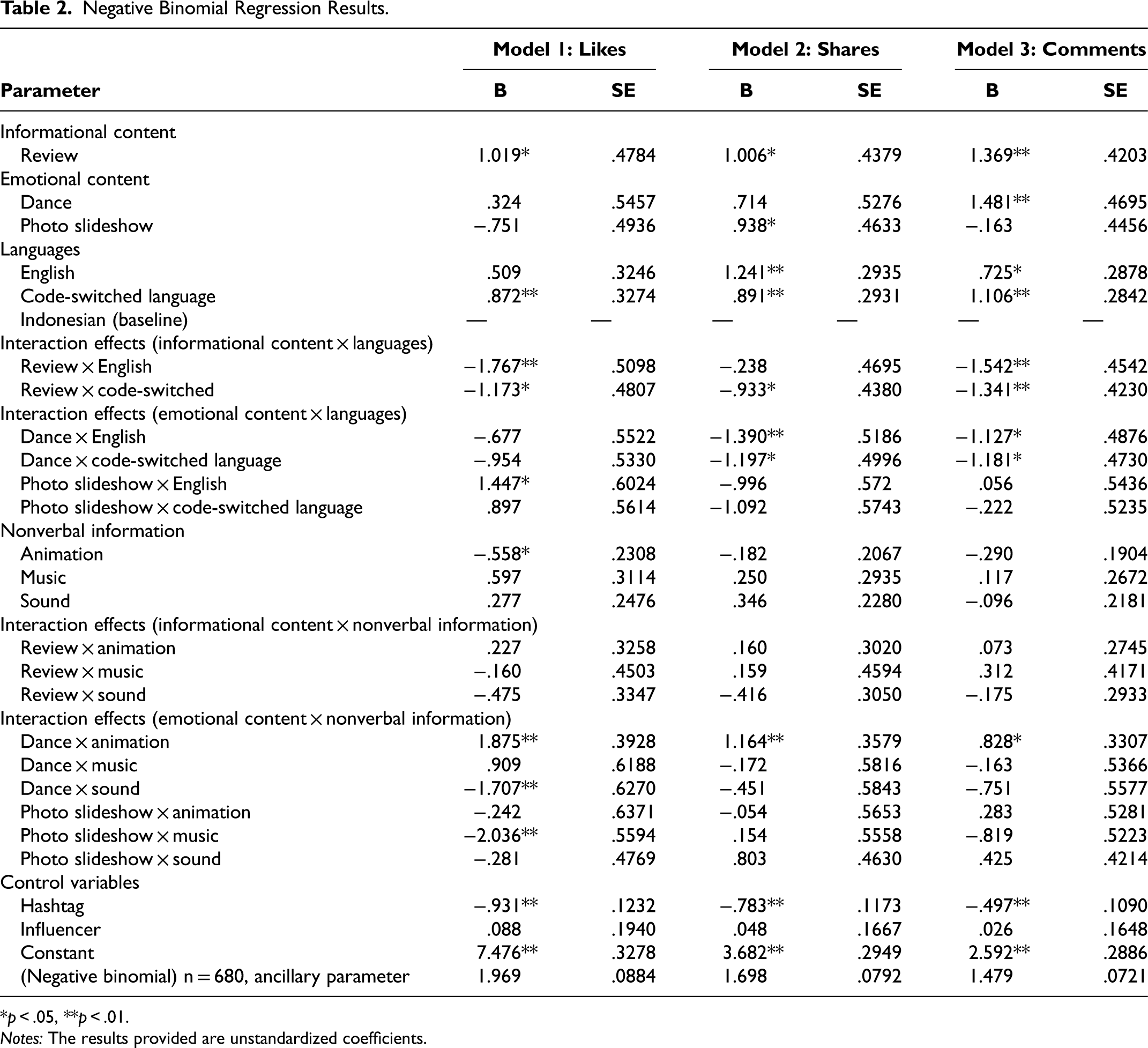
*p < .05, **p < .01.
Notes: The results provided are unstandardized coefficients.
The dependent variables were likes, shares, and comments. The figures were count data showing positive-only integers. In dealing with such data, Poisson regression is more efficient than ordinary least squares regression (Coxe, West, and Aiken 2009). Despite its efficiency, researchers still need to examine the suitability of Poisson regression for their studies. According to Coxe, West, and Aiken (2009), when applying Poisson regression, researchers need to consider specific factors, such as dispersion, deviance, Pearson chi-square, and the likelihood ratio. In this study, several posts gained substantial numbers of likes, shares, and comments. This likely transpired because the respected content became famous on TikTok. As a result, the variance of SME in this research was much higher than the means (likes: M = 2,246.088, S2 = 19,890,368.2; shares: M = 86.072, S2 = 24,225.493; comments: M = 27.563, S2 = 2,579.64). These excessive differences demonstrated overdispersion in the data, which violated the Poisson assumption of equidispersion (Cameron and Trivedi 2013), making Poisson regression unsuitable for this research. Furthermore, the deviance (likes = 4,371.682; shares = 143.375; comments = 46.384), Pearson chi-square (likes = 8,025.425; shares = 225.767; comments = 82.013), and likelihood ratio (likes = 749,108.733; shares = 17,494.010; comments = 4,835.825) values of all the outcome variables calculated using Poisson regression were large. Such large values are undesirable because they reflect that the implemented Poisson models are much worse than the perfect model (Coxe, West, and Aiken 2009).
Coxe, West, and Aiken (2009) proposed that negative binomial regression can fix imperfect models in Poisson regression. This study tested this premise. After we applied negative binomial regression with maximum likelihood estimation, all the deviance values (likes = 1.318; shares = 1.259; comments = 1.204), Pearson chi-square values (likes = 2.327; shares = 1.638; comments = 2.175), and likelihood ratio values (likes = 165.619; shares = 110.432; comments = 111.941) were significantly reduced. This indicates that negative binomial models yield a significantly better fit than Poisson models (Coxe, West, and Aiken 2009). Consequently, following extant studies with similar problems (e.g., Cvijikj and Michahelles 2013; Moran, Muzellec, and Johnson 2020), we implemented a negative binomial regression for the data analysis in this research. The negative binomial models for likes, shares, and comments were as follows: yij = y1j is the total of likes per brand post j, y2j is the total of shares per brand post j, and y3j is the total of comments per brand post j; β reviewj = the regression coefficient indicating review in brand post j (baseline = no review); β dancej = the regression coefficient indicating dance in brand post j (baseline = no dance); β photoslideshowj = the regression coefficient indicating photo slideshow in brand post j (baseline = no photo slideshow); β languageej = the regression coefficient indicating the level of language e in brand post j (baseline = Indonesian); β reviewj × β languageej = the regression coefficient for the interaction term of review in brand post j × level of language e in brand post j; β dancej × β languageej = the regression coefficient for the interaction term of dance in brand post j × level of language e in brand post j; β photoslideshowj × β languageej = the regression coefficient for the interaction term of photo slideshow in brand post j × level of language e in brand post j; β animationj = the regression coefficient indicating animation in brand post j (baseline = no animation); β musicj = the regression coefficient indicating music in brand post j (baseline = no music); β soundj = the regression coefficient indicating sound in brand post j (baseline = no sound); β reviewj × β animationj = the regression coefficient for the interaction term of review in brand post j × animation in brand post j; β reviewj × β musicj = the regression coefficient for the interaction term of review in brand post j × music in brand post j; β reviewj × β soundj = the regression coefficient for the interaction term of review in brand post j × sound in brand post j; β dancej × β animationj = the regression coefficient for the interaction term of dance in brand post j × animation in brand post j; β dancej × β musicj = the regression coefficient for the interaction term of dance in brand post j × music in brand post j; β dancej × β soundj = the regression coefficient for the interaction term of dance in brand post j × sound in brand post j; β photoslideshowj × β animationj = the regression coefficient for the interaction term of photo slideshow in brand post j × animation in brand post j; β photoslideshowj × β musicj = the regression coefficient for the interaction term of photo slideshow in brand post j × music in brand post j; β photoslideshowj × β soundj = the regression coefficient for the interaction term of photo slideshow in brand post j × sound in brand post j; β hashtagj = the regression coefficient indicating hashtag in brand post j (baseline = no hashtag); and β influencerj = the regression coefficient indicating influencer in brand post j (baseline = no influencer).
The constructs of content characteristics and nonverbal information were not mutually exclusive. Accordingly, the absence in each parameter was the pertinent parameter's baseline. Therefore, the data analysis excluded the product construct from the negative binomial models. As presented in Table 1, 676 cases were categorized as products in the overall data of 680 cases, leaving only four nonproduct cases in the sample. This extreme difference caused the negative binomial models to be unable to process the calculations. Lastly, this study modeled the dependent variables of likes, shares, and comments separately.
Findings
The negative binomial regression model explaining likes was significant as a whole (likelihood ratio [LR] χ2(25, N = 680) = 165.619, p < .01). Similar results also applied to shares (LR χ2(25, N = 680) = 110.432, p < .01) and comments (LR χ2(25, N = 680) = 111.941, p < .01). As displayed in Table 2, the details of the findings demonstrated that each of the independent variables had varying effects on likes, shares, and comments.
For content characteristics, the informational content of the review had significant and positive effects on likes (1.019, p < .05), shares (1.006, p < .05), and comments (1.369, p < .05), confirming H1a. For the emotional content, dance had significant and positive effects on comments (1.481, p < .01) and no significant effect on likes (.324, p > .05) and shares (.714, p > .05); a photo slideshow had significant and positive effects on shares (.938, p < .05) and no significant effect on likes (−.751, p > .05) and comments (−.163, p > .05). These results show that informational content primarily generated higher SME than emotional content. Only dance as emotional content outperformed informational content in the outcome variable of comments. Therefore, we generally accept H1b.
The findings further demonstrate that, compared with Indonesian, English had significant and positive effects on shares (1.241, p < .01) and comments (p < .05) and no significant effect on likes (.509, p > .05). The code-switched language had significant and positive effects on likes (.872, p < .01), shares (.891, p < .01), and comments (1.106, p < .01). Thus, this research largely supports H2. Concerning the moderating effect of language on the relationship between informational content (i.e., review) and SME, most of the constructs yielded a negative effect. Notably, English had significant and negative moderating effects on likes (−1.767, p < .01) and comments (−1.542, p < .01), and no significant moderating effect on shares (−.238, p > .05). Similarly, the code-switched language had significant and negative moderating effects on likes (−1.173, p < .05), shares (−.933, p < .05), and comments (−1.341, p < .01). For the moderating effects of language on the relationship between emotional content (i.e., dance and photo slideshow) and SME, most of the results were significant and negative. In particular, for the dance dimension, English had no significant moderating effect on likes (−.677, p > .05), but it did have significant and negative moderating effects on shares (−1.390, p < .01) and comments (−1.127, p < .05). For the dance construct, the code-switched language had no significant moderating effect on likes (−.954, p > .05), but it did have significant and negative moderating effects on shares (−1.197, p < .05) and comments (−1.181, p < .05). For the language and the relationship between photo slideshows and SME, English had significant and positive moderating effects on likes (1.447, p < .05), but it had no significant moderating effect on shares (−.996, p > .05) and comments (.056, p > .05). For the photo slideshow variable, the code-switched language had no moderating effect on likes (.897, p > .05), shares (−1.092, p > .05), and comments (−.222, p > .05). From these results, we generally and marginally accept H3a and H3b, respectively.
In terms of nonverbal information, animation had significant and negative effects on likes (−.558, p < .05) and no significant effect on shares (−.182, p > .05) and comments (−.290, p > .05). Music had no significant effect on likes (.597, p > .05), shares (.250, p > .05), and comments (.117, p > .05). Likewise, sound had no significant effect on likes (.277, p > .05), shares (.346, p > .05), and comments (−.096, p > .05). Thus, the findings generally support H4. With regard to the moderating effects of nonverbal information on the relationship between informational content and SME, all of the nonverbal information predictors generated no significant moderating effects, fully confirming H5a. In particular, animation had no significant moderating effect on likes (.227, p > .05), shares (.160, p > .05), and comments (.073, p > .05); music had no significant moderating effect on likes (−.160, p > .05), shares (.159, p > .05), and comments (.312, p > .05); and sound had no significant moderating effect on likes (−.475, p > .05), shares (−.416, p > .05), and comments (−.175, p > .05). In terms of the moderating effect of nonverbal information on the relationship between emotional content (i.e., dance) and SME, the results varied. Animation had significant and positive moderating effects on likes (1.875, p < .01), shares (1.164, p < .01), and comments (.828, p < .05). By contrast, music had no significant moderating effect on likes (.909, p > .05), shares (−.172, p > .05), and comments (−.163, p > .05). For sound, the moderating effect was significant and negative for likes (−1.707, p < .01) but insignificant for shares (−.451, p > .05) and comments (−.751, p > .05). Pertaining to the moderating effect of nonverbal information on the relationship between emotional content (i.e., photo slideshows) and SME, animation had no significant moderating effect on likes (−.242, p > .05), shares (−.054, p > .05), or comments (.283, p > .05). For music, the moderating effects were significant and negative for likes (−.36, p < .01) but insignificant for shares (.154, p > .05) and comments (−.819, p > .05). However, sound had no significant moderating effect on likes (−.281, p > .05), shares (.803, p > .05), and comments (.425, p > .05). According to these findings, this research only marginally supports H5b.
Discussion and Implications
This research investigated the effects of content characteristics, language, and nonverbal information on SME in the context of global brands operating in an emerging market and implementing TikTok as a tool for SMM. Concerning the first research question, the findings demonstrated varying effects. This study revealed that informational content, represented by reviews, positively affects the SME of high-involvement brands, which is consistent with prior content marketing research (Wahid and Gunarto 2022). This research also showed that, in general, given the intensive information searching of high-involvement customers, informational content generates higher SME than emotional content, which aligns with UGT research (Rubin 1983). Dance as emotional content outperformed all other content characteristics in stimulating SME in this study. This was a likely result because TikTok is famous for its dance content (Haenlein et al. 2020). This finding shows that dance videos have value for TikTok users. When given value by one exchange party, the other exchange party is likely to reciprocate (Bagozzi 1978), and SME consequently increases. As for language, the foreign and code-switched languages mostly had significant and positive effects on SME, compared with Indonesian. This finding indicates that these two languages may signify desirable perceptions of the global brands in this study, which is in agreement with prior research in the advertising literature (Krishna and Ahluwalia 2008). Regarding nonverbal information, most of the media formats had no significant effect on SME. Only animation significantly influenced the SME of likes, and the effect was negative. This finding aligns with those of studies discussing involvement in marketing (Cheung, Pires, and Rosenberger 2020; Wahid and Gunarto 2022) that indicate that high-involvement people are more open to informative input. To accommodate this difference, messages for high-involvement people are likely to be more effective in the form of texts because texts can convey exhaustive information. Thus, the high-involvement consumers in this analysis viewed rich media formats as insignificant and even negative.
Regarding the second research question, the results confirmed that the foreign and code-switched languages mostly had negative moderating effects on the relationship between informational content and SME. Once again, high-involvement people intensively search for product information because of its high consequences (Petty and Cacioppo 1986). Foreign and code-switched languages may hinder high-involvement consumers’ objective of acquiring information to increase rewards and avoid losses. Consequently, although their direct effects are positive, the foreign and code-switched languages had negative effects on SME when used for informational content. Regarding the moderating effect of nonverbal information on the relationship between informational content and SME, all types of nonverbal information in this study had no moderating effect. This was because, as noted previously, rich media formats are ineffective for high-involvement consumers, who generally require comprehensive product information. Therefore, the presence of animations, music, and sound is insignificant in moderating the relationship between informational content and SME.
The moderating effects of language and nonverbal information on the relationship between emotional content and SME tell an interesting story. Both English and the code-switched languages had negative moderating effects on the influence of dance on SME (i.e., shares and comments). This may be because foreign and code-switched languages are unimportant for dance posts. When exposed to dance content, customers focus more on the dance itself rather than the language. Therefore, despite the positive direct effects of foreign and code-switched languages on SME, the languages have negative moderating effects on the relationship between dance and SME (i.e., shares and comments). Conversely, English positively moderated the relationship between photo slideshows and likes. This may be because a photo slideshow displays works of art. Therefore, the use of English, with its alluring qualities associated with luxury products such as art (Krishna and Ahluwalia 2008), may amplify the pleasantness of photography. This combination may eventually persuade consumers to like photo slideshow content on TikTok. This study also found that animations positively moderated the effect of dance for all dimensions of SME. At the same time, sound had a negative moderating effect on the relationship between dance and likes, while music had a negative moderating effect on the relationship between photo slideshows and likes. These varying effects may have been due to factors relating to nonverbal information on TikTok that were excluded from this study. For instance, on TikTok, music can originate from local or global artists and can be of various genres. These elements may produce confounding effects.
Theoretical Implications
This research contributes to the growing literature on content marketing on social media. Despite the availability of efforts to analyze factors driving SME (e.g., Moran, Muzellec, and Johnson 2020; Shahbaznezhad, Dolan, and Rashidirad 2021), previous content marketing scholarship does not discuss the topic in the context of global brands utilizing social media platforms in specific target markets. There is a need to investigate this subject because social media usage differs by culture and region (Lin, Swarna, and Bruning 2017). In addition, emerging countries are especially challenging for the SMM of global brands (Kim, Moon, and Iacobucci 2019) because of factors such as consumer behavior, broadband access costs, regulatory frameworks, and communication device affordability (Ilavarasan, Kar, and Gupta 2018). Given these problems, this study advances the content marketing literature by providing preliminary insights into how content characteristics, language, and nonverbal information affect SME when content marketing strategies are implemented by global brands in an emerging market. This research expands the content marketing literature by investigating content characteristics at a granular level. Prior studies have called for this attempt (Kanuri, Chen, and Sridhar 2018; Wahid and Gunarto 2022). Unlike extant research, in which the content characteristics mostly fall into the categories of emotional, informational, and commercial characteristics (Meire et al. 2019; Tellis et al. 2019), in this study, content characteristics are treated both as generic and topical. Assigning content characteristics into singular topics provides a better theoretical understanding of SME.
In addition, this study extends the international marketing literature on social media. Notably, this research answers the calls in the extant scholarship of SMM and customer engagement in international markets to provide empirical evidence of factors driving SME (Johnston et al. 2018; Steinhoff et al. 2023) by spotlighting the variable of language. When marketing in other countries, particularly in those where English is rarely spoken, global brands need to consider whether to use foreign, local, or code-switched languages in their marketing strategies (Krishna and Ahluwalia 2008). The appropriate utilization of language can maximize marketing outcomes (Ahn and La Ferle 2008). Despite the significance of language and the pervasiveness of social media content that is spoken and written in various languages, the international marketing literature has not explored the role of language in the effectiveness of the SMM strategies of global brands. To the best of the authors’ knowledge, this study is the first to evaluate how foreign, local, and code-switched languages can affect SME. The findings revealed that, compared with the use of Indonesian, the use of foreign and code-switched languages can generate higher SME when language is treated as a single construct. However, when language is used for informational content, the SME decreased. These results imply the complexities of the application of language in the context of international marketing on social media. Thus, there is a need for more studies on this subject. This work may serve as a starting point for further international marketing studies discussing the influence of language on various SMM outcomes (e.g., purchase intention, brand equity, and customer engagement) in either Indonesia or other countries.
Furthermore, this study broadens the SMM literature by exploring TikTok and is among the first to discuss TikTok as a tool for SMM. With this effort, this study responds to numerous calls in the SMM literature to investigate emerging social media platforms other than Facebook and Instagram (e.g., Dwivedi et al. 2021; Wahid and Gunarto 2022) and simultaneously fills the immense theory–practice gap in relation to TikTok. Most importantly, this article responds to the call from Hollebeek and Macky (2019) to use alternate theoretical lenses in investigating content marketing. This study extends the extant social media and content marketing research that involves UGT (Dolan et al. 2016; Hollebeek and Macky 2019) by adding the TE to the framework. In addition, in line with Friman, Rosenbaum, and Otterbring (2020), this research provides empirical evidence that the TE can help in understanding and predicting the interactions between firms and customers in the modern marketplace. In particular, this study builds a conceptual framework based on the TE and UGT for predicting the results of content marketing strategies on TikTok. This study shows that when customers’ motivations (i.e., actors’ characteristics) are considered, the exchange outcomes are either individually or simultaneously impacted by content characteristics (i.e., the object being exchanged), along with language and nonverbal information (i.e., situational variables). In this study, the outcome of the exchange was positive when TikTok users engaged with the content disseminated by global brands and was negative when the users ignored the content. Both scholars and international marketers can use the conceptual framework when studying and planning SME optimization strategies on TikTok.
Practical Implications
Emerging nations are arduous places in which to practice SMM (Kim, Moon, and Iacobucci 2019). This research aimed to provide SMM guidelines for global brands targeting emerging markets. The findings reveal consumers’ preferences concerning content characteristics, language, and nonverbal information on social media. Insights from these three aspects can assist global brands in formulating effective content marketing. Designing and disseminating relevant content can help global brands gain a higher level of SME. Although the insights are instrumental, given the contextual nature of SMM (Lin, Swarna, and Bruning 2017; Voorveld et al. 2018), the findings can only be generalized to global brands offering high-involvement products in Indonesia and deploying TikTok as a device for SMM.
Global high-involvement brands have begun to use TikTok as a marketing tool when targeting the Indonesian market. For example, Samsung (@samsungindonesia), as a global smartphone brand, entered this realm in July 2021. As seen in the brand's account activity, it actively shares videos on TikTok. Honda (@hondaisme) and Toyota (@toyotaid) joined in May 2021 and August 2021, respectively. They also consistently market their products on the platform. The findings of this research can offer practical guidelines for these global brands and others. For example, to optimize their SME, brands might post content that reviews the use of their products. Honda could upload videos of its customers explaining how Honda cars improve their daily lives. At the time of this writing, there were limited dancing posts on Honda's account (@hondaisme) and Toyota's account (@toyotaid). This study confirms that content containing dancing can increase comments and outperform informational content. Therefore, to enhance SME, Honda and Toyota could share more dancing videos on their TikTok accounts. In addition, although media formats (such as animations, music, and sounds) play less significant roles in stimulating SME, global high-involvement brands need to be careful when embedding language in their TikTok videos. When inserted into review posts, English or code-switched language can lower SME. Similarly, using English and code-switched language in dance content reduces shares and comments. Therefore, while English and code-switched languages can amplify SME, global brands—such as Samsung (@samsungindonesia), Honda (@hondaisme), and Toyota (@toyotaid)—should avoid applying those languages to posts consisting of reviews and dancing.
Although this research does not enable us to claim causality between SME and direct marketing outcomes, extant research confirms the positive effects of SME on customer lifetime value (Meire et al. 2019), product consumption intention (Alhabash et al. 2015), word-of-mouth activities, purchase intentions (Hutter et al. 2013), and sales (Saboo, Kumar, and Ramani 2016). Given these benefits, how can firms enhance SME? This study answers this question and thus provides important practical insights for global high-involvement brand marketing in emerging countries using TikTok as a marketing tool.
Limitations and Future Research Directions
This study has several limitations. First, although this analysis addressed the moderating effects of language and nonverbal information on the relationship between content characteristics and SME, it excluded the potential interactions among the content characteristics’ constructs themselves. As demonstrated, the brands in the sample of this article used dance content to share information. These two topics of content (i.e., dance and information content) may interact with each other and influence SME. Given that dance content is prevalent on TikTok, future studies may focus on investigating how such content interacts with other content categories (e.g., promotions). In addition, future research may also test the interaction effects between language and nonverbal information. Second, despite providing significant contributions in uncovering SMM strategies for TikTok, this research inspected a limited number of content characteristics because of data limitation. Such a condition limits understanding of the effects of language on SME. Although foreign and code-switched languages generally have positive direct effects on SME, their interaction effects with informational posts (i.e., reviews) and emotional posts (i.e., dance posts) are mostly negative. The results make one wonder which types of content can be paired with foreign and code-switched languages to enhance SME. Thus, future studies may test the interaction effects of language with other content characteristics (e.g., humor) to provide clearer evidence about how language can improve SME. Third, this study only examined high-involvement products. This choice of products was due to the unavailability of global low-involvement products and brands marketing in Indonesia through TikTok, at least when this research was conducted. Future studies may include low-involvement products as a sample to fully discuss the role of involvement in predicting SME. Fourth, this study proved that dance can affect comments. However, dance on TikTok can be original or a copy of a trending dance, and it may influence SME. This study homogenized the dance construct, without distinguishing original dance from trending dance. Because of this, scholars and international marketers should be cautious when interpreting the related findings in this study. Future discussions may consider this condition by clearly defining and separating the types of dance on TikTok. Fifth, this investigation of global brands’ SMM merely concentrated on the contexts of Indonesia and TikTok. SMM is known for being highly contextual (Lin, Swarna, and Bruning 2017; Voorveld et al. 2018). Therefore, the culture and demographics of social media users and the culture and infrastructure of social media platforms may have caused confounding effects in this study. Thus, future research may examine factors driving SME by spotlighting other emerging economies (e.g., Brazil) and other social media platforms similar to TikTok (e.g., Instagram Reels). The replication of this research in other contexts may also test the reliability and consistency of the framework and findings in this study. Sixth, although this study yielded SME optimization strategies for TikTok, because the data set was secondary, this research was unable to capture the impact of content characteristics, language, and nonverbal information on direct marketing outcomes (e.g., brand equity, conversion, and sales). Future research may use experimental methods to complement this study. Lastly, as a suggestion for future studies, scholars may want to investigate search engine optimization strategies for TikTok. Users search for interesting topics and brands on the platform. To beat the competing brands and accounts that share similar TikTok videos, brands need to formulate their content characteristics and language so that they appeal to organic searches.
Supplemental Material
sj-pdf-1-jig-10.1177_1069031X221129554 - Supplemental material for Becoming TikTok Famous: Strategies for Global Brands to Engage Consumers in an Emerging Market
Supplemental material, sj-pdf-1-jig-10.1177_1069031X221129554 for Becoming TikTok Famous: Strategies for Global Brands to Engage Consumers in an Emerging Market by Risqo Wahid, Heikki Karjaluoto, Kimmo Taiminen and Diah Isnaini Asiati in Journal of International Marketing
Footnotes
Acknowledgments
The authors thank the JIM review team for their valuable comments and suggestions.
Special Issue Editors
Linda D. Hollebeek, Wafa Hammedi, Sanjit K. Roy, and Kelly Hewett
Declaration of Conflicting Interests
The author(s) declared no potential conflicts of interest with respect to the research, authorship, and/or publication of this article.
Funding
The author(s) received no financial support for the research, authorship, and/or publication of this article.

References
Supplementary Material
Please find the following supplemental material available below.
For Open Access articles published under a Creative Commons License, all supplemental material carries the same license as the article it is associated with.
For non-Open Access articles published, all supplemental material carries a non-exclusive license, and permission requests for re-use of supplemental material or any part of supplemental material shall be sent directly to the copyright owner as specified in the copyright notice associated with the article.
