




Abstract
Once the preserve of the elite, many luxury brands are now targeting the rapidly rising global middle classes. This “democratization of luxury,” understood as the perceived reduction in distinctiveness, exclusivity, and self-differentiation of luxury goods due to wider availability and access, has changed the luxury industry landscape substantially, and yet it remains an underexplored phenomenon in academic research. Building on the theory of network effects, this study focuses on how democratization influences the relationship between conspicuous signaling and luxury purchase intentions. Analysis of primary data (n = 1,156) from luxury consumers in developed (United States and Spain) and developing (China and India) markets with distinctly differing economic trajectories reveals the varying negative moderating influence of democratization. These negative effects of luxury democratization are more pronounced in developing markets (Study 1). Further, the findings highlight that consumer indulgence can help mitigate negative externalities associated with luxury democratization (Study 1) and identify its underlying mechanism through positive affect (Study 2). The multimethod approach demonstrated in this study sheds new light on consumer perceptions of luxury democratization and offers actionable implications for international luxury firms on managing this challenge in developed and developing markets.
The rapid rise of global middle classes in the past few decades, in particular within developing markets (Shukla and Rosendo-Rios 2021), has created an aspirational class that strives to purchase international luxury goods and conspicuously signal their luxury possessions to significant others (Awanis, Schlegelmilch, and Cui 2017; Balabanis, Stathopoulou, and Qiao 2019; Cavusgil et al. 2018; Eisend, Hartmann, and Apaolaza 2017). Previously the preserve of the elite, the luxury goods landscape has changed substantially, which has significant implications for firms operating in international markets. Moreover, to fulfill their own growth expectations, many luxury brands have engaged with this aspirational class to exploit the substantial global demand. This approach has led to luxury democratization, which is conceptualized in this research as the perceived reduction in distinctiveness, exclusivity, and self-differentiation of luxury goods due to wider availability and access. The power of democratization is particularly pertinent for luxury goods in international markets.
Although increasing global demand for conspicuous goods is a boon for firms’ bottom lines, luxury democratization also poses a substantial challenge by eroding luxury goods’ value and equity in consumers’ minds. Building on the theory of network effects (Katz and Shapiro 1985), we contend that increased access to and awareness of luxury goods as a result of luxury democratization may lead consumers to ascribe less value to democratized goods. Moreover, users’ gratification from possessing and displaying luxury goods depends on the number of other users in the same network (Berger and Heath 2008). In this regard, individuals base their purchase decisions on expected network size. When luxury democratization occurs, awareness and accessibility of luxury goods increase, which threatens the fundamental tenets of luxury, such as status, social mileage, uniqueness, and exclusivity (Kapferer and Valette-Florence 2018). The negative network externality effects of an enlarged network of users may therefore lead individuals to reduce their purchasing and usage of democratized goods. Extant research, based on cultural notions, highlights the greater tendency to conspicuously signal material possessions among consumers in developing markets than among their developed market counterparts (Eisend, Hartmann, and Apaolaza 2017; Sharma 2010; Shukla 2012). Extending this research through the lens of economic development and growth trajectory, we posit that the effects of conspicuous signaling will differ between developed and developing markets. However, guidance on how to approach luxury democratization is currently lacking for international luxury firms.
We further argue that consumer indulgence can be used to mitigate the negative network effects of democratization. Consumer indulgence refers to enjoying self-gratification and pleasure through consumption (Cavanaugh 2014). Previous research on indulgence focuses predominantly on negative affective responses, such as guilt and remorse (Ramanathan and Williams 2007), shame (Keinan and Kivetz 2008; Kivetz and Keinan 2006), or fear of failing to achieve budgetary goals (Haws and Poynor 2008). We provide new insights and demonstrate a positive affective response derived from consumer indulgence that reduces the negative network effects of luxury democratization. Further, we also examine the underlying mechanism of positive affect (Watson, Clark, and Tellegen 1988) that shows why indulgence weakens the effect of democratization. Thus, we investigate the positive effects of conspicuous signaling cross-nationally, the negative moderating effects of democratization, and the mitigation of the negative effects of democratization on intentions to purchase conspicuous goods through consumer indulgence, as well as the underlying mechanism of positive affect.
Luxury firms have increasingly shifted their focus to international markets—in particular the rapidly growing emerging markets like China and India—as a substantial source of their revenue growth (Deloitte 2021). Thus, there is a greater need to understand and examine cross-national differences, fundamentally between developed and developing markets. Extant research comparing developed and developing markets offers a decidedly inconclusive picture regarding consumption drivers and behaviors (Ashraf et al. 2017; Thongpapanl et al. 2018). Thus, we compare the aforementioned relationships across four countries—the United States, Spain, China, and India—and show the differential effects of conspicuous signaling, democratization, and consumer indulgence.
In doing so, this study makes four main contributions to the international marketing and branding literature. First, we show that consumers will avoid democratized luxury goods in their conspicuous signaling efforts, especially in developing markets. Thus, our research offers nuanced insights on the variation of effects between developing and developed markets. Second, grounded in the theory of network effects (Katz and Shapiro 1985), we demonstrate the negative network effects associated with luxury democratization. Third, in contrast to previous studies that have predominantly focused on the negative effects of consumer indulgence (Keinan and Kivetz 2008; Ramanathan and Williams 2007), our study demonstrates the positive influence of consumer-level indulgence in mitigating the negative network effects of democratization. In doing so, we show the vital role of individual traits regarding conspicuous products. Finally, through the mediation of positive affect (Watson, Clark, and Tellegen 1988), we show why indulgence weakens the negative effects of democratization. Thus, this study enables us to offer further managerial insights into managing the luxury democratization process and positioning international brands to help navigate the current challenges for expansion and globalization strategies.
Conceptualization and Literature Review
Researchers in industrial economics introduced the concept of network externalities to describe a situation in which “the utility that a user derives from consumption of the good increases with the number of other agents consuming the good” (Katz and Shapiro 1985, p. 424). The economic theory of network effects suggests that additional users of goods or services impact the value that people ascribe to those products (Katz and Shapiro 1985). According to this theory, the value of a product or service increases (positive externalities) or decreases (negative externalities) according to the number of people using it. For instance, consumption by a large number of users may increasingly attract other users, and that in turn will attract more new users, demonstrating positive network externalities leading to a “bandwagon” effect (Kastanakis and Balabanis 2012). As positive network externalities cause positive feedback and exponential growth, negative network externalities create negative feedback and exponential decay. Negative externalities occur if the benefits of the network are a decreasing function of the number of other users or agents.
From the literature review, we developed a conceptual framework as depicted in Figure 1. Here, we theorize that luxury democratization negatively affects the positive relationship between conspicuous signaling and purchase intentions. We further theorize that this effect depends on the level of economic development of the different countries under study (i.e., developed vs. developing markets). We posit that this negative effect of luxury democratization can be mitigated through the moderating role of consumer indulgence, and we identify its underpinning mechanism, positive affect. In doing so, we contribute to the body of knowledge by highlighting consumer perceptions of luxury democratization across developed and developing markets and offer guidance to luxury firms in managing the challenge of luxury democratization in international markets.

Conceptual framework.
Development of Hypotheses
Conspicuous consumption focuses on systematic social signaling by displaying wealth to express the self and gain higher status in the eyes of significant others (Berger and Heath 2008) and is posited to be one of the most important motives for luxury consumption (Vigneron and Johnson 2004). Conspicuous purchases, such as luxury goods, are naturally alluring to consumers for their signaling function. Researchers argue that conspicuous displays of luxury may also serve as costly signals to enhance status and economic power (Nelissen and Meijers 2011), since these signals are supposed to reveal information about the underlying qualities of the signaling individual. People engage in conspicuous consumption of luxury goods for their symbolic value (Kapferer and Valette-Florence 2018), mainly because these products are major conveyors of individuals’ social status, as well as signs of prestige and wealth (Han, Nunes, and Drèze 2010). Furthermore, luxury goods’ ability to convey costly signals of social status and group affiliation may strengthen their social image (Shukla 2012). For instance, wealthy consumers may wear luxury watches to symbolically mark their social status and economic power, whereas aspiring consumers may use such goods as a costly signal to distinguish themselves from the masses and conspicuously signal their aspirations and identification with significant individuals or social reference groups (Sundie et al. 2011). We therefore contend that conspicuous signaling and consumers’ intentions to purchase luxury goods are positively related.
Using a historical lens, Berg (2012) argues that rapid economic development has a direct impact on the demand and need for conspicuous signaling among the aspiring class. In recent years, the growth in developing markets has consistently outpaced that of developed markets. For instance, two of the largest developing markets globally, China and India, have had annual growth rates consistently higher than 5% over the past decade or more (World Bank 2022). In addition, long-term forecasts predict that 60% of the gross domestic product growth in the world economy will come from developing markets by 2030 (Organization for Economic Cooperation and Development 2022). Furthermore, the aspiring middle-class population in developing markets is expanding rapidly and expected to more than double from 2 billion today to 4.9 billion by 2025 (Kharas 2017). In developed markets, however, population growth and distribution are stable, suggesting that the demand will grow incrementally. With economic growth rates higher in developing markets than in developed markets, the desire for conspicuous consumption in developing markets is also increasing, especially among the middle classes (Shukla and Rosendo-Rios 2021).
In addition, rapid economic growth has resulted in substantially greater income inequalities in developing markets (Piketty 2014). Research shows that increasing income inequality results in greater levels of conspicuous consumption (Jaikumar, Singh, and Sarin 2018). In their meta-analysis focusing on counterfeit luxury goods, Eisend, Hartmann, and Apaolaza (2017) observe the significantly greater influence of status signaling through luxury goods among consumers in developing markets than in developed markets. Furthermore, extant research reports that the tendency to conspicuously display material possessions is rising among consumers in developing markets and declining in developed markets (Burroughs and Rindfleisch 2002). Prior research examining the overt (i.e., luxury automobiles) and covert (i.e., luxury alcohol) signaling further confirms the rise of conspicuous signaling through luxury goods in developing markets compared with developed markets (Sharma 2010; Shukla 2012). Moreover, scholars argue that consumers in developing markets are the primary source of growth for conspicuous products such as luxury goods as visible signals of newfound wealth (Shukla and Rosendo-Rios 2021). Therefore, we posit:
The Democratization Effect
The concept of democratization originated from political philosophy and is linked to democracy. Some authors define democratization from a general perspective. For example, Quelch and Jocz (2007) conceptualize democratization as freedom of choice or general unrestricted access for everyone. Other researchers advance the concept from a consumer perspective, based on an idea of accessibility of goods and services that involves mass production and consumption (Asmussen et al. 2013). In this regard, democratization has transformed and continues to transform the luxury industry. Historically, luxury brands targeted the elite of the society. However, this has changed in recent decades (Shukla, Rosendo-Rios, and Khalifa 2022) with the emergence of constantly growing affluent consumer segments who have shown substantial demand for luxury products and services, leading to their wider accessibility and consumption (Kapferer and Valette-Florence 2018).
A fundamental tenet of the purchase and consumption of luxury is its distinctiveness, exclusivity, and symbolic self-differentiation (Kapferer and Valette-Florence 2018). However, the rising economic prosperity globally, and in particular within developing markets, has substantially changed the demand structure for luxury goods (Shukla, Rosendo-Rios, and Khalifa 2022). The rapidly growing affluent consumer segments demand the same possessions as the elite social class. This new aspirational consumer class has considerably increased demand for luxury products and services, leading to their wider accessibility and consumption, and more recently leading to changes in consumers’ luxury value perceptions and a decline in conspicuous signaling power (Hennigs et al. 2012; Sharma 2010). Supply-side forces, such as retailers switching to mass merchandising, have also contributed to this phenomenon (Silverstein, Fiske, and Butman 2008). These marketplace interactions have led to luxury democratization, wherein consumers perceive a reduction in the distinctiveness and exclusivity of luxury goods because of their wider availability and access.
With increased availability and access, democratized luxury goods may not provide their possessor the ability to distinguish the self from others. Following the theory of network effects (Katz and Shapiro 1985), we posit that when democratized luxury goods are adopted by a broader network of middle-class consumers, increased access and awareness may decrease the symbolic values of exclusivity and distinctiveness assigned to democratized luxury goods by the networks of significant others. Therefore, luxury goods’ popularity and accessibility resulting from the democratization of mass-consumed luxury (Kumar, Paul, and Unnithan 2020) may jeopardize consumers’ aspiration levels, reducing the symbolic value association (Kapferer and Valette-Florence 2018) and, in turn, the demand for democratized luxury products. As the network of users increases driven by democratization of luxury, we posit that the value ascribed to the democratized luxury goods decreases, creating negative network externalities. Thus, we hypothesize that democratization will negatively impact the relationship between conspicuous signaling and luxury purchase intentions.
As argued previously, democratization reduces the overall symbolic value associated with luxury goods, including exclusivity and distinctiveness, as more people consume such products. We posit that this effect will be particularly pronounced in developing markets. In developed markets, there is comparatively less income inequality than in developing markets (Piketty 2014). With rapid economic growth and increasing wealth as well as greater income inequalities, consumers in developing markets have an inherent desire to signal their social status to significant others (Eisend, Hartmann, and Apaolaza 2017; Jaikumar, Singh, and Sarin 2018). This desire is clearly observed in several studies that focus on developing markets, including China (Podoshen, Li, and Zhang 2011), India (Shukla and Rosendo-Rios 2021), and Pakistan (Dev, Podoshen, and Shahzad 2018), among others. Further, using data from four emerging and three developed markets, McCollough (2020) shows that with increasing individual wealth, consumers in developing markets have a greater desire to show their economic standing to social others. However, democratization, with its increased access, robs them of this opportunity, as democratized goods cannot be used to signal exclusivity, distinctiveness, or self-differentiation.
Further, scholars argue that consumers in developed markets have a greater number of alternative mechanisms to signal status than in developing markets (Jaikumar, Singh, and Sarin 2018). Thus, for consumers in developing markets, democratization of luxury leads to the loss of an important status signal. With this lost opportunity to signal their status conspicuously, we posit that consumers in developing markets will avoid democratized luxury goods, compared with their developed market counterparts. Further, Commuri’s (2009) research on counterfeit luxury goods consumption in Asian developing markets reveals that when a luxury brand is adopted by individuals lower in the social hierarchy, consumers in the upper echelons tend to avoid consuming such goods in public. From the preceding evidence, we postulate that the negative effect of democratization will be more pronounced in developing markets than in developed markets. Therefore, we propose:
The Moderating Role of Consumer Indulgence and Its Underpinning Mechanism
Building on the theory of network effects, we theorize that when luxury goods are democratized, their wider awareness, accessibility, and availability alter the psychological meanings associated with them. Broader access resulting from democratization creates negative network externalities and reduces the value ascribed to the goods by significant others. We further argue that consumers in developing markets, more than in developed markets, avoid the democratized goods for conspicuous signaling. However, in the case of indulgent consumers, we posit that this negative network effect of democratization is mitigated because of their increased awareness of and access to luxury goods.
Cavanaugh (2014, p. 220) describes consumer indulgence as “allowing oneself to select and enjoy the pleasure from an option that is considered a treat compared with the alternative options.” Indulgence is an individual personality trait that combines pleasure and possessiveness. Indulgent consumers use possessions to create a sense of self-esteem and portray their self-identity (Nenkov and Scott 2014; Wilcox, Kramer, and Sen 2011). Indulgence has been widely studied in consumer and social psychology. Studies of indulgent consumption investigate the impact of indulgence using behavioral variables, including the influence of impulsive personality traits and remorse (Ramanathan and Williams 2007), and examine how personal relationships influence perceptions of deservingness in relation to indulgence (Cavanaugh 2014). However, these and related studies focus predominantly on negative consumer feelings associated with increased indulgence. For instance, some researchers focus on guilt, regret, and lack of responsibility (Kivetz and Simonson 2002; Ramanathan and Williams 2007), whereas others focus on shame, embarrassment, and fear of failing to achieve budgetary goals (Haws and Poynor 2008; Keinan and Kivetz 2008; Kivetz and Keinan 2006). Our study diverges from the extant literature and extends it by linking the positive affective response derived from indulgence with conspicuous luxury consumption.
Recent literature suggests that the levels of consumer indulgence may be contingent on external relationships (Cavanaugh 2014). Indulgent individuals are highly influenced by how others see or judge their behavior, which may influence their consumption practices (Dubois, Jung, and Ordabayeva 2021). Luxury goods allow indulgent consumers to use this consumption behavior for self-projection in order to gain a sense of belonging and an affinity with significant others who make similar statements (Berger and Heath 2008), as well as to reflect their social status (Han, Nunes, and Drèze 2010).
We contend that indulgent consumers will increase their conspicuous signaling through the democratized luxury goods because of the general public's greater awareness of the goods. As argued previously, indulgent consumers derive greater pleasure from possessions that allow them to project their identity in a favorable way (Nenkov and Scott 2014). Greater awareness of the democratized goods allows indulgent consumers to use their luxury possessions to create an increased sense of pleasure and self-identity. These possessions also help them demonstrate their self-achievement and social status, so democratized goods may become a source of pleasure and satisfaction for indulgent consumers. In turn, indulgent consumers will increasingly purchase democratized goods for conspicuous signaling in both developed and developing markets.
The Mediation Effect of Positive Affect
We contend that the effect of conspicuous signaling on luxury purchase intentions will be mediated by positive affect and that this effect will be more pronounced for people who are indulgent by nature. Conspicuous consumption reflects a tendency to show off and impress others and is linked with symbolism (Kapferer and Valette-Florence 2018). This tendency is particularly evident when consumers purchase and consume expensive goods, such as luxury items (Haws and Poynor 2008; Levav and McGraw 2009). Such items allow consumers to signal their desired identities and values (Shukla 2012). Moreover, for a conspicuous consumer, the satisfaction derived from luxury consumption stems not only from its functional value but from their reference group's reaction to it. The higher the signaling function, the more satisfaction and positive emotions are felt by the conspicuous consumer (Berger and Heath 2008). Moreover, boosting positive emotions leads to increasing consumer luxury repurchase intentions (Ki, Lee, and Kim 2017). Therefore, we posit a mediating effect of positive affect on the relationship between conspicuous signaling and luxury purchase intentions.
In addition, conspicuous consumption is associated with self-indulgence (Sundie et al. 2011). Indulgent consumers feel that conspicuous consumption serves to improve their subjective economic well-being as they can signal their identity to others (Jaikumar, Singh, and Sarin 2018). Research also shows that indulgent consumers experience a sense of hedonic achievement and positive affect, such as sensory pleasure, when consuming luxury items (Nenkov and Scott 2014; Sharma, Sivakumaran, and Marshall 2011). Moreover, indulgent consumers are highly sensitive to how their consumption signals are perceived by others (Dubois, Jung, and Ordabayeva 2021).
We argue that democratization of luxury, which by nature is associated with increased awareness of and access to luxury goods, will heighten positive affect and emotions particularly among indulgent consumers as they will be able to signal their consumption to a much wider audience. Therefore, we posit that, irrespective of the market context, for indulgent consumers, the idea of pleasure and positive affect associated with possession and acquisition, coupled with greater awareness of the democratized goods by significant others, will mitigate the negative effects of democratization on the relationship between conspicuous signaling and purchase intentions.
To test our hypotheses, we use a multimethod approach. Using data collected from two developed (i.e., the United States and Spain) and two developing (i.e., China and India) markets and a multilevel modeling approach, Study 1 examines the effects of conspicuous signaling on luxury purchase intentions, as well as the moderating effects of democratization, indulgence, and cross-national variations. Study 2, conducted in the United States, uses an experimental approach to capture why indulgence weakens the effect of democratization.
Study 1
Measures, Procedure, and Sample
Data for this study were collected from both developed and developing markets. We chose two of the largest developing markets, China and India. China is the second-largest luxury market in the world, and India is the fastest-growing large developing market for luxury goods (Euromonitor 2020). As for developed markets, we chose the United States, the largest market for luxury goods, and Spain. We decided to examine Spain because it is ranked ninth in the top ten global luxury markets and is the fourth-fastest-growing luxury market in the world (Statista 2021). Moreover, studies examining luxury consumption among Spanish consumers are lacking. Thus, our study provides interesting comparisons between the largest mature developed market (United States), a rapidly growing developed market (Spain), the largest developing market (China), and a rapidly growing developing market (India) for luxury goods.
The individual-level measures for conspicuous signaling were derived from Shukla (2012), and consumer indulgence scale items were derived from Sharma, Sivakumaran, and Marshall (2011). These constructs were measured on a seven-point scale, with “Strongly disagree” and “Strongly agree” as anchors. Purchase intention was measured using a three-item self-reported measure with a semantic differential scale (Schlosser, White, and Lloyd 2006).
Democratization has been discussed extensively in mainstream media but has received little academic scrutiny. Therefore, we employed an iterative process to develop the items for democratization following research by Heitman, Lehmann, and Herrmann (2007). First, we reviewed research on democratization in several fields of study, including sociology, social psychology, economics, and management. From extant research (Tilly 2000), we developed an initial set of 15 items adjusted for the context of luxury. These items were analyzed by a team of academic experts (n = 6), resulting in the removal of seven generic items inappropriate to the context of luxury consumption. As the study deals particularly with luxury consumption in a cross-national setting, the remaining eight items were adjusted to the context. The items were then pilot tested using a sample of luxury consumers (n = 84) to check the psychometric properties. Exploratory factor analysis (EFA) was carried out to examine the factor structure of the construct. This analysis revealed a single dominant factor that captured distinctive aspects that consumers associate with democratization of luxury, consisting of four items: mass production, differentiation, distinctiveness, and exclusivity. The Cronbach's alpha value of the four-item democratization construct, measured on a seven-point scale, was greater than the recommended threshold (α = .89). The results were discussed with two academic experts in the luxury area and two luxury brand managers, who agreed on the items, their properties, and their appropriateness. Thus, this four-item scale was eventually chosen for democratization.
The functional and conceptual equivalence of the individual-level constructs was subjectively assessed by the multicultural and multinational research team members. The questionnaire was evaluated for content and face validity by a panel of expert judges, including two marketing executives and two academics. The experts were also asked to assess each item for its representativeness, specificity, and clarity. The English questionnaire was then translated by an expert translator into Spanish, Hindi, and Mandarin, and these translations were then back-translated by another expert. These versions were examined for equivalence by another professional translator. A pilot test was conducted (n = 15 for each country) to identify any impolite, unclear, or obscure questions.
Respondents, who had purchased luxury goods in the past six months, were approached using professional online panel providers (i.e., Toluna and Prolific), with a final usable sample of 909 across all countries (United States n = 214; Spain n = 201; China n = 259; India n = 235). Table 1 presents the respondent profiles. The overall sample had slightly more female than male participants, and the mean age for each country was similar, with median ages between 24 and 33 years. The largest proportion of the sample in each country was married, and significant numbers of participants were employed full time, followed by students.
Respondent Profiles.
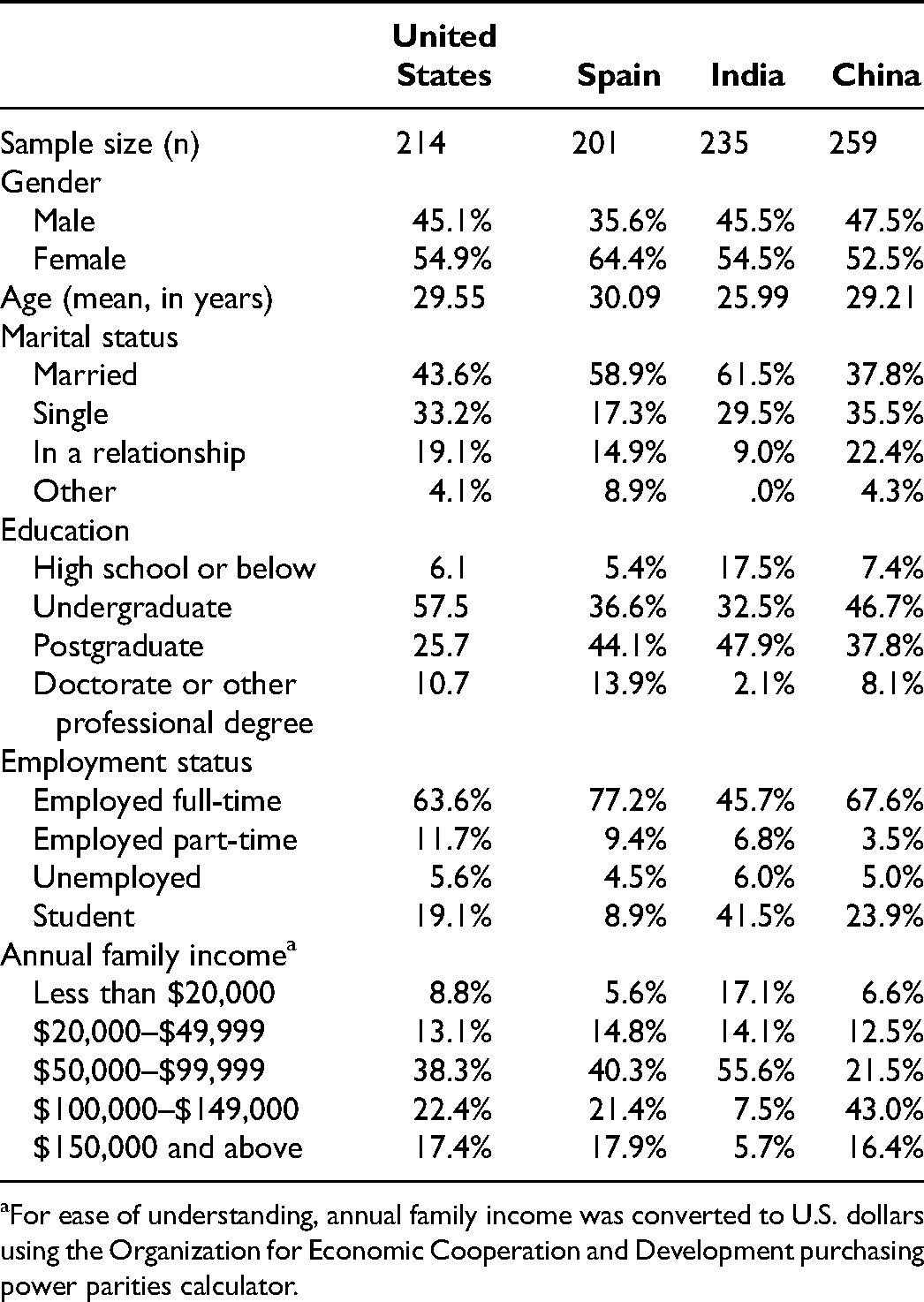
For ease of understanding, annual family income was converted to U.S. dollars using the Organization for Economic Cooperation and Development purchasing power parities calculator.
The questionnaire had four parts. Respondents were initially provided with a generic definition of luxury goods following the Oxford English Dictionary (inessential, desirable items that are expensive and difficult to obtain) and were given several industry examples (e.g., leather goods, fashion, automobiles) and brand examples (e.g., Gucci, LVMH, BMW) to establish an appropriate setting. Respondents’ sociodemographics were captured, and to avoid national heterogeneity, we excluded from the study those who were not nationals of the countries. The respondents were then exposed to predictor items for conspicuous signaling and democratization. The next section of the questionnaire captured consumer indulgence levels. The sections and items were counterbalanced.
Table 2 provides details of the standardized estimates, average variance extracted (AVE), composite reliability (CR), and alpha values for each construct and each country and at the pooled data level. The AVE for each measure was greater than .5, and the CR and alpha values were greater than .7, all above the recommended thresholds. Discriminant validity was measured using Fornell and Larcker’s (1981) recommended method. As no correlation exceeded the square root of the AVE (see Table 3), this criterion was met.
Measurement Model.

Correlation Matrices.

Notes: Values in diagonals represent the square root of AVE.
Invariance and Common Method Bias
As our data were collected from four different countries, it was important to assess cross-cultural measurement invariance for all the scales. We employed Steenkamp and Baumgartner’s (1998) multistep process using the Amos 27 maximum-likelihood method (see Table 4). The scales’ configural invariance was examined by testing the fit indices for an unconstrained model across the four countries. This testing showed a good model fit (χ2/df = 1.95; root mean square error of approximation [RMSEA] = .033; comparative fit index [CFI] = .95; Tucker–Lewis index [TLI] = .93; standardized root mean square residual [SRMR] = .068), suggesting that configural invariance conditions were met. The next step involved constraining the factor loadings to be equal across the four countries to examine full metric invariance. Full metric invariance was achieved, as the difference between the constrained and unconstrained models was nonsignificant (Δχ2(Δdf) = 34.84(30); p > .05) and the other fit indices improved. Next, full scalar invariance was examined (p < .05). Steenkamp and Baumgartner (1998) state that full scalar invariance is rare in cross-cultural research and recommend testing of partial scalar invariance. Testing of partial scalar invariance showed that the model was not significantly worse than the configural invariance model (Δχ2(Δdf) = 69.63(57); p > .05). From the results of invariance analysis, we pooled the data overall and at the developed and developing country level and examined the factor loadings and model fit. The pooled data showed a good model fit.
Invariance Measurement.

To minimize the effects of common method variance (CMV), we employed several procedural and statistical remedies recommended by Podsakoff et al. (2003). For instance, we controlled for order bias by counterbalancing the item order and the position of the predictor and criterion variables. To avoid response format bias, participants completed a series of filler tasks unrelated to the study; to reduce method bias, anonymity and confidentiality were ensured, and participants were told that there were no right or wrong answers.
Although these procedural remedies help reduce CMV, they may not entirely eliminate it. Thus, we also employed statistical remedies. First, we ran a Harman single-factor test using EFA. A single-factor model explained 33.60% of the total variance. However, when EFA was carried out with eigenvalues over 1, the items fell into their requisite theorized constructs, explaining 65.76% of overall variance. As a further stringent test for CMV, we also employed Lindell and Whitney’s (2001) marker variable approach to examine correlations among the constructs. This variable (i.e., “How important do you think is ‘freedom of speech’?”) has no theoretical relationship with any other variable in the study.
For a further robust test of CMV, we used the comprehensive confirmatory factor analysis (CFA) marker technique proposed by Williams, Hartman, and Cavazotte (2010), consisting of a three-phased approach of (1) model comparisons, (2) reliability decomposition, and (3) sensitivity analysis. For the first phase (see Table 5), we first ran a CFA model that allows for a complete set of correlations among the substantive variables and the marker variable to obtain the factor loadings and measurement error variance estimates for use in subsequent models. We then ran a baseline model wherein the substantive latent variables are allowed to be correlated with each other, but the marker variable is assumed to be orthogonal with its indicators having fixed factor loadings and fixed error variances obtained from the CFA model. The data show that the theoretically irrelevant predictor has a nonsignificant correlation (p > .05) with the criterion variable, thus offering validation of orthogonality. We then ran a Method C model, wherein the marker method factor loadings that relate to the substantive items were forced to be equivalent in value to reflect the equal methods effect. The comparison between the Method C model and the baseline model (Δχ2(Δdf) = 6.97 (1)) indicated support for rejecting the restriction of method factor loadings in the baseline model. Next, we compared the Method U model, wherein the factor loadings from the marker variable to substantive variable items were not forced to be equivalent, with the Method C model to determine if the impact of the method marker variable was equal for all items on the substantive indicators. The comparison (Δχ2(Δdf) = 95.62 (13)) provided support for the rejection of the restriction in the Method C model. Thus, the Method U model represents the best model for accounting for marker variance on substantive indicators. An additional model comparison, the Method R model, was conducted to assess the marker variable’s effects on factor correlation parameter estimates through a restricted model. In the Method R model, the factor correlation parameters were fixed at values obtained in the baseline model. The comparison between the Method U and Method R models showed a nonsignificant difference (Δχ2(Δdf) = 3.03 (6)), suggesting that the effects of the marker variable did not significantly bias the factor correlation estimates. From these results, in the second phase, we assessed total reliability associated with the latent variables by decomposing them into substantive and method portions as recommended by Williams, Hartman, and Cavazotte (2010). To achieve this, we examined the overall reliability values based on the estimates of the baseline model and the Method U model. The values yielded adequate overall reliability in all cases (>.70), and the decomposition values indicated that variables were not substantially affected by method variance. Finally, in the third phase, we conducted a sensitivity analysis wherein the factor correlations relating to the latent variables from the various models were examined. Two additional models, wherein the unstandardized factor loading values were set at values associated with the higher end of the confidence interval (CI) for the .05 and .01 α levels, were also compared with the baseline model. This comparison was conducted to determine if they would lead to different conclusions about the impact of marker-based method variance on factor correlations than the original estimates. There was no significant change in the factor correlations when these comparisons were conducted, as all the correlations between the latent variables continued to be significant and relatively unchanged. Thus, the procedural and statistical remedies suggest that CMV did not cause serious bias.
CMV Measurement.

Analysis
Given the nested data structure wherein individuals on the first level are nested within countries on the second level, we employed multilevel modeling with restricted maximum likelihood estimation, as the traditional regression analysis is not appropriate. Our analysis allowed us to retain cluster membership information for each individual observation. To test the level of purchase intentions with first- and second-level variables, we ran a series of random effects intercept-as-outcomes mixed models in IBM SPSS 27.0.
Table 6 shows the results of the pooled-level main effects and country-level differences in the direct effect (Model 1), the interactional model for individual-level moderation of democratization and consumer indulgence (Model 2), and the country-level effect to measure the differences between developed and developing markets (Model 3). The models reveal a decline in the residual variable as the country-level nested model was introduced (Table 6), which provides further support for the proposed model (Heinberg et al. 2021). Table 7 presents the comparative results for Model 2 for each country. First, we ran a null model and observed an intraclass correlation coefficient of .46 further confirming the need for a nested model. To measure the country-level effect as hypothesized in H1, we included gross domestic product per capita data for each country as a proxy (United States = $63,543.58; Spain = $27,057.16; China = $10,500.40; India = $1,900.71) on the basis of the 2020 World Bank data. Our hypothesis predicts a more pronounced effect in developing markets than in developed markets. We used dummy coding (Heinberg et al. 2021) to test the difference between the countries by classifying the United States and Spain as developed markets (coded as 1) and China and India as developing markets (coded as −1). The results in Model 1 show a significant effect between developed and developing markets (β = −.49, p < .001), thus confirming the theorization that the direct effect of conspicuous signaling is significantly higher in developing markets.
Path Coefficients from Hierarchical Linear Modeling of Pooled Data.

*p < .05.
**p < .01.
***p < .001.
Notes: Coefficients are unstandardized.
Path Coefficient Modeling for Each Country (Model 2).

*p < .05.
**p < .01.
***p < .001.
Notes: Coefficients are unstandardized.
As predicted in H2a, Model 2 shows a significant and negative moderating effect of democratization on the relationship between conspicuous signaling and luxury purchase intentions (β = −.07, p < .001). As seen in Model 3, H2b was also supported, as the effect was significant at the country level as well (β = −.50, p < .001). In H3, we hypothesize that consumer indulgence will further moderate the negative moderating effects of democratization. This hypothesis was supported (β = .02, p < .001). Overall, the results show that with increasing democratization, consumers tend to avoid purchasing luxury brands for conspicuous signaling. More importantly, we show a reversal in this boundary condition based on consumers’ level of indulgence by demonstrating that the greater levels of consumer indulgence mitigate the negative moderating effect of democratization. Further, our findings establish that the effects are more pronounced in the developing markets.
Study 2
In the previous study, we identified that the negative moderating effects of democratization are mitigated by indulgence. In this study, we investigate why indulgence weakens the effect of democratization. Moreover, we address the question of whether indulgence can be primed. In this study, we measure conspicuous signaling and manipulate the democratization and the indulgence variables. Further, we examine positive affect as the mediator (Positive and Negative Affect Schedule; Watson, Clark, and Tellegen 1988), with purchase intentions as the dependent variable.
Prestudy
With an aim to manipulate the democratization and indulgence variables, we decided to pilot test our manipulations. Using the Prolific Academic panel, we recruited 41 respondents from the United States (Mage = 31.34 years, SD = 10.11; 65.90% female) who were prefiltered on the basis of their luxury consumption behavior. The respondents were then randomized to either the democratization or the control condition. This step was followed by the democratization manipulation check. Respondents were then randomly exposed to the indulgence/nonindulgence prime and the relevant manipulation checks.
For the democratization manipulation, respondents were exposed to a news story about a fictitious luxury brand called Salvatore Piezzo. For the democratization condition (see Web Appendix), the news story focused on greater access, awareness, and a substantial shift in user base for the brand that included middle- and lower-class consumers. In the control condition there was no significant change in the user base, and the brand maintained its exclusivity. We employed the same four-item democratization scale as used in Study 1 for the manipulation check (α = .85).
A major method of communicating indulgence for luxury brands is their advertisements in regular press or social media. Thus, to increase the ecological validity of our study, we used an image-based indulgence prime that is extensively used in prior research (Ilicic, Brennan, and Kulczynski 2021; Nenkov and Scott 2014). In the indulgence condition, respondents were shown four images of luxury goods (a luxury car, a yacht, interior seating in a chartered plane, and a luxury watch). There were no logos present in the images to avoid any brand-related biases. Respondents in the control condition were exposed to four daily objects (a key, a stapler, a toilet roll, and a pencil case). Respondents were then asked to reflect on these objects and how they would use these products/experiences if they owned them, in three indulgent intention items, namely play, fun, and pleasure (α = .98), and three nonindulgent intention items, namely work, serious project, and homework (α = .76) (Nenkov and Scott 2014). The items were measured on five-point scales (1 = “Not at all,” and 5 = “Totally so”) as a manipulation check for indulgence. We also measured the indulgence scale as outlined in Study 1 (Sharma, Sivakumaran, and Marshall 2011) as a further test of the manipulation.
To measure whether the manipulations were successful, we employed a one-way analysis of variance. The democratization manipulation was successful (F(1, 40) = 14.48, p = .000), as respondents in the democratization condition (M = 4.87, SD = 1.00) scored significantly higher than those in the control condition (M = 3.48, SD = 1.33). Similarly, the indulgence manipulation was also successful on all fronts. Respondents exposed to the indulgence condition (M = 4.52, SD = .68) showed significantly greater indulgent intentions (F(1, 40) = 165.43, p = .000) than those in nonindulgent condition (M = 1.62, SD = .77). Further, respondents exposed to the nonindulgent condition (M = 3.22, SD = 1.04) demonstrated significantly greater nonindulgent intentions (F(1, 40) = 5.69, p = .022) than those exposed to the indulgent condition (M = 2.43, SD = 1.07). The indulgence scale also demonstrated a significant difference (F(1, 40) = 19.64, p = .000), wherein those in the indulgent condition demonstrated much higher levels of indulgence (M = 4.33, SD = 1.15) than those in the nonindulgent condition (M = 2.72, SD = 1.19).
Measures, Procedure, and Sample
For the main study, we recruited 206 consumers in the United States who belonged to the Prolific Academic panel and regularly consumed luxury brands. Four participants who failed attention checks were removed from the study, leaving a final usable sample of 202 participants (Mage = 33.18 years, SD = 11.12; 58.90% female). Respondents were initially provided with a generic definition of luxury goods (similar to that used in Study 1), followed by sociodemographic questions. The respondents then completed the conspicuous signaling scale (α = .84) as used in Study 1 (Shukla 2012). Because the prestudy established our democratization manipulation, respondents were only exposed to the democratization condition in this study. This was followed by a democratization manipulation check with the scale used in Study 1 and the prestudy (α = .82). The respondents were then randomly exposed to either the indulgent or the nonindulgent condition as detailed in the prestudy (Nenkov and Scott 2014), followed by relevant indulgent item (α = .96) and nonindulgent item (α = .81) manipulation checks as well as the indulgence item scale used in Study 1 (α = .82). Following the manipulation checks, participants were exposed to the Positive and Negative Affect Schedule (Watson, Clark, and Tellegen 1988) to capture the mediating effects of positive affect. These items were measured on five-point bipolar scales with items including “unhappy/happy,” “annoyed/pleased,” “unsatisfied/satisfied,” “”melancholic/contented,” “relaxed/stimulated,” “calm/excited,” “sluggish/frenzied,” and “unaroused/aroused” (α = .80). Respondents’ purchase intentions for luxury goods (α = .92) were captured with items similar to those used in Study 1.
Analysis
The indulgence prime was successful (F(1, 201) = 740.06; p = .000), as respondents indicated significantly greater intent to use the products for indulgent purposes in the indulgent prime condition (M = 4.44, SD = .66) than in the nonindulgent condition (M = 1.63, SD = .80). Similarly, for nonindulgent uses (F(1, 201) = 64.13, p = .000), respondents exposed to the indulgent prime demonstrated lower intent to use the products (M = 2.26, SD = .98) than respondents in the nonindulgent condition (M = 3.35, SD = .94). On the indulgence scale also, the respondents in the indulgent condition (M = 3.97, SD = 1.48) scored significantly higher (F(1, 201) = 8.91, p = .003) than those in the nonindulgent condition (M = 3.36, SD = 1.46).
To understand the underlying mechanism that demonstrates why indulgence weakens the effect of democratization, we employed PROCESS macro Model 4 (Hayes 2013) with a bootstrapping procedure (5,000 resamples), with conspicuous signaling as the independent variable, positive affect as the mediator, purchase intentions as the dependent variable, and democratization as the control variable. As theorized, the results revealed that conspicuous signaling had a direct effect on positive affect (F(1, 200) = 39.61, p = .000, β = .41, 95% CI = [.15, .28]), and purchase intentions (F(2, 199) = 21.10, p = .000, β = .32, 95% CI = [.26, .66]). Moreover, the effect of positive affect on purchase intentions was also significant (β = .17, p = .020, 95% CI = [.07, .82]). The indirect effect of indulgence on purchase intentions through positive affect was significant as demonstrated by a 95% CI that excluded zero (β = .10, 95% CI = [.01, .13]).
We examined these relationships further with an expectation that the mediation is stronger in the indulgent condition than in the nonindulgent condition. To achieve this, we employed PROCESS macro Model 7 (Hayes 2013) with conspicuous signaling as the independent variable, indulgence as a moderator, positive affect as the mediator, purchase intentions as the dependent variable, and democratization as the control variable. The index of moderated mediation was significant (β = .08; 95% CI = [.01, .19]). Moreover, the conditional indirect effect analysis demonstrated the mediation was stronger in the case of the indulgent condition (β = .13; 95% CI = [.01, .27]) than in the nonindulgent condition (β = .05; 95% CI = [.01, .14]).
Discussion and Conclusion
This research examines the effects of democratization of luxury in developed and developing markets. In addressing this timely issue, we offer novel insights that inform the international business strategies of firms marketing conspicuous goods and services. Our findings provide a better understanding of the intricate relationship between consumers’ conspicuous signaling motives and the interactive effects of both luxury democratization and consumer indulgence. In doing so, the study offers several implications for theory and practice.
Theoretical Implications
Our results extend the extant cross-cultural luxury consumption research by demonstrating that while conspicuous signaling may influence luxury purchase intentions globally, the effects are more pronounced among consumers in developing markets. Previous studies examine cross-national luxury consumption differences mostly through the lens of cultural traits (Eisend, Hartmann, and Apaolaza 2017; Pillai and Nair 2021). Our study provides an extended contribution in this regard by demonstrating the role of economic development in driving luxury consumption. Our work adds substantial empirical evidence to the international marketing literature (Ashraf et al. 2017; Thongpapanl et al. 2018) by demonstrating that attempts to homogenize strategies without appreciating the contextual complexities involved may lead to inferior performance in international markets for firms.
Another noteworthy contribution of this research pertains to the moderating effects of democratization across developed and developing markets. We show that when luxury goods become democratized, consumers will avoid these goods in their conspicuous signaling efforts, especially in developing markets. Various luxury goods have already become democratized or are in the process of democratization, yet in exploring this effect, we highlight the resulting negative externalities for these goods. Luxury democratization within the marketplace will result in increasing awareness of and access to the luxury goods. However, examination of this phenomenon through the lens of network effects (Katz and Shapiro 1985) reveals that increased access and awareness reduces the overall value ascribed to the democratized luxury goods. Thus, we offer a more complex picture of the effects of democratization of luxury goods (Silverstein, Fiske, and Butman 2008) by observing that when these goods become increasingly available, consumers may ascribe less value to them (Kapferer and Valette-Florence 2018) and thus may not purchase them and use them for conspicuous signaling.
Moreover, in examining the effects of luxury democratization across developed and developing markets, we offer a novel perspective on how these effects vary according to the market context. In doing so, we extend the theoretical contribution of our study to the international marketing literature. For instance, we observe a greater decrease in purchase intentions for democratized luxury goods among consumers in developing than in developed markets. In comparing developed and developing markets, research shows that consumers in developing markets are highly sensitive to increased market penetration by luxury brands (Awanis, Schlegelmilch, and Cui 2017). They also have a greater desire to show their luxury possessions (McCollough 2020). However, when such goods become widely accessible, their accessibility creates negative network externalities, and the goods lose the strength of their societal meaning and resultant upward mobility signaling, leading consumers in developing markets to shun such products. By contrast, in developed markets luxury goods are predominantly consumed for personal pleasure and self-interest (Shukla 2012). Further, compared with their developing market counterparts, consumers in developed markets have a greater number of alternative mechanisms to signal their status (Jaikumar, Singh, and Sarin 2018). Therefore, the effects of democratization that are more societal in nature have significantly less negative influence on consumers in developed markets. Thus, the current research offers pioneering insights on the differential network effects of democratization between developed and developing markets.
At the national level, no significant difference in the effects of luxury democratization is observed between developing markets. However, comparison of developed markets reveals distinct differences. For instance, U.S. consumers exhibit significantly lower intentions to purchase democratized luxury goods than their Spanish counterparts. Such differences may be explained by the value that consumers ascribe to luxury consumption. For instance, Hennigs et al. (2012) argue that U.S. consumers are significantly more driven by symbolic values, such as prestige, whereas Spanish consumers emphasize quality assurance far more. Thus, when luxury goods democratize, the reduction in their symbolic value driven by network externalities influences luxury consumption among U.S. consumers more than among Spanish consumers. Building on these findings, our research offers nuanced insights on the varying effects between developed markets. It highlights the need for further international marketing research that examines the differences between and within developed markets with differing economic and cultural trajectories.
Our study also makes noteworthy additions to the developing stream of literature on consumer indulgence. Existing studies concentrate predominantly on the negative effects of consumer indulgence (Keinan and Kivetz 2008; Ramanathan and Williams 2007). In contrast, our study demonstrates the positive influence of consumer-level indulgence in mitigating the negative network effects of democratization and finds that such a reversal occurs through the underlying mechanism of positive affect. In doing so, we show the vital role of individual traits regarding conspicuous products. Indulgent consumers crave pleasure from the possession and consumption of luxury goods (Dubois, Jung, and Ordabayeva 2021). Thus, when democratized luxury goods are marketed to them, greater awareness of and access to these goods allow indulgent consumers to gain greater pleasure and positive affect, thus strengthening their intentions to purchase such luxury goods for conspicuous signaling. Overall, this research integrates the international marketing, luxury branding, network effects, and consumer indulgence literature and offers insights into the purchase decisions of luxury consumers across developed and developing markets.
Managerial Implications
Our study provides important insights into how international luxury brand managers should engage with and manage the process of democratization in developed and developing markets. Although democratization may seem lucrative because of consumers’ increased access and thus greater revenues for the brand, we recommend that international firms and managers should approach the process with caution, especially if their luxury goods are used for conspicuous signaling. This is because democratization leads to perceived loss of uniqueness, distinctiveness, and exclusivity owing to increased awareness and accessibility. These negative network effects, in turn, lead consumers to ascribe lower value to democratized goods. As a result, consumers avoid buying the luxury goods, so the envisioned revenue increase from democratization may not materialize.
Employing a democratization strategy may seem highly lucrative, particularly within developing markets, where rapid economic growth contributes to the rise of an aspirational class demanding luxury goods, thus leading to greater revenues. Furthermore, income equalities are much higher in developing markets (Piketty 2014). Acknowledging this economic outlook, many luxury brands resort to democratization strategies to enter and target consumers in developing markets. However, our research suggests caution against such a strategy, as the negative network effects of democratization are particularly acute in developing markets like China and India. Consumers in these markets are highly conscious of their societal standing, and luxury goods are used to demonstrate status (Shukla and Rosendo-Rios 2021). Thus, when a luxury good undergoes democratization, it loses its previous societal status association among the target consumers. Many luxury brands, such as Burberry and Prada, which have become democratized within developing markets, have faced a backlash in the marketplace. Thus, we recommend that managers refrain from using democratization strategies when entering or targeting developing markets.
Although we recommend caution in employing democratization strategies because of their negative network effects, many luxury goods have already become democratized or are in the process of doing so in both developed and developing markets. Our study offers further guidance for international firms on how to manage the negative network effects of democratization successfully by priming indulgence. We also demonstrate the process through which consumer indulgence can be primed. By priming indulgence among target consumers through visual communication strategies, international firms may reduce the negative effects of democratization for their luxury brands. Thus, by highlighting the importance of their luxury goods in offering personal happiness, pleasure, and positive affect and by boosting consumers’ self-identity and indulgence, managers can counteract the negative network effects of democratization in both developed and developing markets.
Limitations and Future Research Directions
As with all research, this study has several limitations that offer directions for further research. In focusing on two distinct types of markets (developed and developing), we show how the complexity of luxury goods’ democratization may shape differing consumer behaviors across markets. Although we compare market-level differences, because of resource constraints our sample is not representative of the population. Therefore, further cross validation is needed. Studies show that luxury consumption behaviors differ between less developed and more developed regions within large countries such as India and China (Shukla and Rosendo-Rios 2021). In this regard, examining the comparative effects of democratization in urban, semiurban, and rural markets in other developed and developing countries might assist international managers in building strategies that are sensitive to regional and national differences. Whereas the classification of markets as developed and developing offers an economic viewpoint, a different viewpoint emerging in recent international business literature pertains to globalized versus globalizing markets (Liu et al. 2020; Mandler, Bartsch, and Han 2021). Within globalized markets, the pace of globalization seems to have slowed, whereas globalizing markets are experiencing substantial growth through globalization, which is transforming their consumer markets. Consumers in these markets hold differential attitudes toward globalization, and thus examining these market contexts may offer further interesting insights.
Another interesting path would be to examine whether the effects of luxury democratization diverge for luxury brand firms with a tiered product portfolio. Many luxury brands employ a multitier approach to luxury. For instance, Max Mara is pitched at the higher end of the luxury market, while its other brand, Max&Co., caters to a tier below. It would be worth studying whether there are spillover effects when a firm has a high-end luxury brand line as well as a midlevel luxury brand line. For instance, would the firm be able to democratize the midlevel luxury brand line, while keeping the high-end luxury brand line exclusive, to take advantage of the benefits of both approaches? Or would the democratization of the midlevel luxury brand line create negative spillover effects on the high-end luxury brand line?
Our study is cross-sectional in nature. Thus, longitudinal and experimental studies are needed to unravel the long-term effects of democratization. Similarly, we have not considered country-of-origin effects that may play an important role (Herz and Diamantopoulos 2017). For example, whether the effects of democratization differ for brands originating from developed markets such as Italy or France and brands originating from developing markets such as Turkey or Indonesia needs further research. We also invite empirical research on the role of multicategory comparisons of democratized luxury goods.
This study shows how the negative effects of democratization may be mitigated by consumer indulgence. Further exploration of these mitigating effects might illuminate the nature of consumers’ motivations for buying democratized luxury goods. For instance, using other consumer-level moderators, including consumers’ need for status, interpersonal susceptibility, or vanity, might enable further cross-cultural examination of the effects of democratization. These additional approaches would also help brand managers internationalize their democratized or democratizing luxury goods and develop appropriate global managerial strategies to maintain or improve their market share in the global marketplace.
Supplemental Material
sj-pdf-1-jig-10.1177_1069031X221126925 - Supplemental material for Managing the Challenge of Luxury Democratization: A Multicountry Analysis
Supplemental material, sj-pdf-1-jig-10.1177_1069031X221126925 for Managing the Challenge of Luxury Democratization: A Multicountry Analysis by Paurav Shukla, Veronica Rosendo-Rios, Sangeeta Trott, Jing (Daisy) Lyu and Dina Khalifa in Journal of International Marketing
Footnotes
Associate Editor
Yuliya Strizhakova
Declaration of Conflicting Interests
The author(s) declared no potential conflicts of interest with respect to the research, authorship, and/or publication of this article.
Funding
The author(s) received no financial support for the research, authorship, and/or publication of this article.

References
Supplementary Material
Please find the following supplemental material available below.
For Open Access articles published under a Creative Commons License, all supplemental material carries the same license as the article it is associated with.
For non-Open Access articles published, all supplemental material carries a non-exclusive license, and permission requests for re-use of supplemental material or any part of supplemental material shall be sent directly to the copyright owner as specified in the copyright notice associated with the article.
