




Abstract
The digital ecosystem makes entry into foreign markets easier and provides new ways for consumers to engage with marketing materials (through content clicking, sharing, and electronic word-of-mouth [eWOM] behavior). While evidence has emerged that between-country cultural differences may impact digital consumer engagement (particularly eWOM), far less is known about its impact on online advertising clicking and sharing engagement or how within-country cultural variation (tightness/looseness) moderates this activity. The authors develop and test the notion that between- and within-country cultural differences lead to variations in digital consumer engagement, especially clicking and sharing behavior. Using industry data provided by a programmatic advertising firm, the authors find support for the idea that between-country differences in national cultural values impact digital engagement and that within-country cultural variation moderates these relations. In this way, they provide new insights for researchers and managers about international marketing in the digital age.
Keywords
The digital ecosystem offers new opportunities for consumers to engage with firms (Brodie et al. 2013; Kumar and Pansari 2016). This is especially true as firms expand to foreign countries (Gupta, Pansari, and Kumar 2018). Consumer engagement is critically important for firms because it increases consumer loyalty (e.g. Schouten, McAlexander, and Koenig 2007), increases commitment to the product or service (e.g. Chan and Li 2010), and leads to higher firm performance (Kumar et al. 2010). Recent research indicates that, internationally, digital consumer engagement activities are influenced by between-country differences in cultural attributes (Chu and Choi 2011; Lam, Lee, and Mizerski 2009; Lee and Choi 2019; Pezzuti and Leonhardt 2020; Tang 2017; Wang and Sun 2010). This is especially evident for online word-of-mouth (eWOM) engagement activities (Chu and Choi 2011; Lam, Lee, and Mizerski 2009; Lee and Choi 2019; Pezzuti and Leonhardt 2020; Tang 2017). Yet we know far less about other digital engagement behaviors (e.g., clicking, sharing) or how within-country variations in cultural values (tightness/looseness) impact these digital engagement activities.
Firms understand that consumers react differently to marketing efforts in different countries and that not all consumers in a country share the same cultural values (e.g., Keillor, D’Amico, and Horton 2001; Schwartz 1999). Yet because of privacy concerns and regulations (e.g., General Data Protection Regulation, California Consumer Privacy Act), firms expanding abroad may have difficulty identifying consumers’ specific cultural characteristics. Therefore, they often rely on more general measures of culture, like Hofstede’s measures (Hofstede 1980a; Kirkman, Lowe, and Gibson 2017) to gain insights into potential cultural influences. Using these national cultural dimensions to target engagement activities may be more (or less) successful, depending on the level of variation within each country on these cultural values. This variation is referred to as the degree of cultural tightness/looseness (Gelfand et al. 2011; Uz 2015), or the degree to which members of a society (country) tolerate deviation from (Hofstede’s) national cultural values. Understanding how national cultural values and the degree of tightness/looseness (hereinafter, “tightness”) impacts digital consumer engagement activities is important; to be successful, firms may need to modify their digital marketing strategies to align them better with the specific cultural beliefs and the tolerated variance of these beliefs in a target country.
In this article, we build on national cultural and cultural tightness theories (Gelfand et al. 2011; Hofstede 1980a) to suggest that cross-country differences in cultural values will lead to variations in digital consumer engagement behavior and that this behavior is moderated by within-country cultural differences—that is, the degree of cultural tightness (Gelfand et al. 2011; Uz 2015). Digital consumer engagement involves interactive experiences between consumers and the brand, and/or other members of the online community (Brodie et al. 2013). We look at clicking behavior (brand clicks), which measures a consumer’s exploration of additional brand, product, or service information embedded in an advertisement with the aim of improving their own experience with a particular product or brand (Van Doorn et al. 2010), and the sharing of marketing materials within the consumer’s network, which improves their social experience (Teixeira, Wedel, and Pieters 2012). We theorize that in societies characterized by high individualism, power distance, and long-term orientation, consumers engage more in clicking behavior than in sharing behavior because they tend to be less likely to seek social attention or acceptance online (Seidman 2014), are more interested in themselves (Roth 1995), and prefer being anonymous, resulting in more passive participation in the community (Goodrich and De Mooij 2013). In contrast, we suggest that in societies marked by high uncertainty avoidance and masculinity, consumers are more likely to engage in sharing behavior because they are interested in both their own experience, such that they seek to reduce or avoid risk (Roth 1995), and improving their social experience, such that they seek to promote achievement and success with others (Hofstede 1980a).
Furthermore, we posit that within-country cultural tightness will moderate these relations. This occurs because in tight cultures, consumers tend to enforce national cultural norms and values and have low levels of tolerance toward divergent behavior. In contrast, in loose cultures there is greater deviation from the average national standards, with more people at the higher and lower ends of the distribution (Gelfand et al. 2011; Uz 2015). As a result, we suggest that in tight cultures, digital consumer engagement behavior will align with the cultural values in that country while in loose cultures, because of the wide variation in cultural beliefs held by members of the society, digital consumer engagement behavior will vary. We test our theory on a unique sample of 2,092 online video advertisements from eight countries. Overall, our results indicate that digital consumer engagement differs due in part to between-country differences in national cultural values and within-country variance of cultural tightness/looseness.
We make several important contributions to the international marketing literature. While the international and digital marketing literatures have started to investigate how the digital economy challenges current theory (Brouthers, Geisser, and Rothlauf 2016; Kübler et al. 2018; Watson et al. 2018), we are only beginning to understand how national cultural values impact digital consumer engagement strategies. Digital consumer engagement differs from more traditional engagement because the digital economy offers new and different ways (e.g., clicking and sharing behavior) for consumers to engage with marketing materials (Brodie et al. 2013). Previous research tends to focus on online consumer engagement in a single country (Teixeira, Wedel, and Pieters 2012) or explore how between-country differences in cultural values impacts eWOM engagement activities in multiple countries (e.g., Chu and Choi 2011; Lam, Lee, and Mizerski 2009; Lee and Choi 2019; Pezzuti and Leonhardt 2020; Tang 2017). Building on this work, we contribute to this literature by developing new theory that posits that between-country differences in national cultural values have a significant impact on consumer digital clicking and sharing engagement behaviors. Our theory suggests that in cultures that value individual experience more than social experience, consumers will tend to engage with marketing materials through clicking behavior. Clicking behavior provides more information to the consumer on a particular product or service, thus potentially improving the selection and usefulness of a product to the individual consumer. In contrast, we suggest that in cultures that value social experience over individual experience, consumers will tend to engage in sharing behavior, because sharing is a way to socialize with others within and outside an individual’s ingroup.
Second, we make an important contribution to the international digital marketing literature (Brouthers, Geisser, and Rothlauf 2016; Kübler et al. 2018; Watson et al. 2018) by suggesting that firms operating in foreign markets should modify their digital marketing strategies to align with not only between-country differences in national cultural values, but also the cultural tightness within each country. Building on research suggesting that consumers in each country differ in the degree to which they tolerate divergence from national cultural values (Gelfand et al. 2011; Uz 2015), we theorize that this potential variation in culturally held beliefs within a country will lead to differences in the impact of cultural values on digital consumer engagement. In countries where cultural values are tightly held, engagement behavior will align with the individual/social aspects outlined previously. Yet in countries where cultural values may deviate from the norm, digital consumer engagement activities will also deviate from the underlying predictions of a between-country view. In this way, we add to understanding of international digital marketing by proposing that firms expanding abroad should take into account both between- and within-country cultural differences to learn how to effectively engage with consumers online.
Theory and Hypotheses
Digital consumer engagement has become more important in recent years (e.g., Brodie et al. 2013; Calder, Malthouse, and Schaedel 2009; Harrigan et al. 2018; Van Doorn et al. 2010), as a result of increasing consumer voluntary and intentional brand interaction via social media (Harrigan et al. 2018). Social media platforms enable consumer engagement online through various mechanisms, including eWOM and the sharing of and clicking on brand, product, or service information, thus profoundly changing the marketing discipline and consumer–firm interactions (Deighton and Kornfeld 2009).
Consumer engagement literature defines engagement as consisting of multiple behaviors such as WOM, providing customer ratings, clicking, and sharing (e.g., Brodie et al. 2013; Hennig-Thurau et al. 2004; Pezzuti and Leonhardt 2020 Van Doorn et al. 2010; Wang and Sun 2010). Each type of engagement exhibits various dimensions such as form and modality, scope, and customer purpose. Building on this literature, we argue that a distinction needs to be made between eWOM and engagement sharing and clicking behavior. WOM, in an offline context, is defined as “‘an oral, person-to-person communication between a receiver and a communicator whom the receiver perceives as non-commercial, regarding a brand, product, or service” (Arndt 1967, p. 66, quoted in Lam, Lee, and Mizerski 2009, p. 56). In an online context, it is defined as “a … WOM communication that is transmitted through the Internet” (Lee and Choi 2019, p. 10). Thus, eWOM is an online communication between a receiver and a communicator whom the receiver perceives as noncommercial, regarding a brand, product, or service.
Sharing engagement behavior, in contrast, constitutes the dissemination of brand, product, or service information via a sharing option provided by a digital platform (Belk 2014; Taylor, Strutton, and Thompson 2012). Sharing affords a social mechanism for consumers to interact with each other by providing information that might be of use to those in the consumers’ social network (Taylor, Strutton, and Thompson 2012; Wasko and Faraj 2005). In the context of our study, sharing is enabled by a built-in function on the platform where the online advertisement is viewed. Thus, sharing differs from eWOM, as sharing is enabled largely by specific channel characteristics—that is, a sharing function embedded into the webpage or advertisement—and consists of the transfer of firm-created commercial information. In contrast, eWOM is not restricted or specific to a digital platform; it is content that can be disseminated in various forms, as it is consumer created (Rosario, de Valck, and Sotgiu 2020). Thus, we argue that eWOM and sharing behavior are discrete types of consumer engagement that, in line with Libai et al. (2010) and Van Doorn et al. (2010), differ in form and due to channel characteristics.
Clicking engagement behavior is altogether different from both eWOM and sharing engagement behaviors. Both eWOM and sharing are exogenous; that is, information is passed from a focal consumer to another consumer. In contrast, clicking behavior is endogenous; it comprises the focal consumer engaging with the company produced information to find out more about the product or service (Lohtia, Donthu, and Hershberger 2003; Van Doorn et al. 2010; Wang and Sun 2010), rather than engaging with the company information by passing it on. Thus, clicking represents an individual’s inwardly focused activity, whereas sharing is an outwardly oriented behavior that focuses on the replication of company-produced information through a consumer’s direct action, as opposed to eWOM, which is an online communication created by a communicator (consumer) endorsing (or not) a particular brand, product, or service. Because eWOM engagement has been the focus of much of the past digital engagement research (e.g., Chu and Choi 2011; Lam, Lee and Mizerski 2009; Lee and Choi 2019; Pezzuti and Leonhardt 2020; Tang 2017), in this article we focus exclusively on sharing and clicking consumer engagement behaviors.
Research focused on identifying the drivers of digital consumer engagement tend to investigate such behavior in the domestic setting (e.g., Berger and Milkman 2012; Harrigan et al. 2018; Hennig-Thurau et al. 2004; Lohtia, Donthu, and Hershberger 2003; Yang et al. 2016). Far less is known about how digital consumer engagement (especially clicking and sharing behavior) is impacted by differences in national cultural values between countries or the variance in cultural values within a country. Yet when firms expand abroad, they are faced with the fact that as a result of varying national cultural values, consumers may react differently to marketing activities and therefore require locally adapted marketing content (De Mooij and Hofstede 2002; Kumar and Pansari 2016). As research exploring eWOM (e.g., Chu and Choi 2011; Lam, Lee, and Mizerski 2009; Lee and Choi 2019; Pezzuti and Leonhardt 2020; Tang 2017) and, to a lesser extent, clicking (Wang and Sun 2010) and sharing (Pezzuti and Leonhardt 2020) behavior has begun to note, an understanding of how country differences and national cultural values influence digital consumer engagement is of strategic importance for firms. Although the digital economy has made internationalization easier, it has not been accompanied by a requisite understanding of how to overcome the barriers firms may face. Herein, we develop theory to explain how between-country cultural differences impact digital consumer clicking and sharing engagement behavior and how within-country cultural variation (tightness) moderates these differences. Figure 1 depicts our conceptual model.

Conceptual framework: the moderating effect of cultural tightness on digital consumer engagement.
Individualism and Digital Engagement
Individualism is defined as the extent to which societal members either are concerned primarily with themselves (and their personal experience) or prioritize the needs and wants of their social group (and their social experience). In cultures high in individualism, people tend to look after themselves and their immediate family (Hofstede 1980a). They have little concern for others and tend to look for personal experiences that are in their own self-interest (Hofstede, Jonker, and Verwaart 2008; Steenkamp, Hofstede, and Wedel 1999). In these cultures, identity comes from within the person (Hofstede 1980a). In cultures low in individualism, identity comes through the association with an ingroup, and individuals treasure social experiences that improve ingroup conformity and belonging, which is rewarded with ingroup loyalty (De Mooij 2000). In these countries, people care more about the group than about individual achievement or rewards (Roth 1995).
Theoretically, we suggest that in high individualism societies, consumers are more likely to engage in clicking behavior but are less likely to engage in digital consumer sharing behavior, compared with consumers in low individualism countries. We posit several reasons for these behavioral differences. Studies show that consumers high in individualism place importance on personal experiences (Hofstede, Jonker, and Verwaart 2008) that provide an ability to express their uniqueness (De Mooij 2000) and tend to buy into value propositions that support their own personal values rather than those thats upport in-group conformity (De Mooij and Hofstede 2002; Erdem, Swait, and Valenzuela 2006). Clicking behavior allows these consumers to engage with a firm’s brand, product, and service information, to find out more about these things and what values the firm advocates; thereby, they identify the brand/product value propositions that provide the best personal experience and fit the consumer’s particular needs, wants, and desires (Lohtia, Donthu, and Hershberger 2003; Wang and Sun 2010; Yang et al. 2016). Further, research suggests that the major motives for using online platforms are seeking friends, social support, entertainment, information, and convenience (Kim, Sohn, and Choi 2011). Consumers from high-individualism countries place relatively greater emphasis on improving their personal experiences through entertainment and information rather than gaining social experience from existing social relationships (Kim, Sohn, and Choi 2011). Therefore, we argue that because high-individualism consumers are mainly driven by their own self-interest and personal experiences, these consumers are more likely to undertake clicking behavior to engage with appropriate entertainment or information sources online. We theorize that they will engage in higher levels of online consumer clicking behavior because this behavior enhances their personal experience.
In contrast, sharing behavior is less likely because these consumers are less interested in using digital media for improved social experiences with an ingroup and the brands, products, and services consumed by the ingroup (Correa, Hinsley, and Zuniga 2010). Sharing behavior is partly driven by reciprocity (Constant, Keisler, and Sproull 1994). Consumers in high-individualism societies, however, place little emphasis on social experiences like reciprocity and ingroup belonging (De Mooij 2000; Hofstede, Jonker, and Verwaart 2008). Furthermore, sharing helps consumers maintain contact with one another and provides them with social relationship-building opportunities (Krasnova et al. 2010), something that is less important for high-individualism consumers. These arguments suggest that consumers in high individualism countries will be less likely to engage in sharing behavior. This leads to our first hypothesis:
Power Distance and Digital Engagement
Power distance is the extent to which less powerful members of a society accept and expect power to be distributed unequally (Hofstede 1980a). In cultures high in power distance, social status is highly prized. These cultures are hierarchical, and power is drawn from the position held within society (Daniels and Greguras 2014; Singh 2006). Privileges and status symbols are both expected and desired, and distrust of others is generally high (Hofstede 1980a). Consumers in these societies look for individual experiences to improve their social status and reinforce their hierarchal position (Hollebeek 2018). In contrast, in cultures with low power distance social status is less important, and members are less accepting of special privileges (Hofstede 1980a). In these societies people place more importance on equality (Dawar, Parker, and Price 1996) and on social interactions (Hollebeek 2018).
Based on these characteristics, we theorize that consumers in high-power-distance cultures are more likely to engage in clicking behavior but less likely to engage in sharing behavior, compared with consumer in low-power-distance countries. This occurs because clicking is a form of engagement that allows consumers to enhance their personal experience by seeking information about a brand, product, or service that is congruent with their self-perceptions based on the information being engaged with (Lohtia, Donthu, and Hershberger 2003; Wang and Sun 2010; Yang et al. 2016). Individual experience is valued in high-power-distance cultures because of the extensive distrust of others (Dawar, Parker, and Price 1996). To improve their personal experience, these consumers will engage in more detailed examinations of a brand, product, or service, rather than rely on information provided to them by others. In addition, because social status is so important in these cultures (Daniels and Greguras 2014; Singh 2006), consumers will search for products and services that enhance and reinforce their personal social status. Clicking becomes a necessary part of this search, because these consumers need details about brands, products, or services to be sure they conform with the status and image they want to project (Roth 1995). In summary, we theorize that high levels of power distance lead to a desire for personal experiences with brands, products, and services, which translates into higher levels of online consumer clicking behavior, as this form of engagement is more in line with the cultural values of these types of consumers.
In contrast, sharing behavior among these consumers is low for several reasons. First, in high-power-distance cultures although individuals accept power being distributed unequally (Hofstede 1980a), low levels of trust between individuals are a common tendency (Dawar, Parker, and Price 1996; Hofstede 1980a). Because sharing is a social experience that implies trust (Chow and Chan 2008), in societies where trust is low (power distance is high) consumers tend to do much less sharing online (Liu, Rau, and Wendler 2015). In high-power-distance cultures, consumers do not seek social experiences, which sharing information provides, but instead prefer to undertake individual actions that reinforce status (Hollebeek 2018; Roth 1995). Engaging in sharing behavior might negatively impact a consumer’s social status, as others might misinterpret the sharing activity (Hollebeek 2018). Furthermore, high-power-distance values have been linked to conscientiousness (Marshall, Lefringhausen, and Ferencz 2015; Seidman 2014). Consumers high in conscientiousness tend to be organized, responsible, and hardworking (Marshall, Lefringhausen, and Ferencz 2015). They tend to use social media and online platforms less frequently (Seidman 2014), because they are less likely to socialize online or seek attention or acceptance (Seidman 2014). Sharing of online material is a form of social experience and attention seeking (Taylor et al. 2012; Wasko and Faraj 2005), which would run counter to these cultural beliefs. Overall, this suggests that consumers in high-power-distance countries will be less likely to engage in digital sharing behavior. Building on this reasoning, our second hypothesis proposes the following:
Uncertainty Avoidance and Digital Engagement
Uncertainty avoidance captures the extent to which people feel threatened by uncertainty and ambiguity and try to avoid situations in which these feelings arise (Hofstede 1980a). Cultures high in uncertainty avoidance are more risk averse and prefer rigid rules and regulations and shared social experiences. For these consumers, a feeling of “what is different is dangerous” prevails (Hofstede 1980a, p. 119). Consumers with high levels of uncertainty avoidance engage less in variety-seeking buying behavior (Roth 1995) because they tend to feel threatened by uncertainty (Hofstede 1980a). Thus, they tend to rely on social experiences, customs, and norms to make buying decisions (Hollebeek 2018; Schau, Muñiz, and Arnould 2009). Alternatively, consumers in cultures low in uncertainty avoidance tend to take more risks, feel comfortable in unstructured situations, and are more tolerant of ambiguity and change (Furnham and Marks 2013). They are more likely to seek personal experiences and deviate from existing purchasing patterns or try new products or brands (Yaveroglu and Donthu 2002). These consumers prefer value propositions that are new and innovative and that improve their personal experience (Hollebeek 2018; Steenkamp, Hofstede, and Wedel 1999).
We suggest that consumers in societies high in uncertainty avoidance will engage more in sharing behavior but less in clicking behavior, compared with consumers in low-uncertainty-avoidance countries. Sharing behavior allows consumers to improve their social experience, construct and express their self-concept (Hollebeek 2018; Taylor, Strutton, and Thompson 2012), or initiate personal growth (Ho and Dempsey 2010). Sharing is also favored when consumers perceive that it enhances their reputation (Wasko and Faraj 2005). Recent research suggests that uncertainty avoidance is highly correlated to neuroticism traits (e.g., Marshall, Lefringhausen, and Ferencz 2015; Seidman 2014) and that neuroticism in turn is linked to consumer online behavior (e.g., Marshall, Lefringhausen, and Ferencz 2015; Ross et al. 2009; Seidman 2014). Studies suggest that consumers with high levels of neuroticism are more anxious about self-presentation (Seidman 2014) and suffer more from low self-esteem (Judge et al. 2002), which in turn leads them to engage more in social media platforms and increase social interactions through blogging or posting (Correa, Hinsley, and Zuniga 2010; Guadagno, Okdie, and Eno 2008; Ross et al. 2009) to get the social validation that they lack offline (Marshall, Lefringhausen, and Ferencz 2015). Sharing is a way these consumers can improve their social experiences and interact with other consumers, and sharing supports consumers’ need to engage in self-representation online (Taylor, Strutton, and Thompson 2012; Wasko and Faraj 2005); therefore, we argue that consumers high in uncertainty avoidance are more likely to engage in sharing behavior.
In contrast, we maintain that these same consumers are less likely to engage with online marketing materials through clicking behavior. While clicking behavior can provide improved personal experience through access to additional information about a brand, product, or service (Lohtia, Donthu, and Hershberger 2003; Wang and Sun 2010; Yang et al. 2016), high-uncertainty-avoidance consumers have a fear of unknown and undisclosed problems with new products. Thus, clicking behavior, at best, only partially reduces the risk in the process of adopting a potentially new brand, product, or service. In addition, due to risk aversion, these consumers may also only click on branded content from brands recommended through their social group, further reducing their propensity to click on digital content. Finally, consumers with high levels of uncertainty avoidance are less likely to engage through clicking because they are less innovative in their value proposition choice and tend not to change or depart from prior value proposition purchasing patterns unless supported by their social group (Steenkamp, Hofstede, and Wedel 1999; Yaveroglu and Donthu 2002). These arguments lead us to hypothesize the following:
Masculinity and Digital Engagement
The national culture value “masculinity” can be defined as the extent to which a society is characterized by assertiveness versus nurture (Steenkamp, Hofstede, and Wedel 1999). In cultures high in masculinity, attributes such as achievement and success dominate (Hofstede 1980a) and greater emphasis is placed on social experiences that show off a consumer’s wealth, status, ambition, and material possessions (De Mooij and Hofstede 2002). For cultures low in masculinity, aspects such as caring for others (e.g., family, friends) and quality of life are more prominent (Hofstede 1980a).
We theorize that this cultural value will also impact digital consumer engagement such that consumers from societies high in masculinity are more likely to engage in sharing behavior but are less likely to engage in clicking behavior, compared with low-masculinity countries. Consumer engagement through sharing is high in masculine cultures for the following reasons. Sharing of brand, product, or service information is a form of social engagement that supports self-presentation and self-disclosure of preferences or opinions (Taylor, Strutton, and Thompson 2012; Wasko and Faraj 2005) and helps consumers with high levels of masculinity display their wealth, status, and achievements. Research shows a correlation between masculinity and extraversion (Marusic and Bratko 1998; Zheng and Zheng 2011), as well as a significant link between extraversion and a greater desire for social experiences and use of social media (e.g., Arpaci, Baloglu, and Kesici 2018; Marshall, Lefringhausen, and Ferencz 2015; Seidman 2014). Extraverts are more likely to engage in social experiences such as self-disclosure and exhibitionism (Wang and Stefanone 2013) and tend to update their social media sites more frequently (Marshall, Lefringhausen, and Ferencz 2015). In addition, extraverts have been found to use digital platforms such as Facebook for social activities like communicating with friends, whereas introverts are more likely to use Facebook more passively to keep up with friends by reading feeds, for example (Correa, Hinsley, and Zuniga 2010). Because consumers high in masculinity tend to seek social experiences online because they are extraverts, have higher social media engagement, value self-disclosure, and have a higher propensity to use digital media to communicate with others (e.g., Lucas et al. 2000; Correa, Hinsley, and Zuniga 2010), we suggest they will also be more likely to engage in sharing behavior.
In contrast, we suggest that cultures high in masculinity will have a reduced propensity for digital engagement through clicking behavior. Clicking behavior (i.e., engaging with a firm’s brand, product, or service information to gain a deeper understanding of the brand, product, or service) is a solitary form of engagement that does not directly provide social experiences that support self-disclosure and exhibitionism. It is therefore the opposite of what high-masculinity consumers seek, and so we argue that these consumers are less likely to exhibit this form of digital consumer engagement. High-masculinity consumers tend to engage more in social experiences like communicating with others online (Correa, Hinsley and Zuniga 2010), and clicking behavior is predominantly a solitary, information-seeking process, rather than a process that supports social engagement and communication and information dissemination; therefore, we suggest that these consumers are less inclined to engage in clicking behavior. Thus, our fourth hypothesis suggests the following:
Long-Term Orientation and Digital Engagement
Finally, “long-term orientation” refers to the degree to which a society focuses on the long-term consequences of actions taken today or considers only their short-term impact (Hofstede 1980a). Societies with a high long-term orientation tend to value long-term commitments and thrift (Lam, Lee, and Mizerski 2009). They focus more on personal experiences and are less active in communicating with their community (Goodrich and De Mooij 2013). Such societies may be characterized by patience and tolerance of problems in the short term because their focus is more on the future consequences of today’s actions (De Mooij and Hofstede 2002). In contrast, societies with low long-term orientation tend to focus much more on short-term relationships with more immediate outcomes; reciprocation of favors, greetings, and gifts (Pornpitakpan 2004); and social experiences such as fulfilling social obligations (Hollebeek, 2018; Lam, Lee, and Mizerski 2009).
Building on these inherent differences between long- and short-term-oriented cultures, we suggest that consumers with high levels of long-term orientation are more likely to engage in clicking behavior but less likely to engage in sharing behavior. Extant literature suggests that in cultures high in long-term orientation, individuals prefer personal experiences and being anonymous; thus, they participate in the community in a more passive way (Goodrich and De Mooij 2013). Research also suggests that consumers from cultures high in long-term orientation undertake a greater degree of brand-related processing with a view to expected long-term brand interactions (Hollebeek 2018). Considering that clicking behavior (i.e., engaging with firm information to gain a better understanding about the brand, product, or service) is a more self-focused type of engagement, and does not directly support self-disclosure but rather supports the anonymity of the individual, we argue that consumers high in long-term orientation are more likely to exhibit clicking than sharing behavior. Consumers in long-term-oriented cultures also tend to pay more attention to brand-related processing and interactions (Hollebeek 2018) but prefer engaging in clicking behavior, which allows them to focus on their personal experiences and form their own opinions based on the brand, product, or service information, which they can access privately online.
In contrast, we theorize that consumers in long-term oriented cultures are less likely to engage in sharing behavior. Sharing of brand, product, or service information is a form of engagement that is an outwardly focused, social behavior and supports self-presentation and self-disclosure of preferences or opinions (Taylor, Strutton, and Thompson 2012; Wasko and Faraj 2005). Sharing also helps consumers sustain their personal networks by allowing interactivity with said network (Teixeira, Wedel, and Pieters 2012). In cultures high in long-term orientation, individuals are more inclined to be anonymous, prefer personal over social experiences, and participate less actively in the community (Goodrich and De Mooij 2013). Thus, we argue that they are also less likely to engage in sharing behavior. In addition, prior research has not found any correlation between external opinion-seeking behaviors (i.e., taking advice from social groups) and long-term orientation (Pornpitakpan 2004), which suggests that consumers with high levels of long-term orientation are less enticed by sharing behavior that might result in feedback or opinion giving by the recipient of the shared information (Pornpitakpan 2004). Overall, this leads to our fifth hypothesis:
The Moderating Effect of Cultural Tightness
Some recent research suggests that consumers in different countries differ in not only cultural values but also the level of deviation from these values (Gelfand et al. 2006; Uz 2015). Termed “cultural tightness/looseness” (Gelfand, Nishii, and Raver 2006), this variation in the degree to which each society tolerates deviation from established norms or values means that not everyone in a society adheres to the same (average) cultural values. Gelfand, Nishii, and Raver (2006) argue that in tight cultures, where strong norms prescribe appropriate behavior, individuals share many common experiences and, thus, are likely to be more similar in cultural values. These tight cultures exhibit little variation around the mean cultural value. In contrast, in loose cultures norms are comparatively weaker, and people perceive fewer constraints; these people are more varied in personal experiences, and thus, individuals are more likely to diverge in cultural values. In these loose cultures fewer people possess the mean cultural value, with more people at the higher or lower ends of the cultural value. Understanding how this within-country variation in cultural values impacts the reliability of using the average cultural value when firms make business decisions (e.g., about digital consumer engagement) in the global marketplace is therefore critically important.
Building on this cultural tightness research (Gelfand, Nishii, and Raver 2006; Uz 2015), we theorize that country-level tightness has a moderating effect on the relation between national cultural values and digital consumer engagement behavior. Specifically, we posit that for culturally tight countries, the relationship between each of the five national cultural values outlined previously and digital consumer engagement behavior will be stronger. The reason for this is that in culturally tight countries social norms are clear and pervasive and prescribe appropriate behavior (Gelfand, Nishii, and Raver 2006). There is little tolerance for behavior that deviates from these norms or values (Gelfand, Nishii, and Raver 2006), suggesting that consumers in these societies will likely share similar values and adhere to the expected behavior prescribed through their national cultural values.
For culturally looser countries, we theorize that the relationship between each of the five national cultural values and digital consumer engagement behavior will be weaker. In these countries, norms are comparatively weaker, and people perceive fewer constraints (Gelfand, Nishii, and Raver 2006; Uz 2015); therefore, consumers are more likely to diverge in cultural values and behavior (Gelfand, Nishii, and Raver 2006; Uz 2015). This means that some consumers in a country will adhere to the average cultural values, but others will make decisions that do not conform to these social norms because they possess either higher- or lower-than-average cultural values. Overall, the effect on digital consumer behavior will be that fewer consumers will follow the behavior prescribed in our theory, because they do not share the same (average) national cultural values or follow the same cultural norms. This deviation in within-country cultural values will weaken the relation between each of the national cultural values and our hypothesized digital consumer engagement (sharing and clicking) behavior. Overall, we suggest that the moderating effect of cultural tightness on the relation between national cultural values and digital consumer engagement plays an important role in understanding how national cultural impacts a firm’s ability to obtain the type of engagement activity they seek when expanding to foreign markets (Tung and Stahl, 2018). Building on this discussion, we hypothesize the following:
Methods
To test our hypotheses, we obtained access to a unique data set of over 2,500 digital video advertisements from one of the largest programmatic online video distributors in the world. Online videos run automatically when a user lands on a website. The data set comprises actual advertisements used by various businesses to reach potential consumers and captures consumer engagement with the advertisement for the entirety of the campaign. All the videos included in this study were available in each country for a period of about three months and aired in 2015. Our sampling method is similar to that used by other (international) marketing scholars (e.g., Berger and Milkman 2012; Campbell et al. 2017; Nelson-Field, Riebe, and Newstead 2013) and thus represents an often-applied sampling process. We had to delete 430 videos from the data set because they did not indicate in which country they were shown. Our data set contains information about advertisements shown in Asia, the United States, and Europe and indicates how consumers engaged with the advertisements, including the total number of clicks and shares.
Having access to these data provides a unique opportunity to see how consumers in different parts of the world actually engage with the digital marketing efforts of businesses, instead of measuring how students might engage under nonmarket conditions. That said, relying on corporate players as a source of data has some potential biases. First, depending on the source firm the data available might be limited to small users or to industry-specific users. In our case, this did not happen because the firm from which we obtained data is a key player in the industry and therefore attracts major clients in leading industries. A second potential issue is that industry sources might create selection bias, only sharing successful cases. While we have no data on advertising success (because our aim was not to examine online advertising success but to investigate consumer engagement with advertisements), this potential selection bias should not impact our results.
Our final data set consists of 2,092 videos from eight countries (Singapore (n = 529), the United States (n = 479), the United Kingdom (n = 296), Germany (n = 209), France (n = 187), Sweden (n = 258), Hong Kong (n = 28), and Norway (n = 106)). Data for each video include its campaign name, the country in which it was shown, the platform on which it was shown, the product category advertised, the length of the video in seconds, the share rate, and the click rate.
Dependent, Independent, and Moderator Variables
We have two dependent variables. Our first is Click Rate. Programmatic video advertisements are placed on online platforms and start playing independently of whether consumers click on them. The videos have links embedded into them that connect to brand, product, and service information, which consumers can click on to get more information about the product, service, or brand shown in the advertisement (clicking on these links usually takes the consumer to a separate content page). Clicking in our case is thus related to clicking for more information rather than clicking to view/start the video. We calculated the Click Rate as the average number of times consumers clicked on the embedded links (i.e., brand bars, video expansions, and additional brand information) within video x in country y. Our second dependent variable, Share Rate, indicates the average number of times consumers shared video x in country y with other online users, as indicated by the number of times the share icon in-page, in-stream, and in-feed unit was engaged. We took both these measures directly from our data set. Table 1 provides an overview of the click rate and share rate per country.
Mean Click Rate and Share Rate Per Country.

Our independent variables are measures of national culture. We use national culture because as firms expand to foreign countries, they have difficulty identifying consumers with specific cultural characteristics and must instead rely on more general measures of culture, like Hofstede’s (Hofstede 1980a; Kirkman, Lowe, and Gibson 2017) measures. Despite this practical limitation, firms understand that not all consumers in a country share the same cultural values. Therefore, they need a way to know how much consumers in a particular country might deviate from the norm. To address this within-country variation issue, we introduced the concept of cultural tightness (Gelfand et al. 2011; Uz 2015) as a moderator, and we test the impact of cultural tightness on the relation between national level cultural characteristics and consumer engagement through clicking/sharing behavior.
We used the five dimensions of national culture developed by Hofstede (1980a; see also Hofstede and Bond 1988): Individualism, Power Distance, Uncertainty Avoidance, Masculinity, and Long-Term Orientation. For our sample, Individualism values ranged from 20 to 91, Power Distance values ranged from 31 to 74, Uncertainty Avoidance values from 8 to 86, Masculinity values ranged from 5 to 66, and Long-Term Orientation values from 26 to 83. We adopted Hofstede’s (1980b) national culture framework for two reasons. Prior international marketing research exploring country-level cultural influences tends to use Hofstede’s national culture framework (e.g. Kim 2020; Kübler et al. 2018; Steenkamp 2019), making it the most prominent and widely used method to measure cultural differences at the national level. Furthermore, while some researchers question the usefulness of these measures (e.g., Shenkar 2001), Hofstede’s cultural values have been tested to explore whether they are still applicable, and longitudinal research shows that these measures tend to be stable over time (see Beugelsdijk et al. 2018; Beugelsdijk, Kostova, and Roth 2017; Beugelsdijk, Maseland, and Van Hoorn 2015; Daniels and Greguras 2014; Kirkman, Lowe, and Gibson 2017); thus, these measures are appropriate, even in the digital age. The country-level index scores for each of these measures were taken directly from the Hofstede website (The Hofstede Centre).
For six of our countries, we obtained values for our moderator variable, cultural tightness, from Uz (2015). For the other two countries (Norway and Hong Kong), Uz (2015) does not provide a tightness, score but Gelfand et al. (2011) does. For these two countries, we converted the scales on the Gelfand et al. (2011) scores to be equivalent to the Uz (2015) values. Tightness assesses the degree to which social norms are clear, pervasive, and reliably imposed in a society (e.g. Carpenter 2000; Gelfand et al. 2011). While some studies have used tightness scores developed by Gelfand et al. (2011) (e.g. Chua, Roth, and Lemoine 2015; Eun, Wang, and Xiao 2015), these scores are only available for 33 countries, and are perceptions of cultural tightness based on asking “samples of unknown representatives” (Uz, 2015, p. 329) if their cultures are tight or loose. The tightness measure developed by Uz (2015), in contrast, includes 68 countries and uses the actual variation of tightness at the country level, based on the European and World Values Survey (2006). In line with other recent work (Beugelsdijk and Welzel 2018), we use the CTL_C score (i.e. the combined index of domain-specific [tolerance for moral deviation] and domain-general [endorsement of diverse set of values and behavioral practices] tightness) as our measure of cultural tightness. Because higher CTL_C scores indicate a looser culture, we reverse-coded the original scores so that higher values indicate culturally tighter societies.
Control Variables
We included several control variables that have been found to influence consumer engagement with online video advertising (Teixeira, Wedel, and Pieters 2012): Product Category, Video Length, and Platform on which the video was shown. The advertising videos in our sample covered a range of products and services. Research indicates that the content of online videos can impact consumer engagement (e.g., Akpinar and Berger 2017; Berger and Milkman 2012). To help control for content differences, we watched each video and coded Product Category into 16 categories: alcohol, apparel, beverage/food, chemicals/petroleum, education, entertainment, finance, general health, fast-moving consumer goods (FMCG)/consumer packaged goods (CPG), health/fitness, home improvement, leisure/travel, logistics, motors, pharmaceutical, and technology. For each product category, we created a dummy variable that was coded 1 if the video was about that product or 0 if it was not.
Because of the time involved in viewing them, longer videos might be shared less often than shorter ones (Teixeira, Wedel, and Pieters 2012). To control for this potential confounding influence, we captured Video Length as the number of seconds it played. We also control for the platform on which the video appeared. The videos in our sample were either hosted on YouTube or they appeared in-page on news websites or retailer webpages (see Berger and Milkman 2012). Our measure Platform is a dummy variable that takes the value of 1 if the advertisement appeared on YouTube and a value of 0 otherwise.
Finally, although our data set does not include any data on user characteristics, we added four country-level user controls. First, some research indicates that the genders differ in their use of digital technology (Koivisto and Hamari 2014); therefore, we measured gender as the percentage of women per sample country. Second, the more time a person spends online may be a predictor of their online engagement behavior (Tsai and Men 2013), so we included a measure of the average time spent online in minutes per country. Both measures were taken from datareportal.com. We also included two other country-level user measures: average population age (taken from datareportal.com) and average income (taken from worlddata.com). Research indicates that younger, more affluent consumers have a higher use of digital technology and might thus be more exposed to digital advertisements (Rainie 2018). Finally, we looked at two other user country-level controls: the percentage of online purchases per country (although this figure was highly correlated with the different cultural attributes) and average social media usage (although this measure was highly correlated with our time spent online measure).
Results
Descriptive Analysis
Before testing our hypotheses, we examined the correlations between our variables. Table 2 presents the means, standard deviations, and correlations among each of the variables used in the study. There were some large correlations between the national cultural values. Individualism and Uncertainty Avoidance were positively correlated (.63), Individualism and Long-Term Orientation were negatively correlated (−.71), and Power Distance and Individualism were negatively correlated (−.82). Therefore, we ran separate moderation regression models for each of the independent variables.
Descriptive Statistics and Correlations.

***p < .000.**p < .01.*p < .05.
On average, most videos were between 30 seconds and 1 minute long. Roughly 36% of videos were hosted on YouTube. Videos advertising apparel, beverages and food, entertainment products, general health products, FMCG/CPG products, leisure and travel activities, motors, and technology related products make up 75% of our sample. For each of our regression models we tested for multicollinearity by examining the variance inflation factor (VIF) between our independent and control variables. None of the VIF scores exceeded 4.32. A score higher than 5 suggests a multicollinearity problem (Neter et al. 1996).
Main Analysis
To test our hypotheses, we conducted moderation regression analysis using Model 1 of Hayes’s (2013) PROCESS macro for SPSS, with bias-corrected bootstrap 95% confidence interval based on 5,000 bootstrap samples. This model tests if an independent variable (X)—in our case Hofstede’s cultural values—affects a dependent variable (Y)—that is, consumer sharing or clicking behavior—and if the effect of X on Y is moderated by a variable M (in our case, tightness scores) after controlling for a number of other variables (c1–c21). The model specifications are as follows:
Moderation Regression of Digital Sharing Behavior.

*p < .05.
**p < .01.
***p < .001.
Moderation Regression of Digital Clicking Behavior.

*p < .05.
**p < .01.
***p < .001.
We created two sets of six regression models to examine the control variables and each national cultural attribute/moderation model. We fashioned two tables, one examining Share Rate (Table 3) and the other Click Rate (Table 4). All 12 regression models were significant (p < .00).
Main Findings
We theorized that individualism is negatively related to consumer sharing but is positively related to consumer clicking behavior. Model 2 in both tables tests this idea. Contrary to our hypothesis, we found that individualism was significant and positively related to share rate (β = .09, p < .00) but negative and significantly related to click rate (β = −.19, p < .05). Furthermore, the interaction variable was significant and negative for both sharing (β = −.012, p < .00) and clicking behavior (β = −.006, p < .00). These models provide no support for H1 and only partial support for H6.
Model 3 (in both tables) includes the control variables, our independent variable Power Distance, and the interaction term (Power Distance × Tightness). We found that power distance was significant and positively related to clicking behavior (β = .04, p < .01) and significant and negatively related to sharing (β = −.00, p < .05). Furthermore, the interaction variable was positive and significantly related to click rate (β = .005, p < .00) but negative and not significantly related to sharing (β = −.007, p > .05). These results provide support for H2 but only partial support for H6.
Our theory suggests that uncertainty avoidance is positively related to consumer sharing but is negatively related to consumer clicking behavior. In Model 4, we explore this idea. As we hypothesized, the independent variable Uncertainty Avoidance was significant and positively related to share rate (β = .14, p < .00) and significant and negatively related to consumer clicking behavior (β = −.11, p < .00). Our interaction variable was negatively related to click rate (β = −.002, p < .00) and positively related to sharing (β = .008, p < .05). These results provide strong support for H3 and H6.
In Model 5, we test the idea that masculinity is positively related to consumer sharing but is negatively related to consumer clicking behavior. As theorized, we found that masculinity was significant and positively related to share rate (β = .15, p < .00) and negatively related to click rate (β = −.15, p < .00). Our interaction variable was also negative and significantly related to click rate (β = −.012, p < .00) but not significantly related to share rate (β = .02, p > .05). These results provide strong support for H4 but only partial support for H6.
Finally, in Model 6 (both tables), we test our theoretical notion that long-term orientation is positively related to consumer clicking but is negatively related to consumer sharing engagement. The results show that long-term orientation was negative and significantly related to share rate (β = −.06, p < .05) and positive but not significantly related to click rate (β = .00, p > .5). Our interaction variable was significant and positively related to both sharing (β = .012, p < .00) and clicking (β = .006, p < .00). These results provide partial support for H5 and H6.
To gain a better understanding of the significant interactions, we plotted them using SPSS and the PROCESS output from our moderation regression models. Figure 2 contains the significant moderation effects for the share rate analyses, while Figure 3 shows the significant interactions for the click rate models. Figure 2, Panel A, indicates that share rate decreases in tight cultures as individualism increases but increases in loose cultures as individualism increases. Panel B shows that share rate decreases in tight and loose cultures as uncertainty avoidance increases, but the decrease is faster for tight cultures. Panel C shows that share rate decreases in tight cultures as long-term orientation increases but increases in loose cultures as long-term orientation increases.

Share rate interactions: cultural value and tightness.
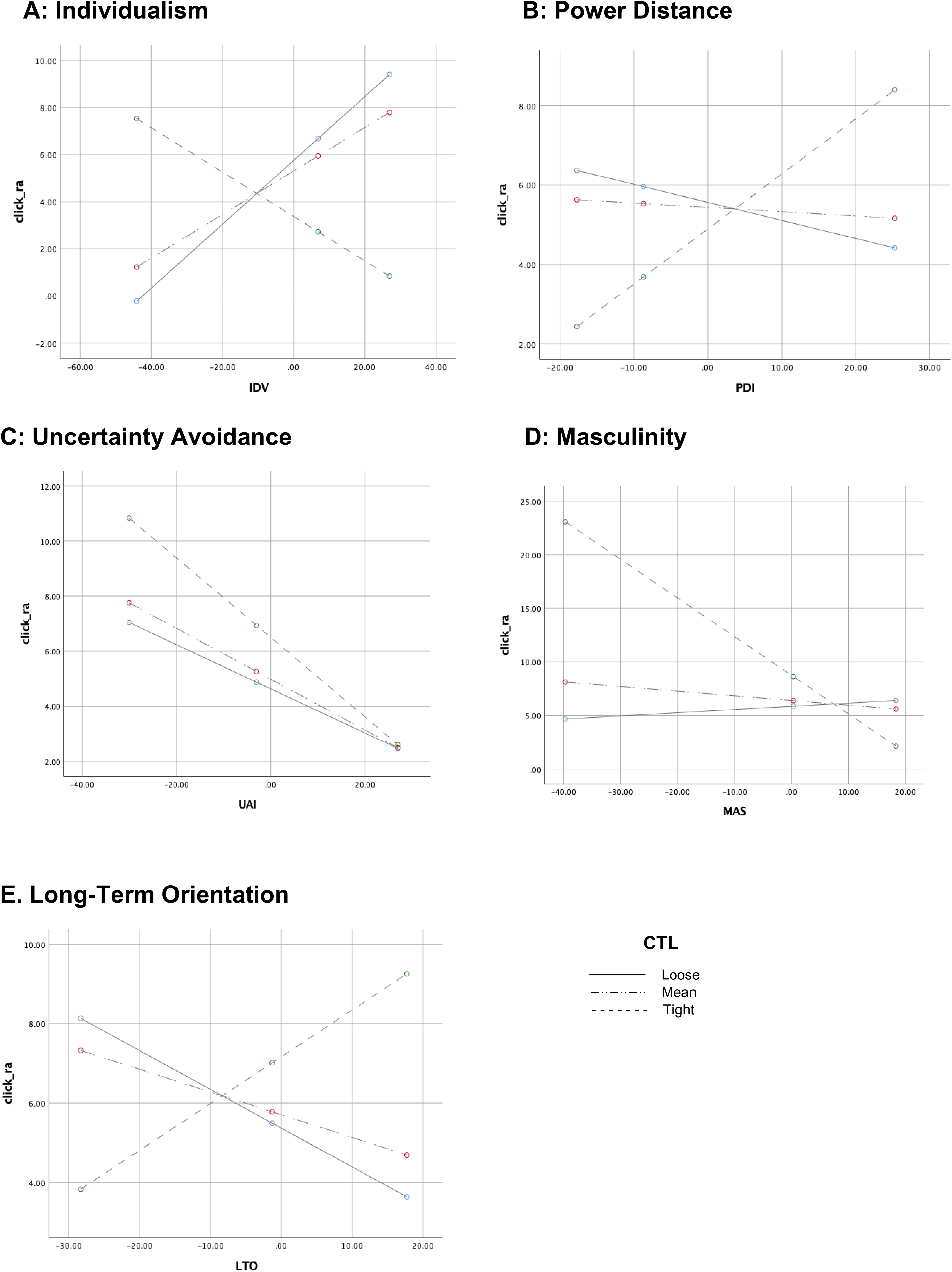
Click rate interactions: cultural value and tightness.
Figure 3 shows the results for clicking behavior. Panel A shows that click rates decrease in tight cultures as individualism increases but increase in loose cultures as individualism increases. Panel B indicates that click rates increase in tight cultures as power distance increases but slightly decrease in loose cultures as power distance increases. Panel C shows that click rates decrease in tight and loose cultures as uncertainty avoidance increases, but the decrease in click rate is greater in tight cultures than in loose cultures. Panel D suggests that click rates decrease in tight cultures as masculinity increases but slightly increase in loose cultures as masculinity increases. Finally, Panel E indicates that click rates increase in tight cultures as long-term orientation increases but decrease in loose cultures as long-term orientation increases. Figures 2 and 3 thus provide mixed support for H6. We summarize all the results in Table 5.
Summary Results of Direct and Moderation Tests.

The Effect of Control Variables
Model 1 in both tables includes only the control variables, and we ran it using ordinary least squares regression analysis. A few control variables were significantly related to consumer engagement. Videos posted on YouTube had a significantly lower click rate (β = −.92, p < .00) but a higher share rate (β=.09, p < .05) than videos posted in-page on news websites or retailer webpages. Furthermore, older consumers were significantly more likely to share (β = .19, p < .05) and click (β = .01, p < .01) videos. Videos about petroleum/chemical products were significantly less likely to be shared (β = −.05, p < .05) but were not significantly related to clicking engagement. Finally, tightness was significant and positively related to share rate (β = .13, p < .00) but not significantly related to click rate. These results suggest that generally in tighter cultures, consumers tend to engage more with online videos through sharing behavior but are no different in clicking behavior compared with looser cultures.
For Model 2, the control variable platform was significant and negatively related to click rate (β = −1.47, p < .00) but not related to the sharing behavior. The variable technology content was positive and significantly related to click rate (β = 2.98, p < .00), while the variable entertainment content was significant and positively related to share rate (β = 3.26, p < .00). Tightness was significant and negatively related to share rate (β = −.13, p < .00) and to click rate (β = −.07, p < .05). Females were significantly less likely to share videos (β = −5.78, p < .01) and click (β = 3.62, p < .01), while time spent online was significant and positively related to both click rate and share rate (β = 2.13, p < .00; β = 3.40, p < .00). Average age of population was significant and positively related to both clicking and sharing behavior (β = .45, p < .01; β = .72, p < .00), as was average income (β= .00, p < .00; β = .00, p < .00).
For Model 3, the control variable entertainment content was significant and positively related to share rate (β = 3.26, p < .00) but not related to click rate. The control variable platform was significant and negatively related to click rate (β = −1.43, p < .00) but not related to share rate, and the variable technology content was positive and significantly related to click rate (β = 2.98, p < .00) but not related to share rate. Women were significantly more likely to share videos (β = 2.52, p < .00) and click on content (β = 1.83, p < .05) than men. Average age of the population was significant and negatively related to share rate (β = −.33, p < .01) but not related to click rate.
In Model 4, we find that the control variable platform was negatively related to click rate (β = −1.47, p < .00) but not related to sharing behavior. The variable technology content was positive and significantly related to click rate (β = 2.98, p < .00), while entertainment content was positive and significantly related to sharing (β = 3.26, p < .00). Tightness was significant and positively related to share rate (β = .09, p < .01), as was average income (β = .00, p < .05); however, neither were significantly related to click rate. Women were significantly more likely to click on video links than men (β = 1.32, p < .01), but gender was not related to sharing. Time spent online had a significant negative relationship to share rate (β = −1.76, p < .00) but was not related to click rate.
For Model 5, our control variable platform was negative and significantly related to click rate (β = −1.47, p < .00) but not related to sharing behavior. Technology content was positive and significantly related to click rate (β = 2.98, p < .00), while the variable entertainment content was positive and significantly related to share rate (β = 3.26, p < .00). Time spent online and average income were both positive and significantly related to sharing (β = 1.31, p < .01; β = .00, p < .01) but not related to click rate.
Finally, in Model 6, our control variable entertainment content was significant and positively related to share rate (β = 3.26, p < .00), as was tightness (β = .11, p < .00), average age (β = .39, p < .05), and female gender (β = 1.39, p < .05). The variable technology content was positive and significantly related to click rate (β = 2.98, p < .00), as was female gender (β = 1.39, p < .01). The platform where videos are shown was negative and significantly related to clicking (β = −1.47, p < .00).
Additional Exploratory Analysis
Two additional issues could be important when examining these digital consumer engagement behaviors. First, while consumers might engage with online advertisements through clicking or sharing behavior, some might undertake both activities. It is possible that those who click on the video and gather more information about the brand, product, or service might also share the video with others. To test this idea, we undertook another set of regressions in which clicking behavior was an independent variable and sharing behavior was the dependent variable. This new analysis (see Table 6) appears to indicate that clicking behavior is significantly related to sharing behavior. Yet this relation does not change the direction or significance of any of the national cultural value variables or the moderation variables that were the focus of our study.
Moderating Regression of Share Rate with Clicking as an Independent Variable.

*p < .05.
**p < .01.
***p < .001.
The second issue that our study raises is the impact of advertising content on the relation between national culture and consumers’ engagement behavior. Previous research has suggested and found that consumers engage differently with different types of content (e.g., Akpinar and Berger 2017; Berger and Milkman 2012; Campbell et al. 2017). According to Weiger, Hammerschmidt, and Scholdra (2019), content can be informative, entertaining, or persuasive. Informative content is content that provides factual knowledge either about the brand and its products and services or other related subjects (Weiger, Hammerschmidt, and Scholdra 2019). Entertaining content is content that evokes arousal and positive emotions (Berger and Milkman 2012). Persuasive content is content that functions as advertising or a sales promotion (Weiger, Hammerschmidt, and Scholdra 2019).
To explore how content might influence clicking and sharing engagement behavior, we examined a random sample of the videos in our study. Because of language and legal restrictions, to conduct the exploratory study we randomly selected a sample of 120 videos from the United States and 120 videos from Germany, countries that differ greatly in terms of the cultural values of uncertainty avoidance, long-term orientation, and, to a lesser degree, individuality. This sample allows us to begin to look at how between-country cultural differences influence clicking and sharing engagement behavior when more affective video content is considered. Our two independent coders coded the videos according to three single items on a five-point scale (1 = “strongly disagree,” and 5 = “strongly agree”), which were adapted from prior literature (Cao, Zhang, and Seydel 2005; De Vries, Gensler, and Leeflang 2012; Weigel et al. 2019). Informativeness was coded using the item “this video is informative,” entertainment using the item “this video is entertaining,” and persuasiveness using the item “this video feels like a sales promotion.” Before coding, both coders received detailed training and coding instructions (Kolbe and Burnett 1991). Intercoder reliability was above .75 for all three coding dimensions (informativeness = .82, entertainment = .75, and persuasiveness = .85) (Berger and Milkman 2012; Campbell et al. 2017). Averaged scores for the videos formed the data set analyzed for the exploratory study.
Once coding was complete, we reran both sets of regression models (clicking and sharing engagement) using each of the five cultural variables as the independent variables and our new content variable as a moderator. The results of our regression analyses on sharing engagement behavior indicate that between-country cultural differences are consistent with our main analysis and that advertising content does not have a significant direct or moderating influence. For clicking engagement behavior, we found that informative content and the interaction between informative content and each of the cultural dimensions tended to be significant. However, the direct effect of each cultural dimension was not significant, nor were entertainment or persuasive content. Overall, these results indicate that online advertising content might have little impact on digital sharing behavior but that more informative online advertisements do influence the clicking engagement behavior of individuals in different ways in different countries, depending on the national culture values.
Discussion, Limitations, and Implications
An increasing number of consumers are engaging with brands and firms online (Harrigan et al. 2018), making digital consumer engagement an important strategic focus for firms. Consumer engagement activities are vital because they tend to lead to increased loyalty (e.g., Schouten, McAlexander, and Koenig 2007), greater trust and commitment to a brand (e.g., Chan and Li 2010), a stronger emotional bond with the brand (e.g., Brodie et al. 2013), and, therefore, better firm performance (Kumar et al. 2010; Ramani and Kumar 2008). Unlike past studies that focus more on eWOM engagement activities (e.g., Chu and Choi 2011; Lam, Lee, and Mizerski 2009; Lee and Choi 2019; Pezzuti and Leonhardt 2020; Tang 2017), in this article we developed and tested the idea that consumers in different countries would engage in different sharing and clicking behavior with online marketing materials due to between-country differences in national cultural values and within-country variations in cultural tightness. Understanding how cultural differences between and within countries affect digital consumer engagement is important, as it allows for a better determination of whether and how digital marketing strategies need to be modified to align with specific cultural beliefs as firms expand abroad.
As theorized, we found support for our idea that both between-country national cultural differences and within-country variations in cultural tightness play a role in determining the level and type of digital consumer engagement (sharing and clicking behavior) undertaken in each country. That said, we noted several deviations from what we had expected. We had theorized that individualism would be negatively related to sharing behavior, but instead found it was positively related to sharing. Furthermore, although we found cultural tightness played an important role in determining digital consumer engagement, it did not always work in the way we had proposed. Again, for individualism we found that in tight cultures, there was a weakening in both sharing (as theorized) and clicking (opposite theory) behavior. These unexpected results relating to individualism might be partly explained by consumer characteristics that drive digital behavior in a way that differs from more traditional offline behavior. Consumers with high individualism are traditionally believed to be interested mostly in themselves and act in this way, as our theory suggested. However, more recent research suggests that high individualism is related to extraversion (Lucas et al. 2000; McCrae and Terracciano 2005; Arpaci, Baloglu, and Kesici 2018) and that extraverts are more likely to engage in self-disclosure and exhibitionism (Wang and Stefanone 2013). This can result in frequent updating of social media sites (Marshall, Lefringhausen, and Ferencz 2015). Therefore, building on research that proposes a significant link between individualism, extraversion, and social media use (e.g., Arpaci, Baloglu, and Kesici 2018; Marshall, Lefringhausen, and Ferencz 2015; Seidman 2014), one could argue that high-individualism consumers will engage more in sharing behavior than lower-individualism consumers.
For long-term orientation, we also observed some discrepancies. We found that in tight cultures, an increase in both clicking (as theorized) and sharing (opposite theory) behavior occurred. Literature suggests that consumers with high levels of long-term orientation prefer personal experiences, being anonymous, and participating less actively in the community (Goodrich and De Mooij 2013). Yet, considering consumers with high levels of long-term orientation are also future focused (Chandler and Luch 2015), it could be argued that these individuals engage in sharing behavior, if this supports their goals for a specific future, or desired (relational) connections through sharing (Chandler and Luch 2015).
Another reason why some of our hypotheses might not have been supported could stem from the sample of countries we us ad. Because we had a limited number of countries in which videos and clicking/sharing behavior were available, we had fairly high correlations between several of our national cultural dimensions. For example, the correlation between individualism and long-term orientation was −.71; yet our theory suggests that high levels of individualism and long-term orientation are positively related to consumer clicking but negatively related to consumer sharing. These differences between theory and results could simply be a function of the countries in our sample. Studies looking at more countries show that cultural dimensions like individualism and long-term orientation are not correlated (e.g., Kim 2020; Steenkamp and Geyskens 2012). Therefore, it will take more research investigating these same clicking and sharing behaviors using samples from other countries to determine if our theory holds and the results we obtained were a function of our sample countries, or conversely, if consumers in these countries behave differently than current cultural and digital theories suggest when dealing with online advertising.
Despite these variations, our study makes important contributions to the international marketing and digital consumer engagement literature in two important ways. First, we look at two additional areas of digital consumer engagement: clicking and sharing. A plethora of literature examines eWOM (Fu, Ju, and Hsu 2015; Hennig-Thurau et al. 2004), including studies that investigate how country differences (Chu and Choi 2011; Lin and Kalwani 2018), national cultural differences (Pezzuti and Leonhardt 2020; Tang 2017), or individual cultural differences (Lam, Lee, and Mizerski 2009; Lee and Choi 2019) impact whether consumers undertake eWOM activities. To the best of our knowledge, however, few studies investigate how between-country differences in cultural attributes impact either clicking or sharing engagement activities. In this article, we develop and test the idea that between-country differences in cultural attributes impact consumer engagement (clicking and sharing) with online video advertisements. We show that different cultural attributes impact each of these engagement activities in different ways: some cultural attributes lead to more clicking behavior, while other cultural attributes lead to more sharing behavior, which means that firms must decide which engagement activities (clicking or sharing) they are aiming for consumers to undertake as they structure their international marketing strategy and adjust their marketing activities to align with the cultural dimensions of consumers in each country.
Second, we add new insights about how cultural variations within countries might change the digital engagement activities consumers undertake. We extend international marketing research by theorizing and finding that within a society (country), not all consumers are the same; in some countries, consumers share a common culture, while in others, cultural diversity persists. We could find no research in the area of digital consumer engagement looking at cultural tightness and how within-country variations in cultural adherence lead to different digital engagement behaviors. Yet if consumers in a country do not share the same cultural values, then adjusting a firm’s international marketing activities to meet country-specific cultural norms might not lead to the outcome that the firm wants or expects. Instead, we theorized and found that variations in the adherence to cultural attributes within a country have a significant moderating impact on digital consumer engagement behaviors, which therefore would require adjustments to the firm’s international marketing activities to achieve success.
Our additional exploratory analyses also provided some interesting insights that require future examination. We found that consumers who undertook clicking behavior and obtained more information about the brand or product in the video tended to share the video more often than consumers who did not also click. It is possible that obtaining additional information about a brand, product, or service strengthens one’s attachment to that brand, product, or service and leads to a desire to share this new information with others. Future research efforts could explore this issue further to determine whether a cause-effect relationship exists and determine the drivers behind such engagement activities. In addition, when we examined more affective advertising content, we found that only the level of informativeness had an impact on digital engagement activity and that only on clicking behavior. It seems that advertising videos that are more informative might lead to increased clicking engagement, which, combined with our other findings, might also lead to additional sharing. Research could explore this issue using longitudinal or experimental data to determine whether this chain of activities does exist, how cultural differences influence these activities, and how firms could use this information for making better international digital marketing decisions.
This study suffers from several limitations that provide opportunities for future research. First, our unique data set of real-life consumer engagement behavior only encompassed consumers from eight countries. Although these countries include Asia, the United States, and Europe and showed significant variance in cultural values and tightness, the results might not be generalizable to other countries or sets of consumers. To provide a more comprehensive picture of the impact of cultural values and tightness on digital consumer engagement, future research should expand the number of countries in which data are collected.
Second, industry data provide several advantages over surveys or experiments, including the ability to capture actual behaviors of real consumers under real-life conditions. However, a potential limitation of using industry data is that the researcher is limited to the data collected and provided by the source firm and is dependent on the measures used by that organization. This problem is common among researchers who rely on publicly available data provided by firms (e.g., annual reports, 10-K filings). Due to the characteristics of our company’s business model, as well as country-specific data privacy restrictions (e.g., General Data Privacy Regulations, the UK Data Protection Act), we do not have access to data on individual-level consumer characteristics. To help overcome this issue, we added various home country consumer-level controls (like average age and time online). Although these controls help us deal with some data limitations, future research could go further by working directly with industry players to design data capture instruments that gather specific data needed for testing new ideas.
Third, not all product types are available in every country. For example, we only had videos for a limited number of product categories in countries like Hong Kong and Norway. To deal with this issue, we control for each product category in our regression models. Because we were interested in how cultural dimensions influence online advertising clicking and sharing behavior, we were not concerned about what product types were being examined. However, we did provide control variables for these different product types to be sure that our results were not driven by differences between products. Future research could investigate how or if national cultural dimensions influence behavior toward different product types. In this case, it would be important to have examples of each product type in all the countries examined.
Fourth, while our regression models control for many factors, including product types, length of videos, platform on which the video appears, and country-level variables like gender mix, average age, average income, and average time spent online, we could not control for unobserved country level factors. Including such additional controls would help eliminate other alternative explanations for our results but would require a data set with a much larger number of countries. Future research should aim to find such data sets, which could then be used to expand on our study.
Fifth, as noted previously our data set contains actual digital engagement behavior, but we do not have any information about the individual consumers (e.g., demographic information, online media usage). As recent news reports about digital data capture at the individual level indicate (Rainie 2018), some controversy exists about obtaining and using such data. To reduce the impact of these missing data, we included several country-level consumer demographic measures. An alternative approach to capture such data would be through controlled experiments; however, these methods have other drawbacks and introduce confounds into the research. Despite these potential issues, future research might design a multicountry, multi-advertisement experiment to examine how between- and within-country cultural differences and consumer characteristics, such as tech savviness and education, impact digital consumer engagement activities.
Sixth, we tested our hypotheses at the country level using Hofstede’s (1980b) national culture framework (in line with Beugelsdijk, Kostova, and Roth 2017; Beugelsdijk et al. 2018; Kim 2020; Kübler et al. 2018; Steenkamp 2019). This provided us with insights into how between-country cultural values impact consumer engagement behavior. Yet there is growing evidence that consumers in any one country are not all the same (Schwartz 1994, 1999; Triandis 1994) and thus may not share the same cultural values (Bond 2002; Schwartz 1999). We capture this variance of within-country cultural values using the tightness/looseness framework developed by Gelfand et al. (2011) and Uz (2015). This new instrument captures the tolerance of individuals within one country toward divergent behavior from national level cultural norms. While using these two measures of culture (Hofstede and tightness) provides valuable insights, future research could fruitfully investigate similar engagement issues at the individual level rather than the national level. In that case, they should capture Hofstede’s cultural values at the individual level to be able to establish within-country variation in consumer engagement behavior. Although doing so would limit the study of between-country differences, it does facilitate a better understanding of individual consumer behavior.
In addition, we explored the impact of each national cultural dimension separately. However, every country is a mix of these five cultural characteristics. Given the nature of our data, we could not explore how these different cultural values interact with each other to drive digital consumer behavior. Future research can add to our understanding of digital consumer engagement by developing and testing theory about how these cultural values impact each other and overall digital consumer engagement in a particular country.
Finally, some research suggests that the content of online ads impacts digital consumer engagement (e.g., Akpinar and Berger 2017; Berger and Milkman 2012). In our study, we controlled for ad content by including 16 different product categories but found most were not significantly related to digital sharing or clicking engagement behavior. We also ran an exploratory analysis on samples taken from two countries looking at three different affective content types: informativeness, entertainment, and persuasiveness (Weigel et al., 2019). Our results were mixed. Future research could explore this issue in more detail by expanding the number of countries in which the engagement activities are examined, looking at different content attributes, or performing experiments in which the same set of ads, with other additional content components, are shown to consumers in multiple countries in an attempt to understand how these content issues influence between- and within-country cultural differences and digital consumer engagement.
In summary, this study provides theoretical and empirical support for the notion that national differences between countries in cultural values and within countries in cultural tightness significantly impact digital engagement behavior. It appears that firms expanding internationally in the digital ecosystem may need to make trade-offs in clicking and sharing behavior because such behaviors are supported by opposite national cultural characteristics. In addition, we suggest and find that variations within countries for the acceptance of each national cultural value (tightness) also influence digital consumer engagement. Although more work is needed in the area, our study makes an important contribution by highlighting these between- and within-country national cultural differences and noting the variation in digital engagement behavior that such differences bring about. Firms can use these insights to start to create more effective online marketing strategies when operating in international markets, which would allow for the development of better digital consumer engagement strategies and consequently help firms obtain superior performance.
Footnotes
Associate Editor
Amir Grinstein
Declaration of Conflicting Interests
The author(s) declared no potential conflicts of interest with respect to the research, authorship, and/or publication of this article.
Funding
The author(s) received no financial support for the research, authorship, and/or publication of this article.