




Abstract
Despite considerable research on export performance, relatively little scholarly attention has been devoted to incorporating managers’ perspectives into operationalizing this concept. This study proposes a new approach for measuring small and medium-sized enterprises’ export performance in the presence of multiple, potentially conflicting, goals while accounting for different approaches to assessing export performance. Adopting a contingency approach, the authors develop two customized measures of perceived export performance: the individualized perceived export performance framework and the simplified model. They demonstrate the application of both measures with a sample of 78 exporting small and medium enterprises in New Zealand and compare the outcomes. The proposed frameworks are intended to measure export performance considering managers’ specific priorities and by incorporating manager- and firm-specific differences in the types and importance of goals, indicators, and benchmarks. This article extends the understanding of export performance by proposing a more nuanced and holistic measurement approach that is tailored to individual firms and reflects firm-specific idiosyncrasies.
Keywords
More than four decades ago, Churchill (1979, p. 67) rightly noted that “researchers should have good reasons for proposing additional new measures given many are available.” This caution is particularly relevant for established topics such as export performance. Nevertheless, a careful review of the literature reveals that important limitations remain in the conceptualization and measurement of export performance. As Sousa, Martínez-López, and Coelho (2008, p. 2) state, “The literature on export performance is probably one of the most widely researched and least understood areas of international marketing.” Reflecting on this, we aim to provide a more nuanced understanding of subjective aspects of export performance assessment among managers of small and medium-sized enterprises (SMEs) by developing a holistic measurement model that reflects firm-specific individuality by explicitly accounting for managerial priorities in the evaluation of the firm’s performance.
Despite promising developments in the literature (e.g., Diamantopoulos and Kakkos 2007; Lages, Lages, and Lages 2005; Lages and Lages 2004), it seems that academic research regarding the measurement of export performance has not kept pace with managers’ evolving needs (Carneiro et al. 2016). One key limitation is that the literature has not really addressed the fundamental role of firm-specific idiosyncrasies in export performance evaluation. Managers’ perceptions regarding performance create the basis for formulating important strategic decisions (Bourgeois 1980; Morgan, Kaleka, and Katsikeas 2004). However, previous studies have paid insufficient attention to whether managers’ perspectives have been incorporated into operationalizations of export performance. For instance, some of the widely used measures of export performance, including EXPERF (Zou, Taylor, and Osland 1998) and STEP (Lages and Lages, 2004), do not explicitly account for variation in managers’ priorities and perceptions with respect to performance assessment. Reviewing the export performance literature, Katsikeas, Leonidou, and Morgan (2000, p. 505) noted “a tendency to employ measures used by other researchers regardless of their applicability to the specific research design.” More recently, Carneiro et al. (2016, p. 410) argued that most models of export performance have been developed from the (informed) minds of academicians, and…they have not, for the most part, been developed with the contributions of the practitioners in the beginning stages.
There is ample evidence that firms vary substantially, in terms of their exporting goals and the criteria and benchmarks that they employ for evaluating export performance (Diamantopoulos and Kakkos 2007; Madsen 1998). Reijonen and Komppula (2007) suggested that goals should shape the measures of success, on the basis that goals drive managerial attention and decision making and can influence individuals’ assessment of performance. As Beaver (2002, p. 98) maintained, “Perhaps the best and most accurate way to judge success is to ask whether the particular goals of the enterprise have been achieved.” In addition to exporting goals, performance indicators and benchmarks can also vary from one firm to another. Diamantopoulos and Kakkos (2007) argued that export performance needs to be measured with regard to differentially weighted goals and based on the specific benchmarks that managers consider in their export operations. Incorporating managerial perspective is particularly important when considering SMEs, which are typically characterized by highly centralized and individualized leadership (Sadeghi, Rose, and Chetty 2018).
An additional challenge in measuring export performance arises from its inherently paradoxical nature. Often, there are potential incompatibilities and trade-offs among different exporting goals, and an improvement in one indicator may come at the cost of another. For instance, if a firm’s strategy for a particular market is to gain a foothold and increase market share, strong financial results may not be realized immediately. This issue is especially salient for SMEs, which operate under stronger resource constraints and are subject to more buffeting by external forces relative to large firms; this creates the potential for more frequent reassessment of realistic performance goals. What SME managers, especially in young firms, view as satisfactory performance may not appear to be very strong by standardized measures.
Against this background, the purpose of this study is to develop a framework, using a contingency approach, for SME export performance measurement, addressing the multifaceted nature of the phenomenon and incorporating managers’ perceptions and priorities. Under the assumption that export performance is idiosyncratic to the firm, its measurement needs to be dictated by the firm’s specific strategic orientations and the rationales adopted by its managers. To reflect these differences in managerial judgment, the proposed framework employs a collection of criteria, indicators, and benchmarks pertaining to export goals while accounting for variation in the value that managers attach to these aspects. To operationalize this framework, we introduce and elaborate on a novel methodology—fuzzy analytic hierarchy process (FAHP)—which is a powerful and flexible multicriteria decision-making tool that is useful for handling complex problems. The FAHP allows us to explicitly take into account the variation in managerial preferences with respect to the assessment of export performance. The use of fuzzy logic in conjunction with the analytic hierarchy process (AHP) facilitates the capture of the uncertainties and imprecision associated with managers’ subjective performance assessment.
This study contributes to the conceptualization, operationalization, and discussion of export performance by proposing a comprehensive and contextualized means of measuring perceived export performance. Building on previous studies (e.g., Diamantopoulos and Kakkos 2007; Lages, Lages, and Lages 2005; Lages and Lages 2004), and adopting a contingency approach, we develop and test two approaches for measuring export performance: the individualized perceived export performance (IPEP) framework and a simplified model. Both measurement approaches provide integrative, multidimensional conceptualizations of perceptual export performance, suited for different purposes. The more complex IPEP framework contributes to the export performance measurement literature by providing a systematic approach to (1) making sense of multiple, potentially conflicting, perspectives associated with the assessment of export performance and enhancing the conceptual understanding of this complex phenomenon; (2) breaking export performance into finer elements (including different goals, criteria, benchmarks, and time frames) using a hierarchical structure; (3) eliciting managers’ judgments regarding the relative importance of these elements while accounting for potential trade-offs and complementarities; (4) accounting for the subjectivity of judgments through the use of fuzzy logic; and (5) reaching a synthesized assessment by integrating variably weighted components related to different aspects of export performance, using a systematic approach to calculating a representation of perceived performance. The IPEP framework provides a valuable managerial tool, but it is overly complex for large-scale data collection; the streamlined simplified model aims to capture the essence of the IPEP in a form that is suitable for use in empirical research. In this way, our research aligns with calls in the literature for acknowledging and accounting for contextual nuances when investigating export performance (e.g., Chen, Sousa, and He 2016; Diamantopoulos and Kakkos 2007; Katsikeas, Leonidou, and Morgan 2000; Sousa 2004).
Reliable and valid measurement is critical to the development of usable research in any field (DeVellis 2016). The proposed approach is intended to facilitate the alignment of export performance measurement with firm-specific business strategies, by providing insight into the question of how SME managers perceive and evaluate their firms’ export performance. Our approach is consistent with the recommendation of Hill and McGowan (1999, p. 9) that, when considering small businesses, “[the] researcher must represent or reconstruct the world as seen by others.” This is an important issue for studying the behavior of exporting firms, as the conceptualization of export performance determines the relevance of both research questions posed and the comparability of findings. Closing the gap between managerial perceptions of export performance and academic measurement of this phenomenon is critical for establishing theory-driven knowledge and advancing our understanding of determinants and consequences of exporting.
Measuring Export Performance
Despite a substantial number of studies in this area, there is no single widely accepted definition for export performance (Chen, Sousa, and He 2016; Lages and Lages 2004; Sousa 2004). In this study, inspired by the definition of “subjective entrepreneurial success” provided by Wach, Stephan, and Gorgievski (2016), we define perceived export performance as an individual’s understanding of the extent to which a firm’s specific financial and nonfinancial goals are achieved in export markets, based on the criteria and benchmarks that are of importance to the manager.
This definition provides a suitable point of departure for our consideration of export performance measurement for three reasons. First, it recognizes the role and nature of firm-specific idiosyncrasies in assessing export performance and underscores the importance of considering the goals, criteria, and benchmarks that are valued by managers. Second, by describing performance as the proximity between intended and attained exporting goals, this definition takes the role of export goals into account in an explicit manner, allowing us to go beyond the objective interpretation of outcomes and consider subjective evaluation and satisfaction with outcomes. Third, this definition accounts for both financial and nonfinancial aspects of export performance.
Some literature emphasizes that the perception of success is subject to managerial interpretation (Carneiro et al. 2016; Sadeghi 2018). Madsen and Moen (2018) contend that managers’ overall satisfaction with exporting encapsulates all of the factors affecting firms’ operations. Therefore, the concept of managerial satisfaction is fundamentally important in capturing an evaluative judgment of export performance. We define managerial satisfaction as the outcome of the manager’s comparison between the firm’s actual exporting accomplishments and a set of prior expectations and goals.
Despite its importance, the notion of satisfaction has not been fully investigated in export performance research (see Diamantopoulos and Kakkos 2007; Katsikeas, Leonidou, and Morgan 2000). With some notable exceptions (e.g., Diamantopoulos and Kakkos 2007; Sadeghi, Rose, and Chetty 2018; Stoian, Rialp, and Rialp 2011), even studies that have considered satisfaction have tended not to operationalize it relative to specific export goals (e.g., sales, profit market share) but rather considered it at the broad level of “overall satisfaction” with export performance (e.g., Cavusgil and Zou 1994; Zou, Taylor, and Osland 1998). In addition, researchers have seldom provided details about the benchmark or time frame under consideration (Diamantopoulos and Kakkos 2007; Katsikeas, Leonidou, and Morgan 2000). This approach has been criticized on the basis that the question is overly broad, and the captured perception of performance can be formed by different implicit goals, criteria, and benchmarks considered by managers when indicating their satisfaction levels. The ensuing lack of consistency is problematic for comparing export performance across firms (Diamantopoulos and Kakkos 2007; Madsen 1998; Sadeghi, Rose, and Chetty 2018).
One of the most comprehensive measures of subjective export performance is the assessed export performance (AEP) framework developed by Diamantopoulos and Kakkos (2007). The AEP offers a composite measure of export performance based on managers’ perceived satisfaction as well as the importance of different export objectives (i.e., sales, profit, and new product introduction) with regard to two frames of reference (i.e., own plan vs. competition). Still, the AEP framework has four key limitations: (1) the model considers a limited number of export objectives, (2) it does not incorporate a variety of indicators for measuring these goals and thus does not capture the differing export performance criteria that are used by managers, (3) the conventional AHP approach used by Diamantopoulos and Kakkos (2007) has been criticized for failing to account for the inherent uncertainties and impreciseness associated with subjective judgments (see Kahraman, Onar, and Oztaysi 2015), and (4) the role of different time frames in assessing export performance is not reflected in the model. Although the AEP framework acknowledges the importance of timing in the assessment of export performance, time is placed at the lowest level of the performance assessment hierarchy, and only the relative emphasis that managers place on short- versus long-term perspectives is captured. Our premise is that this does not do full justice to the importance of time, especially for SMEs that are often subject to rapidly changing strategies. Time is a defining contextual factor in export performance assessment, and the strategic orientations and priorities of managers are unlikely to remain constant across different time frames. In this study, we extend the work of Diamantopoulos and Kakkos (2007) by proposing the IPEP framework that addresses the aforementioned limitations.
Consistent with both the extant literature (Hult et al. 2008; Katsikeas, Leonidou, and Morgan 2000) and insights gleaned from interviews conducted as part of a larger research project, 1 we posit that measuring export performance requires decisions about four sets of perspectives: level of analysis, type of performance, benchmarks employed, and mode of assessment. Next, we discuss each of these aspects, including some brief insights gained from the interviews. 2
Level of Analysis
Export performance can be measured on the basis of various organizational levels such as firm, country, market, export venture portfolio, and product line (see Diamantopoulos and Kakkos 2007; Morgan, Kaleka, and Katsikeas 2004). Despite these different levels, reviews of the literature show that studies have tended to use the firm as their level of analysis (see Hult et al. 2008; Katsikeas, Leonidou, and Morgan 2000; Sousa 2004). Some researchers argue that although considering other levels may seem reasonable for larger organizations, the firm level is particularly relevant for SMEs, on the basis that their smaller size of operations means that other sublevels may not provide meaningful insight into the firm’s performance (Matthyssens and Pauwels 1996; Oliveira and Cadogan 2018). For example, Styles (1998, p. 27) argues that SMEs tend to use an aggregated evaluation at the firm level because “smaller firms are less able to isolate the performance of a specific export venture from total export performance, or even total firm performance.” In contrast to this dominant view, some studies advocate for using more fine-grained levels of analysis such as export venture (Matthyssens and Pauwels 1996; Morgan, Kaleka, and Katsikeas 2004) or product-market export venture (Cavusgil and Zou 1994).
All 20 of the SME managers that we interviewed reported evaluating aggregated export performance at the firm level while also using finer levels of disaggregation, such as markets, for formulating action plans. In this study, following the prevailing approach in the literature, we adopt the firm as the level of analysis. However, the procedures that we introduce can equally be applied to measuring export performance at other levels of analysis.
Type of Performance
Export performance measures can be categorized into two main types: financial and nonfinancial (Katsikeas, Leonidou, and Morgan 2000; Sousa 2004). Financial export performance is represented by indicators such as sales-, profit-, and market share–related measures, whereas nonfinancial export performance is reflected by strategic measures such as the contribution of exporting to the reputation or positioning of the firm (Hult et al. 2008; Katsikeas, Leonidou, and Morgan 2000; Sousa 2004). Although there is evidence that firms generally pursue both economic and strategic goals in their foreign business, most extant studies focus primarily on financial goals, rather than the strategic aspect (Katsikeas, Leonidou, and Morgan 2000; Madsen 1998; Sadeghi, Rose, and Chetty 2018). The lack of focus on nonfinancial measures is especially striking in research on small firms, considering the evidence that SME owners often set nonfinancial goals for their businesses (e.g., Gray 2002; Madsen and Moen 2018; Wach, Stephan, and Gorgievski 2016; Wach et al. 2018). In our interviews, all of the SME managers reported adopting a combination of financial and nonfinancial measures for monitoring and assessing export performance. Furthermore, consistent with previous findings (e.g., DeTienne, Shepherd, and De Castro 2008), we found that SME managers may persist with financial underperformance as long as they are satisfied with the attainment of specific nonfinancial goals. As one interviewee explained, We are prepared to lose some money in the short run, and we see it as an investment, not as a financial loss. What we cannot afford is losing our reputation.
Benchmark and Time Frame
Consistent with previous studies (Ambler and Kokkinaki 1997; Carneiro et al. 2016), our discussions with SME managers revealed that they employ references when evaluating export performance, as it is more convenient for them to develop a relative assessment about their firm’s performance, rather than an absolute judgment. Capturing export performance involves two categories of references: benchmarks and time frames (Madsen 1998). According to Katsikeas, Leonidou, and Morgan (2000), benchmarks and time frames are implicit or explicit referral sources and temporal horizons, respectively, against which performance is assessed. In this study, we incorporate three benchmarks (the firm’s own plans, competitors’ performance, and the performance of the firm’s domestic operations) and two time frames (short term and long term). From our interviews, we observed that managers’ perceptions regarding achieved export performance differ considerably with the choice of benchmarks and time frame. In some cases, export performance was perceived positively against one benchmark (or time frame) and negatively against another; this demonstrates the importance of clarity with respect to frame of reference.
In this research, we ask respondents to indicate the relative importance of each of the three benchmarks (plans, competitors, and domestic performance) in assessing each criterion. This approach provides us with the ability to develop a weighted benchmark that can later be used in aggregating the results into an overall measure of satisfaction with performance. As for the time frame, we distinguish between short-term and long-term performance. Nearly all the SME managers interviewed reported using both short- and long-term export performance assessments, although their relative priorities varied in different time frames. Therefore, we consider short- and long-term export performance outcomes separately.
Mode of Assessment: Objective Versus Subjective Measures of Export Performance
The literature has typically employed two different modes of assessment for capturing export performance: subjective and objective (Katsikeas, Leonidou, and Morgan 2000). Objective or “hard” indicators measure export performance based on reported financial metrics. In contrast, subjective indicators are judgmental and reflect the respondent’s perceptions regarding performance, both financial and nonfinancial (Dess and Beard 1984). Although objective measures may seem to be more reliable for evaluating export performance, previous research has shown that there are limitations associated with utilizing objective indicators, especially for SMEs, raising questions about their validity (e.g., Day and Wensley 1988; Lages, Lages, and Lages 2005). Next, we discuss some of these limitations.
First, obtaining financial data can be extremely fraught, especially when dealing with smaller firms; secondary information on firms’ export activities is seldom publicly available, and many privately owned firms are reluctant to disclose financial information to researchers (Lages, Lages, and Lages 2005; Morgan, Kaleka, and Katsikeas 2004). Second, even for publicly listed firms, specific information related to export activities is not typically provided in financial reports (Katsikeas, Leonidou, and Morgan 2000; Lages, Lages, and Lages 2005; Madsen 1998). Third, performance evaluation is highly idiosyncratic, and firms often view export performance differently from one another. A financial outcome that is perceived as a success by one company can be a failure for another, or even for the same company under different conditions (Brouthers et al. 2009; Diamantopoulos and Kakkos 2007). Fourth, the use of different accounting standards complicates the comparison of outcomes (Brouthers et al. 2009; Hult et al. 2008; Lages, Lages, and Lages 2005).
Subjective measures of export performance seem to be particularly relevant for SMEs. There is evidence that SME managers tend to rely heavily on perceptions of export performance when making decisions and formulating actions (e.g., Carneiro et al. 2016; Madsen and Moen 2018; Sadeghi, Rose, and Chetty 2018). In addition, subjective measures are viewed as strong indicators of the extent to which the firm has exploited the available export opportunities and been successful in its chosen export strategy (Cavusgil and Zou 1994; Lages and Lages 2004). Finally, several studies have found that subjective and objective measures are highly correlated (e.g., Dess and Robinson 1984; Venkatraman and Ramanujam 1987).
The SME managers with whom we spoke were cognizant of the limitations of objective measures and showed a clear inclination toward evaluating export performance based on their own perceptions and interpretations. As one manager commented, You cannot only rely on accounting measures for assessing the firm’s outcomes. If not used properly, they can be misleading…. These numbers are only meaningful when they are seen in the unique context of the firm.
A Contingency Approach to Perceived Export Performance Measurement
This study is based on a contingency approach, consistent with the argument by Paul, Parthasarathy, and Gupta (2017, p. 337) that “exporting and SME internationalization are outcomes of their strategic choices made in contextual settings.” Following Cavusgil and Zou (1994), exporting can be viewed as a strategic response to the interplay of internal and external forces. This implies that expectations from exporting are likely to vary among firms that are dealing with different internal and external conditions and, therefore, different firms will view some goals as being more important than others (Diamantopoulos and Kakkos 2007; Gerschewski and Xiao 2015).
The contingency approach provides a suitable basis for contextualizing export performance. According to this perspective, the most appropriate measure of performance for each firm is the one that best fits the particular contingencies of that firm (Jääskeläinen et al. 2012; Rejc 2004). The use of the contingency approach for measuring export performance is in line with the conclusion of Katsikeas, Leonidou, and Morgan (2000, p. 505) that the choice of export performance measurement approach depends on contextual factors…. This implies the need for the adoption of a contingency approach in the selection of individual export performance measures to address the idiosyncrasies of the situation at hand, rather than taking a dogmatic view.
On this basis, we propose that, to capture the full essence of manager-perceived export performance, researchers need to address four questions that are specific to each firm:
What are the goals against which the manager evaluates export performance, and what is the relative importance of each of these goals?
What are the indicators through which the manager evaluates the attainment of each exporting goal, and what is the relative importance of each of these indicators?
What are the benchmarks against which the manager evaluates export performance, and what is the relative importance of each benchmark for assessing each indicator?
To what extent is the manager satisfied with the actual attained outcomes, based on each indicator and each benchmark?
The first three aspects pertain to what export performance means to an individual; they capture the manager’s perceptual patterns based on the firm’s differentially weighted goals and the weighted criteria and benchmarks that the manager employs to evaluate performance. The last question concerns the degree of satisfaction resulting from the achieved outcome.
It is worth mentioning that the level of satisfaction, per se, does not fully capture perceived export performance, as it does not necessarily reflect the manager’s strategic orientation in individual exporting markets. Satisfaction based on achieving an unimportant goal may not imply success. By the same token, dissatisfaction with underperforming relative to an unimportant goal may not be an indicator of failure. Therefore, it is important to incorporate the notion of “relative importance” to avoid over- or underestimation of export performance (Diamantopoulos and Kakkos 2007).
Export performance is inherently a complex and multilevel phenomenon (Oliveira and Cadogan 2018). The numerous combinations of goals, criteria, and benchmarks, each with varying importance, reflect the many alternative ways in which managers may evaluate export performance. This heterogeneity poses a methodological challenge for measurement. In this study, we propose a multicriteria decision-making (MCDM) method to address the aforementioned four aspects in measuring manager-perceived export performance and to integrate these elements systematically.
Method
Complex and multifaceted problems with multiple (potentially conflicting) influences and goals require decision support systems, which can be developed through MCDM techniques (Kahraman, Onar, and Oztaysi 2015; Sadeghi 2018). In this study, we employ a fuzzy extension of AHP, a widely utilized MCDM approach, to capture the judgments of managers and assess the relative emphases that they place on various aspects of export performance.
The Analytic Hierarchy Process (AHP)
The AHP was developed by Saaty (1980) as a tool for prioritizing alternatives in the presence of multiple, and potentially conflicting, criteria. In complex problems, decision makers cannot intuitively assess and synthesize the multiple aspects that are involved (Forman and Gass 2001; Sadeghi 2018). The AHP can help the decision maker account for multiple constraints and find a way to make rational compromises. This approach facilitates the finding of a solution that addresses the decision maker’s specific goals and priorities and is consistent with their understanding of the problem. The key is that importance weights are not assigned arbitrarily; rather, the priorities are derived from the decision maker’s judgments. A key advantage of AHP lies in its ability to incorporate subjective and intangible criteria that, while challenging to measure, are often critically important aspects of decision making. As noted by Dyer and Forman (1991, p. 75), “AHP allows decision makers to set priorities and make choices on the basis of their objectives and knowledge and experiences in a way that is consistent with their intuitive thought process.”
Analysis using AHP is based on three key principles: decomposition, comparative judgment, and synthesis of priorities (Saaty 1980). In the decomposition stage, the problem is modeled as a hierarchy of goals, criteria, and possible alternatives, similar to a decision tree. After decomposition of the problem and establishment of the hierarchy, the relative importance of each of the elements in each level of the hierarchy (the “local weight”) is assessed. In this comparative judgment stage, decision makers are asked to assess the relative importance of the elements at each level, through pairwise comparisons; these are “local priorities.” In the third stage, the local priorities are synthesized to generate the global or composite index.
The Fuzzy Analytic Hierarchy Process (FAHP)
Assessing relative importance through pairwise comparison involves a considerable amount of subjective judgment. As noted by Chen et al. (2011, p. 266), “The decision maker may be subjective and uncertain about the level of preference due to incomplete information or knowledge, inherent complexity and uncertainty within the decision environment.” The conventional AHP approach has been criticized for failing to take into account some of the uncertainties that are inherent in many real-world decisions (Kahraman, Onar, and Oztaysi 2015). In conventional AHP, respondents are asked to assess the relative importance of pairs of elements at the same level of the decision-making hierarchy using a nine-point rating scale. Despite the benefits of ease of use and simplicity, the discrete values used for the pairwise comparisons may not fully reflect the imprecision associated with human judgment (Mardani, Jusoh, and Zavadskas 2015). In response, a “fuzzy” extension of AHP has been suggested (e.g., Buckley 1985; Chang 1996). Zadeh (1965) introduced fuzzy set theory for modeling uncertainty in decision making. Rather than employing rigid values, fuzzy set theory employs assessment based on linguistic terms, which can then be quantified according to fuzzy logic.
Fuzzy AHP (FAHP) deals with uncertainties in evaluation by asking decision makers to express their judgments using linguistic terms, such as “weakly more important” or “strongly more important.” It converts these linguistic data into “fuzzy numbers” and uses them to derive the respondent’s relative weights for various decision criteria. Several FAHP methods have been proposed; for a review, see Kahraman, Onar, and Oztaysi (2015). In this article, we adopt the extent analysis method proposed by Chang (1996), a commonly used approach that has been applied successfully in many fields (Kubler et al. 2016; Larimian, Zarabadi, and Sadeghi 2013; Sadeghi 2018). Triangular fuzzy numbers (TFNs) are used to represent the linguistically expressed pairwise comparisons (for TFN definitions and analytical details, see the Web Appendix). While FAHP has been applied to problems such as supplier choice, project selection, and market segmentation (for reviews, see Mardani, Jusoh, and Zavadskas [2015] and Kahraman, Onar, and Oztaysi [2015]), this research represents, to the best of our knowledge, the first attempt to apply the method to the assessment of export performance.
Proposed FAHP Model: The IPEP Framework
This article proposes an IPEP framework that allows for the consideration of interfirm differences in export performance assessment. In this section, we explain the analytical procedure of measuring export performance using the IPEP framework and demonstrate its use with data collected from an exporting firm in New Zealand. This sample case is a seafood producer and exporter that was established in 2009 and started exporting from 2010. It has 55 employees and is currently exporting to eight foreign markets.
The IPEP approach is comprised of six distinct, but interrelated, steps, as shown in Figure 1. In the first two steps, we represent the managerial perception of export performance using a hierarchical framework. The coarsest level addresses the main exporting goals: financial and nonfinancial. The next level includes three financial subgoals (sales, profit, and market share) as well as one nonfinancial subgoal (strategic). Each of the four subgoals has associated indicators for assessing the firm’s performance (e.g., export sales ratio, export sales growth, and export sales volume, under the subgoal of sales), and three benchmarks (the firm’s own plan, competitors, and domestic performance) are associated with each indicator. Figure 2 presents the full hierarchical framework.
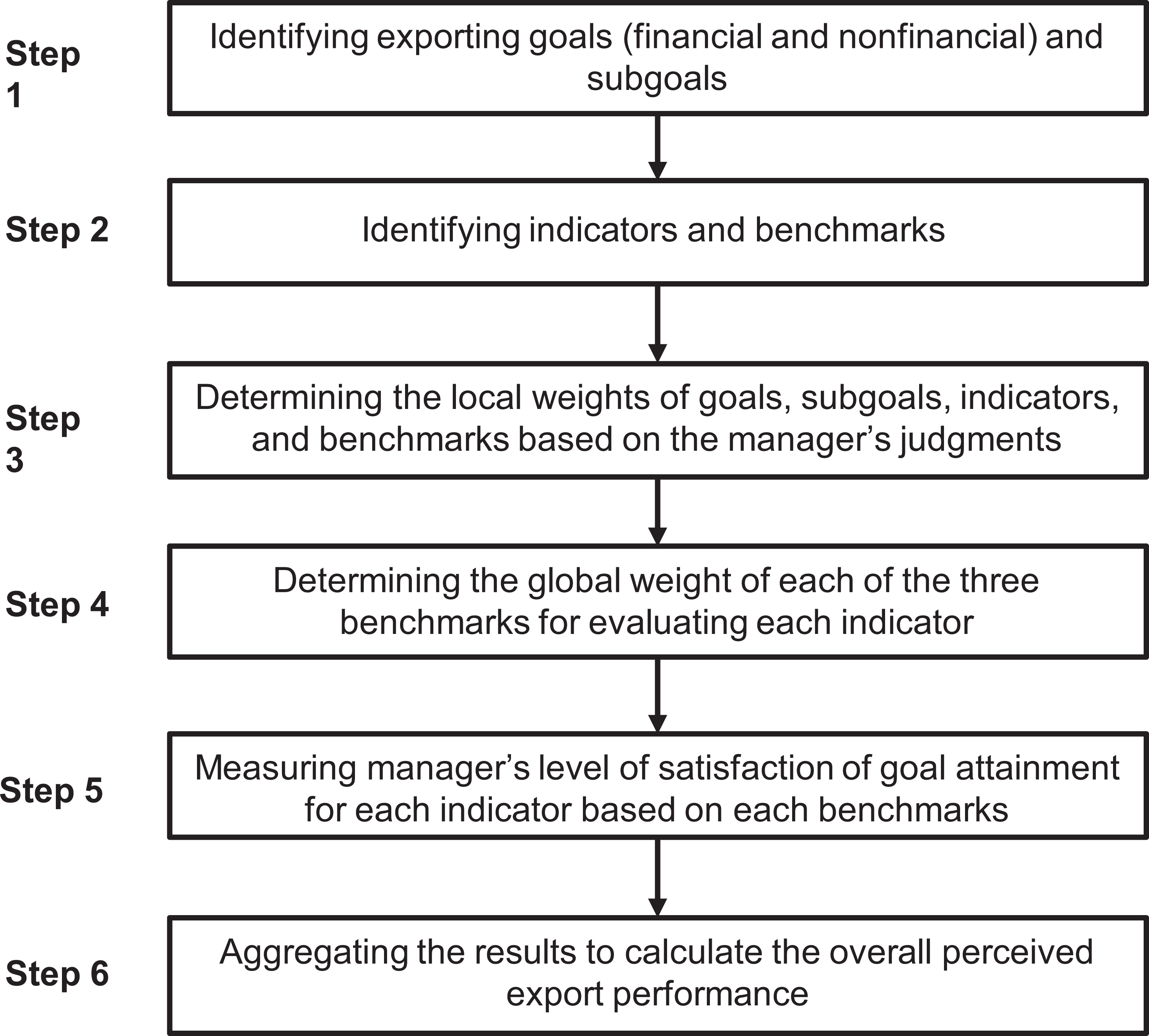
Proposed approach for measuring export performance.
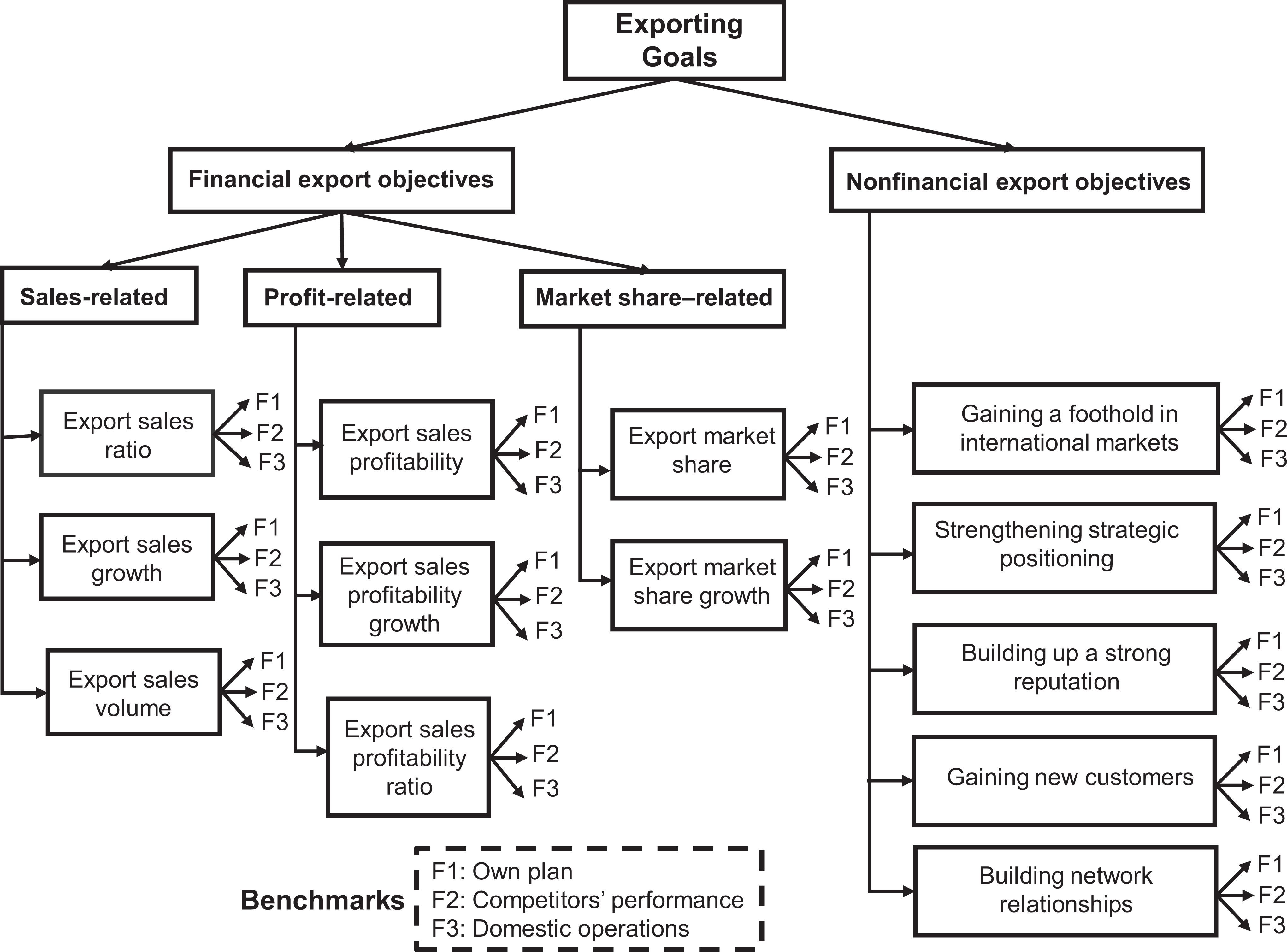
The IPEP framework.
The measures used to develop this export performance framework are based on an analysis of prior research, along with insights gained from the interviews with 20 exporting SME managers. The three financial subgoals and their corresponding indicators are consistent with the Katsikeas, Leonidou, and Morgan (2000) and Sousa (2004) categorizations of export performance measures. The indicators pertaining to the nonfinancial subgoals are adopted from Katsikeas, Leonidou, and Morgan, Brouthers et al. (2009), Sousa (2004), and Papadopoulos and Martín Martín (2010).
The third step of the IPEP approach involves the administration of a pairwise comparison questionnaire to collect information pertaining to each manager’s perceptions regarding the relative emphases that they place on the goals, subgoals, indicators, and benchmarks. (The Appendix provides a sample of questions from the survey instrument.) This step involves conducting a series of pairwise comparisons across all of the possible combinations of elements in each level of the IPEP framework’s hierarchy. For example, to obtain the relative importance of the three sales-related indicators, we asked managers to conduct pairwise comparisons for the three pairs of indicators.
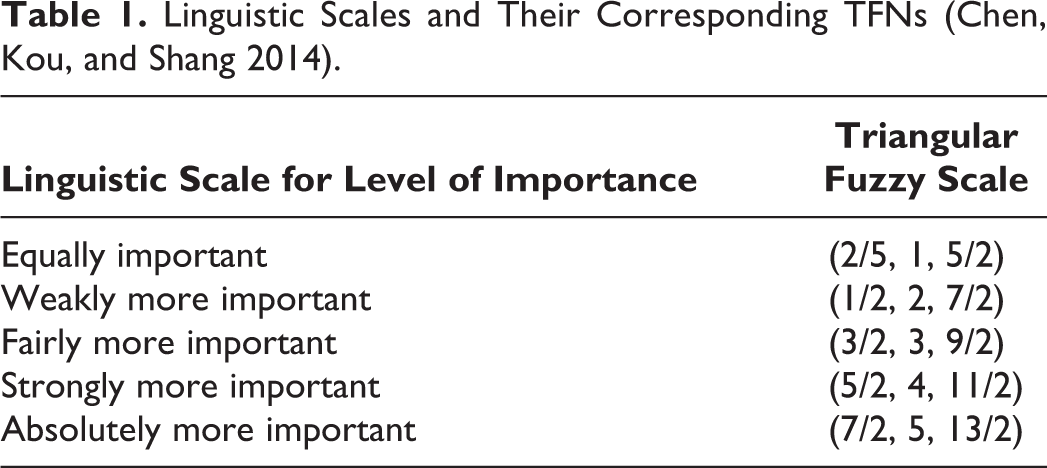
In the FAHP approach, the relative weights (representing importance) of the elements of each level of the hierarchy are called “local weights.” The extent analysis method proposed by Chang (1996) is utilized to calculate the local weights of the goals, subgoals, indicators, and benchmarks. In this method, decision makers are asked to express their pairwise comparisons using linguistic variables such as “weakly more important” or “strongly more important.” These linguistic assessments are converted into a set of TFNs, which are the most widely used form of fuzzy numbers (Kahraman, Onar, and Oztaysi 2015). A TFN is defined by three real numbers expressed as (l, m, u), where l and u are minimum and maximum possible values and m represents the most likely value that describes a fuzzy event (Zadeh 1965). The Web Appendix provides details about the definition of TFNs and Chang’s extent analysis method. Following Chen, Kou, and Shang (2014), we used the values shown in Table 1 to convert linguistic judgments to TFNs. For example, if a participant considers element i to be “fairly more important” than element j, the pairwise comparison between i and j is represented as aij = (3/2, 3, 9/2).
Linguistic Scales and Their Corresponding TFNs (Chen, Kou, and Shang 2014).
For example, for the sample firm, the linguistic data collected by the pairwise comparison questionnaire were converted into corresponding TFNs (per Table 1) and used as inputs for the Chang (1996) extent analysis, to calculate the local weights for each element in the framework. The local weights for the goals, subgoals, indicators, and benchmarks are presented in Table 2. These figures reflect the relative degree of importance of the elements within a group. For example, the local weight associated with export sales ratio (.184) represents the relative importance of this indicator compared with the other two indicators under the sales-related subgoal (i.e., export sales growth and volume). The local weights associated with the elements within each such group sum to 1 (e.g., for the three indicators under the sales-related subgoal [i.e., export sales ratio, growth, and volume], .184 + .338 + .478 = 1).
FAHP Results for the Sample Firm.

Step 4 involves the calculation, for each of the indicators, of global (overall) weights associated with the three benchmarks. This is accomplished by multiplying the local weight for each benchmark by the local weights of each of the associated higher-level elements (i.e., indicator, subgoal, and goal). For the sample firm, the calculated global weights associated with the three benchmarks for each of the 13 indicators are shown in Table 2. These values represent the overall importance of the 39 indicator–benchmark pairings. For example, in line with this table, “export sales profitability” based on “own plans” is the most important indicator–benchmark pairing (.070, in the fifth column). The global weights for the 39 benchmarks sum to 1.
In the fifth step, managers are asked to identify their level of satisfaction with their firms’ attained performance, based on each of the 39 indicator–benchmark combinations (13 indicators, with three benchmarks each), using a seven-point Likert scale (1 = “not at all satisfied,” and 7 = “very satisfied”). The second-to-last column in Table 2 shows the sample firm manager’s reported level of satisfaction with the attainment of objectives, with respect to each indicator–benchmark pair.
Finally, in the sixth step, the outputs of FAHP (the global weights associated with the indicator–benchmark combinations calculated in step 4) are combined with the satisfaction ratings from step 5 to compute the weighted managerial satisfaction index. The overall IPEP index can then be calculated by summing the values of the weighted satisfactions measured in the previous step across all of the benchmarks.
The last column of Table 2 shows the weighted satisfaction scores for the sample firm. These scores are obtained by multiplying the level of satisfaction for each indicator–benchmark pair by its corresponding global weight of benchmarks. The aggregated weighted satisfaction scores for each of the main goals (financial and nonfinancial) can then be calculated by summing the corresponding values across the associated benchmarks. For the sample exporting firm, these results are shown in Table 3. Finally, the overall combined IPEP index can be obtained by summing the values across each row of Table 3.
Aggregated Weighted Satisfaction Score.

a Using values from the weighted satisfaction level column in Table 2, .043 + .156 + .259 + .200 + .099 = .757.
Simplified Method
The IPEP framework’s extreme level of detail in capturing the priorities of managers for export performance evaluation comes at the cost of complexity in terms of data collection and analytic procedures. Moreover, implementing this framework requires the administration of a long questionnaire that takes up a great deal managerial time. This, in turn, may result in a lower response rate. To address these issues, building on the existing literature and results of our pilot tests, we propose a simplified model. While retaining the key benefits associated with the IPEP framework, the simplified model offers a more parsimonious approach for measuring export performance that is more accessible and easier to implement for empirical studies.
The proposed simplified model of perceived export performance measurement is essentially based on the idea of weighted satisfaction underlying in the IPEP approach. This streamlined model attempts to account for the two fundamental building blocks of the IPEP framework: level of importance and level of satisfaction with respect to the performance indicators.
In this approach, similar to the IPEP framework, export performance is measured on the basis of three financial and five nonfinancial indicators. We asked the respondents to indicate both the level of importance of each performance indicator and the extent to which they are satisfied with the attainment of export objectives with respect to each performance indicator, using seven-point Likert scales. To further simplify the model, respondents were asked to conduct all of the evaluations with respect to the benchmark that they use most often. Similar to the IPEP questionnaire, these questions were asked with respect to both short-term (most recent financial year) and long-term (the past five financial years) perspectives. Finally, export performance measures were calculated by multiplying the perceived level of importance by the level of satisfaction for each indicator.
Our approach is in line with the recommendation by Hitt (1988, p. 30) that “the criteria/measures used to indicate performance in an effectiveness domain must be weighted and combined into some overall model.” A similar weighting approach for performance measurement has been used in previous studies (e.g., Gerschewski, Rose, and Lindsay 2015; Sadeghi, Rose, and Chetty 2018). Our study advances this approach by including more comprehensive sets of financial and nonfinancial indicators and accounting for the preferred benchmark for each respondent. Our approach in developing a broad measure of export performance in the simplified model resonates with Carneiro et al.’s (2016, p. 416) argument that “Forgoing a broader conceptualization of export performance may sacrifice content validity, but that does not mean that it would necessarily violate content adequacy—as long as the relevant performance perspectives are still retained.”
The IPEP framework and the simplified model are useful for different purposes. The IPEP framework presents a detailed measure that can be used as a practical decision support tool for planning and monitoring a firm’s export activities. The simplified model is more parsimonious and provides a broad conceptualization of export performance that captures the key aspects of this construct in a more convenient way. This model is suitable for the purpose of empirical studies, as it is easier to implement and requires considerably shorter data collection time. Table 4 provides a brief comparison of these two methods.
Comparing the IPEP Framework and the Simplified Model.

Sample and Data Collection
In this section, we illustrate the application of the IPEP framework and the simplified method using survey data collected from a sample of exporting SMEs in New Zealand. Following the definition of SMEs provided by the New Zealand Ministry of Business, Innovation & Employment (2014), we focus on firms with 100 or fewer full-time employees. Firms operating in both the service and manufacturing sectors, from low- and high-tech industries, are included in the study. Some representative industries include agriculture, beverage, winemaking, industrial equipment, natural health, education, and biotechnology. A multi-industry sample provides broader coverage and more variation in the responses and thus offers the potential for greater generalizability (Morgan, Kaleka, and Katsikeas 2004).
After identifying potential companies to participate in the study, we mailed a questionnaire with a postage-paid reply envelope to the company’s official postal address, inviting the senior managers or export managers to participate in this study. These respondents are likely to have the in-depth knowledge required to provide useful and accurate information about the international activities of their firms. Email and telephone follow-ups were also undertaken. Respondents were asked to complete a survey instrument that included questions associated with both the IPEP and simplified methods. To understand the differences between managers’ shorter- and longer-term perspectives, respondents were asked to provide their assessments of both the most recent financial year and the period comprising the past five financial years. Altogether, we contacted 520 companies. Of these, 78 returned fully completed and usable questionnaires, resulting in a response rate of 15.56%; 79% of our sample had fewer than 19 employees and 71% of them obtained less than half of their total sales from foreign markets. The sample mean age of these firms was 11.8 years, and they had been in international markets for 3.2 years, on average, at the time of data collection. As such, our sample is composed of rather small firms (which is typical for New Zealand) and young firms with often-limited international experience.
Results
Results of Implementing the IPEP Framework
For each firm, we undertook the procedure outlined previously to analyze the responses and to calculate the local and global priorities of the elements at each level of the hierarchy. These priorities were calculated separately for shorter- and longer-term perspectives. Figures 3 (short-term) and 4 (long-term) provide an overview of the variation in the relative importance of the goals, subgoals, and indicators across the 78 firms in the sample. These results suggest that there is a substantial variation across the sample firms in terms of the relative emphasis that the respondents placed on the different aspects of export performance in their assessments. This variation reinforces the view that export performance is a complex and multifaceted phenomenon that is idiosyncratic to the firm, along with the importance of explicitly accounting for the values that managers attach to different aspects of export performance in their assessments.
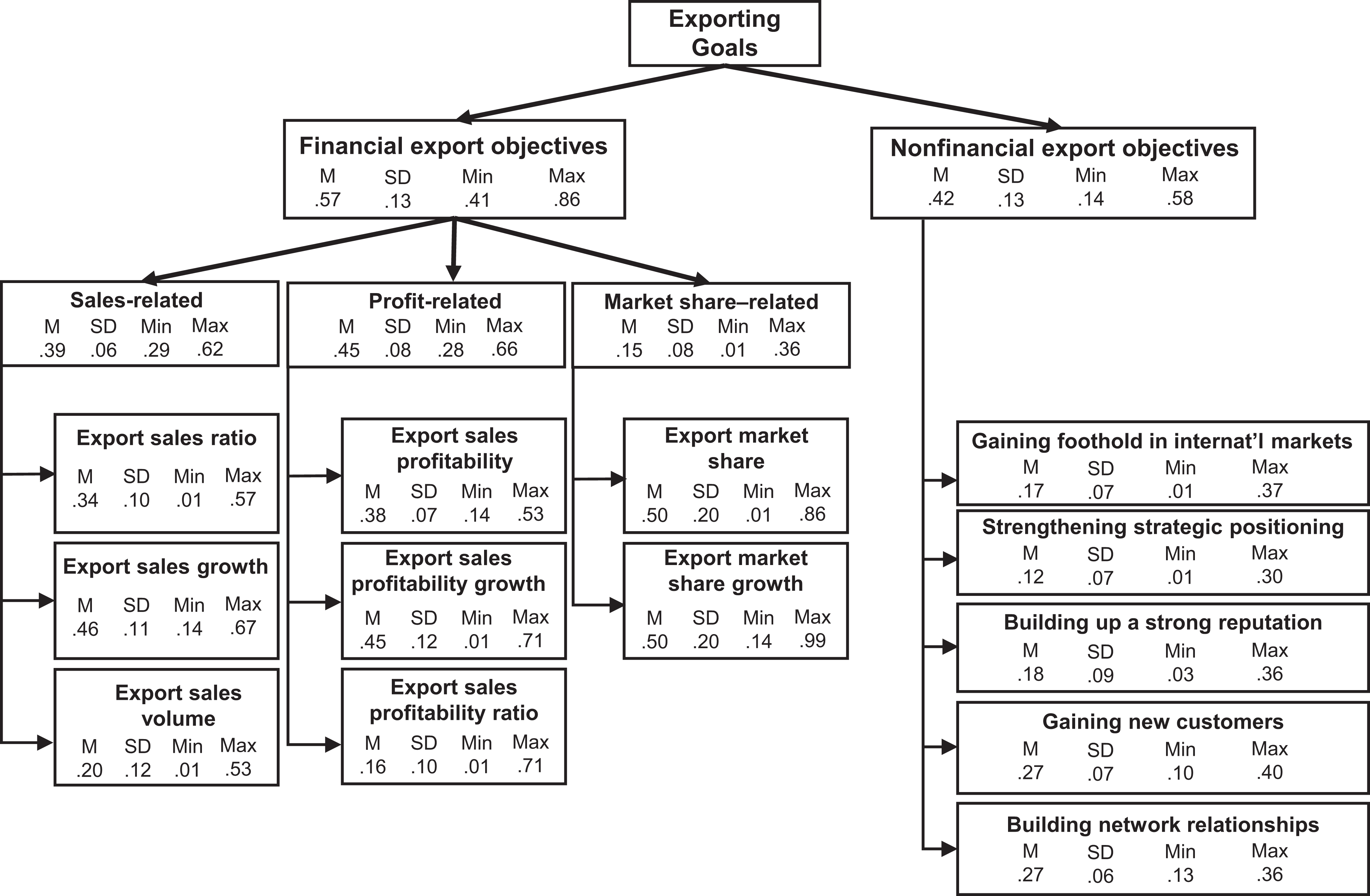
Variation in the relative importance of elements of IPEP framework in the short-term perspective (n = 78).

Variation in the relative importance of elements of IPEP framework in the long-term perspective (n = 78).
We analyzed the variation in participants’ responses using one-way analysis of variance (ANOVA) to assess whether there are significant differences among the average perceived importance of the three benchmarks across the export performance criteria (see Table 5). For all of the export performance criteria, both short- and long-term, there are significant differences (p < .001) in the benchmarks’ mean levels of importance. More specifically, the sample firms tend to place significantly more importance on “own plan” relative to the other two benchmarks. In addition, “competitor’s performance” is found to be significantly more important as a benchmark, on average, compared with “domestic performance.”
ANOVA Results for level of Importance of Benchmarks in Assessment of Different Export Performance Indicators.

***p < .001.
Notes: ANOVA = analysis of variance; CIs = confidence intervals.
Results of Implementing the Simplified Method
To illustrate the feasibility of the proposed simplified model and examine its usefulness, we compared the paired results of responses for the IPEP and the simplified approaches for both the short- and long-term perspectives. Table 6 shows the simplified model’s measurement variables, exploratory factor analysis (EFA) component loadings, percentage of variance explained, and internal reliabilities. The EFA results revealed that financial and nonfinancial measures load onto two distinct factors for both time frames. In addition, the Cronbach’s alphas of all constructs exceed the .6 threshold value (Bagozzi and Yi 1988), which indicates acceptable internal reliability in this exploratory study. Finally, we utilized the EFA component loadings as weights in calculating combined factor scores to represent the overall financial and nonfinancial export performance for each participant.
Factor Analysis Results.

Notes: Extraction is principal component and rotation is varimax. Figures in bold are the higher factor loadings. Total variance explained values are 61.65% for short term and 68.58% for long term.
Comparing the Results of the IPEP Framework and the Simplified Method
We assessed the agreement between the results obtained from the IPEP and simplified methods. Following the guideline outlined by Linnet (1993), we regressed the standardized values of the IPEP results on the results from the simplified model, using ordinary least squares, to check for systematic differences between the two methods. In this approach, the two methods are judged to provide similar results if the estimated regression line does not deviate significantly from the equity line (a slope of 1 and an intercept of 0). The results show that, for financial and nonfinancial responses, both short- and long-term, neither the slope nor intercept of the estimated regression line differs significantly from those of the equity line, with at least 95% confidence, providing support for the notion that the two methods produce substantially similar results. Figure 5 provides a graphical representation of the results obtained from the two methods, with the outcomes obtained from the simplified approach plotted against the mean-centered results obtained from the IPEP framework.

Graphical representation of the comparison of results obtained from the IPEP and the simplified methods.
Discussion and Conclusion
Existing measures of export performance are typically based on a set of predefined variables and weightings that are treated as identical for all firms (e.g., Lages and Lages 2004; Zou, Taylor, and Osland 1998). The lack of attention to managers’ perceptions, preferences, and goals has been criticized in previous studies. For example, Katsikeas et al. (2016, p. 11) conclude that ignoring managers’ views “forces researchers to either assume (implicitly or explicitly) what firms’ goals might be or to adopt more ‘goal-agnostic’ financial-market performance measures” and argue that this approach may lead to inaccurate and misleading results.
In this article, we argue that when it comes to export performance assessment, one size does not fit all. In line with previous studies (e.g., Carneiro et al. 2016; Madsen 1998), we find evidence that managers hold multifaceted views of export performance in terms of goals, criteria, and benchmarks, and place different values on these aspects. Not only do managers’ perceptions of export performance vary among firms, but within-firm perceptions may change over time. Therefore, the use of a uniform approach may lead to a mismatch between measured export performance and the manager’s perception of this phenomenon. For example, profitability may not be the most appropriate measure for capturing the export performance of a firm that is pursuing another goal (e.g., market share growth), and measures that are applicable for large or established firms may be much less so for younger SMEs that are early in their export activities. While a manager might consider the firm to be successful, based on the achievement of firm-specific goals, assessment using a different set of researcher-chosen indicators could yield a misleading result. This mismatch in the treatment of export performance impedes the generation of reliable knowledge and may be a key reason behind the often-mixed results in the current literature. Given these misalignments, it is not surprising that managers may find traditional export performance measures irrelevant to their operations (Alteren and Tudoran 2016).
Improving the effectiveness of export performance measurement is fundamental to advancing the international marketing literature. In this article, we contribute to this advancement in three ways. First, our approach offers a clearer understanding of the constituent elements of perceived export performance by unpacking this construct and developing an inclusive measure that explicitly captures its multidimensionality. Although the separate components of our proposed measure have previously been utilized on an individual basis, our study is among the few to use them collectively and to systematically integrate them in a sequential manner. Second, we respond to calls for adopting a holistic view to measure export performance and account for the inherently cognitive nature of the phenomenon (e.g., Chen, Sousa, and He 2016; Diamantopoulos and Kakkos 2007; Katsikeas, Leonidou, and Morgan 2000; Morgan, Kaleka, and Katsikeas 2004; Sousa 2004). We do so by adopting a contingency approach and offering a detailed and comprehensive measurement framework that systematically captures perceived export performance based on what individual managers value. Third, our data demonstrated considerable heterogeneity in managers’ strategic priorities with respect to assessing export performance. The proposed approach in this study aims to reflect these heterogeneities and reduce the gap between academic research and business practice by tailoring the measurement to each individual firm. Our approach is in line with Katsikeas, Leonidou, and Morgan (2000, p. 506), who state, “The contingency element inherent in export performance measurement suggests that choice of measure depends on firm-specific conditions.”
The IPEP framework proposed in this study can be viewed as an extension of the AEP framework developed by Diamantopoulos and Kakkos (2007), with four key improvements. First, we extend the AEP by proposing a more fine-grained and comprehensive hierarchy of goals, criteria, and indicators to more closely reflect managerial export performance assessment. Second, the IPEP framework reflects the uncertainties associated with subjective judgments by adopting fuzzy logic that allows for a more realistic representation of managerial judgment. Third, the IPEP framework acknowledges different goals, measures export performance with regard to the short and long term separately, and captures the weight of all elements (including goals, subgoals, indicators, and benchmarks) for the specific time frame. Fourth, recognizing that the IPEP framework’s extreme level of detail in capturing managers’ priorities comes at the cost of complexity in data collection and analysis, we build on the idea of “weighted satisfaction” that underlies the IPEP approach and develop a simplified model for measuring export performance that is more parsimonious and easier to implement for empirical research while retaining the key benefits associated with the IPEP approach.
We have demonstrated the feasibility of both the IPEP framework and the simplified model empirically, based on a sample of 78 exporting SMEs in New Zealand. The data reflect considerable variation in the importance that the respondents attach to different elements of export performance. This reinforces the notion that export performance is idiosyncratic to the firm and that its measurement should be dictated by the firm’s specific strategic orientations. Furthermore, our comparative analysis offers preliminary evidence that the two methods produce similar results, providing confidence that the simplified method, which represents a substantial reduction in the time required to complete the questionnaire, also generates a good approximation of perceived export performance with only limited loss of data richness.
Our use of FAHP for the IPEP framework to decompose the multiattribute problem and capture managerial preferences represents an important contribution. With FAHP, we can retain, explore, and account for variation in managerial preferences with respect to export performance assessment while allowing the respondent to focus on one pair of factors at a time, rather than having to deal with the entire complex system. Managerial assessment of export performance is fraught with uncertainty and imprecision that is difficult to represent adequately in a fully deterministic manner. Adopting fuzzy logic in our framework enables us to incorporate some of the uncertainties in managers’ real-world judgments through the use of linguistic variables to express the evaluations.
Our proposed approach for measuring export performance relies heavily on the respondent’s judgments and personal interpretations. Previous studies have argued that the results obtained by such subjective, self-report performance measures are prone to cognitive biases, which may lead to under- or overestimations of performance (Lages, Lages, and Lages 2005; Richard et al. 2009). While we acknowledge the potential for self-assessment bias in subjective performance assessment, this is not of great concern in the context of this stud. The purpose of our proposed approach is not to investigate how managers should evaluate the performance of their firms’ exporting operations. Rather, we aim to take a realistic look at managerial practices and map out managers’ actual perceptions the assessment of export performance. Managers’ perceptions of performance drive their behavior, decision making, and strategy development (Angel, Jenkins, and Stephens 2018; Madsen and Moen 2018). Therefore, rather than trying to reduce or eliminate the impact of individual bias in performance assessment, we attempt to capture it and reflect it in the proposed measurement. The role of subjective judgments in shaping firm strategy is particularly salient for SMEs, which are typically governed by rather centralized management processes that rely on the championing manager for formulating strategies and making key decisions. By preserving the individuality of firms in the process of export performance measurement, the proposed frameworks allow for a more meaningful interfirm comparison in the presence of multiple goals and different modes of assessment.
Managerial Relevance
Our study has several implications for managers of exporting SMEs. The IPEP measurement approach we propose is a versatile tool that can help managers develop a clearer understanding of the constituent elements of export performance. It can also assist SME managers in their efforts to track the process of their exporting operations and assess their performance while shedding light on the trade-offs associated with pursuing different goals. There is evidence that managers prefer to use customized performance measures that are aligned with their strategic priorities, rather than employing generic measurement models (e.g., Banker, Chang, and Pizzini 2004; Lipe and Salterio 2000); the IPEP framework offers a deeply firm-specific approach. In addition, alignment between performance measures and strategic goals is expected to be positively related to the firm’s performance (e.g., Clark and Ambler 2001; Lingle and Schiemann 1996; Pinto and Curto 2007). The IPEP framework provides managers with a systematic decision support tool that is tailored to their changing goals and priorities. This holistic approach to export performance measurement facilitates the process of monitoring and managing export operations by simultaneously accounting for multiple aspects.
Limitations and Future Research
The IPEP framework is not intended as a panacea to overcome the multiple and durable challenges raised in the literature. Rather, it contributes toward advancing the literature by proposing a fine-grained and customized measure of perceived export performance that more closely reflects individual managers’ preferences. The measurement approach proposed in this study has some limitations, which may point to opportunities for future research.
First, it is important to note that the appropriateness of a performance measurement approach depends on its compatibility with a study’s theoretical foundation. Our subjective framework may be particularly useful for measuring export performance in studies that are grounded in behavioral theory (Cyert and March 1963) or related perspectives such as organizational learning (Levitt and March 1988). On the one hand, studying the behavior and development process of exporting SMEs from an organizational learning perspective may require incorporation of key managers’ priorities and orientations, making a subjective measure particularly appropriate. On the other hand, a subjective performance measure may be less appropriate if the focus of the research is more on outcomes than processes. For example, when considering performance from a stakeholder perspective (Freeman 2010), relying solely on managers’ perceptions may not be justified. This theoretical perspective necessitates the use of beneficiary-centered measures that explicitly address the interests of stakeholders (such as suppliers, government, environment, and society); such research is better suited to the use of more outcome-focused and objective performance measures.
Second, despite our attempt to consider a wide range of factors in measuring export performance, the IPEP framework may not encompass a fully exhaustive collection of criteria. Future studies could modify this framework or expand it with additional dimensions and indicators, contingent on the contextually embedded requirements of target firms or the nature of the investigation, to reflect specific goals and business strategies. The ultimate set of indicators in the model depends on the requirements of the target firms, the nature of the investigation, and the theoretical lens adopted in the study. For example, adopting the resource-based view (Barney 1991) may necessitate adopting a performance measurement that includes indicators that are directly connected to specific resources of interest.
Third, this study draws on a rather small sample (n = 78), particularly with respect to the comparison between the outcomes of the IPEP and the simplified model. It is worth noting that the sample size does not represent a limitation with respect to the IPEP model itself. In contrast to conventional statistical analysis, AHP does not require a large sample size to produce useful results (Cheng and Li 2001; Sadeghi and Larimian 2018), and previous AHP-based studies have used what would generally be viewed as very small sample sizes (e.g., n < 10; for a review, see Sipahi and Timor 2010). The sample of 78 New Zealand SMEs serves three purposes in this study. First, it demonstrates the application of the proposed models; for this purpose, a single firm would have sufficed. Second, we use the sample to understand whether variation exists in individual perceptions regarding export performance assessment; the sample clearly reflects such variation. Third, the sample allows us to undertake preliminary analysis to compare the results of the IPEP and the simplified approaches; while we find strong evidence that the two approaches provide broadly similar results, future work involving more firms will be necessary to provide stronger confidence in this preliminary, albeit promising, finding.
Fourth, there is evidence that industry-related factors, such as competition and maturity, and firm-specific factors, such as size, age, stage of internationalization, and earliness, affect managers’ perceptions of opportunities and challenges in foreign markets (e.g., Aliasghar et al. 2019; Gerschewski et al. 2020; Gerschewski, Rose, and Lindsay 2015). For example, Gerschewski and Xiao (2015) found evidence that, compared with other firms, international new ventures place more emphasis on financial performance. Because the versatile frameworks developed in this study aim to capture heterogeneities by explicitly accounting for different approaches, they can be used to capture export performance assessment in various types of SMEs. It also will be valuable to examine the role of industry- and firm-specific factors on SME managers’ assessment of their firms’ export performance. The developed measures can also be used to examine the relationship between export performance and other constructs of interest. Such studies should serve to enhance our understanding of validity of the developed measures. These are important topics that go beyond the scope of this study but represent useful directions for future research.
Fifth, the conceptualization and measurement of export performance in this study were based on the judgments and priorities of the key manager in each firm. In SMEs, the key manager tends to play a crucial role in the firm’s decision making. However, in some firms, multiple managers may be involved with evaluating export performance. In such conditions, it would be advisable to account for the perspectives of multiple informants, potentially incorporating the opinions of a panel of managers (Dabić et al. 2019; Elbanna, Hsieh, and Child 2020). Future studies could employ a combination of FAHP and the Delphi method to incorporate multiple decision makers’ inputs and integrate them systematically to arrive at a single firm-level assessment that represents the group’s aggregated view. For more information about the use of Delphi-AHP in supporting group decision making, see Lai, Wong, and Cheung (2002) and Hsu, Lee, and Kreng (2010)
Supplemental Material
Supplemental Material, sj-pdf-1-jig-10.1177_1069031X20973663 - Perceived Export Performance: A Contingent Measurement Approach
Supplemental Material, sj-pdf-1-jig-10.1177_1069031X20973663 for Perceived Export Performance: A Contingent Measurement Approach by Arash Sadeghi, Elizabeth L. Rose and Tage Koed Madsen in Journal of International Marketing
Footnotes
Appendix: Pairwise Comparison Questionnaire
Associate Editor
Matthew Robson
Declaration of Conflicting Interests
The author(s) declared no potential conflicts of interest with respect to the research, authorship, and/or publication of this article.
Funding
The author(s) received no financial support for the research, authorship, and/or publication of this article.

Notes
References
Supplementary Material
Please find the following supplemental material available below.
For Open Access articles published under a Creative Commons License, all supplemental material carries the same license as the article it is associated with.
For non-Open Access articles published, all supplemental material carries a non-exclusive license, and permission requests for re-use of supplemental material or any part of supplemental material shall be sent directly to the copyright owner as specified in the copyright notice associated with the article.
