




Abstract
Recent changes to medical terminology and nomenclature have made strides to improve ethical integrity in healthcare. Removing tarnished eponymous namesakes and depreciative descriptions from the medical lexicon is a challenging, but righteous undertaking. In this article, the authors propose replacing the pejorative histologic description of “Indian file” with “Tusken Raider file.”
Keywords
Medical nomenclature is fraught with complications, including ethical considerations concerning eponymous namesakes, inaccurate appellations, geographic influences, or depreciatory descriptive terminology. Some of the more recent and most prominent debates in the eponymous classification of diseases have involved physicians associated with Nazis, human experimentation, and “racial hygiene,” resulting in compelling efforts to adopt descriptive titles in order to expunge immoral characters from the annals of medicine. Replacing tainted eponyms with descriptive terminology would not be simple or convenient. Their widespread use and recognition would make universal substitution a monumental, but worthy task in some situations. In this respect, the purpose of this article is to suggest replacing the term “Indian file” as a pathognomonic histologic description for infiltrating lobular carcinoma, with the phrase “Tusken Raider file.”
Used as an idiom, “Indian file” refers to the movement of people or things in a single file width. The phrase likely originated from attestations of early European settlers describing indigenous peoples walking in a line, one behind another through forest trails, with the term coined in John Long's “Voyages and Travels of an Indian Interpreter and Traveler.” 1 In the pathologic lexicon, “Indian file” is used as a histologic or cytologic description for malignant cells arranged end-to-end in a single file. In surgical pathology, malignant cells invading through tissue with an “Indian file” arrangement is essentially pathognomonic for lobular breast carcinoma (Figure 1), however, it can also be seen in polymorphous adenocarcinoma of the head and neck, 2 and has been described in cytopathologic preparations of small cell carcinoma. 3
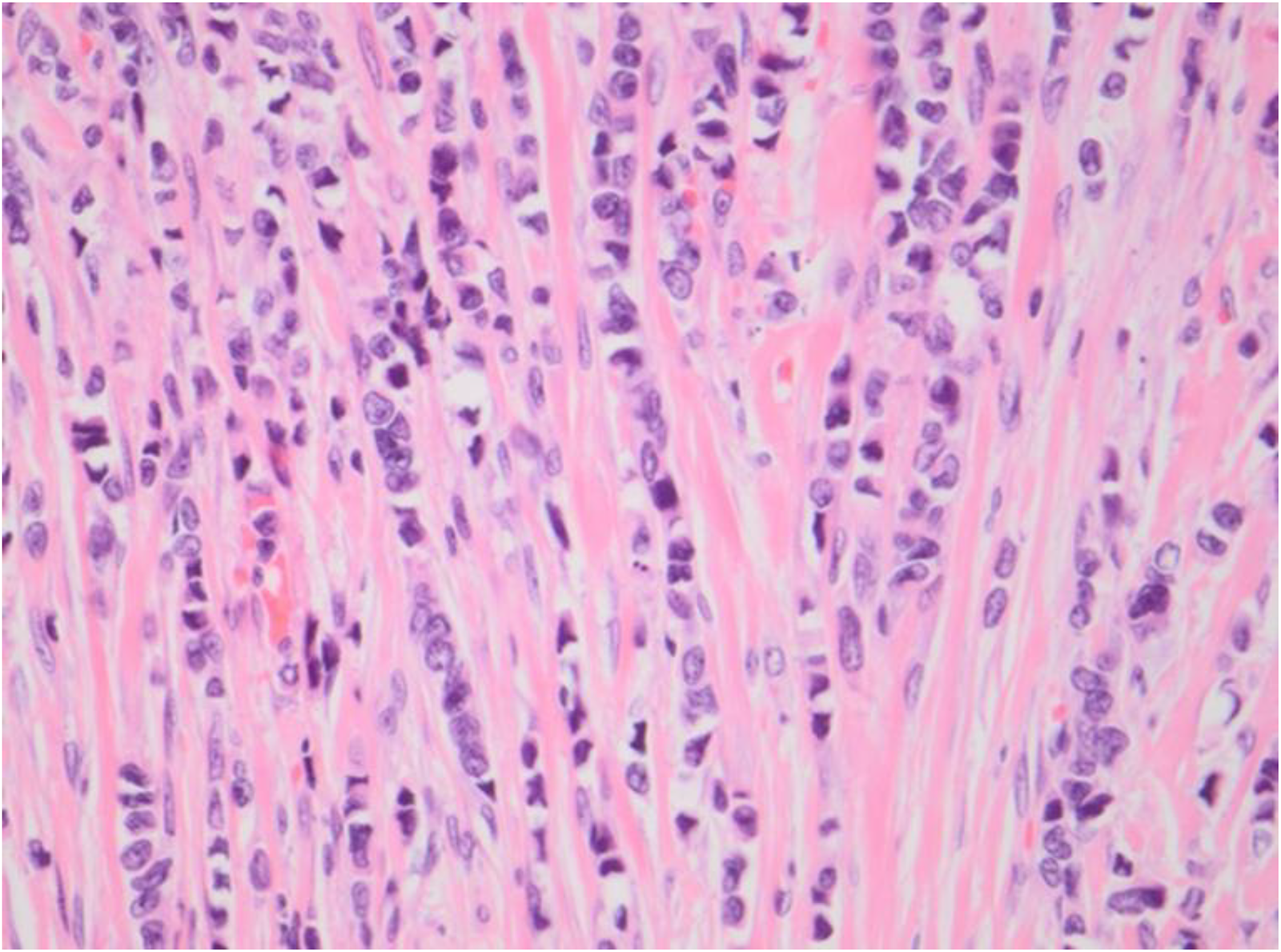
Hematoxylin and eosin stained slide showing infiltrative lobular carcinoma permeating between layers of collagen, forming characteristic single-file clusters.
The phrase “Indian file” itself has multiple problematic connotations. Most obviously, the use of the term “Indian,” which itself arose from a historical error, does not accurately reflect the indigenous peoples to whom it refers. Further, like the problematic phrase “Red Man Syndrome” to describe the flushing that can be accompanied by vancomycin, it is another example of the widespread cultural acceptance of potentially derogatory names and images of Native Americans. 4
Given this problematic usage, the authors suggest substituting the term “Tusken Raider file” to describe the infiltrative pattern of lobular breast carcinoma, or any other single file arrangement of malignant cells. In modern media, Tusken Raiders, otherwise referred to as Sand People, or simply Tuskens, are the indigenous population of the fictional planet of Tatooine in the “Star Wars” galaxy. As the original inhabitants of a harsh world with scarce resources, Tusken Raiders are fiercely territorial, and known to employ violence on settlers who they view as trespassers appropriating their sacred resources. In order to hide the number of individuals in their party, Tusken Raiders will travel in single file. Considering their existence only in a fictional universe, this makes the term “Tusken Raider file” a more palatable alternative to the currently used descriptor.
Naming of diseases, pathologic features, and anatomic structures has a complicated history, and is surprisingly beset by controversy. In some cases, there is debate over who was first to describe or publish their findings on a disease, occasionally resulting in the entity gaining an unmerited eponymous namesake. In other cases, the disease becomes named after celebrities afflicted with the disorder (eg, Lou Gehrig's disease), which is a questionable practice in an era striving for the privacy of medical information. Even excluding pathologic eponyms, there are hundreds of anatomical eponymous terms, primarily arising from anatomists of the 19th century. 5 Indeed, even spaces within the body have been claimed like settlers on the Land Run (eg, the Pouch of Douglas). Oddly, some structures escaped these anatomic colonizers, as is the case with the innominate (literally “unnamed”) artery, a branch of the aortic arch, or the innominate bone of the pelvis. Modern classification is trending towards descriptive identification of maladies, but even this scheme is not without contention. Examples include dermatopathologic entities such as pyogenic granuloma, which is neither pyogenic nor granulomatous, and mycosis fungoides, a T-cell lymphoma with a fungal moniker. The more well-known transitions from eponymous labels are frequently driven by ethical considerations surrounding the discovery and description of the entity, such as Reiter's syndrome, or the similarly contentious Wegener's vasculitis. 6 Previous efforts to replace potentially offensive medical descriptions in the past include a well-intentioned letter to the editor of a pediatric journal recommending replacement of the term “Funny Looking Kid” in pediatric medical jargon with the allegedly less offensive “Unusual Appearing Child.” 7 Although the response from the editor in that particular case was dismissive, we hope our suggested innocuous term “Tusken Raider file” receives better reception.
Footnotes
Acknowledgments
The authors would like to acknowledge the creative inspiration of George Lucas, Dave Filoni, and Jon Favreau.
Declaration of Conflicting Interests
The author(s) declared no potential conflicts of interest with respect to the research, authorship, and/or publication of this article.
Funding
The author(s) received no financial support for the research, authorship, and/or publication of this article.
Ethical Approval
Not applicable.
Informed Consent
Not applicable.
Trial Registration
Not applicable.
