




Abstract
The Trojan war occupies an important place in Greek mythology. Homer describes this in detail in his epic works of “The Iliad” and “The Odyssey.” The ancient town of Troy is located south of the Dardanelles Strait in Turkey. Until the late nineteenth century, scientists thought that the Trojan War was a legend. German businessman and amateur archaeologist Heinrich Schliemann (1822–1890) began excavations in Troy. The Turkish Empire (Ottoman Empire) granted excavation permission in 1871 on the condition that the artifacts discovered would be preserved and exhibited. Schliemann found “the treasure of the Trojan king Priam” in 1873. He smuggled the treasure to Athens. In 1874, the Ottoman government discovered this and went after the treasure. They sued Schliemann in Athens. According to archaeologists, the treasure dates back to 2600–2400 BC. The horde that Schliemann found could not have belonged to the Trojan King Priam. It was during this time that Schliemann met Rudolf Virchow (1821–1902). Virchow was interested in anthropology and prehistory. The Turkish state granted Schliemann new permission to conduct excavations. Virchow stayed in Troy for a month in 1879 as an excavation site physician. He provided health care services to the excavation workers and local people and made observations. Virchow came to Troy once again in March 1890 to attend the second Trojan conference organized by Schliemann. Virchow was also an influential politician in Berlin. He was a member of the Berlin City Council. Thanks to the relations established with Chancellor Bismarck and Kaiser Wilhelm, Virchow ensured that the Treasure of Priam would be permanently transferred to Berlin from London (it is currently at the Victoria and Albert Museum), where it was temporarily exhibited. Trojan treasures were exhibited in the Ethnological Museum (Völkerkundemuseum) and in the Martin-Gropius Bau (formerly Kunstgewerbemuseum –The Decorative Arts Museum) until 1945. After the Soviet Army entered Berlin following the Second World War, the treasure was lost. It was discovered in 1994 that the treasure was at the Pushkin Museum.
Keywords
Preface
Rudolf Virchow (13 October 1821, Prussia, Swidwin /currently Poland - 5 September 1902, Berlin) was a well-known German physician and pathologist. He is known as “the father of modern pathology” and as the founder of social medicine. He is also interested in anthropology, prehistory, biology, sanitation, and politics. He founded the Berlin Society for Anthropology, Ethnology, and Prehistory (Berliner Gesellschaft für Anthropologie, Ethnologie und Urgeschichte). In honor of his contributions to German archaeology, the Rudolf Virchow lecture is held annually in his honor. He made field trips to Asia Minor and Egypt.
Heinrich Schliemann (6 January 1822-1826 December 1890) was a German businessman and an amateur archaeologist. He was obsessed with stories of Homer and ancient Mediterranean civilizations. He dedicated his life to finding the actual physical remains of the cities in Homer's epic tales and excavating Troy. Notably, Virchow and Schliemann's paths crossed due to their common interest in prehistory. A long-lasting friendship began between the two. The focus of the friendship was archeology and Troy. This paper depicts the friendship between Virchow and Schliemann and, consequently, Virchow and Troy.
Introduction
In ancient Greek literature, Troy is depicted as a powerful kingdom of the Heroic Age, a mythical period in which monsters roamed the world and gods interacted directly with humans.
The area where Troy is located was called Troad in ancient times. Troad lost its importance after the city's complete destruction by the Greeks in the Trojan War. Today, the ancient city of Troy is located on the Biga Peninsula in the province of Çanakkale in the northwest area of modern Turkey. It is bordered by the Dardanelles Strait to the northwest and the Aegean Sea to the west. The ancient city is located near the village called “Hisarlık” (Figure 1).
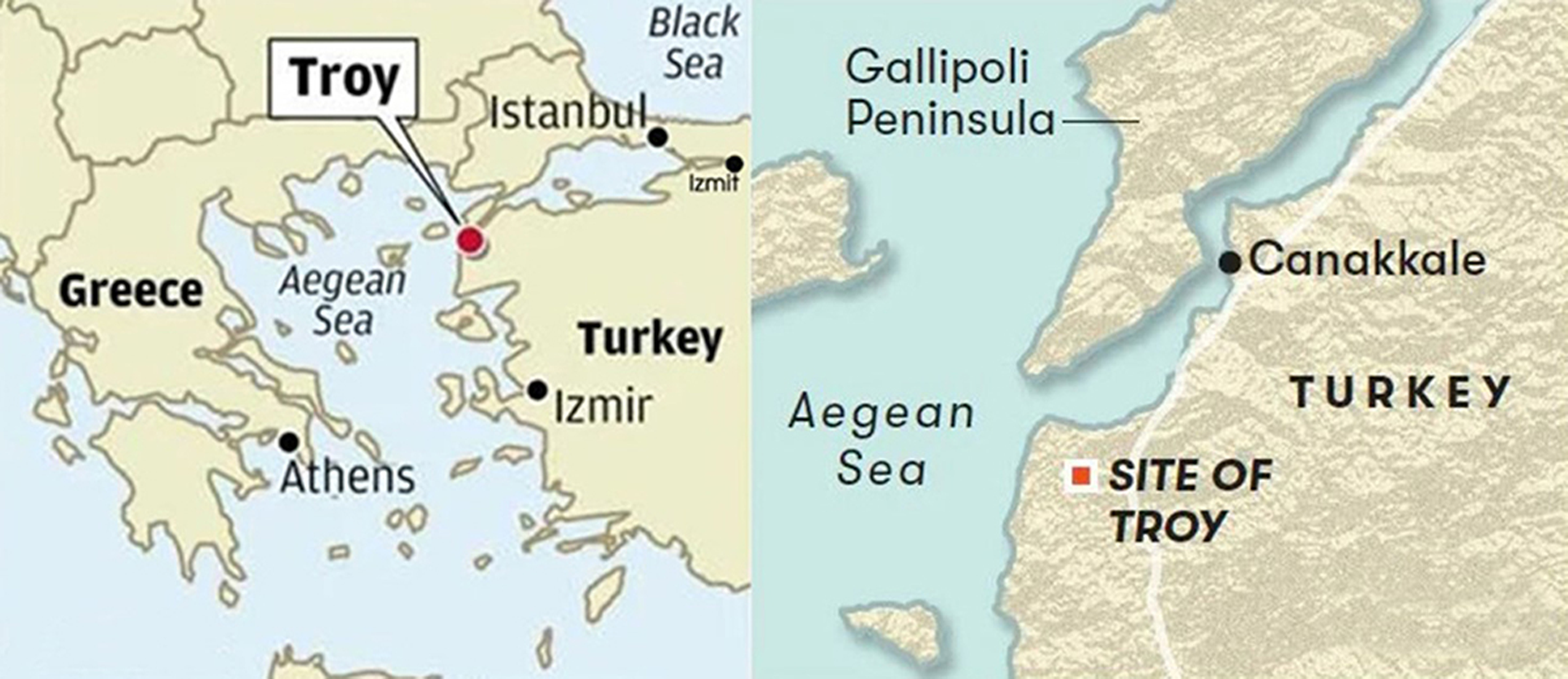
Map showing the location of the Troy (R: Large scale).
Troy's story of destruction is one of the cornerstones of Greek mythology and literature. This story is described in detail in Homer's epic work “The Iliad.” The story of Troy has also been the subject of numerous other poems and plays.
Until the late nineteenth century, scientists considered the Trojan War to be a complete myth. However, starting in 1871, Heinrich Schliemann and Frank Calvert excavated the location of the classical age town. It was noted that many of these layers resembled literary depictions of the ruins of the ancient town of Troy. Thus, it turned out that there was a grain of truth in the stories that some scientists had argued were only legends. Although the exact level of myth and reality in these stories remains unclear, subsequent excavations by others have contributed to the modern-day understanding of the ancient town of Troy. 1
Heinrich Schliemann Excavates Troy
Heinrich Schliemann was a German merchant, businessman, and amateur archaeologist. He was obsessively curious about stories of Homer and the ancient Mediterranean civilizations. His first wife was Russian. Shortly after their divorce, he married Sophia, a 17-year-old Greek student. He had two children with Sophia. His firstborn was a girl named Andromache (in reference to the wife of the Trojan Prince Hector), while his second child was a boy. Schliemann was such a fan of ancient Greece that he named him Agamemnon (in reference to the Agamemnon, the commander of the whole Achaean Army who came from Mycenae and whose brother, Menelaus, was the king of Sparta and husband of Hellen). He devoted himself to uncovering the real physical remains of the cities in Homer's epic tales. 2
In 1868, Schliemann visited places in the Greek world and published “Ithaka, der Peloponnese und Troja”, in which he claimed that Hisarlik was the site of ancient Troy. He submitted the same work as a thesis to the University of Rostock in Germany. In 1869, he received an “honorary doctorate in archaeology” from the University of Rostock. 3
When he initiated the excavations in Turkey, there was a place at Pınarbaşı, a hill at the southern end of the Troy Plain, commonly believed to be Troy.
This site was previously excavated by the British amateur archaeologist and local expert Frank Calvert. Calvert was also the Honorary Consul of the United States. Schliemann examined Pınarbaşı but was disappointed with the findings.
Calvert convinced Schliemann that Troy might be in the village of Hisarlik, suggesting that Calvert excavated the land that belonged to his family (in Turkish, “Hisarlik” refers to a location where there are the ruins of a small castle). It was already known that there are ruins of an ancient town in that region. 4
Schliemann was skeptical at first that Hisarlik could be Troy, but the initial excavation failed in its preliminary stages. He, therefore, accepted Calvert's proposal. 5 Schliemann's excavations, during which dynamite was used, were criticized by professional archaeologists in subsequent years for damaging layers believed to be Troy and many other important historical artifacts.6,7
Discovery of the treasure
Schliemann began digging in Hisarlık in 1870 and discovered nine buried towns by 1873.
On June 15, 1873, he discovered a treasure trove of gold ornaments containing thousands of artifacts, including woven golden diadems (an ornament in the form of a half crown that women wore over their foreheads), rings, bracelets, earrings, necklaces, buttons, belts, and brooches. He concluded that the cache he had discovered was the “Priam Treasures of Troy” that he had been searching for. 8
History of the Treasures
In subsequent years, professional archaeology experts claimed that Schliemann's findings could not have belonged to Priam in the Trojan War. It was stated that the treasures could be Bronze Age artifacts that dated back to 2600–2400 BC. In this case, the artifacts were 4500 years old. According to historical sources, the Trojan war mentioned in the Iliad took place in 1300–1200 BC. Homer, the author of the Iliad, was alive in 800 BC. In this case, he could not have witnessed the Trojan war. The war he described in his work was based on verbal sagas. After all, the treasure that Schliemann found was real, but it was doubtful that it had belonged to Priam, the Trojan king during the war, because the years did not match. However, the treasure is still known as the “Priam's Treasure” today.
Later, an archaeologist named Carl Blegen discovered that the place where the treasure was located was the city of Troy II. Schliemann believed that Priam was the king of Troy VI or VII hundreds of years later, so it was not possible for those treasures to belong to him.9–12
Schliemann Smuggles the Treasure from Turkey
Schliemann wrote an article in the newspaper “Allgemeine Zeitung” published in Augsburg in which he described the discovery of the Trojan treasures and their smuggling out of Turkey. The article aroused excitement in the world of archaeology and outrage in the Turkish state.13,14
The Turkish Empire (Ottoman Empire) granted Schliemann the first excavation permit on June 29, 1871, on the condition that the works would contribute to science and that the artifacts unearthed would be protected and exhibited. 15 Violating the permit granted to him, Schliemann smuggled the Treasures of Priam to Athens in June 1873. In April 1874, the Ottoman Empire launched the first international relics trial in the history of the world in Athens to recover the treasures. 13
It is clearly seen in his diaries that Schliemann, who also used the economic, political, and social difficulties experienced by the Ottoman society at that time to his advantage, actually intended to smuggle the relics right from the beginning of the excavations.13,14,15
Schliemann, who was found guilty by the Greek Royal Court at the end of the legal struggle that lasted about a year, avoided returning the artifacts by hiding them. Upon discovering this action, the Ottoman authorities carrying out the court process had to accept the conclusion of the case with a settlement in return for compensation in 1875 on the condition that Schliemann was no longer allowed to explore or excavate Troy. In addition, Schliemann returned some pottery artifacts other than the Priam Treasury to the Imperial Archaeological Museum in Istanbul and paid compensation.
Schliemann is Regranted Excavation Permission
Despite this decision not to grant permission for research and excavation in Troy, Schliemann managed to obtain permission to excavate four more times in 1876, followed by 1878, 1882, and 1889–90. Schliemann, taking advantage of the economic, political, and social difficulties in Ottoman society at the time, is thought to have been granted excavation permission because of political pressure or commands from high-ranking officials.13–15 Schliemann was kept under strict control during these excavations, his working conditions were made as difficult as possible, and he was not even allowed to visit the area after the excavation permit expired.
Schliemann Meets with Virchow
Rudolf Virchow was also interested in anthropology. 16 He was a founding partner of the German Society of Anthropology.
In addition, in 1869, he founded the Berlin Society for Anthropology, Ethnology, and Prehistory. He continued to be the president of the association until his death. During this time, he worked as an editor for the Zeitschrift für Ethnologie (Journal of Ethnology).
Due to his interest in archaeology and prehistory and publications and conferences, Virchow became well-known in anthropology and ethnology circles.17,18 Thanks to their common archaeological interests and scientific communication, Virchow and Schliemann became aware of each other through mutual connections and corresponded from time to time19,20 (Figure 2).
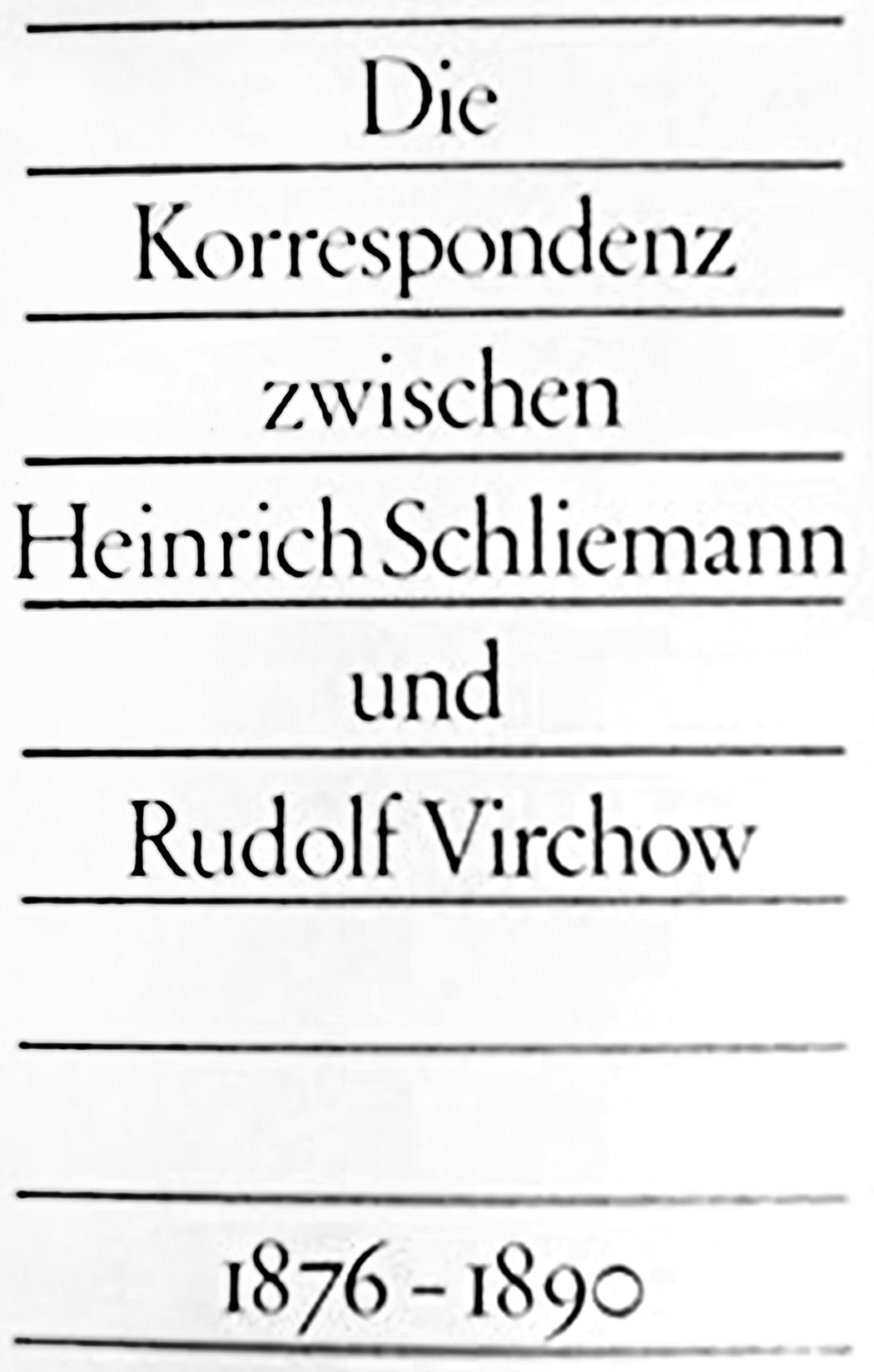
Cover of the book was compiled from Schliemann's correspondence with Virchow (Reference 20).
Moving the Treasure to Berlin
Schliemann wrote to Virchow about some of his difficulties and asked for help. A request was made for the removal of the Trojan treasures from the South Kensington Museum in London (now the Victoria and Albert Museum), where it was stored for a year. Schliemann was frightened and concerned that the Turkish government could take the treasures back.
Virchow and Schliemann first met in Athens. Schliemann asked Virchow if he could help him find a safe place for the Trojan artifacts. They met face to face in 1879. 8
Virchow went to Schliemann's home in Athens, and after the meeting, he was convinced by Schliemann's concerns (the house is now a numismatics museum). Virchow was politically powerful in Germany, was respected even by his opponents, and was a member of the Berlin City Council (City Council). He explained the situation to the Mayor of Berlin, Chancellor Bismarck, Kaiser Wilhelm, and Field Marshal von Moltke, who would later become Chief of General Staff.
The Berlin City Council convened upon Virchow's request. A reception was held in honor of Schliemann and his wife, Sophia, in the presence of Mayor Forckenbeck and council members. After this reception, the council accepted Schliemann as an honorary citizen of Berlin. Chancellor (Prime Minister) Bismarck and Marshal von Moltke gave their approval. In his speech, Virchow stated that Schliemann, who was originally German, had not lost his love and interest in his homeland despite being away from his country for 40 years (today, Schliemann's family house in Ankershagen, close to Berlin, has been converted into the Heinrich Schliemann Museum). He expressed his appreciation for being recognized as an honorary citizen of Berlin. Virchow stressed that the exhibition of Trojan treasures in Berlin would be an elevating event for the city and the country. With the approval of Kaiser William, who supported the initiative, Priam's Treasury was moved to Berlin (1879). The chronology of the Troy treasures exhibit in Berlin is as follows: 1881–1886 in the Building of the Kunstgewerbemuseum (Decorative Arts Museum) (today Martin-Gropius Bau), 1886–1920s Völkerkundemuseum (Ethnological Museum, next to Martin-Gropius Bau) and 1920s–1945 again in the Building of the Kunstgewerbemuseum (Figure 3).21,22
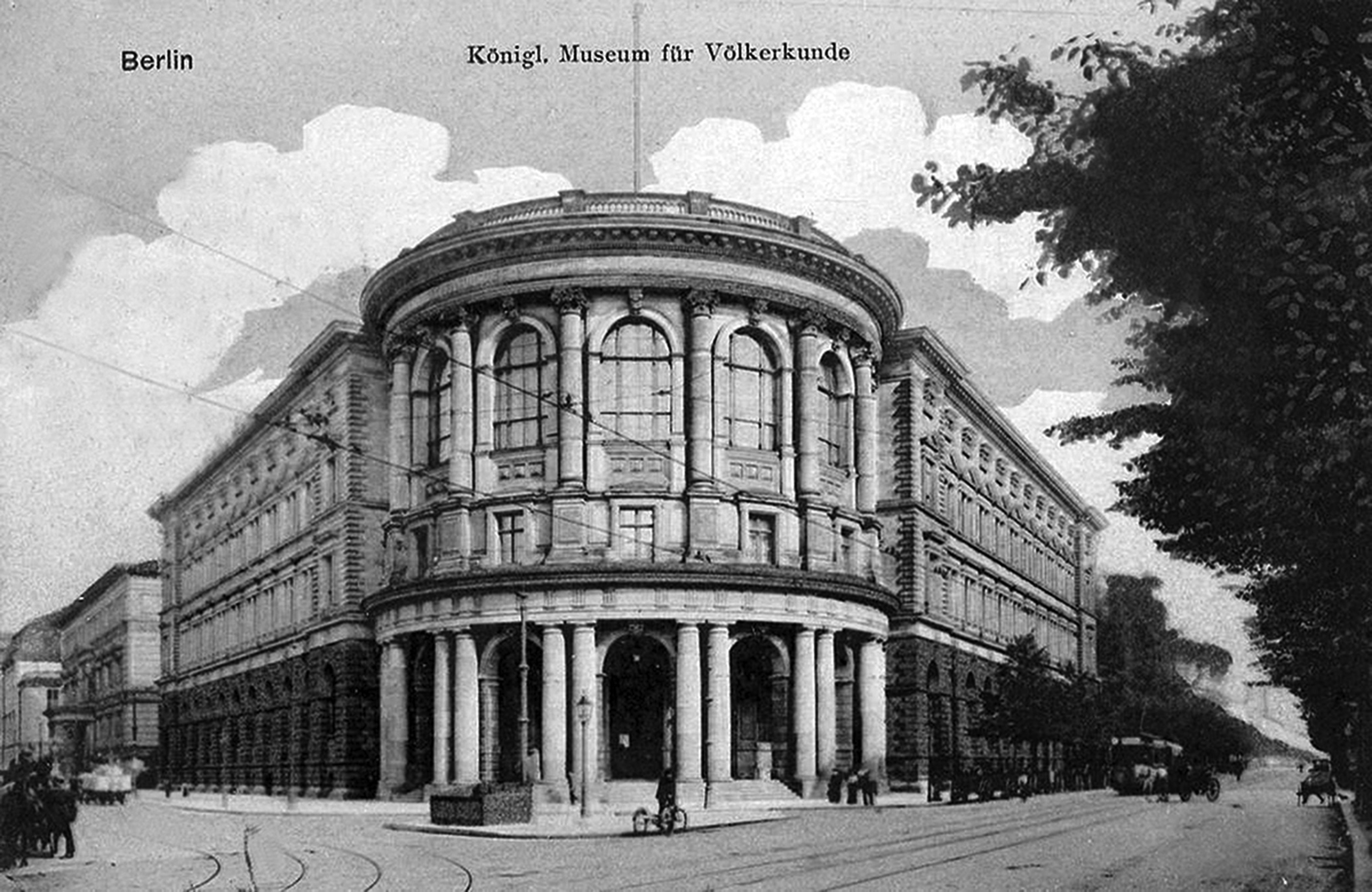
A postcard showing the first building of the ethnological museum (the Völkerkundemuseum) on Prinz-Albrecht-Straße (l.) and Königgrätzer Straße (r.) where Priam's Treasure was exhibited [this building was destroyed, but the Kunstgewerbemuseum (Decorative Arts Museum, today's Martin-Gropius Bau) is seen in the background] (Picture is dated circa 1900s, Open Access).
Virchow Arrives in Troy
Virchow arrived in Troy in 1879 to accompany Schliemann. In Schliemann's book entitled “Ilios –The City and Country of the Trojans,” Virchow wrote the preface as well as two articles in the appendix entitled “Troy and Hisarlik” and “Medical Practice in the Troad in 1879.” In the article, that is more critical in terms of the history of medicine, namely, the “Medical Practice in the Troad in 1879,” Virchow described his observations and investigations as a physician at the excavation site. In the introduction of the text, he wrote that his visit to Troy would be a break from the intensive workload in Berlin. He mentioned that he would have the opportunity to return to his secondary practice due to his other work.
Virchow, who previously examined and treated between 120 and 150 workers who experienced health problems while working at the excavation site, also saw residents of neighboring towns as his fame spread. Virchow reported that there were no physicians in the region at that time, even charlatans, and that only some Greek priests performed phlebotomy. Noting that there was no pharmacy nearby, Virchow expressed his astonishment that the residents did not use local plants such as chamomile and juniper as medicines. To treat patients, Virchow used drugs that Schliemann had previously brought in and those inside a medicine bag that a friend in Germany had sent him. He needed the Vaseline that he had brought with him for skin conditions caused by sunburn and horse riding.23–25
While Virchow's medical practice initially involved only taking care of patients who came to him, he later visited the patients in their homes. He had translation problems due to the variety of ethnic groups, such as Turkish, Greek, Bulgarian, Armenian, and Iranian, residing or working in the region; he mentioned that due to the need for translation in multilingual geography, caring for patients was a difficult and time-consuming task. Virchow interpreted the general appearance of the local people and wrote that although they lived in a malaria zone, they appeared healthier than the locals. He claimed that the reasons for the frequent occurrence of malaria in the region were the extensive swamps, reeds, and puddles as well as rapid rises in air temperature and the smelly fog. Intermittent tertian fever and splenomegaly were reported to be common among the locals. He thought that the impact of malaria in the region was not greater because people mostly lived outdoors (Author's note: In 1894, Manson found that malaria was transmitted via mosquitoes, but the name ‘malaria’ continued to be used. Dr Ross showed in the mid-1890s that malaria parasite was carried by mosquitoes. Ronald Ross received the Nobel Prize for Medicine in 1902).
Virchow wrote that during his time in the Troy region (throughout April), the days were mostly hot, but the temperature dropped to 10°C at night, and the weather was windy. He blamed this situation for the cases of colds and pneumonia among the public. He commented that some cases of tuberculosis could be attributed to the same cause and reported that infectious diseases such as smallpox, scarlet fever, measles, syphilis, and scabies were rare. He attributed this to the low interaction of the region with the outside world. On the other hand, he wrote that chronic ear and eye diseases were common due to lack of treatment. Virchow also reported an intermediate event related to folkloric medicine. He asked for a pit to be dug for geological investigation and occasionally took samples from the soil. After leaving Troy, Schliemann wrote in a letter to Virchow that his people attributed supernatural power to the pit where the water came out and that they sometimes surrounded the pit with stone to capture water and called it the ‘Physician's Spring’. At the end of his article, Virchow stated that he was pleased as a physician with his visit to Troy and the positive attitude of the people he treated (Figure 4).23–25
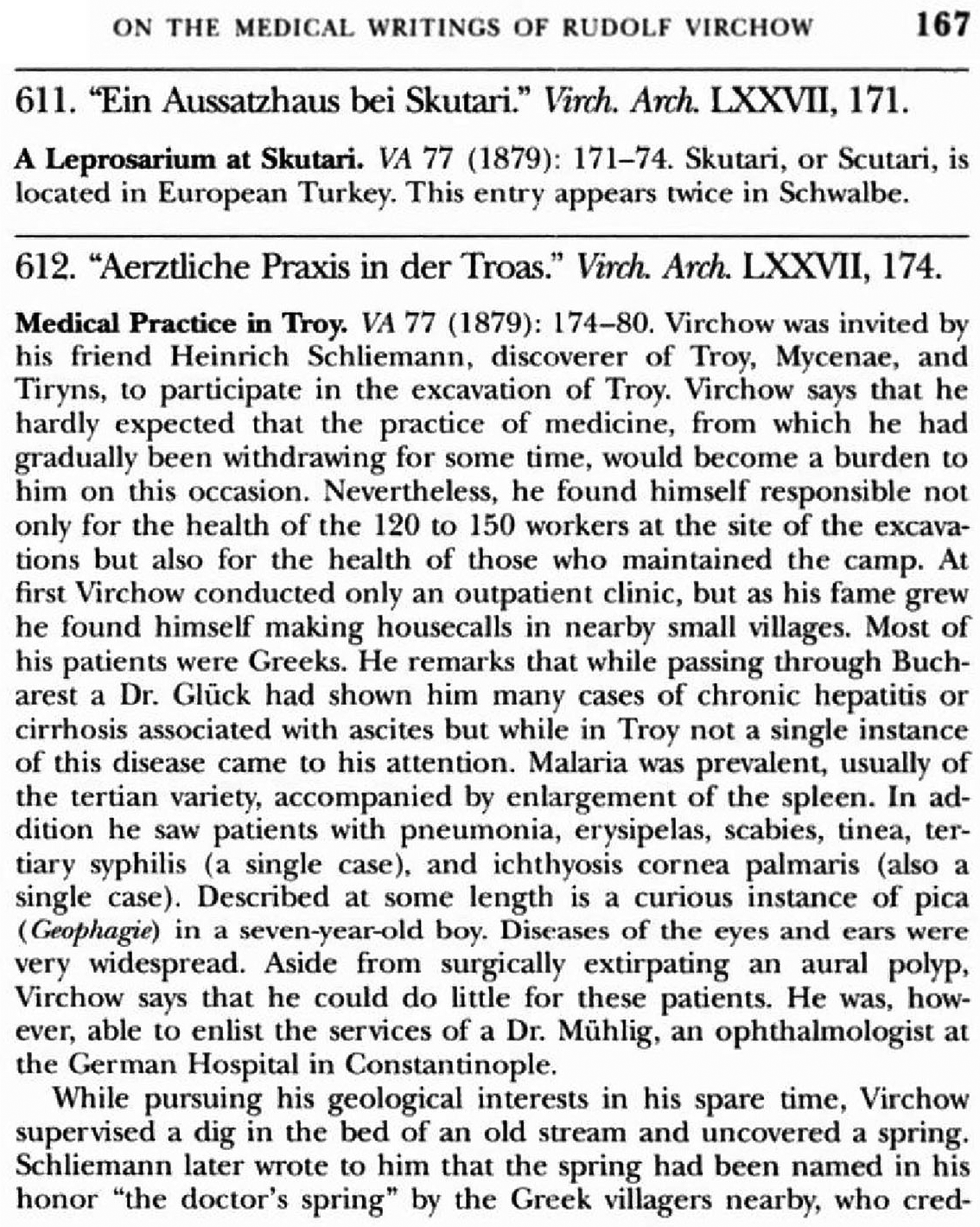
Virchow's article on his health-related observations regarding Troy (Reference 24).
Afterward
Virchow's interest in the region and his collaboration with Schliemann continued in the following years, and he wrote various articles on Troy. It is speculated that their friendship gave Schliemann the scientific stance he needed. Rudolf Virchow came to the region once again to attend Schliemann's Hisarlik Conference in 1890. In the last year of his life, he accepted the honorary presidency of an association engaged in Anatolian studies (Figure 5). 23
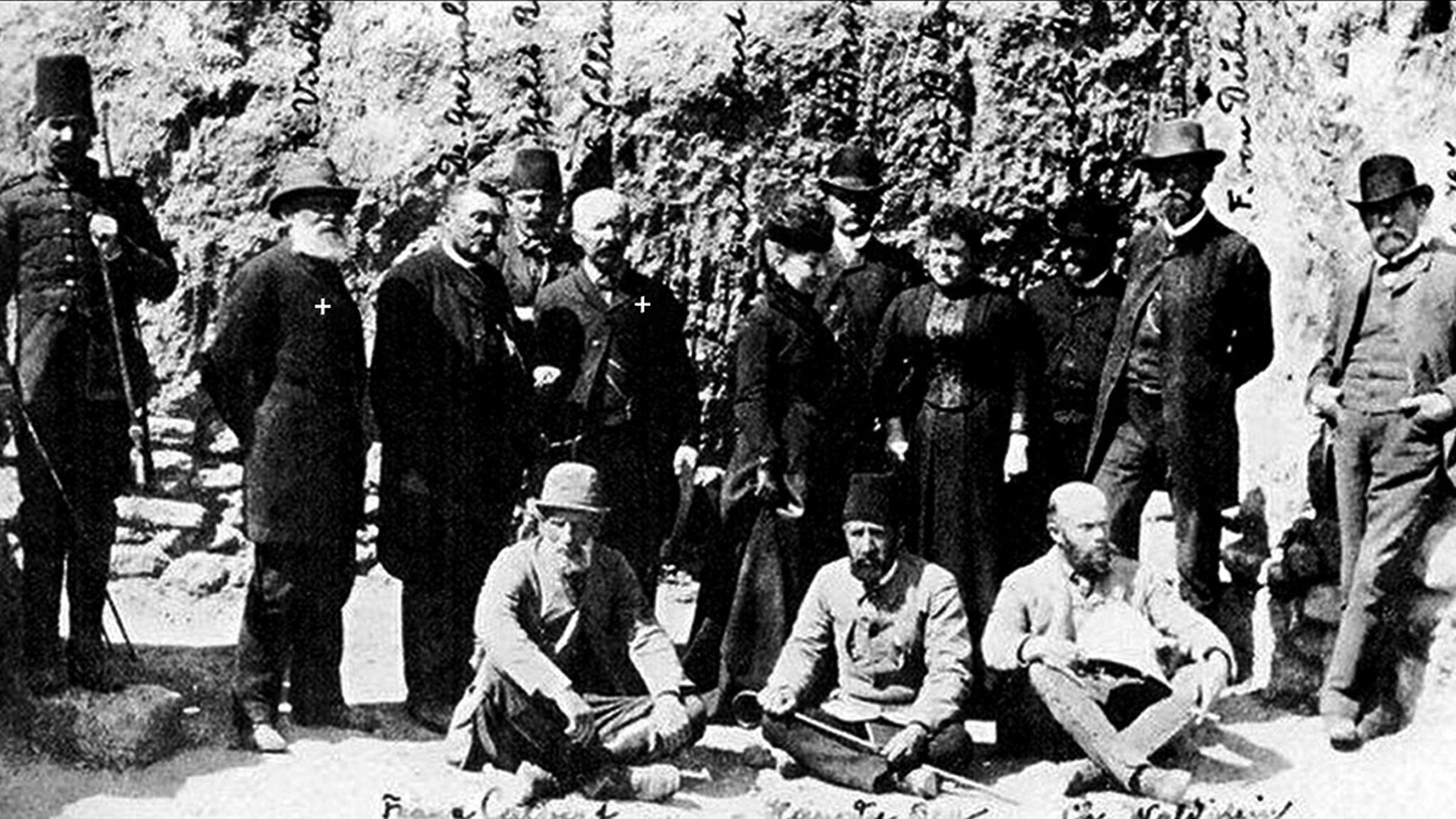
Virchow and Schliemann, 1890, with other workers at the second Troy Conference (Virchow: standing, with hat, second from left. Schliemann: fifth from left; shown with a plus sign) (Open Access).
Schliemann's Death
Schliemann had chronic otitis media. Dr Herman Schwartz in Halle, Germany operated on him. However, his complaints were not fully resolved, and his chronic otitis media turned into a cholesteatoma.
On 1 August 1890, Schliemann reluctantly returned to Athens, and on November 13, he appeared again to Dr Herman Schwartz, who had operated on him at Halle. His inner ear was painfully inflamed. He left the hospital without heeding his doctors’ advice, and his ear worsened. Schliemann was in Naples. Despite his worsened condition, he traveled to the ruins of Pompeii. He fell into a coma on Christmas Eve in 1890 and died the next day in a hotel room in Naples. The cause of death was attributed to the infected cholesteatoma giving rise to a cerebral abscess.
His body was later transported by his friends to the First Cemetery in Athens. He was buried in a mausoleum in the form of a temple erected in the ancient Greek style, designed by architect Ernst Ziller in the shape of an amphiprostyle temple on a tall pedestal. In March 1891, a memorial meeting was held for Schliemann at the Berlin City Hall under the leadership of Virchow and the two men's mutual friend, archaeologist/historian Ernst Curtius (Figure 6).
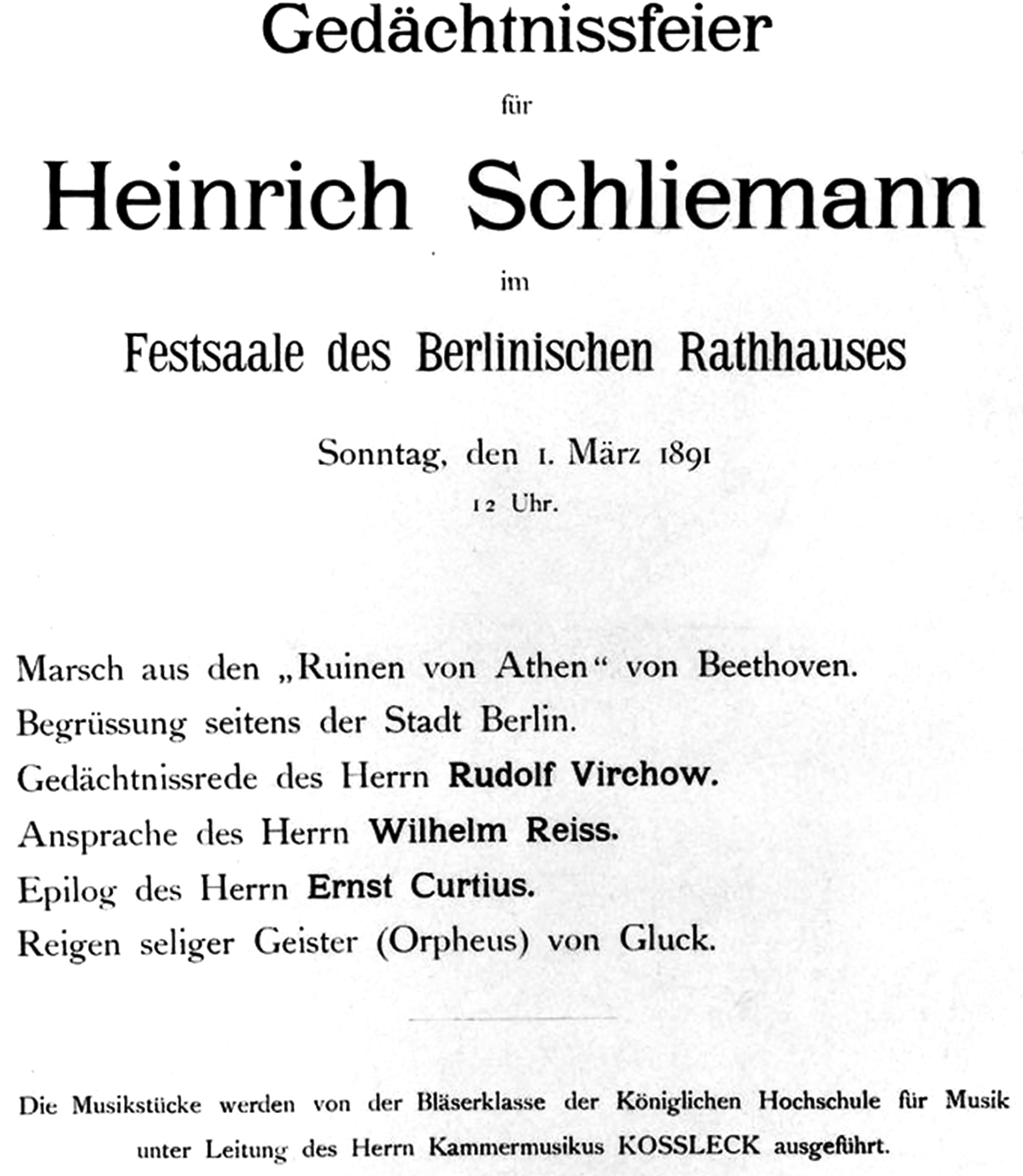
Commemorative meeting program by Virchow held at the Berlin City Hall following Schliemann's death (open access).
Virchow lived 12 years longer than Schliemann. He died at the age of 81 (in 1902 while trying to exit a still-in-motion electric tram that had recently been brought to Berlin, he fell and suffered a femoral fracture. The fracture did not heal completely, and Virchow remained in bed for a long time. He died of related complications).
With his death, Germany and the world of science lost a prominent pathologist, anthropologist, ancient history expert, sanitarian, and liberal politician.
The Treasure Disappeared in Berlin and Reappeared in Moscow
Toward the end of the Second World War, Germans hid the treasure under the Berlin Zoo. Dr Wilhelm Unverzagt, Director of the Museum of Prehistory and Early History in Berlin, hid some of the museum's valuable artifacts in room 11 of the anti-aircraft tower in the zoo. Among these artifacts was the chest containing Priam's Treasure. After the capture of the tower by the Soviet Army forces on May 1, 1945, the Russians found the treasure, and when delivering it, Dr Unverzagt asked the commander of the Soviet Red Army Special Forces (SMERSH) to protect the treasure. According to Akinsha and Kozlov, 26 Unverzagt “thought it would be better to hand over the works of art to the enemy's military official because he might return them in future, rather than fall into the hands of thieves and looters.” After the war, Dr Unverzagt lived in East Berlin and founded the Institute for Pre- and Early History in the German Democratic Republic (DDR), dying in East Berlin in 1971.
No more news of the treasure was heard, and it was believed that it had been lost after the war. After the war, the Germans began searching for the collection, but its whereabouts were unknown until 1994. The director of the Pushkin Museum stated that “only two people in the world knew where it was: the director of the Pushkin Museum and the collection curator.” 27
The Germans wanted to reclaim the treasure, but the Russians refused because it was considered “war reparations.” Priam's Treasure is currently exhibited in Moscow.
Pushkin Museum (first floor, Hall 3). 28 Diplomatic negotiations are being carried out to bring the works exhibited in the Pushkin Museum to Turkey. However, no agreement has yet been reached.
Conclusion
Schliemann was an amateur archaeologist who unearthed Trojan treasures. Virchow was recognized as a distinguished pathologist and versatile scientist who brought Trojan treasures to Berlin and kept them safely displayed there. However, Schliemann is remembered in the collective memory of the international archaeological community as the person who smuggled treasures out of their country of origin without notice or permission.
Footnotes
Acknowledgements
I would like to thank Dr Bernhard Heeb (Curator, Department of Ancient Archeology, Neues Museum, Berlin) for the information provided on the museums where Priam's Treasure was exhibited in Berlin between 1881 and 1945.
Authorship Contribution Statement NP
Conceptualization, visualization, data curation, and writing and reviewing of the original draft.
Compliance with Ethical Standards
The author declares that the ethical standards were followed in accordance with the Helsinki Declaration of 1975. The paper reflects the author's own research and analysis in a truthful and complete manner. The results are appropriately placed in the context of prior and existing research.
Declaration of Conflicting Interests
The author(s) declared no potential conflicts of interest with respect to the research, authorship, and/or publication of this article.
Ethical Approval
No human or animal material was used. This study was exempt from institutional ethics committee approval, as it was a retrospective study based on an archival and web search.
Funding
The author(s) received no financial support for the research, authorship, and/or publication of this article.
Trial Registration
Not applicable, because this article does not contain any clinical trials.
Informed Consent
Not applicable, because this article does not contain any studies with human or animal subjects.
