



Abstract
During late 2021 in Germany (November–December), we conducted a quantitative cross-sectional study of parents (N = 180) during the third wave of school closures. Parental stress was assessed with a global single item and a brief PSI-adapted index of distance-learning stress. Using Spearman's rank correlations and Kruskal–Wallis tests, parental stress correlated strongly with time-related stress (ρ = −.52, p < .001). Parents assisting with schoolwork for ≥3 hr per weekday reported higher stress than those assisting for <1 hr (Kruskal–Wallis H(2) = 6.16, p = .046); 38.3% scored ≥3 (“rather/very much”) on the global stress item. Structural markers showed limited associations. Findings align most closely with transactional appraisal-and-coping perspectives and highlight the value of support that reduces time pressure and stabilizes school routines for families.
Theoretical Background and Research Question
Structural and Situational Factors Influencing Parental Stress During School Disruptions
The advent of the Coronavirus pandemic precipitated an unparalleled paradigm shift in family life. The closure of educational institutions necessitated an augmentation of parental roles, compelling many to assume the responsibilities of home educators and full-time caregivers. A large number of studies have documented the psychosocial burdens experienced by families during such disruptions, especially in cases where educational responsibilities overlap with employment demands (Prime et al., 2020; Spinelli et al., 2020).
The present study focuses on data collected after the acute lockdown in late 2021, when schools in Germany had formally reopened. Nevertheless, in conjunction with the persistent uncertainties surrounding the pandemic, the recurrent occurrence of absences related to quarantine measures has resulted in the continued disruption of established routines. This state of affairs gave rise to a “chronic disruption” scenario, which differs from a complete lockdown and merits independent investigation (Mönch, 2022).
Notably, unlike the winter of 2020/2021, the winter of 2021/2022 was marked by increased political and scientific consensus regarding the harmful effects of school closures on children and families. The availability of vaccines, more effective containment strategies, and accumulating research findings led to a strong policy imperative to keep schools open wherever possible. This context makes it particularly relevant to examine whether the political determination to maintain in-person schooling and restore daily structure mitigated parental stress levels.
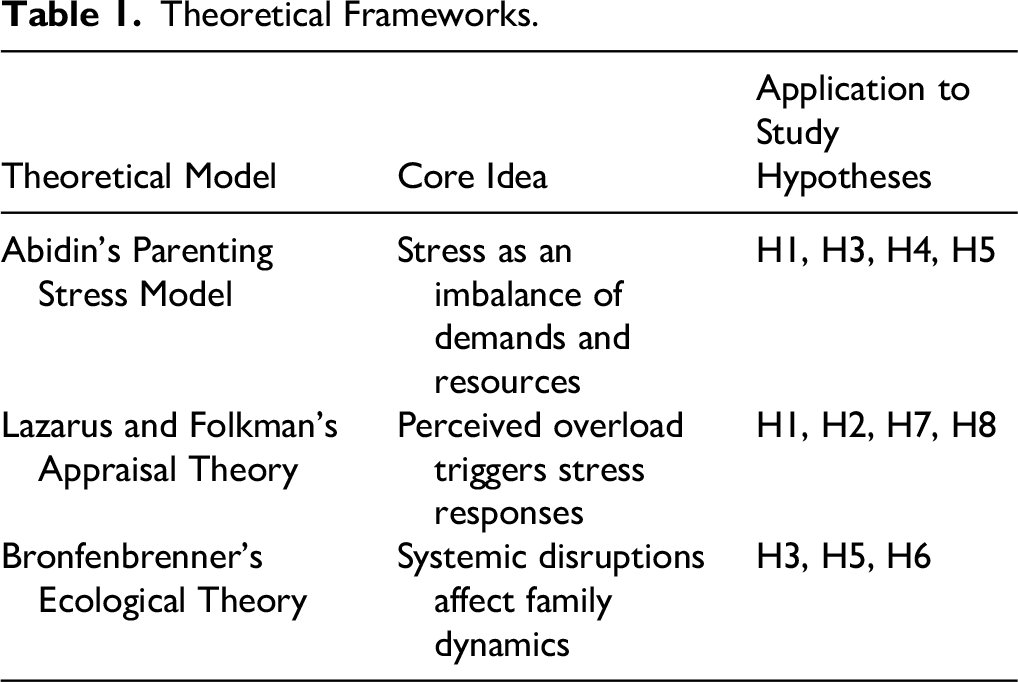
This study draws on three interrelated yet distinct frameworks to comprehensively understand parental stress during late pandemic schooling. Abidin's model highlights the interplay between parent, child, and contextual demands; Lazarus and Folkman's model emphasizes cognitive appraisal and coping processes; and Bronfenbrenner's ecological approach situates stress within broader social systems.
Which structural and situational factors influenced parental stress during school-related COVID-19 disruptions in late 2021?
This study is grounded in three key theoretical perspectives:
Abidin's Parenting Stress Model (1995) frames stress as a multidimensional phenomenon stemming from interactions between child characteristics, parental factors, and external demands. Increased stress is anticipated when cumulative demands exceed available supports.
Lazarus and Folkman's Transactional Stress Model (1984) emphasizes cognitive appraisal: stress arises when parents perceive that pandemic-related demands (e.g., remote schooling, childcare, work obligations) exceed their coping resources.
Bronfenbrenner's Ecological Systems Theory (1979) offers a multilayered understanding of stress, acknowledging how macro-level factors like school policies and pandemic regulations cascade into microsystem dynamics within the home.
These frameworks jointly explain why some parents were especially vulnerable to elevated stress during the pandemic: the interaction of preexisting family structure (e.g., number of children, household composition, employment) and acute situational burdens (e.g., remote work, quarantines, lack of school support) compounded their overall strain (May et al., 2021; May & Hoerl, 2022). Table 1 provides an overview of how each framework informs our research hypotheses.
Theoretical Frameworks.
Structural and Situational Predictors of Parental Stress
Structural characteristics such as family composition and employment conditions have consistently been associated with parental stress. Single parents often report elevated stress, largely due to a lack of shared caregiving responsibilities (Cameron et al., 2022). Similarly, larger families may experience cumulative pressures because of increased educational and emotional demands (Brown et al., 2020). Work-related constraints—such as long hours, low flexibility, or job insecurity—have also been shown to intensify distress (Wößmann et al., 2023), particularly when parents must simultaneously manage employment and caregiving duties (Fan & Moen, 2024).
Situational stressors that emerged during school closures further amplified parental strain. Remote work blurred the boundaries between job and family roles, creating an overwhelming need to “teach, parent, and work” simultaneously (Fan & Moen, 2024). These conditions align with Lazarus's appraisal theory, which posits that stress escalates when individuals perceive their coping resources as insufficient. Inconsistent or absent educational support from schools exacerbated the burden, particularly when parents lacked instructional guidance or live interaction with teachers (May & Hoerl, 2022; Spinelli et al., 2020). Conversely, reliable school communication helped mitigate these effects.
Among the strongest predictors was time burden: many parents reported spending several extra hours per day on schooling-related tasks (Wößmann et al., 2023). This unpaid care work has been closely linked to emotional exhaustion and burnout symptoms (Prime et al., 2020).
Study Aim and Contribution
Building on the theoretical foundations outlined above, this study aims to empirically investigate how structural and situational factors contribute to parental stress during prolonged school disruptions.
While early pandemic studies have focused on the initial lockdown periods, little is known about how families managed the protracted, unstable schooling phase in late 2021. This study addresses this gap by exploring stress-relevant structural and situational predictors in a large German sample, using nonparametric statistical techniques. The results help differentiate between acute crisis responses and more sustained adaptation processes, thereby offering valuable insights for educational policy and psychosocial support strategies.
Building on prior findings that link parenting stress to children's emotional regulation and parental educational efficacy (Abidin, 1995; May et al., 2021; Spinelli et al., 2020), this study investigates five main predictors: time spent helping with homework, perceived time stress, employment status, family structure, and number of children.
Based on these variables, the following hypotheses were derived to guide the empirical analysis:
Hypotheses
Parental stress would increase with more time spent assisting with homework.
More time helping with homework would be associated with greater time-related stress.
Parents in more demanding or uncertain work situations would report higher stress levels.
Having more children would be associated with greater parental stress.
Stress levels would vary across family structures (e.g., married, single parent, shared custody).
Time-related stress would differ by employment status (e.g., full-time vs. part-time).
Perceived time investment and parental stress would be positively correlated.
Parental stress and time-related stress would be positively correlated.
This article aims to test these hypotheses using nonparametric statistical methods and a dataset collected from German parents during the second COVID-19 school closure period in late 2021.
Method
Sample
A total of 180 parents (75% mothers, 25% fathers; M_age = 39.8 years, SD = 6.1) participated via an online panel in November–December 2021. Recruitment targeted a broad sociodemographic spectrum, but the resulting sample was higher educated. Regarding family structure, the majority of participants (n = 157, 87.2%) lived in two-parent households, while 10.0% (n = 18) reported being single parents, and 2.8% (n = 5) indicated a shared custody arrangement.
Concerning education, 74.4% of participants (n = 134) had completed the Abitur (A-Level) or an equivalent qualification, and 64.4% (n = 116) held a university degree. Concerning employment, 60.0% (n = 108) were employed full-time, 25.0% (n = 45) part-time, and 10.6% (n = 19) were marginally employed. Most respondents (n = 126, 70.0%) were salaried employees, followed by civil servants (n = 24, 13.3%) and self-employed individuals (n = 16, 8.9%).
Materials and Measures
The survey instrument included a combination of previously validated and newly developed items aimed at capturing the multifaceted stress experience of parents during pandemic-related disruptions to schooling. All questions were part of a standardized online questionnaire derived from prior study waves (May & Hoerl, 2022), while new items were developed to address specific situational dynamics during the late 2021 lockdown phase.
Parental stress (global). We assessed parents’ stress due to schooling at home with a single item, rated on a 4-point Likert scale from 1 (“not at all”) to 4 (“very much”); higher scores indicate greater stress. Because this is a single-item indicator, internal consistency is not applicable. Single-item global stress measures are widely used in large-scale crisis surveys to minimize burden while retaining face validity (e.g., Fuchs & Diamantopoulos, 2009; Wanous et al., 1997). To support construct validity, we examined convergent and criterion associations (see the results and supplement sections).
Stress during distance learning (PSI-adapted). We assessed situational parenting strain during home schooling with three items adapted from the Parenting Stress Index (PSI/PSI-SF; Abidin, 1995; Tröster, 2011). Items were rated on a 5-point scale and averaged to a composite (higher scores = more stress). Internal consistency in this sample was α = .85. To support construct validity, we examined associations with time-related stress and known-groups differences by parental assistance hours (see Results).
Time-related stress. A single item (1–4) captured perceived time pressure. Higher values indicate greater time stress.
Parental assistance time: Parents reported the typical number of hours per weekday spent assisting with schoolwork (open-ended, hours).
Child self-regulation (SRL). A brief seven-item set (e.g., motivation, planning, technology use, explaining, knowledge, self-control) was used (1–4). Internal consistency in this sample was α = .83 (n = 180). A composite (mean) score was computed.
The survey also collected demographic and contextual data:
Family structure (two-parent household, single-parent, shared custody) Number of children Employment status (e.g., full-time, part-time, marginal, unemployed) Occupational type (e.g., salaried employee, civil servant, self-employed) General education (e.g., Hauptschule, Realschule, Abitur) Professional qualification (e.g., apprenticeship, university degree)
All categorical responses were numerically coded to enable statistical analysis. The survey was administered via a secure online platform optimized for desktop and mobile devices. The average completion time was approximately 15 to 20 min.
Procedure
The data were collected in November and December 2021 as part of the third wave (T3) of a longitudinal study on family stress during the COVID-19 pandemic. The T3 follow-up focused on residual and situational stress after major school closures had ended, but pandemic-related challenges (e.g., quarantine-related teacher absences) persisted in daily school routines.
Participants from the second wave (T2) in early 2021 were recontacted and invited to participate in this follow-up. Additional recruitment was conducted via school mailing lists, social media platforms, and parent advocacy groups to ensure sample diversity. The online questionnaire was administered via the German survey platform Umfrageonline.com and required approximately 15–20 min to complete.
Informed consent was obtained from all participants prior to the start of the survey. According to institutional and national guidelines, no formal ethics approval was required for this study. The study adhered to the ethical standards of the German Psychological Society and the Declaration of Helsinki. Participant anonymity was assured, and individuals could withdraw from the study at any time.
Statistical Analysis
All statistical analyses were conducted using R (Version 4.5.0; R Core Team, 2025). Descriptive statistics were calculated for all relevant demographic and study variables, including child age (M, SD), gender of the reporting parent (frequencies and percentages), general and professional education (medians), working hours (median), and employment type (median). Ordinal variables were summarized using medians and interquartile ranges, while metric variables were summarized using means and standard deviations.
Because key variables were ordinal, we used Spearman correlations and Kruskal–Wallis tests. For the single global item, we prespecified validity checks (convergent/correlational; known-groups by assistance hours) and robustness across codings (ordinal vs. standardized vs. dichotomized).
Prior to all inferential analyses, missing data were removed using listwise deletion. All variables were checked for nonnormal distributions and outliers.
To test group differences in parental stress and time-related strain, nonparametric Kruskal–Wallis tests were applied due to the ordinal scaling of the items and nonnormality of residuals. Significant omnibus results were followed up with Bonferroni-corrected post hoc comparisons. Effect sizes for Kruskal–Wallis tests were calculated using epsilon squared (
Associations between stress-related variables (e.g., perceived parental stress, time stress, time investment, employment context, and family structure) were examined using Spearman's rank-order correlations (ρ). These tests were chosen due to the ordinal nature of the data and the presence of tied ranks. R's built-in procedures handled tied ranks by using average ranks and provided asymptotic p-values. Only complete cases were used in correlational analyses.
Results
Descriptive Statistics
Descriptive statistics regarding the sample's sociodemographic background are reported in the Participants section.
Descriptive statistics for all focal variables are presented in Table 2.
Descriptive Statistics of Study Variables.
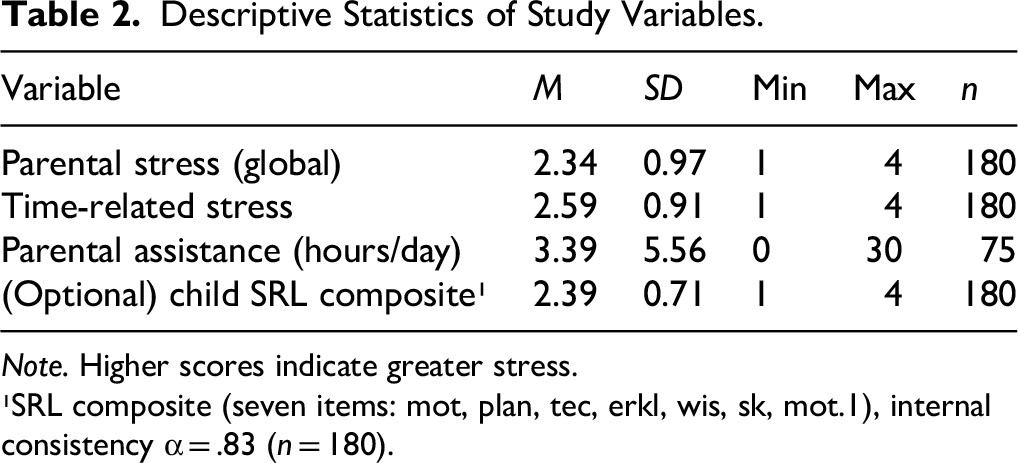
Note. Higher scores indicate greater stress.
¹SRL composite (seven items: mot, plan, tec, erkl, wis, sk, mot.1), internal consistency α = .83 (n = 180).
The PSI-adapted distance-learning stress scale showed good internal consistency (α = .85). Convergent validity was supported by its association with time-related stress (ρ = −.52, p < .001; n = 180). Known-groups validity was indicated by higher distance-learning stress among parents assisting ≥3 hr/day versus <1 hr/day (Kruskal–Wallis H(2) = 6.16, p = .046; medians: < 1 hr = 2, 1–<3 hr = 2, ≥ 3 hr = 3; n: 8/48/19). Robustness across ordinal, standardized, and dichotomized codings was confirmed (Pearson on z-scores r = −.52; Mann–Whitney z = 6.29, p < .001).
Validity Checks for the Global Single Item
The global parental-stress item (distance-learning stress) correlated with time-related stress (ρ = −.52, p < .001; n = 180). Parents reporting ≥3 hr/day assistance showed higher global stress than those <1 hr/day (Kruskal–Wallis H(2) = 6.16, p = .046; medians: < 1 hr = 2, 1–<3 hr = 2, ≥ 3 hr = 3; n: 8/48/19). All key associations were robust across ordinal, standardized, and dichotomized codings of the single item (Pearson on z-scores r = −.52; dichotomized ≥3 vs. ≤ 2 on global stress: Mann–Whitney z = 6.29, p < .001).
Correlational and Group Difference Analyses
H1: We hypothesized that parental stress would increase with more time spent assisting with homework. This hypothesis was supported, as a moderate positive correlation was found between stress and homework support time, ρ = .36, p < .001, indicating that parents who invested more time helping with homework also reported higher stress levels. This finding is consistent with pandemic-era research showing that elevated time demands for supervising children's schoolwork were associated with significant parental stress levels (Jungmann et al., 2021). In Abidin's parenting stress model, this reflects a classic demand-resource imbalance. Coping strategies such as temporal structuring or shared responsibilities may help buffer these effects.
H2: We assumed that more time spent helping with homework would be associated with greater time-related stress. Contrary to this hypothesis, results revealed a weak but significant *negative* correlation, ρ = –.16, p = .038, suggesting that longer time investments were associated with slightly lower levels of perceived time pressure. One possible explanation is that parents who invested more time were able to implement structured routines or engage in effective temporal coping, thus perceiving less time-related strain (Jungmann et al., 2021). Alternatively, this may indicate a disengagement strategy, where overwhelmed parents reduced their educational involvement to conserve emotional energy (Lazarus & Folkman, 1984).
H3: We expected that parents’ current living and working situation (e.g., remote work) would positively affect perceived stress. This hypothesis was supported, ρ = .32, p < .001, indicating that parents in more demanding or uncertain circumstances experienced higher stress levels.
H4: We hypothesized that more children would be associated with greater parental stress. This hypothesis was not confirmed, ρ = .02, p = .765, indicating no significant relationship between family size and stress.
H5: We assumed that stress levels would differ by family structure. A Kruskal–Wallis test did not reveal significant differences, H(2) = 3.69, p = .158. Thus, this hypothesis was not supported. This finding aligns with ecological models which suggest that family structure alone is not a sufficient predictor of stress (Bronfenbrenner, 1979). Instead, contextual factors such as support networks, self-imposed routines, and coping flexibility mitigate stress in single-parent and two-parent households (Abidin, 1995).
H6: We hypothesized that time-related stress would vary depending on employment status. A significant Kruskal–Wallis test supported this, H(2) = 7.41, p = .025, with post hoc tendencies indicating higher time-related stress among part-time working parents.
H7: We expected that perceived parental stress would be positively associated with perceived overall time investment. This hypothesis was not supported, ρ = .09, p = .448, indicating no significant correlation between these perceptions. This supports the notion that perceived time scarcity, rather than absolute time spent, drives stress in caregiving contexts. Research has shown that reframing time investment as meaningful or developmentally important may protect against the emotional burden of overcommitment (Milkie et al., 2018).
H8: We hypothesized that parental and time-related stress would be positively correlated. In contrast, the data revealed a strong negative correlation, ρ = –.52, p < .001, suggesting that higher general stress levels were associated with lower perceived time stress, potentially due to adaptation mechanisms or cognitive reframing. This unexpected finding may reflect functional disengagement, whereby globally overwhelmed parents deliberately reduce their educational responsibilities to preserve coping capacity (Lazarus & Folkman, 1984). Alternatively, it could reflect reframing processes that deprioritize school-related time stress within a broader stress ecology (Milkie et al., 2018).
Visual Summary of Key Findings
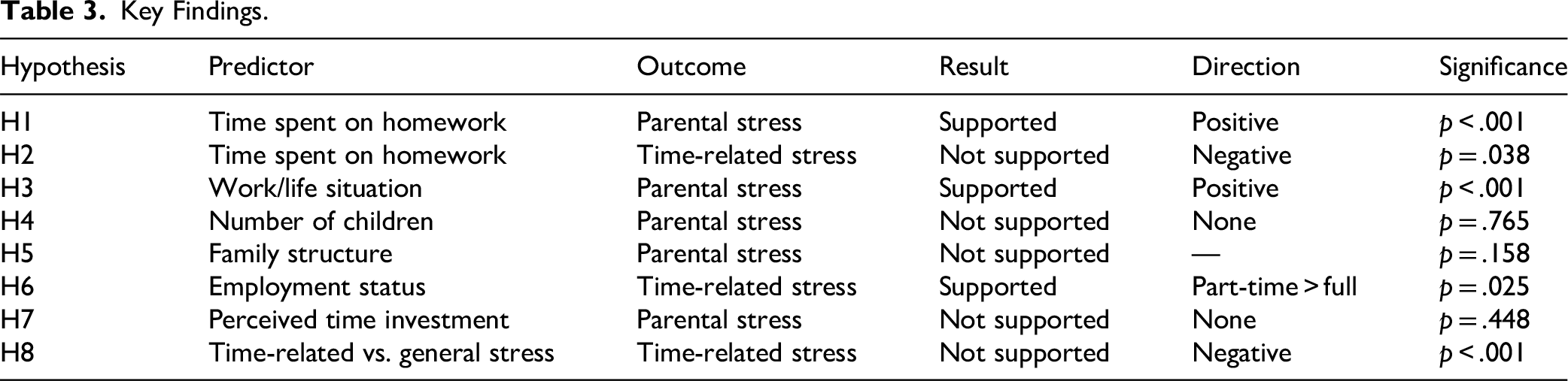
Table 3 summarizes the statistical outcomes for all eight hypotheses, including predictors, outcomes, directions of effects, and significance levels.
Key Findings.
Discussion
This study examined the influence of structural and situational predictors on parental stress during late-phase pandemic schooling in Germany. The results offer several key insights that can be discussed in relation to supported and unsupported hypotheses, as well as the guiding theoretical frameworks.
The pattern of findings is most consistent with Lazarus and Folkman's transactional account, emphasizing appraisal of demands (time burden) and coping. There is secondary support for Abidin's demand-resource perspective via caregiving load. Macro-structural factors highlighted in Bronfenbrenner's framework were less predictive in this dataset, suggesting the need to model mediators (e.g., daily routines, school support) in follow-up work.
Findings Supporting Hypotheses
H1 and H3 were clearly supported: time spent assisting with homework and demanding work/life situations were both positively associated with parental stress. These findings align with Abidin's parenting stress model, which emphasizes the overload created by excessive demands, and with Lazarus and Folkman's transactional model, in which perceived overload triggers stress responses. The persistent nature of educational responsibilities during this time of chronic disruption—though schools were formally open—meant that many parents continued to juggle caregiving and work, often without clear boundaries or adequate support. These results confirm that time demands and work-related constraints remain potent stressors beyond the acute lockdown phases.
H6 also received support, as time-related stress differed significantly by employment status. Part-time workers reported the highest levels of time pressure, which could reflect the double burden of reduced working hours (often linked to increased caregiving responsibilities) combined with limited structural support.
Findings Contrary to Hypotheses
Unexpectedly, H2, H7, and H8 were not supported—and in fact, indicated inverse associations. Parents who spent more time helping with schoolwork (H2) or experienced higher general stress (H8) reported lower time-specific stress. These counterintuitive results may reflect adaptive coping strategies such as routinization or reframing: parents under sustained pressure may have implemented time-saving routines or disengaged from overly burdensome educational supervision. Rather than interpreting these findings as statistical anomalies, they suggest differentiated stress regulation strategies under chronic strain, aligning with Lazarus and Folkman's model of cognitive reappraisal and Bronfenbrenner's concept of system-level adaptation.
In line with this, H7 (time investment
Findings Not Confirming Structural Hypotheses
H4 and H5, which predicted associations with number of children and family structure, were not supported. These null findings underscore Bronfenbrenner's ecological argument that structural variables alone cannot explain stress outcomes without accounting for mediating processes such as social support, routine stability, or self-efficacy. Even in single-parent households or larger families, internal coping and contextual buffers may prevent elevated stress levels.
The observed difference in time-related stress by employment status should be interpreted with caution. The dataset does not include household income or forced-reduction status; thus, financial or contractual mechanisms cannot be tested directly. We outline selection/time-squeeze and salience mechanisms as plausible explanations and plan to include income bands and reduced-hours items in the follow-up.
Conclusion and Outlook
The results suggest that prolonged educational disruption creates unique patterns of parental stress that cannot be fully captured by examining time investment or family structure in isolation. Instead, stress appears to arise through the complex interplay of situational burdens, perceived demands, and coping mechanisms. These insights point to the need for policies that do not only reduce time demands but also strengthen parental agency and coping through predictable school support, accessible counseling services, and structural relief options.
Future research should examine these coping adaptations in more detail—ideally through mixed-method designs that illuminate the cognitive and behavioral mechanisms behind observed correlations. This would enhance our understanding of how families navigate prolonged disruption phases and help design tailored interventions.
Overall, our findings highlight the critical role of differentiated, theory-informed perspectives on stress in long-term pandemic recovery efforts.
Limitations
Several limitations must be acknowledged. First, the cross-sectional design limits causal inference; the directionality of effects between stress and predictors (e.g., time investment) remains speculative. Second, the reliance on self-report data, particularly from a predominantly higher-educated sample, may introduce bias due to social desirability or selective participation. Third, while we aimed to capture diverse family contexts, structural underrepresentation (e.g., of low-income or immigrant households) limits the generalizability of findings. Finally, some constructs (global parental stress; time pressure) were assessed with single items to reduce burden. While this precludes internal-consistency indices, we provided convergent, criterion, and robustness evidence. Future waves will include multi-item scales for global parental stress.
Practical Implications
Despite these limitations, the findings carry important implications for educational policy and family support programs. First, schools should maintain consistent, low-threshold communication structures—even during partial closures or quarantine phases—to reduce ambiguity and empower parents. Second, time relief through flexible work arrangements, targeted subsidies, or school-based homework support can buffer parents from overload. Third, interventions should not only target objective demands but also support subjective coping strategies—such as time reframing, stress appraisal training, and parental self-efficacy. Finally, support structures must acknowledge the long-term nature of pandemic stress, providing continuity rather than one-time crisis responses.
Future Research Directions
Future research should replicate these findings with longitudinal data and include pre- and postpandemic comparisons to better understand long-term stress trajectories in families. Mixed-method designs could further elucidate the mechanisms behind some counterintuitive associations, such as the inverse link between general and time-specific stress (Biddle & Edwards, 2021).
Moreover, future studies should examine the impact of digital supports, such as virtual school platforms or telehealth access, on buffering family stress during educational crises (Singh et al., 2020; Tang et al., 2021).
To understand changes in parental stress throughout the pandemic, we are currently preparing a follow-up analysis comparing the present data (T3) with earlier assessments (T2).
Supplemental Material
sj-xlsx-1-tfj-10.1177_10664807251396944 - Supplemental material for Persistent Disruption, Persistent Stress? Parental Burden During Late Pandemic Schooling
Supplemental material, sj-xlsx-1-tfj-10.1177_10664807251396944 for Persistent Disruption, Persistent Stress? Parental Burden During Late Pandemic Schooling by Isabelle May in The Family Journal
Supplemental Material
sj-R-2-tfj-10.1177_10664807251396944 - Supplemental material for Persistent Disruption, Persistent Stress? Parental Burden During Late Pandemic Schooling
Supplemental material, sj-R-2-tfj-10.1177_10664807251396944 for Persistent Disruption, Persistent Stress? Parental Burden During Late Pandemic Schooling by Isabelle May in The Family Journal
Supplemental Material
sj-pptx-3-tfj-10.1177_10664807251396944 - Supplemental material for Persistent Disruption, Persistent Stress? Parental Burden During Late Pandemic Schooling
Supplemental material, sj-pptx-3-tfj-10.1177_10664807251396944 for Persistent Disruption, Persistent Stress? Parental Burden During Late Pandemic Schooling by Isabelle May in The Family Journal
Footnotes
Author Note
This research was conducted as part of the longitudinal study on family dynamics during the COVID-19 pandemic, supported by internal university resources.

Funding
The author received no financial support for the research, authorship, and/or publication of this article.
Declaration of Conflicting Interests
The author declared no potential conflicts of interest with respect to the research, authorship, and/or publication of this article.
Supplemental Material
Supplemental material for this article is available online.
References
Supplementary Material
Please find the following supplemental material available below.
For Open Access articles published under a Creative Commons License, all supplemental material carries the same license as the article it is associated with.
For non-Open Access articles published, all supplemental material carries a non-exclusive license, and permission requests for re-use of supplemental material or any part of supplemental material shall be sent directly to the copyright owner as specified in the copyright notice associated with the article.
