



Abstract
Maladaptive parental causal attributions for child misbehavior have been identified as one of the lead culprits that reduce parent engagement in and readiness for behavioral parent training programs. As a result, these attributions are often assessed during clinical intake for child mental health difficulties. Despite their importance in the clinical domain, little research has focused on their day-to-day fluctuations and potential targets for their change that can ultimately have implications for clinical practice with parents. The present study examined daily changes in parental causal attributions using a daily diary method, and the role of parent mindfulness on these daily fluctuations. Participants were Canadian parents (N = 156; Mage = 38.2 years, SD = 5.46, 84.6% mothers) with children aged 3 to 12 years old (Mage = 5.93 years, SD = 2.42; 50.0% girls). Parents completed an initial measure of mindfulness at day one, and 14 further daily assessments of parental attributions. Multilevel modeling was employed for data analysis. Findings showed that parental attributions fluctuated across days, regardless of whether parental mindfulness was high or low. However, higher levels of mindfulness were associated with less maladaptive parental attributions overall. These findings suggest that (a) point-in-time assessments of parental causal attributions for child behavior may not always reflect a complete and accurate portrayal of parents’ cognitions, and (b) mindfulness pre-training before standard care may be effective in reducing overall biased parental attributions in the clinical intake process.
Parental causal attributions define beliefs that guide parents’ understanding of the cause of their children's misbehavior (Johnston et al., 2017), and are often linked to harsh, angry, and ineffective parenting behaviors (Beckerman et al., 2018; Wang & Wang, 2018). Recent work by Snarr et al. (2009) theorizes that parental causal attributions may be primarily parent-causal, with misbehavior interpreted as a result of the parent's own actions, or child-responsible, with the child seen as intentionally engaging in misbehavior. Biased parental attributions (i.e., consistent blame toward the self or the child), have been shown to undermine parent treatment engagement and efficacy in clinical treatments for children's mental health problems, particularly behavioral difficulties (Chacko et al., 2017; Mah & Johnston, 2008). Partly owing to this evidence, parental attributions are often assessed at clinical intake for child mental health difficulties to address parents’ pre-existing cognitive biases surrounding their children's behavioral difficulties. Despite the importance of parental attributions in clinical contexts, extant research has generally examined these cognitions as pre-intervention single-timepoint assessments, overlooking the possibility that parental attributions may fluctuate across contexts and over time. Thus, in the present study focused on a preliminary community sample, we aimed to understand (a) day-to-day fluctuations in parental attributions and (b) the role of mindfulness—an emerging correlate of balanced, positive cognitions—on these daily fluctuations. We intended this study to serve as a first step in uncovering important implications of fluctuating parental attributions for clinical decision-making on standard approaches to parent behavior training in the context of child mental health difficulties.
Stability and Fluctuation in Parental Attributions
To date, much of the literature on how parental attributions fluctuate has assessed them across months or years. For example, in a community sample of mothers of 4-year-old children, Mills and Rubin (1992) found nonsignificant changes in mothers’ causal attributions of their children's withdrawal and aggression over 2 years. Similarly, in Enlund, Aunola, and Nurmi’s (2015) study, parents’ causal attributions about their child's academic performance did not significantly differ between grade one and grade nine. While these longitudinal studies may suggest stability in parental attributions, the limited research on day-to-day changes in parental attributions paints a different picture. For example, in a sample of mothers at high risk for child mistreatment, Rodriguez and Silvia (2022) found that mothers’ causal attributions of children's positive behavior were stable over 21 days, but causal attributions of misbehavior varied significantly from day to day. Meanwhile, Enlund, Aunola, Tolvanen, et al. (2015) examined a sample of parents of 6- to 7-year-old children and found that parental causal attributions for children's poor academic performance fluctuated across a 7-day period. Together, these findings suggest that daily attributions may be dynamic, particularly in relation to children's challenging or noncompliant behavior.
Although the scarcity of research prohibits confidently concluding that parental attributions fluctuate daily, these evidence points to the need to move beyond a single-timepoint assessment of parental attributions. Such assessments may obscure important real-world fluctuations that are associated with parents’ thinking, and, instead, capturing day-to-day dynamics in parental attributions may offer elevated accuracy in insights into parenting cognition patterns that ultimately affect parenting behavior.
The Role of Mindfulness
Emerging literature suggests that parental cognitive characteristics such as mindfulness may play a critical role in shaping the patterns of parental attributions for children's misbehavior (Kil et al., 2022). Past research has identified that low levels of executive functioning, specifically lack of inhibitory control, high levels of negative affect, and parents’ insecure attachment with their caregiver as potential parental characteristics that may determine whether a parent is more likely to report biases in their attributions for child misbehavior (Bertrand et al., 2023; Haines et al., 1999; Wang et al., 2013). In the present study, we explored the role of parent mindfulness as a cognitive characteristic that may be implicated in fluctuating parental attributions. Mindfulness refers to an individual's cognitive tendency to maintain receptive awareness and attention across various contexts and situations (Rau & Williams, 2016) and involves deliberate attention and cognitive control which helps individuals focus on the present moment rather than relying on automatic or habitual thought patterns (Noone et al., 2016). In the domain of parenting, mindfulness encourages parents to interpret their child's behavior based on context rather than defaulting to fixed attributional biases (Kang et al., 2013). Thus, mindfulness may be linked to both less biased parental attributions of their child's behavior as well as increased context-dependent variability in such attributions.
Only one study to date has examined mindfulness in relation to parental attributions: in Kil et al.'s (2022) cross-sectional study, parents of 9- to 12-year-old children who reported higher levels of mindfulness were found to make less biased parental attributions and report less negative parenting. However, this effect was only true for parent-causal and not for child-responsible attributions among parents of children with clinically elevated mental health difficulties. These findings align with long-standing theories that mindfulness primarily enhances self-focused thinking such as self-awareness and self-regulation of attention (Van Dillen & Papies, 2014), rather than beliefs about child agency or responsibility. That is, while high mindfulness may result in parents’ reduced parent-causal thinking (Neff & Germer, 2013), the same may not be true for child-responsible attributions. Distinguishing these layered effects is useful for clinical contexts, in which parents who make child-responsible attributions are less likely to consider their own parenting skills as potential conduits for improving child behavior, ultimately impacting their willingness to engage in parenting programs or improve their parenting skills (Chacko et al., 2017).
With regards to daily fluctuations of cognitions, no studies to date have examined the connection between mindfulness and either stability or fluctuations in parental attributions. Findings on other cognitions are promising: mindfulness has been linked to greater daily variability in the use of both adaptive and maladaptive coping strategies (Keng et al., 2018) and to stable, low levels of rumination (Blanke et al., 2020) in non-parent samples. Since mindfulness training is frequently used as a treatment tool to enhance present-moment awareness and cognitive flexibility (e.g., Feldman et al., 2007; Sørensen et al., 2018), it stands to reason that highly mindful parents would be adept at re-interpreting their children's misbehavior to the context, resulting in more fluctuating rather than rigidly biased attribution patterns. Understanding this potential connection could be especially beneficial in the context of parenting interventions, as increased flexibility in attributions patterns may allow parents to respond more adaptively to challenging child behaviors and enhance their openness to trying new strategies offered in treatment (Kil et al., 2020; Sawrikar & Dadds, 2018).
The Present Work
In the present study, we aimed to build on the above growing body of work by investigating (a) whether parental attributions would remain stable or fluctuate on a daily basis, (b) whether mindfulness would be associated with less biased daily parent-causal and child-responsible parental attributions, and (c) whether mindfulness would be linked to daily changes in parental attributions. By adopting a daily diary methodology, this study was expected to provide a foundational and nuanced understanding of parental attributions and highlight the potential of mindfulness as a target for improving biased or rigid parental attribution patterns. Our preliminary findings were expected to benefit behavioral treatments for parents, who could be trained with mindfulness skills prior to standard behavioral parenting treatments that often face concerns with a lack of parental readiness to engage (Chacko et al., 2016; Kil et al., 2020).
Method
Participants and Procedures
Participants were Canadian parents from the community in and around the greater Vancouver area, who were recruited through (a) community outreach, such as distributing flyers at local events; and (b) targeted posts on local parenting group social media pages. The advertisement emphasized the opportunity to share parenting experiences and welcomed parents from diverse backgrounds. Eligibility criteria included being a parent of a child aged 3 to 12 years old, cohabiting with the child's other parent, fluency in English, and access to an electronic device for completing surveys. All participants provided electronic informed consent prior to participation. Participants completed a one-hour baseline survey followed by 14 consecutive daily surveys, each lasting approximately five minutes that participants were asked to complete within a 12-hour time frame between 6:00 PM of the intended day and 6:00 AM of the following day. Only surveys completed within this time frame were considered valid. The consent form and all surveys were collected using Qualtrics. All study procedures were approved by the Research Ethics Board.
The final sample consisted of Canadian parents (N = 156) with a mean age of 38.20 years (SD = 5.46, range = 25–60). The majority of participants were mothers (84.6%), and identified as White/European (41.0%), with 19.8% of East Asian background, 5.1% of Southeast Asian background, 5.1% of mixed origin, and the remaining 29.0% of diverse backgrounds, including East African, South African, Central African, North African, West African, Central Asian, Middle Eastern, South Asian, Central American, South American, and Indigenous identities. Children were 5.93 years old on average (SD = 2.42, range = 3–12), with an equal distribution of boys and girls (50.0% girls). Out of 14 days participants completed an average of 8.41 days (SD = 4.05), giving rise to a total of N = 1312 observations (i.e., daily surveys).
Measures
Mindfulness
Parents’ baseline mindfulness was assessed using the Cognitive and Affective Mindfulness Scale-Revised (CAMS-R; Feldman et al., 2007). For example, one item on the scale was: “It is easy for me to concentrate on what I am doing.” The scale consists of 12 items, including three reverse-scored items, and uses a 4-point Likert scale (0 = Rarely/not at all, 3 = Almost always). Responses were averaged across all items for an overall score of mindfulness, with higher values indicating higher levels of mindfulness. Interitem reliability as indicated by Cronbach's alpha (α) was .71.
Daily Parental Attributions
Daily parental attributions of child misbehavior were measured using an adapted version of the Parenting Cognitions Scale (Snarr et al., 2009). The adapted version included three items targeting parent-causal attributions (e.g., I handled my child in a non-confident way today), and three items targeting child-responsible attributions (e.g., My child tried to get my goat or push my buttons today) for a total of six items targeting that day's parental attributions. The scale uses a 6-point Likert scale (0 = very true, 5 = not true at all). As suggested by Snarr et al. (2009), items were reverse coded such that higher values indicated more negative daily attributions (i.e., more biased attributions) and lower values indicated fewer negative daily attributions (i.e., less biased attributions). Items were averaged separately for parent-causal and child-responsible attributions for each day. Daily parent-causal attributions had a mean person-average score of 1.00 (SD = 1.03), and daily child-responsible attributions had a mean person-average score of 0.93 (SD = 1.20).
Since attributions were measured at the within-participant level, reliability of the Parenting Cognitions Scale was separated into an average reliability across all items and time points (i.e., between-subject reliability, or RkF) and reliability within participants (i.e., within-subjects reliability, or Rc; see Cranford et al., 2006). RkF and Rc values were 0.96 and 0.67, and 0.97 and 0.84 for the parent-causal and the child-responsible subscales, respectively.
Covariates
The analytical models included several socio-demographic variables as covariates to control for their potential influence on the outcome variables. These covariates included parent role (coded as 0 = father, 1 = mother), parent age, parents’ ethnic background (binary coded for the two most commonly reported ethnicities; 0 = White/European, 1 = not White/European; 0 = East Asian, 1 = not East Asian), and household income. Child gender (coded as 0 = boy, 1 = girl) and child age were also included. Including these covariates ensured that the proposed models accounted for potential confounding influence, as they have been found to be linked to parental attributions in previous literature (e.g., Blanchard-Fields, 1994; Carpentier et al., 2008; Kil et al., 2021; Maniadaki et al., 2005; Neece et al., 2012; Sorbring & Gurdal, 2011).
Quantitative Analysis
Multilevel modeling was conducted in R (Version 2024.12.0) using the lme4 package (Bates et al., 2024). Daily surveys of individual participants were nested within individuals. Missing data were handled by lme4's default listwise deletion (Lüdtke et al., 2017), and because models’ assumptions were met, the models could accommodate unbalanced observations, including all participants with at least two consecutive days of survey data. Two separate models were run to determine which variables were associated with parent-causal (Model 1) and with child-responsible (Model 2) attributions. In each model, daily measures of parental attributions were modeled as within-subject variables, and baseline mindfulness and demographic covariates (parent and child age) were modeled as between-subject variables. To determine whether parental attributions were stable or prone to fluctuations, the child-causal and parent-responsible models included predictors depicting within-person centered previous-day child-causal attributions and within-person centered previous-day parent-responsible attributions, respectively. In addition, both models included a predictor depicting between-person centered baseline mindfulness to examine whether baseline mindfulness was linked to less biased child-causal and parent-responsible attributions. The models also included the previously mentioned demographic covariates.
To examine whether parent baseline mindfulness was associated with the fluctuation of parental attributions, two additional models (i.e., Model 3 predicting parent-causal and Model 4 predicting child-responsible attributions) were estimated which included the cross-level interactions between baseline mindfulness and previous-day attributions.
Results
Intraclass correlation coefficient (ICC) estimates for parent-causal attributions was 0.46, 95% CI [0.40, 0.53], suggesting that approximately 46% of the variation in daily parent-causal attributions was due to the differences between parents, while about 54% was due to day-to-day variations within the same parent. For child-responsible attributions, the ICC was 0.40, 95% CI [0.34, 0.47], suggesting that about 40% of the variance in daily child-responsible attributions was due to differences between parents, and approximately 60% of variance was due to day-to-day differences within the same parent.
Descriptive statistics and bivariate correlations for the variables of interest and covariates are presented in Table 1. Several significant correlations were observed among the variables. Baseline mindfulness was significantly correlated with parent age and household income. Additionally, baseline mindfulness was negatively associated with person-average parent-causal attributions and person-average child-responsible attributions, suggesting that higher mindfulness was linked to lower levels of both types of attributions. Parent age, parent role, income, child age, and child gender were negatively correlated with person-average parent-causal attributions. Parent age, income, parent role, child age, and child gender were negatively correlated with person-average child-responsible attributions. Finally, a positive correlation was found between person-average parent-causal and child-responsible attributions, suggesting that parents who tended to attribute their child's misbehavior to themselves were also more likely to blame the child.
Descriptive Statistics of Variables of Interest and Covariates (N = 156).
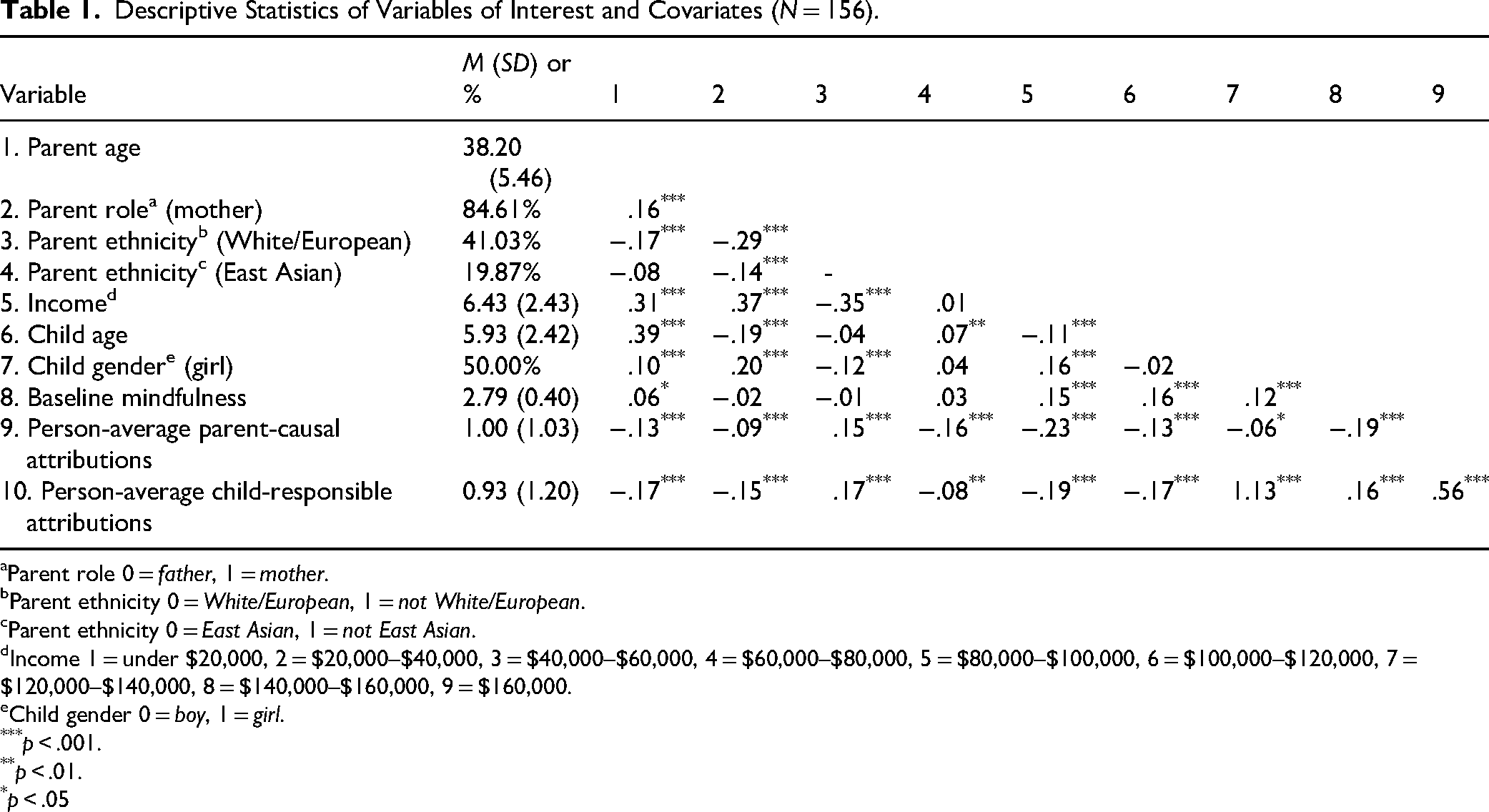
Parent role 0 = father, 1 = mother.
Parent ethnicity 0 = White/European, 1 = not White/European.
Parent ethnicity 0 = East Asian, 1 = not East Asian.
Income 1 = under $20,000, 2 = $20,000–$40,000, 3 = $40,000–$60,000, 4 = $60,000–$80,000, 5 = $80,000–$100,000, 6 = $100,000–$120,000, 7 = $120,000–$140,000, 8 = $140,000–$160,000, 9 = $160,000.
Child gender 0 = boy, 1 = girl.
p < .001.
p < .01.
p < .05
Stability of Parental Attributions
In Model 1, the association between previous-day and present-day parent-causal attributions was not significant (b = .00, SE = .03, p = .808, 95% CI [−.06, .07]), suggesting that parent-causal attributions fluctuated on a daily basis rather than remaining stable. Similarly, in Model 2 the association between previous-day and present-day child-responsible attributions was not significant (b = .00, SE = .04, p = .858, 95% CI [−.07, .08]), suggesting that child-responsible attributions were also prone to day-to-day fluctuation rather than remaining stable.
Baseline Mindfulness and Parental Attributions
Model 1 and 2 results also indicated that baseline mindfulness was negatively associated with daily parent-causal attributions (b = −.30, SE = .14, p = .040, 95% CI [−.59, −.01]) and child-responsible attributions (b = −.33 SE = .16, p = .049, 95% CI [−.65, −.00]) suggesting that parents with higher mindfulness reported less biased parent-causal and child-responsible attributions on a daily basis.
Baseline Mindfulness and Fluctuations in Parental Attributions
In Model 3, the interaction effect of baseline mindfulness and previous-day parent-causal attributions on present-day parent-causal attributions was not significant (b = −.02, SE = .08, p = .781, 95% CI [−.14, .19]). Thus, parent-causal attributions fluctuated regardless of whether a parent had high levels (b = .01, SE = .04, p = .711, 95% CI [−.59, 1.36]), or low levels of mindfulness (b = −.00, SE = .05, p = .978, 95% CI [−.80, 1.51]). Similarly, in Model 4 the interaction effect of baseline mindfulness and previous-day child-responsible attributions on present-day child-responsible attributions was not significant (b = −.05, SE = .10, p = .559, 95% CI [−.25, .13]). Thus, child-responsible attributions similarly fluctuated regardless of whether a parent had high levels (b = .01, SE = .05, p = .753, 95% CI [−.28, 1.23]), or low levels of mindfulness (b = .02, SE = .05, p = .600, 95% CI [−.62, 1.38]). These results suggest that parents’ baseline mindfulness was not significantly related to their day-to-day fluctuations in daily parent-causal or child-responsible attributions.
Covariates
Among the demographic covariates, household income was significantly associated with daily parent-causal attributions (b = −.07, SE = .03, p = .011, 95% CI [−.13, −.01]), suggesting that parents with higher income were less likely to blame themselves for their child misbehavior on a daily basis. However, household income was not significantly associated with daily child-responsible attributions (b = −.06, SE = .03, p = .07, 95% CI [−.12, −.01]. Additionally, child age was negatively associated with daily child-responsible attributions (b = −.07, SE = .03, p = .035, 95% CI [−.13, −.00]), indicating that parents of older children were less likely to interpret their misbehavior as intentional each day.
Discussion
The present study explored whether biased parent-causal and child-responsible parental attributions remain stable or vary over a 14-day period, how mindfulness relates to these attributions, and whether mindfulness predicts daily fluctuations in parental attributions. Findings indicated no significant association between previous-day and present-day parental attributions, regardless of whether they were parent-causal or child-responsible. These results suggest that daily parental attributions are not rigid, but subject to fluctuation from day-to-day. This supports and builds upon findings by Rodriguez and Silvia (2022), who studied the attributions of mothers of 2- to 10-year-old children who were at elevated risk of maltreatment; while mothers’ attributions for positive behavior remained stable over a 21-day period, attributions of misbehavior fluctuated across days. Our findings reinforce the idea that parental interpretations of children's misbehavior can shift over short time spans.
Furthermore, consistent with previous findings by Kil et al. (2022), parents reporting high levels of mindfulness were less likely to interpret their children's negative behavior as a result of their parenting practices (i.e., less likely to make parent-causal attributions). These findings build upon prior work suggesting that highly mindful parents demonstrate self-compassion in the context of parenting and are less likely to blame themselves in stressful parenting situations (Gouveia et al., 2016).
Contrary to our hypothesis, parents with higher levels of mindfulness were also less likely to interpret their children's misbehavior as deliberate or intentional. These findings diverge from previous research that found no association between mindfulness and child-responsible attributions (Kil et al., 2022), instead suggesting that mindfulness in parents may be linked with less blaming cognitions toward their children. One possible explanation for the present inconsistency with past literature is that a daily diary approach is more ecologically valid compared to traditional assessment methods (Schneider & Stone, 2016), and may better capture real-time reflections of parental attributions that vary day-to-day. Alternatively, although mindfulness is a self-focused cognition, it may be a skill that spills over into the interpersonal domain. In line with this perspective, past research has found that parental mindfulness is associated with stronger parent-child secure attachment (Zhang et al., 2019) and better mother-child relationship quality (Passaquindici et al., 2024). These studies illustrate that mindfulness has the potential to spill over into the interpersonal domain in parent-child interactions, including at the parent perception and cognition level.
Also contrary to our expectations, parent mindfulness did not moderate fluctuations in parent-causal or child-responsible attributions over the 14-day period. While this finding suggests that mindfulness is not predictive of fluctuations in parenting cognitions, we suggest instead that measuring daily state mindfulness—referring to moment-to-moment awareness that can vary based on current experience (Tanay & Bernstein, 2013)—may better explain daily fluctuations in parental attributions as it captures mindfulness as a moment-to-moment experience rather than a stable, general characteristic. Although no studies have examined daily mindfulness and daily causal cognitions, research in other domains suggests that on days when individuals are more mindful, they tend to experience less rumination (Ding et al., 2019), and employ more adaptive coping strategies in response to stress (Brockman et al., 2017; Donald et al., 2016). If mindfulness is linked to these cognitions at the daily level, we may expect a similar pattern for parental attributions. Specifically, on days when individuals are more mindful, they might experience fewer intrusive, negative thoughts, such as rumination, which in turn could foster more adaptive responses to daily parenting challenges. However, further research is needed on these hypotheses to confirm whether mindfulness may serve as an impetus for fluctuating and dynamic parenting cognitions.
Clinical Implications for Behavioral Parent Training (BPT)
Our findings suggest that parental attributions of children's misbehavior fluctuate daily, highlighting the need to consider them from a dynamic, context-dependent perspective. In clinical settings, baseline or intake assessments provide pivotal information on parents’ readiness to tackle difficulties via treatment, especially in BPT (predominantly non-pharmacological interventions for parents of children with problematic behaviors). Acknowledging that attributions vary on a daily basis can have tremendous impact on clinicians’ approaches to assessing this baseline cognition. That is, relying solely on one-time assessments as often done at clinical intake interviews could lead to an incomplete or potentially misleading understanding of parental attribution biases that may alter both parent and child outcomes in clinical practice. Thus, our findings suggest that intake assessments may benefit when they account for the daily variable and likely context-dependent nature of parental attributions. For example, having an especially difficult day with one's child on the day of intake assessment may lead to a parent reporting highly biased parental attributions despite fluctuating day-to-day in reality.
Our findings also point to the potential for mindfulness-based training as a pre-intervention tool to adjust parental attributions toward a balanced direction prior to standard parent behavioral interventions. These findings preliminarily address recent calls for pre-intervention programs aimed at addressing biased parent cognitions before initiating standard parenting interventions, as reducing parental cognitive biases prior to standard interventions has been linked to better treatment outcomes, including parent engagement, participation, and readiness to engage in behavioral change (e.g., Kil et al., 2021; Sawrikar & Dadds, 2018). Based on our findings, boosting mindfulness levels in parents could be linked to generally less biased parenting cognitions that do not become swayed by day-to-day challenges with managing child misbehavior. Ultimately, further research is needed to test the impact of mindfulness training on parents’ receptivity to and engagement in treatment as well as both parents’ and children's improved outcomes via established treatments.
Limitations and Future Directions
This study has several limitations that should be considered when interpreting the findings. First, the reliance on self-reported data introduces the potential for self-report bias. Future research could address this limitation by incorporating observational measures to assess mindfulness and attributions more objectively (e.g., mindful reaction-time tasks, structured interviews of parental attributions; Bugental et al., 1998; Verhaeghen, 2021). Further, parental attributions of child misbehavior were measured once each evening. However, if a child misbehaved very early in the day, parents’ immediate and initial interpretation might differ from their later cognitive reappraisal, resulting in a different valence in parental attribution (Miller & Porter, 1980). Future work may involve data collection at multiple points throughout the day to capture multiple daily instances of parental attributions. Additionally, the correlational design of this study limits our ability to conclude that parental mindfulness leads to less biased attributions. Future research could use daily diary methods and integrate mindfulness-based interventions like guided meditations (Bazzano et al., 2015) to assess whether state mindfulness promotes more flexible and adaptive interpretations. This line of work could inform parenting interventions by enhancing parents’ moment-to-moment awareness and reducing reactive, biased interpretations.
Another limitation of this study is that the sample was predominantly White/European mothers, limiting generalizability. Replications with a more balanced and representative sample are required to capture the experiences of fathers and diverse ethnic groups. Further, it is possible that parents did not complete the survey on more challenging days, limiting completeness in capturing attribution variability. Prompting participants multiple times in a single day may help to reduce missing data due to non-completion in future studies. Finally, assessing the present research questions in the context of clinically elevated child behavioral or emotional difficulties and corresponding BPT would provide the next step in bolstering the importance of considering dynamism in parental attributions and the potential of mindfulness to curb biased parent thinking for their better treatment engagement.
Conclusion
This study highlights the dynamic nature of parental attributions, suggesting that they fluctuate daily. Findings also suggest that high parental mindfulness is associated with less biased parent-causal and child-responsible parental attributions, but not necessarily with daily fluctuating parental attributions. Overall, our findings suggest that the role of mindfulness on parental attributions may be in alleviating attributional bias, rather than lessening the variability of parental attributions. These preliminary insights serve an important foundation for further research on improving parenting interventions for child mental health, emphasizing the potential of mindfulness training as a promising route to foster more adaptive parenting cognitions. Future work on these topics may point to mechanisms underlying the effects of mindfulness training for better engaging parents in standard parent behavioral training programs in clinical contexts.
Footnotes

Ethics Approval
The current study's procedures were approved by the Simon Fraser University Research Ethics Board (#30001690). All participants provided written informed consent to participate.
Funding
The authors disclosed receipt of the following financial support for the research, authorship, and/or publication of this article: This research was funded by a grant to the supervising author from the Social Sciences and Humanities Research Council of Canada (grant number 435-2025-0263).
Declaration of Conflicting Interests
The authors declared no potential conflicts of interest with respect to the research, authorship, and/or publication of this article.
Data Availability Statement
Limited data are available from the corresponding author upon reasonable request.