



Abstract
Social networking sites (SNS) and applications are increasingly permeating users’ lives by providing an online communication platform that facilitates the development of new virtual relationships while also complementing offline relationships. Excessive SNS use can potentially develop into SNS addiction, which is linked with infidelity, jealousy, surveillance, conflict, low relationship satisfaction, and breakup. In this study, we sampled 765 participants in a romantic relationship who reportedly used social media. The study explored the relationship between SNS addiction, social media infidelity-related behaviors (SMIRB), and relationship satisfaction. The study further examined whether SMIRB could moderate the relationship between SNS addiction and relationship satisfaction. Results revealed that SNS addiction was inversely linked with relationship satisfaction and positively linked with SMIRB. Also, SMIRB moderated the strength of the relationship between SNS addiction and relationship satisfaction, which gave a statistical impression that SNS addiction and higher levels of SMIRB promote relationship satisfaction. These findings remind researchers to exercise caution when making substantive inferences and when utilizing self-report relationship satisfaction measures.
Social networking sites (SNSs) are ubiquitous in the current times and offer a popular way of communicating with friends and strangers. A substantial number of people are using social media to develop and maintain existing as well as new relationships, receive news, and seek potential romantic alternatives (Abbasi, 2018; Abbasi & Dibble, 2019; Fox, 2016). However, innocuous online interactions can easily develop into habitual interactions that can eventually progress into a pathological psychological dependency (Turel & Serenko, 2012) called Facebook intrusion (Elphinston & Noller, 2011) or social networking addiction (SNS addiction; Andreassen et al., 2012; Kuss & Griffiths, 2017), which could interfere with the user's relationship functioning and everyday activities (Andreassen et al., 2012; Elphinston & Noller, 2011). Even otherwise, greater internet use predicts a lack of intimacy and low relationship quality (Halpern & Katz, 2017). In the same vein, greater SNS use is negatively linked to marriage quality and happiness (Andreassen et al., 2012; Clayton et al., 2013; Goldwert, 2012; Muise et al., 2009; Sheldon et al., 2011; Valenzuela et al., 2014). Online social connectedness is also linked with reduced relationship satisfaction (Abbasi, 2019; Muise et al., 2009; Tokunaga, 2011), which is the degree of happiness a partner feels towards his/her romantic relationship (Corra et al., 2009).
Given that time is not expandable (Nie & Hillygus, 2002), excessive SNS interactions may drain time, emotional, and financial resources from the dyadic relationship resulting in low investments and eventually low commitment (Rusbult et al., 2011). Evidence supports that partners report higher relationship satisfaction when their basic needs for security, companionship, and intimacy are met within their relationship (Phillips et al., 2009). Conversely, when these needs are met in an extra-dyadic relationship online, adverse relationship outcomes such as romantic jealousy arise within the primary relationship, which is negatively connected with relationship satisfaction (Muise et al., 2019; Tokunaga, 2011). Therefore, engaging in SNS interactions to meet basic needs (belongingness, companionship, security) may evoke romantic jealousy in one's partner who may, in turn, resort to surveillance and potentially uncover further jealousy provoking stimuli (e.g., intimate disclosures), which could lead to conflict, dissatisfaction, and breakup (Abbasi & Alghamdi, 2017a; Muise et al., 2009).
SNS encourage maximum dwell time (i.e., mean time a user spends on a website), extend ‘scroll depth’ (how far down a webpage is viewed), minimize ‘bounce rate’ (how soon users navigate away from a website), and cut down time between visits (Aboujaoude & Gega, 2020). SNS platforms also encourage sofalizing, which is a portmanteau of sofa and socializing, representing a preference of engaging in online interactions rather than meeting others offline (Tosuntaş et al., 2020). Computer-mediated communications could potentially transform simple SNSs comments into flirtation and aggressive emotional disclosures due to the absence of contextual cues and lack of physical presence (Carter, 2016; Helsper & Whitty, 2010). Evidence supports that flirting over SNSs evokes a stronger physical and sexual reaction than experienced in a face-to-face interaction (Abbasi & Alghamdi, 2017b; Alapack et al., 2005). Once the boundaries between chatting and flirting blur, the online relationship can escalate to cheating, which begins when a partner in a dyadic relationship directs the first romantic signal to an extra-dyadic partner (Alapack et al., 2005). Left unchecked, such interactions can develop into online infidelity with a romantic alternative (Carter, 2016; Helsper & Whitty, 2010).
Therefore, with the use of computer-based channels, partners can easily engage in behaviors that are considered unfaithful in a dyadic relationship such as online dating, online sex, hot chatting, viewing pornography, emotional involvement, and cybersex (Dijkstra et al., 2010; Henline et al., 2007). These behaviors constitute SNS infidelity and can lead to conflict, jealousy, loss of trust, arguments, surveillance, retaliatory behaviors, and divorce/breakup (Cravens & Whiting, 2015; Muise et al., 2009). Suspicious partners may also demand or coerce SNS account passwords to protect their relationship against external threats (Abbasi et al., 2025). Infidelity behaviors are toxic (as opposed to more benign behaviors, e.g., revealing secret wishes and emotions, showing unusual acts of kindness). For this study, we were interested in measuring less aggressive social media infidelity-related behaviors (SMIRB) as measured by McDaniel et al. (2017) such as developing emotional connections with extra-dyadic partners, being secretive about online activity, messaging ex-partners, and getting defensive.
Theoretically, the connection between SNS addiction, relationship satisfaction, and SMIRB could be explained using multiple theories. For example, the online disinhibition effect (Suler, 2005) contends that individuals are more disinhibited online than in a face-to-face situation; hence, they are prone to making intimate disclosures early in the relationship. Social penetration theory (Altman & Taylor, 1973) holds that intimacy and self-disclosure are the two main components in relationship development. Additionally, the negative effect hypothesis holds that SNS use decreases relationship satisfaction by offering connection with potential partners, promoting over-engagement with SNS, and exposing users to situations that can jeopardize their primary romantic relationship (Valenzuela et al., 2014).
Finally, the self-selection hypothesis holds that social media can affect romantic relationships through self-selection (unsatisfied partners use SNS excessively). Unsurprisingly then, for some users, SNS are flirting platforms where they can easily share their emotions and develop emotional intimacy, which may lead them to online infidelity (Abbasi & Alghamdi, 2017a).
Objective
The current trend of computer-mediated communication and its effects on romantic relationship has sparked interest in the research community. Previous studies have linked adverse relationship outcomes to SMIRB (Cravens & Whiting, 2015; Dijkstra et al., 2010; McDaniel et al., 2017). Moreover, extra-dyadic sexual encounters in a monogamous romantic relationship signify a violation of relationship trust, which is also linked with negative relationship as well as negative personal outcomes (Guilbault et al., 2020). However, it is noteworthy that social media behaviors that might constitute infidelity in a monogamous relationship may stigmatize people who are in a polyamorous relationship (e.g., consensual non-monogamous, CNM), where partners have mutually agreed to allow extra-dyadic romantic and/or sexual encounters (Abbasi, 2022). In light of this mutual agreement, in a polyamorous relationship, satisfaction with the relationship may not be adversely affected. It is not surprising that evidence also supports that infidelity may have certain positive effects. For example, researchers have reported that some partners maintain extra-dyadic relationships to receive rewards that they are unable to find in their primary relationship; in this case engaging in extra-dyadic romantic and/or sexual encounters is perceived as a way of maintaining one's primary relationship (Dainton & Gross, 2008). Investing time and emotions in an extra-dyadic relationship undermines commitment to the primary relationship (Rusbult et al., 2011). However, there may be different dynamics in play in a CNM relationship that need further investigation, which is beyond the scope of this study.
In this study, we explored the link between SNS addiction, relationship satisfaction, and SMIRB in participants who were in a romantic relationship (married, committed or dating) majority of whom reported to be in a monogamous relationship (86%). Our sample was older than the traditional collegiate samples. It is noteworthy that married or committed partners experience higher relationship commitment, than casually dating partners (Rusbult et al., 2011). High commitment corresponds to high investments (Rusbult et al., 2011). Partners with higher commitment levels accumulate more investments over the life of their relationship; therefore, they would face high exit costs if the relationship were to break (Jackman, 2015). It is plausible that married or committed partners would be potentially more careful with their social media activities than casually dating partners. Based on the premise set above, we controlled relationship status as a covariate.
We hypothesized that SNS addiction will be negatively related to relationship satisfaction (H1) and positively related to SMIRB (H2). It would also seem plausible that SNS-addicted users who engage in greater SMIRB will report lower relationship satisfaction as opposed to those who are SNS addicted but are not as engaged in SMIRB. It is noteworthy that SNS addiction and SMIRB can occur independently; however, their impact on satisfaction may be additive. Some evidence suggests that SNS addiction and SMIRB can co-occur, at least in individuals living with mental illness (Abbasi & Dibble, 2019), which invites the potential for interaction between the two factors. In this context, SMIRB may act as a moderator in the relationship between SNS addiction and relationship satisfaction. Therefore, we hypothesized that the strength of the relationship between SNS addiction and relationship satisfaction will be moderated by SMIRB (H3).
Method
Participants
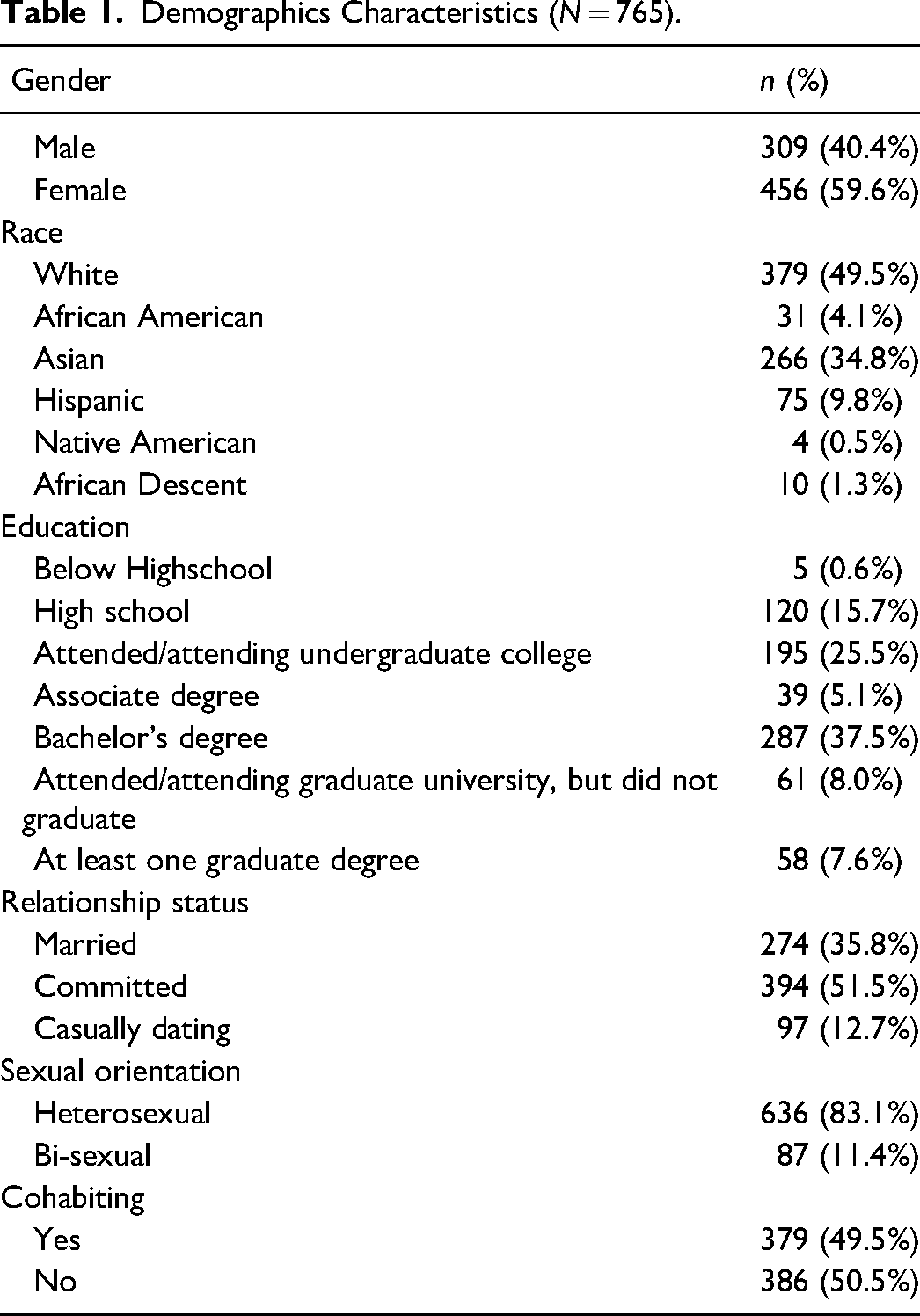
The study was approved by the Institutional review board (IRB) and researchers complied with the ethical standards per IRB approval guidelines. The power analysis using G-power (3.1.9.6; Faul et al., 2009) estimated the total sample size of 395 participants with a power of .80 and a small effect size of .02. This study included 765 participants between the age of 18–77 years (M = 27.79, SD = 10.64) in a romantic relationship (married, committed, dating). The average relationship length was 3.71 years (SD = 2.46). Participants’ income range was primarily average (67.1%), followed by below average (17.1%), and above average (15.8%). Majority of the participants lived in the United States (44.2%), followed by the United Kingdom (25.1%), India (20.1%), Italy (2%), and miscellaneous countries (8.6%). Most of the participants reported having no children (70.8%) and 29.2% reported having at least one child from their current relationship. The participants mostly reported having no relationship problems (72.8%) and 27.2% reported having current relationship problems. Table 1 shows participants’ demographic data.
Demographics Characteristics (N = 765).
Procedure
Participants completed an anonymous survey online, which was hosted on SurveyMonkey. The inclusionary criteria were being at least 18 years of age, in a romantic relationship (committed, married, or dating). A link to the online survey was posted on the approving university's research webpage, SNS(i.e., Facebook, Twitter, Whats-app, LinkedIn, etc.), and Amazon's Mechanical Turk's (MTurk). To collect high-quality data, per recommendation (Aust et al., 2013), we added two attention checks within the survey to ensure participants were attentive when responding. Fifteen responses were discarded due to failing attention checks.
Measures
Demographics
Participants reported their age, gender, country of residence, ethnicity, relationship status, education level, employment status, income status, relationship status, children, and whether they had been clinically diagnosed with a mental illness.
Social Media Infidelity-Related Behaviors Scale
The seven-item SMIRB scale (McDaniel et al., 2017) measured SNS infidelity-related behaviors. Participants rated their agreement to the statements on a 6-point Likert scale (1 = strongly disagree, 6 = strongly agree). Items were averaged to get the SMIRB score. Higher scores represented greater tendency to engage in infidelity-related behaviors. An example item is, “If my spouse/partner asked me about my chats, comments, and messages to others on social networking sites, there are some messages I would like to hide from him/her” (α = .90).
Couple Satisfaction Index (CSI-4)
We used the four-item CSI-4 to measure relationship satisfaction (Funk & Rogge, 2007). An example item is, “How satisfied are you with your relationship?” The response format utilizes a seven-point Likert scale (0 = extremely unhappy, 6 = perfect) and a six-point Likert scale (0 = not at all true, 5 = completely true) for the first and second item, respectively. The remaining two statements are anchored on a six-point scale (0 = not at all, 5 = completely). The total score is calculated by summing all four items. The total scores range from 0 to 21, and higher numbers indicate greater satisfaction (α = .87).
Social Networking Site Addiction
The six-item Bergen Social Media Addiction Scale (Andreassen et al., 2012) assessed SNS addiction, and uses a five-point Likert scale (1 = very rarely; 5 = very often). Each item measures one main aspect of addiction: salience, tolerance, conflict, mood modification, withdrawal, and relapse (Griffiths et al., 2014). Sample items include “You use social media in order to forget about personal problems,” and “You have tried to cut down on the use of social media without success.” Responses are summed into a final score such that higher numbers indicate greater SNS addiction (α = .85).
Results
Consistent with H1, SNS addiction and relationship satisfaction were negatively related (r = −.15, p < .01). Also, consistent with H2, we found that SNS addiction and SNS infidelity are positively related (r = .43, p < .01). SMIRB was also negatively related to relationship satisfaction (r = −.32, p < .01). For the main analysis, we used the SPSS PROCESS Macro developed by Hayes (2013), using the moderation model (model 1) with 5000 bootstrap resamples to compute the standard error, and 95% confidence interval limits at .05 significance level. Although the link between SNS addiction and relationship may be bi-directional or even cyclical, our model treated relationship satisfaction as the outcome variable (Y), SNS addiction as the focal predictor (X), and SMIRB as the moderator (W). This is in line with previous research (Abbasi, 2018; Abbasi & Dibble, 2019). Age was correlated with all three variables (SNS addiction, relationship satisfaction, and SMIRB) and gender was correlated with SMIRB. Relationship status was correlated with the relationship satisfaction such that dating participants were less satisfied than married/committed partners. Therefore, we controlled age, gender, and relationship status in the moderation model. Table 2 lists zero-order bivariate correlations and descriptive statistics for age, gender, relationship satisfaction, SNS addiction, and SMIRB.
Means, Standard Deviations, and Pearson's Bivariate Correlations Among Variables of Study.
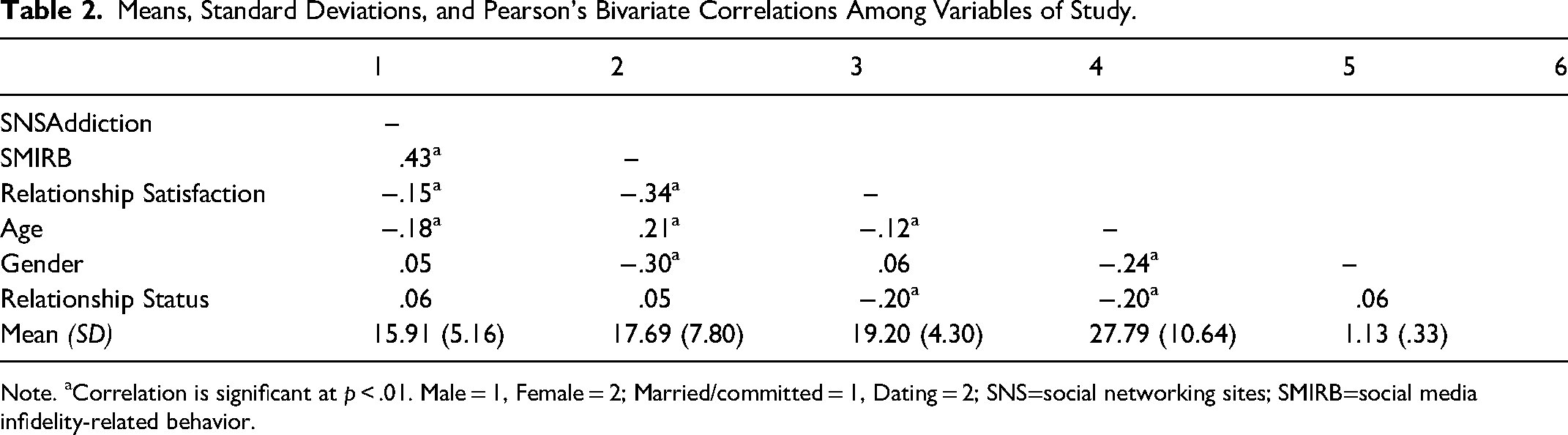
Note. aCorrelation is significant at p < .01. Male = 1, Female = 2; Married/committed = 1, Dating = 2; SNS=social networking sites; SMIRB=social media infidelity-related behavior.
The results revealed an overall model that was statistically significant, F (6, 758) = 29.65, p < .001, R2 = .19). Results showed that the main effects for SNS addiction (b = −.34, t (758) = −4.80, p < .001) and SMIRB (b = −.49, t (758) = −7.70, p < .001) were statistically significant. That is, SNS addiction and SMIRB were negatively related with relationship satisfaction.
Regarding H3, we found a significant interaction such that SMIRB moderated the relationship between SNS addiction and relationship satisfaction (b = .02, t (758) = 5.22, p < .001). Simple slopes analysis (Figure 1) revealed that for low levels of SMIRB (i.e., 1 SD below the SMIRB mean), SNS addiction and relationship satisfaction were negatively related (b = −.16, t (758) = −3.70, p < .001). At average levels of SMIRB, SNS addiction and relationship satisfaction were unrelated (b = −.01 t(758) = −.50, p = .64). Interestingly, however, when SMIRB was high (i.e., 1 SD above the SMIRB mean) SNS addiction and relationship satisfaction were positively related (b = .13, t (758) = 3.09, p < .001). In short, as SMIRB increased, the statistical relationship between SNS addiction and relationship satisfaction changed sign from negative to positive.
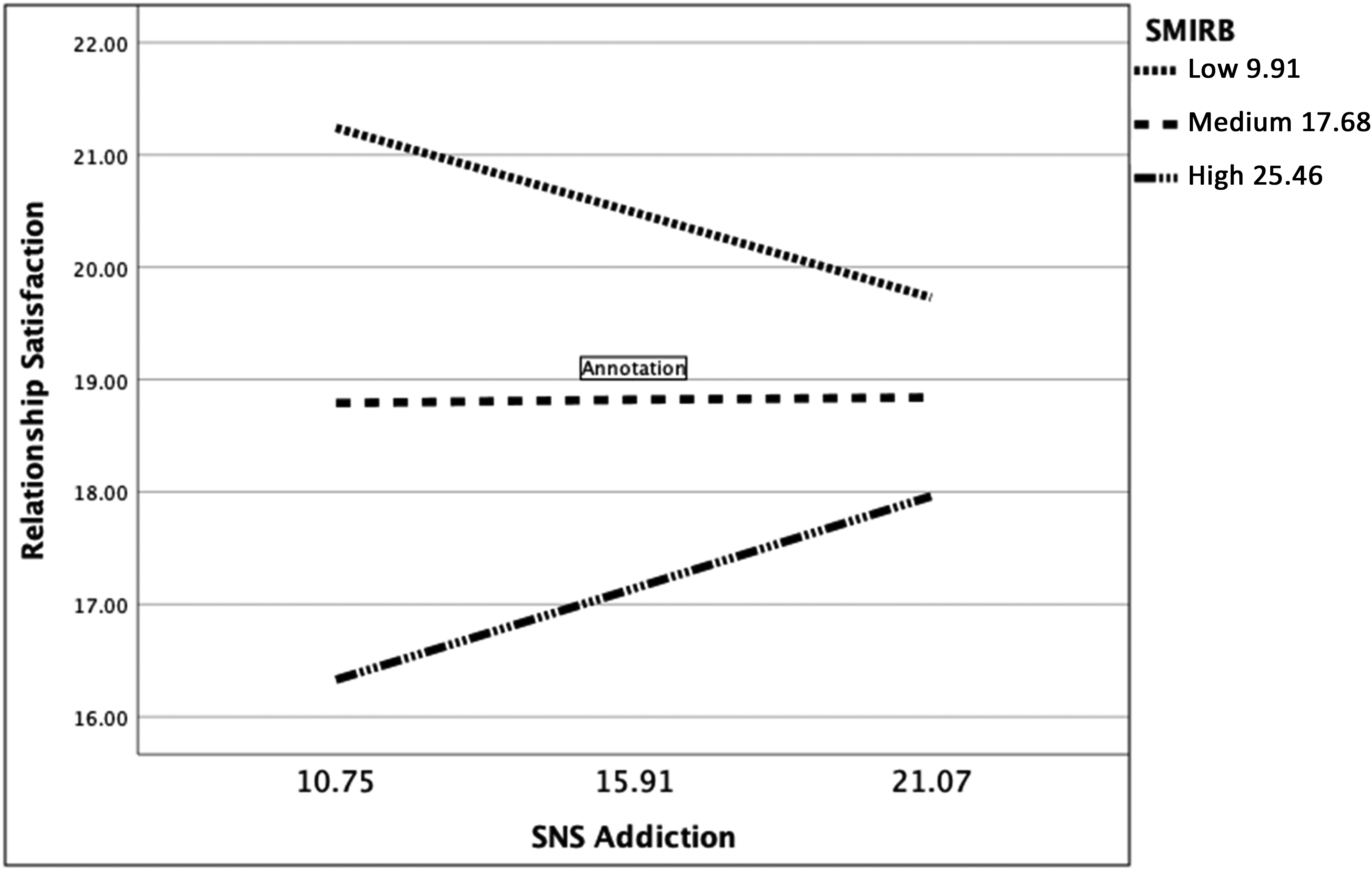
Simple slope analysis indicating the relationship between SNS addiction and relationship satisfaction at three levels of SMIRB. SNS=social networking sites; SMIRB=social media infidelity-related behavior.
Discussion
This study addresses the combination of addiction to SNS and SMIRB to impact relationship satisfaction. In contrast to earlier studies, we employed a non-college sample of adults. SNS addiction and SMIRB have been found to relate negatively with satisfaction on their own (Elphinston & Noller, 2011; McDaniel et al., 2017), and both findings replicated in our non-college sample.
The novel finding from our data concerns the statistical interaction between SNS addiction and SMIRB. At low levels of SMIRB, the typical negative relationship emerged between SNS addiction and relationship satisfaction. However, as SMIRB increased—i.e., as people reported greater online infidelity-related behaviors—the statistical relationship between addiction and satisfaction appeared to change sign. This pattern likely owes more to the measures commonly used to tap these concepts than to a real finding that infidelity-related behaviors and addiction are an automatic recipe for healthy relationships.
One interpretation is as follows. When people are addicted to social media, their relationship quality suffers. However, engaging in SMIRB—e.g., flirting with an extra-relational person or keeping in touch with an old flame—provides certain gratifications to the user. For example, at least two motivations for flirting involve self esteem support and enjoyment, and these motivations are more salient to non-college adults (relative to college students, who flirt primarily to get sex and/or a relationship; e.g., Henningsen et al., 2008). SMIRB thus may provide an enjoyable distraction from an otherwise troubled relationship, and gratifications associated with this distraction may be leaking into one's report of relationship satisfaction. That is, the enjoyments from SMIRB boost the overall experience of the user, which could be driving that user's scores on a relationship satisfaction measure.
As a second interpretation, the gratifications from SMIRB may directly compensate for the shortcomings of the primary relationship, and relationship satisfaction scores could be reflecting compensation. Compared to high-SMIRB users, people who are otherwise addicted to social media but do not engage in SMIRB are less satisfied because they do not have the distraction or compensation that comes from flirting with other people. Both possibilities, SMIRB's distraction and compensation potentials, should be examined in future research.
It is instructive that SMIRB does not automatically qualify as infidelity, but rather as infidelity-related behaviors (McDaniel et al., 2017). Discerning the real potential for harm to the primary relationship is difficult. On the one hand, flirting may result in a relatively innocuous ego boost. On the other hand, the SMIRB's measurement items suggest that people are aware, at least implicitly, that their partners may not approve of their online wanderings (e.g., “I would feel uncomfortable if my spouse/partner read my chats, comments, and messages to others on social networking sites”). As a result, we do not take the position that SMIRB is a path to relational happiness for the SNS-addicted. By analogy, drinking may make an alcoholic feel subjectively happier, but it does not solve problems at home.
These data point to an important lesson for those who study computer-mediated communication and romantic relationships. The conclusions drawn can be no more valid than the measures used to derive those conclusions (Nunnally, 1967; Pedhazur & Schmelkin, 1991). Researchers must consider the operational definitions implied by their measures. Our study hints that common measures of relationship satisfaction may capture a respondent's personal feelings of happiness, but those personal happiness scores themselves may reflect non-relational factors. For example, satisfaction scores from our high-SMIRB participants may be conflating relationship-oriented satisfaction with the satisfactions derived from flirting with an extra-relational target. Two implications may apply. First, this calls into question the construct validity of satisfaction measures for certain applications. Second, relationship satisfaction may not be sufficient as a barometer of relationship quality. That is, studies that would employ relationship satisfaction as a lone indicator, in certain applications, may lack content validity for relationship quality. There are a variety of relational satisfaction and relational quality instruments, and perhaps the results may change based on the scale used. Conceptual interpretations and subsequent theory building depend on sound measurement. Revisiting the psychometric soundness of satisfaction measures may be prudent. In the meantime, researchers should employ greater caution when combining satisfaction into a battery of other measures. Our data underscore a need for this greater caution.
Other limitations include the well-known issues associated with self-report indicators, as well as the cross-sectional nature of our design. Although we treated addiction as a statistical predictor, SMIRB as a moderator, and satisfaction as the outcome, time ordering is not established, and we cannot infer causality. We also assessed only one member of the relationship, and inferences about the overall relationship quality are bolstered by designs that gather both partners’ responses. Likewise, we employed only one measure of relationship satisfaction when many exist. Follow-up research should determine the extent to which our findings replicate using alternate measures of satisfaction.
While testing the potential for SMIRBs to moderate the association between SNS addiction and relationship satisfaction, we observed a pattern that may suggest a bizarre conclusion: online addicts may experience a greater relationship satisfaction with their primary partner while they are also flirting with an extra-dyadic partner. It is plausible that the rewards conferred by flirting may be leaking into satisfaction measures, making this measure a less “pure” measure of relationship satisfaction. Therefore, we are presenting our findings with a caution: Researchers should take greater care when employing measures of relationship satisfaction, especially in computer-mediated contexts.
Implications
Against conventional wisdom, the data from this study hinted that social media addiction and SMIRB may increase relationship satisfaction in a dyadic relationship. It is a unique finding and warrants further exploration in a therapeutic setting. Couple therapists should examine factors that may minimize the impact of SMIRB on relationship satisfaction. Therapists should caution partners against engaging in SMIRB. Partners who are prone to engaging in SMIRB should focus more on behaviors that may benefit their primary relationship. Therapists should also promote behaviors that may curb SMIRB and/or mitigate the impact of SMIRB on the primary romantic relationship. These behaviors may include engaging in respectful communication, expressing affection, tackling difficult issues constructively, finding solutions, supporting each other, engaging in shared activities, demonstrating commitment, and actively listening. Previous research encompassing 160 cultures showed that partner's infidelity is the most common reason cited for a breakup (Grøntvedt et al., 2020). In the contemporary era, SNS provide increased opportunities for online infidelity. Sexting is perceived similarly to cybersex and physical sexual infidelity (Adam, 2019). Therefore, therapists should encourage partners to set boundaries around their Internet use and avoid private interactions with perceived romantic alternatives.
Footnotes
Availability of Data and Material
The data will be provided upon a reasonable request to the author.
Consent from Participants
Participants consented to the study terms approved by the Institutional Review Board.
Declaration of Conflicting Interests
The authors declare that they have no conflict of interest.
Ethical Standards
This study was approved by the Institutional Review Board.
Funding
The author received no financial support for the research, authorship, and/or publication of this article.
Informed Consent
Informed consent was obtained from all individual participants included in the study.
