



Abstract
Siblings are the longest-lasting relationships most individuals experience. While there is limited research on sibling relationships in general, research on Latino/a/x sibling relationships is even more limited. This study explored Latino/a/x siblings’ cultural adaptation processes in the United States and how this adaptation impacted their sibling relationships. Researchers conducted semi-structured qualitative interviews with Latino/a/x sibling dyads. Data were examined using dyadic analysis to identify areas of agreement, divergence, and uniqueness. Analyses revealed two areas of agreement: (a) cultural expectations for their sibling relationship and (b) parental expectations for their sibling relationship; and one area of uniqueness: individualized experiences pertaining to growing up in the United States. There were virtually no areas of divergence. Findings showed that family influence on sibling relationships and cultural adaptation experiences depended on sibling positionality. The implications highlight the importance of sibling position, sibling support during cultural adaptation processes, and the complicated perspectives around parentification.
Sibling relationships can be the longest relationship an individual has (Cicirelli, 1995; McGoldrick & Watson, 2016). Sibling relationships are unique in that these relationships are ascribed rather than chosen and have both shared experiences (i.e., growing up in the same home) and non-shared experiences (i.e., having different relationships with parents) (Cicirelli, 1995). Siblings often follow closely behind each other developmentally (McGoldrick & Watson, 2016; Portner & Riggs, 2016) and spend the most time together in comparison with the time spent with parents and peers (Brody, 1998; Gass et al., 2007; Harper et al., 2016; Updegraff et al., 2016). Most immigrant research revolves around the parent-child dyad, with limited information on sibling relationships (Pyke, 2005; Smokowski et al., 2008). The current study explored the relationship between Latinx siblings, and their cultural adaptation processes to the United States.
Cultural Adaptation
Cultural development for Latinx immigrants involves experiences of marginalization and discrimination (Causadias et al., 2018), while simultaneously attempting to reconcile differing cultural norms and the associated psychosocial cost-benefits in both the dominant and origin cultures (Gonzales et al., 2015; Schwartz et al., 2013). As such, the term cultural adaptation can be used to understand the interactive process of navigating from one cultural context to the other, or put another way, maintaining ties with the culture of origin while navigating participation in the mainstream culture (Gonzales et al., 2002; Knight et al., 2010). Cultural adaptation has been described as a multidimensional and complex process, with behavioral, cognitive, and psychological changes (Schwartz et al., 2010a, 2010b), that can be a source of significant internal conflict and stress (Mangold et al., 2012; Nicholson et al., 2013). Siblings, who are more likely to be sharing developmental experiences, can play a critical role in each other's cultural adaptation experiences.
Current Study
The limited research on Latino/a/x siblings from immigrant families has found that siblings have an impact on each other's cultural adaptations (Hafford, 2010; Kibler et al., 2014; Palacios et al., 2016). The current study explored the influence of sibling cultural adaptation processes to the United States and how this adaptation may impact Latino/a/x sibling relationships. The following research questions were explored:
What is your experience in adapting to U.S. culture? What is your relationship with your sibling? How has your cultural adaptation shaped your relationship with your sibling?
Method
The study used dyadic interviewing and descriptive phenomenology to explore the influence of cultural adaptation processes to the United States and how this adaptation may impact Latino/a/x sibling relationships. While phenomenology aims to capture the essence of a phenomenon experienced by a group of people, descriptive phenomenology additionally aims to get to the core of a phenomenon through careful analysis of the detailed experiences (Creswell & Puth, 2017; Jackson & Bazeley, 2019). Descriptive details about what an individual experienced and how that experience influenced other contexts or situations allowed for a greater understanding of the phenomenon (Creswell & Puth, 2017). The study aimed to understand Latino/a/x immigrant siblings by exploring the influence of cultural adaptation processes to the United States and how this adaptation may impact Latino/a/x sibling relationships.
Procedures
Upon receiving IRB approval, recruitment flyers and email and social media posts were posted, and interested participants were able to contact the researchers for further information on participation. Each subject in the dyad signed two copies of the consent form to participate; one copy was given back to the researcher, and the second copy was kept by the subjects for their records.
To ensure participants have all requirements for the study, a screening survey was administered over the phone. After screening for requirements, eight sibling dyads were selected for interviews. All interviews were conducted in a confidential space provided by the researchers or recommended by the participants. Interviews were conducted together. Participants completed the demographic survey at the beginning of the interview.
Participants
Sibling dyads were recruited through convenient purposeful sampling in the United States. To be eligible for the study, participants had to (a) be at least 18 years old; (b) be U.S. born Latino/a/x or have immigrated to the United States at a young age; (c) have Latino/a/x immigrant parents; (d) speak and understand English; and (e) have at least one other sibling willing to be a part of the study and also meets the recruitment criteria. Most phenomenological studies suggest sampling a heterogeneous group of between three and 15 individuals (Creswell & Puth, 2017). The final sample of participants included eight sibling dyads (N = 8). Five dyads were sister-sister dyads, and three dyads were brother-sister dyads. Participants ranged in age from 20 to 30 years old (M = 24.79 and SD = 3.32). All participants were Latino/a/x and ranged ethnically; nine participants were White, and six participants identified as other (i.e., Native, Mestiza, Hispanic, or Latina). All participants were either first generation (born in the United States) or 1.5 generation (born outside the United States but immigrated to the United States before the age of 3). Participants reported their education level: 13.33% of the sample had completed high school or some high school, 33.33% had completed some college or their associate's, and 53.33% held bachelor's degrees or higher (Table 1). Participants also reported their parents’ demographics (Table 2). To keep respondent's information confidential and to recruit participants as randomly as possible, the survey held no identifiable information.
Demographics.
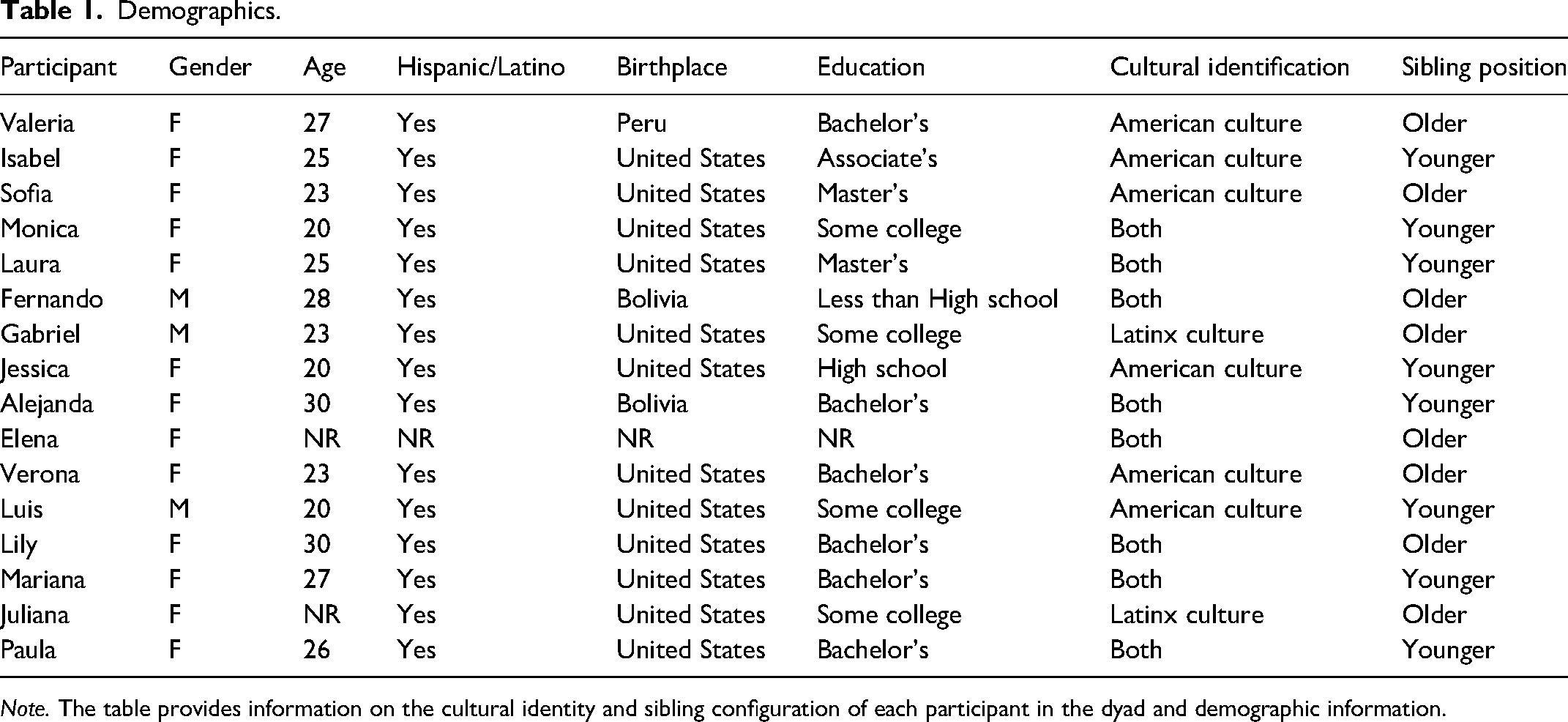
Note. The table provides information on the cultural identity and sibling configuration of each participant in the dyad and demographic information.
Participant Report on Parental Demographics.
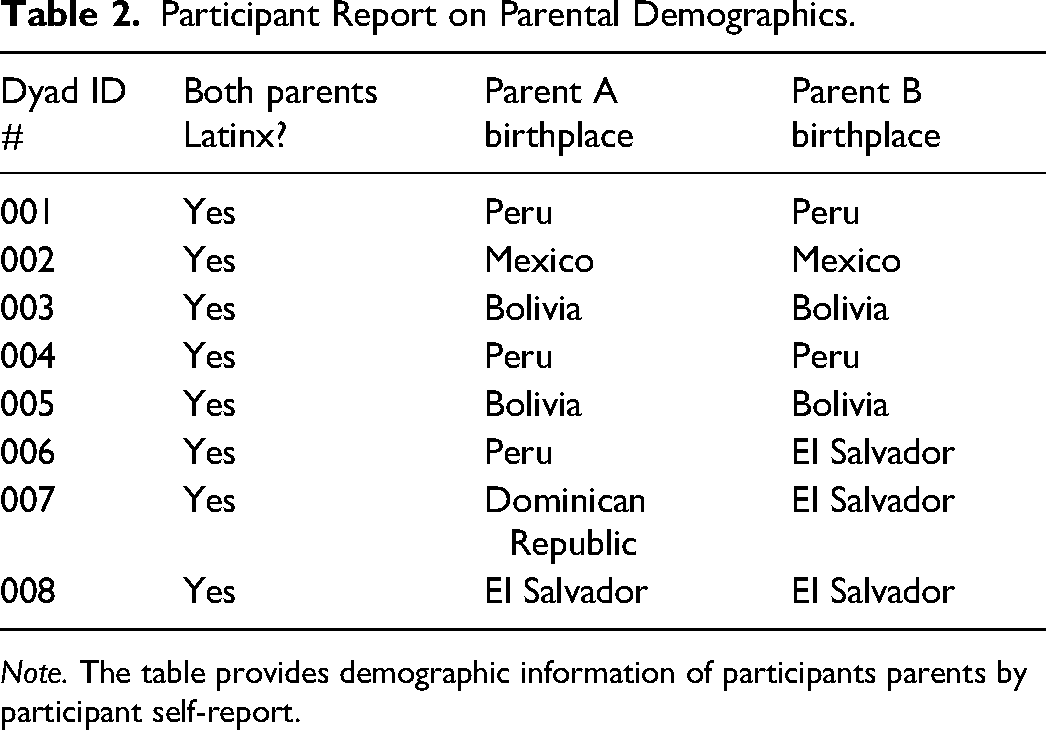
Note. The table provides demographic information of participants parents by participant self-report.
Data Collection
Interview protocol
The interviews were semi-structured and began with the research question: “Coming from an immigrant Latino/a/x family, tell me about your adaptation to the U.S.” It is beneficial to understand how the participants make meaning of their culture(s) and how they identify rather than assume. While the research question remained, “How do cultural adaptation processes to the US shape Latino/a/x siblings’ relationships?,” we began with broader questions to give the participant more options for the direction of the interview. Each sibling was asked about their sibling relationship and how culture has shaped their sibling relationship. These questions are broad enough that it kept the fluidity of the interview and the sub-questions that were asked after each broader question were specific enough that it was able to capture information on those overarching topics.
Data Analysis
To modify and capture the dyadic essence, the study used dyadic analysis as described by Tkachuk et al. (2019) using the areas of agreeance; where siblings agree about the experience of a certain phenomenon; divergence; where siblings disagree about the experience of a certain phenomenon; and uniqueness; experiences unique to one sibling. The first step in the data analysis was to transcribe the interviews and collect all observations taken about the participants. This first step allowed the researcher to become familiar with the data collected and gain a general sense of what was being described by the participants. Due to the dyadic nature of this analysis, this step included holding the perspectives of both interviewees and considering possible areas of agreeance and divergence (Jackson & Bazeley, 2019; Tkachuk et al., 2019).
The next step was for the researcher to set aside her own experience with the phenomenon to solely focus on the experiences of the participants. The researcher provided a reflexive statement during the interview process to control for biases: I acknowledge that I am a Latino/a/x individual with Latino/a/x siblings and Latino/a/x immigrant parents. I believe in the importance of this familial dynamic. I am also a clinician working with immigrant populations. I acknowledge the passion that I have for researching and working with the Latino/a/x immigrant community is inspired from my own personal experiences with my Latino/a/x immigrant family.
Next, transcripts were converted into paragraph form and meaning units were determined from the transcriptions. Meaning units are comments made during the interview that hold either cognitive or emotional significance and often occur after a shift in meaning (Giorgi, 2009; Tkachuk et al., 2019). To modify and capture the dyadic essence, the researcher labeled each meaning unit with the name of who spoke it and was impartial to both participants and included meaning units from both participants (Tkachuk et al., 2019).
Once meaning units were identified, the units were grouped according to similarities in what was being said, within and between the speakers. Following the determination of meaning units, the researcher transformed the meaning units and rewrote them as expressions (Jackson & Bazeley, 2019). Expressions are adapted from direct quotes from the transcriptions and are third-person descriptions of the quote in order to broaden what is being stated (Tkachuk et al., 2019). Horizontalization is a method used to attempt to place equal value on each statement and it is done so by narrowing the described experience down to its essence (Given, 2008). In this study, horizontalization was used to draw out significant meaning units from the data that were used to develop and form expressions. Parallel to the process of grouping similar statements within and between speakers, the grouping of similar meaning units was put under one expression to avoid the dominance of one participant over the other and decrease redundancy.
The next step was to write structural statements for each interview. Structural statements summarized the expressions found as themes of the experience. To modify and capture the dyadic essence, direct quotations from interviews were used as evidence to support the themes and provide context and complexity for areas of agreeance, divergence, and/or uniqueness (Tkachuk et al., 2019). For example, this structural statement was used to build the theme of sibling positionality: When discussing their sibling relationship, siblings discussed the roles they had. Valeria, being the oldest, described her role as the responsible one. Both siblings recognized her role as the responsible sibling and stated ‘because I’m the oldest, I definitely am responsible (Valeria). She was the responsible one (Isabel).’ Both sisters expressed and agreed on the differences between them, but they also expressed experiences that were unique to them. Valeria described feeling not only more responsible but also a sense of responsibility for and a desire to be protective of Isabel.
She stated, “I would try everything in my power, unless a parent had to be dragged in, to get her [out of] whatever trouble that she would be in (Valeria).”
The final step of the analysis was to compare and contrast structural statements across all the interviews and form combined final descriptive themes of the phenomenon. The researcher identified any themes that arose across all interviews and identified significant themes that arose in most interviews. To modify and capture the complexity of the dyadic essence, the final analysis included themes in which both participants of the dyad agreed and themes in which both participants have unique experiences (Tkachuk et al., 2019). For example, the expression “Protective of sibling” came across in many interviews and it was actually determined that it was part of the role of being an older sibling.
To establish validity, researchers and participants collaborated with each other to ensure that the participants' lived experiences were captured the way they had experienced them. Additionally, a codebook was used to ensure that codes, meaning units, and expressions were stored, stable and consistent throughout the coding process.
Results
This study explored the influence of cultural adaptation processes to the United States and how this adaptation may impact Latino/a/x sibling relationships. Eight sibling dyads participated, resulting in a total of eight dyadic interviews. Two key themes and five sub-themes emerged (Table 3).
Themes and Subthemes.
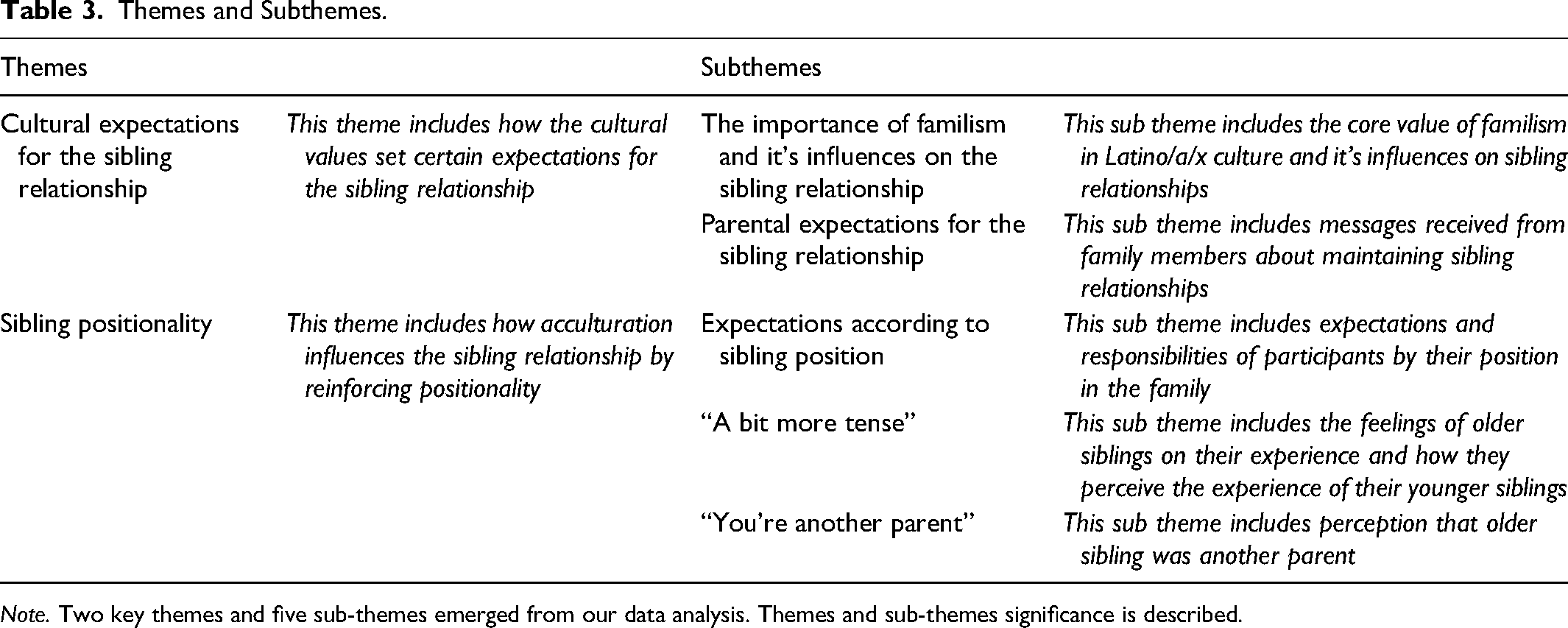
Note. Two key themes and five sub-themes emerged from our data analysis. Themes and sub-themes significance is described.
Theme One: Influence of Family on the Sibling Relationship
A common theme that emerged was the influence of family on the sibling relationship. This theme is composed of participant areas of agreeance, where both siblings in the dyad agreed and expressed similar beliefs about how culture influenced their sibling relationship. Six dyads expressed (a) the importance of familism and its influences on the sibling relationship, and (b) adhering to parental expectations shaped their sibling closeness, interactions, and relationship perceptions.
Subtheme one: The importance of familism and its influences on the sibling relationship
Sibling dyads described Latino/a/x culture as family-oriented. Participants explained how they valued family and included behavioral components such as respecting and helping family members, as well as attitudinal components such as demonstrating care for family members and maintaining a close relationship with family members. Laura and Fernando reported on their cultural value of family: Laura: In Bolivia, there's a big presence of family and a big value of family relationships and being close and being dependable. That is one of the big core values of our family. Fernando: We're Bolivian, family is very important for Bolivians. Alejandra: Some things I feel make me more Latina is family. For me, that's still my Latina trait. Elena: I completely agree. Like the desire to constantly want to be around family.
Subtheme two: Parental expectations for the sibling relationship
When reporting on their sibling relationship, some dyads reported the involvement of parents. Latino/a/x parents explicitly communicated how important it was to have a good or a close relationship between siblings. Alejandra and Elena shared what their mom told them about cultivating their sibling relationship: Alejandra: My mom always made it very important for us to know that we need to get along and make-up. Elena: Yeah, she's like, “You guys have each other. You guys are best friends,” and made sure that we were always on good terms. Telling us, “You're sisters, you have to have to get along, you're best friends, your only friend, you’re best friends the rest of your life.”
Theme Two: Cultural Experiences Dependent on Sibling Positionality
Another common theme that emerged was the unique experiences of siblings depending on their sibling position. This theme is composed of participant areas of uniqueness. Sibling position was identified as an area of uniqueness rather than an area of divergence because sibling position does not change, nor can one position have the opportunity to experience the other. For example, younger siblings will not have the opportunity to be the oldest sibling since that position is already taken and vice versa.
Subtheme one: Expectations according to Ssbling position
When describing their sibling relationship, older siblings expressed experiences due to being the oldest. A lot of the experiences described related to the responsibilities of being a child of immigrant parents. These responsibilities included interpreting for parents, translating documents for parents, learning to do tasks that parents typically do, and care taking for younger siblings. Some siblings expressed the responsibilities as “ones they didn’t want or ask for.” Later-born siblings often acknowledged the firstborns’ experience. Luis validated Veronica's experience by expressing the responsibilities she had as simply expectations of her. Veronica: It's a responsibility that I didn't really want. I kind of wish I didn't have. Luis: It's expected by the parents because you're older.
Subtheme two: “A bit more tense”
Older siblings described feeling that their upbringing was “a bit more tense,” especially when comparing it to the perception they had of the upbringing of their younger siblings. Older siblings reflected on how overwhelming expectations and responsibilities were for them. Fernando stated: Because she was the last child, with her, everything was a little bit more calm. With me, was a little bit more tense. I knew what was going on in the household because I would have to translate [for] my parents. It feels like to me, when you are the oldest, you have to have a lot more responsibility that you don't personally ask for. It was a lot growing up. But in the long run, it helps you understand and makes you appreciate things and not take things for granted.
Discussion
This qualitative study explored the influence of cultural adaptation processes to the United States and how this adaptation may impact Latino/a/x sibling relationships. This study used areas of agreeance; where siblings agree about the experience of a certain phenomenon; divergence; where siblings disagree about the experience of a certain phenomenon, and uniqueness; experiences unique to one sibling, to gain a relational understanding of this phenomenon. This analysis yielded mostly areas of agreeance and uniqueness, with virtually no areas of divergence, and helped develop the themes found in this study. There were two areas of agreeance: (a) cultural and parental expectations for their sibling relationship, and (b) unique experiences pertaining to growing up in the United States, such as their sibling positionality. Some of the findings of this study are congruent with current literature on the importance of family in Latino/a/x culture and the impact of immigrant cultural adaptation processes on familial relationships (Dennis et al., 2010; Pyke, 2005; Smokowski et al., 2008). New information emerged regarding younger siblings noticing the experiences and efforts of the older sibling, and also shared experiences of cultural navigation that create a sense of togetherness in Latino/a/x sibling relationships.
Berry (2005) defines cultural adaptation as integration, assimilation, separation, and marginalization. It was found, however, that participants engaged in another form of adaptation – alternation, the process of altering between cultures depending on the social context (LaFromboise et al., 1993). While participants self-reported identifying with either American culture (assimilation), Latino/a/x culture (separation), or both (integration) (Table 1), all participants described alternation experiences in which they adapt themselves to better fit within their environment; usually engaging more in Latino/a/x culture with family and engaging more in American culture at work or school. There are mixed findings on the process of alternation and its impact on an individual; findings argue for both the process being associated with cultural identity conflict and lower levels of psychological adaptation and high sense of well-being and higher cognitive functioning in bicultural individuals (Ibrahim & Heuer, 2016; LaFromboise et al., 1993; Ward et al., 2018). While participants described how they alternated between cultures depending on their environment, the thoughts and feelings behind this process were not discussed and more research needs to be done to gain a better understanding of the complexities of alternating between cultures.
What is unique is that within the sibling relationship, alternation appeared to be a shared experience. Siblings reported engaging in alternation with each other as well as when they were apart. They reported on the use of English to keep conversations away from parents, the creations of inside jokes about their upbringing, and using Spanish in public around English speakers and how these experiences bonded them. Literature supports the fact that the Latino/a/x immigrant experience is a complex experience that involves a level of stressful cultural adjustments (Berry, 2005; Dennis et al., 2010; Galvan et al., 2015; Gil & Vega, 1996; Smokowski et al., 2008). Participants’ reports add to this literature by indicating that while these experiences are in fact different from White, non-Latino/a/x families in the United States, the experience is not an isolating experience if there is someone to share that experience with. The findings suggest that, to some extent, even when older and younger Latino/a/x siblings have unique experiences, Latino/a/x immigrant siblings have a sense of understanding of each other's experience and a sense of togetherness in that experience. Additionally, it is important to note that siblings did not report where they learned this behavior. While literature supports that siblings learn from each other (Hafford, 2010; Kibler et al., 2014; Palacios et al., 2016), more research needs to be done to better understand how they may have learned this similar cultural navigation strategy.
Consistent with previous literature on the value of familism in Latino/a/x culture (Behnke et al., 2008; Corona et al., 2017; Hernández & Bámaca-Colbert, 2016; Schwartz et al., 2010a, 2010b), participants reported the importance of familism in their families. Familism embraces family cohesion, closeness, support, family ties, loyalty and reciprocity, and family respect and honor (Corona et al., 2017; Hernández & Bámaca-Colbert, 2016; Schwartz et al., 2010a, 2010b). Killoren et al. (2016), found that familism is not only important to the family as a whole but may also be impactful in different subsystems within the family (i.e., sibling relationships, parent-child relationships). Participants reported that the expectations of familism from their parents cultivated their sibling relationships. While current literature does not go into depth with specifics on how familism values are passed down from generation to generation, the current literature indicates that Latino/a/x families transmit familism values and traditions via socialization practices including how parents choose to rear their children (Fuligni et al., 1999; German et al., 2009). These findings support that literature and add to it by highlighting parental practices of explicitly and implicitly sending messages to their children as they pass down familism values and the importance of sibling relationships. More work needs to be done around implicit and explicit communication practices about familism and how those may be passed down to siblings.
Older siblings reported having the burden of translating for their parents and being cultural brokers for their families (German et al., 2009; Kibler et al., 2014; Palacios et al., 2016). While the older siblings having more responsibility in the family is accounted for in immigrant family research (Hafford, 2010; Pyke, 2005), findings in this study go further into the perceptions of younger siblings as their older siblings have this role. Younger siblings acknowledged the unwanted responsibility of their older sibling and were able to validate the experience of the oldest sibling. Older siblings felt supported because younger siblings noticed their efforts and that helped them to create a sense of resiliency. More work is needed to understand ways that younger siblings may actually support older siblings within parentification roles.
Clinical Implications
Extensive literature about Latino/a/x families discusses the importance of family in the culture (Behnke et al., 2008; Corona et al., 2017; Hernández & Bámaca-Colbert, 2016; Schwartz et al., 2010a, 2010b). Findings from this study show that it could be very beneficial for clinicians to spend time assessing and exploring the sibling subsystem within Latino/a/x families. We found that it is important for clinicians to understand a client's role in the family given their sibling position, the support that a sibling can give during cultural adaptation processes, as well as the complicated perspectives around parentification in Latino/a/x families.
Clinicians should know that sibling position in Latino/a/x immigrant families influences the sibling's role in the family, specifically for older siblings. Older siblings reported feeling like another parent to their younger siblings and younger siblings agreed with their older siblings about their role. Previous literature has acknowledged older siblings as caretakers for their younger siblings (Hafford, 2010; Kibler et al., 2014; Palacios et al., 2016) and, in extreme cases, concerns for parentification (Hafford, 2010; Kibler et al., 2014; Palacios et al., 2016). Research has found parentification to correlate with emotional distress, depression, attachment disorders, trauma, and eating disorders (Hooper et al., 2015; Kuperminc et al., 2013). Yet, older siblings in this study reported feeling maternal and paternal admiration toward their younger siblings. This indicates that parentification can be a source of pride for older siblings and is congruent with literature that highlights that sibling caretaking can increase the individual's sense of competence and coping (Hafford, 2010).
Hafford (2010) also acknowledges that in some families parentification may resemble neglect and suggested careful, culturally appropriate family assessment before assuming any type of parental neglect. Sibling caretaking is a cultural norm, and clinicians with little understanding of cultural family practices may be wary of children having these types of responsibilities (Hafford, 2010). It is important for clinicians to be knowledgeable about cross-cultural child-rearing practices and assess their client’s family history, mobility, and resource access in order to have a complete understanding of the client's living situation.
Every family member has a part that they play in the family (Smith & Hamon, 2017), participants identified these as their roles. Participants reported that the roles they played in the family shaped their experiences within the family as well as the ways they interacted with their siblings. Clinicians should be prepared to assess the client's role within the family and the ways that these roles may impact them. For example, while gathering biopsychosocial information, a clinician might consider the following questions to further guide their assessment of these roles: (1) How would you define your role in the family? (2) How is your role in the family determined? (3) Who notices your role? (4) What responsibilities do you have? (5) How do you feel about your role? (6) How do family members perceive your role?
Siblings also reported a shared cultural adherence and cultural navigation that provided them with a sense of social support. Research shows that the phenomenon of cultural adaptation and navigation is not solely an individual experience, and its effects extend to familial relationships and processes (Cooper et al., 2020). Our findings supported this notion, and siblings reported that navigating their culture and adapting themselves to their environment was a relational experience. While mental health professionals should be prepared to engage the entire family when discussing cultural navigation, it may be helpful to assess how siblings, specifically, navigate and adhere to culture and how one sibling's navigation and adherence can influence the others.
Siblings reported that they participated in cultural alternation, which has been documented in other cultures (i.e., code switching, cultural frame switching) (Ward et al., 2018). Clinicians, especially those who do not share the same culture as their client, need to be mindful that siblings may participate in this form of interaction with each other in the therapy room, whereby they may be communicating with each other in cultural ways. While participants reported on their cultural alternation, their cultural alternation was also observed through the ways they interacted with each other in both English and Spanish and through their alternation between both languages within a sentence. Clinicians should be prepared to slow the process down to gain a better understanding of the processes that occur in the room between siblings and inquire about the cultural switching that may occur. Pointing out the switch that occurs in the here-and-now could lead to a conversation on the mechanisms and functions of alternation between cultures and the mechanisms and functions of alternating with each other, in turn, pointing out this dynamic may solidify the relationship between siblings. Clinicians may ask the following questions: (1) How would your siblings speak to their cultural identity and navigation? (2) What similarities or differences, if any, do you notice between your identity and navigation and that of your siblings? (3) How do you feel about the similarities and/or differences you notice? (4) What do you make of the similarities and/or differences you just pointed out? Additionally, clinicians should highlight the similarities their client reports noticing. This study demonstrated that Latino/a/x immigrant siblings can be a source of support for each other, and highlighting similarities can shift a potentially lonely experience into a shared experience.
Lastly, findings from this study suggest that alternation may be an additional element to explore when working with Latino/a/x immigrant individuals and siblings. Clinicians, particularly White, non-immigrant clinicians, need to know what that experience is like. Clinicians should reflect what the client expresses regarding their cultural identity and navigation and follow up with, “Are there ever situations where you’re your identity and/or navigation shifts?” The use of metaphors could be beneficial. Participants in this study described their alternation as jumping into different “pools” or daily shifts that include “nine-to-five and after work.”
Direction for Future Research
This was a descriptive phenomenology study on sibling relationships and yielded topics for further exploration. First, while there is extensive research on White sibling relationships, more research is needed to understand Latino/a/x sibling relationships. Second, findings suggest that gender influenced siblings’ perceptions of support amongst each other, and their responsibilities within the family. Future studies can look at differences between Latino/a/x sister relationships, Latino/a/x brother relationships, and mixed-gender Latino/a/x sibling relationships. Third, further exploration is needed to understand the impact of acculturation processes on immigrant sibling relationships. Lastly, the authors suggest that future studies with siblings should include individual interviews and dyadic interviews to better capture nuances within siblings’ perceptions of their relationship.
Limitations
The study had a couple of limitations. One of the limitations was the sample size. The current sample includes 16 participants within the eight dyads, which is appropriate for a descriptive phenomenology. However, the ideal would be to reach saturation, suggesting more participants recruited for the study. Additionally, while the varied configuration of the dyads (i.e., gender, birth order) was appropriate for an exploratory study, the majority configuration was sister-sister dyads. Research has found that sister‒sister siblings report closer relationships, and this majority configuration may have impacted the results (Killoren et al., 2015).
Another limitation is selection bias given the structure of the interview. The dyadic interview may have attracted siblings who would not mind participating in a research study together and therefore siblings who have closer relationships with each other. Additionally, an important aspect of dyadic interviews is the dyad's interaction and engagement with each other (Tkachuk et al., 2019). There are times where, because of the nature of group interactions, one person leads and engages more than the other (Tkachuk et al., 2019). While participants were reminded of the interactive nature of the interview at the start of the interview, some siblings were still more engaged than others. Multipartiality was upheld by checking in with the other sibling after the other had spoken and limiting direct questions toward a specific sibling.
Conclusion
This study helped address gaps in the Latino/a/x literature by exploring the influence of cultural adaptation processes to the United States and how this adaptation may impact Latino/a/x sibling relationships. Previous studies on Latino/a/x immigrant families focus on parent‒child dynamics, and previous studies on sibling relationships use predominantly Western populations. Additionally, limited literature in this area has used monadic approaches, meaning individual data. This study's use of dyadic interviewing and analysis added a dyadic perspective to these findings and the Latino/a/x literature. Findings from this study highlight the importance of family in Latino/a/x culture and how it extends to and is expected in sibling relationships and the unique and shared experiences of Latino/a/x immigrant siblings growing up in the United States.
Footnotes
Declaration of Conflicting Interests
The authors declared no potential conflicts of interest with respect to the research, authorship, and/or publication of this article.
Funding
NIH U54CA267735 (Diez Roux & Gitlin, MPIs) Drexel FIRST: Catalyzing Systemic Change at Drexel University to Support Diverse Faculty in Health Disparities Research.
