



Abstract
Social media offers a plethora of strangers cum friends whose photo shopped images seem idealistic and more appealing than one's primary partner. Due to the physical absence and lack of non-verbal cues, online communications can quickly become aggressive and emotionally intimate. Emotional intimacy between online friends is considered a betrayal in a dyadic relationship. To protect mates from external relationship threats, romantic partners may request and/or coerce their significant other for social media account passwords. In a sample of 299 adults (women = 246) between18 and 72 years (M = 21.12, SD = 5.39), we explored the participants’ attitudes toward password sharing, their password sharing behavior with the significant other, and finally seeking social media account passwords from their significant other. We also tested if sharing one's passwords (password sharing behavior) would mediate the relationship between the participant's password sharing attitude and the significant other's account monitoring. We found that favorable password sharing attitude may predict password sharing behavior and the significant other's SNS account monitoring. Password sharing behavior also partially mediated the relationship between password sharing attitude and the significant other's account monitoring. Implications and limitations of the study are discussed.
Online communications have seen an exponential rise mostly due to the constant access to handheld devices. Many people use social networking websites (SNS) to interact with family, friends, ex-partners, and potential new partners. SNS are equipped with tools that enable users to transcend geographical boundaries to interact (passively or actively) with other users and browse for new information, job offers, and romantic contacts. SNS use is significantly more prevalent (80%) in the younger and middle-aged adults (19–56 years) compared to 42% in older adults (<68 years; Tammisalo et al., 2022). Older adults are more interested in keeping in touch with family members than making new friends (Mentis et al., 2019). The uses and gratifications model holds that people use social media to satisfy their needs such as entertainment, diversion, social utility, information, and surveillance (Kwon et al., 2013; Utz et al., 2015). Maintaining friendships is most often reported as a motive for SNS use followed by social surveillance (Joinson, 2008), and fear of missing out (FOMO; Gupta & Sharma, 2021).
Certain SNS applications are more popular with younger generation (e.g., Instagram and Snapchat) while older adults are more inclined to using Facebook (Tammisalo et al., 2022).
Although there are dating applications that are especially geared toward helping users connect with romantic partners (e.g., bumble), other commonly used SNS have also developed features to help users connect with romantic partners. Empirical research revealed that SNS users send friend requests with romantic interest, irrespective of their relationship status (Drouin et al., 2014). Essentially, partners already in a dyadic romantic relationship also browse SNS profiles for romantic alternative(s). Romantic alternatives are the potential future committed or sexual partners that may act as a relationship insurance incase the current relationship fails (Dibble et al., 2015). In a study, researchers asked SNS users to identify people from their “SNS friend list” with whom they would consider having a romantic relationship with, if they were single. Results showed that the number of reported romantic alternatives was not significantly different based on the participant's relationship status (i.e., single, committed, dating; Dibble et al., 2015).
It is no surprise that when alternatives are just a click or swipe away, partners in a dyadic relationship may be easily distracted from their primary relationship. These romantic distractions lower relationship commitment with the primary partner (Abbasi, 2018; Abbasi & Alghamdi, 2017; Banas et al., 2021). Relationship commitment is influenced by the perceived quality of romantic alternatives, relationship satisfaction, and mutual investments (Rusbult et al., 2011). Commitment is also inversely related to the amount of communications with all romantic alternatives suggesting that commitment may protect against extra-dyadic interactions. In a study, married partners reported having more online romantic alternatives, but reported communicating and seeing them less often than dating partners (Drouin et al., 2021). One explanation could be that committed partners spend more time together due to which they have more access to each other's devices and have a high likelihood of being caught red handed. It is plausible that married/committed partners tread cautiously in fear of losing resources that are afforded by their primary relationship.
The investment model holds that the extent to which partners find romantic alternatives attractive may vary partly due to their relationship satisfaction and how much they have invested in their relationship (Rusbult, 1980). Some partners may use SNS to seek alternative relationships or to escape from their primary relationship problems (Abbasi, 2019a, 2019b). This could also explain the association between SNS use and relationship conflict, jealousy, low commitment, unhappiness, low self-esteem, envy, low relationship quality, social tension, and divorce (Carter, 2016). A study comprised of partners in a cohabiting relationship found that partners who reported greater online infidelity behaviors were least likely to favor password sharing (Abbasi et al., 2023). It is plausible that partners who do not engage in inappropriate communications and/or do not invest their time in an extra-dyadic online relationship are more inclined to sharing their passwords.
The development and escalation of romantic relationship on social media underlines the phenomenon of “mediatization of romance,” which refers to how social processes become inseparable from and dependent on media technology (Jansson, 2013). The concept of mediatization of romance accentuates the critical role of social media in influencing all aspects of romantic relationships such as online communication, password sharing, and account monitoring. In all aspects of contemporary interactions, virtual communications have become pronounced, albeit lacking meaningful dialogs. This lack of meaningful interactions with superficial online connections may relegate some users to a state of “alone together” (feeling lonely even when connected with online friends; Turkle, 2013).
Password Sharing
Password sharing is common among romantic partners (Van Ouytsel & De Groote, 2022), family (Anderson, 2016), and friends (Meter & Baum, 2015). In this study, we examined two aspects of password sharing, that is, mindset toward password sharing (attitude) and the act of sharing passwords (behavior). Although, SNS password sharing may also include deliberate and secretive behaviors to learn about partner’s activities (Bevan, 2018), for this study, we operationalized password sharing behavior to occur when partners agree to give out their SNS passwords to their significant other (Vendemia & Bevan, 2024). Password sharing has become a widespread practice among romantic partners (Van Ouytsel et al., 2019). A recent survey revealed that 81% of romantic partners have shared their phone and/or social media account passwords (Express VPN, 2023). Additionally, password sharing is also a type of coping mechanism that romantic partners employ to combat jealousy and other relationship insecurities (Van Ouytsel et al., 2016). Individuals who share their passwords believe that the benefits of sharing passwords outweigh the
Overall, SNS password sharing is an accepted dating practice especially among teenagers who often share their passwords to build trust and show their mutual love (Bevan, 2018; Lucero et al., 2014). A recent study comprised of an adult sample found that jealousy, relationship satisfaction, and relationship length predicted password sharing (Vendemia & Bevan, 2024). Researchers have delineated “three levels of perceptions” in password sharing (Van Ouytsel & DeGroote, 2022), which are perceived context, perceived motivations, and perceived consequences of sharing passwords. At the perceived context level, people predominantly share passwords with friends and family. At the perceived motivations level, password sharing is a nuanced practice that can differ based on the context and type of the relationship in which it is shared. Moreover, in some instances, passwords are deliberately shared during friendship formation to show trust. In other instances, passwords are shared based on different motivations (e.g., to take over a Snapchat streak or check emails; Marwick & Boyd, 2014). At the perceived consequences level, password sharing occurs despite users fearing impersonation, hacking, cyber aggression, and cyberbullying (Merdenyan & Petrie, 2022).
Account Monitoring
Password sharing has multiple dimensions including password seeking and account monitoring (Bevan, 2018). The constant availability of online “friends” may cause some partners to be suspicious. Resultantly, suspicious partners may monitor their partner's accounts to guard their relationship against external threats. Mate guarding can potentially lead to detrimental behaviors including conflict and interpersonal violence (Lyons, 2019). Suspecting partners may experience jealousy, which may cause them to demand or steal passwords in order to monitor their partner's online activities (Abbasi, 2022). Evidence suggests that Facebook jealousy predicts SNS account surveillance (Muise et al., 2009). Interestingly, most respondents had negative opinions and attitudes toward partner`s SNS account monitoring (Van Ouytsel et al., 2019). Nevertheless, partners report monitoring their significant other's SNS account. In one study, respondents admitted engaging in their partner's SNS account surveillance and even reading their private messages (De Wolf, 2019). SNS password sharing is both a form of, and distinct from, general online surveillance (Bevan, 2018). In a study, approximately 20% of adult dating sample demanded their partner's Facebook passwords and more than 33% monitored their partner's private Facebook chat and/or messages (Bevan, 2018). Requesting SNS account passwords or viewing partner's SNS content is strongly linked with negative relationship outcomes (De Wolf, 2019). However, research has also indicated that relationship commitment, quality of alternatives, and relationship satisfaction is not significantly linked with password sharing attitudes in cohabiting partners (Abbasi et al., 2023). Unsurprisingly, romantic partners who reported engaging in online infidelity behaviors had unfavorable attitudes towards password sharing (Abbasi et al., 2023).
Hypotheses
To our knowledge, there is no study that examined whether partners' attitude towards password sharing has any implication on their own password sharing behavior and engaging in their significant other's SNS account surveillance. To cover this gap, we examined if partners who espouse favorable attitudes toward password sharing also share their own passwords and whether this password sharing behavior could predict the significant other's SNS account surveillance. It is plausible that if partners share their passwords, they may feel more entitled to seek or demand their significant other's passwords. We hypothesized that password sharing attitudes will be positively related to password sharing behaviors and partner's SNS account monitoring. That is, individuals who espouse a favorable attitude toward password sharing will share their passwords with their partner (H1) and will also be inclined to monitor their partner's SNS account (H2). Additionally, password sharing behaviors would act as a mediator between password sharing attitudes and the significant other's SNS account monitoring (H3).
Methods
Participants
Participants were 299 adults (women = 246) between the ages of 18 to 72 years (M = 21.12, SD = 5.39) mostly from the United Kingdom (53.2%) followed by the United States (41.1%), and other miscellaneous countries (5.7%). The participants were in a committed (n = 282, 94.3%) or married (n = 17, 5.7%) relationship, and majority of them were living separately (73.9%). The average relationship length was 3 years (SD = 1.73 years). Our participants reported to be mostly heterosexual (91.3%). In terms of ethnicity, our participants were White (61.9%), Asian (21.1%), Hispanic (13%), African (3.7%), and Native American (1%). In terms of highest level of education completed: 1.3% did not have a high school diploma, 29.1% completed high school, 41.1% either attended or were attending college (not graduated yet), 6% completed an associate degree, 7.4% completed a bachelor's degree, 11% were in a graduate school, and 4% had completed graduate school.
Procedure
This study received approval from the ethics board at the San Jose State University. The study was conducted in the Spring and fall of 2021. The study was online and included an anonymous survey administered using SurveyMonkey. We posted the study link on the official research webpage of two universities in the United States and the United Kingdom, along with other social networking platforms (e.g., LinkedIn, Facebook, Instagram, Twitter, and WhatsApp). Participants consented to the terms of the study.
Measures
Demographic Questionnaire
Participants were given a questionnaire asking about their demographics including gender, age, relationship status, education level, country of residence, and ethnicity.
Account Monitoring Scale
The four-item Likert type account monitoring scale (Bevan, 2018) measured the significant other's SNS account monitoring. This scale measured both the willingness of our participants to ask for their partner's SNS passwords and also using that login information to monitor their partner's SNS account. This included discreetly logging into partner's accounts to spy on their activities. In essence, we measured how often our participants engaged in account monitoring. The scale items include: “I have asked my romantic partner to give me their SNS passwords”; “I have used my romantic partner's password to check their SNS account.” The response format was rated on a seven-point Likert scale (1 = Never and 7 = Always). The reliability of the scale for this study was good (a = 0.84, M = 6.47, SD = 3.81).
Password Sharing Scale
The two-item Likert type password sharing scale (Bevan, 2018) measured password sharing behavior in the study. The scale items included: “In your current or most recent relationship, how frequently have you (1) shared SNS passwords with your romantic partner? (2) Gave your SNS passwords to your romantic partner.” The response format was rated on a seven-point Likert scale (1 = Never and 7 = Always). The reliability of the scale for this study was good (a = 0.96, M = 5.91, SD = 3.97).
Attitude Toward Password Sharing
We used one question to measure the participants' attitudes toward password sharing. Participants were asked: To what extent, do you think partners should share their social media account passwords with each other? The response format was rated on a seven-point Likert scale (1 = Never and 7 = Always).
Results
As a preliminary step, we first tested if there are any significant differences in password sharing attitudes, password sharing behaviors, and partner's account monitoring based on gender and age. We did not find any significant gender or age differences (p > .05). Table 1 shows Pearson's bivariate correlations of the main variables. Gender and age did not show a significant correlation with the main variables. To test our hypotheses, we used the SPSS PROCESS Macro developed by Hayes (2013). Based on the PROCESS macro template guidelines, the specific mediation model (model 4) with 5000 bootstrap resamples was used to compute the standard error, and 95% confidence interval limits at .05 significance level. In this model, we added password sharing attitudes as the predictor variable (X), partner's account monitoring as an outcome variable (Y), and password sharing behaviors as the mediator (M).
Pearson Bivariate Correlations of the Main Variables.
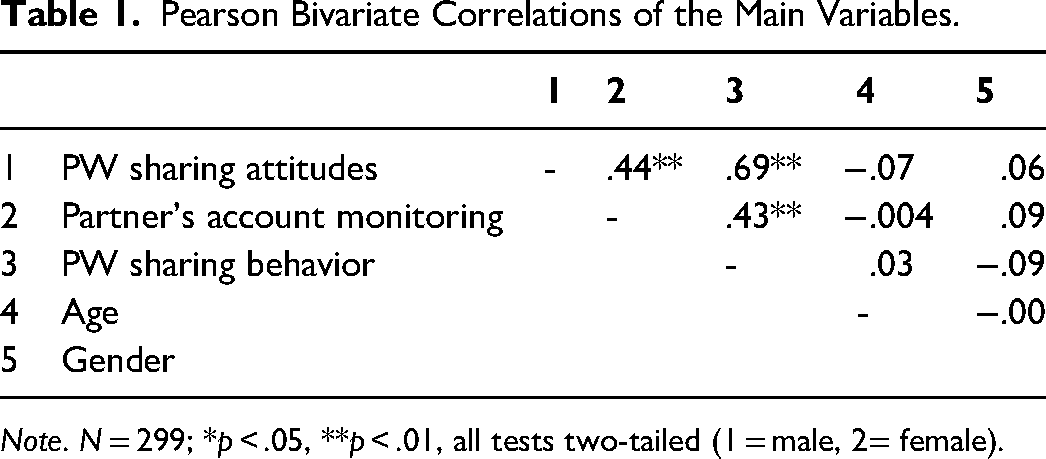
Note. N = 299; *p < .05, **p < .01, all tests two-tailed (1 = male, 2= female).
Figure 1 shows the total and direct effects of password sharing attitudes on partner's account monitoring. We found support for H1 and H2. The total effect (path c) of password sharing attitudes on partner's account monitoring is significant [b = 1.14, t (297) = 8.48, p < .001, F(1, 297) = 71.94, p < .001, R2 = .19]. The effect of password sharing attitudes on password sharing behaviors [path a: b = 1.85, t(297) = 16.32, p = <.001, F(1, 297) = 266.48, p < .001, R2 = .47], the effect of the password sharing behaviors on partner's account monitoring [path b: b = .23, t(297) = 3.35, p < .001, F(1, 297) = 42.81, p < .001, R2 = .22] are both significant. At the same time, the direct effect of password sharing attitudes (X) on partner's account monitoring (Y), after accounting for password sharing behavior (M), path c prime (c’), continued to be significant [b = .72, t (297) = 3.96, p < .001), which ruled out complete mediation. We found a significant indirect effect of password sharing attitudes (X) on partner's account monitoring (Y) via the mediator (b = .42, 95% BCa CI [.20, .64]), which is consistent with partial mediation. Therefore, H3 is supported.
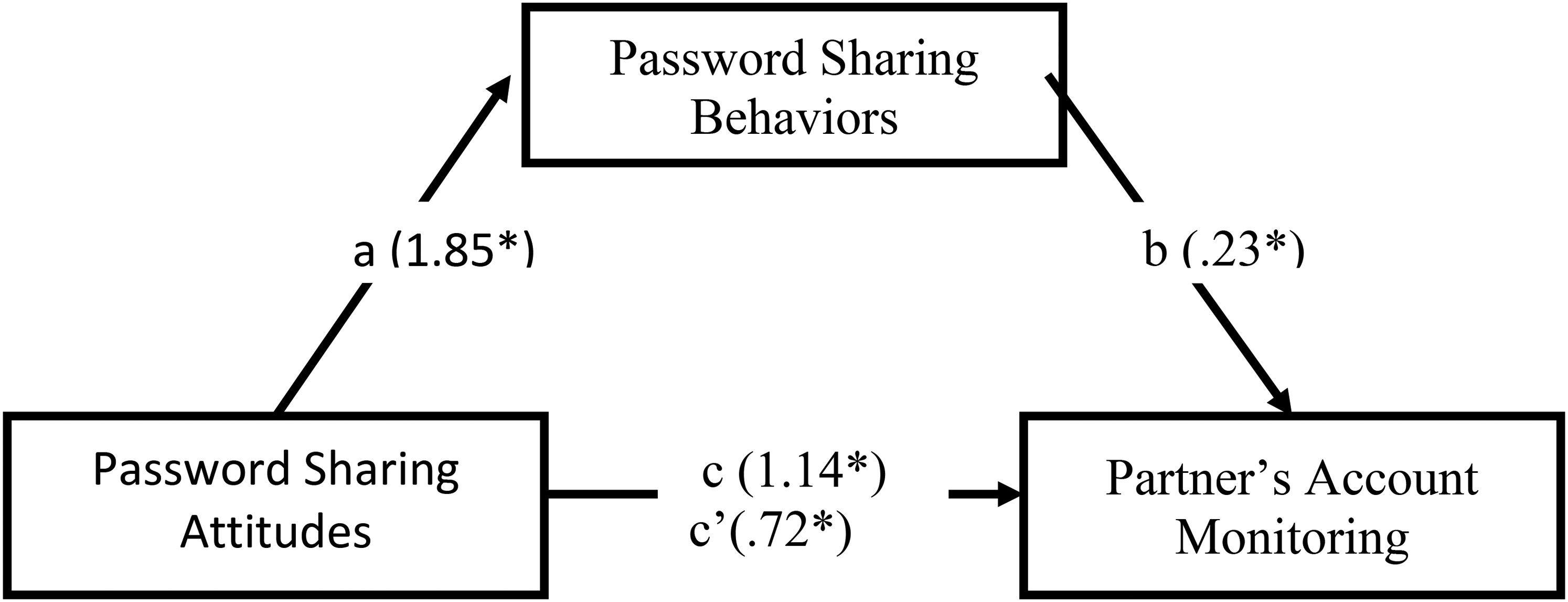
Total and direct effects of password sharing attitudes on partner's account monitoring. N = 299. *p < .05, **p < .01.
Discussion
Social media not only plays a part in the development, escalation, and maintenance of romantic relationship but also in its de-escalation (De Wolf & Joye, 2019). Some romantic partners share their SNS passwords voluntarily while others may be coerced into sharing passwords. Mate guarding, jealousy, and suspicion are some of the reasons partners monitor their significant other's SNS accounts (Lyons, 2019; Muise et al., 2009). Password sharing is a common practice among teenagers (Bevan, 2018). In this study, we found that favorable attitude toward password sharing is positively linked with password sharing behaviors. That is, those who view password sharing favorably also share their own SNS account passwords. Additionally, password sharing behavior is also associated with partner's SNS account monitoring. Essentially, partners who share their own passwords also seek their significant other's SNS account passwords and use the login credentials to monitor their online activities. This is an interesting finding. One explanation could be that partners who share their passwords may feel entitled to seek their significant other's passwords. In this study, password sharing behavior acted as a partial mediator between password sharing attitudes and partner's account monitoring. Partners who share their passwords may believe that their SNS accounts are monitored since they volunteered their login information. This belief may encourage them to seek their significant other's passwords. Considering the uses and gratification model, it is possible that partners who have favorable attitudes toward password sharing may use SNS just to keep in touch with friends and to get news rather than engaging with romantic alternatives. In the light of the investment model, it is possible that partners who favor password sharing and also share their passwords are more likely to dismiss alternatives and avoid engaging in inappropriate private chats. Password sharing can also be very risky and could have grave consequences for the relationship incase a betrayal is exposed.
This study has important implications for couples and relationship counselors. Partners should carefully consider the risks and benefits associated with sharing passwords. Partners who give out their SNS passwords should expect their accounts to be monitored. If partners do not feel comfortable with sharing SNS passwords, they should clearly state their expectation of privacy. Sharing a phone password may also give access to the partner's SNS accounts. To avoid future relationship troubles, counselors should encourage partners to be transparent. However, partners who do not wish to be monitored should be advised to activate the two factor authentication feature (e.g., face recognition) on their SNS applications.
Limitations
A main methodological limitation of this study is its reliance on self-report data, which may be prone to recall bias. Our convenience sample was mostly composed of younger heterosexual white women, which is not representative of the overall SNS population. SNS are popular among all ages despite different underlying motivations. Evidence suggests that in older married couples, password sharing happens not only because of trust but could also be due to cognitive decline (Mentis et al., 2019). Therefore, caution is advised when extrapolating the current findings to older adults. Furthermore, most of our participants reported to be heterosexual, therefore, caution is advised when interpretating these results for other populations. It is possible that participants inaccurately reported their sexual orientation due to social biases. Future studies can include a backup question regarding the gender of the participant's partner to confirm the participant's sexual orientation. In this study, we included participants who reported to be in a committed or marital relationship. Therefore, this study should not be generalized to partners in a dating or uncommitted relationship. To our knowledge, this study included one partner from the primary relationship, which is another limitation.
Due to the cross-sectional design of the study, we are reporting casual (not cause and effect) inferences here. Future qualitative studies could decipher the direction of the relationship between our variables. If a study could be conducted ethically, we propose to assign couples randomly to two groups: (1) couples where both partners share passwords voluntarily (2) couples where none of the partners share passwords. During the in person structured interview, researchers can examine the cause and effect relationship between certain online activities and relationship variables (e.g., satisfaction, commitment, and infidelity). Such research could also explore variables, which show the strongest link with password sharing. Moreover, it could also decipher whether partners share their passwords only to get their significant other's passwords. Lastly, future research could also investigate the real motivations behind partner's account monitoring.
Despite the limitations mentioned above, our study is a step forward in the password sharing research and contributes to the existing literature. We report that those who favor password sharing also give out their passwords. There is an expectation of reciprocity such that partners who share their passwords also seek their significant other's SNS account passwords.
Footnotes
Data Availability
The author may furnish data upon a reasonable request.
Consent From Participants
Participants consented to the study terms approved by the Institutional Review Board.
Declaration of Conflicting Interests
The authors declared no potential conflicts of interest with respect to the research, authorship, and/or publication of this article.
Ethical Approval
This study was approved by the Institutional Review Board at San Jose State University.
Funding
The authors received no financial support for the research, authorship, and/or publication of this article.
