




Abstract
At some point prior to their children turning 18, roughly 70% of mothers will hold the position of breadwinner in their family. The increasing number of breadwinning mothers is reflective of the shifting roles of women in families. Although a family role shift is evident for mothers, the centrality of women in the development of families across the lifespan remains unchanged. The centrality of mothers to family development is obvious in the family life cycle. Embedded in the traditional family structure, the family life cycle is a commonly used assessment model for family lifespan development despite its incongruence with professional counseling ethics and curriculum standards. The incongruence highlights the need for a family development model appropriate for diverse family structures. Therefore, a pilot case study approach guided this study as an initial exploration into the family development of high achieving women. An in-depth semi-structured interview with a single participant was conducted and then analyzed using a phenomenological approach. Four themes emerged from the participant's experience: self-efficacy and hustle, supportive relationships, resources used, and barriers faced. The findings from this study demonstrated a clear need for additional research. Additionally, the researcher recommends that counselor educators and family counselors should be cautious in their utilization of existing family development assessment models with diverse families.
In 2019, 40.5% of mothers with at least one child under 18 were the equal, primary, or sole earners of their households (Women’s Bureau, n.d.). Moreover, roughly 70% of mothers in the United States will be the primary financial provider in their household at some point prior to their children turning 18 years of age (Glass et al., 2021). The increase in breadwinner status among U.S. mothers reflects their shifting role within the U.S. family. Despite the growing presence of mothers in the workforce, their centrality to the development of the family remains unchanged (McGoldrick et al., 2016).
Although women play a central role in overall family development, their individual development within the family life cycle has largely remained ignored. Instead, women's individual and family development focused on their experiences of caretaking the men, children, and elderly in their lives (McGoldrick et al., 2016). Recently, researchers (e.g., Coontz, 2016; McGoldrick et al., 2016; O'Brien, 2021) noted that family development must include the development of women beyond their role as caretakers of others. The importance of acknowledging development beyond caretaker roles is evident in the experiences of employed mothers. Specifically, no model of family development addresses the experiences of high achieving women as they traverse the demands of family and high-demand careers.
The lived experiences of high achieving women are underrepresented in the current literature, thus creating large knowledge gaps about this growing population. Furthermore, the paucity of literature regarding high achieving women across multiple disciplines does not contain a concise definition for high achieving women. In the existing literature, authors (e.g., Ely et al., 2014; Fider et al., 2014; Gersick & Kram, 2002) describe high achieving women as women who have advanced education and/or terminal degrees; likely working in male-dominated fields; and possessing careers in areas such as law, medicine, academia, and the corporate suite. For the purpose of this study and with the support of existing literature (e.g., Ely et al., 2014; Fider et al., 2014; Gersick & Kram, 2002, etc.), high-achieving women are defined as women with a terminal degree in their respective fields.
Purpose of the study
This pilot single case study aimed to capture an in-depth understanding of one high achieving woman's experience of family development. Due to the dearth of existing literature, the study structure was a pilot case study to act as a launching point of knowledge. To obtain an in-depth understanding of a high achieving woman's family development experience, the participant answered questions about how she navigated major family development milestones, implemented support systems, and overcame barriers. The data from this study answered the following research questions:
What are the experiences of a high achieving woman with children as she navigates the family life cycle? What were the significant moments, forms of support, and barriers faced by a high achieving woman from the time period of her own college experience to having children of her own?
Family development
Family development refers to the development of the family system as a whole, along with consideration of the individual development of each system member (Bitter, 2014). Family counselors utilize family development models to assess various dynamics of family systems, such as cohesion, flexibility, power, family structures, adaptability, and potential stage crises (Gladding, 2019; McGoldrick et al., 2016). Although vital to the overall assessment of the family system, few family developmental models exist (McGoldrick et al., 2016; O’Brien, 2021). The lack of available models indicates a gap in treatment options for family counselors, significantly impacting diverse family systems.
By definition, diverse family systems fall outside the traditional family structure (McGoldrick et al., 2016). Eurocentric, heteronormative, middle-class characteristics are dominating components of the traditional family structure (Coontz, 2016). Existing family development models treat traditional family structures as the baseline family structure (Bitter, 2014; Coontz, 2016). Furthermore, the current family development models give little acknowledgment of nontraditional family structures. For example, the family life cycle (Duvall, 1988) is the most widely accepted family development model (Broderick & Blewitt, 2015; Gladding, 2019). However, the family life cycle represents family structure as heavily entrenched in traditional gender role expectations. Moreover, according to McGoldrick et al. (2016), the current family life cycle model conceptualizes women within families as dependent, caretaking bystanders.
The family life cycle
According to McGoldrick et al. (2016), the family life cycle describes the stages and developmental tasks that families must complete. Family counselors utilize the family life cycle to assess various constructs such as cohesion, power, potential crises, and adaptability (Bitter, 2014; Broderick & Blewitt, 2015; McGoldrick et al., 2016). A developmental assessment utilizing the family life cycle acknowledges the existence of both individual development and family system development. While the family life cycle has gone through variations in an attempt to match the changing structure of both family and society (e.g., Hancock, 2005; McGoldrick et al., 2016; McGoldrick & Shibusawa, 2012; Nichols & Pace-Nichols, 1993), the purpose of the family life cycle has remained the same. The family life cycle aims to assess family development and normalize the expected development crises families experience at each stage. However, critics of the family life cycle noted concern with the continued use of an outdated model with clients who fall outside the traditional family structure (Lerner, 2013; McGoldrick et al., 2016). For example, clients such as high achieving women have career goals that differentiate their family development from the currently conceptualized family life cycle.
High achieving women and the family life cycle
High achieving women approach family development differently from their more traditional counterparts. Researchers (Ely et al., 2014; Fider et al., 2014; Trepal et al., 2014) posited that high achieving women tend to take gender-nonconforming approaches to family development. Additionally, their families often operate outside of traditional gender norms and without a traditional developmental blueprint (Gersick & Kram, 2002). Specifically, the family life cycle depicts the first few decades of early adulthood as stages devoted to the cultivation of family, generally through the addition of children (McGoldrick et al., 2016). Moreover, these stages have minimal focus on women's education and careers. Conversely, high achieving women compound these stages with an intense focus on education and career (Gersick & Kram, 2002; Trepal et al., 2014). Incorporating education and career into these stages by high achieving women potentially differentiates their family development from traditional family structures.
Beyond the impact on their family development, balancing career and family creates internal and external expectations that high achieving women describe as difficult and taxing (Qian, 2017). High achieving women report elevated stress levels associated with their attempts to balance professional and family responsibilities (Coontz, 2016; O'Brien, 2021). Relational matters such as balancing professional and family matters are common reasons clients seek assistance from family counselors. However, the incongruence between the families of high achieving women and the family life cycle renders the family life cycle irrelevant in describing the family development of high achieving women (McGoldrick et al., 2016; O’Brien, 2021). Although the irrelevance of the family life cycle to the experiences of high achieving women is evident, family counselors lack access to developmental models relevant to the family development of high achieving women. Family counselors would be amiss to apply the current family life cycle model to high achieving women; however, counselors do not have a culturally appropriate tool to normalize the family development of high achieving women. Therefore, given the extensive knowledge gap regarding the family development of high achieving women and the absence of a culturally appropriate family development model, this study aimed to gather a baseline understanding of the lived experiences of this severely under-researched population.
Method
Due to the lack of existing literature regarding high achieving women and family development, a single-case pilot design was the methodology chosen for this study. According to Patton (2014), researchers use case study designs to deepen their understanding of the issue(s) under inquiry. Specifically, Yin (2018) proposed two rationales for using a single-case study design. Unusual cases are the first rationale proposed by Yin. Unusual cases are instances that deviate from existing theoretical understanding. High achieving women's experiences of family development are unusual cases as they deviate from the theoretical norms set forth by the existing family life cycle and warrant a deeper inquiry for sufficient insight. Common cases are the second rationale proposed by Yin. Common cases are similar characteristics in a population not currently understood in existing research. Although the family development of high achieving women deviates from theoretical norms, existing literature (e.g., Ely et al., 2014; Fider et al., 2014; O'Brien, 2021; Trepal et al., 2014) summarizes similar lived experiences among high achieving women. As defined by Yin, the similar lived experiences among high-achieving women are a common case. Furthermore, a pilot study approach acknowledged that research regarding high achieving women is rudimentary and in its initial exploratory stage. According to Doody and Doody (2015), pilot studies are valuable to the gathering of information and refining of topical inquiry in order to enhance later, large-scale studies. Yin added that pilot case studies allow researchers to improve their questions and increase their conceptualization of the phenomenon under investigation.
Participant
After receiving IRB approval, the researcher disseminated the call for a participant. The call for a participant included recruiting a self-identified female with a terminal degree in their field, employed as a dean or associate dean, and who parented at least one child age 13 or older. From the call for a participant, Sarah (a pseudonym) consented to participate in the study. Sarah was a dean at a state university in the south-central part of the United States. She was a heterosexual female in her 70s. At the time of the study, her relationship status was single. She was previously married to Chris (a pseudonym) for less than ten years. From her marriage to Chris, Sarah had one child who was in their 30s at the time of the study. All data collected for this study came from Sarah's education, career, and family experiences.
Data collection and analysis
According to Creswell and Creswell (2018), researchers gain a richer understanding of participants’ lived experiences using multiple data sources. The data collected and analyzed for this study came from a semi-structured interview and documentation from the participant (i.e., demographic survey and timeline). Yin (2018) asserted that interviews provided dynamic, contextual understanding, while documents provided static, specific information. The complementary interaction between these two data sources supported the researcher's use of this data collection approach. Semi-structured interviews are a flexible and practical approach to data collection (Lichtman, 2014). The interview questions posed to Sarah addressed her experiences of family development, including significant moments, support systems, and barriers she faced while navigating education, career, and family. While acknowledging existing literature, the researcher designed the interview questions to connect with the research questions directly. See Table 1 for a list of the interview questions. The second data source was from Sarah's demographic survey and self-report timeline. Sarah's self-report timeline provided a visual comparison to the traditional family life cycle.
Interview Questions.
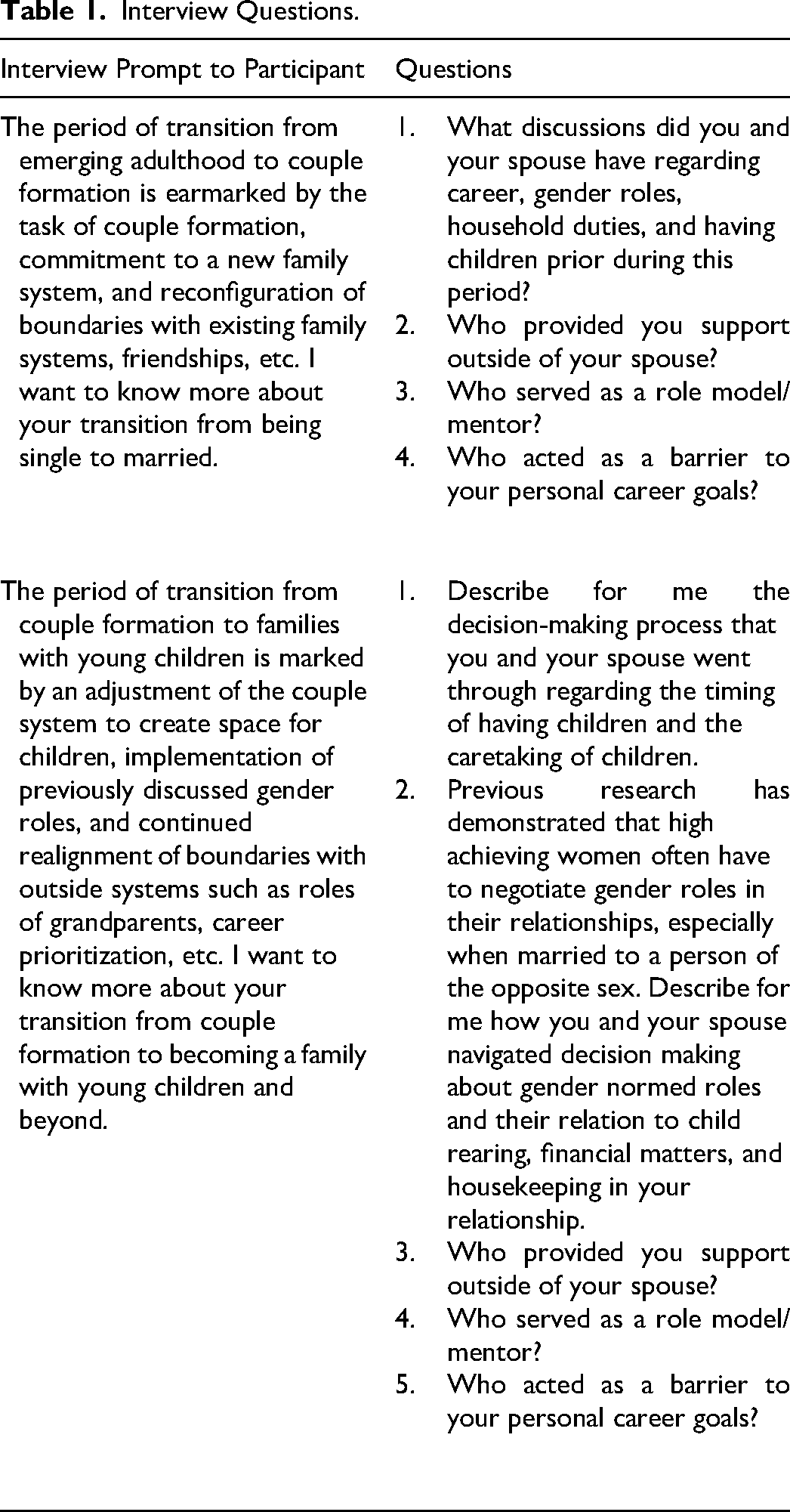
Upon completion of data collection, the researcher employed a phenomenological approach to data analysis. According to Finlay (2014), phenomenological data analysis seeks to conceptualize the lived experiences of the studied phenomenon. Thus, the researcher used Saldaña's (2016) method of in vivo coding to analyze the data. In vivo coding uses participants’ verbatim words as the code for the qualitative data set (Saldaña, 2016). After in vivo coding, the researcher conducted a second coding cycle using pattern coding. Saldaña defined pattern coding as creating explanatory codes to identify emerging themes in the data. The data analysis process resulted in four emergent themes.
Trustworthiness and rigor
Trustworthiness is essential to ensuring that a pilot case study is of acceptable quality. Yin (2018) did not distinguish between qualitative and quantitative research when they proposed four conditions (i.e., construct validity, internal validity, external validity, and reliability) that impact the quality of case study research. The researcher addressed construct validity by utilizing multiple data sources (Yazan, 2015). According to Yazan (2015), internal validity is established through standardized coding techniques such as the previously mentioned coding techniques established by Saldaña (2016). The researcher addressed external validity by obtaining a thick description of the participant's lived experience (Yazan, 2015). Yazan established reliability as the researcher's adherence to structured case study protocols, such as the protocols described for this study.
Results
The findings of this study emerged from the data provided by Sarah during her interview and answered the two proposed research questions. Specifically, four themes emerged from Sarah's narrative, including self-efficacy and hustle, supportive relationships, resources used, and barriers faced. Self-efficacy and hustle described Sarah's experience of believing in herself and making her way, regardless of obstacles. The second theme, supportive relationships, contained the relationships that supported Sarah as she navigated education, career, and family. Resources used, the third theme, comprised Sarah's need to be creative in creating and accessing resources. Finally, the barriers faced by Sarah explained the obstacles that were presented to her while she navigated education, career, and family.
Self-efficacy and hustle
Sarah's experience as a high achieving woman navigating the family life cycle reflected the importance of self-efficacy and hustle, thus answering the first research question. Bandura (1977) defined self-efficacy as “the conviction that one can successfully execute the behavior required to produce the outcomes” (p.195). While self-efficacy explains the belief that one can accomplish something, Sarah's experience went beyond belief and included both thought (self-efficacy) and doing (hustle). There are numerous definitions for hustle. For example, hustle is defined as a forcible push, a sense of urgency, and the act of playing a game in an alert and aggressive way (Merriam-Webster, n.d.). The various definitions for hustle reflect how Sarah framed her experience as a high achieving woman. Common examples of hustle for high achieving women are noted in the existing literature. The examples include increased self-reliance (McGoldrick et al., 2016) and increased intensity over their male counterparts in playing the career game with the hope of equal recognition (Ely et al., 2014).
Sarah described various experiences representing a belief in herself and her actions demonstrating self-efficacy. When reminiscing on her undergraduate collegiate experience and changing majors right before graduation, Sarah shared that the university required her to take other courses outside of her initial major to prove her switch was justified. She disclosed a certain level of “ignorance is bliss” as she embarked on unknown academic content. She stated, “You know…I was just doing what I needed to do in order to get from point A to point B.” She continued: You tend to not look for obstacles…You know, you tend to think ‘Oh well, I had to do this to do that’…You just say ‘Oh, this’ and you go…I don’t know, something about being a little more fearless.
While transitioning into her terminal degree and career, Sarah's self-efficacy and hustle were evident as she recalled her approach to family formation. According to McGoldrick et al. (2016), women negotiate a delicate balance between family and career during the couple formation and families with young children stage of the family life cycle. Sarah stated, “I had these sort of dueling ambitions, you know? I wanted a home, but I also wanted a career…And there wasn’t any question in my mind that I wanted both.” She reported experiencing competition with her male counterparts. She disclosed that “[The men] were like, perfectly prepared to make a choice [between family and career].” Sarah continued, “That's the reality, I mean the reality is it's a really tough choice…a lot of women find themselves unable to commit to that kind of a stress.” As Sarah ended her interview, she shared her perspective on how women should approach difficult decisions with another reflection on self-efficacy and hustle, “You have to trust yourself as much as you trust somebody else to work it out for you.”
Supportive relationships
Supportive relationships served as stepping stones as Sarah transitioned through various family life cycle stages. She noted that relationships helped her manage and overcome obstacles during her education, career, marriage, and motherhood. Furthermore, the supportive relationships illustrated by Sarah throughout her family life cycle shared particular commonalities. The commonalities included the supporters being high achievers, little differentiation between personal and professional relationships, and lacking gendered presumptions within supportive relationships.
Sarah formed supportive relationships typically with those who were also high achievers. Sarah described her husband as initially very supportive, and she directly connected his support to them both working in the same industry. Sarah described her closest friends in college as “very successful women…they were fabulous,” and many went on to do noteworthy projects in their industry. She reported that she continues to connect with these same women even though they have all taken different career trajectories (i.e., industry or academia).
Sarah's supportive relationships also possessed genuine relational connections with little differentiation between professional and personal relationships. Sarah reported that she partially based her decision to marry her husband on the fact that they worked in the same profession. She shared her expectation that “[My husband] understood what it took” to survive in their industry, and men outside of their industry would not possess a similar understanding. When describing the death of a former boss, she stated, “I felt like I lost a family member.” The profound loss Sarah experienced when her boss died reflected Sarah's statement that “Your friends become a very important network…if you have no family.”
Finally, gender presumptions were not apparent in Sarah's supportive relationships. Sarah stated that her husband was “a good partner…a good father” who, when it came to work, “was there putting in the time beside me”. Sarah described her marriage as not predicated on traditional gender roles but instead on independent interests and mutual understanding. Additionally, when discussing the former boss who passed away, Sarah noted he was an ally in her success. She stated he was a “Good friend and mentor my whole life…one of the few men who had absolutely no compunction about letting a woman succeed.” Sarah's supportive relationships did not include the expectation of her to engage in traditional gender roles.
Sarah mentioned some notable aspects regarding supportive relationships. First, Sarah's lack of family of origin likely affected Sarah's supportive relationships. Without the support of a family, Sarah may have placed a higher priority on finding supportive relationships. Additionally, although she described experiencing relational support, she balanced this with an allegiance to self-reliance. Also, Sarah mentioned that the lack of role models was a problem, especially during her college education. The absence of other mothering female role models negatively impacted Sarah's sense of support during her graduate school experience.
Resources used
According to Gersick and Kram (2002), high achieving women must forge their own paths for navigating family and career development. Sarah shared that there were times when her “dueling ambitions” left her wondering how she would have a family and career. She continued, “[Family and career] are demanding. They demand a big chunk of you, a kid is not a part time thing.” Sarah reported utilizing the help of other adults, such as outside caregivers, friends, and other parents, to “stand in” for Sarah on short notice. Although Sarah found support in her relationships, she also described her resourceful nature as assisting her in navigating the demands of a family and a career. Specifically, Sarah shared the learned resourceful methods she used to tailor her domestic life to meet the demands of her career.
Sarah shared that part of her hustle came from a learned resourcefulness. She shared how, early on in her college experience, she faced a full load of classes, limited income, and the drive to achieve. Sarah shared that in circumstances with limited means and intense drive to achieve, “You become resourceful.” Her ability to make decisions despite limitations paid off as the stakes grew higher. Sarah reported that as she advanced in her education and career, she realized that an intense commitment would be necessary to maintain her career trajectory and have the family she wanted. However, she shared, “Once you bite [work and family commitments] off you think…how have other people done this?…Where are they?…Could somebody please tell me?” Sarah shared that there was no blueprint for her to follow and no role models to access. Instead, she reported learning to make tough choices regarding prioritization of resources. She shared with ironic laughter, “Family is going to come first or my job is going to come first. It is a tough…hard choice, you can’t sail through that one…[Prioritization of what gets to come first] was practically a weekly thing.” Sarah's learned resourcefulness was noticeable in her concrete demonstrations of solution-finding.
The intertwining of domestic needs with career expectations is how Sarah most demonstrated her resourcefulness. For example, Sarah reported that when she and a female colleague opened their own business together and eventually became pregnant at the same time, they decided to turn their conference room into a nursery. She shared, “We had a person who stayed with the babies and when [the babies] woke up, we would run upstairs and nurse the babies and then run back downstairs to work.” As Sarah's child grew older, Sarah incorporated her child with her career in other ways. For example, Sarah shared that after her divorce, she became the primary caregiver of her child. In order to align the demanding role of primary caregiver with her demanding career, Sarah reported that her child went everywhere with her. She stated, “I took her with me whenever I could…[My child] has been all over the world…She came with me to the office…She traveled with me.” When taking her child everywhere was no longer practical or necessary, Sarah pivoted and instead made her home the “hangout” house. Sarah shared, “I decided the best way to watch [my child] was to make sure [all of her friends] came over to my house…it was much better to not have to be concerned about what she was up to.” Sarah and her child would also have weekly planning meetings to “work out” their weekly schedule.
Barriers faced
High achieving women report various barriers to navigating career and family development, such as workplace discrimination (Ely et al., 2014), increased marital conflict (Cha & Thébaud, 2009; Friedman, 2015), higher rates of divorce (Ogletree et al., 2006), and feelings of inadequacy as a mother (Coontz, 2016; Trepal et al., 2014). Sarah named many of these same barriers as part of her experience. Specifically, isolation as a woman in professional settings and marital discord were the two major barriers that emerged from Sarah's interview.
Researchers (e.g., Ely et al., 2014; Fider et al., 2014; Gersick & Kram, 2002) reported that high achieving women struggle to find role models who offer examples of balancing family and career in professional settings. Sarah shared at length about her isolation as a woman in professional settings. For example, Sarah was alone without role models during her terminal degree. When obtaining her terminal degree, Sarah shared that she faced choices that her male counterparts did not face. The competition with “the guys” added additional stress because, according to Sarah, the guys were not concerned with the caretaking of family during their education. Sarah shared that her male counterparts were “perfectly prepared to make a choice” in prioritizing career over family. However, when faced with a prioritization decision, Sarah described it as “a tug and pull” internal conflict. She added that she was alone in navigating the internal conflict as there were no role models to lean on. Ironically, Sarah shared that much of the stress stemmed from her understanding that the difficulties in balancing the prioritization of family and future career were “not necessarily going to ease up” after graduation. Her first position after graduation proved Sarah's assessment was accurate.
Sarah also reported experiencing isolation with her first employer. Given that Sarah's career is in a male-dominated field, she often found herself as the only woman in a room of colleagues. However, with her first employer, not only was she the lone woman, but she was also the first woman her boss had hired in a “non-secretarial” position. Sarah reported feeling alienated by her interactions with her boss. She shared that her boss refused to speak to her directly; instead, he always brought in his secretary to relay messages between them. Sarah reported that her boss did not believe he could make the same demands of her that he made of her male colleagues, and she was concerned about the impact this would have on her career. The experiences with her boss led Sarah to open one of the first female-owned practices in her large metropolitan city.
Increased marital discord (Budig & Lim, 2016; Lichter et al., 2019) and divorce (Guilbert et al., 2000; Ogletree et al., 2006) are common concerns for high achieving women. Therefore, it is not surprising that martial discord was another barrier that emerged from Sarah's experience. Sarah initially described her partner as supportive of her desire for a career and family. However, as Sarah's career advanced and more opportunities opened up, she shared how her marriage evolved in a different direction. In describing the evolution of her marriage amidst her increasingly successful career, Sarah recalled: [My marriage] was absolutely fine until everything [in my career] started working…It was fine until he…uh…I don’t know, something happened with [my partner]. He changed…started to follow me around…when I was in the house, he would shadow me everywhere I went. I still don’t quite understand [the dependency], it just eroded the fabric that we had. I wanted that same independent relationship. [The dependency] had strained us and I was just carrying too much. You know if I’m gonna [carry too much] then I don’t need this other person not being a partner. [My partner] became a burden. So [our marriage] just fractured.
Discussion
The aim of this single-case pilot study was to gain an in-depth understanding of a high achieving woman's experience of family development. There is a lack of current research regarding the family development of high achieving women. Therefore, the results of this study serve as an initial conceptualization of the family development experiences of high achieving women. The results included four themes: self-efficacy and hustle, supportive relationships, resources used, and barriers faced.
Congruent with existing literature (e.g., Ely et al., 2014; Gersick & Kram, 2002; Trepal et al., 2014), the findings from this study support the claim that family development for high achieving women may not align with the current family development model as demonstrated in the family life cycle. The misalignment is concerning as the family life cycle is heavily relied upon in the family counseling curriculum to describe family development. Furthermore, the current family development models do not consider the experiences of those who must rely on self-efficacy and hustle to overcome the systemic challenges they may face. The findings of this study support the importance of including the impact of systemic challenges when conceptualizing family development.
The findings of this study identify the vital impact of supportive relationships and resources as a component of family development. While system approaches consider the interactions between people in the same system, these approaches are often void of the collectivist ideals found in feminist theories. Li (2014) highlighted the omittance of feminist theories in family counseling in their meta-analysis of family literature regarding marital attitudes. Li contented that none of the studies in their analysis were buttressed by a feminist theoretical framework. The findings of this study support the intentional inclusion of feminist theories, such as relational cultural theory (Miller, 1976), in the assessment of the family development of high achieving women.
Similar to the barriers found in this study, high achieving women often present to counseling for assistance with relational and career obstacles (O'Brien, 2021). However, the standard assessment models used in family counseling do not reflect high achieving women's lived experiences. Therefore, family counselors must use caution in the utilization of standard assessment models. Instead, family counselors would benefit from incorporating models reflective of diverse experiences, such as feminist theories and identity development models.
Implications
The limited information gleaned from the findings of this study impacts both counselor education and family counseling. The findings of this study emphasize the need for counselor educators to re-evaluate how they approach the preparation of counselors-in-training (CITs). Accreditation bodies such as the Council for Accreditation of Counseling and Related Educational Programs (CACREP, 2023) outline core aspects of the overall preparation of CITs. Specifically, CACREP-accredited programs must cover eight content areas as the foundational counseling curriculum. The content areas include knowledge and skills related to career development and lifespan development. Furthermore, part of lifespan development knowledge includes theories of family development across the lifespan. Given the findings of this study, counselor educators should review the current curriculum to explore gaps in CIT preparation related to the career and lifespan development of high achieving women.
Family counselors must work to overcome gaps in their training regarding the career and lifespan development of high achieving women. Family counselors would benefit from intentionally seeking professional development focusing on family counseling with diverse populations. Furthermore, family counselors should be reticent in applying family lifespan assessment models such as the family life cycle when working with high achieving women and their families. In alignment with the American Counseling Association's (2014) Code of Ethics, when working with diverse families, family counselors should use caution in their utilization of the family life cycle as an assessment tool (see E.8. Multicultural Issues/Diversity in Assessment). Instead, family counselors may benefit from utilizing other developmental models, such as identity development models, to fill the gap until more is known about high achieving women's career and family lifespan development.
Limitations and further research
The purpose of a single case pilot study is to gather depth of knowledge from a small sample size. Studies such as this are crucial to obtaining knowledge on an otherwise unknown phenomenon. Although this study fulfilled its intended purpose, the structure of the methodology created limitations for the findings. The study only had one participant. The single participant lacked diversity in many areas, including sexuality, race, and socioeconomic status. Caution should be used with the results of this study as diversity has a significant impact on development.
Given the findings from this study, it is evident that more research is needed regarding high achieving women and their family lifespan development. Specifically, it would benefit counselor educators and family counselors to understand better how high achieving women approach family development. Additionally, further research is needed to discern the impact of other factors, such as career development and systemic marginalization (e.g., gender discrimination and parental stigmatization), on the family development of high achieving women. Finally, future studies utilizing diverse samples are imperative for researchers to understand holistically the impact of diverse qualities on the family lifespan development of high achieving women.
Conclusion
Counseling research, and on a larger scale family development research, is void of diverse and inclusive assessment models of family development across the lifespan. To narrow the research gap, this pilot case study examined the lived experience of a high achieving woman and their family lifespan development. The participant shared the importance of self-efficacy and hustle in navigating career and family development. Additionally, in disclosing their “dueling ambitions” regarding career and family, the participant shared the critical role of supportive relationships in their success. Resources utilized and barriers faced were the final two emergent themes from the participant's experiences. The culmination of these four themes provides a glimpse into an otherwise unknown lived experience. Although these findings are not generalizable, they offer evidence that additional research on diverse family development is needed. Until additional research is available, counselor educators and family counselors must use caution in utilizing the family life cycle and be transparent to their intended audience about its limitations in assessing diverse families.
Footnotes
Declaration of Conflicting Interests
The author declared no potential conflicts of interest with respect to the research, authorship, and/or publication of this article.
Funding
The author received no financial support for the research, authorship, and/or publication of this article.
