



Abstract
The current body of literature is weighted to the female perspective in exploring the perception and experience of romantic relationships. The paucity of literature on the male perspective provides an opportunity to highlight the unique masculine view attached to relationships. The current scoping review is aimed at summarizing the available literature about the perception and experience of men in various romantic, heterosexual relationship contexts. The findings were drawn from 163 studies published in the last 10 years that were extracted from multiple databases, including SCOPUS, PsycINFO, Web of Science, and Pubmed. The current masculine perceptions associated with romantic relationships were captured and grouped through four contexts: man as a relational being, man in a state of singleness, man as a partner, and man as a parent. Power and sex appear to be the key drivers of research about men across relationship contexts. This study contributes to the literature by identifying the current research gap and providing clearer directions in research about romantic relationships that take into account the perspectives of men.
The role of men in shaping the experience of a heterosexual, romantic relationship is as essential as that of women (Markey et al., 2004; Moss & Willoughby, 2018; Yoo & Joo, 2022). However, while many studies have included both genders in examining the predictors and expectations of engaging in a romantic relationship (Cacioppo et al., 2013; Frazier et al., 2016), our preliminary investigation suggests that more literature tends to construct and frame the experience and expectation of a heterosexual romantic relationship exclusively based on the women's perspective (Baggett et al., 2013; McKinley & Lilly, 2021; Segami & Van Eeden, 2020; Tadros et al., 2022; Yusof et al., 2021). Very little is known regarding how men perceive, position, and construct their experience in a romantic relationship. Men's experience in a romantic relationship seems to be taken for granted, considered ‘taboo’ and not to be discussed as it threatens masculinity (Slauson-Blevins & Johnson, 2016) – and thus less heard of. This assumption is more frequently articulated in patriarchal societies, where more research focuses on the use and abuse of male superiority that results in intimate partner violence (Jeffrey & Barata, 2016; Laslett et al., 2021; Vézina & Hébert, 2007; Wang et al., 2017). In recent decades, there has been an emerging trend that highlights the experience of men in a relationship, but only in the context of a same-sex relationship (Goldenberg et al., 2016; Parsons et al., 2012). As a result, men's unique experiences in a romance remain undertheorized.
The overemphasis on the female perspective as an underlying paradigm in current research about romantic relationships (Jaramillo-Sierra et al., 2015; King, 2020; Rudman & Phelan, 2007) may account for the underrepresentation of the male perspective in romance. Such female-based research is evident in all relationship contexts, from singleness (McKeown, 2015), dating (Husain, 2020), marriage (Himawan et al., 2021b), and parenthood (Duncan et al., 2015). For instance, the perception and challenges associated with being single are predominantly constructed from the experience of never-married women (Abeyasekera, 2017; Budgeon, 2008; Reynolds et al., 2007). In fact, there is an indication that men also experience unique challenges of being single (Himawan, 2020; Himawan et al., 2021a; Shuzhuo et al., 2010), but this area is less systematically studied. In the context of dating and marriage, research that focuses on how body image affects one's dating or marital satisfaction is more articulated from women's voices (Meltzer & McNulty, 2010; Meltzer et al., 2011; Sharp & Keyton, 2016), whereas some findings indicate that body image also affects how men evaluate their relationship satisfaction (Zhaoyang & Cooper, 2013). In parenting, attachment theory (Bowlby, 1982) provides an underlying framework to understand parent–child relationship functioning and has long been associated with the role of the mother (Brown et al., 2012). Research emphasizing father involvement has only been emerging in the last two decades (Lamb, 2000).
Apart from a cultural context that often offers women more diverse emotional outlets within interpersonal relationships (Wester et al., 2007), the underrepresented voice of men in the scholarly literature about romantic relationships could also be understood through at least two perspectives. First, there has been an acknowledged trend where males tend to be more reluctant in research participation, including research on topics that are related to relationship issues (Kalmijn & Liefbroer, 2010; Slauson-Blevins & Johnson, 2016). Furthermore, gender differences indicate higher female participation in surveys which is partially attributed to the limited access to men who are willing to participate rather than men's refusal to participate (Ekholm et al., 2010). Nevertheless, while gender discrepancy is acknowledged, there is little effort to systematically analyze gender gaps in the scholarly literature (Slauson-Blevins & Johnson, 2016). As a result, academic discourses regarding romantic relationships offer more nuances towards women's unique experiences rather than those of men. Second, research about interpersonal relationships tends to focus on minority or vulnerable groups as this segment is usually an area of research significance due to their unique needs. While this is in line with the Sustainable Developmental Goals to empower women and achieve gender equality (United Nations, 2022), focusing largely and exclusively on women's perspective in studies about romantic relationships creates a gap in understanding of relationships, where men's perspective is ignored.
The above arguments suggest that very little is known about how a man perceives, positions, and experiences himself in various forms of heterosexual relationships. To our knowledge, no review of the literature has been conducted to specifically identify the unique themes that point to the man's experience in a romantic relationship. Consequently, the present study is aimed at exploring what we already know about men's experience in, and expectation from, a romantic relationship, and whether there are gaps in this research area. As a romantic relationship has a broad range and forms, the present study seeks to explore romantic relationships in the categories of singleness, dating, marriage, and parenthood. The themes that emerge from this review could provide insights into outlining gaps in the area and shaping the directions for future research emphasizing men's experience in romance.
Methods
The scoping review was guided by the Preferred Reporting Items for Systematic Reviews Extension for Scoping Reviews (Tricco et al., 2018). The primary aim of the review was to identify and extract the themes related to the psychological perception and experience of males in romantic relationships. Considering the study being performed is a scoping review, an evaluation of the methodological quality of the studies was not performed (Munn et al., 2018).
Search Terms and Strategies
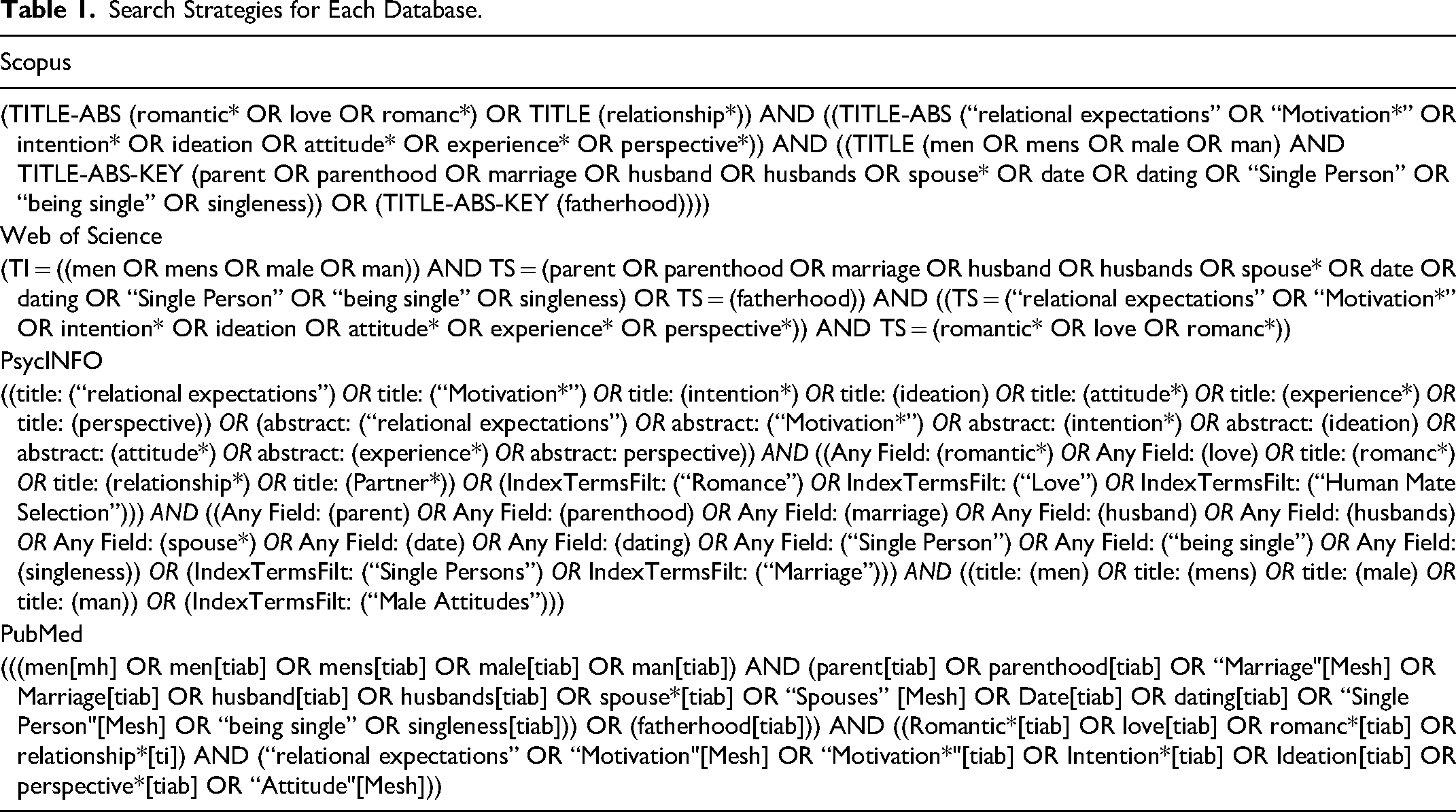
Searches were performed electronically by utilizing four databases: PsycINFO, Scopus, Web of Science, and PubMed. Searches were completed on August 11, 2022. The search strategy for each database is detailed in Table 1. Search terms were used in English and only papers published in the English language underwent a full article review. The screening process was conducted in three stages: (1) title and abstract screening, (2) full-text review, and (3) extraction. All screening processes were conducted through the Covidence program (covidence.org).
Search Strategies for Each Database.
Eligibility Data
To be included in the analysis, studies must meet the following criteria: (1) published within the last 10 years (2012–2022), (2) written in the English language, (3) focusing on the men's experience in a romantic, heterosexual relationship, and (4) peer-reviewed and be a published book chapter or journal article.
The exclusion criteria are (1) studies of homosexual or sexual minority males, (2) studies that compared individuals of both genders, (3) studies that focused on the nonpsychological (i.e., biological, physiological, and historical) aspects of men or masculinity, and (4) dissertations, theses, conference papers, or nonpeer-reviewed articles. Dissertations and theses were excluded because of the varying standards of the peer review process and to avoid redundancy as many studies reported in dissertations and theses are published in peer-reviewed journals.
Data Extraction
The first step of extraction was based on the articles’ titles and abstracts. Selection was performed based on the inclusion and exclusion criteria. The second step of extraction involved a full-text review, upon which the themes emerge. All selection processes were performed by the authors. Any decision gaps that existed were resolved through discussion and all processes were recorded in Covidence. Figure 1 summarizes the selection process according to the PRISMA flow (Tricco et al., 2018).
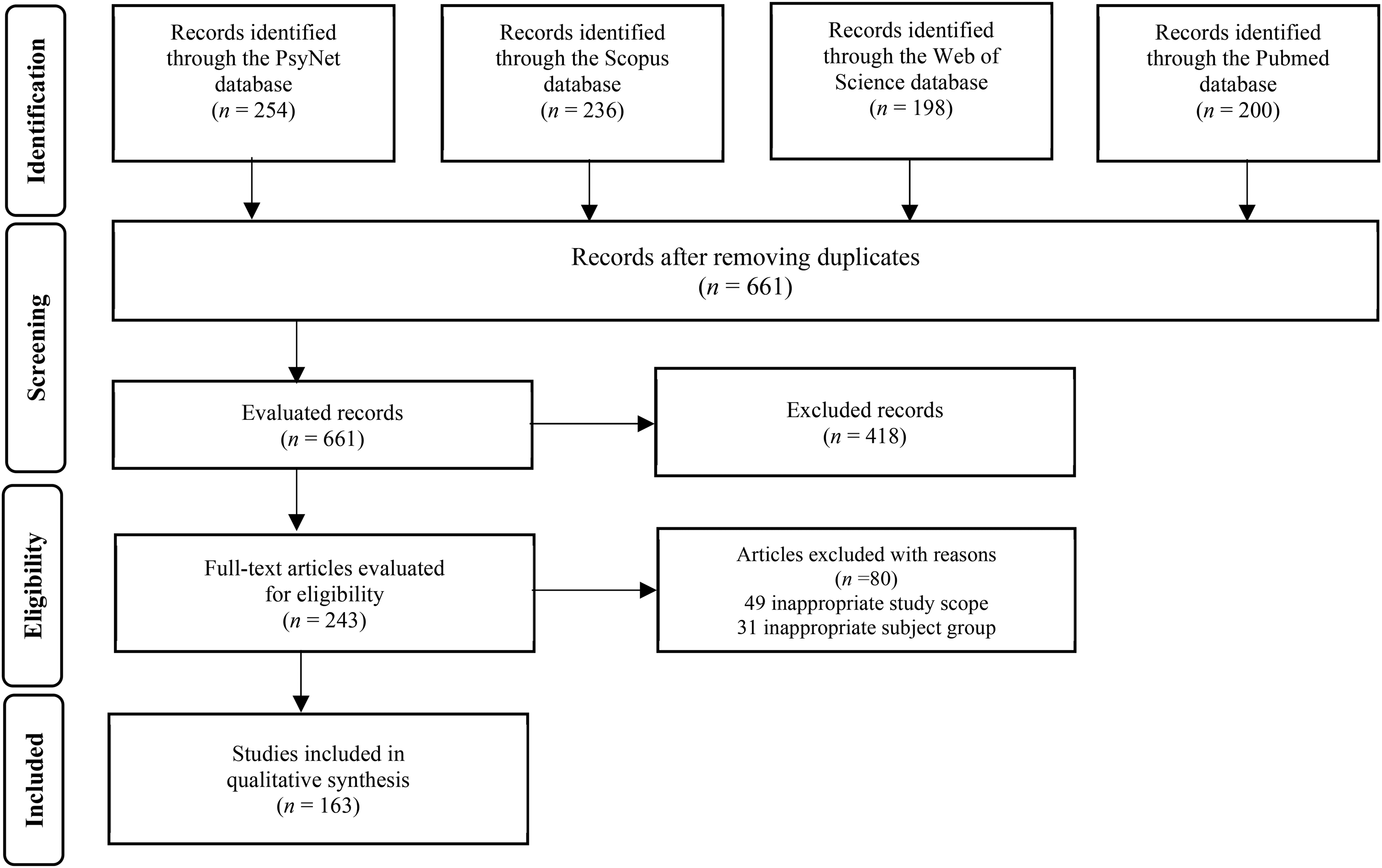
PRISMA flow diagram of the study search and selection (Tricco et al., 2018).
Results
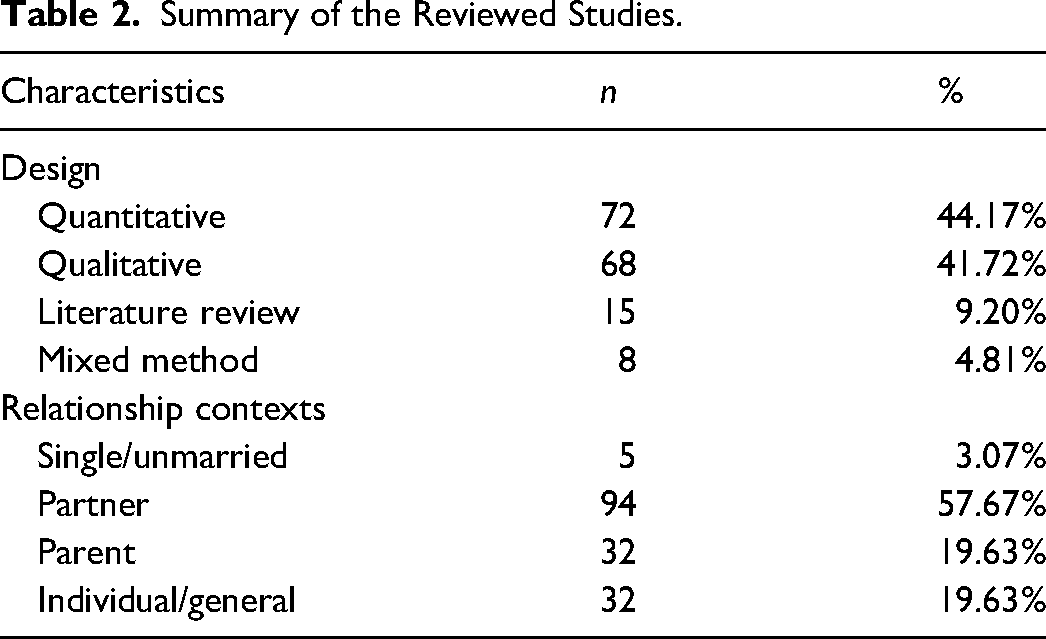
A total of 163 studies were eligible for inclusion in the scoping review. Table 2 provides a summary information of the included studies. The majority of the studies (81.60%) were conducted in Western countries. Regarding study designs, most studies utilized quantitative design (44.17%), followed by qualitative (41.72%), literature review (9.20%), and mixed-methods (4.81%) designs. The majority of the studies focused on the experience of man as a partner (57.67%), as an individual being (19.63%), as a parent (19.63%), and only a few studies focused on the experience of man as a single person (3.07%).
Summary of the Reviewed Studies.
Results are organized based on four emerging themes: man as a relational being, man in a state of singleness, man as a partner, and man as a parent.
Man as a Relational Being
This theme explores the impact of childhood events, gender socialization, and an individual's identity on a man's romantic relationships, irrespective of his current relationship status. The focus is on understanding how these factors shape a man's identity within the context of his romantic relationship. The samples for these studies consisted of males who had undergone relationship trauma or were instructed to envision their future romantic relationships. This overarching theme emerged from the analysis of 32 studies, constituting 19.63% of the total studies reviewed.
Interpersonal violence is the dominant subtheme that emerges when discussing a man's attributes as a relational being, as it is reported in eight studies (25% of the total studies under this theme). In particular, those studies tend to position men as the perpetrators of the violence. Studies suggest that a man is more likely to commit violence to their partners when he has traumatic experience with his family of origin (e.g., insecure/disorganized attachment to father, has been a victim of sexual abuse as a child) (Gilbar et al., 2020; Langton et al., 2017; Miljkovitch et al., 2022; Richardson et al., 2017; Yoo et al., 2017), an implicit rape supportive attitudes and superior male norm socialization (Bock & Burkley, 2019; Widman & Olson, 2013), and an experience of rejection (Andrighetto et al., 2019). One study focused on a violence prevention program, hence still positioning a man as the potential perpetrator of violence (Miller et al., 2012).
Studies also suggest that a man's experience of a romantic relationship is often shaped by the role he envisions for himself as a partner. Supported by eight studies (25% of the total studies under this theme), this role encompasses a range of expectations related to how a man defines masculinity and navigates societal norms associated with gender. These expectations encompass aspects, such as the man's perception of his body image in relation to masculinity (Swenson & Allen, 2018), his role as a provider (Jaramillo-Sierra & Allen, 2013), his involvement in domestic tasks and fulfillment of paternal responsibilities (Edley & Wetherell, 2015; Seporaityte-Vismante, 2015), and his negotiation of cultural perspectives on manhood (Cao, 2021; Hakimi, 2020; Kogan et al., 2019; Zhang & Allen, 2019).
Men's perceived sense of attractiveness is also evident under this theme, as supported by five studies that specifically explore attractiveness (15.63% of the total studies under this theme). For example, some men evaluated their physical attractiveness through the photos displayed on social media (Daniels, 2020; Jin et al., 2019). Yong and Li (2012) defined attractiveness based on a man's capital resources, suggesting that higher ownership of capital resources tends to be followed by higher dating standards. Men were also found to generally be most attracted to those of the same race to them (Brooks & Neville, 2017). Pazhoohi and Hosseinchari’s (2014) study focused on the Muslim community and found that Islamic veiling for women tends to reduce male mating attractiveness.
The last nuance observed under this theme is related to the values a man attaches to relationships, which was supported by 10 studies (31.25% of the total studies under this theme). Men tend to highlight virility as the primary value of their relationship (Hammarberg et al., 2017; Seporaityte-Vismante, 2015; Stahl et al., 2012). This is consistent with the dominant theme related to sexuality (Henao et al., 2022), sexual experience (Fekih-Romdhane et al., 2022; Offiong et al., 2020; Ott et al., 2012), and sexual abuse (Langton et al., 2017; Thompson & Morrison, 2013) that tend to provide a strong ground on what a man expects in a relationship. The men's value of the relationship is also evaluated through the form of romantic relationship that they commit, whether it be monogamous or polygamous; this is supported by one study conducted in Turkey, a society where polygamous marriage is a socially accepted practice (Ekerbiçer et al., 2016).
Man in a State of Singleness
Compared to other relationship contexts, singleness among men gets the least scholarly attention as it is covered only by five studies (3.07%). Among the few articles available, singleness among men tends to be understood through their motives, mating instinct, sexual need fulfillment, and masculinity.
The initial theme, regarding men's motives for being single, was featured in an article that explored the possible reasons for men to stay single based on the responses from a Reddit thread (Apostolou, 2019). In regards to the mating instinct, one study found that single men, compared to their pair-bonded counterparts, are more accurate in linking women's body odor cues to high fertility, suggesting their evolutionary instinct for mating (Oren & Shamay-Tsoory, 2019). While singleness is understood through challenges of sexual need fulfillment, a study reported that masturbation is often a primary compensation for single men in rural China to satisfy their sexual needs (Yang et al., 2012). Lastly, an insight from Namibian society articulates how masculinity is negotiated among Namibian men as they compete for their romantic partners (Boulton, 2017). Singleness among men, or is also known as bachelorhood, is also analyzed as a terror management strategy for those with avoidant attachment issues (Seagel et al., 2020). None of the studies report the nonsexual (emotional and psychological) challenges of being single.
Man as a Partner
More than half of the reviewed studies (n = 94; 57.67%) focused on the role of men as a partner in a romantic relationship. Partner in this context refers to a wide span of relationships, from casual to committed, and from cohabited to marriage. Such a blurred categorization in the various forms of relationships captures the contemporary social perception where marriage is seen as one of the alternatives (Furstenberg, 2015; Himawan et al., 2019).
Interpersonal violence is the dominant theme in this group (n = 38; 40.43% of the total studies under this theme) and manifests in the form of sexual (i.e., He & Tsang, 2017), physical (i.e., Gilbar et al., 2020), emotional (i.e., Alsawalqa et al., 2021) violence, and violence performed online (i.e., Schokkenbroek et al., 2022). Among studies that focused on interpersonal violence, 18.42% (n = 7) of studies positioned men as a victim of violence. Interpersonal violence is often discussed in relation to the insecure attachment style (i.e., McDermott & Lopez, 2013) and maladaptive beliefs around power and masculinity (Esquivel-Santoveña et al., 2021). When a man is positioned as a victim, research focused on help-seeking behavior in relation to the current stereotype of men being independent (i.e., Douglas et al., 2012).
The second top dominant theme in this group discussed the role of men as a caregiver of terminally ill partners (n = 23; 24.46% of the total studies under this theme). Interestingly, the scope of the terminally ill in this context seems to focus only on female-specific illnesses, such as breast and vaginal cancer (i.e., Lopez et al., 2012). In fact, only two studies explored the experience of men as caregivers of female-specific illnesses: dementia (Zhang, 2021) and brain injury (Brunsden et al., 2017), and those studies involved males in later life.
Another sub-theme that accounts for men's experience as a partner relates to changing roles and lifestyles that are triggered by one of the two events: family formation and sexual behaviors (n = 12, 12.76% of the total studies under this theme). Regarding family formation, many studies explored men's experience and role adjustment to cope with their partners who experienced postpartum psychosis (Boddy et al., 2017) and behavioral changes associated with the experience of repeated abortion (Makenzius et al., 2012). In relation to sexual behaviors, studies investigated male experiences related to sexual performance (i.e., Mizrahi et al., 2019), to having sex with female sex workers (Sajidah et al., 2019), and to mitigate the risk of HIV infection (i.e., Gottert et al., 2018).
The few remaining studies in this group focused on the determinants of partner's attractiveness (n = 2), relationship satisfaction in relation to their assigned gender role (n = 6), commitment invested in the relationship (n = 7), and the cultural construction of masculinity (n = 6). Only one study focused on the emotional dynamics that men experience in relation to separation (Hartman, 2019).
Man as a Parent
Marriage and parenting contexts could be overlapping areas. Studies that were categorized in this group referred to those that emphasized the role of men as fathers more than as partners. Thirty-two (19.63%) studies were included in this group. Unlike in the first three groups where relationship tends to be understood through the exercise of power and sex, the role of men as a parent involves richer emotional nuances.
Well-being appears to be the dominant theme that accounts for research in this area (n = 25; 78.13% of the total studies under this theme). Studies that fell under this theme included conceptualization of fatherhood (Ito & Izumi-Taylor, 2013; Prehn et al., 2022), the unique roles of father to their children across developmental stages (Kerr et al., 2021; Walter & Shenaar-Golan, 2017), the impact of father absenteeism (Fuli & Yulong, 2018), and the role of children in improving father's well-being (Macht, 2022). In many studies, discourses about father well-being are often discussed in light of religious perspectives (Collins & Perry, 2015; Freeks, 2019, 2020).
Five studies (15.63% of the total studies under this theme) discussed men's role in accompanying their partner's expecting and birthing experience. This involved studies that suggest men's presence in the birthing experience as emotional support to their partner (He et al., 2015; Porrett et al., 2013), men's motivation to smoke that is influenced by their pregnant partner (Khaddouma et al., 2015; Sahebi et al., 2017), and men's hormonal and emotional responses to their infant's signals (Witte et al., 2019).
Three studies (9.38% of the total studies under this theme) associated the role of the father and the tendency to commit interpersonal violence. The studies concurrently suggested that the role of the father could be a protective factor against their involvement in interpersonal violence (Broady et al., 2017; Mohaupt et al., 2020; Stover et al., 2013).
Discussion
The present study aims to explore what has been known about men's experience in, and expectation from, a romantic relationship across various relationship contexts. We organize the discussion section into two parts by systematically highlighting the gap in the literature and presenting suggestions for future research.
Gap in the Literature
Drawing on data from the scoping review, three important points are identified that highlight gaps in existing literature. First, the themes derived from the current review suggest that sex and power are the dominant themes that represent men's experience across various romantic relationships, except where men are attached to a father role. While being dominant and “oversexed” are the characteristics of traditional masculine stereotypes (Healey, 2020), very little is known regarding men's emotional experiences that are unrelated to exercising power and sex. Many studies in the field tend to frame men's experience in a relationship through a set of presumptions that men are dominant, violent, and sexually (hyper-)active. Studies tend to juxtapose love with violence (Broady et al., 2017; Seiffge-Krenke, 2012; Zammuner & Zorzi, 2012) or sexual experience (Manyaapelo et al., 2019) when constructing men's experience in a relationship. In accounting for the experience of singleness among men, literature is also focused exclusively on the sexual experience (Yang et al., 2012), and none of the studies addresses the men's singleness experience with emotional and psychological challenges, such as loneliness and dealing with social pressures. This is in contrast with how singleness is constructed from women's perspectives that highlight emotional upheavals (Lahad, 2013; Simpson, 2015). Such a research framing limits our knowledge about men's nonsexual and nonviolent emotional experiences in a relationship. In other words, we could not fully comprehend whether the emotions of joy, comfort, fulfilled, and contentment as a result of companionate love are necessarily female attributes. In fact, studies of men in a nonheterosexual relationship indicate that such emotions are also experienced by men (i.e., Antonelli & Dèttore, 2014).
It is interesting to note that when a man is attached to the role of father, studies demonstrate more nuanced emotional experience, particularly when related to their children (Kerr et al., 2021; Ramey, 2012). The experience of joy and contentment, for instance, is only explored when a man is attached to their biological children (He et al., 2015). None of the studies explored such an experience when a man is attached to his romantic partner. The emotional well-being of men in dating relationships appears to be narrowly represented through their exercise of power and sex. This fact suggests that our understanding of men's experience is limited by current literature that frames men's experience in romance according to traditional masculine stereotypes, where they are considered powerful and emotionally reticent towards their romantic partners.
Second, existing literature tends to define men's well-being in a relationship simply by the fulfillment of their instinctual needs according to the evolutionary perspective (Weisfeld & Weisfeld, 2002). The reviewed studies appear to suggest that a romantic relationship is an avenue where a man exercises their needs for sex and domination, which are highly related to their evolutionary role: to be a protector of their partners and their genetic offspring. This notion is also supported when discussing men's experience in singleness, where research exclusively focuses on alternative sexual need fulfillment (Shuzhuo et al., 2010; Yang et al., 2012). Few studies explored the emotional experience of men whose partner had a terminal illness. However interestingly, in all of the studies mentioned the illness was breast cancer (Ávila et al., 2016; Cromhout et al., 2017; Freidus, 2017), except two studies that focused on partner's brain injury or neurocognitive disorder (Brunsden et al., 2017; Zhang, 2021). This pattern indicates how sexual activities are a dominant anchor in existing studies about men's experience in romance. Having such a simplistic perspective, where well-being is assumed to be achieved only by instinctual need fulfillment, hinders us from seeing a full picture of the nuances of men's experience in romance.
Third, as a consequence of upholding the traditional masculine stereotypes, more research tends to reactively focus on solving problems that a relationship suffers as a result of the man's abusive roles. Approximately 28.22% of the reviewed studies focused on the role of man as a perpetrator in interpersonal, including sexual, violence. To put this figure into perspective, the comparison between male perpetrators and male victims in the reviewed studies was 23:3, suggesting that approximately only one study focused on males as a victim of interpersonal violence in every seven available studies on the topic. This finding obviously reflects the high and global prevalence of abusive relationships in society (Sardinha et al., 2022). Nonetheless, this does not negate the mechanism by which men react and cope with the victimization of interpersonal violence. In fact, this is an area important to be further investigated because, compared to women, men are more conditioned to remain silent when being a victim of interpersonal violence because it is considered against their gender stereotype and it is considered necessary to protect their masculinity (Alsawalqa et al., 2021). In a more general picture, there is an urgency to learn how men's experience is more than just violence-related.
Overall, the patterns revealed from our scoping review suggested that men's nonviolence and nonsexual experiences are very rarely discussed in existing academic discourse. This notion seems to be consistent across relationship contexts and across cultures. This gap should be addressed systematically in future studies.
Suggestions for Future Research
The present study contributes to the very limited literature in summarizing what research has been done about how masculinity is constructed in various romantic relationship contexts, based on men's perspective. The current construction of masculinity that weighs heavily towards sex and domination may be captured because of the problem-based approach in the construction of men's experience in romance. For instance, existing research tends to revolve around how power and sex often become a problem in a relationship, where men are often positioned as the perpetrators. The plausible consequence of this approach is that we could not really see the nonproblematic aspects of relationships that men may experience. This limitation calls for an alternative paradigm in exploring the experience of men in romance that is reflected in the approach, methods, and questions to address in future research.
Alternative approach
Future studies should consider adopting an alternative approach to depict men's experiences in romance that moves beyond a problem-centric framework. There is a pressing need for an open-minded stance when delving into this phenomenon. Our current literature review indicates a narrow perspective of men's experience in romance, potentially influenced by stereotypical views that overshadow the complexity of men's diverse experiences in romance. While the open-minded stance is not intended to underestimate the seriousness of instances involving male violence, future research could employ a genuine exploratory approach, with researchers being mindful of the possible stereotypical perspectives, to unveil the overlooked dimensions of men's experiences. Emphasizing cultural sensitivity is equally vital in unraveling the men's unique romantic experiences.
Alternative methods
A genuine exploration approach would require an open discussion, where researchers are value-free and theory-free in constructing the men's experience in romance. Various methods that could be utilized, include unstructured, in-depth interviews, focus group discussion, or open-ended questions presented in surveys. In considering appropriate methods, researchers also need to consider the trend that men tend to be less responsive to research participation. Hence, extra effort needs to be exercised in curating the creative approach to recruiting participants. Cross-cultural insights also need to be accounted for in deciding the effective approach. For instance, Focus Group Discussion (FGD) may be a favorable approach to utilize for targeting men in patriarchal societies. FGD requires less effort (compared to typing their responses in the open-ended survey) and less exposure (compared to one-on-one, in-depth interviews) from the participants’ side, and the presence of other participants might inspire, encourage, and facilitate discussion for those who are not used to sharing emotional-related thoughts (Acocella, 2012).
Alternative questions
As the focus is not on theory testing, questions need to be framed in a way that accommodates all possible perspectives. For instance, asking “How would an unmarried man accommodate their sexual need?” is problematic as it presumes that (1) singleness among men is considered to be a lacking condition and (2) men's singleness is only understood through the limited access to sexual satisfaction and thus other possible challenges (i.e., social pressures and feeling lonely). An alternative question could focus on the genuine exploration of singleness by asking “How is singleness experienced by men?” This question would increase the opportunity to reveal more nuanced emotions rather than just associating them with a lacking status.
Limitation
Some limitations are observed in the current scoping review. We only reviewed peer-reviewed studies that were published in English, thereby excluding gray literature and non-English research articles. Most studies were also conducted on the Western population, and hence the results may not be generalizable to men across cultures. In many relationship contexts, the role of cultures is significant in determining the psychological dynamics of men in a relationship. For instance, men in many Asian societies, such as Indonesia, China, and Malaysia, reported experiencing marriage pressures (Himawan et al., 2017, 2018), while bachelorhood in Western communities is not considered a significant issue among men (Simpson, 2015). The role of the father in a highly patriarchal society may also add a unique layer of interpretation (Li & Jankowiak, 20).
Conclusion
Existing research about men in romance tends to be built upon traditional masculine stereotypes, particularly those that are attributed to relationship problems (i.e., sexual abuse and interpersonal violence). While this fact proves the existence of such stereotypes, framing research around those cultural perceptions of gender limits our understanding of the other faces of men that might potentially provide important insights into how the relationship is valued from the man's perspective. The absence of violence in a relationship does not necessarily make a relationship valuable. Until we uphold to an alternative paradigm that focuses on a genuine exploration of men's experience, we cannot conclude whether sex and power are the only attributes a man seeks in a relationship, or whether there are other faces that are yet to be revealed.
Footnotes
Declaration of Conflicting Interests
The author(s) declared no potential conflicts of interest with respect to the research, authorship, and/or publication of this article.
Funding
The author(s) disclosed receipt of the following financial support for the research, authorship, and/or publication of this article: This work was supported by the Indonesian Ministry of Education and Culture, Republic of Indonesia, under Grant 435/LL3/AK.04/2022. This work was supported by the Direktorat Jenderal Pendidikan Tinggi (grant number 435/LL3/AK.04/2022).
