



Abstract
In this study, we develop a new scale for measuring helicopter parenting of teenagers in India using a sample of 425 teenage students (aged 13–17 years) in the New Delhi education system. The Minor Teen Helicopter Parenting Scale consists of two validated factors of helicopter parenting we label: Pressure and Intrusion. Both factors demonstrated high validity through factor analysis procedures and high levels of reliability (0.804 and 0.709, respectively). Both pressure and intrusion were associated with academic performance and well-being outcomes. Both factors were an improvement over the Helicopter Parenting Scale (HPS) for this age group. Analysis of the HPS did not yield an acceptable reliability (0.422) for these teenagers under the age of 18. Pressure was more related academic performance and school-related outcomes. Intrusion was more associated with general well-being, self-reported health, and happiness. Results suggest the new measure with two subscales is a more age-appropriate tool for assessing helicopter parenting in parents of children not yet in the college or university life stage. Implications for these findings are discussed and future research is considered.
Introduction
Existing studies of helicopter and over-parenting focus predominantly on university student samples (LeMoyne & Buchanan, 2011; Padilla-Walker & Nelson, 2012; Schiffrin et al., 2019). While the university life stage is a time of great transition and adjustment for families, the over-involvement of parenting can occur much earlier in the child's educational experience. Particularly in societies, such as India, where educational attainment is perceived as a salient feature of both socio-economic status and a prominent cultural value. Parents feel a strong sense of responsibility and accountability for the education of their children.
Yet, studies of over-parenting are limited in two very important areas. First, there are very few studies of helicopter parenting in south Asian context. Studies in the Indian context are virtually non-existent. Second, studies of helicopter parenting do not focus on the pre-university-aged populations. Both, the studies and the measures used to examine helicopter parenting, are designed with university students in mind (LeMoyne & Buchanan, 2011; Padilla-Walker & Nelson, 2012; Schiffrin et al., 2019).
Given the aforementioned gaps in existing research, this study analyses how helicopter parenting occurs in Indian context at the secondary stage of education. We developed a scale more fitting to this stage compared to existing scales. The newly developed scale is then used and directly compared against the widely used Helicopter Parenting Scale (HPS) measure developed by LeMoyne and Buchanan (2011) for university populations. We then examine the impact of our developed helicopter parenting measures (and in comparison to an early measure of helicopter parenting (HPS) on academic performance, health, and happiness.
To that end, we address the following questions in this project:
To what extent does a specialized age-specific scale for helicopter parenting improve our understanding of the phenomenon compared to the HPS? To what extent is helicopter parenting evident among Indian parents of adolescents? What is the impact of helicopter parenting on academic performance and self-appraisal of health and general happiness?
Teenage/adolescent life stage
Parents are the first point of contact and are necessary in a child's life as they protect the child from any adversity that comes towards the child. Parenting has its importance in every stage of life but it is especially so for teenagers and/or adolescents. The Center for Disease Control (CDC) divides teenagers into two groups, namely, young teens aged 12–14 years and teenagers aged 15–17 years. According to the CDC, these years are defined by hormonal, physical, emotional, social, and cognitive changes to say the least; where-in, teenagers undergo prominent changes in their lives while having to take a decision on all fronts of their lives. While teenagers are aged 12–17 years, The World Health Organization (WHO) puts people aged 10–19 years in the category of adolescents (WHO, 2021). The Association of Maternal & Child Health Programs divides age 10–24 years into three categories, namely, early adolescence age, 10–14 years, middle adolescence age, 15–17 years, and late adolescence or young adults, age 18–24 years (AMCHP, 2021).
Adolescent/Teenage is a stage of life that is particularly marked by drastic changes. As mentioned, these changes take place in all aspects of the teenager's life. Parenting and parental support is crucial at this time when change is what dominates a teenager's life (CDC, 2021). Parenting at this stage of life adds guidance to the adolescent's changing world. This guidance adds meaning and depth to the adolescent's critical thinking (Wang et al., 2020).
Baumrind's parenting typology
Parenting research has long been given attention from numerous scientific disciplines. Countless theories emphasize that parenting plays a crucial role in a child's development. Research on parenting predominantly builds on the foundational work of Baumrind (Bi et al., 2018; Kuppens & Ceulemans, 2019). Baumrind used naturalistic observations and other research methods for extensive in-depth analyses and proposed three different parenting styles: authoritative parenting, authoritarian parenting, and permissive parenting (Baumrind, 1966).
Per Baumrind's initial theory, parenting can be categorized into three styles, or types based on levels of demandingness and responsiveness (Baumrind, 1966). In authoritarian style, parents have high demands, but they are not very responsive toward their children (low responsiveness, high demandingness). This style of parenting leads to the children being socially ill mannered (Sanvictores & Mendez, 2022), having unrestrained negative emotions, poor emotion regulation (Cole et al., 1994) and poor self-esteem (Wang et al., 2020) The authoritative parent (high responsiveness, high demandingness) expects a lot of their children, but they also provide warmth, feedback, and adequate support. This style of parenting style helps children develop better emotion regulation, decision making, and strong self-esteem (Davids et al., 2015). The permissive style of parent, sometimes referred to as indulgent parenting, has very few or no demands to make of their children. Self-regulation and discipline become unfamiliar concepts to children raised by permissive parents (Piotrowski et al., 2013) McCoby and Martin (1983), further expanded Baumrind's permissive parenting into two different types: permissive parenting (high responsiveness, low demandingness) and neglectful parenting (low on both responsiveness and demandingness). An uninvolved or neglectful parenting style is characterized by few demands, low responsiveness, and very little communication, and are generally detached from their child's life. Children raised with this parenting style develop poor coping skills (Kuppens & Ceulemans, 2019) and emotional dysregulation (Kuppens & Ceulemans, 2019). Thus, the final theory described four parenting styles: authoritarian, authoritative, permissive, and neglectful parenting (McCoby & Martin, 1983).
Parenting control and support
Existing research has broadly highlighted two dimensions of parenting i.e., parental control and parental support (Darling & Steinberg, 1993). Parental support, indicated by parental involvement, acceptance, emotional availability, responsibility, and warmth refers to the affective nature of parent–child relationship (Cummings, 2000). This dimension is indicative of positive outcomes in children, e.g., prevention of alcohol abuse, depression, delinquency, and externalizing problem behavior in children and teenagers (Kuppens & Ceulemans, 2019).
The second dimension, i.e., parental control, has been further divided into two, behavioral control and psychological control. When parents apply behavioral control, they attempt to control the child's behavior using various disciplinary techniques such as rewards, punishment, rules, and/or demands (Barber, 1996; Schaefer, 1965; Steinberg, 1990). An appropriate amount of behavioral control has been associated with positive effects on child development, whereas (e.g., poor parental monitoring) excessive or unnecessary amounts of behavioral control (e.g., parental physical punishment) have been commonly linked to negative outcomes such as, deviant behavior, misconduct, depression, and anxious affect (Barnes & Farrell, 1992). Psychological control is when parents try to manipulate their child's thoughts, emotions, and feelings (Barber & Buehler, 1996; Barber et al., 2005). While behavioral control has been linked to some positive outcomes, psychological control has been conceptualized as highly manipulative and intrusive and has been linked to negative developmental outcomes such as depression, antisocial behavior, and regression (Barber et al., 2005; Harmon, 2002; Kuppens et al., 2013). Thus, it is safe to say that parents can only impact their child's outcomes as much as they believe they can affect the outcomes.
Comparative parenting in India - the cultural context
Culture may play a key role in influencing the parenting behavior and thus parenting style (Holden & Hawk, 2003). Besides parents, there are various aspects of life that affect a child. These keep changing as and when the child grows. Bronfenbrenner was of the view that a child's development is affected by something as small as having a conversation with his/her parent to something as big as an improvised environment. Culture, or the Macrosystem, according to Bronfenbrenner's ecological model may play a key role in influencing the children/teenagers (Kretchmar-Hendricks, 2005). Each and every culture is defined and differentiated from the rest by inherent ideas concerning however one must feel, think, and act as an adequately functioning member of the culture. As far as parents follow a particular culture, they most likely follow the prevalent “cultural scripts” in child rearing practices. Thus, it can be concluded that culture affects cognitions, knowledge, and belief systems of parents, which affects their parenting style and, in turn, the teenager (Bornstein, 2013).
Research suggests East Asian parents are exceedingly controlling and restrictive (Pomerantz & Wang, 2009). Applying Baumrind's parenting styles, East Asian parents are more authoritarian and they are known to be immersed in their child's academic life, when compared to other cultures. As Asians are known for their collectivistic culture and finding solace in relationships and family, Asian parents often view their child as an extension of their dreams, needs, wants and often, their own selves. Their child's success is considered as raising the family's reputation and upholding the honor of the family rather than the child's individual success (Kwon et al., 2017)
According to the APA dictionary (2007), pressure is defined as excessive or stressful demands, imagined or real, made on an individual to think, feel, or act in particular ways. The experience of pressure is often the source of cognitive and affective discomfort, as well as of maladaptive coping strategies. Critique, demands, and appraisal towards authority figures are seen as tactics used by Asian parents for pressurizing the children and reiterating that the parents have made ample sacrifices for them. This pressure is further maintained when there is a regular comparison of success between them and other children (Cheung & Pomerantz, 2011). In addition, high parental control has been associated with lower academic achievement in European American students. Though the same does not hold true for ethnic groups such as Asian American students (Yamamoto & Holloway, 2010).
Literature has compared Asian-origin parents (mostly Chinese origin) and other ethnic group parents, with Western parenting styles. Though, this approach has not been able to encapsulate the diversity of heritage in Asian-origin parents, neither does it pay any heed to culturally specific approaches to Asian-heritage parenting and its correlation to children's outcomes. Thus, in-depth, qualitative and quantitative analysis are essential to understanding this intricate and multifaceted cultural origin and its effects of parenting as well as developmental outcomes in children and teenagers.
India as a country, gives utmost importance to the role played by the culture and family. Family is considered as the foundation of Indian society. Family and parents are the main source of socialization for children and teenagers here. It is important to understand that at the school level, Indian parents don't seem to be involved only with their children's education. This involvement takes a number of forms. For example, some parents become a part of the parent–teacher associations. This fosters more formal involvement that enable them to have a strong opinion particular about their child's education. There are other informal types of involvement as well. For example, Indian parents tend to join school events such as sport events, annual days for their children. For them, this becomes a way to remain overly involved and concerned in their children's lives. In a collectivist culture like India, it is the son who typically lives with the parents after marriage. The concept of “grown-up children moving out of the house” remains a westernized phenomenon, unless it is for job or higher studies (post which children usually come back home). Parental approval for small things like buying candy to big opportunities as jobs in different states are normal (Moitra & Mukherjee, 2010). More importantly, parenting during the adolescent life stage is immersed in children's academic success. This manifests in the pressure, felt by Indian students as they prepare to take two nationwide board exams—one occurring at grade 10 and the other occurring in grade 12 (Deb et al., 2015). Parenting style especially helicopter parenting or controlling parenting plays a key role in adding academic pressure onto the students during adolescents (Sood & Singh, 2021b).
Studies on parenting report two different versions of parenting styles that are prevalent in India. One is the parent's perspective and the second is the child's perspective. In recent times, a third perspective seems to be emerging in full force, that is, the Media's version of Indian parenting. In a study by Barnhart et al. (2013), college students revealed that both Indian origin students and American students felt that their parents were authoritative. While earlier generations of Indian parents from upper and middle socio-economic backgrounds were more authoritative or permissive in their parenting styles, children of contemporary Indian parents tend to receive more freedom from their parents, irrespective of the parents’ socio-economic status (Joseph & John, 2008). Albert et al. (2007) found German mothers of teenagers (aged 14–17 years) used more acceptance and less control than Indian mothers, while both Indian mothers and teenagers showed more anxiety than their German counterparts did.
Helicopter parenting
Children depend on their parents for almost everything; from learning how to make decisions, regulate emotions, make and maintain relationships, etc. A child tends to develop an internal representation of him/herself through this parent–child relationship. This internal representation helps the child develop self-concept, self-esteem, self-efficacy, develop his/her personality further, helps the child regulate emotions, make everyday decisions, and cope with daily stressors in life. Parenting dimensions such as support, control play a key role in shaping these internal representations of the child.
As the child develops, in the teenage period, the need for guidance, supervision, support, and freedom increases multiple folds. It is during this time that they develop an identity, autonomy, and self-worth (Ryan & Deci, 2020). At the same time, their relationship with their parents changes dramatically due to biological and cognitive characteristics and the attitudes of the parents and the child. It is in this period that this relationship begins to go two ways; it either strengthens or struggles to survive the turbulence.
During the last decade or so, students have become increasingly protected. In addition, they have seen a paradigm shift with introduction of new technology, free access to the internet and more worldly exposure. This change is reflected in parenting as well as in technology that can be used to monitor and maintain contact with children (Strauss, 2006). Where parental involvement may increase support for a teenager, parental over-protection may also reduce autonomy (Bressler & Von Bergen, 2017).
Over-parenting has been conceptualized as a parenting style that is age inappropriate wherein parents intervene in the lives of their child and tend to eliminate the foreseen obstacles that their child might face, just to defend them and protect the success of their child (LeMoyne & Buchanan, 2011). Rousseau and Scharf (2015) suggested that over-parenting enforces unfitting amounts of control and supervision for their children, which then hampers their autonomy and development. Segrin et al. (2013) proposed four aspects of over-parenting, which are, “anticipatory problem-solving and risk aversion,” “excessive advice and affective involvement,” “control over children's self-direction,” and “provision of abundant tangible assistance.” In most research, the helicopter parenting and over-parenting have been used and defined interchangeably (Segrin et al., 2013). These types of new parenting styles have come to be known as “helicopters,” “hovercrafts,” “hummingbirds,” and at times, they are called “stealth fighters” and “black hawks” as well. A parenting style called “helicopter parenting” has received much attention over the past few decades. This term was originally coined by Cline and Fay (1990, pp. 19–20) and has been defined in their book as a parent who is often viewed as being “overly involved and protective” of the child. Research has reiterated that such over-involvement begins at a young age and endures through college and at times even infiltrates the job search and employment of adult children (LeMoyne & Buchanan, 2011). Parents who keep calling their child numerous times a day, solving their problems for them, prevent them from facing any difficulty, and are often called “micro-managers” who “have done it before” (Fay, 2006). Helicopter parents are so concerned about their offspring's performance that they might wrongly interject in their children's life to help their child avoid coming face to face with failure. Helicopter parenting behavior could also involve parents handling their child's homework or getting involved with their teachers and pushing for grade changes for their child, for example (Boigegrain, 2020).
Helicopter parenting in India
Helicopter parenting has emerged as a parenting style that is developing at different ages, and across cultures. Though focus of parenting research has shifted to over-parenting or helicopter parenting as it is coming to be known in recent years, the research is still in its nascent stages more so on the Indian population. Studies on helicopter parenting in India are scarce. The only one from India utilized a sample of emerging adults attending university with a sample of 145 adults. This study found helicopter parenting is perceived more by students living with their parents as opposed to those living in hostels (Kukreja & Chauhan, 2016).
Tonarsystem (2020) describes Indian parenting well. In a familial society like India, selfless altruism/sacrifice for parents is a societal value. In addition, parents incessantly use emotional blackmail by making statements about what they have provided for children and how the children should be grateful and how they should be involved with statements such as: “I educated you for years so you’d be successful and make me proud, but you ruin our reputation this way? How dare you?” The aforementioned prodding gives way to an infinite loop of children always providing for parents all throughout their lives, not being able to really envisage or follow their own dreams. The danger of doing something new and/or experimental becomes a collective burden on the entire family rather than an individual choice (Tonarsystem, 2020).
Helicopter parenting is a well-known practice in Asian countries. This style of parenting is known to have ill-effects on the emerging adult's life. The effects include anxiety (Segrin et al., 2013), depression (Okray, 2016
As mentioned, the majority of the research on helicopter parenting has been on emerging adults (18–25 years of age) (LeMoyne & Buchanan, 2011; Padilla-Walker & Nelson, 2012; Schiffrin et al., 2013). More research is needed for conceptualization and authentication in teenagers. There is further need for a measure of helicopter parenting in the Asian teenagers to assess prevalence and implications in this population.
Measures of helicopter parenting
As mentioned, the majority of research has focused on young adult's ages 18–25 years while assessing helicopter parenting. The majority of scales retrospectively assess helicopter parenting. Most scales ask the emerging adults to remember how their parenting was while growing up as opposed to assessing their parenting at the moment. The majority of the literature has mainly used three scales. The HPS which assesses presence and absence of Helicopter Parenting using 7 items (LeMoyne & Buchanan, 2011). It has been validated on young adults. Another widely used scale has also been validated on undergraduates aged 18–25 years with the dimensions of helicopter parenting, behavioral control, and psychological control (Padilla-Walker & Nelson, 2012). Finally, another popular scale that is widely used in literature has also been based on emerging adults aged 18–25 years, assessed helicopter parenting keeping both mothers and fathers in mind (Schiffrin et al., 2019). The HPS (LeMoyne & Buchanan, 2011) was recently used in a study of 96 teenagers aged 15–17 years in a Malaysia-based study to assess the relationship of helicopter parenting and mental health of teenagers (Ganaprakasam et al., 2018). However, most studies focus on post-secondary students as this was where this phenomenon was initially noticed (LeMoyne & Buchanan, 2011).
In the last 5–6 years, new scales have arisen that assess helicopter parenting as a multidimensional construct. For instance, a scale by Hind (2016) was made to assess helicopter parenting in emerging adults aged 18–33 years on the dimensions of problem solving, whereabouts concerns, precautionary actions, and physical concerns. Luebbe et al. (2018) address helicopter parenting on the dimensions of information seeking, academic/personal management, direct intervention, and autonomy limiting, again on emerging adults aged 17–30 years. All scales made thus far have focused on the negative effects of helicopter parenting on emerging adults assuming that this type of parenting has been going on all throughout the life of the emerging adult. Thus, there is a need for a scale that assesses helicopter parenting in teenagers.
Methods
Participants
The primary researcher worked in collaboration with various school teachers, principals and directors of the private tuition centers in Delhi and National Capital Region (NCR) in the various personal and professional capacities (clinical psychologist trainee) to train the teachers to recognize difficulties in students. Thus, 20 such schools and four private tuition centers were targeted to seek permission for data collection. Out of these 20 schools and four private tuition centers, nine schools and four private tuition centers gave permission for data collection. Teenagers aged 13–17 years were chosen for this study. Thereafter, the consent was taken from parents for the data collection from teenagers. The parents and participants were assured of the confidentiality of the study-specific information and personal data. The voluntary nature of the teenage participation was ensured and teenagers were told that they could withdraw at any point of time during the study. Out of 450 targeted teenagers, parents of 18 teenagers refused to give consent for the teenager's participation, and 11 were excluded due to the exclusion criterion. The final sample consisted of 425 students aged 13–17. The sample size was determined by using the power formula developed by Suresh and Chandrashekara (2012). Data were collected both offline (N = 175) and online mode (N = 250) using snowball sampling. All respondents were fluent in English language with residence in the Delhi and National Capital Region (NCR). The mode of data collected was shifted to online mode due to the prevailing COVID-19 situation in the country.
Ethical approval/data availability
The research was approved by all concerned parties and at multiple levels of consent. First, this project was approved by the department level research committee at the primary researcher's university in India. Second, the research was also approved by the university-wide level research committee. Next, all participants and parents were provided with a consent form following Helsinki Good Clinical guidelines (Krleža-Jerić & Lemmens, 2009). The data was collected from teenagers after taking permission from the school principals, class teachers, and directors of private tuition centers, and parents of teenagers from New Delhi and National Capital Region schools. Finally, in addition to written consent provided by all aforementioned parties, the adolescent provided individual asssent with opportunities to opt out. The responses of the participants were not shared with the parents or the school administrators or teachers. Only the researchers had access to the data.
Analysis strategy
One of the primary objectives of this project was the development of a scale of over-parenting that is appropriate for early to middle teenagers, as opposed to late teenage and university students, in a South Asian context. In the first stage of the analysis, we developed and analyzed the new construct with factor and reliability analyses. Next, we compared the results of the new scale development process with an established measure targeting late adolescent university students in the west. A correlational analysis was performed in order to examine how the new scale factors measure up to the established measure and all the control and outcome measures in the study. Finally, we examined the impact of the new measure on a variety of measures of well-being and academic performance and included the HPS in the results for comparison.
Measurement development: minor teen helicopter parenting scale
In developing this helicopter parenting scale, the objective was to measure the respondents’ perceptions that their parents were controlling and/or stepped in too much to solve issues in ways that did not foster trust, respect, and independence in their interactions with their parents. The measure prompts respondents to respond to statements relating to their parental interactions in their home environment. While most measures of helicopter parenting focus on the university students, we contend that it is a practice that begins before post-secondary education begins. The scale items address general interactions with parents, but also the academic pressure and cultural pressure parent's face in India as their children interact with the educational system. Helicopter parenting can be described as parenting characteristics that would be appropriate at younger ages inappropriately practiced at later ages (LeMoyne & Buchanan, 2011). “This inappropriateness manifests itself in the parents’ inability or unwillingness to (as perceived by the respondent) allow their children to experience life's challenges independently” (LeMoyne & Buchanan, 2011, p. 405). For this measure, we address both over-involvement generally and the pressure placed on students by parents as well as the student's perception of their parents’ shame associated with the respondent's performance. For the new measure, we replicate the computation and response set used by LeMoyne and Buchanan (2011) for the HPS scale. This allows for a more direct comparison. We used the following response categories for the survey items: 1 = strongly disagree, 2 = disagree, 3 = slightly disagree, 4 = slightly agree, 5 = agree, 6 = strongly agree. For the scale or for each dimensional factor discovered, the scores for each item reported from the respondent were summed for a total score then divided by the number of items. This provides a sense of how the respondent generally perceived the construct or their level of agreement in its original unit of measure. For instance, if a respondent's final average score was “6,” it would mean that this respondent strongly agreed with all items and perceived the highest level of helicopter parenting as they “strongly agreed” with all items.
Most scales of helicopter parenting are developed using samples of university-aged samples typically in the range of 18–25 years of age (LeMoyne & Buchanan, 2011). Younger aged students were used for this exploratory study ranging from 13 to 17 years of age. Therefore, the item development was exploratory. Eighteen items were developed involving general over-involvement to more specific items addressing school-related aspects of independence and parental school involvement. The school piece is especially important given the aforementioned emphasis put on academic achievement in Indian families. The LeMoyne and Buchanan (2011) helicopter parenting scale (HPS) is included for comparison.
Outcome measures
We measure a number of academic and well-being-related outcomes in order to broadly examine the relationship to the teenage helicopter parenting factors. Unless otherwise specified, all measures all use the following response set (1 = strongly disagree, 2 = disagree, 3 = slightly disagree, 4 = slightly agree, 5 = agree, 6 = strongly agree). Academic Excellence was measured by asking respondents their level of agreement with the following statement, “My academic performance is excellent.” Self-reported Health was measured by asking respondents their level of agreement with the following statement, “I am a healthy person.” Happiness was measured by asking respondents their level of agreement with the following statement, “I am happy with my life.” School Enjoyment was measured by asking respondents their level of agreement with the following statement, “I enjoy school.” Most recent exam score was measured on a 0–100 scale (where 40% is the universal pass percentage score all over Indian schools).
Control measures
Age was measured as years of age. Gender was measured as binary sex and with women (women = 1) and men (men = 0). Religiosity was measured by asking respondents for their level of agreement with the following statement, “My family is very religious.”
Results
Eighteen items were constructed for consideration as preliminary items for the scale. Factor analysis was performed using oblique rotations (direct oblimin) in order to allow for correlation of factors. Both principal components and promax rotations were performed. Items with cross-loadings were dropped and the process was repeated. The results of the final exploratory solution are displayed in Table 1. Two factors were discovered with loadings approximately 0.4 on the factor and less than 0.1 on the juxtaposed factor. The first factor had an eigenvalue of 4.1 with 45.1% of the variance. The second factor had an eigenvalue of 1.2 with 12.9% of the variance.
Item Summary Data for Two Factor Minor Teen Helicopter Parenting Scale (MTHPS) (N = 425).
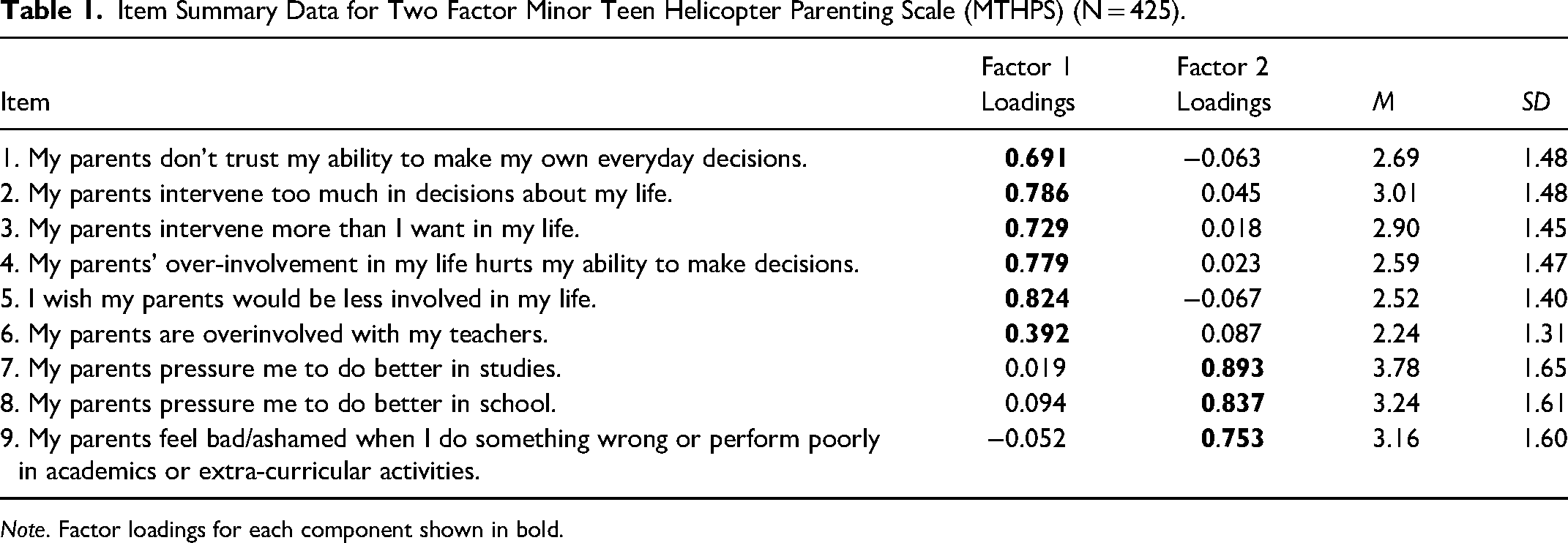
Note. Factor loadings for each component shown in bold.
The first factor we describe as intrusion as it focuses on the perception of parents’ involvement, very generally. The item with the lowest loading is specific to parents’ involvement with teachers. We retain this item because it is not cross-loaded and it approaches our cut-off value of 0.4 or greater (0.392). The school focus of the item is theoretically important for this particular stage of adolescence given the importance of education in Indian society. The second factor is related to pressure that both parents place on the respondent related to school, but also to what they feel.
For the intrusion factor, the 6-item scale has a Cronbach's reliability alpha of 0.804. For the pressure 3-item scale, the alpha is 0.709. The results of a correlation and reliability analysis for all variables, including the two factors and the HPS, are displayed in Table 2. As displayed, the HPS did not work well with this sample of younger teenagers in India. The alpha for the HPS scale in this sample was only 0.422. In addressing our first research question, we conclude that the age-specific measure of helicopter parenting for mid-stage adolescents was an improvement over the HPS general measure. The correlations for all measures used in this study are displayed in Table 2. The correlations also demonstrate that helicopter parenting is prevalent among this sample of Indian adolescents. Thereby, we have initial affirmation of our second research question.
Intercorrelations for All Variables (N = 425).
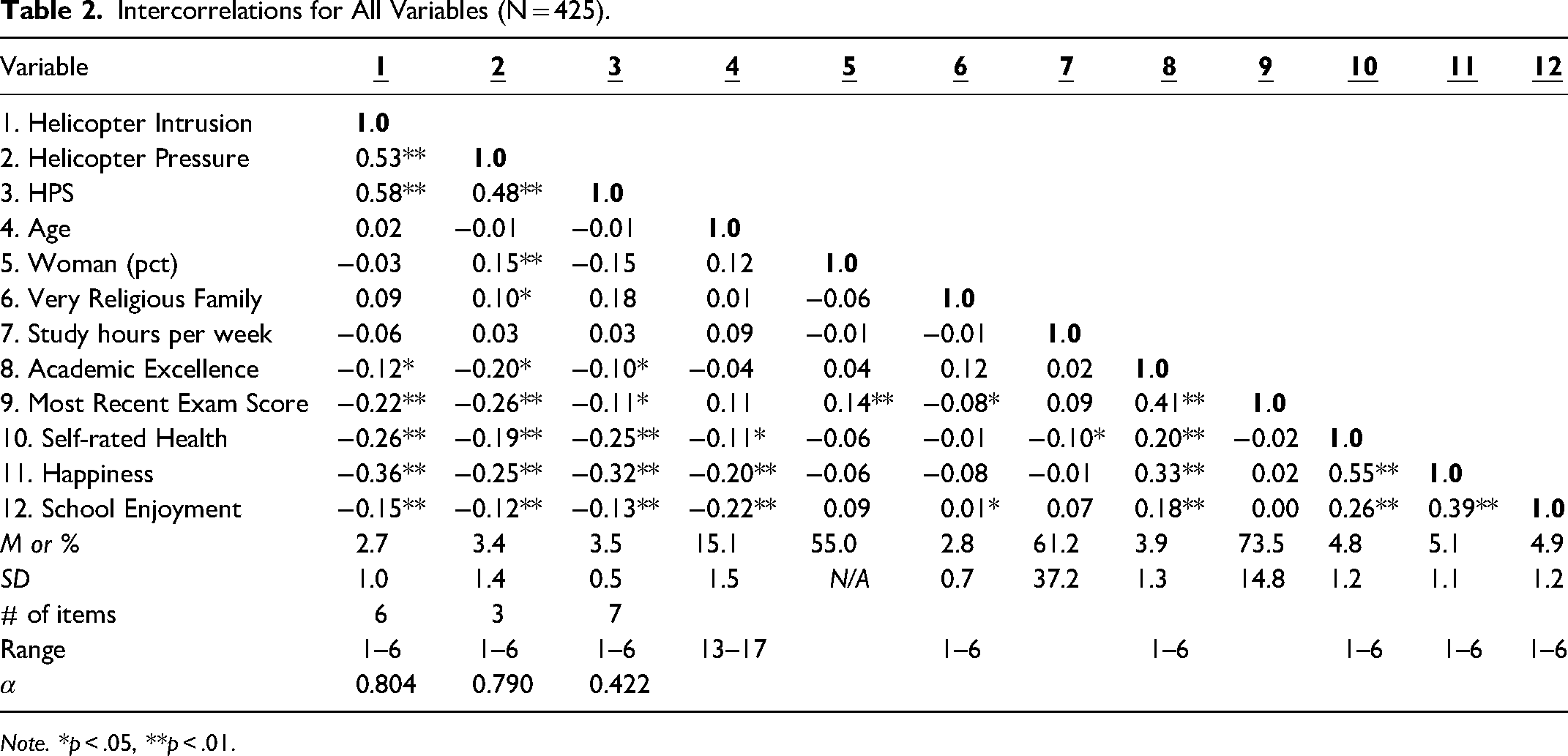
Note. *p < .05, **p < .01.
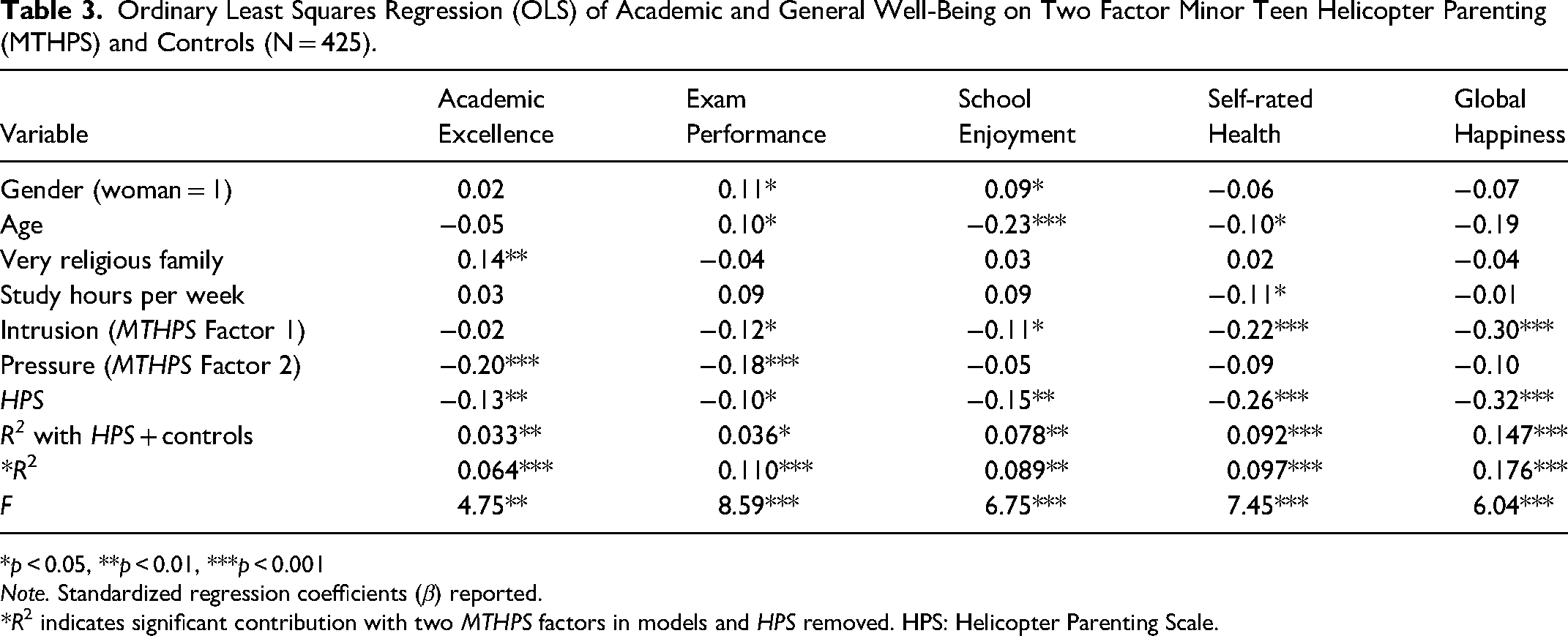
Having established the factors as reliable and correlated with the outcomes, the final stage of the analysis consisted of analyzing the relationship of the two subscales to the outcomes. In order to fully establish this connection, we included four control measures (gender, age, religiosity, and study hours per week). We regressed the outcome on the controls of the helicopter factors (intrusion and pressure). The results of the 5 ordinary least squares regressions are displayed in Table 3.
Ordinary Least Squares Regression (OLS) of Academic and General Well-Being on Two Factor Minor Teen Helicopter Parenting (MTHPS) and Controls (N = 425).
*p < 0.05, **p < 0.01, ***p < 0.001
Note. Standardized regression coefficients (β) reported.
*R2 indicates significant contribution with two MTHPS factors in models and HPS removed. HPS: Helicopter Parenting Scale.
Given the emphasis on education in Indian society compared to western societies, we focused on both education and well-being-related measures. We first regressed the respondent's perception of academic excellence on intrusion, pressure, and controls. Standardized regression coefficients are presented. For this model, the pressure measure was significantly and negatively related to academic excellence, but not the intrusion measure. The model explained approximately six percent of the variation in perceptions of academic excellence. Next, we regressed recent exam score on the two new helicopter factors (intrusion and pressure) with controls. Both new helicopter factors significantly and negatively impacted exam scores. This finding is important as it firmly establishes a relationship of helicopter parenting to academic performance. The model explained eleven percent of the variation in exam scores.
Next, three general well-being measures were regressed on the two new helicopter factors with controls in separate models. First, school enjoyment was found to be related to intrusion. The model explains approximately nine percent of the variation in school enjoyment. Intrusion was also related to both self-rated health and happiness. For global happiness, the model explains approximately eighteen percent of the variation.
For all of the steps followed above, we replicated the models using the HPS in place of intrusion and pressure from the Minor Teen Helicopter Parenting Scale (MTHPS). These results are blocked in the middle of Table 3 and represent the regression coefficient and variance explained for the model column outcome on HPS with controls without the two MTHPS factors in the models. The significance of the explained variation (R2) indicates additional significant explained variation with the addition of HPS to the model. This allows for the comparison of coefficients and variance explained when using the MTHPS and HPS. Recall that the HPS scale alpha reliability for this sample of middle to late adolescents (we are referring to as minor teenagers) was 0.422 and lower than conventionally accepted 0.700 or greater (Cortina, 1993) while the intrusion and pressure scales of the MTHPS were much higher (0.804 and 0.709, respectively). Therefore, the results regarding the HPS should be approached with caution. Moving the HPS-related results, both the coefficients and the explained variation across the outcomes are statistically significant. Unsurprisingly, the associations are negative. The HPS scale, however, is not reliable for this sample. However, when included for comparison, the coefficients are smaller compared to the combined, relative impact of the two MTHPS factor impacts. This is particularly true of the outcomes related to academics. Also worth noting, the MTHPS models explain more of the variation across all of the outcomes compared to the HPS. Again, this difference is more salient for the academic outcomes.
Discussion
The two-factor measure of helicopter parenting was demonstrated to have a significant negative association depending on the outcome. We found that pressure negatively impacted more academic-related outcomes while the more general intrusion factor was more associated with general outcomes related to well-being. This is important to the overall body of research on over-parenting. More importantly, it is noteworthy that the Helicopter Parenting Scale (LeMoyne & Buchanan, 2011) was not an age-appropriate indicator for helicopter parenting at this stage (adolescents aged 13–17 years). Finally, it is essential that Indian parents realize that over-parenting can be negatively related to academic success and well-being. For the MTHPS, we attempted to capture the extent to which the individual (teenager) felt that her/his parents were controlling in their overall treatment of the respondent. While most measures of helicopter parenting focus on the university students/young adults aged 18–25 years, we contend that this practice begins before secondary education begins, particularly in the Indian context.
Helicopter parenting is a style of parenting that has widely studied in young adults and university students is defined as a style of parenting that pays extremely close attention to a child's experiences and problems in every aspect of their child's life. Helicopter parents are called so because they “hover overhead,” overseeing every aspect of their child's life constantly (Fay, 2006). Research suggests that authoritarian parenting and over-controlling/helicopter parenting is consistently linked to negative consequences for child and adolescents for example, it has been linked with poor emotion regulation (Frankel et al., 2012), poor mental health, poor self-efficacy (Ganaprakasam et al., 2018), parental control, academic problems, suicidal ideas, etc. (Kukreja & Chauhan, 2016). Helicopter parenting comes from good intentions but often does more harm than good. Indulgent monitoring of teenagers may have been normative for upper-middle-class parents in 1990s western societies. This is a lot more common in Asian cultures. Particularly Indian culture, wherever family cohesion and conformity are highly prioritized (Chaddha & Deb, 2013). Over-parenting is especially important in Indian society where education and success is so highly valued. This study is critical as it demonstrates the importance of balanced parenting to both educational outcomes and well-being.
Results of this study reveal a strong presence of two factors namely, pressure and intrusion. The two factors affect certain outcomes differently. The psychological definition of pressure is associated with expectations to perform well in a situation and a feeling of being forced to do something. The items regarding performing better in studies and performance in extra-curricular activities weigh heavily on pressure. Interestingly, pressure also positively correlated with number of hours of study per week. Though pressure negatively correlated with academic excellence. Strangely, even though the teenagers study a greater number of hours, their academic performance does not improve as a result. Similar results were found in another study by Sood and Singh (2021b), where helicopter parenting correlated negatively with above average (80–100%) and average academic (60–80%) scores, indicating that helicopter parenting has a negative effect on the academic performance and excellence of teenagers.
The second factor is intrusion. The word “intrusion” is not alien to Indian parenting. In terms of helicopter parenting, the adolescents perceive their parents to be in control of the adolescent's life (De Jonge, 2021). Literature reiterates that teenagers in South Asian countries tend to be complacent with what their parents tell them to do. Pomerantz and Wang (2009) concluded that Chinese teenagers feel compelled towards their parents, as they age, in contrast to western teenagers.
Indian parents are known to maintain a sense of control and order their child around in life without giving much thought to it (Marwaha, 2020). This lack of reflection by parents on this pervasive style of parenting in Indian society is part of its problematic behavior. This creates a dependency within the child which eventually affects the child into adolescence and adulthood (Sood & Singh, 2021a). For children and teenagers, Indian parents prefer to discourage autonomy and tend to have a tendency to monitor, or govern their schoolwork, homework, and social communication. They will exert physical and psychological control using love, and warmth, to get compliance in exchange. Thus, intrusion into teenagers’ lives through their school work, talking to the teachers regularly, getting involved in school's extra-curricular activities are well-known and prevalent practices in India.
The pressure and intrusion factors were negatively correlated with health, happiness, and school enjoyment. These findings clearly indicate that Helicopter Parenting has a negative impact on teenager's health, happiness, and school enjoyment in Indian context for these teenagers. Literature has shown similar results in the past, with studies concluding that Helicopter Parenting has a negative impact on adolescent's mental health and self-efficacy (Ganaprakasam et al., 2018). Interestingly, accordingly to a study by Shrivastava et al. (2020), happiness of Indian adolescents (in class 10 to class 12) depends on five factors, namely, Education, Sociability, Health, Entertainment, and Sensation Seeking. Since in the present study, exam scores and health are negatively impacted by Helicopter Parenting, health and school enjoyment is bound to reduce, similar to the literature available. Literature reiterates that emerging adults, with helicopter parenting had reduced levels of enjoyment and health (Ulutas & Aksoy, 2014).
The present study elucidates the presence of Helicopter Parenting in teenagers. It also indicated that Helicopter Parenting has an impact on a child from the formative years as opposed to previous literature. Helicopter parenting impacts the teenager's health, academic scores and happiness. Over-involvement in the teenager's life is a common-practise in India. Even though, Indian parents don’t put much thought into parenting (Sood & Singh, 2021a), this may be impacting the teenagers heavily, by weighing negatively on their health, education, academic score, happiness and school enjoyment, whether it be talking to their teachers, taking decisions for the teenagers, etc. With teenagers perceiving their parenting as hovering and parents’ lack of awareness, this study shows the important consequences and detrimental implications for teenager's mental health.
Implications for practice
This research demonstrates the impact of helicopter parenting of different types across a range of outcomes. These dynamics can follow children into adulthood. Our findings can help practitioners assist both adolescents and parents. In working with clients in India or from India or south Asia, therapists need to understand the cultural values prioritizing education. Parents and children are under great pressure to succeed. In addition, the collective family's success is partially, if not predominantly, associated with children's success in education. This emphasis, while present, is just not as pervasive or strong in most western families. Therefore, practitioners can help children in having better well-being while also helping them navigate the academic front. When it comes to parenting, practitioners can focus on helping parents let go of the control that they exert on the adolescent's lives. Practitioners can also assist both adolescents and parents strengthen their bond which gets strained especially during adolescents.
From parents’ perspective, practitioners can empower parents with techniques and strategies to support their adolescents rather than exerting control or being intrusive. This not only aids parents but also gives adolescents confidence in terms of better well-being and control over their own lives. The parents can be taught how to keep realistic control standards over their “Hovering” and rather try to understand the adolescent's view of things.
Adolescents can be taught strategies to help them function better, both in the home environment and at school. Adolescent age suggests that children may change their opinion and to some extent become indecisive (Sood & Singh, 2021b). The strategies can pertain to decision making skills which can intern lead to a positive impact on their academics as well.
These efforts will not only empower parents exert less control, but also foster autonomy and independence in adolescents, and improve the parent–child bond as well.
Limitations and future research
Future researchers should delve further into how the MTHPS, and more specifically, intrusion and pressure intersect with other factors such as gender, religiosity, and social class. How might young women and men respond differently to intrusive parental pressures? What are the optimal levels of support, pressure, and intrusion for this challenging age group? Finally, what is the role of the gender of the parent and the extended family in these outcomes?
This research should be considered with some limitations in mind. First, the findings are based on cross-sectional data. The data was collected before and during the COVID-19 pandemic, but the findings were consistent across data collection times.
Footnotes
Declaration of Conflicting Interests
The authors declared no potential conflicts of interest with respect to the research, authorship, and/or publication of this article.
Funding
The authors received no financial support for the research, authorship, and/or publication of this article.
