




Abstract
Social support has been found to act as a buffer against the effects of racial microaggressions, which are known to have an adverse effect on self-esteem. The current quantitative study examined the effects of social support and racial microaggressions on the self-esteem of African American women enrolled in predominately White institutions (PWIs). The sample comprised 121 African American women enrolled at PWIs. Data analysis revealed a statistically significant relationship between perceived social support, racial microaggressions, and the self-esteem of African American women enrolled at PWIs. In analyzing individual subscales, family-based support and self-esteem were statistically significant. Implications for counseling are discussed.
Introduction
Renowned scholar bell hooks advocated strongly for Black women's self-recovery. She has explained for a long time that African American women must confront the racial injustice and gender microaggressions that are a part of their everyday lives. (hooks, 2003). College is considered a distinct developmental period where students hope to navigate through stages and successfully transition into adulthood. As racial and gendered minorities, African American women in the United States are faced with double jeopardy and increased marginalization (hooks, 2003). Navigating through predominately White institutions (PWIs) that have historically created conditions that trigger or exacerbate symptoms damming to the sense of worth can be exhaustive. Literature well-documents the correlation between exposure to racist experiences and lasting impact on self-esteem, often resulting in the development of mental health symptoms for African American women exposed (Paixão et al., 2018; Patterson, 2004). While the occurrences of racial microaggressions and discriminatory practices at PWIs have been established, the impact on self-esteem has not been measured as thoroughly.
Race and gender discrimination will affect the well being of African American women (Alexander & Hermann, 2016). Therefore, it is necessary to explore protective factors, for example, social support that has been demonstrated to weaken the effects of exposure, subsequently improving self-esteem (Taylor, 2015). This research focused on the effects of social support and racial microaggressions on the self-esteem of African American women enrolled in PWIs.
Self-Esteem
For African American women, self-esteem has been defined as a multidimensional and evolutionary concept that should continue to evolve to reflect cultural variances (Hatcher, 2007). Self-esteem has been described as how individuals feel about themselves (Rosenberg, 1965). Within the African American community, self-esteem is often defined through a collectivist approach; thus, higher self-esteem derives from robust systems and communities of support (Bronder et al., 2014; Patterson, 2004). Self-esteem has been challenging to assess regarding the African American community, and research has also linked this variable with racial identity (Hughes et al., 2015). Studies have indicated that higher reports of racial esteem also yielded higher reports of racial identity and higher self-esteem levels (Chao et al., 2017). Thus, communal and family support from other African Americans improves racial esteem and overall self-esteem for African Americans.
Rosenberg (1965) recognized that self-esteem involves “knowing” oneself, encompassing an individual's beliefs, opinions, attitudes, and feelings about themselves. The evaluation of parents, friends and teachers has a major impact on Black people's self-esteem (Rosenberg & Simmons, 1972). American women have historically been the recipients of various stereotypes and damming inferences (Donovan et al., 2012). Within PWIs, African American women have reported treatment from Whites that make them feel unwelcome and unsupported (Lewis et al., 2016). Subsequent feelings are consistent with imposter phenomenon/syndrome (Clance & Imes, 1978), where they begin to question their ability and belonging due to doubt from the adverse treatment. Therefore, it is plausible that peers' negative connotations manifesting as microaggressive behaviors in these settings may lead African American women to begin to believe messages received and consequently suffer from lowered levels of esteem and worth.
Social Support and African Americans
Research has indicated that strong support networks serve as protective functions and buffer against racial discrimination and other factors that impact self-esteem for African Americans and African American women (Jones et al., 2021). Taylor (2015) highlighted social support in the form of kinship, for example, friends, neighbors, and church members that serve as a source of nurturing while also instilling pride and respect, self-reliance, and racial esteem. Prior research has found that African American women with low social support are four times as likely to suffer from depressive symptoms as those with high support (Schumm et al., 2006). There remains a paucity of studies exploring social support and African American women. Much of which exists is indicative that low social support is a predictor of depressive symptomology (Bailey et al., 2019; Bronder et al., 2014). The benefits of social support have been reviewed. Through a longitudinal study, Patterson (2004) reported that African American women gained adaptive skills to survive and thrive within oppressive societies through these relationships. Hogan et al. (2002) recognized social support as a multidimensional construct where the effectiveness is contingent upon several factors, for example, structure, function, and perception of support received. Nguyen et al. (2016) expressed the lack of literature focusing on the benefit of various types of social support (i.e., family, friends) and reducing mental and physical health symptoms for African Americans.
Racial Microaggressions
Sue et al. (2007) expanded on the work of Dr. Chester Pierce, defining racial microaggressions as covert behaviors that are more stunning and subtle than old-fashioned racism. Examples include racial slights, recurrent indignities and irritations, stigmatization, hyper-surveillance, and unfair treatment of marginalized groups by the majority White group members. Racial microaggressions have their foundation in racism and are recognized in three forms: microassaults, microinsults, and microinvalidations that are invisible in nature, the latter two being more harmful due to their hidden disposition (Sue et al., 2007). Consequences of frequent exposure for African Americans include but are not limited to higher rates of depression, low self-esteem, hopelessness and worthlessness, fatigue, and stress (Smith et al., 2020; Sue et al., 2022).
Racial Microaggressions and PWIs
Empirical evidence suggests that instances of racial microaggressions occur more frequently in environments that are layered in systems of White dominance, including institutions of higher learning such as PWIs (Lewis et al., 2016; Smith et al., 2020). PWIs include any higher learning institution where White students account for more than half of the student enrollment (Smith et al., 2020). Scholars have explored such spaces, and findings show that minority students report struggles to survive and thrive in such oppressive environments, thus leading to higher instances of negative psychological symptoms (Lewis et al., 2016; Smith et al., 2020). African American students and women enrolled in PWIs have reported treatment including being excluded in discussion or group work, intelligence or rationale for acceptance questioned, thus leading to feelings of self-doubt, low self-esteem, self-efficacy, and self-concept (Lewis et al., 2016). Despite reports of exclusion and negative experiences, African American women have maintained higher degree attainment than their racial counterparts (National Center for Educational Statistics [NCES], 2017). Educational advancement does not suggest that they are not exposed or impacted but are resilient in their quest toward goal completion and may suppress symptoms. If not addressed, this suppression may lead to maladaptive coping methods throughout college and into adulthood.
Racial Microaggressions and African American Women
Racial microaggressions are argued as being more harmful to the self-esteem of African American women enrolled in higher education than their racial counterparts due to their dual minority status (Alexander & Hermann, 2016; Lewis et al., 2016; Smith et al., 2020; Sue et al., 2007). Although limited in scholarship, the impact of racial microaggressions on African American women's self-esteem and overall wellbeing has been compared to other racial groups. Findings remain consistent with those of whole group experiences. More quantitative and qualitative investigations are necessary to properly generalize results (Alexander and Herman, 2016; Smith, et. al, 2020). The uniqueness of African American women is underscored throughout this work, and experiences and consequences of frequent exposure will differ due to the added layer of gender (Bronder et al., 2014). Gendered racism, defined as the simultaneous experience of racism and sexism, has been examined (Essed, 1991; Lewis et al., 2016; Szymanski & Lewis, 2016); however, research is limited with exploring racist experiences and consequences of frequent exposure for this population. Our objective with examining racial microaggressions does not minimize the importance of intersectionality (gender and race) (Crenshaw, 1991). African American women often report discrimination by gendered experiences (West, 1995).
Smith et al. (2020) noted how frequent exposure to racial microaggressions could elevate depressive symptoms among African American men; thus, the same can be assumed for African American women, noted as being more prone to depressive symptoms than their counterparts (Ponting et al., 2020). Despite this need, African American women remain one of the most underserved populations in the mental health community (Nelson et al., 2020; Ponting et al., 2020; Walton & Boone, 2019). Donovan and West (2015) note the activation of the strong Black women (SBW) where African American women deny negative responses to external stressors, such as racial microaggressions and discrimination, and appear unbothered and strong as a protective factor. The SBW is defined as one who is independent, strong, non-emotional and capable. Further, Romero (2000) and Smith et al. (2020) cite this stereotype of the Black woman from generational tasks of being caretakers and placing the needs of others first (i.e., slavery). As noted previously, African American women often negate their needs for the sake of others, actions triggered by the caretaking mentality. Consequently, the internalization of needs often leads to failure to engage in services or support designed to alleviate symptoms (i.e., counseling), thus further impacting wellbeing over time (Jones et al., 2021).
For this research, we aimed to answer the following question: Is there a statistically significant relationship between social support, racial microaggressions, and the self-esteem of African American women attending PWIs?
Theoretical Framework
Critical Race Theory (CRT), a socially constructed theory designed to oppose racial oppression (Abrams & Moio, 2009), was used as the theoretical framework for this study. CRT has been defined through five tenets (1) recognition of endemic racism, (2) skepticism towards dominant legal claims of neutrality, objectivity, colorblindness, and meritocracy, (3) contention that racism has contributed to all contemporary manifestations of group advantage and disadvantage, (4) idea of storytelling and counter storytelling and finally, (5) the interdisciplinary perspective (Delgado, 2009). CRT comprises many tenets; however, the foundational premise is that racism is ordinary and not exceptional (Crenshaw, 2002). The expansion of this work includes an examination of the existence or racism institutional systems. Ladson-Billings and Tate (1995) are cited with evolving this theory, founded in law studies to educational settings citing the need to explore the role of racism in education. As mentioned, racial microaggressions have their foundation in racism, and are saturated through society to maintain White-dominated culture (Sue et al., 2022). Lewis et al. (2016) noted how PWIs and frequent exposure to racial microaggressions for minorities could negatively impact physical and physiological stability. This exposure is especially true for African American women, who are double minorities and therefore faced with more stressors than their counterparts. Crenshaw (1991) has long argued that as a systemic issue, racism must be dismantled through systemic efforts to dilute its effects. Therefore, consideration of supportive strategies such as social support and self-esteem that are examined in this study would be beneficial with identifying the unique needs of African American women navigating through environments filtered with elements demonstrated to impact their sense of worth.
Materials and Methods
Procedure
Approval was gained from the Institutional Review Board (IRB) at the lead researcher's institution prior to data collection. An online survey was used to facilitate collecting data for this study. Qualtrics, an online survey software platform, hosted this study, and data were analyzed through Statistical Package for Social Sciences (SPSS) version 22. Researchers contacted listservs, graduate and undergraduate student organizations, and professional organizations representing various social and physical sciences requesting permission to distribute surveys. We sought to identify participants who identified as African American females, were at least 18 years of age, and were enrolled in PWIs. All survey data were encrypted to protect confidentiality; the total time to complete all measures was estimated at 15 to 20 min.
Participants
The total number of participants in this study was 121, all identifying as African American females, over 18 years old, and currently enrolled at PWIs. Cohen (1992) notes the need to determine the optimal sample size for a study to detect statistical significance; therefore, a power analysis was conducted to determine the probability of statistical significance between our variables. Our proposed alpha level of .05, a medium effect size of .15, and a .80 power would be achieved with a minimum sample size of 114 participants when conducting a multiple regression analysis with a total of nine independent variables (i.e., six perceived racial microaggression variables, three social support variables) (Faul et al., 2009). Therefore, 121 participants exceeded the minimum recommendation to achieve adequate statistical power in this study. A summary of demographic data revealed that the average age group was 28 to 32 years; women aged 43 and older had the highest response rates; the highest-class level was represented by graduate students who comprised 43.8% of the participants. Over 30% of the population identified a school region in the Southeast of the United States.
Instruments
Demographic Questionnaire
A demographic questionnaire was used to gather information about the participants. Questions included their race, gender, age, enrollment status at a PWI, current education level, the field of study, and school geographic region location.
Multidimensional Perceived Social Support Scale
The level of perceived social support in this study was measured by the Multidimensional Scale of Perceived Social Support (MSPSS), a 12-item instrument that measures social support from three sources: Family, Friends, and Significant Others. This instrument uses a five-point Likert scale (0 = strongly disagree, 5 = strongly agree) and has been cited as one of the most widely used instruments depicting an accurate picture of perceived support (Cecil et al., 1995; Dahlem et al., 1991). Canty-Mitchell and Zimet (2000) identified high internal consistency among a large group of African American adolescents, with results confirming this measure's reliability, validity, and utility with an urban African American sample. Reliability, validity, and factor structure have been demonstrated in various studies following the development of the MPSS (Cecil et al., 1995; Zimet et al., 1990).
Racial and Ethnic Microaggressions Scale
The Racial and Ethnic Microaggressions Scale (REMS) has been utilized in various settings such as schools/universities community settings among varied ethnicities and minority groups, including Asian, Black, and Latino/as (Forrest-Bank et al., 2015). In this study. REMS was utilized to measure perceived racial microaggressions (Nadal, 2011). The REMS instrument comprises a six-factor model with 45 items and six associated subscales: (1) Assumptions of Inferiority, (2) Second-Class Citizen and Assumptions of Criminality, (3) Microinvalidations, (4) Exoticization/Assumptions of Similarity, (5) Environmental Microaggressions, and (6) Workplace and School Microaggressions (Nadal, 2011). Participants in this study were asked to describe various experiences about race and to respond on a scale (0–5) using 0 “no experience” to 5 “I experienced five or more times”; higher scores indicated a higher frequency of exposure over the past 6 months. Reliability of subscales includes the following: Subscale 1: Assumptions of Inferiority (.873), Subscale 2: Second-Class Citizen and Assumptions of Criminality (.821), Subscale 3: Microinvalidations (.841), Subscale 4: Exoticization/ Assumptions of Similarity (.783), Subscale 5: Environmental Microaggressions (.785), and Subscale 6: Workplace and School Microaggressions (.792).
Rosenberg Self-Esteem Scale
The Rosenberg Self-Esteem Scale (RSES), which measures global self-worth by measuring positive and negative feelings about the self, was used to measure self-esteem (Rosenberg, 1965). The RSES instrument consists of 10 self-reported items assessing an individual's feelings of self-worth and overall global self-worth; scores range from 0 to 40, with higher scores suggesting higher levels of self-esteem. The RSES has been utilized in various samples consisting of African American students and has demonstrated high internal consistency with Chronbach's alphas ranging from .83 to .86 (Utsey et al., 2000). Robins et al. (2001) contrasted the RSES and the Single Item Self Esteem Scale. Results indicated that the RSES had strong convergent validity among men and women, varying ethnicities, and college students. Schmitt and Allik (2005) have argued cultural relevancy, citing the lack of diversity present during the original norming sample of students.
Results
Preliminary Analyses
Before analyzing descriptive and inferential statistics, pre-analysis data screenings and testing for covariates were conducted to ensure accuracy, determine if any data were missing, and assess any extreme values or outliers (Mertler & Reinhart, 2016). The inclusion criteria set forth for either eliminating and retaining cases to be included in the final analysis were: (1) participants indicated that their self-identified race was African American, (2) participants self-identified that they were female, (3) participants indicated that they were 18 and older, (4) participants indicated that they were enrolled at a PWI, and (5) participants completed the demographic questionnaire and all three survey instruments (i.e., the RSES, REMS, and MSPSS). A total of 127 individuals responded to the survey; however, six cases were eliminated after data screening and cleaning due to not self-identifying as a woman. There were no missing cases, and the final sample was 121 participants. Multivariate outliers were assessed, and it was determined that no items represented extreme values (Tabachnick & Fidell, 2013).
Bivariate correlations were conducted to test the need to include any covariates in the primary data (Table 1). The variable of age displayed a statistically significant positive correlation with the dependent variable self-esteem. Age was therefore included in the model to control for its effects, as it was identified that self-esteem scores increased with age.
Age and the Dependent Variable.
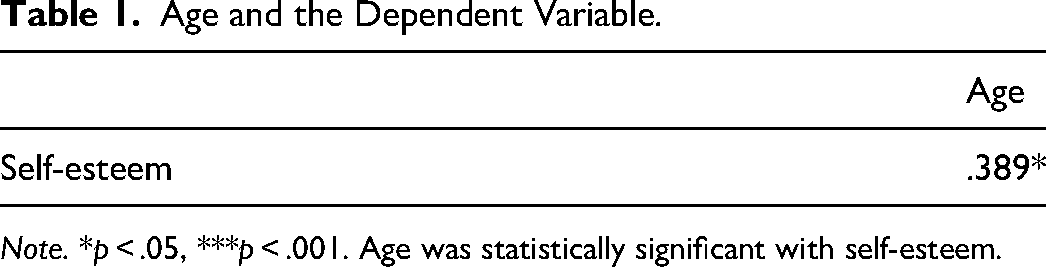
Note. *p < .05, ***p < .001. Age was statistically significant with self-esteem.
Data were analyzed using a hierarchal regression model, but statistical testing for assumptions was checked prior to conducting. Regarding multicollinearity, all independent variables were within the acceptable range (Allison, 1999). The assumption of normality for the dependent variable, self-esteem, was met. Linearity, multivariate normality, and homoscedasticity of the variance of the residuals were also acceptable. Examination of case-wise diagnostics, including Mahalanobis distance and Cooks distance, suggested that no variables exerted undue influence on the model; thus, no cases were excluded from the final analyses.
Descriptive statistics for the study's variable instrument scores are displayed in Table 2. Scores for the RSES are based on a 40-point measurement, REMS, and MSPSS on a five-point Likert scale with higher numbers demonstrating more perceived social support or frequency or likelihood of racial microaggression occurring.
Descriptive Statistics of Study Variables.
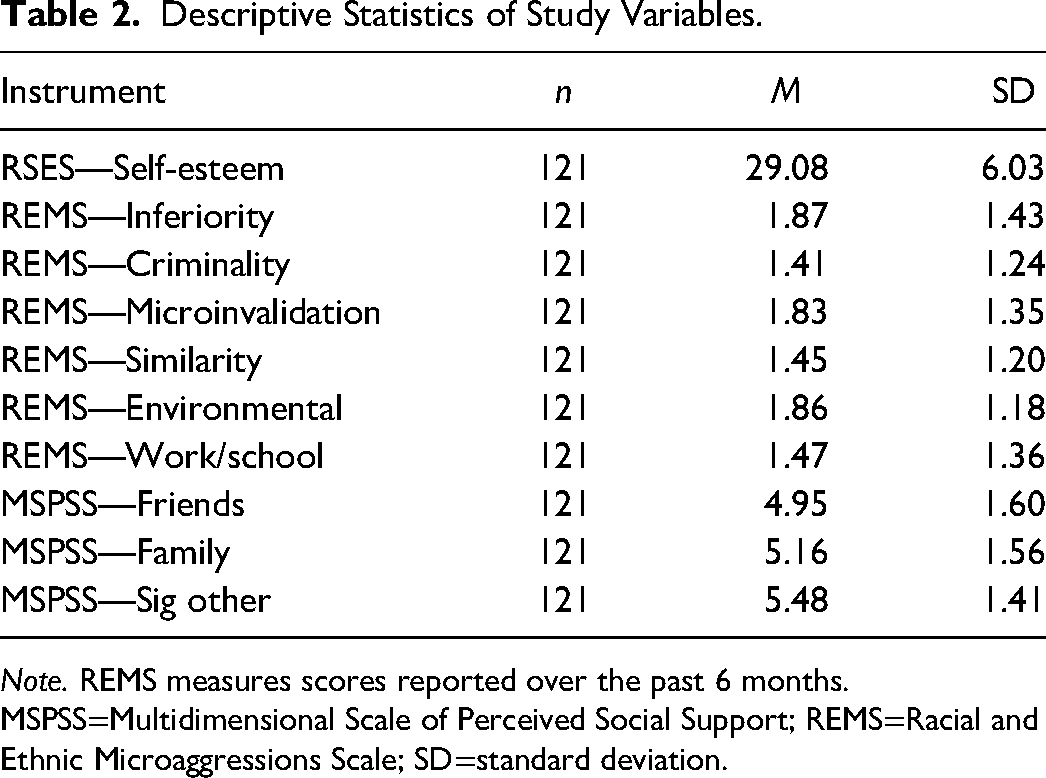
Note. REMS measures scores reported over the past 6 months.
MSPSS=Multidimensional Scale of Perceived Social Support; REMS=Racial and Ethnic Microaggressions Scale; SD=standard deviation.
Pearson's correlation coefficient matrix was generated to determine if a relationship between the variables existed. Next, hierarchical multiple regression was conducted to determine which (if any) of the independent variables were statistically significant with self-esteem, and the results are summarized in Table 3. The “enter” method was used for this exploratory study, and an alpha level of .05 was used as a criterion to determine the significance of statistical results. The data indicated that the control variable of age, when entered into step one, explained 15.1% of the variance of self-esteem. Step two consisted of variables representing social support (as measured by the MSPSS-family, friend, and significant other) and perceived racial microaggressions (as measured by the REMS-inferiority, criminality, microinvalidations, similarity, environmental microaggressions, and work/school microaggressions). This addition contributed to an additional 19.8% of the variance of self-esteem. The results of the analysis of variance (ANOVA) indicated that the overall model was statistically significant with self-esteem, R2 = .349, R2adj = .290 F(9, 110) = 5.90, p < .001. The overall model accounted for 34.9% of the variance in self-esteem (as measured by RSES).
REMS and MSPSS Regression Model Summary, N = 121.
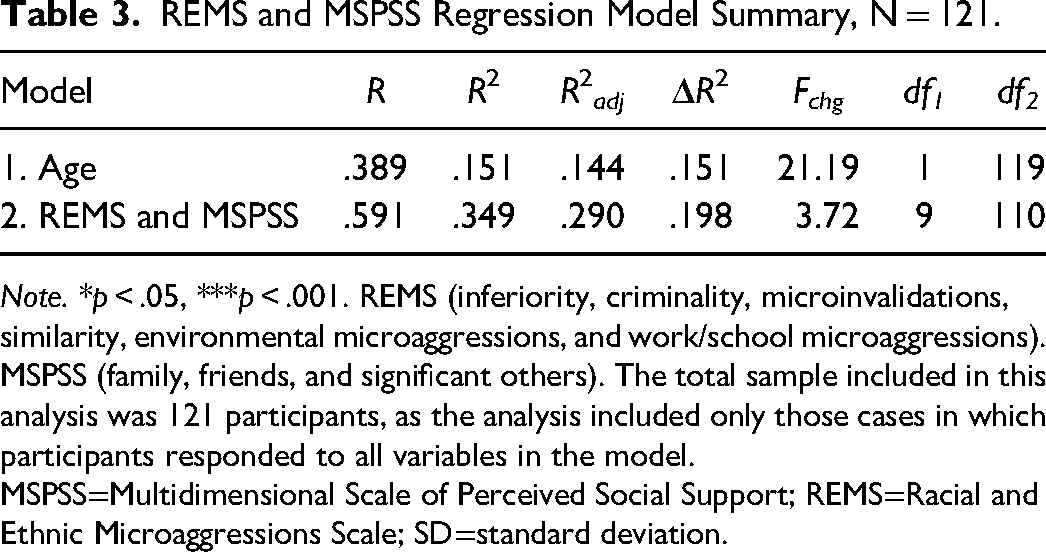
Note. *p < .05, ***p < .001. REMS (inferiority, criminality, microinvalidations, similarity, environmental microaggressions, and work/school microaggressions). MSPSS (family, friends, and significant others). The total sample included in this analysis was 121 participants, as the analysis included only those cases in which participants responded to all variables in the model.
MSPSS=Multidimensional Scale of Perceived Social Support; REMS=Racial and Ethnic Microaggressions Scale; SD=standard deviation.
Discussion
The results of this study documented a statistically significant relationship between social support (as measured by the MSPSS), racial microaggressions (as measured by the REMS), and self-esteem (as measured by the RSES) of African American women enrolled at PWIs. After controlling for the demographic variable of age, the analysis outcome indicated an overall statistically significant relationship between the variables. This model, including all subscales representing social support and racial microaggressions, accounted for approximately 34.9% of the variance of self-esteem.
Regarding individual subscales, social support (family), and self-esteem were statistically significant; however, social support (friends) demonstrated an inverse relationship with self-esteem. Social support (significant other) was not statistically significant. None of the REMS subscales alone were statistically significant with self-esteem. Self-esteem levels were reported as high for this population, and it is plausible that higher levels of self-esteem offset the impact of racial microaggressions, as literature has suggested (Jones & Shorter-Gooden, 2003; Molloy & Herzberger, 2002). African Americans may use the academic mask to downplay their experiences with racism and discrimination (Shavers & Moore, 2014).
The results of this study remained consistent with prior literature that spoke to the importance of social support for African American women's self-esteem. As noted, racism manifests throughout society into modernized forms (e.g., racial microaggressions; Pierce, 1970; Sue, 2015; Sue et al., 2022). It is crucial to understand how oppression can affect the self-esteem of Black women (Owens, 2016). This study revealed that as social support increased, so did self-esteem. This finding was not unusual because African Americans have historically operated from a collectivist perspective. Another highlight of this study was the negative relationship between social support (friends) and self-esteem. Unfortunately, Gray and Keith (2003) noted how demanding social relationships could trigger psychological stress. The superwomen schema whereby African American women can suffer from stress due to cultural obligations—in this case—friendships (Neufeld et al., 2008). SBW should also be considered, given the protector factor of minimizing stressors and the desire to provide support to others (Donovan & West, 2015). Therefore, it is vital to consider the perception of support and its impact, as it can have an inverse effect on the level of self-esteem. In conclusion, women over the age of 43 had the highest rate of responses. As we get older, we prioritize the quality of our friendships on quantity.
Implications for Counseling
It is beneficial for African American women to feel validated throughout the counseling process. Counselors can provide validation through encouragement and support. This validation may trigger a desire to explore feelings regarding microaggressions while also examining past experiences and unresolved emotions that may lead to other adverse mental health outcomes due to the internalization of emotions (Nadal et al., 2014). Through validation, counselors may also take a multifaceted approach advocating with stakeholders within the institution to identify and evaluate policies that reinforce the microaggressions (Shavers & Moore, 2014). Through advocacy, clinical counselors can partner with institutions to best remedy such concerns, demonstrating a solid commitment to humanity and diversity.
The results of this study also indicated the importance of social support; therefore, Shavers and Moore (2014) also suggested more formalized approaches, such as social, academic, and counseling groups dedicated to this population. Counselors can work to enhance social support by organizing such groups that can improve understanding of issues such as racial microaggressions and social support that can impact self-esteem.
The American Counseling Association (ACA) contends that counselors should remain informed about trends in society, specifically cultural trends and diversity issues that can contribute to overall wellbeing (ACA, 2014). Racism and discrimination are not new trends; however, the manifestation of the modernized racial microaggressions can benefit from continued exploration. Further investigation is essential for African American women prone to higher rates of depressive symptoms, as mentioned. Their status as double minorities can lead to more frequent exposure to microaggressions that can be deleterious to self-esteem. Therefore, it is imperative for counselors working with African American women to link them with others of the same race and gender who can counteract many negative experiences reported within unsupportive environments. Advocating for such positive associations, counselors recognize the distinct need of this population but also serve to emphasize culturally sensitive approaches, a facet of treatment recognized by the ACA (ACA, 2014).
Footnotes
Declaration of Conflicting Interests
The authors declared no potential conflicts of interest with respect to the research, authorship, and/or publication of this article.
Funding
The authors received no financial support for the research, authorship, and/or publication of this article.
