



Abstract
The population of adults who neither have nor want children is large and growing. However, it remains poorly understood because its members can be difficult to identify in traditional demographic surveys, and existing research on the population uses a range of methods and terms. In this paper, we review current practices, then to bring a level of consistency and comparability to this literature, we propose a common framework for studying this population. First, we recommend that researchers use the term “childfree” to describe adults who neither have nor want children, because the term is short, widely used, and preferred by members of this population. Second, we recommend that researchers define childfree adults by neither having nor wanting biological or nonbiological children, recognizing that one’s childfree status may change over time. Third, we recommend that researchers identify childfree adults in surveys using “want” questions (e.g., do you want children?), in combination with other questions.
Although many adults have or want to have children, a substantial fraction of adults neither have nor want children. This population is important to understand for at least three reasons. First, this population is large (Neal & Neal, 2022) and growing (U.S. Centers for Disease Control, 2019), with multiple studies suggesting that not wanting children is the most common form of non-parenthood (Brown, 2021; Martinez et al., 2012; Neal & Neal, 2023a). Second, members of this population have unique physical health needs such as long-term contraception (Cummins, 2022a, 2022b; Lemke et al., 2023; Tazkargy, 2014), mental health needs such as coping with stigma (Doyle et al., 2013; Gillespie, 2000; Mollen, 2006; Mueller & Yoder, 1999; Park, 2002; Turnbull, Graham & Taket, 2016), and social needs such as navigating a world where activities (Neal & Neal, 2023b) and financial planning (Zigmont, 2022) are oriented toward parents. Third, this population may significantly impact global demographic trends, including trends of declining fertility and population. This impact makes its members a target for “policies to encourage childbearing,” and that often have “harmful effects on sexual and reproductive health, human rights, and gender equality” (Gietel-Basten et al., 2022, p. 1).
Although adults who neither have nor want children are important to understand, studying this population is challenging. Conventional demographic surveys are not always able to distinguish members of this population from other types of non-parents. As a result, its true size, needs, and impact remain difficult to evaluate using the largest and most widely used datasets. Moreover, researchers that do focus on this population often use idiosyncratic terms, definitions, and methods, making it challenging to compare across studies and to develop an integrated portrait of this population. To overcome these challenges, there is a need for consistency in terms, definitions, and methods, which can be used not only by researchers focused on this population, but by social scientists and demographers more broadly. Therefore, in this paper, we draw on existing research practices to propose a framework for studying adults who neither have nor want children.
The paper is organized into four sections. In the first section, we review the terms that have been used to describe adults who neither have nor want children. In the second section, we identify three dimensions—Attitude, Behavior, and Circumstance (ABC)—that uniquely define the most commonly studied family statuses, including not wanting children, and describe how these statuses are related to one another. In the third section, we identify four types of question—Want, Ideal, Direct, and Expect (WIDE)—that can be used to empirically identify adults who neither have nor want children, and distinguish them from other family statuses. In the final section, we conclude by offering a series of recommendations for consistently applying the same terms, definitions, and methods when studying adults who neither have nor want children.
Definition and Terminology
The population of interest is adults who neither have nor want children. Although this clearly defines the boundaries of the population with a single inclusion criterion, it is worth noting some criteria that are not part of the definition. First, because this definition makes no reference to biological children, the population includes adults who neither have nor want any form of parenting role to biological, adopted, foster, or step-children. Second, because this definition makes no reference to one’s ability to have children, the population includes adults who neither have nor want children, regardless of their ability to have children. Third, because this definition makes no reference to one’s thoughts about whether others should have or want children, this population may include adults who believe having children is morally wrong (i.e. anti-natalists; Benatar, 2006), as well as adults who are supportive of others having or wanting children.
Studying this population requires having a name for it, or a name for its members. Several terms have been used in different contexts (Gouni et al., 2022; Volsche et al., 2020), and the most appropriate term is a contested issue. Some authors are consistent in using only one term (e.g., Neal & Neal, 2021, 2023a), while others use multiple (e.g., Stahnke et al., 2023; Veevers, 1973a, 1973b). However, using a consistent term for this population can bring clarity to research about it. Among the most common terms are “voluntarily childless” and “childfree,” while variants that append “by choice” have also been used. Figure 1 shows the frequency of use of these terms in Google’s corpus of books published in English through 2019, and illustrates that the prevalence of these terms has varied over time. In this section, we review their history, meaning, and usage.
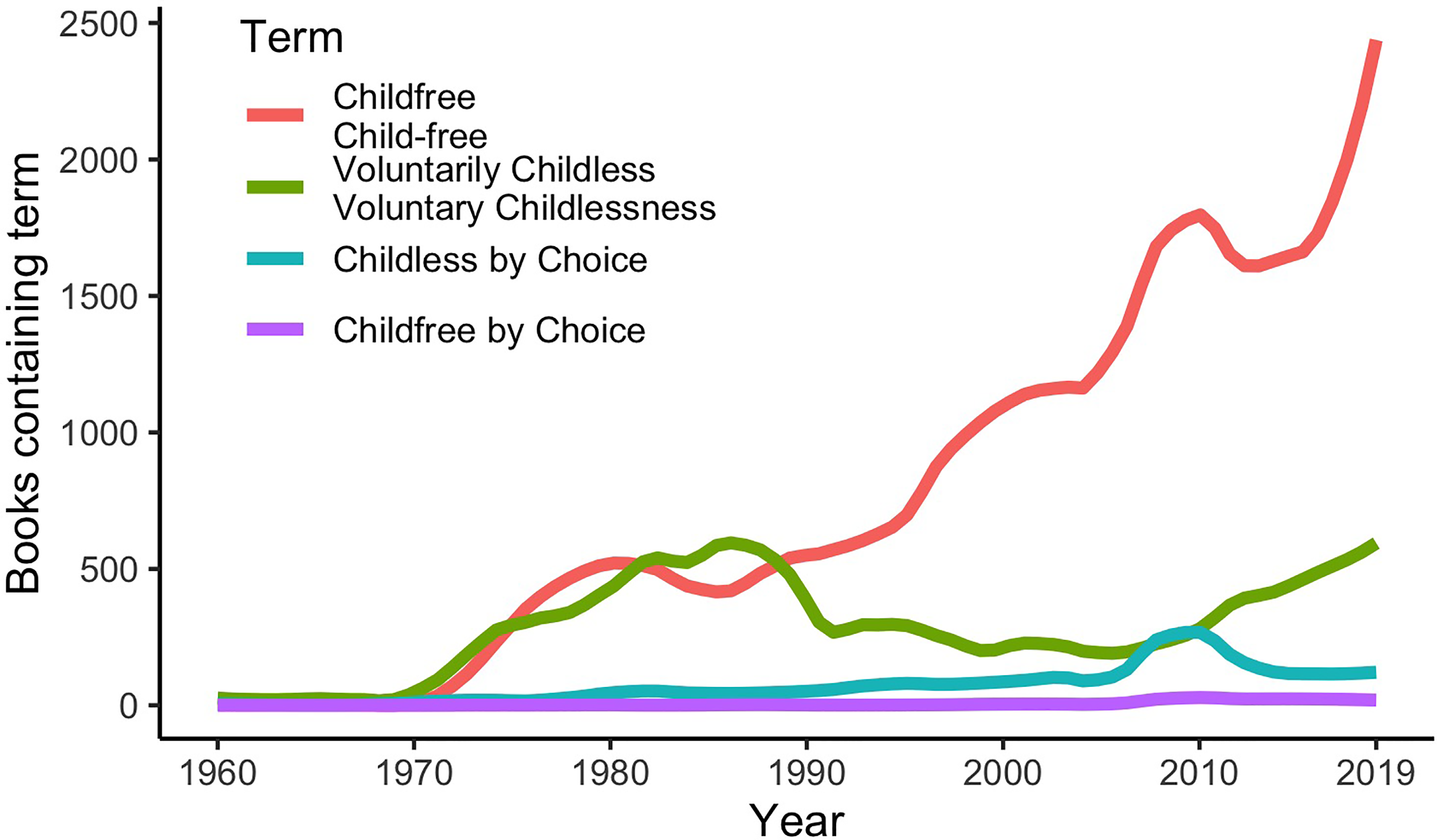
Terms for adults who neither have nor want children.
Voluntarily Childless
The term voluntarily childless is an adjective and refers to the population of adults who neither have nor want children, while the related term voluntary childlessness is a noun and refers to the population’s defining characteristic. For simplicity we treat both the adjective and noun forms as a single term.
This term first appeared in the scholarly literature in a review (Conan, 1905) of a book describing two upper-class women’s experience working in a factory (Van Vorst & Van Vorst, 1903). While both sources viewed voluntary childlessness as a social evil, Van Vorst & Van Vorst (1903) trace it to a shirking of marital responsibility, while Conan (1905) pointed to young women’s limited opportunities for marriage in urban factory towns. The following year, the term appeared in a treatise on the family, where Parsons (1906) traced it to a “growth in general of desires for economic independence” (p. 51), and excluded voluntarily childless couples from a discussion of marriage because it is merely “a progressive substitute for prostitution” (p. 351). Both early uses of the term explicitly invoked eugenic notions of “race suicide,” suggesting that adults who choose not to have children are killing their race by failing to enlarge its numbers.
The term remained infrequent and retained these eugenic associations through the 1930s (e.g., Fite, 1916), but by the late 1930s began to appear in more neutral demographic research (e.g., Hiltner, 1953; Kiser, 1939; Kunz & Brinkerhoff, 1969; Popenoe, 1943). As Figure 1 illustrates, use of this term exploded in the 1970s and 1980s, with the publication of several landmark studies on the voluntarily childless (Veevers, 1973b; Houseknecht, 1979), followed by a series of empirical and theoretical reviews that solidified its use (Veevers, 1979; Houseknecht, 1982, 1987). It remains in use by highly cited and influential studies across a range of disciplines including gender studies (e.g., Gillespie, 2000), sociology (e.g., Park, 2002), economics (e.g., Gobbi, 2013), counseling (e.g., Matthews & Desjardins, 2017), psychology (e.g., Avison & Furnham, 2015), and communications (e.g., Hintz & Brown, 2020). While this term is primarily used in the scholarly literature, at the time of writing, it is also the title of the Wikipedia entry describing this population.
Using the term voluntarily childless offers a couple advantages. First, the term has a long history in the scholarly literature that includes the earliest formal studies in the 1930s, a surge in interest in the 1970s, and more contemporary research today. Second, it builds on the root word “childless” as an umbrella category, within which the subcategory of voluntarily childless adults can be explicitly distinguished from involuntarily childless (i.e., sterile) and temporarily childless (i.e., planning to have children) adults.
At the same time, the term also comes with a couple disadvantages. First, it has historically been associated with eugenics and with a distinctively negative view of the population. Second, the -less suffix is deficit-oriented, implying that something is missing or that members of the population are deficient for not wanting children (Gold & Wilson, 2002; Gillespie, 2003).
Childfree
The term childfree (or sometimes child-free) is an adjective and refers to the population of adults who neither have nor want children. The noun form, childfreeness, is uncommon; no corresponding term exists to refer to the population’s defining characteristic.
Among the earliest uses of this term was in a literary magazine in 1913: “The prominence and admiration gained in public spheres nowadays by the child-free woman have created a spurious standard; and many women who would otherwise have been contented with their natural functions are utterly demoralised by the glare and glitter of the careers of their ‘free and independent’ sisters” (Colquhoun, 1913, p. 153). However, the term’s contemporary use traces to Ellen Peck in 1972 1 : It appeared in an afterword added to the 1972 printing of The Baby Trap (Peck, 1971), and in a pair of media articles (Time, 1972; Kramer, 1972) describing the foundation of the National Organization for Non-Parents by Peck that year. By 1973, it was in use in the scholarly literature (Veevers, 1974, 1973a). As Figure 1 illustrates, this term was used throughout the 1970s and 1980s alongside “voluntarily childless,” but by the 1990s emerged as the more widely used term. It is now used in the scholarly literature across multiple disciplines including geography (e.g., Agrillo & Nelini, 2008), sociology (e.g., Blackstone & Stewart, 2012), counseling (e.g., Gold, 2013), gender studies (e.g., Harrington, 2019), environmental studies (e.g., Helm et al., 2021), demography (e.g., Tanturri & Mencarini, 2008), psychology (e.g., Ashburn-Nardo, 2017), medicine (e.g., Richie, 2013), and social work (e.g., DeLyser, 2012).
The term childfree has also found wide use beyond the scholarly literature. First, it has been adopted as the preferred term by media outlets including Time (Sandler & Witteman, 2013), NPR (Segarra, 2023), The Guardian (Kwon, 2020), CNBC (Ermey, 2022), and BBC (Savage, 2023) when reporting about this population. Second, it is used in the name of numerous events and resources used by members of this population (Blackstone, 2013), including a magazine (Childfree Magazine), a social media board (r/childfree; 1.5 million members at the time of writing), an international day of recognition (International Childfree Day on August 1), and a podcast (We are Childfree). Third, it is used in non-academic popular press books about this population (e.g., Zigmont, 2022; Carroll, 2022; Drut-Davis, 2013; Ford, 2021).
Using the term childfree offers several advantages. First, it is the most widely used term in both academic and non-academic contexts, and therefore is widely recognized and understood by multiple audiences. Second, it is a short, single-word label that facilitates its use in writing. Finally, and perhaps most importantly, it is the term preferred by members of the population it seeks to describe (Browne, 2020; Carton, 2020; Johnson, 2023; King, 2017; Brunschweiger, 2019; Shenaar-Golan & Lans, 2023), and therefore can affirm an individual’s identity in much the same way as using their preferred pronouns (Brown et al., 2020).
Despite these advantages, there is one notable disadvantage to using the term childfree: Some suggest that the term childfree can imply an advocacy of the choice not to have children, or imply an opposition to children generally. This interpretation of the term appeared early in its history (Hoffnung & Loving, 1974), and recently was cited as a reason for rejecting requests in 2021 and 2022 to re-title the “voluntary childlessness” Wikipedia entry to “childfree.” However, the term childfree seems to imply no more advocacy of not having children than the term “gluten-free” or “caffeine-free” implies an advocacy of not having gluten or caffeine; it is descriptive rather than normative. As of 2022 the Associated Press recommends that journalists avoid this term because it “may be viewed as loaded or demeaning,” and to instead “use a neutral description such as doesn’t have children.” However, mainstream media outlets including NPR (Segarra, 2023) and BBC (Savage, 2023) have chosen not to follow this recommendation.
In view of the numerous advantages to using the term “childfree,” we use this term below.
The ABCs of Family Status
The definition of a “family” has changed over the years, incrementally expanding to include single parents and same-sex couples. Volsche et al. (2020) argue that the definition should be expanded further, not requiring the presence of children, thereby recognizing that childfree adults can be families also. By viewing one’s family status as defined by the intersection of one’s
In this framework, the attitude dimension refers to whether one wants or wanted to have any children. The behavior dimension refers to whether one currently has, or has ever had, any biological, adopted, foster, or step-children. Finally, the circumstance dimension refers to whether one experiences barriers to having children. These barriers can be physiological, which demographers call impaired fecundity and the general public calls infertility. However, they can also be economic (e.g. cannot afford to have a child) or social (e.g. cannot find a partner). Figure 2 illustrates that the intersection of these three dimensions defines eight exhaustive and mutually exclusive family statuses.
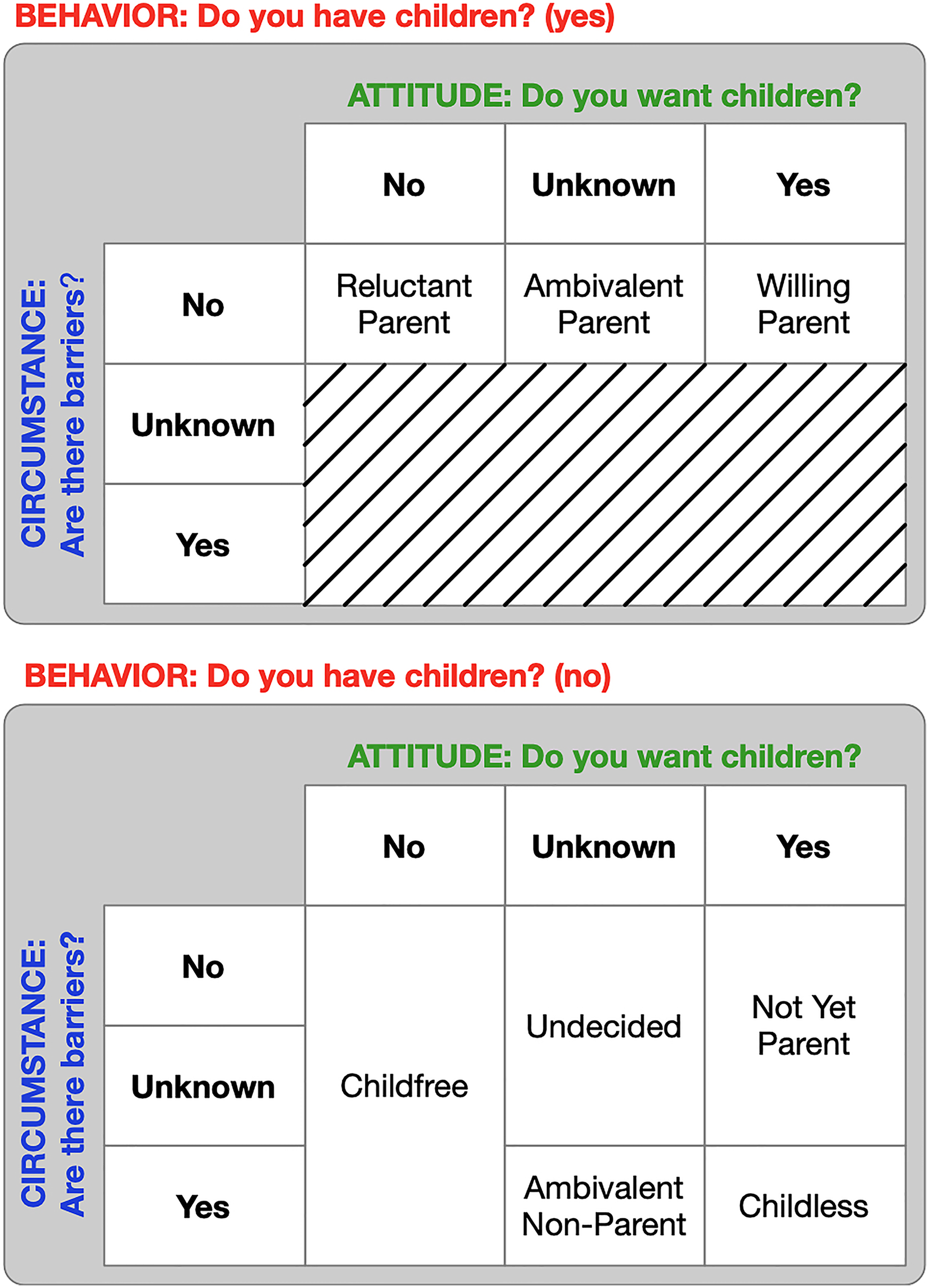
The attitude, behavior, and circumstances (ABCs) of family statuses (Reprinted from https://doi.org/10.31234/osf.io/fa89m under CC-BY 4.0 License).
Among those who have ever had children (i.e., behavior = yes, top panel), there are three parental family statuses defined by differing attitudes: Willing parents who wanted to have children, ambivalent parents who are unsure whether they wanted to have children, and reluctant parents who did not want to have children. Notably, the circumstance dimension is not relevant among parents because whatever barriers may have existed to having children were ultimately overcome.
Among those who have not had children (i.e., behavior = no, bottom panel), there are five non-parental family statuses. First, childfree adults do not want children (attitude = no), regardless of any barriers to having children (circumstance = any). Second, undecided adults do not know if they want children (attitude = unknown), and do not experience any known barriers to having children (circumstance = no or unknown). Third, ambivalent non-parents experienced barriers to having children (circumstance = yes), but do not know if they wanted children (attitude = unknown). Fourth, not-yet-parents do want children (attitude = yes) and do not experience any known barriers to having children (circumstance = no or unknown). Finally, childless adults did want children (attitude = yes), but experienced barriers to having them (circumstance = yes). Still finer-grained family status distinctions may be possible, for example, separating childless adults into those experiencing biological versus social barriers (Lo & Campo-Engelstein, 2018).
The family statuses described by Figure 2 are “momentary” statuses, that is, they are the status a person occupies at that moment. However, these statuses can, and often do, change over the life course. When a person has their first child, they transition from a status in the lower panel (non-parent) to a status in the upper panel (parent). Transitions within each panel are also possible. A parent can transition across any of the three statuses in the upper panel. For example, a new parent experiencing challenges may be reluctant parent, but as those challenges resolve, may later become a willing parent. Likewise, a non-parent can transition across any of the five statuses in the lower panel. Accordingly, these momentary statuses provide the building blocks for identifying an individual’s trajectory or life-course.
There are many possible trajectories toward being childfree. For example, an individual may initially be undecided or may initially intend to become a parent, but later decide to be childfree (i.e. undecided
There are also many possible trajectories from being childfree. First, a childfree adult may decide they want children and intentionally have children, thereby becoming a willing parent. Second, they may persist in not wanting children but nonethless have children under pressure from a partner, thereby becoming a reluctant parent. Third, they may unintentionally have children through an unplanned pregnancy and simply accept their new parent role, thereby becoming an ambivalent parent. Finally, a childfree adult may decide late in life that they actually had wanted children, thereby becoming childless. Although folk theories sometimes suggest this trajectory is a common one for childfree adults, eventually leading to regret, there is little evidence to support this claim (DeLyser, 2012; Neal & Neal, 2023a).
The WIDE Range of Survey Questions
Studying childfree adults requires being able to identify which adults are childfree, which Figure 2 suggests requires assessing behavioral and attitudinal but not circumstantial dimensions. The behavioral dimension (i.e., whether or not one has had children) is easy to measure, but the attitudinal dimension (i.e., whether or not one wants or wanted children) is more challenging to measure. In some cases researchers can rely on nonrepresentative samples “of individuals the …author knew to be childfree” (Blackstone & Stewart, 2016, p. 298), but this approach is impractical for collecting data from large samples, and such samples do not lead to generalizable inferences about the population. Instead, there are a “WIDE” range of simple closed-ended questions concerning individuals’
The want, ideal, direct, and expect (WIDE) range of questions used to identify childfree adults.
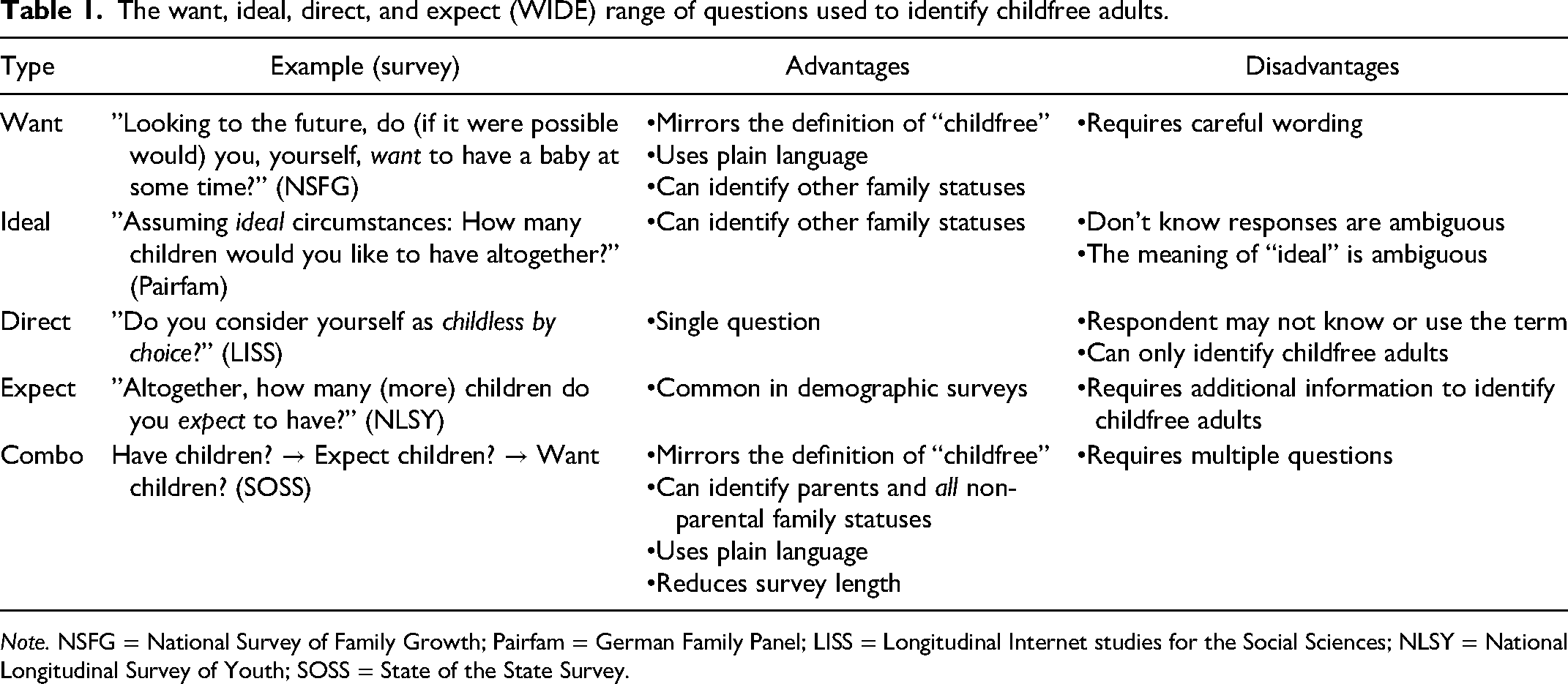
Note. NSFG = National Survey of Family Growth; Pairfam = German Family Panel; LISS = Longitudinal Internet studies for the Social Sciences; NLSY = National Longitudinal Survey of Youth; SOSS = State of the State Survey.
Want Questions
Want questions ask respondents whether they want, desire, wish, or would like to have children, where the response options include “yes,” “no,” and (in some cases) “don’t know.” In general, non-parents who answer “no” to want questions are childfree. However, caution is necessary because many wording variants are possible. Such questions can explicitly ask about only biological children, explicitly ask about both biological and non-biological children, or leave the type of child unspecified. Additionally, such questions can ask only about future desires (e.g., Would you like to have children in the future?), only about historical desires (e.g., Would you have liked to have children?), or leave the time period unspecified.
The 2017-2019 wave of the National Survey of Family Growth (NSFG), conducted by the US Centers for Disease Control, asked a want question: “Looking to the future, do (if it were possible would) you, yourself, want to have a baby at some time?” Several features of this particular variant are notable. First, this question asks only about future desires, but does not ask ask about past desires for children. Second, although this question does not specify whether it is asking about biological and/or non-biological children, the phrasing “you, yourself” may imply a focus on only biological children. Third, the optional phrase “if it were possible” ensures that respondents may answer yes or no, regardless of their ability to have children. Based on responses to this question, 546 women in the sample were childfree, and an estimated 8.95% of US women aged 15–49 were childfree in 2017–2019.
Want questions offer a number of advantages. First, asking respondents whether they want children closely mirrors the definition of being childfree. Second, want questions use plain language that is easily understood by most adults. Third, these questions can also be used to partially identify other family statuses. For example, non-parents who answer “don’t know” are either undecided or ambivalent, while those who answer “yes” are either not-yet-parents or childless. However, want questions must be carefully worded to accurately identify childfree adults. For example, it may be necessary to explicitly specify that the question is asking about having (a) both biological and non-biological children, (b) both in the past and in the future, and (c) if it were possible.
Ideal Questions
Ideal questions ask respondents about either their ideal number of children, or their desired number of children under ideal circumstances, where the response is either an integer or (in some cases) “don’t know”. Non-parents who answer “zero” are childfree. Ideal questions are often similar to want questions because they both ask about wanting children. However, ideal questions are unique because they ask for a specific number of children. Also similar to want questions, ideal questions can explicitly ask about only biological children, explicitly ask about both biological and non-biological children, or leave the type of child unspecified.
The 13th wave of the German Family Panel (Pairfam, 2020-2021) asked an ideal question: “Assuming ideal circumstances: How many children would you like to have altogether?” Although the question wording does not explicitly specify whether it is asking about biological and/or non-biological children, elsewhere this survey clarifies that “children” broadly includes biological, adopted, and step-children. Based on responses to this question, 442 adults in the sample were childfree, and an estimated 7.42% of German adults were childfree in 2020-2021.
The primary advantage of ideal questions is their ability to also identify unique parental family statuses, and in particular its ability to identify regretful parents, who are typically hard to identity. A respondent who reports an ideal number of children that is smaller than their current number of children is a regretful parent because they have more children than they wanted. However, ideal questions can be difficult for respondents to answer. First, respondents who answer “don’t know” may include both those who are not sure they want any children (i.e. undecided, but possibly childfree) and those who are not sure how many children they want (i.e. a parent or not-yet-parent). Second, it may often be ambiguous precisely what “ideal” means, or how broadly it might be interpreted by respondents. For example, a respondent who is childfree out of a concern for the environment might provide a non-zero response (and therefore not be identified as childfree) if they interpret “ideal” broadly as meaning a world free of any environmental concerns.
Direct Questions
Direct questions directly ask respondents whether they identify as X, where X is one of the many terms used to describe adults who neither have nor want children (e.g., do you identify as childfree?), and where response options include “yes,” “no,” and (in some cases) “don’t know.” Respondents who answer “yes” are childfree.
The 2nd through 15th waves of the Dutch Longitudinal Internet Studies for the Social Sciences (LISS, 2009-2022) asked a direct question: “Do you consider yourself as childless by choice, or would you have liked to have children?” This direct question uses the term “childless by choice” (in Dutch, “vrijwillig kinderloos”), which as we show in Figure 1 is not particularly common, and which some childfree adults may find objectionable (Browne, 2020; Carton, 2020; Johnson, 2023; King, 2017; Brunschweiger, 2019). As a result, some childfree adults may have responded ‘no’ simply because they do not personally use the term childless by choice, thereby leading to a misclassification of their family status. Based on responses to this question, 1,459 older non-parents in the panel were childfree, and an estimated 56.31% of older Dutch non-parents were childfree between 2009 and 2022.
The primary advantage of direct questions is their directness. Childfree adults can be identified using a single direct question, without the need to collect any additional information, for example, about whether they already have children. However, despite the appeal of this simplicity, direct questions have several disadvantages. First, respondents may not know or understand the term used in the question, and therefore may not answer correctly. For example, an older parent whose children have moved away may mistakenly believe that childfree means “without children at home right now,” and incorrectly answer “yes.” Second, childfree adults may not identify with the particular term in the question wording. For example, a person who does not want children and self-identifies as voluntarily childless may reply “no” when asked whether they identify as childfree. Strictly speaking, direct questions narrowly measure identification with the term used in the question, and do not broadly measure membership in the population of adults who neither have nor want children. Finally, direct questions can only identify childfree adults, but do not provide any insight into the family status of respondents who answer “no.”
Expect Questions
Expect questions ask respondents whether they expect, intend, are likely to, or plan to have children in the future. Although demographers sometimes distinguish between fertility expectations (i.e., the likelihood of having children) and fertility intentions (i.e., deliberate plans to act on having children), these two constructs tend to be used interchangeably and “operate similarly in empirical studies” (Gemmill, 2019, p. 131). There is considerable variation in how expectations and intentions are measured, including asking respondents binary yes/no questions about their expectations or intentions, count questions about the number of children they expect or intend to have, or numerical questions about their percentage likelihood of having children. Non-parents who report no expectation of children, an expectation of zero children, or a 0% expected likelihood of having children may be childfree, however additional information is sometimes necessary.
The first wave of the National Longitudinal Survey of Youth (NLSY), conducted by the US Bureau of Labor Statistics in 1979, asked an expect question: “Altogether, how many (more) children do you expect to have?” Because this question was asked of both parents and non-parents, information about the respondent’s current number of children is required to correctly interpret the response. Based on responses to this question, 904 young adults in the sample may have been childfree, and an estimated 7.18% of US young adults may have been childfree in 1979.
The primary advantage of expect questions is that they are commonly used on demographic surveys, allowing findings to be compared across samples. However, expect questions cannot distinguish childless from childfree adults. Childfree adults may report expecting zero children because they do not want children, while childless adults may report expecting zero children because they cannot have children due to biological or social circumstances despite wanting them. Therefore, identifying childfree adults using an expect question requires additional information about circumstances (e.g., whether adults can have children), which can be difficult to collect.
The Three-question Funnel
Because there is a WIDE range of ways to identify childfree adults in surveys, these questions can be combined in strategic ways to capture their unique advantages. Neal & Neal (2022) developed a three-question funnel that combines these questions to efficiently identify not only childfree adults, but to identify the family status of all respondents. As shown in Figure 3, the funnel begins by asking all respondents a question assessing the behavior dimension: “Do you have, or have you ever had, any biological, step-, or adopted children?” Respondents who answer “yes” are parents, and are not asked any additional questions. Respondents who answer “no” are next asked an expect-type question: “Do you plan to have any biological or adopted children in the future?” Respondents who answer “yes” are not yet parents and those who answer “don’t know” are undecided. Respondents who answer “no” are asked a final want-type question: “Do you wish you had or could have biological or adopted children?” Respondents who answer “yes” are childless, those who answer “don’t know” are ambivalent, and those who answer “no” are childfree.
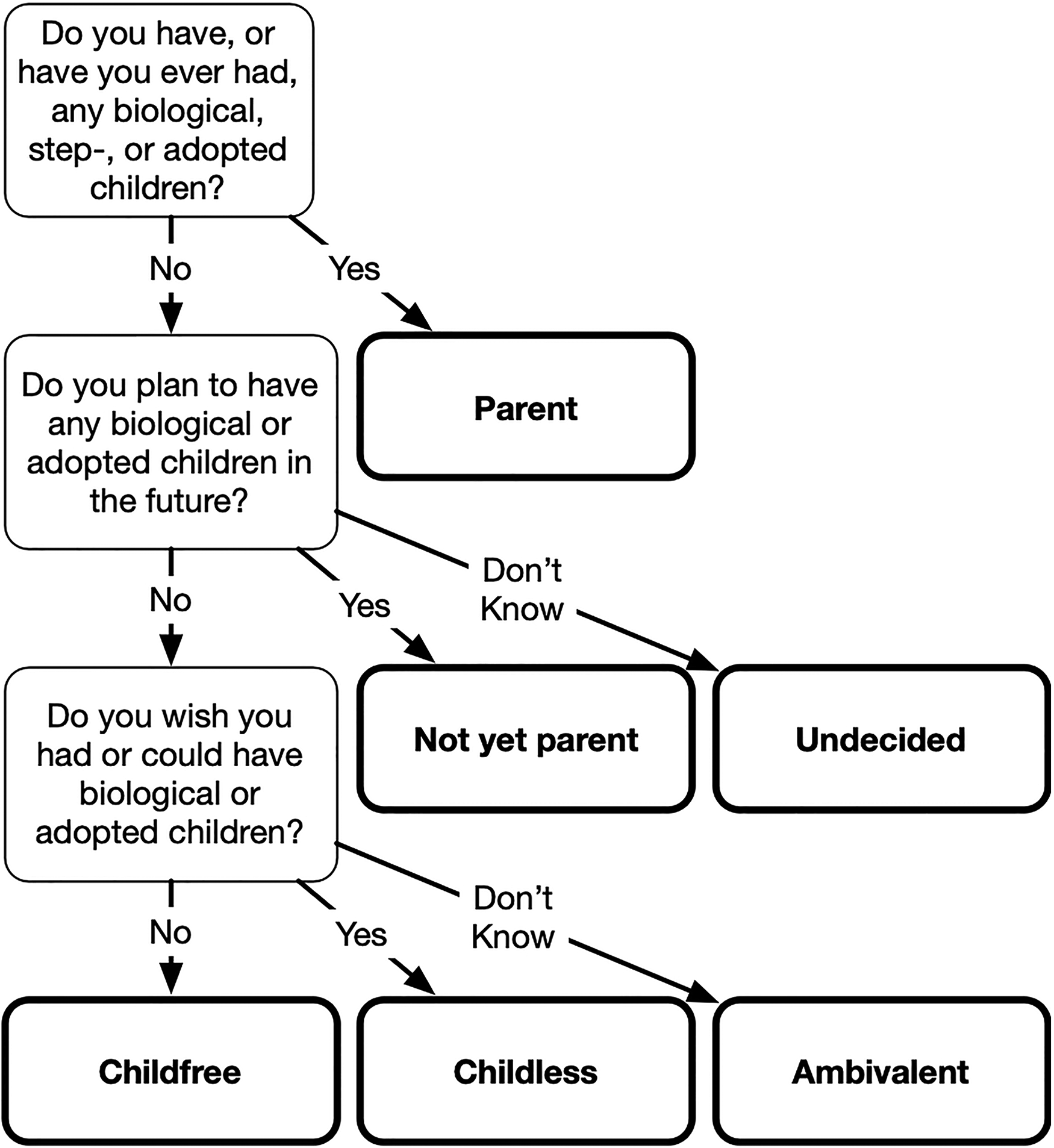
Three-question funnel to measure family status (Reprinted from Neal & Neal, 2023, https://doi.org/10.31234/osf.io/fa89m under CC-BY 4.0 License).
The 84th wave of the State of the State Survey, conducted by Michigan State University in 2022, included this three-question funnel. Based on responses to this funnel of questions, 216 adults in the sample were childfree, and an estimated 20.94% of adults living in Michigan were childfree in 2022.
Although this three-question funnel is slightly more complex than the single questions shown in Table 1, it offers a number of advantages. First, it can be used to identify not only childfree adults, but also parents and adults with other non-parental family statuses. Second, it reduces the length of surveys by minimizing the number of questions any given adult must be asked. For example, parents, which are typically the largest group of respondents, are only asked one question, while not-yet-parents are only asked two questions. Third, each question in the funnel uses plain language yes/no questions, and asks respondents only about their own behavior, expectations, and wants, but does not ask about more ambiguous concepts such as ideals, specific terms, or circumstances.
Conclusion
The design of research on any population should always be guided by the specific research questions and goals. However, some degree of consistency across studies is essential for building a set of comparable findings and developing a complete understanding of the population. Therefore, based on the above review of current practices, we conclude by offering a few recommendations for studying adults who neither have nor want children.
First, we recommend that researchers use the term “childfree” to describe adults who neither have nor want to have children. This term is short, widely used in both academic and non-academic contexts, and preferred by members of the population it seeks to describe. In addition, unlike the alternate term, “voluntarily childless,” the term “childfree” is not deficit-oriented and does not have historic links to eugenics.
Second, we recommend that researchers define childfree adults by neither having nor wanting children, where children includes biological, adopted, foster, and step-children. This definition views being childfree as a social, not a biological, family status because it does not depend on one’s ability to have children, or on the type of children one has or wants.
Third, we recommend that researchers view being childfree as a type of family status, and situate it relative to other family statuses through the intersection of attitudes, behaviors, and circumstances. This approach defines a more inclusive range of family statuses, and recognizes that one’s status may change over time.
Finally, we recommend that researchers identify childfree adults in surveys using want-type questions, in combination with other questions. Want-type questions use plain language that closely mirrors the definition of being childfree, and can be combined with other questions to distinguish childfree adults from those with similar family statuses (e.g., Neal & Neal, 2022, 2023a).
There will be some contexts where these recommendations are inappropriate or impractical. For example, the term “childfree” may not retain its meaning when translated to other languages, and in-depth qualitative interviews may offer more nuanced methods for identifying childfree adults than closed-ended want questions. However, these recommendations offer guidance for researchers studying childfree adults and have the potential to bring clarity and consistency to study findings, thereby facilitating a better understanding of this population.
Footnotes
Declaration of Conflicting Interests
The authors declared no potential conflicts of interest with respect to the research, authorship, and/or publication of this article.
Funding
The authors received no financial support for the research, authorship, and/or publication of this article.
