



Abstract
Motherhood involves intense physical, psychological, and identity transformation, and mental health difficulties can arise through pregnancy, birth, and postpartum experiences. Dismantling group counselors’ participation in relying on Eurocentric counseling ideologies can involve reclaiming the indigenous roots of counseling and healing, including integrating Latin dance as a modality for social connection and internal healing for postpartum mothers. We explore coresearchers’ experiences with a group that embodied Latin values and culture, specifically music and dance. Findings from a heuristic inquiry elucidate the experiences of four postpartum mothers and their babies who danced and connected through a Latin dance group counseling intervention.
Motherhood can involve intense physical, psychological, and identity transformation, and mental health difficulties can arise through the process of pregnancy, birth, and postpartum experiences (Wallis et al., 2021). Literature on how to support the mental health of postpartum mothers, especially using decolonized counseling approaches, is limited. Mental health counselors are uniquely positioned to be of support to postpartum mothers yet need creative, decolonized counseling interventions to help clients move toward connection with themselves, their babies, and their communities.
Mental Health in Postpartum Women
Postpartum depression (PPD) affects approximately one in five women globally, and that number only accounts for live births, negating to count of mothers who experienced miscarriages or stillbirths (Wang et al., 2021). Rates of PPD are higher among low-income and immigrant populations (Simhi et al., 2019). If untreated, PPD can adversely affect the mother's health and might cause sleeping, eating, and behavioral problems for the infant (O’Connor et al., 2016). Awareness of PPD has increased, yet postpartum anxiety (PPA) disorders and other mental health difficulties (e.g., postpartum OCD, postpartum panic disorder, postpartum PTSD, and postpartum psychosis) for postpartum mothers remain underassessed and treated (Ponzini et al., 2021). Women who need additional mental health support often sought this from healthcare professionals (e.g., OBGYN), and found that when support was available, it was not always accessible and some professionals offered negative support (e.g., judgmental, offered conflicting advice, biased toward breastfeeding; Tanganhito et al., 2020).
For decades, researchers have found the negative effects of PPD on maternal–infant interaction and attachment (Beck, 1995). While the literature base clearly accentuates the impact of perinatal and prenatal mental health on maternal attachment, significant gaps in our understanding of postpartum bonding, particularly in clinical practice, remain (Mcnamara et al., 2019). Moreover, the bulk of clinical practice understanding comes from other allied mental health professions, necessitating continued research from a holistic counseling perspective. The limited counseling-focused research studies on supporting postpartum mothers are outdated (Choate & Gintner, 2011). Psychosocial support, including that fostered by group counselors, proved to be the most effective intervention that has been used by healthcare workers to reduce depressive symptoms for postpartum mothers (Anoyke et al., 2018). Thus, we sought to explore the impact of psychosocial support for postpartum mothers using a decolonized group counseling structure, Latin dance.
Decolonizing Group Counseling
Group therapy has been found to meet the mental health needs of postpartum mothers navigating PPD, PPA, and other mental health difficulties (Parsa et al., 2017; Simhi et al., 2021). Thus far, the research has been oriented around traditional forms of group counseling for this population (e.g., CBT; Simhi et al., 2021; Van Lieshout et al., 2022). Group counselors must reimage counseling spaces that have traditionally been oppressive to communities of color, as part of the ethical imperative of social justice advocacy and meeting the needs of diverse clients (Levy et al., 2021).
Traditional group talk therapy can be “plagued by problematic client-counselor power dynamics,” and necessitate culturally responsive counseling interventions (Levy et al., 2021, p. 214). Because indigenous peoples have been forced to acculturate and render their cultural worldviews due to colonialism, counselors must be mindful of decolonizing their group counseling practice (Smith & Chambers, 2015). Decolonizing group counseling involves decentering the Eurocentric status quo that underlies the dominant approaches to clinical practice (Malott et al., 2023). Dismantling counselors’ participation in solely relying on Eurocentric counseling ideologies can involve reclaiming the indigenous roots of counseling and healing, including integrating Latin dance as a modality for social connection and internal healing (Singh et al., 2020). Millner et al. (2021) posited a postcolonial, Asian-centric reconstruction of mental health practices that prioritizes cultural values (e.g., collectivism). We sought to explore coresearchers’ experiences with a mental health practice that embodied and centered Latin experiences and prioritized Latin values and culture, specifically music and dance.
Latin Dance as a Group Counseling Intervention
Dance movement therapy group treatment has been shown to lower depression level, increase energy level, increase the use of mindfulness, and strengthen attachment style (Pylvanainen et al., 2020). Latin dance, in particular, has shown therapeutic outcomes in supporting other populations. Tango, for example, has been shown to help people with Parkinson's improve other areas of their life, including quality of life, mindfulness, cognition, meaningfulness, and emotional and physical health (Israili & Israili, 2017). The impact of Latin dance in supporting clients’ mental health following experiencing the physical and emotional turmoil of pregnancy, childbirth, and postpartum periods, however, has yet to be explored. This study seeks to fill this gap in the literature and inform group counseling practices in supporting postpartum mothers’ mental health.
The purpose of this study is to explore the self-acceptance, self-awareness, and lived experience of postpartum women through Latin dance, specifically merengue, salsa, and bolero. The research question is: What is the experience of postpartum mothers engaging in a Latin dance group intervention with their babies? The goal is to inform the family counseling literature by exploring this creative counseling intervention by inviting postpartum mothers to self-search, explore, and discover themselves and their bodies through Latin dance.
Method
Heuristic inquiry is a “qualitative, social constructivist, and phenomenological aligned” research methodology inspired by the primary researcher's autobiographical experience” (Sultan, 2020, p. 262). We utilized heuristic inquiry because it does not separate the individual from the experience, but rather involves the researchers bringing in their living experience. The first author was a postpartum mother who brought her son to the group experience, congruent with the heart of heuristic inquiry.
Recruitment
Coresearchers were recruited in the Spring of 2023 following IRB approval. Recruitment entailed inviting postpartum mothers to partake in a Latin dance group counseling intervention and interviews via social media pages. The Latin dance group and interviews occurred via Zoom. Coresearchers were invited to bring their babies to attend the Latin dance group counseling intervention alongside them. The interviews, focus group and following individual interviews, were based on a semistructured interview protocol. The focus group interviews lasted 10–15 min after each dance and the individual interviews lasted approximately 60–90 min. After analyzing both the focus group and individual interview data, we utilized Moustaka's (1990) heuristic inquiry to capture the living experiences of postpartum mothers who engaged in a Latin dance group intervention.
Coresearchers were postpartum mothers who have had a child in the last 12 months. All four of the coresearchers also brought their infants to the Latin dance group counseling intervention. We acquired a diverse sample, representative of a variety of ages, abilities, and ethnic backgrounds. Purposive sampling drove participant selection. Table 1 showcases coresearchers’ demographic data. In addition, all four coresearchers identified as middle class and had at least a bachelor's degree. Three of the four coresearchers had graduate degrees or higher. All four coresearchers identified as female. Three of the coresearchers had one child and one participant had two children: a 3-month-old and a 4-year-old.
Coresearchers’ Demographic Data.

Note. This table demonstrates demographic information from the coresearchers.
Data Collection
Due to the personal nature of this study, semistructured interviews were the primary means of collecting data (Sultan, 2020). Coresearchers engaged in both a group interview, lasting 60 to 90 min and an individual interview lasting roughly 60 min. The interview questions were open-ended, and interviewing was done from a relational perspective (Moustakas, 1990). After each Latin dance, the group answered semi-structured interview questions, such as, “What did the dance mean to you?” In addition to the interviews, coresearchers were invited to include poetry, artwork, and other forms of creative expression that aided in their meaning-making process (Sultan, 2019). Given the autobiographical nature of heuristic inquiry, the research also involved my reflexive process as a postpartum mother, allowing for an empathic understanding of my coresearchers’ lived experiences, while still maintaining the focus of inquiry on the coresearchers (Sultan, 2020).
Data Analysis
We followed Moustakas (1990) six phases of heuristic inquiry: (a) initial engagement, (b) immersion, (c) incubation, (d) illumination, (e) explication, and (f) creative synthesis. We used a preliminary theme illumination and identification chart, including words, phrases, symbols, nonverbals, implicit and tacit meanings and themes, and unanticipated themes (Sultan, 2020, p. 150). Following, we explicated our findings through heuristic inquiry's four methods of representation: Individual depictions, composite depictions, exemplary portrait (Mama Bear), and creative synthesis (Sultan, 2020). Moustakas (1990) identified the processes involved in the researcher's journey of arriving at a deeper understanding of the central research question through heuristic inquiry: identifying with the focus of inquiry, self-dialog, tacit knowing, intuition, indwelling, focusing, and internal frame of reference.
Trustworthiness
The second author, who does not identify as a postpartum mother, served as an external auditor throughout the heuristic inquiry process to balance the first author's personal experiences, assumptions, and biases. We met weekly for 5 months to facilitate prolonged engagement and thick descriptions per the recommendation of how to cultivate trustworthiness in counseling heuristic inquiries posited by Sultan (2020). Both of us also kept a reflexive journal to bracket assumptions and biases throughout the data collection and analysis process, which we processed in the weekly meetings.
Results
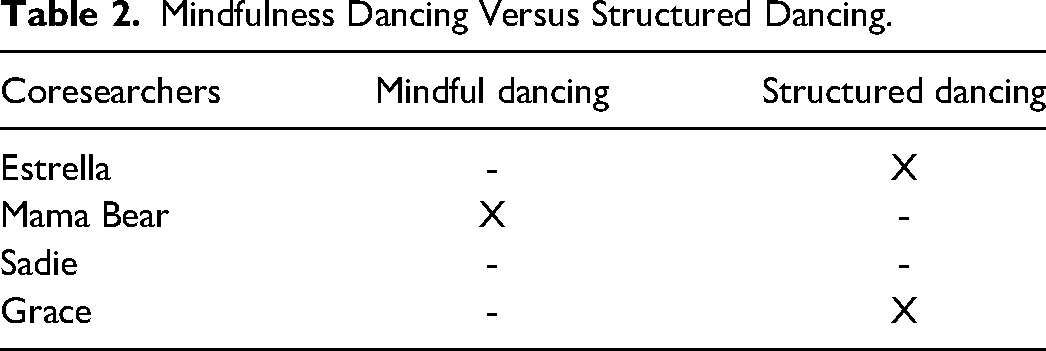
The composite depiction is the overarching depiction that contains all core, thematic structures of the coresearchers’ experiences in the Latin dance group for postpartum mothers and their babies. The composite depiction includes direct quotes, categories, subthemes, and themes of postpartum mothers’ experiences in the Latin dance group (Moustakas, 1990). The four final themes were: (a) connection to baby, (b) connection to other postpartum mothers, (c) connection to self, and (d) connection to music and culture. Throughout, individual depictions of each coresearcher are presented. Table 2 highlights individual depictions regarding preferences for mindfulness dancing compared to structured dancing, with Sadie equally enjoying both forms of dance.
Mindfulness Dancing Versus Structured Dancing.
Theme 1: Connection to Baby
All coresearchers reflected on their connection to their baby during their experience with the Latin dance group counseling intervention. To illustrate, Grace described, “I could just feel almost like a string of connection between me and my little one in that moment.”
Coresearchers felt a deep connection with their baby as they engaged in coregulating movements, such as dance movements mirroring rocking, throughout the group counseling intervention. Grace captured the heart of the group's experience when she explained, “And once I turned off some of the anxious, Am I doing it right? Thoughts in my brain and tried to just connect in my imperfect way, even if I do not feel like I am doing it right or a good dancer, then I think it [the Latin Dance] helps me be more connected with my body and my baby.” The movement appeared to foster a connection between the mothers and babies as they moved together, they spoke of the felt sense of attachment with their infants.
As part of the deep connection felt with their babies during the Latin dance, postpartum mothers also processed their attunement with their baby and their emotions through what felt like an “energy transfer.” Estrella shared her attunement with her baby through the experience: “It has been really fun to see her (my baby) go through. She slept through part of it. She got really happy through part of it, almost like she was dancing at another part. Figure 1 captured the coresearchers’ experiences in the Latin dance at large, and the connection with a baby is felt within the words, such as “love-filled” and “connected.” Specifically, after both salsas, Estrella realized how soothing it was for her and her baby: I thought salsa was going to be for my body. I thought it was going to be very invigorating and energized. But with both songs, I felt so soothed, like almost to sleep. It just was really relaxing. And for my baby as well, she was just sleeping on me … that really surprised me that I just have this internal reaction to it, just like being very calming.
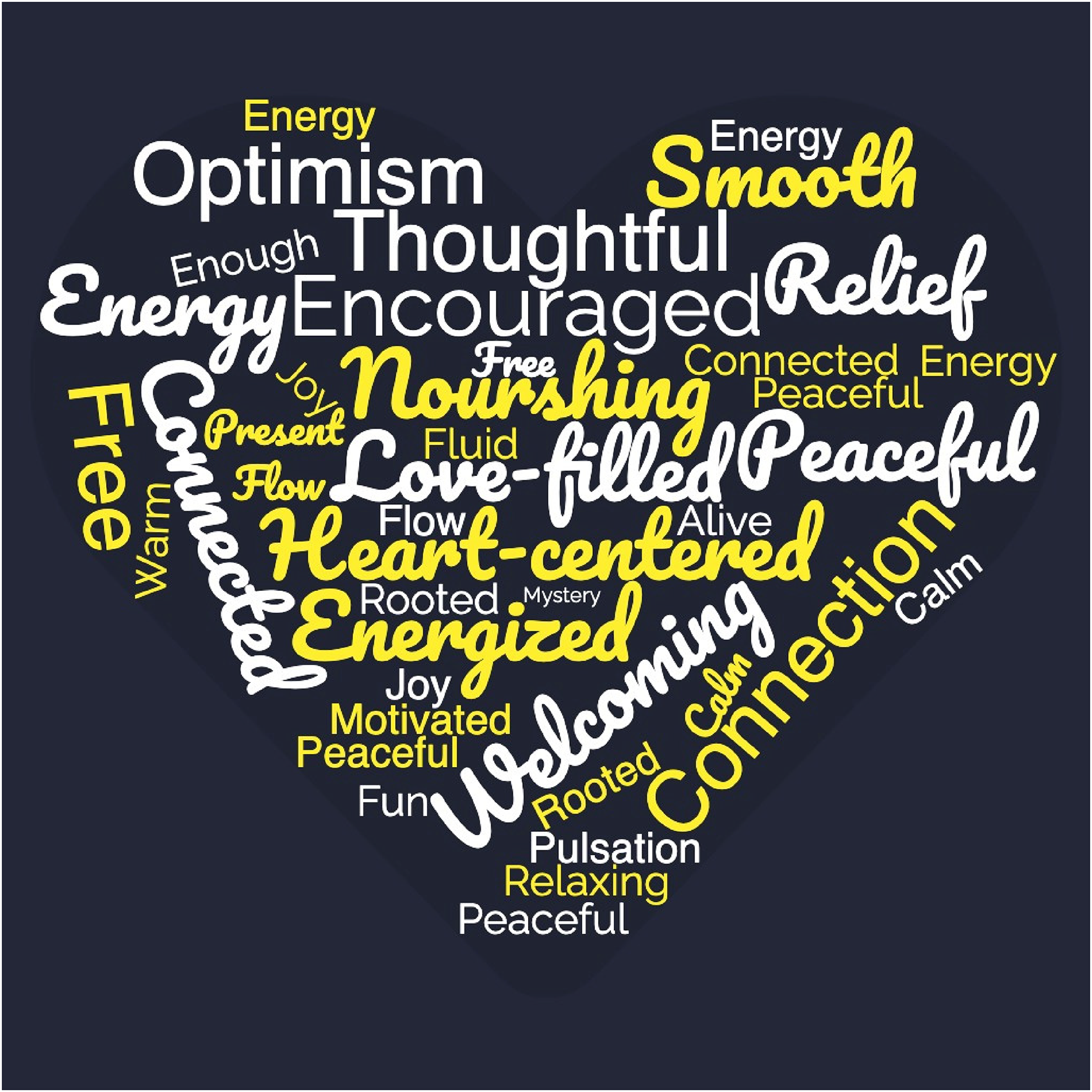
Word cloud of coresearchers’ experiences.
After Merengue 1, Sadie shared a similar sentiment, feeling connected with her baby through music: “I had my speakers on kind of loud and (baby's name) were just like (imitate eyes popping). He does not have a lot of reactions, he kind of reacts to a few things, but he is still so little. So, it was really funny to see his eyes just like really pop up and it was really fun.” Relatedly, Mama Bear observed others connect with their babies through the group experience. She shared, “I observed that all the moms were connected with their babies, making eye contact and making it not just mommies, but mommy and me. And I am sure that is the purpose of the meeting.” Mama Bear added her own connection and attunement with her own baby, sharing “my baby was giggling throughout the music.”
Theme 2: Connection to Other Postpartum Mothers
All coresearchers identified the sense of community and connection they felt with the other postpartum mothers during the Latin dance group counseling intervention. The postpartum mothers used phrases such as “no judgment” and “community” when reflecting on their experience dancing with the other group members. Estrella stated, “You guys have created a great environment here on Zoom to feel safe. I do not think any of you are judging me as I sway around or look silly. If anything, I might be judging myself. But I feel safe. You have given us the permission to take care of ourselves and to love ourselves.” Mama Bear captured the heart of the group's experience: It's really helpful to have a community that's a group of other moms that are going through the same journey, through the same experience. It helps to feel relief that, okay, I'm not alone. I'm not in isolation. There are other moms out there that are going through the same experience, the same chapter of life. And then to be able to connect over music and have a common topic to talk about, it's helpful and it helps the conversation going and it helps a lot.
Similarly, Sadie emphasized how healing the group experience was for her, and accentuated that she felt the group setting was integral to her experience: It was really helpful in a group setting. I don't know if it if I would have felt so comfortable if it had been like a one-on-one situation. But because I think there's other mothers and babies and there's something about that that kind of helps in a group setting more than maybe a one on one. I think it's something like a good kind of peer pressure. Almost like well, everyone else is doing it, so I can do it too.
The coresearchers indicated that they previously felt alone and isolated in some of their experiences, but through the group, their experiences were normalized. Mama Bear, for example, shared, “I have been feeling like doing too many contact maps. It is nice to know that I am not the only one that does them.” The environment created space for the group members to “take what they needed” from the experience. Mama Bear offered, It (the Latin dance group) was welcoming and warm. It felt like we were in a no judgment zone and just free to do whatever, however you wanted to dance and just going with the flow and just letting go of all our worries and all the stress and just being tension free. And that's how life should be. Just letting everything loose, not being so hard on ourselves as new moms, and just taking it one step at a time. Baby steps.
Each of the coresearchers emphasized how meaningful the connection they experienced with the other mothers was for their mental health and emotional regulation processes.
Theme 3: Connection to Self
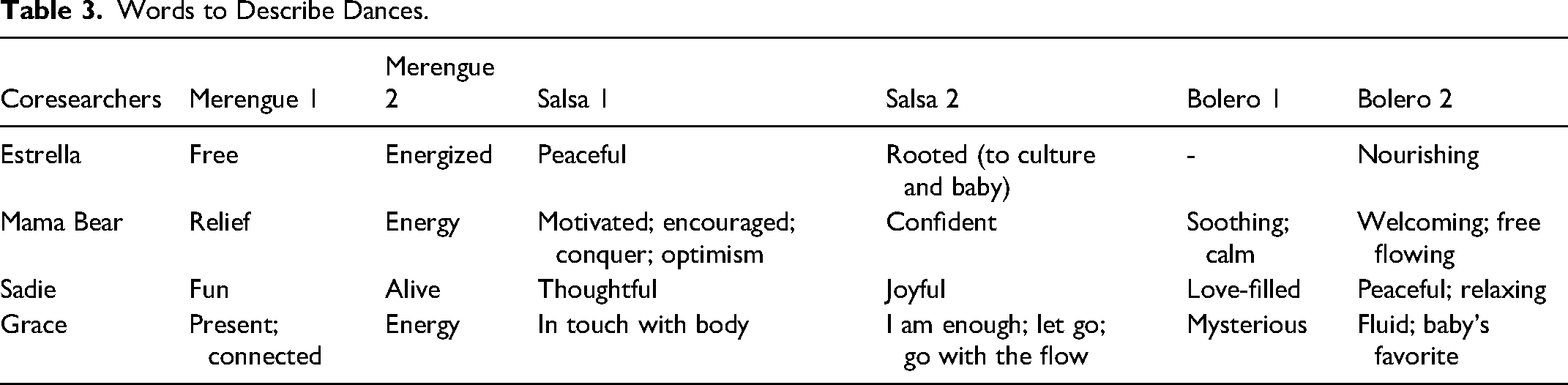
All coresearchers cited an experience of feeling a connection to themselves through the Latin group counseling intervention. Some coresearchers (n = 3) juxtaposed their reflection of their connection to self with their loss of self in motherhood. While the composite depiction highlighted the group members feeling connected to themselves, the individual depictions of what that connection to self looked like were unique for each postpartum mother. Individual depiction of the connection to self: for Mama Bear, was about prioritizing herself, for Grace, was about her connection to her body and feeling sexy postpartum, and for Sadie and Estrella, were about acceptance and emotional regulation. Table 3 demonstrates the words used by each coresearcher to describe their experiences with the dances.
Words to Describe Dances.
To illustrate the coresearcher's personal living experience, individual depictions related to the connection to self are presented. Figure 2 exemplified a coresearcher's artifact of the connection she felt with her baby as well as herself through the intervention. As a mother of two, Mama Bear felt connected to herself through her prioritization of herself. Mama Bear stated, “I feel like the group itself is very important and useful because I know us moms tend to not prioritize ourselves and not be able to have a real social life as much as like prior to having the baby.” Mama Bear also captured a group sentiment of the fluidity of moving for self, or for baby. After Bolero 1, she explained, “One moment you are feeling some way toward the song and then another moment like with the babies, you feel differently toward the same song that you could feel a more sensual or romantic toward a certain song.”
For Grace, the experience of connecting with herself was related to exploring feelings regarding her body, movement, and feeling sexy in her postpartum body. Grace explained, “Most of my body's movements are really necessary, like doing it to take care of him or to meet a need. Not as much moving for fun or enjoyment for me sometimes. It felt different being able to get up and move and do so in a different way that was not task oriented.” Further, she described, “I was thinking about my relationship with my body since I have had my son and not feeling very sexy very often. With the changes in my body through the process of being pregnant, childbirth, and so on, it is been hard to feel sexy and connected to that part of myself and my body. I was like, okay, something about this is feeling fun and sexy and makes me want to move my hips.”
For Sadie and Estrella, their connection to self throughout the Latin dance is related to their connection with their emotional experiences. Latin dance helped both Sadie and Estrella emotionally regulate as postpartum mothers. For Sadie, the music and dance helped her regulate after a frustrating blowout diaper and manage her perfectionistic tendencies. After Merengue 2, she shared, Coming back after like a slightly inconvenient moment [a blowout diaper] where I think normally, I would be kind of frustrated like, oh, I need to change my clothes and change. It's a whole thing kind of coming back and having like just this fun music playing and being able to just hop into dancing. I think it really helped my mental moment instead of being kind of frustrated and like, argh. That was really awesome.
Sadie also described how Latin dance helped her emotionally regulate thoughts of perfectionism: “Not having to think and more just kind of go with what I feel. And not being super perfectionist about it either has been really cool.” Sadie also emphasized, after both Merengue 1 and Salsa 1, how much better it felt to move and feel less stagnant. She emphasized the importance of moving her body: “It just felt good to move. I know I am kind of in the phase where I am doing a lot of sitting right now. Like halfway through, I was like, I am going to stand up and try to move a little bit more because it just felt really good.”
Although Estrella's experience was individualized, her connection to self, too, embodied her ability to enhance her emotional regulation skills as she engaged with Latin dance. Summarizing her emotional regulation process and takeaways, after Bolero 1, she reflected, “There are three requirements in being a good mom and a good dad, and that is that we keep her safe, we keep her fed, and we give her lots of love and that is it. It is a reminder that that is all we need to be and that is all we need to do.”
Theme 4: Connection to Music and Culture
All of the coresearchers recognized their connection to the music and to culture through their experience with the Latin dance group intervention. Because each of the group members had unique cultural backgrounds, individual depictions are provided to capture their experience with connecting to music and culture. To capture the individual depiction further, Table 4 highlights the coresearchers’ favorite songs.
Dance(s) Preference(s).

Denotes favorite of the structured dances.
As a Puerto Rican woman, Estrella's connection to music and culture is related to her cultural identity as a Latina woman. She described, “My family's from Puerto Rico, so I grew up hearing a lot of Hispanic music. So, when you said the Guido, I could hear my uncle playing it in the background,” and then she added, “The music is making me move in a natural way …. With this dance, especially since I can connect to the music since I grew up with a lot of it, my body is just moving in an organic way that it usually does not. It is like it has permission to just flow.” For Estrella, she emotionally connected to the words of the Latin songs and deeply reflected on her Latin culture throughout the experience, including feeling inspired by the group in terms of how she can share her culture with her newborn daughter. After dancing to Merengue 2, she reflected, “That is something I have not thought of. I do not know why I have not thought of it yet. Is playing Spanish music for her. I have been singing like Spanish nursery rhymes, but I have not played like actual Spanish music, it just did not cross my mind yet, so I would love to make a little playlist.” Similarly, Estrella emphasized how Latin music could help her daughter create a connection with her grandfather, even with him living in another geographical location. She stated, But I was thinking what a great opportunity for her to make a connection with my dad, with her grandfather. I am going to have him make a playlist of songs that he liked to play for me when I was a baby so I can play them for her. That way, the next time she sees him, he can play the songs and see how she reacts. I think it will be a really good connection for them to have.
As a Puerto Rican woman, the Latin group counseling process fostered a deeper connection to her culture and inspired the intergenerational sharing of the culture with her daughter.
While Mama Bear is a Pakistani woman, she acknowledged the beauty and power of Latin music and dance, transcending culture. Mama Bear shared, “Especially Latin music. I feel like the vibes are more lively and welcoming, regardless of the lyrics, the words, the language, and they feel more calm …. I feel like it is a mutual benefit for both mom and baby, and Latin music in particular is very welcoming and inclusive, regardless of your culture and background.”
The group, together, processed Mama Bear's emphasis on how music and dance transcend culture. Estrella responded to Mama Bear and added, I know for Sadie and Mama Bear, you don't know the language, but you were still able to connect to the music and you even connected to the meaning of the words without even knowing it. Because Mama Bear said she felt motivated to keep going. And that word actually was about walking like, caminando. I thought that was really cool, that the music spoke to you in that way, even though you did not understand what it was saying, but you felt the meaning. And then someone like me, that Latin music is in their culture. It allows me to connect to my culture and find ways of how to incorporate that with my baby and with myself and my recovery.
Mama Bear emphasized the universalism of Latin music and dance, regardless of the group member's personal cultural identity, and the group agreed.
As white women, Sadie and Grace explored their connection to the cultural experience of the music. Sadie, a trumpet player, honed in on a meaningful connection with the heart of Latin America through her musical appreciation and connection. Sadie stated, “I am a musician, I am a trumpet player. For me, some of the things that I am kind of like listening to is like the orchestration and things like that. And yeah, and it is just been really fun to connect to music in a way that I normally do not. I am not a dancer, like I am usually the person playing. So that is been really, really fun.” Sadie also shared an artifact she drew; using the array of colors with her colored pencils drawing, she described My feelings kind of matched the instruments. And it's been really fun to kind of see the difference between the three with what I've just been drawn, too, with my pencils. But also not having to think and more just kind of go with what I feel. And not being super perfectionist about it either has been really cool.
Through this artifact, Sadie focused on the tones with color as a form of expression.
Similarly, Grace accentuated a deep connection with Latin music, in particular, as a postpartum mother dancing with her baby, It is so freeing, just being able to try to let go and connect with the music. And especially in a space like this, I literally have crackers all over my shirt that my baby was eating earlier. But somehow, I feel like that's okay, and you all get it because you've been spit up on and pooped on and everything else too. So, to be able to be authentic and let go of some of those things.
Individual depictions noted individualized experiences with the connection to music and culture, while the larger composite depiction of connection to music and culture permeated through the diverse group of postpartum mothers.
Discussion
Overall, the findings in this study are consistent with previous literature regarding the benefits of group counseling to support the diverse mental health needs of postpartum mothers (Anoyke et al., 2018). Similarly, the findings are congruent with preexisting literature in denoting the therapeutic impact of Latin dance on diverse clients (Israili & Israili, 2017). The findings highlight challenges and possible strategies that were deemed helpful in providing a positive experience with the Latin dance group for postpartum mothers’ experience. In alignment with heuristic inquiry, we offer a creative synthesis that encapsulates the study: Creative Synthesis_Lullaby_mixdown.mp3. Appendix A includes the lyrics of the creative synthesis from the heuristic inquiry: a bilingual lullaby using phrases from the coresearchers.
The findings seem to suggest that Latin dance group counseling intervention naturally moved through the typical stages of forming, storming, norming, performing, and adjourning (Tuckman & Jensen, 1977). We were impacted and changed through both the individual and group experiences shared. Interestingly, it seemed as though the group members took what they needed from the group experience. For example, Latin dance provided space for either down or upregulating, sometimes even with the same song, based on the needs of the postpartum mother. The group set-up and facilitation created space for the postpartum mothers to have their needs met, including some needing regulation to navigate depression or anxiety, some needing to move their bodies after a lot of sitting, some needing to attune and attach with their babies following PPD, and some needing support and connection with others navigating a similar experience.
Many of the group members spoke to the value of the group leader identifying as a postpartum mother and having her baby present. The group member's appreciation of such might suggest the need to consider specific counseling approaches, such as feminist theory or relational cultural theory, when supporting this population's unique mental health needs. When setting up and facilitating groups for postpartum mothers, group counselors might pull from feminist theories and utilize appropriate self-disclosure from a group leader who was also a postpartum mother with her baby present. The feminist theories seemed to be particularly impactful for the group of postpartum mothers, who yearned to feel like they were not alone in their experiences.
Limitations and Future Research
A primary limitation was the small sample size, of four mothers and their babies. While attempts were made to acquire a larger group, we found that recruiting postpartum mothers to participate in a group was rather difficult, perhaps impacted by the myriad of demands postpartum mothers experience. The sample size of four postpartum mothers and their babies was under the recommendations for qualitative focus groups of six group members (Onwuegbuzie & Collins, 2007). Additionally, our group only consisted of group members who identified as cisgender mothers and future research might explore the impact of Latin dance on other caregivers’ connection with self and baby. Moreover, the group was a one-day intervention, rather than a sustained group counseling intervention. Therefore, future research might seek to acquire a larger sample, more gender diverse, over a longer period of time.
Implications and Recommendations for Research, Teaching, and Practice
Based on the findings, the following recommendations are offered to group counselors interested in providing mental health support to postpartum mothers through Latin dance. First, the coresearchers emphasized the need for group counseling that is accessible and aligns with their developmental needs. Tanganhito et al. (2020) also found that women found it difficult to attend postpartum group support meetings due to logistics, including childcare, etc. Thus, group counselors ought to tailor the group to be accessible and meet the needs of postpartum mothers. The findings indicate that the telehealth set-up, such as having the group on HIPAA compliant Zoom, helped the mothers attend the group and have their needs met. The coresearchers emphasized that having the group “in their own space” and being able to tend to their needs and the babies’ needs (e.g., changing a diaper, feeding their baby) made the group feel comfortable and tailored to their needs. Childcare also frequently prevents postpartum mothers from seeking mental health care, therefore, group counselors might consider adopting a “mommy and me” style, where mothers are welcome to join their babies in to the group (Tanganhito et al., 2020). Furthermore, the mothers stressed the need for a no-judgment zone given the significant amount of mom shaming and judgment that can be pervasive for postpartum mothers grappling with a new role. Therefore, group counselors might limit the group size as well as set and maintain specific group rules to mitigate feelings of judgment and shame amidst diverse parenting beliefs and styles.
For group work researchers, it is recommended that qualitative, quantitative, or mixed methods be utilized to determine the degree to which the Latin dance group intervention supports the mental health needs of postpartum mothers. For example, future research may explore how the experience of the Latin dance group impacts the attachment between the mother and her baby. Future researchers may also explore postpartum mothers’ experience with dances from other cultures, such as the African dance style of Azonto. Based on the suggestions shared by the coresearchers, researchers may also explore the impact of the Latin dance group intervention across many sessions, rather than an elongated, one-time intervention.
Conclusion
In this article, we presented the experiences of postpartum mothers and their babies who engaged in a Latin dance group intervention. Our findings indicate the benefits of the Latin dance group for postpartum mothers, including deeper connections to their babies, to other postpartum mothers, to self, and to music and culture. We hope that the data gleaned from this heuristic inquiry provides counselors and counselor educators with insights on how to serve the diverse mental health needs of postpartum mothers while also de-colonizing traditional group counseling practices.
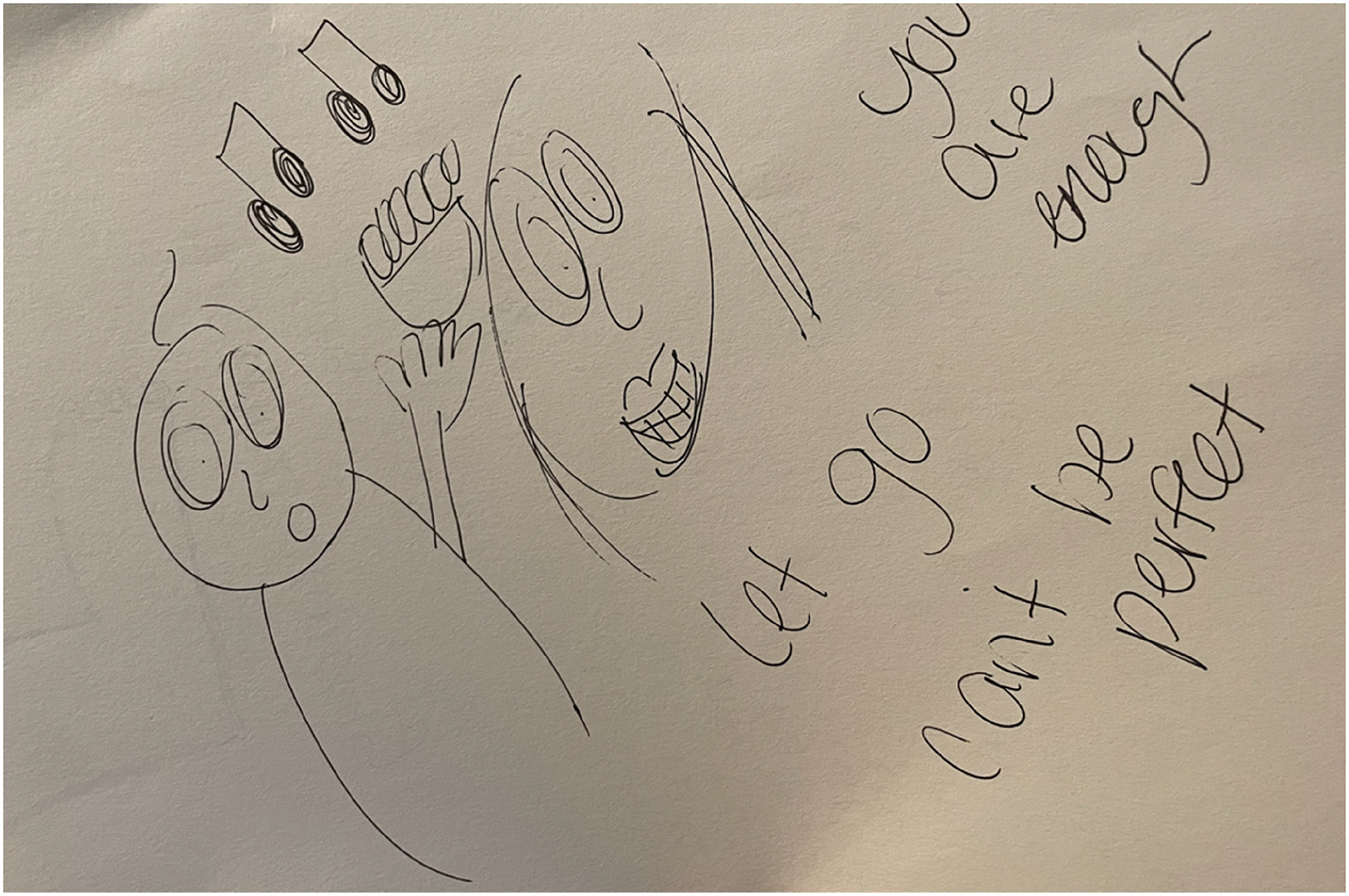
Sample artifact of a coresearcher's experiences.
Footnotes
Declaration of conflicting interests
The authors declared no potential conflicts of interest with respect to the research, authorship, and/or publication of this article.
Funding
The authors received no financial support for the research, authorship, and/or publication of this article.

Appendix A
Step one, two.
Connected with you.
Step three, four.
Couldn’t love you more.
Step five, six.
A kiss on your lips.
Step seven, eight.
So much on my plate.
Step nine, ten.
Taking care of myself again.
Paso uno, dos. (Step one, two).
Oigo tu voz. (I hear your voice).
Paso tres, cuatro. (Step three, four).
En contacto con mi cuerpo. (In touch with my body).
Paso cinco, seis. (Step five, six).
Soy suficiente y alegre. (I am enough and cheerful).
Paso siete, ocho. (Step seven, eight).
La musica me tiene arrugado. (The music has me wrinkled).
Paso nueve, diez. (Step nine, ten).
Y cuando me muevo contigo, me siento en paz. (And when I move with you, I feel at peace).