




Abstract
Studies report that single mothers are at a higher risk for psychological stress than married mothers. This study investigates which risk factors are relevant for the stress of single mothers and how much the maternal stress depends on the number of stressors occurring in combination. For this purpose, multiple regression analyses as well as ANOVAs were calculated using data from 923 single mothers from Germany. Factors influencing single mothers' stress are (1) low parenting self-efficacy beliefs on the part of the mother, (2) at least one child with a disability, (3) low perceived social support, (4) a new partnership, and (5) the age of the youngest child. Cumulation of several stressors causes a significant increase in stress in the domain resulting from the child's behavior and characteristics, i.e. single mothers with several simultaneously occurring stressors experience many times more stress especially in this domain than those who are affected by only one stressor. Our findings suggest that it is not sufficient to focus interventions on the relative disadvantages of single mothers, but that the combined occurrence of different stressors and their cumulative effect should be focused on in prevention and intervention.
Stress of Single Mothers
The proportion of single-parent families in Germany is growing steadily (Struffolino & Bernardi, 2017). Not only in Germany, but in at least 45 different countries, about one in five families on average is a single-parent household (Maldonando, 2018). In 2020 there are more than two and a half million single parents in Germany, around 83% of whom are mothers (Statistisches Bundesamt [Federal Statistical Office], 2021). This proportion is consistent with most other countries in Europe (Council of Europe, 2021). Numerous studies show that single mothers are at a higher risk of physical and, above all, psychological problems than married mothers (e.g. Franz & Lensche, 2003; Wang, 2004). They rate their health as poor or very poor almost twice as often as mothers in couple families (Sperlich et al., 2011).
Special stress for single parents often arises from a critical economic situation, little social support and the increased demands arising from the child's sole care and upbringing (Dor, 2021). For example, 35% of single parents report problems with their children, but only 25% of parents living in couple families. Also, single parents more often fear that they have too little time for their children and their education (Heimer et al., 2009).
Risk factors and limited resources can help to explain the higher stress on single mothers. One of these risk factors is childhood behavioral problems, more specifically, chronic diseases or disabilities of the child, which often place considerable demands on the parents (e.g. Hatzmann et al., 2013; McCann et al., 2012). Tröster's findings (2011) confirm the connection between the child's behavioral problems and parental stress. The increased need for support resulting from the impairment, in combination with limited resources, represents a permanent challenge to education (Sarimski, 2010). It can be assumed that single mothers in particular find it difficult to cope with the demands arising from the child's impairment, as these cannot be divided between two parents or dealt with together. Thus, the single mother is on her own regarding care and support needs of her child. In addition to childhood behavioral problems, the number and age of the children can also be significant for maternal stress. The higher the number of children to take care of and the younger their age, the higher the perceived parenting stress (Skreden et al., 2012).
The economic situation is also particularly problematic for single mothers, as they are more often unemployed or less likely to work full-time and have no other source of income from a partner (Porterfield, 2002). Single parents feel stressed by the need to combine work and family life and the associated demands, such as the organization of childcare (Dor, 2021). Characteristics such as low educational attainment, which is often found among young mothers, usually imply higher economic pressure, which is considered to be hazardous to health (Dahlgren & Whitehead, 1991).
Stress can be especially high immediately after becoming a single parent when there is a parallel separation to be dealt with (Tavares & Aassve, 2013). The situation after a separation or divorce is usually very difficult for parents. In two thirds of the cases both parents still have contact with each other after the separation, but only a quarter of the respondents describe their relationship as friendly (Schneider et al., 2001). Protracted conflicts with the ex-partner, such as legal custody disputes, can be exhausting for single mothers.
It is not only risk factors that can place stress on single mothers, but also their limited resources. Social support makes it easier to cope with the demands of parenting (e.g. Tröster, 2011), which is why it should be seen as an important resource for single parents. The confidence that one can cope better with the increased demands if one can count on the support of social contacts can buffer stress (Cohen & Wills, 1985).
Stress occurs when a self-evaluation suggests that one does not have the necessary skills to cope with the demands. Those mothers who are convinced that their educational measures are effective feel less stressed (Tröster, 2011). Parental self-efficacy convictions are convictions that parents stand up to the tasks involved in raising a child (Ardelt & Eccles, 2001). Studies show that low self-efficacy beliefs increase the perceived child-rearing stress of single mothers (Jackson & Huang, 2000).
Single parents often experience a new couple relationship as a way out of their deprived life situation. The new partner can be supportive on an economic and everyday practical level as well as on an emotional level. It also has a positive effect on the well-being of the single mother (Hetherington & Kelly, 2002) and is therefore seen as a resource. It could therefore be assumed that single parents find many things easier with a new partner, as they receive support and are no longer on their own. However, the results of some studies also show the opposite, because many single parents also see the single parenthood as an advantage, e.g. in their freedom of choice or because of the elimination of partnership conflicts or because it requires additional energy to establish and maintain a new relationship (Schneider et al., 2001).
This study examines which factors contribute to the stress on single mothers and how they interact with each other. It is assumed that single mothers are able to compensate the impact of a single risk factor with their resources, but the demands associated with each additional risk factor are perceived as considerably more stressful. This assumption is based on numerous studies in which stress have proven to be cumulatively amplifying (e.g. Lösel & Bender, 2003). The risk factors should therefore not be examined independently of one another, but in combination to check whether they reinforce one another (Amato, 1993).
Method
Sample
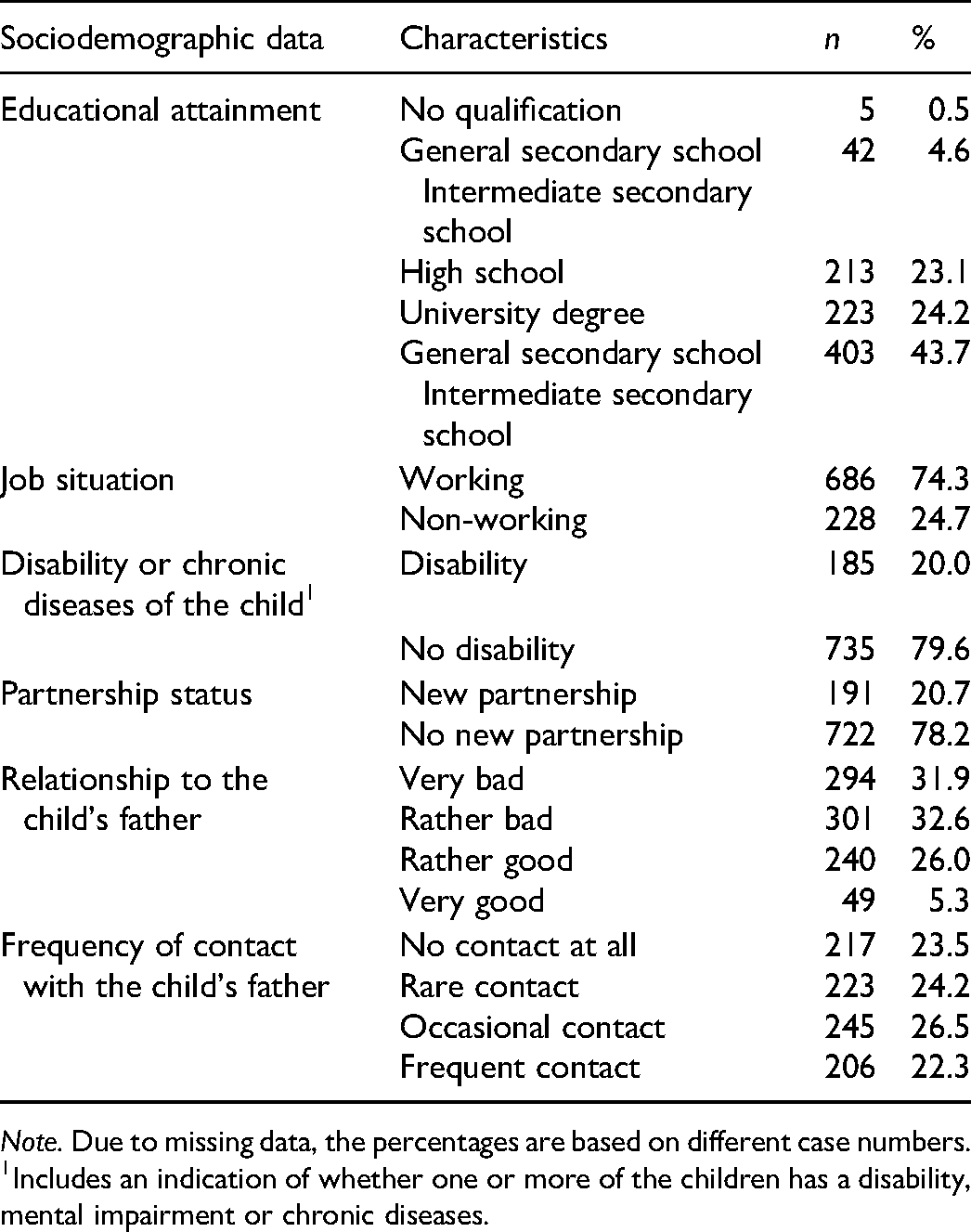
Data was collected prior to the COVID-19 pandemic. Participants were informed prior to their participation that the data would be collected anonymously and used for research purposes only. The study involved 923 single mothers aged 18 to 60 years (M = 38.37, SD = 7.05) from all over Germany. Single mothers were defined as a mother living alone in a household without a partner with at least one child under the age of 18. The mothers had been single mothers for an average of 5.39 years (SD = 3.96 years) and had a mean of one to two children (M = 1.54 children, SD = .80 children). Among these, the youngest of their children was under one year to 18 years old (M = 6.53 years, SD = 4.25 years). Table 1 shows more sociodemographic details of the single mothers as well as the frequencies and percentages.
Sociodemographic Data of n = 923 Single Mothers.
Note. Due to missing data, the percentages are based on different case numbers.
Includes an indication of whether one or more of the children has a disability, mental impairment or chronic diseases.
Implementation of the Study
The data collection was carried out over a period of six weeks by means of an online questionnaire, which, in addition to socio-demographic data, recorded the stress and resources of single mothers. Recruitment took place via the nationwide locations of an association for single parents in Germany and via groups on social networks whose members were exclusively single parents.
Survey Instruments
The Parenting Stress Inventory (“Eltern-Belastungs-Inventar“; EBI; Tröster, 2011) was used to assess the stress of single mothers. In many studies, this has proven to be a multidimensional screening method for recording parental stress (e.g. Irlbauer-Müller et al., 2017; Sarimski, 2017). The EBI is based on Abidin's Parenting Stress Model (1995) and consists of 12 subscales, each with four items assigned to either the child domain or the parent domain (see Table 2). The EBI child domain records the stress resulting from the characteristics and behavior of the child. Five subscales record, for example, the exposure of the parents to unpredictable mood swings of their child (subscale: mood) or to the demands of caring for and looking after the child (subscale: demandingness). The EBI parent domain is used to measure aspects of stress resulting from the demands of the parental role. Its seven subscales record, among other things, the stress resulting from the difficulty of maintaining contacts outside the family (subscale: social isolation) or doubts about parental competence (subscale: parental competence). The 48 items in total are answered on a five-level Likert scale (“does not apply at all” to “applies exactly”). In our study, the subscale partner relationship was excluded for the group of single mothers because of the content of the items that did not fit the needs of the group. The overall EBI value showed a high reliability of Cronbach's alpha α = .93, the child range α = .91 and the parent range α = .89.
The Child and Parent Domain Subscales of the EBI (Tröster, 2011).
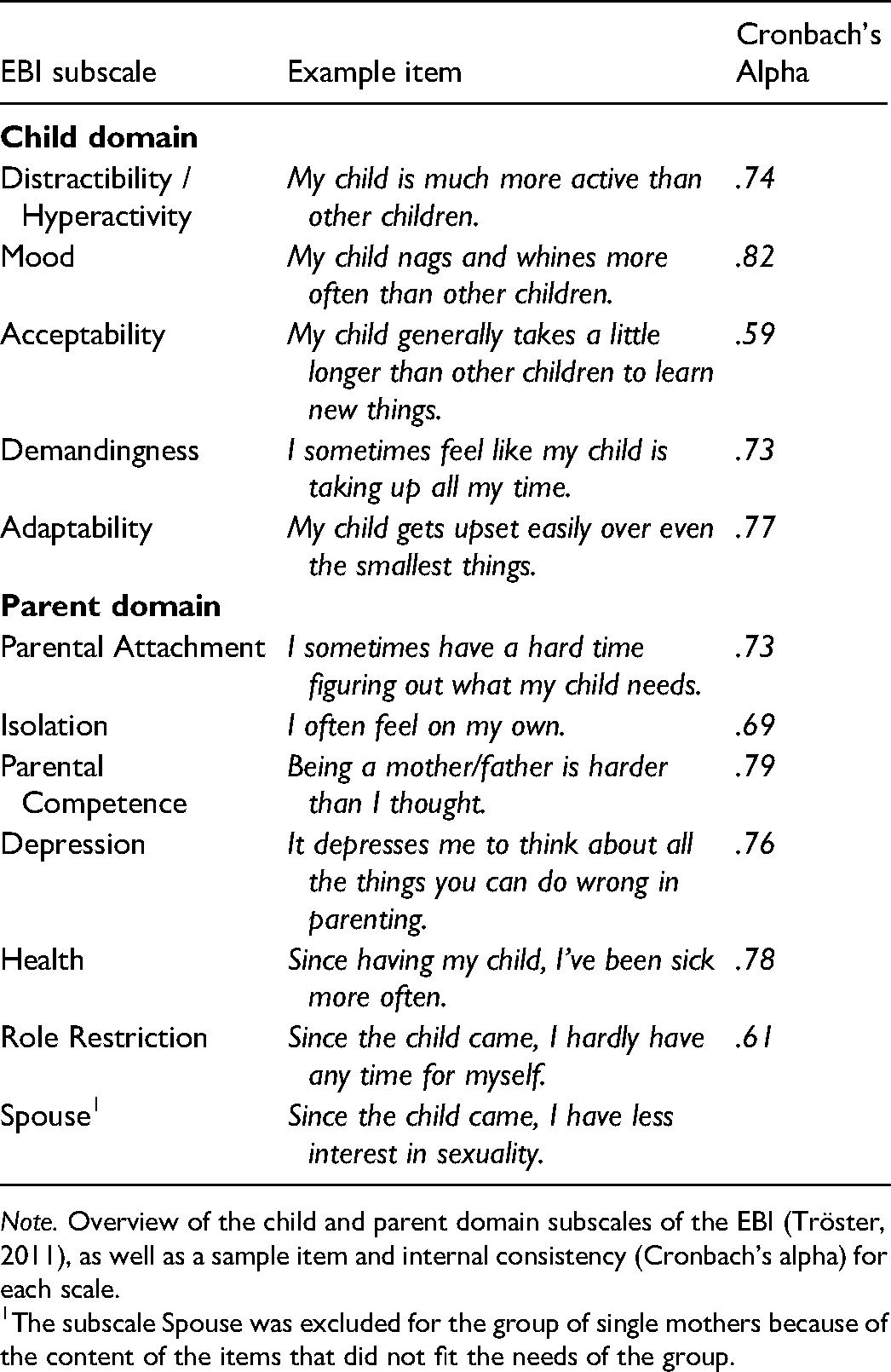
Note. Overview of the child and parent domain subscales of the EBI (Tröster, 2011), as well as a sample item and internal consistency (Cronbach's alpha) for each scale.
The subscale Spouse was excluded for the group of single mothers because of the content of the items that did not fit the needs of the group.
The Parents' Sense of Competence Questionnaire (FKE; Miller, 2001) was used to assess single mothers' parenting self-efficacy beliefs, which encompass confidence in the effectiveness of their own parenting actions (7 items; sample item: “I firmly believe that I have all the skills necessary to be a good mother to my child”). The response format of the scale was reduced to four gradations from “strongly disagree” to “strongly agree” and reversed. The internal consistency of the FKE was α = .77.
The short form of the Social Support Questionnaire (F-SozU; Fydrich et al., 2007) was used to record perceived social support, which uses 14 items to determine emotional, practical, and social support. A sample item is “I can easily find someone to take care of my apartment when I am not there”. The statements were answered with a five-point response scale (“strongly disagree” to “strongly agree”). The scale had a particularly good internal consistency of α = .95.
Statistical Analysis
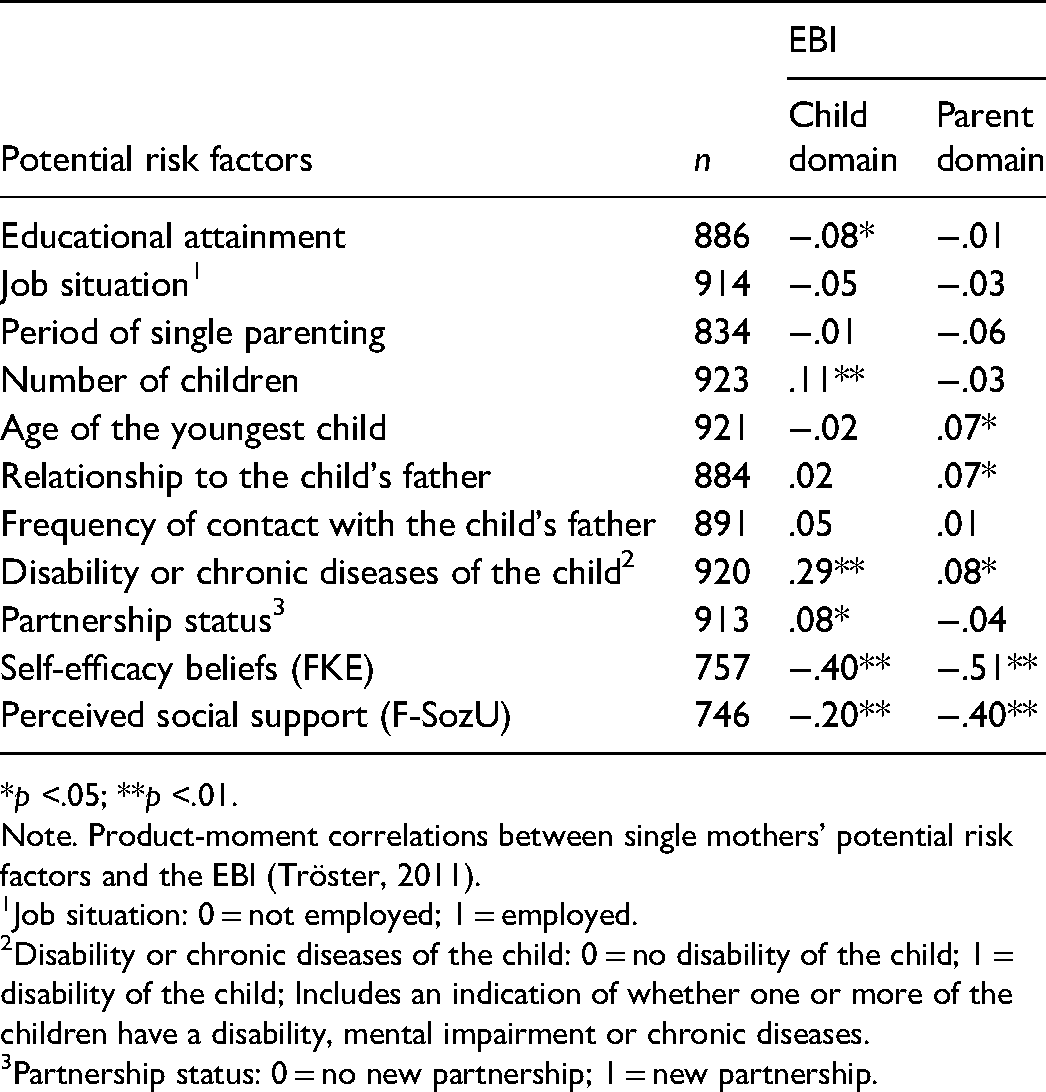
Associations between the potential risk factors (see Table 3) and the stress on single mothers were tested using bivariate correlations and multiple linear regressions. Subsequently, those risk factors that were found to be significant for the stress of the mothers based on the results of the exploratory data analysis (stressors) were tested with single factor analyses of variance in combination with each other. Stressors entered as the independent variable and maternal stress entered as the dependent variable. Raw values were used in the analyses, the significance level being α = .05. Sample size discrepancies were due to individual missing values.
Correlations of Parental Stress with Potential Risk Factors of Single Mothers.
*p <.05; **p <.01.
Note. Product-moment correlations between single mothers’ potential risk factors and the EBI (Tröster, 2011).
Job situation: 0 = not employed; 1 = employed.
Disability or chronic diseases of the child: 0 = no disability of the child; 1 = disability of the child; Includes an indication of whether one or more of the children have a disability, mental impairment or chronic diseases.
Partnership status: 0 = no new partnership; 1 = new partnership.
Results
Correlations
The strongest correlations with the EBI child domain were found with the mother's self-efficacy beliefs (r (757) = -.40; p <.01), the child's disability, mental impairment, or chronic diseases (r (920) = .29; p <.01), and the mother's perceived social support (r (746) = -.20; p <.01) (see Table 3). Stress arising from the demands associated with the parenting role (EBI parent domain) also correlated most strongly with parenting self-efficacy beliefs (r (757) = -.51; p <.01) and the mother's perceived social support (r (746) = -.40; p <.01). The remaining potential risk factors showed small (r = .07 to r = .11; p <.05) or no significant associations with maternal stress (r = .00 to r = .06; p >.05).
Risk Factors of Stress on Single Mothers
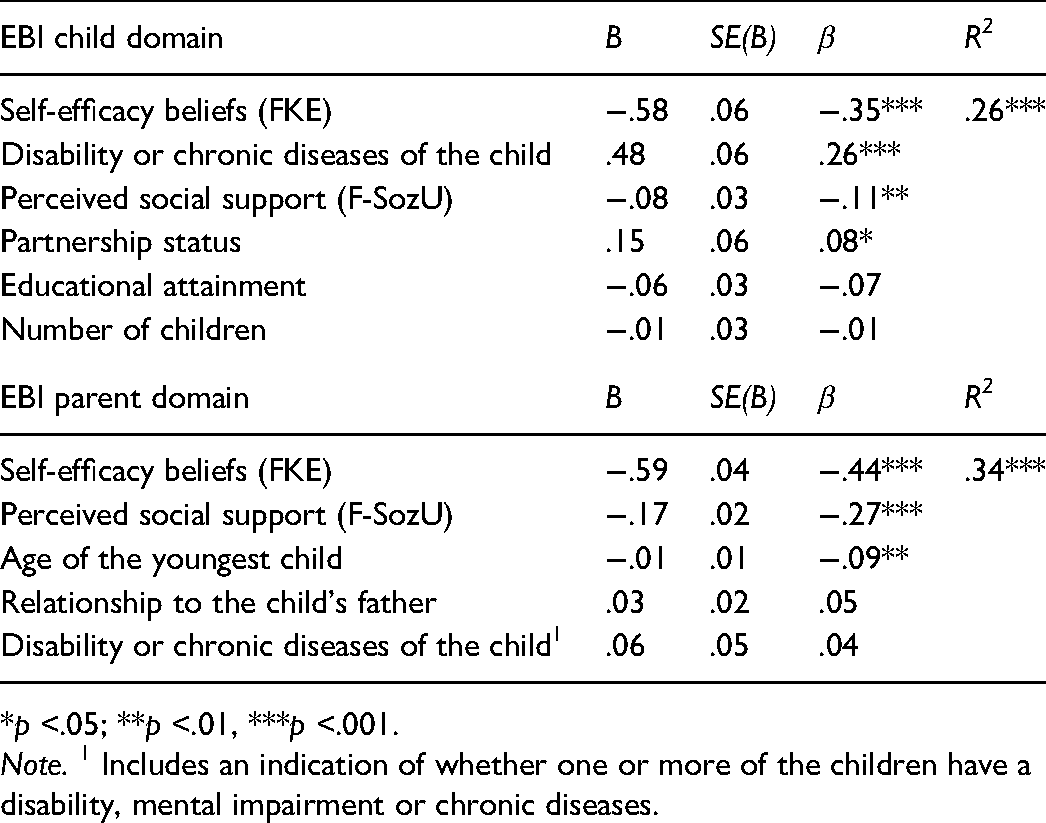
To identify those risk factors that significantly affect stress on single mothers, the potential risk factors that were found to be significant in the correlation analysis were tested in multiple regression analyses (see Table 4). According to Cohen (1992), the risk factors show a strong effect in the EBI child domain (F(6,709) = 41.450, p <.001, f2 = .35) with a variance resolution of about 26% and a strong effect in the EBI parent domain (F(5,715) = 73.796, p <.001, f2 = .51) with around 34%. The predictors of the two models independently contribute to the prediction of single mothers' stress. The variables that correlated the highest with maternal stress also show the highest influence. In the child domain, the two most significant predictors are maternal self-efficacy beliefs (β = -.35, p <.001) and having one or more children with a disability or chronic disease (β = .26, p <.001). In the parent domain, self-efficacy beliefs (β = -.44, p <.001) and social support (β = -.27, p <.001) show the highest influence. In this composition, for the child domain, the number of children does not contribute to the resolution of stress (β = -.01, p = .850). In the parent domain, the relationship with the child's father (β = .05, p = .102) and a child's impairment or chronic disease (β = .04, p = .214) are shown not to be significant.
Results of Multiple Regression Analysis of Potential Risk Factors and Stress among Single Mothers.
*p <.05; **p <.01, ***p <.001.
Note. 1 Includes an indication of whether one or more of the children have a disability, mental impairment or chronic diseases.
Cumulation of Stressors
In a next step, it was examined whether single mothers can be differentiated by their stress level on the basis of the number of their stressors. For this purpose, extreme groups were defined for all significant risk factors (referred to as “stressors” in what follows). For nominally scaled variables, it was defined whether a risk expression was present or not. For the remaining variables, extreme groups were formed (see definition further below). The stressors were summed up for each of the single mothers. If there were zero stressors, none of the factors had a risk expression; if, for example, there were two stressors, two factors had a risk expression. For the risk factor self-efficacy beliefs, the lower third of the study sample (percentile 33.3 of the FKE scale; n = 209) was used, which had the lowest self-efficacy beliefs. The same approach was used for perceived social support (percentile 33.3 of the F-SozU scale; n = 248). The risk expression of the child disability factor included mothers' agreement that one or more of their children had a disability, mental impairment, or chronic diseases (n = 185). For the partnership status of single mothers, the status of a new partnership shows the risk expression (n = 191). For the factor of highest educational attainment, all expressions except high school diploma and university degree were considered risk expressions (n = 595). The threshold for the risk expression regarding the factor age of the youngest child was defined as younger than 6 years old in order to be included as a stressor in the model (n = 454).
In the EBI child domain, a total of six groups (0 to 5 existing stressors) were formed from the risk expressions of the five significant risk factors. Here, the groups with four and five stressors had a very small sample size (three stressors: n = 74, four stressors: n = 13, five stressors: n = 6), so the groups were combined and defined as “three or more stressors”. In the EBI-parent area, a total of four groups were formed from the three significant risk factors (0 to 3 existing stressors).
Due to heterogeneous variances, Welch's test was used for both domains of the EBI. The number of stressors present shows a significant effect on single mothers' stress in the EBI child domain (F(3,919) = 48.363, p <.001, n2 = .136, n = 922). The more stressors mothers show, the more significantly stressed they feel with regard to the child domain, being that domain indicating the stress that results from the child's characteristics and behavior. According to Cohen (1988), the effect size in the EBI child domain corresponds to a strong effect (f = .40). Post-hoc tests with Scheffé correction revealed differences in all groups (see Figure 1). The effect in the EBI parent domain proved to be strong (F(3,919) = 48.600, p <.001, n2 = 137, n = 922, f = .40). The group with two stressors (M = 3.75, SD = .51) and the group with three stressors (M = 3.75, SD = .51) did not differ significantly from each other (p = .235). Note the small sample size of the group of mothers exposed to three stressors (n = 42). Group comparisons between the groups with no stressor and one stressor as well as one stressor and two stressors showed significant differences (see Figure 2).
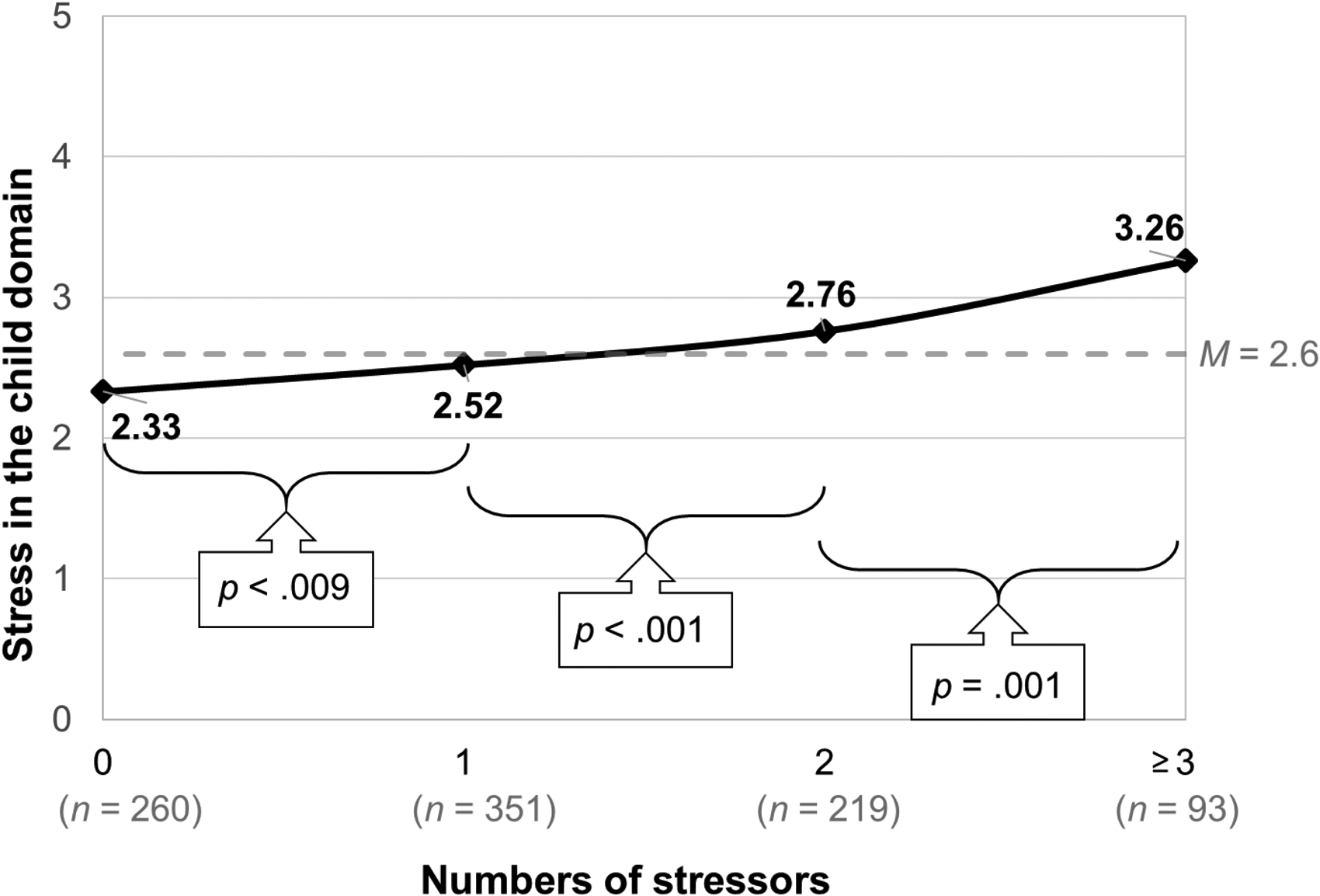
Mean values of stress in the child domain of the EBI (Tröster, 2011) of the four groups of single mothers with no stressors to three or more stressors.
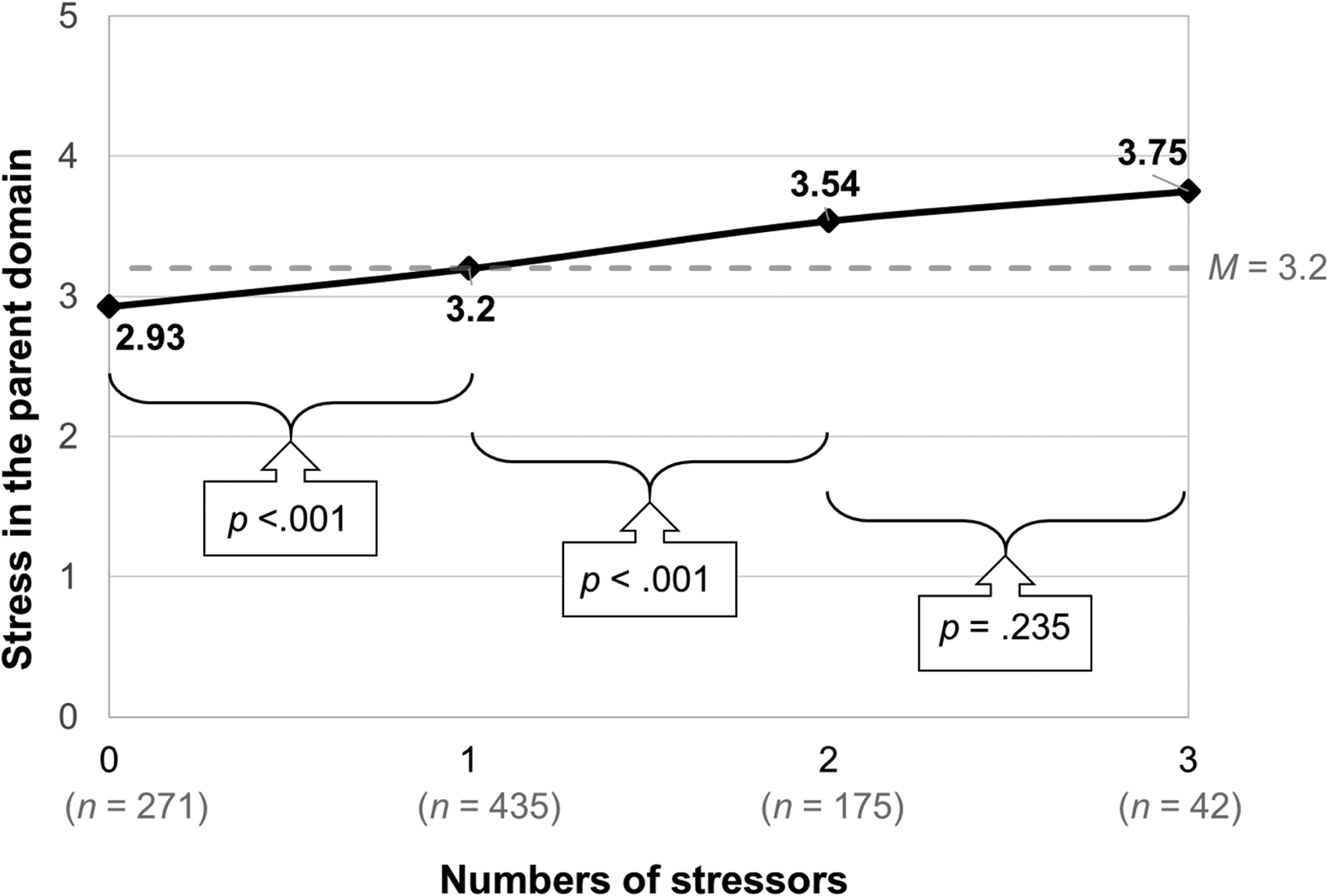
Mean values of stress in the parent domain of the EBI (Tröster, 2011) of the four groups of single mothers with no stressors to three stressors.
Discussion
The relation of various risk factors on the stress of single mothers could be confirmed in agreement with the hypotheses especially in the EBI child domain, that is, the stress domain resulting from the child's behavior and characteristics. From the accumulation of several stressors, a single mother seems to be highly stressed. This could not be confirmed in the EBI parent domain due to the fact that there was no statistical difference in the stress of mothers with two or three stressors. However, it should be noted that the sample size of mothers with three simultaneously occurring stressors is very small, which is why the results should be interpreted with caution. In the EBI child domain, the risk factor of at least one of the children having an impairment was identified as a main stressor. Low self-efficacy beliefs and low perceived social support were found to be stressors in both EBI stress domains. So, it can be seen that in addition to sociodemographic parameters, it is mainly the psychological variables that have an impact on the stress of single mothers. Yet these two constructs should not only be seen as stressors if they are not pronounced or only weakly pronounced, but should especially be considered as resources if they are strongly manifested. Through strengthened resources, the development of stress can be prevented or at least reduced. For example, perceived strong social support shows that stress can be buffered because you know you will have support if you ever need it (Cohen & Wills, 1985).
Based on findings on the cumulation of stressors (e.g., Amato, 1993; Lösel & Bender, 2003; Rattay et al., 2017), the assumption was tested whether the stress of single mothers increases significantly with each additional cumulative stressor. This was only confirmed in the EBI child domain. The single mothers with co-occurring stressors perceive a stress level that is many times higher. It can be assumed that with only one stressor the single mothers cope with the demands by help of their resources, which seems to become more difficult with each additional stressor, so that the perceived stress level increases. This finding confirms the assumptions that the combination of multiple stressors needs to be focused on as they are cumulatively reinforcing (e. g. Amato, 1993). In the future, it should be examined whether the cumulation of stressors is similarly strong among mothers in couple families or whether this phenomenon is particularly prevalent among single mothers.
It must be considered that no causal effect statements can be made from our results, since no information exists about the mother's stress before she became a single parent. It can be confirmed that single mothers feel a great deal of stress, but it is not clear whether this fact results from single parenthood. In order to further contextualize the stress of single mothers, the stressors should have been compared with mothers in couple families as well as with single women without children. Studies indicate that the stress of single mothers does not primarily result from the stress as a mother, but as a single woman, i.e., from the lack of a partnership (Pollmann-Schult, 2018). In addition, it must be pointed out that especially mothers experiencing stress participated in the survey, as they are presumably more interested in the topic. Due to data recruitment, the probability of bias is given because the survey was sent to associations, networks and self-help groups for single mothers, which were presumably rather joined by single parents who felt stressed. Mothers with low levels of stress may be underrepresented as a result.
With regard to the methodology, it is critical to note that the limits of when a potential risk factor can be evaluated as a stressor, i.e., at what value a risk expression is present, are controversial. For example, the limit set for the age of the youngest child is open to debate. Here, it was decided to set the limit to school entry age (6 years). Further, the results are limited in interpretation because no third variable influences, such as through moderation or mediation effects, were included in the calculations. In future research, possible third variable influences should be examined to be able to discuss the actual effect of the stressors in more detail.
Conclusion
The findings suggest that the perspective on single mothers needs to be broadened in order to support them as best as possible in their phase of life. The heavy stress results from the cumulation of the various stressors to which single mothers are presumably more exposed than other mothers, which is why holistic interventions are needed which take this interplay of stressors into account. Current studies should examine both the short- and long-term effects of the COVID-19 pandemic on single mothers. It can be assumed that single mothers with cumulative stressors in particular experienced especially high demands during the lockdowns, and that new stressors emerged.
Footnotes
Acknowledgments
We would like to thank all the single parents who participated in our study. Likewise, we express our gratitude to the contact persons of the many associations and social networking groups for their support.
Declarations of Interest
There are no conflicts of interest for any of the authors.
Declaration of Conflicting Interests
The author(s) declared no potential conflicts of interest with respect to the research, authorship, and/or publication of this article.
Funding
The author(s) received no financial support for the research, authorship, and/or publication of this article.
