



Abstract
Prevalence rates of infertility show that one in every six couples worldwide have experienced fertility problems; however, there is still a relatively high chance of spontaneous conception for couples with unexplained infertility. Nevertheless, most existing research has focused on the infertility experience leading up to potential parenthood, rather than the actual parenting experience itself. Hence, this paper presents an in-depth exploration of the lived experiences and personal meaning of becoming parents of individuals affected by unexplained infertility. Semi-structured interviews were conducted, and transcripts were subjected to Interpretative Phenomenological Analysis (IPA). Four themes emerged: perception of fragility of life, father's embodied emotional connection with child, becoming a parent—identity shift, and imprint of infertility on relationships with a partner. The findings emphasize clinicians’ and researchers’ awareness of the need to process couple's grief and highlight the importance of addressing romantic relationship issues, experienced during the infertility period to facilitate couples transitioning to parenthood.
Introduction
Parenthood is often seen to be a significant part of an individual's lifespan. Unfortunately, infertility affects a significant proportion of individuals; according to the World Health Organization (2019), one in every six couples has experienced fertility problems. Guidelines from the National Institute of Health and Care Excellence in the UK (2013) defines infertility as a disorder of the reproductive system, which is characterized by a failure to conceive after more than 1 year of unprotected sexual intercourse (World Health Organization, 2019).
It is well documented that couples navigating the journey of infertility have to cope with many losses; they face numbers of failed infertility treatments, recurrent miscarriages, the deprivation of opportunity to become parents or experience pregnancy emerge, the intimacy with a partner is impaired, the meaning of the life becomes unsteady, the lack of understanding of an infertile person's suffering is also present. Moreover, infertile individuals experience feelings of self-loathing, sadness, guilt, anger, inadequacy, and doubt about their femininity or masculinity (Benasutti, 2003; Covington & Burns, 2006; Daniluk, 2001; Glover et al., 2009; Hanna & Gough, 2016; Unruh & McGrath, 1985; Watkins & Baldo, 2004). Infertile women also tend to feel alienated from other women and express feelings of a lack of a maternal self or exposure of an inauthentic gendered self (Loftus & Andriot, 2012).
In spite of improvements in diagnostic assessments, many couples still have no explanation for their infertility. Unexplained infertility (the failure to conceive in the absence of a specific medical cause) has an incident rate of 15%–30% in all infertile couples (Practice Committee of the American Society for Reproductive Medicine, 2006). The level of distress is slightly higher among couples with unexplained infertility than among couples with a definitive cause for infertility (De Berardis et al., 2014). Furthermore, although there is still a relatively high chance of spontaneous conception for couples with unexplained infertility (Sadeghi, 2015; Troude et al., 2012; Van Dongen et al., 2010), and despite not knowing the exact cause of the infertility, these couples often undergo expensive and emotionally challenging medical treatments, including intrauterine insemination (IUI; Hughes et al., 2010) and/or in vitro fertilization (IVF; Pandian et al., 2015). These treatments usually involve risks, such as miscarriage, premature birth, low birth weight (Qin et al., 2017), gestational diabetes mellitus, pregnancy-induced hypertension, and placenta previa (Bernsten et al., 2019). In summary, couples with unexplained infertility experience many of the same physical, financial, and emotional challenges as those couples with known causes of infertility, but they may experience additional challenges because, not knowing the cause of their infertility, they do not have confidence that the treatments will be successful.
Most existing research has focused on the infertility experience leading up to potential parenthood, rather than the actual parenting experience itself. Until recently, most empirical post-infertility parenting studies revealed, that past infertility may be associated with increased anxiety about pregnancy loss; delayed mother–child attachment; declined self-confidence as a mother, idealized expectations for parenthood or tendencies for overprotective parenting (Bernsten et al., 2019; Hammarberg et al., 2008; Huang et al., 2019; Lin et al., 2013; Smorti & Smorti, 2012). However, post-infertility parenting studies are still emerging, inconclusive and contradictory. Previous research also predominantly used quantitative research design and focused on parenting after assisted conception (Hammarberg et al., 2008).
In brief, infertility is usually endured as a major life crisis with inevitably distressing experiences, which offers an individual the opportunity for either psychological growth and resilience or may lead to negative behaviors that hinder recovery or may cause more harm. In addition, the context of prior unexplained infertility experience, which usually causes even higher distress among couples, may account as a special path of transition to parenthood and requires exploration of it. Thus, the purpose of this study was to examine the lived experiences and personal meaning of becoming parents of individuals affected by unexplained infertility.
Method
Participants
To better understand the lived experience of unexplained infertility, six participants for whom the research question was meaningful, were selected to form a homogeneous and purposive sample. This is a normative sample size for Interpretative Phenomenological Analysis (IPA), an approach that allows for a detailed analysis of each case. There is not necessarily a correct number of participants for a qualitative study; with IPA, but sample sizes are usually small (Smith et al., 2009). IPA's ideographic research approach aims to recruit a group of participants that represents the study's perspective, rather than the study's population (Larkin & Thompson, 2012).
Participants were selected according to the following criteria: (a) the participants were members of infertile couples who had experienced difficulty conceiving a child for at least 2 years with no definitive medical cause for infertility, (b) all pregnancies were conceived spontaneously with no medical-assisted reproductive treatments, and (c) the infertility was of primary form. Due to difficulties with the selection process, the inclusion criteria was expanded to include participants with a wider range of time spent trying to conceive, and with a wider range of their children's ages at the time of the study than initially expected.
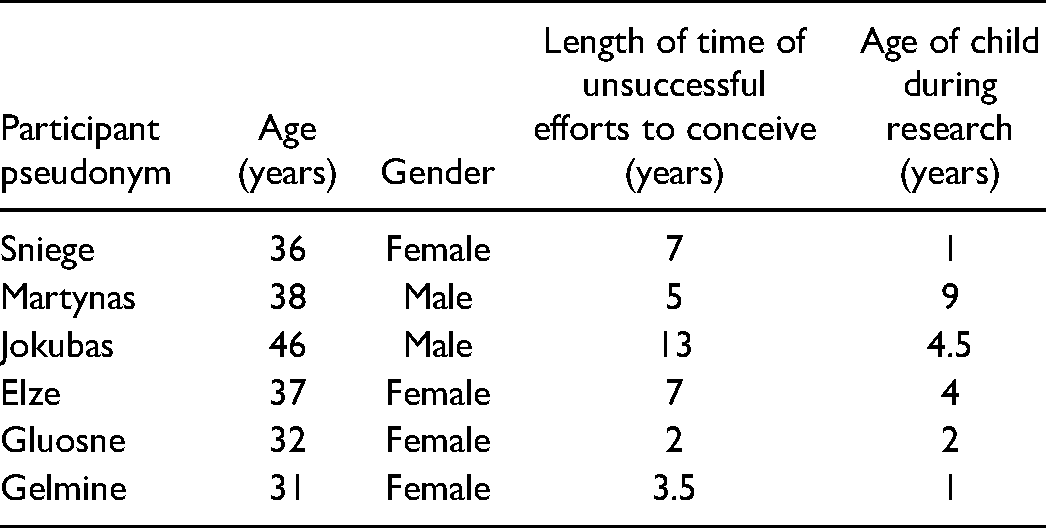
Participants were contacted through notices placed in various online support groups for infertile couples. The snowball principle was also used. Names have been changed to protect confidentiality. The ages of participants, the length of time spent trying to conceive, and the ages of participants’ children during the study are listed in Table 1.
Characteristics of Study Participants.
Procedure
After providing written consent, participants took part in audiotaped, semi-structured interviews. To better understand the lived experience of participants with unexplained infertility, we asked participants to talk about their experiences while trying to conceive, after they conceived, and when they became a parent. Participants were encouraged to talk in detail about their concerns and were probed by the interviewer on important individual topics that arose during the interviews. Each interview lasted approximately 60–90 min. All participants were interviewed by the main researcher on the premises, which guaranteed confidentiality. The study was conducted in the participant's own home, at their place of work or in the researcher's office. Psychological help for each participant was available after the interview if needed. The study followed the principles of the Declaration of Helsinki.
Data Analysis
To analyze the collected data, we used IPA, a qualitative research approach that aims to gain insight into how people make sense of their major life experiences (Smith et al., 2009). First, the qualitative interview data were transcribed verbatim and in-depth analysis of each participant, case by case, took place. While rereading the transcript, the researcher free coded—which includes writing down initial ideas for potentials themes, metaphors, associations, and so forth. Later, the researcher engaged in line-by-line analysis—phenomenological coding—of participants’ experiences and understandings to identify core concerns (important events, relationships, etc.). Identification of emerging themes did not occur until after this step was completed. During this phase, the researcher was able to interpret the data and generate more abstract categories. Following this, connections and patterns across individual cases were identified, and a table of superordinate themes with sub-themes particular to each individual was constructed. Only after all six cases were completed, analysis considered, were the convergences and divergences across cases and a master table of meta-themes, highlighting unexplained infertility experiences made. The first author took the lead, but the second researcher reviewed and audited the themes to ensure that they were grounded and well represented.
Because the researcher takes a leading role in all stages of the qualitative research process (Eatough & Smith, 2008), the researcher must assure self-reflexivity through all stages of the research process. Addressing the researcher's subjectivity and understanding their positions, attitudes, and knowledge can enhance the quality of the research (Smith et al., 2009). The main researcher in this study acknowledged the inevitability of her own biases and assumptions and reflected in her personal diary on how they shaped the research process.
Results
When analyzing the data, four superordinate themes emerged from the participants’ lived experiences (Table 2). All the themes are supported by quotes from at least three participants in this study (except the second superordinate theme), but due to space limitations only key quotes will be presented in the following paragraphs.
Summary and Prevalence of Themes.

Perception of Fragility of Life
Participants shared that they experienced difficulties adjusting to their new roles as parents. Pregnancy, and even early parenthood, was a time of uncertainty and uneasiness that included fear of the loss of the child.
Martynas described early pregnancy as a period of anxiety and trepidation. For him and his wife, not letting others know about the pregnancy acted as a buffer from the possibility of loss: We both were trembling through it all, as nobody knew, because we were trying to protect ourselves in case it didn't go well.
For Martynas, the unified infertility experience overwhelmed him with accountability to protect his wife from any frustration during their efforts to conceive, while also evoking a sense of hopelessness. And it seems that during pregnancy, he still did not feel capable of protecting his wife completely as he could not control the situation as well. Keeping pregnancy as a secret emerged as the only protection he could offer for his partner and himself.
Gluosne had difficulty accepting the fact that she was pregnant after learning that she had conceived. There appeared to exist difficulties to integrate a new role of mother into her identity. Her narrative revealed her fragile state during her psychological preparation for mothering: I did a pregnancy test four times. All of them showed positive, but I still thought it couldn't be right, and I was unable to feel happy. I was only sure when we saw that little dot during our doctor appointment.
Gelmine reported that she kept a medication that was prescribed for an assisted reproduction procedure for a long time, even after childbirth. Her memory emphasizes the difficulties she experienced transitioning to her new role as a mother: I bought the medicine [for an assisted reproduction procedure], but I kept it in my wallet until Nojus was probably nine months old, until it seems you finally realise that this is your child and that this journey has finally ended, and you won't need it anymore.
The world that Gelmine lived in even after she conceived, was no longer safe, as the experience of all the losses of infertility has violated her sense of security. Especially if her life had no secure ground upon which to build an awaited life of being a mother.
Father's Embodied Emotional Connection with Child
Male participants also described having an embodied strong tie of intimacy with their child during the pregnancy and after becoming a parent. The intimate bond in the parent–child relationship at the same time was, both strong and fragile. Jokubas described feeling so much love for his daughter that it caused a sense of physical pain: Love until it hurts. This sensation is somewhere in the solar plexus. You experience a physical sensation. … There's a huge desire that she is going to experience only the best things … and there is also a painful moment … how awful will it be if something was to happen to her.
Martynas’ connection with his daughter during his wife's pregnancy was deeply important to him. Physical touching acted as nonverbal exchanges in growing the parent–child relationship. The feeling of being the father to a child contained deep emotional reactions, an indescribable emotional feeling. The father was emotionally bonded to his child in a more nonreflective way. Martynas encouraged a physical interaction with his unborn child to achieve a feeling of closeness. His narrative captures the physical interplay with his daughter, which reveals the psychological bond that was developing between them: I’m scratching the back of a baby [in utero], and then out of curiosity I started scratching a few centimeters away, and she turned over there in order for me to reach her. … There was some kind of waiting and even involvement before her being born. … I always felt there was a special connection between us.
Becoming a Parent—Identity Shift
Participants also stated that becoming first-time parents was a transformative experience, marked by shifts in their self-identification and in their priorities in their lives and daily routines. Elze's perception of herself during her efforts to conceive was shattered. She described a sense of profound loss of her original self, and that it was replaced with a new, less-desirable self. She also felt that she could not completely fulfill her gender role, experienced feelings of self-loathing, anger, and worthlessness. Elze's narrative below encapsulates the essence of her connection with her child and reveals a transformation of her self-concept: a shift from a “damaged childless self” to a new “complete mother self”: [My baby] looked straight into my eyes, and we were just looking at each other and [crying]. … Our eye contact was so deep—she was like a grown-up, like an eternity; everything was so supernatural, unreal. She was safe, she was with us, she was finally born, and we were together after such a long journey. … Indeed we had traveled, and she did as well. … I died and felt like I was reborn; she was finally born, and so was I [crying].
For Martynas, meeting his daughter for the first time was a deeply meaningful experience: That moment, you know, when you see the child and you understand that she is yours. Other newborns are ugly and red [laughing], but there's no such thing of course. It's a beautiful moment; you understand that she is yours … wow.
Jokubas described that his life had new meaning after his daughter's birth. The world that Jokubas used to live in, had other reasons for his part in it before the childbirth. His daughter's birth caused Jokubas to instill in him a new self-concept: You receive a huge gift. Finally, you don't have to struggle with answering a question that keeps you on edge—what's the most important thing in your life? … It opens you up, you let go of many pseudo-projects; they may be cool, good, but you can't even compare them to the worth of a new life.
Imprint of Infertility on Relationships with a Partner
Participants expressed that the experience of infertility affected their relationships with a romantic partner even after a childbirth, as discussed in the paragraphs that follow.
One participant, Martynas, felt that the psychological scars from the couple's experience with infertility remained even after the birth of their child. Managing with emerging issues related to their prior infertility was, to Martynas, an additional task that required conscious effort. The relationship issues also emerged after they conceived a child: All these wounds, that sinking feeling, you know, it builds up, and later, when you don't expect it, it hits you from time to time, and then you’re going to therapy [laughing]. … All these periods, it hurts while trying to conceive, certainly, and even later it still knocks you out.
Jokubas described how the lack of intimacy in his marriage affected his relationship with his partner during the transition to parenthood. After the couple had conceived, Jokubas felt lonely and left out as a romantic partner. It seems that prior infertility experience has changed couple's relationship dynamic, causing the decreasing emotional bond in his marital life. His narrative powerfully expresses his experience of lost intimacy with his wife: A woman puts her hand on my shoulder, and I am falling in love with her, and I understand what is going on—my wife is gone for half of the year. Everything is fine, but you feel so free, and due to the fact that a child gets all her attention … there is no such touch of the shoulder from her. … We were happy together around the child, but when you look together in that same direction, but not into each other, it had a negative effect.
Discussion
This section highlights the importance of key superordinate themes identified in the analysis of the lived experiences and personal meaning of becoming parents of individuals affected by unexplained infertility.
Participants in this study stated that becoming first-time parents after unexplained infertility was an experience, marked by feelings of anxiety and insecurity. These findings point out that couples facing many hardships while getting pregnant, may develop a violated sense of security and such experience might hinder them from psychological preparation for parenthood. Fieldsen and Smith (2021) revealed that unresolved outcome of childlessness may be perceived as a loss without closure. This notion is helpful in understanding the participants fragile state during transition to parenthood and difficulties they experience transitioning to their new role as parents. These results also support previous empirical works that emphasize that fear made it difficult for some individuals to feel happy about finally conceiving and that feelings of uncertainty and insecurity persisted during the pregnancy (Hanna & Gough, 2016; Lin et al., 2013).
Further, male participants experienced an embodied relationship with their child during the prenatal and postnatal periods. This suggests that although men physically cannot experience the long-awaited pregnancy, physical intimacy might act as a nonverbal exchange in growing a parent–child bond during pregnancy. Nevertheless, the embodied bond in a parent–child relationship at the same time may be, both strong and fragile. The thought of loss of a child caused a sense of fear and anxiety and a sense of physical pain for participants. Fieldsen and Smith (2021) offered that involuntary childless men might form an attachment to the unborn child. This finding can clarify the importance of developing an emotional bond with a child for male participants in a current study.
Participants revealed that transition to parenthood was a transformative experience with shifts in their self-identification. The loss of a hoped-for child is only one of many losses couples face during efforts to conceive, that may lead to major crisis in a couple's life. Existing literature reports that grief is defined as a common response to infertility experience (Menning, 1988). This current study has added to our understanding of how a birth of a child might heal the ‘damaged’ self of a parent. However, unhealed emotional pain and unexperienced grief of the infertility journey might negatively affect parent's self-concept after a child is finally born. This suggests that the targeted psychotherapeutic intervention, might facilitate transition to parenthood after infertility.
Participants expressed that the experience of infertility affected their relationship with a romantic partner even after a childbirth. Issues related to a romantic relationship are well documented in earlier research: repeated diagnostic testing has a negative effect on a couple's sexual relationship, and many couples experience a decrease in intimacy, feel frustration with a fixed schedule for sex, and view sex as a goal-oriented activity (Benasutti, 2003). The findings of our study highlight the importance of couple therapy during the infertility period: effective communication about infertility treatment might help couples avoid unresolved conflicts, tension, or frustration within their relationship. Furthermore, managing emerging romantic relationship issues related to prior infertility (after a child is born) might be another vital element in couple's therapy.
Conclusions
This study examined the lived experiences and personal meaning of becoming parents of individuals affected by unexplained infertility. To conclude, participants shared their difficulties in adjusting to their roles as parents. Participants revealed their fragile psychological state during transition to parenthood, marked by feelings of anxiety and insecurity. They also stated that becoming first-time parents was a transformative experience, marked by shifts in their self-identification (from a “damaged, childless self” to a “complete mother/parent self”) and changes in priorities in their lives and daily routines. Male participants expressed the importance of developing an embodied emotional bond with a child during the prenatal and postnatal periods. Finally, participants reported that their romantic relationships were affected by the experience of unexplained infertility, both during efforts to conceive and during the transition into parenthood.
The findings presented from this small homogenous sampling study cannot be generalizable, though, this paper provided micro-level psychological explorations of individual men and women transitioning to parenthood after an unexplained infertility period. The findings emphasize clinicians’ and researchers’ awareness of the need to process couple's grief and highlight the importance of addressing romantic relationship issues experienced during the infertility period to facilitate couples transitioning to parenthood.
Footnotes
Acknowledgments
The authors express appreciation to all participants who contributed to this study. We also would like to acknowledge Larry J. Nelson for his support and extensive help on this paper.
Declaration of Conflicting Interests
The author(s) declared no potential conflicts of interest with respect to the research, authorship, and/or publication of this article.
Funding
The author(s) received no financial support for the research, authorship, and/or publication of this article.
