



Abstract
Although parental burnout has been acknowledged as a unique psychological condition that can have serious consequences to families, most research so far has been conducted with mothers. The present study investigated how the descriptions of parenting-related demands and resources differ between burned-out and non-burned-out fathers. Furthermore, we examined what kinds of support or services fathers need to increase their wellbeing as parents. The participants were 10 fathers with the highest level of parental burnout symptoms, and 14 fathers with the lowest level of parental burnout symptom, out of 158 fathers who answered the questionnaire. The qualitative open-ended answers were analyzed using hierarchical thematic analysis and the accounts of the burned-out and non-burned-out fathers were compared. Furthermore, quantitative answers regarding parenting-related stress-factors were compared between the two groups. The results showed that burned-out fathers experienced more parenting-related demands than the non-burned-out fathers and reported needing financial, practical, and social support. Compared to non-burned-out fathers, the burned-out fathers reported more often being dissatisfied with the society, having difficulties integrating work and family life, and being strained by everyday life with children. The reported resources were similar with both burned-out and non-burned-out fathers and consisted mainly of happiness regarding their children. The results can be used in generating services and support for fathers to increase their wellbeing as parents.
Parenting can be stressful and tiring, and sometimes even lead to burning out (Roskam et al., 2018). Parental burnout—consisting of exhaustion in one's role as a parent, feelings of being fed up in one's parental role, and emotional distancing from one's children (Roskam et al., 2018)—has been associated with parental health problems, substance abuse, suicidal thoughts, and violence and abuse towards one's children (Mikolajczak, Brianda et al., 2018). Despite the severity of the syndrome, the majority of the previous research on parental burnout has been conducted with mothers, and little is known about parental burnout among fathers. To the best of our knowledge, no study has investigated so far qualitative descriptions of burned-out fathers, which could help understanding the in-depth experiences of fathers’ burnout process. Furthermore, if fathers’ wellbeing as parents was supported, fathers may be more willing to stay home with children, which would enhance gender-equal parenting and working life (see EU policy on gender equality; Torella, 2014). The aim of the present study was to examine how the quantitative and qualitative descriptions of parenting-related demands and resources differ between burned-out and non-burned-out fathers. Furthermore, we examined what kind of support fathers report needing that could increase their wellbeing as parents.
Parental Burnout
Parental burnout is a stress-related condition that is related but separate from job burnout and depression (Mikolajczak et al., 2020). Parental burnout has been shown to consist of four dimensions: (1) exhaustion related to one's parental role (i.e., feeling emotionally drained and fatigued of facing another day with one's children); (2) being fed up with one's parental role (i.e., no longer enjoying spending time with one's children); (3) emotional distancing from one's children (i.e., limiting interactions with children to instrumental aspects of parenting), and, (4) contrast to one's prior parental self (i.e., feeling of no longer being the parent that one used to be) (Roskam et al., 2018). Parental burnout has been suggested to arise as a result of chronic exposure to parental stress that is evident when the experienced parental demands constantly exceed the available resources (see the model of resources and demands; BR2; Mikolajczak & Roskam, 2018). The demands of parenting can be either individual-related, such as perfectionism or poor child-rearing practices, or environment-related, such as numerous parental chores and duties or lack of external support (Mikolajczak, Raes et al., 2018; Sorkkila & Aunola, 2020). Similarly, the parental resources can relate to the individual, such as self-compassion or good child-rearing practices, or environment, such as time for leisure or external support (Mikolajczak, Raes et al., 2018). The key factor in the model is the imbalance between the demands (stress-enhancing factors) and resources (stress-alleviating factors): even if one has some resources, if the demands constantly override them and weigh more, one can still burn out (Mikolajczak & Roskam, 2018).
Although it has been shown that both mothers and fathers can burn out (Roskam & Mikolajczak, 2020), the majority of the parental burnout research has been conducted among mothers. For example, the measure of parental burnout (Parental Burnout Assessment, PBA; Roskam et al., 2018) has been developed solely based on the testimonies of mothers. This is problematic, because fathers’ burnout-related experiences, including parenting-related demands and resources, may differ from those of mothers. Furthermore, parental burnout may have even more severe consequences for fathers than for mothers in terms of suicidal ideations and neglect and abuse towards children (Roskam & Mikolajczak, 2020), which makes it essential to understand the processes behind fathers’ burnout also from a prevention point of view. As pointed out by Roskam et al. (2018): “The most urgent direction stemming from the current research is to go deeper into the experience of burned-out fathers” (p. 10). Consequently, the aim of the present study aimed to understand more deeply the experiences of fathers and to examine the demands and resources reported by burned-out and non-burned-out fathers as well as their needs that could improve their wellbeing as parents. To gain a more holistic understanding of the phenomenon, we combined qualitative and quantitative data, which may be particularly useful for novel and under-researched topics (Creswell & Plano Clark, 2011).
The Present Study
The present study sought to answer the following research questions:
What kinds of resources and demands do burned-out and non-burned-out fathers experience? Do the resources and demands differ between these two groups? What kinds of needs do the fathers report having that could increase their wellbeing as parents? Do these needs differ between burned-out and non-burned-out fathers?
The present study was carried out in Finland, where general public stands and parental leave policies have been driven to improve gender equality in parenting and working life (Salmi & Lammi-Taskula, 2014). After the child is born, all fathers are given a 9-week paid paternity leave, after which the parents can choose whether it is the father or the mother who stays home with the child for the following 10 months on a paid parental leave or on a home care allowance until the child is 3 years of age (The Social Insurance Institution of Finland, 2019). Although it is normal that fathers take paternity leave for some weeks, mothers still use the main share of the offered parental leave (Official Statistics of Finland, 2019). While there has been a lot of speculation for the obstacles of father's parental leave, such as traditional gender roles and income differences across genders (Lammi-Taskula, 2017), to the best of our knowledge, the role of father‘s wellbeing has not been examined. Moreover, it has been argued that the challenges that fathers experience are a neglected topic since most family studies have been conducted among mothers, and child health centers have been developed to support mainly the wellbeing of the mother, not the father (Lindblom et al., 2016). Consequently, little is known about the services fathers would need to increase their wellbeing as parents.
Method
Participants
The data used in the present study is part of a larger research project to which 1,725 Finnish parents (9% fathers) participated in the spring of 2018 (Authors, 2018–2019). The data was collected either online, or as a paper and pen questionnaire through systematic sampling at the child health centers of three Finnish cities (Jyväskylä, Hyvinkää, and Posio) that were considered geographically representative of Finland (one from Southern, one from Middle, and one from Northern Finland). In Finland, parents are required to undertake annual check-ups with their children at child health centers, and therefore, a heterogeneous sample of parents can be reached (e.g., various socioeconomic classes and family types).
The participants of the present study were 10 fathers with the highest parental burnout scores and 14 fathers with the lowest parental burnout scores, out of the participating 158 fathers. The criteria for selecting the burned-out fathers from a larger sample were that they experienced burnout symptoms at least once in a week (i.e., their total burnout score on a scale from 0 to 6 was higher than three) and that they had answered the relevant qualitative parts of the questionnaire. From the 11 fathers who met the first criteria, 10 had answered the qualitative questions and were selected as representing the burned-out group. Although we will refer to the group as “burned-out,” the reader must acknowledge that their burnout symptoms were not clinically evaluated. However, having burnout symptoms weekly can be considered severe, as they are likely to affect everyday functioning (Ahola & Hakanen, 2014). The criteria for selecting the non-burned-out fathers was that they reported no burnout symptoms or symptoms less than a few times a year (i.e., they had a total burnout score of less than 0.30) and that they had answered the relevant qualitative parts of the questionnaire. Of the 33 fathers who met the first criteria, 14 had answered the qualitative parts of the questionnaire and were thus selected as non-burned-out fathers. All of the burned-out fathers replied to the questionnaire online, whereas from the non-burned-out fathers seven answered the questionnaire online and seven answered the questionnaire at the child health center.
The burned-out fathers’ average age was 37 years (ranging from 32 to 49 years), they were highly educated (60%) with an average income. They had, on average, 2.5 years of children (ranging from 1 to 3 years) living at home, with the youngest child of 3 years of age (ranging from 2 to 7 years) and the oldest child of 7 years of age (ranging from 2 to 12 years). Eight of the burned-out fathers were living in traditional families (i.e., two parents with mutual children) and one father was living in a blended family (i.e., raising children with a partner who is not the parent of all one's children and may have children from previous relationships). One father had not answered the question regarding family type. The non-burned-out fathers’ average age was 37 years (ranging from 27 to 53 years), they were highly educated (64%) with an average income. On average, they had two children living at home (ranging from 1 to 4 years) with the youngest child of 2.5 years of age (ranging from 0 to 12 years) and the oldest child of 5 years of age (ranging from 0 to 16 years). Out of the non-burned-out fathers, 13 represented traditional families and one blended family. The two groups of fathers did not differ from the total sample of fathers based on the background variables (i.e., father’s age, education, employment, income, number of children, age of the youngest child, and family type).
Procedure
Ethical permission for the study was approved by the ethical committee of the University of Jyväskylä. Before participating, all participants were required to fill in informed consent to confirm their voluntary participation in the study. The web questionnaire was advertised on various channels of social media, and the parents could participate by clicking a survey link. At the child health centers, the study was introduced to the parents by the nurses at the end of the annual check-up, after which the parents could fill in the questionnaire at the waiting room of the center, and drop it anonymously into a post box marked with the project's name. Alternatively, the parents were allowed the option to take the questionnaire home and send it back to the researchers anonymously in a pre-paid envelope. All answers were inserted either electronically or manually into the IMB SPSS Statistical software program (Version 24).
Measures
Parental Burnout
Parental burnout was measured using the Finnish version of the PBA (Aunola et al., 2020; see also Roskam et al., 2018). The scale consists of four sub-dimensions: (1) exhaustion in the parental role (nine items; e.g., I feel completely run down by my role as a parent), contrast in the parental self (six items; e.g., I don't think I’m the good father/mother that I used to be to my children), feelings of being fed up as a parent (five items; e.g., I can't stand my role as father/mother anymore), and emotional distancing from one's children (three items; e.g., I do what I’m supposed to do for my children but nothing more). The parents were asked how often they feel the following way. All items were rated on a 6-point Likert scale (0 = never; 6 = every day). Cronbach's alpha reliabilities for the subscales were .95, .92, .86, and.75, respectively, and for the total burnout scale .97.
Demands
To measure demands or stress factors related to parenthood, parents were asked: “How much the following matters and consequences related to them stress you or wear you out as a parent?” after which 22 different options were presented (e.g., lack of support network; matters related to my health; financial issues). All options were rated on a 5-point Likert scale (1 = does not stress me at all; 5 = stress me very much). At the end of the questionnaire (as option 23), the parents were asked: “what else?” to which the parents could answer in their own words.
Resources
To measure resources related to parenthood, parents were asked to answer on open question: “Write down things which give you strength for parenting.”
Needs
To assess what kinds of support or services the parents would need that would increase their wellbeing in parenting, an open question was asked: “What kinds of things (e.g., what kinds of support or services) could best support you as a parent and increase your satisfaction in parenting?” to which the parents could answer in their own words.
Additional Information
At the end of the questionnaire, parents were asked an open question: “Is there anything else you would like to tell about yourself, your family, or your parenthood?.” The demands and resources that emerged from this section were also included in the analysis.
Sleep Problems
Parents’ problems with sleep were measured with dichotomous questions “Do you feel that you get enough sleep?” Parents answered to the questions either “yes” or “no.”
Background Variables
Parents’ were also asked about their gender, age, age of their youngest child, unemployment (“yes”/“no”), level of education (1 = no vocational education, 2 = vocational school degree, 3 = technical college degree, and 4 = university or college degree), family income (1 = poor, 2 = poorer than average, 3 = average, and 4 = higher than average), and family type (1 = two parents and mutual child/-ren; 2 = single parent; 3 = blended family; 4 = rainbow family; 5 = a family of several generations; 6 = other).
Analysis Strategy
The analyses were conducted along the following steps. First, to assess the validity of the used cutoff scores for burnout and non-burnout groups, the burned-out fathers (n = 10) and non-burned-out fathers (n = 14) were compared to the rest of the fathers’ sample (N = 158−n) based on their burnout symptoms and their perceptions of whether they get enough sleep (i.e., whether the selected two groups of fathers differed significantly from the total sample of fathers).
Next, the demands and resources experienced by the burned-out group and the non-burned-out group were analyzed, as well as the reported needs of the fathers. First, due to non-normally distributed data, quantitative questions assessing different demands (i.e., stress factors) were compared between the two groups by using Mann-Whitney U-test. Second, the qualitative data of demands and resources experienced by fathers were analyzed using interpretative thematic analysis and the five steps suggested by Braun and Clarke (2006): (1) The answers were familiarized by the authors; (2) the answers were read and re-read by the authors, and notes were made regarding initial interpretations; (3) preliminary codes were formulated; (4) the codes were organized into categories, sub-categories, and themes, which were finally defined in a more abstract terminology. A hierarchical structure of the themes is presented in Figure 1 (demands and resources) and Figure 2 (needs). Finally, the two groups of fathers were compared based on their answers to parenting-related demands and resources by creating a comparative box figure (see Sorkkila et al., 2020). In this figure (see Figure 3), burned-out fathers (marked with a black box) were compared to non-burned-out fathers (marked with a white box) in each category as either confirming the category or disconfirming the category. This type of figure may be particularly illustrative in comparing group differences in qualitative data and offer the reader a holistic view of the phenomenon (Sorkkila et al., 2020). The reported needs between burnout and non-burned-out fathers were also similarly compared (see Figure 4).
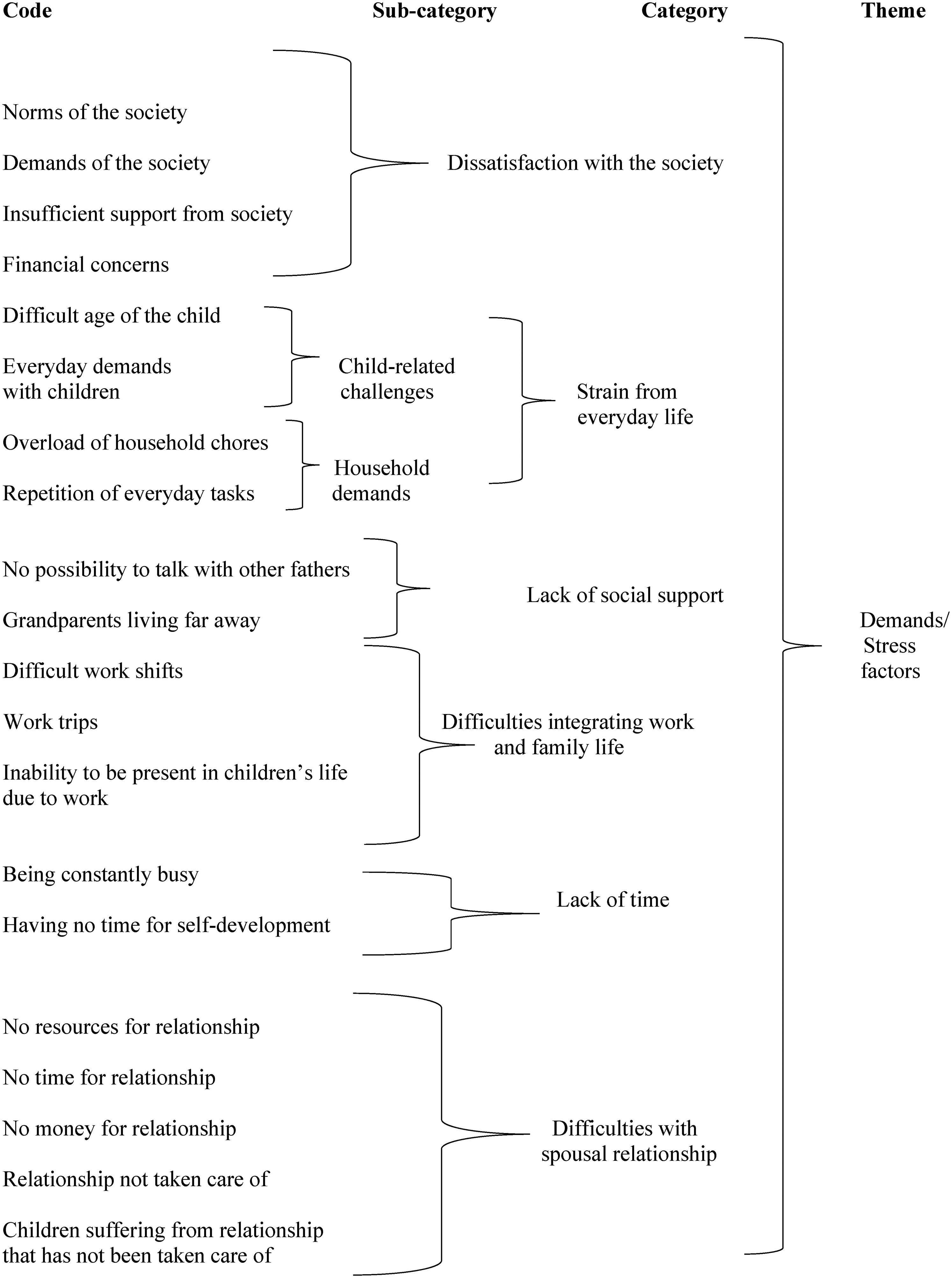
Hierarchical categorization of the demands and resources in parenting described by burned-out (n = 10) and non-burned-out (n = 14) fathers.
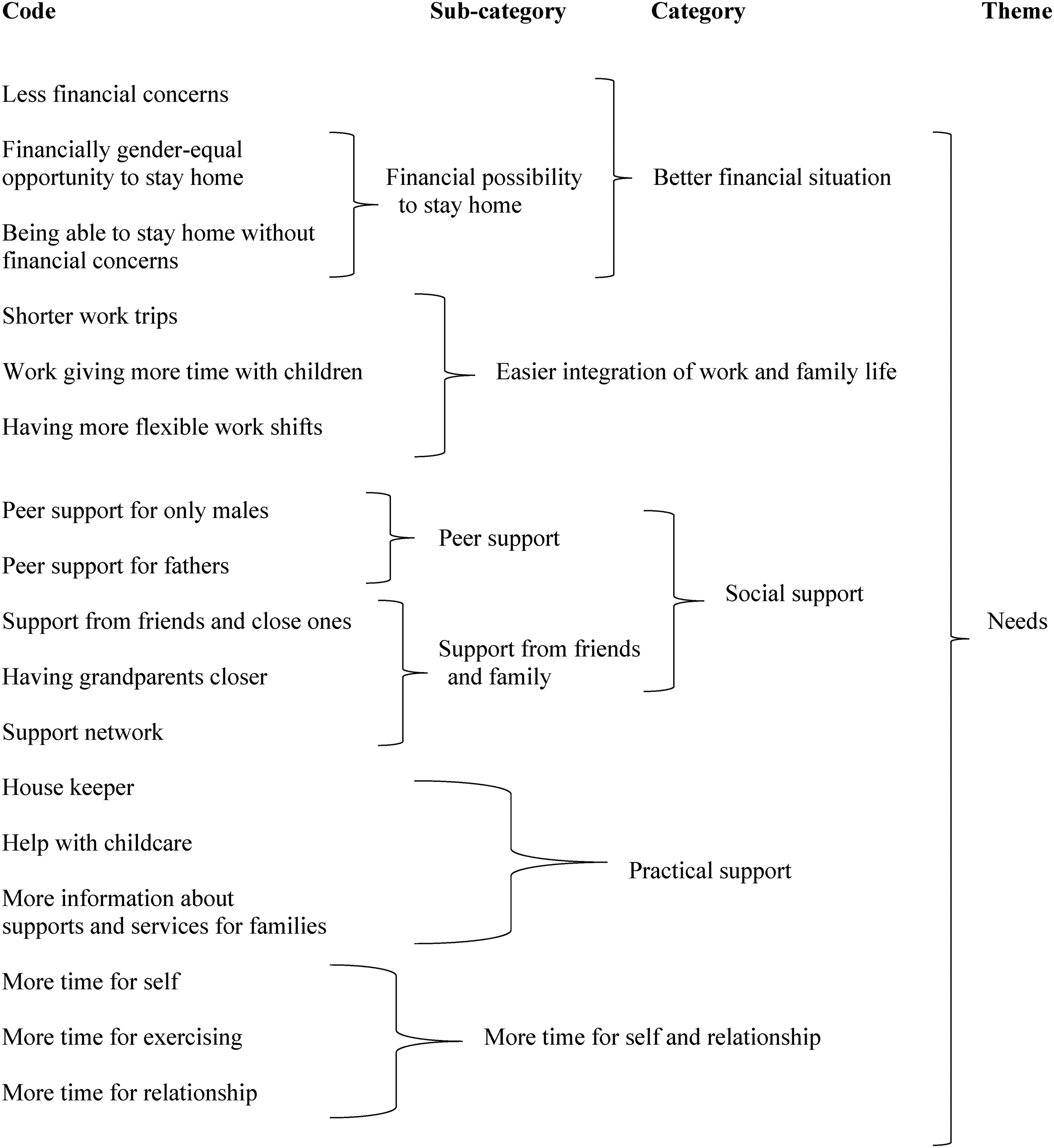
Hierarchical categorization of the reported needs burned-out (n = 10) and non-burned-out (n = 14) fathers.
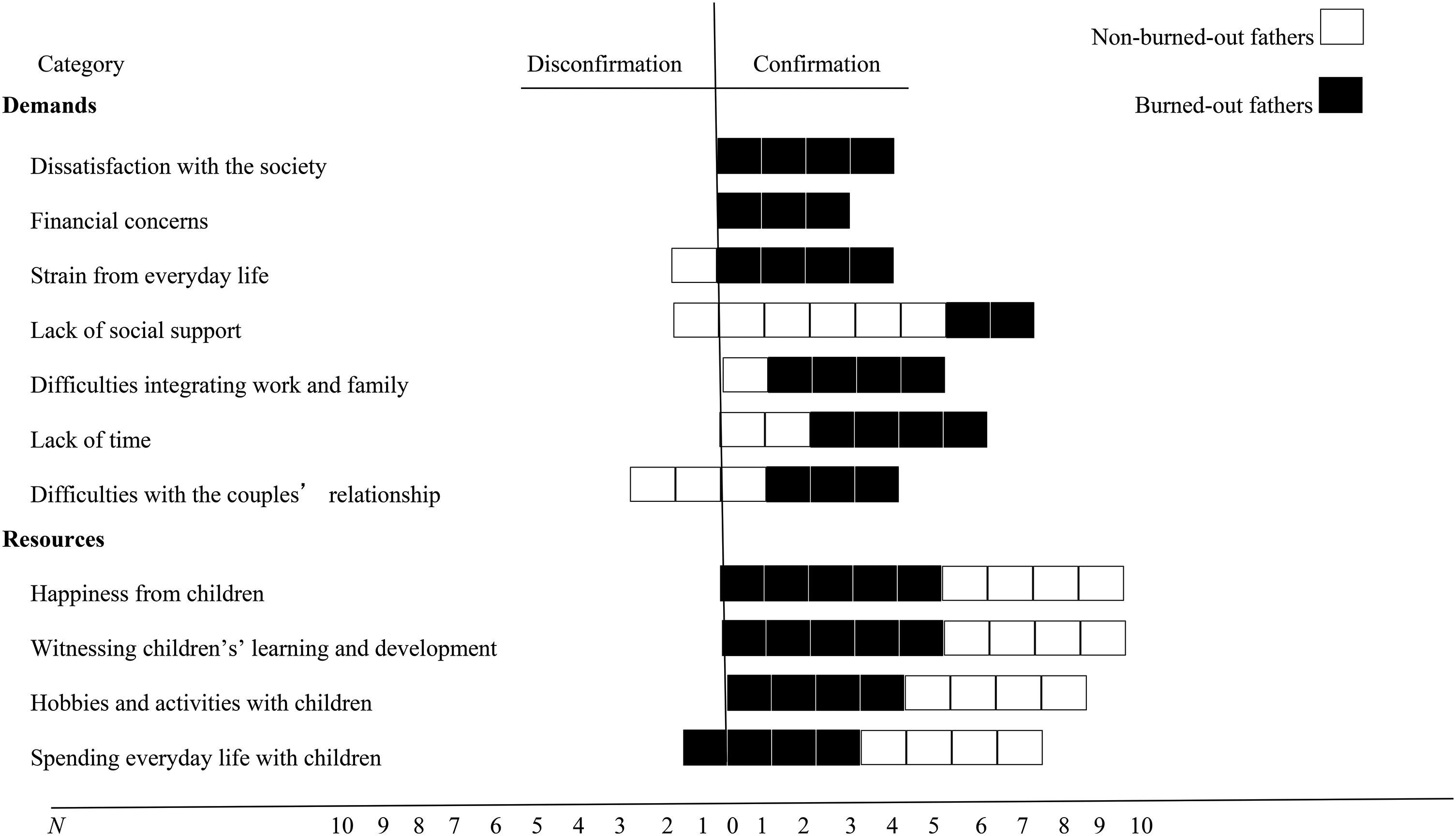
Comparison of the descriptions related to demands and resources among burned-out (n = 10) and non-burned-out fathers (n = 14).
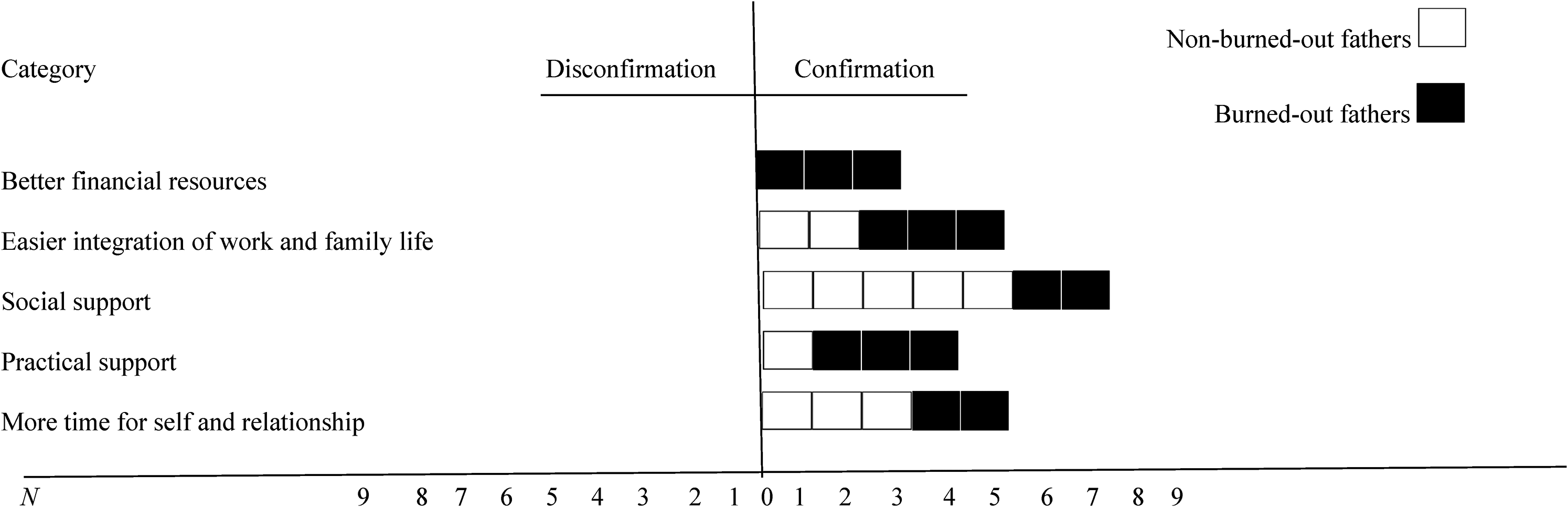
Comparison of the descriptions related to the needs of burned-out (n = 10) and non-burned-out fathers (n = 14).
Results
First, the results of a Mann-Whitney test showed that the burned-out fathers (n = 10) had significantly higher burnout scores (Mdn = 3.50, min = 3.04, max = 5.48) than the rest of the total sample of fathers (N = 147; Mdn = 0.65, min = 0, max = 3.00), U = 5.29, p < .001. Contradictory, the non-burned fathers (n = 14) had significantly lower burnout scores (Mdn = 0.15, min = 0, max = 0.26) than the rest of the total sample of fathers, U = −6.12, p < .001. The burned-out fathers were more likely to report that they did not get enough sleep than the total group of fathers (χ2[1] = 6.22, p < .05) and, oppositely, the non-burned-out fathers were less likely to report not getting enough sleep than the total group of fathers (χ2[1] = 8.65, p < .01). Overall, the results provide support for the used cut-off scores of the two groups.
Second, fathers’ answers for the quantitative questions assessing stress factors were compared by using Mann-Whitney U-test between the burned-out (n = 10) and non-burned-out (n = 14) fathers (see Table 1). It was shown that the burned-out fathers reported statistically significantly more stress regarding nine of the 22 potential stress factors: couple's relationship, financial issues and matters related to subsistence, lack of own time, their own temperament or character, their partner's temperament or character, the change in lifestyle brought by having children, their neighborhood or living place, their children's temperament or special characteristics, and, finally, matters related to organization of daycare than the non-burned-out fathers did (for comparisons, see Table 1).
Comparison of Stress Factors (1 = Does Not Stress Me; 5 = Stresses Me Very Much) Among Burned-out (n = 10) and Non-Burned-out (n = 14) Fathers.
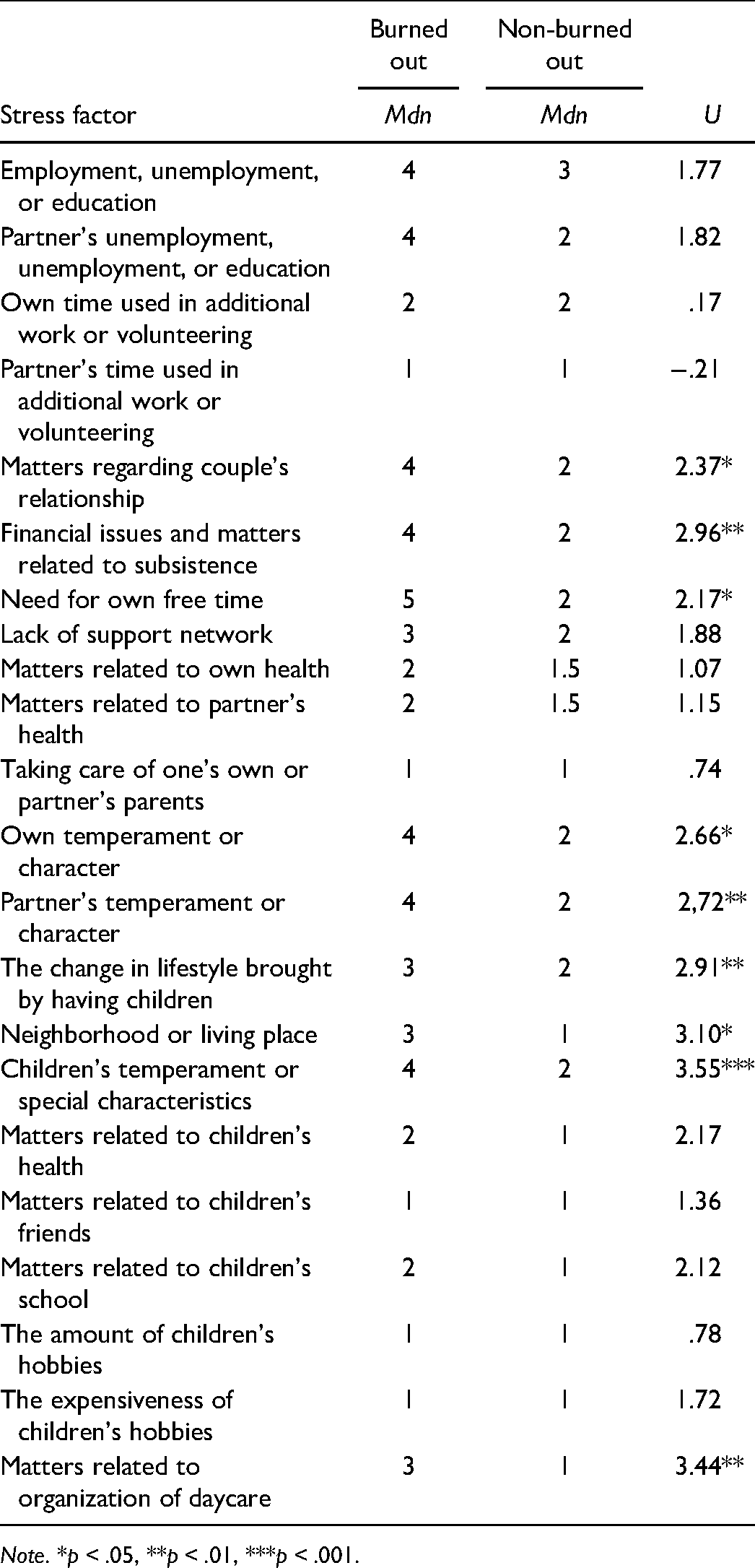
Note. *p < .05, **p < .01, ***p < .001.
Third, based on the answers of all 24 fathers, seven demands-related categories (dissatisfaction with the society, financial concerns, strain from everyday life, lack of social support, difficulties integrating work and family life, lack of time, and difficulties with couple's relationship) and four resource-related categories (happiness from the children, witnessing children's learning and development, hobbies and activities with children, and spending everyday life with children) were identified. The codes, subcategories, categories, and themes are presented in Figure 1. When fathers’ needs were analyzed, five categories (better financial situation, easier integration of work and family life, social support, practical support, and more time for self and relationship) were identified, which are similarly presented in Figure 2.
Finally, the accounts of demands and resources of burned-out and non-burned-out fathers (Figure 3) and their needs (Figure 4) were compared. As the needs were mostly reflective of the experienced demands (e.g., if the father reported low social support, they often reported needing social support), the demands and needs of the fathers in the quotes below are often mentioned together.
As illustrated in Figure 3, nearly half of the burned-out fathers who replied the open-ended questions reported some sort of dissatisfaction with the society, consisting of factors such as dissatisfaction with the expectations of the society and insufficient support from the society, whereas none of the non-burned-out fathers did. For example, one burned-out father explained: The everyday life of a family with small children is so hard, that particularly with the current societal demands and low support; I cannot recommend it to anyone, although children bring a lot of joy to one's life.
Another burned-out father, in turn, explained: Parenting is a black whole filled with inadequacy and it has ruined my life. I wish I had not followed society‘s demands of increasing the population of Finland and reproducing.
In some cases, the dissatisfaction with the society also seemed to be related to difficulties integrating work and family life. Five fathers explained that due to work-related demands, such as high working hours and work-related travels, they could not spend as much time with their children than what they wanted to. One father from the burned-out group wrote: Shorter working hours would enable more time with the kids. The current economy does not support this. The government's competitive agreement (“kiky”) of 24 hours more working time is all time taken away from the family.
Some fathers felt that they would have wanted to stay at home more with the children, but society did not provide them financially equal opportunities for this.
[I wish men would have] a genuinely equal opportunity to stay home on parental leave [as what the women have] without it affecting family income negatively. The benefit of the family always overrides the benefit of the father
Some fathers from the burned-out group felt oppositely, that family was taking too much time off from work, as one father explained: “The birth of a child was already difficult as it decreased the time I could focus on work, and this has been some kind of psychophysiological-economic shock for me.”
In line with the quantitative results, several of the burned-out fathers also seemed to be strained by the demands of everyday life with young children consisting of factors such as everyday household chores and challenges with the children, whereas none of the non-burned-out fathers reported this. Consequently, they often mentioned needing practical support: I often fantasize of having a “wet nurse”—meaning a housekeeper who would live in the house and would take care of at least half of the hassle related to children, that is, getting dressed, going to the grocery store, cooking, feeding, taking care of the homework, etc. This would allow parents time to educate themselves, take part in societal conversations, take naps, or surrender to making love. In families with young children there is very little time for any of these activities, which leads into short sightedness and symptoms of anxiety, as life loses its meaning and direction due to constant repetition of everyday life. Get the wet nurses back!
As shown also in the quantitative results (see Table 1), also in their qualitative descriptions burned-out fathers were more likely than non-burned-out fathers to mention difficulties in their spousal relationship. The challenges in a spousal relationship were often seen as a consequence of the overall challenging situation, which was particularly evident in one father's answer: It would be so important to take care of one‘s relationship, but there are no resources, time, or money for that. Children suffer from our [parents] relationship that has been poorly taken care of, and taking care of myself is also reaching its limits.
Oppositely, some of the non-burned-out fathers reported that a good spousal relationship and shared values in parenting buffered them against parenting-related stress. For example, one father described: “I share similar values and principles with my spouse. It makes the parenting a lot easier, although there may be disagreements on other matters.”
From both burned-out and non-burned-out fathers, some mentioned lack of social support and lack of time for themselves or their relationship as stress factors in parenting (see Figure 3). Lack of social support was characterized often by grandparents living away and not having the opportunity to talk to other fathers. One non-burned-out father described: I would need more time for myself, peer support-based conversations with other fathers in a similar situation (others have same kinds of challenges), and shorter work trips.
Similar stories were reported by other fathers (from the burned-out group and from the non-burned-out group) who hoped that there would be a peer-support group only for fathers, as it they felt like they did not have many opportunities to talk with other men in a similar situation (see Figures 3 and 4). Interestingly, most resources mentioned by both non-burned-out and burned-out fathers included resources from their children. Many fathers said that they were given strength by the everyday moments with their child (e.g., reading, biking, playing) and by seeing the children grow and develop. Father's also appreciated small good moments, and several mentioned receiving happiness from their children's smiles and laughter. One non-burned-out father described: Overall, parenting is a positive thing for me; I‘ve always wanted to be a father. It is a resource for me knowing that I can help my children develop into good people who have necessary skills in life.
One burned-out father, similarly, described: Just looking at the children gives me joy when things go well. [It gives me joy] when I notice that my children learn something, or when they come to me voluntarily and I have time for them. Many small things, that I find difficult to put into words, give me joy and help me carry on.
However, all burned-out fathers did not find happiness in their children. One father described: There is very little joy when the children are young. If there happens to be a moment when everyone's happy … That's a wow.
Discussion
The present study examined what kind of resources and demands burned-out and non-burned-out fathers report (research question 1) and what kind of support they report needing that could increase their wellbeing as parents (research question 2). Even though both burned-out and non-burned-out fathers experienced joy related to their children, unlike non-burned-out fathers, burned-out fathers experienced multiple stressors, such as inadequate financial situation and inadequate support from the society, difficulties integrating work and family life, and being constantly strained by the demands of everyday life with young children. Overall these results support the balance theory of parental burnout (Mikolajczak & Roskam, 2018), suggesting that the key to burning out is the misbalance between resources and demands (i.e., the demands constantly override the resources). Burned-out fathers reported needing better financial resources, easier integration of work and family life, and practical support. Fathers from both groups, however, reported needing social support and more time for themselves and their spousal relationship, suggesting that these factors may be needed by all fathers, not only those who are at risk of burning out.
Compared to non-burned-out fathers the burned-out fathers reported in their quantitative answers stress regarding financial issues and matters related to subsistence, their neighborhood or living place, and matters related to organization of daycare. It is likely that those with financial difficulties may not be able to choose a more convenient living place or a better daycare for children, which may result in an accumulation of stress factors (see Sorkkila & Aunola, 2020). In their qualitative answers, the majority of the burned-out fathers described being dissatisfied with society. This was characterized by low societal support (e.g., low financial support, inability to stay home with the children) and high societal demands (e.g., constantly increasing work demands and demands of reproducing), which support and bring deeper insight to the quantitative findings. Many fathers, furthermore, reported experiencing difficulties integrating work and family life and some felt like too long working hours took off from their children, although there were also some fathers who felt like family was taking too much time off from their work. In line with these findings, fathers reported needing easier integration of work and family life. If one of the society‘s aims is to increase gender-equal parenting (Salmi & Lammi-Taskula, 2014), it would be important to increase flexibility at workplaces also for fathers (e.g., allow options to work from home, allow part-time work). The decision-makers in family politics could also think of ways to support fathers staying at home financially, as many fathers felt like this option was available for them only in theory, not in practice. Fathers may still feel like they need to be the breadwinners (Lammi-Taskula, 2017), and since men still have a higher salary than women, on average (see Official Statistics Finland, 2019), the family income may suffer more if the father chooses to stay at home with the children.
In their quantitative answers, the burned-out fathers reported more stress regarding the change in lifestyle brought by having children. This finding was supported and deepened in fathers’ qualitative answers, as they described being strained from everyday life with children due to never-ending household tasks and chores. Taken this it is not surprising that many of the burned-out fathers reported needing practical support. In their quantitative findings, the burned-out fathers reported also more stress related to the children‘s temperament or character, their own temperament or character, their partner‘s temperament of character, and also more stress related to the couple‘s relationship. These may reflect dysfunctional family dynamics which may be either a cause or consequence for burning out: It is possible that dysfunctional family dynamics induce burning out (e.g., by constant arguing, not supporting one another), or that burning out induces dysfunctional family dynamics (e.g., not having the energy to take care of family relationships). To qualitative descriptions of the burned-out fathers support the latter alternative: the difficulties in couples’ relationship was often mentioned as a consequence of the overall strain of everyday life with young children, as the fathers felt like they did not have time to take care of their relationship or themselves anymore. Some of the non-burned-out fathers oppositely mentioned their spousal relationship as a resource that buffered against difficulties in parenting. These findings highlight the need to provide resources to support families’ spousal relationships, as it could have long-lasting effects on the wellbeing of the whole family (see Lindblom et al., 2016).
Interestingly, the resources mentioned by both burned-out and non-burned-out fathers were related to their children and they were of a similar kind. Fathers mentioned that they received joy from looking at the children’s development and from seeing the children happy. They also received happiness from everyday tasks (e.g., reading, biking, playing) with the children. It seems like although everyday life with children can be exhausting and staining, particularly if there is little social support and multiple stressors, many fathers still receive happiness from their children. This finding is important by demonstrating that children themselves may not be the primary source for burning out, but the reasons may stem more from the societal structures and demands that are perceived insufficient in supporting fathering and balanced work–family life.
As practical implications, many fathers may need more social support as well as more time for themselves and their spousal relationship. Support, for example, from child health centers, should be offered preferably before fathers burn out and the consequences escalate to dysfunctional family dynamics or more severe mental health problems. The support should be both practical (e.g., help with household chores, babysitting) and social (e.g., discussing the situation with someone; receiving spousal counseling). Some fathers also suggested peer-support groups for men, as they had no other fathers to talk to. These kinds of groups could be organized at child health centers or even at workplaces, and they could offer a safe place for fathers to be heard and seen. Peer support has been shown to be one of the most efficient tools in treating, for example, depression (for meta-analysis, see Pfeiffer et al., 2011), and some promising results have been also found in treating stress and occupational burnout (Peterson et al., 2008).
Strengths and Limitations of the Study
This study brought novel information about the experiences of burned-out fathers, which has been argued to be the most urgent direction in examining parental burnout (Roskam et al., 2018). Furthermore, we combined quantitative and qualitative data to enrichen and validate our findings. Nevertheless, the study had several limitations. First, no clinical cutoff scores were used for parental burnout, making it difficult to know what the results mean in real life. Nevertheless, the selected individuals with the highest and lowest amount of burnout symptoms differed from the whole sample regarding burnout symptoms and quality of sleep, indicating that they may well represent these groups. Second, only those fathers who answered the open-ended qualitative questions were selected. This may make the qualitative sample selective (i.e., it is possible that only those with specific experiences answered), and it is not possible to generalize these findings to a wider population. Third, all of the burned-out fathers answered the questionnaires online, whereas half of the non-burned-out fathers answered the questionnaires at child health centers. This raises the question of whether the differences in answers were influenced by the way the data was collected (i.e., those who answered online may have been particularly honest or upset with parenting). Fourth, due to the qualitative and cross-sectional nature of the study, no causality can be drawn from these findings. Future research is encouraged to examine this topic further by using random sampling and longitudinal design to examine the development of burnout among fathers. Finally, the study was conducted in only one cultural context, that is, Finland. Demands and resources related to fathering may be very different in other countries and cultures, and therefore, it would be enriching and important to conduct similar studies also in other cultural contexts.
Conclusion
The present study showed that, unlike the non-burned-out fathers, burned-out fathers experienced a vast range of demands and stressors, such as difficulties integrating work and family life, financial concerns, and difficulties with the couple's relationship. The experienced resources, in turn, were similar with burned-out and non-burned-out fathers and consisted mainly of factors relating to their children, indicating that despite the difficulties of everyday family life, children are a source of happiness. To support gender equality in both parenting and labor force, it would be important to facilitate the easier integration of work and family life among fathers, as well as secure families’ income despite the gender of the stay-home-parent. Furthermore, practical support for families should be offered especially for families with low income to avoid the accumulation of stressors. Fathers could also benefit from support with the spousal relationship as well as from peer support groups only for fathers, which could be organized by child health centers or even workplaces to support a more well-functioning work–family balance.
Footnotes
Declaration of Conflicting Interests
The authors declared no potential conflicts of interest with respect to the research, authorship, and/or publication of this article.
Funding
The authors disclosed receipt of the following financial support for the research, authorship, and/or publication of this article: This study was funded by a grant from the Alli Paasikivi Foundation (grant no.: 21000041571), which was awarded to Kaisa Aunola.
