Abstract
This paper develops a novel theory of intentional community formation grounded in systemic exclusion. Intentional communities—ranging from Amish settlements and eco-villages to countercultural gatherings like Burning Man—are often understood through their shared utopian visions. However, this study reconceptualizes them as collective responses to social exclusion or alienation by mainstream society. Drawing on interdisciplinary insights from utopian studies, institutional analysis, and social psychology, the paper argues that intentional communities emerge when three conditions converge: systemic social pressure or exclusion, the resulting disaffection, and the freedom of residence to withdraw. Drawing on comparative historical analysis, three cases—the Old Amish, Burning Man, and Jonestown—highlight how these variables interact, while emphasizing isolation and leadership’s role in shaping community trajectories. The theory suggests that intentional communities serve as experimental sites of utopian institutionalism and prefigurative politics, embodying efforts to build alternative social worlds in the present. This framework addresses definitional ambiguities and invites future empirical testing while acknowledging conceptual, theoretical, and methodological complexities inherent to studying intentional communities. Ultimately, it reframes these groups as dynamic laboratories of social and political change, deeply intertwined with broader struggles over inclusion, identity, and societal transformation.
Keywords
In the early 2000s, Graber (2024) grew up in an Amish community, where weekly prayers often sparked talks about faith, simplicity, and separation from the modern world. Years earlier, Dan Richman helped raise the first Burning Man effigy in 1986. As bystanders joined in, he and his friends felt both embarrassed and exhilarated—an unexpected moment of radical self-expression (Trippingly Peak Experiences 2016). Even earlier, in 1977, Marceline Jones arrived at Jonestown, a remote settlement that promised refuge from racism and capitalism. She hoped for a better life but soon found herself under the authoritarian control of her husband, the community’s founder. In time, she became central to one of history’s most tragic communal experiments (Reiterman and John 1982b).
These people, and the communities in which they lived, are part of a centuries-old tradition of collective reimagining. This tradition has many forms, including monastic orders, religious colonies, separatist enclaves, urban communes, eco-villages, and cooperatives.
Such communities often build around shared values, rejecting mainstream norms, and adopt new ways of life. However, these efforts are not just cultural or personal; they are deeply political. Many people today feel disillusioned with politics, environmental decline, and failing institutions. Some respond with protest and activism. Others attempt to build small-scale alternatives, creating new social worlds in their communities. These intentional communities share one driving force: the desire to reimagine how to live together. They act as real-world experiments in utopian politics (Jameson 2005, 42–56). Rather than waiting for systemic reform, would-be community members attempt radical change here and now.
Yet research on intentional communities is scattered and contested. What makes a community “intentional”? Why do some survive while others collapse? And what explains their emergence in the first place?
This paper demonstrates that by understanding intentional communities within a broader context of utopia, scholars can more effectively explain how they form and why they exist. To illustrate this effectiveness, I develop a theory of community formation rooted in systemic exclusion, arguing that such communities emerge when people feel excluded from mainstream society. My purpose is to offer a conceptual framework and ontology for studying intentional communities. By “ontology,” I mean the worldview that defines these communities: their way of existing is rooted in a utopian impulse, not just a planned vision.
This paper is a theory-building project, not a theory-testing one. I focus on how communities form, leaving questions of survival and decline for later research. The cases I present are not formal tests but rather the empirical grounding on which I relied in explaining how groups transition from exclusion to utopia.
This paper consists of five parts.
Ultimately, intentional communities are more than lifestyle choices. They are sites of experimentation with taken-for-granted assumptions about society. Far from fringe, they reveal both the promise and danger of building alternatives. While the study of intentional communities typically falls under the purview of communal studies, this paper focuses on its political dimensions. While communal studies offer insights into how people live together, utopian studies provide a bridge between politics and intentional living, showing how communities function as living critiques of society. I also draw on institutional analysis, which links them to tensions between structure and agency, and social psychology, which highlights how subjective experiences become the basis of collective action. Together, these perspectives culminate in a general (if provisional) theory of community formation.
Utopian Foundations
Before Lyman Sargent’s 1994 effort to standardize the phrase, dozens of terms described what are now called intentional communities.
2
Without a shared framework, definitions shifted depending on the cases under study.
3
Sargent provided clarity with his definition: …intentional community [is] a group of
Sargent offered this definition to put diverse communities on an equal footing, allowing scholars to make meaningful comparisons (14). While case-specific definitions were helpful, they were often too narrow for comparing across communities (2013). While Sargent’s definition is only one of many, it is noteworthy because it highlights a standard feature of virtually all definitions: a community’s shared purpose. 4
Prevailing Ontology
Sargent (1994) tied his definition to utopian studies, especially the “city utopia” tradition (19). He defined utopianism as social dreaming—“the dreams and nightmares that concern the ways in which groups of people arrange their lives and which usually envision a radically different society than the one in which dreamers live” (3). This ontology frames intentional communities as practical attempts to realize utopian ideas. For Sargent, the difference between utopian thought and utopian practice was method: • Writers communicate their dreams on the page. • Communards attempt to live them, however limited or temporary (1994, 18; 2010, 33).
Under this view, the utopian element lies in the vision. Founders imagine a different society and deliberately strive to build it. This interpretation aligns with accounts of utopia as possibility, imagination, and radical hope (Lipscomb 2025).
However, this perspective is also limiting. It underplays more expansive understandings of utopia—those that frame it not just as a blueprint for a better world but also as an expression of alternative ways of being (Booth 1991, 535; Brown 2021, 6–7; Claeys 2010, 224; Levitas 2013, 43; Nicholson 1998, 66). From this new view, intentional communities can emerge from diverse impulses, such as necessity, trauma, or exclusion, as much as by a deliberate vision.
Empirical Shortfalls
Sargent’s (1994) practical definition, as he himself noted (16–17), resolves several conceptual challenges. It clearly distinguishes intentional communities from tribal groups, 5 remains neutral regarding community form—encompassing cases as varied as the Amish and Guise’s Familistère (see Appendix A in the online Supplemental Material)—and avoids imposing judgments of “success” or “failure,” allowing for differences in cohesion and longevity.
Still, in retrospect, the definition has significant drawbacks. First, it leaves unresolved the tension between internal validity (does the group qualify as an intentional community?) and external validity (how representative is it of others?). Even Sargent conceded that “all boundaries are tentative and porous” (15). This built-in ambiguity makes the concept functional but weak as the foundation for a research program. 6
Problem 1: Too Many Yes/No Rules
Sargent’s five criteria— Sargent’s conception of intentional community.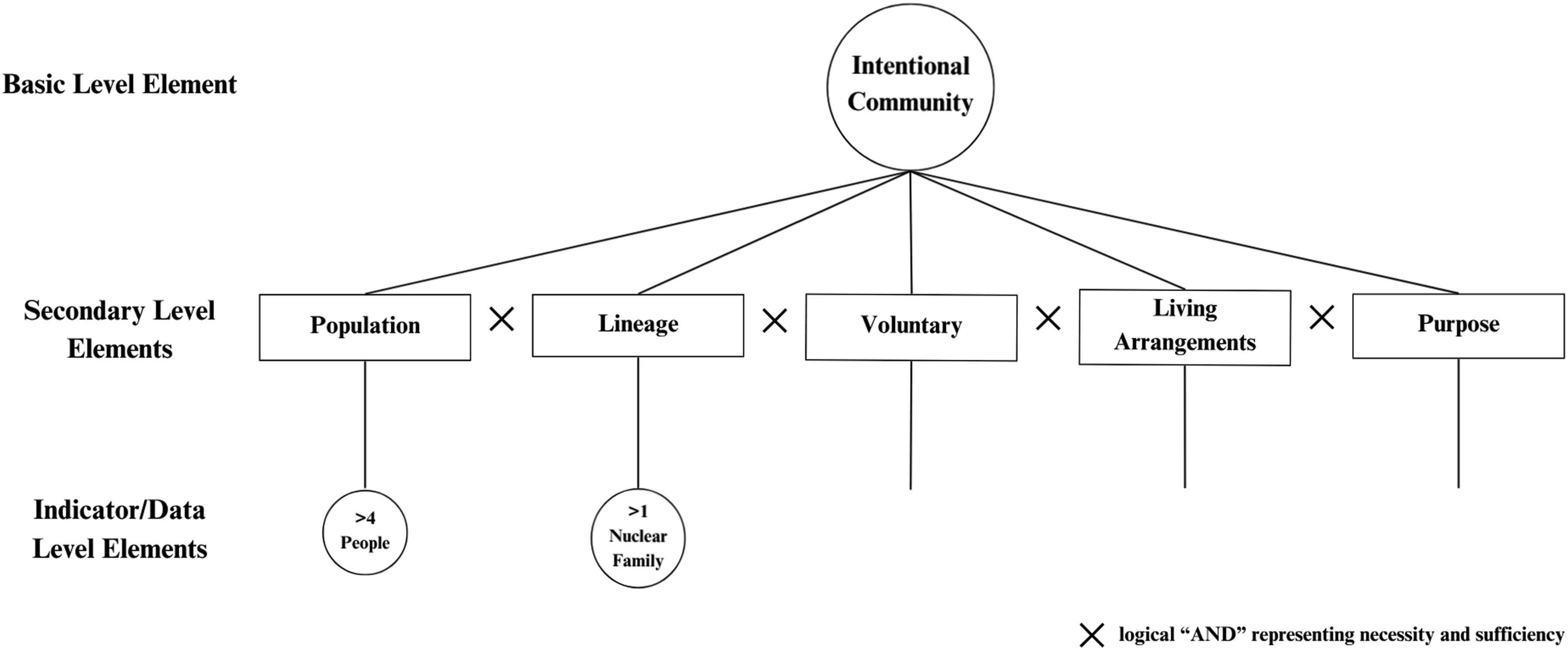
Problem 2: Too Broad and Too Narrow
The criteria are too broad, allowing ordinary things to qualify as intentional communities. For example, music festivals like Summerfest, where unrelated families often share lodging for a common goal, might be considered intentional communities under Sargent’s criteria. This broadness blurs the line between communities and short-term events.
At the same time, this definition is too narrow. Many marginalized groups, such as diaspora communities, which exhibit community-like features, fall outside it. Africville, a historic Black community in Nova Scotia, illustrates this point (see Appendix A). Founded by formerly enslaved people fleeing plantations, Africville developed through mutual aid and settlement under duress rather than through a shared, preconceived vision. Yet it resembles other communities studied in utopian and communal literature, such as U.S. hippie communes (Miller 1999) or Israel’s Kibbutzim (Sargent 2010, 40–41).
Africville shows that intentionality can be a bottom-up process—lived and emergent rather than planned. While Sargent tied intentionality to prior visions, Africville suggests that communal life can also form as an outcome of exclusion and struggle. Its legacy pushes scholars to rethink whether “vision” should remain the defining feature.
Intentional Community Revisited
One way to address definitional problems is to categorize intentional communities into subtypes, such as religious or secular, permanent or temporary, political or lifestyle-based, and so on. Sargent employed this strategy in his taxonomy (1994, 17), and the Foundation for Intentional Communities utilizes a similar system in its database.
But this approach has downsides. It permits differentiation but weakens clarity. For research to build over time, scholars need to establish a precise and consistent definition, one that is neither too flexible to include unrelated phenomena nor too rigid to refer only to one thing. If a concept is too flexible, it risks conceptual stretching, rendering it meaningless (Collier and Levitsky 1997). Even more nuanced definitions—such as Pitzter’s “developmental communalism” (2009; 1997, 3–13) or Lockyer’s “transformative utopianism” (2009; 2023)—do not solve the root issue. They demonstrate how communities evolve, but they still assume a shared intent or vision from the outset.
This focus on vision helps address the lack of robust theories about intentional communities (Sargent and Sargisson 2016, 159–60). If scholars continually make exceptions for features that fall outside its definitional scope, the concept loses its power. Cumulative research—the kind that builds real knowledge over time—requires sharper foundations (Mahoney and Rueschemeyer 2003, 41–91, 131–76). That means rethinking the core characteristics of intentional communities. As Miller argued, the issue is not only definitional but also ontological: “If utopia is about ‘the’ ideal, no matter its form, then there can be no question that utopian intent lies in the heart of utopia” (2009, 32). In other words, the problem is how scholars understand utopia itself. This confusion drives the instability of the field and underscores the need to ground intentional communities in something other than blueprints for ideal societies.
A New Ontology
To develop more robust theories, scholars require stronger conceptual foundations. For empirical research, this means asking: What worldview shapes our interpretation of these communities? This foundation is their ontology—the basic way of understanding what they are (Goertz 2006; Mahoney and Rueschemeyer 2003). The standard way of understanding intentional communities is through their intentionality: the shared purpose or collective goals that motivated their formation. 13 This view focuses on what members do together and the aims they openly share.
But this view is too narrow. As Sargent and Sargisson noted, much research on intentional communities amounts to “antiquarian reports or travelogues,” characterized by weak theories and limited comparison (2016, 159–60). Few studies make meaningful comparisons or build broad explanatory theories. The result is an under-theorized field (Sargent 2013) that neglects communities that emerge without a clear vision.
This argument draws from utopian social theory. Utopia has multiple dimensions: content (what it represents), form (how it is expressed), and function (what it does) (Fernando et al., 2018; Levitas 1990, 2013). While many think of utopia as a dream of the future, I follow Nicholson (1998) and others in stressing its critical function: utopia protests the failures of the present and insists other ways of living are possible. In this way, utopia works as prefigurative politics (Jameson 2005, 1–9), an idea that builds on Bloch’s “utopian impulse.” 14 Hope and dissatisfaction drive action—even without a complete plan. 15
Viewing intentional communities this way has several advantages. First, it accounts for both planned and unplanned emergent groups—those born from shared dreams or displacement. Second, it shifts attention from what they say they want to what their community does in relation to society. Even if members deny a political purpose, leaving mainstream norms is itself political (Ghodsee 2023, 13) and, whether deliberate or not, challenges dominant ideas about society. This conception differs from Miller’s (2009) “unintentional communities,” which still keeps the binary between intent and non-intent. My framework instead tackles the deeper ontological mismatch that has hindered theory-building.
In short, this shift is from vision to impulse 16 —from a purpose to position. Grounding intentional communities in exclusion and critique makes them easier to study and compare. This offers a new ontology: not only how scholars come to understand intentional communities (epistemology) but also what animates them in the first place. 17
A New Definition
The distinction between impulse and vision helps clarify what sets intentional communities apart from other social groups. A community only becomes an intentional community when its existence challenges society by showing that life can be lived differently. This is their utopian element.
To dig deeper into the question “What is an intentional community,” I first need to ask: What kind of phenomenon does this concept capture? In other words, what inner meaning does “intentional community” reflect (Goertz 2006, 69–94).
Sargent and Sargisson captured this well: When most people are unhappy with something in their society, they either simply accept it, through apathy or because they believe, rightly or wrongly, that they have no ability or power to effect changes, or they try, individually or collectively, to bring about change in the direction they desire. Others physically withdraw. [They] do so because they want to lead their chosen life immediately rather than wait for change to take place; others do so because they believe that their way is the right way for a chosen few. They may withdraw by changing societies; if the country is large enough, they migrate internally to a part where they believe life will be better; or they may attempt to create that better life within the confines of the larger society but in various ways separate from it (Sargent and Sargisson 2016, 1).
This quote highlights two key features of intentional communities:
To capture this process, I use what I call the Spark-Filter approach, a decision-tree framework inspired by game theory (see Figure 2). It begins with mere existence and whether people are unable or unwilling to conform to social norms. Here, Filter 1: If individuals cannot or will not conform, they face subjective harms and social sanctions. Filter 2: They may resist, protest, or try reform. Failed reform can lead to political disillusionment or social alienation (Grison and Gazzaniga 2019, 564), generating a sense of Filter 3: Disaffected individuals may choose relocation, but this requires some Game-theoretic logic of intentional community.
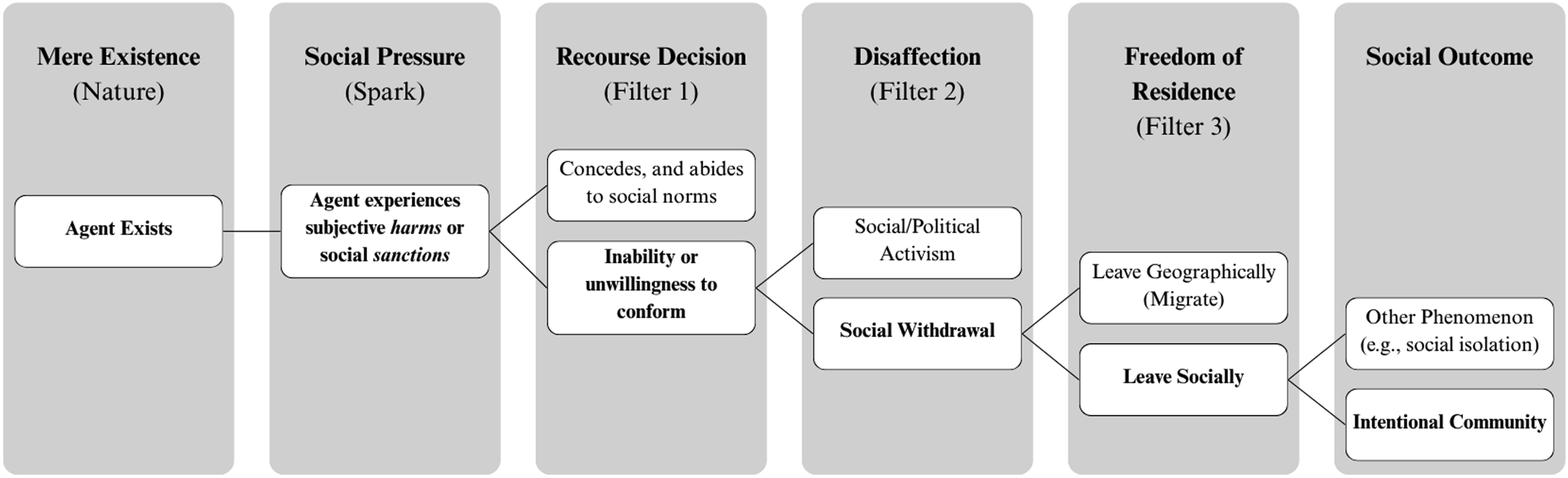
These filters show how intentional community often becomes a last-resort option. Such communities form due to constrained choices. As Miller explained, “Here, ‘unintentionality’ becomes a mechanism through which utopia becomes practically possible, evolving, rather than a proscribed, deliberate, blue-printed, or controlled expression of ideality” (2009, 30). See Appendix B in the online Supplemental Material for a hypothetical queer example.
Disaffection, however, is both imposed and interpreted. Communities form only when
From this view, purpose is less important than A community without disillusionment is just a neighborhood. A disillusioned group without community is a scattered crowd. A group with neither is simply a mass of individuals.
Thus, intentional communities are
A General Theory of Community Formation
With this foundation in place, I now shift from defining what intentional communities are to theorizing about their emergence. This is a move from conceptual analysis to causal explanation. I now argue that intentional communities arise from a combination of factors: (1) Systematic social pressure or exclusion (the spark; hereafter, (2) Resulting disaffection (filter 2; (3) Freedom of residence (filter 3;
I represent this model using Boolean logic and set-theoretic terms in Figure 3 (Mahoney, Kimball, and Koivu, 2009). The causal relationship takes the following form:
23
A general theory of intentional community formation in set-theoretic terms.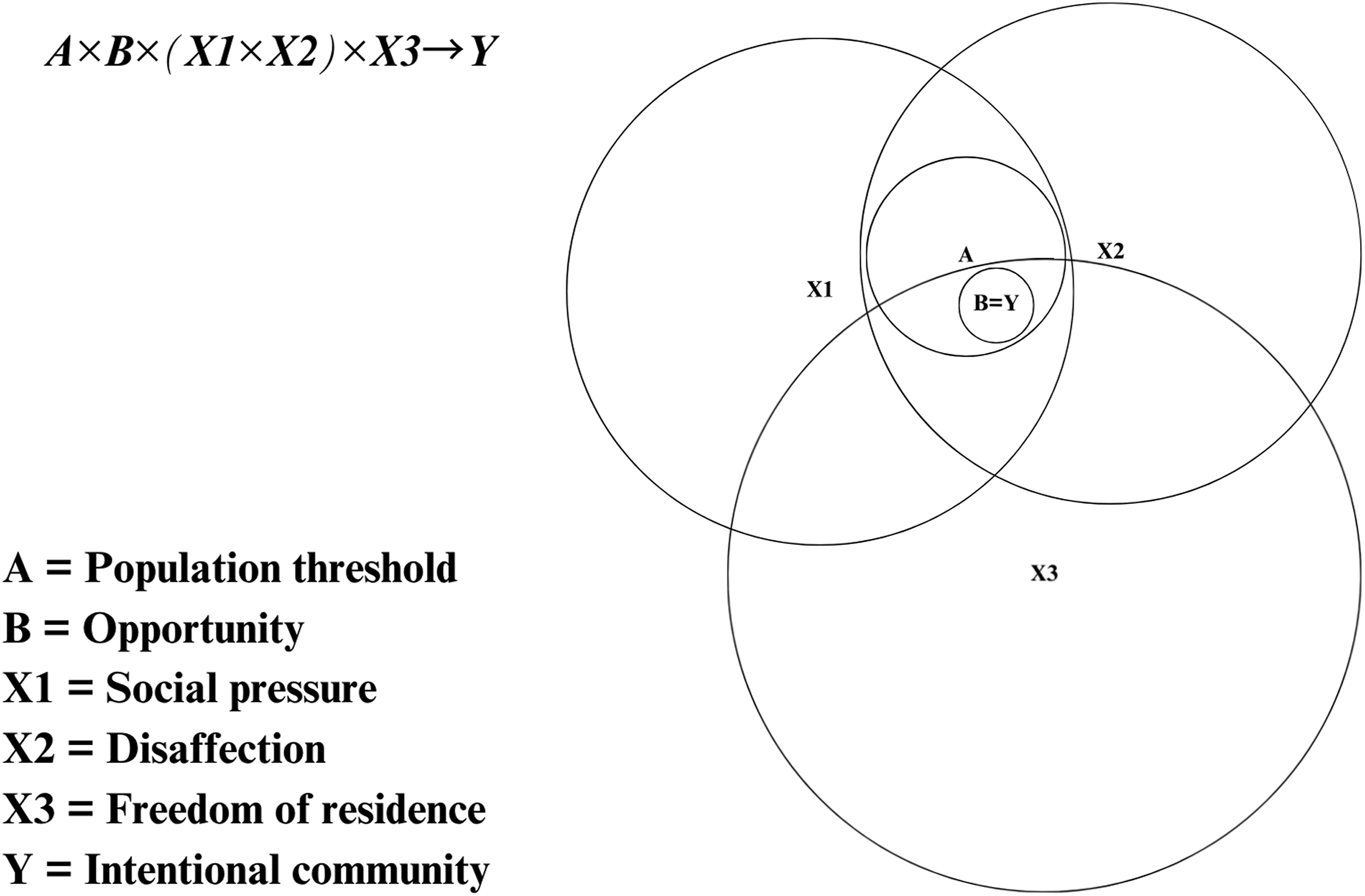

It is important to note that neither social pressure (X1) nor political disillusionment or social alienation (X2) is enough to qualify as disaffection. What matters is the interaction: disillusionment or alienation arising from a specific social pressure (X1×X2).
Freedom of residence (X3) is also a necessary condition. Without it, disaffected groups differ fundamentally from intentional communities; they remain products of exclusion rather than self-directed withdrawal. Ghettos, prisons, and concentration camps illustrate this inversion. Intentional communities begin when people conclude that they no longer belong, while imposed enclosures begin when society declares certain people do not belong. In the first case, the utopian impulse is one of self-asserted autonomy; in the second, it is a response to coercion. By freedom of residence, then, I do not mean unrestricted migration or broad geographic liberty, but the minimal ability to leave one’s immediate social context and relocate beyond the reach of mainstream institutions (whether through neglect or ignorance). Even if constrained, as long as some avenue for physical withdrawal exists, the condition is met. Only where exit is categorically denied does intentional community formation become impossible.
Communities also require two preconditions: (A) Enough people recognize they no longer belong. (B) Some opportunity to gather (e.g., through leaders, networks, and historical events).
Again, this helps explain why intentional communities are both relatively rare and often perceived as undesirable: they form not so much out of utopian ambition but as practical responses to exclusion. What follows may not be a planned utopia but rather a survival-driven experiment in living otherwise. As Sargent (2020, 46, 62, 64, 71–72) and Miller (2009) showed, some of the most resilient and under-recognized examples of intentional life emerged in response to racial segregation and abandonment. These communities nevertheless created alternative social worlds grounded in the very same principles that make intentional communities a remarkable practice. In this way, intentional communities are not merely responses to exclusion but serve as an ongoing negotiation of belonging (Rubin 2021). In some sense, then, intentional communities are institutional, geographic solutions to collective action problems (Miller 2009, 41; Hogan 1985) driven by necessity, mutual recognition, the desire for refuge, dignity, and autonomy, which are central features of utopian thinking, according to some critical political scientists (Niemi 2025).
Methods and Cases
I developed this theory through a close examination of three cases: the Old Amish, Burning Man, and Jonestown. I presented the theory first for clarity, but in practice, it emerged iteratively by sustained engagement with these cases. 24 Instead of focusing on whether communities “succeeded” or “failed,” I focused on the causal processes that gave rise to them. This allowed for more flexibility in handling historical and social differences by examining how they formed rather than what they became.
I began this project by reviewing the literature and considering whether the way scholars conceptualize intentional communities is the root of the problem. I then suggested a new conception using game-theoretic logic. From there, I developed short case studies on the Old Amish, Burning Man, and Jonestown to derive a theory of community formation. The upshot is an inductively produced theory.
My approach drew on Comparative-Historical Analysis (CHA) (Mahoney and Rueschemeyer 2003; Thelen and Mahoney 2015) and what I refer to as “qualitative logics” (Brady and Collier 2010; Cyr and Goodman 2024). These methods emphasize tracing historical events and “causal mechanisms” (Brady and Collier 2010), 25 with attention to long-term, often invisible processes (Pierson 2004). Process tracing is central here: moving detailed evidence to broader insights to uncover recurring patterns—or what some call macro-configurations—that can support mid-level theories. 26
I do not use these cases as after-the-fact “proof” but as the material through which the theory took shape. Each case highlighted a different mechanism that fed into the proposed theory: A×B×[X1×X2]×X3→Y.
The
These cases do not aim to “test” the theory but to illuminate how it came about. Because they differ widely in structure, time, and ideology, I expected them to reveal common factors across very different settings. In this sense, they form a “most diverse” case set (Seawright and Gerring 2008), giving a broad view of alternative pathways to community formation. Concerns about survivorship bias or selecting on the dependent variable (Geddes 1990) are less relevant here, as the aim is not to explain why some communities persist but rather how they form. This is appropriate because the primary goal of this paper is to demonstrate the value of redefining intentional communities in terms of exclusion, even if the causal model itself remains imperfect.
The following subsections outline how each community emerged in this matter: the Old Amish through religious persecution and emigration; Burning Man, a backlash against cultural marginalization; and Jonestown, driven by profound racial and political disillusionment. Still, it is essential to note that I derived this theory from these very cases—social pressure (X1), disillusionment (X2), and freedom of residence (X3). The question is not whether the evidence “proves” the theory, but whether it illuminates the mechanisms at work. These cases were the inductive origins of the theory and now serve an illustrative function.
The Old Amish
The Old Amish originated from the 16th-century Swiss Anabaptist movement during the Reformation (Kraybill 2001). Much of their early history was passed down by word of mouth, but written accounts trace their origin to Menno Simons (Hochstetler 1912, 15). Simons brought scattered Anabaptist groups together under a single identity, later known as the Mennonites—a forerunner of the Amish (Gus 2007).
By 1700, a split occurred. Jacob Amman broke away from the Mennonites due to disagreements over scripture and church discipline (Hochstetler 1912, 19; Kraybill 2001, 7). He pushed for stricter rules, including excommunication, shunning, and even corporal punishment. This created a culture of self-imposed separation. Frustrated with what he saw as weak leadership, Amman asked, “Do we not have some such leaders today, who are perhaps sincere and well-meaning, yet blind to certain Scriptural truths?” (Mast 1950, 49). The first Amish community formed in Switzerland’s Emmen Valley, growing to over 8,000 inhabitants, partly as a way to escape persecution. 29 Their core texts (see Appendix C in the online Supplemental Material)—such as Martyr’s Mirror, the hymnbook Asbund, and the Wandelnde Seele—tell stories of martyrdom and reinforce collective trauma (Fischer-McClearn 1994; Hochstetler 1912, 25; Kraybill 2001, 5).
This early history shows two forces driving the formation of intentional communities. First, social pressure (
Facing constant hostility, the Amish chose migration. In 1737, many traveled to North America aboard the Charming Nancy, founding Northkill in Berks County, Pennsylvania (Kraybill 2001, 9). While William Penn had invited Mennonites, records show some Amish left Europe independently, seeking refuge on their own terms (Hochstetler 1912, 9). This points to a third critical condition: freedom of residence (
Since then, the Amish have worked to preserve their way of life while facing modern pressures (Kraybill 2001, 19). Internal splits, such as the Meetinghouse Amish in 1877 and the New Order Amish in 1966, illustrate the ongoing tension between unity and change (Misiroglu 2015). The Amish case shows how X1 (social pressure), X2 (disillusionment), and X3 (freedom of residence) can combine to build intentional communities through cultural memory, strict institutions, and adaptive migration.
Burning Man
Burning Man started as a small beach bonfire. In the mid-1980s, Mary Graubarger hosted “spontaneous art-party gatherings” at Baker Beach in San Francisco (Doherty 2004, 26). In 1986, Larry Harvey called his friend Jerry James with an idea: “Let’s burn a man” (Harvey 1998). That June, they brought their children and a few friends to the beach, along with two wooden figures—one a man and the other a dog—and set the figures on fire (Doherty 2004, 29). Strangers joined in, playing music and singing. The group grew from eight people to more than thirty (Harvey 1998). What began as a personal ritual soon evolved into something communal.
Harvey never gave one explanation for why it started. Sometimes, he referred to it as a space for free expression (Harvey 2000). Others thought it came from personal struggle (Harvey 1998; Witt 2018). Jerry James said what mattered most was the meaning people found in the moment (Trippingly Peak Experiences 2016). Early participants described it not as a shared ideology but as stepping outside normal society (Mangrum 2018). This illustrates the interaction between social pressure and alienation to produce disaffection (
By 1990, the effigy stood over 40 feet tall and drew more than 450 participants, but authorities shut it down for lacking permits (Burning Man 2008). This made freedom of residence (
In the desert, Burning Man grew into a whole community. Organizers built Black Rock City, designed for those who felt excluded by mainstream society. Harvey later outlined its values in the “Ten Principles of Burning Man” (Harvey 2004). With the help of groups like the Cacophony Society and Desert Siteworks, they developed a city grid and hosted thousands annually (Mangrum 2018; Olivier 2017). During this period, Burning Man showed how X1 (social pressure) and X2 (alienation), combined with X3 (freedom of residence), could sustain a community through openness and reinvention.
But growth also created problems. In 1997, legal issues forced a move to the Hualapai Lakebed (Doherty 2004, 120–21). Organizers soon formed an L.L.C. to manage permits and planning (White 2020, 6). Architect Rod Garrett oversaw the city’s layout and a Department of Public Works (Dalton 2011). These changes formalized the event, reducing its earlier freedom of residence (
By the 2000s, Burning Man consistently drew over 20,000 people. Attendance surpassed 50,000 by 2010 and hit 78,000 in recent years, with thousands of art projects and theme camps (Burning Man Project, nd). But success brought backlash. Ticket prices climbed $575 by 2023 (Wikipedia: The Free Encyclopedia 2024, “Burning Man”). Celebrities and social media influencers arrived, and some longtime participants questioned whether Burning Man still reflected social marginalization (Allen 2016; Bilton 2017; Bowles 2014). See Appendix D in the online Supplemental Material for examples of some early traditions and activities common at Burning Man.
In summary, Burning Man demonstrates how X1, X2, and X3 can interact to create a strong, albeit temporary, sense of community. It also shows how institutional growth and mainstream attention (¬X1, ¬X3) can weaken the very forces that make such a community possible.
Jonestown
This case primarily draws on secondary accounts (Chidester 2004; Nelson, Smith, and Walker, 2007; Reiterman and John 1982a, 1982b) and primary sources from San Diego State University’s Alternative Considerations of Jonestown & Peoples Temple virtual archive.
The story of Jonestown begins with Jim Jones, whose childhood showed an early need for control. As a child, he hosted bizarre “science shows,” once attempting to graft a chicken’s leg to a duck. He greeted neighbors with lines like “Good morning, you son of a bitch” (Chidester 2004, 2; Reiterman and John 1982b, 43). These behaviors foreshadowed his later manipulations.
In 1952, newly married and ordained, Pastor Jones grew frustrated with traditional churches. Rather than reject religion, he decided to reshape it to fit his own vision (Abbott 2022; Wessinger 2000). Inspired by Father Divine and models of communal living, he founded the Peoples Temple. His belief system, “Apostolic Socialism,” blended Christian language and Marxist ideals, cloaking politics in the guise of religious authority (Collins 2023).
After moving to California, Jones preached openly against capitalism. He declared: “If you’re born in capitalist America, racist America, fascist America…then you’re born in sin” (Chidester 2004, 72). This placed the Temple in direct opposition to U.S. social systems, showing how social pressure (
But inside, members described a culture of control and fear. Jones demanded possessions, enforced public humiliation, and framed suffering as proof of loyalty. These practices reveal profound disillusionment (
By 1977, journalists were investigating the Temple. In response, the Temple fled to 3,800 acres in Guyana, relying on freedom of residence (
In Guyana, Jonestown operated in isolation. Jones grew paranoid, staging “white nights” where community members would rehearse collective defense against imagined threats. In 1978, U.S. Congressman Leo Ryan, along with a group of reporters, visited Jonestown (see Appendix E in the online Supplemental Material). As they tried to leave, Temple guards attacked them at a nearby airfield, killing Ryan and several others (CNN 2012; Wagner-Wilson 2008).
Fearing retaliation, Jones ordered mass suicide. Over 900 people died, many by drinking cyanide-laced Flavor Aid (not Kool-Aid; see Appendix E). On the “Death Tape,” Jones claimed: “We didn’t commit suicide, we committed an act of revolutionary suicide protesting the conditions of an inhumane world” (Jones 2019). 31
Jonestown illustrates how charismatic leadership can consolidate diffuse feelings of disillusionment into an intentional community and how this process depends on two preconditions: a sufficient base of followers (A) and the opportunity that Jones’ leadership enabled (B). Social pressure (
Discussion
Examining these cases reveals the mechanisms behind intentional community formation. These mechanisms link key factors—social pressure and disillusionment (X1×X2)—with the enabling condition of freedom of residence (X3). Following this theory, however, leads to three broader insights about communities: (1) isolation helps communities maintain cohesion over time, (2) disaffection grows from perceived 34 exclusion from mainstream society, and (3) leaders have a powerful influence on community formation.
While these cases illustrate how the variables operate in practice, they also highlight the limits of the standard definition of intentional communities. While the focus on purpose is practical, it overlooks the role exclusion, disaffection, and isolation play in these three cases. The Old Amish demonstrate how isolation developed from cultural and social conflict. Persecution in Europe created disaffection (X1×X2), pushing Anabaptists to the margins. William Penn’s “Holy Experiment” provided space to build new communities. Over time, practices such as excommunication, communal living, and rejecting “worldly” influences reinforced their separation at both individual and collective levels (North 1990).
Burning Man demonstrated how external pressures can influence community formation. Initially, they created a countercultural space for radical self-expression and the rejection of mainstream values (X1×X2), situated in the remote Black Rock Desert (X3). But as the event expanded, legal and logistical challenges (⌐X3) and rising ticket prices drew in more mainstream participants (⌐[X1×X2]). This shifted Burning Man from a challenge to the status quo into a reflection of American consumer culture.
Jonestown revealed the darker side of utopian projects (Claeys 2010, 182) and the decisive role leadership can play. Jones exploited his followers’ disillusionment with capitalism and their belief in a broader struggle against oppression (X1×X2). 35 When this struggle seemed unwinnable in the U.S. due to media scrutiny (X1×X2), relocation to Guyana (X3) allowed for isolation and greater control. Yet none of this would have happened without enough followers (A) and Jones’s role as a rallying figure (B). His charisma drew disaffected people together, creating the population needed for Jonestown.
Taken together, these cases reveal a clear pattern: intentional communities formed when enough people (A) who felt disaffected (X1×X2) had the opportunity (B) to relocate or withdraw (X3). While each case differs in form and outcome, the underlying cases are similar. Future research should test whether communities whose existence challenges the status quo through utopian impulses arise at the intersection of disaffection and spatial freedom.
Remaining Issues
This paper introduced a framework for understanding intentional communities, but several tensions and unresolved questions remain. Future research will need to address conceptual, theoretical, methodological, and ethical challenges.
This tension reflects a broader pattern in utopian thought, often referred to as the “dark side” of utopia. Utopias usually inspire hope and innovation, but dystopian visions reveal the potential for immense suffering and unspeakable harm (Davis 1983; Claeys 2010, 107–31, 135–53). Intentional communities occupy this dual space: they are experiments in alternative living that can offer refuge and autonomy, yet they are also structurally vulnerable to coercion, manipulation, and violence. Recognizing this duality demands both theoretical rigor and ethical care. By highlighting systemic exclusion and spatial freedom as core mechanisms, this framework situates intentional communities within a broader understanding of social movements, capturing both their creative and destructive dimensions.
Conclusion
This paper was a theory-building project. It does not make a confirmed causal claim but instead offers a conceptual framework to guide future research. I argued that the best way to understand “intentional communities” is not by their goals but in how they challenge the status quo.
I started by evaluating the standard view that sees intentional communities as expressions of utopian visions. I offered a new perspective: that intentional communities reflect a utopian impulse. I then defined intentional communities as groups whose mere existence challenges the status quo. I then derived a theory of community formation rooted in exclusion and spatial freedom.
This study makes several contributions to both political science and utopian studies. First, by centering on social exclusion, scholars can better capture a variety of communities across cultures and time. Second, by engaging in inductive theory-building, I have helped transition the study of intentional communities beyond descriptive accounts to mid-level theories. Third, I have situated the concept of intentional communities within a broader understanding of utopia—one that exists beyond idealism. These contributions invite political scientists to view utopian thinking as something deeply political and challenge the implicit assumption that all intentional communities are idealistic or coherent—some emerge simply in response to social problems.
This paper also points to directions for future research. Scholars should track when small groups become lasting institutions. They should study why communities fail, change, or grow too large. Other factors contributing to community formation, such as trauma, leadership, shared beliefs, or economic needs, should also be considered. Researchers should use methods that respect cultural differences and complex histories, and avoid unfair comparisons, especially linking communities to violent or extremist groups.
Intentional communities are experiments. They are built by people trying, and sometimes failing, to find better ways of living together. They are rarely about perfection; they are about possibility. As one resident of Ecotopia said, “We don’t try to be perfect, we just try to be OK on the average, which means adding up a bunch of ups and downs” (Callenbach 2021, 33). Intentional communities are uneven, fragile, and profoundly human. Their greatest lesson may not be achieving utopia, but pursuing a livable “OK” beyond exclusion.
Supplemental Material
Supplemental Material - From Exclusion to Utopia: A Comparative Study of Intentional Community Formation
Supplemental Material for From Exclusion to Utopia: A Comparative Study of Intentional Community Formation by Donald H. Zárate in Political Research Quarterly.
Footnotes
Acknowledgments
I am deeply grateful to

Ethical Approval
This study analyzed existing, publicly available data sources, including peer-reviewed academic articles, newspapers, and organizational websites. It does not meet the federal definitions of human subjects research (45 CFR 46.102(e), 46.102(l)) or clinical investigation (21 CFR 50.3(c), 56.102(c)). No human subjects were directly involved, and no identifiable private information was obtained or used.
Funding
The authors disclosed receipt of the following financial support for the research, authorship, and/or publication of this article: The
Declaration of Conflicting Interests
The authors declared no potential conflicts of interest with respect to the research, authorship, and/or publication of this article.
Data Availability Statement
All data utilized in this study are publicly accessible and openly available.
Supplemental Material
Supplemental material for this article is available online.
Notes
References
Supplementary Material
Please find the following supplemental material available below.
For Open Access articles published under a Creative Commons License, all supplemental material carries the same license as the article it is associated with.
For non-Open Access articles published, all supplemental material carries a non-exclusive license, and permission requests for re-use of supplemental material or any part of supplemental material shall be sent directly to the copyright owner as specified in the copyright notice associated with the article.