



Abstract
Women’s representation has significantly increased in recent decades. Women even dominate some decision-making bodies. How do these changes influence men’s attitudes toward democratic institutions? I analyze original survey data and a factorial survey experiment from the UK, and demonstrate that equal representation does not affect men’s expectations regarding policy output. However, if men are under-represented, most men across various sub-groups believe institutions are less likely to cater to their interests. Furthermore, men’s perceptions of fairness are higher under equal representation compared to the under-representation of either group. These findings underscore the importance of upholding gender equality in democratic institutions.
Introduction
Women’s representation in democratic institutions has increased remarkably in recent decades. Women have secured more than half of the cabinet positions in some governments, leading to criticisms that men are being treated unequally. In Finland, the government formed under Sanna Marin in 2019 included 12 out of 19 women ministers. This sparked criticism that the cabinet violated the principles of equality, as men comprised fewer than 40 percent of its members. 1 Petteri Orpo’s right-wing cabinet, which succeeded Marin’s in 2023, also violated principles of gender equality, as only 37 percent of its members were men.
Women also hold over 50 percent of parliamentary seats in some democratic countries. Elsewhere, there have been notable surges in their representation. Since 2020, women have comprised 53 percent of Bolivia’s parliament, and women’s parliamentary representation in France has increased by 30 percent over the past two decades alone. The United Kingdom has experienced an increase of 27 percent in women’s representation over the past three decades. How do changes in women’s representation influence men’s attitudes toward democratic institutions? And how do men respond if women are over-represented?
This study investigates how shifts in women’s collective representation affect men’s perceptions about whether democratic institutions represent their interests. It also examines whether (and how) women’s collective representation affects men’s perceptions of fairness. Do men’s fairness perceptions benefit from increases in women’s representation? Most importantly, I explore how these perceptions change depending on the level of women’s representation, including equal representation of both genders, men’s over-representation and men’s under-representation. Previous theoretical contributions have raised concerns that women’s empowerment in the form of office gains may lead men to worry that their political demands will not be met and that democratic institutions will cater less to their needs (Mansbridge and Shames 2008; Sanbonmatsu 2008). Previous studies suggest that men do not believe that an uptick in women’s collective representation (Breyer 2024) affects their self-interest, but rather that such increases benefit all of society (Schwindt-Bayer and Mishler 2005). I argue, however, that it is necessary to distinguish between the dimensions of self-interest and overall fairness of the compositions of institutions to uncover the full range of men’s reactions. This study examines how shifts in gender representation shape men’s expectations regarding policy output as well as their fairness perceptions.
Using a well-powered (3,457 males from a total sample of 7,047 participants) and pre-registered 2 factorial survey experiment, I demonstrate that changes in a legislature’s gender composition affect both (1) how men feel democratic institutions represent their interests and (2) the extent to which they anticipate institutions will make (un)fair decisions. The results indicate that increasing women’s representation only negatively affects men’s expectations with regard to policy output if men are under-represented. This effect is consistent across different sub-groups of men. Both men who believe that gender equality measures outside of politics (e.g., in business) undermine society and those who see them as enriching conclude that women’s over-representation negatively affects their self- interest. Equal levels of representation, however, do not signal to men that institutions cater less to their needs. While men, on average, perceive gender parity in legislatures as the fairest scenario, this positive effect is limited to more progressive men.
My experiment presents respondents with a hypothetical prediction of the composition of the UK House of Commons after the next general election. Within each hypothetical assembly, the level of representation of men and women varies on three levels: (1) over-representation of men, (2) equal representation and (3) (narrow) under-representation of men. Unlike prior studies that have examined the effects of trajectories of women’s representation (Breyer 2024), my research design allows me to examine the impact of women’s over-representation—mimicking a scenario similar to the controversial Finnish government discussed above. In addition to gender, I vary the descriptive representation of different age groups, classes, ethnic minorities, and ideological camps. Respondents indicated the degree to which they believed the decisions of the fictional House of Commons would reflect their policy preferences and the degree to which they expected its decisions to be fair.
The findings have important implications for decision-making bodies and their gender compositions. If women are over-represented, men feel their interests are not well represented, suggesting that increases in women’s representation signal a stronger emphasis on women’s interests to men. This perceived loss of influence may trigger feelings of exclusion (Anderson et al. 2005; Reher 2015), which may fuel discontent and motivate efforts to reverse such developments (Anduiza and Rico 2022). While women are rarely over-represented in key institutions, this scenario may become more frequent. Furthermore, men perceive equal levels of gender representation as the fairest option and believe such institutions cater to their needs. My results thus indicate that fears of negative male reactions should not hinder efforts to advance gender parity in political representation. They also carry important implications for the design of mechanisms—such as quota laws—to ensure they promote balanced gender representation.
Women’s Representation, Output Expectations and Fairness Perceptions
In recent decades, women’s representation in key decision-making bodies has increased significantly in democratic countries, most importantly in the executive (Nyrup and Bramwell 2020; Nyrup et al. 2024) and legislative branches (Carnes et al., 2022; Gobel and Munzert, 2022). 3 In several countries, women have reached or are nearing parity with men. Women make up 50 percent of national legislators in Mexico and New Zealand, and 53 percent in Bolivia. In Sweden, Finland, and Iceland women hold around 45 percent of parliamentary seats. In 2023, women comprised about half of the US, Dutch and South African cabinets.
Women have even outnumbered men in governments, most famously — but not exclusively — in Finland. In 2022, the Chilean government formed with 14 women and 10 men, and the most recent Scottish government featured 70 percent female ministers. The Spanish, Albanian, and Belgian governments, formed between 2021 and 2023, also achieved at least 50 percent female representation. At times during their tenures, women outnumbered men by one or two ministers.
In some cases, these increases have been sudden. For example, the share of women in the Swiss Parliament jumped from 32 percent in 2015 to 42 percent in 2019. In Chile, women made up only 25 percent of the previous cabinet before surpassing parity in 2022. Much of this progress can be attributed to gender quotas, which have played a crucial role in accelerating women’s political representation (Clayton 2021; Clayton and Zetterberg 2018). While women remain under-represented in most democracies, the recent progress is remarkable and marks a significant shift. 4
Do men interpret these developments as the political agenda slipping away from them and as jeopardizing their own interests? The increasing number of women in a decision-making body may symbolize that the political agenda is increasingly in women’s favor and ignoring men’s agenda. The presence of women has been found to affect policies at various stages of the legislative process (Childs 2004; Swers 1998) and to increase the amount of attention that institutions pay to women’s issues (e.g. Chattopadhyay and Duflo 2004; Clayton and Zetterberg 2018; Dahlerup 1988; Grey 2002; Parthasarathy et al. 2019). Men’s perception that institutions with greater women’s representation will consider men’s interests less can be described as ego- or socio-centric (Schwindt-Bayer and Mishler 2005). In ego-centric reactions, men perceive their personal preferences as being affected; socio-centric responses consider the impact on the interests of their closest social group, possibly other men.
The heightened levels of sexist attitudes and men’s growing endorsement of populist radical right parties and ideas in reaction to the success of feminist movements (Anduiza and Rico 2022; Green and Shorrocks 2023; Norris and Inglehart 2019; Off 2023; Parth 2022) suggest that men feel defensive about women’s empowerment and seek to protect their interests by endorsing ideas that align with this goal (Lipset and Raab, 1970; Mansbridge and Shames, 2008; Sanbonmatsu, 2008). Women’s empowerment may threaten men’s interest representation. Furthermore, the targeted nature of men’s hostility toward women campaigning for (or winning) political office (Herrick and Thomas 2022; Yan and Bernhard 2024) further suggests that at least some men perceive women in political office as a threat.
However, prior research on the effects of women’s representation contradicts this conclusion and shows that women’s office gains do not cause men to think the political agenda is slipping away from them. Previous studies conclude that men respond to women’s gains in office from a socio-tropic perspective: they view women’s representation as beneficial to society as a whole. Schwindt-Bayer and Mishler (2005) demonstrate that men react in similarly positive ways as women to increasing levels of women’s representation and display higher levels of confidence in legislative institutions. The authors conclude that men view women’s representation with an “enlightened self-interest” (a socio-tropic reaction): they believe decisions in women’s favor are beneficial to both themselves and society as a whole. Supporting this, Breyer (2024) finds no evidence of a negative ego-centric response among men; they do not feel that they receive less attention from politicians as women’s representation in legislatures grows. Furthermore, Verge et al. (2020) find that men rate women’s inclusion positively, even if women are described as poorly prepared for the job as representative. These recent findings suggest that men have an overall positive assessment of increases in women’s representation and believe that it benefits society.
However, previous studies have struggled to clearly distinguish between ego-/socio- centric and socio-tropic reactions, as well as the different levels of women’s representation at which they may occur. Schwindt-Bayer and Mishler (2005) assess confidence in legislatures, which is shaped by self-interest as well as procedural considerations such as whether institutions uphold basic principles of procedural justice. This raises the question of whether men respond positively to increases in women’s representation because they perceive greater institutional integrity as female representation rises. In other words, are favorable evaluations of legislatures in response to women’s rising representation driven by procedural concerns such as perceptions of fairness?
We may underestimate the ego- and socio-centric reactions to increasing women’s representation. Do men perceive equal levels of representation as detrimental to their interests? What if levels of women’s representation exceed parity? Previous studies do not allow us to identify the levels of women’s representation at which both socio-centric and -tropic considerations are affected.
In this paper, I study men’s output expectations to assess whether their reactions to gender representation are ego-centric. Output expectations refer to individuals’ beliefs about whether political institutions will produce decisions that align with their own policy preferences. Citizens develop these expectations about democratic elites and institutions and regularly apply them when observing which parties secure majorities in elections (Blais et al. 2017). Gender representation may similarly signal likely policy outcomes. Examining output expectations may help us better understand what citizens infer from the gender of their representatives. The degree to which citizens feel represented by political institutions and elites is a key factor in shaping their overall satisfaction with democracy (Aarts and Thomassen 2008; Blais et al. 2014; Holmberg 2014). This feeling reflects a form of self-interest, rather than a broader confidence in legislative bodies—confidence that may also stem from procedural considerations such as fairness (Schwindt-Bayer and Mishler 2005).
Furthermore, men may believe that increasing women’s representation benefits society in multiple ways. Fairness perceptions are one way in which voters think in terms of benefits for society. Does women’s representation inform men’s fairness perceptions? And which levels of gender representation do men consider “fair” or “right”? If gender representation is a factor in men’s fairness perceptions, we can also conclude that their assessment of levels of gender representation goes beyond considerations of self-interest. It is also unclear whether men assess the norm of fairness in line with what are generally considered principles of equality. We have a very limited understanding of these questions because previous studies either conflate fairness perceptions within general confidence in the legislature (Schwindt-Bayer and Mishler 2005) or only look at ego-centric considerations (Breyer 2024). These procedural considerations are crucial for citizens’ overall evaluation of institutions. A variety of studies have demonstrated that citizens’ satisfaction with institutions is influenced by their perceptions of how these institutions function procedurally—particularly the fairness of the conditions under which they operate (Easton 1965; Esaiasson et al. 2019; Esaiasson et al. 2012; Folger 1984; Lind and Tyler 1988). Previous experimental studies have demonstrated that descriptive representation affects whether specific policy decisions are perceived to be fair (Clayton et al., 2019; Hayes and Hibbing, 2017; Kao et al., 2024). However, we have yet to determine whether women’s representation can inform men’s fairness perceptions of institutions. To address this gap, I examine how gender representation affects fairness perceptions, and distinguish such perceptions from considerations of self-interest (i.e., output expectations).
Beyond the theoretical and empirical distinction between output expectations and fairness perceptions, I investigate how the effects on both dimensions also depend on the level of gender representation. Investigating the effects of changes in levels of women’s representation—including majority shifts—may reveal at what level men consider their substantive outlooks to be impaired (Sanbonmatsu 2008, 637–638). Earlier studies assessed the effect of a simple but numerically undefined increase (Verge et al. 2020), trajectories of representation (Breyer 2024; Wetts and Willer 2018) or dyadic representation (e.g., McDermott 1998). I instead examine shifts in collective representation to identify which levels of representation lead to perceptions of reduced representational outcomes or fairness. Dyadic and undefined increases in representation are less likely to signal trade-offs in substantive outcomes, while trajectories of descriptive representation do not allow us to identify the levels of representation that affect these perceptions.
Hypotheses
Parliamentary composition provides important cues that help citizens evaluate the extent to which political outcomes are likely to reflect their policy preferences (Blais et al. 2017). Significant changes in the proportion of women and men in legislatures may also signal shifts in preference representation. While men and women are internally diverse groups—shaped by intersecting identities such as race, class, and partisanship—they often hold distinct collective interests (Huddy et al. 2008; Yildirim 2022). Citizens recognize these gender-based differences in opinion (Elder and O’Brian 2022, see 1412–1413). Women in policymaking roles have been found to be more likely than men to prioritize issues that reflect women’s social identities, such as domestic violence, reproductive rights, and child care (Childs 2004; Swers 1998, 2002). Even conservative women dedicate substantial time and resources to these concerns (Celis and Childs 2018; Swers 2002). Women’s emphasis on women’s issues appears at multiple stages of the legislative process (Bailer et al. 2022), often occupying a significant portion of an assembly’s agenda.
As more attention and resources are directed toward women’s issues—reflected in the growing number of women representatives—men may perceive a corresponding decline in focus on issues that concern them. The presence of male representatives can also symbolize continuity with a historically male-influenced agenda. Since women’s issues are more effectively addressed by a critical mass of female decision-makers (e.g., Dahlerup 1988; Grey 2002), increased women’s representation may signal a shift in policy emphasis. Given that politics is often perceived as a zero-sum game, in which attention to one group’s concerns may come at the expense of those of another group, men may interpret rising female representation as threatening to their own priorities. This leads me to my first hypothesis:
Men’s output expectations worsen with increasing levels of women’s representation.
However, gender representation may also shape men’s perceptions of fairness. Voters may view legislative seats as resources for expression, participation, and influence, which (like any other resource) can be perceived as fairly or unfairly distributed among social groups. Multiple studies have established that these fairness perceptions significantly shape satisfaction with democratic institutions and their decision-making processes (Easton 1965; Esaiasson et al. 2019; Esaiasson et al. 2012; Folger 1984; Lind and Tyler 1988). Given the decades of efforts to promote equal opportunities for women, the notion that women deserve a higher or equal share of voices in decision-making assemblies might have become an established norm, even among men (Bicchieri 2016). Such normative expectations make the level of gender representation a key factor in fairness evaluations.
However, the level of descriptive representation is a crucial aspect of fairness perceptions. I expect men’s fairness perceptions to peak when men and women are equally represented in parliament, because balanced representation is most likely to align with societal expectations of equality and fairness. Unequal representation of either gender may create a perception of inequality, potentially lowering men’s sense of fairness in institutional decision-making. Thus, the second and third hypotheses follow:
Men’s fairness perceptions are higher when women and men are equally represented than when women are under-represented.
Men’s fairness perceptions are lower when women are over-represented than when women and men are equally represented.
Additionally, I investigate whether negative sentiments toward increasing levels of women’s representation are driven by perceptions that such advances in gender equality represent a threat. These underlying perceptions may strengthen the mechanisms described above with respect to men’s negative reactions toward gains in women’s descriptive representation. Before we even consider the level of women’s representation in parliament, some men might see general advancements in gender equality as negative, while others might be predisposed to perceive such advances as a net benefit to society. These a priori views might shape perceptions of output expectations and fairness under different patterns of gender representation in parliament.
Men who believe gender equality undermines their position in society may be most likely to assume that their priorities will be sidelined when more women are present in decision-making bodies. By contrast, men who think gender equality enriches society may react to increases in women’s representation with indifference, at worst, since they perceive less at stake for them. Similarly, a threat perception can skew fairness perceptions, leading men to view the increased presence of women in decision-making roles not as a positive shift benefiting society, but as an unfair encroachment on their share of influence. Hence, I expect that the greater men’s disapproval of gender equality measures is, the stronger the negative effects of women’s descriptive representation on output expectations and fairness considerations. 5
The effect of H1 is stronger when men perceive achievements in gender equality as negative.
The effect of H3 is stronger when men perceive achievements in gender equality as negative.
Methods & Data
To assess men’s perceptions of different levels of gender representation, I collected original survey data, including a factorial survey experiment, in the United Kingdom in February 2024. My sample of 3,457 men is part of a larger survey of 7,047 respondents. The survey was conducted with Bilendi/Respondi using quota sampling based on gender, age, and education. 6
Women’s representation in decision-making bodies in the UK has increased significantly in recent decades. In 1990, the proportion of women in the House of Commons was just 7 percent, increasing to 15 percent by 2000 and 35 percent by 2020. The survey was administered before the 2024 election. The government at the time featured 36 percent female ministers—the highest proportion of women in any UK government up to that time. The share of women in the House of Commons was expected to rise further in the 2024 election: predictions ranged from approximately 220 to 280 women out of 650 seats. The UK has also had several female prime ministers, all from the Conservative Party.
In the first part of the survey, respondents were asked about their demographics, their attachment to various social groups, attitudes toward recent developments in society, such as measures to assure gender equality in businesses, prospective party choice, ideological self-placement and attitudes toward current politics, including trust in institutions (parties, parliament and the legal system) and in the current government. I use men’s perceptions of gender equality measures in the business sector to proxy for broader atti- tudes toward societal gender equality. The survey asks men whether they believe bringing in consultants to advance women’s careers in publicly traded companies undermines or enriches life in the UK. 7
These types of corporate initiatives mirror efforts in other domains and represent active steps toward improving women’s social status. Men’s evaluations of whether such measures enrich or undermine life in the UK offer valuable insights into their views on the societal consequences of gender equality initiatives. I do not ask directly about women’s political representation since this would risk tautology—testing whether men who oppose women’s political advancement also oppose increased descriptive representation.
Data from the most recent European Social Survey (ESS) (European Social Survey European Research Infrastructure Consortium ESS ERIC, 2024) reveal that attitudes toward women’s advancement in politics and business are highly correlated. The ESS includes two items: one asks whether it would be good or bad for businesses in the respondent’s country to have equal numbers of men and women in higher management, and the other asks the same about political leadership. 8 Among male respondents in ESS Round 11, the correlation between these two items is r = .79 (r = .81 for the subsample of British male respondents). In the remainder of the paper, I interpret results with respect to attitudes toward gender equality in business. Yet, these strong correlations suggest that attitudes toward gender equality in business and politics are aligned and not orthogonal to each other.
In the second part, respondents completed a factorial survey experiment that presented them with a hypothetical scenario from polling institutes predicting the composition of the House of Commons after the next election, including the social backgrounds of representatives. 9 Each respondent saw one prediction at a time; they varied in the collective representation of (1) men and women, (2) three different age groups, (3) White and Asian/Black individuals, (4) vocational and university education levels, and (5) left- and right-leaning orientations.
Respondents rated each prediction based on two outcome questions in randomized order, measuring their output expectations. They were asked how much they believe the assembly’s decisions will serve the interests of people like them, as well as the extent to which they expect these decisions to improve their future well-being. 10 These items capture the respondents’ belief that the future House of Commons will produce policies aligned with their preferences—i.e., they assess the anticipated match between citizens’ interests and institutional output from both short-term (serving interests) and long-term (improving well-being) perspectives. If the gender composition of the fictional House of Commons influences output expectations, this would suggest male respondents infer substantive representation from representatives’ gender. Respondents rated seven responses from zero (“Not at all”) to 10 (“Very much”), evaluating one prediction at a time about the possible composition of the House of Commons.
They then received a second set of seven predictions which they rated on an 11-point scale based on two fairness perception questions, also in randomized order. The first question asked how fair they believed the assembly’s decisions would be, and the second asked how unfair these decisions might be for some groups. 11 These items capture the extent to which respondents expect the decisions of the fictional House of Commons to be fair—or how fairly they believe the institution operates. Participants received the two sets—asking about output expectations and fairness perceptions—in random order. Respondents were informed that there were no wrong or right answers and that they should report their perceptions.
In the House of Commons predictions, I varied the level of gender representation across three categories: strong over-representation of men, equal representation, and slight under-representation of men. Four other social characteristics were also varied: class (operationalized as education), ethnicity, age, and ideology. When voters evaluate their output expectations and fairness perceptions, multiple factors may influence their views. Prior research highlights the significance of ideological, gender, ethnic and class composition (Hayes and Hibbing 2017; Clayton et al. 2019; Singh et al. 2012; Blais et al. 2017; Barnes et al. 2023). I also included age as an additional dimension of representation that may be important.
Attributes and Levels Used in the Factorial Survey Experiment. Except for Age, Each Attribute Varies at Three Levels (Low, mid, and High).
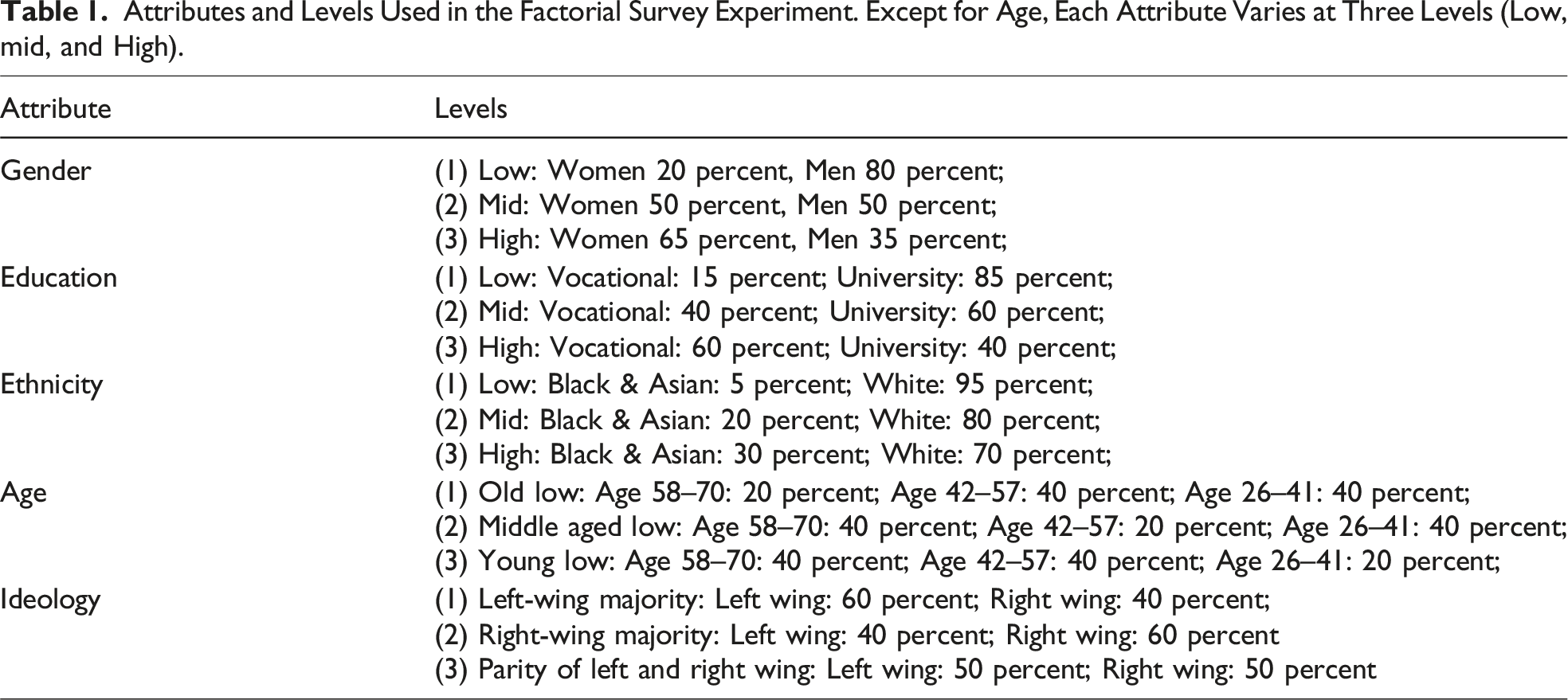
An increase to over 60 percent female representation—resulting in men being under-represented at 35%—distinctly signals a shift away from a male majority and mirrors scenarios in which gender parity principles have been questioned, such as Sanna Marin’s cabinet. This setup allows me to examine whether a shift from gender parity to slight male under-representation influences men’s perceptions of fairness and substantive representation. The asymmetry in representation levels (20/80, 50/50, 65/35) further enables a comparison between men’s reactions to mild under-representation of their own group and the historically more pronounced under-representation faced by women. To support accurate inferences about responses to over-representation, I selected a relatively modest yet noticeable 15 percent women’s majority. This advantage for women is: (1) substantial enough to be salient to respondents but (2) moderate enough to remain credible as an election prediction, thereby enhancing experimental realism (Druckman 2022). Findings from the 65 percent women’s representation likely generalize to scenarios with even greater imbalances—such as men being represented at only 20 percent, paralleling historical levels of women’s under-representation. This supports the external validity of effects observed at or beyond the 65 percent threshold (Druckman 2022).
The representation of other groups also shifts to levels that reflect high or even over-representation compared to the population. For example, members of parliament (MPs) with vocational training are represented at 15 percent, 40 percent, or 60 percent levels. In the pre-test phase, respondents were asked to estimate the share of these groups within the overall population. While respondents generally provided accurate estimates, the shifts used in the factorial survey experiment are designed to be substantial, often altering the majority composition of the fictional parliament. This ensures that the attribute levels effectively manipulate the representation of different types of groups, not only those with well-known population shares, such as gender and ethnicity. To minimize the cognitive burden, I limited the number of attributes to five, each with three levels. The order of attributes was randomized across respondents but remained consistent across tasks.
The levels of representation were provided in a numeric format and visualized using large icon arrays to present the statistical information in an accessible manner (Figure 1). The icons were color coded to reduce respondents’ cognitive burden and help them quickly process the information.
12
Hypothetical scenario of assembly composition displayed in numerical and array format.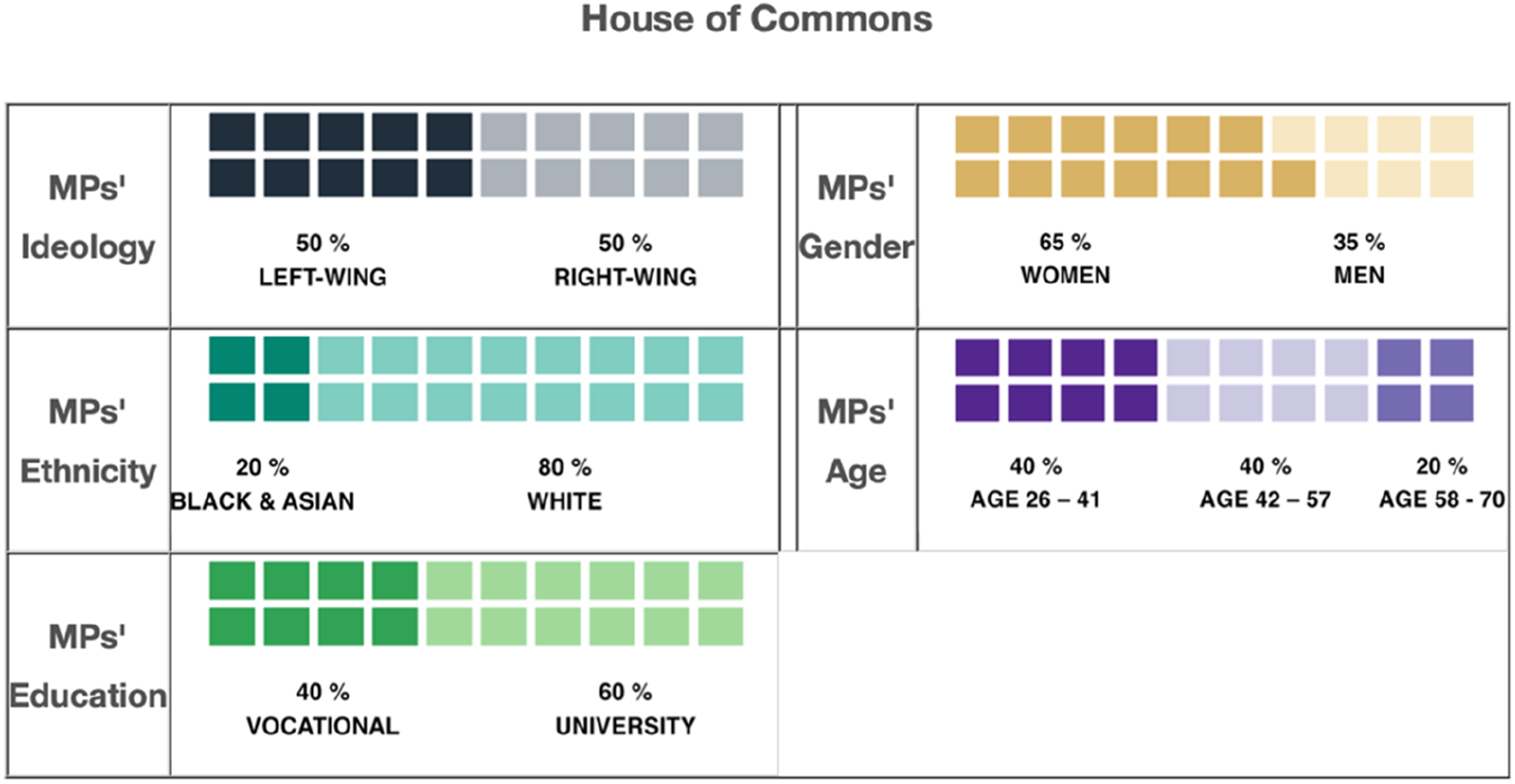
To ensure the treatment’s effectiveness, I implemented several measures and pre-tested different versions of the experimental design. Tests conducted during multiple pilot studies confirmed that respondents could understand, process, and compare the numerical and visual information provided: over 90 percent correctly answered two graph literacy questions designed to test their comprehension of the experimental design. Furthermore, I randomized the side on which women, working class, younger, Asian and Black representatives were displayed across respondents. For example, in Figure 1 women were placed on the left and men on the right.
My experimental design allows me to isolate the importance of women’s versus men’s representation within a multidimensional concept of representation while holding other forms and levels of representation (e.g., ideology) constant. This approach addresses challenges found in observational studies, where women’s representation often correlates with that of other groups; for example, increases in women’s representation in a newly elected parliament may coincide with greater representation of younger politicians. Using a factorial survey experiment, I can separately assess preferences for men’s and women’s representation levels regarding perceived output expectations and fairness.
By focusing on collective rather than dyadic representation—assessing shifts in group representation rather than choices between or ratings of individual representatives—I can test whether shifts in collective representation are perceived as gains or losses in terms of political agenda and fairness. Appendix 3 provides several diagnostics demonstrating that the factorial survey experiment functioned as intended (Hainmueller et al., 2014).
Analysis
I begin by presenting men’s output expectations and fairness perceptions across three levels of gender representation, as illustrated in Figure 2. These estimates are derived from linear regression models, where the ratings on the output expectations and fairness perceptions measures are the dependent variables. Cluster-robust standard errors account for respondent-level clustering, and the scenario of equal gender representation serves as the baseline.
13
Predicted values for output expectations and fairness perceptions for male respondents. The estimates are based on ratings on a 11-point scale from 0 to 10.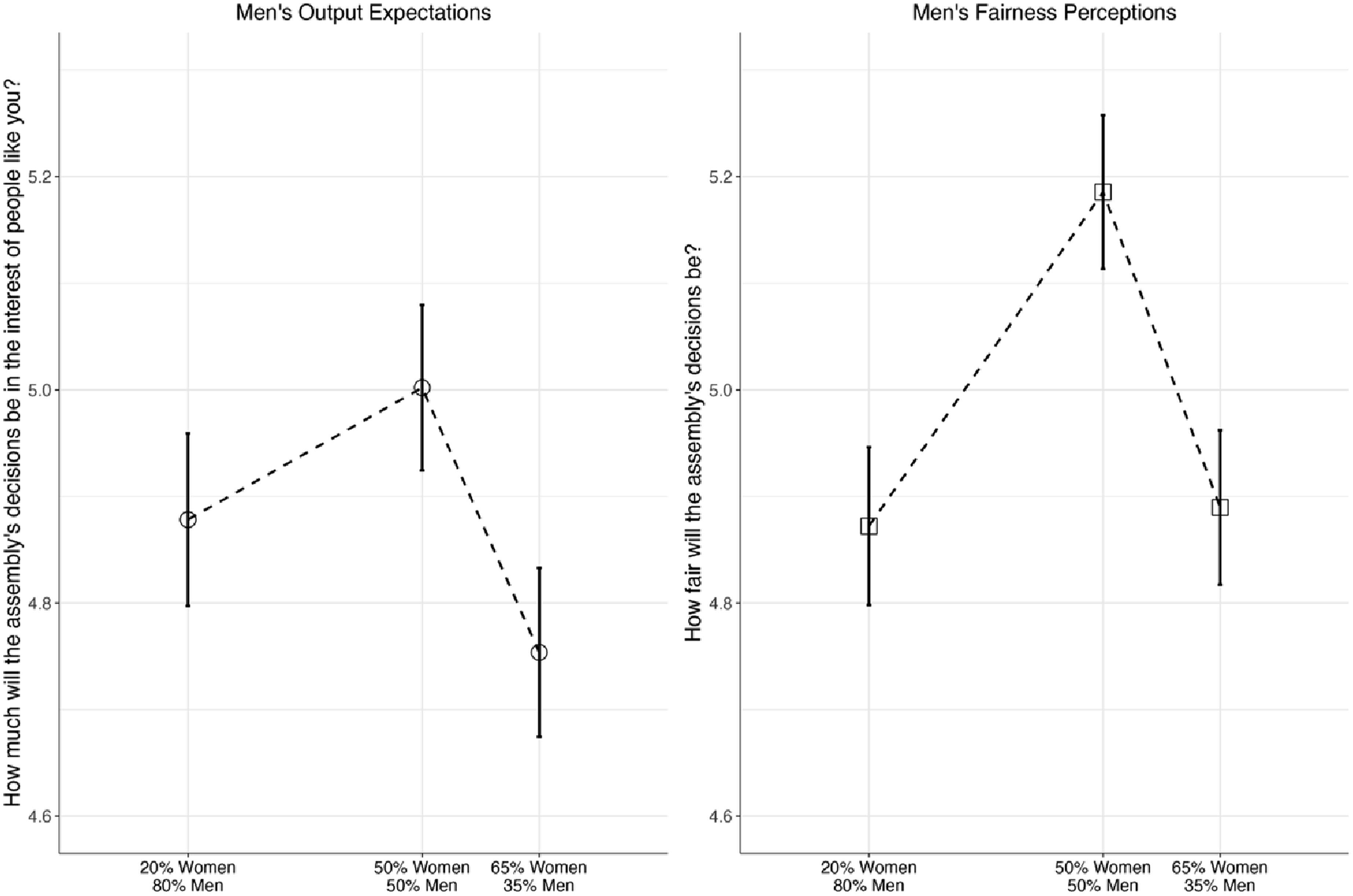
Figure 2 depicts the effects on men’s output expectations—whether they expect the assembly’s decisions to align with the interests of people like them. 14 Contrary to what I initially anticipated, male respondents’ output expectations decrease slightly (by 0.12 points) when women are significantly under-represented compared to the baseline of equal gender representation—a statistically significant difference (see Table A7 in Appendix 4 for model details). This modest decline contradicts the expected direction of the effect proposed in Hypothesis 1, which predicts that increasing women’s representation would reduce men’s output expectations.
However, when women constitute a majority in parliament (65 percent representation), men’s output expectations decrease by 0.25 points from the gender parity baseline. Men perceive a reduction in the output generated in their interest in a woman-majority scenario. Thus, while Hypothesis 1 is not supported in the transition from 20 percent female representation to gender equality, it finds partial confirmation in the decline observed when women outnumber men. I find similar results for the second outcome measure on output expectations, which captures a longer-term perspective by assessing whether men believe the assembly’s decisions will improve their future well-being. 15 The similar pattern reiterates the partial confirmation of Hypothesis 1. 16
To benchmark these effect sizes, I compare men’s responses to shifts in gender representation with reactions from two ideological groups to changes in ideological majorities in a fictional House of Commons as an additional analysis. Left-wing respondents’ 17 output expectations fell by 1.09 points when the majority shifts from left to right, while those of right-wing respondents’ decreased by 0.61 points when the majority shifts to the left. 18 The effect sizes for men’s responses to gender representation shifts are roughly one-third to one-half the size of the ideological responses to majority shifts. Men’s attention to gender representation is moderate when other forms of representation, such as class and ethnicity, are also considered.
Figure 2 shows that the level of gender representation also influences men’s perceptions of the fairness of the assembly’s decisions. The estimates are based on a linear regression model using the outcome measure of the anticipated fairness of future decisions (see Table A10 in the Appendix for details). 19 Male respondents report a decrease of 0.31/0.30 points in fairness perceptions when either gender group is under-represented compared to a scenario of equal representation. These findings align with the expectation that gender parity is perceived as the fairest composition (Hypotheses 2 and 3). Leveraging the asymmetry of the treatment, male respondents seem to view women’s strong under-representation as equally (un)fair as their own slight under-representation. This suggests that, on average, men do not apply the same fairness standards to their own under-representation as they do to women’s under-representation. 20 I report similar results for the related outcome measure of fairness perceptions, assessing how unfair respondents perceive compositions to be to some groups, in Table A11 in Appendix 4.
It is possible that the negative effects found in the scenario of a women-majority parliament on output expectations stem from the assumption that increases in women’s representation are associated with an increase in left-wing women. While the experimental design holds the ideological composition constant, it does not control for potential intersections respondents may infer between gender and ideological groupings of MPs. To address this possibility, I conduct an additional exploratory analysis to evaluate whether the negative effect of moving from 50 percent to 65 percent female representation in the fictional parliament varies according to men’s ideological self-placement (right vs. left wing). The results from linear regression models, presented in Table A17 and Figure A3 in Appendix 5, include interaction terms between ideological self-placement and levels of gender representation. The findings indicate that the interaction terms are insignificant, suggesting no substantial difference in the effect of women’s over-representation based on ideological self-placement. I provide an additional analysis of whether assessments of shifts in gender representation differ across ideological majorities and levels of trust in the current parliament; I detect insignificant differences across ideological majorities (See Appendix 5).
Finally, I evaluate the results for men with high and low levels of pre-treatment measured attitudes toward actions in favor of gender equality in the business sector. Figure 3 illustrates the effects of gender composition on output expectations and fairness perceptions depending on the extent to which male respondents perceive current developments in gender equality in business as undermining vs. enriching for society.
21
The results are based on model output in Tables A13 (output expectations) and A14 (fairness perceptions) in Appendix 4 page 9 in the SI. Contrary to expectations, the results suggest that the negative effects of women’s over-representation are not stronger for men who perceive measures of gender equality as undermining; both sub-groups of men display negative reactions to women’s over-representation for both outcome measures. Male respondents’ output expectations and fairness perceptions by level of gender representation and attitudes toward gender equality in the business sector.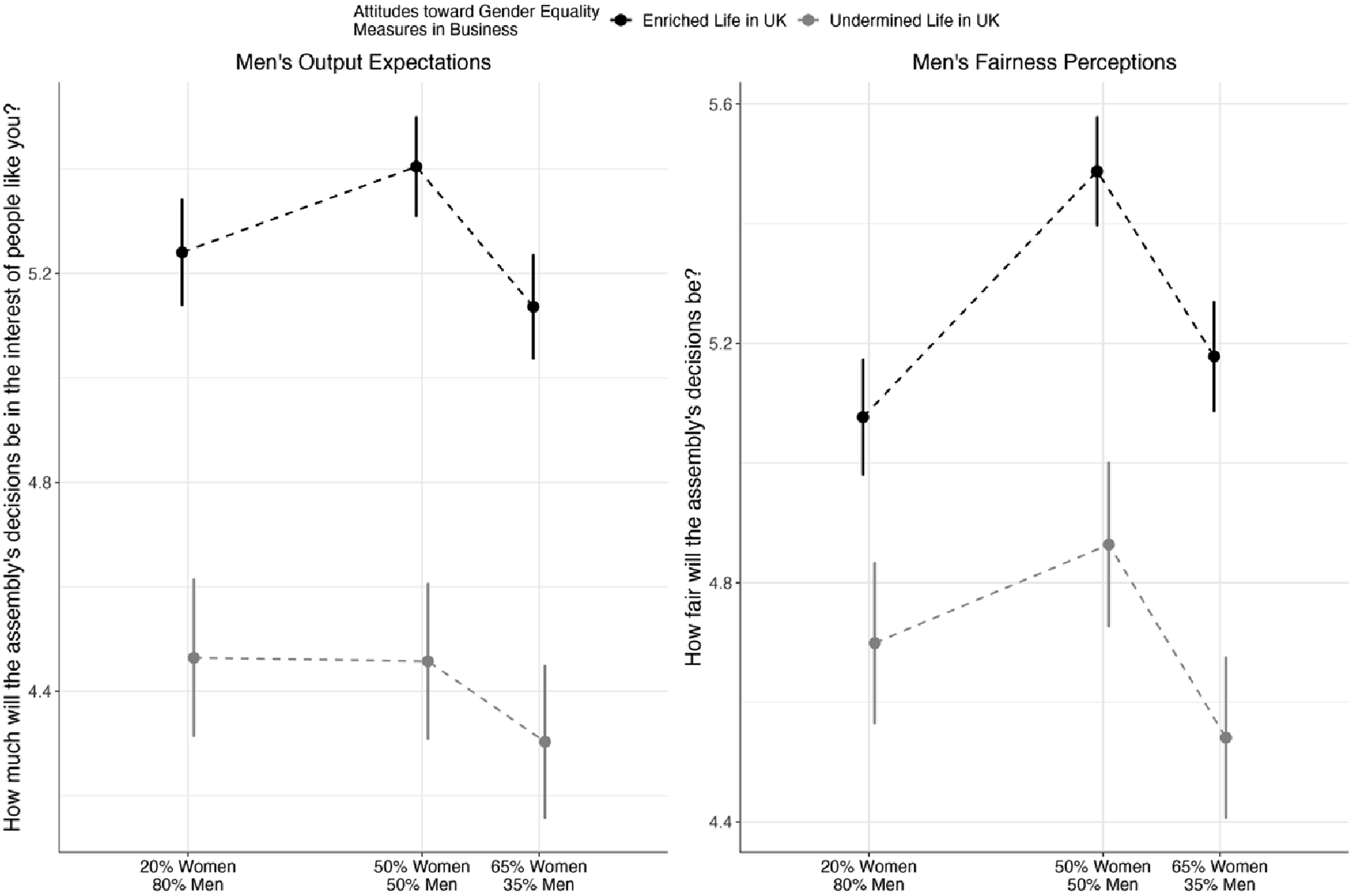
These results do not support Hypotheses 4 or 5. However, male respondents who report concerns about gender equality measures in business do differ from those who do not: the former perceives shifts from 50 percent to 20 percent women as less unfair (see significant interaction effect in Table A14). Hence, the fairness concerns regarding women’s under-representation are limited to certain sub-groups of men.
Overall, these results indicate that men’s perceptions of representation of their interests are linked to changes in gender composition. When women’s representation exceeds that of men, men expect less output in their favor. This suggests that men assume female representatives will prioritize women’s interests, creating a perceived tension with their own when women are in the majority. 22 This effect is consistent across different sub-groups of men. However, men think about women’s representation in ways that extend beyond their own self-interest. I do find that gender representation informs men’s fairness perceptions: on average, men perceive the equal representation of both genders as the fairest. However, this is limited to men who perceive support for women’s careers as beneficial to British society. Additionally, the way men factor women’s representation into their fairness perceptions differs from how they do so with regard to their own self-interest. Their reactions to women’s descriptive representation are stronger in relation to fairness perceptions than to output expectations, suggesting that two distinct dimensions are at play. This is most evident in the significant drop in fairness perceptions when women’s representation moves from 50 percent to 20 percent. While this shift also decreases men’s output expectations, the impact is less pronounced than for fairness.
Conclusion
Women are steadily gaining representation in political office; in some cases, they outnumber men. These shifts prompt varied reactions among men, the historically over-represented group. A key question is whether men perceive their self-interest as being negatively impacted and how they evaluate women’s representation in terms of overall fairness. In this study, I examine how different levels of gender representation—over-representation of men, equal representation and (narrow) under-representation of men— affect how men perceive future political decisions, both in terms of procedural fairness and policy output.
Using a well-powered experimental design, I demonstrate that women’s descriptive representation significantly influences men’s perceptions of both their self-interest and the fairness of decisions made by democratic institutions. Regarding output expectations, men’s perceptions that their interests are being considered remain stable as women’s representation increases to parity. However, once men become under-represented, they perceive a loss of influence over the political agenda. I observe this shift in a scenario of a moderate increase in women’s representation from 50 percent to 65 percent.
Moreover, men’s fairness perceptions—a dimension of assessment of democratic institutions that considers the implications for society as a whole—improve when gender representation is balanced at 50 percent. Fairness perceptions decline in scenarios in which men or women are under-represented. These findings highlight how gender representation affects evaluations of democratic institutions along both ego-centric and socio-tropic dimensions.
The findings have normative and substantive implications for key decision-making bodies in democratic systems, particularly in the executive and legislative branches, and their gender composition. Changes in the majority of women versus men appear to signal shifts in preference representation to male citizens. The results suggest that women legislators are perceived as advocates for women’s interests; a female-majority body may be interpreted as a shift toward policies aligned with those interests, potentially marking a departure from a male-dominated agenda. Future research could further explore whether increased women’s representation negatively influences men’s socio-centric considerations—that is, whether men believe a female-majority legislature disadvantages their closest social group (e.g., other men). This could be investigated, for example, by analyzing relevant outcome measures or examining responses to open-ended questions concerning men’s initial associations with female representatives. If men conceptualize political interests in gendered terms, then shifts in gender composition may be seen as impacting not only their individual interests but also those of their gender group. These findings highlight the importance of examining both self- and group-based interests and challenge earlier claims that the effects of women’s representation are primarily socio-tropic (Breyer 2024; Schwindt-Bayer and Mishler 2005).
However, the results reinforce conclusions from previous studies that increases in women’s representation—up to the point of equal representation between genders—do not jeopardize men’s self-interest. This suggests that concerns about negative male reactions should not deter efforts to promote gender parity in political representation. In fact, the positive effects that equal representation can have on men’s perceptions of fairness may translate into greater overall confidence in decision-making bodies, further indicating that promoting gender parity can benefit the stability of the political system as a whole. This is particularly relevant for initiatives that alter the gender composition of institutions, such as various types of quota laws or other mechanisms to support women’s representation (e.g., financial assistance for their political campaigns). When designing such policies, it may be important to ensure that they aim to achieve balanced levels of gender representation in key decision-making bodies.
Finally, the results have important implications for men’s sentiments toward democratic political systems. Fairness perceptions and output expectations are fundamental components of satisfaction with democratic institutions (Aarts and Thomassen 2008; Esaiasson et al. 2019; Reher 2015). Violations of the principles of gender equality—and men’s resulting perception that the political agenda is slipping away from them and their interests, or that the political system is treating them unfairly—may trigger feelings of being political outsiders. Such feelings may have behavioral consequences, such as voting for parties that promise to reverse these developments (e.g., Anduiza and Rico 2022). While instances of women outnumbering men in cabinets, legislatures, or other key decision-making bodies are still rare, they may become increasingly common. Understanding how these shifts affect men’s perceptions will be critical for anticipating and managing the democratic consequences of evolving gender dynamics in representation.
Supplemental Material
Supplemental Material - How Men React to Shifts in Gender Representation: Ignored Interests? Good for Society?
Supplemental Material for How Men React to Shifts in Gender Representation: Ignored Interests? Good for Society? by Verena Reidinger in Political Research Quarterly.
Footnotes
Acknowledgements
I am grateful to the two anonymous reviewers at Political Research Quarterly for their thoughtful and constructive feedback, which significantly improved this manuscript. I would also like to thank Jonathan Slapin, Lucas Leemann, Silja Häusermann, Ana Weeks, Daphne van der Pas, Jesper Lindqvist, Magdalena Breyer, Valentina Consiglio, Bilyana Petrova, Delia Zollinger, Catarina Pereira, Fabienne Eisenring, and Reto Mitteregger for their detailed comments. I also thank seminar participants at the University of Zurich, Swiss Political Science Association Conference (2024), and the European Political Science Association 14th Annual Conference (2024).
Declaration of Conflicting Interests
The authors declared no potential conflicts of interest with respect to the research, authorship, and/or publication of this article.
Funding
The authors disclosed receipt of the following financial support for the research, authorship, and/or publication of this article: The UZH Research Priority Program ‘Equality of Opportunity’ has supported this research.
Data Availability Statement
Replication material can be found at: https://doi.org/10.7910/DVN/IOXIKG,  .
.
Supplemental Material
Supplemental material for this article is available online.
Notes
References
Supplementary Material
Please find the following supplemental material available below.
For Open Access articles published under a Creative Commons License, all supplemental material carries the same license as the article it is associated with.
For non-Open Access articles published, all supplemental material carries a non-exclusive license, and permission requests for re-use of supplemental material or any part of supplemental material shall be sent directly to the copyright owner as specified in the copyright notice associated with the article.
