




Abstract
Black, Latino, and Asian-American candidates have disproportionately ran as Democrats in the modern political era. Yet the number of nonwhite Republican candidates for U.S. Congress reached a record high of 260 in 2022, nearly tripling the number who ran in 2016. I utilize a candidate-level dataset to provide the first account of who these nonwhite Republican candidates for Congress are, where they run, and how they fare both electorally and financially. I find that despite increases in the number of nonwhite Republicans who run for office, these candidates are not well positioned to win. In comparison to their white counterparts, nonwhite Republicans are less experienced candidates who run in unfavorable districts and raise less money. Additionally, I employ an original survey of 2022 congressional candidates and find that nonwhite Republicans report facing greater institutional and electoral hurdles than white Republicans. Overall, these findings further our understanding of how the barriers to political representation may differ across social groups, while highlighting the enduring limitations that the Republican Party faces in broadening its electoral tent.
Introduction
In 2013, following the defeat of presidential candidate Mitt Romney, the Republican National Committee issued a report titled the Growth and Opportunity Project. This “autopsy” of Romney’s defeat concluded that the Party would need to fundamentally change in order to broaden its appeal to an increasingly diversifying electorate. The report emphasized the importance of adopting policy positions that better mirrored public opinion and recruiting diverse candidates who could effectively convey these messages to voters.
The Republican Party has made advances in recruiting and attracting candidates from diverse racial and ethnic backgrounds who align with ideologically conservative viewpoints. High-profile Republicans do seem to believe it is electorally advantageous for the Party to expand its governing coalition. For instance, former House Speaker Kevin McCarthy has remarked to donors that to win and hold a Republican majority in Congress, Republicans must elect candidates who “better reflect the nation as a whole” (Cai 2023). Part of this stems from the calculus that racial minority candidates are better able to appeal to voters of color. Indeed, several studies show that nonwhite candidates experience greater electoral support from coethnic voter groups (Barreto 2007; Barreto, Segura, and Woods, 2004; Washington 2006).
The political media has characterized the proliferation of nonwhite Republican candidates for office as a relatively new phenomenon (Scott 2022). Historical data confirm the dramatic nature of this shift. The left panel of Figure 1 presents the total number of nonwhite Republican congressional candidates and officeholders from 1980 to 2022. The right panel presents the data as the proportion of Republican candidates and officeholders that are nonwhite.
1
The number of nonwhite Republican candidates for Congress has increased rapidly in recent years, particularly over the last three election cycles. Overall, 260 nonwhite Republicans ran for election to the U.S. House in 2022 alone, nearly tripling the number who ran just 6 years prior in 2016. Over the last three election cycles, nearly 20 percent of Republican candidates were from a racial minority group. Yet only a handful of these nonwhite candidates were elected to office—a mere 8 percent of Republican officeholders in these same three election cycles were nonwhite.
2
Despite a substantial number of nonwhite Republicans making runs for Congress, there have not been tangible changes in the racial composition of the key congressional power players in the Republican Party: officeholders. Nonwhite Republican candidates and officeholders over time.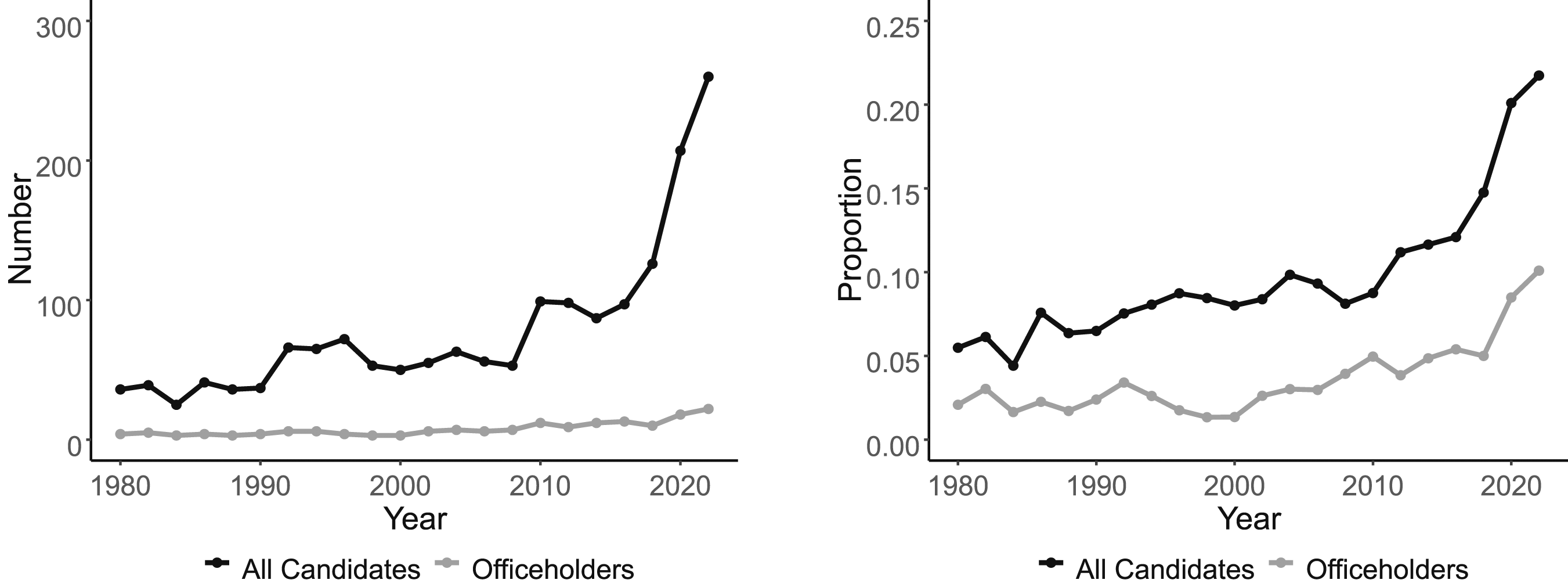
This paper examines why a diversifying candidate pool has not led to greater diversity within the halls of Congress for Republicans. Using a dataset of all congressional primary candidates across three election cycles, along with an original survey of congressional candidates, I find that nonwhite Republicans are running for Congress, but not in the ways that foretell winning. Key electoral characteristics and contexts hinder their pursuit of elected office. Nonwhite Republicans are less experienced candidates than white Republicans and they raise less money in the crucial early stages of the campaign. They also run in unfriendly electoral environments: districts that are more Democratic and racially diverse. In addition, nonwhite Republicans report receiving less institutional support from the party and from their immediate networks. This unfriendly backdrop begets poor general election outcomes and contributes to their underrepresentation among Republican officeholders. With other demographic groups, large increases in the number of candidates running for office have generally resulted in subsequent increases in elected officials. For example, the 1992 “Year of the Woman” and its 2018 counterpart saw substantial increases in both the number of women running for, and elected to, Congress. 3 The same is not true for nonwhite Republicans.
Thus, this paper also furthers our understanding of how the barriers to political representation may differ across social groups. While a lack of representation at the candidate level is the primary inhibitor to increasing descriptive representation for social groups like women and working class Americans (i.e., Carnes 2018; Lawless and Fox 2010), the findings suggest that it will take more than a candidate to improve nonwhite representation within the Republican Party. These candidates not only need to run, but they need to do so in favorable contexts while receiving meaningful party support in order to have a realistic chance of winning. By and large this is not happening. The results from an original candidate survey highlight how a lack of institutional support for nonwhite Republicans fits within these broader empirical findings. Overall, increases in the number of nonwhite Republicans running for office have not led to greater levels of racial representation within the ranks of officeholders.
A Recipe for Underrepresentation
Winning congressional elections is highly context dependent. Candidate characteristics, campaign resources, electoral environments, and institutional backing are particularly impactful for who gets elected to office and who does not. Comparing how these core predictors differ between white and nonwhite Republicans will help identify the key factors contributing to the underrepresentation of nonwhite Republicans in the party’s governing coalition.
Candidate Characteristics
With respect to candidate characteristics, prior political experience has long been an important variable in the study of electoral politics. It may be that the gap between nonwhite Republican candidates and officeholders is partially rooted in political backgrounds. Previous work has shown that experienced candidates behave strategically and are more likely to enter congressional races when their odds of winning are high (Carson, Engstrom, and Roberts, 2007; Jacobson 1989; Jacobson and Kernell 1983). Voters also use prior political experience as a signal of candidate competence and suitability for higher office (Portmann 2022), and it is closely associated with electoral success.
Existing work highlights disparities in experience between white and nonwhite candidates (Branton 2009; Shah 2015). Additionally, Black candidates are less inclined to seek higher office if they feel that their race may diminish their appeal to white voters and, consequently, their likelihood of winning (Highton 2004). Other research finds that Black candidates are significantly less likely than white candidates to win elected office across levels of government, including important “stepping stone” positions like municipal, county, and state offices (Shah 2015). The bulk of scholarship on prior experience, and its implications for winning, has not considered how these dynamics might apply to nonwhite Republicans specifically. However, I anticipate similar racial disparities in prior experience between white and nonwhite Republicans, reflecting the patterns seen between white and nonwhite candidates more broadly. This lack of experience will underscore the struggles these candidates face and contribute to their underrepresentation in Congress.
It is also possible that nonwhite Republicans display a unique ideological bent which impacts their electoral fortunes. Candidate ideology has important implications for who runs for, and wins, elected office (Hall 2019; Thomsen 2017). Indeed, previous scholarship has shown that more ideologically extreme candidates receive slight electoral benefits in the primary stage (Hall and Snyder 2015). Thomsen (2015) additionally investigates why women are underrepresented within the Republican Party, finding that ideological conformity within the party influences the decision to run for office which specifically impacts Republican women. However, the ideology of nonwhite Republican candidates remains an open question—they may be distinct from white Republicans, but ideological differences may also not emerge.
Turning to campaign resources, early fundraising is an important indicator of candidate viability and support (i.e., Aldrich 1980; Bonica 2017; Krasno, Green, and Cowden, 1994). In addition, raising early money often foretells fundraising success in later stages of the campaign (Biersack, Herrnson, and Wilcox, 1993; Smidt and Christenson 2012), while generating a perception of viability from the media, donors, engaged voters, and other candidates (La Raja 2007). I focus on early money for the following analyses because of this importance, both symbolically and materially. Considering the sources of money, raising early funds from individual donors specifically is crucial because individuals are the single largest source of campaign contributions (Barber, Canes-Wrone, and Thrower, 2017). Donations from individuals can also provide a rough proxy for candidate popularity and viability in ways that funds from other sources, like self-financing, cannot. Indeed, extant scholarship has shown that candidate fundraising ability is correlated with voter support and electoral success, particularly in primary elections (Bonica 2017; Maestas and Rugeley 2008; Thomsen 2023).
Existing research has found that nonwhite candidates face fundraising challenges in their runs for political office (Albright 2014; Johnson, Oppenheimer, and Selin, 2012). Additionally, coethnics are most likely to donate to coethnics and the supply of nonwhite Republican donors is low (Grumbach and Sahn 2020). Bonica (2017) emphasizes the important role that personal and professional networks play in obtaining early financial backing. These networks are often segregated along racial lines, among other social characteristics (Hellerstein and Neumark 2008).
Many nonwhite Republicans may therefore face a lose-lose proposition: first, they cannot rely on financial backing from coethnic donors who are more likely to be ideologically allied with Democratic candidates and causes. In fact, Democratic donors are more likely than Republicans to use racial group issues and identities to decide who to give to (Crowder-Meyer and Cooperman 2018). Yet, nonwhite Republicans are also less likely to occupy the personal and professional networks of potentially wealthy white Republican donors who might provide campaign funds in the pivotal early stages of the campaign. Furthermore, the limited representation of racial minority Republicans in “stepping stone” positions likely exacerbates these fundraising disadvantages as they may lack an established base of financial support and relationships forged through previous runs and victories. Due to these factors, Republican donors, both large and small, may not uplift the candidacies of nonwhite Republicans through early financial support, largely dooming their candidacies before votes are even cast.
District and Institutional Contexts
In addition to candidate characteristics, district characteristics are also associated with which candidates are elected to office. Traditionally, nonwhite candidates have found the greatest levels of success in districts with a large percentage of coethnic nonwhite voters (Barreto 2007; Washington 2006). In fact, a significant portion of this electoral success has been localized to majority–minority districts (Barreto, Segura, and Woods, 2004; Frederick and Jeffries 2009). This phenomenon is particularly applicable to nonwhite Democratic candidates (Juenke and Shah 2016). However, nonwhite Republicans cannot rely on broad coethnic support in primary elections because of their lack of ideological alignment with the majority of nonwhite voters who support Democratic candidates. Indeed, extensive work has analyzed Democratic loyalty among nonwhite voters and the political, social, and psychological factors that explain such allegiance (Huddy, Mason, and Horwitz, 2016; Wamble et al., 2022; Zheng 2019). Due to candidate supply factors, the geographic distribution of voters, and the general loyalty of nonwhite voters to the Democratic Party, I expect nonwhite Republicans to run in less favorable contexts than white Republicans, causing them to face long odds of victory based simply on the demographics and partisan makeup of their districts.
With respect to seat type, open seats are often prime opportunities for nonincumbents to win election as their electoral pathway does not include having to defeat an incumbent member of Congress (Jacobson 1990; Jacobson and Kernell 1983). Across the full dataset, over 70 percent of nonincumbents who won election to office did so via an open seat. I hypothesize that nonwhite Republicans also face unfavorable electoral contexts related to seat type, with fewer nonwhite Republicans running in open seat contests. Overall, it may be that the candidacies of nonwhite Republicans are not resulting in nonwhite Republican officeholders because they are running in unfavorable electoral environments which ultimately position them as “sacrificial lambs” within their Party—standard bearers in hopeless seats where the party just needs someone to run.
Finally, I predict that nonwhite Republicans will not benefit from recruitment, institutional support, and their own networks in the same way that white Republicans do. Recruitment has a powerful impact on candidate ambition and emergence (Fox and Lawless 2011; Maisel and Stone 2014). Prior work has shown that recruitment and emergence are imbalanced across social groups, which has contributed to the underrepresentation of traditionally marginalized populations like women and racial minorities (Fox and Lawless 2005; Lawless 2011). 4 Experimental research has also revealed that power players within both parties view nonwhite candidates as less likely to win primaries which may impact how they allocate party resources and support (Doherty, Dowling, and Miller, 2019). 5 Additionally, there are asymmetries in how the parties appeal to racial identities, with Republicans less likely to make appeals grounded in descriptive representation (Crowder-Meyer and Cooperman 2018; Grossmann and Hopkins 2015).
I also hypothesize that nonwhite Republicans are more limited in their access to wealthy, personal networks which propel candidates toward viability (Bonica 2017). For instance, donors are more likely to support coethnic candidates and the supply of nonwhite Republican donors is limited (Grumbach and Sahn 2020). This lack of an established donor base may further constrain their ability to make successful runs. Ultimately, I expect the attitudes and experiences of Republican candidates to illustrate that nonwhite Republicans are not recruited by party leaders and that they do not benefit from elite networks to the degree that white candidates do.
Despite large increases in the number of nonwhite Republican candidates for Congress, these candidacies are not resulting in subsequent increases in the number of nonwhite Republican officeholders. I argue that, in comparison to their white counterparts, nonwhite Republican candidates are disadvantaged because of key electoral factors. Specifically, I hypothesize that nonwhite Republicans will have less political experience, receive less in campaign contributions, be more likely to run in unfavorable contexts, and lack institutional support. These crucial disadvantages hinder their candidacies and ultimately curtail the number of nonwhite Republican members of Congress. The next section of the paper introduces the data sources and methodology, followed by a descriptive overview of the nonwhite Republicans who choose to run for Congress.
Data and Method
The analyses draw on congressional candidate-level data. 6 The primary scope of this paper considers three election cycles: 2018, 2020, and 2022. These election cycles were chosen not only because they were most recent and thus most relevant for understanding current dynamics, but also because they saw a relatively large number of nonwhite candidates and they vary in electoral environments, voter turnout, and whether they were held during a midterm or presidential year. Candidate race is the key independent variable and was collected according to a strict coding protocol. 7 Internet searches of candidates were utilized to find articles, interviews, candidate websites, and photographs which were used to determine a candidate’s race. I follow the methodology of Fraga, Gonzalez Juenke, and Shah (2020) and classify candidates into one of five racial categories: White, Black, Latino, Asian, and Native American. 8 For the three election cycles in this analysis, there were 271 Latino Republican candidates, 205 Black Republicans, 97 Asian-American Republicans, and 20 Native American Republicans.
Turning to the dependent variables, I consider a candidate experienced if they have previously held elected office (Jacobson 1989). Election outcomes were gathered through each state’s official election administration website, and I used presidential vote share data from Jacobson and Carson (2020) to measure district partisanship. 9 Campaign finance data was obtained through the Federal Election Commission (FEC). I utilize individual itemized contributions in the campaign finance analyses which consist of donations made by individuals to candidate fundraising committees that either exceed $200 or that were made through a third-party conduit like ActBlue or WinRed. Individual contributions consistently make up a majority of candidate funds, with itemized contributions constituting the bulk of individual contributions. For the purposes of differentiating between early and non-early money, I follow Porter and Steelman (2023) and define a contribution as early if it was given within 90 days of a candidate’s first recorded itemized contribution of the election cycle. A benefit to this 90-day measure is that it imposes an equal temporal time frame across all candidates and it ensures that contributions captured are truly “early.” 10
I also conducted a survey of 2022 congressional candidates to collect data on candidate experiences running for Congress and to explore whether nonwhite Republicans are supported by their party and networks. This survey was deployed over email during the 2022 election cycle. I obtained candidate email addresses from web searches, campaign websites, and social media accounts. Included in the survey were screening questions asking if the respondent was the candidate themselves or a member of campaign staff. At the end of the survey, respondents provided information about various demographic characteristics. Among other themes, the survey asked candidates about their experiences running for office, the relative importance of various candidate qualities and characteristics, and the perceived priorities of their party. Overall, 137 contacted candidates responded to the survey with varying levels of completion, for a response rate of 12 percent. 11 Further discussion of this survey is included in a later section of the paper.
Descriptive Patterns
Before presenting the results, this section provides a brief overview of the descriptive characteristics of nonwhite Republicans. Over the three election cycles in the time frame, 593 nonwhite Republicans ran for Congress constituting about 20 percent of all Republican candidates. In terms of gender, 36 percent of nonwhite, nonincumbent Republicans were female, outpacing the 17 percent of white, nonincumbent Republicans who were female. This gender disparity between white and nonwhite candidates is more pronounced among Republicans than Democrats: 41 percent of nonwhite Democrats were female compared to 33 percent of white Democrats. A key descriptive difference between nonwhite and white Republicans is their levels of prior political experience. Nonwhite Republican candidates are less experienced than white Republican candidates—11 percent of racial minority Republican candidates had prior political experience, compared to 19 percent of white Republicans. 12 This is particularly relevant in light of previous work which has shown that experienced candidates behave strategically and are more likely to enter congressional races when their odds of winning are higher (Jacobson and Kernell 1983).
Nonwhite Republicans are markedly similar to white Republicans when it comes to ideology. CFscores developed by Bonica (2014) use donor activity to generate ideology estimates for both incumbents and nonincumbents. Among nonincumbents, the average nonwhite Republican had a CFscore of 1.27 while the average white Republican had a CFscore of 1.26. 13 Responses from the candidate survey echo the ideological similarity between white and nonwhite Republicans: both groups report comparable levels of conservatism in their self-identified ideology. The median white and nonwhite Republican candidate reported their ideology as “Conservative” on a seven-point scale from “Extremely Liberal” to “Extremely Conservative.” Descriptively, it does not appear that there are ideological differences between nonwhite and white Republicans and, given these data, it would be surprising if ideology was a main driver of their differences in electoral success.
I next consider descriptive patterns in the types of districts that nonwhite Republicans choose to run in compared to white Republican candidates. District partisanship is perhaps the most significant predictor of electoral fortunes, particularly in our contemporary political climate defined by accelerating polarization (Jacobson and Carson 2020). Along this dimension, nonwhite nonincumbent Republicans ran in districts that were, on average, only 38.8 percent Republican (median = 38.9 percent). On the other hand, white nonincumbent Republicans ran in much more favorable districts which were, on average, 48.8 percent Republican (median = 49.1 percent). Relatedly, nonwhite Republicans ran in much more racially diverse districts: they ran in districts that were 51.3 percent nonwhite, on average, compared to 32.2 percent nonwhite for white Republicans. Nonwhite Republicans also ran in fewer open seat races than white Republicans: 24 percent of white Republicans ran in open seat races compared to only 18 percent of nonwhite Republicans.
Results
Association Between Candidate Race and Other Attributes, Nonincumbent Republicans, 2018 to 2022.
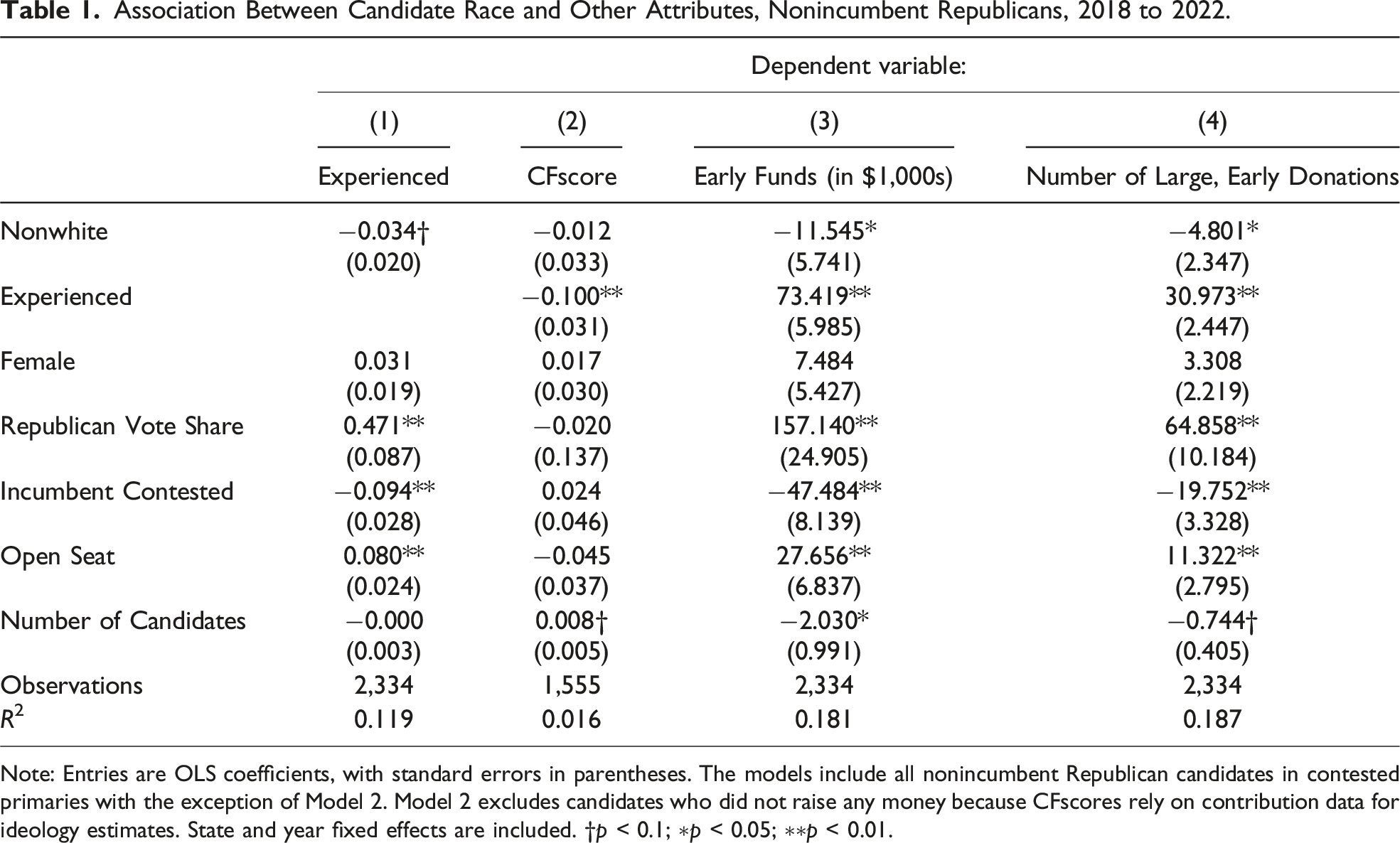
Note: Entries are OLS coefficients, with standard errors in parentheses. The models include all nonincumbent Republican candidates in contested primaries with the exception of Model 2. Model 2 excludes candidates who did not raise any money because CFscores rely on contribution data for ideology estimates. State and year fixed effects are included. †p < 0.1; ∗p < 0.05; ∗∗p < 0.01.
Perhaps nonwhite Republicans also differ from white Republicans with respect to ideology. Model 2 of Table 1 evaluates the relationship between candidate race and ideology with nonincumbent CFscores developed by Bonica (2014) as the dependent variable. 14 Positive values correspond to ideological conservatism. Following the descriptive patterns, nonwhite Republicans do not differ from white Republicans in their ideological leanings. While it is possible that nonwhite Republicans are perceived as ideologically distinct by voters, I find little empirical evidence that ideological incongruity is the driving factor responsible for the dearth of nonwhite Republican officeholders.
Shifting to resources, early campaign donations are another key predictor of victory at the ballot box and, as previously highlighted, early money has important implications for candidate viability. Therefore, it will be important to evaluate how nonwhite Republicans fare in attracting early donor support. In terms of early fundraising success, nonwhite Republicans raise less than their white counterparts. Over these three election cycles, the average nonwhite, nonincumbent Republican raised $32,838 in early individual itemized funds while the average white, nonincumbent Republican candidate raised $53,239. Excluding candidates who raised no money from the sample showcases a difference in early funds raised that is just as stark—within this sub-sample of nonincumbent candidates, nonwhite Republicans raised an average of $46,305 in early money while white Republicans raised an average of $76,267. In exclusively open seat races, white Republicans raised nearly twice as much as nonwhite Republicans ($93,871 vs. $54,662). Nonwhite Republicans thus raise less early money than white Republicans in absolute terms.
However, it is important to account for candidate and district characteristics like prior political experience and district partisanship which are closely linked to fundraising success. Model 3 of Table 1 therefore presents the total amount of early individual itemized primary funds received as the dependent variable with the inclusion of these other relevant independent variables. In first considering the controls, Republicans who have prior political experience, who run in more heavily Republican districts, and who run in open seat races are more successful in securing early financial backing. However, even with the inclusion of these relevant covariates, nonwhite Republicans are significantly more resource disadvantaged than their white Republican counterparts as they raise, on average, $11,000 less in early money. The Republican donor base does not seem to elevate nonwhite candidates financially, and nonwhite Republican campaign war chests are subsequently underfunded in the crucial, early stages of the primary campaign.
While overall early fundraising totals and grassroots donor support are undoubtedly important, securing the early financial backing of wealthy individuals who are willing to provide high-dollar donations is often the financial foundation that propels campaigns towards long-term solvency and provides a crucial degree of viability. Large-dollar donations are particularly important in the early stages of the primary when voter information and enthusiasm is low, and they also give candidates more “bang for their buck” in the fundraising process. 15 As demonstrated by Model 4 of Table 1, nonwhite Republican candidates for Congress face additional struggles in attracting wealthy donors who might be willing to make large, early contributions, securing fewer of these contributions than white Republicans. These patterns similarly endure when raising the donation threshold to only include max-out contributions, as evidenced by Appendix Table A.1.
The results here illustrate an important facet of the failures of the Republican Party in diversifying their congressional candidate pool to include viable, nonwhite candidates. As fundraising becomes increasingly important for mounting competitive congressional campaigns, nonwhite Republicans are not well positioned from the outset of their candidacies. Additionally, it appears that nonwhite Republicans do not benefit from the institutional networks of the donor elite in the same ways that white candidates do. These candidates are left comparatively resource-strapped and without an important early indicator of viability and support. Without more meaningful financial backing, particularly in the early stages of the campaign, nonwhite Republicans are set up for electoral failure.
Association Between Candidate Race and District Characteristics, Nonincumbent Republicans, 2018 to 2022.
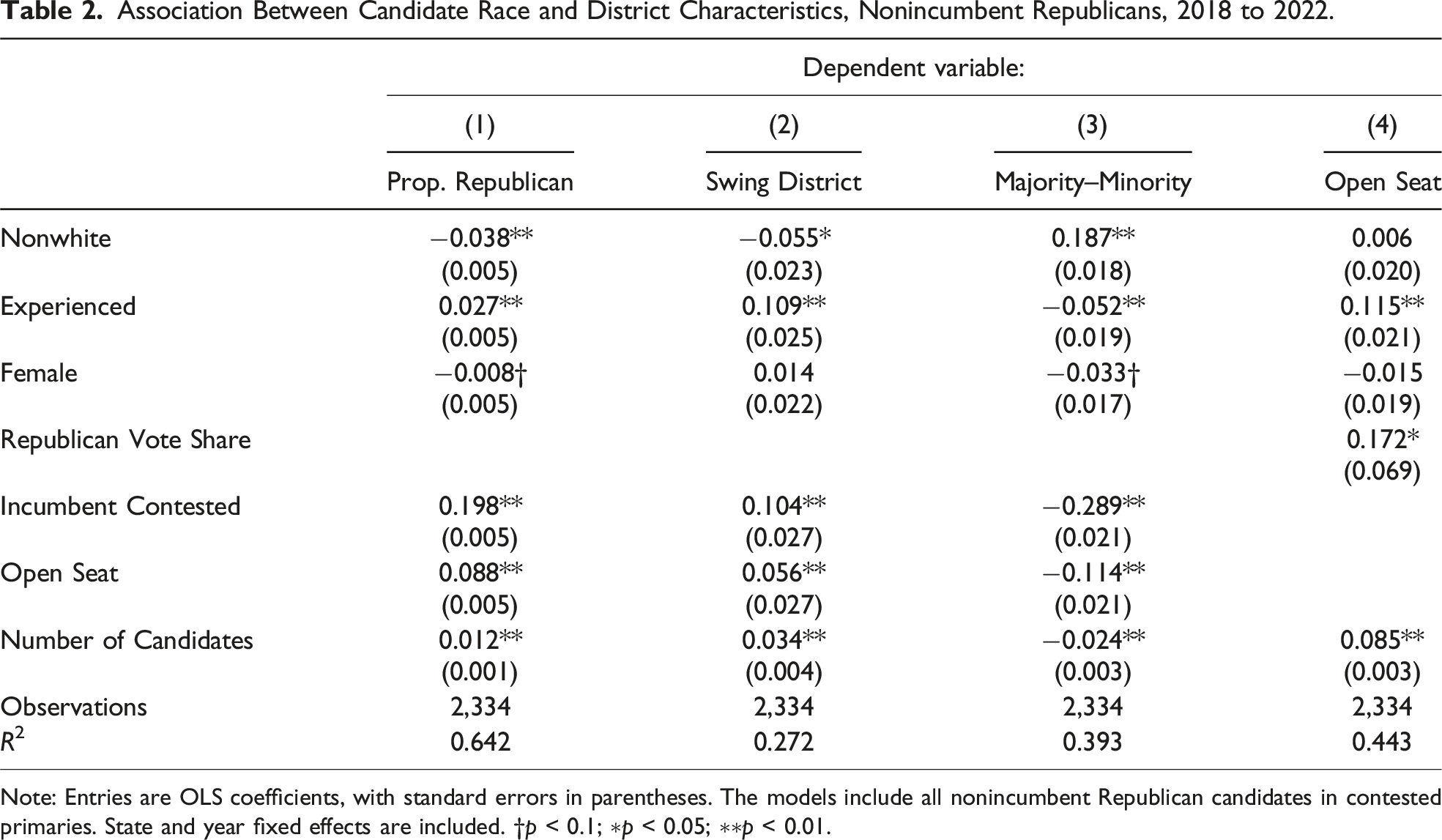
Note: Entries are OLS coefficients, with standard errors in parentheses. The models include all nonincumbent Republican candidates in contested primaries. State and year fixed effects are included. †p < 0.1; ∗p < 0.05; ∗∗p < 0.01.
Model 2 of Table 2 evaluates the relationship between candidate race and running in a competitive partisan district. These “swing” districts are seats where either party could conceivably win a general election. The dependent variable utilizes the classification system of Hirano and Snyder (2019) which denotes districts as competitive when Republican presidential vote share is between 42.5 percent and 57.5 percent. Nonwhite Republican candidates for Congress are significantly less likely to run in these swing districts than white Republicans. They are not the standard bearers for their party in the races that are commonly decisive in determining the partisan balance of power in the chamber. Taken in conjunction with the results of Model 1, this suggests that nonwhite Republicans are not who the party turns to in order to win key seats.
While undoubtedly linked to district partisanship, it is worth testing the relationship between candidate race and district racial demographics explicitly. Model 3 of Table 2 uses a binary measure of whether a district is majority-nonwhite as the dependent variable. 17 A significant portion of electoral success for nonwhite candidates has taken place in majority–minority districts (Frederick and Jeffries 2009). Importantly, support for the Democratic Party is often robust in these districts, limiting the potential for Republicans to have realistic paths toward winning election to office (Juenke and Shah 2016). As evidenced by Model 3, nonwhite Republicans are significantly more likely to run in majority–minority districts than white Republicans. Most of these districts are Democratic strongholds and the Republican candidates running in them, who are disproportionately nonwhite, have virtually no chance of winning a general election and securing a seat in Congress. Like the district partisanship results, district demographics play a large role in the underrepresentation of nonwhite Republican officeholders.
Model 4 of Table 2 tests the relationship between candidate race and seat type, specifically considering differences in the likelihood of running in open seat races. While descriptively nonwhite Republicans are less likely to run in this more favorable context, after controlling for other covariates the relationship between candidate race and likelihood of running for an open seat is not statistically significant. The underrepresentation of nonwhite officeholders within the Republican Party is not driven by a lack of candidate entry into open seat races. Rather, other key variables are responsible for this dearth of nonwhite Republican lawmakers. Note, for example, the statistically significant relationship between prior political experience and running in open seat contests. This linkage is well documented (Jacobson 1989; Lazarus 2008) and is notable in conjunction with the fact that nonwhite Republicans are less likely to have prior political experience than white Republicans. Taken together, these metrics paint a relatively grim picture for racial minority Republican candidates. They face an uphill climb in their pursuit of elected office based strictly on the profiles of their districts. While many nonwhite Republicans do run for Congress, most are not running in races where they have a realistic chance of winning, which heavily contributes to the dearth of nonwhite Republican officeholders.
Association Between Candidate Race and Election to Office, Nonincumbent Republicans, 2018 to 2022.
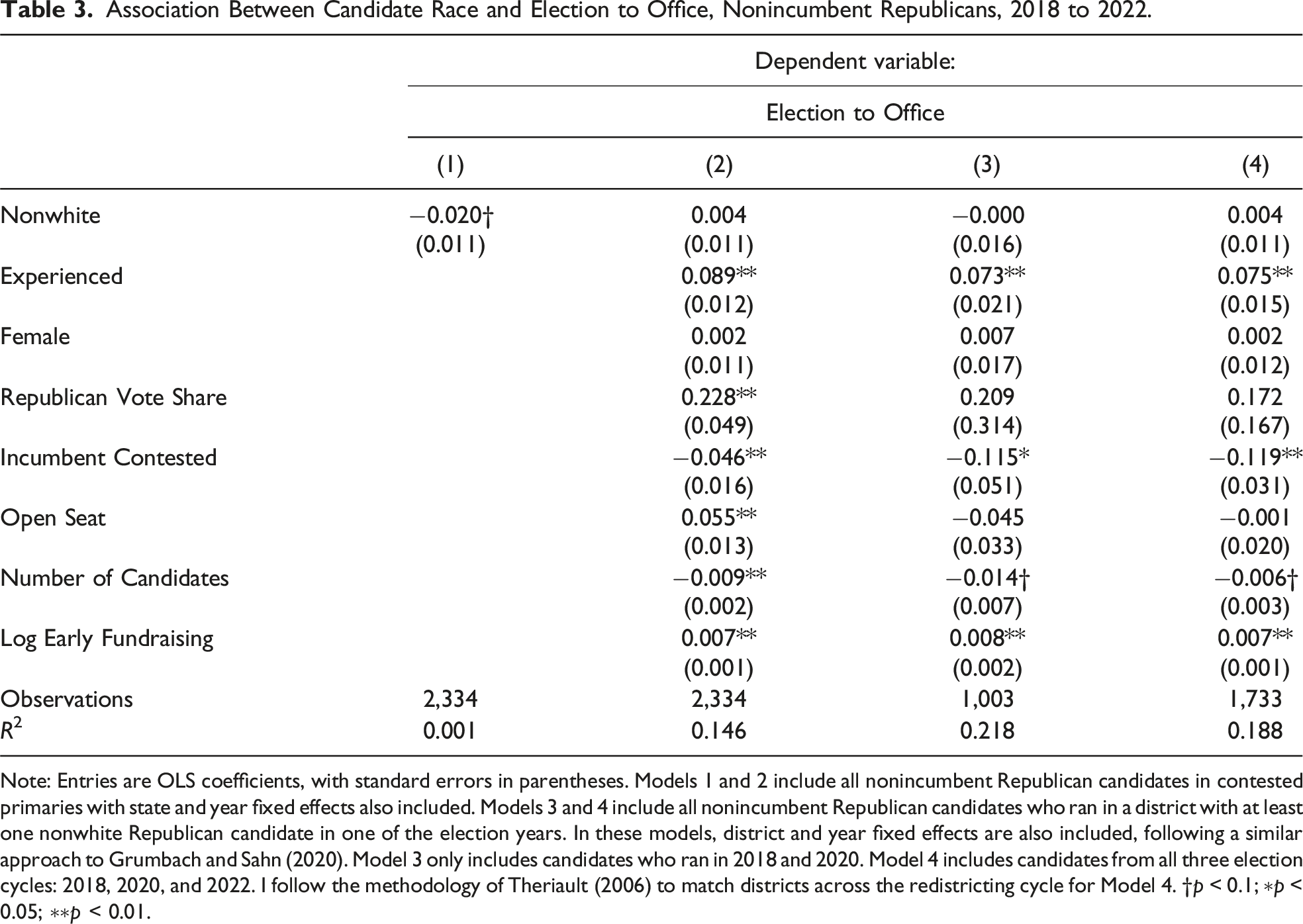
Note: Entries are OLS coefficients, with standard errors in parentheses. Models 1 and 2 include all nonincumbent Republican candidates in contested primaries with state and year fixed effects also included. Models 3 and 4 include all nonincumbent Republican candidates who ran in a district with at least one nonwhite Republican candidate in one of the election years. In these models, district and year fixed effects are also included, following a similar approach to Grumbach and Sahn (2020). Model 3 only includes candidates who ran in 2018 and 2020. Model 4 includes candidates from all three election cycles: 2018, 2020, and 2022. I follow the methodology of Theriault (2006) to match districts across the redistricting cycle for Model 4. †p < 0.1; ∗p < 0.05; ∗∗p < 0.01.
To mitigate the potential that unobserved district-level factors are driving the results, I replicate the election outcome analysis using a difference-in-differences design, following a similar approach to that of Grumbach and Sahn (2020). Results are displayed in Models 3 and 4 of Table 3. Model 3 only includes candidates who ran in 2018 and 2020 because matching 2018 and 2020 congressional districts to post-redistricting 2022 districts requires a degree of inference. Model 4 includes all three cycles and employs an inference strategy to match districts across redistricting, following the methodology of Theriault (2006). The results of the difference-in-differences design further support the conclusions and echo my previous findings: the underrepresentation of nonwhite Republicans is being driven by candidate characteristics and district contexts rather than by their race directly. Notably, the difference-in-differences models exclude districts where a nonwhite candidate did not run in any of the election cycles in the sample. The districts included in these models are far less friendly to Republicans than districts that are excluded. For instance, 56.0 percent of districts included in Model 4 are considered “hopeless” compared to only 18.7 percent of excluded districts. 18 Again, there is convincing evidence that nonwhite Republicans are running in largely unfavorable environments, which is heavily contributing to their difficulties winning elected office. 19
These findings comport with recent scholarship from Karpowitz et al. (2021) who find that Black Republican candidates are not penalized by racially resentful voters because these candidates counter stereotypical expectations about Black behavior and are thus “exceptionalized.” Ultimately, electoral context is vital and the disparities in nonwhite Republican electoral success are mediated by the complex interplay of candidate characteristics, district demographics, and campaign resources, rather than simply demand-side factors like voter prejudice.
Overall, nonwhite Republican underrepresentation in reaching elected office is driven by important candidate and district characteristics like prior political experience, district demographics, and campaign funding. Nonwhite Republican candidates fare poorly both at the ballot box and in building up their financial war chests. Ultimately, the Republican Party will have to pay more attention to crucial political and electoral factors in order to elect a more diverse set of officeholders. I next leverage an original candidate survey to illustrate how a lack of institutional support for nonwhite Republicans echoes these empirical findings.
Institutional Sources of Support: Candidate Survey Findings
Nonwhite Republican candidates are, by and large, disadvantaged in their pursuit of holding elected office largely because of the electoral factors and contexts outlined in the previous section. Utilizing a survey of 2022 congressional candidates, I evaluate how forms of support via party recruitment and personal networks comport with these prior findings. Ultimately, 137 nonincumbents responded to the survey for an overall response rate of 12 percent. Respondents were asked about various personal characteristics, along with a battery of questions about their experiences running for office, their assessments of other candidates, and the perceived priorities of their party.
One of the survey questions asked candidates whether they had been encouraged or discouraged from running for office by various groups, organizations, and entities. Only 36 percent of nonwhite Republicans reported that they were encouraged to run for office from local interest groups, whereas 45 percent of white Republicans reported encouragement from these local organizations. On the flip side, over one-fourth of nonwhite Republicans said that they had been discouraged from running for office by their local political party compared to only one-fifth of white Republicans. This is particularly relevant because local interest groups and parties are often important sources of organizational support, particularly in the early stages of the campaign. It also corroborates extant literature on how party networks and hierarchies impact recruitment for certain social groups (Crowder-Meyer 2013; Tolley 2023).
If the party does not emphasize the recruitment of nonwhite candidates, we would expect candidates to report that increasing racial diversity within the party is not a priority. Indeed, one of the survey questions asked candidates “How important do you think it is for your party to have racially diverse candidates on the ballot?” Republican candidates placed little importance on candidate racial diversity. This was true for both white and nonwhite Republicans, as there were no meaningful differences in how different racial groups answered this question. Half of Republican candidates surveyed said it was either “unimportant” or “not very important” to have racially diverse candidates on the ballot, and only 17 percent said it was “very important.” Republican candidates reported being more willing to prioritize diversity in other areas, however, as 40 percent of Republican candidates said that it was “very important” to have candidates from working class backgrounds on the ballot.
This runs in stark contrast to Democrats—only 8 percent of Democratic candidates said it was either “unimportant” or “not very important” to have racially diverse candidates on the ballot while half said it was “very important,” a significant difference compared to Republicans. While Republicans appear willing to place value on diversity in certain capacities, race, along with other identity categories like gender, remains a sticking point, as evidenced by Figure 2. The reluctance to prioritize racial diversity illustrates how the barriers to representation differ among social groups in the party. At least with respect to perceptions, candidates say that the Republican Party should not prioritize diversity. This likely contributes to challenges recruiting and supporting viable nonwhite candidates and has important implications for candidate entry, resource allocation, and election outcomes. “How Important is it for your Party to Have ___ Diversity on the Ballot?”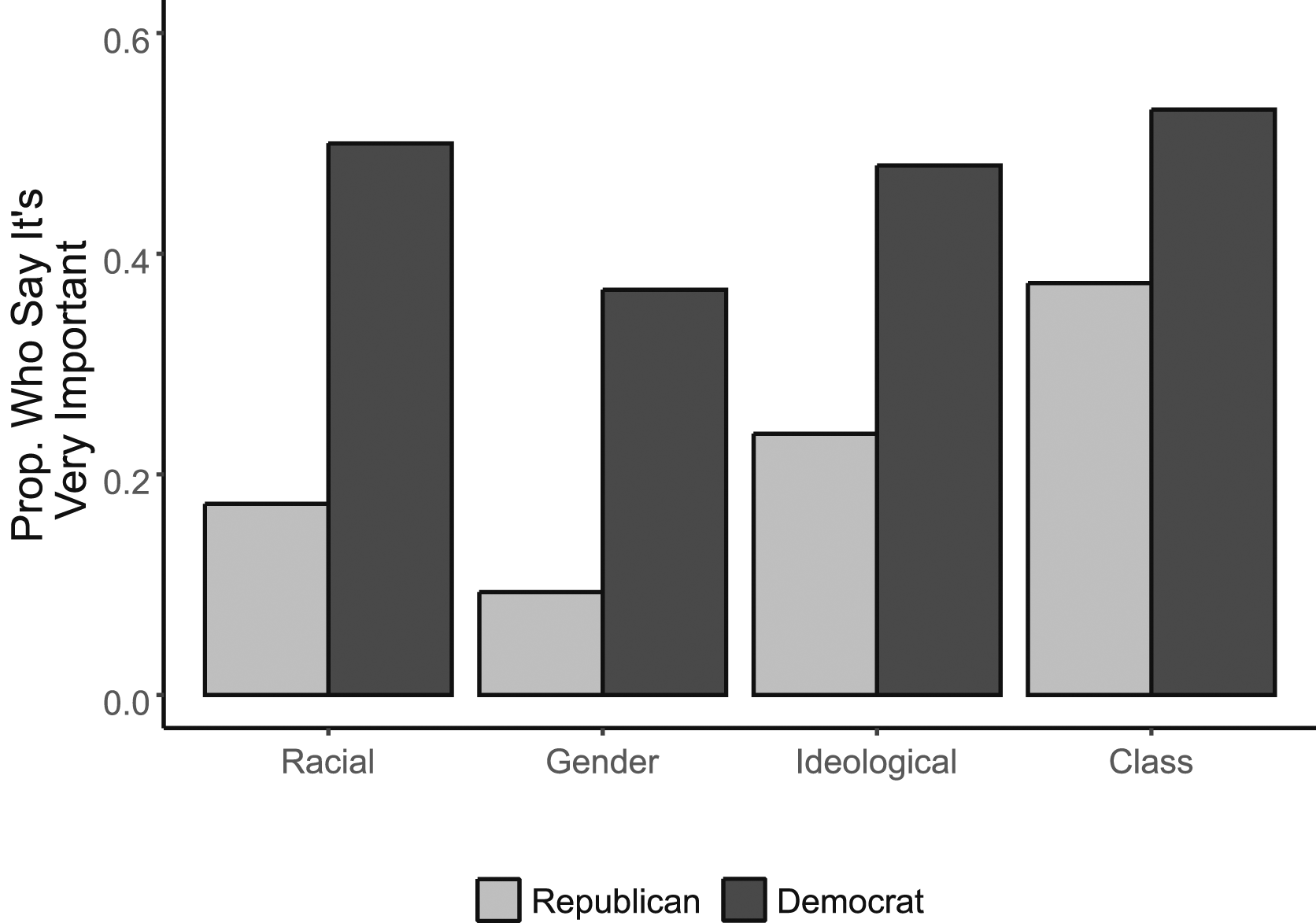
Nonwhite Republicans are not actively recruited during the pre-candidacy stage, and once they decide to run for office they report receiving less support from their networks and key political actors than white Republicans. For instance, when asked about the sources of their early money, 44 percent of nonwhite Republicans reported receiving early financial support from their immediate networks (e.g., friends and acquaintances), compared to 54 percent of white Republicans. Early financial backing from sources like friends and family is important because candidates often draw most heavily on their personal networks to jump start their campaigns (Bonica 2017). Furthermore, whereas nonwhite Republicans and white Republicans were equally as likely to report that more democratized channels of giving like social media have made fundraising easier, 15 percent of nonwhite Republicans reported that endorsements from local interest groups in their race made fundraising more difficult, compared to only 3 percent of white Republicans. Similarly, 20 percent of nonwhite Republicans said that endorsements from party leaders made fundraising harder, versus only 8 percent of white Republicans. These disparities suggest that nonwhite Republican candidates may face unique structural challenges in accessing the financial resources and institutional backing necessary for running successfully. Nonwhite Republicans are certainly not targeted for recruitment nor do they report receiving greater resources and support from political power brokers or their networks, factors which likely further contribute to the underrepresentation of nonwhite Republican elected officials.
Discussion and Conclusion
Despite the influx of nonwhite Republican candidates in recent election cycles, these candidates are not well positioned to win elected office in comparison to their white Republican counterparts. A host of factors contribute to this underrepresentation. Many of these candidates lack prior political experience and the signal of viability that accompanies it. Nonwhite Republicans are also less likely to run in districts that are potentially favorable for electoral success. These factors contribute to the struggles that nonwhite Republican candidates face in financing their campaigns as they raise less than their white Republican counterparts. Finally, the experiences of nonwhite Republican candidates shed light on the institutional and electoral challenges they encounter over the course of their campaigns.
As it stands, the Republican candidate pool is far more diverse than their officeholders as nonwhite Republicans are ultimately not well positioned to actually win elected office. A similar dynamic has been observed with female Republican candidates. Stambough and O’Regan (2007) invoke the “sacrificial lamb” framework to explain the nomination of Republican women in gubernatorial races, noting that the underrepresentation of female Republican governors can be partially explained by their nominations being confined to races where their chances of victory are low. While the application of the sacrificial lamb theory to racial groups is fairly limited, 20 the results here suggest it may help explain the positioning of nonwhite Republican candidates. The problem that the Republican Party faces is not that they are failing to recruit nonwhite candidates to run. Rather, the nonwhite Republican candidates that do face dauntingly steep odds of election, paralleling the sacrificial lamb research in the gender and politics literature.
The findings highlight the enduring limitations that the Republican Party faces in broadening its electoral tent through the elevation and election of racial minority candidates. Political pundits have speculated that the Republican Party will continue to face an uphill electoral battle as the country diversifies. One implication of this paper is that the GOP has a long way to go in realistically threatening the Democratic Party’s persistent advantages in attracting viable nonwhite candidates who are well positioned to win. Simply recruiting more nonwhite Republican candidates to run for office is not sufficient for diversifying the Party’s governing coalition. Instead, candidate experience, a favorable electoral environment, and adequate financing are central for their pursuit of holding elected office. It will ultimately take more than a candidate for nonwhite Republicans to make meaningful gains in winning congressional races.
There are numerous avenues for further research on nonwhite Republican candidates. For one, I only consider one level of government: federal elections to the House of Representatives. It would be worthwhile to examine whether these same dynamics exist both across different levels of the federal government and within a sub-national scope. For instance, is the Republican Party seeking to build a deeper bench of nonwhite candidates in state legislative elections? A more localized focus could tease out the degree to which nonwhite Republicans are present in common candidate pipelines for higher office.
The analyses largely reduce racial identification to a simple binary: white or nonwhite. Extensive literature shows that nonwhite Americans do not behave as a monolith. There are considerable, cross-racial differences in how nonwhite Americans position themselves, both socially and politically. Racial hierarchies also exist within nonwhite groups (Masuoka and Junn 2013). While the racial minority American experience is largely different than the experiences and behaviors of white Americans, operationalizing race as a binary may gloss over important sources and effects of cross-racial variation within nonwhite groups. That said, a chief concern related to the study of elite level, nonwhite politics is constraints related to sample size. This concern is particularly acute when narrowing the scope to nonwhite Republicans. Creating a racial binary thus presents a methodological trade-off. Ultimately, I prioritize larger sample sizes and broader generalizability at the expense of cross-racial nuance. However, further analysis of the differences between Republican candidates across nonwhite racial groups could reveal potential variation in these contexts.
Furthermore, exploring the ways that nonwhite Republicans discuss their race, both as potential and declared candidates, is a potentially promising opportunity. It would be valuable to consider whether nonwhite Republican candidates center their race in their motivations for running for office and in their campaign messaging. Contemporary scholarship has examined differences in how potential candidates from various social groups articulate their motives for running for office; however, data availability has resulted in a particular focus on Democratic-leaning potential candidates (Conroy and Green 2020; Green, Conroy, and Hammond, 2024). Extending this analysis to the motives and messaging of nonwhite Republicans would be valuable. Do nonwhite Republicans view themselves as unique messengers of a Republican ideology? Or do they shy away from mentions of race? Surveying motives of potential candidates, coupled with a content analysis of candidate websites, advertisements, and interviews, would be useful in exploring how race is discussed by nonwhite Republicans.
Finally, in terms of ideology, nonwhite Republicans may be perceived as more liberal than white Republicans, regardless of whether they actually are. Some work has found that racial minority candidates and officeholders are indeed perceived as more liberal than whites, resulting in electoral costs (Jacobsmeier 2015; McDermott 1998). Thus, nonwhite Republican candidates for Congress may be seen as poor ideological fits within their party by conservative primary voters. By contrast, more recent scholarship finds that these perceptions do not apply to nonwhite Republicans, and nonwhite Republicans may in fact be perceived as more conservative than white Republicans (Meyer and Boyle 2022; Visalvanich 2017). In light of these mixed findings, additional investigation may be warranted into voter perceptions of Republican candidate ideologies.
While the potential for further research remains fruitful, this paper meaningfully contributes to our understanding of an increasingly discussed, yet understudied group of candidates: nonwhite Republicans. Despite growing rates of participation among nonwhite Republicans as candidates, their prospects for success remain constrained. They often lack prior political experience, compete in less favorable electoral districts, and secure comparatively limited financial support. Moreover, insights from the candidate survey deepen our understanding of how obstacles to representation may vary across social and political groups and ultimately underscore the persistent challenges impeding the Republican Party’s efforts to broaden its electoral tent.
Supplemental Material
Supplemental Material - A Bigger Tent? Nonwhite Republican Candidates and Their Uphill Paths to Office
Supplemental Material for A Bigger Tent? Nonwhite Republican Candidates and Their Uphill Paths to Office by Ryan Mundy in Political Research Quarterly.
Supplemental Material
Supplemental Material - A Bigger Tent? Nonwhite Republican Candidates and Their Uphill Paths to Office
Supplemental Material for A Bigger Tent? Nonwhite Republican Candidates and Their Uphill Paths to Office by Ryan Mundy in Political Research Quarterly.
Supplemental Material
Supplemental Material - A Bigger Tent? Nonwhite Republican Candidates and Their Uphill Paths to Office
Supplemental Material for A Bigger Tent? Nonwhite Republican Candidates and Their Uphill Paths to Office by Ryan Mundy in Political Research Quarterly.
Supplemental Material
Supplemental Material - A Bigger Tent? Nonwhite Republican Candidates and Their Uphill Paths to Office
Supplemental Material for A Bigger Tent? Nonwhite Republican Candidates and Their Uphill Paths to Office by Ryan Mundy in Political Research Quarterly.
Supplemental Material
Supplemental Material - A Bigger Tent? Nonwhite Republican Candidates and Their Uphill Paths to Office
Supplemental Material for A Bigger Tent? Nonwhite Republican Candidates and Their Uphill Paths to Office by Ryan Mundy in Political Research Quarterly.
Footnotes
Declaration of Conflicting Interests
The author(s) declared no potential conflicts of interest with respect to the research, authorship, and/or publication of this article.
Funding
The author(s) received no financial support for the research, authorship, and/or publication of this article.

Supplemental Material
Supplemental material for this article is available online.
Notes
References
Supplementary Material
Please find the following supplemental material available below.
For Open Access articles published under a Creative Commons License, all supplemental material carries the same license as the article it is associated with.
For non-Open Access articles published, all supplemental material carries a non-exclusive license, and permission requests for re-use of supplemental material or any part of supplemental material shall be sent directly to the copyright owner as specified in the copyright notice associated with the article.
