




Abstract
Social media is used by millions of Americans to access news and politics. Yet there are no studies, to date, examining whether these behaviors systematically vary for those whose political incorporation process is distinct from those in the majority. We fill this void by examining how Latino online political activity compares to that of white Americans and the role of language in Latinos’ online political engagement. We hypothesize that Latino online political activity is comparable to whites. Moreover, given media reports suggesting that greater quantities of political misinformation are circulating on Spanish versus English-language social media, we expect reliance on Spanish-language social media for news predicts beliefs in inaccurate political narratives. Our survey findings, which we believe to be the largest original survey of the online political activity of Latinos and whites, reveal support for these expectations. Latino social media political activity, as measured by sharing/viewing news, talking about politics, and following politicians, is comparable to whites, both in self-reported and digital trace data. Latinos also turned to social media for news about COVID-19 more often than did whites. Finally, Latinos relying on Spanish-language social media usage for news predicts beliefs in election fraud in the 2020 U.S. Presidential election.
Millions of Americans are using social media to stay informed about current events and politics. According to a 2023 report by Pew Research, approximately 50 percent of all Americans report “sometimes” or “often” getting news from social media (Liedke and Wang 2023). Yet we know relatively little about variations in this usage and political activity across the electorate.
While a rich literature examines the political consequences of social media consumption (Berinsky 2017; Boussalis and Coan 2017; Carlson 2018, 2019; Flynn et al. 2017; Grinberg et al. 2019; Lewandowsky et al. 2017; Schaffner and Roche 2016; Thorson 2016), these studies fail to account for important subgroup variations, especially among individuals whose incorporation into U.S. political process are distinct from those in the majority (Abrajano and Alvarez 2012). Such experiences can affect minoritized individuals’ orientations to and attitudes towards politics as well as their pathways to political learning (Jones-Correa and McGann 2020; Lajevardi 2020; Velez et al. 2022). Our study fills this void in existing research by examining how Latinos, the largest minoritized group in the U.S., seek out information on the most popular news platform today—social media. 1 A 2023 Pew study finds that 56 percent of Latinos get news at least “sometimes” or “often” from social media, compared to 46 percent of whites (Liedke and Wang 2023). Although previous studies on Latinos have examined how news consumption affects their political preferences and behaviors, these studies focus on “traditional” news platforms such as print publications, television, and radio (Branton and Dunaway 2008; Dunaway et al. 2010; Subervi Velez 1999). We fill this void in the literature by examining how Latinos access news and information on social media and whether social media usage is associated with their political beliefs. We do so by conducting, to the best of our knowledge, the largest and most comprehensive survey of Latinos’ online political activity and information-seeking preferences to date.
Having this baseline is critical in ensuring the health of our civil society and democracy, since it would be problematic to assume that Latinos’ online political activity mirrors those of non-Hispanic whites. Take, for example, recent studies by Gervais and Wilson (2019) and Bailey et al. (2018); they find that members of Congress develop distinct Twitter messages for their Latino constituents, but whether or not Latinos even follow these politicians on Twitter, and the how Latinos engage with these messages, remains unaddressed.
Another distinctive feature of the Latino electorate is that, for many, their digital news environment is distinct from white Americans. About 30 percent of Latinos are bilingual, and thus uniquely positioned to access both English-language and Spanish-language news sources (Krogstad and Gonzales-Barrera 2015). Bilingual Latinos not only have more media sources at their disposal, but this segment of the Latino population can also choose media outlets of different languages depending on the specific type of information. Another 40 percent of Latinos are Spanish-dominant: these individuals communicate primarily or exclusively in Spanish, and must rely only on Spanish-language media outlets (either based in the U.S. or abroad).
Latino reliance on Spanish-language news has been shown to influence their policy preferences (Abrajano and Singh 2009; Gomez-Aguinaga et al. 2021; Kerevel 2011; Subervi Velez 1999) and their levels of political engagement (Félix et al. 2008; Garcia-Rios and Barreto 2016; Vidal 2018). But assessments of the content of these news stories have largely focused on which issues are covered (e.g., immigration or healthcare). Yet today, much of the concern over news stories is not the topic of the information, but the accuracy of the information. The anecdotal evidence suggests that news content on Spanish-language social media contains greater amounts of political misinformation than its English-language counterparts (Cortina and Rottinghaus 2022; Valencia 2021). The content of this misinformation has ranged from the COVID-19 virus and vaccines, to false claims that then 2020 presidential contender Joe Biden was a socialist, akin to Venezuelan President Nicolás Maduro (Cortina and Rottinghaus 2022; Paul 2021; Rodriguez and Caputo 2020; Valencia 2021; Velez et al. 2022).
Our paper seeks to address two outstanding research questions: (1) How does Latino online and social media political activity compare to those of non-Hispanic White Americans? (2) What role does language use play in Latinos’ online political engagement and beliefs? With regards to our first question, we expect Latinos’ online political activity to be similar to those of non-Hispanic white Americans (H1). WhatsApp is an especially popular platform used by Latinos to express their political views (Riedl et al. 2022; Velasquez et al. 2021); as such, we expect them to also use other social media platforms for political purposes, much in the same way as white Americans.
Our second hypothesis turns to expectations regarding Latinos’ information-seeking behaviors on social media, particularly as it relates to a highly pressing issue, the COVID-19 pandemic. Recent research by Gomez-Aguinaga et al. (2021) find that media usage and source credibility help to shape Latinos’ attitudes on COVID-19. Additionally, Campos-Castillo and Laestadius’ (2020) analysis of a March 2020 Pew Survey reveals that Latino respondents were more likely to post content related to COVID-19, compared to white respondents. While their study only focuses on self-reported behavior of posting content on COVID-19, we were interested in understanding what information sources individuals used for information on COVID-19, and provided them with range of options spanning from local and national news, health organizations, state officials to the internet, social media, and their personal community. In light of the existing research, we have reason to believe that Latinos will rely on social media for important health-related information (e.g., COVID-19 virus) more so than these other information sources, and we also expect Latinos to rely on social media for COVID-19 information to a greater extent than do white Americans (H2). The latter expectation builds on recent study by Lee and colleagues (2024), who find that distrust in science moves individuals to rely more on social media for information on COVID-19; and coupled with the fact that Latinos exhibit higher levels of medical mistrust when compared to white Americans (Jaiswal 2019), Latinos should use social media to acquire information about COVID-19 to a greater extent than do whites.
Our third and final hypothesis examines the way social media usage predicts beliefs in misinformation. We hypothesize that Latinos who use Spanish-language social media for news will be more likely to believe in inaccurate political narratives when compared to Latinos who rely on English-language social media for news (H3). Our rationale for this hypothesis is based on the growing number of media reports indicating that political misinformation is more abundant in Spanish versus English-language social media, as well as the research showing how consumption of Spanish-language news affects Latinos.
We test these hypotheses by fielding a large online survey of U.S.-based Latinos’ (N = 2,326) and non-Hispanic whites’ (N = 769) social media political activity. Not only does our data-collection effort greatly improve on existing work examining Latinos’ social media political expression and activity, but it also allows us to compare their behavior with those of non-Hispanic whites. Moreover, we augment self-reports with digital trace data from multiple social media platforms (Facebook, Twitter/X, web browsing, and YouTube). This large sample size of Latinos allows us to empirically test subgroup variations amongst our Latino respondents, particularly regarding the relationship between the language of media consumption and beliefs in false political narratives.
Latino Online Political Engagement and Activity
Over four decades of scholarship on Latino politics reveals their status as a socially and historically marginalized group in the United States. Group-specific factors, such as language use and citizenship status, have led to their distinct political incorporation into the U.S. polity (Abrajano and Alvarez 2012; Carlson et al. 2020; Garcia Bedolla 2014; Hero 1992; Jones-Correa et al. 2018; Jones-Correa and McGann 2020; Masuoka and Junn 2013). 2 As such, the formation of Latinos’ political preferences, attitudes, and behaviors oftentimes stands in contrast from those in the majority, non-Hispanic whites (Jones-Correa et al. 2018).
The shift to digital news via social media opens up a myriad of questions regarding the way Latinos engage politically in this online information environment. To the best of our knowledge, no studies comprehensively analyze Latino online political activity vis-à-vis white Americans. The closest study to engage in a comparative analysis focuses on variations between racial/ethnic minority groups and white Americans (Lane et al. 2022). In this study, Lane et al. hypothesized that whites would be more likely to engage politically on social media relative to racial/ethnic minorities. 3 The conclusions from this study are quite narrow since it only captures only one type of social media political expression—it asked respondents if they sent a message on Facebook or Twitter about a political issue in the last 12 months. Moreover, because their analysis primarily relied on the 2016 American National Election Study (ANES), the sample size of Latino respondents is limited (N = 500). Currently, the social media landscape has evolved considerably, not only in the number of platforms available but also in the forms of political expression that users can engage in.
Despite a dearth of comparative studies focusing on Latino and white online political expression, several scholars have worked to understand how Latinos use social media for political purposes. Nearly all of this research centers on WhatsApp, primarily due to its popularity amongst the Latino population in the U.S. and Latin America (Riedl et al. 2022; Velasquez et al. 2021). Some may not view WhatsApp as a “traditional” social media platform, such as Facebook, since it was originally created for end-to-end encrypted communication. However, a study by Karapanos et al. (2016) finds that individuals use both of these online platforms for similar purposes, to connect with friends and family, to share information, and even conduct business. Because WhatsApp users share information and form “group communities,” it has transformed into a platform where people share social, health, and political information (Riedl et al. 2022). 4
One study by Riedl et al. (2022) delves deeper into information exposure and sharing amongst Mexican and Cuban Americans, specifically related to political information. Their findings reveal that Mexican Americans use WhatsApp to share political information at higher rates than Cuban Americans. Mexican American respondents also reported the greatest exposure to the following false narratives (i) voter fraud played a role in Joe Biden’s victory in the 2020 Presidential election; (ii) China developed the COVID-19 virus as a biological warfare weapon; and (iii) the COVID-19 virus is a hoax. 5 Cuban Americans were also exposed to falsehoods regarding electoral fraud, but the other top stories pertained to Joe Biden being a socialist/communist and that individuals are not significant contributors to climate change. Along with information exposure, Velasquez et al. (2021) find there is a positive correlation among Latinos between self-reported use of WhatsApp to express political views and levels of offline political engagement. 6 Altogether, these studies provide compelling evidence of how WhatsApp is used for politics by immigrant communities in the country. The limited sample size in both U.S.-based studies of the Latino electorate, as well as its reliance solely on self-reported data and just one social media platform, suggests that there is much to learn in our understanding of Latinos’ online political engagement, especially as it compares to the behaviors of white Americans.
Language Use and Latino Political Behavior
The term “Latino” and the notion of “Latino” politics is a highly complicated phenomenon, largely because the term “Latino” is a pan-ethnic label that fails to account for the vast heterogeneity of the Latino population based on attributes such as country of origin and context of reception into the U.S., generational status, language use, racial background, and so on (Beltran 2010; Mora 2014). When it comes to navigating the online information environment, variations based on language use are particularly salient in capturing variations in Latinos’ political attitudes and opinions. The existing research indicates that language proficiency, or language use, is highly correlated with one’s acculturation status (Garcia Bedolla 2014; Hero 1992). Those who are Spanish-dominant are predominantly foreign-born and thus more recent immigrants to the U.S. (approximately 40 percent of the Latino population), whereas English-dominant Latinos are typically second-, third-, and later-generation Americans. There is also 30 percent of the Latino population who are proficient in both English and Spanish and thus consider themselves to be bilingual (Krogstad and Gonzales-Barrera 2015).
Moreover, a considerable amount of research has documented how Spanish-language news consumption amongst Latinos, relative to news consumption from mainstream media, predicts immigration and healthcare attitudes (Abrajano and Singh 2009; Gomez-Aguinaga et al. 2021; Kerevel 2011) as well as their political behaviors (Félix et al. 2008; Garcia-Rios and Barreto 2016; Vidal 2018). Additional research by Dunaway et al. (2010) and Branton and Dunaway (2008) reveal that the content of Spanish-language and English-language news vary, especially when it comes to the framing and tone on issues salient to the Latino community (e.g., immigration). Given this considerable body of work, we have strong reason to believe that distinctions in political attitudes will exist between English-speaking versus Spanish-speaking Latinos.
Although these studies document the variations in the way certain issues such as immigration are covered in English versus Spanish-language news outlets, the media landscape is more complicated today with the rise of misinformation in both mainstream and ethnic media outlets. Meta, the technology company behind Facebook and WhatsApp, has acknowledged that its surveillance and monitoring of Spanish-language content for misinformation is far less rigorous than its surveillance efforts on English-language platforms (Paul 2021; Rodriguez and Caputo 2020; Valencia 2021). Riedl and colleagues’ (2022) research offers evidence to support this assertion. Recall that both Cuban American and Mexican American survey respondents reported a great deal of exposure to (mis)information about the COVID-19 virus. 7 A report from Longoria and colleagues (2021) demonstrated that misinformation about the COVID-19 vaccines was widespread on social media, and Spanish-language online sources also heavily touted “alternative treatments” to combat the virus. The prevalence of this misinformation is concerning given that the COVID-19 virus disproportionately affected the Latino community. Latinos were twice as likely to be infected with the virus as non-Hispanic white people and 2.3 times as likely to die from COVID-19, compared to non-Hispanic whites (Silesky et al. 2023). Considering the pandemic’s impact on Latinos, it is understandable why community members relied on social media for the latest updates. However, based on the anecdotal evidence from media reports, navigating the accuracy of this information proved to be quite challenging for Spanish-speaking Latinos.
While researchers have invested in concerted efforts to understand the causes and consequences of political misinformation, particularly those circulating on social media (Berinsky 2017; Boussalis and Coan 2017; Carlson 2018, 2019; Flynn et al. 2017; Schaffner and Roche 2016), their focus has been solely on English-language media sources. 8 The one exception is a recent study by Velez and colleagues (2022), who find that efforts to provide fact-checking information to Latinos can improve factual accuracy amongst certain subgroups in the Latino population. Similar to our expectations, Velez et al. find that acculturation status is an important factor to account for, with those who are less acculturated being most receptive to these corrective measures. 9
Research Design and Data
We tested our three hypotheses by fielding an original online survey; our goal was to recruit a large sample of Latinos consisting of approximately equal numbers of English-dominant, bilingual, and Spanish-dominant respondents, as well as a large sample of non-Hispanic whites. 10 We recruited survey participants using a Meta ad campaign. 11 The ads simply promoted a survey about “news consumption” and offered a $5 incentive for participating in the survey. 12 Our Latino sample consists of 2,326 individuals who self-reported as Latino/Hispanic/Latinx, and our non-Hispanic white sample consists of 769 respondents. The demographic characteristics of Latino respondents are somewhat representative of the overall Latino population in the U.S. 13
We conducted a total of five survey waves, with the first campaign fielded from March 24–July 25, 2022, and the last wave fielded from February 8–27, 2023. 14 To correct for any concerns with the representative nature of the sample, we weight on standard demographic categories of gender, age, education, and U.S. region as described in Appendix C. The survey instrument was offered in both English and Spanish and contained an extensive battery of items covering demographics, political attitudes and preferences, social media behaviors and usage, information sources, and policy questions (especially related to COVID-19). 15 Due to the wide array of topics in Wave 1, it took respondents about 18 minutes, on average, to complete the survey in English, and approximately 25 minutes in Spanish. 16
We also asked respondents their willingness to share (i) their Twitter/X handle, (ii) their Facebook data via an application embedded in the survey, and (iii) their web browsing history by installing URL Historian, a web browser plug-in that collects the URLs and website information for every website they visited. Additionally, we took advantage of YouTube’s takeout functionality, in which participants are requested to upload their personal video history to our servers. Our rationale for doing so is that digital trace data is an important dimension to the study of online information consumption and social media, and allows us to measure online behavior that might be either under-reported or over-reported in the self-reports. 17 Respondents were provided with additional incentives for providing this information; details can be found in Appendix A.
To empirically test our first hypothesis (H1), which expected Latino and non-Hispanic whites’ online political activity to be similar, we compare the following self-reported social media political behaviors for Latinos and whites: (1) the percentage of respondents following at least one politician on Facebook, Twitter/X, Instagram, and YouTube; (2) the percentage of respondents who report talking about politics, share news content, and view a news account on Facebook, Twitter/X and Instagram; and (3) the percentage of respondents who report talking about politics, share news content, and view a news account on WhatsApp. Finally, we analyze the digital trace data to examine what online news sites Latinos and non-Hispanic whites engage with, and from which social media platforms (Twitter/X, Facebook, Web Browsing, and YouTube). We also are able to look at the regional source of this information for Facebook and Web-Browsing (e.g., North America, Latin America, or other).
Regarding our second hypothesis (H2) expecting Latinos’ reliance on social media for news about COVID-19 to be greater than it is for white Americans, we estimate a probit model of the likelihood of relying on social media for information about COVID-19, with the main explanatory variable of interest being the respondent’s race/ethnicity. We created a dummy variable that is coded as a “1” if the respondent identifies as Latino and “0” otherwise. Additionally, we created dummy variables to denote Asian American respondents, Black Americans, and those who consider themselves to be another race/ ethnicity. The baseline category is non-Hispanic white respondents. The model includes other control variables such as demographics, socioeconomic indicators, and political orientations.
Finally, we test the third hypothesis (H3) regarding the relationship between beliefs in false narratives and Latinos’ use of Spanish-language social media for news by estimating two probit models where the dependent variable are beliefs in election fraud. As Riedl and colleagues’ (2022) study indicates, both Mexican Americans and Cuban Americans (who comprise over 50 percent of the Latino electorate), report a considerable amount of exposure to this particular electoral falsehood. Thus, there is a possibility that Latinos were exposed to such narratives. The first probit model estimates the likelihood of believing that more people voted for Donald Trump than Joe Biden; here, the two main independent variables of interest are as follows: (1) Latinos who use Spanish-language social media for news; (2) Latinos who use English and Spanish-language social media for news. 18 We also control for a respondent’s demographics, partisanship, and political ideology. 19 The second probit model uses an identical estimation strategy, except that the dependent variable asks respondents’ beliefs that a U.S. State was declared the incorrect winner in the 2020 Presidential election. Since both of these statements are false, we would expect the coefficient capturing Latino reliance on Spanish-language social media to be positively correlated with these false narratives.
Findings
We begin by providing basic descriptive statistics to determine whether we find any discernible differences in the social media platforms used by Latinos and non-Hispanic whites. In Figure 1, we report the percentages of Latinos and non-Hispanic whites who report using the following 11 social media platforms: Facebook, YouTube, Instagram, Twitter/X, WhatsApp, TikTok, LinkedIn, Snapchat, Reddit, Telegram, and GroupMe. With few exceptions, the differences in the rates of social media usage between Latinos and non-Hispanic whites are not statistically significant from one another. Social media account usage, Non-Hispanic Whites vs. Latinos. Grey bars represent 95% Confidence Intervals.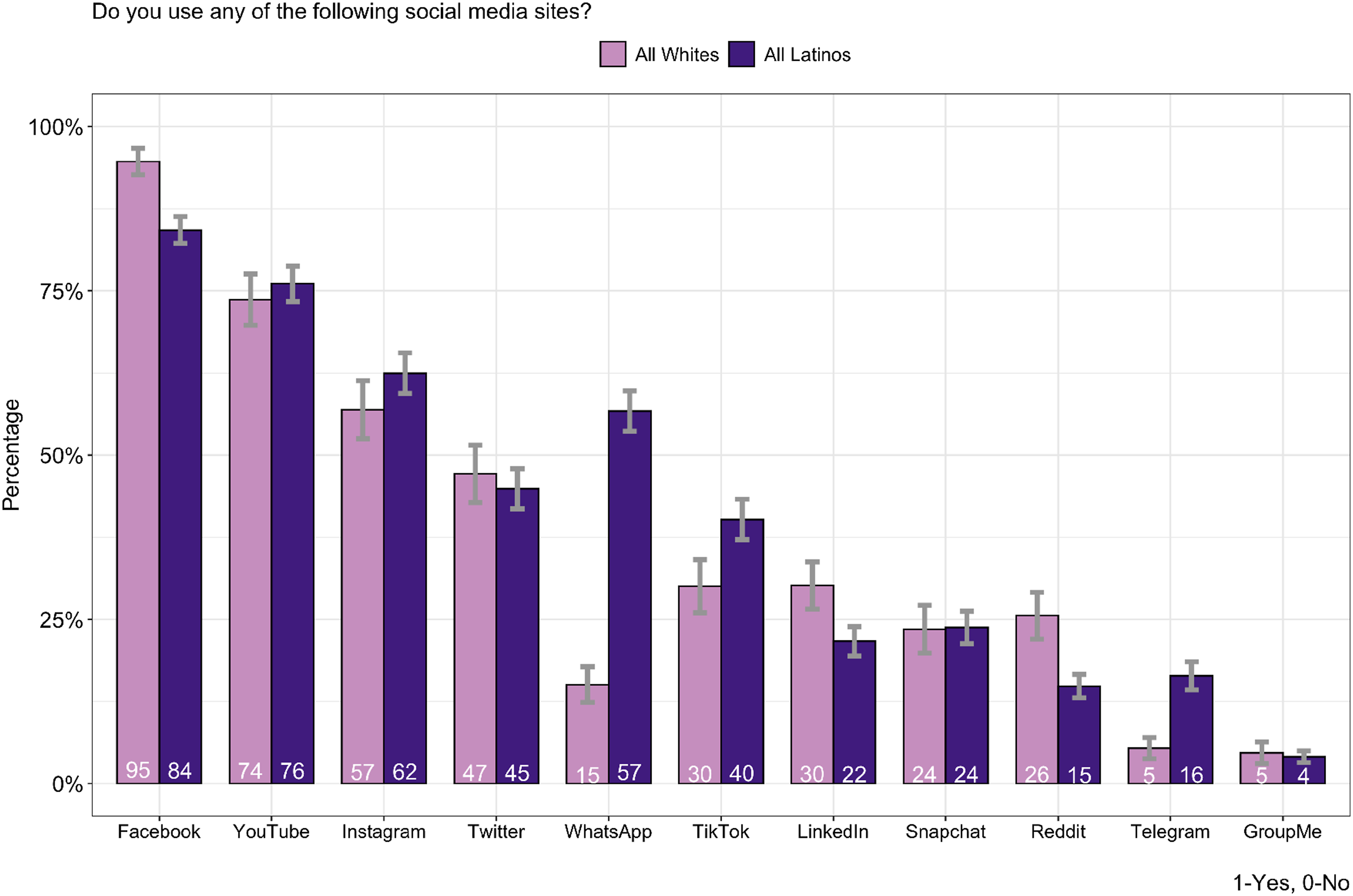
Figure 1 indicates that far more of our Latino respondents report having a WhatsApp account than do our non-Hispanic white respondents. In our sample, 57 percent of Latinos have used WhatsApp, whereas only 15 percent of non-Hispanic whites have used this social media platform. This breakdown is consistent with a recent 2023 by Pew Research, which found that more than twice as many Latinos report using WhatsApp, 51 percent, relative to white Americans, 20 percent (Liedke and Wang 2023). Moreover, we observe that Latinos are more likely than non-Hispanic whites to favor the newer social media platform, TikTok, though the gap is not nearly as great as the usage rates for WhatsApp.
The one social media platform where there is a greater percentage of usage amongst non-Hispanic whites versus Latinos is Facebook. Nearly all of our white respondents, 95 percent, report having used Facebook, whereas 84 percent Latinos report doing so. However, it should be noted that our sample was predominately recruited using ads on Facebook or Instagram, so inferences about broader usage of these platforms may be complicated by selection bias.
20
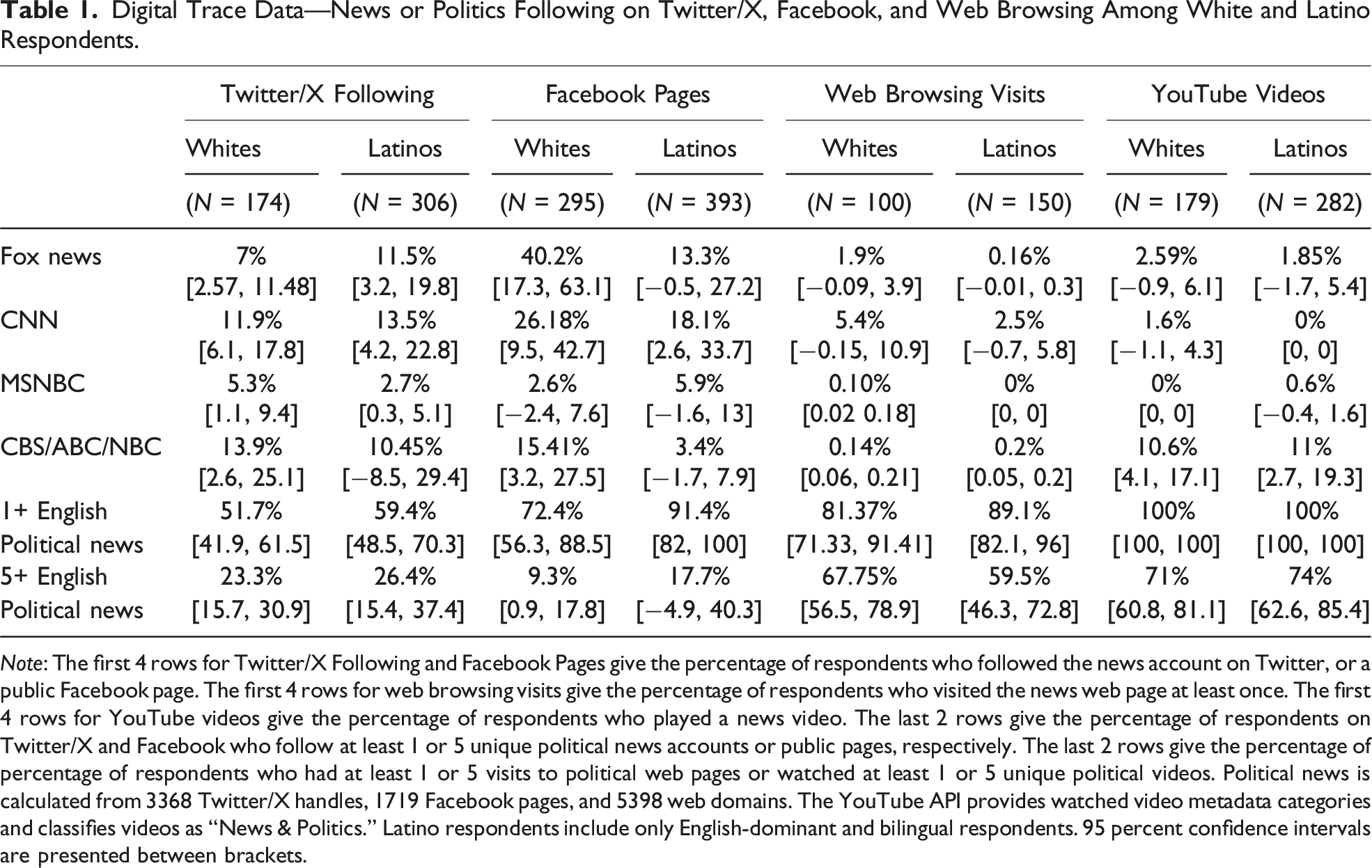
We now turn to the results testing Hypothesis 1: that Latino political activity on social media will be similar to levels of non-Hispanic whites’ political activity on social media. The self-reported results are presented in Figures 2–3 as well as Table 1. Proportion of respondents following at least 1 politician on social media platform, Non-Hispanic Whites vs. Latinos (self-reports and digital trace data). Note: Panel A data comes from survey self-reports, whereas Panel B entails Twitter/X digital trace data donation. Social media platforms usage, Non-Hispanic Whites vs. Latinos. Digital Trace Data—News or Politics Following on Twitter/X, Facebook, and Web Browsing Among White and Latino Respondents. Note: The first 4 rows for Twitter/X Following and Facebook Pages give the percentage of respondents who followed the news account on Twitter, or a public Facebook page. The first 4 rows for web browsing visits give the percentage of respondents who visited the news web page at least once. The first 4 rows for YouTube videos give the percentage of respondents who played a news video. The last 2 rows give the percentage of respondents on Twitter/X and Facebook who follow at least 1 or 5 unique political news accounts or public pages, respectively. The last 2 rows give the percentage of percentage of respondents who had at least 1 or 5 visits to political web pages or watched at least 1 or 5 unique political videos. Political news is calculated from 3368 Twitter/X handles, 1719 Facebook pages, and 5398 web domains. The YouTube API provides watched video metadata categories and classifies videos as “News & Politics.” Latino respondents include only English-dominant and bilingual respondents. 95 percent confidence intervals are presented between brackets.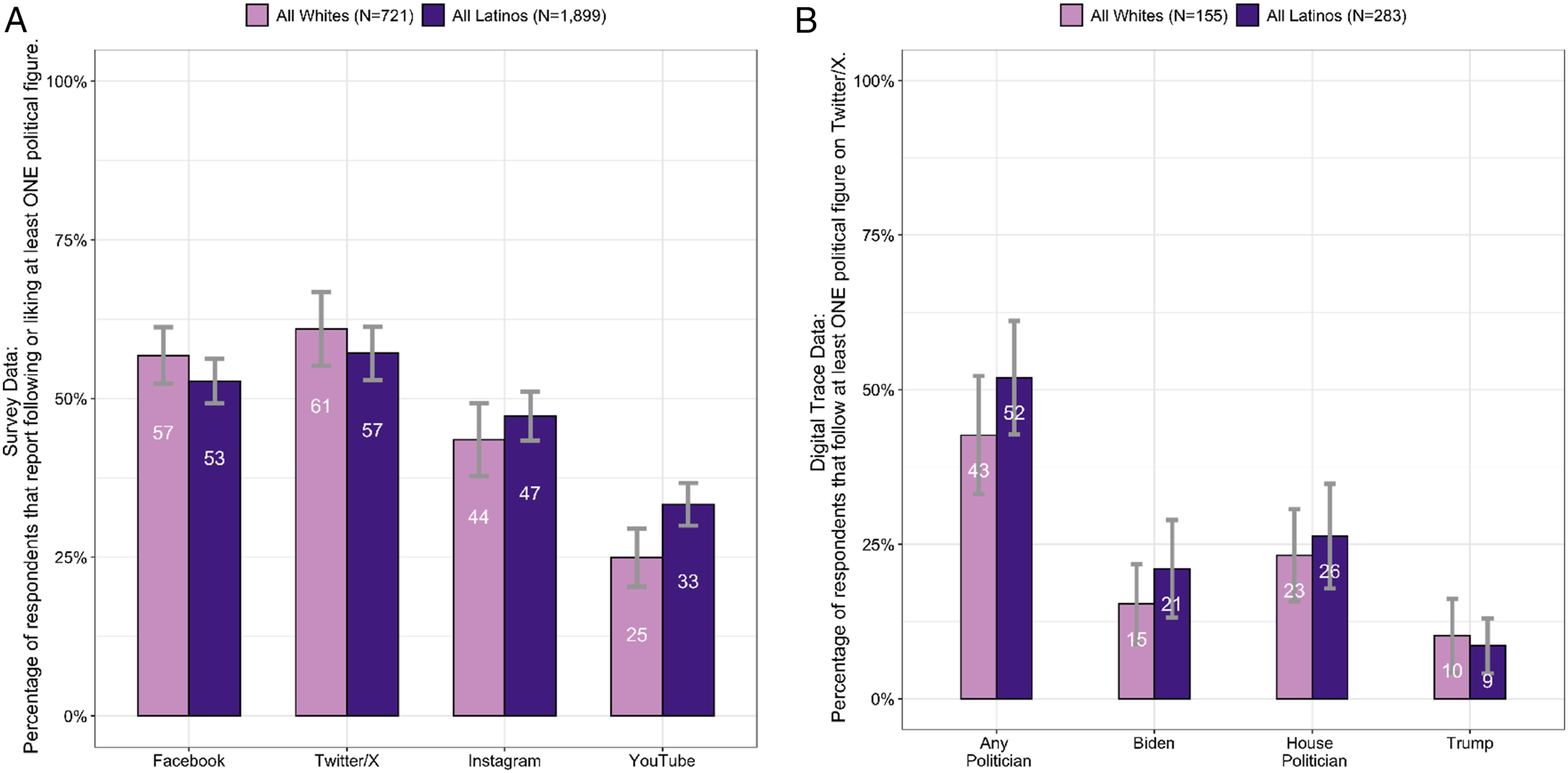
In Figure 2, Panel A presents the percentage of Latino and non-Hispanic white respondents that self-report following at least one politician on Facebook, Twitter/X, Instagram, and YouTube. Panel B uses the digital trace data to determine the specific politician that respondents follow on Twitter/X (i.e., Biden, Trump, Members of the House, and other politicians and candidates of 2022). On Facebook, Twitter, and Instagram, we do not observe any statistically significant differences in the percentage of non-Hispanic white and Latino respondents who report following at least one politician. Yet on YouTube, there is a statistically significant difference in the percentage of Latinos who report following a politician, 33 percent, compared to non-Hispanic whites (25 percent). It is worth noting that the percentage of respondents engaging in this type of online political activity on YouTube is considerably lower when compared to Facebook and Twitter/X, as well as on Instagram (though to a slightly lesser degree). From the digital trace data, it appears that Latinos are a bit more likely than non-Hispanic Whites to follow a politician on Twitter/X (the difference is not statistically significant, though we note the smaller sample sizes here). 21 But we see relatively similar following rates across Latinos and non-Hispanic Whites for Biden, Trump, and members of the House. Taken altogether, these first set of findings lend support for Hypothesis 1; we note that differences between Latinos’ and non-Hispanic whites’ online political activity are only observed on 1 of the 4 social media platforms examined.
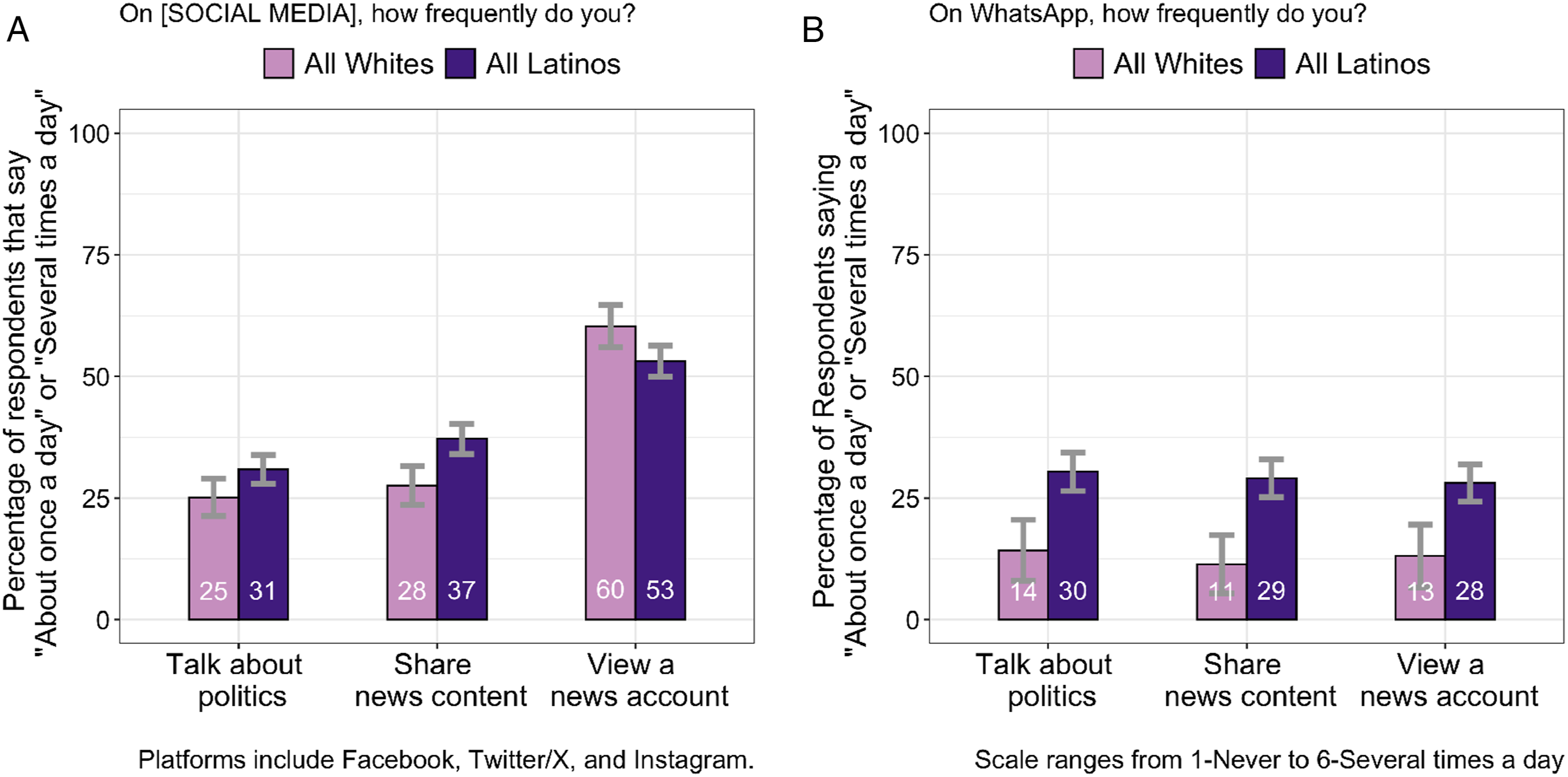
Figure 3 presents information on three common types of social media political behaviors: the frequency with which one talks about politics, shares news content, and views a news account daily. 22 As in our earlier analyses, we compare these behaviors for Latino and non-Hispanic white respondents. Viewing a news account several times a day is the most common type of political act for both Latinos and non-Hispanic whites (60 percent of whites and 53 percent of Latinos report doing so), followed by sharing news content (28 percent for whites and 37 percent for Latinos) and talking about politics more than once a day (25 percent for whites and 31 percent for Latinos). For both Latinos and non-Hispanic whites, the most popular type of self-reported political activity on social media is one that requires the least amount of effort, whereas sharing news content and talking about politics necessitates a greater level of time and energy. We see that while non-Hispanic whites are more likely to report viewing a news account, conditioning on using social media, Latinos are more likey to engage in the more “active” tasks of talking about politics and sharing news content. 23
In light of WhatsApp’s popularity amongst Latinos, Figure 3 examines these three types of political behaviors for this specific platform. These comparisons, however, are subject to greater uncertainty due to the small sample of non-Hispanic whites who use WhatsApp. With this in mind, our comparisons reveal marked variations in these various political acts, with Latinos talking about politics, sharing news content, and viewing news content at higher rates than non-Hispanic whites on this platform. The difference in means tests between Latinos and non-Hispanic whites for all of these behaviors reach statistical significance at the 95 percent level. Latinos use WhatsApp as a form of political expression to a considerably greater extent than non-Hispanic white Americans—nearly a third of Latinos engage in these three political behaviors several times a day. The percentage of whites who engage in such activities on WhatsApp is considerably lower, roughly at about half of what it is for Latinos. These findings greatly expand on the work by Riedl et al. (2022), as our results offer a baseline comparison with non-Hispanic whites; it also offers specific detail on the types of political activity individuals engage in on social media. Although our first hypothesis expected equal levels of online political engagement between Latinos and non-Hispanic whites, Latinos appear to be much more politically engaged than non-Hispanic whites on WhatsApp.
Thus far, the findings in our test of H1, that Latinos and Whites have similar online political behavior, have relied on self-reported data. We now turn to the digital trace data as a further test of this hypothesis. Table 1 provides a breakdown of Latinos’ and non-Hispanic whites’ overall English-language news following behavior on Twitter/X, Facebook, YouTube, and web browsing; as well as their online behavior towards four legacy media outlets. The percentages in this table represent the percentage of respondents that: follow the (row news outlet) account on Twitter/X; like the (row news outlet) page on Facebook; watched a (row news outlet) video YouTube, or visited the (row news outlet) website at least once. The last two rows give the percentage of percentage of respondents who: follow at least 1 or 5 unique political news accounts or public pages on Twitter/X or Facebook respectively; had at least 1 or 5 visits to political web pages; or watched at least 1 or 5 political videos.24, 25
Across the digital trace data that focuses on the four legacy news outlets (Fox News, CNN, MSNBC, and CBS/ABC/NBC), we observe no systematic and statistically significant differences in the rate at which Latinos and non-Hispanic whites access these political news across the five digital platforms. There are, however, some isolated variations; for instance, 40.2 percent of non-Hispanic whites follow Fox News on Facebook, while only 13.3 percent of Latinos do so. Yet on Twitter/X, 11.5 percent of Latinos follow Fox News, compared to 7 percent of whites. Turning to our aggregate measure of political news engagement, a larger percentage of Latinos follow/visit/watch 1+ news outlets on Facebook, the web, and YouTube when compared to non-Hispanic whites. Moreover, amongst respondents who are frequent consumers of news (those who interact with 5+ news outlets), we find that YouTube is a particularly appealing platform for both Latinos and whites; 74 percent of Latinos and 71 percent of whites watched 5 or more political videos.
Our aggregate measure of political news engagement also suggests that the majority of English-dominant and bilingual Latinos turn to English-language news sources outside of these major news outlets; the same can be said, although to a lesser extent, for non-Hispanic whites. Taken altogether, the findings from the digital trace provide additional support for our first hypothesis, as we observe no significant gaps in information seeking between Latinos and non-Hispanic whites. These findings also offer novel insights regarding individuals’ preferred news sources and the fact that many are turning away from the major news networks in favor of a whole array of other, and likely unregulated, news sources.
We now turn to a discussion of our results that tests H2, which expected differences in where Latinos and whites turned to for information about the COVID-19 pandemic as well as expectations on which information source Latinos use most. To that end, we asked respondents about their level of reliance on each source (national and local news, health organizations, state officials, the internet, social media, as well as one’s personal community). Figure 4 presents the percentage of Latino and white respondents reporting their reliance of a news source, which was either “a lot” or “a great deal.” Overall, the responses to this question reveal that Latinos sought out information on COVID-19 to a greater extent than whites across all these sources, with the largest gap in the amount of information gathered from social media. Consistent with our hypothesis, a much larger percentage of Latinos (53 percent) relied on social media for COVID-19 information relative to the percentage of non-Hispanic whites (32 percent) who did so (this difference is statistically significant at p COVID-19 information sources, Non-Hispanic Whites vs. Latinos.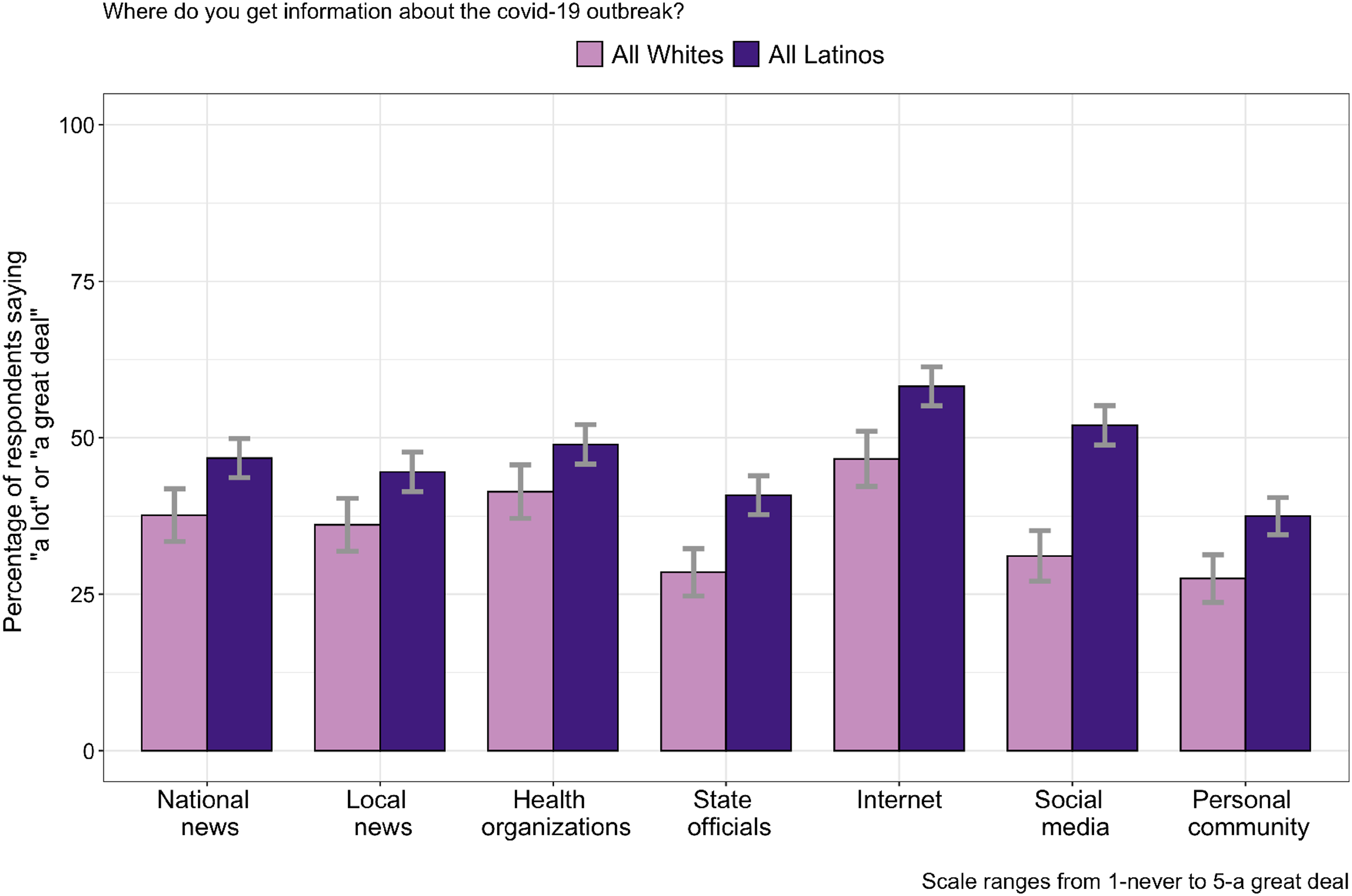
In line with our expectations, social media and the internet were the most popular sources for information on COVID-19 for Latinos, and Latinos used these information sources to a greater extent than state officials, national and local news, as well as one’s own personal community.
Predictors of Relying on Social Media for Information About COVID-19.
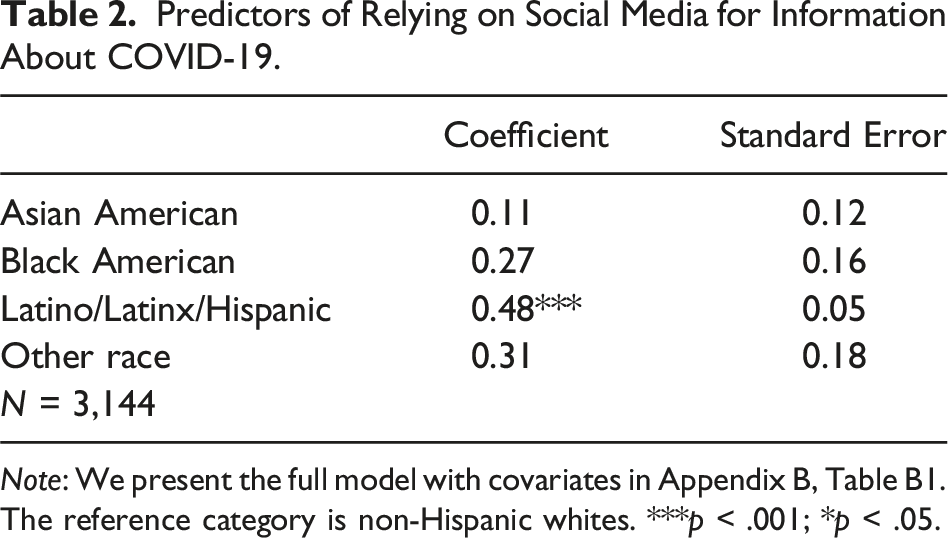
Note: We present the full model with covariates in Appendix B, Table B1.
The reference category is non-Hispanic whites. ***p < .001; *p < .05.
Latinos, Language Use, and Beliefs in Political Misinformation
Digital Trace Data—News or Politics Following on Twitter, Facebook, and Web Browsing Data Among Bilingual and Spanish-Dominant Latinos.
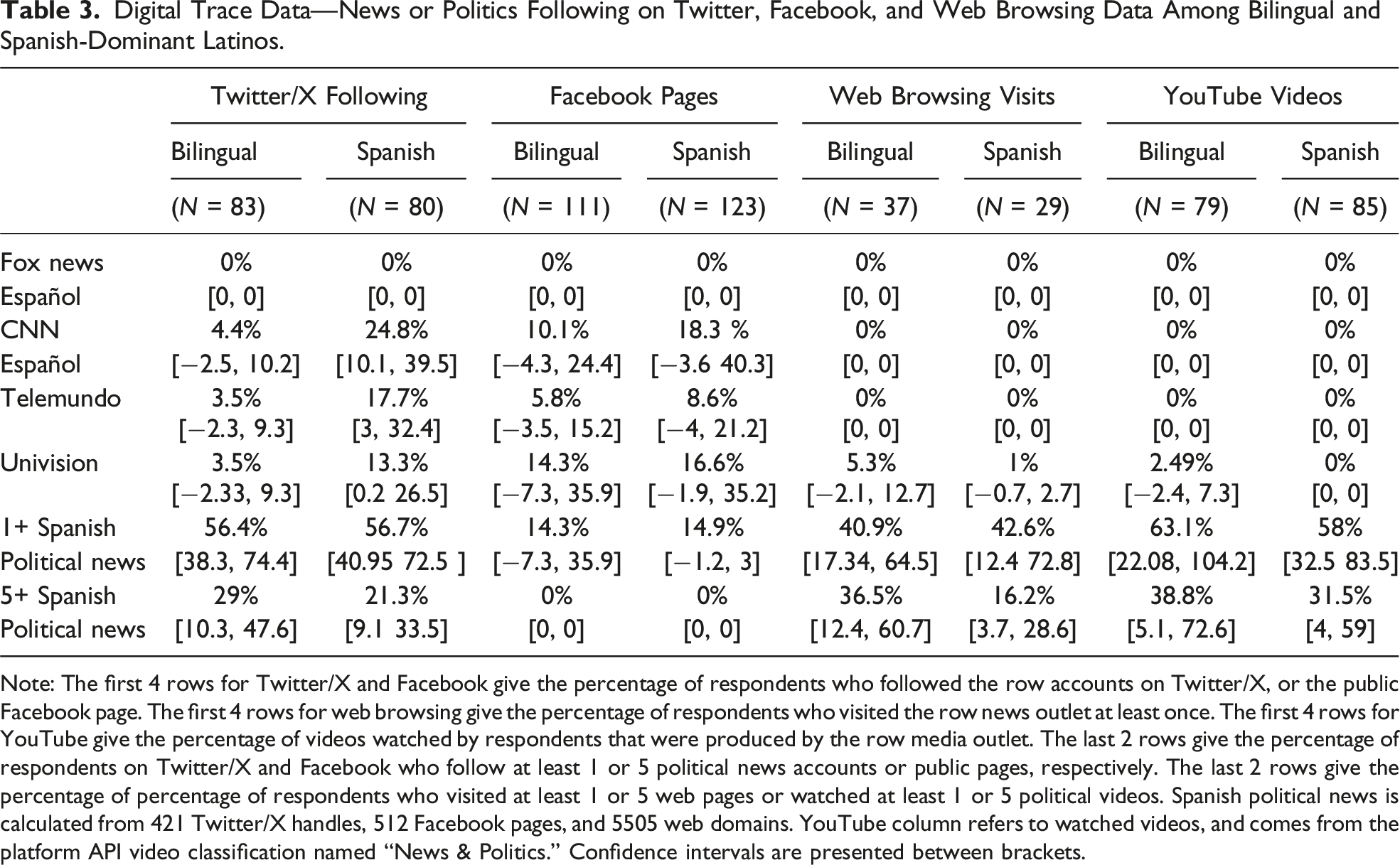
Note: The first 4 rows for Twitter/X and Facebook give the percentage of respondents who followed the row accounts on Twitter/X, or the public Facebook page. The first 4 rows for web browsing give the percentage of respondents who visited the row news outlet at least once. The first 4 rows for YouTube give the percentage of videos watched by respondents that were produced by the row media outlet. The last 2 rows give the percentage of respondents on Twitter/X and Facebook who follow at least 1 or 5 political news accounts or public pages, respectively. The last 2 rows give the percentage of percentage of respondents who visited at least 1 or 5 web pages or watched at least 1 or 5 political videos. Spanish political news is calculated from 421 Twitter/X handles, 512 Facebook pages, and 5505 web domains. YouTube column refers to watched videos, and comes from the platform API video classification named “News & Politics.” Confidence intervals are presented between brackets.
As we would expect, Spanish-speaking Latinos report greater news engagement (as measured by liking the page) with CNN Español, (18.3 percent) Univision (16.6 percent), and Telemundo’s Facebook pages (8.6 percent), relative to bilingual Latinos. A similar pattern can also be observed in their Twitter behavior. Of note, based on our aggregate measure of news engagement, both Spanish-dominant and bilingual Latinos are strong consumers of Spanish-language political news, though with two important caveats. First, the platforms by which Latinos follow/like/visit these news sources are predominately via YouTube and web browsing. Second, the digital trace data indicates that the majority of their political news is not from the four major U.S.-based Spanish-language news outlets. For example, 58 percent of Spanish-speaking and 63.1 percent of bilingual Latinos have watched 1+ YouTube videos labeled news and politics. That being the case, Spanish-speaking and bilingual Latinos could very likely be viewing YouTube videos from lower-quality news outlets, the content of which can go unverified. As such, it may increase the possibility of being exposed to political misinformation.
We also leverage the digital trace data to examine whether Spanish-dominant Latinos were more inclined to engage with information from their homeland (Latin America), relative to English-dominant and bilingual Latinos. Since 40 percent of the Latino population are foreign-born, and 64 percent of Latinos in our sample report being “more concerned about government and politics in Latin America” or “equally concerned about government and politics in the U.S. and Latin America,” Latinos may continue to be engaged in homeland politics. To determine whether this is the case, we compared the frequency that Spanish-dominant Latinos “liked” Facebook political pages hailing from Latin America, compared to their bilingual and English-speaking counterparts in Figure 5. The results presented in Figure 5 indicate that this appears to be the case. We find a larger percentage of Spanish-dominant Latinos “like” 51+ political pages, compared to the percentage of English-speaking and bilingual Latinos liking 51+ Facebook pages. Additionally, a large majority of Spanish-speaking Latinos like at least one Facebook political page. In contrast, English-dominant Latinos interact with very few, if any, Facebook political pages originating from Latin America. These digital trace findings further demonstrate the importance of language proficiency in understanding Latinos’ social media activity and usage. Latino engagement on Facebook pages from Latin America, by language proficiency.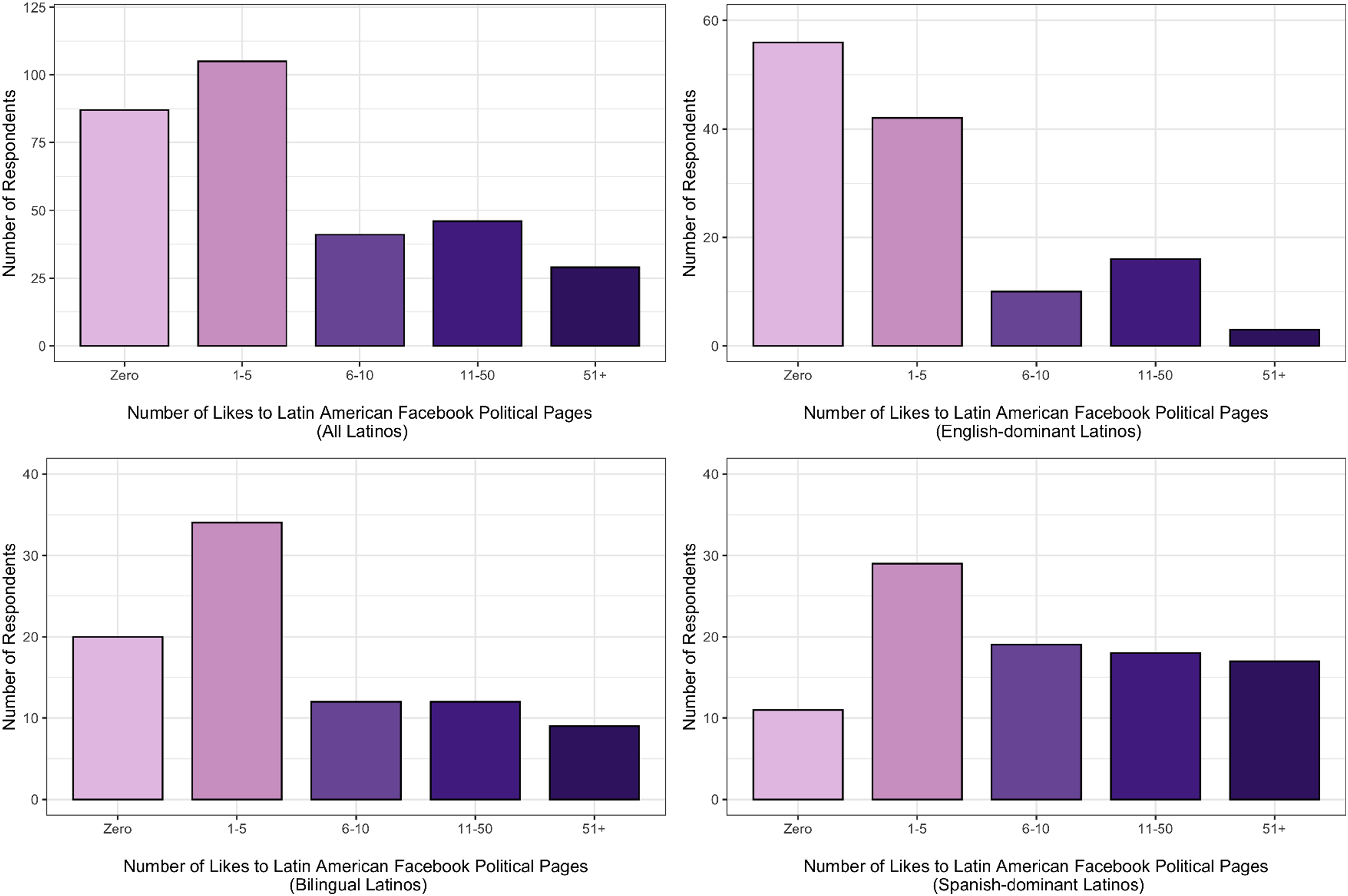
Belief in Election Fraud
Predictors of Opinion on Electoral Fraud in the 2020 Presidential Election Among Latinos.
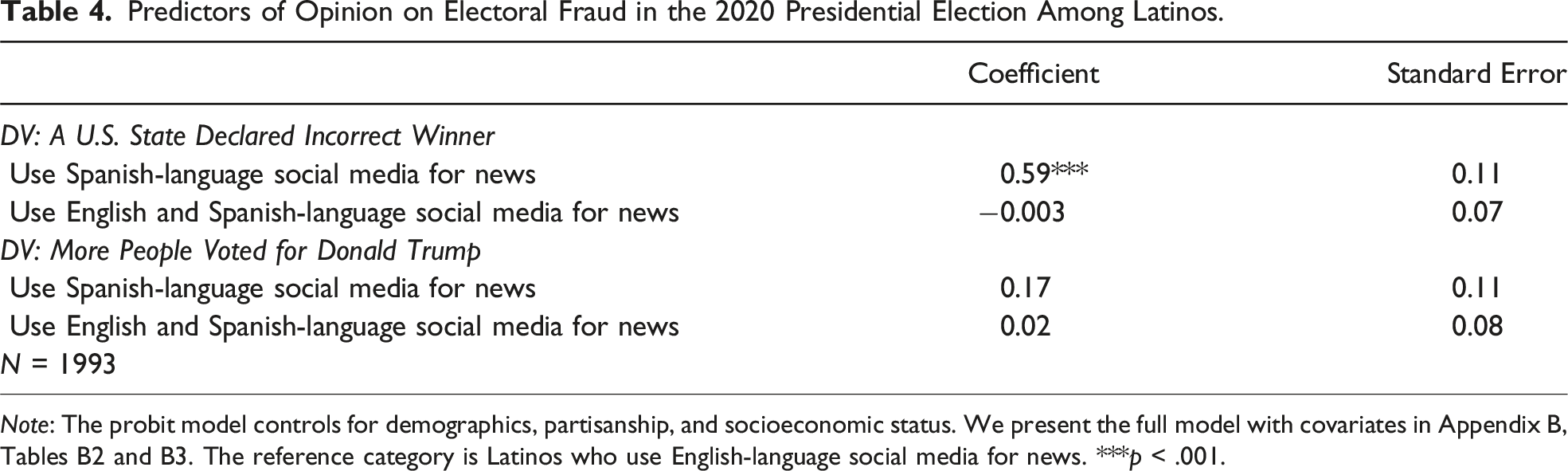
Note: The probit model controls for demographics, partisanship, and socioeconomic status. We present the full model with covariates in Appendix B, Tables B2 and B3. The reference category is Latinos who use English-language social media for news. ***p < .001.
These results expand on a recent study by Cortina and Rottinghaus (2022), who find that Latinos who use social media as their primary source of news will be more likely to believe in conspiracy theories, particularly amongst older Latinos. 29 Yet our findings are unique as they highlight the critical role that language use plays in Latinos’ beliefs in political misinformation. The existing research has yet to identify this important attribute in understanding Latinos’ political beliefs in misinformation. Therefore, researchers should account for both where Latinos receive their news and political information and the language in which it is provided in.
Conclusion
Our research efforts addressed two unaddressed questions in the existing literature. First, we sought to compare the rates of Latino social media political activity with those of non-Hispanic white Americans. Second, we examine the role of language use in Latinos’ beliefs in false political narratives. Our motivation for these research questions stems from a void in the current research situating Latino social media political activity vis-à-vis the majority of the electorate (non-Hispanic whites). This lacuna is significant in light of extensive research establishing how Latinos’ unique political incorporation process has led to the formation of unique political beliefs and behaviors (Jones-Correa and McGann 2020). Our first hypothesis posited that Latino social media political activity would be similar to that of non-Hispanic white Americans. We confirmed this expectation in our analyses of both self-reported and digital trace data; Latino political expression on Facebook, Instagram, YouTube, and Twitter/X are comparable to those of non-Hispanic white Americans. The main exception to this pattern emerged in Latinos’ usage of WhatsApp, which far outpaces the usage amongst non-Hispanic whites. The digital trace findings also provide us with a better understanding of Latinos’ and whites’ information-seeking behaviors. When searching for political news, YouTube is a popular choice for both Latinos and whites, especially amongst those who are frequent news consumers. This preference for YouTube does raise some concerns, given that this platform has been identified as a significant source of online misinformation. 30 The digital trace data also supports our contention of the important role that language plays in Latinos’ social media behaviors; Spanish-dominant Latinos engage with far more Facebook political/news pages originating from Latin America than do English-dominant or bilingual Latinos.
Our analyses also provide support for our second hypothesis, which asserted that Latinos would rely on social media for important health-related information to a greater extent than non-Hispanic whites. This expectation was based on Latinos’ historical experiences with medical racism in the U.S. (Manian 2018) and subsequent distrust of the COVID-19 vaccine (Longoria et al. 2021). As such, Latinos preferred to rely on those in their social networks for information about COVID-19 to a greater extent than non-Hispanic whites. Finally, our expectations regarding the role of language use in beliefs in false political narratives were partially supported. Latinos who used Spanish-language social media for news were more likely to believe in the presence of electoral fraud in the 2020 Presidential Election (as measured by the beliefs that a U.S. state was declared an incorrect winner), relative to English-dominant Latinos. These findings provide much-needed empirical validation of the media reports detailing the widespread misinformation circulating on Spanish-language social media.
Several implications arise from these research findings. First, Latinos are just as engaged politically online and specifically on social media, as are non-Hispanic whites. Thus, campaigns and politicians would be well-served to create unique and culturally appropriate efforts to engage and mobilize Latinos in these online spaces. As research by Gervais and Wilson (2019) and Bailey et al. (2018) demonstrate, U.S. House members have developed distinct Twitter messages for their Latino constituents, yet our digital trace analyses reveal that only 26 percent of Latinos follow at least one politician on Twitter/X. The reality is that a majority of Latinos are not following U.S. House members on this social media platform, and as such, many of their messages go unread by their constituents. The one social media platform where our analyses find considerable political activity amongst Latinos is WhatsApp. Our findings indicate that 28 percent of Latinos report viewing a news account several times a day on WhatsApp, 29 percent share news content, and 30 percent talk about politics. Campaigns and politicians wishing to target the Latino electorate would therefore be well-served to invest their efforts on this particular platform.
Our findings also speak to the need for nuance in understanding how social media impacts Latino political behavior. In particular, researchers must not overlook the important role of language proficiency in determining what information Latinos can access and what the content of this information is. In our study, we find that Latinos who use Spanish-language social media for news stand out from Latinos who rely on English-language sources in that these individuals are more likely to believe in false political narratives—namely, about the presence of electoral fraud in the 2020 Presidential election. Our supposition for this relationship stems from media reports documenting the disproportionate amount of misinformation circulating on Spanish-language social media, ranging from falsehoods about the COVID-19 virus as well as political misinformation about the 2020 Presidential election. The digital trace data also indicated that the overwhelming majority of English-speaking Latinos do not access news and information online on reputable news outlets such as CNN, ABC, CBS, or NBC. The same is true for Spanish-speaking Latinos: the majority do not access Fox News Español, CNN Español, Telemundo, or Univision on their websites, YouTube, Facebook, and Twitter. We realize that the sample sizes of this digital trace data are limited, and thus the results should not be viewed as definitive by any means. We do hope that our research encourages future scholars to delve further into these data-collection efforts.
While our research offers important insights into Latinos’ and non-Hispanic whites’ online political activities and their consequences on Latinos’ beliefs in false political narratives, it also opens up a host of additional questions and paths for future research endeavors. Given the quickly changing landscape of social media, not just in the emergence of new platforms but also in how individuals use them, further research in this area is greatly needed. Of particular importance is the need to examine what types of political misinformation Spanish-speaking Latinos are targeted with and how that, in turn, affects their political attitudes, opinions, and offline political engagement. Moreover, taking a deeper dive into digital trace data to determine the types of news content individuals access on social media would be a worthwhile endeavor, and in the case of bilingual Latinos, it would also be fruitful to explore what information these individuals access on Spanish-language media sites, versus English-language news sources.
Supplemental Material
Supplemental Material - Understanding Latino Political Engagement and Activity on Social Media
Supplemental Material for Understanding Latino Political Engagement and Activity on Social Media by Marisa Abrajano, Marianna Garcia, Aaron Pope, Edwin Kamau, Robert Vidigal, Joshua A. Tucker, and Jonathan Nagler in Political Research Quarterly
Footnotes
Declaration of Conflicting Interests
The author(s) declared the following potential conflicts of interest with respect to the research, authorship, and/or publication of this article: J.A.T. received a small fee from Facebook to compensate him for administrative time spent in organizing a 1-day conference for approximately 30 academic researchers and a dozen Facebook product managers and data scientists that was held at NYU in the summer of 2017 to discuss research related to civic engagement. J.A.T. also is one of the co-leads of the external academic team for the 2020 U.S. Facebook & Instagram Election Study, a project that began in early 2020 and is still ongoing at the time of the publication of this article. He was not compensated financially for his participation in this project by Meta, but the project involves working collaboratively with Meta researchers and is funded by Meta. The Center for Social Media and Politics at NYU has just received a Google Research Award, on which J.A.T. is the P.I. J.A.T. and J.N. were investigators on a previous research grant from Facebook that did not support the research in this article.
Funding
The author(s) disclosed receipt of the following financial support for the research, authorship, and/or publication of this article: We are grateful to Craig Newmark Philanthropies, the John S. and James L. Knight Foundation, and NYU's Office of the Provost and Global Institute for Advanced Study for supporting this reserach. The Center for Social Media and Politics at New York University is supported by funding from the John S. and James L. Knight Foundation, the Charles Koch Foundation, Craig Newmark Philantrhopies, the William and Flora Hewlett Foundation, the Siegel Family Endowment, and the Bill and Melinda Gates Foundation.

Supplemental Material
Supplemental material for this article is available online. The underlying survey data, code, and all Supplementary material will be made available on the Harvard Dataverse repository.
Notes
References
Supplementary Material
Please find the following supplemental material available below.
For Open Access articles published under a Creative Commons License, all supplemental material carries the same license as the article it is associated with.
For non-Open Access articles published, all supplemental material carries a non-exclusive license, and permission requests for re-use of supplemental material or any part of supplemental material shall be sent directly to the copyright owner as specified in the copyright notice associated with the article.
