




Abstract
Epistemic injustice means that knowledge relevant to collective decisions gets discounted, thus inflicting harm on disadvantaged groups. The most familiar kinds (established by Fricker 2007) are testimonial (dismissing arguments because of the social characteristics of the speaker) and hermeneutical (lack of collective interpretive resources to make sense of oppression). We develop the idea of expressive epistemic justice, which exists when social forces induce a systematic failure for an individual or group’s values and beliefs to be reflected in what the individual or group expresses as its wants. Expressive epistemic injustice can persist even if testimonial and hermeneutic injustice were to be eliminated. The degree of failure can be quantified, enabling us in an empirical analysis of multiple cases to locate the source of expressive epistemic injustice in the conditions of discourse in a public sphere awash in symbolic manipulations by relatively powerful actors. We then show how citizen deliberation can remedy expressive epistemic justice. Our analysis adds to existing epistemic arguments for deliberative democracy, for it shows that deliberation increases the likelihood that collective decisions will respond to the values and beliefs that define these decisions as good to begin with.
Keywords
Introduction
Epistemic injustice exists when knowledge relevant to collective decisions goes unheard or gets discounted in ways that serve established hierarchy, and therefore inflicts wrongs upon the individuals or groups so disadvantaged. In Miranda Fricker’s (2007) classic statement, there are two kinds of epistemic injustice. Testimonial epistemic injustice occurs when prejudice leads relatively powerful people to dismiss considerations (such as arguments or testimonies) based on the social characteristics (such as class, race, or gender) of those advancing the considerations. Hermeneutical epistemic injustice is when the “collective interpretive resources” do not exist to make sense of oppression; Fricker’s own example is when a society lacks a conception of sexual harassment, even as what could be recognized as sexual harassment by outsiders or later in history is pervasive.
We present an additional kind of epistemic injustice which we believe has not heretofore been recognized, let alone analyzed. 1 We call this expressive epistemic injustice, and it can persist when the voiced considerations of the disadvantaged do get heard, and when relevant collective interpretive resources do exist. 2 It can be observed to the degree the values and beliefs that people hold fail to be expressed in their stated preferences. Such failure is not a product of limited individual cognitive capacity. Injustice occurs because there is a systemic failure to realize the conditions that engage latent reasoning capabilities—which we demonstrate can be readily activated when conditions are right. This means that people are wronged in their capacities as knowers because the necessary conditions to convert values and beliefs into preferences are either neglected, suppressed, or debased. Thus the individual is wronged “in his [sic] capacity as a giver of knowledge, as an informant” (Fricker 2007, 5)—not through being unheard (as in the testimonial epistemic injustice Fricker has in mind here), but in not being able to express. The wrong extends to the collective level (and so social epistemology) inasmuch as collective decisions are unresponsive to the values and beliefs whose expression is inhibited
We shall undertake empirical analysis where we test (and corroborate) two hypotheses. The first is that expressive epistemic injustice is largely a consequence of symbolic manipulation of the conditions of discourse in the public sphere by relatively powerful actors, which can also be embodied in social structures in a way that serves the interests of those same actors. Thus we locate the origins of expressive epistemic injustice in the conditions of political discourse in the public sphere that suppress the translation of values and beliefs into preferences, which means that this paper also moves the center of gravity of analysis of epistemic injustice from philosophy to political theory and social science. Our second hypothesis is that good deliberative democratic conditions can effectively ameliorate expressive epistemic injustice. To the degree this second hypothesis is supported, the move from philosophy to political theory and political science is further solidified, which in turn bolsters epistemic arguments for deliberative democracy (for a survey of such arguments, see Estlund and Landemore 2018). In an epistemically just world, comprehensive interpretive resources and testimony from all relevant actors would inform the values and beliefs of all concerned, which would then find expression in their voiced wants and needs. Hermeneutical epistemic injustice means that interpretive resources get suppressed by not being present. Testimonial epistemic injustice means that testimony gets suppressed by not being heard. Expressive epistemic injustice means that values and beliefs that should underwrite expression of wants and needs get suppressed by the conditions of discourse in the public sphere.
This kind of suppression might be seen, for example, when people feel and proclaim support for environmental values—but are much less likely to support environmental policies (Gill, Crosby, and Taylor 1986; Kollmuss and Agyeman 2002). Similarly, surveys show that many people in the United States approve of the supportive considerations for public provision of health care—but at the same time oppose specific initiatives such as Obamacare that can be stigmatized as socialist. 3 Populist appeals can be successful even when they are disconnected from the values and beliefs of those captivated by them. Populism works in the first instance by symbolically constructing an image of an authentic “people” whose integrity is under threat from corrupt elites, and this symbolism can then override specific values and beliefs (e.g., egalitarian values that would support redistribution) in generating support for populist candidates and parties. To take another example, people will express support for democratic values—but find a way to rationalize violations of those values if it is done by parties and leaders they support (Krishnarajan 2023). These cases demonstrate something a bit different from what is called in public opinion research (especially on environmental and energy issues) the “value-action gap” (Kollmuss and Agyeman 2002). It is not just that actions fail to follow values and beliefs, but rather that preferences fail to reflect values and beliefs. 4
The consequence of expressive epistemic injustice is profound, for it implies that familiar remedies to testimonial and hermeneutic epistemic injustice will not have the desired effect so long as expressive epistemic injustice goes unrecognized and unremedied.
Defining Expressive Epistemic Injustice
We define expressive epistemic injustice as existing when social forces induce a systematic failure for an individual or group’s subjective dispositions (values and beliefs) to be reflected in what the individual or group expresses as its wants (preferences). Values and beliefs can draw upon collective interpretive resources. We stress the collective character of interpretive resources, because (in keeping with epistemic arguments about democracy) different individuals may have access to different relevant bits of information, interpretation, and reasoning, which need combining. Wants for their part can be expressed in terms of preferences (which can also be revealed in behavior such as voting or political activism). Expressive epistemic injustice can be demonstrated to exist to a degree in most of the cases we have examined (see below). We believe it applies to some degree to many or most issues most of the time, affecting many and perhaps most of the people engaging those issues. It is injustice because it can serve the interests of a privileged few, though the characteristics of that few need careful identification. 5
Expressive epistemic injustice resembles hermeneutical epistemic injustice in that it deprives people of the ability to seek, choose, or advocate what is in their own interest or consistent with their own values and beliefs. Yet it is not necessarily the absence of a concept or interpretive resources that is causing injustice. Rather, we hypothesize, it is that the interpretive resources may exist and be shared, but their expression in individual preferences (and so into individual or collective action) gets overridden by the kind of problematic symbolic politics that can dominate the public sphere.
For the purposes of this paper, the public sphere can be understood in encompassing terms, as the total volume of communication relevant to politics that occurs in a society, reaching from everyday talk (Mansbridge 1999) to parliamentary debate. 6 Thus for us, the public sphere is a descriptive concept, though the communication within it (as well as its overall health) can be evaluated in normative terms, as we do here.
By the symbolic dimension of the public sphere, we mean the construction of accepted political reality through language, which can in turn involve rhetoric, myths, narratives, gestures, and dramaturgy. Symbolic action is not necessarily unjust: think, for example, of the dramatic and emotional way in which Martin Luther King, Jr. appealed to the symbols of the US Constitution and Bill of Rights in order to persuade Northern whites of the justice of the struggle for African-American civil rights. But symbolic manipulation is very different. Symbolic manipulation can be defined as power over the terms of discourse that is exercised covertly and against the incipient will of those subject to it. 7 This incipient will can be found in the values and beliefs of individuals; it is symbolic manipulation that prevents these values and beliefs finding expression in preferences. This failure can also be a consequence of people deceiving themselves, which is one aspect of what Habermas (1987) calls “systematically distorted communication,” alongside manipulation, which Habermas also recognizes. Manipulation exists because it is an effective way for communicative elites to exercise power. It can be exerted too at the micro-level by dominant individuals in social networks. Expressive epistemic injustice can remain even once the standard remedies for other kinds of epistemic injustice are applied. Those remedies might involve attentive listening to the voices of the disadvantaged, greater equality across groups in the educational system, guarantees of legal standing for disadvantaged individuals, acceptance of different ways of knowing and communicating, and political activism to improve communicative capability.
We intend to go beyond illustrative examples of expressive epistemic injustice in order to examine the content, extent, and power of processes operating on individuals and groups that enable such consequences to occur. Epistemic injustice in general has for the most part heretofore been explored in philosophical terms, while relying on some empirical illustrations. Our approach is a bit different in that systematic empirical analysis is going to be central, because it is through this analysis that the extent and force of expressive epistemic injustice can be revealed. (Indeed, it was only through working closely on empirical materials that the concept of expressive epistemic injustice became apparent to us.) We allow that it is not intuitively obvious that expressive epistemic injustice is as pervasive and powerful as we hypothesize; that needs to be demonstrated empirically.
The Origins of Expressive Epistemic Injustice
The source of expressive epistemic injustice can sometimes be found in conscious attempts by the powerful to manipulate the terms of political discourse. Plutocratic owners of popular media outlets (such as Rupert Murdoch) might ensure that these outlets propagate jingoistic nationalism, patriotism, and free market ideology, producing a non-stop symbolic parade that overwhelms the attentive capacities of citizens, while also ridiculing policies (and their supporters) that might represent environmental concern, civil liberties, or gender equality. Demagogues such as Donald Trump can evoke national and racial symbols to inspire visceral response and stigmatize redistributive reforms. Corporations such as BP in its “Beyond Petroleum” years can greenwash their products and activities, making plausible but false claims that lead those who hold environmental values to prefer environmentally unfriendly products and regulatory policies. However, to assume simply that the propagators of expressive epistemic injustice are easily identified as the already powerful, out to preserve the status quo, and just as easily condemned would miss the point that contemporary politics is awash in symbolic politics, and that it can come from different sides. Thus, symbolism might also involve pictures of starving children that induce a libertarian (otherwise committed to the idea that fair terms of trade is the best way to lift countries out of poverty) to think that government aid to relieve a famine is a good idea; or brief coverage of an extreme heat event that is supposed to prove the reality of climate change might convince a waverer of the need for immediate action to cut greenhouse gas emissions. The propagation of symbols may result from highly motivated actors on different sides (not necessarily just one side) manipulating symbols in ways that serve their own narrow interests or causes (Edelman 1985). 8 In this light, we can define problematic communicative elites as those who seek to manipulate the terms of discourse in the public sphere (be it for material self-interest or the cause they favor). This definition excludes both elites who resile from the public sphere (such as billionaires or large corporations who prefer to deal quietly with compliant politicians), as well as communicative elites whose interest is enlightenment rather than symbolic manipulation (such as serious journalists).
Expressive epistemic injustice may be caused by structures as well as elite agents of the kind we have just identified. The sheer volume of political communication generated by and in social media means intense competition to get quick, striking (and often misleading) messages across. Spaces for meaningful reflection in contemporary politics can be in short supply (Ercan, Hendriks, and Dryzek 2019). Other structural factors might include concentrated media ownership, or social media algorithms that limit exposure to counter-argument, and cultural norms that restrict what can be said by whom to whom, often in a way that serves social hierarchy (Sass and Dryzek 2014: 19-20). Sass and Dryzek (2014) describe examples including the jury system in Japan, which had to be abandoned because low-status participants did not feel able to give voice to their views. Here, culture can be restrictive in two ways: in impeding preference construction from values and beliefs (which is what we will stress in our empirical analysis), and in inducing individuals not to voice the preferences they do hold. The latter would only be a matter of expressive epistemic injustice if it serves hierarchy—as it does in the Japan jury example. But lack of voice may serve more benign values that the group holds. Eliasoph (1998) identifies a norm of avoidance of political discussion in social settings in the United States, which can serve the value people put on maintaining their social relationships. This norm would only cause expressive epistemic injustice in our terms if it also impeded preference construction from values and beliefs; and it is only the latter we are going to ascertain empirically.
Expressive epistemic injustice can therefore exist even when no identifiable perpetrators of injustice can be found. Anderson (2012: 166) points out that this is the normal case when it comes to hermeneutical epistemic injustice, which “is always structural.” In this respect, expressive epistemic injustice more closely resembles testimonial epistemic injustice, which as Anderson notes can be caused by both agents and structures. This is why our first hypothesis is framed not just in terms of manipulation of the terms of discourse in the public sphere by powerful actors, but also structural conditions (including culture) that serve the interests of those same actors.
Toward Empirical Analysis
If expressive epistemic injustice is something that can conceivably afflict just about everyone in a society, we need to do some empirical analysis in order to determine who it affects most. If it afflicts the disadvantaged most, then that makes it still more serious. We might suspect that well-educated readers of the New York Times, the Economist, the Wall Street Journal, the Guardian or their equivalents in other societies are probably among those least susceptible to symbolic appeals that sever the link between subjective dispositions and preferences, and that expressive epistemic injustice reinforces hierarchies based on education and knowledge. When this question is investigated empirically, it appears that there is no straightforward relationship here (Niemeyer et al., 2024: 358, table 5); we discuss the reasons for this lack of relationship below. In light of this result, the harm caused by expressive epistemic injustice is not that it reinforces hierarchies based on social characteristics such as social class, but rather that it reinforces symbolic domination of the public sphere by the few—and their interests. 9
A contrast between a small elite with well-organized, coherent policy preferences and a mass whose policy preferences are disorganized is actually a staple of opinion survey research in political science. However, such findings do not support our account of expressive epistemic injustice. This is because in this literature, mass opinions are characterized as being random rather than as being the result of any systematic forces that yield injustice. In other words, the problem for these opinion researchers lies only in the political incompetence of ordinary people. The classic work here is that of Converse (1964) on “low constraint” across attitudes. Low constraint might be a matter of inconsistency (e.g., supporting simultaneously greater government expenditure, lower taxes, and a balanced budget); or failure to think in terms of any identifiable belief system at all. A well-organized belief system as held only by elites would for Converse feature high constraint, such that we would be able to (say) predict specific attitudes based on whether a person was conservative or liberal. This skeptical tradition in opinion survey research continues in studies that find people rarely vote on the basis of issue opinions, or even self-interest (see, for example, Achen and Bartels 2016).
We argue in contrast to skeptical opinion researchers that the problem lies not in the intrinsic (in)competence of ordinary people, but rather in the circulation of symbols in the public sphere that suppress the activation into expressed preferences of any understandings people do reach, based on interpretive resources they are able to access (and which may have a high public profile). This kind of circulation is (we hypothesize) propagated by elites and amplified by structures of the sort we introduced earlier, such as social media algorithms and concentrated media ownership, and (sub)cultural norms that make it hard for individuals to express dissent from what they think is the majority view (Noelle-Neumann 1984 refers to this as the “spiral of silence”). We can test and demonstrate the effects of this influence on people empirically. We will then explore the power of deliberation and its facilitating conditions in countering these effects. First we outline the empirical approach that we deploy to investigate these questions.
An Intersubjective Empirical Approach
Expressive epistemic injustice impairs human reasoning. We have argued that it exists to the extent available interpretive resources (notably values and beliefs) are not reflected in preferences (due to larger social forces). This might suggest an empirical approach that first measures an individual’s values and beliefs, then measures that individual’s preferences, then looks for the degree of inconsistency. 10 However, such an approach would be undesirable for two reasons. The first is that it requires an external judgment about what consistency should look like. It may seem fairly obvious that individuals committed to environmental values should also (say) be opposed to nuclear power—but maybe not, if they think nuclear power could help curb greenhouse gas emissions. Or to take another example, it is plausible that an individual who is committed to an ethic of care for others should support generous social policy programs—but maybe not, if they think such an ethic is better expressed in private charity, or through religious institutions.
The second reason is that such an approach fails to do justice to the nature of human reasoning. Recent thinking in psychology suggests that human reasoning is essentially intersubjective: it evolved in order to convince others in social settings, and if necessary be convinced by them, not to chart an isolated individual’s path (Mercier and Sperber 2011). In this light, just as it makes most sense to look for human reasoning in group contexts, it is only impairments to such reasoning in dialogical group contexts that truly matter. Poor monological reasoning is to be expected as the human norm and need not concern us here. The only exception might be when individuals reason in isolation while imagining a conversation with others who have different positions (Mercier and Landemore 2012: 246-247; and for an experiment under deliberative conditions, van der Does and Mazepus 2024); but even here, such “imagined interactions” are generally with people that the individual interacts with in real life (Honeycutt 2015).
So while we should indeed seek evidence of expressive epistemic injustice in terms of inconsistency between subjective dispositions (values and beliefs) and expressed preferences, we should do it in a way that first, requires no (contestable) external judgment about what a substantively consistent relationship would look like; and second, operates at the intersubjective level. 11 There is one such measure available, in the form of the deliberative reason index (DRI; Niemeyer and Veri 2022). This measure was developed as a way to assess the deliberative quality of group reason (Niemeyer et al., 2024), but it can be adapted in order to detect expressive epistemic injustice in the form of a mismatch between subjective dispositions and expressed preferences that is induced by larger social forces, with origins in a distorted public sphere.
We explain how the DRI works in detail in the next section, but for the moment we note that a high DRI will reflect the degree preferences for actions are supported by the same representational framework, under which individuals understand what others mean. This framework should provide a common definition of the situation at hand that identifies all the relevant considerations (values and beliefs) on any particular issue. This representational framework might draw on different frames, discourses, or ways of life; all it requires is that those who come to it reach shared understandings.
Consider, for example, the problem of an effective policy response to gambling in a context where most forms are not currently legal. Pertinent considerations that might factor into the framework could be scientific findings about the psychology of gambling addiction and other motivations to gamble, and social scientific findings about violent crime associated with illegal gambling, as well as the degree to which different social groups engage in illegal and legal gambling. Also relevant could be statistics on the distributive effects of gambling where it is legal (i.e., which social groups lose most money). Some of these findings might be disputed, some settled. There might be different views on whether gambling is in essence a harmless social pastime, or a trap for the unwary. Relevant community values might include individual choice, social safety, and protection of the vulnerable. If these considerations are applied, there will be a range of both accepted and disputed factors concerning the impact of different policies such as full legalization, continued prohibition, partial legalization, and legalization under regulation for valued ends. A shared representational framework would cover all these factors, in such a way as to make them understandable to all participants.
Within the representational framework, people can of course still disagree, even deeply, but there should ideally be regularity between subjective dispositions and preferences, such that differing values or beliefs should be reflected in a comparable degree of difference in preferences. So in our gambling example, an “incentives” policy package might stress individual liberties while highlighting the material opportunities that illegal gambling provides to organized crime, a “regulation” policy package might also emphasize that crime while also highlighting social harms associated with both illegal and legal gambling, a “prohibition” policy package might stress intrinsic moral (and perhaps religious) principles above all, while stressing the harms of legal gambling on the poor in particular. Ideally, individual support for each package should be proportional to endorsement of its underlying considerations. Inconsistency would exist if (say) a subset of individuals agreed on individual liberty as a principle and recognized the inducements to organized crime under illegal gambling—but responded to symbolic appeals that painted legalized gambling as socially abhorrent, and so supported prohibition. Across all the individuals in the group, agreement on preferences should ideally be proportional to the degree of agreement on supporting considerations.
We stress that this gambling example is only an illustration of what reason could look like on this issue, hence the proliferation of “coulds” and “mights” in our exposition. Our actual DRI measure requires no casual specifications of the sort we just made about what constitutes consistency between subjective dispositions and preferences, as we will now show.
The Empirical Measure
The DRI is based on the intersubjective consistency of any pair of deliberators, 12 whose measurement begins by surveying opinions across the underlying considerations (values and beliefs) that plausibly might inform preferences about a specific issue. Considerations are modeled by asking each person to sort around 20–40 statements about the issue on a “most agree” to “most disagree” scale. Preferences about options for action (usually alternative policies) are ascertained by asking each person to rank (usually less than ten) policy options.
Computation of DRI starts by calculating the correlation between any two persons for considerations, repeating this for preferences, and then doing the same for every possible pair of persons within the group. The combination of these pairs of correlations are then used to create a plot of points for each pair, and to calculate intersubjective consistency. Figure 1 is an intersubjective consistency plot for four deliberators (A,B,C,D), drawn from the Uppsala Speaks case, a deliberative forum composed of lay citizens which concerned options regarding internal EU migrants begging on Swedish Streets. Intersubjective consistency for each pair (AB, AC, AD, BC, BD, CD) is measured as the orthogonal distance (dab, dac, dad, dbc, dbd, dcd) from the 1:1 line; where this line reflects perfect consistency. Intersubjective consistency is different from agreement. The pair AB shows highest agreement on preferences. Yet the pair AD, which disagrees about both considerations and preferences, is the most intersubjectively consistent in its orientation of considerations to preferences (as it is closest to the 1:1 line, slightly closer than pair AC, though both pairs are almost perfectly consistent). The pair BC is the most intersubjectively inconsistent, because it is furthest from the 1:1 line. Illustrative intersubjective consistency plot.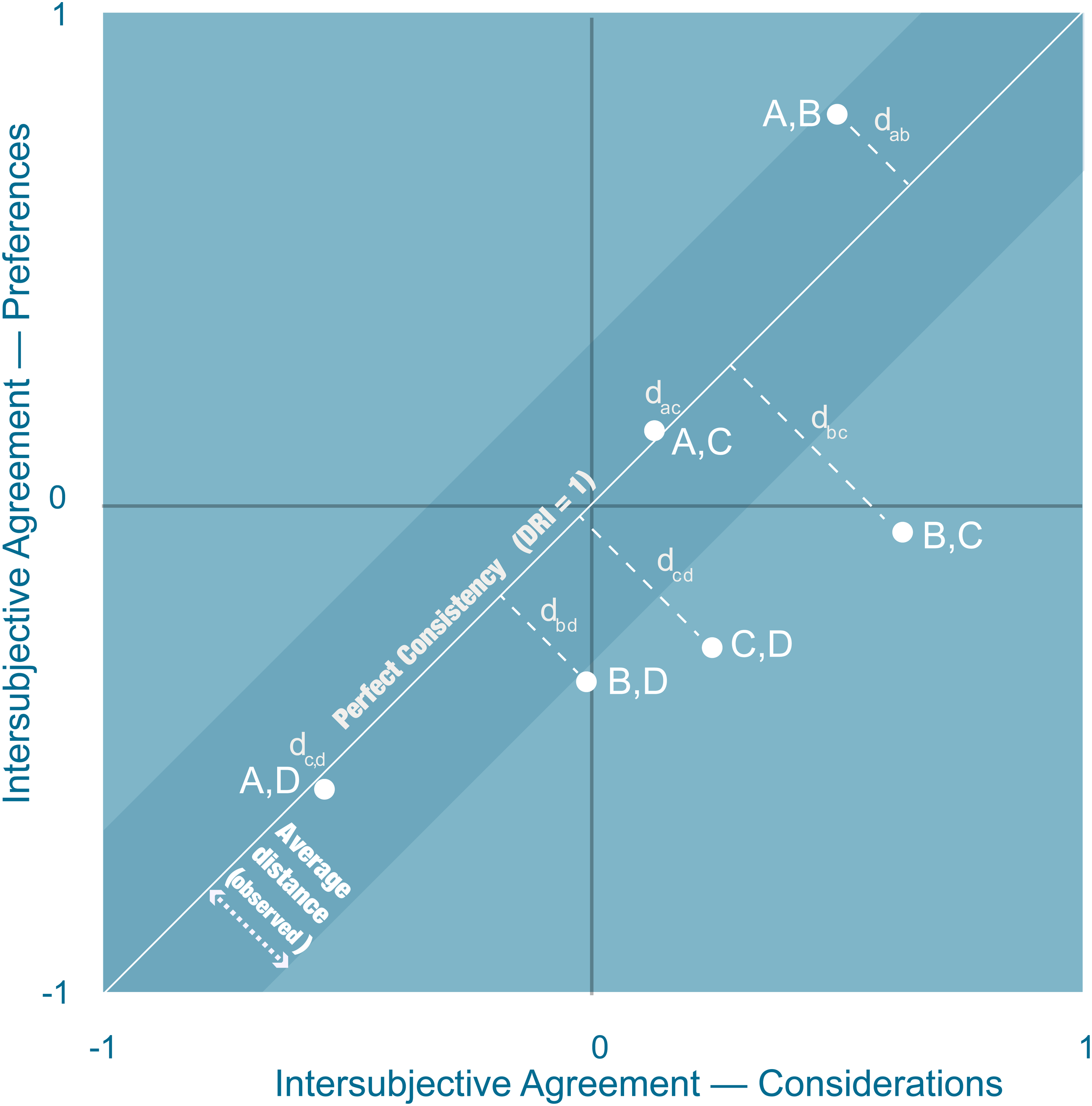
Here we stress the intersubjective and relational nature of deliberative reason that is captured by our measuring instrument. Deliberative reason is an emergent property of the group being considered, where the collective expression of preferred outcomes reflects shared interpretive resources and the absence of distorting influences that inhibit the potential construction of a common understanding. Thus, any transformation on the part of one individual will impact the intersubjective relationship of this individual’s reasoning to the rest of the group.
Accordingly, individuals are not measured in isolation from one another, but in their relationship to others. Individual-level DRI (DRIInd) is indeed an individual measure (with the limitations that implies when it comes to fully capturing group dynamics), but it reflects the reasoning of the individual in relation to the rest of the group, calculated by aggregating intersubjective consistency for every pair including that individual.
Figure 1 shows that pairs including person B are least consistent, indicating B shows the lowest levels of reason when triangulated with others in the group. All DRIInd are then aggregated to produce group DRI, which reflects the average distance of all points to the 1:1 line (indicated in Figure 1 by the dark band). 13
Plotting all combinations of pairs for all 48 participants in this forum, we end up with Intersubjective Consistency Plots: Uppsala Speaks. Note: Includes combined data from the Group Briefing and Group Building cases. See Table 1.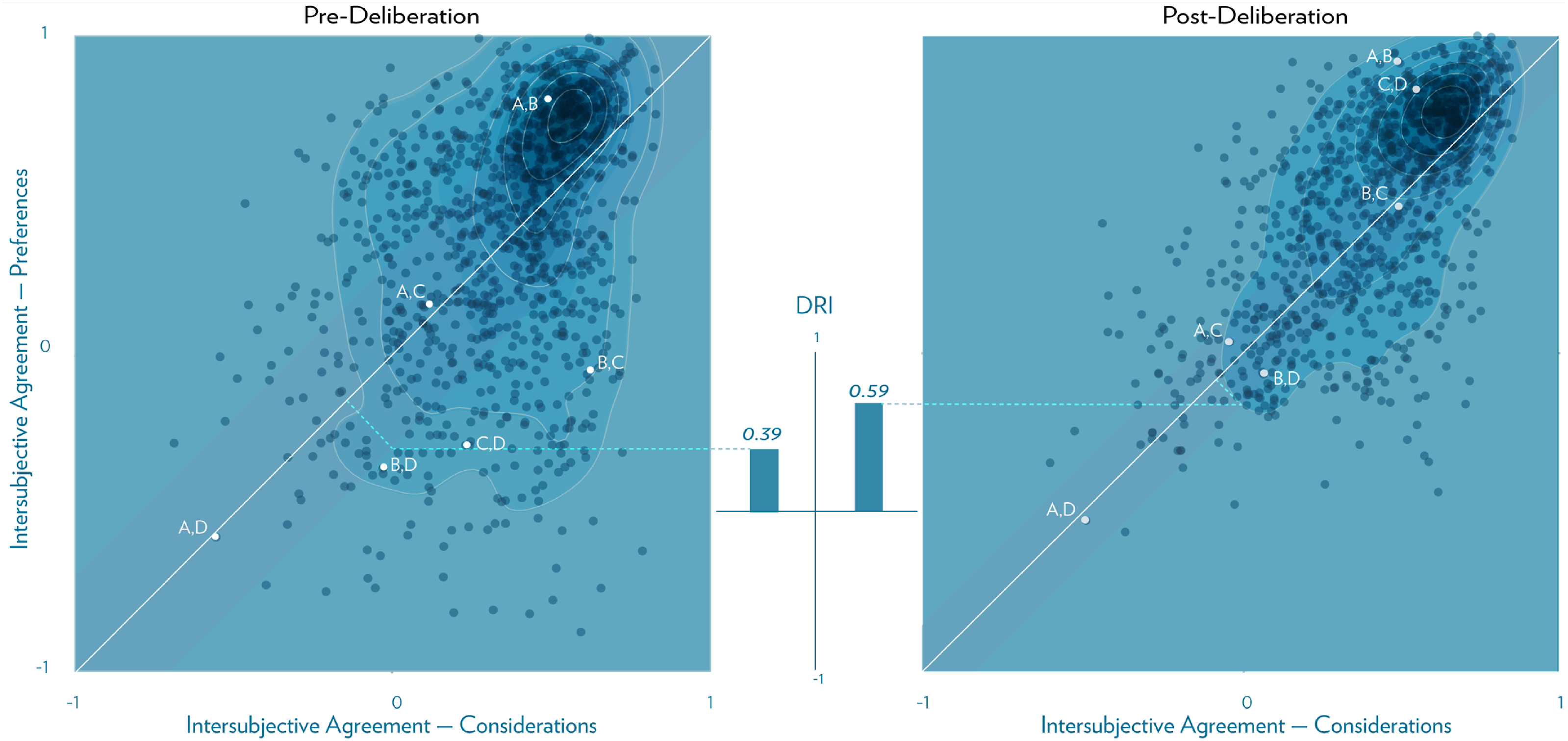
Pre-deliberation group DRI (0.39) rises to 0.59 post-deliberation, as graphically represented in Figure 2. Note that the changes in the four illustrative points involve predominantly vertical movement (indicating little relative change regarding considerations compared to preferences), and much of the change occurs in pairs involving C and D. Those individuals experienced little change in opinion regarding considerations, but they did change the way in which the totality of their opinions was expressed in their preferred course of action. The post-deliberative positions were much more consistent with a mutual understanding of the issue within the group. Before deliberation two sub-groups tended to talk past each other. One adopted a perspective that stressed the welfare of the community as a whole, the other embodied an unreflective response informed by wider anti-immigration discourse that was on the rise in Sweden at the time. Neither considered the specific details of the case at hand and the situation experienced by the mainly Romanian beggars identifying as part of the Roma community. In deliberation, both the welfarist and (to a greater degree) anti-immigrant group broadened their perspectives to encompass these specific concerns, realizing a greater degree of overlapping concern that became possible once the dominant symbolic populist (mainly anti-immigrant) discourse gave way to reflection on the issue. This observed pre-post change measures the degree of remediable expressive epistemic injustice within the deliberating group (which happened in this instance to yield arguably more justice in attitudes toward beggars, though that is not part of our measure). 14 The fact of pre-post change corroborates our second hypothesis that good deliberative conditions can effectively ameliorate expressive epistemic injustice (see below for further discussion of this effect).
Comparing the Degree of Injustice Across Cases
Deliberative reason as captured by the DRI can occur to greater or lesser degree in natural settings in the broader public sphere (i.e., not just designed forums). A low (pre-deliberation) group DRI would suggest poor reason in the public sphere on an issue.
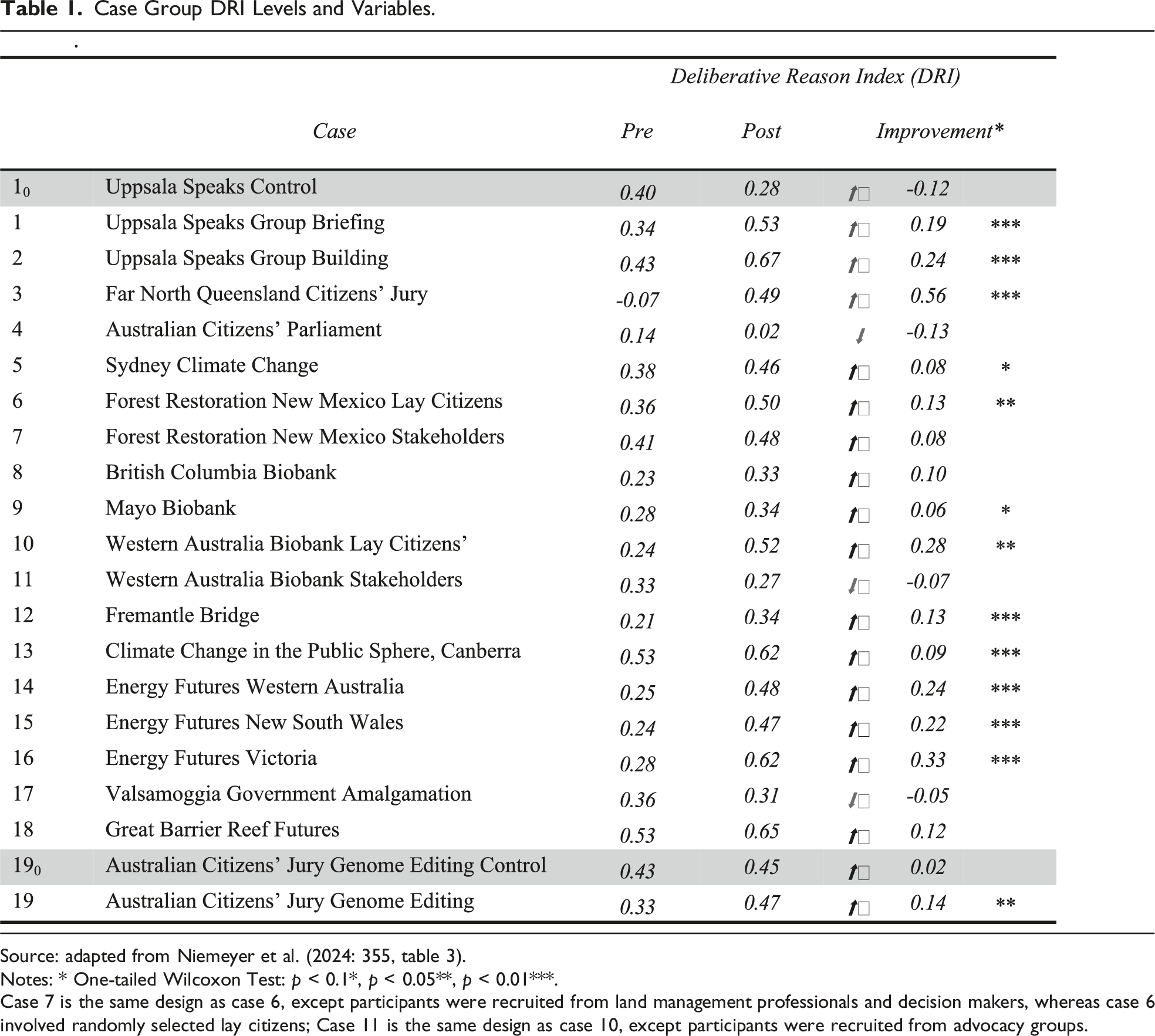
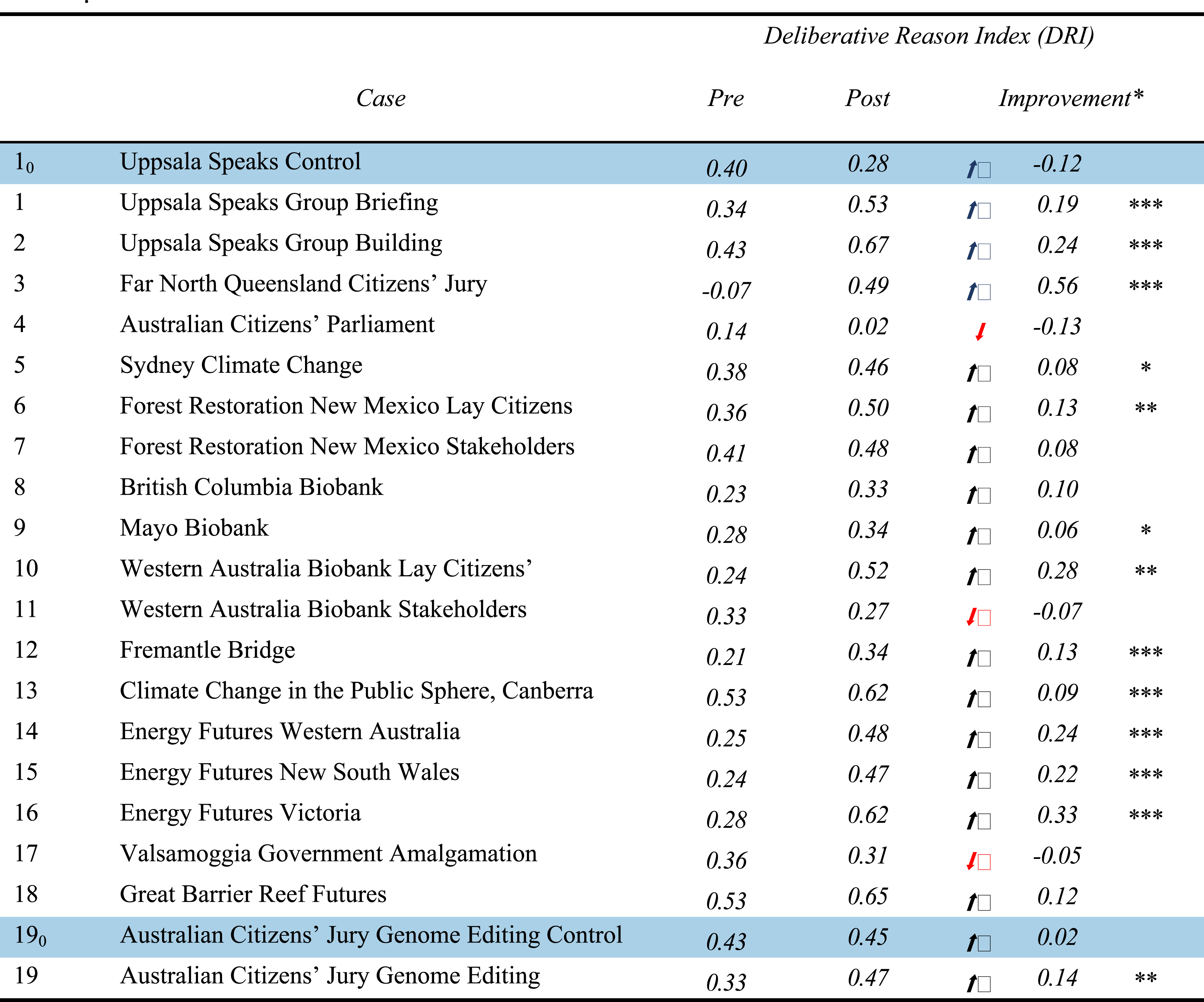
Case Group DRI Levels and Variables.
Source: adapted from Niemeyer et al. (2024: 355, table 3).
Notes: * One-tailed Wilcoxon Test: p < 0.1*, p < 0.05**, p < 0.01***.
Case 7 is the same design as case 6, except participants were recruited from land management professionals and decision makers, whereas case 6 involved randomly selected lay citizens; Case 11 is the same design as case 10, except participants were recruited from advocacy groups.
Beyond these judgments, group DRI per se is a bit of a blunt instrument when it comes to values between 0 and 1. We cannot say with confidence that a case of climate change adaptation in Australia with a group DRI of 0.38 features less expressive epistemic injustice than a case on biobanking in Canada with a group DRI of 0.23 (see Table 1), because the group DRI is based on a measuring instrument specific to each case. And measurement depends on careful instrument development such that all relevant values and beliefs are captured in the survey. 16 Nor can we specify what the effective threshold DRI is for an acceptable degree of elimination of expressive epistemic injustice. What we can do, though, is compare the degree to which a low (or negative) group DRI is ameliorated by good intersubjective conditions. The best such conditions we know of are those associated with designed deliberative forums. These conditions include hearing from experts and advocates on different sides of an issue, respectful listening, the opportunity to speak and be heard, turn taking, and an orientation to finding ways forward on an issue. It is possible to measure how much DRI changes from before to after a deliberative process.
Table 1 compares the results in these terms for 19 deliberative processes. 17 Each process was a forum with between 15 and 150 participants, variably designed to enable inclusive and informed deliberation among the participants on the issue at hand. The issue is generally signaled by the title of the case (except for Uppsala Speaks, which as discussed earlier addressed the issue of begging). In most cases, the participants were lay citizens, selected on the basis of stratified random sampling to ensure appropriate diversity when it comes to age, education, and gender, as is standard when constituting a citizens’ jury or citizens’ assembly. However, cases 7 and 11 involved stakeholders with a history of prior political participation on the issue at hand; as we will see, this enables us to make some relevant comparisons with results from parallel lay citizen processes. We see that in most (but not all) cases group DRI improves substantially over the course of deliberation, suggesting that expressive epistemic justice is indeed pervasive before deliberation—especially given the radical variety in terms of locations and issues in those 19 cases. In each case, the improvement from pre-deliberation to post-deliberation DRI is a direct measure of the degree of remediable expressive epistemic injustice. We see that remediable expressive epistemic injustice is highest for the Far North Queensland Citizens’ Jury case. 18
What is Causing Expressive Epistemic Injustice?
Recall we stressed that injustice would be exacerbated to the degree that a low individual DRI is associated with people disadvantaged on other dimensions. We do not have data on social class, but level of education is a very rough proxy. The previous section examined variation in the total level of expressive epistemic injustice across cases. We can also investigate individual-level variation. As noted earlier, individual DRI is still an intersubjective measure, because it is composed of the target individual’s interactions with all the other members of the group.
An analysis of variation in individual DRI in a multi-level modeling analysis involving a pre-post comparison of all the individuals in the 19 cases found that level of education had no consistent impact on individual DRI change, and so (in our terms) on the degree of remediation in expressive epistemic injustice (Niemeyer et al., 2024, 358, table 5). 19 What this suggests is that expressive epistemic injustice is chronic and pervasive, not something that afflicts only the relatively poorly educated.
What, then, is being remediated in deliberation, if not the effects of class inequalities? This is important because, as we argued earlier, a remediable shortfall in DRI is only a matter of expressive epistemic injustice if it is induced by problematic social conditions—which we have hypothesized are a consequence of symbolic manipulation of discourse in the public sphere by powerful actors, possibly reflected by embodiment in social structures and cultures. The case that shows the greatest shortfall as measured by group DRI, the Far North Queensland Citizens’ Jury (FNQCJ) provides a clear illustration of both the operation and remediation of expressive epistemic injustice. Niemeyer (2004) concluded that prior to deliberation the inconsistency of underlying beliefs and values with preferences within the group (indicating what we can now recognize as the presence of high expressive epistemic injustice) was a result of discourse in the public sphere relevant to the issue (what to do with a road illegally constructed through a pristine rainforest) being dominated and distorted by symbolic arguments disseminated by political elites. Such elites can now be described as the source of the epistemic injustice (Niemeyer 2004 did not make the connection to injustice). Briefly, elite defenders of the road stressed the degree to which it provided access to remote communities, was actually beneficial to the environment, and successfully portrayed their opponents as “unwashed hippies” (Niemeyer 2004, 354), while elite critics stressed the damage that runoff from the (unsurfaced) road was causing to fringing coral reefs. Neither set of arguments could withstand deliberative scrutiny. The result was that an underlying environmental consensus on beliefs and values could after deliberation be reflected in what the citizen jurors though should be done about the road. This resulted in a shift of jurors’ policy preferences toward closure of the road (because arguments about the knock-on effects of the road on further rainforest destruction were compelling, even as the argument about coral reefs failed), though from our point of view the more important effect is a dramatic improvement in group DRI from −0.07 to 0.49, indicating the dissolution of expressive epistemic injustice in this case.
It is possible to dig more deeply into what happened in this case by examining which specific “consideration” items (values and beliefs) had the greatest effect on group DRI pre- and post-deliberation, by selecting the subset of items that will maximize (apparent) group DRI. Prior to deliberation, that subset consisted of 12 items; after deliberation, 26 items (out of a possible maximum of 42). What this suggests is that deliberation meant that a broader set of considerations was integrated into reasoning. But more significantly for present purposes, it is striking that only three items in the pre-deliberation subset did not make it through into the post-deliberation subset. Two of these could be classified as “symbolic” in the sense that they are false claims circulating in the public sphere, deployed with strategic intent. 20 The third is an item that referred to the subject’s lack of knowledge. 21 After deliberation, none of the eight items that could be classified as symbolic were present in the subset of integrated items. Again, this suggests that deliberation remedies expressive epistemic injustice as propagated in symbolic arguments by political elites.
We can further illuminate the effect of elites by comparing the two of our cases composed of stakeholders with their corresponding two cases (on the same issue in the same place) that were composed of lay citizens (see Table 1). As political elites, stakeholders are in a position to propagate expressive epistemic injustice through manipulation of the content of discourse in the public sphere (note they are in a position to; this does not mean that all of them will actually do so). For the Western Australia Biobank case, we find that prior to deliberation, stakeholders had a higher group DRI than the lay citizens: 0.33 compared to 0.24. This difference itself suggests the existence of expressive epistemic injustice: stakeholders’ preferences were better aligned with their dispositions (values and beliefs) than was the case for lay citizens. Deliberation yielded a dramatic improvement in group DRI for the lay citizens, from 0.24 to 0.52, suggesting that expressive epistemic injustice was radically reduced for them. But participation in deliberation did nothing for the stakeholder group in these terms; their group DRI actually decreased (though not significantly) as a result of deliberation. This is a striking finding that suggests lay citizens can benefit from participation in deliberation much more than can political elites, thus further corroborating our second hypothesis concerning the ability of citizen deliberation to ameliorate expressive epistemic injustice.
We see something similar (but not quite so striking) in the Forest Restoration case (about local ecological restoration). Prior to deliberation, the stakeholder group had a slightly higher group DRI than the lay citizens, 0.41 compared to 0.36. After participation in deliberation, the group DRI for the stakeholders increased from 0.41 to 0.48, indicating some correction of symbolic politics within this group. The increase for the lay citizen group was much bigger (and statistically significant at the 0.05 level), from 0.36 to 0.50, suggesting a substantial reduction in the influence of symbolic politics and its corresponding expressive epistemic injustice.
Overcoming Expressive Epistemic Injustice
How then might expressive epistemic injustice be remedied? To begin, the solution is not to be found in the multiplication of messages from the other side in order to neutralize those propagated by plutocratic media moguls, Russian troll factories, populist demagogues, or corporate public relations experts. Such multiplication may actually intensify expressive epistemic injustice if it further debases the quality of political communication, thus further weakening the link between subjective dispositions and expressed preferences.
Some early discussions of remedies for testimonial and hermeneutical epistemic injustice located the solution in individual virtues for well-meaning people in relatively powerful social groups. For Fricker herself, in correcting hermeneutical injustice, the required “virtue is such that the hearer exercises a reflexive critical sensitivity to any reduced intelligibility incurred by the speaker owing to a gap in collective hermeneutical resources” (Fricker 2007, 7). The discussion in the epistemic injustice literature has since moved beyond relying on virtue (in, for example, considering the role played by social structures in both causing and ameliorating injustice; Anderson 2012). As should be clear by now, we believe the individualism entailed in relying on virtue fails to do justice to the ineluctably social character of human reasoning (even individual virtues are likely to be a product of collective processes). Individual virtue may have a place in responding to any kind of epistemic injustice, but it cannot be enough. Epistemic outcomes are intersubjective, not subjective, in the sense that they involve reasoning (or failing to reason) together. In this light, one cure for expressive epistemic injustice flows directly from our earlier empirical analysis: it involves participation in public deliberation.
However, not just any forum will do. Dieleman (2015; following Young 1996; see also Young 2000; Sanders 1997) argues that putative deliberation and deliberative forums themselves can embody structural inequalities and so epistemic injustice. We agree this is conceivable, if, for example, deliberation prizes rational argumentation oriented only to the common good. Rational argumentation is a speech style of the highly educated, and the common good can be defined in terms that fail to recognize particular disadvantage (e.g., prizing a safe climate, but ignoring the costs that mitigation will impose on say people who can’t afford to convert their house to 100 percent electric). We also agree with Dieleman (and Young) that the solution here lies in enabling more truly inclusive conditions for deliberation. The role of facilitation is important in ensuring that communicative inequalities are minimized. In practice, deliberative forums of the kind we have studied do not impose constraints on what can and should be said of the sort that worry Dieleman; people are free to couch points in personal stories rather than abstract arguments.
Catala (2015, 46) points out that the standard conditions of deliberative forums should be able to generate the “epistemic trust” (of majorities in marginalized minorities) that she sees as the key to overcoming what she calls “hermeneutical domination.” 22 Group building (involving the group contemplating the principles that should guide them, prior to the substantive deliberative task) and time are also crucial in enabling effective deliberation in citizen forums (Niemeyer et al., 2024).
Our identification of the role of deliberative conditions in remedying expressive epistemic injustice reinforces the epistemic argument for deliberative democracy that has been developed by Estlund and Landemore (2018), among others. The essence of their argument is that deliberative democracy maximizes the chances of arriving at good answers to collective problems (in comparison to alternative processes, such as expert-based ones). Landemore (2012) relies heavily on the idea that group diversity is more important than (individual or group average) ability in these terms, and that deliberation is a good way to integrate diverse perspectives, each one of which has only a partial view of the problem. The account we have developed here shows that epistemic arguments for deliberative democracy can also be a matter of justice as well as producing good collective decisions. But we can also add a layer to the argument, because our account shows how deliberation can promote the likelihood that collective decisions respond to the underlying values and beliefs that define collective decisions as “good” to begin with.
The particular kind of participation we have studied empirically concerns only designed forums, such as citizens’ juries and citizens’ assemblies. Direct participation in such forums can generally only be for a small minority of the population, in which case the challenge becomes to replicate the results at the macro-level. This relates directly to the “scaling up” agenda in the deliberative democracy field. This agenda can involve thinking about how the content of reasoning that occurs in deliberative forums can be disseminated and so replicated in the broader public sphere. 23 (This is not the same as ensuring that the policy conclusions of deliberative forums are accepted, which would do nothing to overcome expressive epistemic injustice.) It can also involve looking for macro-level counterparts to the micro-level deliberative mechanisms we have identified. Such counterparts might include the cultivation of spaces for reflection in political systems that are currently overwhelmed by floods of information and misinformation (Ercan, Hendriks, and Dryzek 2019).
Anderson (2012) argues that when testimonial and hermeneutic epistemic injustice result from social structural factors or “epistemic institutions” (e.g., the inequality generated by segregated schooling) then structural remedies are required. Expressive epistemic injustice too may be ameliorated by structural change that, for example, would reduce the domination of plutocratic media owners, or the ease with which symbolic distortions can be spread via social media. But our emphasis above is on what can be done (through citizen deliberation) without having to wait for such change.
Conclusion
Expressive epistemic injustice has its most significant origins not in interpersonal (or inter-group) inequalities, but rather in the conditions of discourse in the public sphere. As such, it is chronic and pervasive, as elite manipulation of symbols in the public sphere can undermine the connection between what people believe and value on the one hand, and what they express as their policy preferences on the other. We have shown that good deliberative conditions can restore this connection. The challenge is how to create those conditions not just in small-scale forums, but more importantly in the larger public sphere.
Footnotes
Acknowledgments
We thank André Bächtiger and the anonymous reviewers for comments, and Francesco Veri for analysis. Previous versions were presented at the 2022 General Conference of the European Consortium for Political Research in Innsbruck and 2023 Conference of the Argumentation Network of the Americas.
Declaration of Conflicting Interests
The author(s) declared no potential conflicts of interest with respect to the research, authorship, and/or publication of this article.
Funding
The author(s) disclosed receipt of the following financial support for the research, authorship, and/or publication of this article: This work was supported by the Australian Research Council, Discovery Grant DP180103014.
