




Abstract
Since both parties committed to adding women to the federal bench in the 1970s, Democratic and Republican presidents have sought out qualified women for judgeships. Diversifying the bench offers symbolic and substantive benefits to both parties, but those benefits come at the cost of finding non-traditional nominees. Presidents can take one of two different approaches to diversification: maintain existing diversity by anchoring women to a seat, or increase diversity by considering women for every opening. Given presidents consider many factors, including electoral benefits, when selecting potential judges, we expect partisan politics influence approach. Examining all lower court nominations made between 1981 and 2022, we find that Republican presidents tend to anchor while Democratic presidents expand diversity. Additionally, Senate diversity influences diversification, as women are more likely to get nominated when the relevant state Senate delegation includes a woman. Overall, we offer new perspectives on the mechanisms of judicial diversification.
As Democrats responded to the Supreme Court’s 2022 ruling in Dobbs v. Jackson Women’s Health Organization with pledges to protect reproductive rights (Itkowitz et al., 2022), news broke that President Joe Biden planned to nominate an anti-abortion conservative to a district court in Kentucky (Vazquez, Diaz and Lee 2022). The move was old-fashioned senatorial horse trading—Biden would nominate Republican Senate Minority Leader Mitch McConnell’s home state pick in exchange for McConnell’s cooperation on future nominations (Klein 2022)—but no one liked it. Democratic senators were furious Biden would negotiate with someone who regularly stymied their agenda (Stern 2022), and they demanded to know why a president who prioritized and was praised for diversifying the federal bench wanted to appoint a White male member of the Federalist Society to it (Mejia and Thomson-DeVeaux 2021b). Republicans accused McConnell of trading valuable party resources for personal gain, even as he rushed to call the arrangement a personal favor (Hulse 2022). Eventually Senator Rand Paul promised to destroy the deal procedurally, using his status as a fellow Kentuckian to object to a nomination within his home state (Everett 2022). Unsurprisingly, the nomination never happened; as partisan, identity, and procedural concerns proliferated, Biden and McConnell’s agreement fell apart.
Identifying nominees for appointment to a federal district or circuit court and getting them confirmed is a complex task. Partisanship drives the process, with presidents seeking nominees whose selection scores political praise and whose judging promises to uphold their policies (Nemacheck 2008; Steigerwalt 2010), and Senate opponents using their advisory roles to gain their own ideological advantages (Epstein and Segal 2005; Shipan and Shannon 2003; Tushnet 2004). Several procedural norms and rules effectively allow senators to veto nominations, leading presidents to consult with senators and giving their networks, personalities, and preferences sway over the process, too (Binder and Maltzman 2004). Both parties’ commitments to making the judiciary less White and less male further complicate this process (Cameron and Kastellec 2023; Goldman 1997), as senators struggle to dismiss non-traditional nominees when diversifying the bench is popular (Kenney 2013), allows for the selection of more extreme nominees (Asmussen 2011), and creates opportunities for credit claiming (Dancey, Nelson and Ringsmuth 2020). For partisan and electoral reasons, presidents and senators weigh these considerations differently (Calmes 2021; Crowder-Meyer and Cooperman 2018), but the end result is a judiciary that is more politically polarized and more diverse than it was in the 1970s (Mejia and Thomson-DeVeaux 2021a; Solberg and Waltenburg 2020), with each president building on gains made by his partisan predecessor.
While the ideological and procedural nature of lower court nominations is well documented (Binder and Maltzman 2009; Hartley and Holmes 2002; Steigerwalt 2010), scholars know significantly less about diversification’s place in the process (but see Bratton and Spill 2002). Given women have joined the bench in consistently higher numbers since the Carter administration (Moyer and Haire 2015), scholars need to better understand gender’s role in selection. When do presidents nominate women to the federal bench? To answer this question, we examine the collision of gender, partisanship, and procedure on both district and circuit court nominations from the start of the Reagan administration to the Biden administration’s first Congress (1981 to 2022). Our analysis suggests both parties value bench diversification but approach it differently, with Democratic presidents naming women to any available seat and Republican presidents “anchoring” and replacing one woman with another. We also find that female senators play a key role in inclusion, as their presence significantly increases the likelihood a woman gets nominated to a court in their home states.
Our analysis contributes to the literature in three significant ways. First, we pivot from the literature on “firsts” to examine the next step of diversification. Putting the first woman on a court fundamentally alters the gender composition of the judiciary, as a court rarely reverts to an all-male institution after a woman infiltrates it (Escobar-Lemmon et al., 2021b). Judicial firsts also change the idea of who can be a judge, leading more women to think they can be lawyers and judges, too (Escobar-Lemmon et al., 2021a). But increasing women’s representation on the bench is equally important. While having women on the bench does not directly translate to higher feelings of judicial legitimacy (Chen and Savage Forthcoming), women’s inclusion in the judiciary does produce better and more equitable outcomes (Boyd 2013; Boyd, Epstein and Martin 2010; Haire and Moyer 2015), and female judges feel more comfortable with their work when they have female colleagues (Johnson and Reid 2020). Consequently, identifying if and how presidents move from firsts to lasting diversity is crucial for understanding the federal judiciary’s processes and outputs.
To that same end, our research also shows that women in one institution can help diversify another. Research on Congress broadly and the Senate specifically shows that while all members of Congress tend to follow partisan priorities, female representatives and senators still seek to advance women’s interests within their party, from trumpeting their party’s friendliness toward women (Swers 2013), to fronting causes that could scare women away (Clayton, O’Brien and Piscopo 2019), to recruiting more women to run for office (Dittmar, Sanbonmatsu and Carroll 2018). Collectively, this research shows that women’s presence in an institution affects its policies and future membership. Our work goes a step further by suggesting that female senators also use their position to increase the gender diversity of other institutions and thus affect women’s overall inclusion in the government.
Finally, our approach shows how partisan asymmetry affects the nominations process. Early studies of diversity focused on broad dynamics without considering partisan differences in approach, at least partially because only one party was diversifying the bench (Haire and Moyer 2015). But in recent years, both parties started trumpeting their diversification efforts (Badas and Simas 2022; Greenhouse 2021). Given the parties report to different constituencies and thus approach politicking differently (Crowder-Meyer and Cooperman 2018; Grossmann and Hopkins 2016), understanding how and why they support diversification is crucial for understanding their priorities. Republican campaigns promise to put conservatives on the federal bench, while Democratic ones focus more on identifying diverse judges (Kaplan 2018). These promises lead to different approaches in the prioritization, selection, and confirmation of female judges (Calmes 2021). Our data allow us to probe these dynamics while still accounting for the broader political environment.
Increasing Women’s Representation in the Federal Judiciary
The broad transformation of the federal bench from an all-White, all-male institution to one that “looks like America” happened in fits and starts, but presidents have consistently nominated more women to it since the 1970s (Haire and Moyer 2015). 1 Presidents occasionally suggested White women and Black men for judgeships as early as the Great Depression, but senators’ protection of their selection prerogatives led them to punish presidents who suggested anyone other than their preferred (White and male) nominees, which in turn drove presidents to approach diversification with caution (Goldman 1997). Things changed during the 1970s, as presidents took more control of the judicial selection process (Goldman 1997), and both parties made “the appointment of women to positions of top responsibility,” including the Supreme Court, a priority in their official platforms. 2 With their parties’ encouragement, presidents sought to transform the look of the federal judiciary while still aligning it with their policy goals (Goldman et al., 2001). The question was how.
Presidents in both parties began the diversification process by putting “firsts” on each court. As Escobar-Lemmon et al. (2021b) explain, the first woman on a court is important for symbolic and substantive reasons. For one thing, judicial firsts disrupt the idea that only men can be judges (Feenan 2008), which leads more women to legal careers and creates more mentors for the women who follow them (Badas and Stauffer 2023b; Rhode 2017). And, because people object to courts reverting to all-male institutions (Solberg and Stout 2021), few courts do it (Escobar-Lemmon et al., 2021a), which means putting a woman on a court permanently transforms it. Substantively, a woman’s presence on a court also changes outcomes, as male judges approach some “women’s issues,” such as sex discrimination, differently when they work with female judges (Boyd, Epstein and Martin 2010; Haire and Moyer 2015). Similarly, asking a female judge to write certain opinions can validate them, especially when those opinions go against women’s interests (King and Schoenherr 2024; Matthews, Kreitzer and Schilling 2020). Additionally, women judges make it easier for female attorneys to overcome bias and win (Szmer et al., 2013), suggesting presence affects more than judges. Put simply, firsts change the look, feel, and outputs of the judiciary.
Nearly every federal district and circuit court has had at least one woman serve on it. The black lines in Figure 1 show the proportion of district (Figure 1(a)) and circuit (Figure 1(b)) courts that have had at least one woman on them over time. Turning first to Figure 1(a), we see that between 1961, when Judge Sarah Hughes took her seat on the District Court of the Northern District of Texas, and 2022, 94% of the 89 state-based district courts have had at least one woman on them;
3
only four district courts have never had a woman take the bench.
4
Similarly, Figure 1(b) shows that since Judge Florence Allen joined the Sixth Circuit in 1934, all 11 regional circuit courts have had at least one woman on them.
5
Historically, once a woman joins a court, that court typically maintains a feminine presence in perpetuity. Looking to the grey dashed lines in Figure 1, which indicate the number of courts with at least one woman on them in any given year, we see that with few exceptions, benches stay diversified, with 91% of district and 100% of circuit courts having a woman on them in 2022. (a) Number of District Courts with at Least One Woman, Number of district courts that have historically (black line) or in any given year (grey dashed line) had at least one woman on them; (b) Number of Circuit Courts with at Least One Woman, Number of circuit courts that have historically (black line) or in any given year (grey dashed line) had at least one woman on them. White and shaded grey areas separate presidential administrations.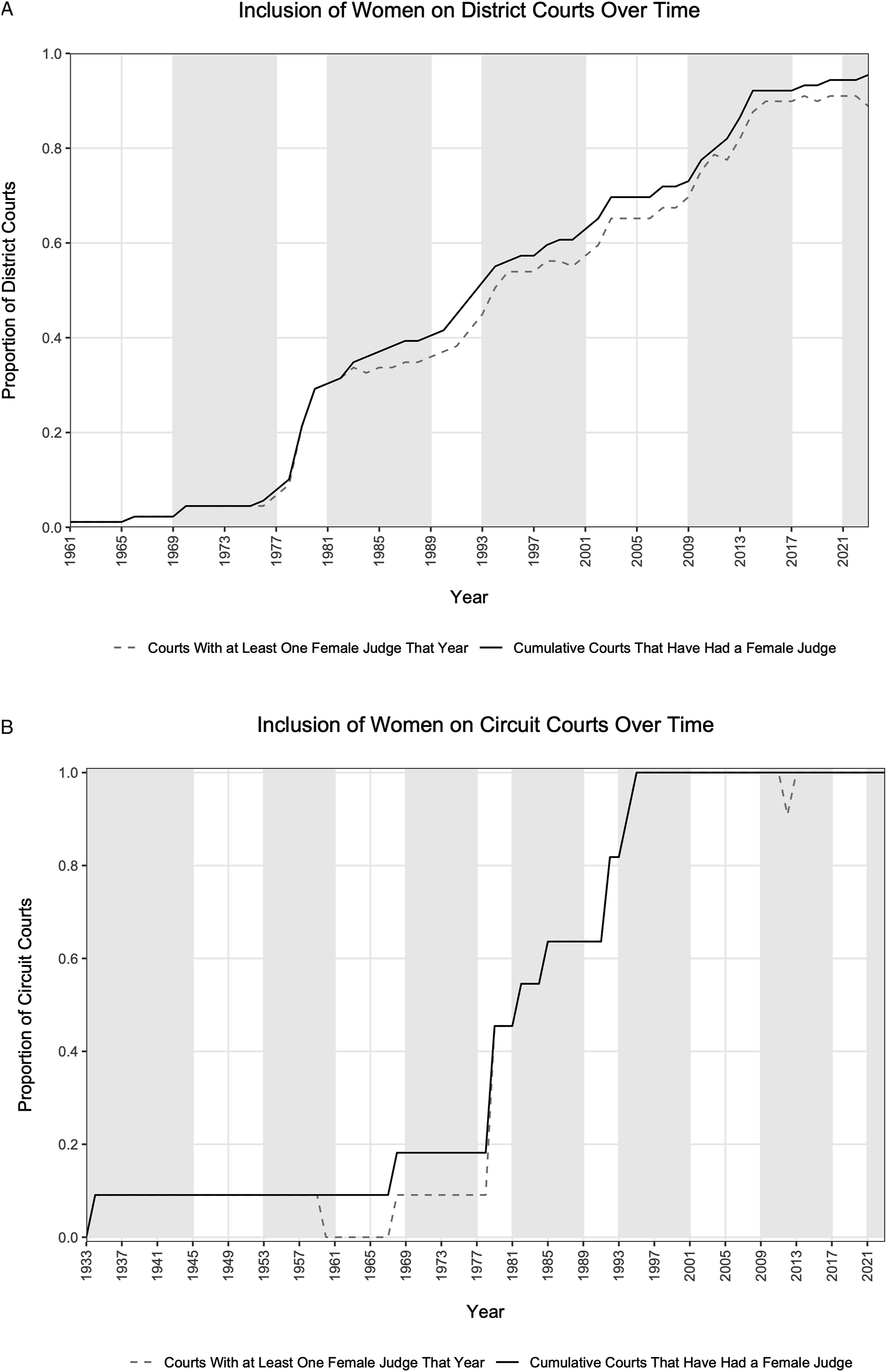
As the first generation of female judges began retiring in the 1990s (Moyer and Haire 2015), presidents had to decide how to proceed with diversification (Kenney 2013). Initially, they simply replaced one woman with another (Bratton and Spill 2002), creating a “woman’s seat” on many courts. But as the number of female lawyers grew and electoral and ideological pressures to nominate women to the bench increased (Badas and Stauffer 2023a), presidents in both parties increased women’s representation (Badas and Stauffer 2024). Now, 85% of district and all circuit courts have more than one woman serving. While this move was electorally savvy, it also significantly altered the world in which female judges work. Women who sit alone speak less, experience isolation from their colleagues, and feel increased pressure to perform at a high level and in accordance with gender stereotypes (Karpowitz, Mendelberg and Shaker 2012; Lindholm, Gregory and Johnson 2018). Alternatively, women who sit with other women feel integrated and emboldened to simply do their jobs (Collins Jr., Manning and Carp 2010; Johnson and Reid 2020), which in turn changes judicial processes and outputs (Boyd, Collins Jr. and Ringhand 2023; Szmer et al., 2023). 6 That is, putting more women on the bench also makes it easier for women to be on the bench, which has long-term consequences for judicial composition and output.
Procedural Constraints on Nominations
While presidents from both parties care about putting women on the federal bench, they also want to nominate people whose ideological preferences align with their own (Epstein et al., 2007). This goal creates conflict around the nomination and confirmation process as senators, constitutionally tasked with providing “advice and consent” on judicial nominees, are equally concerned about the ideological composition of the bench (Scherer 2005; Shipan and Shannon 2003). Both presidents and senators use confirmation battles to wage partisan warfare and score political points (Badas and Simas 2022; Dancey, Nelson and Ringsmuth 2020). Members of the president’s party do everything they can to confirm a nominee while opposition party senators seek to obstruct nominations (Jo 2017; Ostrander 2016; Tushnet 2004), and interest groups wielding money and influence add fuel to partisan fire by making their own demands about nominees and attempting to influence narratives about them (Cameron et al., 2020; Steigerwalt 2010). The subsequent partisan gridlock can delay confirmation for months, if not years, and even lead to failure (Bell 2002; Binder and Maltzman 2002, 2009; Bond, Fleisher and Krutz 2009). Consequently, presidents consider senator preferences when selecting nominees (Massie, Hansford and Songer 2004).
Senators possess many tools for obstructing lower court nominations and more broadly constraining the president’s selection powers. Historically the filibuster, which required a supermajority of 60 votes to break, created the biggest impediment to successful confirmation, but it lost much of its potency after the 2013 “nuclear option” rules change lowered the effective threshold for lower court nominations to a simple majority of votes (Boyd, Lynch and Madonna 2015; O’Connell 2015). Senators retain many other obstruction tools, however (Ostrander 2017; Wallner 2017), including “holds” that keep nominations from being scheduled for debate (Howard and Roberts 2015, 2019). One of senators’ most significant powers is the tradition of senatorial courtesy and its institutionalization in the Senate Judiciary Committee’s blue slips process. Particularly at the district court level (Dinan 2019), refusing to return a positive blue slip to the Judiciary Committee prevents a nomination from moving out of committee, effectively allowing a single senator to veto judicial nominations within their state (Binder, Madonna and Smith 2007; Binder and Maltzman 2004). Senators use these procedural maneuvers and norms to keep displeasing nominees off district courts in their home states and discourage presidents from placing undesirable nominees on circuit court seats “assigned” to their states; the norm of senatorial courtesy, for example, enabled Senator Paul’s preemptive block of Biden’s Kentucky deal with McConnell.
Given individual senators have so much power to obstruct a nomination, presidents at a minimum consider pivotal senators’ preferences when selecting a nominee, and in the best cases consult with those senators before making a decision. Consideration leads to compromise, such as picking a nominee more aligned with a senator’s ideological preferences (Binder and Maltzman 2009), or selecting an ideologically extreme nominee who diversifies the bench (Asmussen 2011). Consultation also offers senators opportunities to suggest that people within their networks, including friends, acquaintances, former colleagues, and talented local lawyers, would be ideal for judicial positions (Goelzhauser 2016; Goldman 1997). These informal suggestions widen the net of potential judges (Kenney 2013), and allow senators to credit claim when a home state hero joins the bench (Dancey, Nelson and Ringsmuth 2020). For female senators particularly, these consultations also provide opportunities for them to advance women’s causes and encourage women to take positions of power, which they view as part of their job (Dittmar, Sanbonmatsu and Carroll 2018; Swers 2013). And, to their credit, these appeals appear to work (Badas and Stauffer 2024), with more women joining the federal bench as more women join the Senate.
Partisanship and Competing Considerations
Because presidents consider so many factors when identifying a nominee, judicial nominations are time and effort intensive (Cameron and Kastellec 2023); this is why presidents are often slow to make nominations when their time is most valuable (King and Ostrander 2020). To lower the cost, presidents and senators often draw names from existing and trusted networks (Goldman 1997). These networks are efficient at identifying ideologically-agreeable nominees—the Federalist Society, a conservative network with connections to many senators and recent presidents, is a notable example (Bird and McGee 2022; Calmes 2021)—but they also tend to reflect the composition of the Senate, which is overwhelmingly White and male (Goelzhauser 2016; Kenney 2013). This is despite the fact that women of all political persuasions increasingly attend law school, to the point of near parity in attendance (Moyer and Haire 2015). Finding qualified women for judgeships thus requires presidents and many senators go beyond their typical networks and put in extra work, like Carter did when he set up committees to find diverse and qualified nominees (Binder and Maltzman 2009), or as conservative groups did when they established programs to recruit promising female lawyers to their causes (Greenhouse 2021). Doing so, however, requires additional effort that presidents and senators could use elsewhere. Presidents (and the senators who consult on lower court nominations) thus have to make a decision about how much work to put into the gender diversification of the courts: they can maintain the current diversity of the bench or they can permanently modify their candidate pool.
Seat maintenance involves treating a seat held by a woman as a “woman’s seat” in perpetuity (Arrington 2018; Bratton and Spill 2002). This anchoring strategy reduces the workload associated with identifying qualified women by focusing extended attention on a single seat. It also gives presidents (especially Republican ones) opportunities to push through more ideologically extreme candidates during periods of partisan gridlock (Asmussen 2011; Solowiej, Martinek and Brunell 2005), as politicians seek to avoid backsliding to an all-male bench (Escobar-Lemmon et al., 2021b). 7 At the same time, however, seat maintenance puts pressure on presidents and senators to find female nominees for anchored seats, which can lead to delays in nominations, compromises on candidate characteristics, or the decision to “shelve” a female nominee until a woman retires—consider, for example, that President Trump decided not to nominate then-Judge Amy Coney Barrett to replace Justice Anthony Kennedy at least in part because he wanted her available for Justice Ruth Bader Ginsburg’s seat if it became available (Greenhouse 2021).
The other option is ensuring that women are perpetually in the nominations pool and thus a consistently available option for nominations. This is what President Carter did when he established panels for finding qualified circuit court judges in the 1970s (Goelzhauser 2016); what President George W. Bush did by looking for conservative women (Haire and Moyer 2015); and what Presidents Barack Obama and Joe Biden did when seeking nominees from non-traditional backgrounds (Kaplan 2018; Solberg and Diascro 2020). Initially, developing infrastructure to keep women in the nominations pool is costly (Cameron and Kastellec 2023), but that cost decreases as infrastructure hardens and the network built from it expands. Theoretically, if the pool is deep enough, seats do not need to be anchored and presidents can just select a candidate of any gender from the pool.
Electoral incentives should drive the decision of which path to take, and partisan asymmetry suggests each party will follow a different one (Grossmann and Hopkins 2016). Democrats, who appeal to identity-based constituencies, feel pressure to put women into positions of power and reap electoral benefits for doing so (Crowder-Meyer and Cooperman 2018; Swers 2013). While Democrats have an advantage in identifying promising women who could be judges and thus have an easier time selecting women for judgeships (Boyd, Epstein and Martin 2010; Norgren 2018), they have also shown a willingness to increase women’s representation at the expense of ideological purity if the situation demands it (Asmussen 2011). Alternatively, Republicans, who care most about conservative credentials, focus more on a nominee’s ideological purity than on their identity (Bird and McGee 2022; Solowiej, Martinek and Brunell 2005). They acknowledge that nominating women is important (Asmussen 2011), make efforts to identify more women for judgeships (Greenhouse 2021), and will claim credit when a woman takes a seat (Dancey, Nelson and Ringsmuth 2020), but they also lack electoral incentives to compromise on ideology for the sake of increased representation (Crowder-Meyer and Cooperman 2018), and thus refuse to do so.
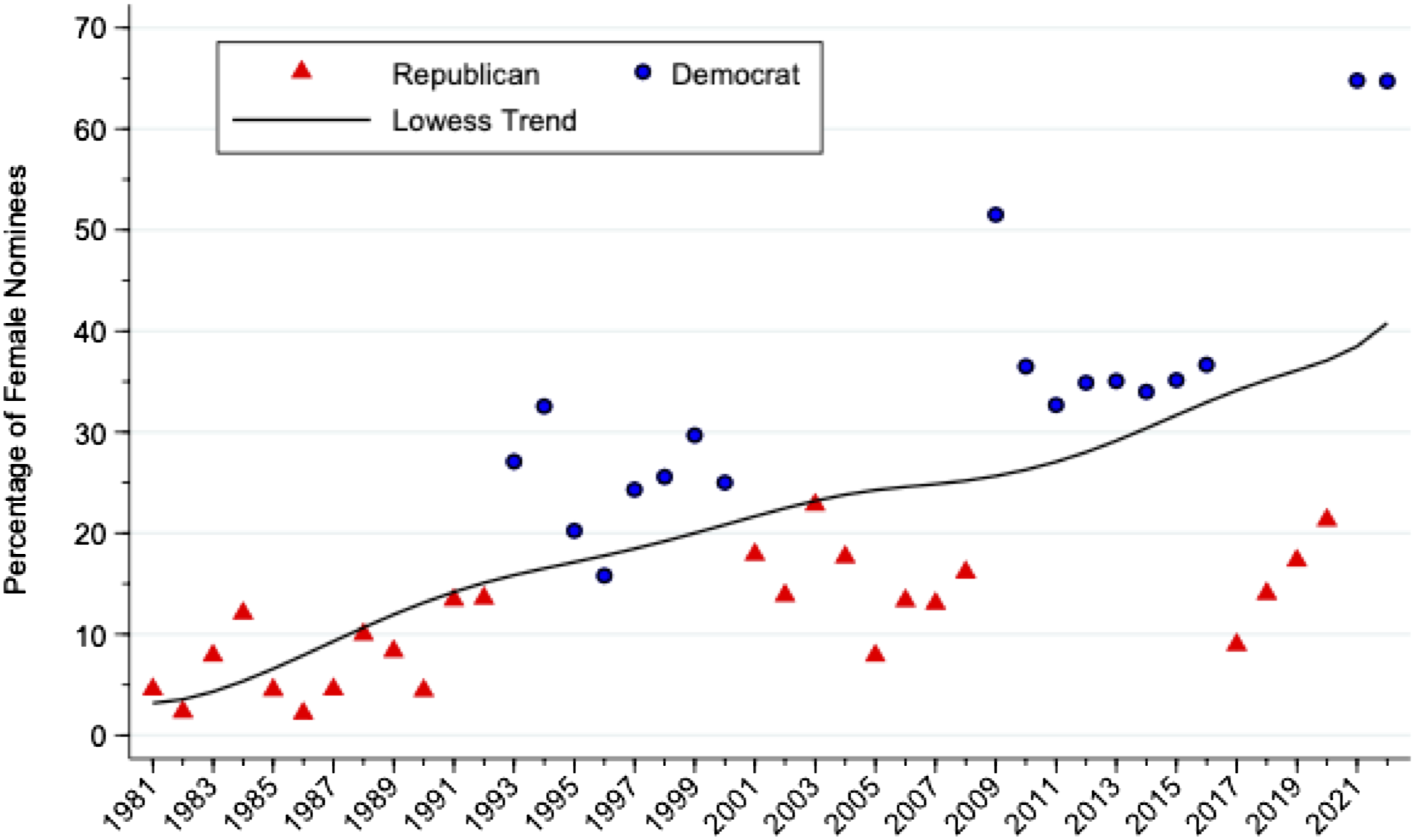
Consequently, we suspect that Democrats continuously appoint women to judgeships so they can reap the electoral benefits of putting women on the bench, while Republicans engage in seat maintenance in order to focus on finding conservative nominees to draw adoration from the party faithful. Such different strategies should yield divergent patterns in nominations, but still result in an overall increase in the number of women on the bench. As we show in Figure 2, nominations increase broadly over time, with Democrats consistently nominating more women to the bench than Republicans.
8
Aggregated nominations patterns suggest the same thing. Between 1981 and 2022, Democratic presidents nominated 1133 people to district and circuit court seats, and 41% (467) of them were women. Republican presidents nominated 1537 people to lower court seats, 17% (260) of whom were women, during that same period. Percentage of Female Nominations to Lower Court Positions: 1981–2022. Percentage of Republican (triangles) and Democratic (circles) lower court nominees in a given year that are women. Solid line shows the over-time trend using a lowess curve.
We add one procedural caveat to the broader story of partisan strategies. Senatorial courtesy and the blue slips process give home-state senators an opportunity to weigh in on nomination (Binder and Maltzman 2004); when combined with female senators’ personal desire to increase women’s representation (Dittmar, Sanbonmatsu and Carroll 2018; Swers 2013), and their knowledge of local networks of women who could fill a judicial seat, Senate delegations with women should be more likely to suggest women for judgeships. As such, we expect that in cases where the relevant Senate delegation for a given vacancy includes at least one woman, the nominee for that position will be more likely to be a woman as well, especially at the district court level, where those ties are strongest (Dinan 2019). This should be true regardless of that senator’s party.
Data and Method
To examine the dynamics of nominating women to the federal bench, we collected data on all formal presidential nominations to lower federal courts between the 97 th Congress (President Reagan’s first) and the 117 th Congress (President Biden’s first). This 1981 to 2022 timeline encompasses the era in which women held seats and could be replaced. 9 Starting with the Reagan administration also allows us to examine lower court nominations in an era of increased attention to ideological coherence (Goldman 1997). When gathering our data, we collected the details of each nomination from Congress.gov, which tracks actions, votes, and the final disposition of all formal presidential nominations to the lower courts. Gender for confirmed nominees comes from the Federal Judicial Center’s (FJC) Biographical Directory, and we used press releases and professional web pages to find the same information for unconfirmed nominees. 10 We also used the FJC Biographical Directory to identify the identity characteristics of the judge who previously held the seat. 11
Because we are interested in who gets nominated, our unit of analysis is the formal presidential nomination and not the vacancy itself. Our dependent variable thus identifies whether the president nominated a woman (1) or a man (0) to a federal judgeship. We examine nominations because judicial vacancies often span Congresses and administrations, 12 and an opening can span a variety of political contexts—including multiple nominations across different presidents—before successfully getting filled (Binder and Maltzman 2009). Given our interest in the role of Senate delegations, we remove nominations to the D.C. courts from our analysis. 13 We consequently examine 1809 district court nominations and 480 circuit court nominations. In acknowledgment of the different dynamics at play in these nominations, specifically that the weaker blue slips process at the circuit level leads to less home-state senator influence (Dinan 2019), we analyze the two courts separately (see also Martinek, Kemper and Winkle 2002; Primo, Binder and Maltzman 2008).
To identify the replacement strategy, we used Congress.gov and the FJC Biographical Directory to identify whether a woman (1) or a man (0) previously held the seat. Because we are interested in partisan differences, we also identify whether a Republican (1) or Democratic (0) president made that nomination, and then interact that variable with the variable indicating the gender of the previous seat holder. Congress.gov also matches each district court position to a corresponding home state, and each circuit nominee with the state where their seat exists (e.g., a judge on the Fourth Circuit who will work in South Carolina). These state identifications allow us to note when a relevant delegation includes a female senator. 14 For circuit court nominations, we also include the proportion of female senators from states included in a given circuit. Additionally, we used this data to determine how well-aligned the Senate delegation was with the nominating president, categorizing each delegation-president pairing as wholly aligned, wholly opposed, or a mixture of the two.
We also control for several factors that influence the overall likelihood of getting nominated. First, we control for the possibility of strategic retirement by identifying situations of “party switching,” where the president has an opportunity to fill a vacancy created by someone nominated by a president of the opposite party (e.g., President Obama nominates for a vacancy created by the departure of a Reagan administration appointee, see Spriggs and Wahlbeck 1995). Further, since the time left in a congressional session may influence nominating decisions (Binder and Maltzman 2002), we include the number of days left in a congressional session at the time a nomination is made.
To measure political contexts broadly, we control for a number of factors. First, given presidents modify their approach when faced with out-party control (Binder and Maltzman 2009), we control for whether the president faces an opposition (1) or allied (0) Senate. 15 Because previous attempts to fill a position may influence presidential nominating strategies (Asmussen 2011), we also account for whether the previous nomination was successfully confirmed (1) or not (0). 16 Additionally, we examine presidential approval via Gallup data, as well as whether the president and Senate are of the same party. 17
We also take steps to control for the possibility that women’s increased inclusion in the government broadly and the judiciary specifically might better explain bench diversification. First, we control for the proportion of female judges on a specific court at the time of the nomination because the gender composition of a bench can affect the decision to nominate another woman to it (Escobar-Lemmon et al., 2021a; Solberg and Stout 2021). Second, given the gender diversity of the legal profession and the Senate has increased over time, we include fixed effects by congressional term. We use congressional term because nominations fall within them and any outstanding nominations are “returned” at the end of a given term. 18 Finally, because state-level factors may lead to divergent nominating strategies, we include state fixed effects. 19
Results
Nominating Female Judges: 1981–2022.
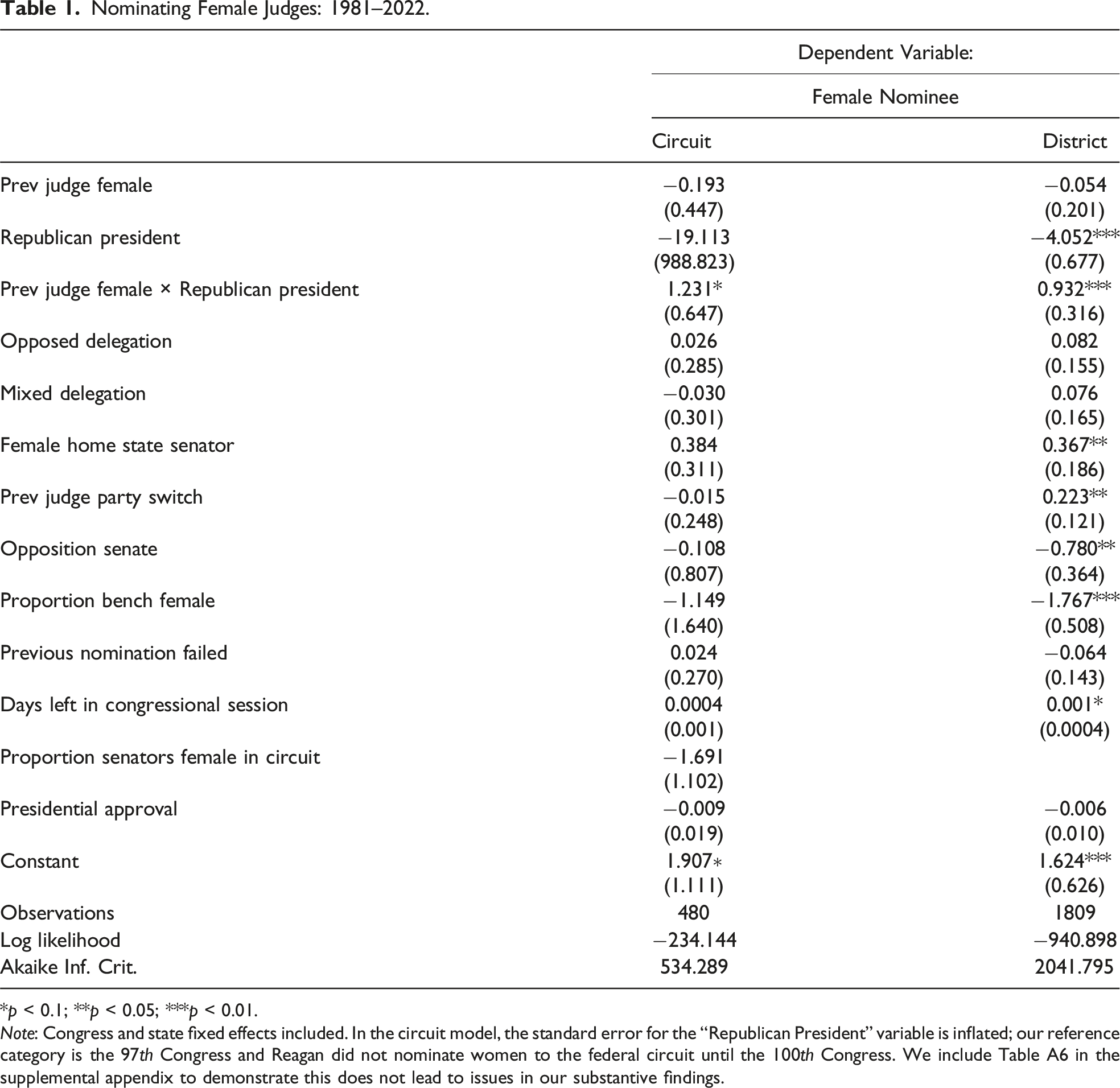
*p < 0.1; **p < 0.05; ***p < 0.01.
Note: Congress and state fixed effects included. In the circuit model, the standard error for the “Republican President” variable is inflated; our reference category is the 97th Congress and Reagan did not nominate women to the federal circuit until the 100th Congress. We include Table A6 in the supplemental appendix to demonstrate this does not lead to issues in our substantive findings.
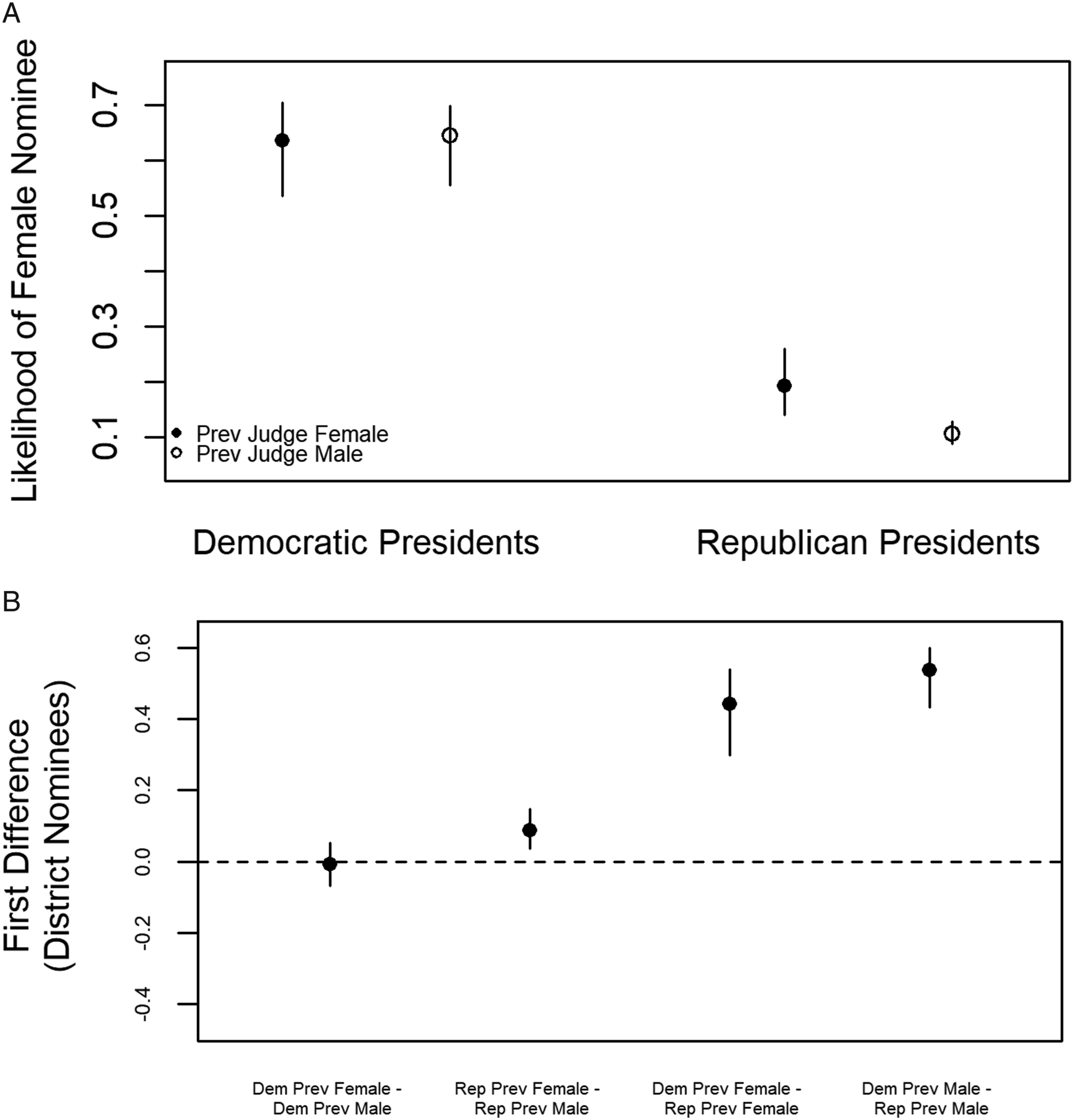
Our examination begins with our expectation that Democratic and Republican presidents approach nominating women to the bench differently. Figures 3(a) and 4(a) show the predicted likelihood of nominating a woman to replace a female or male judge by Democratic and Republican presidents at the circuit and district levels, respectively.
20
Because confidence intervals do not lend themselves to easy interpretation (Schenker and Gentleman 2001; Wright, Klein and Wieczorek 2018), we also provide first difference estimations in Figures 3(b) and 4(b). These figures suggest there are partisan differences in nominating women to federal judgeships. (a) Likelihood of Female Nominee: Circuit Courts, Likelihood of female nominee for circuit courts with vertical bars representing 95% confidence intervals and (b) First Difference Estimates: Circuit Courts, first differences of nominating judges by gender. Vertical bars represent 95% confidence intervals and vertical bars crossing the dotted line at zero do not significantly differ. Full regression results are included in column 1 of Table 1. (a) Likelihood of Female Nominee: District Courts, Likelihood of female nominee for district courts with vertical bars representing 95% confidence intervals and (b) First Difference Estimates: District Courts, first differences of nominating judges by gender. Vertical bars represent 95% confidence intervals and vertical bars crossing the dotted line at zero do not significantly differ. Full regression results are included in column 2 of Table 1.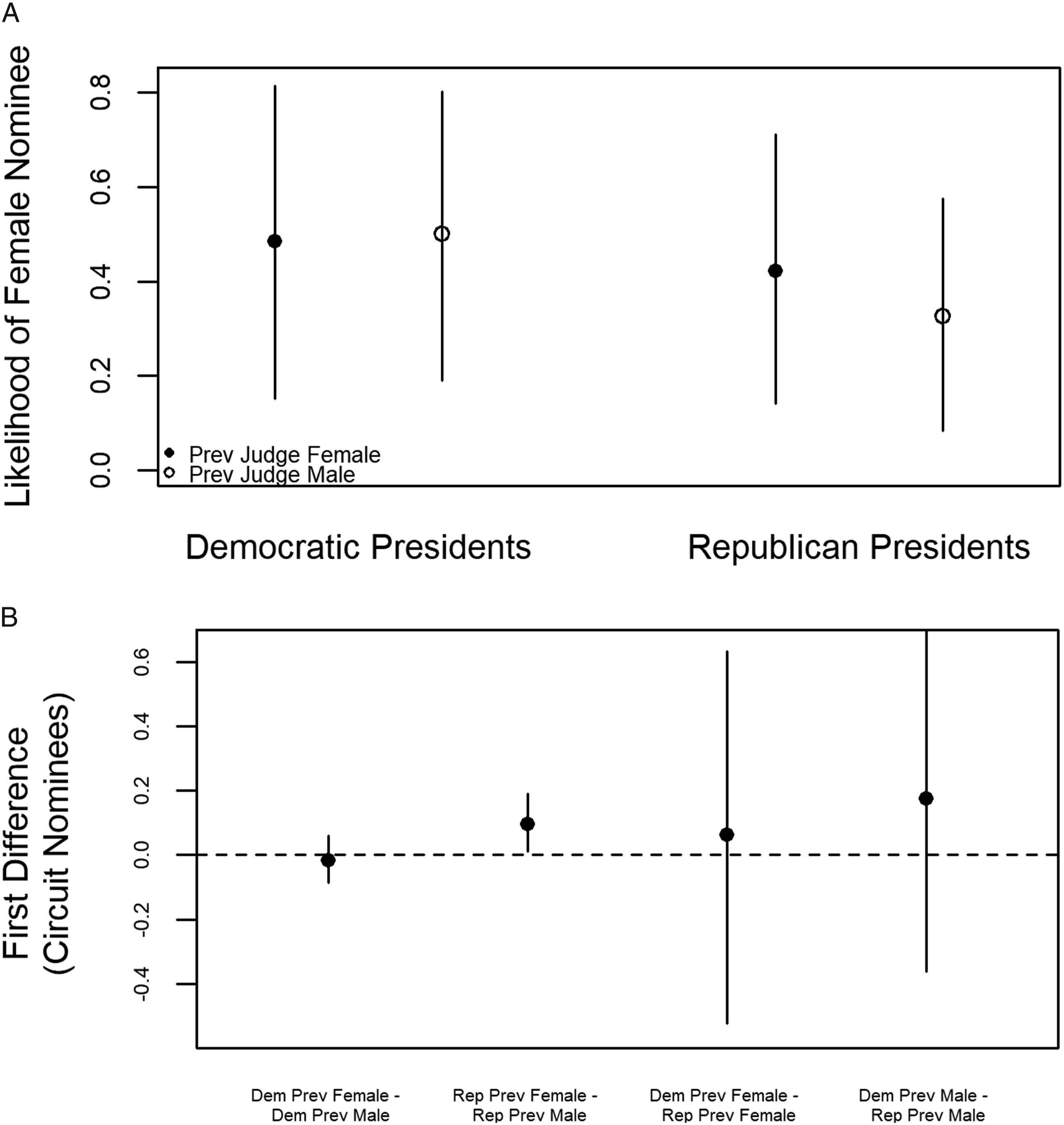
Turning first to the circuit courts, as the left side of Figure 3 shows, Democratic presidents are equally likely to nominate a woman to a circuit court judgeship whether the position was previously held by a male or female judge. Democratic presidents have a 0.50 probability of nominating a woman to a seat vacated by a male judge, and a 0.49 probability of nominating a woman to a seat vacated by another woman. Put simply, Democratic presidents are as likely as not to nominate a woman to a circuit court seat, regardless of the gender of the judge who held it previously. When combined with the fact that Democrats have increasingly nominated women to the federal bench over time, this finding suggests Democratic presidents are putting women up for any available seat, not just seats previously held by women, and lends support to Expectation 1a.
Democratic presidents may not anchor, but we find strong evidence that Republican presidents do. Republican presidents are significantly more likely to nominate women to a circuit vacancy previously held by a woman (0.42) than they are to nominate a woman to a circuit vacancy previously held by man (0.32, p < 0.05). Unlike Democratic presidents, Republican presidents are more likely to replace a female judge with another female judge than they are to consider a woman for a seat vacated by a man. From this, we find support for Expectation 1b and provide evidence of anchoring behavior by Republican presidents at the circuit level.
At the district level, we find additional evidence of anchoring for Republican presidents, as seen in Figures 4(a) and 4(b). Republican presidents are again more likely to nominate women to vacancies previously held by a female judge (0.19) than a male judge (0.10, p < 0.05). Similar to their behavior for circuit nominations, Democratic presidents do not tie nominations to the gender of the previous seat holder and continue to nominate women to seats previously held by male judges (0.64) and do so at a significantly higher rate than Republican presidents (0.10, p < 0.05). Combining these findings with the results from the circuit level, we find strong support for Expectations 1a and 1b, finding that Democratic presidents nominate women to any seat, and Republican presidents engage in anchoring. Further, as Figures A1a and A1b in the supplemental appendix demonstrate, confirmation success does not differ by nominee gender, contrary to Asmussen’s (2011) findings. That is to say, Republicans are not nominating women less because they are less likely to get confirmed. Taken together, these findings provide strong evidence that partisan asymmetry affects the nominations process, with Democrats leaning into diversification and Republicans engaging in it in a more limited manner.
Turning next to Expectation 2, we find partial support for our hypothesis that presidents are more likely to nominate a woman to a vacancy when the relevant Senate delegation includes at least one woman. The logic behind this expectation is that senators have some influence over who gets nominated from their home states (Binder 2007; Binder and Maltzman 2002), and that influence allows female senators particularly to nominate women to the bench. We find that having a woman in a state Senate delegation significantly increases the probability that a woman gets nominated to the district court, though we do not find a similar effect for circuit court nominations. At the district court level, Figure 5 demonstrates that having at least one woman in the relevant Senate delegation significantly increases the likelihood a woman gets nominated to a federal district court in that state. Specifically, female nominees are six percentage points more likely to be nominated to seats when there is at least one female senator in the delegation (0.34) than they are when the state delegation is all male (0.28, p < 0.05). Alternatively, women are no more or less likely to be nominated to circuit court seats if a woman is in the relevant Senate delegation (0.37) or not (0.30).
21
First differences of nominating judges by home-state senator gender. Vertical bars represent 95% confidence intervals and vertical bars crossing the dotted line at zero do not significantly differ. Full regression results are included in columns 1 and 2 of Table 1.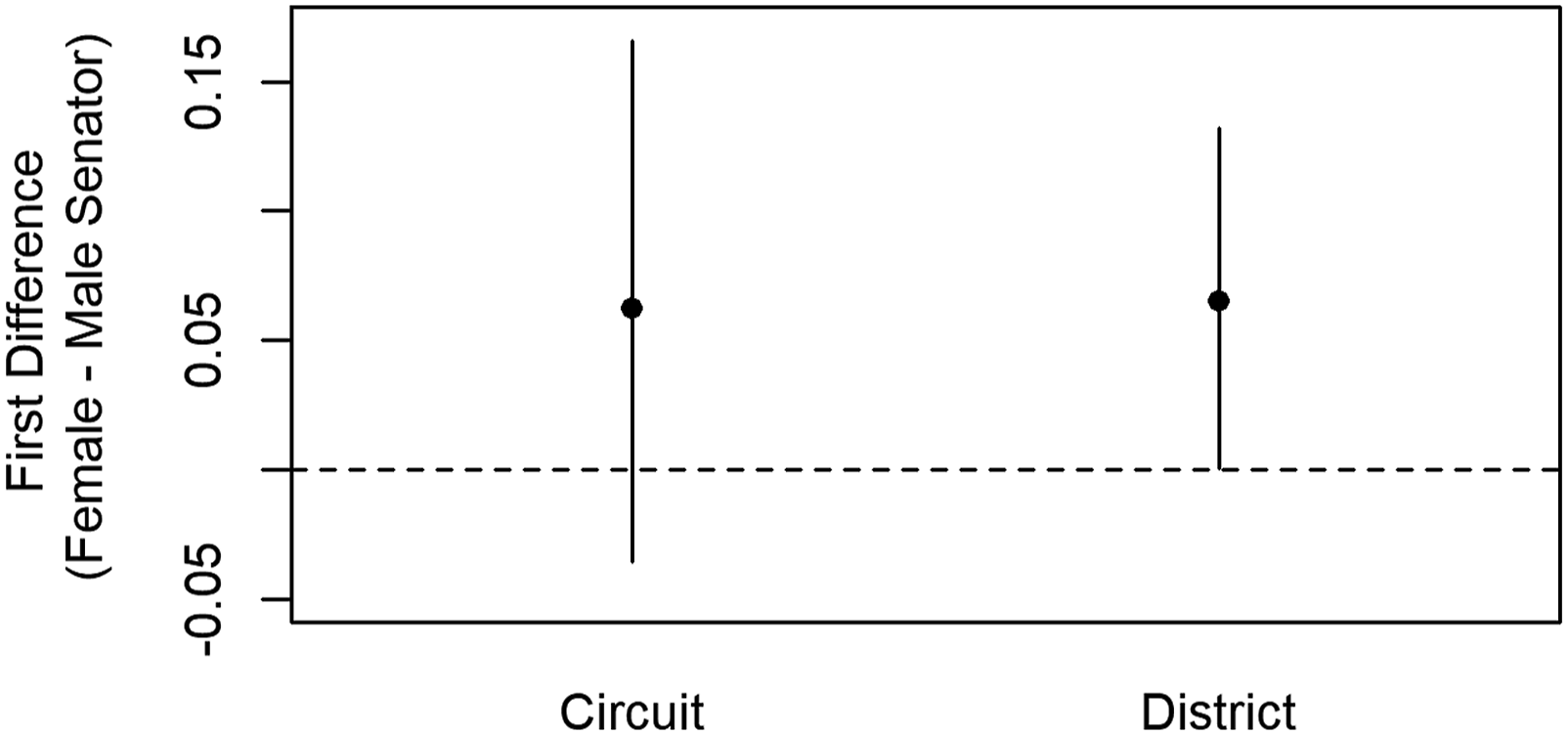
These findings offer some support for our second expectation while also speaking to the broader importance of taking Senate dynamics into account when discussing judicial nominations. At a basic level, our results suggest that Senate diversity influences the diversity of the federal judiciary at the level where senators have the most influence—the district courts that sit within their own states. When women are in power, they help put other women into positions of power. These findings also suggest that as influence wanes, female senators’ voices might not sound as loudly. Given recent reports that circuit court nominations are getting more national attention, this finding is perhaps not surprising (Calmes 2021). At the same time, however, we hesitate to read too much into this null effect, as our sample size on circuit court nominations is small enough that we might expect to see similar findings with more data.
Aside from the results discussed above, we find that little else influences the likelihood of a female nominee getting nominated to a circuit judgeship. At the district level, female nominees are significantly more likely to be nominated when there is a party switch. That is, a woman is more likely to be nominated when a Democratic (Republican) president is replacing a judge previously nominated by a Republican (Democratic) president. Further, women are more likely to be nominated at the beginning of a congressional session. Conversely, women are less likely to be nominated to district judgeships when facing an opposition Senate or as the proportion of women on the bench increases. These findings provide interesting avenues for future research on the selection of women to district judgeships. Put together, however, we see that the main determinants of women being nominated to the bench is anchoring behavior and the nominating president’s party.
Ultimately, these findings suggest that while both parties declared their support for increasing female representation on the courts, they have divergent strategies for doing so. Democrats routinely nominate women to the lower federal courts and we demonstrate they do so significantly more than their Republican counterparts. Furthermore, while Democratic presidents seek to advance diversity on the bench, the Republican strategy of anchoring seems more tailored toward maintaining existing diversity—with the caveat that they are still growing their diversity by replacing retired Democratic female judges with Republican female judges. Importantly, we also show how these factors operate both at the district and the circuit court level and most importantly that the findings differ by court level. Both single-court studies and investigations that pool models across the lower courts may miss or obscure this court-level variation.
Discussion and Conclusion
Having a judiciary that reflects the American population is crucial for having a representative and functioning judicial system. Pairing this broad democratic need with the electoral benefits offered by promoting diversification, presidents from both parties pledged to nominate more women to the federal bench starting in the 1970s. Since then, both Republican and Democratic presidents have nominated women to every level of the federal judiciary. But the parties—through their respective presidents—have wildly diverged in their tendency to nominate women to the lower federal courts. Over the past 40 years, Democratic presidents have proven much more likely to nominate women to the lower federal courts than their Republican counterparts. Why?
We find the two parties take different strategies for nominating women to the federal bench. Specifically, Republican presidents anchor their diverse nominations by nominating women to positions vacated by women. In contrast, Democratic presidents simply nominate a high proportion of women to the bench, regardless of the vacating judge’s gender. This change cannot be ascribed solely to the Democrats’ early advantage in finding women for federal judgeships, as Republicans made concerted efforts to build their own pools from which to select nominees. Instead, we suggest the parties diverge in strategy because they have electoral incentives for doing so; while both parties claim credit for their diverse nominees, Democrats are pressured to diversify the bench and Republicans gain more traction by heralding the conservatism of their judges. Interestingly, however, one of the long-term implications of our findings is that as Democratic presidents add diversity to the bench, Republican presidents maintain that diversity through their anchoring behavior.
Beyond showing that different partisan goals drive different approaches toward nominations, we provide evidence that the representation of women in the Senate influences the likelihood of a woman being nominated to the judiciary. In this way, the diversity of one branch of government is shown to directly influence the diversification of another. This relationship, however, is attenuated by the procedural structure of the Senate, as the result is not significant for circuit courts. Such a finding demonstrates the important role the Senate plays in the confirmation process, extending beyond mere voting for home-state senators putting judges on their home-state courts. These results suggest that in some ways, as the Senate slowly diversifies, so too does the federal bench. Put simply, our results suggest that diversification can snowball in meaningful ways when women are in positions of power.
Importantly, our findings lend themselves to a multitude of research topics that future scholars can explore. At a minimum, researchers can examine different types of diversification and its operationalization across different institutions. For example, do female senators’ influences over the judicial process extend to other appointments (Bratton and Spill 2002)? While we focus on gender, future work could consider the impact of race and ethnicity on nominee selection. One could also look for similar effects in the bureaucracy (see also Asmussen 2011), or in state courts (consider Arrington 2021; Goelzhauser 2016), with a particular focus on the role partisanship plays in the process over time. Looking beyond the study of who ends up in appointed positions, one could also build on our results by looking more deeply at what diversification means. Consider, for example, Boyd, Collins Jr. and Ringhand’s (2023) suggestion that gendered expectations taper out as more women take positions of power—is that true in the lower courts? If yes, what is the tipping point for it? Or, alternatively, consider Gleason and Smart’s (2023) work on how gendered expectations affect female attorneys’ win rates. Do those expectations change as more women take the bench? Scholars have only started to examine how a post-“firsts” judiciary behaves, and we look forward to future work addressing it.
Supplemental Material
Supplemental Material - Anchoring or Expanding? Gender and Judicial Nominations
Supplemental Material for Anchoring or Expanding? Gender and Judicial Nominations by Jonathan M. King, Jessica A. Schoenherr, and Ian Ostrander in Political Research Quarterly.
Footnotes
Acknowledgments

Declaration of Conflicting Interests
The author(s) declared no potential conflicts of interest with respect to the research, authorship, and/or publication of this article.
Funding
The author(s) disclosed receipt of the following financial support for the research, authorship, and/or publication of this article: This work was supported in part by a 2019 research grant provided by the Dirksen Congressional Center. Previously presented at the 2022 Annual Meeting of the American Political Science Association in Montreal, Quebec and at the University of Georgia School of Law.
Supplemental Material
Supplemental material for this article is available online.