




Abstract
This study delves into the determinants of legislative overrides in multiparty legislatures, with a specific focus on the influence of partisan fragmentation within congress. Utilizing an original dataset spanning from 1995 to 2017, we examine the cases of Ecuador and Peru. Our argument posits that during lawmaking, a dispersed and fragmented party system prevents the president from anticipating the preferences of the congressional pivotal party. In such a scenario of incomplete information, the president’s capacity to introduce selective incentives through vetoes is limited. In this way, the president is less likely to break the congressional majority supporting a bill. Consequently, the vetoed bill becomes less acceptable compared to the original statute. This, in turn, provides the congressional majority with increased incentives to uphold the original bill, elevating the likelihood of a legislative override. In alignment with this rationale, our findings indicate that an increase in the effective number of parties (ENP) has a positive and significant impact on the probability of a legislative override. Additionally, our evidence underscores a noteworthy contrast between the relatively high rate of legislative overrides in Latin America and findings for the US case.
Introduction
This paper studies what happens to bills after receiving a veto. Following a presidential veto, Congress decides to override or repass the bill. Typically, overriding requires a larger voting majority than repassing. For this reason, overrides tend to be uncommon events, yet their sheer possibility compels presidents to consider partisan congressional composition before issuing a veto. This task is straightforward before a bipartisan congress where parties’ preferences tend to be stable. This is not always the case. Presidents often interact with multiparty legislatures with switching platform positions, which further complicates presidential considerations to prevent Congress from opposing his veto. Since rules and partisan composition shape legislative outcomes, studying overrides in multiparty settings is crucial to understanding the last stages of the executive-legislative bargaining process.
How prevalent are overrides? Under what conditions do legislatures override bills? Do some congresses override more than others? Sequential veto bargaining models developed to explain the US case suggest that override attempts are much more likely when the opposition controls both chambers of Congress and increase with legislative significance (Cameron, 2000, 2009). There are reasons, however, to question whether this theory extends to other presidential countries. For instance, Latin American presidential democracies differ from the US model of presidentialism in at least two crucial aspects. First, these presidents are typically endowed with significant prerogatives to affect the lawmaking process. These agenda-setting prerogatives extend to the veto process (Tsebelis and Alemán, 2005). For example, most presidential constitutions allow presidents to veto parts of the bill, and in some cases, the president is allowed to introduce amendments to vetoed bills, which Congress may accept or reject before moving to an override vote (Alemán and Schwartz, 2006; Palanza and Sin, 2020). Second, Latin American Congresses tend to be much more fragmented than the US Congress. Moreover, in several countries, fragmentation varies from one period to the next (Kitschelt et al., 2010; Mainwaring, 2018; Pereira and Melo, 2012; Saiegh, 2009). If institutional and partisan configurations matter, then these differences will be highly consequential during inter-branch legislative bargaining.
This article advances a counterintuitive alternative to Cameron’s models. We argue that variations in the effective number of parties influence the likelihood of an override. Using a novel data set from two presidential multiparty countries, Ecuador and Peru, we illustrate how this mechanism works. We posit that, during lawmaking, a dispersed and fragmented party system hinders presidential capacity to anticipate congressional median voter’s preferences. Such an incomplete information scenario reduces the president’s ability to, through his veto, introduce selective incentives to break the congressional majority that sustains a bill. The resulting vetoed bill will tend to be less acceptable vis-à-vis the original statute. Thus, the congressional majority will have more incentives to sustain the original statute, thereby increasing the probability of an override.
This paper offers two key contributions to the broader study of legislative politics in multiparty presidential systems. First, amidst scarce comparative analysis of the determinants of legislative overrides, it advances the debate to two cases of presidential multiparty systems. Since the specialized literature focuses on the paradigmatic US case, this paper extends our knowledge about the lawmaking process under a more varied institutional and partisan setting. Second, this paper offers new empirical evidence covering 15 administrations across 20 years in Ecuador and Peru (N = 1,910). In addition, the main finding highlights the relevance of studying legislative fragmentation as a determinant of congressional outcomes in multiparty presidential democracies. This evidence provides comparative advantages to other students of legislative politics inasmuch as almost a quarter of the countries worldwide have multiparty presidential systems.
This study unfolds as follows. First, we review the main literature on vetoes and overrides in the context of presidential systems. Here, we consider the necessity of extending our understanding of legislative override dynamics outside the United States. Next, we propose some working hypotheses and variables derived from the previous section. Third, we introduce our cases and describe details about our research design. Subsequently, we test our hypotheses using logistic regression models and discuss their main results and implications. Finally, we outline our main conclusions and some notes for a subsequent research agenda.
What We Know About Vetoes and Overrides?
The Federalist papers anticipated presidential veto as one of the most powerful tools to influence the legislative process (Hamilton, Madison, and Jay, 2009[1788]). Since then, the literature interested in executive-legislative relations has conveyed a wealth of ideas regarding veto power and congressional override, chiefly in the American political system (McCarty, 1997; McGrath, Rogowski, and Ryan, 2018). Nonetheless, other presidential systems – for example, Latin America and Eastern Europe – have not followed the same tradition. Such systems seem to work under a different logic (Köker, 2017; Tsebelis and Alemán, 2005; Tsebelis and Rizova, 2007). This section reviews the main contributions around the presidential veto and legislative override dynamics while pointing out some limitations.
The literature exploring presidential veto and override is uneven. While research on veto is theoretically and methodologically rich (Cameron 2000; Cameron and McCarty, 2004; provide a comprehensive summary), our knowledge on override is scant. Research on the conditions that influence legislative override has been approached tangentially as part of the veto process (Cameron, 2012; Gilmour, 2002; McCarty and Poole, 1995). Given the connection between veto and override, these works assume that a valid theory should explain both processes (Copeland, 1983). In addition, theoretical US veto bargaining models predict override success rates in around 50% of cases (Martin, 2012). Empirical evidence, nonetheless, reveals a 12.88% override rate, which is much lower than theoretical expectations (Bridge, 2014).
Although both veto and override are part of the lawmaking process, they do not follow the same causal rationale. A veto decision hinges only on the president’s choice, while an override requires the agreement of a collegiate body representing diverse preferences. In this sense, legislators must coordinate when attempting to override a bill; failure in this endeavour results in accepting a presidential veto. Common key assumptions of these models are that the spectrum of legislative preferences is distributed within a bipartisan legislative framework and that both the Congress and the President possess enough information from each other. However, most presidential regimes worldwide are rather multiparty systems where near-perfect information is rather scarce. These considerations limit the external validity of such arguments.
One explanation regarding legislative override points to the size of the seat share of the president’s party (e.g. Conley, 2002). Here the prediction is that override events are less likely to be observed if the president’s party is large enough (Cameron, 2000). This relationship highly depends on the presidential party’s legislative discipline and the type of majority necessary to override that might vary between a simple and or a super majority (Tsebelis and Rizova, 2007). Consequently, the prospect of observing such an override diminishes significantly when the presidential party commands at least one-third of the chamber (Cameron, 2009; Hoff, 1992). In contrast, instances of override may experience an upswing when the threshold demands a simple majority.
From a different perspective, a group of scholars emphasizes that the features of the bills serve as predictors of congressional overrides. More precisely, they note that the topics of the bills, like issues related to taxes or foreign policy, have a lower proportion of vetoes and legislative overrides (Fleisher and Bond, 1983). In addition, regarding the bill’s salience, Cameron (2000) notes that vetoing more important pieces does not necessarily increase the odds of a congressional override. Nevertheless, this should be taken cautiously since scholars have no consensus on the appropriate criteria to capture bills’ salience (Grant and Kelly, 2008). Furthermore, the diverse rationales devised to capture the essence and significance of bills occasionally introduces ambiguity, rendering it challenging to extrapolate findings to other contexts.
Beyond the pure lawmaking environment, external factors such as the electoral cycle and public support are deemed as variables that influence legislative override (Rohde and Simon, 1985). The literature conveys that during the honeymoon period – known as the first 3 months since the president takes office – Congress passes bills closer to presidential preferences, decreasing vetoes and, therefore, overrides (McCarty, 1997). Following this logic, veto overrides increase due to political erosion as time passes. The explanation is that legislatures will have more incentives to confront presidents with low levels of public support (Hoff, 1992; Woolley, 1991). However, the effect of this variable will decrease in contexts where citizens largely support the president at the end of his mandate (Saeki, 2009). From a different perspective, Bridge (2014) contends that Congress is more likely to override presidents undergoing unfavourable circumstances – ‘poor leadership’ – irrespective of timing in the presidential term.
Overall, these findings heavily rely on the specific circumstances found within the US context. Nonetheless, there are reasons to wonder if these rationales travel to the context of new presidential democracies. For example, at least two significant differences exist between the presidential systems in Latin America and the United States. First, Latin American presidents usually have considerable power to influence the legislative process. These agenda-setting powers include the veto procedure (Tsebelis and Alemán, 2005). As an illustration, beyond total veto, the majority of presidential constitutions permit vetoing specific sections of bills, and even propose revisions to vetoed bills – known as amendatory veto – which Congress may approve or reject prior to an override vote (Alemán and Schwartz, 2006; Palanza and Sin, 2020). Second, compared to the United States, Latin American Congresses are often far more dispersed. In Latin America, the presence of a multiparty system coupled with a strong institutional framework for the president intensifies the conflict between the executive and legislative branches. On top of this, a fragmented multiparty structure (Mainwaring, 2018; Mainwaring and Scully, 1995) and varying levels of party volatility and institutionalization (Jones, 2010) tend to be common across the region. Both the rules and the partisan conditions constitute a breeding ground where vetoes and overrides might arise as a result of the latent executive-legislative conflict.
Among the comparative studies for this region, from a game theoretical perspective, Alemán and Schwartz (2006) examine 18 countries. They find wide variations in veto and override configuration and classify them into four extended games. Such classification highlights total and amendatory veto variants (amendatory vetoes include additive, deletional, or both). Against conventional expectations, the authors show that veto and override clauses are consequential, and they encourage responsible government rather than presidential dominance. Beyond this study, research around veto and override tends to be country-specific (see Palanza and Sin, 2020 for a comprehensive summary). These studies underscore that the president's ability to veto legislation matters to the extent that it affects inter-branch bargaining.
Regarding legislative override, Argentina and Chile are the most studied countries. In Argentina, Figueroa-Schibber (2012) contends that congressional overrides occur from prior negotiations between the two branches. Employing a distinct rationale, Palanza and Sin (2013) posit that the probability of a successful override increases when the president’s party holds a dominant position in the chamber but lacks an outright majority. They argue that congressional leaders of the incumbent party would prefer to disagree with the President on some issues in order to preserve credibility among other lawmakers, eschewing excessive alignment that could jeopardize their capacity to forge future coalitions. When analysing the Chilean congress, Alemán and Navia (2016) find that presidents use conference committees – as an agenda-setting tool – to make policy outcomes more acceptable for legislators, thereby ensuring their amendatory vetoes are less likely to be overridden. On the other hand, a recent study focused on Ecuador emphasizes that overrides emerge as a legislative response to vetoes over particularistic bills (Basabe-Serrano and Huertas-Hernández, 2021).
These studies collectively elucidate three common points. The primary explanations centre around the dynamics of the legislative bargaining process and the size of presidential seat share as the main drivers of overrides. Furthermore, each study underscores the pivotal impact of the institutional framework over the override outcome. Lastly, they collectively emphasize the infrequent occurrence of vetoes and, by extension, overrides.
The research discussed so far accounts for the main factors that explain veto and legislative override in presidential systems. While a substantial portion of this literature is methodologically and theoretically robust, it is predominantly centred on explaining the US case (Cameron, 2009; Cameron and McCarty, 2004). Notably, Latin America presents a diverse institutional and partisan landscape, offering the potential for alternative hypotheses and evidence to emerge. Most of the scholarly effort is still country-specific; thus, we know perilously little about the last stages of the lawmaking process from a comparative standpoint. Given the increasing prevalence of countries transitioning into multiparty systems (Chaisty, Cheeseman, and Power, 2014), assessing the impact of a fragmented party system on legislative outcomes is imperative. To address these gaps, the subsequent section advances a theoretical framework that builds upon existing knowledge while presenting a novel explanation of the legislative bargaining conundrum and an empirical test using the cases of Ecuador and Peru.
Legislative Override: Theory and Hypotheses
A salient characteristic of presidentialism in Latin America is the lack of a majority of the president’s party within Congress (Chaisty, Cheeseman, and Power, 2014; Santos, Pérez-Liñán, and García Montero, 2014). Conflicts over legislation between the president and Congress often arise in such scenarios. While the constitutional framework equips the president with a potent legislative tool, namely, the veto, it concurrently empowers Congress with the override mechanism as a counterbalance. When facing policy disagreements, the Congress has a compelling incentive to override the president’s veto. This dynamic introduces override considerations into the president’s strategic calculations, limiting his capacity to modify the content of certain bills, especially when he lacks a majority within Congress. According to Palanza and Sin (2013), cognizant of this interplay, the president strategically employs amendatory vetoes to introduce sufficient incentives, thereby inducing a fracture within the legislative coalition that initially endorsed the bill. If this strategic dynamic holds true, aligning with Cameron’s (2000) predictions, one should expect a limited number of legislative overrides against presidential vetoes.
Evidence stemming from Figure 1 contradicts this expectation. The depicted bars reveal a notable prevalence of overrides in Peru and Ecuador – 23% and 26% incidence over a span of 20 years, respectively. These figures indicate that Peru and Ecuador experience between two and four times as many overrides as observed in countries such as Argentina and Chile, respectively. Compared to the United States, we note that congressional overrides are about half as they are in Ecuador and Peru. Thus, the research question that guides this study remains latent: what are the main factors that explain congressional overrides in Latin America? Legislative override in Latin America and the United States. Source: Bridge (2014), Palanza and Sin (2013), Alemán and Navia (2016), and Valdivieso (2017). Note: Data are presented without disaggregating between overrides over amendatory or total vetoes, except for the United States, where overrides are only over total vetoes.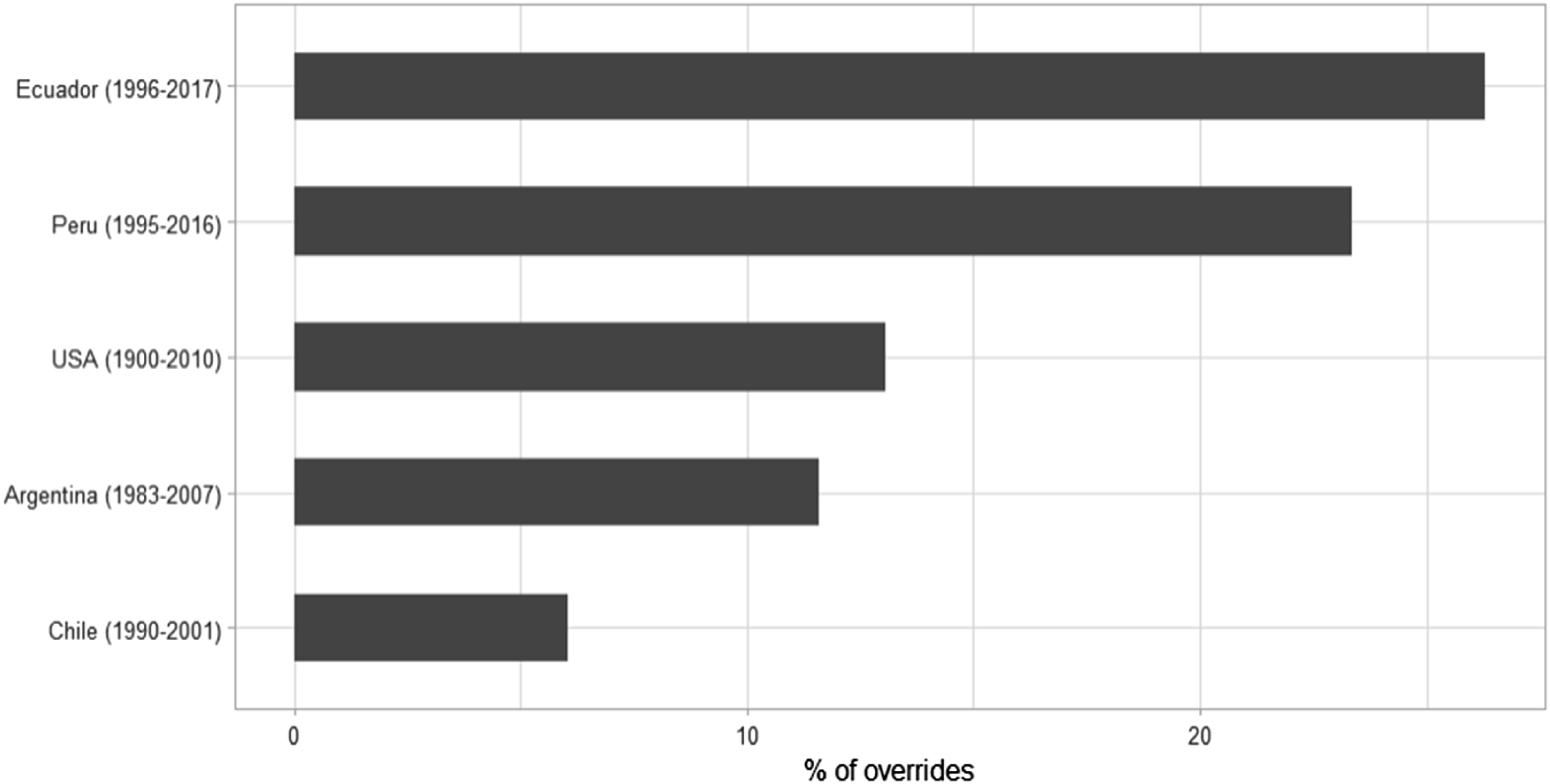
We argue that when the partisan scenario conveys a large number of parties, executive-legislative bargaining becomes a particularly complex business due to the increasing difficulty in predicting the preferences’ portfolio of parties within Congress. This challenge is exacerbated within the context of a fragmented multiparty system, as prevalent in the majority of Latin American countries, where parties are often characterized as unstable, volatile, and exhibit varying levels of institutionalization 1 (Kitschelt et al., 2010; Piñeiro and Rosenblatt, 2020; Scully and Mainwaring, 1995). Legislative fragmentation in a system featuring an increasing number of parties has at least four deleterious effects: (i) Parties’ preferences and strategies are not necessarily constant. This is partisan ideological positions are susceptible to shifts contingent upon the dynamics of the political environment. (ii) The main partisan contenders tend to vary from one conformation of Congress to another (Kitschelt et al., 2010). (iii) Seat shares of parties vary – sometimes drastically – from one election to another (Mainwaring and Torcal, 2006). (iv) The absence of party discipline and instances of party switching exacerbate this instability scenario (Heller and Mershon, 2009).
We contend that these unfavourable conditions arising from party fragmentation hinder the president's ability to accurately predict the range of party preferences within Congress. Executive-legislative bargaining hinges on the stability of patterns of preferences. The lack of repetition of such patterns impedes the president’s formation of expectations regarding likely future lawmaking interactions. If the main contenders are different parties, and if they get different specific legislative weights from one election to another, and if they vary their ideological positions, the president is less capable of properly interpreting their range and order of preferences. This misinterpretation, in turn, compromises the president’s capacity to craft effective vetoes. Consequently, the president is less likely to formulate override-proof vetoes, as the misalignment prevents the introduction of sufficient selective incentives to effectively dismantle the legislative coalition supporting the original bill passed by Congress.
In other words, the incomplete information scenario provoked by the varying levels of party fragmentation hinders the president’s ability to overcome the congressional majority upholding a bill, thereby increasing the likelihood of an override. An empirical referent that objectively examines the fragmentation of political parties within a congress is the effective number of parties (ENPs). This measure effectively gauges the number of parties and their weight in a particular party system or congress. 2 The central intuition behind the measure is to count the number of parties while considering their relative weight based on the corresponding number of seats, they hold (Laakso and Taagepera, 1979). This argument leads to the following hypothesis:
As the ENP increases, the probability of verifying a legislative override increases. From an alternative perspective, one could argue that the executive’s preferred status quo – expressed in the presidential veto – can be modified via override, depending on the number of existing partisan veto players within the legislature (Tsebelis, 2002). In this sense, a president without a significant seat share could anticipate a defeat in the legislative arena if his party is not large enough to overcome the override majority (McGrath, Rogowski, and Ryan, 2018). A successful override necessitates a congressional majority attaining a specified voting threshold, typically ranging from two-thirds to an absolute majority (Tsebelis and Alemán, 2005). Thus, if the incumbent party holds a congressional seat share closer to the override threshold, the probability of an override decreases. To illustrate, consider two scenarios where the Congress consists of a total of 120 legislators, and the override threshold is two-thirds. In the first case, if the incumbent party holds at least 39 seats (32%) – close to the override threshold (33%) – we would anticipate a minimal occurrence of overrides. The rationale is that despite the incumbent party lacking a majority, it is closer to the seat threshold that prevents Congress from overriding the presidential veto. In the second scenario, if the incumbent party holds 20 seats (16%), we would expect to observe more overrides since the president’s party is farther from the override threshold. Our reasoning posits that in the first case, it is easier for the incumbent party to persuade one legislator to join their voting group compared to the number of legislators they would need to convince in the latter case. An empirical referent of this rationale is captured by the percentage of seats that the incumbent party requires to reach the override threshold.
3
This line of reasoning leads to the following hypothesis:
The closer the president’s party seat share is to the complement of the override threshold, the probability of an override tends to decrease. In addition to these hypotheses, we test other possible explanations derived from the relevant literature discussed in the previous section. We consider the honeymoon period, measured as the first 3 months of government, and the last year of government, also known as the lame-duck period, as control variables of the political context (Bridge, 2014; McCarty and Poole, 1995). Furthermore, we consider the bill proponent to be a relevant player in the lawmaking process since the first mover might have an advantageous position when bargaining (Tsebelis, 2002). Studies that have measured the effect of this variable found that presidents in Latin American countries are, on average, successful actors in the legislative arena (Alemán and Tsebelis, 2016). Moreover, the literature on the lawmaking process notes that introducing bills on a fast-track-procedure allows the president to manage his legislative agenda to the extent that it prevents amendments during floor debate (Huertas-Hernández and Palanza, 2024; Magar, Palanza, and Sin, 2021; Mimica, Navia, and Osorio, 2023). In this sense, presidents might use this tool to speed up bill’s approval and lower the uncertainty of a potential legislative override. For this reason, we include the fast-track-procedure – known as urgency – as a control variable of the institutional design. Furthermore, extant research suggests that bills dealing with more important issues are more likely to face a veto (Cameron, 2009; Palanza and Sin, 2014) and, therefore, are also more likely to be overridden. To account for this, we add a control variable legislative significance. Other scholars have pointed at the policy area of the bills arguing that domains dealing with more consensual issues are more likely to pass (e.g. Barrett and Eshbaugh-Soha, 2007; Fleisher and Bond, 1983). We also control for this possibility.
Cases and Variables
Case Selection
We chose Ecuador and Peru to test our hypotheses. Studying these cases contributes to understanding the impact of partisan fragmentation on variations of legislative override rates within and between countries. Both cases are illustrative examples of the growing prevalence of multiparty legislatures within presidential systems, a trend observed particularly in Latin America, Eastern Europe, and Africa (Köker, 2017; Robinson and Torvik, 2016; Tsebelis and Rizova, 2007). Moreover, both congresses are characterized as unstable multiparty and fragmented systems (Basabe-Serrano and Martínez, 2014; Tanaka and Vera, 2010), where their mean ENP is close to the regional average, which is around 4 (Bormann and Golder, 2022; Mainwaring, 2018).
This two-country study design also allows us to examine other factors associated with rival explanations and between countries differences. From an institutional design perspective, both congresses exhibit distinct lawmaking rules – for example, different override majority – and their executives have differences in terms of their legislative and non-legislative attributions (Negretto, 2009). Also, from an empirical perspective, our knowledge of the final stages of the lawmaking process outside the United States remains scant (Palanza and Sin, 2020). To fill this gap, we collected evidence spanning 21 years covering the periods of Peru (1995–2016) and Ecuador (1996–2017). Following this strategy ensures variation in both dependent and independent variables. This approach is advantageous as it enables the collection of high-quality, congress-level data while controlling for contextual, institutional factors, and bill characteristics that might be challenging to manage in a comparative study involving a large number of congresses.
Ecuador and Peru in Context
During the studied period, Ecuador had three constitutions (1979, 1998, and 2008). Every text varied the congressional composition from 77 legislators in the early nineties to 137 nowadays. The legislative tenure was extended from two to four years 4 due to the new design introduced by the 1998 constitution. The constitution of 2008 kept a similar design in terms of legislative tenure. On the other hand, in a similar period, Peru had one constitution enacted in 1993 in the aftermath of president’s Fujimori self-coup (autogolpe) (Levitsky and Cameron, 2003). Congressional composition remained at about 120 seats until 2009 when a constitutional reform increased ten seats to make a total of 130. 5 The Peruvian Congress’ tenure lasts 5 years and has been stable during the studied period. 6
The lawmaking process in both countries conveys similarities and differences (see Figure 2). In both cases, the president is entitled to propose bills and has exclusive legislative initiative over topics such as taxes, political-administrative division of the state, and public spending. Legislators and other institutional actors might also propose bills. Once introduced, a bill (B) shall pass two debates and requires a simple majority – half plus one – vote to pass. According to Figure 2, once Congress (C) passes the bill (B), the president’s (P) decision is three-fold: (i) a total veto signalling that he opposes the congressional bill (B) and instead prefers the status quo (SQ). In the case of Ecuador, following a total veto, bill (B) freezes for 1 year. (ii) An amendatory veto where he might add or delete (or both) sections producing an alternative bill (X). (iii) Enact bill (B) (no veto), signalling his agreement and the end of the process. Veto and override institutional design in Ecuador and Peru. Source: Elaborated by the authors. C: Congress, P: president, B: bill, SQ: status quo, X: amended bill, B’: new bill.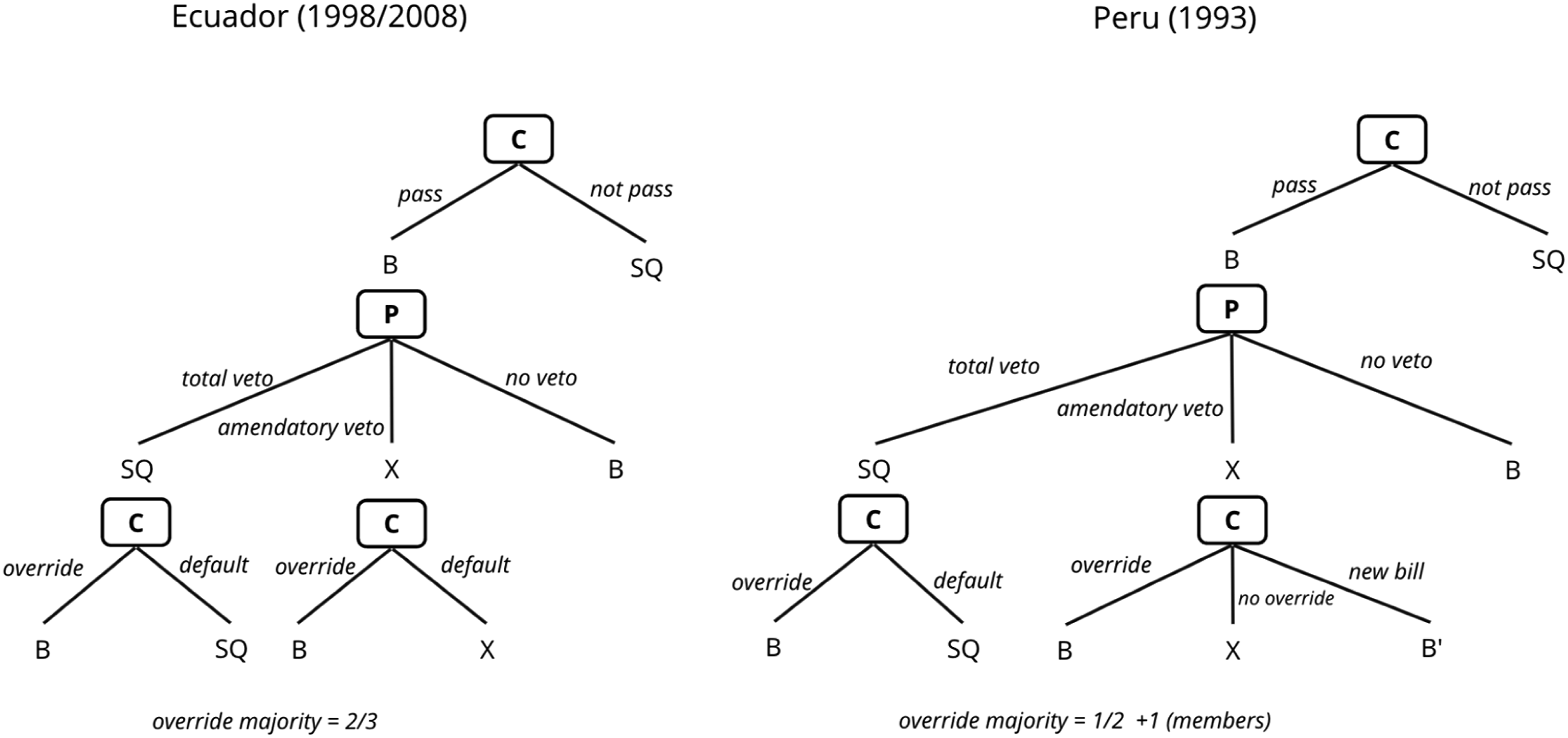
If the president (P) decides a total veto, congress’s choice is two-fold: (i) override, which requires a two-thirds majority in Ecuador, 7 and an absolute majority (1/2 + one of the members) vote in Peru. In both cases, the outcome is the bill (B) originally passed by Congress. (ii) Not override, in which case the outcome is the status quo (SQ). It is important to note that in the case of Ecuador if Congress does not decide within a 30-day limit, the automatic outcome is SQ.
If the Ecuadorian president decides amendatory veto, then the overriding rule is the same as the total veto. Still, if Congress does not reach the overriding majority (2/3) or fails to vote within the 30-day limit, then the amended bill (X) is the automatic outcome. This configuration grants enormous agenda-setting power to the Ecuadorian president. On the other hand, if the Peruvian president (P) issues an amendatory veto, then Congress’ (C) choice is three-fold: (i) override, in which case the rule and the outcome are the same as in the case of total veto, (ii) not override, in which case the outcome is the amended bill (X), and (iii) alternatively, the Congress might opt for a new bill (B’) which might encompass parts of the old bill plus additional regulations not included in the original bill, nor in the veto. In this case, the new bill shall be sent back to the president, who can decide between total veto, amendatory veto, or no veto.
Examining the political context, Ecuador underwent a period of persistent instability from 1996 to 2006, following a decade of relative steadiness. Three presidents failed to complete their 4-year tenures, succumbing to coups or legislative ousting. This protracted instability is closely tied to economic challenges and the president's struggles to forge enduring legislative coalitions (Mejía Acosta and Polga-Hecimovich, 2011). In stark contrast, President Correa (2007–2017) achieved three consecutive re-elections and experienced popularity and stability, correlated with the commodities boom, the use of formal and informal powers, and a centralized power administration (Polga-Hecimovich, 2020).
Conversely, Peruvian presidents managed to maintain relative stability, with all completing their 5-year tenures, except for President Fujimori, who resigned after one year during his second term in 2000. Despite this apparent stability, Peru has long been characterized by a minimally consolidated party system (Levitsky and Zavaleta, 2019; Tanaka, 2004). It is important to note that, although our analysis spans up to 2016, Peru witnessed presidential instability starting in 2020, with three presidents ousted in a single year (Dargent and Rousseau, 2021) and another self-coup by President Castillo followed by a presidential vacancy vote in congress in 2022 (Pizarro, 2023).
Variables
Our research question aims to unveil the main determinants of congressional overrides. The appropriate dependent variable for this study will be whether Congress successfully overrides a presidential veto, denoted by a dichotomous outcome taking the value of 1 when the override achieves the required voting majority and 0 otherwise. Since the outcome variable is binary, we use a logistic regression model. This analytical approach aligns with the methodology employed by other researchers, such as Cameron (2000) and Palanza and Sin (2013). Our research design utilizes an original database encompassing all bills passed by the congresses of Peru (1995–2016) and Ecuador (1996–2017). The unit of observation is vetoed bills for each country, totalling 1,910 cases, distributed as 331 for Ecuador and 1,579 for Peru.
To test the outlined hypotheses, we employ three distinct sets of independent variables, each forming a separate model for each country. The first set pertains to the political context and encompasses variables such as the ENP, the percentage of seats that the incumbent party requires to reach the override threshold, the honeymoon period – first three months – and the last year of government, commonly known as the lame-duck period. Data for these variables were sourced from the National Electoral Council (CNE) of Ecuador and the National Office of Electoral Processes (ONPE) of Peru. Utilizing this information, we computed the effective number of parties (H1) and the percentage of seats required to reach the override threshold (H2) within the Congress. The latter variable goes from −100 to +200; negative values mean that the president’s party has a deficit of seats, whereas positive values reflect a surplus above the override threshold. Honeymoon and lame-duck periods are coded as dummies taking the value of 1 if the override occurred during that period and 0 otherwise.
The second set includes variables of the institutional setting regarding the rules that influence legislative outcomes, such as the override. To distinguish whether the override is on a total or amendatory veto, we coded a dummy variable amendatory veto, which takes the value of 1 for an amendatory veto and 0 for a total veto. Urgency bills variable is a dummy coded as 1 when the president issued the fast-track procedure and 0 otherwise. We also construct a categorical variable that captures whether the bill was proposed by either the president, his party, an opposition party, or other actors – reference category.
The third set corresponds to the bill attributes, which allows us to control for the intrinsic characteristics of legislation and their influence on our dependent variable. Among these variables, we capture the policy area of the bill, distinguishing between public issues (reference category), economic and tax, private issues, and human rights. We also consider the legislative significance of the bill 8 that encompasses landmark, important, and minor legislation-reference category. 9 As a final step, a fourth full model integrates estimates from the three previous models, serving as a robustness check to validate the reliability of our findings.
Explaining Legislative Overrides in Multiparty Systems
As depicted in Figure 1, the occurrence of overrides in both Peru and Ecuador challenges the general perception that overrides are infrequent events. Notably, the congresses of each country override between 23% and 26% of the vetoed bills. Figure 3 bar graph offers a more detailed examination of this phenomenon. Over a 21-year span, the congresses of Peru and Ecuador exhibit a comparable pattern, with approximately 75% of vetoes being accepted and 25% overridden. This observation becomes particularly intriguing given the Ecuadorian legislative design, which requires a two-thirds majority vote to override the president compared to the absolute majority required in the Peruvian case. Contrary to common expectations, the data suggests that the prevalence of overrides is not necessarily tethered to a specific voting threshold. Legislative override by type of veto in Ecuador and Peru. Source: Library Congresses of Ecuador and Peru. Note: Details of the number of observations for each country can be found in Table A.4 of the annex.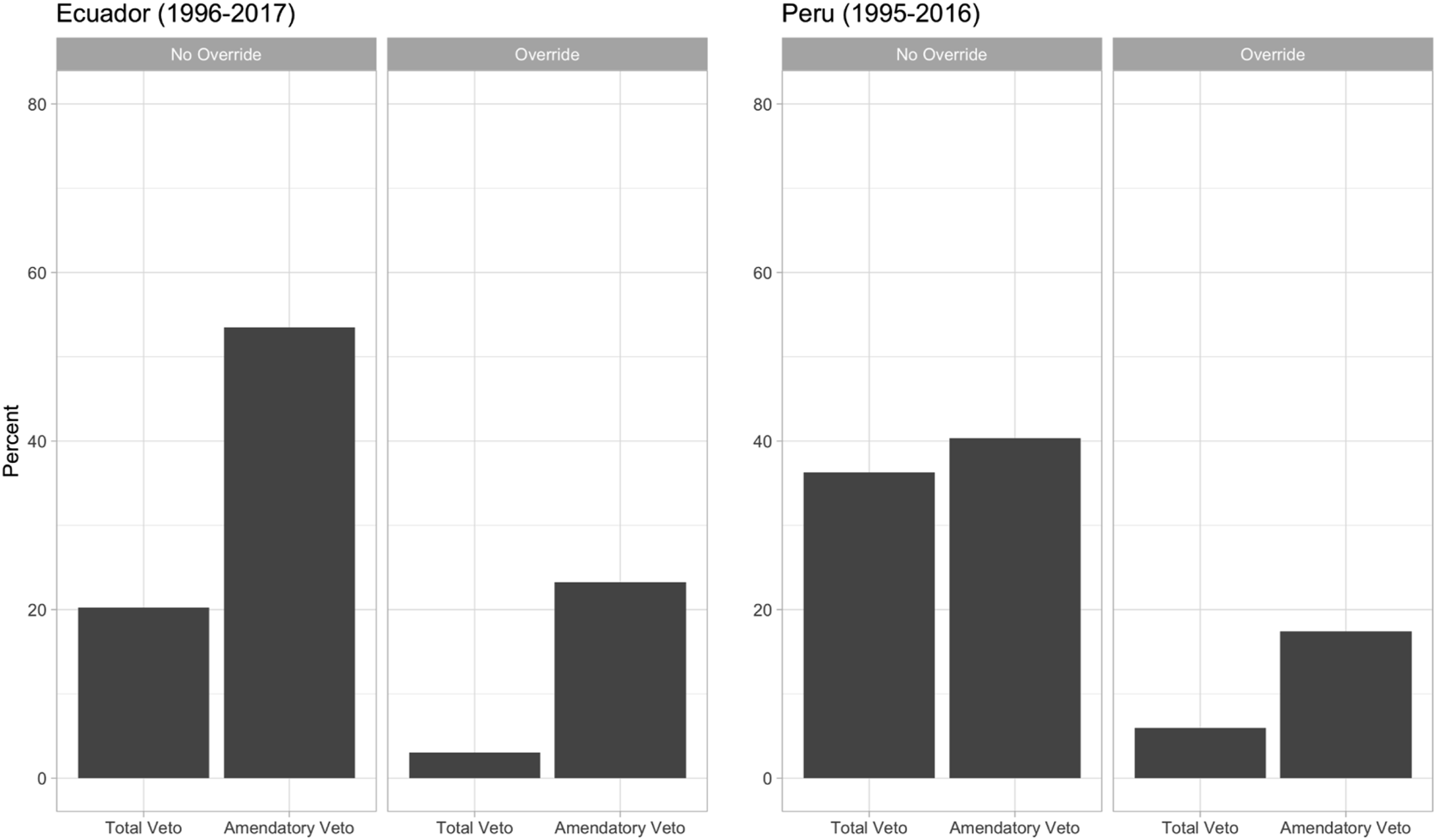
Moreover, Figure 3 reveals a trend in both countries, indicating a higher frequency of overrides on amendatory vetoes compared to total vetoes. In Ecuador, 23% of the overrides target amendatory vetoes, whereas only 3% are over total vetoes. Following a similar pattern, in Peru, overrides on amendatory vetoes account for 17%, while overrides on total vetoes border on 6%. These figures imply that despite distinct configurations of the veto process in each country, overrides persist, and they tend to affect amendatory vetoes. Overall, this figure suggests that occurrence of overrides is, at best, only partially associated with institutional design, thereby allowing for a more intricate explanation.
Advancing the analysis, Figure 4 presents override rates for the respective presidents of each country over the examined period. Notably, presidents during the 2000s encountered a heightened incidence of overrides in both Ecuador (Noboa, Gutiérrez, Palacio, and Correa) and Peru (Fujimori II, Paniagua, Toledo, and García). This fact is intriguing, especially considering the backdrop of intense crises of representativeness and legitimacy of political parties in each country. This crisis of representativeness was tied to weak party brands that varied from one election to the other and shifted their ideological positions when in office (Freidenberg and Pachano, 2016; Levitsky and Zavaleta, 2016). In addition, no incumbent party held a stable majority or legislative coalition during their time in office. Conversely, in both cases, leaders with strong political influence, such as Fujimori and Correa, tend to exhibit lower override rates, given that their party’s representation within the congresses was closer to meeting or even surpassing the override threshold (see Table 1). Override by presidential terms in Ecuador and Peru. Source: Library Congresses of Ecuador and Peru. Effective Number of Parties and Percentage of Seats to Reach the Override Threshold in Ecuador and Peru by Presidential Term. Source: CNE and ONPE. * Alarcón was interim president, and Noboa and Palacio completed the period corresponding to their ousted predecessor. ** Paniagua took over as interim president after Fujimori's resignation and removal from office.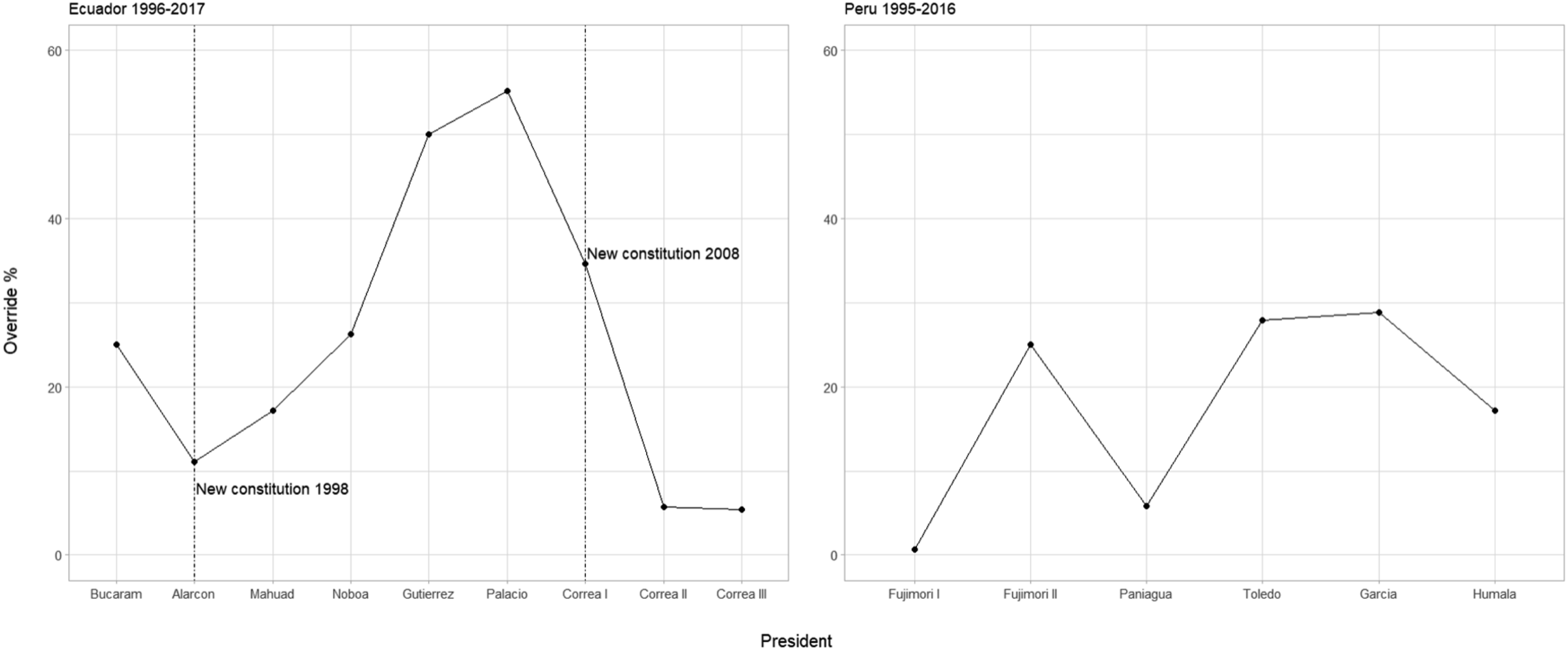
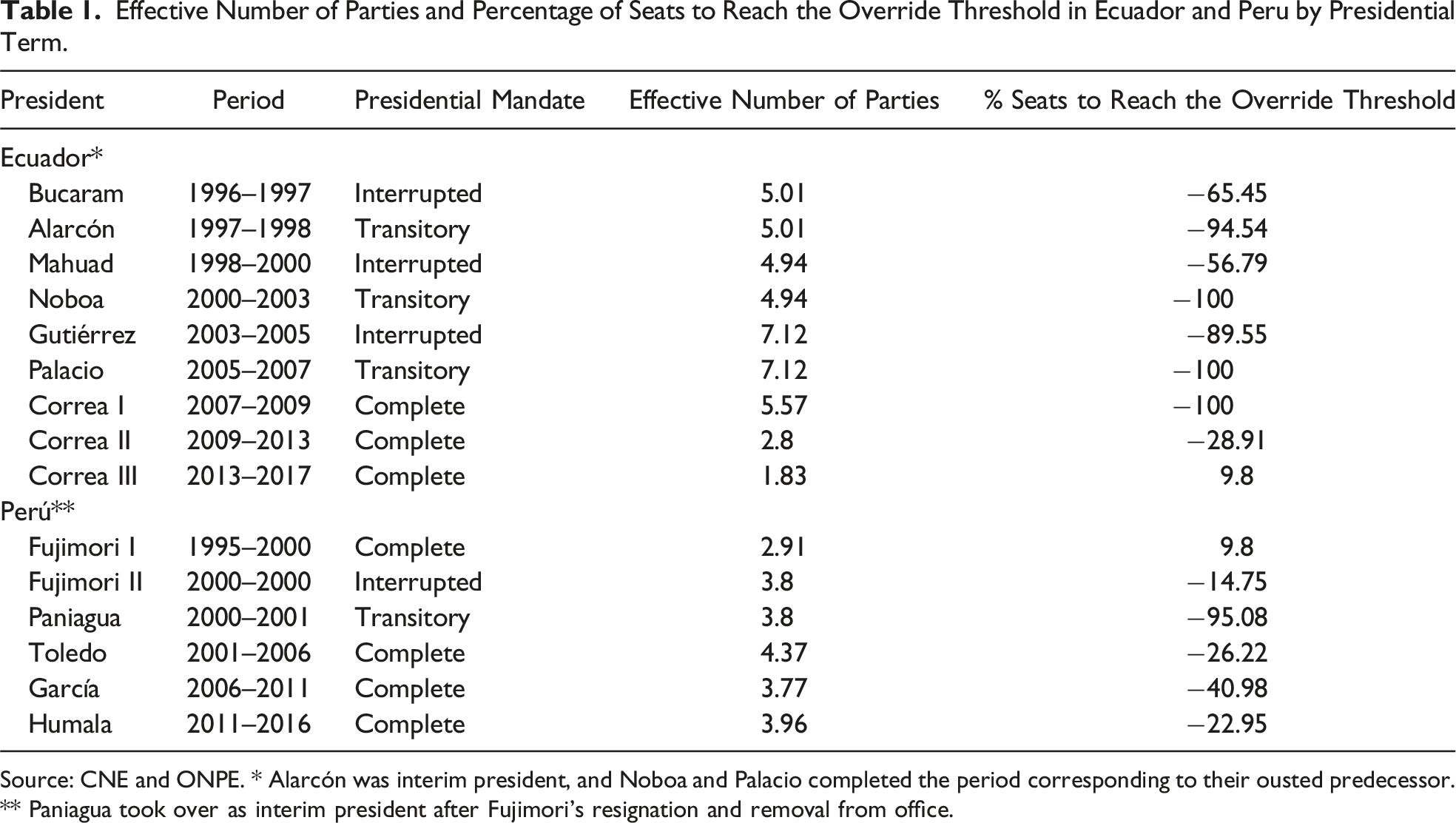
Table 1 conveys the variation of the ENP as well as the percentage of seats required to reach the override threshold for each presidential administration in Ecuador and Peru. In general, these data show increasing levels of ENP for those executive administrations whose override rate is over 20%. The data suggest that overrides systematically increase when the ENP surpasses the 3-unit benchmark. Conversely, the opposite effect tends to occur when congresses are less fragmented – below this benchmark – like presidents Fujimori I and Correa II and III. On the other hand, the last column of this table, together with Figure 4, strengthens the idea that the farther the presidents are from reaching the override threshold – two-thirds in Ecuador and an absolute majority in Peru – the higher the rates of override they face.
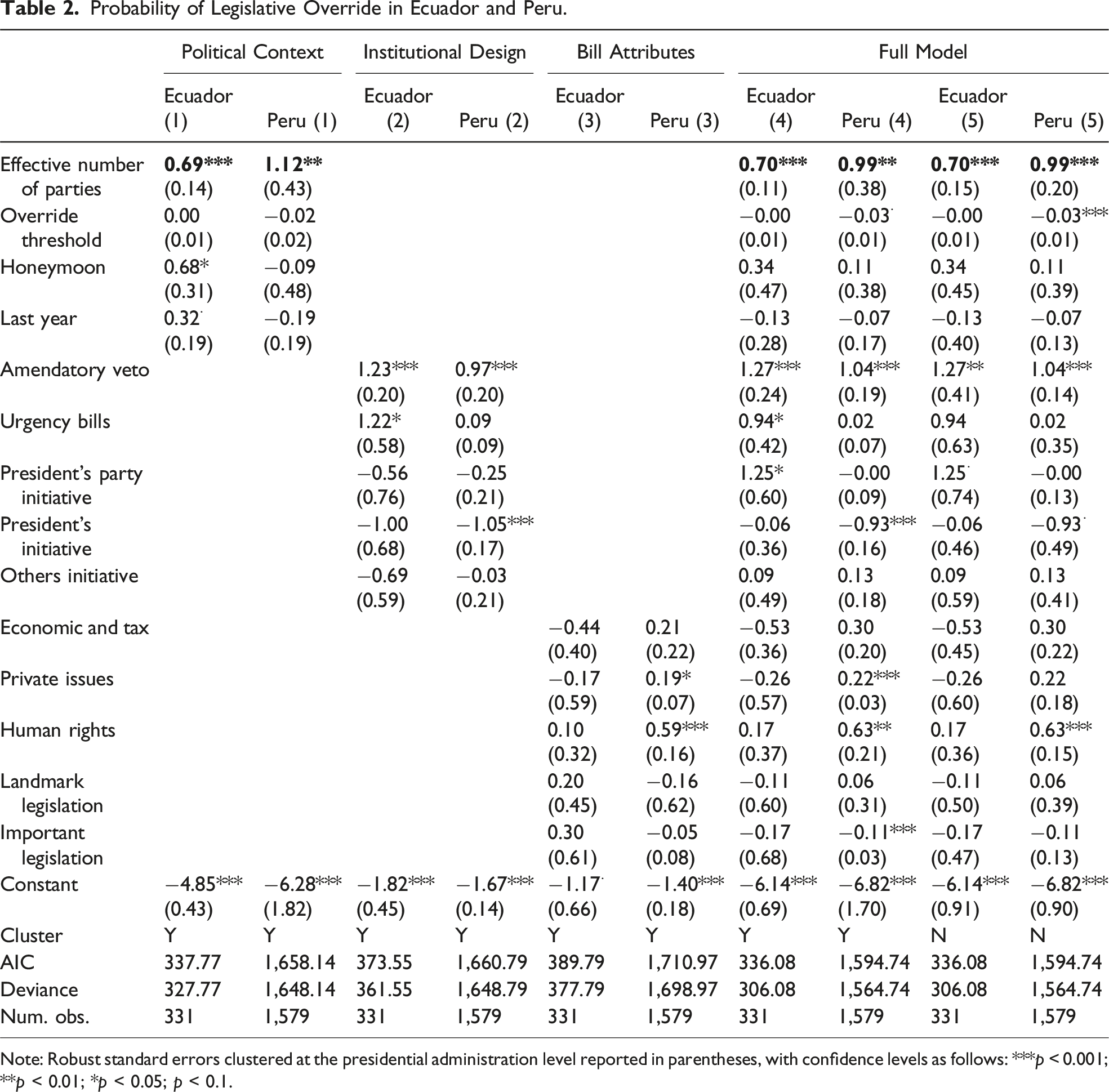
To further disentangle this puzzle, in the next section, we convey five logistic regression models organized according to our theoretical argument. Model 1 examines the effects of the political context (H1 and H2). Model 2 assesses the impact of the institutional design variables. Model 3 conveys the effect of bills’ characteristics. Models 4 and 5 include all the independent variables that are part of the study. All models, except model 5, include clustered errors for presidential administration.
Results
Probability of Legislative Override in Ecuador and Peru.
Note: Robust standard errors clustered at the presidential administration level reported in parentheses, with confidence levels as follows: ***p < 0.001; **p < 0.01; *p < 0.05; p < 0.1.
Overall, the findings presented in Table 2 align with our two hypotheses. In line with hypothesis 1, legislative overrides are significantly more likely to occur when the ENP increases. Across models 1–5, the ENP consistently exhibits a positive and statistically significant coefficient, indicating that an increase in the dispersion of parties within the congress substantially influences the probability of an override in both countries, ceteris paribus. Our estimates partially support hypothesis 2. The results indicate that as the president’s party seat share, measured in percentage points, approaches the override threshold, the probability of an override tends to decrease. The log of the odds for the variable override threshold consistently exhibits negative values, however, is only statistically significant at conventional levels for the Peruvian case, holding other factors constant.
The full model (4) suggests that our finding remains consistent when adding all the control covariates. Furthermore, as part of robustness checks, Table B1 and B2 in the appendix convey alternative model specifications. In B1, we consider a model (4) with aggregate data for Ecuador and Peru and introduced country fixed effects plus an additional control for the duration of each presidential administration defined as the number of months in power. The estimates of the effects on the ENP maintain their statistical significance and direction. In contrast with Table 2, the impact of the override threshold becomes statistically significant and negative as expected in our hypothesis 2, suggesting an effect only on the aggregated data. Table B2 introduces an additional robustness check for the model Ecuador (4) in Table 2, by controlling for constitutional changes in that country. Notably results regarding the ENP remain unchanged.
Beyond the hypothesized effects, Table 2 reports evidence indicating a substantial positive impact of amendatory vetoes on the likelihood of an override compared to total vetoes. We elaborate on this below. Other control variables related to the political context (such as the honeymoon period and the final year of the government’s term) do not seem to affect the probability of a legislative override in either country. This finding challenges the notion that the favourable political environment presidents experience at the beginning of their term provides advantages in the later stages of the legislative process. 10
Furthermore, institutional design control variables related to urgent bills significantly influence the likelihood of an override only in Ecuador. Although the direction of the effect is consistent across models for both countries, its magnitude and significance differ. 11 One possible explanation lies in the Ecuadorian system, where, unlike Peru, the congress has a 30-day deadline to debate an urgent bill proposed by the president. Due to the limited time, legislators may only introduce changes that garner broad consensus (without room for negotiating other alterations), thus the veto incentivizes overrides based on general agreement. This mixed outcome offers partial support to the notion that a closed rule fast-track procedure aids presidents in successfully advancing their legislative agenda (e.g. Huertas-Hernández and Palanza, 2024; Magar, Palanza, and Sin, 2021).
Similarly, concerning the bill’s proponents, the findings indicate that when the bill originates from the Ecuadorian president's party, the likelihood of an override increases, whereas when the bill is initiated by the Peruvian president, the probability of an override decreases compared to bills initiated by the opposition. However, these results, while significant, should be interpreted cautiously as they are not consistently observed across models and countries.
Control variables pertaining to bill attributes include factors related to the policy area and legislative significance of bills. Model 4 estimates suggest that bills addressing private and human rights issues are more likely to receive an override compared to those dealing with public issues, but only in Peru. Economic topics do not exhibit statistically significant impacts in either country. Moreover, only legislation of substantial importance appears to be significantly less prone to overrides, though this effect is only observed in Peru. As in the previous case, interpretations of estimates for bill characteristics should be taken cautiously, considering the lack of consistency across countries and different model specifications. 12
To enhance interpretability, Figure 5 reports the coefficients of Table 2 as odds ratios. The graph conveys odds changes of a bill having a legislative override, associated with unit changes in the explanatory variables of model 5 (all other regressors at their mean value). More precisely, all else being equal, a one-unit increase in the effective number of parties index is associated with approximately a factor 2 and a factor 2.7 increase in the odds of a legislative override against a presidential veto, for Ecuador and Peru, respectively. Similarly, for each additional percentage point by which the president's party moves closer to the override threshold, the odds of an override decrease by approximately a factor of 1 for both countries. Odds ratios from model 5. Filled circles report odds ratios for each independent variable; bars are 95% confidence intervals. Source: Own elaboration based on the results of model 5 in Table 2.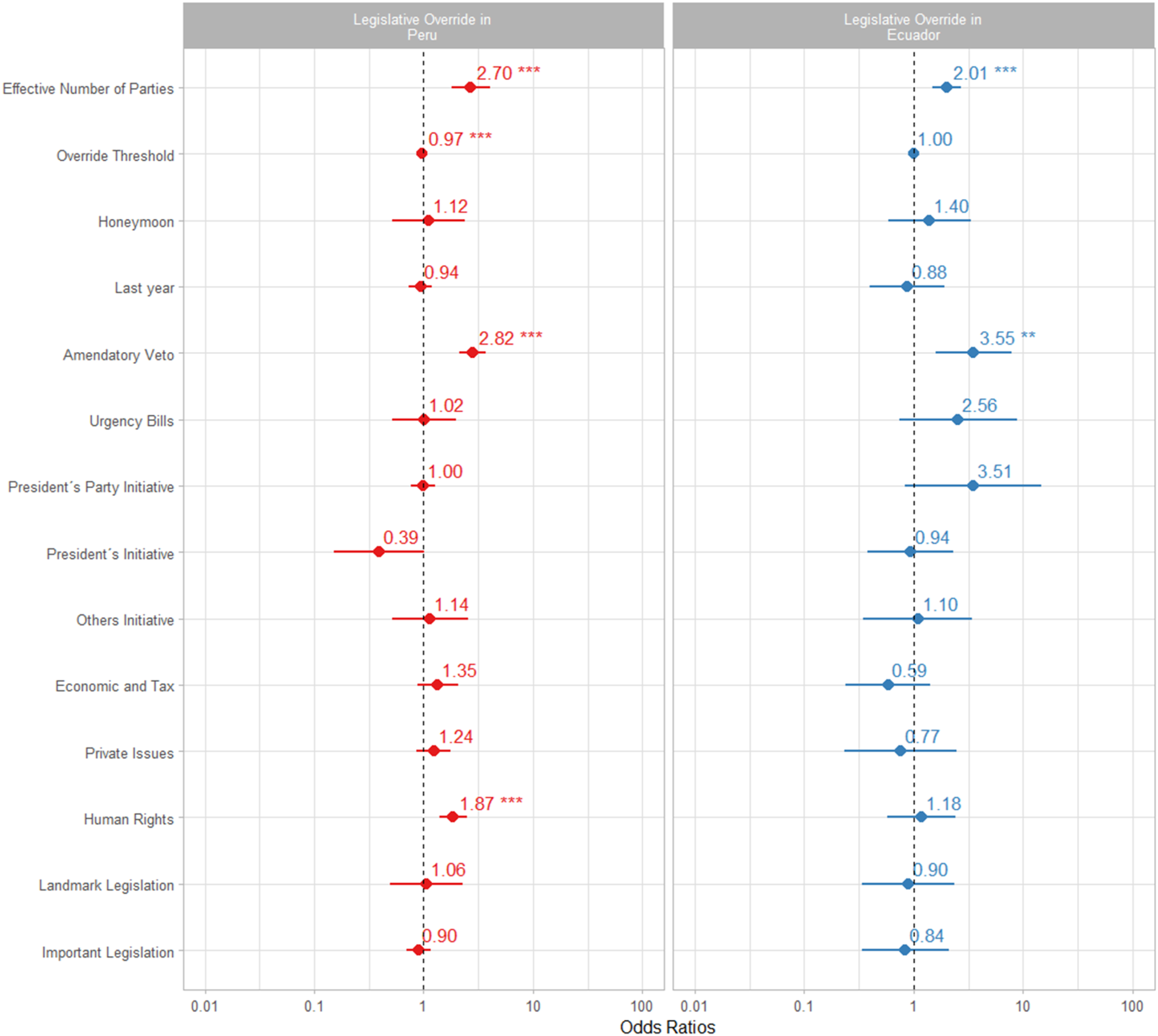
Figure 6 plots predicted probabilities of observing an override across different scores of the ENP index for both countries. At odds with common intuition, the prediction suggests that an increase in party dispersion within Congress significantly influences the likelihood of observing an override. For instance, when the ENP is 5, the average in the Ecuadorian case, the probability that a president might face an override is around 10%. In contrast, in Peru, where the average ENP is 4, the predicted probability of an override is around 15%. Notably, when the ENP exceeds 6 points, the predicted probability of encountering a legislative override on an amendatory veto surpasses the 50% and 30% threshold for Peru and Ecuador, respectively. The prediction here underscores the underlying hindrance – linked to party dispersion – that the president faces when trying to construct override-proof vetoes. Effect of ENP on override probability in Ecuador and Peru. Source: Own elaboration based on the results of model 5 in Table 2.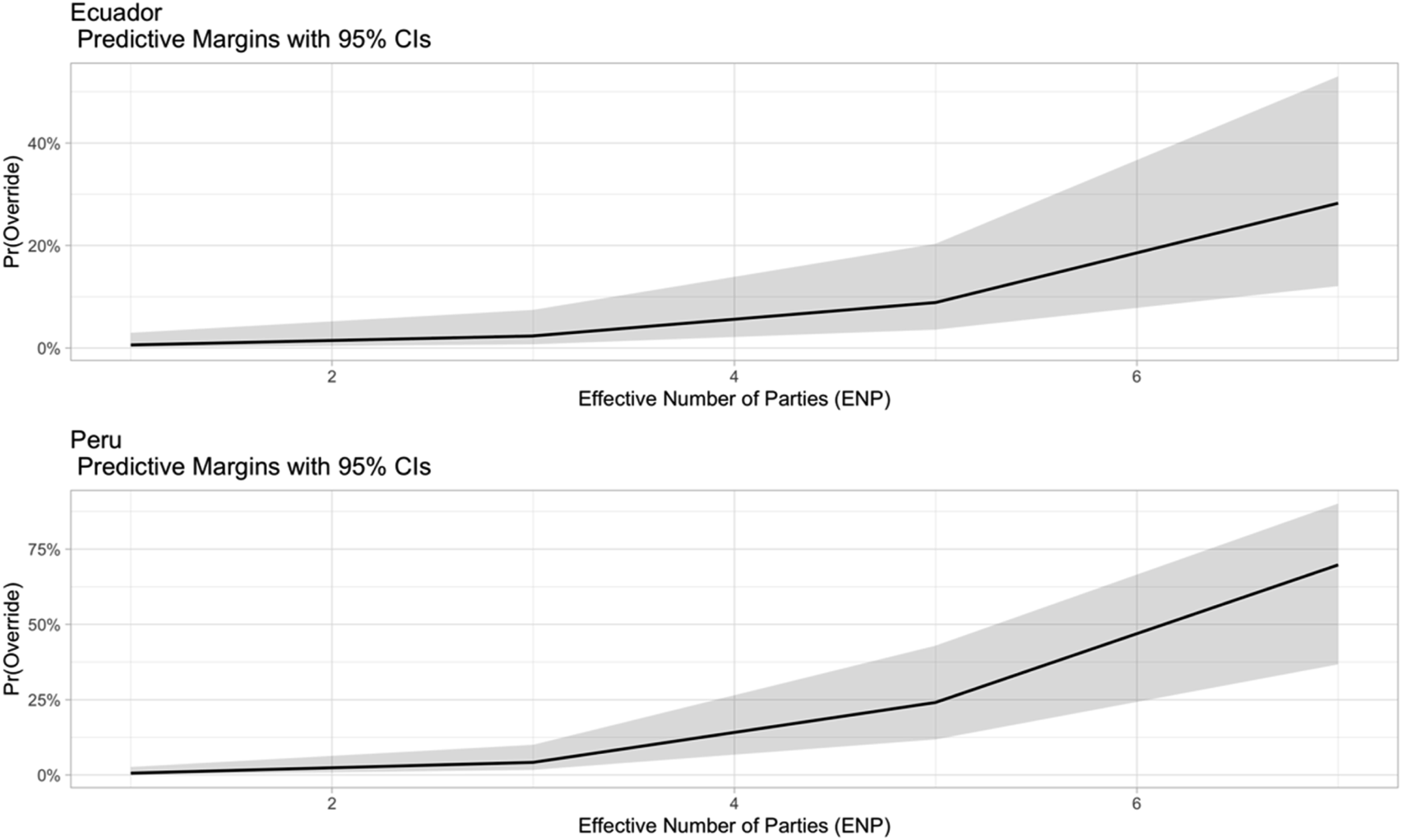
Figure 7 conveys predicted probabilities of an override as a function of the percentage of seats that the president’s party is apart from reaching the override threshold. The prediction indicates that when the president’s party is considerably distant from the override threshold, the probability of facing an override is approximately 10% for Ecuador and 40% for Peru. In contrast, when the president’s party is near such threshold, the probability of an override decreases to below 10% in both cases. For instance, in Peru, where congress may override with an absolute majority, the predicted probability for the average president to face an override is around 10%. This negative relationship underscores the crucial importance for presidents to have a seat share that at least approximates or – in the best scenario – surpasses the complement of the overriding majority in order to successfully advance their legislative agenda. Effect president’s seats remaining to reach the override threshold on override probability in Ecuador and Peru. Source: Own elaboration based on the results of model 5 in Table 2.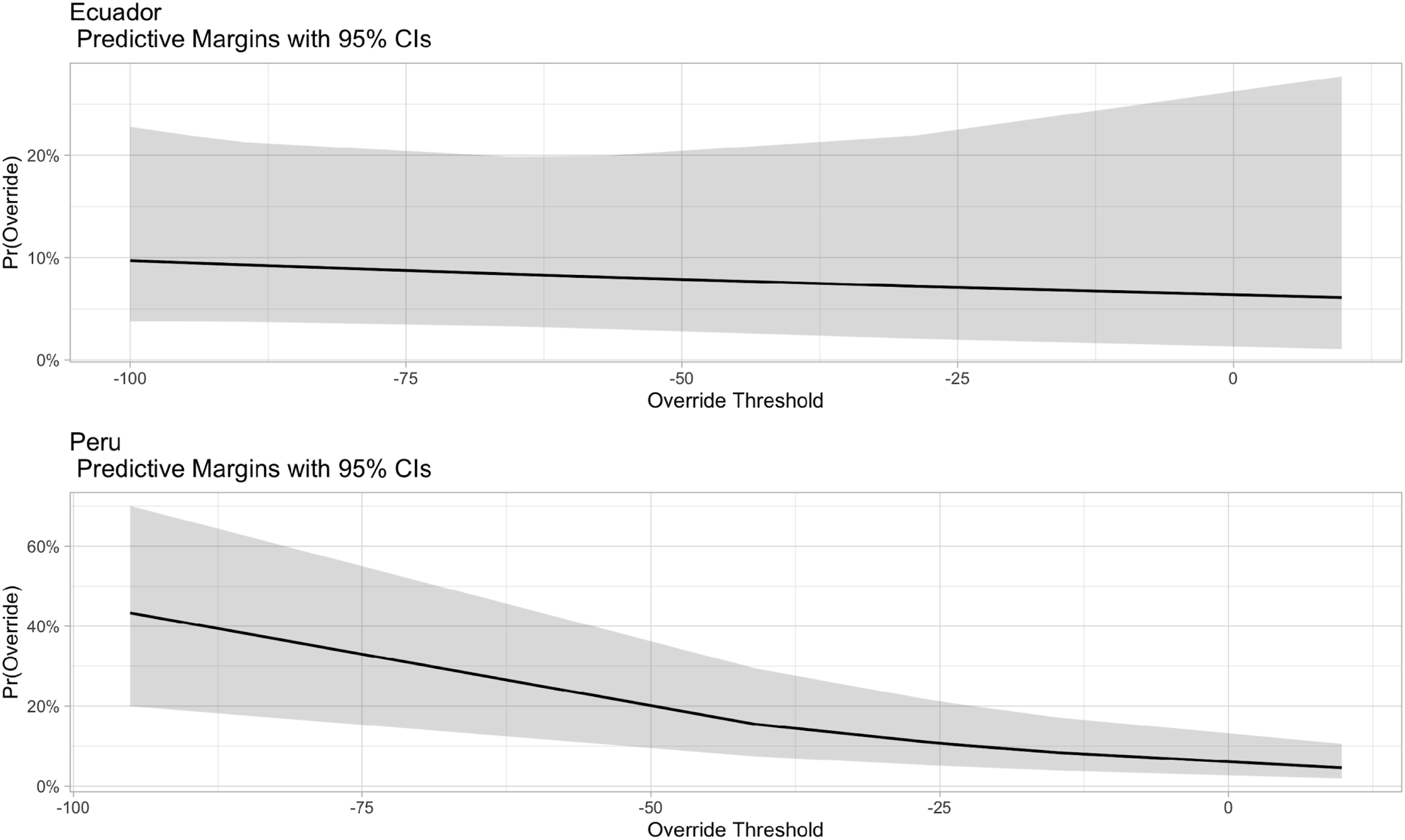
In sum, the statistical analysis results support the theory that party dispersion within Congress hinders the president from formulating a veto that is immune to override. Simply put, the president’s misinterpretation of partisan legislative preferences, driven by the constantly shifting ideological positions, fluctuations in seat share and primary partisan contenders, as well as the absence of party discipline, obstructs the president from crafting a veto that is impervious to override. This finding is at odds with Palanza and Sin (2013), who contend that presidents strategically employ vetoes to induce fractures within the legislative coalition that initially endorsed the bill. Our evidence indicates that presidents can hardly pursue such a strategy due to the fragmented nature of the congress. Moreover, the president's misreading of legislative preferences manifests in an increasing number of overrides, contradicting Cameron's (2000) prediction of a limited number of overrides.
The analysis also confirms that the executive's legislative bargaining power tends to escalate as its party secures a greater number of seats within the congresses, which aligns with previous literature predictions (e.g. Cameron, 2012; McGrath, Rogowski, and Ryan, 2018; Saiegh, 2009, 2011; Santos, Pérez-Liñán, and García Montero, 2014). Holding sufficient seats to prevent an override translates into substantial agenda-setting power (Alemán and Tsebelis, 2016; Tsebelis and Alemán, 2005). In simpler terms, as long as the president commands a number of seats equivalent to the complement of the override threshold, he can almost assure dominance in the lawmaking process, at least in the Peruvian case. Such a president can confidently introduce his preferred policy positions through an amendatory veto, knowing that it is unlikely for Congress to muster enough votes to override such a veto.
One puzzling finding for a future research agenda concerns the effect of the amendatory veto compared to the total veto. We believe part of the explanation of this result aligns with our main argument. When a president exercises veto power, a prevailing factor is the inherent uncertainty stemming from the dispersion of political parties within the congress, regarding the potential ramifications of such action on the cohesion of the coalition that originally endorsed the bill. Our logic is that this uncertainty varies across type of veto. In instances of an amendatory veto, the president’s uncertainty diminishes, as there is greater clarity regarding the parties likely to be impacted and the potential for their inclusion in an override coalition. Conversely, in the case of a total veto, although the president possesses a clearer understanding that all parties will be affected, the uncertainty remains regarding their eventual participation in an override vote.
Presidential attempts to exploit these uncertainties to fracture coalition support may encounter obstacles beyond mere legislative fragmentation. For instance, in the Ecuadorian context, the institutional framework governing veto powers may offer insights into this phenomenon. As elucidated in our contextual overview (see Figure 2), a total veto in Ecuador results in a 1-year freeze on the bill, with an override vote only becoming viable after this period. Given the transient nature of legislative coalitions, the likelihood of witnessing an override diminishes significantly, in contrast to the relatively higher likelihood associated with amendatory vetoes. It is worth noting that this issue warrants further scrutiny, as it diverges from prior research findings in the Argentinian context, where Palanza and Sin (2013) documented contrary evidence.
Conclusion
In this paper, we present a comparative analysis of legislative overrides on executive vetoes in multiparty legislatures in Ecuador and Peru. Our evidence highlights a notable contrast between the relatively high rate of legislative overrides in Latin America and findings from the US case (e.g. Cameron, 2000). Legislative overrides are prevalent, serving as a clear indication of tensions between the executive and legislative branches.
Moreover, our main findings underscore one variable that significantly influence the probability of a legislative override. Legislative fragmentation, as reflected in the ENP index, exhibits a positive and substantial effect on the likelihood of observing a legislative override in both countries. The underlying rationale is that as the ENP increases within Congress, the president is prone to misread parties’ preferences, making it less likely to break legislative arrangements by introducing modifications in the veto. Consequently, the legislative majority is more inclined to override the president. This finding contradicts the evidence and logic presented by Palanza and Sin (2013) for the Argentinian case.
Secondly, our evidence also reveals that when the president’s party is closer to reaching the override threshold, the probability of facing a legislative override decrease. This emphasizes that presidents do not necessarily require a legislative majority to advance their legislative agenda. To enhance their probabilities of successful legislative outcomes, presidents merely need a congressional seat share as close as possible to the override threshold, typically equivalent to one-third of the seats in most presidential democracies. However, this finding is not statistically significant for both countries suggesting that this argument requires further refinement and study.
Furthermore, our results underscore the importance of party system characteristics, particularly the nature of party fragmentation, in understanding legislative outcomes. In Ecuador and Peru, these characteristics appear to exert a powerful impact on the likelihood of a legislative override. Scholars interested in examining legislative outcomes should note that variables commonly emphasized in the institutional setting tell only part of the story, and the partisan context can significantly enhance explanatory power.
On the other hand, a point that requires further elucidation is the effect of total vis-à-vis an amendatory vetoes impact in the probability of a bill receiving an override. The explanation of this effect might be related to the uncertainty generated by the party dispersion but also could attributed to the institutional design. Additional research is required to unveil the nature of this relationship and its main drivers.
Finally, this piece contributes new evidence to the thriving literature on executive-legislative bargaining in the final stages of the lawmaking process in new democracies. More broadly, our paper connects with the literature on executive-legislative relations and offers comparative implications for other fragmented multiparty legislatures.
Supplemental Material
Supplemental Material - When Congress Prevails: Veto Overrides and Legislative Fragmentation in Multiparty Legislatures
Supplemental Material for When Congress Prevails: Veto Overrides and Legislative Fragmentation in Multiparty Legislatures by Pablo Valdivieso-Kastner and Sergio Huertas-Hernández in Political Research Quarterly
Supplemental Material
Supplemental Material - When Congress Prevails: Veto Overrides and Legislative Fragmentation in Multiparty Legislatures
Supplemental Material for When Congress Prevails: Veto Overrides and Legislative Fragmentation in Multiparty Legislatures by Pablo Valdivieso-Kastner and Sergio Huertas-Hernández in Political Research Quarterly
Footnotes
Acknowledgements
The authors would like to thank Eduardo Alemán, Valeria Palanza, Daniel Chasquetti, and Ezequiel González-Ocantos for helpful comments. The authors also thank the anonymous reviewers for their comments and suggestions. Replication and data files can be downloaded from the PRQ website.
Declaration of Conflicting Interests
The author(s) declared no potential conflicts of interest with respect to the research, authorship, and/or publication of this article.
Funding
The author(s) received no financial support for the research, authorship, and/or publication of this article.

Supplemental Material
Supplemental material for this article is available online.
Notes
References
Supplementary Material
Please find the following supplemental material available below.
For Open Access articles published under a Creative Commons License, all supplemental material carries the same license as the article it is associated with.
For non-Open Access articles published, all supplemental material carries a non-exclusive license, and permission requests for re-use of supplemental material or any part of supplemental material shall be sent directly to the copyright owner as specified in the copyright notice associated with the article.
