



Abstract
This paper examines whether—and if so, to what extent—religious scripture and values can promote inclusionary attitudes towards refugees. Sacred texts across faiths call on believers to embrace foreigners, suggesting that religious discourses can be harnessed to promote refugees’ inclusion in host societies. To test this possibility, I implement a survey experiment in which citizens of Lebanon—a religiously diverse country that has received the most Syrian refugees per capita globally—are exposed to various forms of pro-refugee religious messaging. I find that inclusionary religious messaging can shift refugee-related attitudes towards tolerance, particularly for members of sectarian communities with the highest baseline anti-refugee animosity. The study's findings have important implications for understanding religion’s consequences for both the dynamics of refugee integration and intercommunal relations more generally, especially in the Middle East and North Africa and the broader developing world.
Do not oppress a foreigner; you yourselves know how it feels to be foreigners, because you were foreigners in Egypt. – Exodus 23:9 If any one of the polytheists seeks your protection, then grant him protection so that he may hear the words of God. Then deliver him to his place of safety. – Surat At-Tawbah 9:6
Introduction
Can appeals to religious values lead people to empathize with refugees who have settled in their communities? On one hand, recent research has highlighted an ambiguous relationship between individuals’ religious faith and tolerance of immigrants (McDaniel, Nooruddin, and Shortle 2022; Shady 2022). Yet, across many of the world’s major faiths, sacred texts call on believers to embrace foreigners fleeing persecution. This raises the question of whether invoking religious values can help mitigate host country citizens’ xenophobic sentiment and promote refugees’ inclusion in their host society.
Understanding the complex role of religion in shaping migration-related attitudes is particularly important in countries of the developing world, where disproportionately large numbers of refugees have settled and where religiosity remains high even as the centrality of organized religion has dissipated in many Western nations. Figure 1 displays the relationship between citizen religiosity (from 2009 Pew polling) and the number of refugees as a percent of the total population (via UNCHR) in every country globally, with countries whose refugee populations represent greater than 1 percent of the total population highlighted in black. The two graphs—the second of which includes the extreme outliers of Lebanon, Gaza and the West Bank, and Jordan—underscore that the countries hosting the largest numbers of refugees also tend to be among the most devout. Religiosity and global refugee populations (without/with Lebanon and two other outliers).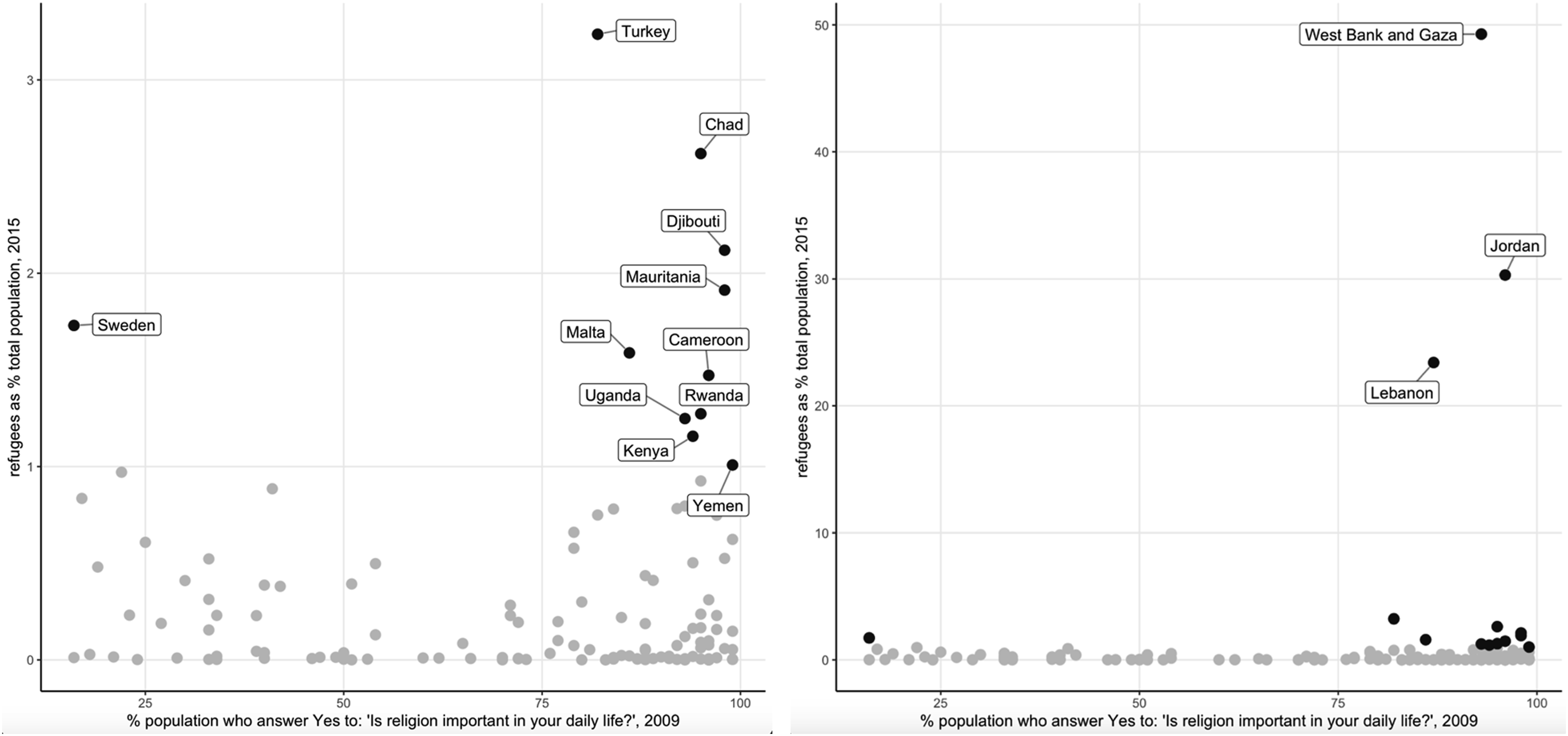
In this paper, I test the capacity of religious discourses to serve as a tool for mitigating anti-refugee resentment through an experiment in Lebanon, a religiously diverse country that has received the most Syrian refugees per capita globally. I employ a survey experiment in which Lebanese citizens from varied religious backgrounds are exposed to faith-based arguments for tolerance towards refugees. These messages are presented either on their own or linked to a specific religious leader, in order to determine which—if any—is capable of fueling inclusionary attitudes: religious messages, the religious authority figures who tend to employ them, or the interaction of the two.
In line with pre-registered hypotheses, I find that inclusionary religious messages can shift refugee-related attitudes towards tolerance, and that this is especially the case for members of ethno-religious communities with higher baseline animosity towards refugees. Moreover, my results indicate that both faith-based messaging and religious leader endorsements can independently induce attitudinal change, echoing recent work that has aimed to disentangle the effects of political messaging from those of their messenger (Afrouzi, Arteaga, and Weisburst 2023).
This paper’s findings have profound implications for understanding and improving host-migrant relations, especially in the developing world. While scholars of comparative migration politics have convincingly shown that xenophobia is largely rooted in individuals’ anxieties about the supposed threat that migrants pose to their country’s cultural fabric, this research corpus has been far less successful in identifying interventions capable of mitigating this cultural threat. My results suggest that a fundamental element of host society culture itself—religious faith, and the values within it—can be mobilized to reframe citizens’ perceptions of the foreigners who have settled in their communities.
This paper also builds on recent efforts in the religion and politics literature to disentangle different elements of religion and determine when and how faith shapes political behavior and attitudes. In a growing body of experimental work, researchers present individuals with religious scripture, either on its own (Masoud, Jamal, and Nugent 2016; McClendon and Riedl 2019) or linked to a specific religious leader (Blair et al. 2021; Condra, Isaqzadeh, and Linardi 2019), but how scripture and authority—two crucial elements of religious experience—together and individually influence people’s political commitments remains obscure. This study’s factorial experimental design, in which survey respondents are presented with scripture and authority both on their own and bundled together, addresses this gap and helps develop a deeper understanding of religion’s consequences for individual-level political behavior.
Religion and Attitudes Towards Refugees
In response to recent waves of mass migration, researchers have sought to explain the determinants of individuals’ attitudes towards immigrants and immigration-related policies. This literature has identified various sources of anti-migrant sentiment, including perceptions of the economic threat that migrants pose (Dancygier 2010; Scheve and Slaughter 2001) and anxieties over conflict between different cultures and value systems (Alrababa’h et al. 2021; Adida, Lo, and Platas 2019; Bansak, Hainmueller, and Hangartner 2016; Chandler and Tsai 2001; Schneider 2008).
To what extent can these prejudices be overcome? A growing literature aims to identify interventions for softening xenophobic attitudes. Several of these studies have demonstrated that intolerance is not an immovable object and that well-designed interventions can lead to positive shifts in host society members’ views. For example, recent research in the United States has found that priming individuals to consider their own families’ histories of migration (Williamson et al. 2021) and engaging them in nonjudgmental interpersonal exchanges with immigrants (Kalla and Broockman 2020) may elicit a sympathetic response and reduce xenophobic sentiment, including among conservative voters.
While these studies have yielded some promising results, however, they have overwhelmingly focused on Western democracies. Considerably less scholarship has investigated potential ways of mitigating anti-migrant attitudes in developing countries. This is a problem, given that these countries host about 85 percent of the world’s refugees, per UNHCR estimates. Moreover, evidence indicates that the politics of xenophobia differ in the so-called Global South for numerous reasons, including larger refugee populations and lower levels of economic development (Adida 2011; Alrababa’h et al. 2021; Harris et al. 2018; York 2022). Thus, interventions that have been shown to reduce anti-refugee prejudice in North America and Western Europe may not be similarly successful in, say, the Middle East or Africa.
Recent research on religion and politics suggests that different dimensions of religious faith and belonging may contribute to ongoing efforts to combat animosity towards refugees and other types of migrants in the developing world. Survey-based observational research in Africa has linked higher levels of religiosity with increased involvement in both secular and religious volunteer groups generally (Compion 2017) and in pro-refugee volunteerism specifically (Gordon 2023). Experimental work, meanwhile, has shown that exposure to religious scripture and sermons can alter political attitudes and behavior in varied ways (Condra, Isaqzadeh, and Linardi 2019; McClendon and Riedl 2019). With specific regards to outgroup intolerance, Masoud, Jamal, and Nugent (2016) and Blair et al. (2021) demonstrate that religiously-infused rhetoric and religious authority figures can significantly reduce biases against women and ex-combatants from terrorist groups, respectively.
There are multiple reasons to expect that religion can be similarly employed to promote inclusionary attitudes towards refugees. For one, narratives of exile and calls for charity and humanitarianism are prevalent throughout the Bible, Quran, and other sacred texts, providing religious leaders with ample source material to draw on to persuade followers to accept and even embrace refugees. In Islam, contemporary jurists and legal theorists frequently argue that Islamic law concepts such as aman (protection/refuge) evince the intrinsic rights of asylum seekers, regardless of their religion, within sharia. Scholars similarly point to the biographical narratives of numerous prophets who were forced into exile—including the Prophet Muhammad himself—to argue for the importance of compassion towards refugees in the Islamic faith (Abd Al-Rahim 2008; Elmadmad 2008; Muzaffar 2001). Likewise, Christian theologians often interpret sacred narratives like the Book of Exodus and varied Biblical exhortations to welcome and protect foreigners—such as God’s assertion that “the foreigner residing among you must be treated as your native-born” (Leviticus 19:34)—through a pro-refugee lens (Bretherton 2006; Groody 2009; O’Neill and Spohn 1998).
Clerics are also often trusted leaders in their communities, potentially rendering them more capable than other authority figures of changing the beliefs and policy preferences of lay believers. In this vein, several studies (Brown et al. 2017; Karyotis and Patrikios 2010; Nteta and Wallsten 2012; Paterson 2018; Wallsten and Nteta 2016) have posited that religious elites can shift host citizens’ immigration attitudes, in part by countering or amplifying security threat discourses propagated by political elites.
These are several challenges, however, plaguing these works. Firstly, from a conceptual standpoint, there is no distinction between religious faith and practice. Yet, religion is a multidimensional phenomenon and may be shaping political views and behavior through a number of channels (Grzymala-Busse 2012). For example, it is possible that religious service attendance can change individuals’ perspectives towards refugees because it exposes them to messages about immigration from a trusted authority figure. Alternatively, it is possible that the rhetoric—particularly, the scripture cited—that faith leaders employ is what shifts prejudice.
Secondly, from a theoretical standpoint, all of these previous studies are centered in Western Europe or the United States—where the number of refugees vis-à-vis the overall population is much lower. Both the likelihood and level of direct contact with refugees are low. In contrast, in the Global South—as we saw in Figure 1—the refugee population is much higher, and consequently citizens are more likely to interact with refugees in their day to day lives. In such contexts, where refugees and host country citizens may be literally sitting in the same pews, spiritual leaders may be more capable of convincing their followers to empathize with refugees and view them as people deserving of support.
Thirdly, from an empirical standpoint, the literature relies almost exclusively on survey respondents’ self-reported church attendance as a proxy for exposure to immigration-related conversations from religious leaders. The one notable exception is (Wallsten and Nteta 2016). The near-exclusive use of survey data is problematic given the potential for self-selection. That is, these studies cannot effectively address the possibility that individuals choose to attend churches that align with their preexisting political views and immigration positions, or that regardless of denomination, church attendees are more sympathetic towards immigrants to begin with.
To help address these gaps, I employ an experimental design that aims to identify whether and how inclusionary religious discourses can shift refugee-related attitudes. I argue that exposure to religious values-based cases for tolerance towards refugees leads host country citizens to embrace more inclusionary migration-related positions. Scholars of international human rights often speak of the need for human rights discourses to be “localized” and translated into familiar vernaculars in order to gain mass adoption (An-Na’im 1990; Merry 2006). Presenting ideas through culturally relevant images and vocabularies makes them appear less foreign, thereby facilitating their acceptance among the public. In this vein, arguments for compassion towards refugees rooted in the tenets of an individuals’ religious faith fit into a familiar sociocultural framework. Thus, when host country citizens listen to pro-tolerance religious sermons, their xenophobic attitudes dissipate.
Yet, I predict that mere exposure to scripture-based inclusionary discourse—that is, the what—is not sufficient to change people’s minds. Rather, I expect to find that the efficacy of this rhetoric is dependent on its source—that is, the who. Religious pro-refugee frames are effective when they are linked to an individual who is perceived as a trusted authority in scriptural exegesis and spiritual guidance. By contrast, when the message is presented on its own, detached from an individual recognized as a subject matter expert, listeners will not view the message as legitimate. In fact, recent experimental work by Grewal and Cebul (2022) suggests that the message may backfire, hardening conservatives’ xenophobic attitudes. Similarly, given that clerics’ authority is largely based on their perceived expertise in interpreting sacred texts, religious elites who present messages that are similar to those provided by secular leaders will be incapable of shifting believers’ attitudes. In sum, detaching the message from the messenger limits the effectiveness of faith-based discourses in reducing host citizen prejudice. This expectation is formalized as follows:
Scripture-based arguments for tolerance towards refugees mitigate xenophobic attitudes of host country citizens, but only when the arguments are tied to a trusted religious authority figure. Given the well-documented stability of immigration attitudes (Kustov, Laaker, and Reller 2021), I do not expect that all citizens are open to changing their views in response to inclusionary religious appeals. Rather, certain background characteristics of host country citizens should condition the effectiveness of such messaging, with important implications for prejudice reduction efforts. In testing this main hypothesis, then, I additionally examine whether certain individual-level traits render host country citizens more or less likely to respond positively to inclusionary faith-based messaging. First, I aim to evaluate how host citizen religiosity shapes the effects of pro-refugee religious discourse. I predict that people who are more religiously devout are more susceptible to faith-based persuasion efforts. The logic here is straightforward: Highly religious individuals are likelier than others to base their political and moral positions on the guidance provided by their faiths. Therefore, exposure to progressive interpretations of their sacred texts is likely to cause them to reevaluate their xenophobic attitudes. In short:
Exposure to pro-refugee religious discourse has the strongest positive effects on highly religious individuals. Second, I evaluate potential religious sect-based differences in the potency of these inclusionary discourses. I expect to find that members of religious communities with higher average baseline levels of anti-refugee prejudice are more likely to change their views after being presented with faith-based pro-refugee messaging. This prediction follows from substantial research in a variety of contexts showing that individuals’ fears that migration will transform their country’s dominant culture are among the most significant drivers of anti-migrant attitudes (Alrababa’h et al. 2021; Hainmueller and Hopkins 2014). For members of sects that, for whatever reasons, are characterized by stronger xenophobic sentiment, religious elites who frame their pro-refugee arguments in a language rooted in the teachings of their faith will be uniquely capable of reducing their coreligionists anxieties of social and cultural displacement. This abatement of feelings of cultural threat in turn stimulates tolerance. I thus hypothesize the following:
Forced Migration and Religious Authority in Lebanon
An estimated 1.5 million Syrians currently reside in Lebanon out of a total population of less than seven million (Karasapan and Shah 2021). Syrian refugees have long faced an environment of deep hostility driven by a variety of factors, including perceived labor market competition with Lebanese workers, host citizens’ fears that migrants will upset the demographic balance between established ethno-sectarian groups, and concerns about Syrians’ potential involvement in terrorism (Betts, Ali, and Memişoğlu 2017; Hägerdal 2018). A history of contentious relations between Lebanon and Syria also likely plays a role in the enduring prejudice towards Syrians: The Syrian government was an occupying force in Lebanon from the early days of the Lebanese Civil War (1975–1990) until 2006, which the Assad regime ideologically justified by appealing to the notion of a “Greater Syria” that was artificially split apart by French colonial machinations after World War I (Nisan 2015). Anti-Syrian intolerance has only worsened since the collapse of the Lebanese economy over the past several years, as many citizens blame refugees for unemployment and rising housing prices (Brun et al. 2021).
Two features of Lebanon make it an ideal setting for testing the capacity of religious values to mitigate anti-refugee xenophobia. The first is the aforementioned sheer quantity of refugees in the country. Given that around 20 percent of residents of Lebanon are Syrian refugees, the topic is highly salient for regular citizens, many of whom have held strong (and mostly negative) opinions on the issue for many years. This quality renders Lebanon a hard test of my theory and raises the possibility that any positive results could travel elsewhere. Secondly, relative to other countries in MENA hosting large numbers of Syrians, such as Jordan and Turkey, Lebanon is highly diverse religiously, with Sunni Muslims, Shia Muslims, and Christians each comprising (very roughly) even proportions of the population. As a result, Lebanon allows me to compare the effects of religious value exposure across religious groups, and in particular how co-religiosity with the refugee community in question shapes the effects of religious appeals for tolerance.
Over the course of the Syrian conflict, the response of religious elites from Lebanon’s numerous sectarian communities to the inflow of refugees has ranged from tolerance and appeals to followers’ sense of humanitarianism to blatant xenophobia. Lebanon’s Christian faith leaders have tended to take almost universally anti-Syrian stances. For example, the patriarch of Lebanon’s Maronite Christian Church, Beshara al-Rai, accused refugees of “snatching (the Lebanese people’s) daily bread from their mouths, throwing them into a state of poverty and deprivation” (Francis 2017). Rights organizations have repeatedly criticized the Maronite religious leadership for fanning the flames of prejudice against Syrian refugees (Middle East Monitor 2017).
Shia religious authorities have similarly tended to emphasize the cost of Syrian refugees to the Lebanese people rather than refugees’ rights. Hassan Nasrallah, the Shia cleric and secretary-general of the party and militant group Hezbollah, regularly calls for the return of refugees to Syria (Rose 2019). Meanwhile, when the recently deceased head of Lebanon’s Supreme Islamic Shia Council, Sheikh Abdul Amir Qabalan, met with International Committee for the Red Cross officials in 2018, he discussed the need for the immediate return of refugees to Syria to relieve their burden on Lebanon, echoing similar language used by politicians (National News Agency 2018). However, some Shia religious leaders have occasionally preached messages of tolerance towards Syrian refugees and have spoken out against abuses that they have suffered in Lebanon.
Compared with elites from the other two main religious groups, national-level Sunni religious leaders have more frequently centered humanitarian concerns in their public rhetoric around Syrian refugees. The top spiritual leader of Lebanon’s Sunni community, Grand Mufti Abdul Latif Derian, has been critical of politicians’ calls to return Syrians to their country (Naharnet 2018) and stated during a Ramadan address in 2017 that popular discourses surrounding Syrian refugees make him feel that “our humanity may be lacking” (El Nashra 2017). Similarly, he has compared the situation of Syrian refugees with that of Palestinians, pointing to their shared experience of state violence that forced them to leave their homelands (Orient Net 2018). Dar al-Fatwa, Lebanon’s main Sunni Muslim umbrella organization, has also been involved in various charity projects in support of Syrian refugees since the beginning of the civil war (Topalian 2017).
Overall, the different positions of Lebanon’s religious authorities regarding Syrian refugees reflect varying sectarian community views on this issue. Shia Muslims and Christians are broadly unified in their opposition to the presence of Syrians in the country and tend to be highly suspicious of Syrian refugees, most of whom are Sunnis (Selsky 2024). Although polling shortly after the initial influx of Syrians in Lebanon showed Shia refugee-related views to be similar to those of Sunnis (Christophersen et al. 2013), more recent data indicates that the gap between the two Muslim sects has since widened (Ghosn, Braithwaite, and Chu 2019). This is likely due at least in part to the deepening involvement of Hezbollah in the Syrian conflict on the side of the Alawi (Shia)-led government of Bashar al-Assad and, relatedly, the increasingly sectarian character of the civil war (Corstange and York 2018). Sunnis, meanwhile, are also generally opposed to the Syrian refugee presence in Lebanon, yet for several reasons—including a shared religious background with most refugees and friendlier historical relations with earlier waves of Syrian migrants and Palestinian refugees—they generally hold less hostile attitudes (Hägerdal 2018). Following H3 outlined above, I expect that these distinctions lead to divergent susceptibility to faith-based pro-refugee messaging. Specifically, I predict that inclusionary religious discourses have the strongest effect on the attitudes of Shias and Christians, who experience stronger communal-level anti-refugee resentment.
Experimental Design
To study the effects of inclusionary religious discourses on attitudes towards refugees, I recruited a sample of 1200 Lebanese citizens to complete a survey via a Facebook ad. In the Facebook ad, presented in Appendix C, Lebanese Facebook users were offered the opportunity to “help research on Lebanese social affairs” and enter a drawing to win $100 USD. Clicking the ad linked respondents to the survey instrument in Qualtrics.
Facebook ads have become an increasingly popular means of survey recruitment in social science research for various reasons, including their relatively cheap cost and utility in accessing hard to reach populations (Bhutta 2012; Jäger 2017; Samuels and Zucco 2013; Williamson and Malik 2021). Online convenience samples—whether obtained via Facebook or from other platforms such as Amazon’s MTurk—are especially useful for survey experiments, given research showing that treatment effects estimated from these samples are similar to those obtained from nationally representative samples (Mullinix et al. 2015).
Survey Respondent Summary Statistics.
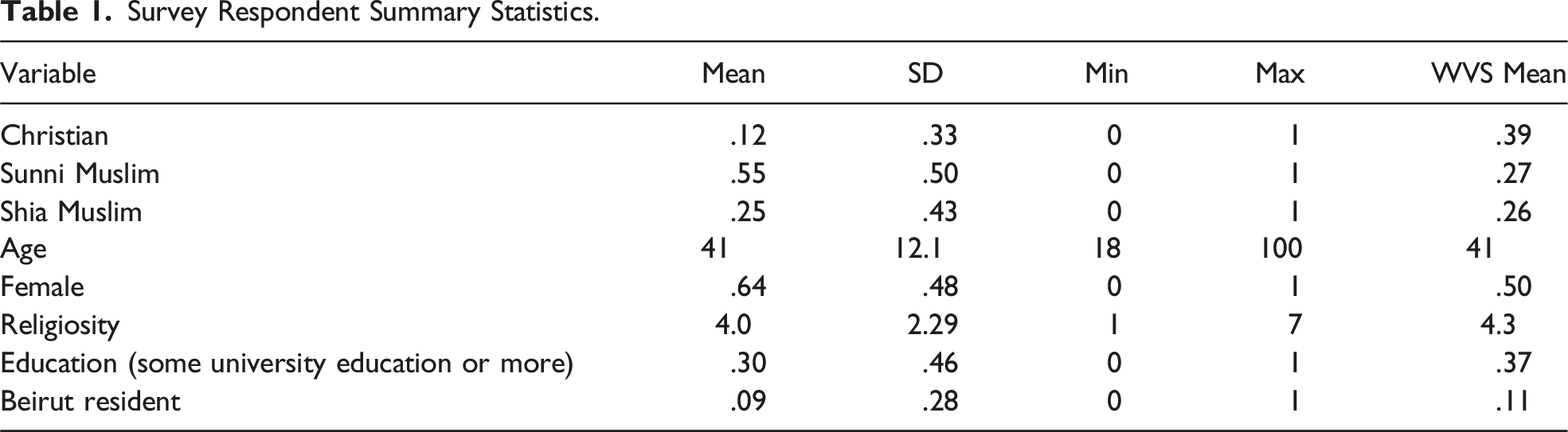
The survey begins with a brief pre-experiment questionnaire to record basic background information about the subjects, including religious sect and level of religiosity measured by religious service attendance. The subjects are then exposed to the primary treatment. Respondents are randomly divided into four treatment groups (religious authority + scripture, religious authority, scripture, video sermon) and a control group (see Figure 2). This division of treatment groups helps determine whether appeals to religious values and scripture or religious elite endorsement leads to attitudinal change, or whether the interaction between the two variables is the key determinant of shifts in respondents’ views. The full treatments with English translations are provided in Appendix B.
In the main treatment group, religious authority + scripture, respondents read a short fictitious news article—styled to mimic the appearance of the website of a real Lebanese news source (without providing the name of any news source)—about a real religious authority figure giving a sermon in which he criticizes politicians’ calls for the forced return of Syrian refugees, brings attention to their plight, and calls on followers to treat Syrians with compassion. As part of the article, a quote is attributed to the religious leader in which he reminds his followers that Jesus/Muhammad was himself a refugee and cites a piece of religious scripture that scholars have previously interpreted as being pro-refugee. 1
This treatment is divided into three “sub-treatments” which differ according to the sect of the religious leader who is discussed (Sunni, Shia, or Christian). Any respondent can be exposed to any sub-treatment, regardless of sect. Therefore, a Christian respondent can potentially be presented with a Muslim religious leader treatment, and vice-versa. My rational for exposing respondents to both in-group and outgroup linked religious values and authority figures is twofold. The first motivation is theoretical. If I find that the spiritual channels driving host citizen tolerance can be activated from outside the boundaries of one’s own faith group, this would indicate that religious discourse does not change attitudes solely by fueling believers’ sectarian solidarity with coreligionists. Secondly, from a practical experimental design standpoint, allowing respondents to only be exposed to treatments linked to their religious in-group would raise potential inference concerns related to the so-called Stable Unit Treatment Value Assumption (SUTVA) (Rubin 1986; VanderWeele and Hernan 2013).
In the Sunni and Shia sub-treatments, the leaders cited are Sheikh Abdul Latif Derian and Ali Fadlallah, respectively, who are the religious leaders from the two Muslims sects with the highest levels of public trust in Lebanon, per Yildirim (2019). As the Grand Mufti of Lebanon, Derian is the highest-level mainstream Sunni religious leader in Lebanon. Ali Fadlallah is a cleric who owes much of his renown to his father, Muhammad Husayn Fadlallah, who was for decades one of Lebanon’s most prominent Shia religious authorities. In addition to enjoying relatively high levels of trust, both leaders have in the past spoken (to varying degrees) in defense of Syrian refugees’ rights, making it more likely that the treatment will be perceived as credible for most respondents. 2
The leader in the Christian subgroup is Pope Francis. From a research design standpoint, the Christian leader would ideally be a Lebanese Christian to mirror the Shia and Sunni sub-treatments. However, empirically, given the Maronite Church’s hostility towards Syrian refugees, there is no well-known Lebanese Christian religious leader from whom the message would seem believable. Pope Francis, on the other hand, regularly speaks out about the plight of refugees. Moreover, he is in many respects seen as an in-group religious authority figure for most Lebanese Christians. Note that the Maronite Church is an Eastern Catholic Church in full communion with the Holy See. To make the treatment credible, in the news article that I present, Pope Francis refers to Syrian refugees around the world, rather than specifically in Lebanon.
The article that respondents read is identical across sub-treatments in all respects except for the religious authority figure mentioned, the scriptural citation that he provides, and some differences in religion-specific language (e.g., “Friday sermon” for Muslims versus “Sunday sermon” for Christians). To improve the treatment’s naturalism and credibility, the format of the article is based on that of a real 2018 news article about a Friday sermon that Grand Mufti Derian gave about refugees, and the quotes attributed to the religious leader are derived from real statements that the three leaders have made about Syrian refugees.
In the religious authority treatment, a news article is presented that is identical to that of the main treatment in every way except that the citation of religious scripture is absent. Respondents assigned to the scripture treatment are presented with the same piece of scripture that respondents from the main treatment group read, but without any associated religious authority figure. In this case, rather than reading a news article, respondents are simply asked to read a short paragraph that states the following: “Many [Christians/Muslims] believe that we should protect refugees and allow them to reside in Lebanon in peace. They remind us that [Jesus/Muhammad] was himself a refugee, and they say that numerous verses of the [Bible/Quran] prove that protecting refugees is important to the [Christian/Muslim] faith. For example: [verse].” This treatment is divided into two sub-treatments (Muslim and Christian).
Finally, I include a fourth treatment group in which respondents watch a short (∼2:00) YouTube video of a Lebanese Muslim imam delivering a pro-refugee sermon. In the video, the imam emphasizes the importance of tolerance towards refugees in Islam, criticizes the abuse and discrimination that Syrians face in Lebanon, and calls on listeners to welcome Syrian refugees. The primary purpose of this treatment is to serve as a stronger “dose” of the religious authority + scripture treatment. It combines the elite endorsement and scripture present in the religious authority + scripture treatment with the emotion, rhetoric, and religious imagery that respondents would regularly encounter in real worship contexts. Respondents will likely immediately recognize that the cleric in the video is Sunni, but as he does not employ sect-specific language, I expect that some non-Sunni respondents will find the rhetoric and arguments compelling. Treatment/sub-treatment breakdown.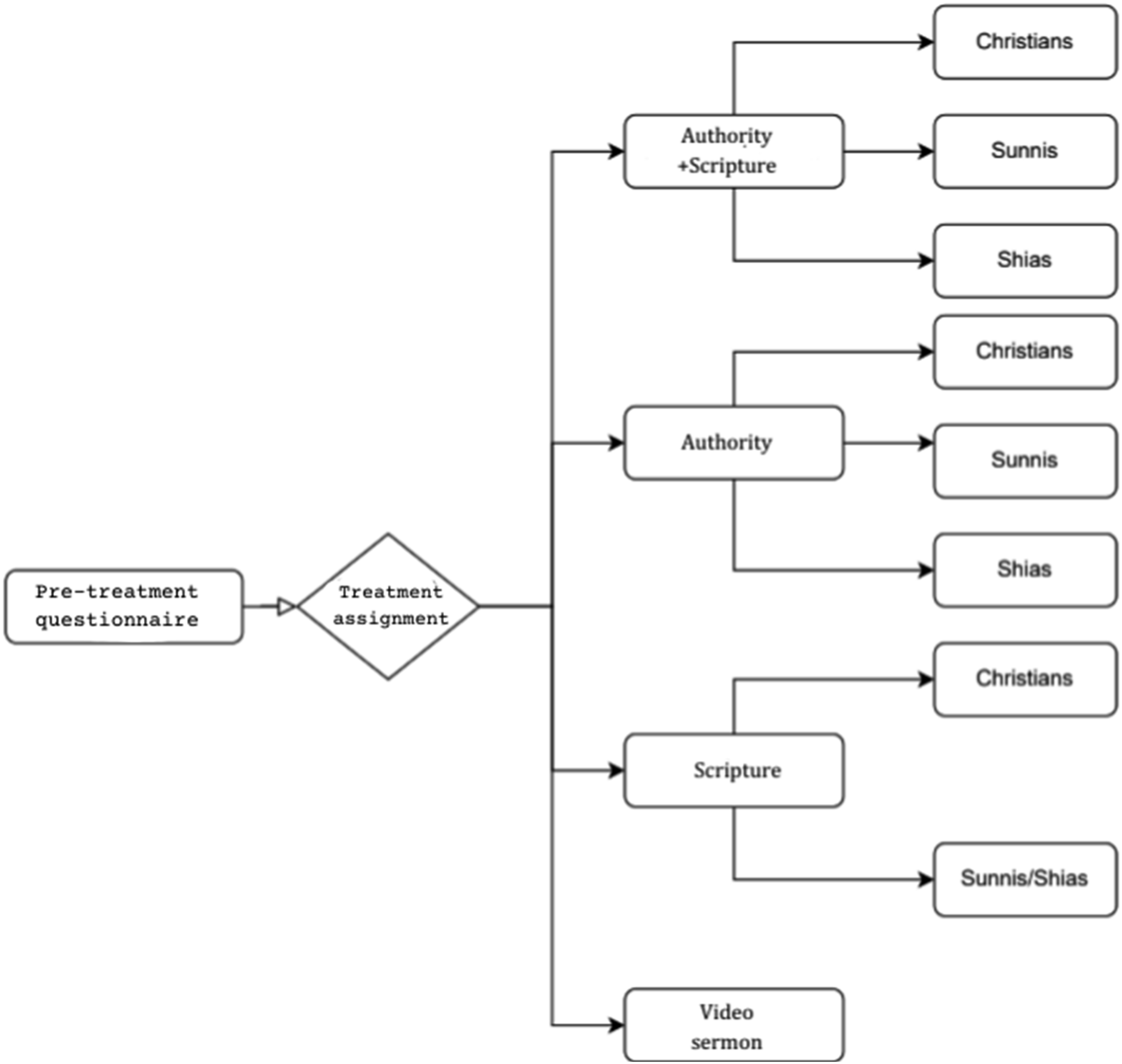
To measure the attitudinal effects of the treatment, I follow with two short sections. First, respondents are asked several questions aimed at measuring their general levels of tolerance towards Syrian refugees and preferences for various refugee-related policies (e.g., curfews and forced returns to Syria). Next, they are presented with a hypothetical Syrian refugee profile and asked to rate their preference for Lebanon hosting this refugee on a 1–7 scale. The refugee profiles are identical in all respects, except for religious background (Christian, Sunni, or Shia), which is randomized. Non-religious attributes were consistent across surveys. 3 This allows me to evaluate whether the religious treatment reduced respondents’ prejudice against coreligionist refugees, rather than Syrian refugees generally.
Finally, to supplement my attitudinal measure of the treatment effects, I include a behavioral component at the end of the experiment. Respondents are given the option of donating any amount of their potential earnings from the survey (if they win the survey lottery) to an international charity providing aid to Syrian refugees. This component of the experiment helps advance the study beyond examining attitudinal change by also showing how these shifts translate into political behavior.
Results
Policy Preferences and Social Attitudes
I first use OLS regression to examine the effects of each treatment on respondents’ level of agreement (from 1–5) with the following statements, presented in random order: 1. I am in favor of opening the border to allow Syrians to enter Lebanon. 2. If I were an employer, I would support hiring a Syrian living in Lebanon. 3. I would allow my child to marry a Syrian living in Lebanon. 4. I would favor banning Syrians from working in Lebanon’s agricultural sector. 5. I am in favor of my municipality imposing curfews to restrict Syrians to their residences at night. 6. I would be willing to attend a religious service with a Syrian in Lebanon. 7. I would be comfortable with Syrians living in my town.
These questions measure respondents’ general attitudes towards Syrian refugees and preferences for various refugee-related policies. In the models, I control for respondents’ demographic characteristics: age, income, religiosity, gender, education, and religion. Figure 3 presents coefficient plots showing the effects of every treatment group (i.e., with religion-specific sub-treatments pooled together) across all respondents. As a robustness check, I also perform all of the analyses involving Likert scale questions with ordered logistic regression. The ordered logit models are presented in Appendix D. The results are substantively identical to those presented here. Main treatments effects across all respondents.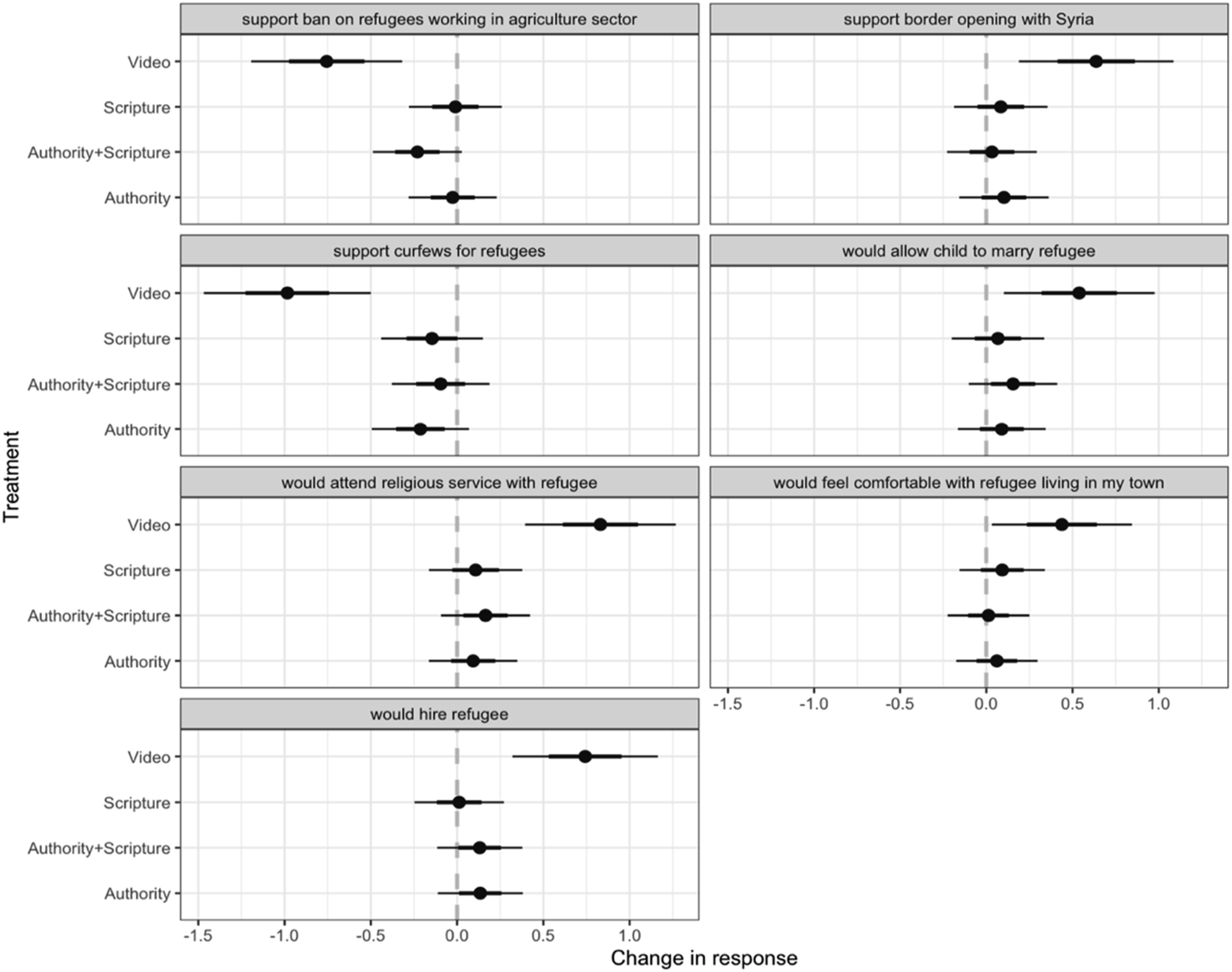
These results provide some encouraging evidence that faith-based arguments for tolerance towards refugees can mitigate xenophobic attitudes. Across all models, the video sermon has a significant effect. It is striking that even for the “hardest” questions of social inclusion, such as respondents’ willingness to allow their child to marry a refugee, the video sermon’s effect was statistically and substantively significant, leading to an average change of 0.5–1 point on the 1–7 scale. This initial analysis shows that only the very strongest form of the treatment—one that combines religious elite endorsement, appeals to religious values and scripture, and a cleric’s emotional rhetoric—significantly drives pro-refugee tolerance. Yet, while the other three text-based treatments are not statistically significant, their point estimates suggest religious appeals can move respondents. In fact, it is possible the non-significance is driven by the aggregation of respondents of different religions into the same treatment—for example, a Sunni is getting a Christian scripture.
To identify whether the effects are positive when the text-based treatments match the religious identity of the respondent, I examine responses for the three major religious groups separately and evaluate each of the sub-treatments individually. For presentation purposes, I use factor analysis to collapse respondent’s answers to all of the seven above questions (Cronbach’s α = .79) into a single “refugee attitudes” variable with mean 0, higher values of which represent more tolerant attitudes. 4
Figure 4 shows that some of the text-based treatments do drive tolerance towards Syrian refugees. Yet, contrary to H1, I find inconsistent evidence regarding which of these text-based treatments was most convincing. All three treatment groups (authority + scripture, authority, and scripture) significantly improved attitudes for at least one religious subset of respondents. And the authority + scripture treatment was not significantly more effective than exposure to either authority or scripture on their own. This suggests that religious authority figures’ capacity to influence the beliefs of their followers is not wholly dependent on their mobilization of religious scripture, and similarly, that appeals to scripture need not originate from trusted religious leaders to be credible. Sub-treatment effects across sects.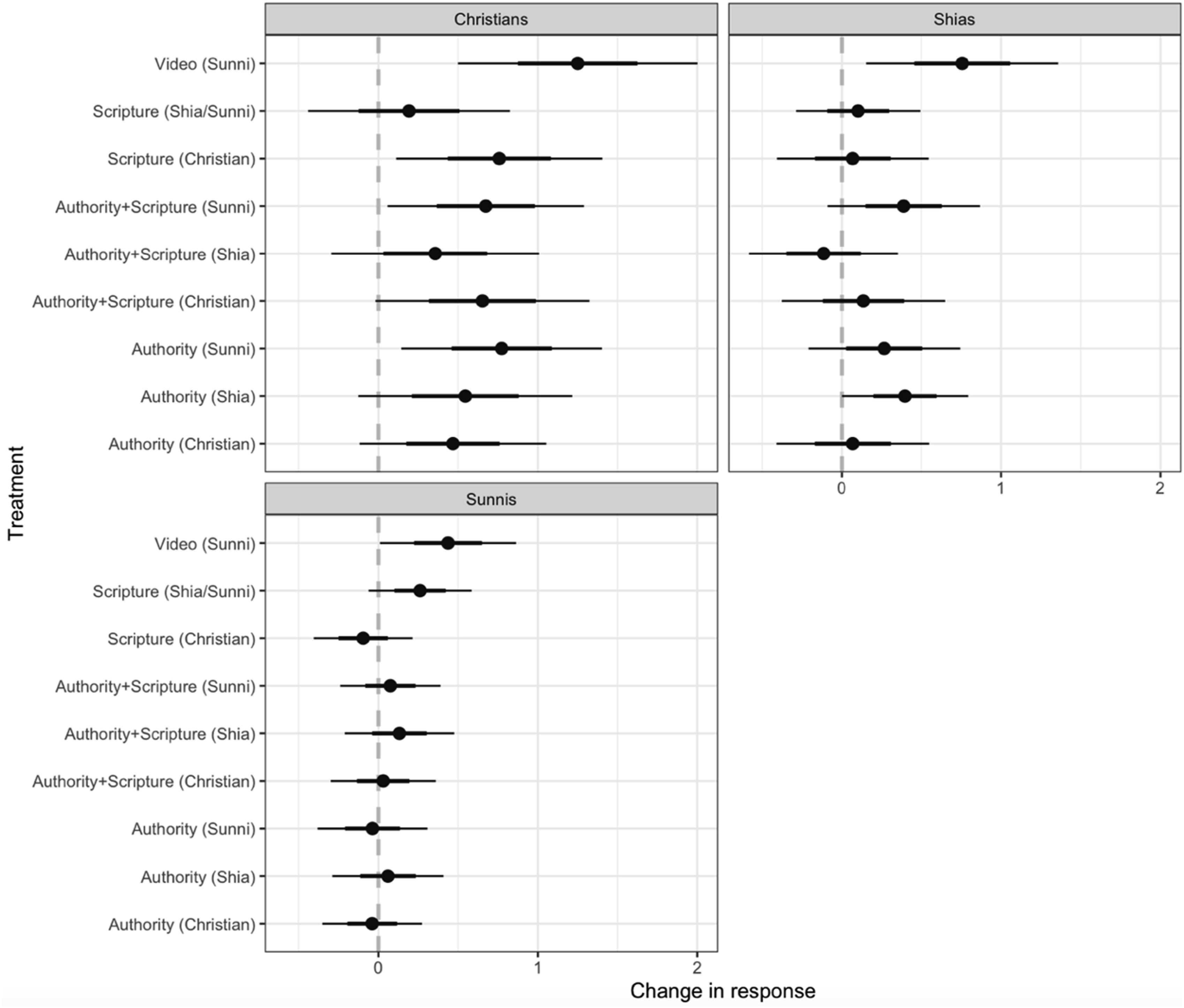
This figure also provides surprising evidence that some forms of pro-tolerance religious messaging hold cross-sectarian appeal. On one hand, the only text-based treatment with a statistically significant attitudinal effect for Shias was the Shia-specific religious authority news article. Similarly, for Sunni respondents, the Muslim scripture treatment came closer to conventional statistical significance levels (p = 0.11) than other text treatments. At the same time, however, among Christians, the two news articles discussing Sunni Grand Mufti Derian fared about as well as the Christian treatments. Moreover, the video sermon by a Sunni Muslim imam was the single strongest treatment for respondents from all three religious groups. Overall, the results suggest that even in a setting with high levels of sectarian polarization, calls for tolerance from outgroup religious authority figures can improve host citizens’ attitudes, though exposure to religious outgroups’ pro-refugee scripture on its own does not appear to affect people’s views.
Finally, this analysis shows significant sect-based treatment effect heterogeneity, in line with H3. Specifically, Christians and Shias appear to be more responsive to the pro-tolerance messaging than Sunnis. For Christians, five treatments, including several non-Christian-specific ones, were able to improve attitudes at the α
Refugee Profile Preferences
To examine respondents’ willingness for Lebanon to host a hypothetical refugee, I again use OLS regression with full demographic controls. Figure 5 presents the resulting coefficient plot. Refugee profile favorability.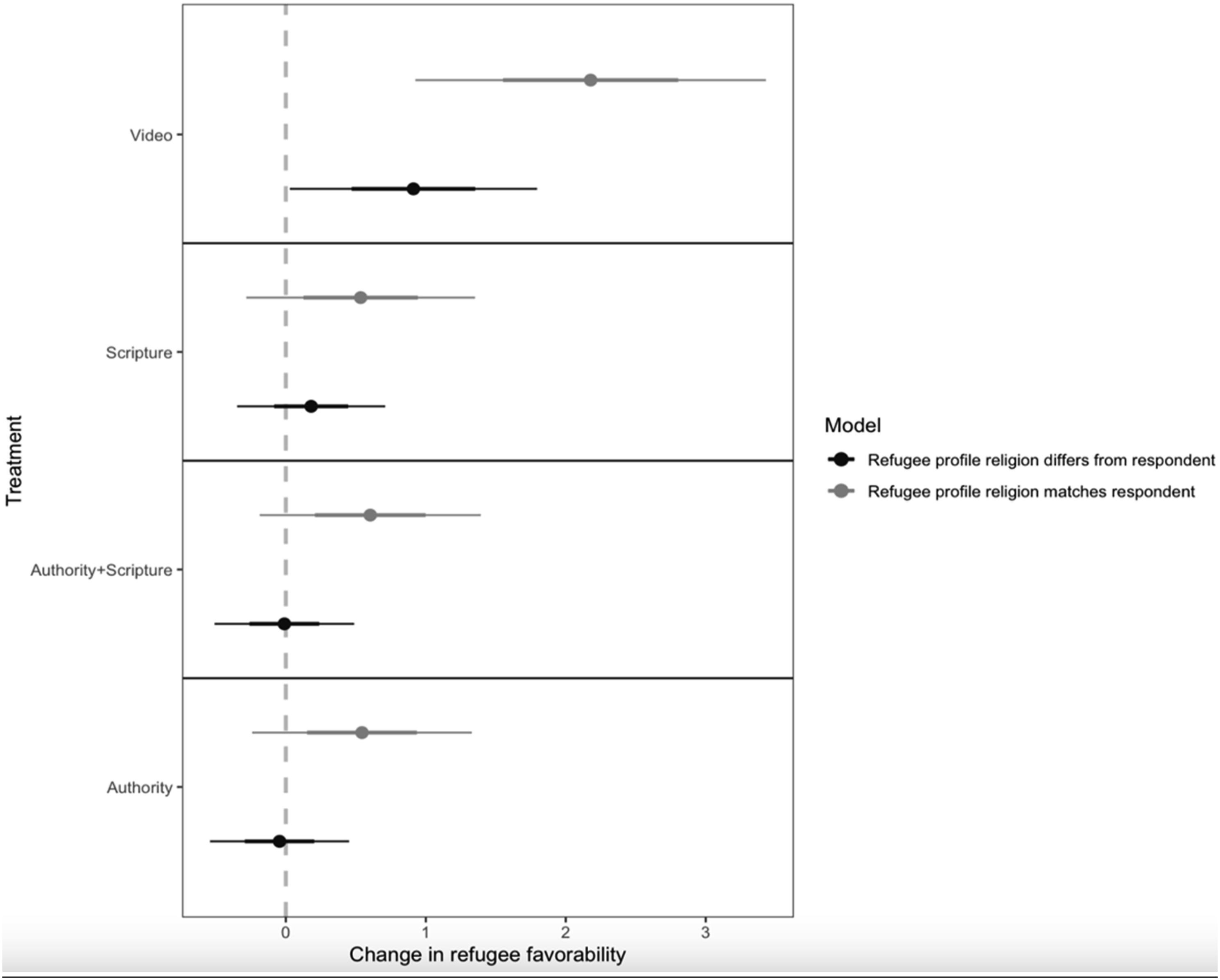
As with the previous analysis, the results show the video sermon to be uniquely capable of driving pro-refugee attitudes. We also see that the effect is greater when the hypothetical refugee shares a religious background with the respondent, though the treatment effect of the video sermon is also statistically significant at the 0.05 level when asked to rate a non-coreligionist refugee. All else equal, watching the two-minute sermon led to an average increase of 2.2 points (on a 1–7 scale) in individuals’ willingness for Lebanon to host a refugee who shares their religious background. These results suggest that religious appeals for tolerance influence host citizens’ attitudes in part by triggering a sense of solidarity with coreligionists in need of support.
From Attitudes to Behavior: Do Treatments Affect Donations?
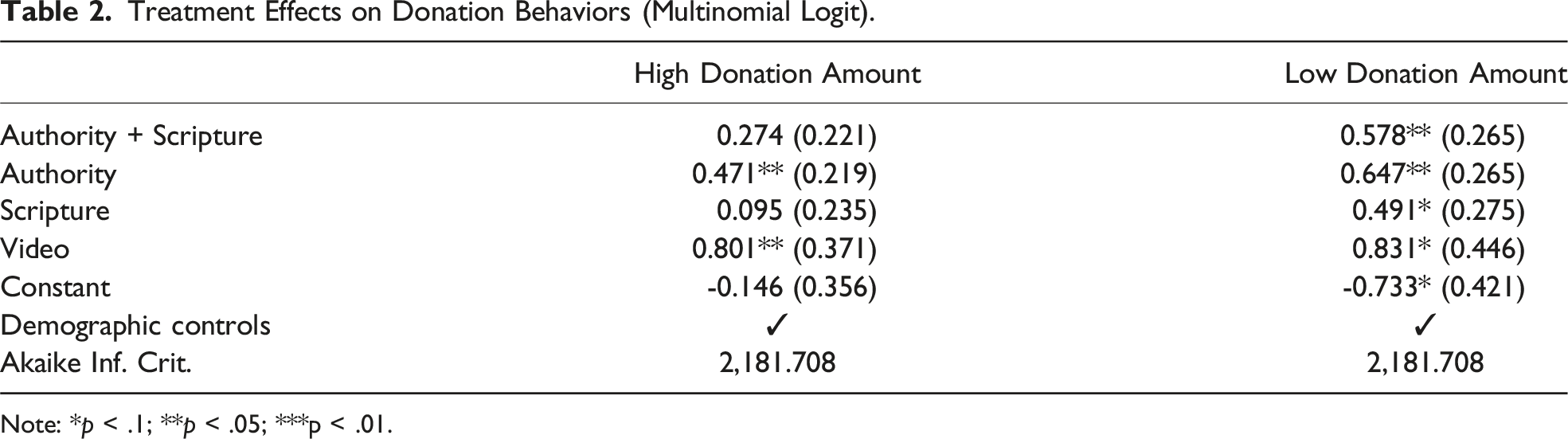
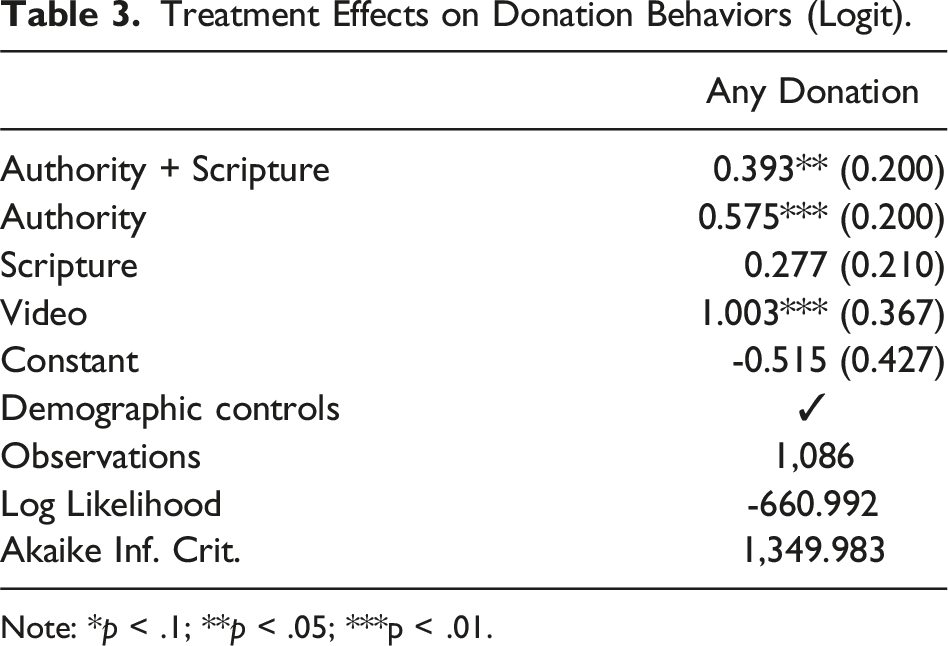
I now turn to analyzing how the treatments affected respondents’ willingness to donate to an international charity providing support to Syrian refugees. Here, I am interested not just in the respondent’s likelihood of donating, but the level of donation. To this end, I divide respondents into three groups: no donation, low donation (any >$0 donation amount below the mean amount of $12.68), and high donation (above the mean) and estimate using multinomial logit. For robustness, I also run a logit model with a binary dependent variable taking a value of 1 if a respondent donated any amount, and 0 otherwise.
Treatment Effects on Donation Behaviors (Multinomial Logit).
Note: *p < .1; **p < .05; ***p < .01.
Treatment Effects on Donation Behaviors (Logit).
Note: *p < .1; **p < .05; ***p < .01.
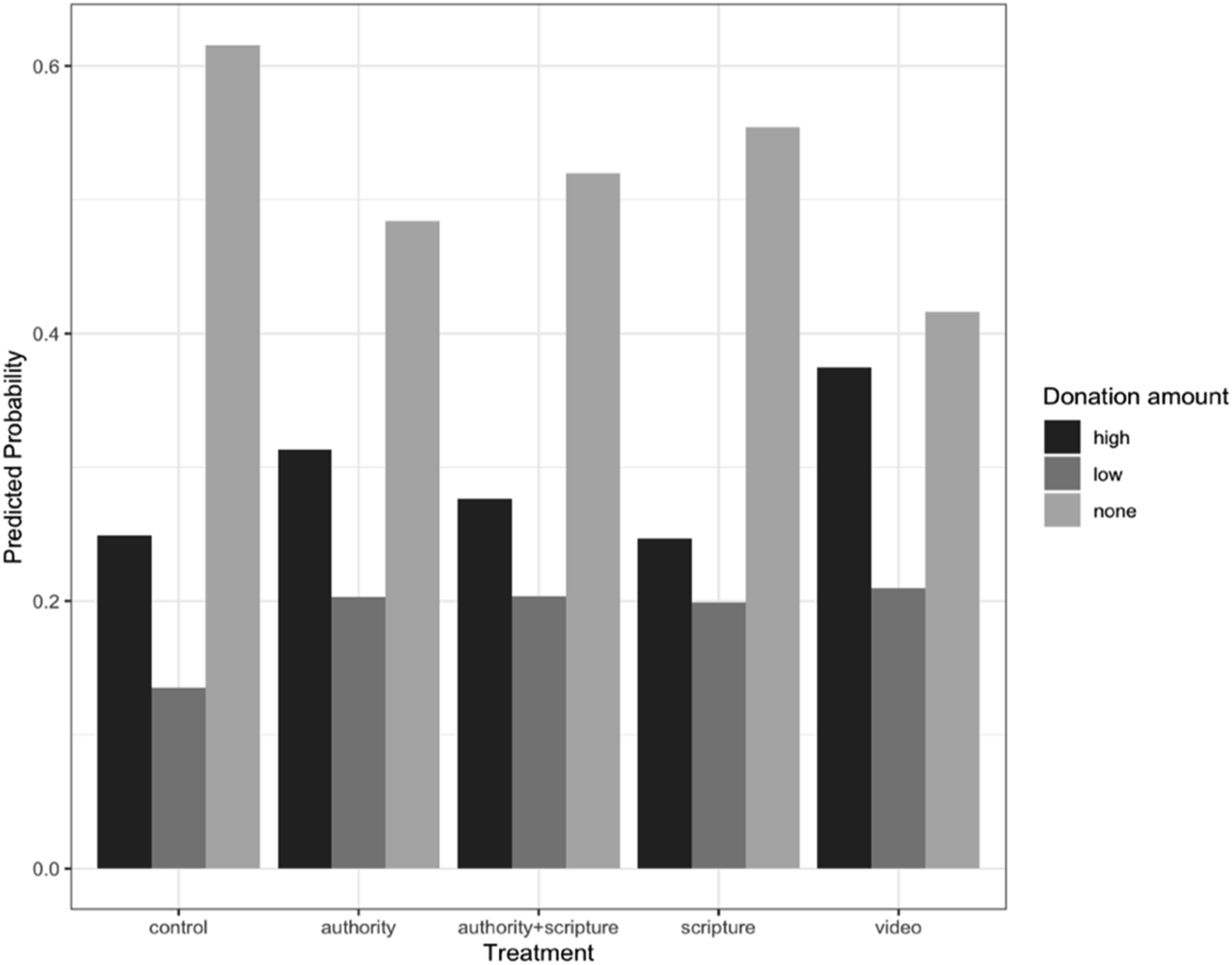
Predicted donation probabilities by treatment.
Respondent Religiosity: Does Religiosity Condition Treatment Effect?
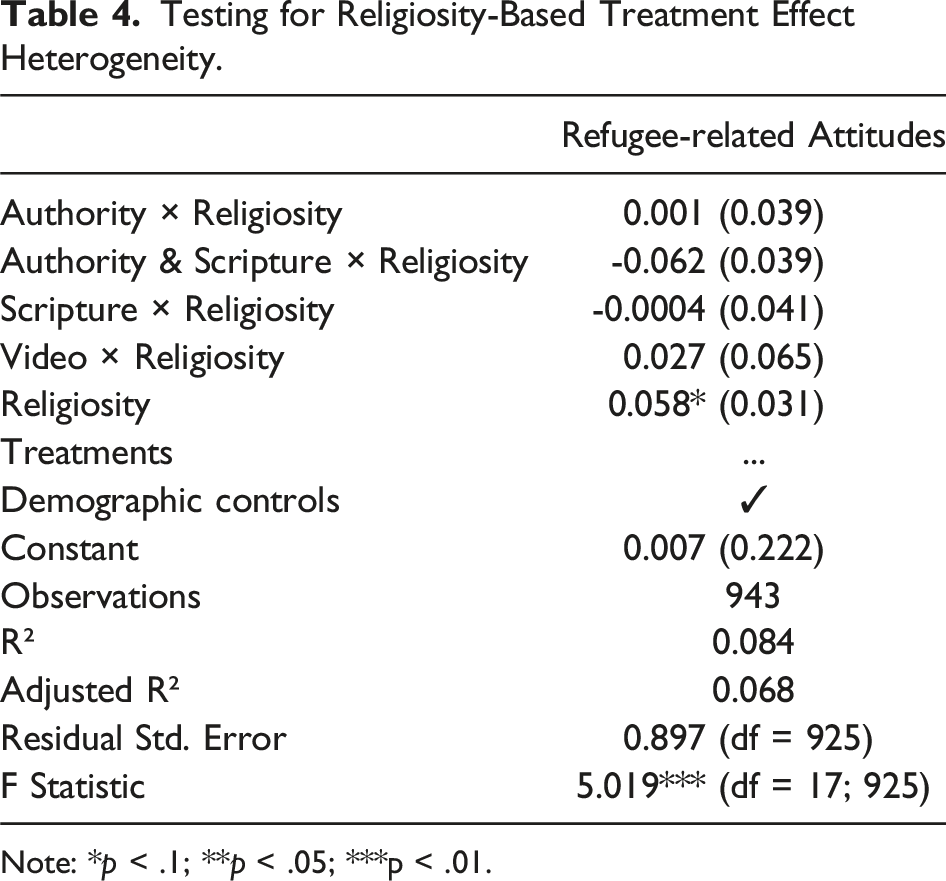
Testing for Religiosity-Based Treatment Effect Heterogeneity.
Note: *p < .1; **p < .05; ***p < .01.
Contrary to H2, I find no evidence that religious discourse’s attitudinal effects are conditioned by respondent religiosity. Individuals with high levels of religious service attendance were no more susceptible to changing their attitudes in response to the treatments than their low religiosity counterparts. One possible explanation for this is that because highly religious respondents’ views towards refugees were significantly more positive to begin with (see coefficient on the religiosity variable), their increased susceptibility to the treatments was balanced out by a ceiling effect on their tolerance levels. It is also plausible that in a highly religious country like Lebanon, even most nonbelievers come from religious backgrounds and may therefore find faith-based arguments convincing.
Discussion and Conclusion
Recent research in Western democracies has emphasized that immigration attitudes are highly stable (Kustov, Laaker, and Reller 2021), and there are good reasons to suspect that this is likewise true in the setting of this study. In Lebanon, where around one in five residents is a Syrian refugee, questions related to the presence of Syrians and Lebanon’s obligations towards them have been some of the most hotly contested and salient political issues for over a decade. As such, it is remarkable that any of the interventions tested here were able to shift host country citizens’ attitudes in a positive direction.
This study has clear implications for policymakers, activists, and other actors seeking to address the worldwide problem of anti-refugee prejudice and hostility. It provides compelling evidence that appealing to inclusionary interpretations of religious values can mitigate the feelings of cultural threat that engender xenophobic attitudes, and that this is true even for those ethnic communities with the strongest animosity towards refugees. Since the treatments all consisted of very brief interventions, the experiment’s results raise the possibility that longer-term exposure to pro-refugee religious discourses—through, for instance, an advertising campaign with supportive local religious leaders—could drive sustained attitudinal change. The results from the donation solicitation component of this study are particularly promising, as they demonstrate that religious messaging not only influences host country citizens’ attitudes towards refugees but can also motivate them to take tangible action by contributing to refugee-related causes.
While these insights are globally relevant, they are likely to be particularly instructive for the Middle East and North Africa in the medium- and long-term future. In countries across the MENA region, not only are self-reported levels of religious faith and religious service attendance consistently high, but there is little gap in religiosity between younger and older generations, indicating that religion will continue to influence political attitudes and behaviors for decades to come (Hackett et al. 2018). Moreover, multiple sources of mass displacement—including ongoing violent conflicts around the Middle East and climate change, which is expected to disproportionately impact the region (Cummings 2019)—ensure that questions related to refugees and their fates in the countries hosting them will remain distressingly relevant in MENA throughout the twenty-first century.
The results presented here should additionally inform ongoing debates about how the varied dimensions of religious faith interact to inform regular citizens’ political commitments. By stacking appeals to faith-based values and endorsements by religious authority figures on top of one another and also examining these two phenomena separately, I am able to test their effectiveness relative to one other. Notably, all four of the treatment groups were capable of mitigating anti-refugee sentiment among at least one of the three religious groups that I examine, suggesting that both religious messaging and religious messengers can shape political attitudes independently of one another.
The surprising cross-sectarian appeal of some of the sect-specific sub-treatments merits further discussion. Specifically, the three Sunni-specific treatments (the video sermon, Sunni authority and Sunni authority + scripture) led to significant declines in anti-refugee responses among Christian respondents, suggesting that faith leaders may be able to influence the political attitudes of non-coreligionists even in settings where religious sect is highly salient. Furthermore, this finding provides encouraging insights into the state of interfaith relations in Lebanon specifically. Given a dominant narrative that sectarian divisions are the driving force behind Lebanese politics and society, it was especially notable that the treatment that had the strongest pro-tolerance effects across religious groups was a short sermon by a cleric who was recognizably Sunni.
Why did this video sermon elicit a stronger and more consistent response than any of the text-based treatments? Since the video sermon was distinct from the other treatments in multiple ways, such as the medium of video versus text and the precise language used, we can’t know precisely what drove its stronger cross-sectarian effects. Recent work by (Wittenberg et al. 2021) finds that video-based political messaging has at best a marginal persuasive advantage over text. It is unlikely, then, that the difference in medium alone is entirely responsible for the video sermon’s relative strength. On the other hand, it seems quite plausible that the video was more compelling to many respondents because it offered them a closer connection to the speaker’s emotional and morally charged discourse. It is also possible that viewers found the religious appeals that the cleric made—arguing, for instance, that those striving to be like the ansar in Islamic tradition 5 should be welcoming of Syrians—particularly convincing. Following this and other recent research on clerical engagement in politics (Nielsen 2017; Williamson et al. 2023), future work should continue probing the sources of variation in religious elites’ powers of political influence.
More generally, this study and its findings speak to the need for further research clarifying how different dimensions of religion interact with each other and with their broader social environment to inform regular people’s political attitudes and behaviors. Religious scripture and the values within them do not exist in a vacuum. Rather, citizens’ understandings of their sacred duties as believers and of how those duties should shape their engagement in politics are deeply influenced by varied aspects of the social and political context that they are embedded in, including elite messaging and personal relationships with religious outgroup members. Moving forward, mixed-methods research combining experiments with other tools—especially in-depth interviews with religious elites and lay believers—will need to be employed to fully investigate this complexity.
Supplemental Material
Supplemental Material - Can Appeals to Religious Values Mitigate Anti-Refugee Sentiment? Experimental Evidence From Lebanon
Supplemental Material for Can Appeals to Religious Values Mitigate Anti-Refugee Sentiment? Experimental Evidence From Lebanon by Sam Selsky in Political Research Quarterly
Supplemental Material
Supplemental Material - Can Appeals to Religious Values Mitigate Anti-Refugee Sentiment? Experimental Evidence From Lebanon
Supplemental Material for Can Appeals to Religious Values Mitigate Anti-Refugee Sentiment? Experimental Evidence From Lebanon by Sam Selsky in Political Research Quarterly
Footnotes
Declaration of Conflicting Interests
The author(s) declared no potential conflicts of interest with respect to the research, authorship, and/or publication of this article.
Funding
The author(s) received no financial support for the research, authorship, and/or publication of this article.

Supplemental Material
Supplemental material for this article is available online.
Notes
References
Supplementary Material
Please find the following supplemental material available below.
For Open Access articles published under a Creative Commons License, all supplemental material carries the same license as the article it is associated with.
For non-Open Access articles published, all supplemental material carries a non-exclusive license, and permission requests for re-use of supplemental material or any part of supplemental material shall be sent directly to the copyright owner as specified in the copyright notice associated with the article.
