



Abstract
This research considers the effects of gendered personalities on political ambition. The sex gap in political ambition is a normatively troubling empirical reality. Ambition research is often limited by binary conceptions and measurement of gender and sex. Recent scholarship urges scholars to employ more nuanced measures, including gendered personality as a measure beyond sex. Using original survey research incorporating the Bem Sex Roles Inventory (BSRI), we explore how femininity and masculinity influence nascent political ambition. Respondents who score higher in masculinity are more likely to have higher political ambition regardless of sex. However, sex remains significant, as female respondents are less likely to express nascent ambition. The results have implications for understanding the sex gap in political ambition and how political behavior conceptualizes and measures gender as a variable.
“Intelligence without ambition is a bird without wings.” – Salvador Dali
Recent research on gender and political behavior makes a compelling case to more fully conceptualize and measure gender (Bittner and Goodyear-Grant 2017; McDermott 2016). These scholars persuasively argue that gender, measured with a dichotomous variable, is theoretically and empirically insufficient. While this critique applies broadly to all research using a binary measure of gender, it should potentially be heeded most urgently by scholars who study gender gaps in outcomes. The long-noted imbalance in political ambition between women and men is both empirically persistent and normatively troubling (Lawless and Fox 2022). The disparity is particularly vexing when women of equal experience, intelligence, and candidate quality consistently express lower ambition than their male counterparts (Fox and Lawless 2011).
In this paper, we use the logic of gendered personality drawn from Bem (1974) to explore the relationship between gendered personality (femininity and masculinity), as well as sex as predictors of nascent political ambition. Using an original survey, we find that incorporating direct measures of masculinity and femininity enriches our understanding of factors driving political ambition. Specifically, when examining whether respondents have thought about or feel qualified to run for political office, masculinity and femininity have effects independent of the conventional dichotomous measure of sex. While femininity has a negative association with ambition, masculinity has positive and robust effects on reported ambition. Even incorporating measures of gendered personality, sex retains its influential effects on the expression of nascent political ambition. The results have implications for how gender is conceptualized and measured in political behavior.
Moving Beyond the Binary
Recent scholarship on gendered political behavior argues convincingly that gender should be understood and deployed as a variable in more granular and refined ways. Bittner and Goodyear-Grant state that the standard practice of measuring gender as a dichotomy, a practice they dub “sex as proxy,” limits the ability to understand gender across the spectrum of political behavior (2017). By conflating sex and gender in analysis, scholars have misunderstood the influence of gender and mis-specified models of political behavior (Bittner and Goodyear-Grant 2017). To the authors’ point, data projects like the American National Election Study (ANES) traditionally use a simple dichotomous measure for sex. In effect, in studies of the gender or sex gap in behavior, scholars are often using an approach that is imprecise, overly blunt, and hides the substantial heterogeneity that exists.
In this vein, we turn to scholarship in psychology that utilizes measurement of gendered personality. Bem (1974) developed a robust inventory to measure gendered personality independently from sex. The original Bem Sex Roles Inventory (BSRI), comprised of a series of agree-disagree items that seek to capture the respondent’s assessment of their adherence to traits traditionally linked to men and women, asks respondents to rate their masculinity (i.e., assertive and forceful), femininity (i.e., gentle and feminine), as well as a neutral category of items (i.e., friendly and truthful).
Drawing from Bem and other gender scholars, McDermott (2016) furthers the compelling theoretical and empirical case for separating feminine and masculine personalities from biological sex. Using the BSRI, McDermott finds that both femininity and masculinity have important effects on political identification, engagement, and attitudes toward politics and sex roles (2016). Perhaps most importantly, this line of recent scholarship is a clarion call to scholars to revisit and reconceptualize one of the most important variables in political behavior—gender. Following McDermott, we consider gender to be “the construct society has built over time to reflect behaviors and beliefs thought to be typical of, though by no means unique to, the sexes and their roles in society” (2016, 4).
In this paper, we extend the logic of gendered personality to one of the most critical areas of gender research—nascent political ambition. The intuition that masculinity and femininity might influence ambition is not entirely novel, but it is rarely directly incorporated into statistical analysis. Oliver and Conroy explore a similar question, albeit using a different measure of masculinity and femininity, in their book-length study of city council members (Oliver and Conroy 2020). In this analysis, we examine the link between gendered personalities and ambition at the mass level and the roots of imbalances in ambition between men and women.
Gender and Nascent Ambition
Scholars look at the roots of political ambition to explore the determinants of gender imbalances in representation and office seeking. As Fox and Lawless argue, scholars must examine “nascent political ambition—the embryonic or potential interest in office seeking that precedes the actual decision to enter a specific political contest” (2004, 643). Nascent ambition is the precursor to future decisions to seek political office and contains a collection of factors from ideological motivations and politicized upbringing to minority status and stage of life considerations (2004, 645). When asked whether they have thought about running for office or whether they are qualified, there is a persistent empirical gap between men and women, with men more likely to express ambition even at commensurate levels of professional attainment and qualifications (Fox and Lawless 2011; Lawless and Fox 2015).
Scholars attribute the ambition imbalance to a host of social drivers from broad socialization effects over a lifetime to specific patterns of encouragement and elite candidate recruitment. Generally, men are more likely than women to be encouraged by their parents to run for political office (Fox and Lawless 2005, 2014; Lawless and Fox 2013, 2022), and those who receive more encouragement are more likely to be politically ambitious than those that are not encouraged (Pate and Fox 2018). This is why it is important to encourage young children to run for political office, particularly young women. Encouragement is also beneficial when it comes from sources outside of the family (Lawless and Fox 2022; Pate and Fox 2018). Specifically, in their study, Lawless and Fox found that almost 50% of men are encouraged to run for political office by someone whom they have a personal connection to, while only 34% of women receive the same encouragement (Lawless and Fox 2022).
In adolescence, coaches, teachers, and friends also serve as important sources of encouragement. The pattern of young women receiving less encouragement than men continues in each of those categories as well (Lawless and Fox 2013). Recent innovative research beyond the work of Fox and Lawless further expands our understanding of the drivers of imbalances in political ambition by focusing on socialization, encouragement, recruitment, and personality traits (Bos et al. 2022; Carroll and Sanbonmatsu 2013; Crowder-Meyer 2020; Fraile and Vitores 2020; Oliver and Conroy 2020; Sanbonmatsu, Carroll, and Walsh 2009).
Some of this inequity stems from the early childhood and adolescent socialization women receive (Bos et al. 2022; Heck et al. 2021; Lawless and Fox 2013). Gendered political socialization, “involves both the internalization of gender roles and norms among children and learning about and being socialized to the political world” (Bos et al. 2022, 485). The socialization into both gender roles and into politics happens concurrently rather than as separate experiences. When young women are socialized to favor cooperation over competition, and simultaneously are also told that politics is a competitive career field, it should come as no surprise that they then have less nascent ambition than their male counterparts who are socialized to be competitive (Lawless and Fox 2013; Schneider et al. 2016).
According to social role theory, children absorb behavioral cues and expectations for their gender based on the gendered divisions that they see around them (Bos et al. 2022; Conroy and Green 2020; Eagly and Koenig 2006; Schneider and Bos 2019). These divides tend to place women in a care-giver role with careers focused on nurturing and compromise, while men have more agentic roles with careers focused on competition and being assertive (Schneider and Bos 2019). Young children notice these divisions and stereotypes, connecting gender stereotypes to careers and impacting their perception. Bos et al. display this phenomenon using the “Draw a Political Leader Test” where 66% of the children drew a male political leader, 13% drew a female, and 8% of participants drew the political leader with no particular sex (2022).
Consequently, many children view politics as a man’s world and a masculine world. These beliefs then follow them into adulthood where women express less political ambition than men. Socialization effects are nurtured at home, where behaviors and actions taken by family members influence their development. Family socialization comes from growing up in a politicized household where political conversations and activities are incorporated into family life (Bos et al. 2022; Fox and Lawless 2014). Even in politicized households, parents are more likely to have political discussions with male children than female ones (Lawless and Fox 2013).
When politics is perceived as a power-attainment career that engages in conflict, women are less likely to be politically ambitious (Schneider et al. 2016). While masculine traits such as “leader” and “tough” are associated with politics, feminine traits like “compassion” and “honesty” are less so (Bauer and Santia 2022, 6). These gendered personality traits are not exclusive to just women or just men. A woman who is politically ambitious could embody masculine traits in order to better fit into the masculine image of politics through trait-balancing (Bauer and Santina 2022).
Moving beyond the binary conception of gender by considering the idea of gendered personality could provide insight into what drives the imbalance in nascent ambition. Is a portion of the gender gap in ambition driven by an individual’s masculinity or femininity? If the political world is conceived of as a masculine endeavor, might masculine women and men be more likely to express nascent ambition? When reconsidered through the lens of gendered personality, it seems clear that moving beyond the binary conception of gender has the potential to provide insight into what drives the imbalance in nascent ambition. Is a portion of the gender gap in ambition driven by an individual’s masculinity or femininity rather than their sex?
Research Design
Our study uses a sample of 800 respondents from Lucid Theorem gathered on May 18, 2023. 1 The sample demographics are balanced on our key indicators of sex and partisanship. Women make up 51.5% of the sample. The partisan breakdown is 334 Democratic respondents (including leaners) or 41.4% of the sample, 297 Republicans (including leaners) or 36.9% of the sample, and 175 Independents or 21.7% of the sample. The mean age of respondents was 45.5 (with a range of 18–87), modal terminal degree was a bachelor’s degree or higher (42% of respondents). The sample had 73% white, 13% African American, 11% Hispanic, 5% Asian/Pacific Islander, and 6.7% other.
Our key measures are derived from two batteries on personality traits and political ambition. Following an introductory political interest question, the survey begins with a personality battery where participants were asked the short BSRI in random order. While the initial formulation of the BSRI consists of three 20-item batteries, our study employs the short BSRI which uses 20 items to capture feminine and masculine personality (the BSRI survey items are listed in the Appendix). The short BSRI has the dual advantage of both greater statistical validity, while also being less laborious for survey respondents. 2 Our study design acknowledges recent criticisms of certain items of the BSRI (particularly those in the femininity scale such as gullible and childlike) as out of date, and rather uses the short version of the BSRI that has been shown to perform more consistently in terms of scale validity (McDermott 2016).
The short Bem Femininity and Masculinity scales we utilize in our models are additive indices that we rescale to run from 0 (least identified with the personality trait) to 1 (most identified with the trait). Both true minimums and maximums were observed in the data. For our scaled measures, Cronbach’s Alpha values for the femininity and masculinity scales are reliable with scores of 0.93 and 0.87, respectively.
Following the personality battery, respondents were randomly assigned to an unrelated experimental design, 3 before moving to the ambition battery. In this section of the survey, participants were asked standard ambition questions, about their prior consideration of running for office (never thought about it, has crossed my[their] mind, thought about it many times) in addition to evaluating their qualifications for office (not at all qualified, somewhat qualified, qualified, very qualified), as well as their interest in participating in certain campaign activities and willingness to run given an estimated chance to win. Having thought about running for office encapsulates the foundational first step of a nascent candidacy. Feeling qualified for office is crucial for understanding gender and ambition because one major contributor to the gender gap is that women of similar qualification often rate themselves as less qualified (Fox and Lawless 2005; Lawless and Fox 2022).
Testing Gendered Personality and Ambition
Our analysis examines two classic questions of political ambition—has the respondent thought about running for office and how qualified do they see themselves to run for office. As a preliminary, we consider our measures of masculinity and femininity, and whether they differ across self-reported sex. The differences between self-identified women and men on femininity are statistically significant (0.75 vs. 0.70, p < 0.00) with women higher in femininity. Furthermore, the difference between women and men on masculinity is significant (0.59 vs 0.64, p < 0.00) with men higher in masculinity. Though there are differences, men and women both exhibit masculinity and femininity. Distributions for masculinity and femininity overall and by self-identified gender appear in the Appendix.
Our modeling strategy is to estimate a “conventional” model of political ambition (sex, strength of partisanship, education, age, and race), before moving to models that incorporate the BSRI measures of femininity and masculinity. This “conventional model” allows us to present the base effect of sex as it is traditionally presented in ambition research with binary measurement. We, subsequently, display the added value of using gendered personality measures to the conventional approach. We also estimate the full models with female and male subsamples to test whether gendered personality effects vary by sex.
Due to the categorical nature of our dependent variables, we estimate our models using ordered logistic regression. As mentioned above, femininity and masculinity are indices of 10 items, rescaled to run from 0 (total absence of the personality traits) to 1 (complete embracing of the personality traits). Sex, or the conventional measure of gender, is the standard dichotomous variable (coded as 1 for female and 0 for male).
With respect to our control variables, strength of partisanship is a 4-category measure created by folding the traditional 7-point partisanship scale. The resulting variable runs from pure independent (1) and leaners (2) to partisans (3) and strong partisans (4). For our other demographic measures, education is a 7-category variable (from some high school to graduate degree). Age is measured in years (ranging from 18 to 87 years of age in our sample). And finally, race is a dichotomous variable (1 if nonwhite, 0 if white). All variables are rescaled to run from 0 to 1. This standardization simplifies our ability to present key relationships on comparable scales, while not altering the statistical relationships between covariates and the outcome variable.
Given the literature on gender and ambition, our overall expectation is that feminine personality traits, independent of sex, should diminish political ambition. If politics is perceived as a masculine endeavor as the literature suggests, masculine personality traits should increase nascent ambition regardless of sex. Further, if our sample conforms to standard expectations, self-identified women should also be less likely to express having thought about running and feeling qualified to run than men.
Models of Thought About Running for Office.
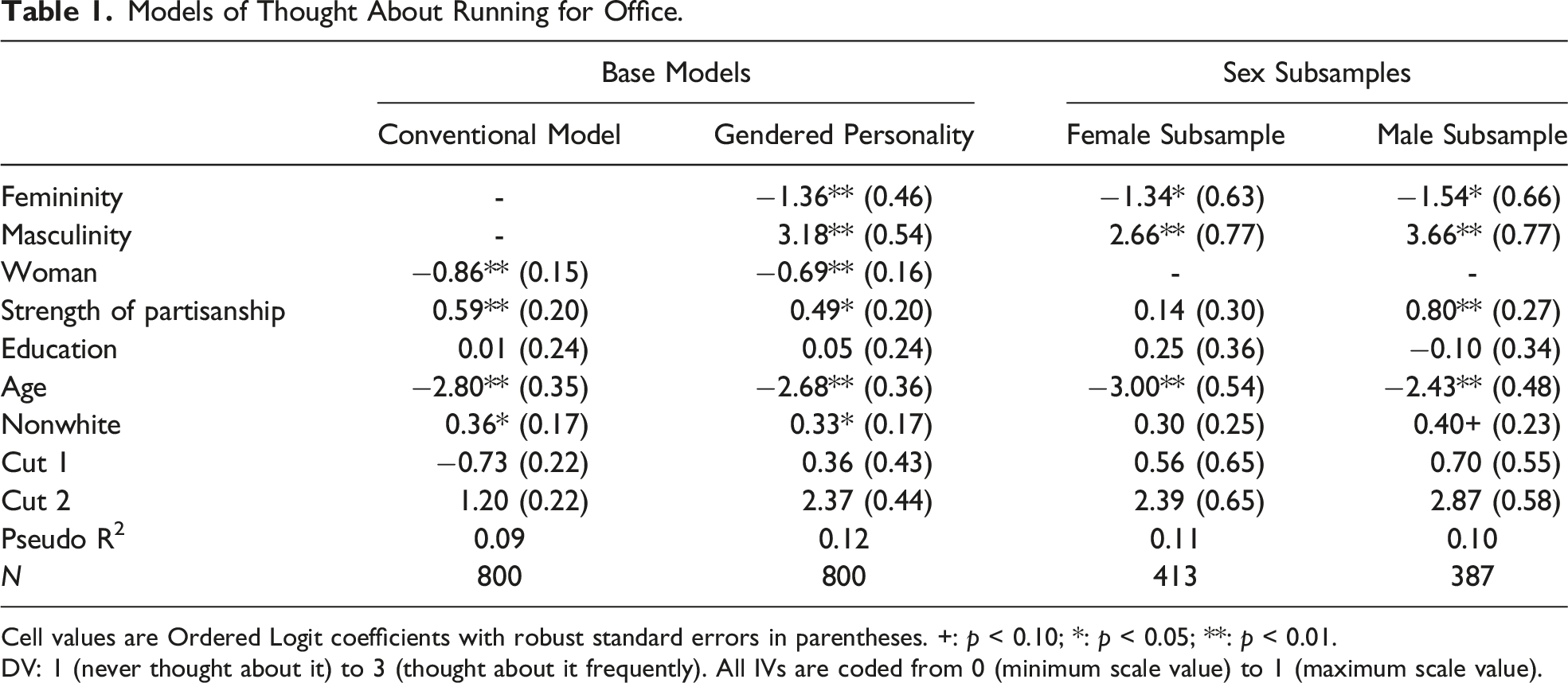
Cell values are Ordered Logit coefficients with robust standard errors in parentheses. +: p < 0.10; *: p < 0.05; **: p < 0.01.
DV: 1 (never thought about it) to 3 (thought about it frequently). All IVs are coded from 0 (minimum scale value) to 1 (maximum scale value).
To explore whether femininity and masculinity’s effects on ambition vary by sex, we run full models on subsamples of female and male respondents in models 3 and 4, respectively. The results for our split-sample models are notable in their similarity. For men and women, masculinity and femininity behave similarly, reinforcing our findings from the full model. Masculinity has a positive influence on the likelihood of having thought about running for both men and women. On the other hand, femininity has a negative and significant influence on the expression of ambition. Substantively, the effect of masculinity for men is larger than for women. But for both sexes, higher masculinity is associated with higher nascent ambition.
Models of Feeling Qualified to Run for Office.
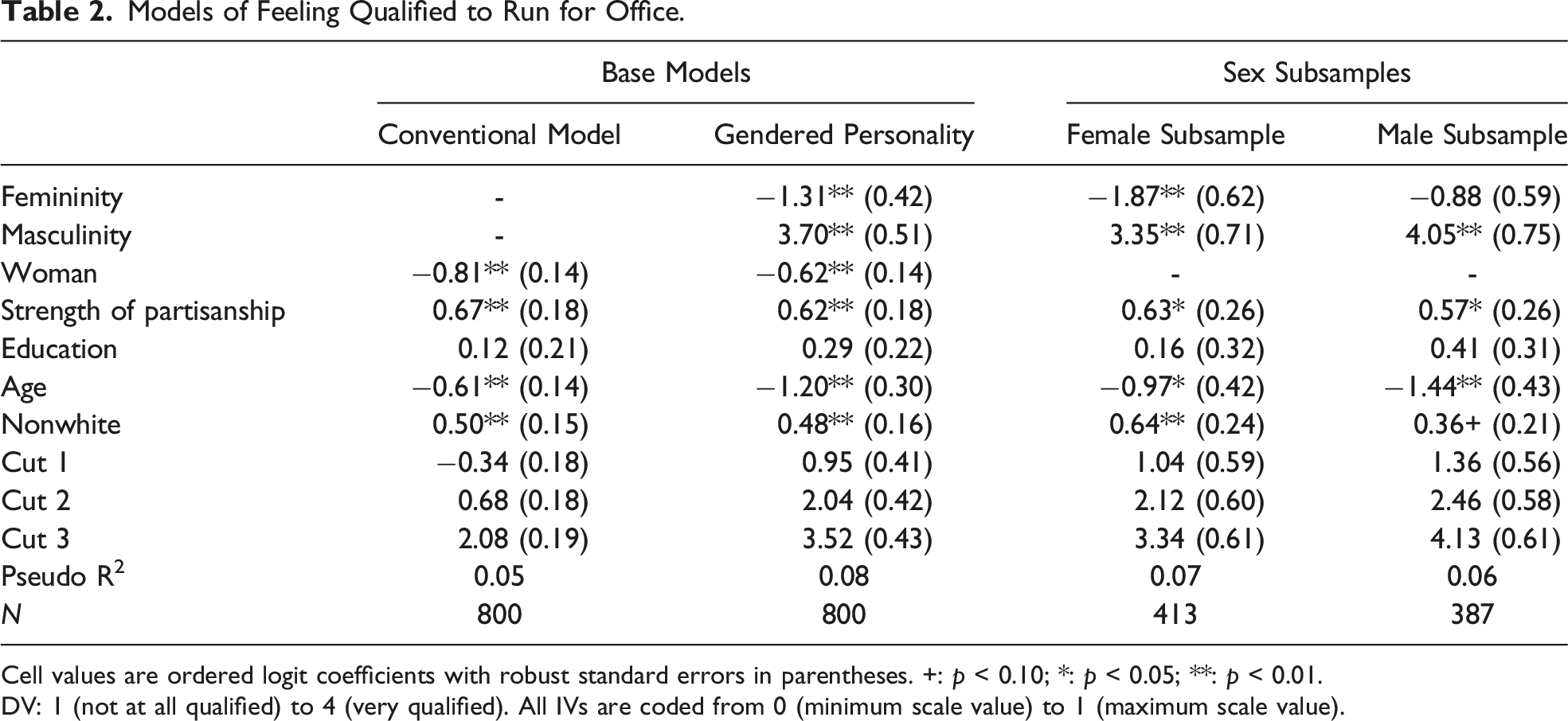
Cell values are ordered logit coefficients with robust standard errors in parentheses. +: p < 0.10; *: p < 0.05; **: p < 0.01.
DV: 1 (not at all qualified) to 4 (very qualified). All IVs are coded from 0 (minimum scale value) to 1 (maximum scale value).
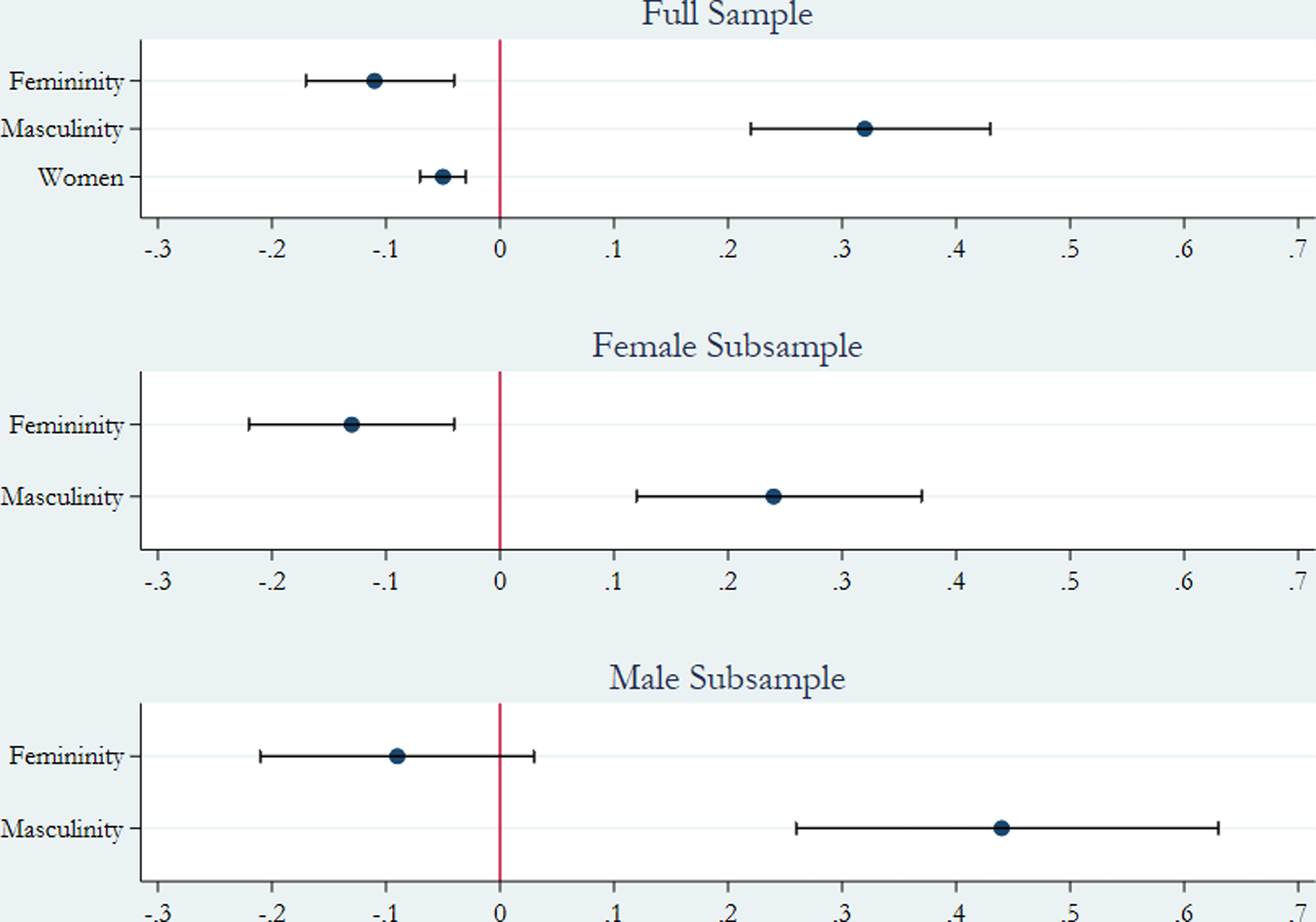
Taken together, the models presented in this research show a tellingly consistent story of the contribution of gendered personality. Sex still retains its influence on nascent ambition in our sample. However, masculinity and femininity are consistently important predictors in our models and provide added value in understanding and explaining nascent ambition. To better display the substantive effects, we generate marginal effects for masculinity, femininity, and sex, holding all other variables constant. These estimates are plotted in Figures 1 and 2. The estimated effects represent the change in likelihood of being in the highest category of thought about running and feeling qualified, respectively. The plotted marginal effects further elucidate the robust and consistent positive effect of masculinity on nascent ambition. While sex has the traditional negative effect with women less likely to express ambition, the effect for masculine personality is positive and far larger than sex. Regardless of identifying as a man or a woman, gendered personality is a robust predictor of ambition. Marginal effects plots for thought about running for office. Note: Plotted values are marginal effects with a 95% confidence interval. Estimates are the likelihood of responding in the highest category for thought about running. Marginal effects plots for feeling qualified. Note: Plotted values are marginal effects with a 95% confidence interval. Estimates are the likelihood of responding in the highest category for feeling qualified.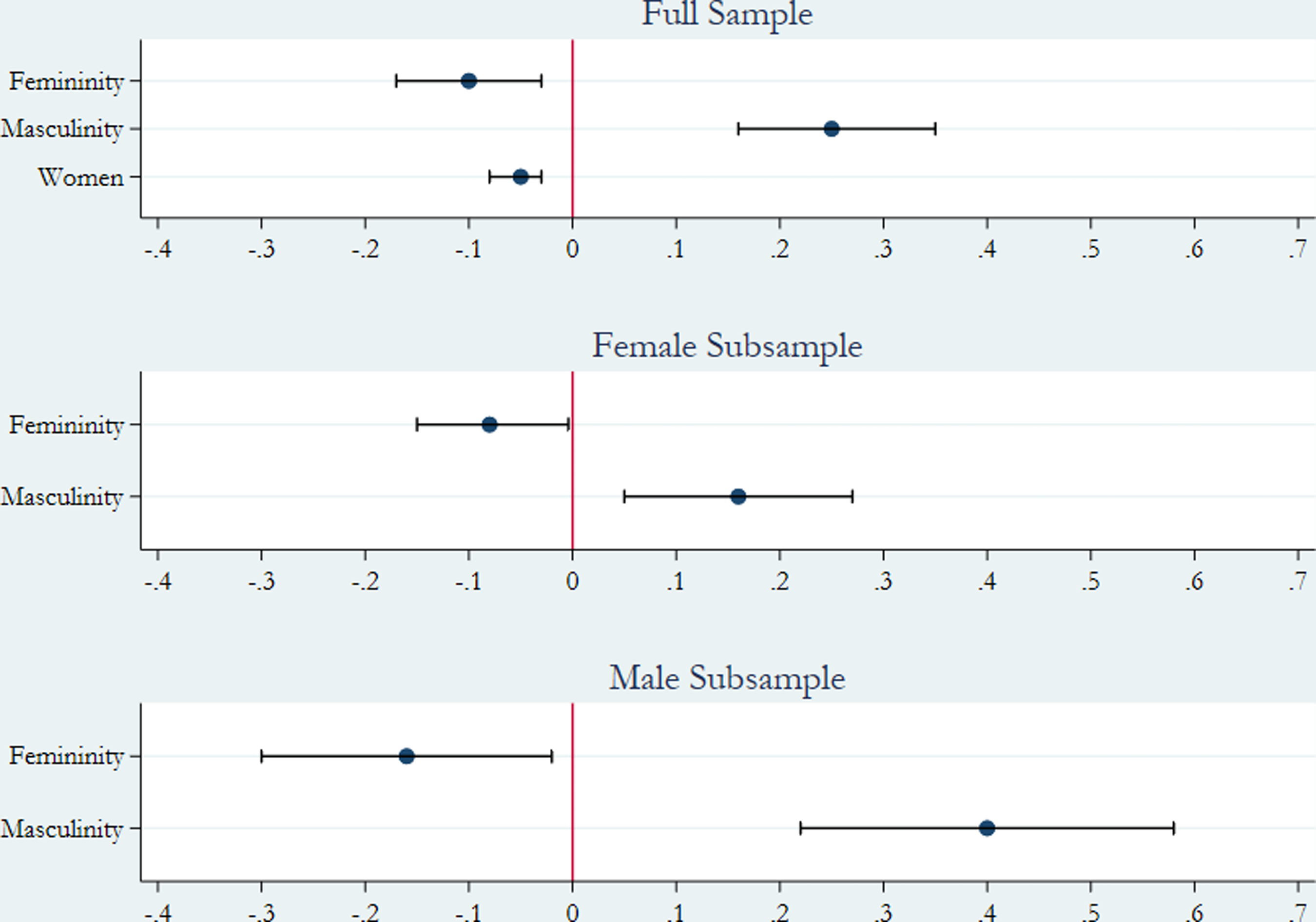
Discussion
The relationship of sex to political ambition is one of the most important and durable research agendas in American political behavior. There are many predictors and correlates of the imbalance in ambition and office seeking between men and women. Modern research has probed and dissected differences in socialization, encouragement, recruitment, political efficacy, stereotypes, and personality traits. The basic binary distinction of gender used in research is still a powerful way to understand gender divides. However, we believe that refining and drilling down on the gendered personality traits of masculinity and femininity provides extra explanatory power and theoretical richness to understanding gender and modern politics. Masculinity and femininity are not new to studies of candidate appeals and voting choice or political engagement and socialization. But there is added value to fully conceiving and explicitly measuring these components of gender beyond the binary.
In our exploration of the influence of gendered personality on political ambition, we have consistent results across outcomes. Moving beyond a dichotomous measure of gender yields significant findings, as the gendered personality traits of both femininity and masculinity influence the expression of nascent ambition. Whether analyzing having thought about or feeling qualified to run for office, masculinity has a consistent positive effect, regardless of sex. Femininity is significant in the opposite direction with higher levels of femininity corresponding to lower nascent ambition. The effect of masculinity appears to be the more robust and substantively influential of the two gendered personality traits. Even controlling for gendered personalities, sex (measured as a dichotomous variable for female) retains a negative effect on having thought about and feeling qualified to run.
Our analysis is not without limitations. While the BSRI has been used for decades to measure gendered personality, we are open to the notion that gender norms of personality are increasingly fluid and changing in society. The BSRI has been validated, yet we acknowledge that the instrument is largely unchanged in its descriptors and traits from conceptions of gender ideals from the 1970s. Certainly, more research on the suitability of the scales could be employed to ensure that it still conforms to our rapidly changing understanding of gender today. Our research is bolstered by using the short BSRI which omits the outdated feminine traits like gullible and childlike. But that does not preclude researchers from teasing out and homing in on the most relevant traits aligned with contemporary society’s gender norms. A secondary question is how these traits might change and react at different ages and stages of an individual’s life. The various configurations of gendered personality that make up an individual’s gender is a final research consideration. For example, Bem’s initial typology includes androgyny, undifferentiated, masculine, and feminine personality types (1974). Our inability to test an encouragement effect is another potential limitation to our analysis. Encouragement is an important variable in the ambition literature that we did not include in our study design. Future research should explore how gendered personality and encouragement interact to influence ambition.
Taken together, we hope these preliminary findings move the debate forward in considering gender beyond the binary. The complexities of the relationship between gender and ambition necessitate an understanding of many social forces including personality traits. It is important to note that sex or sexual identity still matters and has a negative effect on the likelihood that a respondent expresses nascent ambition. Sex and everything the dichotomy captures still matters and gendered personality matters as well.
Supplemental Material
Supplemental Material - Moving Beyond Binary Measures of Gender in Political Ambition
Supplemental Material for Moving Beyond Binary Measures of Gender in Political Ambition by Rolfe Daus Peterson, Carl L. Palmer, and Elizabeth Bosanko in Political Research Quarterly
Supplemental Material
Supplemental Material - Moving Beyond Binary Measures of Gender in Political Ambition
Supplemental Material for Moving Beyond Binary Measures of Gender in Political Ambition by Rolfe Daus Peterson, Carl L. Palmer, and Elizabeth Bosanko in Political Research Quarterly
Footnotes
Declaration of Conflicting Interests
The author(s) declared no potential conflicts of interest with respect to the research, authorship, and/or publication of this article.
Funding
The author(s) received no financial support for the research, authorship, and/or publication of this article.

Supplemental Material
Supplemental material for this article is available online.
Notes
References
Supplementary Material
Please find the following supplemental material available below.
For Open Access articles published under a Creative Commons License, all supplemental material carries the same license as the article it is associated with.
For non-Open Access articles published, all supplemental material carries a non-exclusive license, and permission requests for re-use of supplemental material or any part of supplemental material shall be sent directly to the copyright owner as specified in the copyright notice associated with the article.
