




Abstract
This article introduces the thesis of threatened social identities as a new explanatory approach to the emergence of populist attitudes and tests it explicitly for the first time using quantitative data. We examine whether SIT indicators explain populist attitudes directly and influence effects of indicators of two established approaches: the losers of modernization thesis (LOM) and the cultural backlash thesis (CBT). We use a sample representative for the German labor force. Furthermore, we developed items to quantify the recognition of social identities for the first time with respect to social class and occupational identities. All four of our SIT indicators—recognition of social class, recognition of an East or West German identity, political recognition of occupational groups, and identity insecurity—are significant predictors of populist attitudes. Based on SEMs, we also conclude that these variables are important antecedents of previously established indicators of LOM and CBT on populist attitudes. Overall, we conclude that SIT adds to the literature on the emergence of populism as another complementary explanatory approach. In addition to being effective as an explanation in its own right, this thesis can also fill theoretical and empirical gaps of the established LOM and CBT.
Introduction
One current challenge to social cohesion in Western democracies is the growth of populist movements which polarize societal debates and delegitimize political compromises as “a betrayal of the common people by elites” (Mudde and Rovira Kaltwasser 2019). Scholars have extensively tried to identify reasons for the rise in populist attitudes. The ongoing debates center around the “losers of modernization thesis” (LOM, Gidron and Hall 2017; Spier 2010) and the “cultural backlash thesis” (CBT, Norris and Inglehart 2019). However, both theoretical approaches have not yielded conclusive findings yet. Moreover, both ideas do not deliver a precise explanation of how exactly macrostructural changes like modernization and globalization are supposed to affect populist attitudes at the microstructural social level. Recent studies indicate that threats to social identities which result from large scale social changes contribute significantly to the emergence of populist attitudes (Droste 2019; Groß 2021). Based on these initial findings, we introduce social recognition and identity insecurity as important mechanisms that connect social change with populist attitudes. We test the explanatory scope of this innovative approach in comparison to the more established LOM and CBT.
Hence, the central question of this paper is: to what extent do threats to social identities serve as an explanation for the rise of populist attitudes? We use data of an online survey which is representative of the German labor force to address this research question. Germany is an interesting case as populist parties did not have any long-term success after WWII until the AfD (alternative for Germany) was founded in 2013. Ten years later this party is represented in most of the 16 state parliaments and is a contestant for the second highest share of votes at the federal level. Within this 10-year span, the party leadership has changed several times and some of the regional branches of the movement, which was once founded as a party critical of the euro and the EU, are being monitored by the German domestic intelligence service. Political scientists uniformly classify the party as populist (Arzheimer and Berning 2019; Decker 2016). However, few scholars use measurements of populist attitudes in the context of Germany which we intend to do.
Furthermore, this is the first study of populist attitudes using a quantitative measure of social recognition. We collected information on the perceived recognition of three different social categories as well as a general measure for identity insecurity in the form of anomia. We use social class recognition, perceived occupational recognition on the part of politicians during the Covid pandemic, and recognition of an East or West German identity. The regional dimension of recognition is important for the German case since previous studies have shown higher prevalence of populist attitudes in the Eastern federal states of Germany (Manow 2018; Pesthy, Mader, and Schoen 2021; Weisskircher 2020).
We organize our paper as follows: The next section lines out the theoretical framework. The third section of this paper describes the underlying data and methods in more detail. In section four, we present the results of our analyses. We conclude this paper by discussing our findings in section five and suggest directions for future research.
Theory and Hypotheses
We start this section with our understanding of populism as a “thin ideology” (Mudde 2004; Mudde and Rovira Kaltwasser 2019). Second, we provide a brief overview of the state of research on the explanation of populist attitudes to date. Third, we present our new approach for the explanation of populist attitudes. Based on a short elaboration of the importance of intact social identities, we argue that the identity threat approach is the missing piece of the puzzle to fill the conceptual gaps in the LOM and CBT approaches. To conclude the theoretical framework, we derive our hypotheses for the subsequent empirical analyses.
Populism as a “Thin Ideology” and Established Explanatory Approaches
This paper uses the definition of populism as a “thin ideology.” Cas Mudde and Cristobal Rovira Kaltwasser established this definition, thereby depicting populism as an antagonist conflict between the common will—“volonté générale”—of the “pure people” and a “corrupt elite” that is in power and betrays the people (Mudde 2004, 543; Mudde and Rovira Kaltwasser 2019, 25). Fundamental for this “ideational approach” is the Manichean worldview of a moral conflict between good and evil, the anti-elitism, and the sovereignty of the people (Mudde 2004; Mudde and Rovira Kaltwasser 2019).
Two approaches have emerged as the most frequently discussed theories for identifying the causes of populism. These are, first, the “losers of modernization thesis” (LOM, Gidron and Hall 2017; Spier 2010) and, second, the “cultural backlash thesis” (CBT, Norris and Inglehart 2019). Both approaches identify the consequences of modernization and globalization as main drivers for the rise of populism. The LOM focuses on economic change and sees material wealth losses and status anxiety as decisive reasons for the development of populist attitudes. The CBT, on the other hand, emphasizes cultural change and its consequences in the form of cultural threats to traditional or national identities. The two approaches are not mutually exclusive but rather complementary.
Losers of Modernization Thesis
The most prominent explanation of the emergence of populist attitudes in Western democracies is the LOM which focuses on economic change (Gidron and Hall 2017; Mudde and Rovira Kaltwasser 2018; Spier 2010). According to the LOM, globalization and modernization in its form as mechanization, destabilization of labor relations, and immigration lead to more competition and pressure for low-skilled and increasingly also middle status positions in the labor market. Populist actors often declare themselves as advocates of protectionist measures to counter outsourcing of jobs and the immigration of potential competitors in the local labor market (Kriesi 2008). They also argue in a sense of welfare chauvinism and frame public (monetary) assistance as primarily a privilege of native people—with nativism being a political highly contested subject (de Koster, Achterberg, and van der Waal 2013; Mau and Burkhardt 2009; Mewes and Mau 2012; Van der Waal et al. 2010).
Various scholars have already investigated the LOM. Overall, lower educational attainment, low income, and joblessness are possible predictors of populist voting (Lux 2018; Tutic and von Hermanni 2018). Still, the robustness of these findings is debated. Especially the different operationalizations of populism (votes cast, voting intentions, or appreciation of certain parties as proxy for populist attitudes) draw criticism (Bergmann et al. 2017; Lengfeld and Dilger 2018; Schröder 2018).
An increasing body of literature focuses on the subjective perception of current and anticipated material hardship. Not only people in low socio-economic circumstances feel attracted to populist movements but also members of the middle class may have sympathies for populist parties (Antonucci et al. 2017; Kraemer 2010; Lengfeld 2017; Nachtwey 2016). Globalization puts middle classes under pressure, as they face a higher level of competition in the labor market. They see their established skills devalued and are increasingly employed in atypical work arrangements (Blossfeld et al. 2011). Being employed under atypical working conditions, in turn, increases the risk of poverty and a decline in the socio-economic status of an individual (Giesecke 2009). Once again, populist parties present themselves as patrons of local workers to reduce status anxiety (Burgoon et al. 2019).
Relative deprivation has emerged as a key concept in this regard and refers to a condition in which an individual does not possess a good to a sufficient degree with respect to a point of reference. This concept acknowledges that people strive for goods that they themselves do not own, while either other people do possess them or the individuals used to be in control of said good in the past, but not anymore (Rippl and Baier 2005; Runciman 1966). Empirically, several studies have shown that relative deprivation is indeed a strong predictor for populist voting behavior or populist attitudes (Manunta et al. 2022; Rooduijn and Burgoon 2018; Spruyt, Keppens, and van Droogenbroeck 2016). Lüders et al. (2021) argue that vertical group relative deprivation is the most important facete of relative deprivation in explaining populist attitudes. Fears of downward mobility—also referred to as status anxiety—are another subjective economic motivation for populist voting (Bergmann et al. 2017; Engler and Weisstanner 2021; Sachweh 2020; Sthamer 2018).
Besides the different interpretations of LOM in terms of objective and subjective indicators, another discussion resolves around the scope of the economic situation under consideration. Is it only the (perception of) individual socio-economic positions or rather the development at the macro-level which influences populist voting? Studies indicate that the perception of the individual’s economic situation is not as decisive for populist voting as the perception of the economic development at the country level (Cena et al. 2023; Engler and Weisstanner 2021; Rico and Anduiza 2019; Rooduijn and Burgoon 2018; Watson, Law, and Osberg 2022).
Overall, the literature provides mixed results so far in testing the LOM with subjective assessments that reach beyond people's individual situation being the most promising explanatory factors. Moreover, this perspective lacks a specific explanation why people who are not deprived in absolute terms feel threatened in relative terms anyway and how this then translates into populist attitudes. These conceptional and empirical ambiguities indicate the need for alternative explanations.
Cultural Backlash Thesis
According to Ronald Inglehart and Pippa Norris (2016), globalization and modernization also challenge hierarchy of social groups in cultural terms. They argue that improved material security led to a “silent revolution” and empowers previously marginalized social groups to articulate their political demands. Against this background, populist movements bundle a “cultural backlash” of previously socio-culturally dominant groups that have lost their traditional dominance or see it endangered by societal pluralization (Norris and Inglehart 2019). While Inglehart sees value shifts between generations as decisive group boundaries, only one study examines this narrow interpretation of CBT and finds no significant influences between generation and a populist party vote (Schäfer 2022). In our view, the central element of this approach is that group membership is linked to certain values, norms, and associated expectations of action. As soon as the characteristics of the corresponding lifestyles are attacked, threatening situations arise against which these established lifestyles defend themselves, resulting in a so-called backlash. The clearly defined lifestyles and their traditions try to maintain their hegemony and any form of change is rejected.
Most often, authors use attitudes toward migration in general or toward refugees in specific as indicators of whether people support or oppose cultural change. Especially when the research focus is on right-wing populist parties, as this is the case in most of the research related to Germany, studies find a positive association between opposing migration and voting for the right-wing populist (Bergmann et al., 2017; Hambauer and Mays 2018; Lengfeld and Dilger 2018; Rippl and Seipel 2018; Schröder 2018; Schwarzbözl and Fatke 2016). In the European context, attitudes toward the European Union are another significant predictor of right-wing populist voting (Schmitt-Beck, van Deth, and Staudt 2017; Schwarzbözl and Fatke 2016).
However, it is debatable whether these findings can be considered as reliable empirical support of the CBT, since xenophobia or attitudes toward migration are conceptually very close to the dependent variable used in these studies (right-wing party voting). In fact, scholars identify nativism as a core concept of right-wing party identities (Golder 2016; Mudde 2007; Rydgren 2007). Moreover, we also have to question whether nativism does not also conceal economic motives. At this point, the boundaries between LOM and CBT become blurred. A negative attitude toward migration can arise from pure xenophobia on the one hand or from fear for one's own socio-economic status due to migration on the other. Moreover, skepticism toward the European Union does not necessarily imply a rejection of cultural change. It is also possible that respondents view the European institutions critically for other reasons.
All in all, empirical tests of the CBT—at least for the German case—lack convincing operationalization so far.
New Approach: Theory of Threatened Social Identities
The two explanatory approaches outlined above still lack explicit micro-social foundations. We propose the thesis of threatened social identities as an alternative explanation for the rise of populism. Though various scholars from different disciplines have already pointed out the importance of social identities and its possible implications on societal issues, there has not been a coherent approach to introduce social identity threats as an explanatory mechanism for populist attitudes and test this assumption empirically.
Two Functions of Social Identities
Two functions of social identities are essential for human beings which we will elaborate in more detail over the course of this section. First, individuals need positive social identities because they are an important condition for positive self-esteem (evaluative function). Second, the knowledge of one's own social identities empowers to act in social contexts (cognitive function). Without social identities, people lack guidelines that structure their actions.
Recognition and Identity Threat (Evaluative Function)
In their “Social Identity Theory” (SIT), Henri Tajfel and John C. Turner (1979; 1986) argue that a positive social identity is based on a won comparison of one's own in-group with an out-group considered relevant. Threats to social identities posit a great danger for people as only a positive and stable social identity can lead to a healthy level of self-esteem and self-efficacy (Luhtanen and Crocker 1992; Martiny and Rubin 2016).
Francis Fukuyama (2018) points out that the degree of social recognition received for belonging to a social group is the most important signal of the evaluation of social categories by others. He argues that a lack of recognition explains a substantial part of the political power struggles and the polarization processes which arise simultaneously. This idea overlaps with Axel Honneth (1992) who argues that recognition is a basic universal human need. If an individual’s social recognition is compromised, the result is that its self-esteem is hurt which threats social identities existentially. Thus, we interpret social recognition as an important way of creating valued identities—or destroying them: a lack of social recognition lowers self-worth considerably, “shaking up” the fundamental base of people’s identity. There may be other sources or threats to personal identities (such as being loved by relatives or close friends), but in terms of social identities—which consist of social categories (Mead 1973; Tajfel and Turner 1979, 1986)—social recognition is the main way to establish those identities.
Both SIT and Fukuyama’s approach emphasize that identity formation is the result of a constant competition between social groups: the evaluation of the in-group identity results from comparisons with out-groups, and the social recognition of both groups determines the outcome of this comparison.
As our application of the Coleman (1990) model in Figure 1 illustrates, macrostructural trends such as globalization and modernization impact this competition since they influence the evaluation of social categories. Conceptual framework of social change, identity threats, and populism.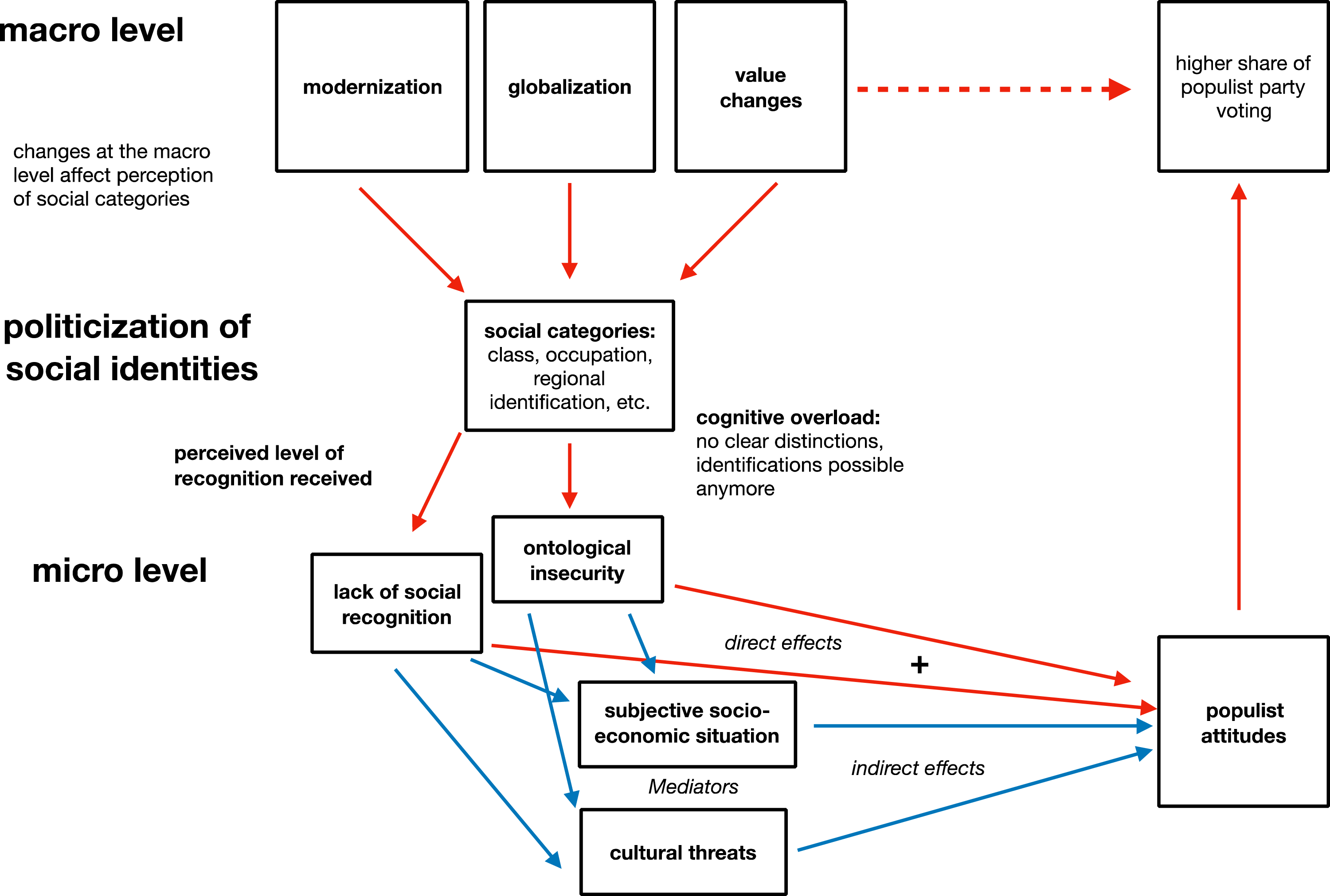
Processes of societal change ensure that various groups within social categories are evaluated differently than in the past. Formerly hegemonial groups (for instance: men, marriages between men and women, groups that strive for “megalothymia” according to Fukuyama (2018, 36ff)), are no longer unquestioned atop the recognition hierarchy. Meanwhile other groups (for instance, women and new living arrangements of same-sex partners) are striving for equal rights (or for “isothymia” in Fukuyama’s terms). There lies an inherent potential for conflict in this concept. While the former dominant groups want to maintain their morally superior standing, the other groups strive for more equality and recognition. Either the first groups feel threatened by a potential loss of recognition through more equality, or the last groups still feel insufficiently recognized (Fukuyama 2018).
Anomia (Cognitive Function)
In addition, social identities are under threat if they cannot provide sufficient orientation about social categorizations, that is, they cannot fulfill their cognitive function. According to Herbert Mead (1973), only those who are able to understand different roles and to classify their own identity by understanding different roles are capable of acting (Mead 1973). With an intact social identity, the cognitive map is clear and the individual knows which path to take in everyday life. Without orientation for social action, people feel “ontological insecure” (Hermans and Dimaggio 2007, 40) which is another form to “shake up” identities.
Due to societal changes, social identities are constantly re-evaluated. During that process, it is possible that a lot of new categories or potential in-groups within these categories arise. Furthermore, expectations in conjunction with certain social identities may change in a rapid manner. As a result, people may feel threatened in their social identities as the constant increase in complexity becomes overwhelming for the individual. The cognitive map is enriched with a greater number of details and possible paths to take. Consequently, this leads to ontological insecurity because the expectations of certain social identities and the subsequent modes of conduct are no longer clear. Thus, the individual is not capable of choosing a certain path or feels lost with the consequences of wrong decisions. This ontological insecurity is the second main threat social identities resulting from social change (Hermans and Dimaggio 2007).
Identity Threats and Populism
We argue that these two threats to social identities—lacking social recognition and identity insecurity—make populist movements attractive. If the desire for recognition is not fulfilled, this sends signals to those affected: Needs, worries, fears, and desires are not acknowledged (anymore). The general displeasure over a lack of recognition leads to estrangement from social and political institutions. Populist movements meet the demand of the emerging recognition vacuum. They promise to fulfill the nostalgic wish for a restoration of the traditional status order through their rhetoric and political programs (Oliver and Rahn 2016).
Ontological insecurity also has the potential that people turn to populism. People start to feel the need of holding on to traditional hierarchies to soften the identity insecurity (Hermans and Dimaggio 2007). As populist movements offer to restore traditional values, they should attract those people who feel socially disintegrated due to their cognitive overload and their ontological insecurity. The appeal for these people is to retain a stable positive social identity with clear role expectations in a proven recognition order with strict definitions of social categories.
Identity Threats in Relation to LOM and CBT
A lack of social recognition increases populism not only because it signals a bad evaluation of others, threatening identity, and lowering self-evaluation. On top of that, respect of social identities provides information about the social status of an individual. The amount of respect is an indicator for its position in the social hierarchy. If this rank is in line with expectations of the individual or even higher, this would have a positive impact on the perceived subjective situation which relates to the economic perspective of the LOM. Through this mechanism, we expect an indirect effect of recognition on populist attitudes. If an individual feels respected, this increases the satisfaction with the subjective situation, making the formation of populist attitudes unlikely. Vice versa, perceived disrespect can impact the subjective situation negatively, increasing the likelihood of populist attitudes.
Furthermore, an “intact” social identity not only buffers fears and anxieties which result from economic change. It also influences fears and anxieties which result from cultural change. If a person feels respected and is able to ground decisions on clear conceptions of him/herself, he/she would feel less threatened by changing values or incoming migrants than people who feel already disrespected by society. At this point we link to CBT, as here the individuals interpret the reordering of interactions and the arrival of new actors as threatening. Thus, as long as individuals feel respected, they have less reason to fear, which should reduce susceptibility to populist attitudes. Conversely, we expect signals of lack of respect to reinforce existing feelings of threat and hence indirectly increase the tendency toward populist attitudes.
Hypotheses
All in all, the argument put forward results in the following conceptual framework (see Figure 1). Intact social identities are essential for people because they serve two overriding functions: recognition of social identities provides a resource for self-esteem and provides information about one’s hierarchical level, allowing the individual to derive clear principles of action in social contexts. Social change in economic and cultural terms now alters traditional orders of recognition in two ways. First, certain groups within social categories experience devaluations, whereas other groups experience valorizations. As a result, those who do not feel sufficiently recognized desire the old order back. Second, social change is causing an increase in the complexity of the recognition order of social categories. Thus, certain social groups no longer know where they stand, which is accompanied by losses of guiding and orientation functions. These groups feel their social identity is at risk and crave complexity reduction. All of these consequences potentially lead to populist attitudes and increase the likelihood of a higher turnout for populist parties in elections. Taken together, these arguments underpin our first hypothesis:
Social identity threats—lacking social recognition and ontological insecurity—are strong explanatory factors for populist attitudes. In addition to this initial direct mechanism, we assume that threats to social identities also impact populist attitudes indirectly through perceived economic threats as a mediator. In this line of thought, perceptions about disrespect or ontological insecurity cause a feeling of not receiving the fair share compared to others or not being compensated adequately. Especially future expectations and subjective perceptions might suffer due to social identity threats. This anticipation of future losses may result in populist attitudes. This reasoning leads us to hypothesis 2a:
The effects of threats to social identities are partially mediated by economic threats. With respect to CBT, we argue that cultural change can cause the evaluation and recognition of particular social categories to change. While previously marginalized groups may experience valorization, this may be accompanied by devaluation processes for traditionally privileged in-groups. This perceived disrespect increases fears which result from cultural change, which in turn would enhance populist attitudes. These arguments motivate our last hypotheses:
The effects of threats to social identities are partially mediated by cultural threats.
Data and Methods
Data
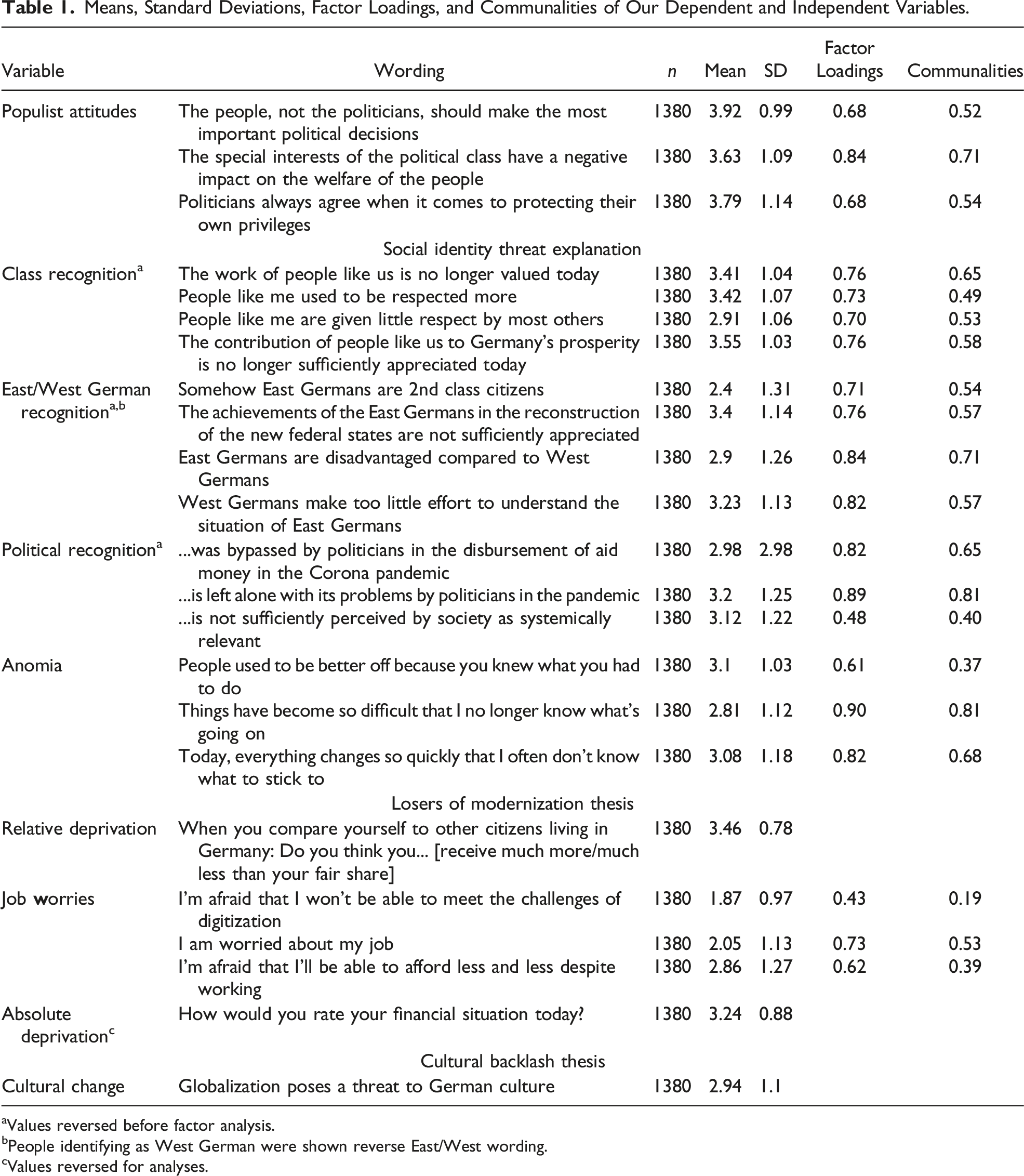
Means, Standard Deviations, Factor Loadings, and Communalities of Our Dependent and Independent Variables.
aValues reversed before factor analysis.
bPeople identifying as West German were shown reverse East/West wording.
cValues reversed for analyses.
Dependent Variable
Castanho Silva et al. (2020) compared seven different approaches and concluded that the scale of Akkerman, Mudde, and Zaslove (2014) is suited most adequately to identify populist attitudes. Building upon this work, van Hauwaert et al. (2020) propose a slight modification to capture extreme positions better. We use this instrument and calculate z-standardized factor scores. Overall, we find high loadings for all three items between 0.68 and 0.84 with good fit indices. A positive value indicates people with a more populist attitude compared to the average respondent.
Recognition of Social Identities
Lacking social recognition has been tested as an explanation for populist or related attitudes so far (Droste 2019; Gidron and Hall 2020; Grosfeld et al. 2022; Manunta et al. 2022; Selenko and de Witte 2021). However, to investigate the outlined ideas, we need a more sophisticated and explicit approach. Therefore, we use instruments that directly measure possible shortcomings in social recognition with regard to three social categories: (1) social class (“class recognition”), (2) recognition experienced by policies addressing occupational groups during the pandemic (“political recognition”), and (3) an East or West German identity “East/West recognition.” Class identities remain an important source to build social identities upon. Classes are defined by socio-economic circumstances which limit or enhance the opportunities and chances in life of their members to a critical degree (Albertini, Ballarino, and De Luca 2020; Breen and Jonsson 2005; DiPrete 2002; Goldthorpe 2016).
Occupational groups are the most important source to gather resources and recognition for performances in modern working societies (Konietzka and Berger 2001; Reckwitz 2019). As Goos, Manning, and Salomons (2014) argue, especially routine-based technology jobs are under pressure. Especially during the Covid-19 pandemic, the importance of respected occupational identities became evident as professions were classified into (non)-essential work in Germany (Mayer-Ahuja 2021). Since our dependent variable, populist attitudes, is a political variable, we use the perceived political recognition of occupational groups within the first year of the pandemic.
For the German case, the distinction between East and West Germany remains sharp even more than 30 years after the union of both parts of Germany. The voting behavior, demographic characteristics, socio-economic status and cultural values reveal lots of differences between both regions (Haffert 2022; Manow 2018; Pesthy, Mader, and Schoen 2021; Weisskircher 2020). Thus, it seems reasonable to consider threats to an East or West German identity as potential reasons for a higher likelihood of forming populist attitudes.
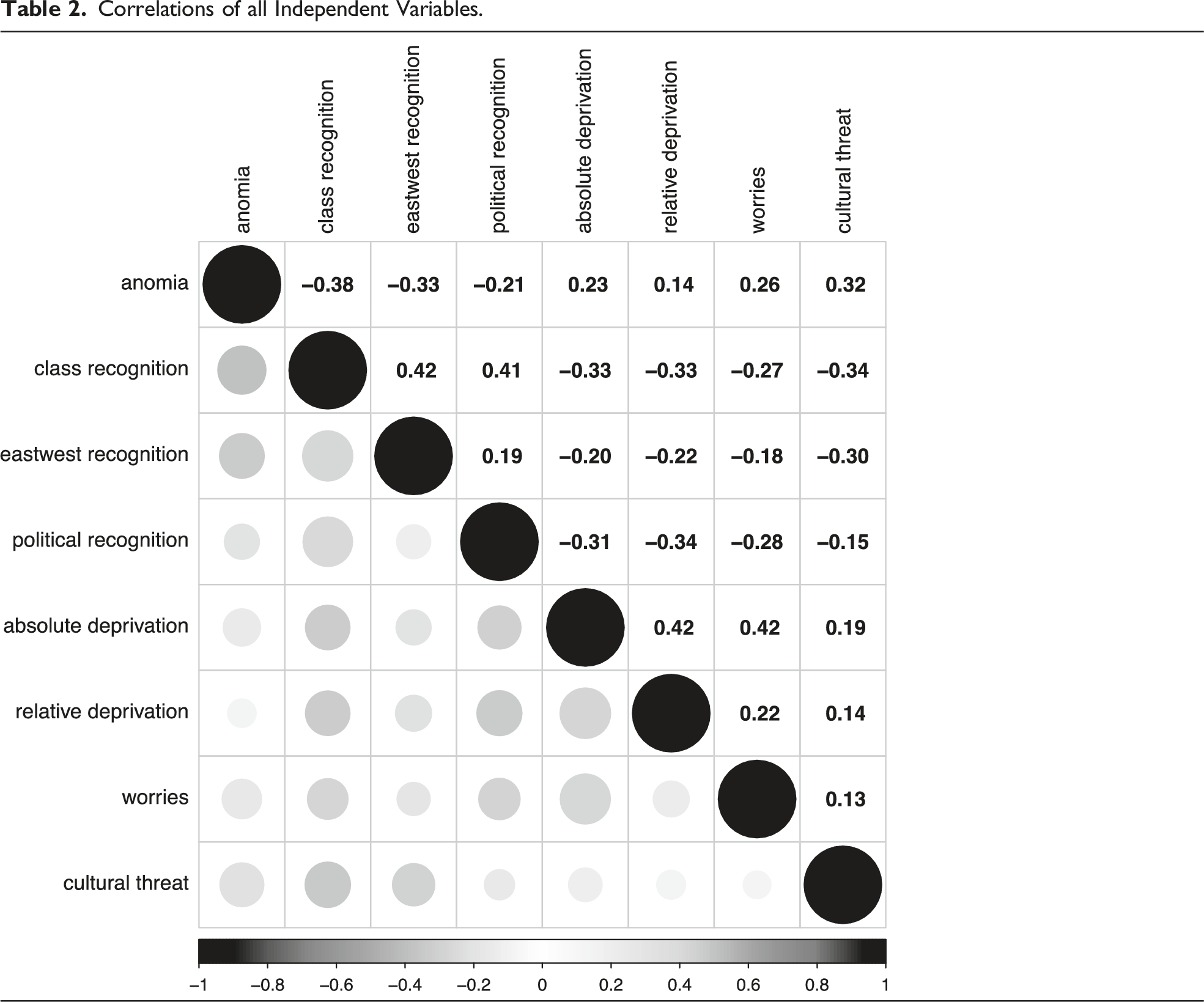
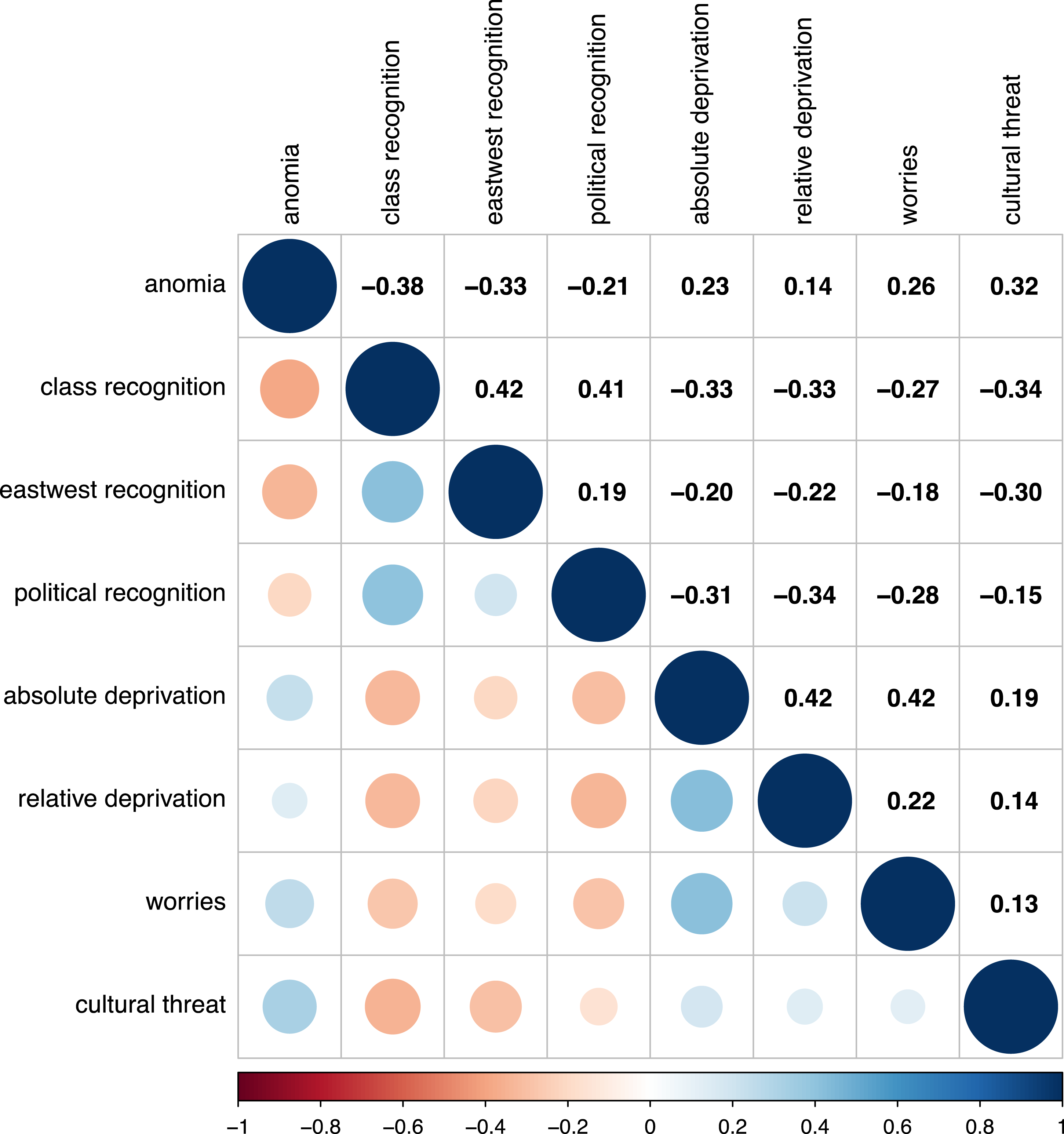
Correlations of all Independent Variables.
Anomia Indicator
A growing body of literature measures ontological insecurity as general anomia (Gidron and Hall 2020). Indeed, anomia is one of the strongest predictors of populist voting and of populist attitudes (Droste 2019; Elchardus and Spruyt 2016; Spruyt, Keppens, and van Droogenbroeck 2016) and feelings of social exclusion can be predictors of right-wing populist voting as well (Langenkamp and Bienstman 2022; Sachweh 2020). We restrict our measure of ontological insecurity to the anomia scale that has been empirically tested before (Gümüs et al. 2014). It contains three items, one example being: “Things have become so difficult that I don't know what's going on.” Once again, positive values indicate stronger feelings of anomia compared to the average respondent.
LOM Indicators
Subjective deprivation is measured by the perception of one’s financial situation (“absolute deprivation”), a standard item on the perception of getting less than a fair share when compared to others (“relative deprivation”) and by worries about losing one’s job (“job loss worries”). The last indicator is once again operationalized through z-standardized factor scores and based upon three items that capture potential worries about one’s own job status. A positive value indicates a higher perceived job threat compared to average respondent in the sample. To make the coefficients of later analysis comparable, we z-standardized the items of financial worries and relative deprivation. Again, positive values indicate greater financial worries or a more pronounced sense of relative deprivation compared to the mean.
CBT Indicator
The perception of cultural change is measured with one item where respondents were asked whether they feel that globalization poses a threat to German culture. Respondents could give their answer on a five-point Likert-scale. Once again, we z-standardized this item in the way that a positive value indicates higher levels of perceived threats to the German culture compared to the mean answer in the sample.
Socio-Demographic Controls
Socio-economic status is indicated by education, occupational status, and a fixed-term employment contract (yes/no). Education was measured with three categories: having no school degree (low), inheriting at least a high school degree (middle), and possessing a university degree (high). Occupational status was operationalized by a standard scale as well as a scheme that contains 11 different sub-groups and is mainly orientated by the required formal education of a job and its definition as essential work. These nine groups are care workers, occupations with a high level of necessary education and a non-essential status, occupations with a high level of necessary education and an essential status, occupations with a medium level of necessary qualification and a non-essential status, occupations with a medium level of necessary education and an essential status, occupations without formal training necessary and non-essential status, occupations without formal training required but necessary jobs—so-called “base workers”—essential civil servants, non-essential civil servants, and lastly a rest category.
Methods & Models
For our first analyses we implement linear regression models. In an initial model, we use one of the four indicators of social identity threats (“anomia,” “class recognition,” “eastwest recognition,” and “political recognition”) together with demographic controls as well as objective socio-economic characteristics. The second model contains the three indicators of the LOM approach in addition. In Model 3, we extend the analyses by introducing the proxy of the CBT. In a last model, we include all four SIT indicators at the same time to see whether we still find net effects after controlling for that many other possible explanatory mechanisms. To test hypotheses H2a and H2b, we perform structural equation models by using the R package “lavaan” to conduct the analyses (Rosseel 2012).
Results
Threats to Social Identities as a Strong Predictor of Populist Attitudes
First, to test H1, we run linear regressions of all four SIT indicators considered on populist attitudes, while controlling for socio-demographic information and socio-economic characteristics (M1). With respect to the three dimensions of social recognition, Figure 2 shows a significant negative effect of social recognition on populist attitudes: an increase in recognition in each dimension leads to a decrease in populist attitudes. These effects are not only significant but also strong. Especially class recognition has a large impact on populist attitudes. An increase of one standard deviation in class recognition reduces populist attitudes by 0.35 standard deviations. The effects of occupational recognition (−0.27) and recognition received as an East or West German person (−0.33) also indicate strong associations between the level of perceived recognition and populist attitudes. Results of multivariate weighted regression analyses.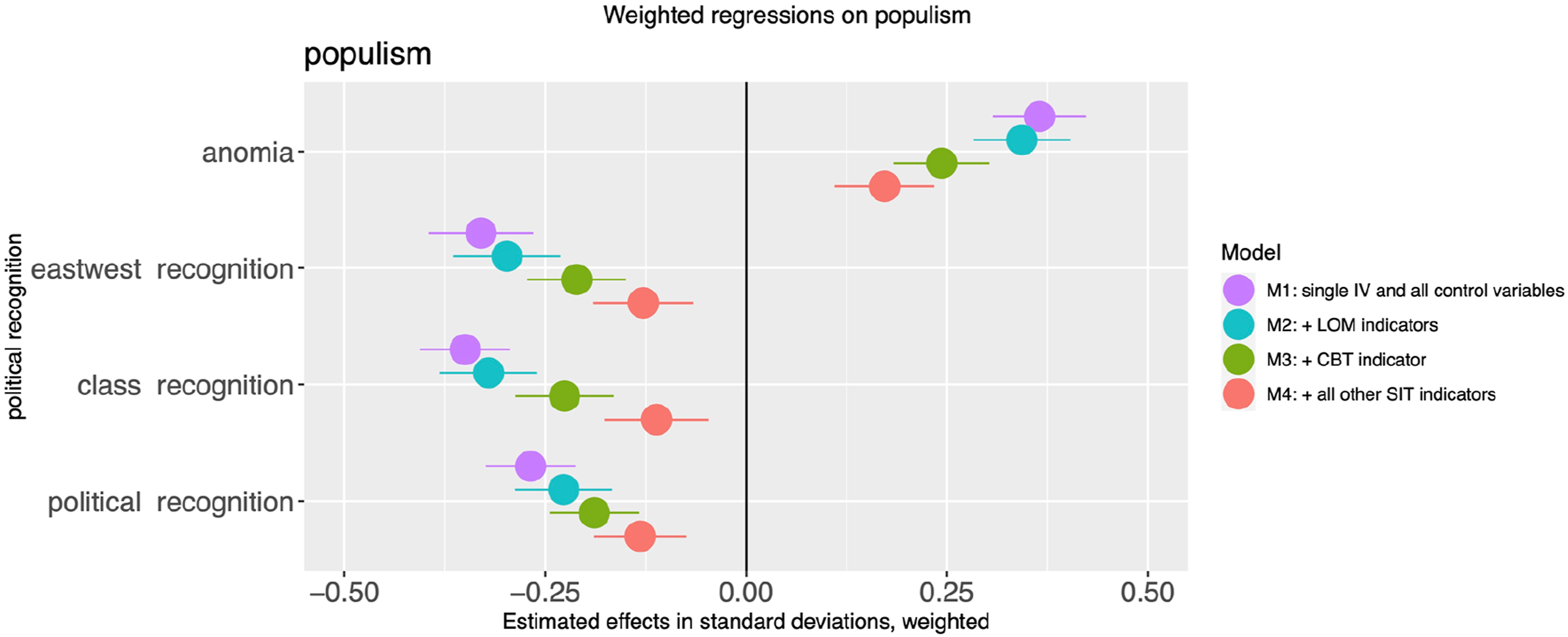
Additionally, we find that between 17 (political recognition) and 21 percent (class recognition) of the observed variance in the dependent variable can be attributed to the recognition indicators and control variables. We also find significant effects of anomia on populist attitudes. An increase of anomic feelings of one standard deviation leads to an increase of populist attitudes by almost 0.37 standard deviations. This model can explain roughly 22% of the observed variance in populist attitudes.
In a second Model (M2), we introduce the three indicators of the LOM approach. Here we intend to see, whether the significant effects of the social recognition variables are still valid once we include other possible explanations. All four recognition variables still show significant correlations with our dependent variable and the effect sizes decrease only slightly. Regarding the LOM indicators, only relative deprivation has a significant effect on populist attitudes. However, this is not the case when combined with class recognition.
Model 3 includes the CBT indicator as well. The effects of the four SIT indicators are still significant, even though the effect sizes diminish a little more compared to the introduction of the LOM indicators. However, at almost or above 0.2 standard deviations, all four SIT indicators have a substantial impact on populist attitudes.
Lastly, in Model 4, we combine all SIT indicators. All four predictors still have significant effects even though those may be distorted by multicollinearity, since the indicators correlate moderately (Cronbach’s alpha between 0.19 and 0.42). This underpins the importance of the different facets of social recognition and anomia that seemingly influence populist attitudes in slightly diverging patterns. All in all, these results show that a lack of recognition of social identities and anomic feelings leads to higher populist attitudes.
The results outlined so far confirm our hypothesis H1 that threats to social identities increase populist attitudes at a significant level. Not only do we find significant effects with a considerable effect size when looking at bivariate associations. Furthermore, these effects are still significant if we control for demographic information, socio-economic characteristics, and alternative explanatory approaches. Interestingly, the effects of the LOM approach are not as robust and no longer significant once we run a combined model with all eight indicators of the three explanatory mechanisms tested (M4). This sets up our second part of the results section in which we have a closer look on the relationship between threats to social identities and the LOM and CBT.
Structural Equation Models: Economic and Cultural Threats as Mediators of the Effects of Threats to Social Identities on Populist Attitudes
To further disentangle the relationships between the indicators of threatened social identities and the indicators of the LOM and CBT approaches, we calculate structural equation models (SEM). Our assumptions in our second and third hypothesis state that indicators of the LOM and CBT mediate the effects of perceived social identity threats on populist attitudes.
We compute a separate SEM for each of our four recognition indicators in order to filter possible differences between the different recognition dimensions on the one hand and to prevent multicollinearity on the other hand. The latter reason is also crucial for the fact that we include relative deprivation as the only indicator for LOM in the model. We also include age, occupational prestige and gender as control variables.
Figure 3 illustrates the results of the SEM that contains class recognition. Class recognition has a significant negative direct effect on populist attitudes. An increase of class recognition leads to a decrease in populist attitudes by almost 0.28 standard deviations. Furthermore, class recognition has significant negative effects on relative deprivation and perceived cultural threats. In both cases, an increase of social recognition of one standard deviation would relate to a decrease in the LOM and CBT indicator of about 0.4 standard deviations. The effect is little stronger for the CBT indicator. Structural equation model of class recognition, relative deprivation, and cultural threats on populist attitudes.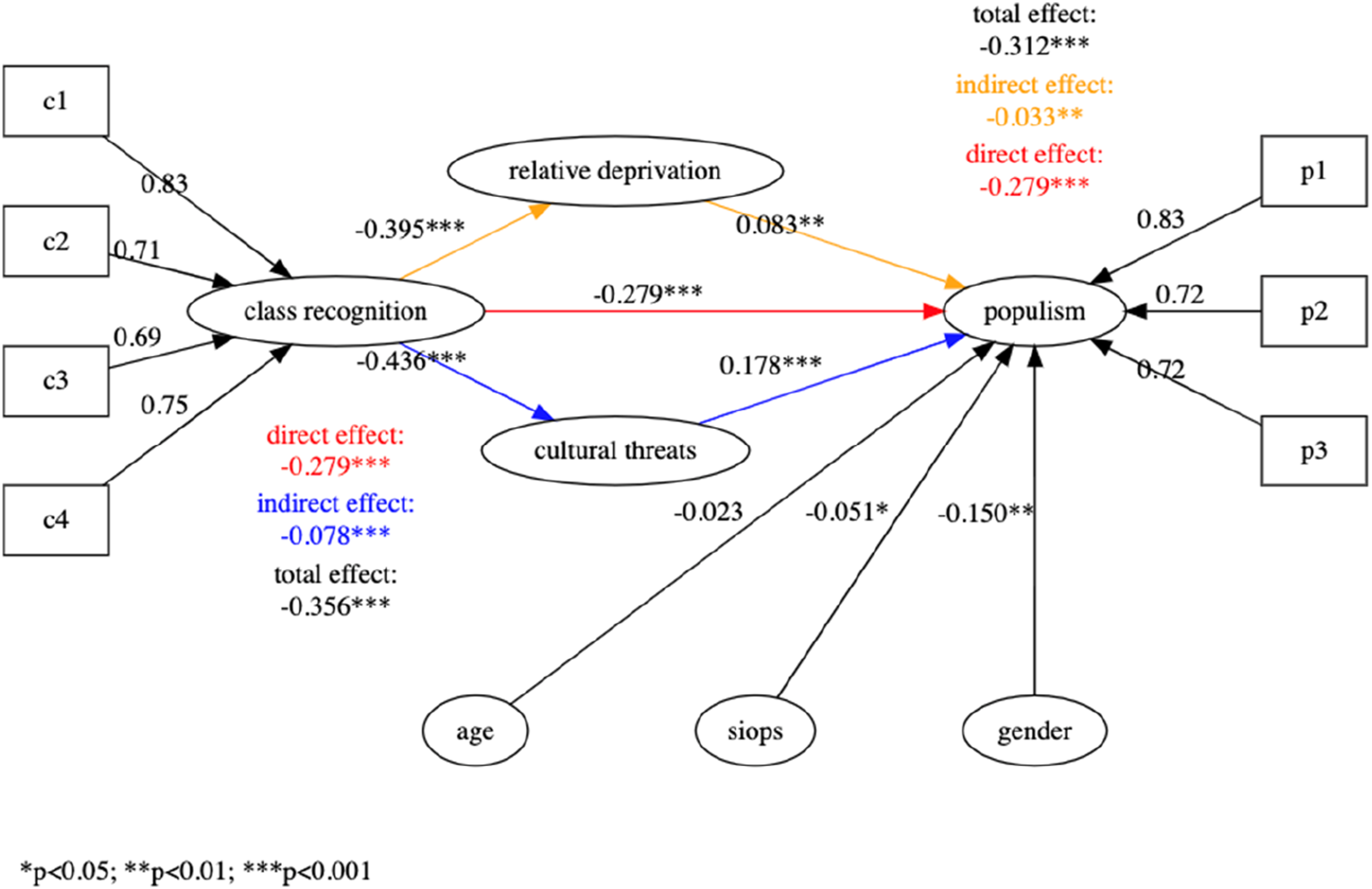
If we look at the second part of each mediation path, on the one hand, we find significant positive effects of each indicator on populist attitudes, on the other hand; however, these effects are low, resulting in a low indirect effect. Based on this result, we can confirm hypotheses H2 and H3 as we see a partial mediation of the LOM and CBT indicators on the relationship between the SIT indicator and populist attitudes. The more accurate interpretation of this finding may be that social identity threats are not only an important direct predictor of populist attitudes, but also for economic and cultural threats that have no longer as much of an impact on populist attitudes when social recognition is part of the model.
In our second SEM (see Figure A4 in the appendix) that contains political recognition of the occupation, the SIT indicator has once again a significant negative effect on populist attitudes at about −0.23 standard deviations. As before the indirect effects through relative deprivation and cultural threats add little to the total effect. In the case of relative deprivation, occupational recognition has a significant predictor at roughly −0.31 standard deviation. However, the effect of relative deprivation on populist attitudes is small and only significant at p < 0.05. The relationship between political recognition of the occupation and cultural threats is rather small at about −0.15 standard deviations.
The recognition perceived for an East or West German identity (see Figure A5 in the appendix) has a direct effect on populist attitudes at ca. −0.22 standard deviations. Again, the LOM and CBT indicators add little to the total effect as potential mediators. Cultural threats contribute with about a quarter to the total effect.
Lastly, we find similar patterns in the case of anomia (see Figure A6 in the appendix) compared to the results presented so far. The direct effect is positive; however, this is expected as a higher level of identity insecurity of one standard deviation leads to an increase in populist attitudes at about 0.16 standard deviations. In contrast to the previous three indicators, the differences in the effect sizes of anomia on relative deprivation and cultural threats stand out. While for the different recognition indicators, the effect sizes were about similar, this time, and the effect of anomia on cultural threats is more than twice as big compared to the effect on relative deprivation.
In total, we can conclude that the results confirm our hypotheses H2 and H3. All four recognition indicators show significant direct effects on populist attitudes. Of the total effect of our SIT indicators, the potential mediators of the LOM and CBT contribute only little through their indirect effect. This means that social recognition effects on populist attitudes are partially mediated by the indicators of the established approaches. While social recognition indicators are significant predictors of the CBT and LOM indicators, the latter only show small effects when we already account for social recognition. Therefore, we deduce that threats to social identities are an important new mechanism that should be considered as an explanation for populist attitudes.
As our data are cross-sectional and we cannot identify causal mechanisms, we reversed all of the SEMs described above in the way that the recognition indicators served as the mediators while the LOM and CBT indicators were modeled as the independent variables (see Figures A3 through A6 in the appendix). With regard to the economic indicators, their direct effects on populist attitudes are smaller or similar than/compared to the indirect effects through the identity threat indicators. The total effect sizes are smaller as well when identity threat indicators are modeled as the mediators. We consider these results as a confirmation that using social recognition indicators and anomia as the independent variables and LOM indicators as well as the CBT indicator as mediators depicts the data structure more accurately than the other way around.
Discussion and Outlook
Overview of the Hypotheses and Conclusions.

Moreover, the findings underscore that anomia is indeed a distinct type of identity threat. On the one hand, the direct effect of anomia on populist attitudes is very strong and comparable to the effect strength of lack of class recognition. On the other hand, the relations with the LOM and CBT indicators suggest that other feelings of threat underlie here, which seem to be less economically tinged.
However, the results of our study only serve as a starting point, as they are limited in many respects. First, in our data we found that especially indicators of the economically orientated LOM explanation do not work well as possible predictors. Future research should keep a closer look on the relationship with the CBT. Therefore, it is necessary to identify social categories that have been endangered by cultural aspects of globalization. While we focused on social categories (social class and occupation) that are more closely connected to economic change, cultural value shifts relate to ethnic, gender, or family identities. Future studies should investigate how to conceptualize, operationalize, and model cultural threats more specifically in this regard.
Particularly given that our data did not include any variables on attitudes toward migration, this should be a primary focus of future research. First, it should be tested whether the results of the present identity threats still hold when controlling for xenophobia or other measures of attitudes toward migration. Secondly, it would also be interesting to see to what extent the recognition of social categories constituted by ethnicity and culture are related to populist attitudes.
Moreover, by adding control variables such as ideologies and partisanship, future analyses could deepen our understanding of the extent to which the effects of lack of recognition on populist attitudes differ by political camp. While some studies find no mediating effect of left-right self-placement on the impact of relative deprivation on populist attitudes (Droste 2019; Lüders et al. 2021), other studies suggest that a closer look at these mechanisms may be worthwhile. For example, Burgoon et al. (2019) show that relative loss of status varies depending on the comparison group: a relative loss of status measured by the comparison with the upper income decile thus significantly favors the election of left-wing populist parties, whereas a loss of status compared to the lowest income decile makes the election of right-wing populist parties more likely. Equivalently, the recognition mechanisms could also have different effects depending on the ideological position.
Additionally, the exact relationship between threats to social identities, LOM indicators, and CBT indicators is still up for debate and several configurations could be plausible. Based on our data, it is not possible to identify a clear direction. Longitudinal or experimental data would be needed in order to get a deeper understanding of the causal processes taking place.
Also, our results are restricted to the German case and based on a data set that is only representative for the working population. We are therefore unable to draw conclusions about the German population as a whole. Non-working individuals and people in pension are not included in our analyses. It would be interesting to see if we can identify similar patterns when these two social groups are included. The results of previous studies indicate that for workers, the experience of a decline of status has a stronger impact on the tendency to vote for populist parties (Häusermann 2020; Kurer 2020).
Nevertheless, the results of our analyses clearly indicate that threats to social identities should be included more strongly in the discourse on the causes of populist attitudes in the future. Although many assumptions may already be implicitly contained in other explanatory approaches, we argue that it is essential to explicitly state these theoretical arguments and to test them using distinct empirical measurements.
Supplemental Material
Supplemental Material - Rise of Populism: Identity Threats as an Explanation in Relation With Deprivation and Cultural Fear
Supplemental Material for Rise of Populism: Identity Threats as an Explanation in Relation With Deprivation and Cultural Fear by Axel Babst, Martin Groß, and Volker Lang in Political Research Quarterly
Supplemental Material
Supplemental Material - Rise of Populism: Identity Threats as an Explanation in Relation With Deprivation and Cultural Fear
Supplemental Material for Rise of Populism: Identity Threats as an Explanation in Relation With Deprivation and Cultural Fear by Axel Babst, Martin Groß, and Volker Lang in Political Research Quarterly
Footnotes
Declaration of Conflicting Interests
The author(s) declared no potential conflicts of interest with respect to the research, authorship, and/or publication of this article.
Funding
The author(s) disclosed receipt of the following financial support for the research, authorship, and/or publication of this article: This work was supported by the Deutsche Forschungsgemeinschaft (INST 35/1597-1 FUGG) and Bundesministerium für Arbeit und Soziales (MPR.00.00014.20).

Supplemental Material
Supplemental material for this article is available online.
References
Supplementary Material
Please find the following supplemental material available below.
For Open Access articles published under a Creative Commons License, all supplemental material carries the same license as the article it is associated with.
For non-Open Access articles published, all supplemental material carries a non-exclusive license, and permission requests for re-use of supplemental material or any part of supplemental material shall be sent directly to the copyright owner as specified in the copyright notice associated with the article.
