




Abstract
When are human rights defenders at risk of being killed? Echoing research on journalist killings, we argue that a democratic context makes it easier for human rights defenders to operate and incentivizes them to continue activities and to pursue information that puts them at risk. De jure protections that defenders have may not be enforced or may not protect defenders from bad actors engaging in politically motivated murder. These factors make human rights defenders more likely to be killed by actors trying to avoid the spotlight and exposure in democratic systems than in other types of regimes. Autocratic regimes provide fewer opportunities to freely advocate for human rights and to pursue or disseminate information about human rights violations by state or non-state actors, reducing the likelihood of defender mortality. Using two new sets of cross-national data on the number of killings of human rights defenders between 1997 and 2010 and from 2014 to 2020, we find that these arguments are generally supported when controlling for other factors that affect the killing of human rights defenders, particularly in democracies with lower state capacity.
On March 2, 2016, environmental and indigenous peoples’ rights activist Berta Cáceres was murdered in her home in Honduras. Cáceres had recently highlighted concerns about corruption and human rights abuses that led a major company to have to withdraw from a dam-building project. Authorities later arrested the president of the company and charged him with plotting her murder (Ramirez 2018). Five years later in the Philippines, on March 7, 2021, police killed Emmanuel “Manny” Asuncion at the Workers’ Assistance Center in the city of Dasmariñas. Asuncion, a labor advocate who was in charge of reporting rights abuses in the province to local human rights monitors, was one of nine human rights defenders killed during “Bloody Sunday,” a coordinated state crackdown across the Philippines (Bolledo 2023). On May 2, 2023, criminal gangs in Celaya, Guanajuato, in Mexico, were suspected of killing Teresa Magueyal. Ms. Magueyal, whose 31-year-old son went missing 3 years prior, was a member of a collective of families of the disappeared who conducted searches for loved ones “given the lack of effective investigation or response from the authorities” (Frontline Defenders 2023b).
The murders of Berta Cáceres, Manny Asuncion, and Teresa Magueyal are part of a larger pattern of targeted killing of members of civil society in general, and of human rights defenders (HRD) in particular. In 2022 alone, at least 401 human rights defenders were killed because of their work, up from 136 in 2014 (Frontline Defenders 2015; 2023a). Whether targeted by violent or corrupt non-state actors trying to silence activists or by state actors engaging in crackdowns on civil society, activists, lawyers, family members, non-governmental organization (NGO) workers, and others find themselves at risk because of the key roles that they play at the local or national level in defending human rights.
During the last decade, human rights defenders have seen an increase in both the importance of, and risk inherent in, their roles (Forst 2018). Research on the closing of civil society space has focused on the repressive targeting of NGOs, as states or violent non-state actors make it harder for local NGOs and transnational advocacy networks to monitor behavior, operate within a country, or disseminate information about rights abuses (Bakke et al. 2020; Chaudhry and Heiss 2022). Yet we know little about where and why HRDs who work in, alongside, or independent of NGOs are most at risk of lethal violence (Landman 2006).
In this study, we ask when human rights defenders are at risk of being killed. Echoing research on journalist killings, we argue that a democratic context makes it easier for HRDs to operate and incentivizes them to continue activities and pursue information that puts them at risk. De jure protections that defenders have may not be enforced, or may not protect defenders from bad actors engaging in politically motivated murder. These factors should make HRDs more likely to be killed by actors trying to avoid the spotlight and exposure in democratic systems than in other types of regimes. Autocratic regimes may provide fewer opportunities to freely advocate for human rights and to pursue or disseminate information about human rights violations by state or non-state actors, reducing the chance of defender mortality. Using two new sets of cross-national data on the number of killings of HRDs between 1997 and 2011 and from 2014 to 2020, we find that these arguments are generally supported when controlling for other factors that affect their murders.
Who or What are Human Rights Defenders?
Human rights defenders are ordinary individuals who make the extraordinary decision to openly and peacefully advocate for “the defense and promotion of the human rights of others” (Wiseberg 1991, 527; see also: Nah et al. 2013, 403; UN 1998; OHCHR 2004). They can act alone or in groups, in a professional capacity or as private members of civil society—as a lawyer advocating for the human rights of a detainee, a student organizing a hunger strike to call attention to abuses, or a family holding a vigil for a loved one who has been “disappeared.” Some HRDs are staff members of established NGOs which directly or indirectly advocate for rights. Many others are union organizers, lawyers, health care workers, and social movement participants seeking a halt to abuses of civilians, environmental justice advocates, local activists demanding human rights for marginalized communities, writers, peace builders, even groups of families of rights abuse victims (Bennett et al. 2015; Landman 2006; Wiseberg 1991). The UN General Assembly, the Office of the UN High Commissioner for Human Rights, and numerous human rights NGOs all categorize HRDs by what they do, not by who they are (UN 1998; OHCHR 2004, 6; IFDHRD 2011; Jilani 2011; Frontline Defenders 2023a). They are recognized by Article 1 of the UN Declaration on Human Rights Defenders as having “the right, individually and in association with others, to promote and to strive for the protection and realization of human rights and fundamental freedoms at the national and international levels.” (UN 1998, 3).
Human rights defenders play a crucial role in the attainment and maintenance of human rights within countries. As the former Deputy Director of The International Foundation for the Protection of Human Rights Defenders (or Frontline Defenders) argues, “the people who make the most significant contribution to the better realization of human rights around the world are people working at the local and national levels.” (Lawlor and Anderson 2014, 366). They are crucial to protecting justice, rights, and the rule of law (Ramirez 2018, 20), and are “often the only force standing between ordinary people and the unbridled power of the state… [and] are vital to the development of democratic processes and institutions, ending impunity, and the promotion and protection of human rights” (IFPHRD 2011, 9).
They also play a crucial role in the maintenance and enforcement of human rights around the world. HRDs are key local actors upon whom transnational advocacy network campaigns and rights-based movements depend (Keck and Sikkink 1998; Smidt et al. 2021, 1286). They can raise awareness of local issues, reframe issues, reinforce or challenge rights-based norms, spotlight abuses, identify perpetrators, and use their platforms to broadcast this information to a wider audience (Keck and Sikkink 1998; Murdie and Davis 2012). As the former Special Representative of the UN Secretary-General on Human Rights Defenders has argued, “exposing human rights violations and seeking to redress them is largely dependent on the degree of security enjoyed by human rights defenders” (Jilani 2001, 4). The consequence for not protecting HRDs is often decreased human rights for all (Wiseberg 1991). Yet the very things that make human rights defenders important also put them at risk.
The Risk Environment
The risk environment within which HRDs operate is fraught, and has become more dangerous over the last two decades. The UN Declaration on Human Rights Defenders continues to be implemented inconsistently around the globe. Many states have been critical of defenders’ efforts, actively engaged in the frustration of their efforts, and/or have engaged in their direct targeting for repression or violence (Forst 2018). A landmark study done more than 15 years ago identified a wide range of repressive tactics used against defenders and noted that 11 percent of repressive acts against them from 1997 to 2003 involved targeted murder or execution or their attempts (Landman 2006). Targeted repression and lethal attacks—by states and by violent non-state actors—may have increased since that study’s findings (Forst 2018; Frontline Defenders 2023a; UN 2013). They are most often “deliberate and well planned” and directly related to a political agenda and to the work of HRDs (Eguren 2005, 3).
The growing danger has occurred within a broader context—the closing of civil society space. Researchers have documented the shrinking space within which NGOs can operate, and the degree to which this has diffused internationally (Chaudhry and Heiss 2022). The closure of civil society space is in part a result of repressive measures by states to limit NGOs (Bakke, Mitchell, and Smidt 2020; Chaudhry 2022; Chaudhry and Heiss 2022; Forst 2018; Kiyani and Murdie 2020), and in part due to environment of impunity for targeting activists (Jilani 2011, 7; Forst 2018). It may at times be due to rhetoric and action by local political parties or factions (Hatcher 2021) or by populist and nationalist leaders to whom a human rights agenda poses a threat or impediment (Alston 2017; Nah 2020). Or it is a result of targeting by non-state actors with “shadow power” engaged in questionable practices (Nah 2020, 4), including violent non-state actors such as rebel groups, organized crime, drug cartels, and gangs, as well businesses or religious organizations (IFPHRD 2011, 80; Nah 2020). Whether due to state or non-state efforts, the space within which advocates and other civil society actors can operate has been severely constrained over the last few decades.
This makes it harder for global activists or other members of transnational advocacy networks to monitor behavior, operate within country, or disseminate information regarding human rights abuses (Bakke, Mitchell, and Smidt 2020; Smidt et al. 2021). The result has been worsening rights conditions in countries where advocates have been more constrained, escalating targeting of rights advocates, and increases in political terror in those states (Chaudhry and Heiss 2022).
Human rights defenders in particular have been under increased threat during this time (Forst 2018; Ramirez 2018, 20). Their work is inherently dangerous, and they are often unprotected by those in power (Lawlor and Anderson 2014; van der Vet & Lyytikainen 2015). And, as we will argue below, their work involves taking significant risks to challenge the powerful in environments where they expect norms, institutions, and actors to ensure their ability to do their work. As civic space closes and activists face increasing repression and targeting in a climate of impunity, the result has been a particularly dangerous risk environment for HRDs. According to a former UN Special Rapporteur for Human Rights Defenders, “the much discussed closing of civic space… has become, in too many locations, a war on human rights defenders.” (Forst 2018, 7).
Most examinations of HRDs at risk have understandably focused on securing their safety and protection (Bennett et al. 2015; Harding 2015; Nah 2020; Nah et al. 2013). Some scholars have examined the repression of NGOs writ large (Bakke, Mitchell, and Smidt 2020; Chaudhry 2022; Chaudhry and Heiss 2022; Smidt et al. 2021), not all of which focus on human rights. These studies also tend to exclude defenders not working in or through NGOs. Landman’s (2006) is a rare study that systematically examined which factors lead HRDs specifically to be at risk of repression and rights abuses. Examining cross-national time series data on numerous types of repression against human rights defenders from 1997 to 2003, he found that they were targeted less frequently in democracies. However, he did not analyze lethal violence against rights defenders separately other than to indicate that 11 percent of all acts against them were executions, assassinations, or murders. This is important, as research suggests different logics and dynamics of violent repression vs. repressive targeting through legal restrictions (Chaudhry 2022) and between lethal and non-lethal targeting of actors within civil society (Asal et al. 2018). Ultimately, extant research tells us little about what factors make human rights defenders more likely to be killed.
Lessons from the Literature on Journalist Killings
What we know about the killing of journalists may provide some insight into this question. Journalists and human rights defenders are “often similarly opposed by vested interests” (Forst 2018, 9). They both spotlight corruption and rights abuses and use information to try to hold the powerful accountable. Some human rights defenders use print or online media to publicize rights abuses in ways remarkably similar to journalists, and some local journalists may even act as human rights defenders (Mitchell 2019). Both are at risk in large part because of the job they do, and the issues that they raise (Eguren 2005; Waisbord 2007).
Research on the killing of journalists suggests that key causal factors include conflict and poor governance (Brambila 2017; Waisbord 2007). Yet most reporters that are killed are local journalists pursuing stories about corruption, violence, abuses, or other political issues, rather than during ongoing conflicts or other dangerous assignments (Asal et al. 2018; Bjørnskov and Freytag 2016; Carey and Gohdes 2021). And when studies control for conflict and poor governance, regime type is shown to play a critical role. Normally democracies—especially consolidated and long-standing democracies—have a pacifying effect on repression because of constraints on state behavior by institutions and the public (Davenport 2004). But while journalists often face non-lethal repression in autocratic states (Getz 2022), in democracies journalists are at greater risk for being killed by state or non-state actors looking to eliminate a threat by silencing reporters permanently (Asal et al. 2018; Carey and Gohdes 2021).
Autocratic regimes, where power is more centralized and less constrained, can and do use non-lethal repression to silence, detain, or deter journalists or derail their stories. This leads to fewer journalist killings, as reporters have fewer opportunities to pursue stories, know that the information that they gather is likely to be censored or suppressed, and may even self-censor. Journalists operating in democratic states are less restricted, and have greater opportunities to pursue stories about corruption, abuses, or other topics that may threaten powerful state or non-state actors. They also many believe that their information is more likely to be disseminated and to have an effect in holding actors to account. They are thus more likely to take risks, especially if they believe that laws and institutions of the state will protect them. Their willingness to take risks, assumption of protection, and sense of duty as essential actors in a democratic society lead them to pursue stories that put them at great risk (Asal et al. 2018). Doing so in environments in which power is decentralized and diffused to local actors, and when the state has less of an ability to impose its power at the periphery of the state is yet another risk factor (Brambila 2017; Carey and Gohdes 2021). Thus in democracies, journalists are more likely to be killed by either corrupt local state actors or violent non-state actors (Asal et al. 2018; Bjørnskov and Freytag 2016; Carey and Gohdes 2021).
Where Are Human Rights Defenders at Risk of Being Killed?
The literature on journalist killings lays out an explanation for lethal targeting that also applies well to human rights defenders. Like journalists, HRDs are enabled and encouraged to act by democratic institutions, laws, and norms (IFPHRD 2011, 10). Nah and colleagues (2020, 13) find that “some defenders don’t expect to be targeted for what they see as legitimate and peaceful – even ordinary – acts” and expect that their activism will not result in threats or lethal attacks, even when it is threatening to those in power.
Since governance tends to be more decentralized in democracies (Faguet 2014; Marks, Hooghe, and Schakel 2008), it is more likely that both journalists and defenders may spotlight local governmental or non-state actors which could threaten their influence or position, but might do so with less protection from the state (Brambila 2017; Carey and Gohdes 2021). National protection mechanisms for defenders in democracies are sometimes ineffective, may be too geographically distant from the location of the abuses or threats to defenders, or may suffer from bureaucratic inefficiency or a lack of funding or support (Nah 2020).
And while non-state actors may be more likely than the state to target defenders in democracies, the state may also feel at risk of the HRD spotlight. Democracies effectively channel much dissent through institutions thereby reducing the need for repression, though when faced with dissent deemed threatening they are just as likely as other states to repress (Hendrix and Salehyan 2019). This should be especially true in democracies with poorer quality of governance, where state actors believe that they can engage in such behavior with impunity.
Ultimately, democratic systems provide more opportunities to advocate for rights, which leads to greater visibility of the rights defender, which in turn leads to greater risk (Suhr 2022; van der Vet & Lyytikainen 2015). Where it is easier for people to mobilize around and advocate for human rights it is also more likely that they would then experience severe abuses such as murder—a strategy of last resort to silence those with such sensitive information (Landman 2006, 131).
HRDs also actively engage in risk-taking, just as journalists do. Human rights defense is high-risk activism; risk is inherent in the work that defenders do in challenging abuses by those in power (IFPHRD 2011, 25–26; 74–76; McAdam 1986; Nah 2020). Yet in interviews, some defenders noted that they often ignore or normalize risk and threats to their own physical security, focusing instead on the risks to those they were defending (Nah 2020, 19). HRDs are also likely to take more risks in the course of their work because they are highly committed to human rights causes, even to the point of being willing to live with some measure of insecurity (McAdam 1986; Nah 2020, 13–14). They may also use risk strategically to call attention to their campaign, emphasize their own vulnerability to violence, or to highlight threats from those in power (Bennett et al. 2015; IFPHRD 2011, 74–75; van der Vet & Lyytikainen 2015). Finally, defenders may take more risks if think they think they will be protected by the state, or if they have networks of support within civil society or internationally (Dooley 2012; McAdam 1986; van der Vet & Lyytikainen 2015).
The international connection is crucial in other ways as well. Democracies provide more external access to the information that human rights defenders generate. When international NGOs, media, or other members of transnational advocacy networks have greater access to information from local advocates it creates a greater likelihood of global publicity and potential consequences (Murdie and Davis 2012). This presents a threat to states or non-state actors who would otherwise prefer to avoid the spotlight (Landman 2006; Smidt et al. 2021). The death of a defender under suspicious and hard to attribute circumstances is problematic, but limits the stream of attention directly implicating the perpetrator that is generated by continued defender reporting. HRD advocacy also provides information regarding state treaty compliance. The potential costs of noncompliance can be reason enough to use lethal repression, (Bakke, Mitchell, and Smidt 2020; Ritter and Conrad 2016). While human rights treaty compliance may be an empty promise for many autocracies, democratic states worry about the domestic costs of non-compliance (Ritter and Conrad 2016).
Perpetrators are more likely to use more violent strategies against defenders, whether working through NGOs or as individual activists, if they pose a direct threat to their power, legitimacy, tenure, or freedom. This is especially true if the targeted advocates are working at the local level, as violence against them is more likely to go unnoticed by the international community (Chaudhry 2022). Threat of exposure requires a quick response, especially if killing the advocate is less likely to bring further scrutiny. Such killings should be more likely when states are unwilling or unable to provide protection to those advocating for human rights, suggesting that regime type’s effect may be conditioned by quality of governance. The same logic should hold for targeting of defenders by either state or non-state actors.
The killing of human rights defenders may also be intended to have a chilling effect on subsequent human rights activism, monitoring, or other defender activity (van der Vet & Lyytikainen 2015). Such intense repression can demobilize campaigns by signaling the high costs of continuing to challenge those with power (Ritter and Conrad 2016; Smidt et al. 2021). Defenders can feel “vulnerable, anxious, confused, and helpless” in the face of such severe repression (IFPHRD 2011, 43) and may come to believe that it is too dangerous to continue engaging in activism. It may also be harder to recruit supporters of human rights, or to continue to conduct monitoring and defense of human rights (Smith et al. 2021, 1273). With human rights monitors and defenders killed or demobilized there is little to stop a continuing steady decline in human rights conditions. Just as NGO repression and the killing of journalists both lead to worsening human rights abuses (Chaudhry and Heiss 2022; Gohdes and Carey 2017), the killing of human rights defenders leads to the diminishment of human rights for all (Wiseberg 1991; IFPHRD 2011, 14). Yet just as journalists in Mexico persist in reporting in the face of a wave of killings (Casey 2023), so might HRDs persist in the face of lethal repression. Such killings highlight the importance of their work, and might lead to more rights defender action to highlight the killings, creating more opportunities for them to be at risk.
Therefore, we argue that a democratic context makes it easier for human rights defenders to operate and incentivizes them to continue activities and to pursue information about corruption or abuses by state or non-state actors that puts them at risk. De jure protections that defenders have may not be enforced or may not protect defenders from bad actors engaging in politically motivated murder. This should make HRDs more likely to be killed by actors trying to avoid the spotlight and exposure in democratic systems than in other types of regimes. Autocratic regimes may provide fewer opportunities to freely advocate for human rights and to pursue or disseminate information about human rights violations be the state or non-state actors, reducing the chance of defender mortality.
Human rights defenders who work in more democratic countries are at greatest risk for being killed than those who work in less democratic countries.
Dependent Variable
To operationalize the killing of HRDs from 1997 to 2010 we rely on coding of narrative reports from the Observatory for the Protection of Human Rights Defenders. The Observatory was a joint project run by the World Organization Against Torture (OMCT) and the International Federation for Human Rights (FIDH), each of which consists of large networks of NGOs working on human rights issues. The Observatory gathered information about restrictions and rights abuses against human rights defenders from their network partners, and then published annual OMCT-FIDH reports detailing violations against defenders in each country. The reports rely on the definition of HRDs recognized by the UN, most NGOs, and scholars in this field that focuses on defender status as defined by their role and activity, regardless of whether they are acting alone or as part of a larger group (Nah et al. 2013, 403; OHCHR 2004, 6; UN 1998, 3; Wiseberg 1991). These reports, published a few months after the end of each year, detail events from 1997 to 2010, after which they were no longer published.
Landman (2006) coded reports for all types of violations against HRDs from 1997 to 2003 using the “who did what to whom?” format. Given our argument, we focused on the instances that he coded as “summary execution/murder.” We then attempted to learn the coding scheme and replicate a sample of his data before proceeding to code the reports detailing violations against defenders from 2004 to 2010.
We used the 2003 data in the Landman data set to “learn” Landman’s (2006) coding scheme. We applied the “who did what to whom?” approach to hand coding of each HRD killing identified in that report, using our best understanding of the coding scheme to the 2003 OMCT-FIDH Report. We then compared our results to Landman’s data for 2003 to see how well we had replicated his data and tried to identify where we had different results and why that might have occurred. In most cases differences were due to a victim not being the intended target, the lack of a clear date associated with a killing, or an entry noting a killing being listed in a footnote rather than the main narrative text. 1
Once we felt confident that we understood the decisions that Landman (2006) had made in coding the 2003 data, we applied the coding scheme to the 2000 Annual Report. We counted the number of HRDs killed per country-year and kept track of the names of those killed along with the circumstances and perpetrators (when known) to be sure that we replicated not just the aggregate numbers but also the individual cases. This process allowed us to replicate the 2000 Landman data very closely—intercoder reliability was a remarkable 0.99, with only two instances different between the two data sets. 2 Thus we feel confident that we fully understood the coding process that Landman had used to generate his data and could apply it reliably to the new 2004–2010 reports. We also believe that given that level of reliability we can analyze the full combined data set from 1997 to 2010, though we also analyze the original Landman (2006) data and the updated 2004–2010 data separately.
Although we were unable to generate data on the period from 2011 to 2013, we were able to capture the killing of HRDs from 2014 to 2020 by using the list of names and country of origin of murdered defenders published the Annual Reports of Frontline Defenders (also known as the International Foundation for the Protection of Human Rights Defenders). Founded in 2013, Frontline Defenders is an international NGO based in Dublin, Ireland that works to protect defenders and highlight the risks that they face (Lawlor and Anderson 2014). Yearly cross-national lists of defenders killed because of their work are generated from reports from their human rights organization network partners around the globe. Each case is verified using multiple sources through “systematic open source data gathering” by researchers through the HRD Memorial (Frontline Defenders 2019, 58). The HRD Memorial (2022, 4) is “a global initiative led by 14 national and international human rights organizations” with the aim of producing “a verified dataset that highlights the scale of the killings of defenders worldwide”. 3
The resulting 2014–2020 data set is comprehensive but likely still undercounts the number of defenders killed due to: attempts at suppression of information by state or non-state actors; self-censorship in some communities due to fear of reprisals; some killings in remote areas that go unreported; or reduced access to locations or information to verify reports due to COVID-19 restrictions (Frontline Defenders 2019, 58; HRD Memorial 2022, 4). Of course, these limitations also apply to the 1997–2010 OMCT-FIDH data as well. 4 Note that we test our argument on this later set of data, but separately from the OMCT-FIDH data due to its collection by a different organization using a slightly different process.
Figure 1 depicts the resulting trends in the aggregate numbers of HRDs killed across all three data sets—the original Landman (2006) OMCT-FIDH data from 1997 to 2003, our update of that data via coding of 2004–2010 OMCT-FIDH reports, and the Frontline Defenders data from 2014 to 2020. The increase over time in the number of HRDs killed, especially evident in the Frontline Defenders data, is expected given increases in closing civil society space and democratic backsliding in the last decade (Bakke, Mitchell, and Smidt 2020; Hatcher 2021). Human rights defenders killed datasets, 1997 to 2020.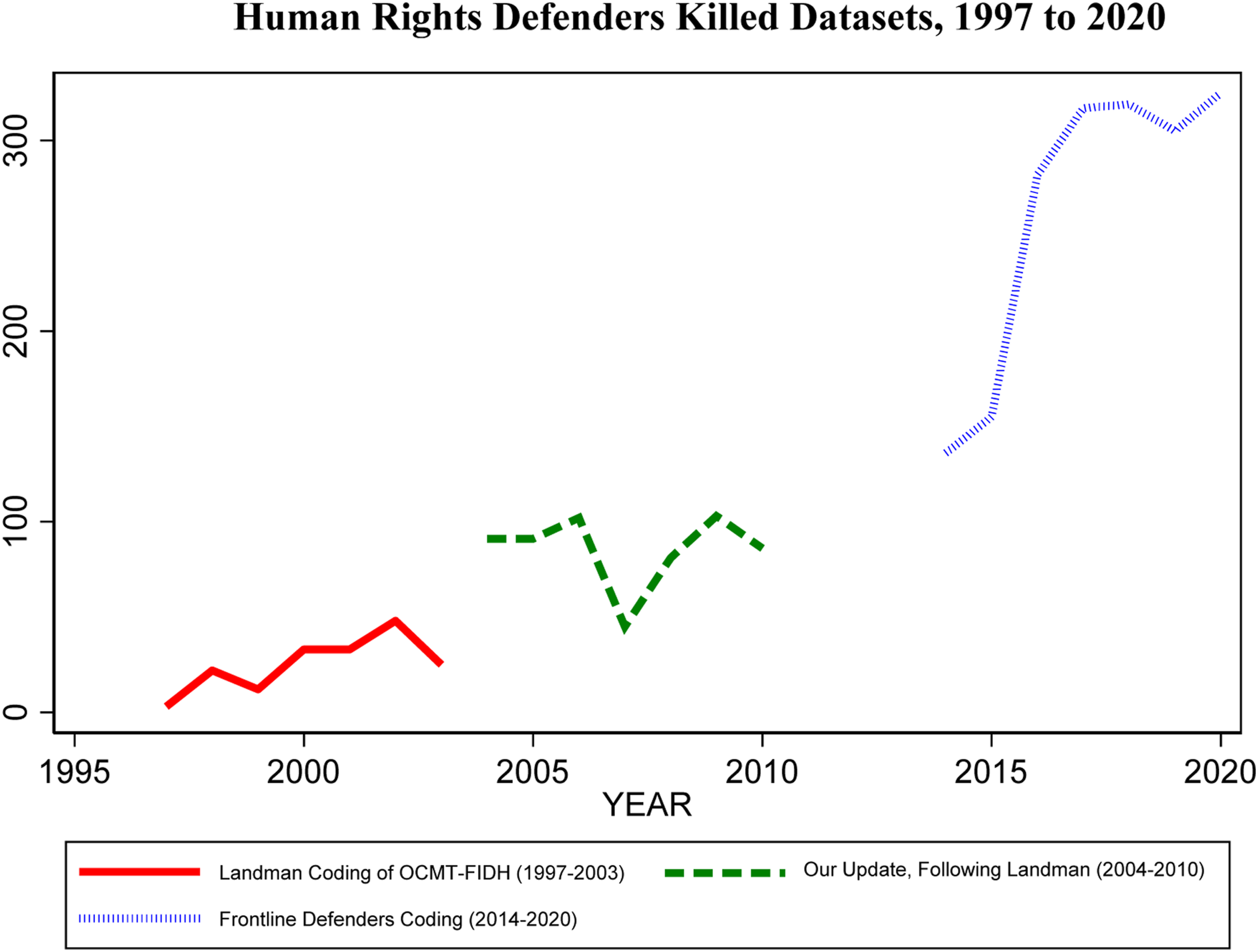
Key Independent Variable
Our baseline indicator for regime type is Polity 5’s revised combined polity score, often called “polity2.” This measure varies from −10, indicating a country is a consolidated autocratic regime, to a 10, indicating that a country is a consolidated democracy (Marshall and Gurr 2020).
We use a number of additional indicators of regime type to gauge the robustness of our results. First, as shown in the online appendix (Table A1), we also try a curvilinear approach, including both the Polity 5 21-point regime type indicator and this indicator squared. We find no evidence of a curvilinear relationship. Second, we use Boix, Miller, and Rosato (2013)’s dichotomous indicator for whether a country is a democracy (Table A2). 5 Third, we run a specification where we include separate dichotomous indicators for whether a country is a democracy (6 to 10 on Polity 5’s 21-point regime type indicator) or an anocracy (−5 to 5) (Table A3). Further, we include a model where we add an indicator for regime type duration, also from Polity 5. This additional control is consistent with Solis (2021)’s concern that regime duration and not type per se should matter for state violence against potential activists. Our basic results are consistent across these specifications.
As shown in the appendix (Table A14-A22), we also ran models using various indicators from the Varieties of Democracy (V-Dem) project (Coppedge et al. 2021). For the most updated measure of human rights defenders (Frontline Defenders-based measure that is available from 2014 to 2020), we consistently find that V-Dem’s conceptualizations of electoral democracy, liberal democracy, participatory democracy, and deliberative democracy are positively and statistically significantly associated with increased killings of human rights defenders. Somewhat surprisingly, V-Dem’s measure of equalitarian democracy is negative and statistically significant using the historical data, and its egalitarian index is negative and statistically significant using the updated data. The egalitarian index is correlated with the Polity 5 measure of regime type at less than 0.50 in our sample. Although interesting, egalitarian democracy and V-Dem’s egalitarian index represent a very different conceptualization of democracy than referred to in this paper and is conceptually more in line with basic civil liberties. For the other operationalizations of our dependent variable, the V-Dem variables are routinely not statistically significant.
Also in the appendix (Table A25), we include models that adopt Davenport and Armstrong (2004)’s binary decomposition approach to capturing each level of the 11-point “democ” scale from Polity5 (Marshall and Gurr 2020). Across all models, our results continue to show support for our general idea, with democracy scores of 6, 7, 8, and 9 routinely having a positive and statistically significant coefficient. In two of the models (the model using the updated Human Rights Defenders dataset from 2004 to 2010 and the model using the updated Landman (2006) dataset from 1997 to 2010), we find that democracy scores of 10 have a negative and statistically significant coefficient; this result does not hold in the most recent data (2014–2020). These binary decomposition results show support for our hypothesis but indicate that the hypothesis is less supported in the most democratic of democracies—those that are increasingly less common in an era of democratic rollback. 6
Controls
In addition to our core argument about the role of democracy, we think there are several additional drivers of and protectors against killings of human rights defenders. Some regimes may use the existence of foreign civil society actors and aid funds to fuel a backlash against human rights (Snyder 2020). If HRDs can be seen as foreign-backed or imperial in nature, it may be easier to justify violence. Externally funded or foreign HRDs may also lack knowledge of cultural and logistical workings which could increase their risk of harm. To capture this logic, we first include the natural log of the number of international NGOs that focus on human rights active within the country. This variable comes from Smith et al. (2019)’s coding of transnational social movement organizations from the Yearbook of International Organizations. Their data is collected every other year; we interpolate for years not collected by Smith, Plummer, and Hughes (2017, Smith et al. 2019). Although this indicator could capture some locally grown groups, the vast majority of organizations in the Yearbook come from a very small number of countries in the Global North (Cheng et al. 2021). Second, we include indicators for the natural logs of foreign aid directed to the NGO sector and directed specifically for human rights. These variables come from AidData’s Core Research Release Version 3.1 (Tierney et al. 2011; AidData 2017). 7 Consistent with ideas of human rights backlash, we expect that increases in international NGOs and aid funds directed at either NGOs or human rights will be associated with an increased number of HRDs killed. Unfortunately, the indicators for international NGO numbers and aid to NGO/human rights stop prior to the time period for which we have data from Frontline Defenders (2014–2020) and are thus not included in that analysis.
Our control variables for international human rights NGOs and aid to NGOs/human rights also help us account for the number of HRDs within a country. Although a thorough count of all HRDs is impossible in that defenders are identified by what they do as opposed to who they are, it is likely that the number of defenders is correlated with international human rights NGOs and foreign support for human rights. Previous scholarship has shown that domestic mobilization increases as a result of international human rights NGOs (Murdie and Bhasin 2011). Further, Meernik et al. (2012) show that international human rights NGOs help increase information gathering on human rights issues, tasks which could put HRDs at risk for violence. These control variables thus help us account for the overall population of HRDs which could be mobilized and working in ways that put them at risk for killing. And controlling for the effect of the challenge posed by sheer numbers of defenders allows us to test for an independent effect of regime type.
We also include a control for quality of governance. A poorly run and corrupt country could create a situation where the killing of HRDs is not sanctioned, especially if such killing serves the interest of key constituents of the state. Our control comes from the Political Risk Services’ International Country Risk Guide (PRS Group et al. 2021; Teorell et al. 2021). We use their 0–1 composite indicator of “law and order,” “corruption,” and “bureaucratic quality.” A higher score on this variable indicates a better quality of governance. 8
We also include a number of variables to capture the level of contention within the country. We use the Political Terror Scale’s general repression measure as an indicator of the level of general human rights abuses within each country. This indicator varies from 1, indicating a low level of repression, to 5, indicating that violations of human rights by agents of the state affect the whole population (Gibney et al. 2021). We use the version of this variable coded based on the U.S. State Department. 9 We also include a count of the number of protests that occurred within the country in a given year from Clark and Regan (2018)’s Mass Mobilization Data Project. This variable captures the number of protests targeting the government that involve at least 50 people that are found via Lexis-Nexis searches. This protest indicator does not capture “rebel attacks” or “armed resistance” (Clark and Regan 2018, 4). For this, we also include a dichotomous indicator for whether there was at least one international or domestic armed conflict involving the country in a given year. This indicator comes from the UCDP/PRIO Armed Conflict Dataset Version 21.1 (Gleditsch et al. 2002; Petersson et al. 2021; Petersson 2021). In line with this dataset, a conflict is defined as “a contested incompatibility that concerns government and/or territory where the use of armed force between two parties, of which at least one is the government of a state, results in at least 25 battle-related deaths in a calendar year” (Petersson 2021, 4).
Finally, we include indicators for the size and wealth of the country from the World Bank’s World Development Indicators (Kaufmann, Kraay, and Mastruzzi 2010). For size, we include the natural log of population. For wealth, we include the natural log of gross domestic protect (GDP) per capita in constant 2010 U.S. dollars. Worth noting, multicollinearity is not a concern in our model. Our mean variance inflation factor is 2.3, with no individual indicator greater than 4.
Approach
Given the over-dispersed and count nature of the dependent variable, our baseline estimator is a negative binomial model. Due to the time-series cross-sectional nature of our dataset we run our negative binomial model using a generalized estimating equation approach with an AR(1) correlation structure and robust standard errors. This correlation structure allows us to account for both over-time autocorrelation and heteroskedasticity across countries (Zorn 2001). In the online appendix, we also include results where we use a zero-inflated negative binomial model (Table A9) and run models where our dependent variable is per capita instead of number of defenders killed (Tables A29 and A30). Results for our key independent variable are consistent. To account for causal ordering, all of our independent variables are lagged 1 year in all models, allowing us to capture the effect of our independent variables in year t on our dependent variables in year t + 1.
Further, we acknowledge Fariss (2014)’s important work and finding that there could be a changing standard of accountability in human rights over time. This could mean that it is easier to find and record HRD deaths over time. To account for this, we include yearly fixed effects in all models.
Findings
Regime Type and Human Rights Defenders Killed.
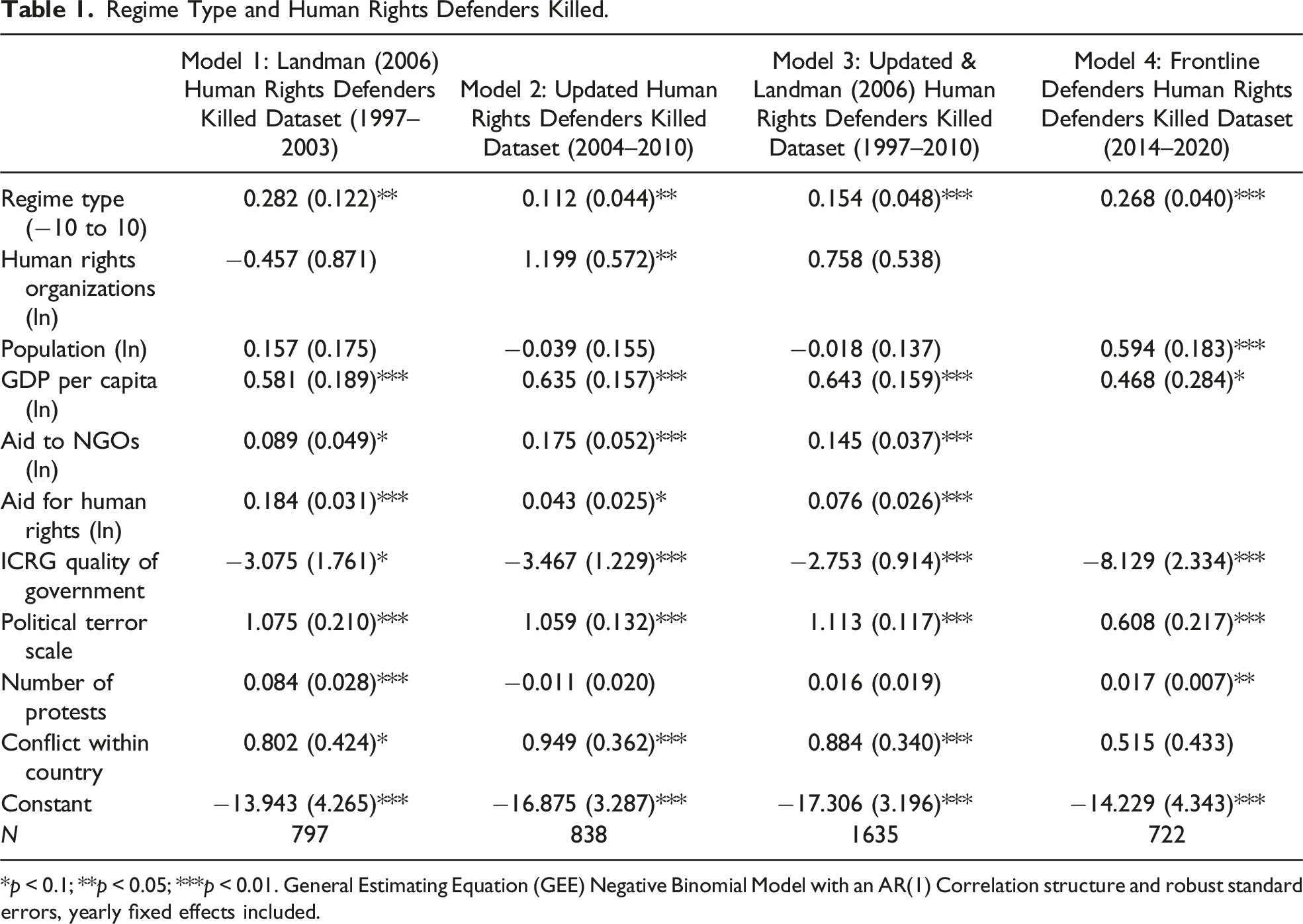
*p < 0.1; **p < 0.05; ***p < 0.01. General Estimating Equation (GEE) Negative Binomial Model with an AR(1) Correlation structure and robust standard errors, yearly fixed effects included.
Figure 2 provides a graphical representation of this relationship, based on the results of Table 1. The line represents the mean effect with the shaded area around the line representing the 95 percent confidence interval. The boxes on the x-axis are a histogram of the distribution of the regime type indicator in the sample. As shown, as our regime type indicator goes from its lowest to its highest value in our dataset, the predicted number of human rights defenders is expected to increase over 20-fold. Of course, the killings of HRDs are still relatively rare events, as evidenced by the small predicted values. However, given the substantive importance of defenders, this predicted change represents a real detriment to human rights and civil society. Predicted number of human rights defenders killed, as Regime type varies.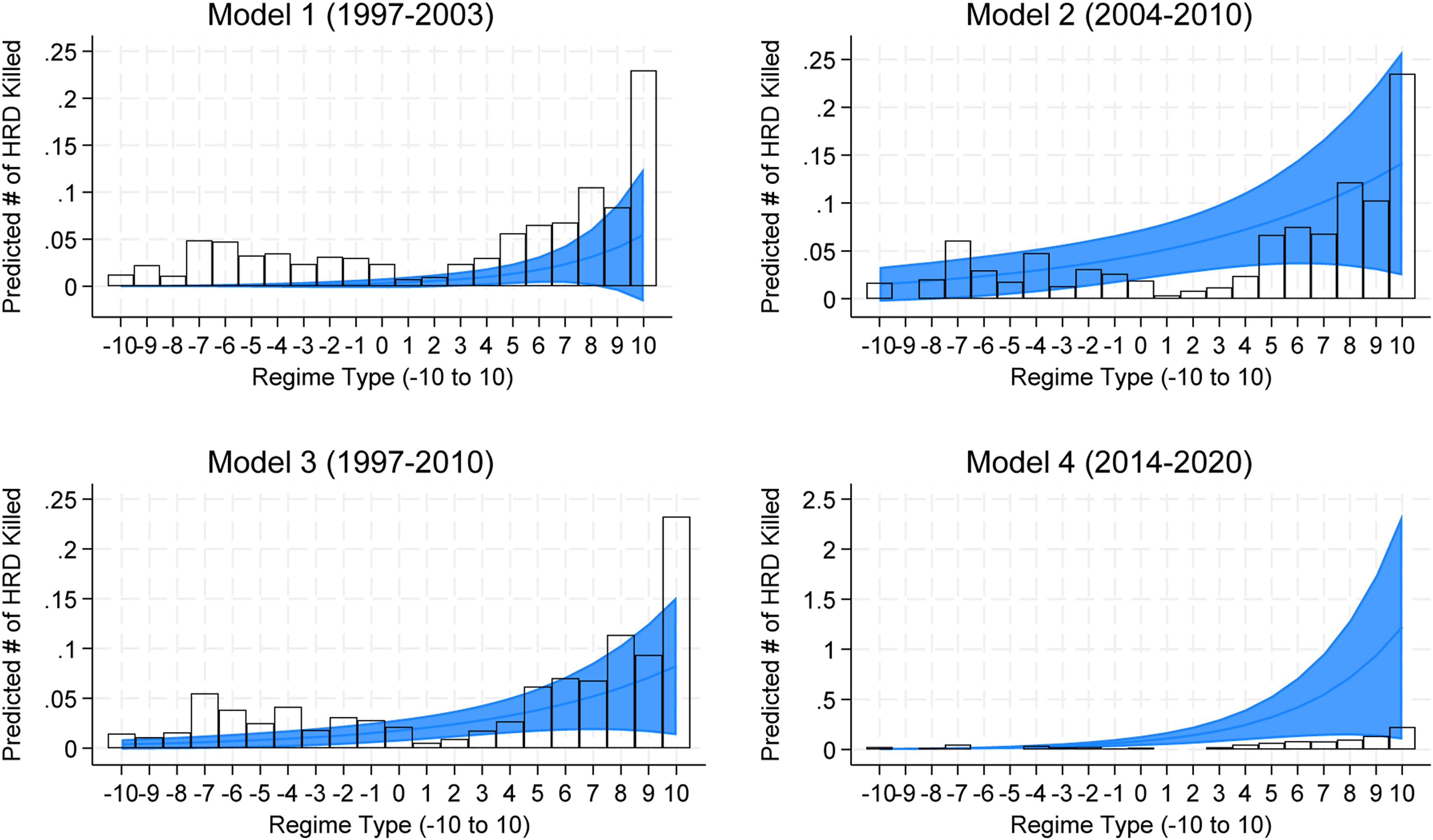
Our results presented in Table 1 also show some interesting relationships concerning our control variables. First, when statistically significant, more violence in a state is associated with an increased number of human rights defenders killed. In particular, and unsurprisingly, HRDs are more likely to be killed when political terror is high, when there is a conflict involving the country, and when protests are more numerous. Second, a higher quality of government protects against killings of HRDs. Third, as expected, when statistically significant, more foreign aid directed at NGOs or human rights increases the number of HRDs killed. Similarly, when significant, we find that a higher number of human rights international NGOs within a country’s borders are associated with a more human rights defenders killed. Like suggested by Snyder (2020), backlash against human rights is more likely when civil society actors can be linked to outside attacks on sovereignty. Somewhat surprisingly, we also find that higher GDP per capita is associated with a greater number of human rights defenders killed. Together with our finding on quality of government, we think this result shows that it is the control of corruption and rule of law that protect against the killing of human rights defenders, not the general wealth of a country. In fact, a wealthy country may have more options for human rights defenders to move throughout the polity and create additional opportunities for violence.
Robustness Checks
In addition to the various alternative specifications of regime type addressed in our research design, we ran a number of further robustness tests. First, to account for any effect of increased restrictions to civil society, we ran models where we included Bakke, Mitchell, and Smidt’s (2020) measure of the number of restrictions towards civil society and V-Dem’s measure of civil society repression (as shown in Tables A5 and A6 of the online appendix). With both additional measures, we still see our key relationship between regime type and number of human rights defenders killed. Further, using the more recent Frontline Defenders indicator as the dependent variable, both models show that a more restrictive civil society environment is associated with reductions in human rights defenders killed. This makes intuitive sense: as modern closing civil society space restrictions have spread, human rights defenders may have trouble even entering some locations, limiting their exposure.
We also ran models where we interacted regime type with contentious politics indicators, namely the number of total protests in a country (Table A7) and whether the country is part of an armed conflict in a given year (Table A8). We did not find consistent evidence of any interactive effect, and our regime type indicator continues to be positive and statistically significant. Further, Table A28 shows the results of models with an additional control for oil rents, reflecting an idea that perhaps HRDs are more vulnerable in oil or mineral-rich countries. We find no evidence of this idea but continue to find results in line with our research hypothesis. Models with an additional control for urbanization (Tables A31 and A32) also show the robustness of our main finding, with urbanization percentage statistically significant (and positive) only in the most recent sample.
Additionally, we ran models (Table A13) where we included the V-Dem indicator for freedom of expression (Coppedge et al. 2021). This variable is not statistically significant, and its inclusion does not alter our main findings. Models with the inclusion of an interaction between the number of human rights organizations and human rights abuses are also included in the appendix (Table A12), and the inclusion of this control does not alter our main results.
Our online appendix also includes the results of models (Tables A23–A24) with an additional control for the total number of stories about the country in the New York Times, as calculated using the Phoenix Event Data (Althaus et al. 2019; 2020). This additional control could help us account for whether we are capturing more human rights defender deaths in some countries due to overreporting. We do not find that more New York Times coverage correlates with increased human rights defender deaths. Further, our main results remain consistent in sign and statistical significance. We also ran models where we took out the Philippines and Colombia, both countries that regularly have high numbers of HRD killings. As shown in the online appendix (Table A26 and 27), our key results do not change.
Finally, we ran models where we included indicators for the number of journalists killed. Our concern here was whether journalist killings could serve as a substitute or a compliment for the killing of human rights defenders. For the dependent variables based on the OMCT-FIDH data, we use Asal et al. (2018)’s data on journalist killings, which is available from 1992 to 2008. For the more recent Frontline Defenders HRD killing data, we use Carey and Gohdes (2021)’s coding of journalists killed, which is available from 2002 to 2016. As shown in Table A10 of the online appendix, we find that the number of journalists killed is positively and statistically associated with the number of HRDs killed. Across models, a more democratic regime type continues to be positively and statistically significantly associated with a higher number of HRDs killed.
Extension: How Can We Save Defender Lives?
Our analysis left us with a key question: can anything be done to limit the killings of human rights defenders? 10 As one possible way forward, we looked at whether improved state capacity can limit our hypothesized relationship between democracy and defender killings. State and non-state abusers may be more hesitant to use violence in situations where widespread corruption and control of legal and security apparatuses do not offer some degree of protection, even when the incentives for HRDs to collect and disseminate information increase in democracies. Democracies with low state capacity, like Paraguay, Thailand, or Bangladesh, for example, may create the perfect storm of HRD incentives and perpetrator impunity. As state capacity increases, perpetrator impunity may decrease even as the political environment continues to create incentives that put human rights defenders at risk.
Interaction Between Quality of Government and Regime Type.
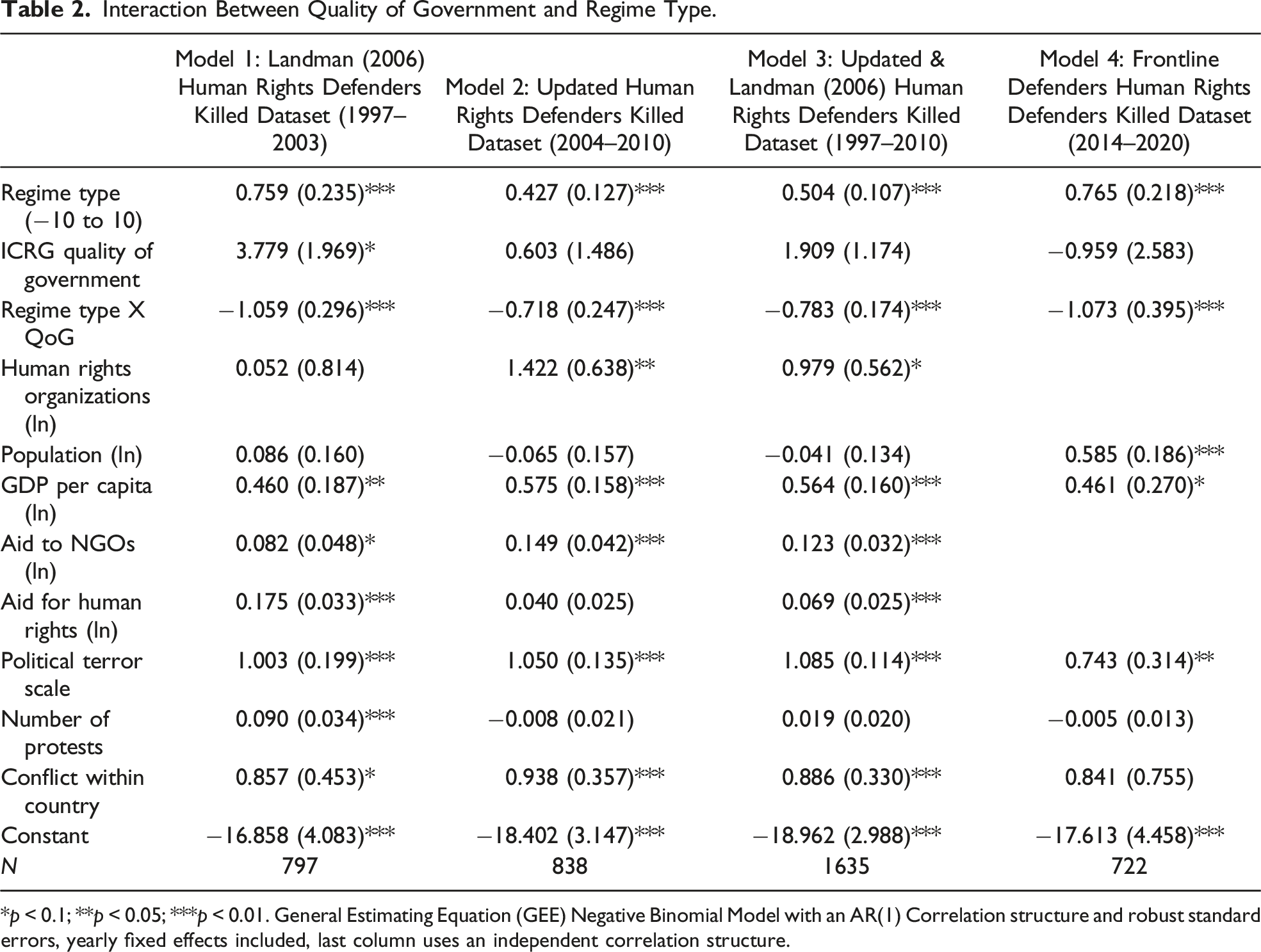
*p < 0.1; **p < 0.05; ***p < 0.01. General Estimating Equation (GEE) Negative Binomial Model with an AR(1) Correlation structure and robust standard errors, yearly fixed effects included, last column uses an independent correlation structure.
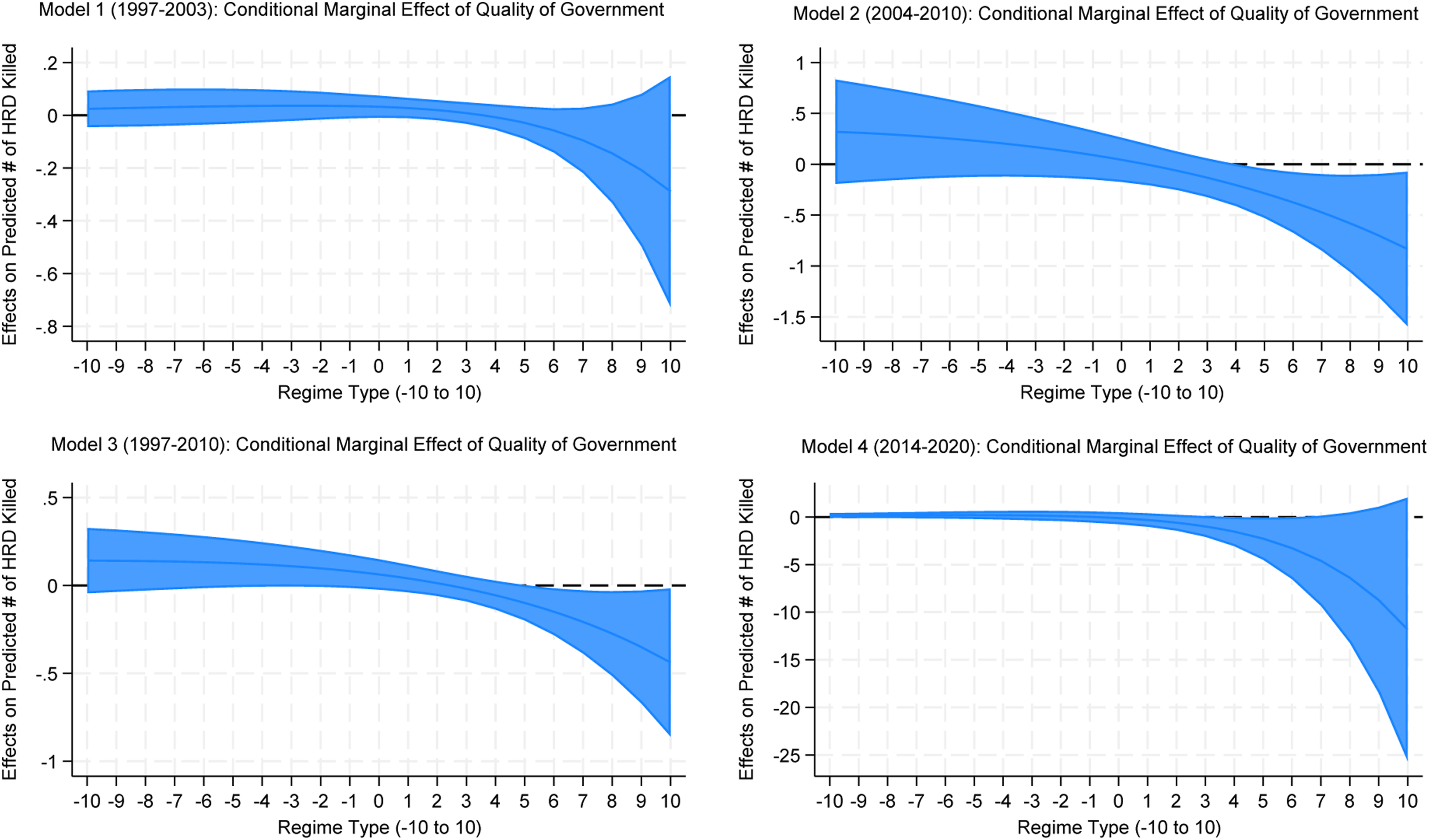
Conditional marginal effect of quality of government, as Regime type changes, based on Models in Table 2.
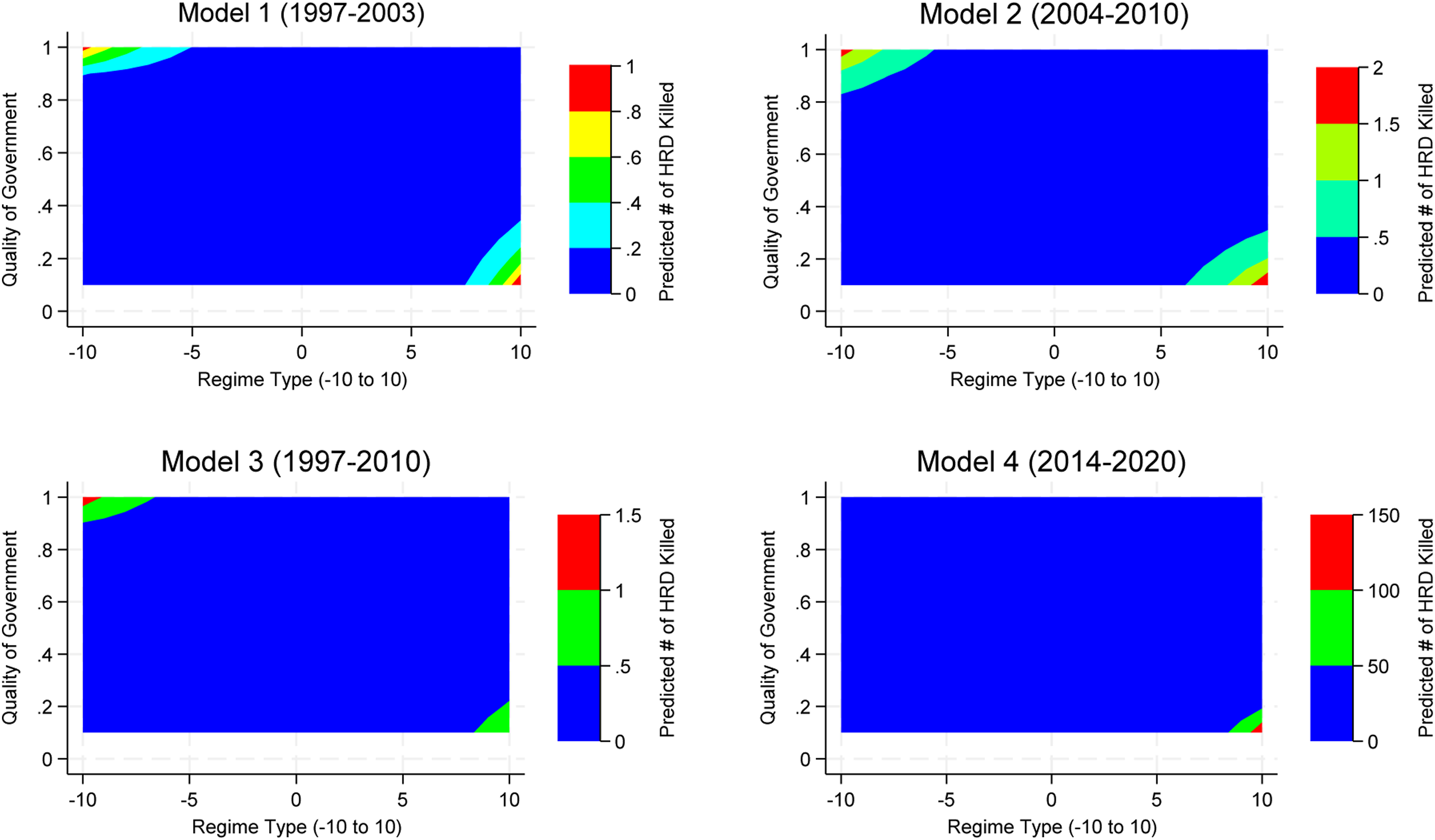
Control plots based on Models in Table 2.
Conclusion
When are human rights defenders more likely to be murdered because of their work? We argued that defenders, who already operate by embracing risk, are more likely to face lethal violence in democratic states. The institutional and normative environment makes it easier for them to engage in human rights defense and provides incentives to do so. Using two new sets of cross-national data on the number of killings of HRDs between 1997 and 2011 and from 2014 to 2020, we find that human rights defenders are indeed more likely to be killed by actors trying to avoid the spotlight and exposure in democratic systems than in other types of regimes, particularly when low state capacity makes impunity for such killings more likely.
These results should be sobering to those who advocate for human rights, as well as those who wish to push back open the increasingly closed civil society without increasing safeguards for those who operate within it. We echo a former UN Special Rapporteur for Human Rights Defenders’ suggestion that laws that enable HRDs to operate but do not safeguard their well-being are well meaning but clearly problematic: Provisions in national legislation on human rights defenders, such as Mexico’s Law for the Protection of Human Rights Defenders and Journalists, requiring key agents within the State to publicly support human rights defenders not only provide an important counter to existing dangerous discourses but also a path forward towards the prevention of future violations and the promotion of the right to defend human rights more generally (Forst 2018, 9).
While democratic states must more proactively safeguard human rights defenders, NGOs, international organizations, the media, and even scholars can also play a role. Advocacy groups can continue to inform defenders about the risks that they face, and to provide training in how to mitigate them (Eguren 2005; Frontline Defenders 2023a; IFPHRD 2011). And as Harding (2015, 8) notes, actors can “share knowledge and information to broaden understandings of threats and to build an evidence base around protective interventions.” We hope that this study is one such step, and that future research can highlight measures that democratic states in particular can take to minimize the lethal risks to human rights defenders.
Supplemental Material
Supplemental Material - Silencing Human Rights Defenders Once and for All? Determinants of Human Rights Defenders’ Killings
Supplemental Material for Silencing Human Rights Defenders Once and for All? Determinants of Human Rights Defenders’ Killings by Matthew Krain, Amanda Murdie, and Abigail Beard in Political Research Quarterly
Supplemental Material
Supplemental Material - Silencing Human Rights Defenders Once and for All? Determinants of Human Rights Defenders’ Killings
Supplemental Material for Silencing Human Rights Defenders Once and for All? Determinants of Human Rights Defenders’ Killings by Matthew Krain, Amanda Murdie, and Abigail Beard in Political Research Quarterly
Footnotes
Declaration of Conflicting Interests
The author(s) declared no potential conflicts of interest with respect to the research, authorship, and/or publication of this article.
Funding
The author(s) received no financial support for the research, authorship, and/or publication of this article.

Supplemental Material
Supplemental material for this article is available online.
Notes
References
Supplementary Material
Please find the following supplemental material available below.
For Open Access articles published under a Creative Commons License, all supplemental material carries the same license as the article it is associated with.
For non-Open Access articles published, all supplemental material carries a non-exclusive license, and permission requests for re-use of supplemental material or any part of supplemental material shall be sent directly to the copyright owner as specified in the copyright notice associated with the article.
