




Abstract
This study examines the differential impact of mass shootings on state gun policy restrictions and posits that victims' race and ethnicity plays a pivotal role. Since the 1970s, pro-gun movements have exploited latent racial biases to oppose gun control measures. They frame gun control as prioritizing the protection of racial minorities over the rights and safety of White Americans, creating political resistance. However, when mass shootings affect White communities, perceptions of the primary beneficiaries of gun control temporarily change. Utilizing a 30-year state panel dataset, the study demonstrates that ten White mass shooting fatalities lead to approximately 1–1.5 restrictive state firearm laws on average, while the same number of fatalities among racial and ethnic minorities has a negative but inconsistent effect on state gun restrictions. These findings are robust to a wide range of modeling specifications and when controlling for other victim-level demographic characteristics. Empirical evidence suggests that legislators and gun control interest groups display stronger support for restrictive legislation following mass shootings involving White victims but not racial and ethnic minority victims.
Mass shootings have become increasingly prevalent and devastating (Lankford and Silver 2020). Although the federal government passed the 2022 Bipartisan Safer Communities Act, gun policymaking has largely been left to the states, where it is subject to local cycles of social violence and mass shootings, resulting in episodic changes. Notably, certain mass shootings, such as the 2018 Parkland, Florida, or the 2022 Highland Park, Illinois, incidents, led to a significant tightening of state gun laws, while others in the same states, like the 2016 Orlando, Florida, or the 2019 Aurora, Illinois, shootings, did not (Caputo 2018; Vinicky 2023). Since conventional explanations like state partisanship or the severity of the shootings cannot account for these divergent responses, what does? State legislators involved in the policy responses offer valuable insights: “The majority of the Pulse victims, the 49 people who lost their lives at Pulse, they were mostly LGBTQ “I think H.P. [Highland Park] is considered
These informed observers suggest that the victims' identities shaped advocacy efforts, issue urgency, and, ultimately, states' policy responses. In this paper, I test these claims and contend that victims' race and ethnicity shapes policy responses to mass shootings. I borrow from social construction theories of policymaking and build off a rich and bludgeoning literature in public opinion research linking race and gun policy preferences (Berryessa, Sierra-Arevalo, and Semenza 2022; Filindra and Kaplan 2017; 2016; Higginbotham, Sears, and Goldstein 2023; Kreitzer and Smith 2018; Schneider and Ingram 1993; Walker, Collingwood, and Bunyasi 2020).
I propose that the gun rights movement, spearheaded by the National Rifle Association (NRA), propagates racialized narratives that frame gun control measures as state protections for “undeserving” racial and ethnic minorities and a threat to “deserving” White Americans (Filindra and Kaplan 2017; 2016; Schutten et al. 2022). Coupled with political power disparities, these narratives hinder politicians' willingness to intervene in gun markets even as states face local gun violence epidemics (Schneider and Ingram 1993). Mass shootings involving racial and ethnic minority victims fail to challenge these narratives.
However, the dynamics change when mass shootings affect White communities. In their immediate aftermath, White Americans are framed as the primary beneficiaries of gun control, leading to increased support for restrictive gun laws among co-ethnics (Berryessa, Sierra-Arevalo, and Semenza 2022; Walker, Collingwood, and Bunyasi 2020). While shifts in public opinion might influence policy responses to some extent, they are unlikely to tell the entire story because gun policy often diverges from public opinion, and elite preferences and behavior dominate gun politics (Goss 2010; Lax and Phillips 2012; Spitzer 2023). I contend that legislators, influenced partially by their own implicit biases, are more likely to signal support for gun restrictions if victims are White rather than racial minorities (Butler 2014; Gell-Redman et al. 2018). These signals open policy windows, increasing issue saliency and inviting interest group activity (Canes-Wrone 2001; Grimmer 2013; Iliev 2021). Reacting to this opportunity, gun control interest groups increase their lobbying efforts.
To test this theory, I utilize a novel dataset merging information from The Violence Project and the State Firearms Laws Project, creating a 30-year state panel dataset (1990–2020) tracking mass shootings and state gun policy. I employ a set of rigorous models that leverage two-way fixed effects, time-variant unit-specific controls, and state-linear time trends to account for confounds and differing trends. The findings are robust when using new difference-in-differences estimators that address biases found in two-way fixed effects models (Callaway & Sant'Anna, 2021; Liu et al., 2022).
The findings indicate that state firearm policy is responsive to mass shootings when victims are White. On average, ten White fatalities lead a state to implement approximately 1 to 1.5 additional restrictive gun laws. Conversely, ten racial and ethnic minority fatalities led states to implement about 0.6 fewer restrictive gun laws, although this latter finding is not statistically significant across all models and may be driven by pre-shooting trends. A second set of models using newly developed DID estimators shows that states experiencing one or more majority-White mass shootings implement about one additional restrictive firearm law, whereas one or more majority-minority mass shootings had no statistically significant effect on new restrictive gun laws. The findings are robust when controlling for victims' age and gender, whether the shooting occurred in a school, and the median income of the neighborhood where the shooting occurred, and to a wide range of modeling specifications.
The proposed mechanisms are supported by examining legislators' rhetorical responses to mass shootings and interest group lobbying behavior. Twitter data reveals that legislators discuss gun violence more after mass shootings when victims are White compared to racial and ethnic minorities. Moreover, examining interest group lobbying data from Follow the Money shows that gun control interest groups increase lobbying efforts in response to White mass shooting fatalities, while gun rights interest groups are unaffected. Mass shootings fatalities of color do not significantly influence interest groups' lobbying efforts. However, whether legislators' rhetoric or differential rates of lobbying explain disparate policy responses remains untested.
This study challenges conventional wisdom on gun policy (in)action. By showing how victims' race and ethnicity shapes policy responses to mass shootings, this study provides critical insights into the complexities of gun policymaking and the impact of racial dynamics. Furthermore, this study extends the existing literature in American politics that highlights racial disparities in representation (e.g., see J. Griffin et al. 2019; J. D. Griffin and Newman 2008; Hajnal and Trounstine 2013) by looking beyond the public opinion-policy link. By demonstrating that state legislators, interest groups, and policies in the United States are more responsive to disasters when victims are White rather than people of color, this research underscores the need to address biases influencing the policymaking process in the United States.
Racial Resentment and Gun Politics
Throughout American history, the relationship between gun policy and race has been intricate and evolving. In the past, White Americans could protect their right to bear arms while simultaneously disarming people of color, whom they perceived as threats to their lives and property (Cramer 1994; Satia 2019; Tahmassebi 1991). This strategy maximized White safety and rights but subjugated people of color. More recently, greater federal enforcement of the equal protection clause and changing social norms prevent the implementation of explicitly racist gun control laws. Still, racial sentiments shape gun policy, and I propose the following hypotheses, which I will proceed to defend: • •
After the Civil Rights Movement, explicitly racist beliefs based on ideas of innate racial superiority were labeled immoral and explicitly racist policies became illegal. However, research shows that race continues to shape politics through “symbolic racism” and racial resentment (Kinder and Sanders 1996; Sears 1988). This line of research argues that beliefs about race have become interconnected with ideals of individualism and traditional American values (Kinder and Sanders 1996; Sears 1988). For example, Whites with high levels of racial resentment believe that higher incidences of Black poverty and crime are due to individual and cultural failures, not structural or institutional factors (Kinder and Sanders 1996; Sears 1988). 1 In turn, White Americans with latent racial prejudices gravitate towards positions presented as advancing individual liberties because they are implicitly perceived as self-beneficial and studies show that racial resentment strongly influences White opposition to policies perceived as primarily benefiting racial and ethnic minorities (Kinder and Sanders 1996; Kinder and Sears 1981; Mendelberg 2001; Sears 1988).
In the 1970s, gun rights movements engraved racial resentment into the politics of gun control. While organizations like the NRA supported gun control laws in the 1960s, including the Mulford Act and the Gun Control Act of 1968, a deep shift occurred in the late 1970s and the NRA adopted a language of rights and liberties to advocate for uncompromising gun rights (Filindra & Kaplan, 2016; R. B. Siegel, 2008). Simultaneously, the NRA and its members aligned themselves with the broader “New Right” movement that was categorized by White resistance to racially egalitarian policies (Filindra & Kaplan, 2016; R. B. Siegel, 2008). Today, racial resentment is a strong predictor of pro-gun attitudes even when controlling for confounds like conservative values and authoritarian inclinations (Filindra and Kaplan 2016). 2
Following the Civil Rights Movement and particularly after the rise in urban violence in the 1980s, pro-gun movements and gun manufacturers began framing guns as a tool of self-defense rather than one for hunting and sport (Yamane, Yamane, and Ivory 2020). The propagation of negative stereotypes, racially biased media frames, and racist dog-whistles have framed gun control measures as a threat to White safety, preventing “law-abiding gun owners” (i.e., White Americans) from owning guns but doing nothing to prevent “criminals” (i.e., Black Americans) from acquiring weapons (Parham-Payne 2014; Schutten et al. 2022). Furthermore, significant racial disparities in gun violence victimization rates facilitated right-wing narratives that paint racial minorities as the primary beneficiaries of gun control and White Americans as those most burdened by them. 3 The gun rights movement advances narratives that make guns a symbol of liberty and label gun control advocates, including “undeserving” minorities, enemies of freedom seeking “special” state protection from violence (Filindra and Kaplan 2016).
These narratives frame gun control measures as benefiting “undeserving” groups and burdening “deserving” groups (Kreitzer and Smith 2018; Schneider and Ingram 1993; Schutten et al. 2022). Powered by effective public and private lobbying campaigns, these frames became engraved in the collective consciousness. Therefore, policymakers are unwilling to pass laws that they and their constituents believe will benefit an “undeserving” and non-powerful group (racial minorities) while burdening a “deserving” and politically powerful group (White gun owners) (Kreitzer and Smith 2018; Schneider and Ingram 1993).
Threat to White Lives and Narrative Change
Theories of punctuated equilibrium suggest that mass shootings, a relatively uncommon but salient form of gun violence, may lead to stricter gun laws by serving as focusing events. Focusing events, like mass shootings, provide an urgent, symbol-rich example of purported policy failures, opening policy windows where policy change is more likely (Baumgartner, Jones, and Mortensen 2018; Birkland 1997). But mass shootings disproportionately affecting racial and ethnic minorities fail to significantly shift deeply engraved collective narratives regarding “targeted groups.” In the aftermath of a mass shooting that mostly kills people of color, gun control efforts are still seen as primarily benefiting racial minorities and burdening “law-abiding” White Americans. Unless those shootings shift social perceptions of racial minorities, we have limited reasons to expect a strong and compassionate policy response (Kreitzer and Smith 2018; Schneider and Ingram 1993).
However, mass shootings that disproportionately impact White Americans can (temporarily) change gun control narratives. Research shows that Republicans are more likely to support restrictive gun laws when framed as a public safety issue instead of an individual rights issue (Haider-Markel and Joslyn 2001), and proximal exposure to mass shootings increases support for restrictive gun laws (Newman and Hartman 2019). However, perceptions of victims affect these responses because they change who is seen as the primary beneficiaries of a policy. Experimental research finds that White Americans are more likely to support gun control when they are primed to think about White people as gun violence victims versus Black people (Berryessa, Sierra-Arevalo, and Semenza 2022; Walker, Collingwood, and Bunyasi 2020). These patterns parallel racialized responses to other crises where White Americans, especially those with high racial resentment, support government interventions only when the perceived beneficiaries are White (Fong and Luttmer 2009; Iyengar and Hahn 2007; Lee, Seo, and Leahey 2022; Stephens-Dougan 2023). This research suggests that mass shootings will increase public support for restrictive gun laws when victims are White but not racial and ethnic minorities.
Beyond Public Opinion
The extensive and rich literature cited above illustrates how gun policy preferences are shaped by racial resentment and perceptions of what groups benefit from gun control. However, it is focused on public opinion—particularly White public opinion. And, while we expect public opinion—particularly White public opinion—to drive policy decisions, we know this is not always the case (Lax and Phillips 2012). State gun policies are particularly incongruent with public opinion, and mass shootings do not appear to increase voter turnout or affect vote choice (Hassell and Holbein forthcoming; Lax and Phillips 2012). Gun policy is largely shaped by legislators' personal preferences and interest group lobbying efforts (Goss 2010; Spitzer 2023).
This is not to say that legislators do not care about what constituents want in terms of gun policy, but that mass shooting-induced changes in public opinion alone are unlikely to lead to more restrictive gun laws as they do not translate to significant shifts in electoral behavior (Hassell and Holbein forthcoming; Lax and Phillips 2012; Newman and Hartman 2019). However, legislators are overwhelmingly White, their behavior is shaped by perceptions of targeted groups, and implicit racial biases lead them to discriminate against people of color even in low-cost situations (Butler 2014; Gell-Redman et al. 2018; Hansen and Clark 2020; Schneider and Ingram 1993). Therefore, I contend that mass shootings that disproportionately impact White Americans are more likely to increase legislators' willingness to pass gun restrictions than those that disproportionately impact racial and ethnic minorities.
Racial biases in legislators' responses to mass shootings do not just matter because they shape legislators' willingness to vote in favor of gun control legislation; legislators' immediate rhetorical responses to mass shootings affect the post-shooting political environment. If legislators are more likely to discuss gun violence and politicize the issue more often after a specific type of mass shooting, this rhetoric shapes legislative agendas, influences fellow legislators, and invites interest group lobbying and donations (Canes-Wrone 2001; Grimmer 2013; Iliev 2021).
I propose and test the following hypotheses: • ○
Signals from legislators illustrating an openness to address state gun laws are likely to shape how interest groups behave (Iliev 2021; Ray 2018). If interest groups believe legislators will address gun policy soon, they are more likely to compete for influence through lobbying and political donations. However, these groups are also shaped by the preferences of their leaders and members, who themselves may be prone to racial biases. The NRA and other gun rights groups are known to foster racial resentment as part of their policy strategy (Filindra 2023; Filindra, Kaplan, and Buyuker 2021; Schutten et al. 2022). So, resistance to efforts that are perceived to benefit White Americans may alienate members. And, while pro-gun control interest group leaders and members are less likely to harbor racial resentment, these organizations have been accused of internally marginalizing the voices of people of color (Clayton 2023; Reed et al. 2023). Therefore, gun policy interest groups might respond to mass shootings in racially biased ways for two reasons: 1) because they are responding rationally to shifts in public opinion and legislators' public statements, and 2) because of latent racial biases among their leaders and members. Given that gun policy is heavily influenced by interest group lobbying, divergent interest group responses may also shape post-shooting policy responses (Goss 2010; Spitzer 2023).
I propose and test the following hypothesis: • •
Victims' Race and Ethnicity Shapes State Gun Policy Change: Data
To assess potential racial bias in state policy responsiveness, this study analyzes data on mass shootings primarily obtained from The Violence Project, a nonpartisan research center funded by the National Institute of Justice. Their comprehensive coding of victims' race and ethnicity, based on a rigorous multi-coder process, is a reliable source for the analysis. The definition of mass shootings utilized by The Violence Project follows that of the Congressional Research Service, requiring a multiple homicide incident with four or more victims murdered with firearms within one event, occurring in public locations or nearby settings, and not attributable to other criminal activity or commonplace circumstances. While this definition is relatively conservative, it best captures the salient public events that serve as potential focusing events.
From 1990 to 2020, there were 137 mass shootings across 38 states. There are 973 victims across these mass shootings. Victims' racial and ethnic information primarily comes from The Violence Project. As a verification check, I hand-coded the race and ethnicity of 475 mass shooting victims between 2010 and 2019 using pictures found online in news reports and obituaries. My coding matches The Violence Project's coding in 91% of cases. The Violence Project is missing race and ethnicity data for 114 victims, mainly from older years when less media information was available. I use Bayesian Improved Surname Geocoding (BISG) to predict the race and ethnicity of the remaining victims 4 and aggregate individual racial and ethnic minority fatalities into a broader umbrella category. 5 Six hundred thirty-three victims are White, and 340 are racial and ethnic minorities.
The main independent variables in this study are mass shooting fatalities disaggregated by victims' race and ethnicity (in these broader buckets) at the state-year level.
6
Figure 1 plots mass shooting fatalities by victims' aggregated race and ethnicity over time, showing that mass shooting fatalities have increased over time, though the racial and ethnic distribution is relatively constant. Mass shooting fatalities disaggregated by victims' race and ethnicity by year.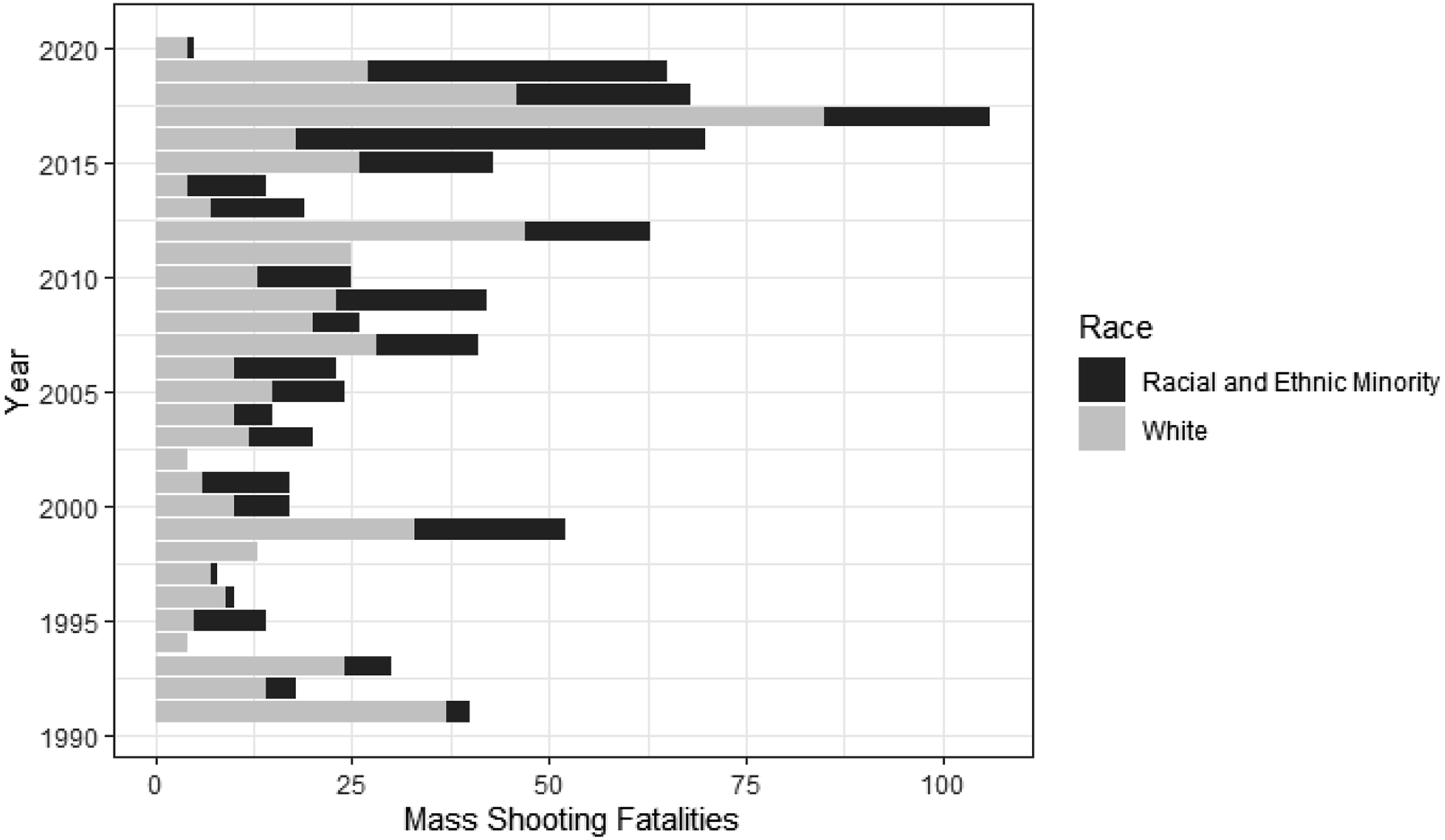
State Firearm Laws Policy Areas.
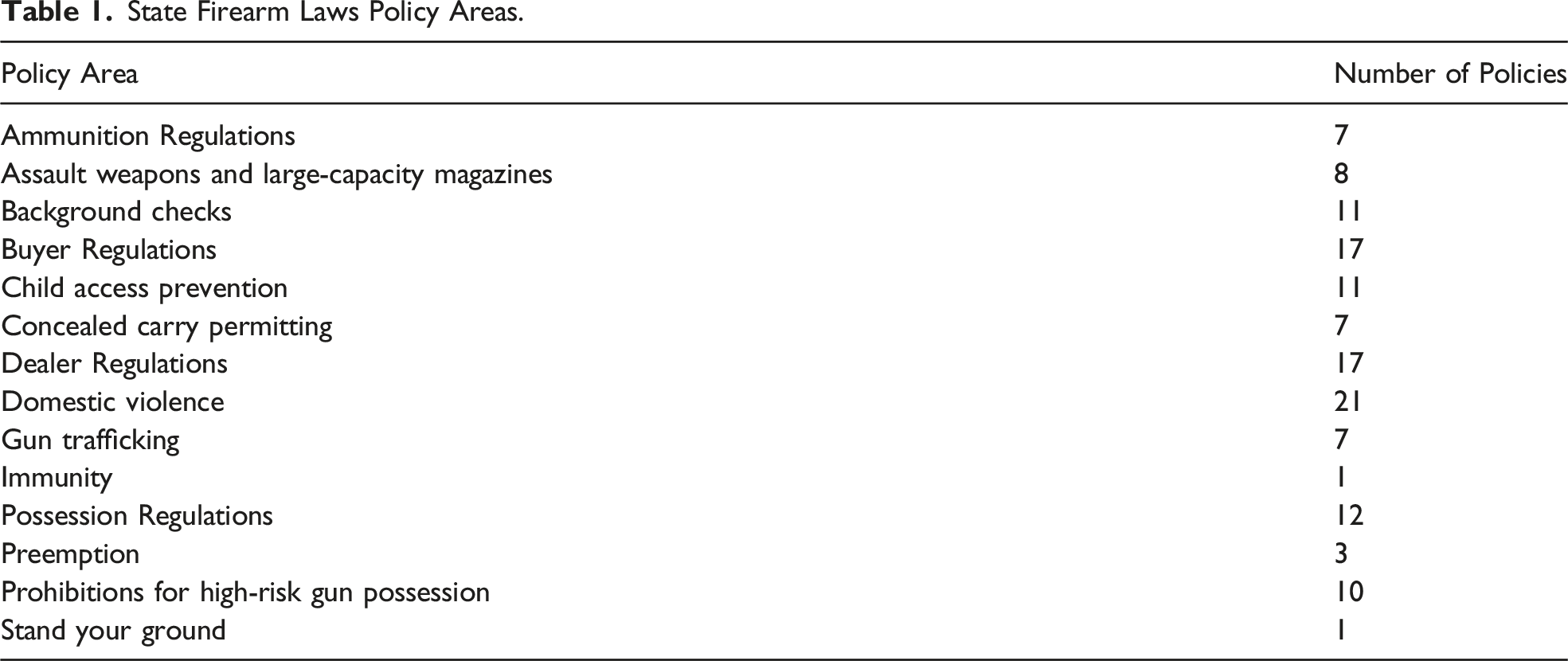
The primary dependent variable is the number of new restrictive gun laws implemented in time T
State partisan control, whether a state is under unified Democratic control, unified Republican control, or divided partisan control, 8 is used as a control and a moderating variable in robustness checks. 9 State partisan control is included as a covariate because gun policy is a particularly partisan issue, partisan control of government is closely linked with the direction of policy change, and state partisan control is a time-variant state-specific confound (Oliphant, 2017; Caughey, Xu, and Warshaw, 2017).
Figure 2 plots the number of restrictive gun laws over time by state with smoothed trends by partisan control.
10
The distribution of firearm laws follows logical partisan divisions. States under unified Democratic control have the most restrictive gun laws, and states under unified Republican control have the fewest restrictive gun laws. One important observation is that the gap between Democratic and Republican-controlled states has grown. To account for this, I add state-specific time trends to the main models as a robustness check. Time trends of the number of restrictive state firearm laws by party control.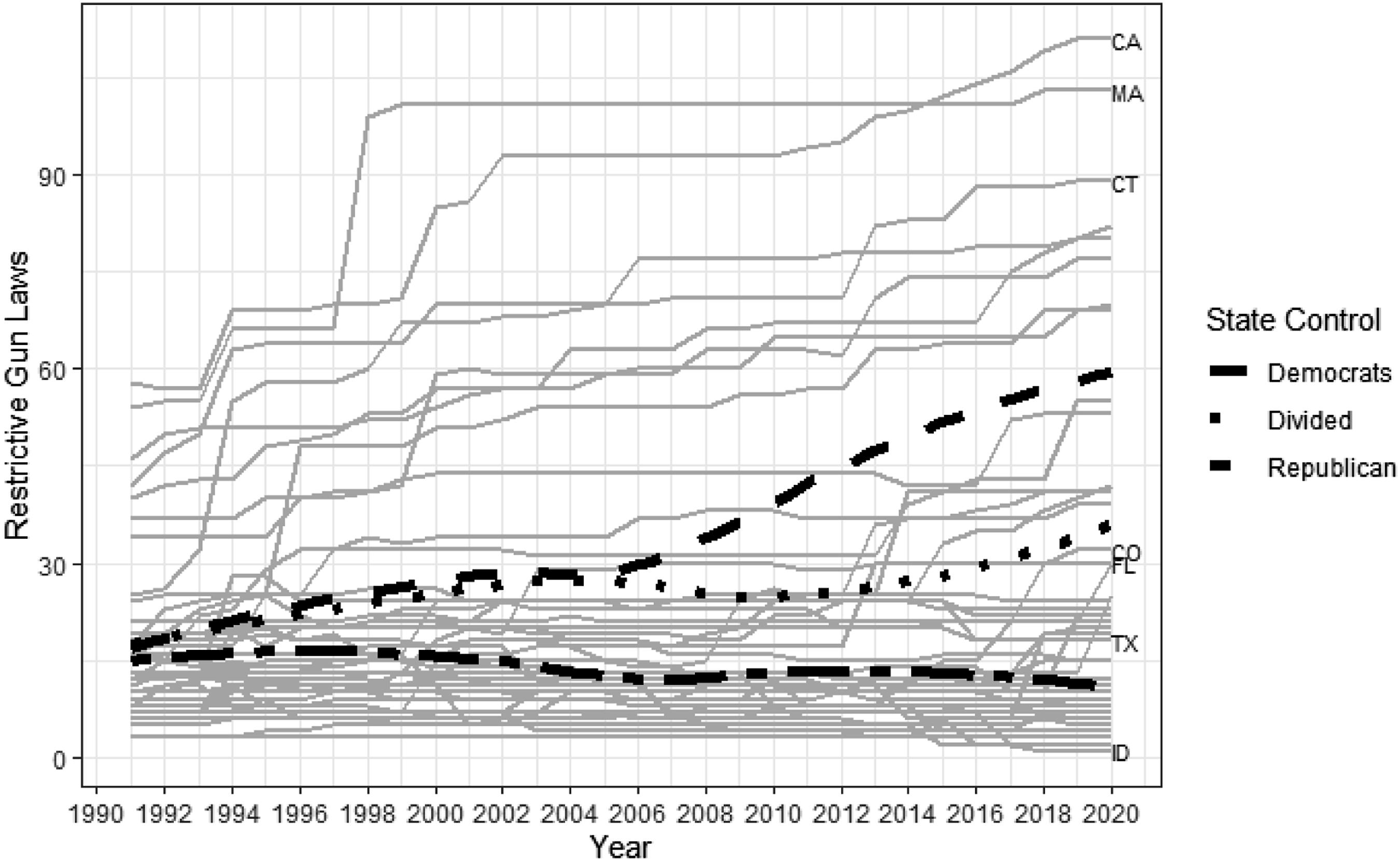
Victims' Race and Ethnicity Shapes State Gun Policy Change: Methods
This study primarily uses a “non-traditional” staggered difference-in-differences (DID) design. Models have a dual “dosed treatment” (White fatalities and REM fatalities) that are contemporaneous (treatment reversal is inherent). This method estimates the dynamic effect of mass shooting fatalities on the implementation of new restrictive gun laws by comparing states with and without shootings at different levels of deadliness while controlling for state characteristics and temporal effects using two-way fixed effects (TWFE).
While some literature supports the potential outcomes framework, indicating that predictors of mass shootings are individual-level attributes of shooters, not location-specific characteristics (Madfis, 2017; Paolini, 2015; Wike & Fraser, 2009), recent work suggests that mass shootings may be correlated with some relevant political variables at the county level (Hassell and Holbein forthcoming), potentially violating the parallel trends assumptions necessary for well-defined difference-in-differences designs. I take various steps to address this issue and show models are robust to a wide set of specifications.
In the main analysis, I present three models addressing confounds in increasingly rigorous ways. One model specification uses only state and year-fixed effects. This model shows that the results are not an artifact of specific hand-picked control variables, which may bias results (Achen 2005). In another model, I include a series of time-variant state-specific controls. 11 In the third model, I add state-specific linear time trends to control for the state-level underlying trends shaping variation in the outcome variable over time, as suggested by scholars engaged in similar research (Hassell and Holbein forthcoming). This helps capture the state-specific effects and ensure that any observed changes in the outcome are not due to the underlying trends but rather to the treatment (in this case, the mass shooting fatalities).
Victims' Race and Ethnicity Shape State Gun Policy Change: Findings
The results in Figure 3 consistently support Marginal effects of mass shooting fatalities by victims' race and ethnicity on change in the number of restrictive state gun laws.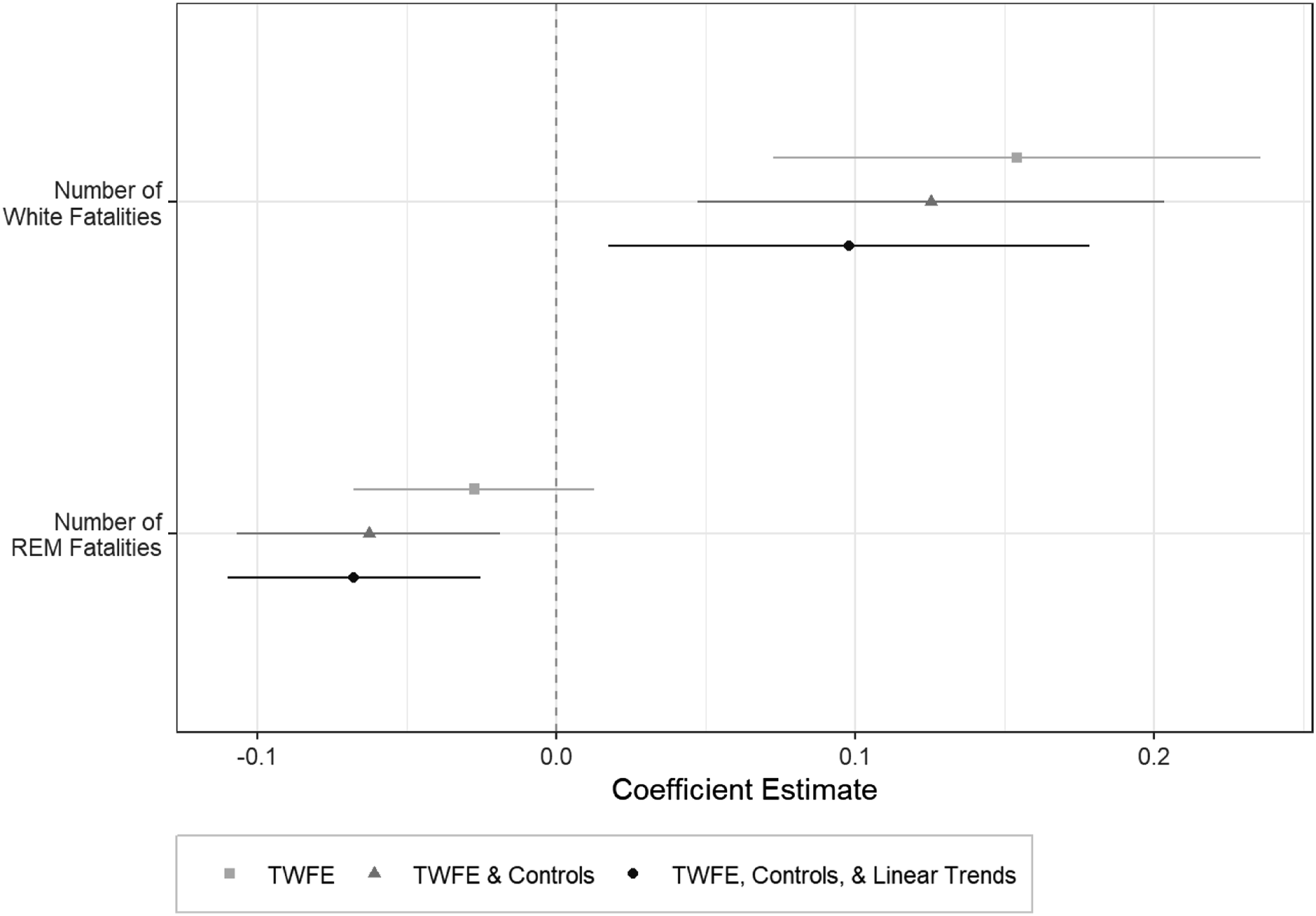
On the other hand, Figure 3 suggests that REM mass shooting fatalities have a negative effect on new restrictive gun laws, though this finding is not statistically significant across all three models, lending support to
Bias in Difference-in-Differences Estimates
Recent scholarly work has raised concerns about estimated average treatment effects in staggered DID models due to potential biases caused by "forbidden comparisons" (Callaway and Sant’Anna 2021; Liu, Wang, and Xu 2022). 13 Existing econometric tools usually only address this issue for a limited set of "traditional" DID models with a single bivariate treatment without reversal. However, the models presented in Figure 3 include two continuous treatments (Number of White Fatalities; Number of REM Fatalities) that involve treatment reversal. Unfortunately, to the best of my knowledge, no econometric tool developed thus far can deal with all of these non-standard applications simultaneously. However, Liu et al. (2022) developed an estimation technique to handle treatment reversal if using a single bivariate treatment. Although this technique does not cover all the non-standard applications used in the previous models, I can adjust the data and employ two separate models to estimate the effect of majority White mass shootings and majority REM mass shootings individually, testing the robustness of the main findings in Figure 3 using a different independent variable but without the risk of TWFE-induced biases. To do so, I measure whether a state had one or more majority White mass shootings or one or more majority REM mass shootings. The dataset includes 77 majority White shootings and 38 majority-minority shootings.
I begin by testing the effects of majority White mass shootings on new restrictive gun laws in Figure 4, employing the bias-robust estimator developed by Liu et al. (2022). This model estimates the average treatment effect of a majority White mass shooting on the number of new restrictive gun laws implemented during the year of the shooting and the following year by imputing counterfactual outcomes for treated observations (Liu et al., 2022). Additionally, I conduct a placebo test, comparing the post-shooting effect to pre-treatment trends. The results from this analysis are robust, indicating that a majority White mass shooting leads states to implement approximately one additional restrictive gun law during the year of the shooting or the subsequent year (p = 0.03). The placebo test confirms that pre-treatment trends do not explain the post-shooting effect, and the results hold up well when unit-specific linear time trends are added to the model (ATT = 0.75; p = 0.07). Estimated effect of majority White mass shooting on change in the number of restrictive state gun laws (FEct).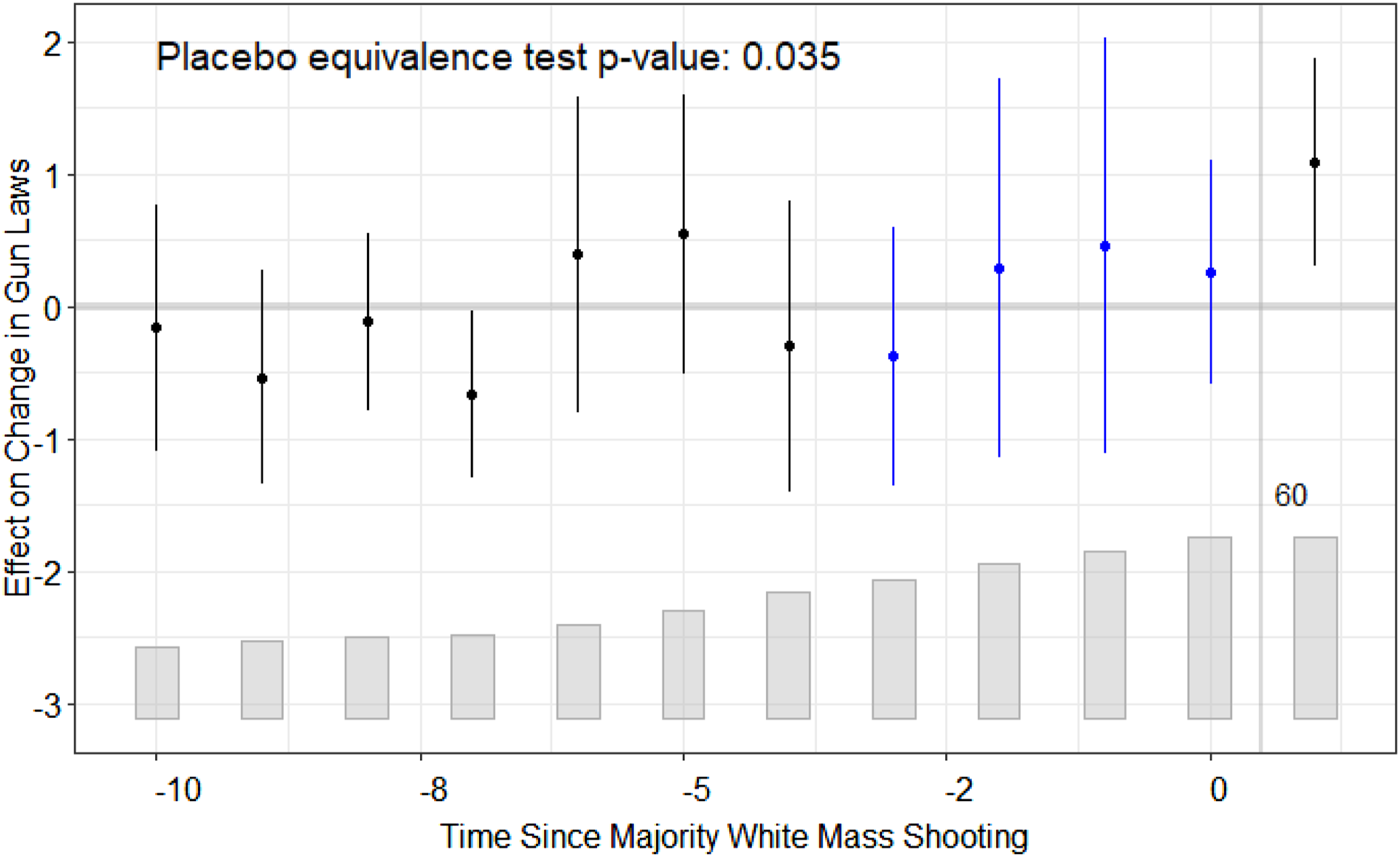
Next, I examine the effects of majority REM mass shootings on new restrictive gun laws in Figure 5, employing the same estimator and placebo test. The results from the previous model are not as robust when using this estimation strategy, although it is crucial to recognize that both the estimation strategy and the measurement of the independent variable change. Figure 5 indicates that a majority REM mass shooting leads a state to implement 0.5 fewer restrictive gun laws over the next two years, but this effect is not statistically significant (p = 0.48). It is essential to note that this estimate may be influenced by pre-shooting trends, which indicate that states tend to loosen gun laws in the years immediately preceding majority REM mass shootings. The effects do not substantially differ when unit-specific linear time trends are included (ATT = – 0.58; p = 0.35). Given these findings, including the placebo test of pre-shooting trends, we should approach the interpretation of the results from the previous analysis with caution. It is plausible, and perhaps likely, that racial and ethnic minority mass shooting fatalities do not significantly affect new restrictive gun laws instead of having a statistically significant negative effect. Estimated effect of majority REM mass shooting on change in the number of restrictive state gun laws (FEct).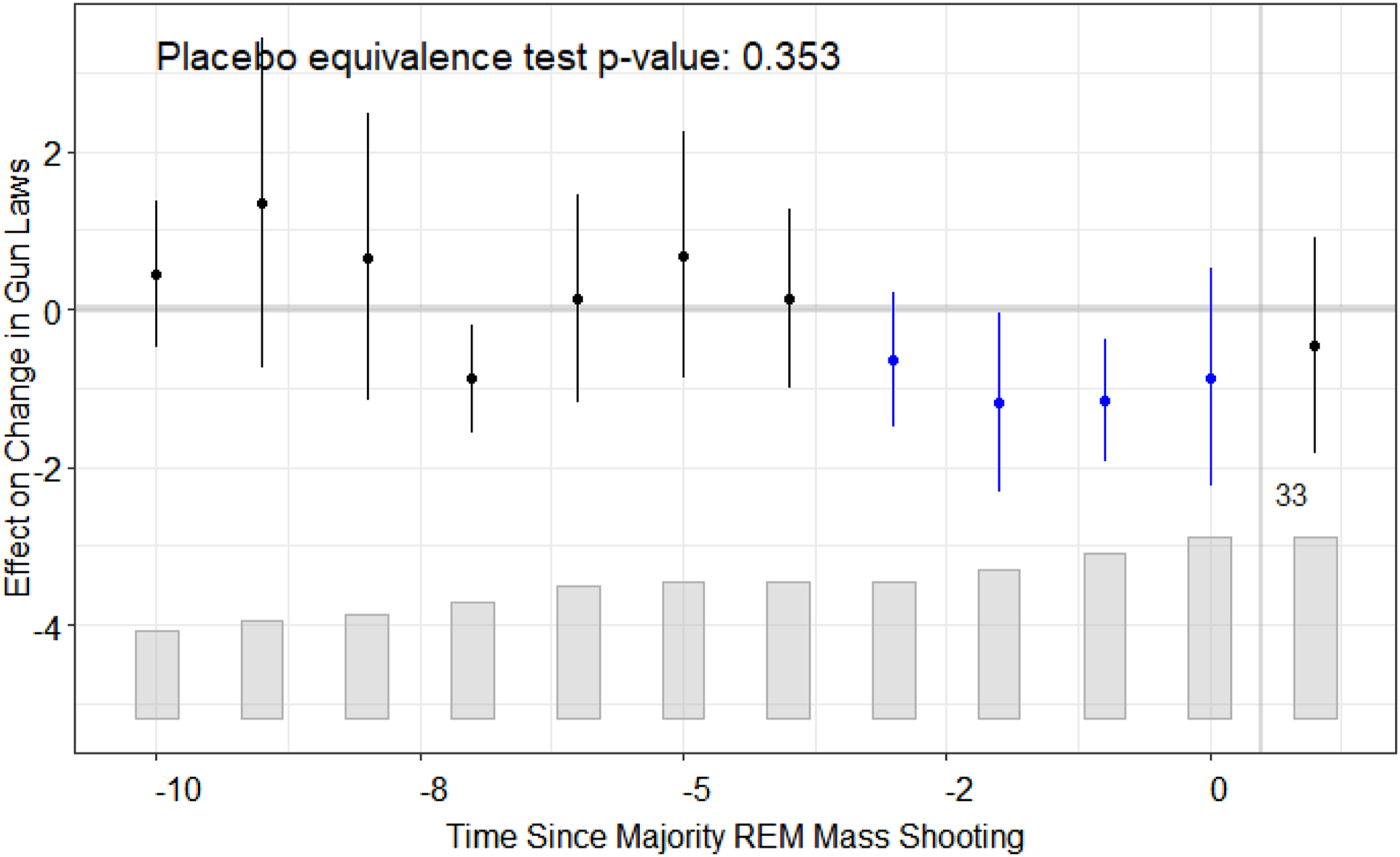
Controlling for Confounding Demographic Characteristics
When considering one of the motivating examples comparing Florida's policy response to the Parkland, Florida, and Orland, Florida, shootings, victims' characteristics differ in many ways. Among them are age, sexual orientation, location, gender, and income. The Stoneman Douglas High School shooting (Parkland) happened at a school in an upper-income neighborhood, and the victims were children, while the Pulse nightclub shooting (Orlando) occurred at a nightclub in a low-income neighborhood, and the victims were primarily young LGBT adults. We might expect legislators to see children, students, women, higher income, and heterosexual individuals as more “deserving” of protection than young adults, men, low-income earners, and LGBT individuals for a wide range of reasons (Bridges 2016; Israel-Trummel and Streeter 2022; Padamsee 2020). If these characteristics are correlated with race, previous findings may be biased.
While I was unable to collect data on victims' sexual orientation, income, or wealth, I was able to collect data on victims' age, expressed gender, and location. Therefore, in Figure 6, (i) control for the number of mass shooting victims that are under 18 years old and female presenting and the number of victims killed while in school or in a high-income neighborhood (defined as in the top 1/3rd of income tertials).
14
Marginal effects of mass shooting fatalities on change in the number of restrictive state gun laws controlling for Confounding demographic characteristics.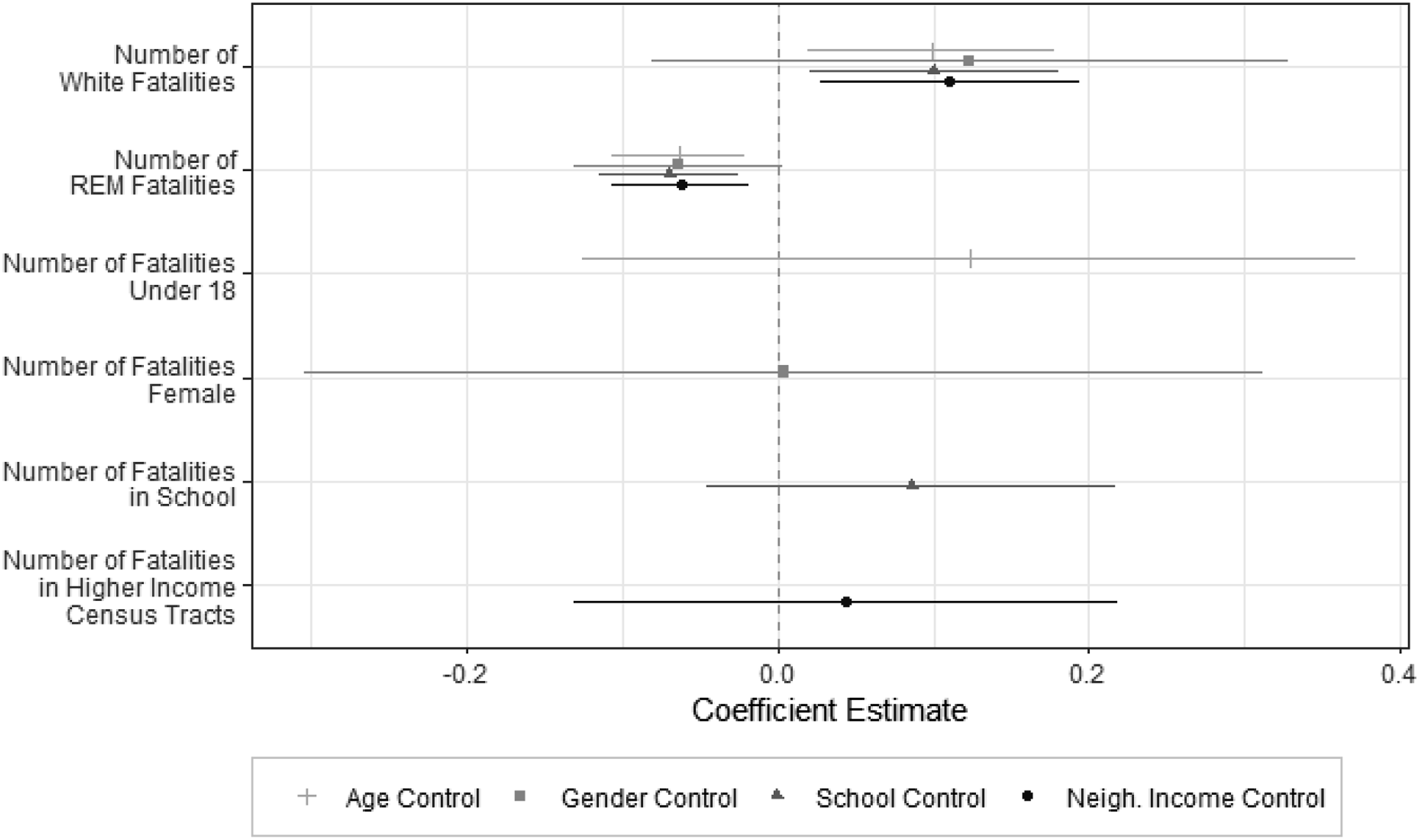
The findings from the main models are robust when these controls are included. Model 1 in Figure 6 controls for the number of mass shooting fatalities under 18 years old. According to this model, ten White mass shooting fatalities lead to about one additional restrictive gun law on average (p = 0.02). Controlling for the number of female victims in Model 2 suggests that ten White mass shooting fatalities lead to about 1.2 restrictive firearm laws (p = 0.24). While the coefficient is not statistically significant, this might be because of high collinearity in the independent variables, as the coefficient for female victims is small (0.004) and standard errors are large (p = 0.98). In Model 3, I control for the number of mass shooting fatalities on school campuses. This model suggests ten White mass shooting fatalities lead to about one additional restrictive gun law. Model 4 controls for the number of mass shooting fatalities in the highest tertial census tracts based on median income that year. Once again, the results are robust to this model specification, which predicts that ten White Mass shooting fatalities lead to 1.1 additional restrictive gun laws (p = 0.01). The control variables are not statistically significant in any of the models.
In comparison, all four models find that ten racial and ethnic minority mass shooting fatalities lead to about 0.6 fewer restrictive gun laws and these findings are statistically significant in three models. However, the previous analysis suggests being cautious with over emphasizing these findings because they may be partially driven by pre-shooting trends. While the point estimates for White fatalities are slightly smaller across these models than the effects observed in previous models, the findings are largely robust to this set of controls. These models show that systematic differences in victims' age, gender, or location do not drive racial disparities in state policy responses to mass shootings.
Racial Biases in Legislators' Post-Shooing Rhetoric: Data
Thus far, the evidence demonstrates that victims' race and ethnicity shapes state gun policy responses to mass shootings. Because various mechanisms may help explain these disparities, I will explore some I believe to be important. I contend that victims' race and ethnicity shapes state legislators' support for gun control post-shooting and that legislators' racially biased responses to mass shootings do not just influence their willingness to vote for restrictive gun legislation but also affect the way they communicate with the public which in turn shapes legislative agendas, public opinion, other legislators' views, and interest group behavior (Canes-Wrone 2001; Grimmer 2013; Iliev 2021).
I study legislators' post-shooting communication using Twitter. Twitter is an excellent data source for conducting this research because it is a direct source of communication between an elected official and the public, mirrors their policy agenda in other communication mediums, cannot be micro-targeted, and is used by most legislators during the period under observation (Casas & Morar 2015; Straus et al., 2013).
Using data from Butler, Kousser, and Oklobdzija (2023), which includes 3,580,727 tweets from 3399 legislators (63%) and mass shooting data from The Violence Project, I focus on mass shootings occurring between January 1st, 2012 and April 23rd, 2019, covering 40 shootings across 16 states. 15 I focus on tweets posted in the seven days before and after an in-state mass shooting. 16 In these 16 states, 826 legislators tweeted at least once in that time frame. Empty tweets or those only containing UTF-encoded objects were removed from the dataset. After subsetting tweets to the relevant dates and removing non-usable tweets, the remaining 29,188 tweets were analyzed.
I code two dependent variables. First, I code the number of tweets a legislator posted discussing gun violence using a supervised naïve Bayes learning model.
17
I then corrected false positives in the predicted dataset by hand but was unable to correct false negatives by hand given the size of the dataset. This resulted in 1532 tweets classified as discussing gun violence.
18
These are examples of tweets classified as discussing gun violence by the supervised training model: • RT @NevadaDPS: #VegasShooting Should you decide to donate blood, here's a link to make a reservation: https://t.co/csHTbEyAOM • RT @SoCalOpinion: In wake of #SanBernardino mass shooting, I must be strong, resilient. By Frank Pine: https://t.co/iG37ufbav1 #SBStrong • RT @scottbraddock: Mass shootings in Texas have resulted in no new restrictions on the constitutional right to a firearm.
Next, I hand-coded whether tweets discussing gun violence used politicized frames. This process involved a research assistant and I going through tweets classified as discussing gun violence and analyzing their content. Tweets classified as using politicized frames prime gun policy or call for legislative action to reduce gun violence. These tweets often reference gun legislation or otherwise bring specific attention to the institutional causes of gun violence.
19
Some tweets call for legislative action but do not directly mention gun policy. The research assistant and I hand-coded the same set of Tweets separately to ensure intercoder reliability. Our coding matched in about 88% of cases. Instead of adjudicating between differences, I analyze both sets of codes separately. Only 538 tweets were classified as discussing gun violence using a political frame.
20
Some examples of tweets classified as using a political frame include: • Our “leaders” will say absolutely anything to avoid a real conversation about common sense gun legislation. • RT @NRA: What the media doesn't report -- > Concealed Carrier Prevents Mass Shooting At #SC Nightclub https://t.co/DMzO4vG3hC #armedcitizen • Y'all been sending thoughts and prayers for two freaking decades now. Time to try something new.
Ten Most Common Words in Gun Violence Tweets Overall vs Politically Framed Gun Violence Tweets.

Racial Biases in Legislators' Post-Shooing Rhetoric: Methods
I employ a pre-post within-unit design, analyzing tweets posted seven days before and seven days after an in-state mass shooting. The unit of analysis is legislator pre- or post-shooting. In other words, I aggregate the data up to the legislator-level and compare the number of tweets they posted discussing gun violence the week before an in-state mass shooting and the number they posted the week after the shooting. The dependent variables are the number of tweets discussing gun violence and the number of tweets discussing gun violence that use a political frame (a subset of the former). I investigated the independent effects of both types of victims (White and REM) using multivariate regression. Fatality counts are treated as a continuous treatment, influencing legislators in the post-shooting period with the pre-shooting period as a baseline. State-fixed effects, year-fixed effects, and controls for legislators' party identification or legislator-fixed effects and year-fixed effects are included in the models. 21
Figure 7 provides a visual representation of the data, showing the proportion of tweets referencing gun violence and using political framing before and after an in-state shooting. Tweets referencing gun violence peak on the day of the mass shooting and the day after, gradually decreasing over time. Around 17% of tweets address gun violence on the day of the shooting, compared to only one percent the day before. Within six days of the shooting, only three percent of tweets discuss gun violence. Approximately three percent of tweets use a political frame during the post-shooting period. Legislators' gun violence-related tweets and frames used before and after in-state mass shootings.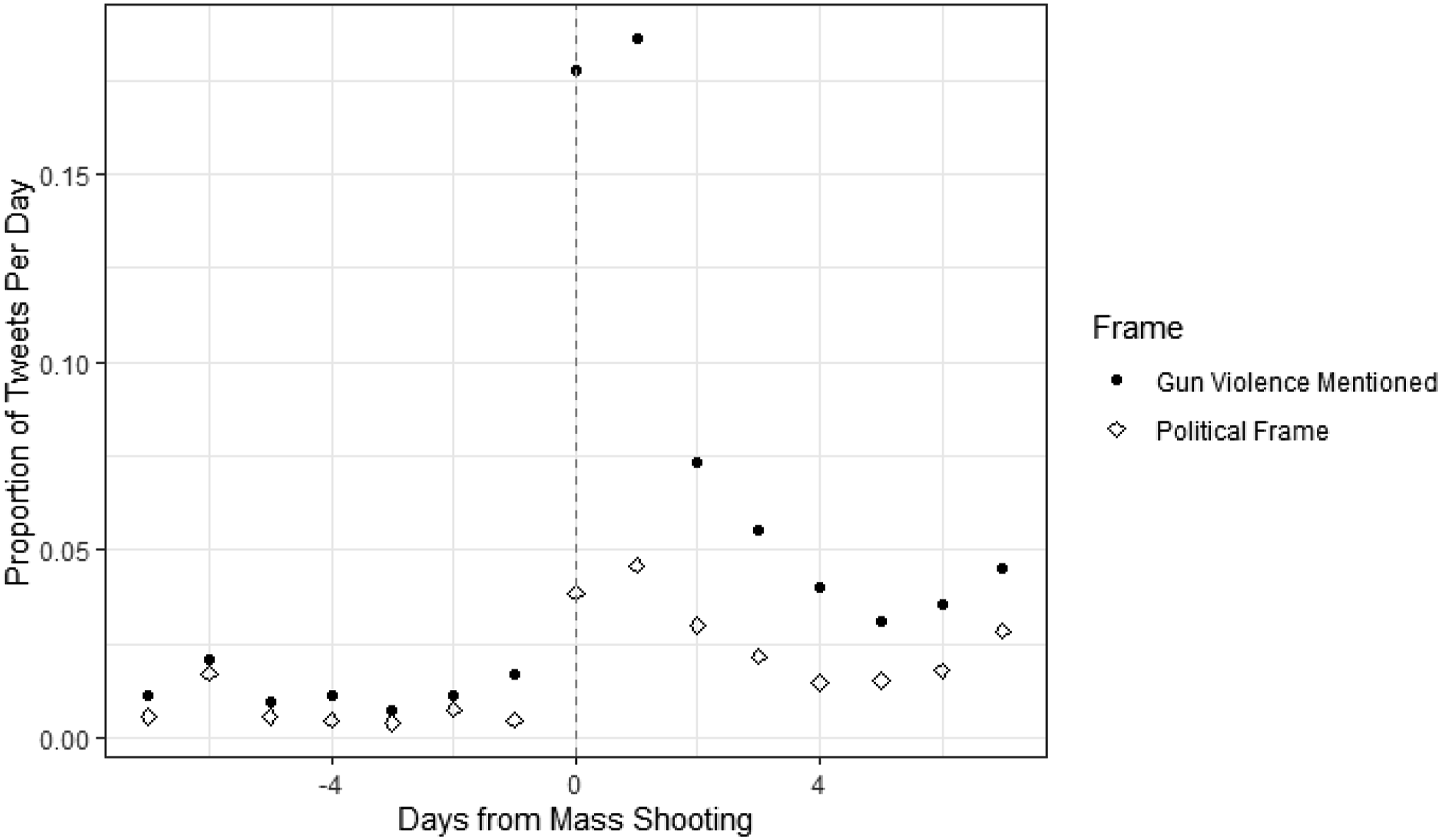
Racial Biases in Legislators' Post-Shooing Rhetoric: Findings
The first set of models in Figure 8 (left panel) tests whether the number of White mass shooting fatalities and REM mass shooting fatalities affect how much legislators discuss gun violence on Twitter.
22
This analysis aims to determine whether victims' race and ethnicity impact the overall quantity of gun violence-related tweets. The coefficient for the Number of White Fatalities is positive and statistically significant. The models suggest that ten White mass shooting fatalities led legislators to post approximately one additional gun violence-related tweet, on average, in the week after the shooting compared to the week before. Similarly, the Number of REM Fatalities coefficient is also positive and statistically significant. The models indicate that ten racial and ethnic minority fatalities led legislators to post about 0.5 additional gun violence-related tweets, on average. Although both coefficients are statistically significant, the impact of racial and ethnic minority fatalities on legislators' gun violence tweets is about half that of White fatalities, and robustness checks modeling that main independent variables as an interaction indicate that the differences are statistically significant (See SI-I). Marginal Effects of Mass Shooting Fatalities on the Proportion of Legislators' Tweets that are Violence-Related.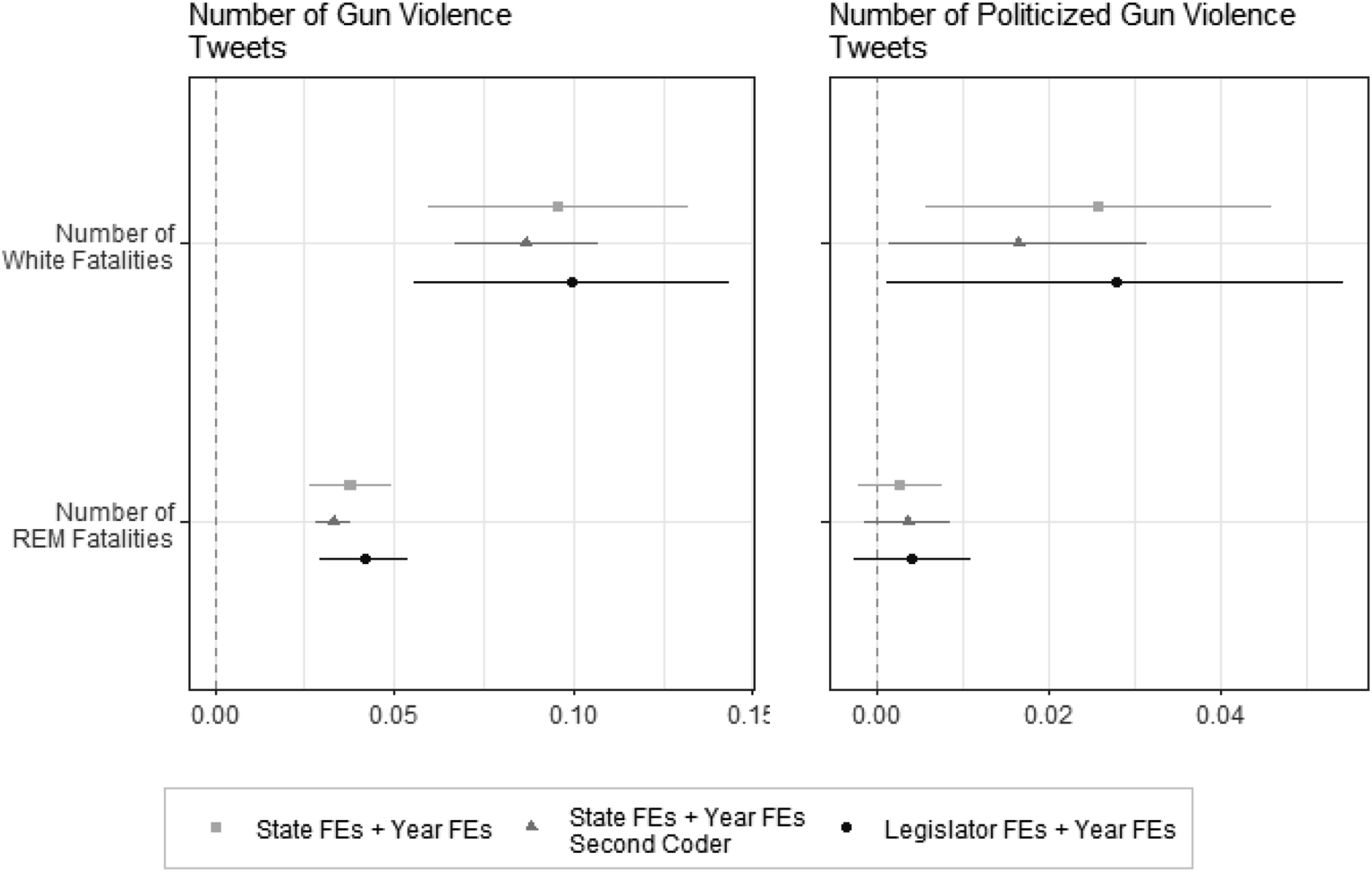
The second set of models in Figure 8 (right panel) explores how the number of White and REM mass shooting fatalities affects legislators' politicized discussion of gun violence on Twitter. The Number of White Fatalities coefficient is positive and statistically significant in all three models. The models suggest that ten White mass shooting fatalities lead legislators to post about 0.3 additional tweets discussing gun violence using political frames on average the week after the shooting compared to the previous week. Although this effect may appear small, this is about 1/3rd of a standard deviation in the pre-treatment period and the impact of racial and ethnic minority fatalities on politicized gun violence tweets is even smaller. The Number of REM Fatalities coefficient is positive but not statistically significant in any model. The models estimate that ten racial and ethnic minority mass shooting fatalities led legislators to post 0.1 more tweets discussing gun violence through a political frame the week after a shooting compared to the week before. However, when modeled as an interaction, the differences in effects are not statistically significant (See SI-I)
These findings support
Racial Biases in Interest Group Lobbying Responses: Data
I explore one more potential mechanism, gun policy interest group lobbying, because of its purported importance in gun politics (Goss 2010; Spitzer 2023). To examine whether gun policy interest groups respond to mass shootings in racially biased ways, I utilize state lobbying expenditure data from Follow the Money, covering the years 2012 through 2020. Lobbying expenditures serve as a measure of latent lobbying efforts. The dataset includes 11 states with lobbying expenditure data starting from 2012, which expanded to 19 states in 2014, encompassing states with multiple mass shootings, like California, Colorado, Florida, and Texas. Using all available data since 2012 results in an unbalanced panel of 19 states observed over seven to nine years. The lobbying data explored in this study is less complete and, therefore, less reliable than the gun policy data explored previously, so it is important to take extra care when interpreting and extrapolating from these findings.
I analyze lobbying expenditures for gun control and gun rights interest groups separately. Mass shooting data comes from The Violence Project, and the unit of analysis is state-year.
To better visualize the lobbying expenditure data, Figure 9 illustrates lobbying expenditures by interest group positions in states based on their partisan control. Interestingly, gun policy interest groups seem to lobby at higher rates in states with unified Democratic governments, and their spending fluctuates significantly from year to year within states. Yearly state lobbying expenditures by interest group position by state partisan control.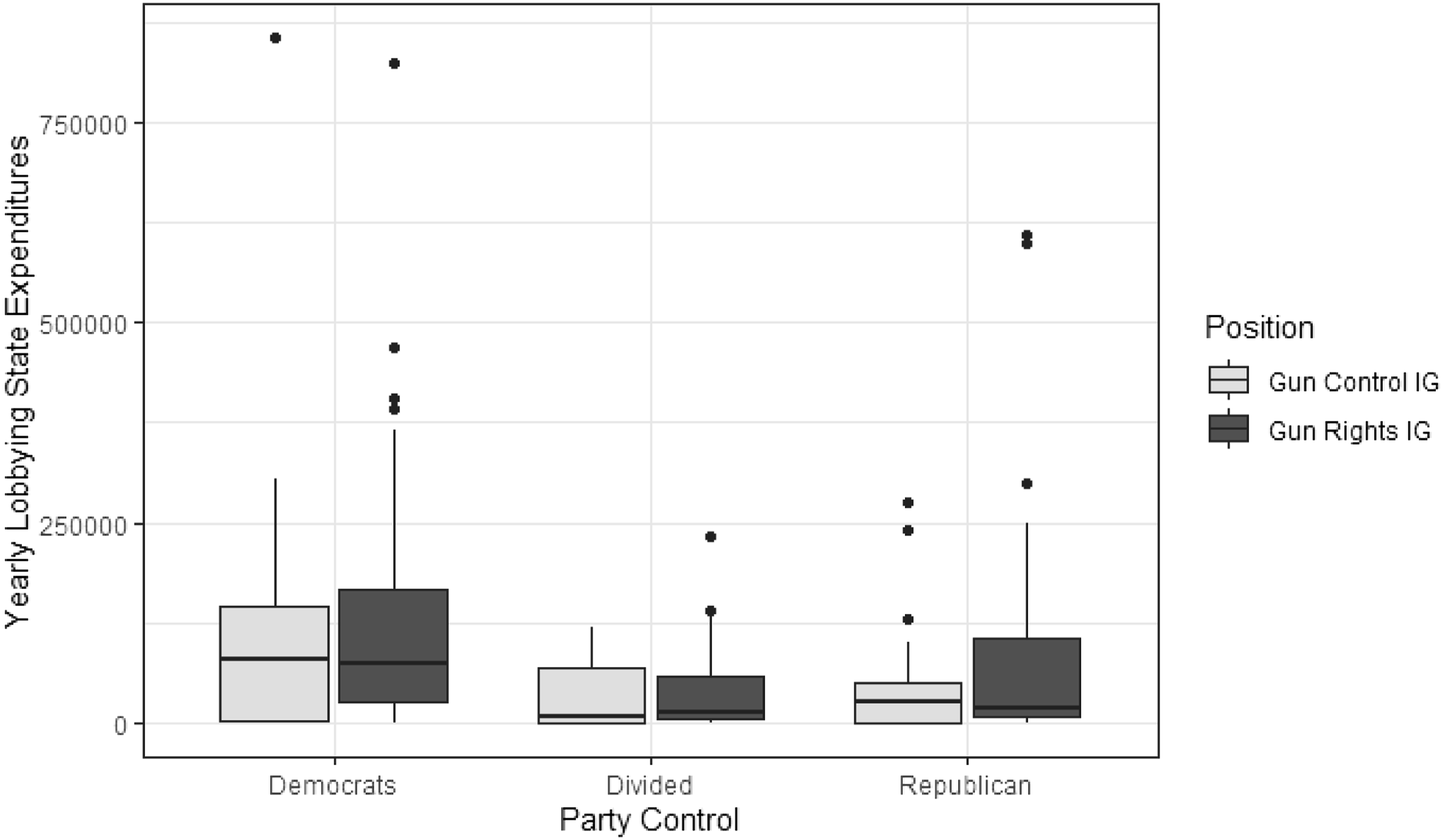
Like policy, mass shootings may influence interest group lobbying efforts that same year or the following year, with the timing partially affected by when the shootings occur within the calendar year. To address this possibility, the dependent variable is the total combined lobbying spending in years T and T+1, matching the primary empirical models in the first study. Therefore, the analysis estimates the effects of mass shooting fatalities by race in time T on lobbying spending that year and the following year.
Racial Biases in Interest Group Lobbying Responses: Methods
Like in the first study, I ran three sets of models. The first model specification includes only state and year-fixed effects. The second model incorporates a similar series of time-variant state-specific controls. In the third model, I add state-specific linear time trends. Results are largely robust when using new DID estimators developed by Liu et al. (2022) (See SI-J).
Racial Biases in Interest Group Post-Shooting Lobbying Response: Findings
The first set of models in Figure 10 (left panel) tests the effect of White fatalities and REM fatalities on gun control interest groups' lobbying spending.
23
These findings lend support to Marginal effects of mass shooting fatalities on gun policy interest groups' lobbying expenditures in states.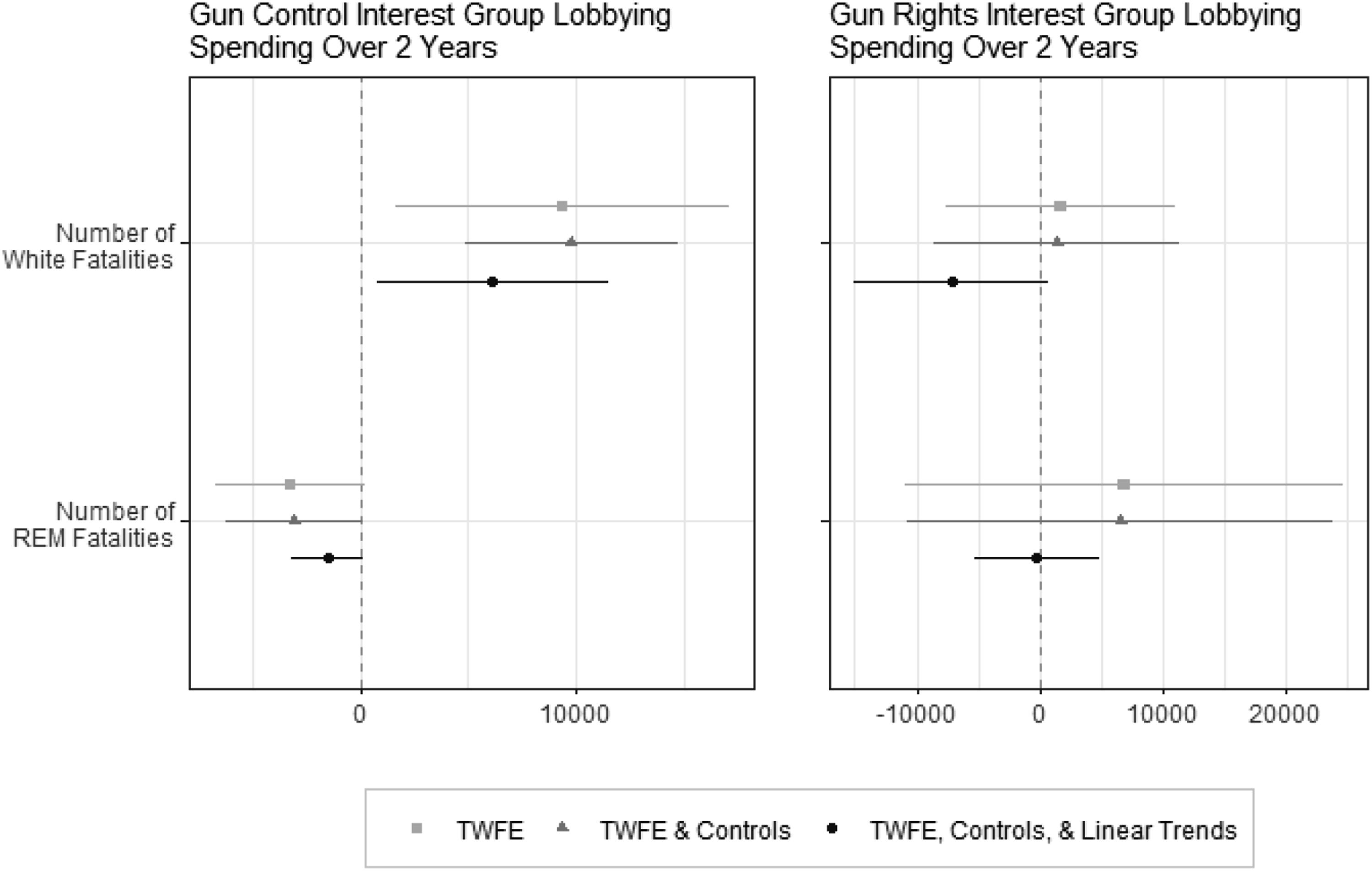
The Number of REM Fatalities coefficients are negative and nearly statistically significant in all three models. These models suggest that ten racial and ethnic minority fatalities lead gun control interest groups to spend between $15,000 and $30,000 less over the next two years lobbying the state. However, this latter finding falls short of conventional levels of statistical significance and is not robust to new DID estimators (See SI-J).
The second set of models in Figure 10 (right panel) tests the effect of White mass shooting fatalities and racial and ethnic minority mass shooting fatalities on gun rights interest groups' lobbying spending. These findings do not support
Overall, this analysis suggests that gun control interest groups spend more money lobbying state legislators in responses to mass shootings when victims are White but not when victims are racial and ethnic minorities. Gun rights interest groups' lobbying spending is not affected by either type of mass shooting fatality.
Discussion
This paper contends that victims' racial and ethnic identities shape state policy responses to mass shootings, and the empirical findings support this claim. White mass shooting fatalities and majority White mass shootings lead to stricter state gun laws, but racial and ethnic minority fatalities and majority–minority mass shootings have either a negative effect or no substantial effect on the implementation of new restrictive state gun laws. The results are robust to a wide range of modeling specifications (See SI-C through SI-G). Neither victims' age nor location explains these disparities. Robustness checks further suggest that the shooter's race and ethnicity are not biasing results or that the effects are strictly partisan (See SI-K; SI-L).
Elite behavior may help explain these disparate responses. State legislators discuss gun violence more in the days after an in-state mass shooting as White fatalities increase, but fatalities of color have a substantially weaker positive effect. Gun control interest groups spend more lobbying states in response to more White mass shooting fatalities but not more racial and ethnic minority mass shooting fatalities. Mass shootings do not appear to influence gun rights interest groups' lobbying efforts, irrespective of victims' race. We do not know if race affects gun control interest groups' lobbying because of internal implicit biases or because they respond strategically to legislators' signals and public opinion change. However, these racially disparate lobbying responses may ultimately impact the policy process.
Better understanding the causes of racial disparities in state gun policy responses to mass shootings presents a crucial opportunity for future research. Future studies may want to explore more carefully whether racially biased responses to mass shootings are driven by voters' demands, legislators' biases, media frames, interest group lobbying, or other causes.
This paper pushes us to think beyond conventional explanations, like NRA lobbying or political polarization, for gun policy inaction in the United States. It contends that the racialization of gun politics also matters. Gun rights narratives have leveraged racial resentment and disparities in gun violence victimization rates to frame gun control as a “special” benefit for people of color and a threat to White Americans, creating political barriers to gun restrictions. When mass shooting victims are White, these narratives can temporally shift, increasing political support for gun control. But when victims are people of color, racialized gun control narratives that impede change are unaffected. These findings indicate that victims' race and ethnicity may partially explain legislators' inaction on gun laws, even in the face of 45,000 gun deaths annually.
Moreover, the paper reveals that legislators tend to respond more compassionately to tragic events and public health crises when the victims are White, compared to when they are racial and ethnic minorities. The racially biased responses discovered in this paper are not unique to gun policy. For instance, differing responses to Hurricane Harvey and Hurricane Maria and the different policy tools used to address the opioid crisis compared to the crack epidemic reflect racial and ethnic inequities in government responsiveness. Further investigation into the causes of these disparities is essential to promote a more equitable and just democracy.
Footnotes
Acknowledgments
I would like to thank all the members of my dissertation committee—Marisa Abrajano, Dan Butler, Zoli Hajnal, LaGina Gause, Stephen Haggard, and That Kousser—for their instrumental insights. I would also like to thank the folks at Loyola University Chicago who provided valuable feedback, particularly David Doherty, Eric Hansen, and Sarah Maxey for their detailed contributions.
Declaration of Conflicting Interests
The author(s) declared no potential conflicts of interest with respect to the research, authorship, and/or publication of this article.
Funding
The author(s) received no financial support for the research, authorship, and/or publication of this article.
