




Abstract
What kind of moral rhetoric do national leaders use after their homelands are attacked by foreign forces? Informed by crisis leadership literature, this study uses Moral Foundations Theory (MFT) to examine the rhetoric of three leaders of nations before and after attacks by foreign forces: Ukrainian President Zelenskyy and the 2022 Russian invasion, U.S. President Bush and the September 11, 2001, terrorist attacks, and British Prime Minister Churchill and the 1940–41 German bombing campaign. The word-based automated content analysis shows that following the attacks the leaders substantially shifted their moral rhetoric. They also employed similar moral rhetoric, mainly by using Harm rhetoric, presumably to condemn the destruction and loss of life suffered by their nations. All three also emphasized Loyalty rhetoric, presumably as a call to nationalism, and Authority rhetoric, presumably to rally followership. Otherwise, they gave little attention to Degradation rhetoric, which presumably would demonize the enemy. This study is one of very few to evaluate political elite rhetoric during crises. It is also one of a small number to assess political elite rhetoric through the lens of MFT. It demonstrates that MFT can be a useful tool for understanding political elite rhetoric and crisis management across heterogeneous contexts.
Keywords
What kind of moral rhetoric do national leaders employ after their homelands have been attacked by a foreign power? One assumes that an attack would be viewed initially as unjust, warranting the use of strong moralistic language in response both to demonize the enemy and to unite the citizenry. But this research question is largely unanswered. Therefore, we analyze and compare the moral rhetoric of President Volodymyr Zelenskyy of Ukraine before and after Russian military forces invaded his country on February 24, 2022; U.S. President George W. Bush before and after the terrorist attacks in the United States on 9/11/01; and British Prime Minister Winston Churchill in 1940–41 before and after the German “Blitz” against England during World War II.
In this study, we assess pre- and post-attack speeches of these leaders using Moral Foundations Theory (MFT), which has been used to explain the psychological underpinnings of moral judgment and behavior. To date, there have been a limited number of studies of rhetorical leadership employing MFT to examine the type of morality being advocated by political, or other, elites to persuade stakeholders and the general public. Further, we use word-based automated content analysis, which allows us to quantify the similarities and differences between the three leaders.
Looking ahead, we begin with a review of literature, starting with the body of research on MFT and research regarding elite political rhetoric as viewed through the lens of MFT. We then review pertinent literature on leadership and crisis management. After detailing the context of the three attacks, we discuss our hypotheses, data sources, and methodology before turning to the results of our analyses. We conclude with a discussion of lessons learned and suggestions for future research.
Moral Foundations Theory and Elite Rhetoric
Moral language has a strong effect in the public realm. For instance, political elites’ moral messaging significantly affects public attitudes (Clifford & Jerit, 2013), and it is more likely to be diffused through political and social networks (e.g., Brady et al., 2019). Further, political elites vary their use of moral language based on their gain or loss of political power (Wang & Inbar, 2021). Given this salience, it is not surprising that Moral Foundations Theory (MFT; Graham et al., 2013) has been widely used in political science (e.g., Clifford & Jerit, 2013; Wendell & Tatalovich, 2021). Proponents argue it explains the psychological underpinnings of moral judgment and behavior as well as differences in political values and behaviors. Further, it highlights the complex moral and ethical dimensions of political behavior.
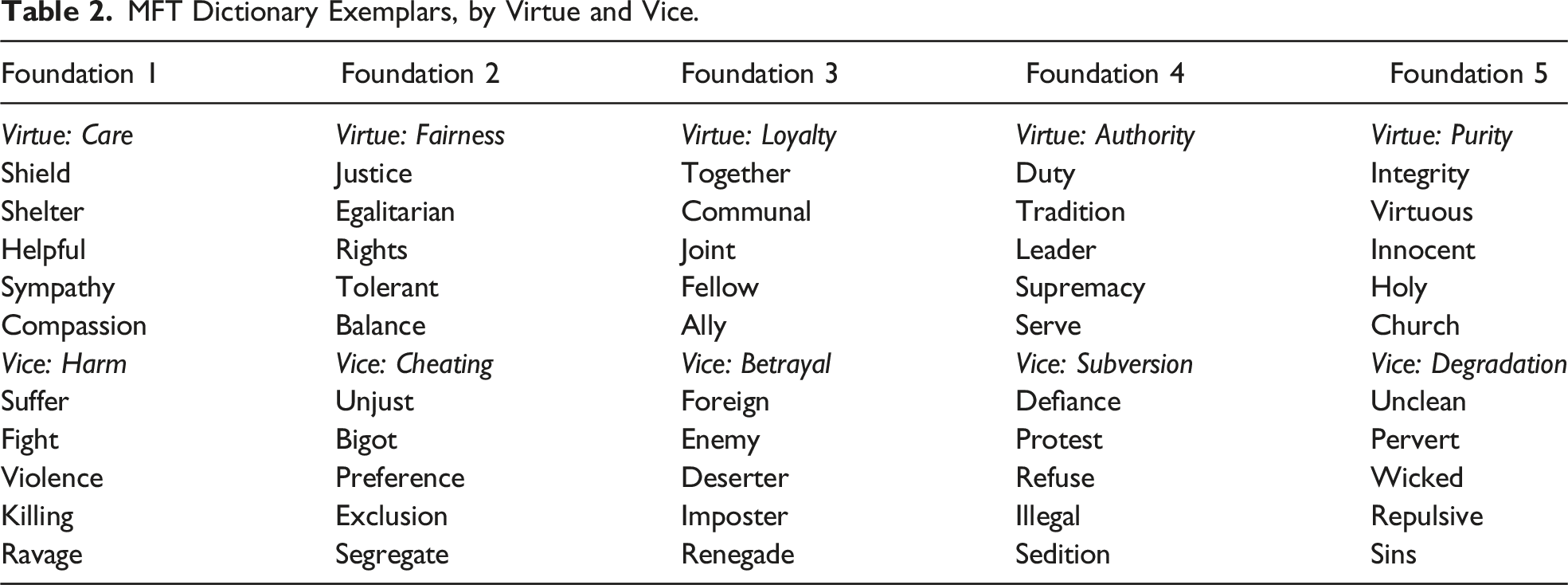
It is based on five foundations of morality, each with a positive (virtue) and negative (vice) connotation, which have application both historically and cross-culturally. The Care/Harm foundation, which pertains to helping others and avoiding danger, is indicated by such virtues as compassion, peace, and security and such vices as cruelty, violence, and killing. The Fairness/Cheating foundation, which pertains to treating others similarly, is indicated by such virtues as rightfulness, equality, and reasonableness and such vices as bigotry, favoritism, and prejudice. The Loyalty/Betrayal foundation, which pertains to supporting one’s group or community, is indicated by such virtues as familial, national, and membership and such vices as foreignness, betrayal, and deception. The Authority/Subversion foundation, which pertains to giving deference to social hierarchies, is indicated by such virtues as duty, law, and leader and such vices as dissension, illegality, and sedition. The Purity/Degradation foundation was shaped by the psychology of disgust and contamination and underlies religious notions of striving to live in a more elevated, noble way. It also underlies the widespread view that the body is a temple, and that the bodily and spiritual integrity of the individual should not be desecrated by immoral activities and contaminants. The Purity/Degradation foundation is characterized by such virtues as purity, innocence, and wholesomeness and such vices as lewdness, wickedness, and obscenity.
The Care/Harm and Fairness/Cheating foundations together comprise the individualizing foundations, and the other three foundations—Loyalty/Betrayal, Authority/Subversion, and Purity/Degradation—comprise the binding foundations of MFT (Haidt & Graham, 2007). In particular, the binding foundations, which are oriented toward group rather than individual behavior, focus on the necessity of groups to develop cohesion and order, which they accomplish by “[binding] people into roles, duties, and mutual obligations” (Graham et al., 2011, p. 368).
Graham et al. (2009, pp. 1045–1046) developed a Moral Foundations Dictionary (MFD) of keywords that designate positive (virtue) or negative (vice) expressions within each of the five psychological intuitions of MFT (also see Haidt & Graham, 2007). In early work, Graham et al. (2009, p. 1039) content analyzed the sermons in liberal Unitarian Universalist and conservative Southern Baptist churches. As expected, “liberals used Harm and Fairness words more frequently than did conservatives, whereas conservatives used Authority and Purity words more frequently than did liberals.”
Applying the same dictionary in the context of political elites, Sagi and Dehghani (2014) content analyzed U.S. Senate abortion debates (1989–2006) and found Democrats and Republicans prioritized different foundations, Fairness and Purity, respectively. Clifford and Jerit (2013, p. 665) similarly employed MFT to content analyze the debate over stem cell research among elites (e.g., the president, members of Congress, and scientists) as reported in the news media. They found that “proponents (liberals) used a greater proportion of Harm words than did opponents” whereas “opponents used a greater proportion of Purity words” than did the proponents. In the context of political campaigns, a study of political advertisements during 2008 showed that Democratic presidential candidates stressed Care and Fairness, while Republican presidential candidates emphasized Authority (Lipsitz, 2018, p. 68). Similarly, Hackenburg et al. (2023) found that Democratic presidential primary candidates relied more on care and justice for individuals in the social media accounts, while Republicans focused more on in-group loyalty and recognition of social hierarchies.
On the other hand, MFT did not differentiate between the Leftist and Rightist party manifestos in three European multi-party systems (Bos & Minihold, 2022) or between the Democrats and Republicans who participated in the 2015–16 presidential primary debates (Lewis, 2019). A final study is directly relevant to our analysis. In the wake of 9/11/01, Pilecki (2017) analyzed the anti-terrorism rhetoric in the speeches of Presidents G. W. Bush and Obama to show that both presidents used all the foundations to marginalize terrorists as murderers (Harm), unjust (Fairness), divisive (Loyalty), chaos causing (Authority), and a contagion (Purity). By segregating terrorists from the rest of humanity, Bush and Obama could justify a wider range of means of retaliation in their War on Terrorism.
Leadership Studies and Crisis Management
Leadership is fundamentally rooted in language and communication (Conger, 1991) insofar as the content of rhetoric is a “primary means through which the leadership relationship is developed and sustained” (Bligh et al., 2004a, p. 569). In their analysis of how leadership was forged through the content of speeches, Shamir et al. (1994, p. 25) concluded: “Despite apparent consensus about the importance of leader rhetoric, the topic has not received systematic attention from leadership scholars.” Particularly this is the case, though, regarding elite political rhetoric. There are some disparate studies, though. For example, Jerit (2004) examined the rhetoric of candidates in the 1988 Canadian federal election, finding that appeals based on emotions overshadowed the election’s rhetoric. Hermann (2005) presented a process for examining “what they say” in media interviews, suggesting the technique can be used to psychologically profile leaders. Andrews-Lee and Liu (2021) analyzed speeches by Argentine president Cristina Fernández de Kirchner, arguing that leaders can rebuild low public trust by evoking images of popular predecessors. Gaffney (1991) and the contributors to his edited volume examined party speeches of late-20th Century British leaders, pointing out the limits of and opportunities for personalized political leadership. Kane and Patapan (2010) briefly reviewed the rhetoric of several national leaders, concluding the suspicious nature of citizens in democracies causes their leaders to use “artless” or “plain factually informative speech” instead of “fine oratory” (p. 371). Others have taken a more linguistic approach. For instance, Fetzer and Bull (2012) evaluated 15 speeches by leading British politicians, finding that particular verb forms communicate messages of political competence and responsiveness. What these studies do not meaningfully address, though, is elite political rhetoric during crises.
During crises, leaders strategically use words to manage information and meaning. In particular, managing meaning, which this study focuses on, is trying to influence how people perceive the crisis. Some scholars have argued that leadership as the “management of meaning” is “realized in the process whereby one or more individuals succeed in attempting to frame and define the reality of others” (Smircich & Morgan, 1982, p. 258). The primary factor in people’s perceptions of a crisis is how much responsibility can be attributed to the organization or actor at the center of the crisis, from “victim” crises, where little to no responsibility is attributed, to “intentional” crises, where substantial responsibility is attributed (Coombs, 2018).
What may have more relevance for this analysis are those previous studies of leadership during crisis, variously termed crisis leadership (Wu et al., 2021), crisis rhetoric (Nord & Olsson, 2013), or crisis exploitation (Boin et al., 2009) within the broader domain of crisis management (Boin et al., 2010). But once again, those studies rarely focused on political leadership. In a comprehensive overview of 168 articles on crisis leadership by Wu et al. (2021), the vast majority studied private-sector business and corporate leaders and stakeholders—only two articles were drawn from Public Administration Review.
One study of 15 cases that did involve political leadership (including 9/11/01) argued that “framing contests” determined whether those efforts at “crisis exploitation” ended in success or failure. According to Boin et al. (2009, p. 82), crises “typically generate a contest between frames and counter-frames concerning the nature and severity of crisis, its causes, the responsibility for its occurrence or escalation, and implications for the future. Contestants manipulate, strategize and fight to have their frame accepted as the dominant narrative.” Indeed, Entman (1993, p. 52) argues that framing is designed “to promote a particular problem definition, causal interpretation, moral evaluation [emphasis added], and/or treatment recommendation.” From that perspective, President Bush’s framing of 9/11/01 boosted his stature and led to significant policy changes (e.g., creating the Department of Homeland Security). Yet only 4 years later, his reputation was severely damaged (Boin et al., 2010, p. 707) “in what is widely considered to be one of the worst failures of crisis leadership in recent U.S. history (the response to Hurricane Katrina).” Those divergent outcomes resulted from the different contexts of each crisis, as Davis and Gardner (2012, p. 927) explain. “The September 11th crisis presented a threat from a human enemy, which rhetorically was perhaps easier for President Bush to identify, providing a unifying ‘us versus them’ effect on followers.” But “in the case of Hurricane Katrina, it may have been more difficult for President Bush to frame ‘mother nature’ or an ‘act of god’ as a threat from an enemy.”
In other words, a natural disaster could not be framed as a moral battle between good and evil, as President Bush argued in his televised speech from the White House on the evening of 9/11/01. He depicted the terrorist attacks “as acts of evil, giving a moral dimension to the nation’s tragedy and allowing for the introduction of one of the main organizing devices of the oration: the opposition between differing values and qualities” (Kuś, 2020, pp. 47–48).
About a decade after 9/11/01, another terrorist attack occurred in Norway. A right-wing extremist bombed a government building and then began a shooting spree at a youth summer camp that resulted in the death of 77 people (Olsson et al., 2015). The Norwegian government survived this crisis. It deployed three rhetorical frames in response to the massacre: (1) “managerial,” to assure the public that the government was in charge; (2) “responsibility,” to emphasize that the attack was the work of one man, not a network of terrorists and, pertaining specifically to this study, and (3) “cultural congruence,” to characterize the attack as directed against the Norwegian society and its values.
The crucial role of framing in crisis leadership also was underscored by the ability of a center-right government in Sweden to overcome the 2008 global financial crisis and win re-election (Nord & Olsson, 2013). It employed three similar frames: “responsibility,” to note the financial crisis began in another country; “managerial,” to highlight Sweden managed the crisis better than most countries; and, pertaining specifically to this study, “moral,” to show the government defended ordinary people against greedy private banks. Three of these frames have relevance for our study. First, “actors prefer exogenous crisis causal frames because these allow actors to locate blame outside their own realm” (p. 89), and a military invasion is the most obvious example of exogenous causation. Second, the government “promoted itself as a symbol of national unification by engaging the opposition in a quest for political consensus across party lines” (p. 89), and national unity is often a top priority of national leaders during wartime. Third, the governments specifically used morality as a frame to manage the meaning of the crises.
Concluding this literature review, it is worth nothing that to our knowledge none of the research on leadership and crisis management employed MFT to content analyze crisis rhetoric. Thus, this study breaks new substantive ground insofar as the extant scholarship offers few if any insights to guide our hypothesis-building and analysis.
Three Case Studies
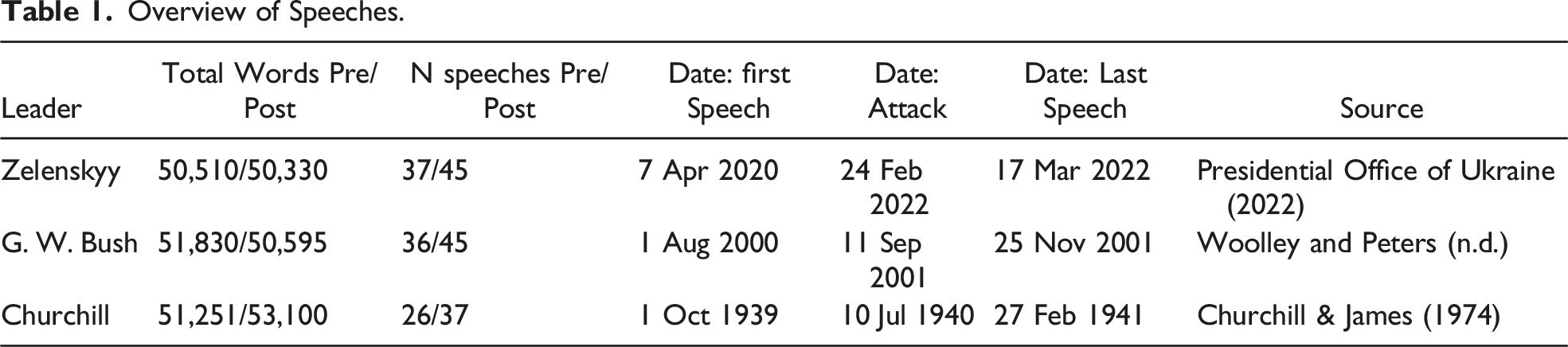
The three cases were selected because (1) each represents an instance when a country’s homeland was attacked by a foreign power, and (2) seemingly complete and reliable sets of transcripts of the national leader’s pre- and post-attack public speeches are available in English. These criteria, one motivated by theory and the other by the method of analysis, significantly limit the number of available cases.
Zelenskyy and the Russian invasion of Ukraine (2022)
Volodymyr Zelenskyy became President of Ukraine on May 20, 2019. He campaigned on an anti-corruption platform and, regarding his country’s long-term tensions with Russia, supported diplomacy toward Russian-backed separatists in eastern Ukraine. Once a republic within the USSR, Ukraine became independent when the Soviet Union was dissolved in 1991 but retained close ties with its neighbor Russia. But tensions developed between the two countries, because Russia considered Ukraine within its sphere of influence. Amidst continuing tensions in 2020, Zelenskyy approved a new National Security Strategy that provided for a partnership and then membership in NATO, an action which Russia said threatened its national security. In February 2021, Russia deployed 3000 paratroopers to the Russia-Ukraine border. In response the following month NATO began military exercises, which prompted Russia to begin a sizeable troop buildup along the Russia-Ukraine border. Several incidents further escalated tensions between the two countries, eventually leading to the Russian invasion on February 24, 2022.
Bush and the terrorist attacks on the US (2001)
On September 11, 2001, almost 3000 people were killed in the deadliest terrorist attack in American history. Two planes hijacked by Islamic jihadists crashed into the twin towers of the World Trade Center in New York City. A third plane was flown into the Department of Defense’s Pentagon, and a fourth plane was diverted by passengers and crashed in an empty field in southwestern Pennsylvania. President Bush, who had been talking to elementary school children in Florida, immediately left for Washington, D.C., and ordered all U.S. airspace closed to civilian aircraft. At 8:30 pm that day he addressed the nation, the first of many speeches he would make about the attack.
Churchill and the German bombing of London (1940)
In September 1939, the Germans invaded Poland, which provoked France and Great Britain to declare war against Germany. In April 1940, the Germans attacked Norway, which largely precipitated the elevation of Churchill to Prime Minister. The German blitzkrieg of France, Belgium, and the Netherlands began the day that Churchill took office. On the continent, the German advance forced the Allies to withdraw to the coast, when their evacuation from Dunkirk began on May 26 through June 4. By late June, the Netherlands, Belgium, and France had surrendered. Thus, Great Britain at this time stood alone since the Soviet Union and the United States had not entered the war yet. Three months later the Battle of Britain commenced with a sustained German bombing campaign (the “Blitz”) across England and especially London. September 7, 1940, began 56 days of continuous day-and-night bombing that lasted 8 months until May 11, 1941. This was the critical period when Prime Minister Churchill gave some of his most powerful and memorable speeches.
Hypotheses
Rathbun and Pomeroy (2022, p. 656) claim “it is almost impossible to talk about threat and harm without invoking morality” in international relations. In analyses of financial and terrorism crises, Olsson and co-authors concluded that Norwegian leaders used rhetorical frames that included “cultural congruence” with the country’s values (Olsson et al., 2015) and “morality” (Nord & Olsson, 2013). Analyses of terrorist attacks in the United States and France led Bastardoz et al. (2022, p. 16) to conclude that crisis leaders “have the latitude to focus on a common enemy … by communicating values that differentiate the good and the bad” and, in doing so, “champion the collective and show that they share their followers’ feelings.” In particular, an individual-level analysis of MFT and foreign policy attitudes showed that “moral frames may be one technique decision makers can employ to mobilize support for their desired foreign policy options” (Kertzer et al., 2014, p. 838). Consistent with these conclusions, we propose five hypotheses that are gleaned from our discussion of the geo-political context of the three case studies and informed by the scholarship on crisis leadership and the logic of MFT.
From a communication perspective, crises have two phases, pre- and post-crisis, and each phase requires different approaches by crisis managers (Coombs, 2018; for a non-communication perspective see, for example, Brecher & Wilkenfeld (1997)). As such, it is commonsensical to conclude that an armed attack on a country influences the moral rhetoric of its leader. Such a provocation would call forth a period of crisis management which, according to past experience, often prompts a “blame game” between critics and the government (Brändström & Kuipers, 2003), whose leaders would try to develop rhetorical frames to protect and enhance their political standing. But an enemy invasion is not “typical” of the kinds of crises that confront governments, since the line of causation is obvious, and responsibility can readily be assigned to external actors. Though the literature is not clear regarding how national leaders in this context would change their moral rhetoric, there are precursors that offer some hints.
An especially poignant episode was the Russian invasion of Crimea (then a Ukrainian territory) in February 2014, a pivotal flash-point that escalated tensions between Ukraine and Russia. A before-and-after textual analysis of the rhetoric used by Ukrainian leadership showed that with “the start of conflict with Russia in March 2014, there was a 6% increase in nationalist rhetoric couched in political issues” (Kasianenko, 2021, p. 120). Content analysis of speeches by French President François Holland before and after terrorist attacks in Paris and Nice during 2015–16 also found that President Holland increased his use of charismatic rhetoric (Bastardoz et al., 2022).
A textual analysis of speeches by President Bush before and after the 9/11/01 attack showed a dramatic change in content and tone insofar as his “speeches were more likely to reference the American people as collective and incorporate more patriotic, faith-based themes. In addition, the President’s post-crisis speeches were more aggressive and less ambivalent when compared with those given in the first 9 months of his administration” (Bligh et al., 2004a, p. 565; also see Bastardoz et al., 2022). According to Bostdorff (2003, pp. 301–302), his use of religious themes “portrayed the U.S. citizenry as a special people watched over by a benevolent God; depicted external evil that necessitated a new national mission; optimistically urged the need for a renewal of the national covenant, particularly by the younger generations; described September 11 as a successful test of character and opportunity for cultural change; and encouraged acts of faith and ‘good works’.” Changes in nationalist and charismatic rhetoric as well as increased references to citizens as a collective and patriotism and faith-based themes directly connect with moral foundations (e.g., Loyalty, Authority, and Purity). Thus, these studies suggest:
The moral rhetoric employed by national leaders in speeches before an attack on their homeland differs markedly from their moral rhetoric in speeches given after an attack on their homeland.
It may seem obvious to some that leaders’ moral rhetoric in such a situation would change. But testing this intuitive hypothesis is useful to confirm that the attacks nontrivially affected the leaders’ rhetoric, and that the methodology used can detect it. Put otherwise, it is useful because null results here would significantly undermine other findings or conclusions. Kertzer et al. (2014, p. 838) found that a foreign policy of “cooperative internationalism” embodies humanitarianism and multilateralism, while a foreign policy of “militant internationalism” uses force to protect the community. Kertzer implies that when a nation suffers an armed attack, the body politic and its leadership would rally-round-the-flag and embrace militant internationalism. In particular, the rallying effect should include a wide range of a country’s values including multiple dimensions (or foundations) of its moral values. Research on U.S. presidential reactions to international conflicts shows that an assertive response is the norm since the public expects the United States to show strength when under attack (see Bostdororff, 1992). For example, advocates of militant internationalism were more supportive of the Iraq War and the use of military force against a nuclear Iran than were advocates of cooperative internationalism (Kertzer et al., 2014, p. 832). When a nation suffers an armed attack, presumably the body politic and its leadership would rally to common moral values, which suggests:
National leaders of countries that have recently been the victim of an attack on their homeland are likely to express similar types of moral rhetoric in their public speeches. The following three hypotheses focus on the use of binding foundations, which serve to promote group cohesion and order in pursuit of group survival (Graham et al., 2011). If a leader’s purpose is to unify the citizenry of a country under siege, as suggested by Nord and Olsson (2013), then which foundation might seem most appropriate for a national leader to employ? Since nationalist rhetoric is an especially powerful tool for mass mobilization in times of war (Cederman et al., 2011), a promising candidate would be the Loyalty Foundation. The MFT dictionary for the Loyalty Foundation includes such “virtue” words as nation, homeland, patriot, unite, and insider (Graham et al., 2009, p. 1045). This speculation leads to:
National leaders of countries that have recently been the victim of an attack on their homeland are likely to express moral rhetoric that emphasizes the “virtues” of the Loyalty Foundation. There is also research that shows “direct empirical evidence for a link between crisis and charismatic leadership” (Bligh et al., 2004b, p. 215). Not only because “followers attribute positive characteristics to leaders by their mere presence at the helm during a crisis situation” (Bastardoz et al., 2022) but also because leaders employ more charismatic language in their public rhetoric. In an experimental design involving President G. W. Bush and a (post-9/11/01) terrorist threat, Merolla et al. (2007, p. 39) found that “crisis conditions magnify perceptions of charisma” because “during times of crisis, individuals look for a strong, confident leader, and they project additional power, morality, and competence onto that individual. They further become more willing to overlook policy mistakes and to volunteer their personal resources for the leader’s purpose.” Since many of the “virtue” words in the MFT dictionary for Authority are indicative of leadership, such as respect, command, order, control, and position, this suggests that to rally the public around their leadership:
National leaders of countries that have recently been the victim of an attack on their homeland are likely to express moral rhetoric that emphasizes the “virtue” of the Authority Foundation.
The crisis communication literature in general (Coombs, 2018) and Olsson and his co-authors specifically note a consistent rhetorical frame in crisis response is to attribute responsibility for a crisis (Nord & Olsson, 2013; Olsson et al., 2015), usually to others. In the case of international conflict, the “others” often are evil actors worthy of demonization (Normand, 2016). Regarding demonizing the enemy, there is evidence that the “vices” associated with the Purity/Degradation Foundation are likely to be used by a national leader whose country is under siege. Purity engages disgust, the emotion that drives the Behavioral Immune System (BIS), which detects infectious pathogens, triggers emotional and cognitive responses, and facilitates avoidance (Schaller & Park, 2011, p. 99). But the BIS extends beyond physical health. As Haidt et al. (1997, p. 121) explain, “disgust has extended among Americans to become not just a guardian of the mouth, but also a guardian of the ‘temple’ of the body, and beyond that, a guardian of human dignity in the social order.” Several MFT studies indicate that “foreigners” are the target of disgust (e.g., Navarrete & Fessler, 2006), which is among a list of “vice” words in the MFT dictionary regarding Purity including indecent, ruin, profane, obscene, and filth. This research, then, suggests that national leaders will seek to demonize those enemies who attacked their homelands:
National leaders of countries that have recently been the victim of an attack on their homeland are likely to express moral rhetoric that emphasizes the “vices” of the Purity Foundation (Degradation).
Data and Methods
We use MFT word-based automated content analysis to provide quantitative measures of each of the five types of MFT morality. This will allow us to compare the moral rhetoric of Zelenskyy to that of Bush and Churchill. Second, we content analyze not only the total words embodied in each MFT foundation but also the words that signify the positives (virtues) and negatives (vices) within each foundation. This will allow us to address the specific expectations in some of our hypotheses.
Data
The vast majority of research on MFT has been individual-level studies (e.g., Kertzer et al., 2014; Navarrete & Fessler, 2006) based on experimental designs, opinion surveys, and convenience samples of college students or online respondents. To date, there have been only a small number of studies that applied MFT to elite rhetoric. We add to those studies.
Overview of Speeches.
Method
This study uses word-based automated content analysis. In general, automated content analysis limits human input thereby likely reducing the influence of human biases and variability. As well, due to the close detail in which it can examine text, it can pick up patterns that may not be detectible by human coders (Bligh et al. 2004).
MFT Dictionary Exemplars, by Virtue and Vice.
The analyses are conducted using R and the open-source Quanteda package (Benoit et al., 2018). The analytic process follows a conventional bag-of-words process in which a unit of analysis was selected (words), the texts were tokenized (by word), complexity was reduced (converting the text to all lowercase, removing punctuation and English stop words, and stemming to create equivalent classes), and a document-feature matrix was created (Grimmer et al., 2022, ch. 5).
Results
Following H1, the first step is to establish whether the leaders’ moral rhetoric changed after their homelands were attacked. The Online Appendix reports the mean percentage of each of the 10 subcategories of moral foundations rhetoric for each leader pre- and post-attack along with a pre- versus post-attack difference of means test for each subcategory. H1 suggests there should be statistically significant differences in the leaders’ use of moral words before and after their countries were attacked. All tests of statistical significance, here and later, are based on two-tailed tests.
The Online Appendix shows that of the 10 subcategories, Zelenskyy’s use statistically differed pre- and post-attack with two subcategories differing at conventional levels of statistical significance (p < 0.05, Harm and Loyalty), and four differing at marginal levels of statistical significance (p < 0.10, Fair, Betray, Authority, and Subversion). Bush’s use statistically differed at conventional levels for three subcategories (Harm, Betrayal, and Purity), while Churchill’s statistically differed at conventional levels on four subcategories (Harm, Loyalty, Betrayal, and Subversion) and at a marginal level on one (Degradation).
It also reports the mean percentages and difference in means tests for the aggregated vice-related words used by each leader pre- and post-attack. This should provide a more reliable estimate of the underlying moral rhetoric than any single subcategory. The vice subcategories include Harm, Cheat, Betray, Subvert, and Degrade. The Online Appendix shows Zelenskyy increased his use of vice-related words for four of the five subcategories (Harm, Cheat, Betray, and Subversion but not Degrade) by 26.7% (p < 0.05) post-attack versus pre-attack (see column POST-PRE DIFF). It also shows Bush increased his use of vice-related terms for four of the five subcategories (all but Cheat) by 29.5% (p < 0.05), while Churchill increased his use of vice-related words for three of the five subcategories (all but Harm and Degradation), but his aggregate use dropped by 8.6% (p < 0.10). These bivariate results support H1 and suggest that leaders’ moral rhetoric did differ pre- and post-attack, but that the effects across leaders were not entirely consistent.
Interrupted time series (ITS) provides another means to test the robustness of the differences. ITS is a strong quasi-experimental method that controls for the effects of time in a time series, as the speeches are in these data. It includes chronological observations on a variable before and after an intervention (Shadish et al., 2002). In particular, it detects changes in the level (intercept) and rate of change (slope) of the variable that may be associated with the intervention. It assumes that the level and rate of change of the variable would remain constant without the intervention. This study uses segmented-regression ITS (e.g., Taljaard et al., 2014) to estimate the effects of the attacks on the leaders’ use of vice-related words. The estimates are derived from generalized least squares (GLS) regression using maximum likelihood estimation to permit adjustments for autocorrelation. Durbin-Watson tests and autocorrelation function plots informed the adjustments. In general, ITS includes a variable that accounts for the slopes of the pre- and post-intervention time series, TIME and TREND, respectively, and post-intervention change in the intercept or level, LEVEL. In this study, LEVEL is the primary variable of interest. It represents the change in the level of vice-related words following the attack or, more technically, a change in the intercept of the regression equation following the intervention.
ITS Segmented-Regression Predicting Mean Percentage of Vice-Related Words.

Note: *p < 0.05, + p < 0.10. Standard errors in parentheses.
Figure 1 visually summarizes the ITS results. The x-axis presents the chronological order of the speeches. The y-axis indicates values of the dependent variable, the logged percentage of vice-related words used. The dashed vertical line indicates the interruption, that is, the attack. The horizontal regression line preceding the vertical line shows the use over time of vice-related words leading up to the attack, while the horizontal regression line following the vertical line shows the use over time of vice-related words following the attack relative to their use prior to the attack. The break in the regression line at the dashed vertical line, which indicates the attack, shows the effect of the attack (LEVEL) on the pre-attack trend (TIME). The results reported in Table 3 and Figure 1 show the significant changes in vice-related words. Consistent with the bivariate analyses, both Zelenskyy and Bush significantly increased their use of vice-related words, while Churchill significantly decreased his use. These multivariate analyses support H1 and suggest that leaders’ moral rhetoric did differ pre- and post-attack, but that the effects were not consistent in direction. ITS depiction of effects of interventions (attacks).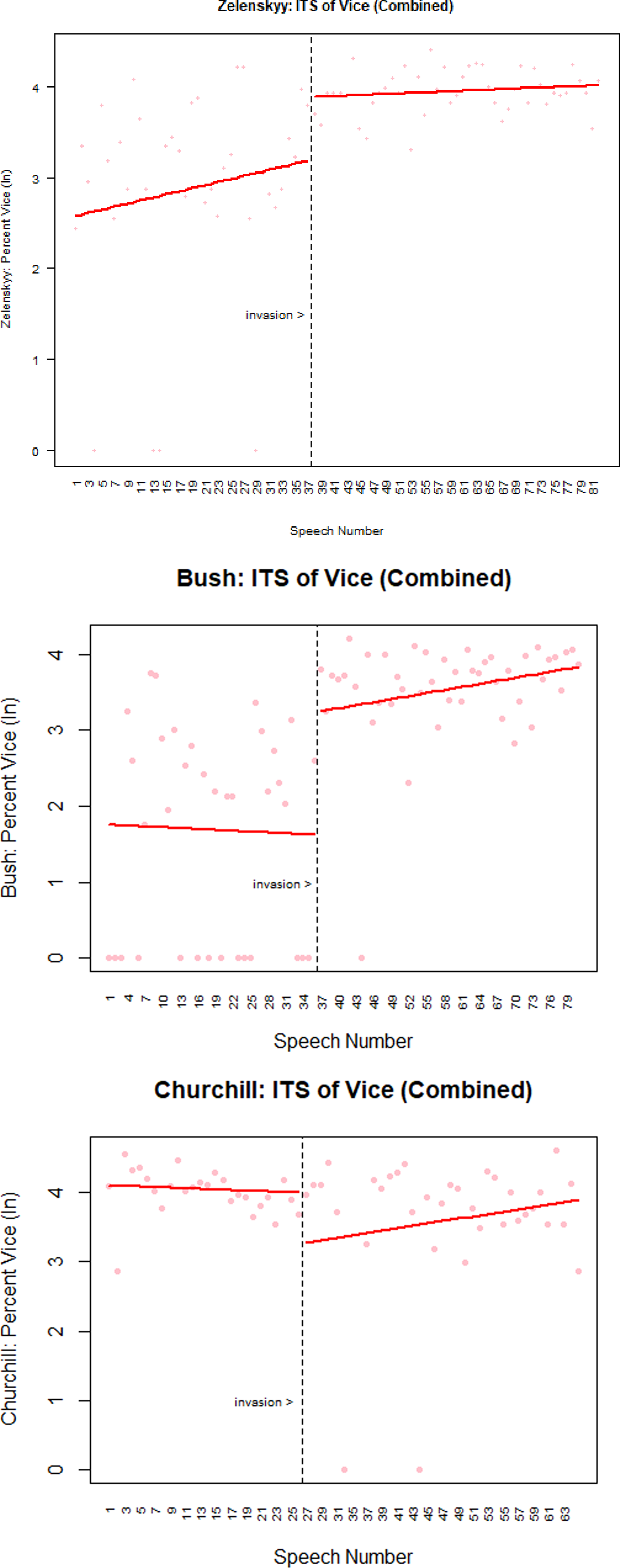
Overall, the bivariate results presented in Online Appendix and the multivariate results presented in Table 3 support H1. These leaders appear to have used different moral rhetoric after the attacks on their countries than before the attacks.
Following H2, the next step is to assess how similar (or not) the leaders’ moral rhetoric was after their homelands were attacked. The Online Appendix reports the mean percentage of MFT words used by each leader post-attack (see column POST Mean). For instance, it shows that 16.5% of Zelenskyy’s moral rhetoric post-attack was Care related, while 8.4% of Bush’s and 7.8% of Churchill’s were Care related. Figure 2 depicts the mean proportion of each subcategory’s use by each leader across the 10 subcategories in his post-attack moral rhetoric. For example, the black line shows that of the MFT-related words Zelenskyy used following the Russian invasion of his country, almost 20% were related to Care and almost 50% were related to Harm. The solid gray line depicts Bush’s usage, and the dashed gray line depicts Churchill’s usage. The figure visually suggests the distributions of words used by the leaders are similar. Post-attack proportion analysis of total MFT words, by subcategory.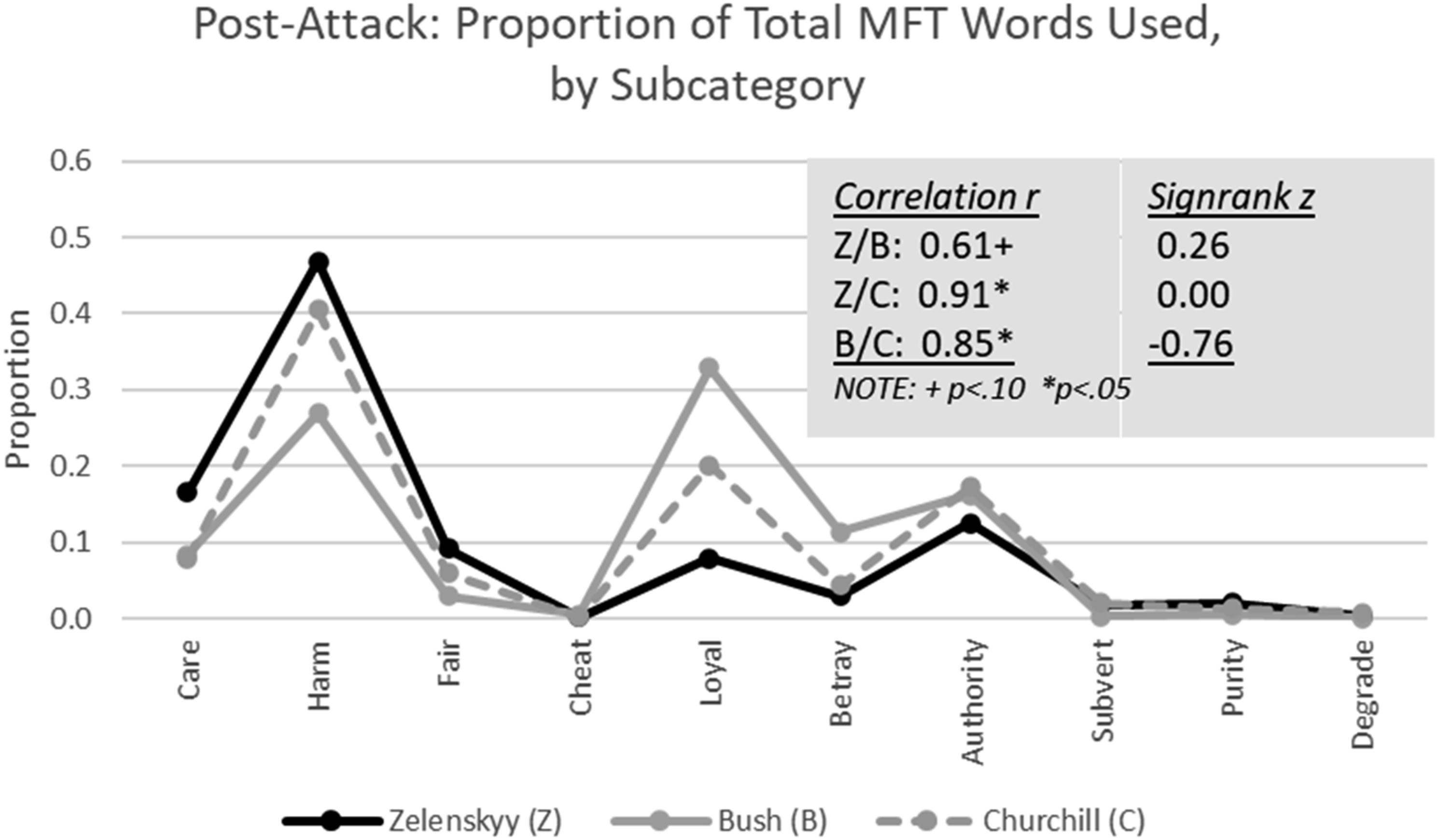
Statistical analyses are consistent with the visual inspection and indicate the distributions are meaningfully and statistically correlated. H2 suggests that the series of proportions of subcategories should be correlated. Figure 2 reports the series of subcategories of post-attack percentages for each leader are substantively and statistically correlated with strong correlations between Zelenskyy and Churchill (r = .91, p < 0.05; black and dashed lines) and Bush and Churchill (r = .85, p < 0.05; gray and dashed lines) and a moderate correlation between Zelenskyy and Bush (r = .61, p < 0.10; black and gray lines). H2 also suggests that the distributions of post-attack, MFT-related word usage should be the same. As reported in Figure 2, Wilcoxon matched-pair signed-rank tests provide no statistical evidence that the three series’ distributions are different (maximum z = −0.76, p = 0.44). Together, this evidence supports H2. These leaders appear to have used similar patterns of moral rhetoric following the attacks on their countries.
MFT Subcategories by Post-Attack Rank, by Mean Rank.
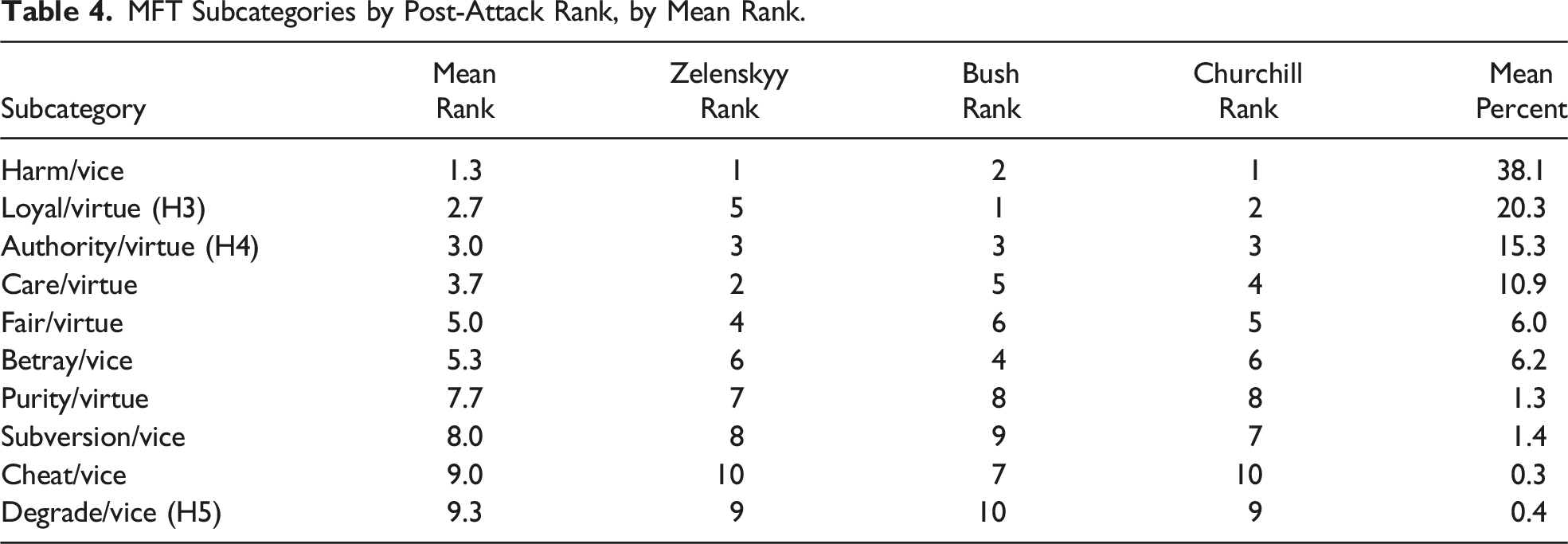
H4 states that leaders of countries that have been recently attacked will emphasize Authority morality. Table 4 shows that all three leaders used Authority rhetoric the third highest percentage of the time post-attack giving it a mean rank of 3.0. Authority comprised 15.3% of the leaders’ moral rhetoric on average, placing it noticeably below Harm and Loyalty rhetoric but about 40% above the next highest subcategory, Care. Given its mean rank and mean percentage use relative to the other seven subcategories, it is reasonable to conclude that the results support H4 and that the leaders did emphasize Authority morality post-attack.
H5 states that leaders of countries that have been recently attacked will emphasize Degradation morality. Table 4 shows that the three leaders used Degradation rhetoric the lowest (Bush) or next to lowest (Zelenskyy and Churchill) percentage of the time post-attack. It comprised less than 1.0% of the leaders’ moral rhetoric on average. These results fail to support H5 and the assertion that leaders will emphasize Degradation morality post-attack.
Discussion
The results support four of the five hypotheses. H1 is supported insofar as the moral rhetoric employed by the three leaders before the attacks were markedly different from their moral rhetoric afterwards. Although we did not formalize any expectation on what kind of moral rhetoric would be expressed before the attacks, our speculation would have been that national leaders would emphasize Care and seek to address the domestic needs of their citizens, as the Online Appendix somewhat suggests Bush and Zelenskyy did. On that score Churchill is an outlier. But his pre-attack speeches were dominated by ongoing war, not peace. Britain declared war on Germany before Churchill became Prime Minister on May 10, 1940, when he immediately had to cope with the Dunkirk Evacuation that began on May 26. Thus, Churchill’s pre-invasion rhetoric was the rhetoric of a nation at war even if the Battle of Britain had not yet been launched.
H2 is also supported as the evidence presented in Figure 1 suggests that the leaders used similar distributions of moral rhetoric after being attacked. While, for instance, Bush stood out from the other two in terms of the percentage of vice-related words used post-attack, 39.1% versus 52.0 and 47.8, respectively, Wilcoxon matched-pair signed-rank tests provide no statistical evidence that the three series’ distributions are different in terms of the rank of each subcategory’s use relative to other leaders’ use of that subcategory. These leaders’ post-attack rhetoric was morally quite similar despite the multi-decade time difference in when the words were uttered.
We also find support for Hypothesis 3. Bush and Churchill emphasized the “virtues” of the Loyalty foundation between a fifth and a third of the time according to the Online Appendix. Zelenskyy, on the other hand, used Loyalty less than a tenth of the time, though he still used it the fifth most often of the 10 subcategories according to Table 4. Zelenskyy, then, was a bit of an outlier in regard to Loyalty. This may have been the result of the zero-sum nature of the measures in which his dramatic increase in use of Harm morality had to be offset, and Loyalty was the primary contributor to the offset. He may have felt that the Ukrainian citizenry was unified after years of confrontation with Russia and, particularly, the Russian annexation of Crimea in 2014, and that he needed to devote more energy to drawing attention to the attack to attract more international support. H4 is also supported by our findings. The three leaders all expressed moral rhetoric based on the “virtue” vocabulary of the Authority foundation at levels exceeding 10% according to the Online Appendix, and each used Authority the third most often of the subcategories according to Table 4.
H5 posits that leaders of nations under siege would employ “vices” language within the Purity foundation (Degradation) to demonize the enemy. That was not the case with these three leaders. The use of Degradation words comprised no more than two percent of the moral rhetoric of Zelenskyy, Bush, or Churchill. This may be because MFT Degradation is closely associated with disgust and contamination, which stimulates avoidant behavior, not anger (and a will to fight), which leaders at war would want to stimulate among their citizens (e.g., Graham et al., 2013). Contrary to what the parallel MFT analyses of “vice” wording by Pilecki (2017) might imply, the “vices” component of the Purity foundation deserves no more than a footnote in the larger scheme of moral rhetoric by these three national leaders. In this regard, a few previous studies have assessed the role of Purity in elite rhetoric, including U.S. presidential primary debates (Lewis, 2019), U.S. political advertisements (Lipsitz, 2018), and discussions about stem cell research reported in the New York Times (Clifford & Jerit, 2013). In each study, the results showed that the political elites involved were reluctant to use Purity rhetoric. This limited stream of research as well as this study, then, suggests that national leaders will not seek primarily to demonize those enemies who attacked their homelands.
Two of the five hypotheses (H1–H2) are not foundation specific, while the other three hypotheses (H3–H5) focus on the rhetoric from the three binding foundations: Loyalty, Authority, and Purity. For thoroughness, we should address the individualizing foundations: Fairness/Cheating and Care/Harm. We formalized no expectations with respect to the Fairness/Cheating foundation because the literature offered little to no guidance about its role in crisis leadership. The findings reported in Table 4 indicate it fell in the middle of the pack in terms of rank and noticeably below the top ranks in terms of frequency of use.
We also did not hypothesize about the Care/Harm foundation but given the findings we would be remiss not to address this subcategory. Table 4 shows that Zelenskyy and Churchill used Harm rhetoric the highest percentage of the time post-attack (ranked 1st), while Bush used it the second highest percentage of the time post-attack (ranked 2nd), giving it a mean rank of 1.3. The table also shows that Harm comprised 38.1% of the three leaders’ use of moral rhetoric on average, which is almost double the next most highly used subcategory. We did not expect that Harm would so dominate the moral rhetoric of these national leaders of three countries whose crisis leadership spanned a period of 85 years. Beyond showing that MFT does have application through time and space, the predominance of Harm rhetoric may suggest that the highest priority by a substantial margin of these wartime leaders was not to unify their countries (e.g., emphasize Loyalty) or to rally the public around their leadership (e.g., emphasize Authority). It was to share the values of their followers by identifying fully with their first-hand experiences with the death, destruction, and suffering of war. This dramatically illustrates the observation by Bastardoz et al. (2022, p. 4) that crises “offer an opportunity for political leaders to publicly articulate and express the sentiments that followers feel and place these shared emotions in the national spotlight.”
Conclusion
This study tests five hypotheses regarding the kind of moral rhetoric national leaders employ after their homelands have been attacked by a foreign power. It provides evidence that leaders of attacked countries use different moral rhetoric in public speeches before and after an attack (supporting H1). It also shows that leaders use similar moral rhetoric after an attack (supporting H2). They emphasize Loyalty (supporting H3) and Authority (supporting H4) morality in public speeches after an attack but not Degradation (not supporting H5).
Overall, this study makes several substantive contributions. It is one of very few studies to evaluate the rhetoric of political elites during crises. It is also one of a small number of studies to assess the rhetoric of political elites through the lens of MFT. Unlike most MFT research, it disaggregates the five foundations into subcategories of virtues and vices. Further, unlike most MFT research, which to this point has been based on mass surveys of and experiments using convenience samples of college students or online respondents, this study is based on the rhetoric of actual elites. Finally, it demonstrates that MFT is a useful lens through which to understand elite political rhetoric and crisis management across heterogenous contexts, such as three generations of national leaders separated in service by up to 85 years.
Readers should note several limitations of this study. While MFT has been and continues to be widely applied in social science research, it is subject to criticism. Some argue it does not adequately fit with the fundamental theory from which it is derived, evolutionary theory, because it omits other critical foundations (Curry, 2016). Others raise empirical issues noting that some studies have failed to replicate the five-foundation model (e.g., Iurino & Saucier, 2020).
Methodologically, automated content analysis can inhibit inquisitiveness due to its rigidity. This can produce distorted conclusions due to its (1) assumption that higher frequencies indicate more importance and (2) process of separating words from their contexts (Bligh et al., 2004). Bag-of-words analysis, specifically, is reductive, making it difficult to capture complex latent concepts (Grimmer et al., 2022, p. 178). Regarding case selection, the analyses and conclusions are based on only three cases. While the cases were selected for strict theoretical and methodological reasons, the cases are reasonably heterogeneous. That said, the small number of cases does limit generalizability and increase concerns regarding issues such as Type 1 error, susceptibility to outliers, and controlling for confounding variables. Regarding data, it is likely that speakers have used moral rhetoric differently over time. So, similarities and differences between 21st century leaders Zelenskyy and Bush and 20th century leader Churchill may be distorted. Similarly, the study uses an English-based dictionary. It is likely that the translations of Ukrainian speaking Zelenskyy’s speeches into English, despite being completed by his office, may lose some precision of meaning conveyed in the MFT dictionary. That said, we have not validated the precision of the MFT dictionary in capturing the moral rhetoric that appears in these leaders’ specific speeches, so it is possible that the dictionary did not adequately capture the relevant moral rhetoric even in Bush’s or Churchill’s speeches.
Looking to future research, it is worth remembering there has been very limited MFT-related research on political elite rhetoric compared to individual-level, mass studies. A future research agenda should include more attention to how MFT is employed in public utterances by political leaders and other opinion leaders (e.g., Wendell & Tatalovich, 2021). In regard to the fruitfulness of this potential avenue of research, our analyses confirm results of two other studies of elite rhetoric, namely, that political elites rarely employ Purity/Degradation (see Clifford & Jerit, 2013; Lewis, 2019; Lipsitz, 2018) or Fairness/Cheating (see Lewis, 2019; Lipsitz, 2018) in their moral rhetoric. Our caveat also extends to the methodology used in MFT research. While employing the combined dictionary of “virtue” and “vice” words may seem appropriate for categorizing individual-level responses to hypothetical scenarios, analysis of the actual speeches by public elites might benefit from differentiating the positives (virtues) from the negatives (vices).
In conclusion, this study makes a number of substantive contributions regarding the use of MFT to assess elite political rhetoric during times of crisis. It is a powerful endorsement of MFT that it can be effectively used to differentiate the rhetoric of three national leaders from different countries who span a period of 85 years. Given the diverse contexts, it is notable that they reacted so similarly, at least in moral terms, to the attacks on their homelands. By prioritizing Loyalty, they seemed to acknowledge the value of unifying the collective as one people who can survive this ordeal. And by prioritizing Authority, they seemed to call upon a special warrant to lead their citizenry in coping with the tragedy that afflicted their nations. None of these leaders, though, chose to demonize the enemy by prioritizing Degradation. Yet their dominant response seemed to be to empathize with the sufferings of their followers, by drawing attention to the Harm they had suffered.
Supplemental Material
Supplemental Material - Crisis Leadership and Moral Rhetoric After a Foreign Attack on the Homeland: Zelenskyy, Bush, and Churchill
Supplemental Material for Crisis Leadership and Moral Rhetoric After a Foreign Attack on the Homeland: Zelenskyy, Bush, and Churchill by Gregg R. Murray, Grantham Sandlin, and Raymond Tatalovich in Political Research Quarterly
Footnotes
Acknowledgments
The authors extend their deepest gratitude to Craig Albert, Susan Murray, Raquel Oliveira, Josh Rutland, Samantha Sandlin, and Dane Wendell for their critical feedback and encouragement during the development of this research. They also thank the editorial team and anonymous reviewers for their insightful comments and suggestions, which greatly improved this manuscript.
Declaration of Conflicting Interests
The author(s) declared no potential conflicts of interest with respect to the research, authorship, and/or publication of this article.
Funding
The author(s) received no financial support for the research, authorship, and/or publication of this article.

Supplemental Material
Supplemental material for this article is available online.
References
Supplementary Material
Please find the following supplemental material available below.
For Open Access articles published under a Creative Commons License, all supplemental material carries the same license as the article it is associated with.
For non-Open Access articles published, all supplemental material carries a non-exclusive license, and permission requests for re-use of supplemental material or any part of supplemental material shall be sent directly to the copyright owner as specified in the copyright notice associated with the article.
