




Abstract
This paper examines how individual-level partisanship and state-level factors affect perceptions of electoral integrity in the United States. We find that evaluations of the integrity of the 2020 US presidential election national outcome were only modestly conditioned by the quality of election administration in a person’s state. Perceptions of electoral legitimacy were much more substantially conditioned by motivated reasoning associated with a person’s partisanship, the partisan context Republicans resided in, and Republican partisans’ residence in a swing-state where final results from 2020 were delayed due to late-counted ballots. Overall, estimated effects of the quality of election administration on confidence in elections are null or modest. Partisan factors associated with Donald Trump’s “Big Lie” about the 2020 US presidential election were the strongest forces predicting lack of confidence in US elections and perceptions that election officials were altering results. These factors were not evident in 2016. We discuss how these findings may reflect a fundamental alteration of attitudes among Republican voters and elites about the legitimacy of democratic elections in the US, rather than reflecting cyclical variation in partisan confidence associated with which party won the past election.
Introduction
The 2000 Bush versus Gore presidential election, with its fiasco over vote counting in Florida (Atkeson and Saunders 2007), helped to usher in a series of reforms of electoral administration within the United States (e.g., Hale and Slaton 2008; Wise 2001). Yet, despite the many innovations and reforms in the conduct of US elections since 2000, false allegations from Republicans of absentee/mail voting fraud and of official misconduct in processing ballots were prominent features of the 2020 US presidential election. Partisanship colored views on US elections prior to Donald Trump (Ansolabehere and Persily 2008; Bowler and Donovan 2016), but trends in opinions presented below suggest that Trump’s “Big Lie”—falsely alleging election fraud in 2020 (Jacobson 2021)—may have heightened partisan polarization in attitudes about US elections after his defeat. One question of interest we seek to address is whether those reform efforts blunted the polarization in views of integrity in 2020.
There is no actual evidence that Trump’s loss in 2020 resulted from anything other than his failure to persuade sufficient numbers of voters in enough states to vote for him. Despite the many inducements and opportunities offered by right-wing media and politicians—including the promise of very large financial rewards 1 —and scores of failed court cases, no evidence has been brought forward which shows that Trump’s loss was due to fraud (Canon and Sherman 2021). Moreover, as repeated studies show, it is not just that the 2020 US presidential election was unusually clean (e.g., Eggers et al. 2021; Funke et al. 2020). There is very little evidence indeed of any kind of systematic fraud in the thousands of elections held in the US—state, local, or federal (e.g., Alvarez et al. 2009; Minnite 2011).
Despite this pattern of clean elections, partisans—particularly Trump and his Republican allies—cast doubt on the conduct of elections, especially ones that they lose. These heightened national partisan divisions in views of the legitimacy of US election results leave us with the possibility that local conditions associated with the administration of elections have little, if anything, to do with public confidence in how votes are counted and the way Americans perceive the legitimacy of election results. That is, the many efforts to improve the quality of election administration that states have pursued since the 2000 presidential election may have had little impact on public confidence in electoral integrity.
Our primary research question in this paper is how much of a relationship (if any) is there between the context of how elections are conducted and perceptions of election integrity? Using data from the Survey of the Performance of American Elections (SPAE) 2 we examine whether effects of state-level factors such as the quality of “election performance” that have been found to be present in previous research existed after the unprecedented, manufactured controversy over the 2020 presidential election results. In addition, we test hypotheses relating to state-level and individual-level factors associated with partisanship that may have affected public confidence in the quality of state and national election counts in 2016 and 2020. Another key state-level factor of interest here is when a state’s 2020 results were finalized, given that late-counted ballots can amplify opportunities for elites to promote conspiracies about electoral fraud.
We find that effects of the quality of election administration on confidence in elections are null or modest. Rather, partisan factors associated with Donald Trump’s false portrayal of the 2020 US presidential election results were the strongest forces predicting lack of confidence in US elections and perceptions that election officials were altering results. Republicans in states not controlled by Republicans, and Republicans in late counting states targeted by Trump as “rigging” results, were among those least confident in the vote counting in their state.
The Relevance of Election Administration
Higher quality election administration increases transparency and consistency of election procedures, which is likely to reduce perceptions of voter fraud. Elklit and Reynolds (2002) found that the conduct of elections had a direct positive relationship between political efficacy and democratic consolidation in African nations. Hartlyn et al. (2008) demonstrate the relevance of independent (as opposed to partisan) election administration on “acceptable” versus flawed presidential electoral processes in Latin America. Birch (2008) documents that perceptions of electoral integrity (as measured in CSES survey questions) was positively associated with the propensity to vote in new and established democracies (see more generally the work of Norris and the Electoral Integrity Project e.g., Norris 2014; 2017 3 ). Atkeson and Saunders (2007) report that local factors associated with the experience of voting (e.g., helpful poll workers) have a positive association with confidence in elections in the US; whereas perceptions of confusing ballots had a negative relationship with confidence in elections (see also Anderson et al. 2005; Norris 2014; Norris et al. 2018).
Previous work has also shown that higher quality election administration in a US state, as measured by the MIT Election Data and Science Lab’s Elections Performance Index (EPI) was found to be positively related to perceptions of elections being fair (Bowler et al. 2015). State-level implementation of voter photo identification laws has been shown to be associated with polarized views of confidence in elections, with Democrats being less confident and Republicans more confident where strict ID laws were in place (Bowler and Donovan 2016). Support for policies that could make it easier to vote were found associated with how people experienced elections, in terms of how long they waited in lines to vote (Bowler and Donovan 2018). There are also clear partisan differences evident, with Democrats more supportive of making voting easier, and Republicans less so (Bowler and Donovan 2018). Conducting the 2020 election during a pandemic also presented unique administrative challenges, as many states experienced substantial increases in voting by mail, which then slowed the processing of ballots and reporting of results in key states. This too may affect how much confidence partisans had in the outcome. Thus, while individual-level partisanship affected perceptions of electoral integrity and election rules in the US prior to 2020 (Ansolabehere and Persily 2008, 2016), so too did objective measures of election rules and of the performance of elections.
Perceptions of Electoral Fraud and Voter Confidence in the US
Earlier studies from the US found a relationship between the performance of elections in a person’s state, and their perception of the integrity of elections. These studies, however, were based on data collected prior to the 2016 and 2020 election (e.g., Bowler et al. 2015); that is, prior to Trump ratcheting up attacks on election officials and the results they reported. Over the course of several US elections, the MIT Election Data and Science Lab’s Survey on the Performance of American Elections (SPAE) has asked respondents in post-election surveys how confident they were in the vote count in their state, and how confident they were in the “national vote count” and these data allow us to examine whether the effort put into reforming state election administration at least blunted the effects of the attacks by Trump and his supporters.
Figure 1 plots trends in the percent of respondents who reported they were “very confident” in their state’s vote count, and in the “national” vote count, for strong Republicans and strong Democrats, respectively. The 2020 SPAE (Stewart 2021) found strong Republicans nearly 30% less confident in voting counting in their states than strong Republicans were in 2016, with strong Democrats 23% more confident in 2020 than they were in 2016. Despite Trump’s efforts to discredit results of his 2016 election victory
4
(Brennan Center 2017), Figure 1 shows that partisan differences in attitudes about the integrity of vote counting were relatively muted in 2016 and 2012, compared to 2020. This suggests that Trump’s “Big Lie” in 2020, in conjunction with his double defeat in the electoral vote and popular vote, was far more consequential in polarizing opinions about the integrity of vote counting than his 2016 rhetoric was. In 2020 strong Democrats were nearly 40% more confident (compared to strong Democrats in 2016) in “national” vote counting in a year when election administrators in many states scrambled to dramatically expand voting by mail in response to the COVID-19 pandemic. Very confident in vote counts, strong partisans.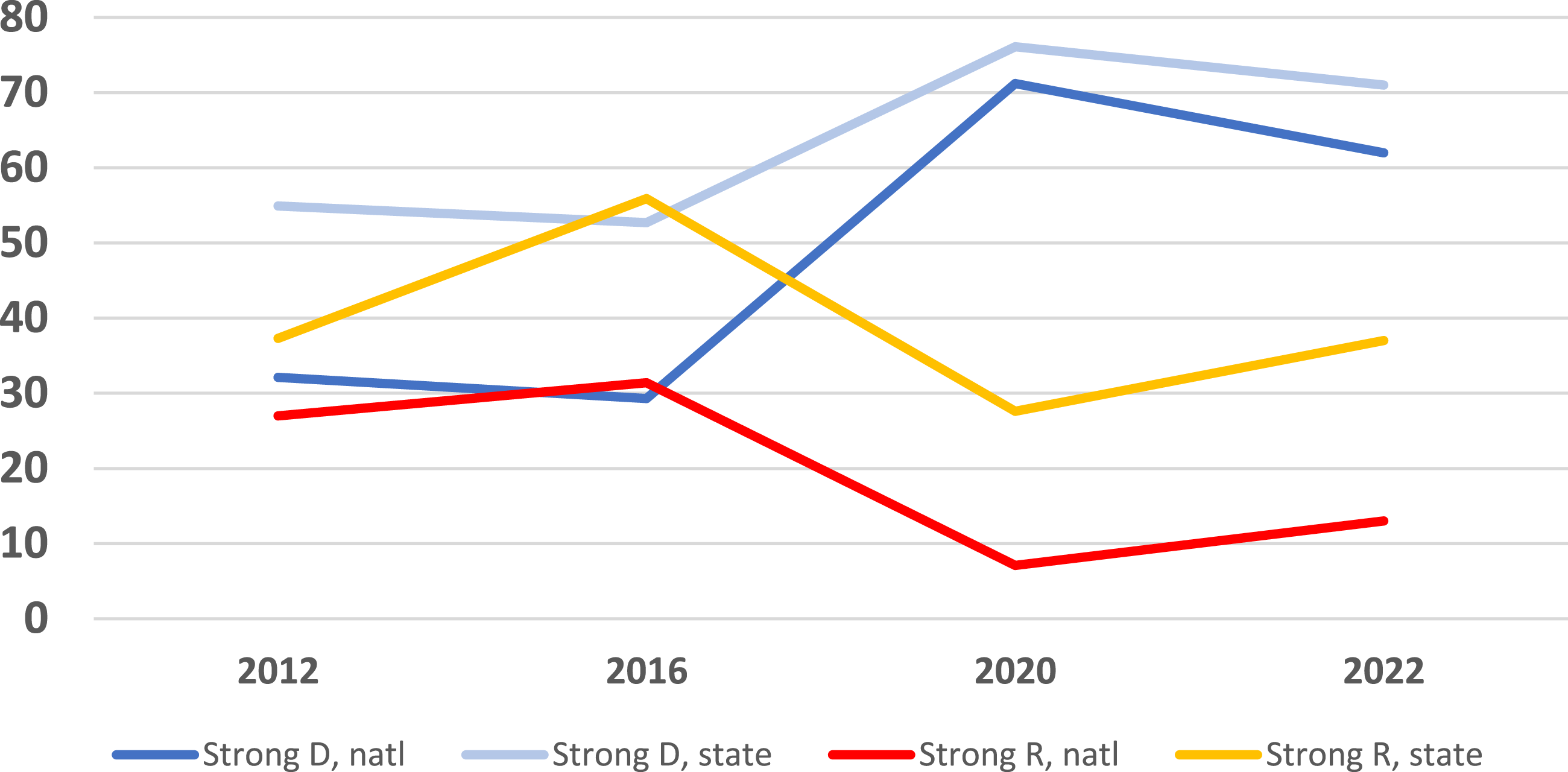
Figure 2 plots similar trends in the party divide about Americans’ perceptions of specific types of potential election fraud that may occur. The SPAE has regularly included items asking respondents how common it was for people to steal or tamper with ballots (steal in Figure 2), how common it was for people to pretend to be someone else when voting (pretend), how common it was for people to vote an absentee ballot intended for someone else (abst), and how common it was for officials to change the reported vote count (change). Given that the SPAE has not specifically tracked perceptions of fraud associated with the phrase “voting by mail,” the absentee item, and the “changing votes” item may be the closest to measuring public response to Trump’s 2020 lies about electoral fraud.
5
Perceptions of election fraud in the US, by party.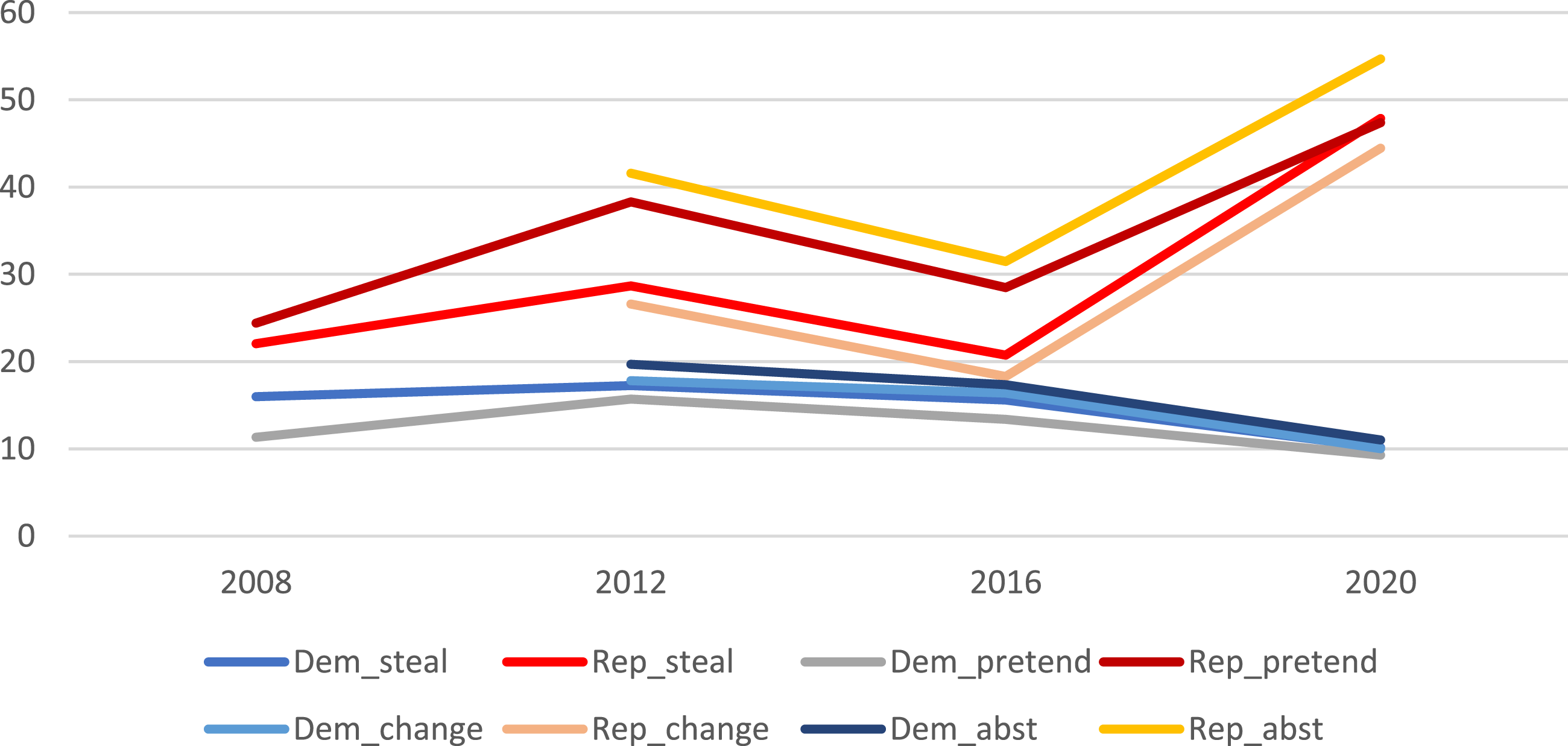
Figure 2 plots trends in the percent of responses to these items from all Democrats and Republicans who said a particular form of fraud was “very common” or something that occurred “occasionally.” Regardless of the item asking about forms of electoral fraud, we see much higher levels of partisan polarization in perceptions after 2020 than what was measured previously. One of the more striking observations here is that prior to the 2020 election, Democrats and Republicans shared roughly similar views on the (rare) frequency of ballots being stolen or tampered with after being cast, and similar views that it was uncommon for officials to be changing election results. After 2020, Republicans were 27% more likely than in Republicans in 2016 to agree that it was common or an occasional event for election officials to alter results. There was a similar increase after 2020 in the propensity of Republicans to report that stealing and tampering with ballots was occurring. Unlike the trends displayed in Figure 1 where (strong) Democrats displayed substantially more confidence in vote counting in 2020 than 2016, Democrats perceptions of various forms of fraud remained relatively flat over time.
Figure 2 illustrates a changed political landscape after the 2020 election, where Trump’s Big Lie about election fraud appears to have gained traction among a substantial proportion—nearly a majority—of Republican partisans nationally.
This heightened partisan polarization in confidence (or lack of confidence) in vote counting raises questions about whether or not forces of partisanship “crowd out” effects of state-level factors associated with the quality of how elections are administered. As noted, a large body of work in since the 2000 election (e.g., Alvarez, 2014; Alvarez et al. 2013; Hale et al. 2015; Norris et al. 2018) emphasizes the value that local efforts may have on reinforcing the legitimacy of national elections. The federal government may provide advice, some resources and a legal framework but there is no “national” election administration of elections. In the US setting the argument that “all [election integrity] politics is local politics” makes a great deal of sense because “national” elections are conducted by county officials who are embedded within state contexts. But a counter argument is that the growing polarization of American politics has been accompanied by a growing nationalization in Americans’ political orientations.
Hopkins (2018), for example, argues that American political behavior has become increasingly nationalized, in part because local sources of information such as local newspapers have declined and local campaigns are funded by donors who may not be within locality (Reckhow et al. 2017; Warshaw 2019). It is an argument which suggests there is less and less scope for local information and local factors to play a role in how citizen views of politics are formed. Grumbach (2022) also makes a case for the “nationalization” of state politics as the national political arena becomes gridlocked and the two parties themselves begin to be more active within state politics. The work of Grumbach, Hopkins and others suggest that we should see a crowding out of the importance and prominence of local information by a more national orientation. More specifically, we might see the local/state context of election administration matter less to voters who will be oriented more towards national political debates and claims of ballot fraud.
Hypotheses
Given previous research cited above, we have expectations about individual-level and state-level factors that may affect confidence in US elections. At the individual level, partisanship has been shown to affect perceptions of electoral fraud and confidence in elections (e.g., Ansolabehere and Persily 2008, 2016; Bowler et al. 2015). If most or nearly all variance in confidence is accounted for by the lens of partisanship, the prospects for better quality administration of elections boosting confidence in vote counting may be muted. Given messaging from party elites, we expect self-identified Republicans to have less confidence in how votes were counted and to be more likely to perceive electoral fraud, particularly in 2020. Conversely, Democratic identifiers are expected to have greater confidence in vote counting and be less likely to perceive fraud.
We expect that partisans of the winning party may engage in partisan motivated reasoning (Bolsen et al. 2014) where some project greater legitimacy on election results (or are less likely to view an election as flawed) if their party’s candidate wins. The direction of partisan effects, then, may be contingent on who wins in what year. Previous finding of a partisan pattern where Democrats were more confident in elections and Republicans were less so (Bowler et al. 2015) was estimated with opinion data from the 2012 presidential election, when a Democrat was the winner. Other things equal we expect Democrats in 2020 to have been more sanguine about the conduct of elections that produced a win for Democrats than Democrats were in 2016 when the election process produced a Trump win. Conversely, Republicans in 2016 may have been more confident with election processes associated with Trump winning, than Republicans were in 2020 when Biden won.
One of the promises of electoral reforms introduced since 2000 is that better quality of election administration should increase public confidence. Measures of the performance of election administration should, then, correlate positively with perceptions about electoral integrity. Our expectations are less certain about when measures of state-level election performance would affect respondents’ confidence in elections. If national forces of partisanship associated with Trump’s Big Lie “crowded out” the potential effects of local context, we would expect to see less of a relationship between state election performance and confidence in elections in 2020 than in previous years. Conversely, heightened media attention to Trump’s baseless claims in 2020 may have also heightened attention to, and popular awareness of, the high quality of work by professionals who administer elections, particularly those in states known to have best practices. This could have the effect of increasing the salience of quality election practices among people in those states in 2020.
Given that Trump repeatedly made false allegations about the legitimacy of legally mailed/absentee ballots counted after election night, and given media attention to these claims, perceptions of fraud could have been particularly heightened in key states where the presidential vote was not yet called on election night. Trump claimed victory on election night in 2020 while many votes remained to be counted in seven states that news organizations had not yet called. Biden eventually won six of those, and those states were the focus of Trump’s efforts to delegitimize vote counting after election night. These were Arizona, Georgia, Nevada, Michigan, Pennsylvania, and Wisconsin. We expect that false allegations of fraud associated with ballots being counted after election night had particular resonance in the six late counting states that were the target of Trump’s Big Lie, and that respondents in those states would be more likely to perceive fraud and see vote counting as suspect.
We also test for cross-level interactions between individual-level partisanship and a respondent’s state’s political context to help better understand how an individual’s partisan context may amplify their perceptions that votes are (or are not) counted properly and whether that context affects perceptions of fraud by election officials. We expect that Republicans in Republican-controlled states will have more confidence in vote counting in their states than Republicans generally. This hypothesis flows from the assumption that partisans will be more trusting of outcomes in a state that their party controls. Further, in 2020 Republicans (who we presume to be receptive to Trump’s message) in late counting states are expected to be even less confident in vote counting than Republicans in other states.
Data and Methods
We test these hypotheses with data from the 2016 and 2020 Survey of the Performance of American Elections (SPAE) (Stewart 2017 2021). We merge individual-level SPAE measures of perceptions of confidence in vote counting and perceptions of election fraud with measures of the performance of election administration as assessed by the MIT’s Elections Performance Index (EPI) for each year in the respondent’s state. We also include a measure of status as resident in a late counting swing state in 2020, and a measure of state party control in the respondent’s state at the year of the election. This design allows us to estimate multi-level models predicting an individual’s confidence in vote counts and perceptions of fraud as a function of state context and individual-level partisanship.
Confidence in Vote Counting in US Elections.
Notes. Multi-level models estimated with Stata. Dependent variables (confidence state, national vote) range from 1 to 4; high scores reflect greater confidence. Level 2 N = 51 (includes DC).
Source: SPAE, 2016, 2020.
** = p < .01 (two-tail), * = p < .05 (two tai), + p. < 0.10 (two-tail).
Perceptions of Electoral Fraud, 4-Point Scale. Higher Scores = More Agreement That Fraud Occurs.
Note. ** = p < .01 (two-tail), * = p < .05 (two tai). Standard errors in parentheses.
Source: 2016, 2020 SPAE.
Our main independent variable of interest at the individual-level is partisanship, and our main independent variables of interest at the state-level are quality of election administration, party control, and status as a late counting swing state. Partisanship is measured with four dichotomous items generated from the seven-point party identification question. These represent strong Democrats, “other Democrats” (weak Democrats and independent Democratic leaners combined), strong Republicans, and “other Republicans” (weak Republicans and Republican leaners combined), respectively. Pure independents serve as the reference category. State-level election performance is measured with the MIT Election Performance Index (EPI). The EPI has been calculated for each election year examined here, and the index ranged from 0.66 to 0.90 in 2020 (values vary by state across years). Components of the index include the proportion of absentee and military/overseas ballots rejected, ballots returned, voting problems, the presence of post-election audits, registrations rejected, the presence of information look-up tools, and other factors. Top scoring states in 2020 included Vermont (0.90), Iowa (0.88), Minnesota (0.88), North Dakota (0.88) and Nebraska (0.87), with the lowest scoring including Mississippi (0.66), Oklahoma (0.71), South Dakota (0.72), and California (0.73). Late counting swing states in 2020 are Arizona, Georgia, Nevada, Michigan, Pennsylvania, and Wisconsin.
Models control for respondents’ education (a six-point ordinal measure), age (in years), gender (a dichotomous item with the higher value representing female), race (white vs. other), and an indicator for self-identification as a “born-again” Christian. Multi-level models were estimated with Stata’s xtmixed command, treating the dependent variables as continuous. 6 We report multi-level models, followed by estimated marginal effects. After this, we report results of models that include interactions accounting for Republicans in Republican controlled states, and Republicans in the swing states where results were reported late, respectively.
Results
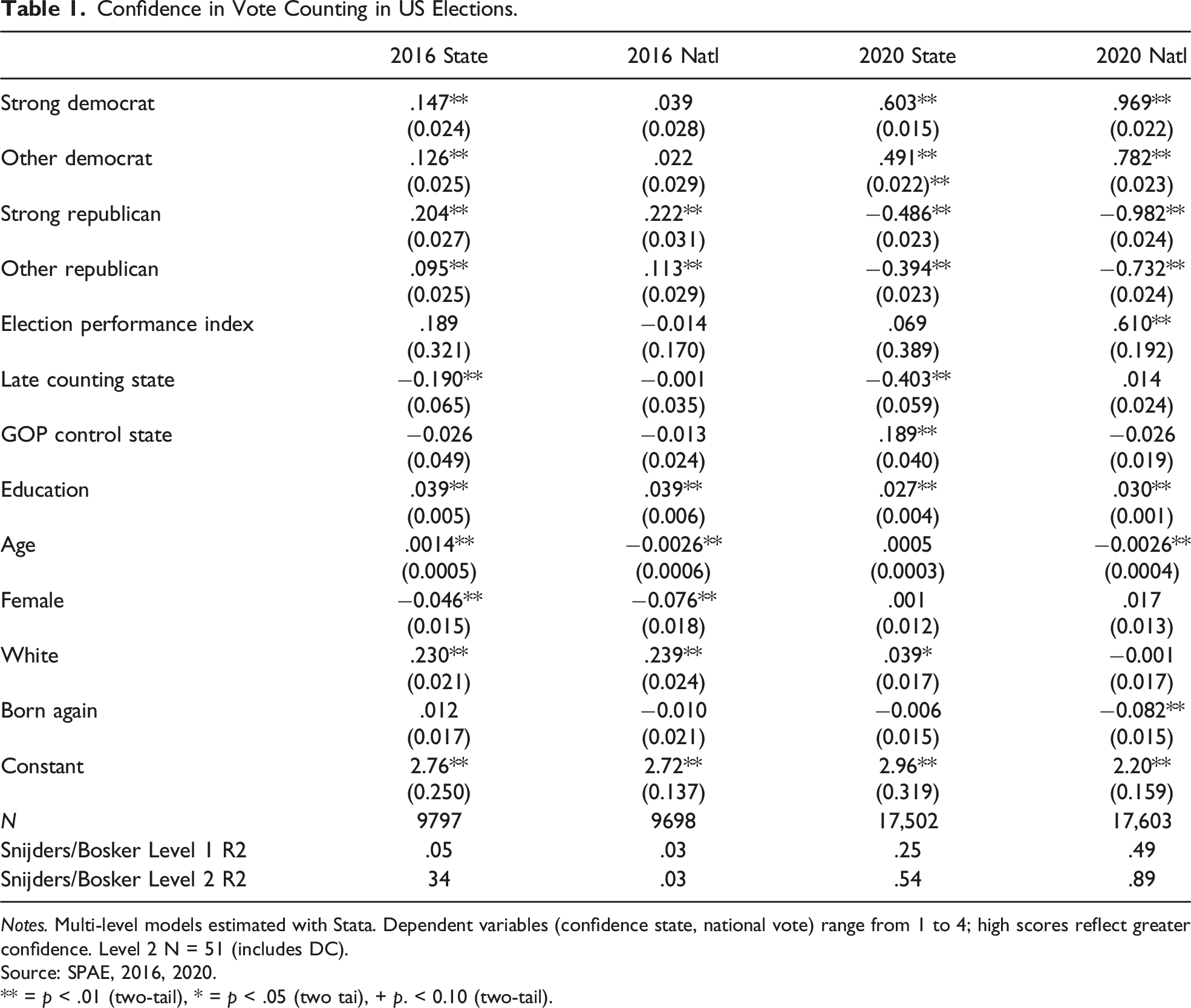
Table 1 reports our models of perceptions of vote counting estimated with the 2016 and 2020 SPAE data. Predicted values are plotted in Figure 3 for confidence in state counts, and in Figure 4 for confidence in national counts. As for our primary hypotheses regarding individual-level partisanship, strong Republicans were significantly less confident than strong Democrats in both their state’s vote count in 2020 (Figure 3), and in the 2020 national count (Figure 4). Figure 4 illustrates that strong Republicans had low confidence in the 2020 national vote count (1.99 on this 4-point item, where the mean is 2.78); over one standard deviation lower than strong Democrats (3.48, where 4 = “very confident”). Both sets of partisans had more confidence in their state’s 2020 count than the national count, with strong Republican’s confidence in their state’s count (2.85 +/− 0.029) significantly lower that strong Democrats (3.67 +/− 0.027). Confidence in state count, 2016 and 2020. Confidence in national count, 2016, 2020.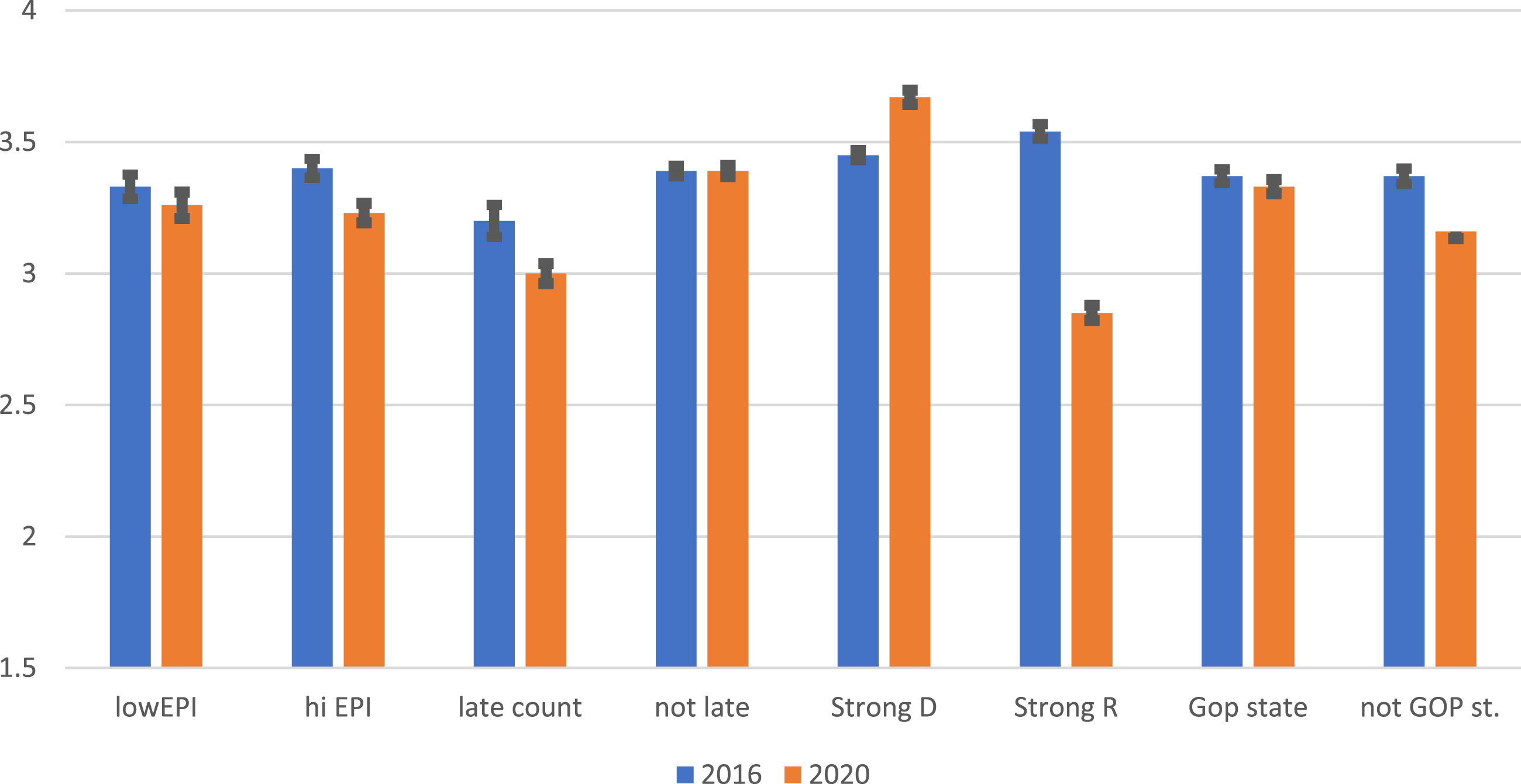
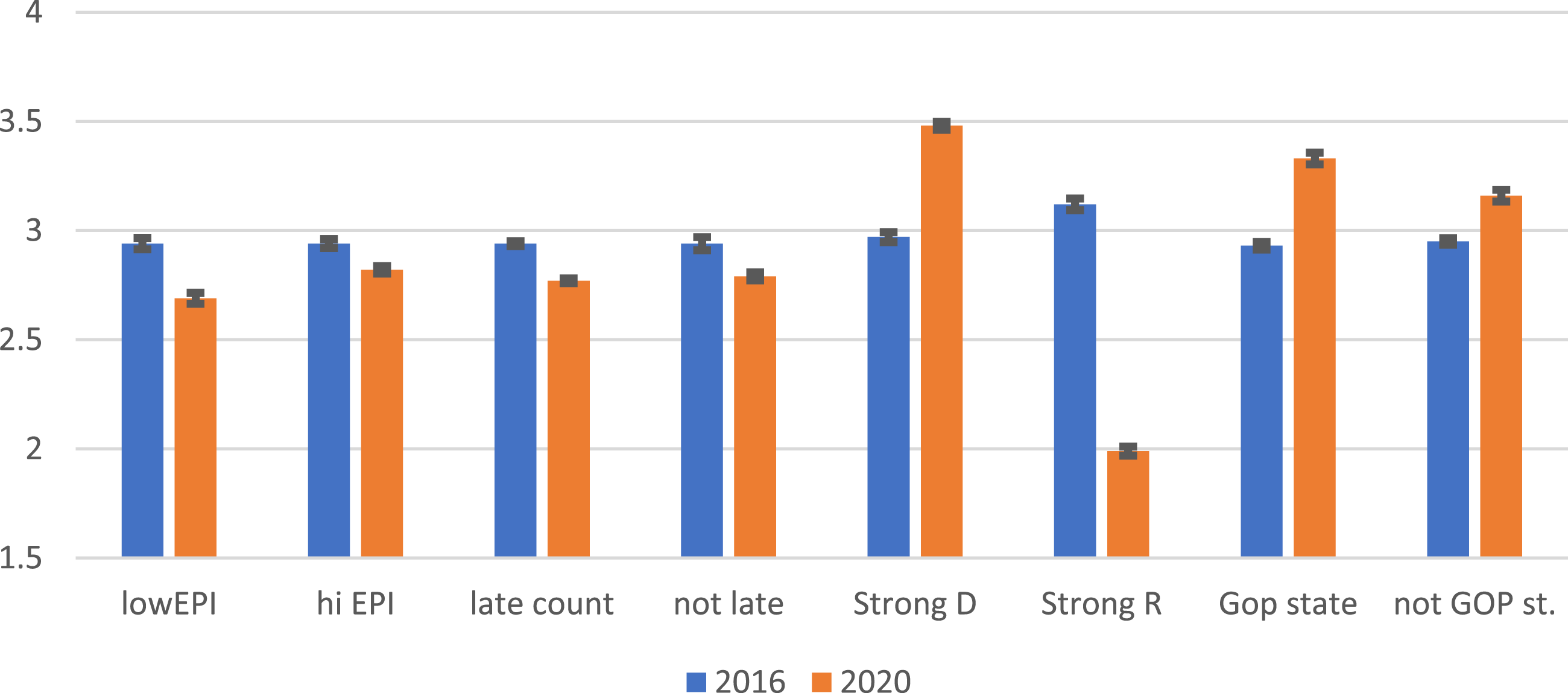
As anticipated, these partisan differences appear contingent on election results. Figure 4 shows that strong Democrats (2.97 +/− 0.023) were slightly but significantly less confident than strong Republicans (3.12 +/− 0.027) in the 2016 national vote count when Trump won, and less confident (3.45 +/− 0.019) than strong Republicans (3.54 +/− 0.028) in their 2016 state count (Figure 3). Democrats in 2020 were also much more confident in their 2020 state’s count and the national count (Figure 4, 3.48 when Biden won) than Democrats were in 2016 with the state count (Figure 4, 2.97 when Clinton lost). Republicans similarly reported more confidence in how votes were counted when Trump won in 2016 (3.12, Figure 4) than Republicans were in 2020 when Trump lost (1.99, Figure 4). Trump’s rhetoric in 2020 may have further polarized partisan perceptions on electoral integrity in 2020 (see Figures 1 and 2), but partisans nonetheless seem to have previously filtered their confidence in elections through the situational partisan lens of victory.
As for our hypotheses related to state-level election performance, our models find no relationship between the state EPI measure and individuals’ perceptions of the state or national vote count in 2016. We do find a significant relationship between state-level EPI and confidence in the national vote count in 2020 (Figure 4). This is inconsistent with our expectation that there will be “crowding out” where election conspiracy rhetoric crowed out potential effects of election administration, and suggests there may be space for local effects even in a highly polarized national setting. Given previous reported findings, it is interesting that we find no relationship between state-level EPI and evaluations of electoral integrity in 2016. 7 However, the SPAE item asking about confidence in “how votes nationwide were counted as voters intended” may tap respondents’ perceptions of who was the legitimate winner of the presidential election, as there is no actual nationwide count. The positive relationship between state-level EPI and confidence in the “nationwide” result is consistent with our expectation that media response to (and scrutiny of) Trump’s 2020 election lies may have put increased focus on states’ with better election administration practices, and that, other things equal, people in those states responded by having greater confidence in the national result.
Table 1 and Figure 3 suggest our hypothesis about residence in a late counting state is confirmed, but there is some nuance here. In 2020, respondents from late counting swing states targeted by Trump where the outcome was not decided on election night were significantly less confident than people from other states in their state’s 2020 vote count (2.98 +/− 0.054 vs. 3.39 +/− 0.022). However, estimates from 2016 in Figure 3, using the same measure representing these same states produced a similar, but smaller difference (3.20 +/− 0.061 vs. 3.39 +/− 0.020). This suggests that some attribute associated with these six states, other than their late counting status in 2020, may have contributed to reduced confidence in these states’ vote counting in both 2016 and 2020. 8 That said, comparing across 2016 and 2020, respondents in late counting swing states in 2020 (2.98 +/− 0.054) were significantly less confident in their state’s vote count than respondents in the same states in 2016 (3.20 +/− 061). This suggests the Trump’s rhetoric may have had some effect on further reducing confidence in vote counting in these states in 2020. Our control variables have some consistent patterns of results. Other things equal, educated respondents were consistently more confident in vote counts, and white respondents were generally more confident.
Interactions Between Individual Partisanship and State Context
Table 1 and Figure 3 illustrate that respondents in Republican controlled states were significantly more confident in their state’s vote counting results in 2020 (3.35 +/− 0.028) than people in other states (3.16 +/− 0.027), while there was little difference in voter confidence between people in Republican controlled and non-Republican controlled states in 2016 (3.37 vs. 3.37, Figure 3). If anything, people in non-Republican controlled states may have become less confident in their state’s vote counting in 2020 than people in non-Republican states in 2016. In 2020, respondents in states not controlled by Republicans (3.16 +/− 0.027) were significantly less confident in their state’s vote counting compared to respondents in non-GOP states in 2016 (3.37 +/− 0.029).
Confidence in 2020 State Vote Counting, With Interactions.
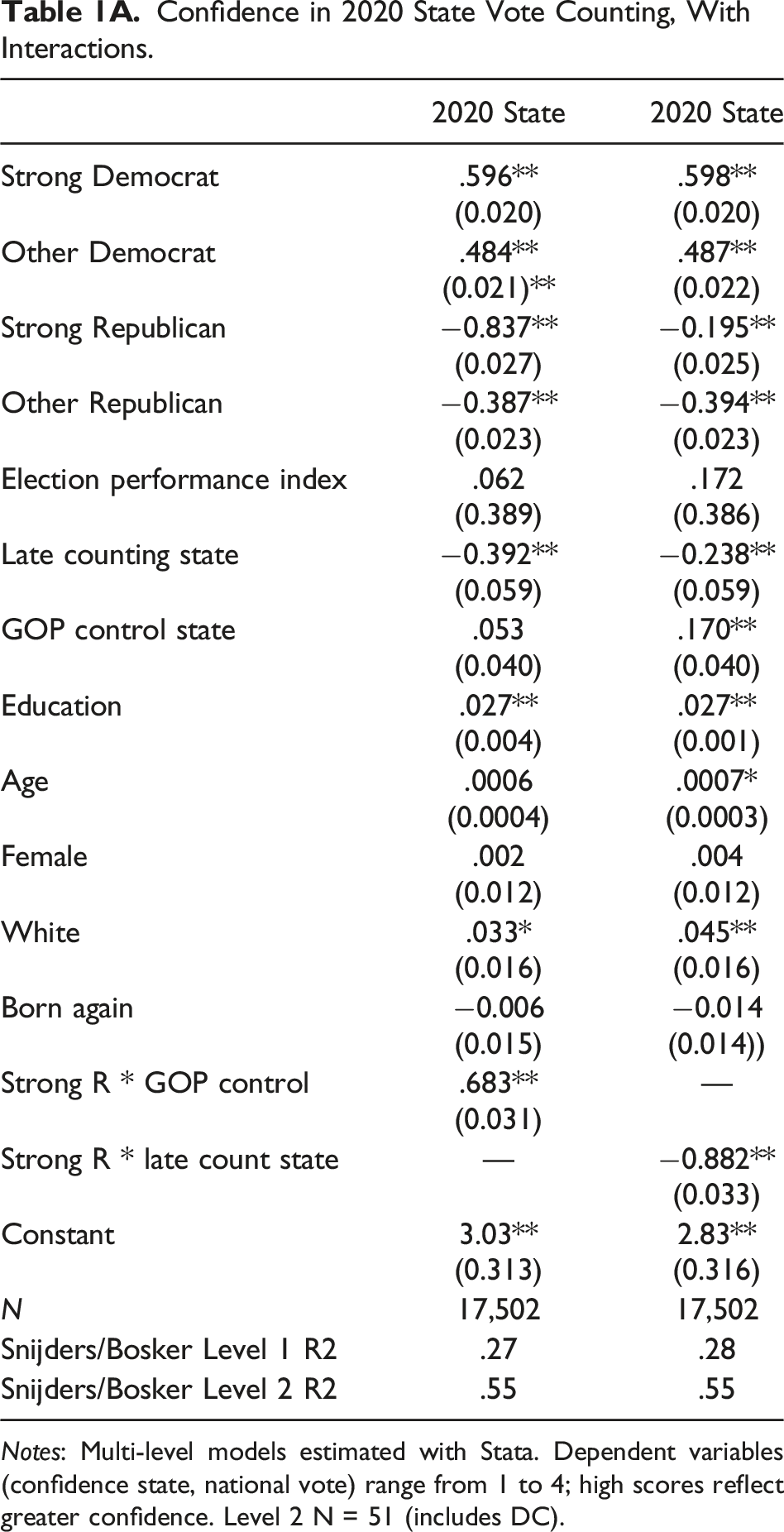
Notes: Multi-level models estimated with Stata. Dependent variables (confidence state, national vote) range from 1 to 4; high scores reflect greater confidence. Level 2 N = 51 (includes DC).
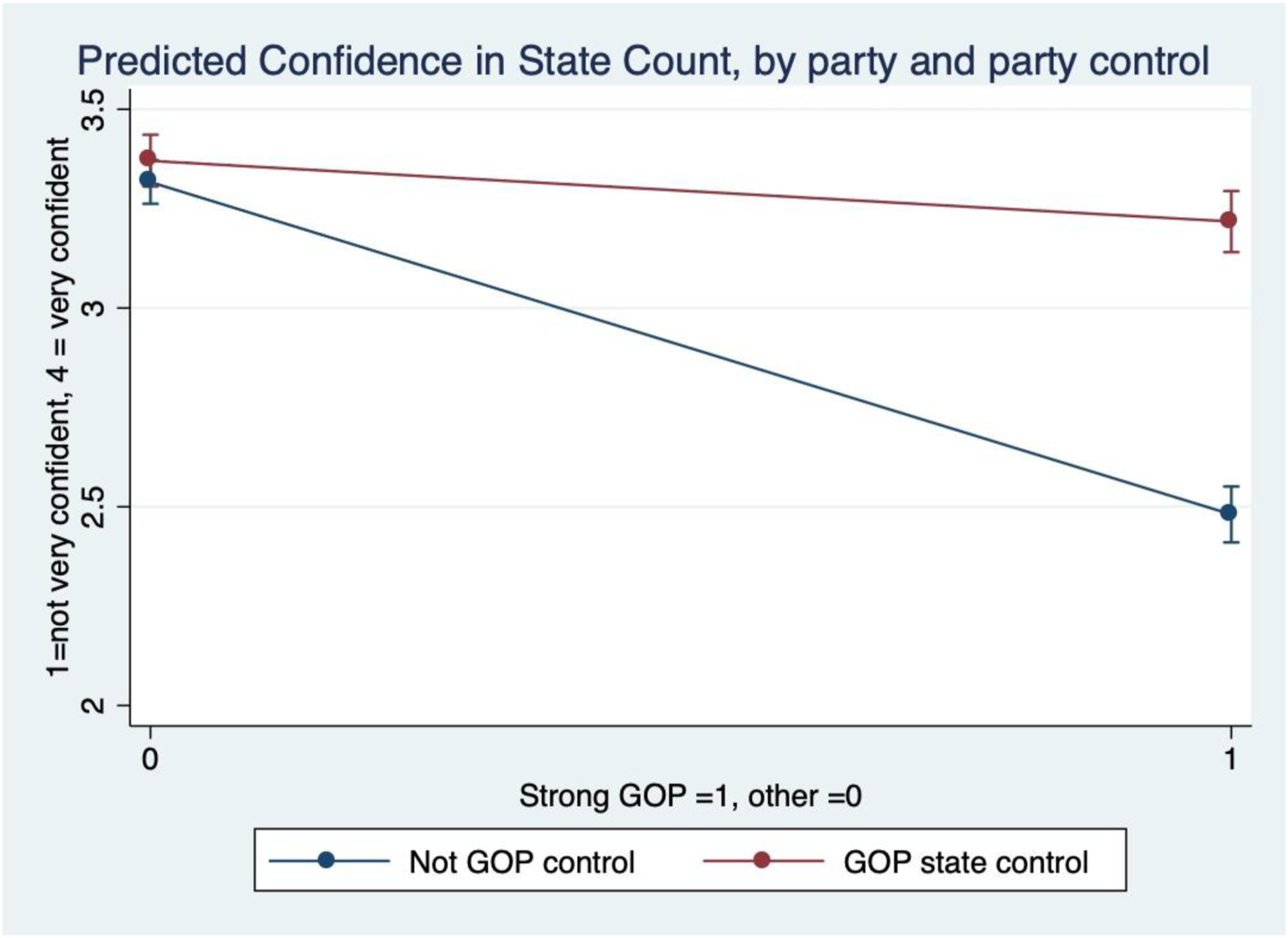
Interaction between Republican partisanship, and control of state government.
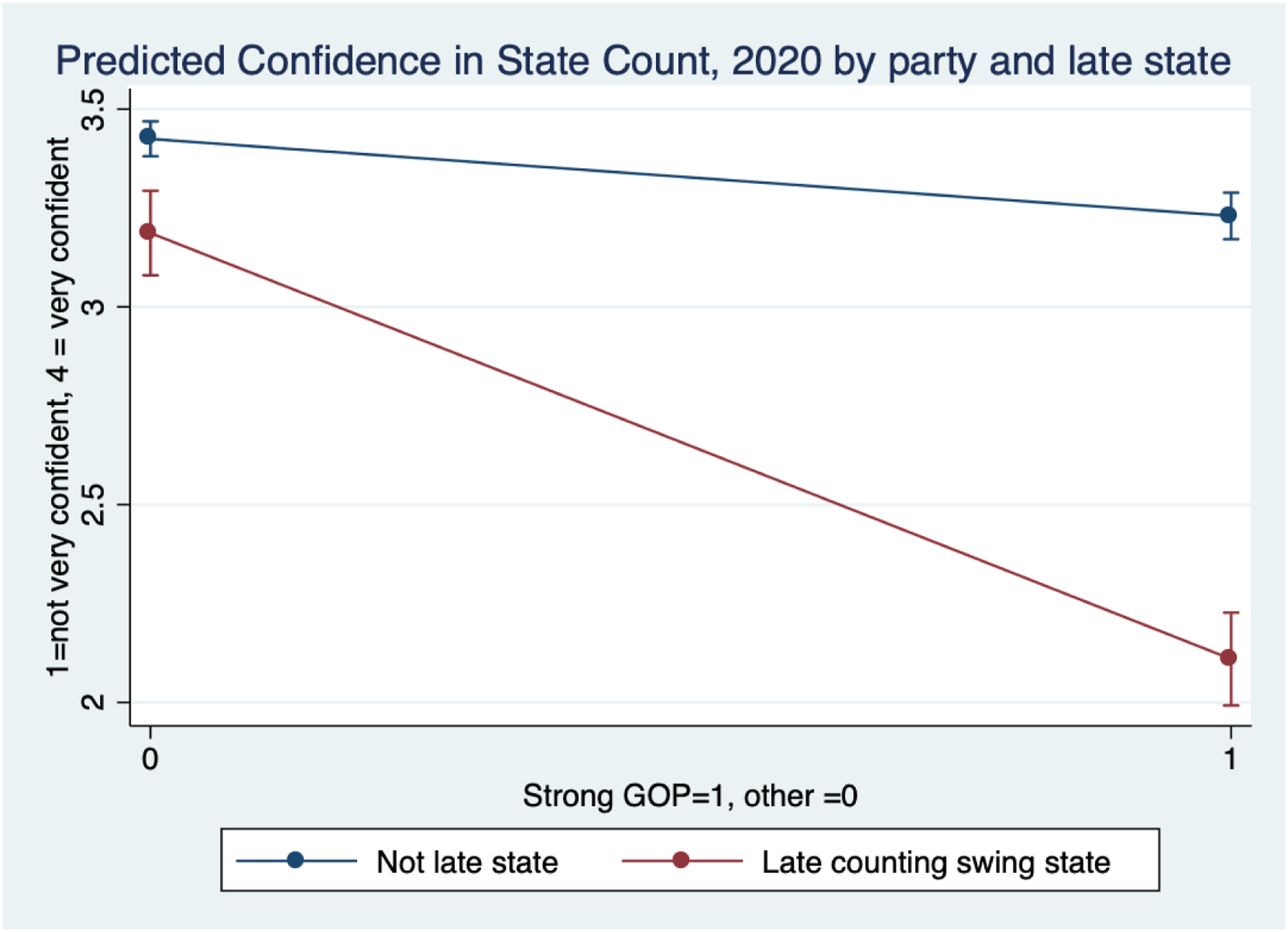
Interaction between Republican partisanship, and living in a late counting state.
Views on the Components of Fraud
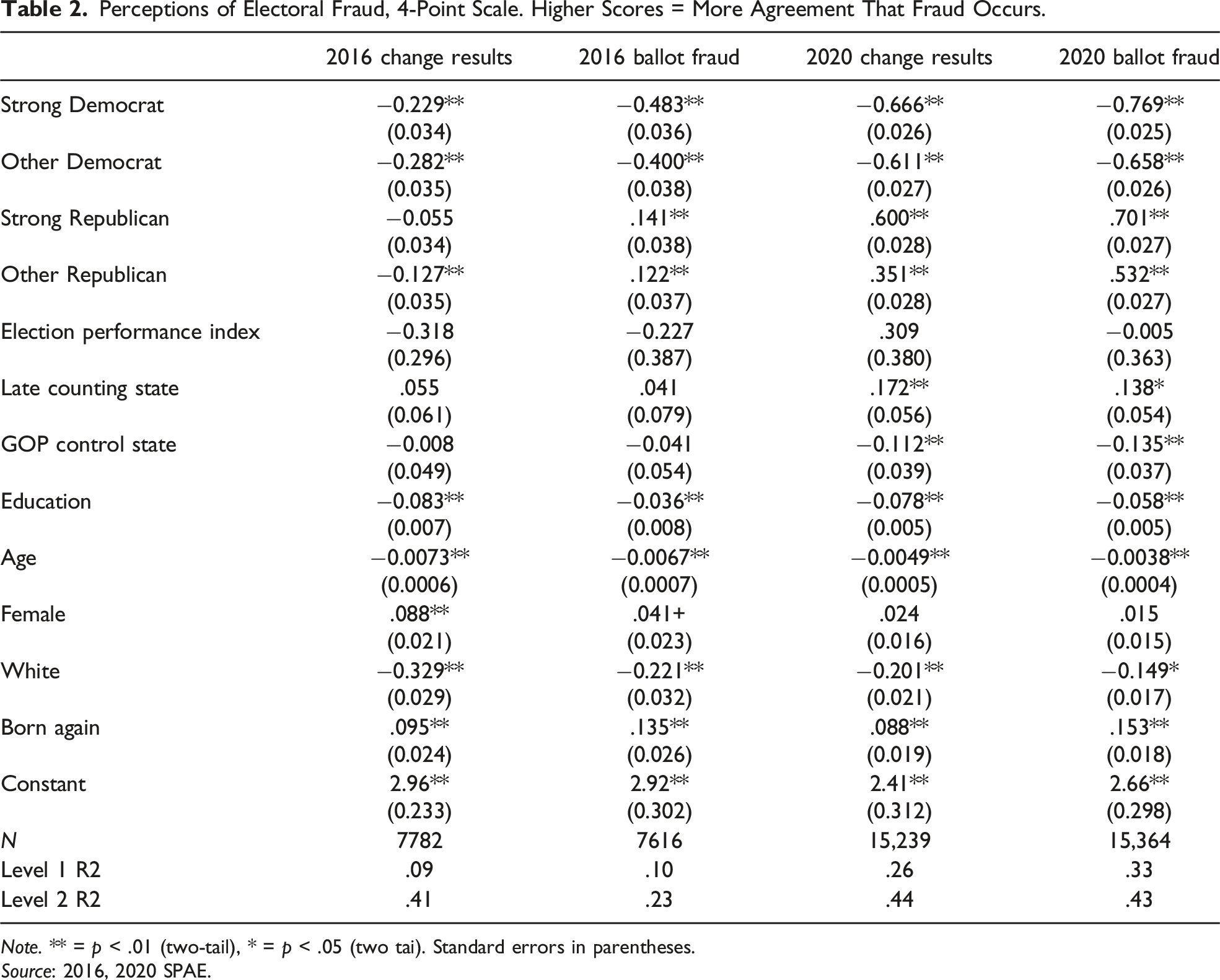
As noted above, the SPAE includes items asking about specific types of election fraud. Perceptions on these matters likely structure attitudes about the integrity of vote counts, and provide additional opportunities to test our hypotheses. Table 2 reports estimates of opinions measured by two of these items: perceptions of the frequency that officials change results, and perceptions of the frequency of ballot fraud (people voting other folks’ ballots). Results in Table 2 show some consistency in these perceptions across time, as well as noteworthy change from 2016 to 2020. Other things equal, and not surprising given Figure 2, Democrats were less likely and Republicans to some extent more likely, to view these two types of fraud as common after both the 2016 and 2020 elections.
Figure 7 present post estimation predictions of the marginal effects of our independent variables on how people scored on the item asking if it was common for officials to change results. Responses ranged from 1 to 4—where higher scores reflect the opinion that fraud is common. Partisan differences were of greater magnitude in 2020 than 2016, other things equal. There is also a significant relationship between residence in swing states where late-counted ballots delayed the release of final results in 2020, and heightened perceptions of both forms of fraud (Figure 7). As this was not evident in 2016, it provides additional evidence suggesting that Trump’s false claims had particular resonance in these states. Republicans in late counting states were also significantly more likely to say that it was common for officials to change results (not shown). We also note a change in the estimated effect of residing in a state controlled by Republicans. Respondents in states not controlled by Republicans were more likely to view these forms of fraud as common after the 2020 election, while this was not evident in 2016. We find this view consistent with Trump’s message that Democrats and some complicit Republicans had “stolen” the election from him. Perceive officials change results, 2016 and 2020. Scores range from 1 to 4. Higher scores reflect agreement that this fraud is common. Mean response in 2016 was 1.67. 2020 mean was 1.86.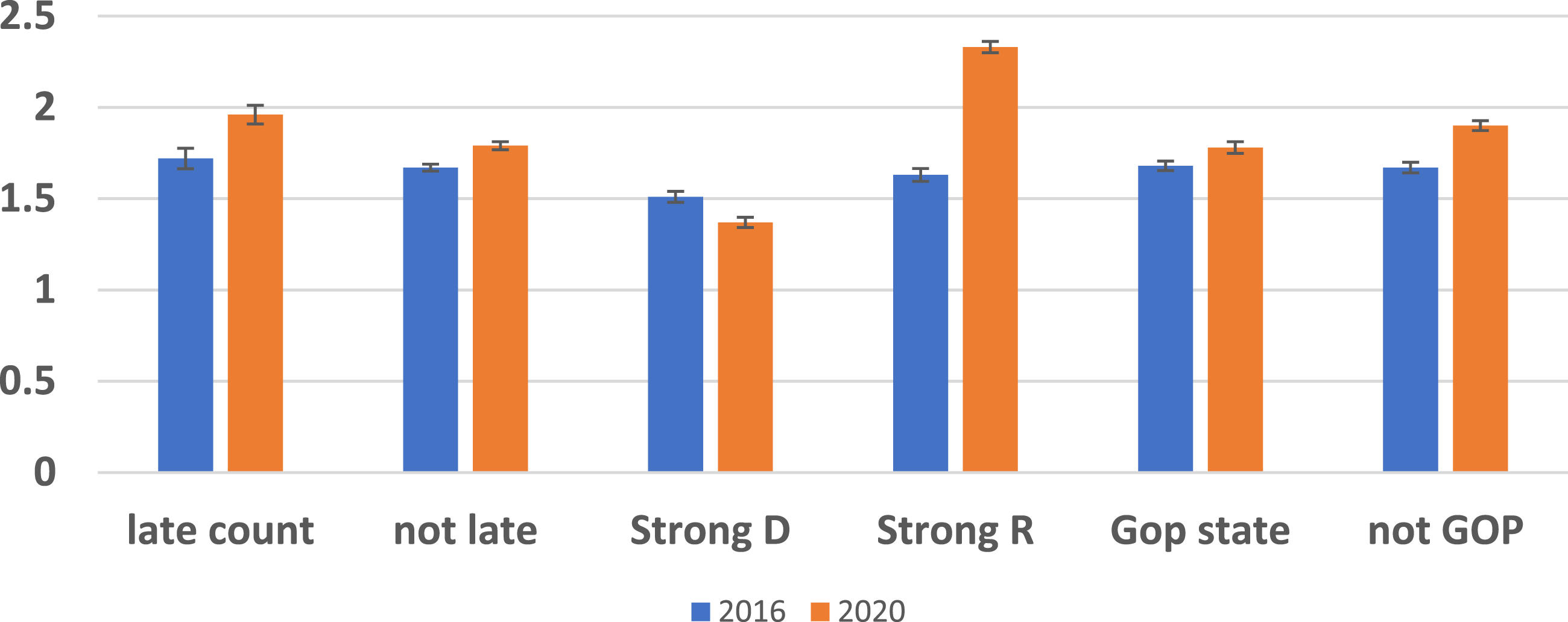
Discussion
We find that partisans respond situationally to conditions that favor or disfavor their party when they evaluate the integrity of elections. Democrats viewed the 2020 vote counts (when they won) more favorably than they did the 2016 count (when they lost), and vice versa with Republicans. Republicans perceived more fraud by officials in 2020 than Republicans did in 2016, while Democrats perceived more in 2016 than they did in 2020. From this perspective, one might conclude this could be a cyclical pattern, where views of fraud and the integrity of elections ebb and flow as partisan control of the White House changes. We have seen such a long-term, recurring pattern in the US with trust in government: Republicans and Democrats both became more trusting when they win the White House, then less so when they were on the losing side (Anderson et al. 2005). In that sense, then, we may not be seeing anything other than cyclical change associated with motivated partisan reasoning.
However, there may be reasons to view US opinions about electoral integrity in 2020 not as part of a regular cycle but as an alteration of mass and elite attitudes about the legitimacy of democratic elections reflecting an enduring acceptance of Trump’s lies among a substantial part of the Republican Party. We have identified factors unique to 2020 consistent with the possibility that the Big Lie has taken hold: Increased perceptions that election officials changed votes among residents in states targeted by Trump’s efforts to overturn the results, particularly among Republicans. Further, Republicans had less confidence in vote counts in their states if those states were not controlled by Republicans in 2020. Republicans generally were also far more cynical about electoral integrity after the 2020 election than after previous elections going back to 2008. Swing states where results were finalized late became subjects of Trump’s conspiracies, and Republicans in these states were particularly suspicious about their state’s vote count. This raises questions about how late counting—even under the best administrative practices—presents future opportunities for defeated candidates to promote conspiracies about electoral foul play. While GOP concerns about election integrity do, to some extent, pre-date Trump, these patters do suggest Trump’s (unfounded) allegations about the 2020 election on perceptions of electoral integrity also shaped such perceptions.
Much has changed since the 2020 post-election survey was conducted; changes that continue to send strong public signals from Trump and his Republican allies reinforcing the idea that US elections lack legitimacy and cannot be trusted. Several Republican candidates for Governor, US Senate, and US House who lost in November 2020 alongside Trump would not concede, making false claims of electoral fraud, even in cases where they lost resoundingly. 11 In December of 2020, 90% of Republicans in Congress would not acknowledge that Joe Biden had won fairly. 12 During the January 6, 2021 assault on Congress, Trump addressed the insurrectionists from the White House saying his “landslide” election was “stolen, and everyone knows it … this was a fraudulent election … we love you, you’re very special.” 13 After initial post-insurrection outrage among some congressional Republicans, and a second impeachment attempt resulting from Trump’s role, most elected Republicans, even those critical of Trump’s role in the January 6 attack subsequently muted their criticism, rallied around Trump, or were driven from office. In February of 2021, 90% of Republicans in Congress still would not offer an answer when asked if Trump lost because of fraud. 14
Trump’s election lies persisted through 2022, gaining momentum among Republican candidates. The New York Times estimated that elected Republicans who made efforts to overturn the 2020 results comprised 44% of Republican state legislators in nine swing states as of 2022. Eight of the 10 House Republicans who voted to impeach Trump subsequently retired or lost their 2022 primaries to Trump-supported Republicans echoing his Big Lie. 15 Some Republican candidates who lost their 2022 primaries badly echoed Trump, and attributed their losses to widespread electoral fraud. 16 Trump-endorsed candidates reinforcing his election lies secured 2022 Republican nominations for Governor, 17 US Senate, 18 and US House. 19 Trump also endorsed several “election-denier” candidates for Secretaries of State, and seven were nominated as Republican candidates for 2022. 20 Two of these Secretary of State candidates were elected, another became a state Republican Party chair, and a third was running for US Senate in 2024. US Senate candidates JD Vance and Ted Budd who echoed Trump’s view of elections were also elected in 2022, while Senate Republicans using similar 2020 election rhetoric were also re-elected (Ron Johnson, Rand Paul, John Kennedy, and Mike Lee). CBS News estimated the 2022 election yielded an increase in the number of GOP House members who raised doubts about the legitimacy if the 2020 elections, up to 156 members, a large majority of the caucus. 21 There has been no let-up in “the Big Lie.” As illustrated in Figure 1, confidence in the vote count among Republican partisans remained low after the 2022 midterm elections when Republicans took over control of the US House.
With all of this, how much can best practices in election administration affect perceptions of election integrity? After all, a substantial proportion of Republican elites and scores of millions of Republican partisans will not accept the fact that Donald Trump and his allies are lying. To repeat a point made earlier: despite huge incentives (both financial and political) dozens of court cases, multiple audits and the presence of large numbers of energetic right-wing media investigators, there remains zero evidence that the 2020 election—or indeed any subsequent election—was “rigged.” There may be no amount of accuracy, security, transparency, post-election audits, polling-place observations, or any similar effort that can counter the continuous messaging coming from Republicans that elections are rigged.
More critically, if a major party assumes the position that elections are, by their definition, illegitimate if they lose, has “‘losers’ consent” in America democracy been lost? If this is the case, we may enter an era where there are fewer limits on how elections might be manipulated. Costly and time-consuming efforts to promote electoral integrity may no longer be very effective in the US—at least not in improving voter confidence among a major segment of the electorate. Where there is no possibility for many to accept that elections are legitimate if they lose, there may be less need to show restraint when challenging or manipulating the fair administration of elections.
Footnotes
Declaration of Conflicting Interests
The author(s) declared no potential conflicts of interest with respect to the research, authorship, and/or publication of this article.
Funding
The author(s) received no financial support for the research, authorship, and/or publication of this article.
