




Abstract
While existing research shows why politicians’ social media messages spread online, we know comparatively less about the types of individuals who see these messages. The current study tests whether Americans’ exposure to posts from political elites is best explained by their partisan allegiance (homophily) or the intensity of their political engagement. To test this question, we employ data from a 2020 Cooperative Election Study module that asks respondents how often they encounter social media posts from various political figures. We find that both homophily and intensity characterize exposure to elite messages: partisans and ideologues not only tend to encounter posts from politicians on their own side of the aisle most often, but they also encounter posts from politicians on the opposite side more often than do independent or moderate respondents. The role of intensity relative to homophily is greatest for posts by former President Donald Trump, which Democrats were more likely to encounter than Republicans or independents.
Political figures are active on social media, using these platforms to communicate directly with the public, to raise money for campaigns, and to mobilize voters. Some of these messages get widespread attention, as they are shared thousands of times and may be included in news coverage even beyond the confines of the social media platform(s) on which they were posted. While existing studies give us insight into the factors that shape the content of these messages and the extent to which they spread online, we know comparatively less about the types of individuals who see these messages. It is unclear whether Americans tend to see only messages from politicians they support, or whether they encounter messages from across the political spectrum.
There is ample reason to expect elite messages to be seen predominantly by individuals who have similar partisan affiliations or political ideologies. One potential source of homophily in social networks offline and online is selective exposure (Barberá et al. 2015), where individuals navigate within “echo chambers” by following only political figures they support, much as they might surround themselves with like-minded family members, friends, neighbors, and co-workers in their daily lives (e.g., Christakis and Fowler 2009; Miller, Lynn, and James 2001). A second mechanism potentially driving homophily is “filter bubbles,” where social media algorithms push content to users based on their previous behavior online (e.g., Pariser 2011).
There also are reasons to expect that exposure to elite political messages might be more complicated, with individuals on both sides of the political/ideological spectrum seeing them frequently. First, with some social media messages receiving coverage from more traditional news outlets, it is possible for a wider audience to encounter these messages regularly. For example, before he was barred from the platform, Donald Trump’s tweets were shown verbatim in television, online, and print news, and therefore would be difficult to avoid for individuals who are even casual followers of current events, regardless of their social media habits. Second, there is ample evidence that negativity sells (Fournier, Soroka, and Nir 2020; Soroka 2014); negative messages are more likely to spread online, including messages from political elites like members of Congress (Fine and Hunt 2023; Lee and Xu 2018; Sahly, Shao, and Kwon 2019; Stromer-Galley et al. 2018). It is therefore possible that individuals might see these messages when others in their social network share them. Third, individuals may seek out content from politicians they dislike, which is often referred to as “doom scrolling,” as it riles them up and engages them further, especially in an era where affective polarization is widespread (Abramowitz and Webster 2016; 2018). Finally, information made public by a Facebook whistleblower in 2021 underscores the economic value of negative emotions like anger, which social media sites elevate to keep users engaged on their platforms (Merrill and Oremus 2021). As a result, social media algorithms might also push messages to individuals who are more likely to react strongly in a negative direction to encourage those users to be more active on the site. Each of these might make strong partisans and ideologues on both sides of the spectrum more likely to see messages from opposing elites.
The current study investigates whether exposure to elite political messages is characterized by homophily, by intensity of partisanship and political ideology, both, or neither. To answer this question, we employ data from a 2020 Cooperative Election Study (CES) module. Our key question asks respondents to estimate how often they encounter social media posts from each of a list of political figures who are prominent on social media, regardless of whether they see them on the social media platforms or elsewhere (e.g., reported on television news). We use factor analysis to assess the relationship between exposure to posts from different elites and regression analyses to determine the effect of partisanship, ideology, social media use, and other covariates on exposure to posts from each elite. We find that both homophily and intensity characterize exposure to elite messages: partisans and ideologues not only report encountering posts from politicians on their own side of the aisle most often, but they also report encountering posts from politicians on the opposite side more often than do independent or moderate respondents. The role of intensity relative to homophily is greatest for posts by former President Donald Trump, which Democrats were more likely to encounter than Republicans or independents. We find that American partisans encounter a significant amount of messaging from “the other side” on social media, which likely gives rise to negative emotions and may intensify affective polarization. Our findings also suggest that messages politicians post on social media have a reach considerably beyond their own followers, and perhaps beyond social media itself, whether for good or ill.
Social Media Exposure and Political Beliefs
Over the past two decades, politicians have shifted their communication strategies from relying heavily on traditional news outlets to directly communicating with the public through online mediums, most recently through social media. While traditional news companies and their respective editorial boards were responsible for “curating content” in the past, that function has become less centralized. Today, some decisions about the types of political information that individuals will consume rest in the hands of users who choose which political elites and news outlets to “follow,” the social media platforms themselves that control the flow of that information (Bakshy, Messing, and Adamic 2015), and the more traditional news media that makes decisions about whether to report elites’ social media messages in their own stories. With almost half of individuals reporting that they get some of their news from social media (Walker and Matsa 2021), and considerable attention paid to social media messages more broadly, it is important to understand the way in which elite political messages reach the masses.
Whether through the actions of individuals or social media platforms, there are competing expectations for the nature of the audiences that elite political messages will reach. Some research suggests that social media platforms, much like social networks more generally, are prone to “echo chambers,” where politicians might be preaching to the proverbial choir of their core or “base” supporters (e.g., Barberá et al. 2015). However, there also is work that suggests that elite messages might be promoted both to core supporters and to strong opponents of a given message (Bakshy, Messing, and Adamic 2015; Brown, Nagler, and Tucker 2021). Below, we unpack each of these competing frameworks before testing which better characterizes mass exposure to elite political messages on social media.
Homophily in Social Networks
Social networks are often characterized by a high degree of “homophily,” with individuals associating largely with others who look like themselves and share similar views on a variety of topics. With a high degree of homophily in groups, including family, friends, neighbors, and co-workers (Christakis and Fowler 2009; Miller, Lynn, and James 2001), individuals tend to discuss politics with others who share their preferences (e.g., Barberá et al. 2015). Although individuals usually receive reinforcing messages most often in face-to-face interactions with others in their social network, they also receive high levels of view reinforcement and homogenous content in online networks (e.g., Gentzkow and Shapiro 2011). Sunstein (2007) feared that individuals would become increasingly nested in political silos online. Research on the topic of homophily is mixed, however. Some studies demonstrate that most individuals do not live in echo chambers (e.g., Eady et al. 2019), that the majority encounter relatively mainstream news content (Guess 2021), and that they receive some cross-cutting content in social media networks either intentionally or incidentally (e.g., Brundidge 2010; Flaxman, Goel, and Rao 2016; Messing and Westwood 2014). To the extent that the fear of homophily is founded, it is driven by both the choices of individuals themselves and some that are imposed on them externally through social media platforms.
The first of these mechanisms is self-selection, with individuals seeking to cultivate networks of like-minded individuals online (Garrett 2009), much like they seek news from outlets that are more likely to confirm their pre-existing political views (Iyengar and Hahn 2009). Part of this homophily is simply the product of the strong overlapping preferences and behaviors of within-person social networks that are the basis for many online networks (e.g., becoming Facebook “friends” with one’s family members, peers, and co-workers) (e.g., Christakis and Fowler 2009). However, even within those online networks, individuals may be more likely to associate themselves with those who share political views, or to remove people from their network who post messages that voice cross-cutting ideologies. Individuals might also choose to pay closer attention to posts they agree with, or to click on shared links to news stories that reinforce their own attitudes (Bakshy, Messing, and Adamic 2015; Garrett 2009). The result is an echo chamber, whereby individuals are more likely to see and hear political news from their side of the political spectrum. There is some evidence that this proclivity might be especially strong among conservatives (e.g., Garrett 2009).
A second mechanism that results in individuals seeing information that is consistent with their already-held preferences is that social media companies can push this type of content to users. Through sophisticated AI algorithms, these companies can assess the content of particular messages and create “filter bubbles” to ensure that users encounter more messages that fit with their political ideology (Bakshy, Messing, and Adamic 2015; Pariser 2011). This second path does not require the same conscious action on the part of individuals. The existing research demonstrates that some exposure to content on social media is incidental rather than intentional (e.g., Brundidge 2010; Fletcher and Nielsen 2018; Messing and Westwood 2014). It also is possible that these platforms might reduce the chances of a user encountering messages that run counter to that individual’s political worldview (e.g., Bakshy, Messing, and Adamic 2015; Sunstein 2007), again resulting in homophily and the reinforcement of views within political networks (Bennett and Iyengar 2008).
Whether through echo chambers or filter bubbles, it is therefore possible that individuals will be more likely to encounter political messages from elites with whom they are aligned politically and ideologically.
Intensity, Affective Polarization, and Exposure
While the evidence in support of homophily in social networks is compelling, there also are reasons to expect more mixed exposure to elite political messages. First, even in highly homogenous social networks, there often remains some diversity. One account suggests that 15–20 percent of the messages that individuals are exposed to online are cross-cutting, meaning that elites’ messages would reach individuals with whom they disagree (Bakshy, Messing, and Adamic 2015; also see Flaxman, Goel, and Rao 2016; Gentzkow and Shapiro 2011). Although most existing studies of exposure to elite messages focus on exposure that occurs on social media itself, some elite messages also receive widespread coverage beyond social media, including in more traditional news mediums like television or newspapers. The most prominent example of this was the daily discussions of Donald Trump’s tweets, from both conservative and liberal outlets. This is especially true of his negative messages; the New York Times maintained a running list of all of the people and groups that Donald Trump had insulted on Twitter (Lee and Quealy 2019). Following his ban from Twitter, Trump’s posts on his own platform, Truth Social, have continued to make news despite the platform’s comparatively miniscule user base and traffic (Forman-Katz and Stocking 2022), further underscoring the potential of posts to travel beyond their platform through media coverage. It is therefore possible that individuals will be exposed to more diverse political messages, either through a subset of their own networks or through coverage of cross-cutting content that they might encounter elsewhere.
Just as self-selection might lead to echo chambers on social media, individuals might behave in ways that increase their own exposure to cross-cutting political messages. A wealth of research across many disciplines demonstrates that negativity in general and specific types of negative messages (those sparking anger and disgust) are more emotionally engaging than is positivity (e.g., Berger 2011; Rimé 2009; Soroka 2014). As these messages spark more outrage, it is possible that users will seek political messages from elites with whom they disagree, so these users can then voice their disagreement to their own social networks. Recent research suggests that Republican elites see their messages shared more on social media than messages from Democrats, but that this pattern is the result of liberal and Democratic users expressing their outrage at the views of these political elites. These tweets are “ratioed,” as they receive more negative reactions than positive ones (Brown, Nagler, and Tucker 2021).
The ability of social media platforms to use algorithms to push like-minded messages to users also means they can promote messages that they know users will dislike. The account of Facebook whistleblower Frances Haugen suggests that these companies have a disproportionate incentive to do so. Messages that incite an “angry” reaction on Facebook were much more valuable for engagement on the platform than those eliciting positive reactions, and Facebook promoted the former to keep users on the platform (Merrill and Oremus 2021). It is possible, if not probable, that social media algorithms might also route messages to individuals who will find them most objectionable. This might drive the high degree to which some elite social media messages are “ratioed” (Brown, Nagler, and Tucker 2021).
Hypotheses
The existing literature suggests two hypotheses for how a person’s political beliefs might shape their exposure to social media messages from political elites, which we call the Homophily Hypothesis and the Intensity Hypothesis. These hypotheses are in tension with one another but are not fully mutually exclusive.
The Homophily Hypothesis posits that posts from partisan public figures will be encountered most often by people who share the same partisan identity as the public figure. At a minimum, this hypothesis predicts that co-partisans will report higher levels of exposure to a figure’s messages than will out-partisans. It also predicts that exposure to a partisan figure’s posts should be more highly correlated with exposure to posts from other figures of the same party rather than from the opposing party. The strongest version of this hypothesis also predicts that exposure to a given partisan figure’s posts will be higher among independents than among out-partisans, since it holds that partisans live within social media “echo chambers” that screen out messages from the other side.
The Intensity Hypothesis suggests that the degree to which an individual is invested in their partisan identity determines the extent to which they see social media posts from any political figure, whether friend or foe. It predicts that partisans, especially strong partisans, on both sides of the aisle are more likely to encounter posts from politicians than are independents, and that exposure to posts from any political figure will be correlated with exposure to posts from other figures of all political stripes. The strongest version of this hypothesis would hold that exposure to posts for a given partisan figure among co-partisans will be indistinguishable from exposure among out-partisans.
Notably, both hypotheses deal with the same causal variable, partisan identification, but focus on different concepts captured by it. The Homophily Hypothesis is concerned with party identification as a statement of one’s position in political and ideological space. 1 The Intensity Hypothesis is concerned with party identification as an indicator of one’s personal investment in political conflict. For the former, the most salient difference is between the two polar extremes (strong Democrats versus strong Republicans), while for the latter, the important difference is between both extremes and the center (strong partisans versus independents). The measurement strategy we detail in the next section allows us to distinguish between these patterns.
Of course, it is possible to capture at least some aspects of intensity of political engagement with variables that do not also place someone in political and ideological space. We incorporate some of these variables (e.g., social media use and political knowledge) into our analyses, as we discuss later. We contend that these generic measures of engagement will never fully capture intensity as described in the Intensity Hypothesis, however. Strong identification with one party or the other produces a type of political engagement oriented around polarized conflict, which is not present for even the most politically attentive independent or moderate.
Data & Methods
To test these hypotheses, we take a novel approach by measuring Americans’ self-reported exposure to social media messages from a list of eight political figures. This is distinct from related studies in the literature, like the work of Barberá et al. (2015), which focuses on social media interactions among the masses and looks specifically at those communications within the social media platforms themselves. This approach has distinct advantages and disadvantages that we discuss below.
We use data from a 2020 Cooperative Election Study (CES) module. The CES (formerly the Cooperative Congressional Election Study or CCES), which began in 2006, is an online survey administered by the survey research firm YouGov in collaboration with university-based teams of researchers. Each study consists of pre- and post-election surveys of the same sample of American adults (with some attrition), recruited from online panels using a procedure called “sample matching” which produces a nationally representative sample (Schaffner, Ansolabahere, and Luks 2021). Survey weights are included to account for remaining disparities between the sample and the population. The survey itself consists of a battery of standard demographic and political questions called the Common Content, which is fielded to all respondents (61,000 in 2020), and team-specific questions fielded to modules of 1000 pre-election respondents. The pre-election survey was fielded between September 29 and November 2, and the post-election survey was fielded between November 8 and December 7.
We measure exposure to politicians’ social media posts using a grid-style question on the post-election survey ( Below is a list of political figures who regularly post on social media platforms like Facebook, Twitter, and Instagram. Whether or not you follow these political figures on social media, you might come across their posts in a number of ways. For example, you might see a post covered on the news, someone you know might share it with you, or someone you do follow on social media might re-post or react to it. How often would you say that you see social media posts from each of these political figures? For each, please choose the answer that you think comes closest to the truth.
The survey question we use to generate our dependent variable is not limited to content from a specific social media platform like Facebook, Twitter, or Instagram. The literature demonstrates that there are important differences across these platforms, including the types of content elites post on them, the types of people who use them, the affordances (i.e., features) that are part of these platforms, and the timing of these activities (Kreiss, Lawrence, and McGregor 2018; Kreiss and McGregor 2018; Rossini et al. 2018). We contend that this is the best approach for assessing the overall reach of political figures on social media, but note that studies focused on a particular platform may come to different conclusions.
Our use of a self-reported measure of exposure to social media posts brings both advantages and limitations to our analysis, relative to objective measures of social media behavior (e.g., follows or “likes”). In terms of advantages, embedding the measure on a survey gives us access to a wealth of other information about the respondent that would be difficult to glean from an online profile alone, but we believe the exposure measure also carries major advantages in its own right. It has the potential to capture exposure to posts through channels that objective measures could miss, such as reposts by other users (including screenshots, which would not show up as “retweets” or “shares”), reporting in the mainstream media, and content that is shared by individuals outside social media (via text, email, or even face-to-face). Since most individuals do not follow political elites on social media (e.g., Wojcieszak et al. 2022), it is especially important to explore other channels through which individuals encounter this content. As a measure of respondents’ subjective experience, it is also weighted toward posts that are relatively salient and memorable to them, which are likely more relevant to their political beliefs and behavior. Of course, this also relates to the major limitation of this measure—the fact that individuals’ recall and reporting of their experiences are not necessarily reliable, though there is some research that suggests self-reported survey responses on social media behavior parallel actual behavior, at least on average (Guess et al. 2019). Still, it could be the case that more engaged Americans are more likely to remember and report (and perhaps to over-report) exposure to social media posts by particular figures, while less engaged people may be more likely to forget that they have seen such posts (especially if they do not know the identity of the figure in the first place). Price and Zaller’s (1993) findings on the reception and retention of information from traditional news media suggest that recall is highly correlated with political knowledge, which we account for in our models (see below). We return to these issues in our discussion of study limitations in the conclusion.
We rely on the Common Content for the remainder of our variables. For partisanship, we use the standard seven-point party identification scale, with higher values indicating stronger identification with the Republican Party. To allow for a non-linear relationship (e.g., one in which strong partisans on both sides of the aisle are more attentive than independents or weak partisans), we use a completely flexible specification, with dummy variables for the six partisan categories (leaving independents as the excluded group). 4 This also prevents bias resulting from non-monotonicity, which occurs when “leaners” are more intensely partisan than “not very strong” partisans, a documented problem with the seven-point scale (Paparo, de Sio, and Brady 2020). The main text of this manuscript focuses on results for partisanship, but we apply the same approach to self-reported ideology (a five-point scale) in analyses presented in Appendix C, with similar results.
Again, the Intensity Hypothesis concerns the intensity of party identification per se, so we include other covariates that measure political engagement in a more neutral manner. The most important of these is our measure of political social media usage: an index counting the number of the following activities that the respondent reported doing in the past 24 hours: “posted a story, photo, video, or link about politics,” “posted a comment about politics,” “read a story or watched a video about politics,” “followed a political event,” and “forwarded a story, photo, video, or link about politics.” 5 The resulting index variable ranges from 0 (no social media use) to 5 (all five activities).
We also use Common Content variables to account for other variables that proxy or correlate with political engagement, including overall media use (the number of specific sources used in the past 24 hours, ranging from 0 to 4), education (six-category ordinal scale), and political knowledge. For the latter, we use an index that counts the number of correct answers (out of a possible eight) to a series of questions about partisan control of institutions and offices (the US House and Senate, the upper and lower chambers of the respondents’ state legislature, and the respondents’ governor, US senators, and US House member). Again, Price and Zaller (1993) find that political knowledge is the best predictor of recall of information from media, meaning that accounting for it should mitigate the aforementioned bias introduced by the self-reported social media exposure measures.
In addition, we control for several demographic factors that may correlate with both social media experiences and the key independent variables, including age, gender (indicator for female respondents), race and ethnicity (indicators for Black, Hispanic, and Asian respondents with all others forming the excluded category), and family income (16-category ordinal scale). For the wording of all Common Content questions, see the official CES Guide (Schaffner, Ansolabahere, and Luks 2021). Descriptive statistics for all variables are displayed in Online Appendix A.
We begin with exploratory factor analysis of the social media exposure measures for the eight political figures, to see whether they cluster together in ways that are predicted by our hypotheses. We then use a series of multivariate ordered logit models to test the statistical significance and magnitude of the effects of our independent variables.
Results
Correlations and Exploratory Factor Analysis
Correlations Between Frequency of Exposure to Social Media Posts From Different Political Figures.
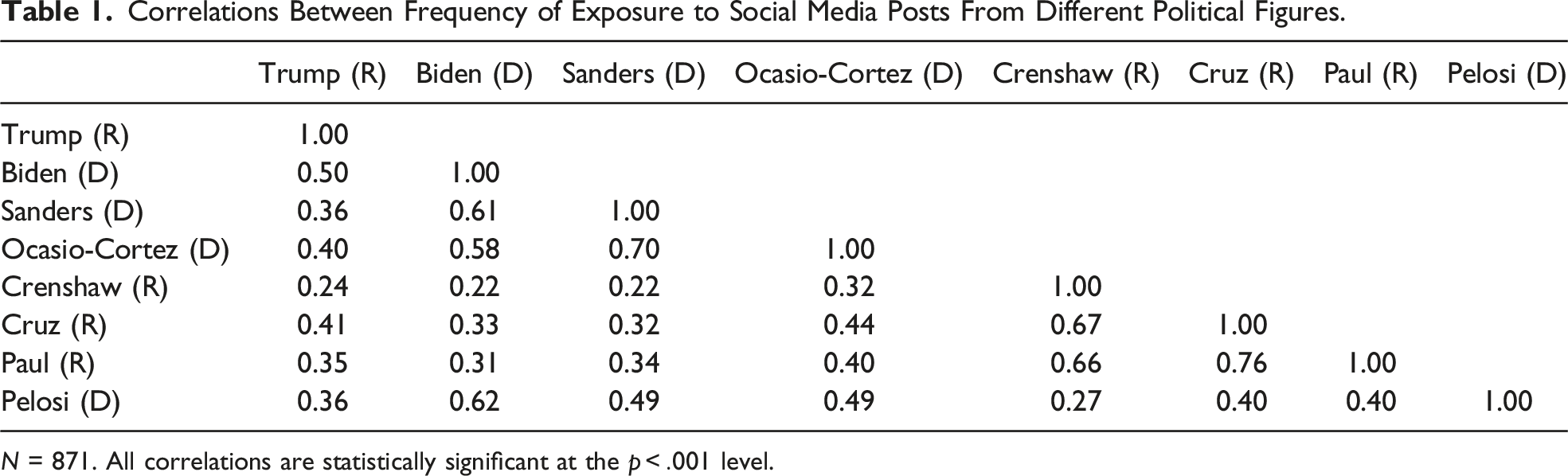
N = 871. All correlations are statistically significant at the
We probe these relationships further with an exploratory principal components factor analysis, which has the potential to provide some suggestive evidence on whether a given person’s exposure to posts from all eight of these elites is shaped by homophily or intensity. This analysis finds that two factors with Eigenvalues greater than 1 explain about 69 percent of the variation in these items. The first factor (Eigenvalue = 4.1) explains 51 percent of the variance by itself, and all eight items load positively on this factor, consistent with the correlations reported above. This could represent political intensity or attention. The items for the three congressional Republicans load positively on the second factor (Eigenvalue = 1.45), while those for all Democrats and Trump load negatively (though Trump only weakly so). This could represent homophily, though again the unique nature of Trump’s social media presence is evident (the uniqueness statistic for the Trump item is 0.59, suggesting almost 60 percent of the variation in exposure to his posts is unexplained by these factors). Figure 1 displays the loadings for each item on the two factors, while full results for the factor analysis are displayed in Online Appendix B. Factor loadings of social media exposure items from principal components factor analysis.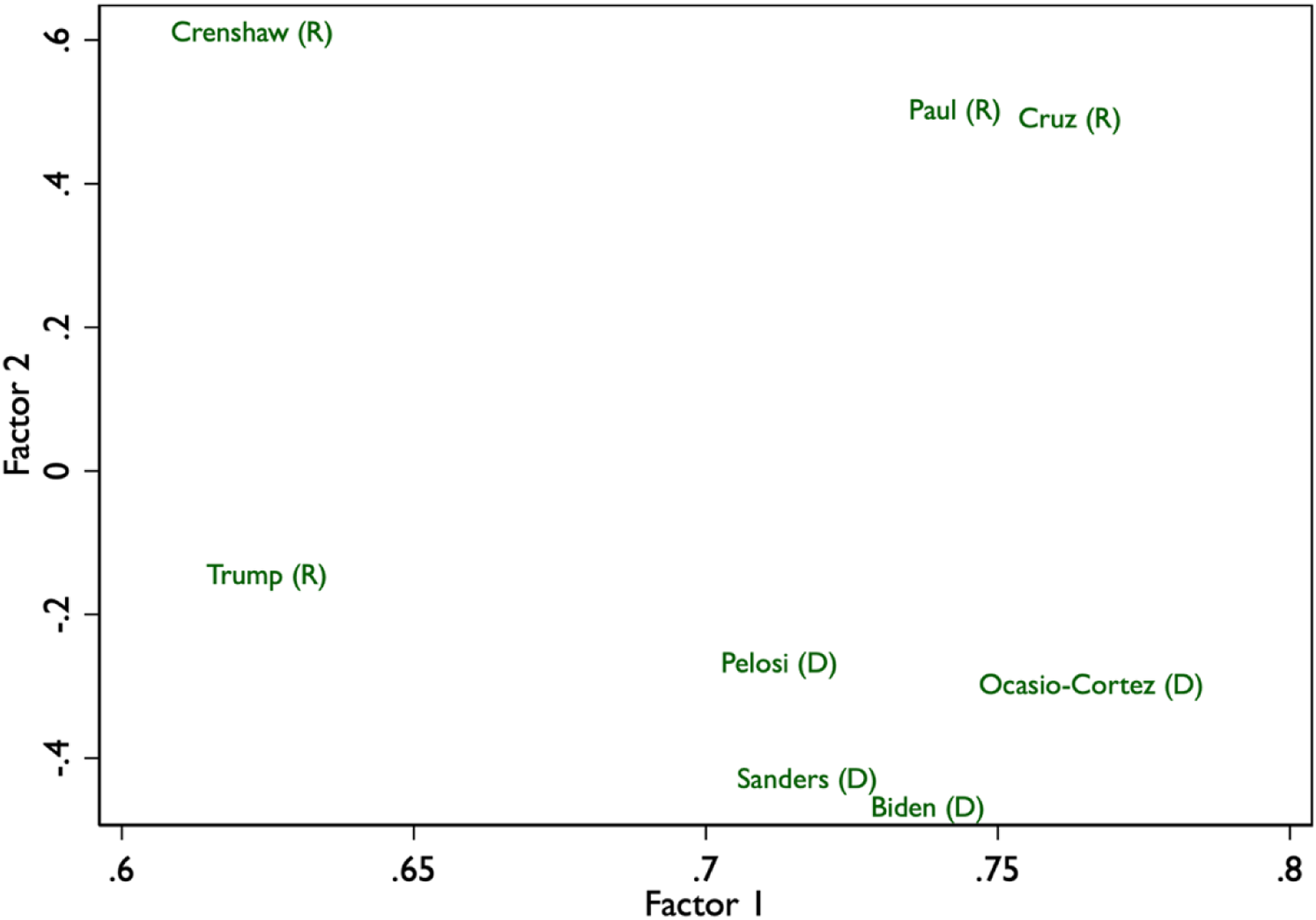
Multivariate Models
Effects of Partisanship, Social Media Use, and Other Covariates on the Frequency of Encountering Social Media Posts From Political Figures (Ordered Logit Models).
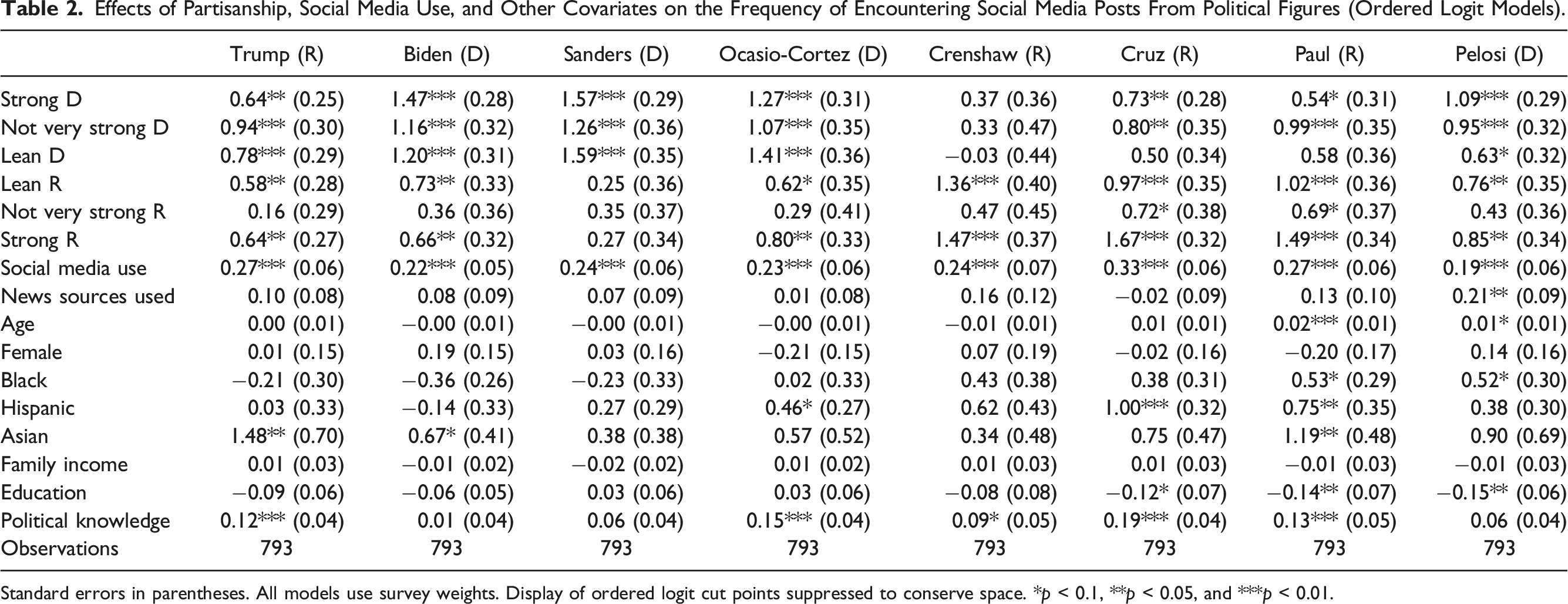
Standard errors in parentheses. All models use survey weights. Display of ordered logit cut points suppressed to conserve space. *p < 0.1, **p < 0.05, and ***p < 0.01.
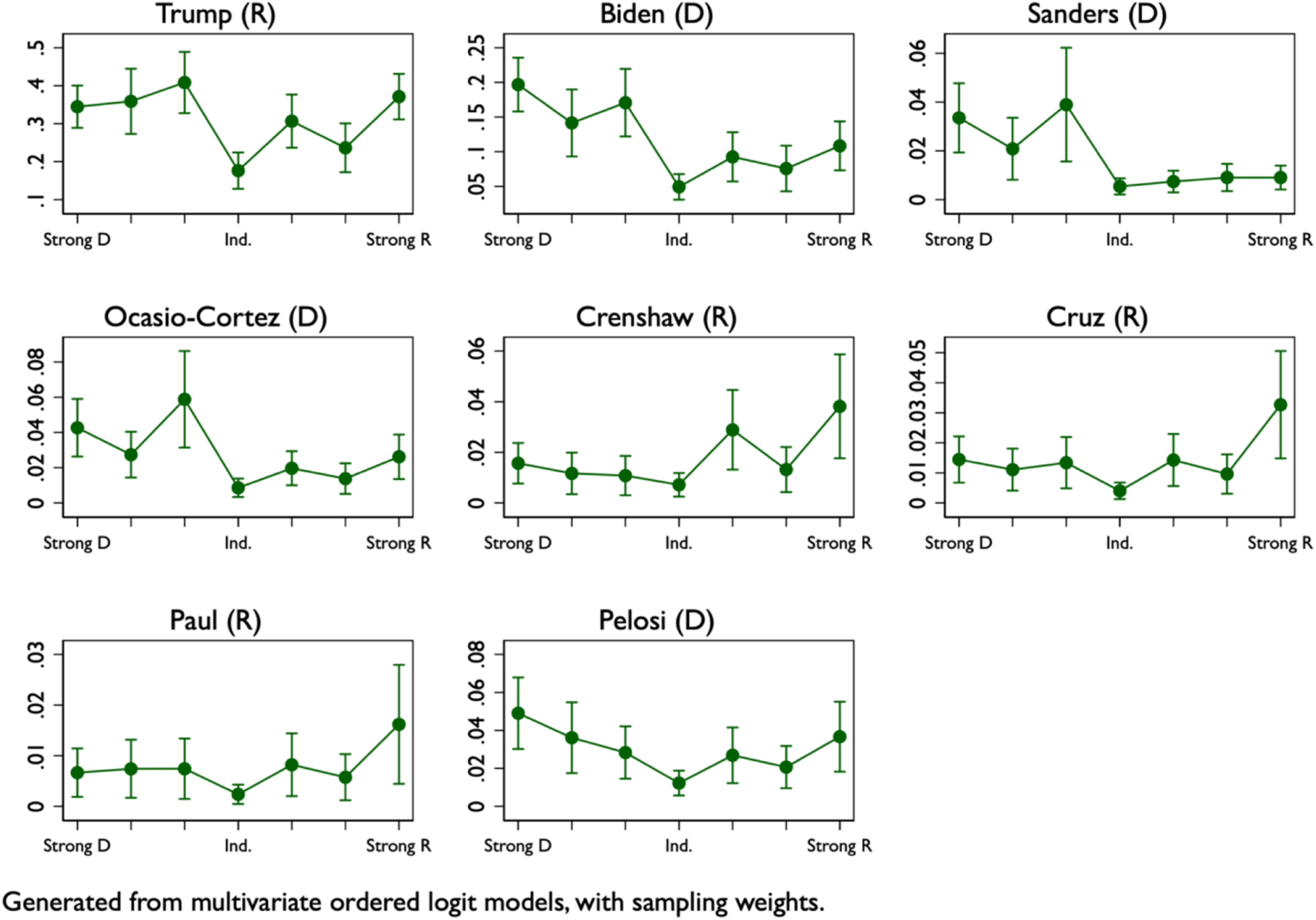
Predicted probabilities of encountering social media posts from politicians “every day” by party identification category, with 90 percent confidence intervals.
The homophily effect is far from straightforward, however. First, the pattern is reversed for Trump, with Democrats more likely to report seeing his posts more often than Republicans. 6 This suggests that Democrats actively seek out these posts, akin to “doom scrolling,” that social media platforms are promoting them to Democrats more than Republicans, or that Democrats are consuming other types of media where these messages appear more often. More generally, while patterns vary somewhat for different politicians, one consistent impression that emerges from Figure 2 is that independents are less likely than partisans on both sides of the aisle to encounter posts from all these figures, consistent with the Intensity Hypothesis and contrary to the stronger version of the Homophily Hypothesis. The results for Trump, Biden, Ocasio-Cortez, Cruz, Paul, and Pelosi all show at least one statistically significant and positive group effect from each party relative to the baseline of independents. 7 For Sanders and Crenshaw, only co-partisan groups show positive effects relative to independents, but opposite-party groups are statistically indistinguishable from the baseline, meaning, for example, that strong Republicans are not significantly less likely to encounter posts from Sanders daily than are independents. In fact, every partisan group coefficient is positive relative to the “independent” baseline in every model. 8 To put it in visual terms, none of the plots show anything resembling the consistent diagonal line we would expect from a simple homophily pattern. 9
Instead, our results suggest that exposure to social media posts is partly characterized by intensity, which is consistent with partisans encountering posts more frequently than independents. Furthermore, the fact that the coefficients for so many partisan variables are positive and statistically significant even when other measures of engagement (including social media use, positive and statistically significant in all models) are accounted for suggests that partisan intensity per se is a causal factor of interest, above and beyond generic political engagement.
None of the other covariates consistently predicts exposure to social media messages, though political knowledge (another measure of generic political engagement) is positive and statistically significant in five of the eight models. Hispanic respondents were more likely to be exposed to messages from the two Hispanic members of Congress, Ocasio-Cortez and Cruz, though their increased likelihood of seeing messages from Paul is less intuitive. The null findings for the news sources variable in all but the Pelosi model merit discussion, since we speculate that traditional media is one channel through which people might encounter posts from politicians that they do not personally follow. The coefficient is positive in all eight models, and we note that this variable shows a fairly strong correlation with the social media use variable in our sample (
While we allow the scale of the y-axes to vary in Figure 2 to show the nature of the effects for each politician, the differences in scale are worth noting. It is not surprising that exposure to Donald Trump’s tweets far outpaces exposure to any other political figure we test. Trump’s frequent use of Twitter as a primary source of communication, his frequent use of that platform to attack opponents, and the frequency with which his tweets were covered in mainstream media stories well beyond social media all make this expected. Still, the frequency with which Americans encountered Trump’s posts in 2020 is remarkable, especially when controlling for factors like social media use. Even among the 391 respondents in our sample who scored 0 on the social media use index (meaning they reported engaging in none of the listed social media activities in the past 24 hours), roughly half reported seeing Trump’s posts either every day (23 percent) or several times a week (27 percent), and only about one in four responded that they never encountered them. 10
Exposure to Joe Biden’s tweets is the next highest that we observe. This again should come as no surprise, as he was previously Vice President and was the Democratic nominee for President when this poll was in the field. The drop from Trump exposure to Biden is sharp, though, as the partisan groups with the lowest exposure to Trump’s tweets on a daily basis (independents) are similar to the group with the highest exposure to Biden’s Tweets (strong Democrats). Exposure to tweets from every other political actor we test, including Speaker Pelosi and Bernie Sanders, pales in comparison to Biden, let alone Trump.
Conclusions and Implications
We test two hypotheses that might explain why some individuals encounter politicians’ social media messages more frequently than others. The first suggests that the homophily in social media networks will lead the masses to see more social media messages from politicians with whom they align politically. The second suggests that individuals might seek messages from individuals with whom they disagree because it sparks stronger emotions like disgust and anger, or that media organizations (traditional and digital) might make such messages more visible. Using novel data from a high-quality nationally representative survey, we find some evidence to support both hypotheses, suggesting that both are relevant to understanding the political reach of social media posts. We find that exposure to social media messages from Donald Trump is highest among Democrats, suggesting that some individuals seek out this content (“doom scrolling”) or that this content is being pushed more to opponents through algorithms or traditional media. For less prominent politicians, we generally find that exposure is strongest among those on the same side of the political spectrum, consistent with the idea of “echo chambers” in social networks. At the same time, we find that exposure to politicians’ posts is higher among out-partisans than among independents, even when controlling for social media use and other measures of engagement, which is consistent with the importance of overall partisan intensity driving exposure, and suggests that “doom scrolling” may be politically important. Our results also demonstrate that the reach of these politicians’ social media messages extends beyond the platforms, as there is still high exposure to elite political messages even among those who report that they had not used social media in the past 24 hours.
Overall, our work provides novel insights on exposure to social media messages. Previous studies identify factors that drive message diffusion on these platforms and explore how ideology shapes the ways in which the masses interact with each other on social media. The current study builds on this work in several ways, by providing insight into who sees messages from political elites. Furthermore, since we find that even those who use social media platforms infrequently are seeing these messages, our results also suggest that traditional news media and offline social networks help to drive exposure. Finally, our work confirms that there is wide variation in the extent to which the masses encounter politicians’ messages. We suspect that some of these effects are driven by differences in the extent to which politicians’ messages are included in mainstream news stories (e.g., a newspaper or online news story that includes a tweet from Donald Trump verbatim).
It is important to better understand exposure to elite social media messages for several reasons. Existing research demonstrates that social media messages are much more likely to spread when they are negative (Fine and Hunt 2023; Stieglitz and Dang-Xuan 2013; Stromer-Galley et al. 2018). Given our findings, it is possible if not likely that a significant portion of messages that individuals encounter from political elites is negative. This could increase affective polarization and distrust in the political system more broadly and perhaps lead individuals to become more extreme over time (Bakshy, Messing, and Adamic 2015; Fine and Hunt 2023). This parallels other work that demonstrates that polarization is exacerbated by social media (Settle 2018). As concern grows about the impact of politics and political news on mental health (Caporino, Exley, and Latzman 2020; Solomonov and Barber 2018; Stainback, Hearne, and Trieu 2020), these findings suggest that negative emotions sparked by social media posts could be an important mechanism underlying this relationship. Another important and understudied aspect of political social media is the reach of politicians’ posts, given that they are able to use platforms to spread both valuable information and potentially dangerous content, such as misinformation about vaccines or election results. The finding of Wojcieszak et al. (2022) that few people actually follow political elites on social media highlights the importance of studies like this one that are not limited to following behavior. Our finding that exposure to political social media posts is fairly high (especially for prominent figures like Trump and Biden) even among less active social media users suggests that “offline” exposure through traditional media coverage or conversations with friends and family may extend politicians’ social media reach. In short, political social media may have more widespread impacts on American politics and life than we might otherwise have suspected.
Our findings also speak to controversial issues regarding the way that social media companies run their platforms. As discussed above, it is clear from the Facebook whistleblower’s accounts that these companies have an incentive to drive engagement on their platforms by fomenting outrage. Our results suggest that posts are often seen by individuals on both ends of the political spectrum, including those who are likely to be strong supporters and those who might be most outraged by the posts. Whether this is intentional or incidental is beyond the scope of this article, but the underlying patterns suggest that this strategy from the social media platforms may be having its intended effect.
This study does of course suffer from some limitations. First, our results rely on self-reported exposure to elite social media messages. An advantage of this approach relative to a more objective measurement approach, such as social media follows, is that it can capture exposure to messages from figures the individual does not follow, including the “offline exposure” we discuss above. The disadvantage is that self-reports of past experiences may be unreliable, and it is possible that the strength of partisan identity or ideology is associated with an increased likelihood of reporting that one is exposed to posts from a given political figure, regardless of actual exposure. This could occur because intense partisans overreport their own exposure, or because independents and less intense partisans fail to report real instances of exposure due to a lack of familiarity with the politicians in question. Encouragingly, however, existing work suggests that survey responses can be a reliable source of information about social media behavior (Guess et al. 2019). Also, by accounting for respondents’ political knowledge per Price and Zaller (1993), we believe we have at least mitigated the potential bias in recall of information, but we cannot claim to have definitively eliminated it. Our findings therefore reflect Americans’ subjective experiences with social media and politics, which may depart from objective reality in important ways. Ultimately, however, the impression that social media posts make in Americans’ minds may be more relevant to their political beliefs and behavior than the posts they actually see. Future work should further explore the different channels through which Americans encounter elite social media messages and the extent to which their subjective impressions align with objective reality.
A second important limitation is that our results are drawn from one survey in a single presidential election year, with a small number of politicians. It is possible that these results are not typical; the nature of the political figures we examined in 2020 might not hold for other elites, in other presidential election years with different candidates, to say nothing of the considerable changes to the social media landscape since the 2020 election, a point we return to below.
We are also unable to test whether the exposure that respondents report having to political elites’ social media posts is intentional or incidental. It seems likely that both types of exposure are occurring. Disentangling these distinct paths by which individuals are exposed to messages, and whether they vary based on partisanship, would be a fruitful direction for future research.
Another noteworthy limitation of our study is that a vast majority of the politicians in our survey question are male, making it difficult to speak to potential differences in the factors that shape exposure to male and female elites online. Existing research demonstrates that gender shapes behavior of politicians online; male and female politicians behave differently (e.g., McGregor, Lawrence, and Cardona 2016) and have different types of interactions with the public on social media. Women tend to be more interactive (e.g., Meeks 2016), but men are more likely to control the conversations about them (e.g., McGregor and Mourão 2016). And while uncivil attacks based on gender are relatively rare (Tromble and Koole 2020), research shows that women politicians are targeted more often than men (Rheault, Rayment, and Musulan 2019; but see Tromble and Koole 2020). It is possible that similar gender asymmetries may also exist in the factors that shape exposure to elite social media messages, but our study is not designed to identify such a pattern. This would be a worthwhile extension of our work for future scholars.
Lastly, the rapidly changing nature of the social media landscape adds an important caveat to any social science findings regarding social media experiences and behavior, ours included. We report findings from the results of a particular point in time for American life and politics—the 2020 presidential election and the coronavirus pandemic. The political and social media world has transformed considerably in just the last few years, including the ban of former President Donald Trump from Twitter and, subsequently, the platform’s purchase by and transformation under new owner Elon Musk. The decline in users and traffic on Twitter, now “X” under Musk, created an opening for Meta (Facebook’s own rebranded identity) to roll out a competing offering, Threads, which enjoyed an initial surge in popularity followed by a decline of its own (Singleton 2023). Meanwhile, TikTok, already an important player in 2020, exploded in popularity afterward, with a growing share of individuals who report getting their news on the platform each year (Matsa 2022). While we believe our findings offer generalizable insights about how Americans experience and engage with political content on social media, any generalization must account for the fact that the social media context has undergone major changes.
Supplemental Material
Supplemental Material - Echo Chambers or Doom Scrolling? Homophily, Intensity, and Exposure to Elite Social Media Messages
Supplemental Material for Echo Chambers or Doom Scrolling? Homophily, Intensity, and Exposure to Elite Social Media Messages by Jake Haselswerdt and Jeffrey A. Fine in Political Research Quarterly
Supplemental Material
Supplemental Material - Echo Chambers or Doom Scrolling? Homophily, Intensity, and Exposure to Elite Social Media Messages
Supplemental Material for Echo Chambers or Doom Scrolling? Homophily, Intensity, and Exposure to Elite Social Media Messages by Jake Haselswerdt and Jeffrey A. Fine in Political Research Quarterly
Footnotes
Acknowledgments
The authors would like to thank the Truman School of Government and Public Affairs at the University of Missouri for providing funding support for the CCES module and Jamila Michener and Christopher Ojeda for sharing module space. The authors also thank the editor and anonymous reviewers for their helpful comments and suggestions.
Declaration of Conflicting Interests
The authors declare no potential conflicts of interest with respect to the research, authorship, and/or publication of this article.
Funding
The author(s) disclosed receipt of the following financial support for the research, authorship, and/or publication of this article: Internal funding was provided by the Truman School of Government and Public Affairs at the University of Missouri.

Data Availability Statement
Supplemental Material
Supplemental material for this article is available online.
Notes
References
Supplementary Material
Please find the following supplemental material available below.
For Open Access articles published under a Creative Commons License, all supplemental material carries the same license as the article it is associated with.
For non-Open Access articles published, all supplemental material carries a non-exclusive license, and permission requests for re-use of supplemental material or any part of supplemental material shall be sent directly to the copyright owner as specified in the copyright notice associated with the article.
