




Abstract
Pete Buttigieg’s candidacy in the 2020 Democratic primaries caught fire more than most predicted. An openly gay man, Buttigieg is also a veteran and a Christian. Did voters penalize Buttigieg for being gay and in a same-sex relationship? Did his other traits offset voter negative bias? We conducted a survey with over 6000 likely voters during the primaries. We included a priming experiment that manipulated the salience of Buttigieg’s identity traits. We then asked respondents how much they liked Buttigieg and who they would support in a match-up between Buttigieg and Trump. Overall, voters penalized Buttigieg for being in a same-sex relationship. The penalty surprisingly increased when his religiosity was highlighted. In contrast, Buttigieg’s military background mitigated voter discrimination when he was presented as a veteran married to a man. This article reveals how double standards and heterosexism penalize gay candidates, and contributes to discussions on minority candidates and electability.
Pete Buttigieg was perceived to be a long shot presidential candidate. Despite his impressive biography, he was young, politically inexperienced, and a gay man from a small Midwest college town. But his candidacy caught fire more than most observers predicted when he launched his run in April 2019. Buttigieg finished at or near the top in Iowa and New Hampshire and collected more presidential delegates than any out gay man before. Despite ultimately dropping out of the race, he positioned himself for future leadership roles. In January 2021, he took office as Secretary of Transportation in President Biden’s cabinet, becoming the first out LGBTQ cabinet member confirmed by the Senate in American history.
During the primaries, many warned that America would not support a gay man in the White House. In a 2019 Politico/Morning Consult Poll, a plurality of respondents thought the country was not ready for a gay president (46%–40%). 1 Donald Trump believed that Pete Buttigieg was too gay for America. Even Barack Obama privately doubted that a gay candidate could win the Presidency. 2 The campaign itself worried about the chances of a gay candidate with Black voters in the South.
Buttigieg faced a conundrum in deciding how to present himself. To counter the “queer” image that several pundits sought to lodge in Middle America’s mind, some Democrats believed that accentuating his military experience in Afghanistan and his devout Christian faith would help counter prejudice. In sharp contrast, some queer activists criticized Buttigieg for a centrist platform and a heteronormative presentation, in line with a respectability strategy often embraced by the LGBTQ movement in the portrayal of same-sex relationships (Jones 2022). 3 But what was the reality of America’s propensity to vote for an openly gay man in a visible same-sex relationship? Did Buttigieg’s veteran status and religiosity counter balance any potential voter bias rooted in heterosexism?
To find out, we conducted a survey with 6345 likely American voters during the primaries. We included a priming experiment that presented respondents with information about Donald Trump and Pete Buttigieg, at the time a potential Democratic nominee. While all respondents received the same information about Trump, we randomly varied the information about Buttigieg across seven groups: Mayor Pete (control group), gay Pete (a soft control), proudly gay Pete (a treatment that emphasized his sexual orientation with a focus on his same-sex relationship), military Pete, religious Pete, military and proudly gay Pete, and religious and proudly gay Pete. We then asked respondents whom they would vote for in a hypothetical matchup between Trump and Buttigieg. We also asked respondents to express how much they liked Buttigieg on a 10-point scale, separately from vote choice.
Voters penalized Buttigieg when he was introduced as a gay man in a same-sex relationship. Not only does this indicate that heterosexism is still present in the electorate but also suggests that double standards apply, inasmuch as voters penalized a gay candidate for a characteristic—being married—that is often a positive asset for heterosexual candidates. Surprisingly, and contrary to our expectations, the penalty further increased when we highlighted Buttigieg’s religiosity. In contrast, Buttigieg received a boost in support when his military service was made salient. Hence, in American elections, a traditionally masculine and heteronormative cue—his military background—successfully contrasted voter discrimination when he was presented as a veteran married to a man.
Our study builds on the literature that explores voter reactions to LGBTQ candidates (Golebiowska 2001; Haider-Markel 2010; Haider-Markel et al. 2017; 2020; Jones et al. 2018; Magni and Reynolds 2018; 2021a; Magni 2020). We advance previous work in several ways. First, we consider a gay candidate in a real election in the United States with a known party ID, a fundamental determinant of political support often omitted in previous studies. Second, we vary the degree of the candidate’s “outness” and analyze whether voters reject a gay man in a visible same-sex relationship. Third, we examine the interaction of sexual orientation with other candidate traits, evaluating whether such characteristics offset the impact of negative bias against gay candidates.
This study allows us to examine whether Buttigieg exceeded expectations because sexual orientation is no longer an issue for voters, or whether he did so despite being gay, because of his other assets. The article also contributes to work examining the impact of candidate background on electoral success. More broadly, we join discussions of electability that often surround minority candidates (Bateson 2020), shedding light on how double standards still apply.
LGBTQ Candidates and Elections
Candidate identities often play an important role in campaigns and may affect election outcomes (Campbell et al. 2011; Castle et al. 2017). First, some voters are more likely to support candidates with similar demographic profiles because of group affinity (Conover 1984). Second, voters may use a candidate’s traits to make inferences about a candidate’s ideology, which then influences vote decision (Arnesen et al. 2019). For instance, women and sexual minority candidates are often seen as more liberal (Huddy and Terkildsen. 1993; McDermott 1997; Dolan 2014; Magni and Reynolds 2021a). Third, candidate identities can elicit prejudice, as some voters discriminate against racial minority candidates (Huddy and Feldman 2009; Cramer 2020), as well as non-Christian candidates (Berinsky and Mendelberg 2005; Fisher et al. 2015).
A small but growing literature has explored electoral support for gay, lesbian, bisexual, and transgender candidates. Transgender candidates face strong electoral penalties in the United States and other western democracies, quantified by recent work in 10–12% points (Jones and Brewer 2019; Magni and Reynolds 2021a). While voters' party ID, ideology, religiosity and disgust sensitivity influence support for trans candidates, penalties tend to be significant across most subgroups of voters. Prejudice against trans candidates, rooted in transphobia, remains generally strong (Haider-Markel et al. 2017; Jones et al. 2018; Jones and Brewer 2019; Magni and Reynolds 2021a).
Mixed results emerge with regard to sexual orientation. Studies on gay and lesbian politicians running for office have considered both hypothetical candidates (Herrick and Thomas 2002; Golebiowska 2003; Beyerlein and Klocek 2020) and real candidates (Golebiowska 2002; Haider-Markel 2010; Haider-Markel et al. 2020). In the case of hypothetical candidates in experiments or non-descriptive survey questions, studies have generally found a negative impact of sexual orientation on electoral chances. A mix of prejudice and homophobia, concerns about whether gay and lesbian candidates can win elections, and ideological attributions (i.e. voters see gay and lesbian candidates as more liberal) explain vote choices. Penalties tend to be stronger among religious, conservative and older voters, as well as among individuals who do not have LGBTQ friends and family members (Golebiowska 2001; Herrick and Thomas 2002; Doan and Haider-Markel 2010; Magni and Reynolds 2021a).
Considering hypothetical gay and lesbian candidates has many advantages. It allows researchers to gauge the baseline discrimination against sexual minorities, examine their likelihood to emerge in primary elections, and explore the support they receive in non-partisan elections (Magni and Reynolds 2021a; 2021b). Most of the studies considering hypothetical gay candidates have kept partisanship constant. Party ID, however, has traditionally been a key factor in determining voting behavior. Its relevance has arguably increased in times of growing polarization, so that candidates’ partisanship may trump other considerations (Mason 2018). At least one study on hypothetical gay candidates manipulated partisanship and found that the impact of sexual orientation significantly decreases when voters have information about candidates’ party ID (Loepp and Redman 2020).
Studies that have examined the effect of sexual orientation for real candidates have necessarily engaged with partisanship, a trait difficult to conceal in most real elections. Earlier studies found substantial penalties for gay and lesbian candidates, with the partial exceptions of attitudes of liberal voters and the cases of sexual minority candidates running in progressive districts (Haider-Markel 2010). More recently, work on post-2015 elections in the UK and the US has found that gay and lesbian candidates do as well as their straight counterparts at the ballot box (Magni and Reynolds 2018; Haider-Markel et al. 2020).
Studies on real candidates have generally assumed that voters knew that the candidates were gay. This is often a reasonable assumption, inasmuch as out LGBTQ candidates have usually been quite visible, either because of their decision to campaign openly or because of coverage by the media and rival campaigns. To our knowledge, no study has directly manipulated the salience of a real candidate’s sexual orientation to test how such priming influences vote choice.
Other Candidate Identities
While being gay or lesbian is often a central dimension in a candidate’s identity, sexual orientation is not the only trait that a candidate possesses. A 2016 Pew Research survey found that voters considered three candidate characteristics (of the thirteen tested) to be positive assets for presidential contenders: military service, elite education, and Christian identity. Scholarly evidence on the impact of education is mixed. Voters tend to slightly prefer candidates with higher and elite education (Herrmann and Tepe 2018; Horiuchi et al. 2020; Magni and Reynolds 2021a; 2021b), with liberals in particular perceiving elite-educated politicians as more competent (Gift and Lastra-Anadón 2018). The penalty for candidates with lower education, however, may not be very strong (Carnes and Lupu 2016).
Some evidence suggests that religious candidates enjoy a higher degree of support (Clifford and Gaskins 2016; Sumaktoyo, Ottati, and Untoro 2016). This is especially true among conservative and religious voters (McLaughlin and Wise 2014; Albertson 2015; Castle et al. 2017). Religious cues, in particular, prime religious traditionalism, which influences the electoral evaluations of candidates (Weber and Thornton 2012). Voters are also more likely to choose candidates of their own religion, which especially benefits Christian politicians (Campbell and Cowley 2014; Campbell, Green, and Layman 2011).
Candidates with a military background may also have an edge. The military has the highest level of confidence among American institutions. 4 Each presidential election between 1944 and 2008 had at least a veteran on the ballot, and until the 1970s three-quarters of Congresspeople were veterans (Teigen 2017). Voters see candidates with a military background as more competent on security and defense issues, which increases the level of electoral support (Teigen 2013; McDermott and Panagopoulos 2015). And while veterans do not always have an advantage in general elections, they tend to outperform in purple districts (Teigen 2017; 2018).
Most studies on lesbian and gay candidates have considered sexual orientation in isolation from other candidate characteristics. A few, however, have explored the interaction with gender and race. These studies have found that lesbian and Black gay candidates in the United States face intersectional challenges, beyond the penalties faced by white gay men running for office (Doan and Haider-Markel 2010; Magni and Reynolds 2021a). But work on the interaction of sexual orientation with religiosity and military background is scarce (Beyerlein and Klocek 2020). In fact, these categories have often been seen as mutually exclusive. This is partly because highly religious people have been less supportive of LGBTQ rights and candidates (Haider-Markel 2010), while LGBTQ individuals tend to be more secular and were long prevented from openly serving in the military. In this study, we examine the interaction of sexual orientation, religiosity and military service by focusing on Pete Buttigieg, a gay, religious veteran who ran for President.
The Complex Identities of Candidate Pete Buttigieg
Pete Buttigieg, a contender in the 2019–2020 Democratic presidential primaries, was the first openly gay man running for president for a major party. His primary race exceeded expectations. He won, or finished near the top, in the Iowa caucus and the New Hampshire primary, and became the first openly gay candidate for president in US history to win delegates to a major party convention. And yet, Buttigieg faced exceptional challenges, as many doubted that America was ready for a gay president. 5 Rush Limbaugh did not believe the country would elect a man who “loves to kiss his husband.” 6 During the Iowa caucus, a Democratic voter who had cast her ballot for Buttigieg asked to change her vote after she found out that Buttigieg was gay. 7 Even Buttigieg’s supporters doubted Americans’ willingness to embrace a gay President. 8
But Buttigieg was not merely a gay candidate. Buttigieg attended Harvard University and was a Rhodes Scholar at Oxford University. He is a veteran, who served 7 months as an intelligence officer in the Navy in Afghanistan. Throughout his campaign, Buttigieg highlighted his military background, drawing a distinction with his rivals in the Democratic primary 9 and contrasting his service with Donald Trump’s decision to dodge the Vietnam War. 10 Buttigieg is also religious. He attended Catholic school and regularly goes to an Episcopalian Church on Sunday. On the campaign trail, he vocally embraced his Christian faith, made religion a cornerstone of his message, and openly questioned the association of Christianity with the Republican Party (see Gibson and Hester 2023). 11
For these reasons, candidate Pete Buttigieg is a prime case to explore the interaction between sexual orientation and other candidate assets. Was heterosexism an electoral barrier for Buttigieg? Did his other traits, such as military service and religiosity, counter balance any potential negative effects of voter homophobia? Answering these questions can help us understand if Buttigieg over-performed the initial expectations and became the first openly gay man to win delegates for a presidential election because sexual orientation is no longer an issue; or whether he accomplished this despite being openly gay, because his other assets muted the negative consequences of voter prejudice.
Expectations About Candidate Pete Buttigieg
Despite the growing support for gay rights and gay candidates, especially among Democrats, out gay candidates in the United States still experience an electoral penalty (Magni and Reynolds 2021a). Previous work has also found that some people reject public displays of affection between gay men (Doan, Loehr and Miller 2014; Kluttz 2014). As a result, support for gay and lesbian candidates decreases if they are in visible same-sex relationships (Doan and Haider-Markel 2010; Haider-Markel et al. 2017). For this reason, we anticipate a penalty for Buttigieg when his same-sex relationship is highlighted (hypothesis 1).
We also believe that Buttigieg’s veteran status might mitigate the negative impact of his outness (hypothesis 2). Not only are candidates with a military background in the United States seen as competent leaders on key issues like national security and defense, which in turn increases their electoral support (Teigen 2013; McDermott and Panagopoulos 2015). These cues also challenge the stereotypes associated with gay men that reduce support among some voters, such as femininity, lack of assertiveness, and liberal ideology (Golebiowska 2001; Magni and Reynolds 2021a). Buttigieg’s military service could therefore mute some of these stereotypes and contrast negative voter attitudes.
Moreover, we expect Buttigieg’s religiosity to partially offset the negative impact of his sexual orientation among religious and conservative voters (hypothesis 3). Religious voters tend to evaluate religious candidates more positively (McDermott 1997; McDermott 2009; Weber and Thornton 2012). Conservative and religious voters are also more likely to vote for religious candidates (McLaughlin and Wise 2014; Albertson 2015; Castle et al. 2017). Hence, highlighting Buttigieg’s Christianity could increase his support, especially among conservative and religious voters.
Study Design
We conducted a survey in February and March 2020 with 6345 likely American voters. The survey was administered online by Dynata (former Survey Sampling International). We collected responses in 12 states (eight battleground, two liberal, two conservative): California, Colorado, Florida, Indiana, Michigan, Minnesota, Ohio, New York, North Carolina, Pennsylvania, Texas, and Virginia. The sample mirrors registered voters with regard to gender, age, race, income, and education. 12
We embedded a priming experiment in our survey. 13 The experiment presented respondents with information and pictures of Donald Trump, the Republican candidate, and Pete Buttigieg, at the time a potential Democratic nominee. All the information came from the candidates’ campaign websites to increase the experiment realism. Respondents saw the same information about Trump, who was described as the 45th President of the United States committed to continue to “make America great.”
We then randomly varied the information about Buttigieg presented to respondents. The goal was to heighten the salience of specific Buttigieg’s traits in respondents’ minds in order to raise a primary heuristic for voter choice. When making decisions, voters often rely on shortcuts based on readily available information (Achen and Bartels 2017; Redlawsk 2002). Stored information, in particular, can be activated by prompts that modulate the relative accessibility of information (Fiske and Taylor 2013; Srull and Wyer 1980).
We randomly assigned respondents to one of seven Buttigieg treatments. Mayor Pete (control) presented Buttigieg as a Midwest mayor who turned his city around and could bring change to D.C. While the control did not mention that Buttigieg was gay, the coverage of his sexual orientation had been extensive during the primary. Hence, we cannot rule out that likely voters in this group had been aware of his sexual orientation by the time we conducted our experiment. We then have a “soft control” group, which provided the same information presented in the control, in addition to mentioning Buttigieg’s sexual orientation. In particular, Gay Pete (soft control) explicitly introduced Buttigieg as the first openly gay man running for President, thereby ensuring that all respondents in this group knew about his sexual orientation.
Five additional treatments varied the salience of Buttigieg’s identity traits. We designed the treatments in such a way that we can precisely evaluate the priming effect of the identity traits under consideration. All the treatments provided the same baseline information offered in the control group. Moreover, each treatment added a sentence focused on the highlighted identity trait and changed the picture to emphasize the specific trait. Proudly gay Pete (treatment 1) emphasized Buttigieg’s outness by focusing on his same-sex relationship and showing a picture of the candidate embracing his husband. Military Pete (treatment 2) had a picture of the candidate in military uniform and mentioned Buttigieg’s service in Afghanistan. Military and proudly gay Pete (treatment 3) combined the previous two treatments. Religious Pete (treatment 4) presented Buttigieg as a devout Christian with a picture of Buttigieg praying. Religious and proudly gay Pete (treatment 5) combined treatments 1 and 4.
We then measured support for Buttigieg in two ways. First, we asked respondents to make a vote choice in a hypothetical matchup between Buttigieg and Trump. The question read, “If the election for President were held today, and Donald Trump were the Republican candidate and Pete Buttigieg were the Democratic candidate, for whom would you vote?” Respondents could choose between Buttigieg and Trump or say they were undecided. Second, we asked respondents how much they liked Buttigieg on a 10-point scale. This item can explore the effect of priming Buttigieg’s sexuality on support for Buttigieg beyond a forced vote choice between a Democratic and a Republican candidate. This allows us to test treatment effects also among Democratic voters who may be negatively biased against a gay candidate but unwilling to embrace a Republican like Donald Trump over a Democrat. If this is the case, the vote choice question may underestimate the negative impact of heterosexism on support for Buttigieg.
In the analysis, we examine whether the differences in support for Buttigieg between the control and the treatments are statistically significant. The experiment, therefore, allows us to evaluate how priming various candidate characteristics influences voter choice, and how the interaction between visible same-sex relationship and other candidate traits affects voter evaluations. Specifically, by varying the degree of the candidate “outness,” we can analyze whether voters react negatively to a gay candidate in a visible same-sex relationship. By examining the interaction of a visible same-sex partnership with veteran status and religiosity, we can evaluate whether such characteristics counter electoral penalties rooted in heterosexism.
Randomization and Manipulation Checks
Before presenting the treatment effects, we report the results of randomization and manipulation checks. To verify the even distribution of socio-demographic groups across the treatments, we conducted Tukey’s Honestly Significant Difference tests for respondents' gender, age, race, income, education, political ideology, party ID, religiosity, and having LGBT friends. The tests found no significant differences across treatments for any of the socio-demographic considered. Figure A1 in the online appendix presents plots with the results of the Tukey’s Honestly Significant Difference tests with 95% confidence intervals.
The manipulation checks provide evidence that the treatments successfully primed respondents to think about the candidate’s characteristics highlighted in the treatment conditions. Our post-experiment survey contained an open-ended question in which respondents listed which Pete Buttigieg’s characteristics they liked or disliked. If the treatments successfully primed respondents, we should expect that: (a) Respondents in the gay Pete condition mentioned Buttigieg’s sexual orientation more often (positively or negatively) than respondents in the mayor Pete condition; (b) Respondents in the proudly gay Pete condition mentioned Buttigieg’s sexual orientation more often than respondents in the gay Pete condition; (c) Respondents in the military Pete condition mentioned Buttigieg’s military service more often than respondents in the mayor Pete condition; (d) Respondents in the religious Pete condition mentioned Buttigieg’s religion more often than respondents in the mayor Pete condition.
Tables A11 and A12 in the online appendix present the results of OLS models in which the dependent variables are the open-ended answers. Answers are coded 1 if respondents mentioned Buttigieg’s sexual orientation, military background, or religiosity, respectively, whether in a positive or in a negative way. They are coded 0 if respondents did not mention such characteristics. The independent variables are the treatment conditions operationalized as a factor variable. In Table A11, the baseline condition of the treatment factor variable is Mayor Pete. In Table A12, the baseline condition of the treatment factor variable is Gay Pete. The results of the analysis confirm that the treatments primed respondents to think about Buttigieg’s emphasized characteristics, i.e. sexual orientation, military service, and religiosity.
Results
Figure 1 presents the results of vote choice divided by treatment. Buttigieg led Trump in all treatments. However, support for proudly gay Pete (44.3%) is lower than support for mayor Pete (47.9%) and than support for gay Pete (46.4%). On the other hand, reminding voters of Buttigieg’s veteran status (48.1%) more than made up for the penalty faced by proudly gay Pete. In contrast, support for Buttigieg is lowest when he is presented as a religious and proudly gay candidate (42.4%). Two tailed-tests for pairwise comparisons of the percentages of respondents saying they would vote for Buttigieg reveal that support for religious and proudly gay Pete is statistically significantly smaller than support for mayor Pete (−5.5% points, p = 0.022), military Pete (−5.8, p = 0.015), military and proudly gay Pete (−5.7, p = 0.018).
14
These percentage differences are substantively important, if one considers presidential election results. For instance, in the 2020 New Hampshire primary, Bernie Sanders and Pete Buttigieg—the top two finishers—were separated by only 1.3% points. Moreover, in the 2020 general presidential election, the Democratic and Republican candidates were within a 3% margin in seven states. Vote results by treatment condition. Note. The bars represent margin of errors for 95% confidence intervals. The number of respondents in each treatment condition are: Mayor Pete: 895; Gay Pete: 890; Proudly gay Pete: 929; Military Pete: 929; Military proudly gay Pete: 928; Religious Pete: 903; Religious proudly gay Pete: 866.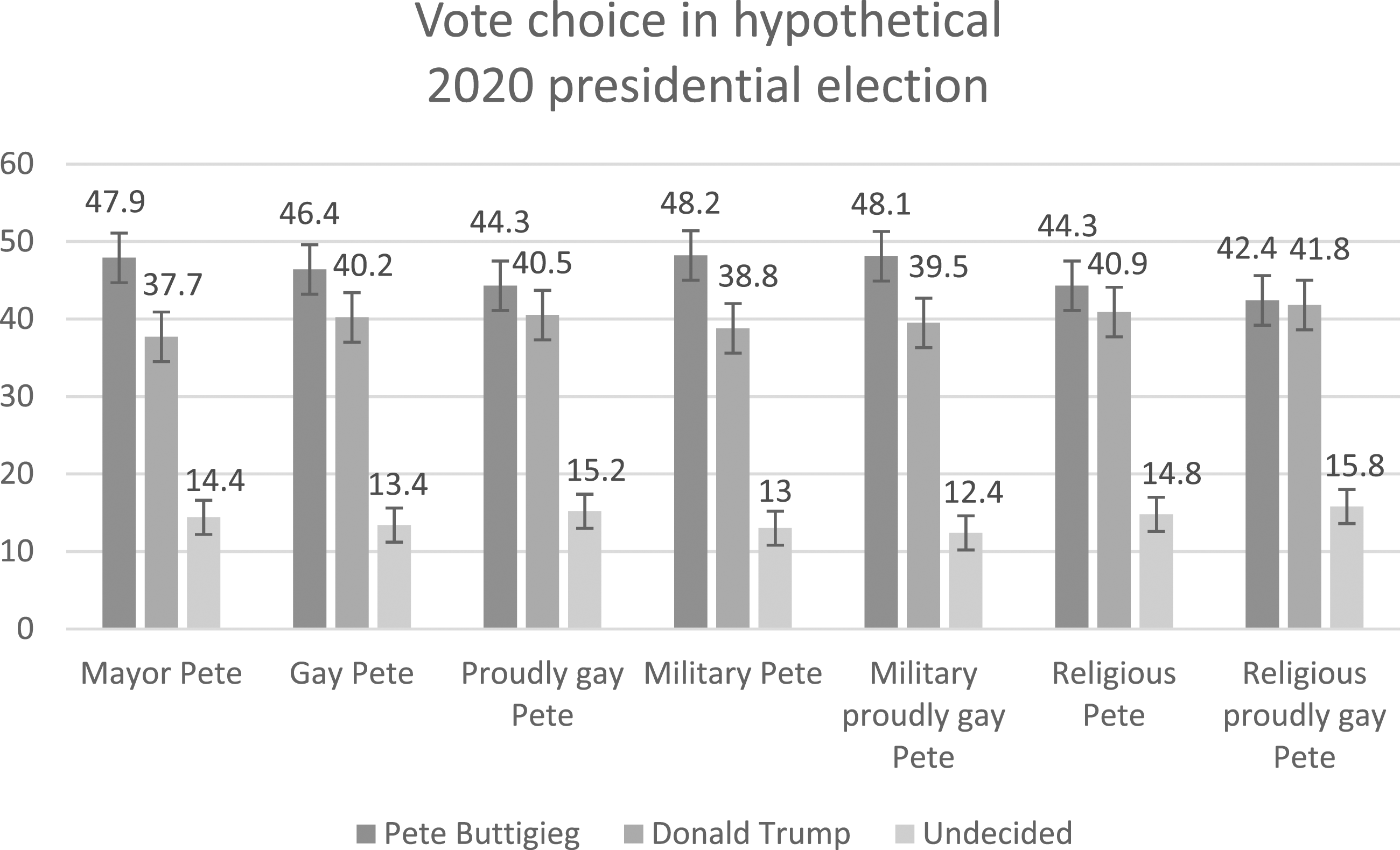
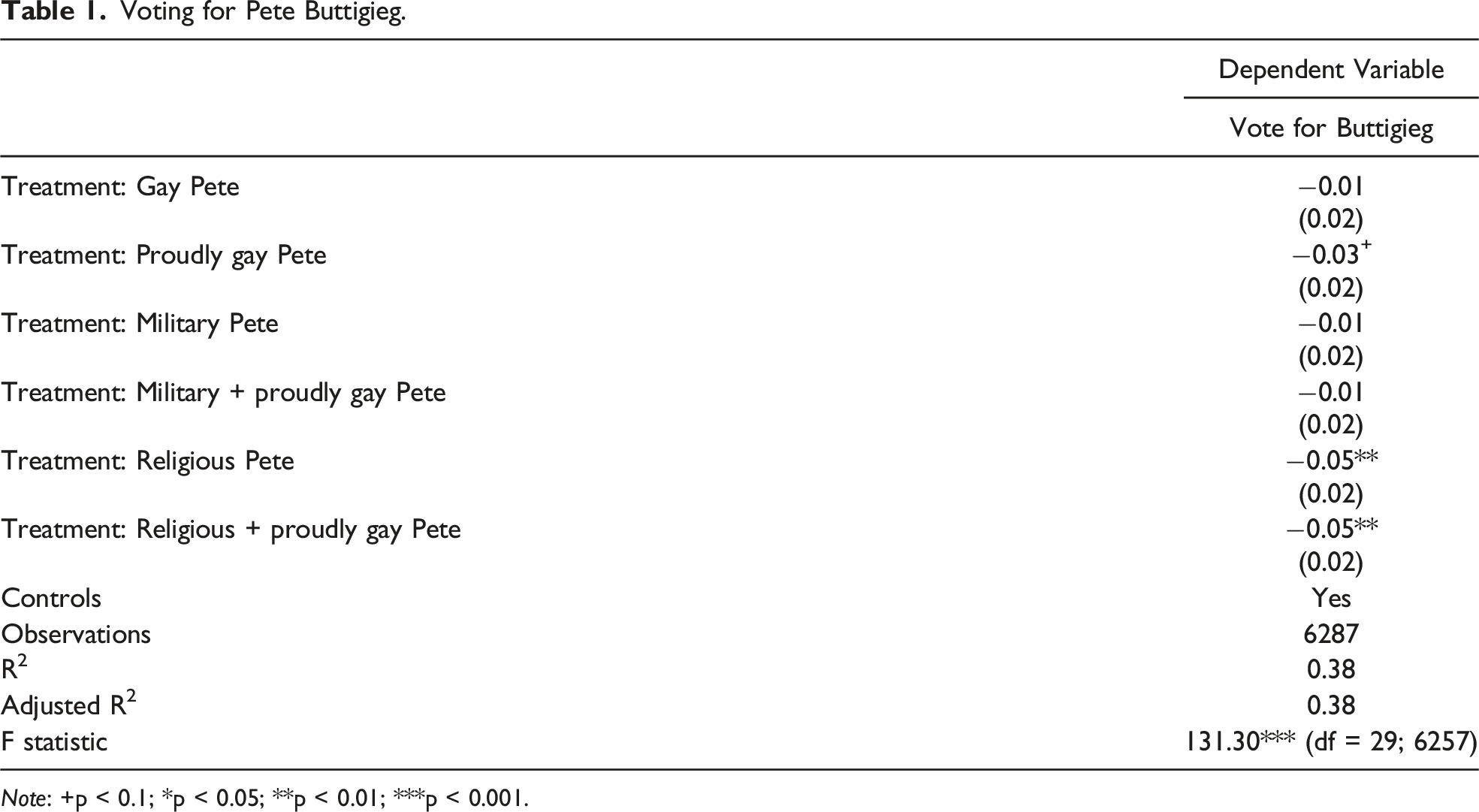
Voting for Pete Buttigieg.
Note: +p < 0.1; *p < 0.05; **p < 0.01; ***p < 0.001.
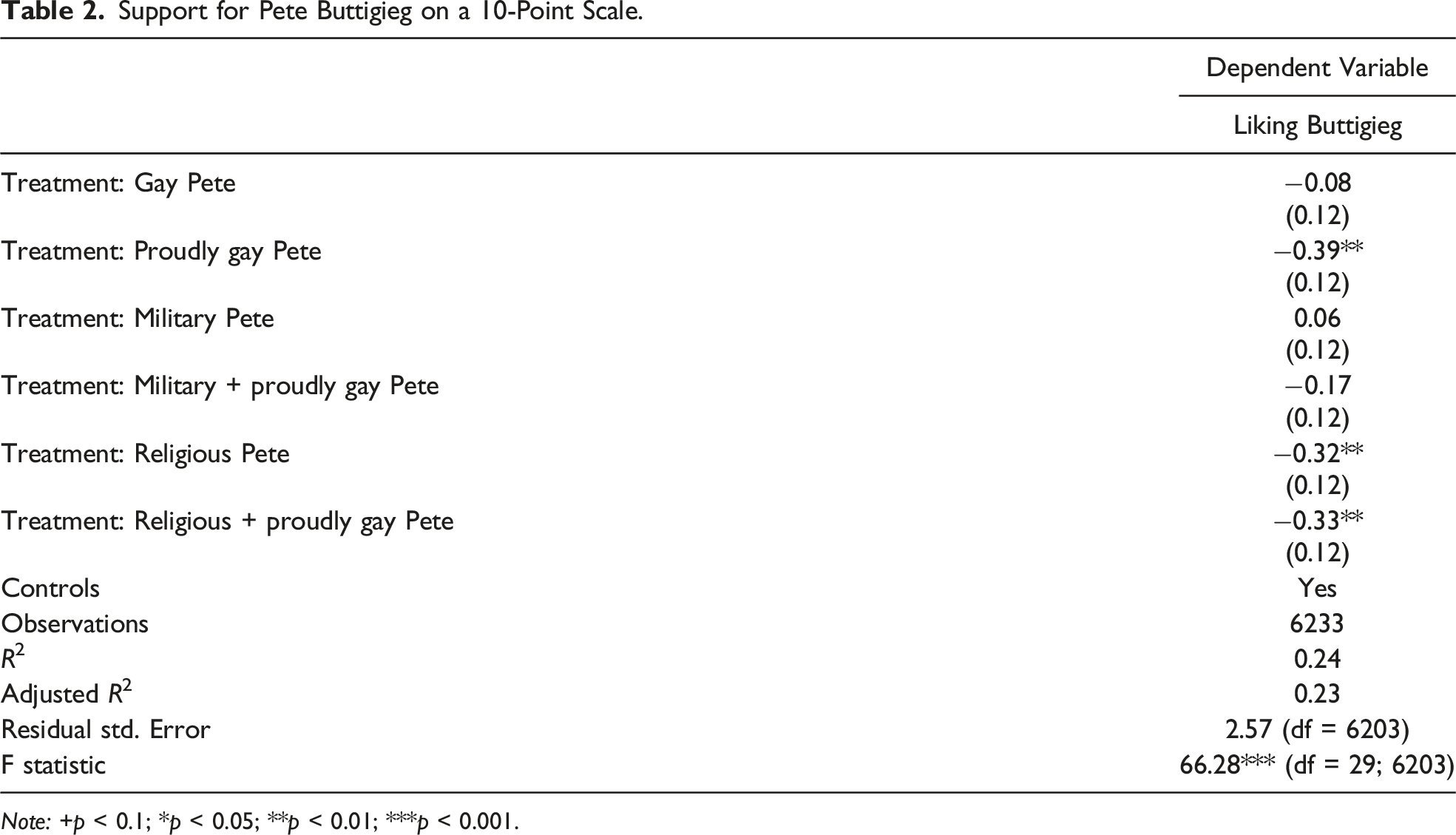
Support for Pete Buttigieg on a 10-Point Scale.
Note: +p < 0.1; *p < 0.05; **p < 0.01; ***p < 0.001.
On average, on a 10-point scale, the proudly gay Pete treatment decreased support for Buttigieg by about 0.4 points, while the two religious treatments decreased support by about 0.3 points. These are arguably substantial effects, larger than the impact associated with respondents' gender, considering that men were on average 0.25 points less supportive of Buttigieg than women, all things equal (see Table A5 in the appendix). 16
As a robustness check, we also ran OLS models where the baseline category for the treatment factor is gay Pete (Table A6 in the appendix). Results remain substantively unchanged. In particular, the proudly gay Pete treatment decreased support for Buttigieg even compared to the gay Pete treatment by about 0.3 points. This indicates that the degree of outness and visibility of same-sex partnership negatively affected support for Buttigieg. 17
Subgroup Results
Vote Choice by Treatment Condition Across Subgroups of Respondents.
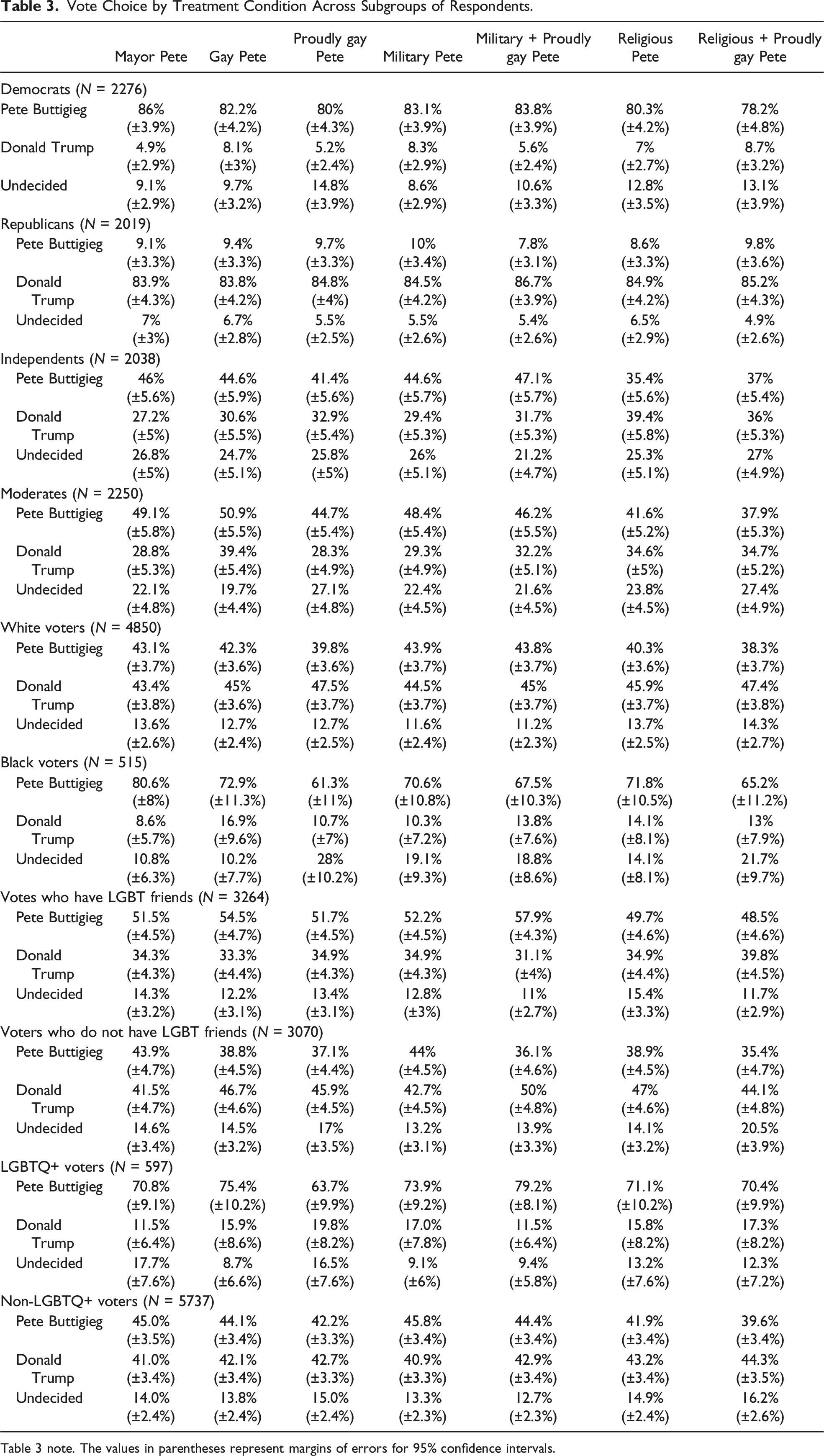
Table 3 note. The values in parentheses represent margins of errors for 95% confidence intervals.
Support for Buttigieg does not vary substantially across treatments among Democrats and Republicans. Republicans (N = 2019) always strongly support Trump, with Buttigieg always at or below 10%. Among Republicans, there are no statistically significant differences by treatment in the level of support for Buttigieg. Democrats (N = 2276) always strongly choose Buttigieg, even though the vote share for religious gay Pete falls below 80% and is significantly smaller than the vote for mayor Pete (−7.8% points, p = 0.017) and for military and proudly gay Pete (−5.6, p = 0.09). 19 The proudly gay Pete treatment increases the number of undecided among Democrats to 14.8%, and its level of support is 6% points lower than support for Mayor Pete (p = 0.058).
Larger treatment effects emerge among independents and moderates. 20 Among independents (N = 2038), proudly gay Pete with military service does not do significantly worse than mayor Pete (46% vs. 47.1%). In contrast, Buttigieg’s religiosity decreases his support to below 40%. The vote share for religious Pete (35.4%) is statistically significantly smaller than the shares for mayor Pete (−9, p = 0.012), gay Pete (−7.6, p = 0.033), military Pete (−7.6, p = 0.031) and military and proudly gay Pete (−10.1, p = 0.006). Similarly, religious Pete and religious and proudly gay Pete perform the weakest among moderates (N = 2250). The vote share for religious proudly gay Pete is statistically significantly smaller than the vote shares of all the other treatments, with the only exception of religious Pete.
Among white voters (N = 4860), Trump consistently wins. Buttigieg, however, makes up for most of the disadvantage when he is presented as a proudly gay veteran (43.8%). Once again, religious and proudly gay Pete receives the lowest level of support (38.3%). Such support is statistically significantly lower than support for military and proudly gay Pete (−5.5% points, p = 0.048). On the other hand, Black voters (N = 515) are strongly supportive of Buttigieg, even when he is presented as gay (gay Pete received 72.9% of the votes). Nonetheless, support among Black voters significantly drops in the proudly gay treatment. In this group, support for Buttigieg is almost 20% points lower than in the baseline mayor Pete condition (61.3% vs. 80.6%, p of the difference = 0.009), while the number of undecided Black voters substantially increases to 28%. 21
While respondents who have LGBTQ friends (N = 3264) strongly embrace Buttigieg across treatments, any presentation highlighting Buttigieg’s same-sex relationship generates significant penalties among voters who do not have LGBTQ friends (N = 3070). Among these voters, mayor Pete receives 43.9% of the votes, gay Pete obtains 38.8%, proudly gay Pete 37.1%, military and proudly gay Pete 36.1%, religious and proudly gay Pete 35.5%. The levels of support in all the proudly gay treatments are statistically significantly smaller than support for Mayor Pete. Support for Buttigieg in the LGBTQ community is strong regardless of the way in which he is presented. Our survey included 597 respondents who self-identified as LGBTQ. 22 Overall, 72% of the 597 LGBTQ voters chose Buttigieg, 16% chose Trump, and 12% were undecided. Even among LGBTQ voters, proudly gay veteran Pete has the greatest support (79.2% vs. 11.5% vs. 9.4%).
Finally, and perhaps counterintuitively, religiosity does not help Buttigieg with religious voters. 23 Among these voters (N = 1451), religious Pete (29.9%) receives a slightly greater support than gay Pete (26.6%) but smaller than mayor Pete (31.7%), even though the differences are insignificant (see appendix).
The Impact of Buttigieg’s Religiosity
The results show that Buttigieg’s support decreased when his religiosity was highlighted. This finding contradicted our expectations, and specifically our hypothesis that religiosity would prove a positive asset for Buttigieg especially among religious and less liberal voters. The finding is especially surprising if one considers that conservative and religious voters have traditionally been more supportive of religious candidates (Albertson 2015; Castle et al. 2017; McLaughlin and Wise 2014). Our result also confounds the Buttigieg campaign’s decision to amplify the candidate’s faith, but aligns with results from Beyerlein and Klocek (2020) by showing how voters penalize a gay religious candidate.
The data at hand do not allow us to examine fully the reasons why voters—including religious ones—rejected religious candidate Buttigieg. However, we can offer some speculations that future work could test directly. First, the deeply partisan context of the 2020 election helps us understand why religiosity did not help Buttigieg among Republicans in a head-to-head face-off with Trump. Evangelical Christians and other highly religious voters have become the bedrock of the Republican Party (Layman 2001; Putnam and Campbell 2012). Evangelical Christians, in particular, were a key part of Trump’s 2016 constituency (Margolis 2020). Trump’s status as a polarizing figure led most voters to form opinions of him early on, and such opinions remained polarized and largely steady in 2020 (Sides, Tausanovitch, and Vavreck 2022). This could explain why Evangelicals and other religious Republicans did not embrace a Democratic candidate.
Another possibility is that highlighting Buttigieg’s religiosity made religion salient in voters’ minds. Religious cues in campaign messages, in turn, activate religious traditionalism (Weber and Thornton 2012). Activating religious traditionalism may then increase support for conservative candidates, who tend to be Republican.
An alternative explanation relies on expectancy violations, which happen when salient features of an object or a person are not consistent with the prototype (Roese and Sherman 2007). The disconfirmation of expectations can suppress ingroup cue taking and support, leading voters to be more critical in processing political information (Johnston et al. 2015). In the specific case, voters may expect a gay candidate to be Democratic, progressive, and non-religious, given that LGBTQ candidates are often perceived as more liberal and less religious (Magni and Reynolds 2021a). A gay religious candidate, therefore, would violate voter expectations. Conservative religious voters, in particular, may then reject a religious candidate who is gay—despite the shared religiosity—because they may perceive such a candidate as a threat to their ingroup identity.
Indirect empirical evidence supports this interpretation. A recent computational analysis of more than 2.5 million tweets about presidential candidate Buttigieg found that the most shared tweet was a tweet from evangelist Franklin Graham, who questioned whether a gay man could be a true Christian (Gibson and Hester 2023). In our dataset, answers to the open-ended question that asked respondents what they liked and disliked about Buttigieg provide further support for this explanation. Several conservative religious voters mentioned that being openly gay and in a same-sex relationship was sinful behavior inacceptable for a truly religious person. Conservative religious voters, therefore, may reject a gay religious candidate who they see as an affront to their religious identity.
Interestingly, Buttigieg also lost support among Democrats, independents, and moderates when his religiosity was highlighted. This could be explained by the fact that the Democratic Party’s “public image” is increasingly tied to secularism (Campbell, Green, and Layman 2011; see also Hansen 2011; Campbell, Layman, and Green 2020). Survey experiments have shown that voters penalize hypothetical Democratic candidates who use highly religious language (Castle et al. 2017). To investigate this point, we conducted further subgroup analysis for respondents who answered “yes” and “no” to the question on whether they belonged to any religion or denomination. Our results reveal that support for religious Pete declined more among respondents with no religious affiliation. Compared to the baseline Mayor Pete, support for religious Pete declined by 6% points and support for religious and gay Pete declined by 9.9% points among respondents with no religious affiliation. In contrast, it declined only by 0.8% points and 1.7% points, respectively, among religiously affiliated respondents. This suggests that Democratic candidates who use religious rhetoric may alienate a significant portion of the Democratic base and overall lose support.
Discussion
In 2020, voters slightly penalized Buttigieg for being in a same-sex relationship. Our results reveal smaller penalties than the ones observed for gay politicians in earlier work (Golebiowska 2001; Haider-Markel 2010) and in studies considering hypothetical candidates (Magni and Reynolds 2021a). However, while other recent findings have suggested that sexual orientation is no longer penalizing when partisanship is taken into account (Haider-Markel et al. 2020; Loepp and Redman 2020), our study cautions that the level of outness influences the discrimination experienced by sexual minority candidates. This emerged especially clearly when we measured support for Buttigieg on a 10-point scale beyond vote choice.
Indeed, there was a drop in support for Buttigieg when he was pictured with his husband. This happened partly because the number of undecided voters among Democrats increased. At a time of growing polarization where most voters are not persuadable (Mason 2018) and parties often focus on mobilizing their base, this is a troubling finding, as some of the undecided voters may decide not to vote for their party candidate on Election Day. This finding is consistent with previous scholarship, which found that support for gay and lesbian candidates decreases when they are in visible same-sex relationships (Doan and Haider-Markel 2010; Doan, Loehr and Miller 2014; Haider-Markel et al. 2017). It is also consistent with prior work showing that a respectability strategy that portrays same-sex relationships as exemplifying heteronormative expectations does not necessarily gain the support of straight Americans (Jones 2022). In fact, our finding points to the double standards that gay candidates face. When considering heterosexual politicians, voters tend to reward candidates who are married (Teele et al. 2018). Voters, therefore, may differently evaluate gay and straight candidates with similar profiles, penalizing gay candidates for traits that are usually a positive asset for straight candidates.
In contrast, in the context of US elections, Buttigieg’s veteran status made up for the penalty associated with Buttigieg’s outness. On the one hand, this may be welcome news. As voters learn more about a gay candidate and come to appreciate their story, the impact of homophobia on vote choice may weaken. On the other hand, this finding points to the power of heterosexism and traditional gender expectations. In fact, the characteristic that allowed candidate Buttigieg to overcome voter penalty—military experience—is a trait that is often associated with masculinity and heterosexuality. This finding also cautions against possible misleading conclusions about voter bias. The fact that gay and lesbian candidates often received as many votes as their straight counterparts (Haider-Markel et al. 2020) may mask voter penalties, if other candidates’ assets make up for the penalty against sexual minorities induced by homophobia.
Additionally, Black voters are still often described as less likely to support gay candidates. However, our results show that Black voters were much more supportive of Buttigieg over Trump than white voters, even when Buttigieg was presented as gay. Since Black voters remain among the most reliable supporters of the Democratic Party, they strongly embrace Democratic candidates in general elections even when the candidates are gay.
Support for Buttigieg against Trump was overwhelming among LGBTQ voters. This was not merely an expression of party loyalty, as one may think considering that the vast majority of LGBTQ voters identify as Democrats (Egan, Edelman, and Sherrill 2008; Jones 2021). We can show this by looking at the effect of voters' sexual orientation and gender identity on support for Buttigieg as measured by the likeability question. In the model described in Table 6, we now include a dichotomous independent variable, “LGBTQ,” which equals 1 for respondents who identify as members of the LGBTQ community and 0 otherwise. The effect of the LGBTQ variable is significant at the 0.001 level. On the 10-point scale measuring how much voters liked Buttigieg, LGBTQ voters scored on average 0.62 points higher than non-LGBTQ voters, all things equal, that is, controlling for treatment conditions, individual characteristics including party ID and education, and state of residence. This indicates that LGBTQ voters did embrace Buttigieg beyond party loyalty.
Conclusion
Pundits and party operatives have speculated about whether American voters are ready to elect a gay man for President. Many voters believe that other voters are more homophobic than they are. Alongside the presumption of homophobia in the Black and Latinx communities, urban voters think that rural voters are more homophobic than they are. Young people think old people are more homophobic. Highly educated voters think less educated voters are more homophobic. When these judgements about the electorate are amplified, they lead to strategic discrimination (Bateson 2020). The decision of some voters not to support an LGBTQ candidate because they believe such a candidate has limited support in other sectors of the electorate (Magni and Reynolds 2021a) creates a self-fulfilling prophecy that may prevent the election of LGBTQ candidates.
Our study, conducted in the midst of highly competitive Democratic primaries with a large sample of likely voters, sheds light on voter support for a gay presidential candidate in a visible same-sex relationship, whose sexual orientation interacted with other identity traits. The findings reveal that support for Buttigieg slightly decreased when he was introduced as a man married to another man. The fact that voters penalized Buttigieg for being in a same-sex relationship indicates that heterosexism persists in the electorate. Interestingly, on the other hand, Buttigieg received a significant boost in support when he was depicted as a veteran married to a man. Voters were as likely to support Pete the mayor as they were to choose Pete the proudly gay veteran. His military background, therefore, successfully countered voter discrimination, suggesting that some gay candidates may close the gap once voters learn more about their story.
We should be careful, however, about generalizing the results to all LGBTQ candidates. In fact, Buttigieg signaled a number of heteronormative cues that may not be available to other queer candidates. Moreover, as a white cisgender gay man, Buttigieg embodies a minority within the LGBTQ community, and his experience is unlikely to be the experience of a queer woman of color or a transgender candidate. Transgender candidates, in particular, likely face stronger hostility, as highlighted by prior work and in light of recent anti-trans rhetoric and legislative action.
Buttigieg was also pitched against an extremely polarizing Republican candidate, who may have induced some Democrats and moderates to vote for Trump’s opponent regardless of the opponent’s identity. Yet, Buttigieg’s outness and military background influenced support for the candidate beyond vote choice. Overall, therefore, our results point to both the changing landscape of American politics and the resilience of long-standing prejudice against gay men. While a gay man running for President may be competitive, double standards still penalize gay candidates, and heteronormative cues play a significant role in shaping voter considerations.
Supplemental Material
Supplemental Material - Candidate Identity and Campaign Priming: Analyzing Voter Support for Pete Buttigieg’s Presidential Run as an Openly Gay Man
Supplemental Material for Candidate Identity and Campaign Priming: Analyzing Voter Support for Pete Buttigieg’s Presidential Run as an Openly Gay Man by Gabriele Magni and Andrew Reynolds in Political Research Quarterly
Footnotes
Declaration of Conflicting Interests
The author(s) declared no potential conflicts of interest with respect to the research, authorship, and/or publication of this article.
Funding
The author(s) received no financial support for the research, authorship, and/or publication of this article.

Data Availability Statement
All data and code used for analysis will be publicly available on the Harvard Dataverse at the following link: https://dataverse.harvard.edu/dataset.xhtml?persistentId=doi%3A10.7910%2FDVN%2F2DKE7L&version=DRAFT
Supplemental Material
Supplemental material for this article is available online.
Notes
References
Supplementary Material
Please find the following supplemental material available below.
For Open Access articles published under a Creative Commons License, all supplemental material carries the same license as the article it is associated with.
For non-Open Access articles published, all supplemental material carries a non-exclusive license, and permission requests for re-use of supplemental material or any part of supplemental material shall be sent directly to the copyright owner as specified in the copyright notice associated with the article.
