




Abstract
What explains the variation in the interpretation and enforcement of international law by domestic judges? Can independent judiciaries control the enforcement of countries’ commitments to international law? In this paper, we leverage a unique source of data—cases related to the Alien Tort Statute—to investigate how independent judges might be able to enforce international commitments to human rights without concern for whether the state (here the United States) has opted into the commitments in the first place. We show that behavioral factors in judicial decision making, and particularly those related to judicial ideological preferences, are potent predictors of judicial enforcement of international law. This implies that states with highly independent judiciaries are right to be worried about their abilities to control enforcement domestically, although we also find evidence that the U.S. government get a special degree of deference in these cases.
What explains the variation in the interpretation and enforcement of international law by domestic judges? Can independent judiciaries influence the enforcement of countries’ international legal obligations to international law? The literature on domestic enforcement suggests that states may be reluctant to agree to treaties when they know that their (independent) domestic judiciaries are likely to enforce those agreements (e.g., Powell & Staton 2009). Indeed, the most accountable states may be the least likely to agree to treaty restrictions in the first instance. The U.S. is sometimes seen as the exemplar of this kind of “opt out” state (Powell & Staton 2009, 157), regularly ranked as having one of the most independent judiciaries in the world (Linzer & Staton 2015).
In this paper, we leverage a unique source of data—cases related to the Alien Tort Statute (ATS)—to investigate how independent judges might be able to enforce international commitments to human rights without concern for whether the state (here the United States) has opted into the commitments in the first place. 1 We show that behavioral factors in judicial decision making, and particularly those related to judicial ideological preferences, are potent predictors of judicial enforcement of international law. This implies that states with highly independent judiciaries are right to be worried about their abilities to control enforcement domestically, although we also find evidence that the U.S. government gets a special degree of deference in these cases. Our findings speak to whether increasing reliance on domestic institutions to enforce international commitments (e.g., Slaughter and Burke-White 2006) is likely to be heavily premised on the discretion of individual judges and how that discretion might be controlled. Our results also suggest that dialogue between international relations and judicial politics is critical for a richer understanding of the domestic enforcement of international law.
The ATS allows federal judges to incorporate customary international law in cases claiming violations of human rights norms. 2 U.S. federal appellate court judges applying the ATS have often reached different conclusions. For instance, in Sarei v. Rio Tinto (671 F.3d 736, 797-98), Judge Kleinfeld wrote in dissent: “Now that our court has adopted universal jurisdiction to grant tort damages for violations by foreigners against foreigners in foreign lands of ‘the law of nations’, … we… now exercise jurisdiction over all the earth….” On the other hand, Justice Sotomayor, concurring in the recently decided Nestle v. Doe (19–416) said: “[F]rom the moment the ATS became law, Congress expected federal courts to identify actionable torts under international law and to provide injured plaintiffs with a forum to seek redress.” We posit that to understand this variation we need to look at how the individual-level behavioral predispositions and policy preferences of domestic judges influence their attitudes toward international law, a phenomenon that received limited attention to date in the literature on international relations.
Our argument is that judicial behavior plays a key role in the enforcement of international law in domestic courts. Domestic judges act ideologically consistent with their pre-existing preferences toward international law while walking the fine line between paying attention to the political environment in which they operate to prevent backlash and facilitating the enforcement of international law. We derive hypotheses from competing models of judicial decision making focusing on the attitudinal model centered on the role of judicial ideology. We test our argument using a newly created dataset of cases in U.S. federal courts interpreting and applying the ATS. 3 We show that who sits on the bench matters. Liberal judges are significantly more likely to allow ATS cases to be considered in federal courts and to decide them in a way that favors human rights enforcement. Further, we demonstrate that higher courts can impose some control on interpretation in lower courts, by investigating the ability of the Supreme Court to limit the scope of judicial discretion with precedent.
Despite being somewhat constrained by the judicial hierarchy, domestic judges nevertheless use ideology to guide their decision making when it comes to the application of international law. Judicial decision making regarding the application of international law has an ideological foundation, making it similar to cases pertaining to domestic issues. In showing that that judicial behavior is predictive of the domestic enforcement of international law, our results indicate that above and beyond the nature of the international legal instrument at stake, jurisdiction, and judicial doctrine, the ideology of a randomly (or pseudo-randomly) assigned federal judge to a case has important implications for whether they apply international law. Simple descriptive statistics tell this story well. On a judicial panel that is more liberal than average the court votes to enforce international norms about 40% of the time, whereas when the panel is more conservative than average the rate of enforcement drops to about 30% (this difference is statistically significant at p = 0.07). This clearly indicates that there are limits to how much a country with a strong independent judiciary can really determine the domestic enforcement of international law.
By building a bridge between the psychology of judicial decision making and domestic enforcement of international law, our work offers a benchmark for explaining how differences in the individual ideological beliefs of domestic judges affect the application of international law in world affairs. In what follows, we briefly review existing works to situate the importance of judicial ideology as a decision making factor in the political/legal environment in which national courts operate. Then we discuss the nature of cases interpreting the Alien Tort Statute. Next, we present our new source of data and method of analysis. Discussion of the results and their implications conclude.
Enforcement of International Law at National Courts and Judicial Decision Making
National courts are crucial sites for the enforcement of international law. They play a vital role in the implementation of international legal rules (Nollkaemper et al. 2011; Sloss 2009), settlement of disputes between transnational actors (Putnam 2016), and in the further development of international law (Kahraman et al. 2020). As their importance grew in the international legal system, a large body of research has shown interest in the enforcement of international law in national courts (Nollkaemper et al. 2011; Lupu et al. 2019; Benvenisti 2008; Sandholtz 2015; Alter et al. 2019). Scholars have examined the legal grounds for the application of international law in domestic courts such as jurisdiction, standing, direct effects, and consistent interpretation (Nollkaemper et al. 2011), the monism versus dualism dichotomy (Jackson 1992), and judicial doctrines and canons of interpretation (Lupu et al. 2019). The willingness of courts to curb the power of the executive branch (Benvenisti 2008) and to legitimize their decisions on individual rights when they overrule government acts (Sandholtz 2015) as well as the broader political constraints such as the possibility of backlash from the executive branch or civil society actors (Lupu et al. 2019; Alter et al. 2019), have also been topics of interest.
With respect to international human rights law, it is well known that domestic enforcement is critical because there are no strong international mechanisms of enforcement. Existing works have shown that domestic actors, such as national courts, legislatures, civil society organizations, and public opinion play a role in the domestic enforcement of international human rights law (Lupu 2013; Powell and Staton 2009; Hafner-Burton and Tsutsui 2005). Scholars have found that national courts are more likely to enforce human rights laws when they have independence from the other branches of government (Powell and Staton 2009), when judicial doctrine allows courts to interpret domestic law consistent with treaty obligations (Lupu et al. 2019), when admissible evidence on human rights abuses is strong (Lupu 2013), and when treaties are directly incorporated (Sandholtz 2017).
This scholarship has greatly advanced our understanding of the application of international law in domestic courts. Yet, little has been done to examine how the behavioral characteristics and dispositions of individual judges shapes their willingness to apply international law.
This is an important omission albeit a curious one given the well-established scholarship on judicial politics. Ample empirical evidence suggests that judges facing the same political context will decide similar cases differently (e.g., Epstein and Knight 1997; Segal and Spaeth 2002). Specifically, decades of findings in political science, replicated across many contexts, indicate that judicial ideology is a critical determinant of judicial behavior (Segal and Spaeth 2002). And we know that ideology helps shape individual attitudes towards international politics, including international law (Gries 2014; Rathbun 2011). Except for a handful of studies (Voeten 2008; van Aaken and Broude 2019), however, researchers have not studied the impact of judicial ideology on the domestic enforcement of international law in detail. Merging insights from the psychology of judicial decision making and behavioral international relations, we emphasize judicial ideology and empirically show that taking it into account alters our existing understanding of domestic enforcement of international law by indicating the limits to a state’s ability to constrain the domestic enforcement of international law.
There are important reasons to take judicial ideology seriously. Ideology matters most in judicial decisions when the law is vague (requiring interpretation) and when the legal context is complex (Segal and Spaeth 2002). When legal requirements are unclear, judges take heuristic cues from their ideology to form opinions. Notwithstanding the principle of consistent interpretation, we know that the application of international law in national courts often requires judicial discretion. There are few clear guides on whether, for instance, a company can be held liable for the use of slave labor by a third-party supplier or whether a litigant has fully exhausted judicial remedies in another country’s jurisdiction; both issues that arise under the ATS. When treaties are directly incorporated into domestic law and have the same standing as a domestic statute, judges need to regard them as binding law (Sandholtz 2015). But this is rare. And even then, treaties do contain a myriad of imprecise norms that require the exercise of substantial judicial discretion as to whether and how they apply (Sloss 2009). The room left for judicial discretion in the application of international law in domestic courts gives us reason to think that ideology will influence judges’ willingness to apply international law.
Further, strong evidence indicates that ideology shapes the foreign policy preferences of politicians and members of the public (Gries 2014; Rathbun 2011). We expect it to similarly affect the preferences of judges about international law. As one indication, consider that the judges we quote in the opening paragraph were appointed by presidents from different parties—Judge Kleinfeld by a Republican and Justice Sotomayor by a Democrat—indicating the potential prominence of policy preference-based explanations for the application of international law.
The prominence of judicial ideology as an explanation for judicial behavior is the basis of our theoretical approach, but we seek to build on it by asking what a state might do if it faces an independent judiciary with policy-motivated judges whose goals may differ from those of the state. Of course, we recognize that “the state” is a rhetorical reification and a host of actors might be able to more centrally direct or influence judicial decisions in ATS cases. A (non-exhaustive) list includes Congress, the Supreme Court, and the president. Furthermore, because we are dealing with legal actors, it should be the case (normatively) that the substance of the law itself influences decisions. It could also be that other legal actors, like the Supreme Court, can indirectly exert some influence by changing the law in ways that reflect Court preferences. But the important role judges play as arbiters of cases still lies at the core of an independent judiciary.
Decision making in cases involving the ATS most often, indeed overwhelmingly, focus on violations of human rights norms. We explore these cases in more detail below, but for now it is sufficient to note that our analysis is centered on cases involving human rights, and this allow us to further refine our argument for the importance of judicial ideology in decision making in these disputes and to focus on the most relevant legal interpretations that might influence decision making.
Empirical Context
The Alien Tort Statute 4 was initially passed in 1789 as a way for foreigners to file cases against American citizens for the violation of international law—specifically those involving human rights (Burley 1989). Yet, it was not utilized until a 1980 case in which a Paraguayan doctor successfully sued a former Paraguayan police office living in New York City for the kidnapping and torture of family members who opposed the Paraguayan government. 5 It has become a significant way to try to hold actors accountable for violations of international law in the U.S., specifically human rights violations, although its use has recently been curtailed some by the U.S. Supreme Court. 6 Importantly, the ATS is not an international commitment that the U.S. government can opt into or out of, unlike most other commitments studied in the literature. This means that we need to be less worried about the potential confounding caused by the ability of states to select into agreements that they are already predisposed to agree with.
The second key statute we focus on is the Torture Victim Protection Act (TVPA). The TVPA was enacted in 1992 to enable judicial redress for victims of torture and to carry out U.S. commitments under international agreements (including the Convention Against Torture). The TVPA and the ATS are similar in that they allow for civil (monetary) damages against actors who violate international law. Key differences between the two statutes are that the TVPA may only be used against defendants who act under the authority of a state, corporations are not liable under the TVPA (but are under the ATS). Claimants under the TVPA must show that they have exhausted all potential remedies in the country where the conduct occurred and claims under the TVPA must be filed within 10 years of their occurrence (there is no time bar under the ATS). In short, the ATS can be applied more broadly than can the TVPA. Combined, the TVPA and the ATS are two major routes by which domestic judges can apply international law in the U.S.
The focus of our study is the intermediate federal appellate courts that sit just below the Supreme Court in the federal judicial hierarchy. Judges on these intermediate courts have been shown to use ideology in the decision making process, including the decision to dissent (Hettinger et al. 2004), the decision to review the outcome of a case (Giles et al. 2007), and votes across a host of important issues areas (Sunstein et al. 2007).
We provide two brief examples of actual ATS cases in order to further contextualize our research. First consider Wiwa v. Royal Dutch Shell Petroleum, 7 in which Nigerian plaintiffs sued Royal Dutch Shell for allegedly participating with the Nigerian government in human rights violations. More specifically, the plaintiffs alleged that the Nigerian government targeted them for protesting against oil exploitation practices and that Royal Dutch Shell was complicit in this persecution, including the recruitment of local police to suppress protests against the company’s activities. The lower court held that Royal Dutch Shell, a Dutch corporation, could not be sued in the United States. However, the 2nd Circuit reversed the lower court’s decision, finding that the promulgation of the TVPA was a clear indication that adjudicating torture claims was in the interest of the United States. The appellate panel did not find that Shell violated customary international law, only that the case should continue at the district court level. As a second example, in Gonzalez-Vera v. Kissing 8 citizens of Chile sued the U.S. government for its support of the Pinochet regime. The plaintiff’s suit was prompted by a report that the U.S. government had been aware of the Pinochet regime’s human rights abuses, including torture and false imprisonment, and continued to support it anyway. The appellate court held that this type of claim was a non-justiciable political question and could not continue under the ATS, thereby avoiding a ruling on the merits of the case.
Hypotheses
Summary of Hypotheses.
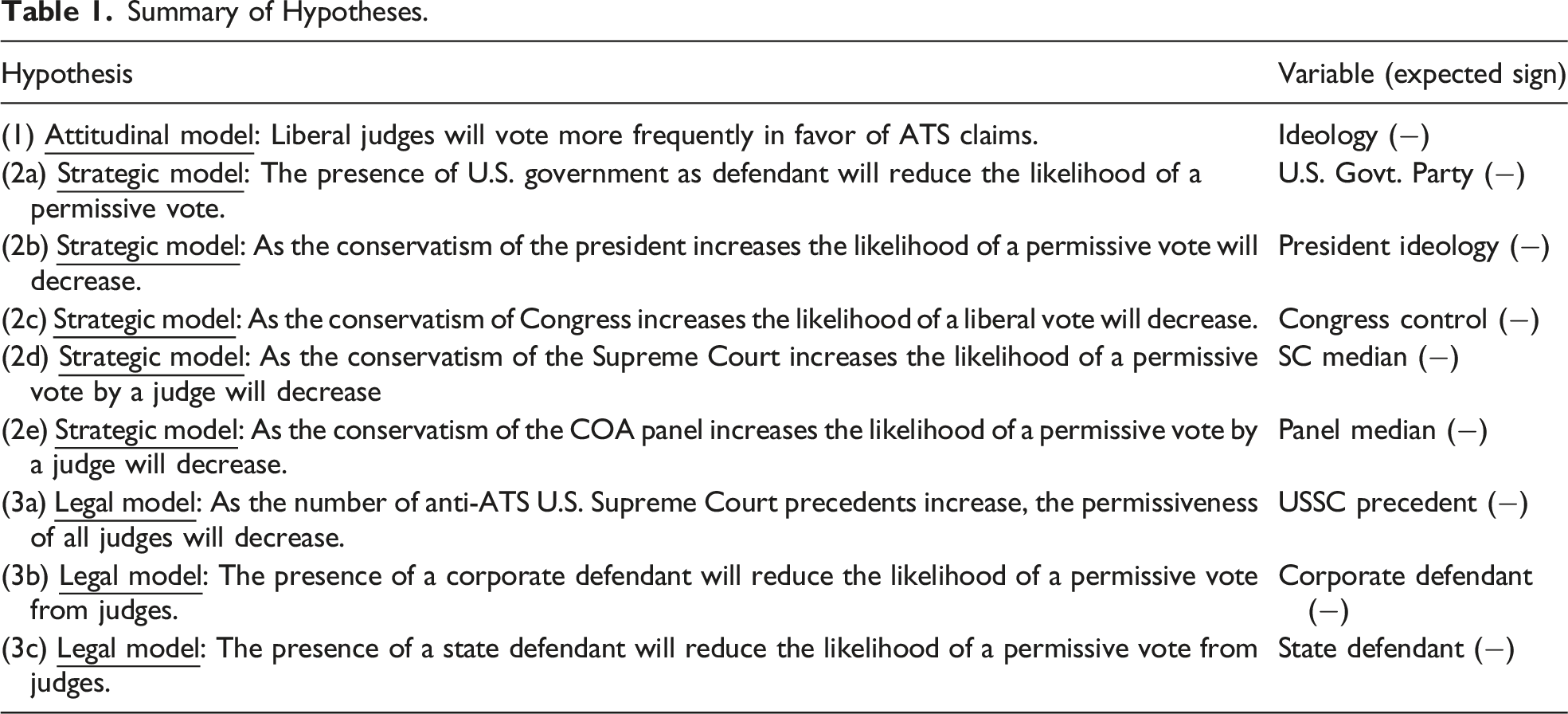
Judicial ideology has been at the heart of the study of judicial decision making since the behavioral revolution in political science in the 1950s and 1960s (Schubert 1958). Seminal works in this field have confirmed the central role of ideology in judicial decision making on the U.S. Supreme Court as well as on lower federal courts (Segal and Spaeth 2002; Sunstein et al. 2007; Epstein and Posner 2012). Judges on the intermediate federal appellate courts have also been shown to use ideology in the decision making processes discussed in the previous section. Ideology has also been used to explain the voting behavior of non-American judges. For instance, Voeten (2008) finds that ideology explains voting on the European Court of Human Rights. Ideology has also been found useful in explaining votes in other domestic high courts such as the Law Lords in Britain (Iaryczower and Katz 2016) and in Canada and Australia (Weiden 2011), among others.
Ideology matters in judicial decision making because the law itself is often vague and requires interpretation and judges have discretion (Segal and Spaeth 2002; Epstein and Posner 2012), something that is true of the ATS and international human rights norms (Bradley and Goldsmith 1997). When legal standards are vague, judges rely on cognitive shortcuts that all human processing exhibits. One way of understanding this is to think about motivated reasoning. Under the motivated reasoning framework, judges, who are required to compare cases using processes of analogical reasoning, might see a case that supports their preferred outcome as more “controlling” than one that does not even if there is little objective difference (Braman and Nelson 2007).
With respect to the application of human rights laws, scholars have long noted differences between conservatives and liberals. For instance, Salehyan and Rosenblum (2008, 107) suggest that “in the United States…Democrats have generally advocated more liberal humanitarian migration policies than have Republicans.” Furthermore, liberals have tended to want to protect human rights more broadly than have conservatives (Miller et al. 2020). These relatively clear and accessible ideological tendencies will, we hypothesize, allow federal judges to utilize ideology in their decision making in ATS cases, because these cases almost always involve the enforcement of customary international norms on the protection of human rights. The hypothesized ideological split has played out on the U.S. Supreme Court. For instance, a decision on the applicability of the ATS engendered a 5-4 decision, with conservatives voting to restrict the applicability of the ATS. 9
These findings map onto the results of international relations scholars showing that liberal-conservative ideological differences reflect different policy preferences (Gries 2014; Rathbun 2011). Conservatives hold less favorable attitudes towards international law and organizations than liberals (e.g., Wallace 2013, Gries 2014; Mattes and Weeks 2019). They are more comfortable with the use of torture at the expense of international law and human rights protections (Wallace 2013) and are generally skeptical of international organizations, courts, and supranational institutions than liberals (Gries 2014; Copelovitch and Pevehouse 2019; Lee and Prather 2020). Liberals’ positive attitudes toward international law and institutions is also manifested in their unwillingness to support hawkish military foreign policies (1;), cutting foreign development and humanitarian aid (Bodenstein and Faust 2017; Bayram and Thomson 2022) and curbing migration and refugee admission (e.g., Wallace 2013, Gries 2014; Mattes and Weeks 2019).
Drawing from these insights from judicial decision making and international relations, our first hypothesis is that the liberal judges are more likely to uphold international human rights law than are conservative judges (hypothesis 1). Conceptually, liberal judges are more likely to support an internationalist stance (Stobb 2021) and more specifically, as applied to human rights law (Miller 2015) are more likely to support more rigorous enforcement.
We recognize that international legal instruments can be (and have been) leveraged for political capital. In this sense, it is possible for an international legal instrument to be appropriated by conservatives. On balance, however, such instances are the exception than the rule. Liberals are generally more supportive of international law compared to conservatives.
Of course, judges are sensitive to the political-legal context in which they operate. The strategic model of judicial decision making posits that judges will account for the preferences of other judges and relevant institutional actors in making their decisions (Epstein and Knight 1997). Here, we focus on four potential sources of constraint from within the strategic model: executive backlash, concern over reversal of a decision by the Supreme Court, concern over how other judges on the Courts of Appeal might react to a decision and worry about how Congress might react.
Existing works have shown that the independence of domestic courts from the executive and other branches of government is important. Courts that have independence and thus do not fear backlash are more likely to punish state actors for violations of human rights and strike down laws that clash with human rights norms (Powell and Staton 2009; Carrubba 2009). But judges are also motivated to avoid backlash. Courts fear executive backlash because it can curb their legitimacy and ability to rule as they see fit in the future (Alter et al. 2019; Abebe and Ginsburg 2019). Court curbing by the executive branch, for example, can severely limit a court’s power (Chilton and Versteeg 2018). In the case of human rights law, fear of backlash limits courts’ ability to enforce rights and compel compliance with international treaty obligations. Prior work shows that in the U.S. context, the federal government is most interested in those cases with the potential to limit executive discretion (Zorn 2002) and many ATS cases involve the actions of the executive in foreign affairs. Thus, it stands to reason that ATS cases will garner significant attention from the executive when executive action is called in to question. 10 We therefore hypothesize that all judges will become less liberal in their decision making when the U.S. government is a defendant in an ATS case (hypothesis 2a). Federal courts in the United States are noted for their independence (Ramseyer 1994). Further, scholars have found that lower-level courts like the federal intermediate appellate courts have little to fear in terms of oversight from the executive as compared to the U.S. Supreme Court (Baum 2009). Thus, we believe that we offer a stringent test of the role of potential backlash to limit the ability of judges to implement international law by focusing on subnational courts in the U.S.
We conceptualize backlash in two distinct ways. First, as noted above, we believe that the presence of the U.S. as a party in a case will heighten a judge’s attention to the preferences of the federal government. Our second conceptualization involves accounting directly for the preferences of the president. Carrying over our expectations with respect to ideology and judging, we believe that generally speaking Democratic presidents will be more open to permissive findings of liability under the ATS than will Republican presidents (see, e.g., Salehyan and Rosenblum 2008; Miller et al. 2020) (hypothesis 2b). This conceptualization is distinct from the mere presence of the U.S. in a case in two important ways. First, it allows us to capture more general preferences across all cases, including the majority of cases in which the U.S. government is not a participant. Second, it allows us to assess the effect of executive preferences independent of the extra-legal protections afforded to states as sovereign actors. 11 Similarly, we include a measure of congressional control (with higher scores indicating more control by Republicans) and have the same expectations with respect to control of the presidency—control by a more conservative set of leaders will reduce the permissiveness of judicial voting (hypothesis 2c).
Hierarchical legal control of the federal judiciary by the U.S. Supreme Court is well-established in the literature on U.S. courts (Westerland et al. 2010). To assess the strategic implications of this hierarchical control (and the concomitant fear of reversal) we include in our models a measure of the median ideology of the Supreme Court. As with other political actors, we expect that as the Supreme Court becomes more conservative lower court judges should be less likely to vote in a permissive, or liberal, direction in ATS cases (hypothesis 2d). Note, this measure is distinct from the ATS precedents handed down by the Court, which we treat as measures of compliance with a legal model.
Finally, with respect to the strategic model, judges on the Courts of Appeal commonly serve on three-judge panels when they hear a case. This means that a judge needs to be aware of how her colleagues will react to any vote she makes. This is an important consideration because judges on the intermediate appellate court need the vote of one other judge to win a case, but also because a dissent by a colleague is likely to signal the Supreme Court that a decision is misaligned with the Court’s preferences (Cross and Tiller 1997). 12 Therefore, there is reason to suspect that judges will become more reluctant to vote in favor of liability under the ATS (or permissively) as the conservatism of their fellow panel members increases (hypothesis 2e).
Our conceptualization of the legal model in ATS cases focuses on two aspects: precedent and legal facts (Friedman 2006). It is expected that courts in the U.S. will adhere to the precedential decisions of courts above them in the judicial hierarchy. In ATS cases, which tend to be more salient than most, compliance with precedent might be expected to be especially high given the heightened expectation of Supreme Court review (Benesh and Reddick 2002). In recent years, the U.S. Supreme Court has decided three important cases on the applicability of the ATS in different legal contexts. 13 The cases use in building our measure of Supreme Court precedent are fully described in the supplemental material. Each of these cases limits the reach of the ATS and so should, all else equal, result in more conservative decisions over time in our dataset. This corresponds with the fact that the Court has becoming increasingly conservative over our period of study. This leads to our hypothesis (3a): each additional U.S. Supreme Court precedent in our time period of study will lower likelihood of a liberal decision for all judges in our study.
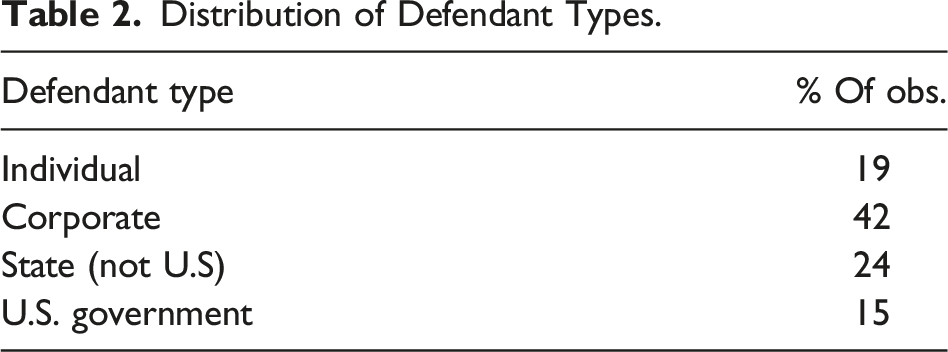
In addition to precedent, two legally significant facts are likely to be important in the decision making of appellate judges. Both corporate defendants and state defendants enjoy legal protections that individuals do not under the ATS. The protections for corporate defendants largely revolve around jurisdictional questions, such as whether a corporation without any tangible ties to the U.S. can be sued in a U.S. court. Therefore, we believe that corporate defendants are less likely to be found liable than individuals who are sued under the ATS (hypothesis 3b). Second, state actors enjoy traditional protections of sovereign immunity in ATS cases. Although this immunity can be abrogated in narrow circumstances, this is rare. Therefore, we believe that state defendants will also be less likely to be found liable under the ATS (hypothesis 3c). Table 1 below summarizes each hypothesis and the variable with which it is associated in our models.
Research Design and Method
We complied a new dataset of ATS cases using searches of the LexisNexis database for the phrase “alien tort statute” or for the specific section of the U.S. Code that contains the ATS (28 U.S.C. 1350). Cases span the period from 1981, just after the Filartiga decision, through February of 2021. Our analysis focuses on the Courts of Appeals, the intermediate appellate courts in the U.S. federal system. These searches returned a wide number of cases and we read each to ensure that the case tasked a court with applying customary international law, resulting in a total of 159 usable cases and 581 judge-votes. 14 We then coded a number of variables from the cases. Our dependent variable—permissive vote—is coded one if a judge voted in favor of liability for a defendant under the ATS or if a judge voted to allow a case against a defendant to continue. 15 We count votes to simply allow a case to continue as permissive (or liberal) because while this might not result in an ultimate decision in favor of the plaintiff, it clearly strengthens their bargaining position. 16 Indeed, prominent scholars of international law have noted that the mere willingness of U.S. courts to contemplate these lawsuits, much less to allow them to progress, gives impetus to often-successful international efforts to settle these issues (Slaughter and Bosco 2000). 17 It also means that the judge believes that customary international law is likely to provide some cause of action for the plaintiff. Given the dichotomous coding of the dependent variable, we estimate logit equations in the regressions that follow. Standard errors are clustered simultaneously by judge and case.
Distribution of Defendant Types.
We include five control variables. Our measure for the Torture Victim Protection Act (TVPA) is set to one if a TVPA claim is made in the case. We also control for the impact of the international political relationship between the United States and country of the defendants. This allows us to examine whether a positive relationship has any impact on a judge’s vote. The regime type of a defendant’s country (democracy vs autocracy) may be a factor. To account for this, we used the Polity IV coding scheme to measure the level of democracy in a state. State scores are assigned to individuals and corporations based on the nation in which they live or are headquartered. Higher scores indicate more democratic states. It is important to note that we assigned scores based on the time the case was decided, not the time of the alleged violation. 20 A high volume of trade between the U.S. and a defendant’s country suggests a high level of economic interdependence between two countries, which may affect judicial decision making. We control for this possibility by considering bilateral trade with the United States which is coded using data from the OECD. To compute trade, we added the U.S. imports and exports to a state. This variable is then logged to handle skew and is coded based on the year the case is decided. We include the direction of the decision made by the district court (lower court decision). In general, appellate court tend to uphold the decisions of lower courts. Second, we include a variable that captures whether the decision was published in a federal reporter that is equal to one if the decision was unpublished. It is possible that un-published decisions are less salient or ideological than published decisions (Ringquist and Emmert 1999). Lastly, we include fixed effects for the different federal circuit courts that appear in our data. Descriptive statistics for all of the variables are included in the supplemental material.
Results
Regression results.
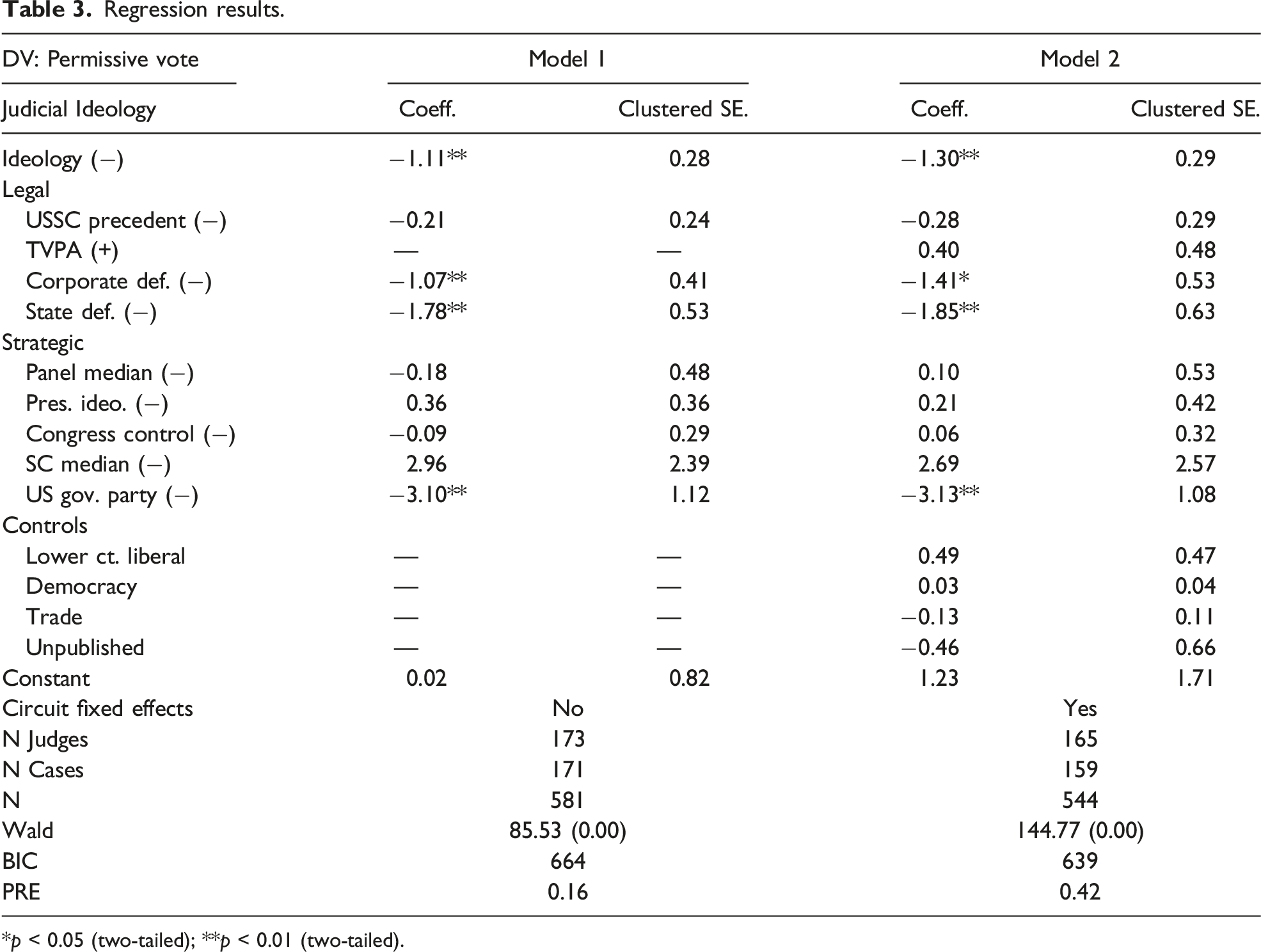
*p < 0.05 (two-tailed); **p < 0.01 (two-tailed).
Figure 1 displays the average marginal effects (using results from Model 1) for the variables of theoretical interests. Moving from a very liberal judge (10th percentile of our ideology measure) to a very conservative judge (90th percentile of our measure) decreases the likelihood of a permissive (or liberal) vote by 21-percentage points. This provides support for attitudinal explanations of judicial behavior (hypothesis 1). As we expect, compared to individual defendants the presence of both corporate defendants and state defendants reduces the chances of a liberal vote (in support of hypotheses 3(b) and 3(c)). Judges in cases with corporate defendants are 19-percentage points less likely to vote permissively compared to cases with an individual defendant, while judges in cases with a state defendant are 31-percentage points less likely to vote permissively. This especially large difference for states reflects the fact that they are protected legally by doctrines of sovereign immunity that make it harder to successfully sue. Average marginal effects.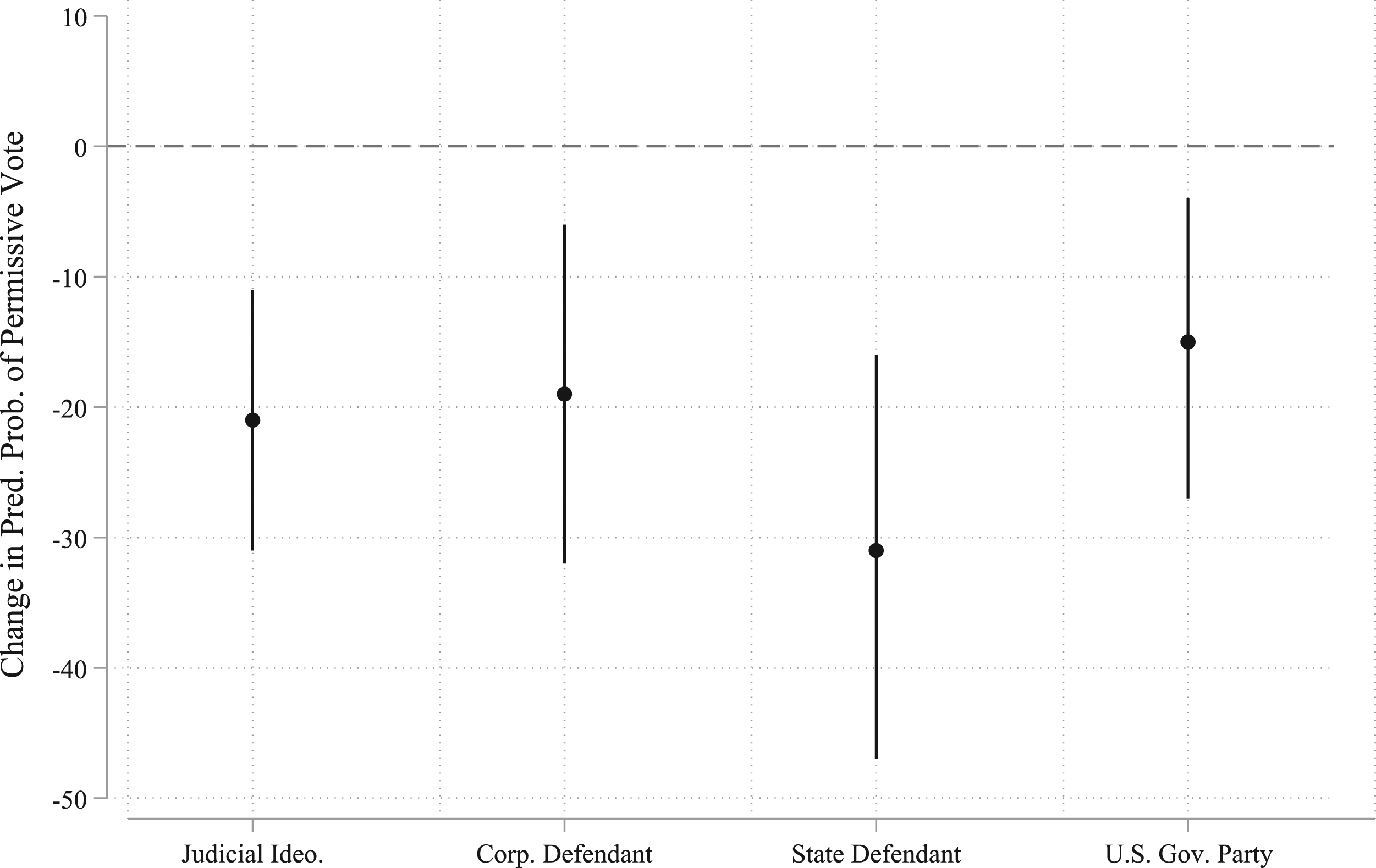
Finally, the U.S. government is a special sovereign in these cases, as it is facing its own courts. Our results suggest that as a party the U.S. government enjoys special advantages and a permissive vote is 15-percentage points less likely when the U.S. is a defendant compared to other states. Combined, with the estimated effect for state actors (who are not the U.S. government) the data suggest that judges are highly unlikely to vote against the U.S. government’s interests in these cases (supporting hypothesis 2(a)). Theoretically, this is important because it suggests that fear of backlash from the state is a constraining factor in enforcement even by a highly independent judiciary. As important is that we observe this effect while accounting for the fact that the federal government is entitled to the special sovereign immunity protections given to other states. The “extra” 15-percentage points of deference are likely attributable to strategic concerns vis-à-vis the state that is responsible for enforcing your decisions, in support of hypothesis 2(a). In turn, this suggests that even states facing highly independent judiciaries can expect to exert some degree of influence over them.
Several additional strategic measures are not statistically significant, including presidential ideology, Supreme Court ideology, the ideology of the panel on which a judge sits, and Congressional ideology. The lack of explanatory power for these variables suggests that judges are not particularly attuned to strategic concerns outside of the presence of the U.S. government as a party to the case. This is theoretically important to the extent that it indicates that influencing an independent judiciary may in fact be difficult except in cases where the sovereign itself is implicated. On the other hand, in cases involving treaty enforcement of human rights commitments it is likely that the sovereign will be implicated. We have, then, a mixed picture of the likely ability of a state to control an independent judiciary in these kinds of cases.
Exploring the Effects of Ideology
An alternative way to approach our inquiry, knowing the importance of ideology, is to ask what factors might restrain the influence of ideology. Given the significance of defendant type in the models an obvious step is to interact ideology with defendant type to explore whether the effect of ideology is more important in certain kinds of cases than others. We do this in models presented in the supplemental material, with results displayed in Figure 2. In the top panel of Figure 2 we show the effect of ideology comparing a case with an individual defendant and a corporate defendant. Although increasing conservatism decreases the likelihood of a liberal vote for both individual and corporate defendants, the effect is much more dramatic for corporate defendants. Across the range of ideology, the decrease in the likelihood of a permissive vote is 11-percentage points for individuals but is 25-percentage points for corporations. The bottom panel of Figure 2 displays the effect focusing on state defendants—here the decrease in the likelihood of a liberal vote across the range of judicial ideology is only 8-percentage points. In sum, the effects for judicial ideology are largest in cases involving corporate defendants. Ideological distance and defendant type.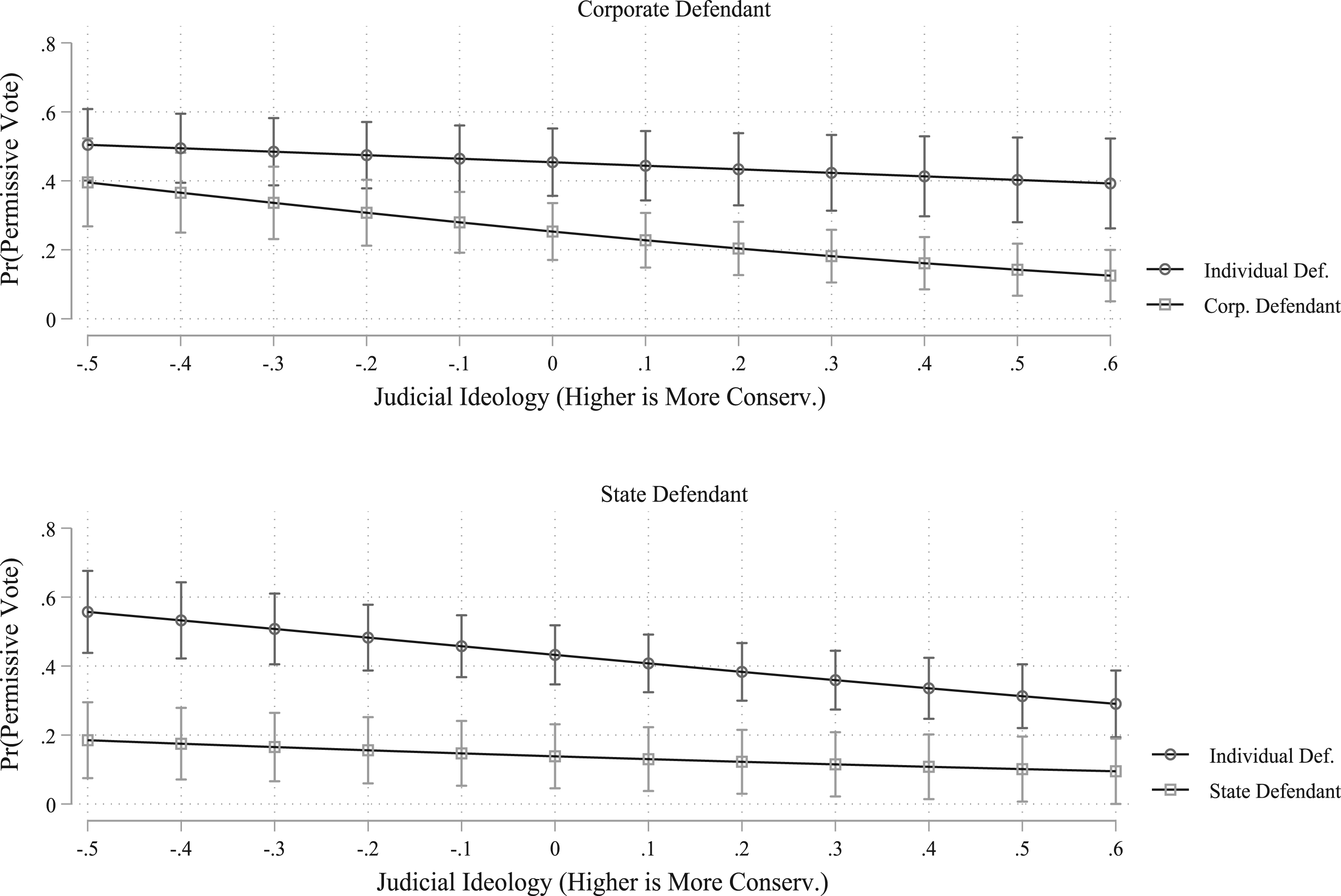
This result is more important than it might, at first, seem. Given the Supreme Court’s focus in these cases on issues that surround corporate liability, the finding here suggests that a conservative Court’s targeted use of precedent is effective in reducing the role that judicial discretion at the intermediate level can play in these cases. This is obviously a form of centralized influence in a system with high judicial independence, although not one that is readily controlled by the executive. Further, as many countries have apex courts with discretionary dockets, hierarchical control from within the judicial branch is an important factor to consider in determining how a state may be held to its international agreements.
Conclusion
In this paper, we have shown that judicial ideology is a major determinant of the use of the ATS to hold potential human rights violators accountable in U.S. federal courts. There are two ways to take our results. A narrower interpretation suggests that the enforcement of international human rights instruments, especially those similar to the ATS, in U.S. domestic courts will hinge on the ideology of the judge tasked with deciding the case.
While we are cautious about taking our findings too far, a broader interpretation of our results allows us to gesture towards larger issues. The first pertains to the politics of treaty commitments. States with strong independent judiciaries should be wary of committing to international human rights treaties if they do not have sincere intentions to uphold them. Domestic judicial decisions can practically propel the domestic enforcement of a human rights treaty once treaty membership takes effect. This finding has further implications for separation of powers. On the one hand, judges act as autonomous agents to enforce international human rights law in accord with their ideological preferences. But judges are also strategic, motivated to prevent backlash and sensitive to the preferences of the U.S. federal government and the Supreme Court. Finally, in showing the relationship between liberal political ideology and judges’ willingness to uphold ATS, our findings illustrate the potential of domestic courts to serve as sites of transformative change and fresh political contestation in international legal order.
Our findings suggesting a complex interaction between judicial ideology and hierarchical control in the implementation of human rights in the U.S. might generalize to countries where judges are given a good deal of leeway in interpretation, such as the United Kingdom, Canada, Australia, and New Zealand. But even where there is less separation between the executive and the judiciary, we think it is likely that the preferences of judges themselves will matter for the extent to which human rights norms are applied within a country. We also believe that our findings have the potential to generalize to other human rights instrument such as the Convention on the Elimination of all Forms of Discrimination Against Women (CEDAW), the Optional Protocol to the Convention against Torture (OPCAT), or the ratification of the Rome Statute establishing the International Criminal Court (ICC), as descriptive evidence suggests that these instruments are generally supported by liberals and opposed by conservatives.
We believe that our research has the distinct potential to open new avenues of research at the intersection of judicial politics and international relations and sheds new light on questions such as when domestic judges are more likely to cite the decisions of international courts, participate in transnational rule creation, or respond to changes in the larger body politic such as the rise of populism or increased attempts at court curbing.
Supplemental Material
Supplemental Material - Influencing Enforcement: The Application of International Law in Independent Judiciaries—The Case of the Alien Tort Statute
Supplemental Influencing Enforcement: The Application of International Law in Independent Judiciaries—The Case of the Alien Tort Statute by A. Burcu Bayram and Banks Miller in Political Research Quarterly
Footnotes
Acknowledgment
We are thankful to Clint Peinhardt, Brian Rathbun, Siv Cheruvu, Brett Curry and Wayne Sandholtz for valuable comments on earlier drafts. We are also thankful to anonymous reviewers and editors of PRQ. A version of this paper was presented at the 2022 annual convention of the American Political Science Association.
Declaration of Conflicting Interests
The author(s) declared no potential conflicts of interest with respect to the research, authorship, and/or publication of this article.
Funding
The author(s) received no financial support for the research, authorship, and/or publication of this article.

Supplemental Material
Supplemental material for this article is available online.
Notes
References
Supplementary Material
Please find the following supplemental material available below.
For Open Access articles published under a Creative Commons License, all supplemental material carries the same license as the article it is associated with.
For non-Open Access articles published, all supplemental material carries a non-exclusive license, and permission requests for re-use of supplemental material or any part of supplemental material shall be sent directly to the copyright owner as specified in the copyright notice associated with the article.
