




Abstract
Racial classifications are a social construct with no basis in biology; yet, race is an omnipresent and powerful factor in U.S. politics, shaping electoral boundaries, disbursement of resources, and political alliances (Omi and Winant 1994, Haney López 1994). Race, then, is a malleable construct wielded by varying interests, with racial definitions changing in response to social and political battles. Some new immigrant groups initially classified as not white have been reclassified as white over time, thereby benefitting from associated legal, economic, and sociopolitical privileges. More recently, however, some Latinos have sought recognition as a distinct non-white racial group, in acknowledgment of the racialization of their identities over time. We seek to better understand who is most likely to support a racialized Latino identity, and the political consequences of this choice. Using data from the 2020 Collaborative Multiracial Post-election Survey, we test whether individuals who believe that a Latino identity is a racial identity are also more likely to be interested in and engaged in politics. We also examine the extent to which support for a racialized Latino identity is associated with progressive attitudes on racial issues.
Racial classifications are a social construct with no basis in biology; yet, race is an omnipresent and powerful factor in U.S. politics, shaping electoral boundaries, disbursement of resources, and political alliances. American society has “guarded the privilege of Whiteness,” through policies such as anti-miscegenation and one-drop (hypodescent) laws (Haney López 1996). However, racial definitions have changed over time in response to social and political battles. New immigrant groups initially classified as not white, for example, Polish, Irish, Catholics, and Italians, have been reclassified as white over time, and have benefited from the associated legal, economic, and sociopolitical privileges of whiteness including citizenship and the right to own land (Lajevardi et al. 2019; Omi and Winant 1994, 2004; Tehranian 2008). Immigrants from Latin America have been treated as an exception in the U.S. racial classification system, with Latino identity considered an ethnicity rather than as a race. Yet, most Americans understand Latinos to belong to a separate and identifiable group that is phenotypically distinct from the majority white population in the United States (Telles and Ortiz 2008), and anti-Latino prejudice and discrimination are well documented (Chavez 2008, Farris and Silber Mohamed 2018). Some Latinos respond to this political reality by embracing a white identity (Beltrán 2021, Jiménez 2009, Gutiérrez 1995).
This strategy recognizes the legal, economic, and sociopolitical privileges historically associated with whiteness (Haney López 1994). The 1790 Naturalization Act restricted naturalization (and thus voting and other rights) to “free white persons.” Many states allowed only white citizens to own or lease land. These restrictions stayed in place, with only minor adjustments for African Americans after slavery was abolished, until the McCarran–Walter Act of 1952. In restricting naturalization to whites, the U.S. government laid the foundation for Latino groups to be classified as white. The 1848 Treaty of Guadalupe Hidalgo, ending the Mexican American War, conferred citizenship eligibility on Mexicans living in land that was newly part of the United States. In 1897, the Supreme Court decision In re Rodriguez reinforced the right of Mexicans to naturalize according to the 1848 treaty and, consequently, asserted that Mexicans were considered legally white (Cantrell 2013).
The assumption that Latinos were not a distinct racial group brought some initial benefits, but community leaders eventually found it important to pursue legal recognition as a distinct group in order to secure civil protections initially designed to support the rights of Black Americans, for example, the right to not be tried by all-white (Anglo) juries and the right to not be discriminated against in voting, housing, or public accommodations, and access to Affirmative Action programs. Recently, some Latinos have sought government acknowledgment of the racialization of their non-white identity via changed U.S. federal policies to include Latino as a distinct racial category on government documents such as U.S. Census forms (Strmic-Pawl et al. 2018, Hernández 2021). These Latinos might be politically different from those that do not seek recognition as a distinct racial group.
Specifically, our analysis builds on the work of Stokes-Brown (2012), who used the 2006 Latino National Survey to explore the predictors and effects of Latino self-identification as “some other race.” She finds that for some individuals, the “some other race” label represents a racialized pan-ethnic identification. Similarly, when Latinos check the “some other race” box, they may not necessarily be asserting that Latino is a race, but they may be acknowledging that they do not see themselves within the standard U.S. racial schema (Hernández 2021). Using data from a large 2020 survey of the Latino population, we build on Stokes-Brown’s work on what predicts racialized Latino identities. We are primarily interested here in the political consequences of Latinos’ ongoing battle for racial recognition as a distinct group and hypothesize that individuals who believe their Latino identity is a racial identity are more likely to be interested in and involved in politics and are more likely to feel a sense of commonality with other marginalized racial groups, namely Black Americans. In addition, we argue that racialized understandings of Latino identity are encouraged due to widespread and persistent discrimination. Latinos who believe their identity is a race are more likely to understand the political power implications of those identities and thus to have adopted them in recognition of the political statements they represent.
We find mostly positive support for our hypotheses: Latinos who believe Latino is a race are indeed more interested in politics, participate more in some aspects of political life, and are more likely to support the Black Lives Matter movement and hold progressive attitudes on racial issues. Yet, our analysis also suggests that while this belief may increase passive political participation, such as signing a political petition or discussing politics with friends, it does not always translate into more active political behaviors, such as participating in a community organization or attending a protest march. We conclude that members of the Latino community who understand their Latino identity as racialized may be more likely to be a coalitional partner in the quest for broader racial justice efforts but that further mobilization from within may be needed to build active support of these efforts.
Racial versus Ethnic Categories
There is increasing evidence that the U.S. public, and even some governmental agencies (e.g., the U.S. Department of Education and the Equal Employment Opportunity Commission), consider Black, white, and Latino to be mutually exclusive racial categories (Roth 2012). In popular usage, including public media and mainstream news, Latino identity is increasingly treated as a race. This can be traced back to the 1960s, when federal agencies, Latino activists, and media organizations collaborated to create a Hispanic pan-ethnicity to unify Latin Americans from different countries of origin, obscuring important national origin differences between these groups (Beltrán 2010, Mora 2014). This reworking of racial categories, what Roth dubs the “Hispanicized U.S. schema,” is a consequence of “the efforts of many Latinos to differentiate themselves from Black Americans at the same time that White Americans sought to distance themselves from Latinos” (Roth 2012, p. 180; see also Marrow 2003 and Hernández 2021).
In addition, Latinos are increasingly likely to insist that their ethnic identity is also their racial identity. In the 2010 U.S. Census, 37% of Latinos identified themselves as “some other race,” evidence that a significant subsection of this community is rejecting the existing official racial categories, and 90% of those “some other race” Latinos indicated that their race was Hispanic or Latino (Prewitt 2013). Census studies have documented that Latinos find the separate race and ethnicity questions confusing, and that combining the items would improve data accuracy about Latinos (Strmic-Pawl et al. 2018). In the 2020 U.S. Census, an estimated 45.3 million Latinos classified themselves as “some other race,” either alone or with another racial identity. Of all census respondents who self-identified only as “some other race,” 93.9% were Latino, representing 42.2% of Latinos included in the census.
This preference by Latinos for their own racialized identity, rather than for inclusion in the racial category of white, lies in stark contrast to how previous ethnic immigrant groups have worked to assimilate into the dominant racial group in the United States (Lajevardi et al. 2019). Some observers caution that this strategy, while perhaps appealing in the short run due to a desire for distinct racial visibility and pride, may have long term disadvantages. For example, Roth (2012) warns that the designation of Latino as a race and not an ethnicity may work against Latinos in the long run because racialized categories are less easily shed than are ethnic categories. Thus, as Latinos succeed in reclassifying Latino as a race, they are also making it more likely that they will be “perpetually defined as foreigners even after many generations and full acculturation to American norms” (Roth 2012, p. 156). In other words, the reclassification of Latino as a race might make it less possible for Latinos to follow the route of previous ethnic groups of being assimilated as white. This builds on work by Hattam (2007), who contends that ethnically defined groups have had more success in achieving social mobility and integration while those defined racially tend to suffer greater disadvantages. Hernández (2021) cautions that if Latino officially becomes a separate racial category, the Afro-Latino community may be rendered less visible and this classification may mask differences that the racial hierarchy continues to perpetuate within the Latino community.
Persistent racism toward Latinos, including perceptions that they are perpetual outsiders or perpetual foreigners, however, suggests that whether Latinos choose to identify as a race will have little impact on their ability to fully assimilate into U.S. society (Ngai 2014, Rocco 2014, Sampaio 2015). In other words, the policies of the host society constrain the ability of Latinos to assimilate. This conclusion is reinforced by work from Tomás Jiménez and his colleagues that demonstrates that Latino feelings of belonging—among both immigrants and the U.S. born—are affected by whether they live in an area with policies that are welcoming toward immigrants (Jiménez et al. 2021). Latinos may also reject traditional “hard” forms of assimilation in favor of a “softer” form that preserves their politicized group consciousness (Citrin and Sears 2014).
The distinction between ethnicity and race is somewhat arbitrary, based on societal norms. Race is socially constructed, but outside of academia it is generally considered fixed and based on physical traits such as hair texture and skin tone, whereas ethnicity (also considered fixed) is perceived as based in cultural identity and expression (Shelton and Sellers 2000). Latinos are thus considered a pan-ethnic group in the United States because of their shared culture and heritage, while their varied phenotypes signal that they can be of any race. The U.S. Census Bureau notes: “The racial categories included in the census questionnaire generally reflect a social definition of race recognized in this country and not an attempt to define race biologically, anthropologically, or genetically. In addition, it is recognized that the categories of the race item include racial and national origin or sociocultural groups” (U.S. Census Bureau, n.d.).
Political science as a discipline has long been aware of racial fluidity, or “the idea that race is flexible and impermanent” (Davenport 2020, p. 221). Yet, despite the “constructed, contradictory, and fickle nature of U.S. racial classification” (p. 223), racial identification is largely uncontested and highly stable for the majority of the U.S. population. Instead, the fluid nature of race is illustrated by the shifting of who is included in various categories over time, and the ability of individuals to migrate from one racial identity to another based in part on phenotypic differences, for example, light-skinned Black people passing as white, or Chinese people passing as Mexican (Hobbs 2014). In 1930, the census listed Mexican as a race, while today it is listed as part of a Hispanic/Latino ethnic option. Historically, changes in self-identification have been influenced by social, political, and economic factors including emancipation, immigration and civil rights (Pratt et al. 2015). At varying points, individuals have also pushed for such changes.
Latino is a Race
As Stokes-Brown (2012, p. 5) notes, “the structuring of Latino racial identity is a complex interaction between policies of the state and institutional practices, primordial ties, individual characteristics, and social interactions.” Individuals are also thought to select a racial identity in a way that reacts to perceptions of racial dynamics and potential for coalition-building in the United States (Dowling 2014). Indeed, some Latinos may be motivated by the importance of recognition as a racial group “for visibility and claims-making in a multiracial society” (p. 1834), and scholars contend that the lack of racial group designation as it stands reduces perceptions of belonging (Flores-González et al. 2014). Often this leads Latinos to check the box for “some other race” when filling out U.S. Census Bureau and other forms, where they do not see themselves in any of the standard racial categories (Stokes-Brown 2009, Golash-Boza and Darity 2008, Strmic-Pawl et al. 2018).
In many Latin American and Caribbean countries, race is understood differently, often including conceptions of white, Black, Indigenous, and mixed race (Marrow 2003). Yet, data from Latin America also suggests a preference for identifying racially as white, even when this category does not match with an individual’s phenotype (Telles 2014). Immigrant Latinos bring their understanding of race from their home country, and may or may not recategorize their own racial identification as they assimilate into the U.S. racial classification system (which generally does not include Latino as a race), including the persistent preference for selecting a white identity (Hernández 2021, Ostfeld and Yadon 2022).
Legal whiteness of many Latinos notwithstanding, discrimination against Latino Americans, and targeting of Latino immigrants, has increased over time. For instance, beginning in 2001, the U.S. government significantly expanded a range of immigration enforcement programs, resulting in heightened arrest rates, deportations, and fear within Latino communities (Capps et al. 2018). Under certain circumstances this increase in enforcement indirectly impacted levels of linked fate among Latinos (Maltby et al. 2020). Anti-Latino discrimination further intensified beginning in 2015, in response to the racist presidential campaign and subsequent administration of Republican President Donald Trump. The Southern Poverty Law Center reported a spike in anti-immigrant hate crimes after Trump was elected, mostly aimed at people of Latino descent (SPLC 2016). This trend continued throughout his presidency, with record increases in anti-Latino hate crimes reported to the FBI, and the massacre in El Paso in 2019, in which 23 people were killed and another 23 injured in one of the deadliest anti-Latino attacks in US history (Beirich 2019).
The rampant proliferation of negative and discriminatory attitudes, behaviors, and policies makes it difficult, if not impossible, for many Latinos to take advantage of the protections and privileges of whiteness, regardless of how they racially identify. Prior research explores when and why a pan-ethnic Latino identity will emerge (Jones-Correa and Leal 1996), and finds that a sense of Latino solidaridad (Barreto et al. 2009) and perceived racial discrimination against Latinos (Gutierrez et al. 2019) mobilize participation, particularly in times of hostility. We build on this scholarship, but focus on a distinct research question and theoretical process. We theorize that this persistent discrimination may be generating a new understanding of Latino identity as a race, rather than as an ethnicity, among many Latinos, and further contend that this racialized understanding of group identity has a significant effect on political attitudes and behaviors.
Scholars have examined other variables associated with the adoption of a racialized Latino identity. Zepeda-Millán and Wallace (2013) find that first generation respondents are less likely to view Latinos as a distinct racial group, as are respondents of Cuban or Puerto Rican national origin, and men, while stronger support for Latino as a distinct racial group is reported by Latinos with higher levels of education, Democrats, those who see anti-Latino discrimination, and those who have personally experienced discrimination. Some of these results are consistent with that of other scholars, including effects of generation (Fraga et al. 2012), Cuban national origin (Stokes-Brown 2012), group discrimination (Stokes-Brown 2012), and individual experiences of discrimination (Golash-Boza and Darity 2008). Other scholars find very different results. Stokes-Brown (2012) finds no evidence that education, Puerto Rican national origin, or gender matter, but unlike Zepeda-Millán and Wallace finds positive correlations with higher income, darker skin, and lower ages. Flores-González, Aranda, and Vaquera (2014) also find that Latino young adults are more likely to embrace a Latino racial designation.
We begin our analysis by using recent data to revisit these questions. Given the importance of political context in shaping individual identities (Silber Mohamed 2017, Zepeda-Millán and Wallace 2013), we are interested in exploring whether the factors above continue to contribute to perceptions of whether Latinos constitute a separate race in the distinct context of the 2020 election. After exploring which group members perceive Latinos to be a separate race, we then explore the political consequences of this choice. We anticipate that perceptions of Latino as a racialized rather than an ethnic category will be associated with distinct political behaviors and attitudes. Specifically, we hypothesize:
Latinos who believe that Latino is a distinct race are more interested in politics than Latinos who do not think Latino is a race.
Latinos who believe that Latino is a distinct race are more likely to participate politically than Latinos who do not think Latino is a race. We expect that Latinos who understand their identity as racialized will be more participatory because of the mobilizing effect of discrimination. Those who think their identity is racialized are also more likely to acknowledge discrimination as political ontology and understand the political implications of their participation, resulting in increased interest and participation. We further hypothesize that racial identification choices will have political consequences for coalition building, including harboring feelings of commonality with Black Americans and expressing support for anti-racism struggles. This is consistent with previous findings in which Latinos who racially identified as non-white were more likely to report a sense of commonality with African Americans, compared to their racially white-identifying counterparts (Kaufmann 2003). The proposed mechanism is racialization, whereby individuals who experience racial/ethnic discrimination may find common ground with African Americans, a historically racialized group. Using Pew Research Center’s 2016 Racial Attitudes in America III Survey, Corral (2020) corroborates this finding. Corral’s data is notable in that Latino is included as one of the categories available for participants to choose as their racial identity. He finds that Latinos who identify racially as Black are most likely to be aware of and support BLM. However, the dataset included just 48 Black Latinos (of 654 Latinos overall). More robust are Corral’s findings comparing Latinos who racially identify as white to those who racially identify as Latino. He finds the latter group is less likely to have heard of BLM, although those who are familiar with the movement are more supportive compared to members of the former group, a finding he attributes to their non-white racial identity. Corral’s findings support our underlying hypothesis that racial identity matters, as the racial identities of both Black and Latino-identifying respondents are strong predictors of their support for Black Lives Matter. We replicate and build on his work by examining whether a belief that Latinos constitute a distinct racial group is correlated with broader attitudes on racial relations in the United States. Yet, while Corral focuses on the distinction between white-identifying Latinos and non-white identifying Latinos, we focus primarily on Latinos who view this identity as racial versus those that do not. In doing so, we focus on those who distinctly reject the imposed racial-ethnic divide. Additionally, Corral’s work focuses on self-identification, while our research goes beyond individual identity to examine a general belief measuring whether Latinos should constitute a distinct racial group in the United States. As such, we are interested in understanding if attitudes about whether Latino is a racialized group identity are associated with greater awareness of the U.S. racial hierarchy, as outlined in our final hypothesis:
Latinos who believe that Latino is a distinct race will be more supportive of efforts to fight racism compared to Latinos who do not think Latino is a race.
They will express higher support for the Black Lives Matter Movement and
They will be more likely to agree that information about race and racism in U.S. history should be taught in grades K-12.
Data and Methods
We test these hypotheses using the Latino subsample of the 2020 Collaborative Multiracial Post-Election Survey (CMPS), an online survey fielded between April 2, 2021 and August 25, 2021 (Frasure et al. 2021). The size of the Latino subsample (n = 3529) allows us to revisit the question of who in the Latino community believes that Latinos should be categorized as a separate racial group and provides the opportunity for a more robust exploration of Corral’s (2020) theory about the political opportunity structure created by racialized Latino identities for Black–Brown coalitions. The Latino subsample also includes respondents who identify as Latino and another racial/ethnic group.
Our primary variable of interest is the belief among Latinos that Latinos constitute a separate racial group. The CMPS asked all Latino respondents, “In the US we use a number of categories to describe ourselves racially. Do you feel that Latinos make up a distinctive racial group in America?” The variable is recoded such that 1 indicates a belief that Latinos make up a distinct group and 0 does not. Using the weighted data, an estimated 72.9% of Latino respondents agree that Latinos constitute a distinct racial group, suggesting surprisingly high agreement on this question. 1
We first examine the factors associated with categorizing Latinos as a distinct racial group; because this variable is binary, we use logistic regression analysis. After this reassessment, we then use this measure as an independent variable to test the hypotheses outlined above. Our analysis uses continuous measures of income, education, and age. We also add a series of dummy variables, including for gender (women as the reference group, with a separate category for respondents who identify as non-binary or other) and immigrant generation (reference category = first generation, referring to respondents born in another country or the island of Puerto Rico; second generation = respondent born in the United States with at least one parent born elsewhere; third generation and above = respondent has at least one grandparent born in the United States).
While our analysis is limited to respondents whose primary identity is Latino (or Hispanic), we also include dummy variables to capture additional identities that respondents may have indicated, including white (23.0% of respondents) and Asian American, Native American/Indian, Middle Eastern/North African, or Pacific Islander (1.98%). Rather than including a dummy variable for respondents who identify as Black, we instead use a separate question asking respondents whether they “identify as Afro-Latino, or being Black with Latin American ancestry.” Clealand and Gutierrez (2022) note that fewer Latinos self-identify as Black than as Afro-Latino due to the devaluation of Blackness within Latino communities, and thus which racial groups they feel aligned with, regardless of skin tone. In addition, while Latinos may identify as Afro-Latino as an indication of their mixed race and darker skin tone, many Latinos interpret the terms Black and African American as exclusively referencing Americans with ancestry in the United States, but not Black Latinos from Latin America and the Caribbean. Indeed, this pattern holds in the CMPS data, with just 1.98% of respondents identifying as Black, but 15.8% indicating yes to this question, which includes both the respondent and their ancestors. 2
Existing research demonstrates that political attitudes and behavior vary by national origin (Masuoka 2008, Wals 2011, Silber Mohamed 2017). As such, we include a series of dummy variables to capture a respondent’s country or region of origin or ancestry, including Cuban, Puerto Rican, Dominican, Mexican (reference category), Central American (El Salvador, Costa Rica, Guatemala, Honduras, Nicaragua, and Panama), South American (Argentina, Bolivia, Brazil, Chile, Colombia, Ecuador, Paraguay, Peru, Uruguay, and Venezuela), Spanish, and other Latino national origin groups. We additionally include two sets of dummy variables to capture partisanship and ideology, including Democrat, Republican, or independent/other (reference group), as well as liberal, moderate (reference group), conservative, or non-ideological. Because darker skin tone has been found to increase the perception that Latino is a racialized identity (Stokes-Brown 2012) and the prevalence of liberal positions on racialized political issues (Ostfeld and Yadon 2022), we include skin tone as a control variable across our models. 3 To capture skin tone, we use a question in the CMPS asking respondents to pick an image that best matches the shade of their skin, ranging from 1 (lightest) to 10 (darkest). We also include two variables to capture perceptions of discrimination, which are both correlated with the adoption of a racialized Latino identity in existing literature (Golash-Boza and Darity 2008, Stokes-Brown 2012, Zepeda-Millán and Wallace 2013). The first of these variables captures personal experiences, asking whether respondents themselves have experienced discrimination because they are Latino (1 = discrimination in any setting; 0 = no discrimination), while the second variable asks the extent to which Latinos as a group experience discrimination (recoded, 3 = a lot to 0 = none at all).
Political Interest and Political Participation
H1 anticipates that individuals who believe Latinos are a distinct race also have greater political interest. To capture this dependent variable, we use the question: “Some people are very interested in politics while other people can’t stand politics, how about you?” We have recoded responses such that very interested represents the highest value (4) while not at all interested is the lowest (1).
To test H2, we develop two scaled measures of political participation using a series of questions that ask about engagement in various other political activities since January 2020 (each activity is recoded such that 1 = yes, I am certain I did that last year or I think I did that, I can’t remember for sure; 0 = all other responses). The first of these measures, active engagement, focuses on activities that require a more intense level of participation, including: working or volunteering for a candidate, political party, or some other campaign organization; participating in one or more social, cultural, civic, or political groups or unions; attending a meeting to discuss issues facing the community; attending a campaign rally, meeting, or event; and attending a protest, march, demonstration, or rally. Our approach is similar to Gutierrez et al. (2019, p. 965), who create an aggregate scale of 6 indicators of participation using 2016 CMPS data, including actions that are costlier to voters and thus are likely to be undertaken “only (by) those who are really invested in the political outcome.” 4
The second scaled measure captures passive engagement. The activities in this category require less of a time commitment and are more accessible to a wider range of respondents, including non-citizens. These include signing a petition regarding a problem or issue of concern; wearing a campaign button or posting a campaign sticker or sign; boycotting a company or product for political reasons; discussing a candidate or political issue by posting on an internet site or social media like Facebook, Twitter, or WeChat; and discussing politics with family or friends.
For both of the scaled variables, values range from 0 to 5, with results standardized on a 0–1 scale. In both measures, respondents were given a point for each activity they engaged in, and Cronbach’s alpha suggests high internal consistency within each scale (alpha = 0.82 for active engagement and 0.77 for passive engagement). We also explored whether the respondent reported voting in 2020 as an alternative dependent variable. However, consistent with other surveys, CMPS respondents significantly overreported voting, with 94.1% of respondents who are either born in the United States or Puerto Rico or are naturalized U.S. citizens reporting that they voted. As such, we did not use reported turnout in our analysis.
Descriptive Statistics, Latino Racial Identity, and Political Participation (CMPS 2021).
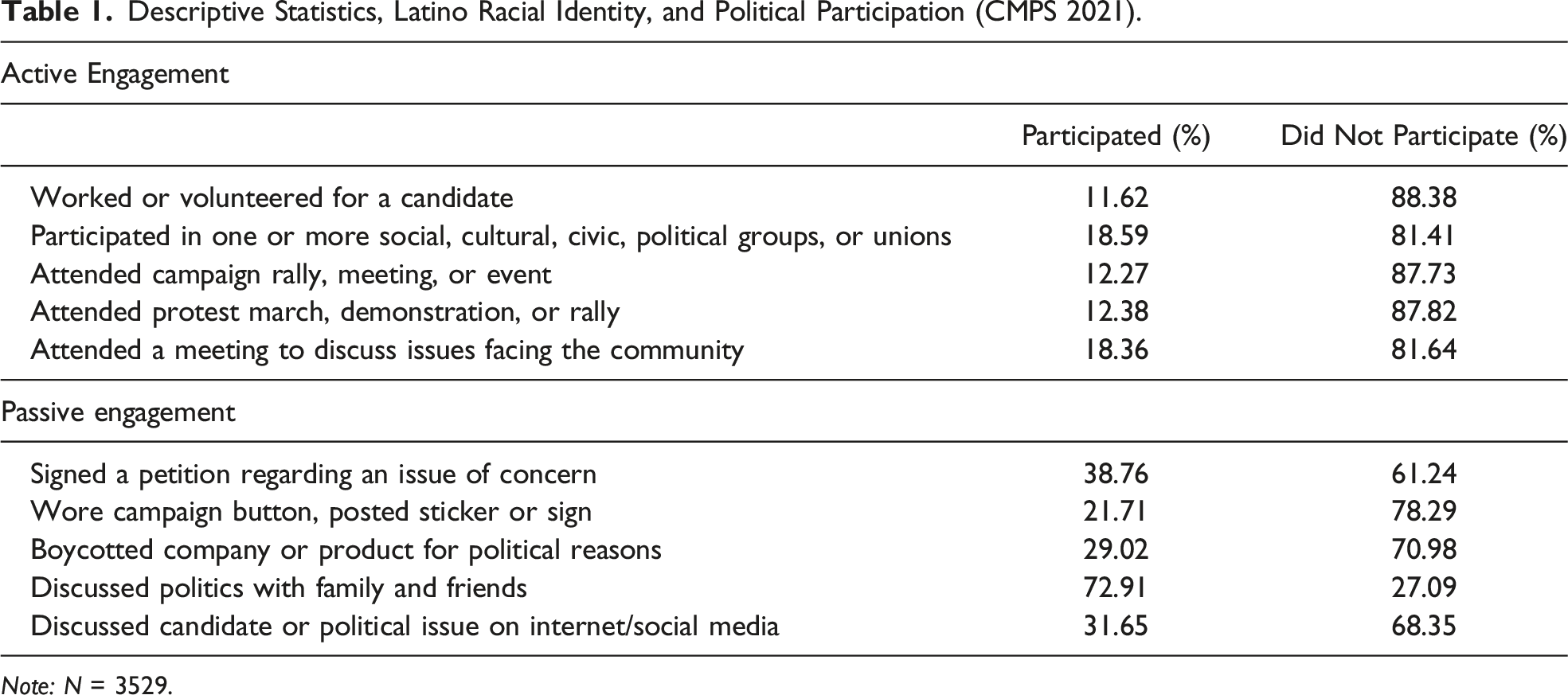
Note: N = 3529.
Attitudes about Race and Racism
Finally, we test H3 with three dependent variables related to coalitional racial politics. Following Corral (2020), our first hypothesis gauges support for the BLM Movement, examining responses to the question, “Based on what you have heard or seen, how much do you support or oppose the Black Lives Matter Movement?” (recoded 1 = strongly oppose to 5 = strongly support). Because we are broadly interested in political participation, we also measure this support using a binary measure for attendance at a BLM protest: “Over the past year, did you participate in a Black Lives Matter protest or a protest against police brutality?” (1 = participated, 0 = did not). A third measure asks whether respondents agree that children in grades K-12 should be taught about race and racism: “During the summer of 2020, Black Lives Matter and protesters around the world stressed bringing an end to racism among individuals and within larger society. Part of these protests involved acknowledging the history of racism in the United States and beyond. Do you agree or disagree that children in grades K-12 should learn about race and racism in their U.S. history curriculum?” (recoded 1 = strongly disagree through 5 = strongly agree). While it is possible that respondents may also be thinking about anti-Latino racism in their responses, the question is clearly phrased to evoke the BLM protests. We include this alternative measure to capture whether the belief that Latinos constitute a distinct racial group is associated more broadly with a greater awareness of, and emphasis on, racialized structures in the United States, as well as the need to acknowledge them.
Findings
Who Believes Latino is a race?
Predictors of Viewing Latino as a Separate Race (Logistic Regression, CMPS 2020).
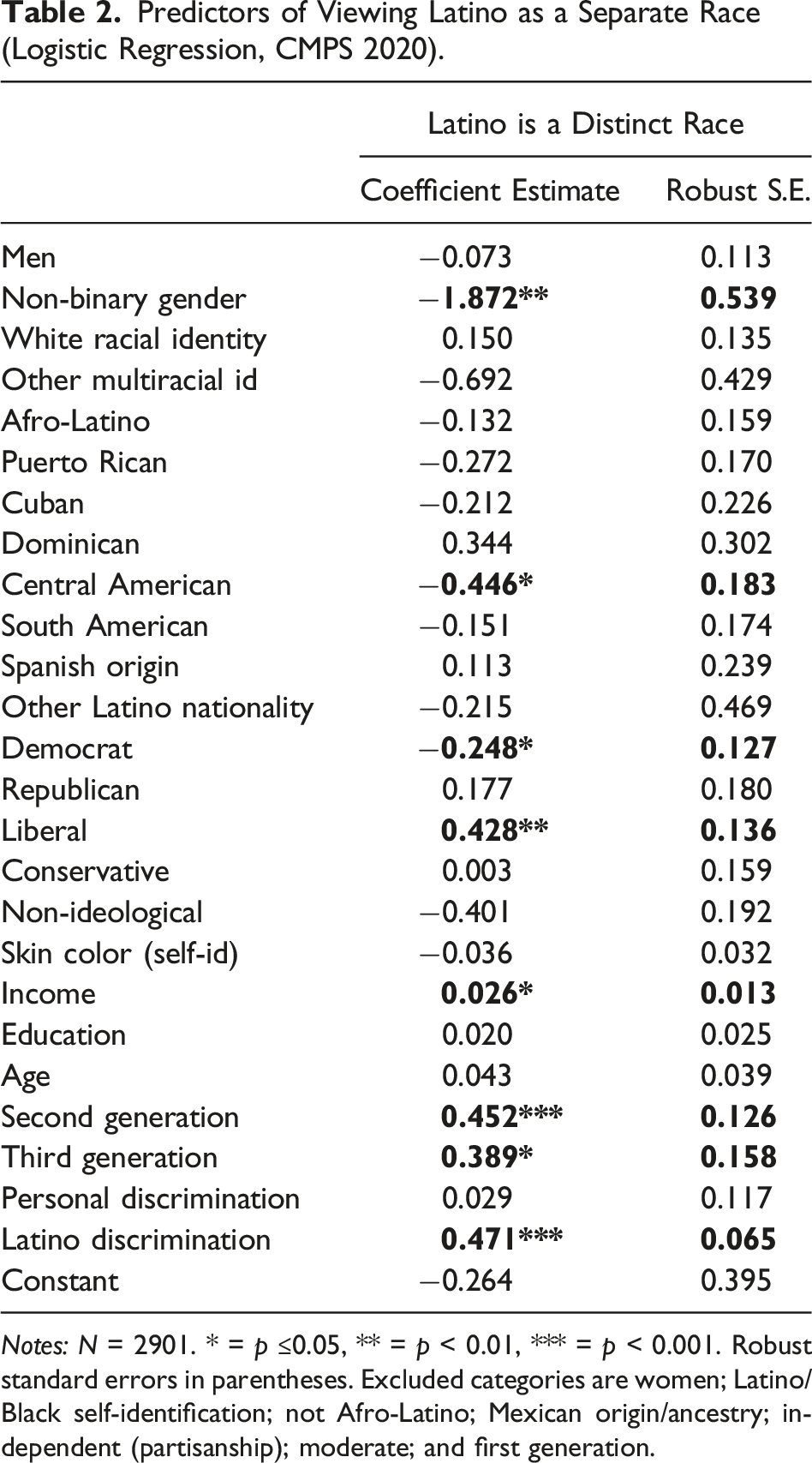
Notes: N = 2901. * = p ≤0.05, ** = p < 0.01, *** = p < 0.001. Robust standard errors in parentheses. Excluded categories are women; Latino/Black self-identification; not Afro-Latino; Mexican origin/ancestry; independent (partisanship); moderate; and first generation.
Consistent with Zepeda-Millán and Wallace (2013), in comparison to first generation respondents, second and third generation immigrants are more likely to believe that Latinos represent a separate racial group. This belief also correlates with a higher income, consistent with Stokes-Brown (2012). We find that liberal Latinos are more likely to view their identity as racial, suggesting that there is a progressive dynamic at work. Interestingly, while personal experiences with discrimination are not significant, diverging from Golash-Boza and Darity (2008), respondents who believe that Latinos as a group experience high levels of discrimination are significantly more likely to believe that Latinos constitute a separate racial group, consistent with the findings of Zepeda-Millán and Wallace (2013) and Stokes-Brown (2012). In contrast to prior research, the only national origin difference in our model is that, compared to Mexican Americans, Central Americans are less likely to believe Latinos constitute a separate racial group; we do not replicate previous findings (Zepeda-Millán and Wallace 2013, Stokes-Brown 2012) that Cuban and Puerto Ricans are less likely than Mexican Americans to view Latinos as a separate race. The small number of respondents who do not identify with the gender binary (n = 25) are less likely to indicate that Latinos represent a distinct race but we find no other gender differences; given the small number of non-binary respondents, we interpret this result with caution. Future research should continue to explore potential relationships between gender, broadly defined, and racial identities. Despite concerns that a racialized Latino identity might further marginalize Afro-Latinos (Hernández 2021), we see no significant difference in the extent to which members of this group believe Latinos constitute a separate race. Consistent with the findings of Stokes-Brown (2012) we also find no effect for education. In contrast with previous research, we find no evidence that age (Flores-González et al. 2014) or skin tone (Stokes-Brown 2012) is associated with the perception that Latino is a racialized identity.
Political Interest
Political Interest and Latino Racialization (Ordered Logistic Regression, CMPS 2021).
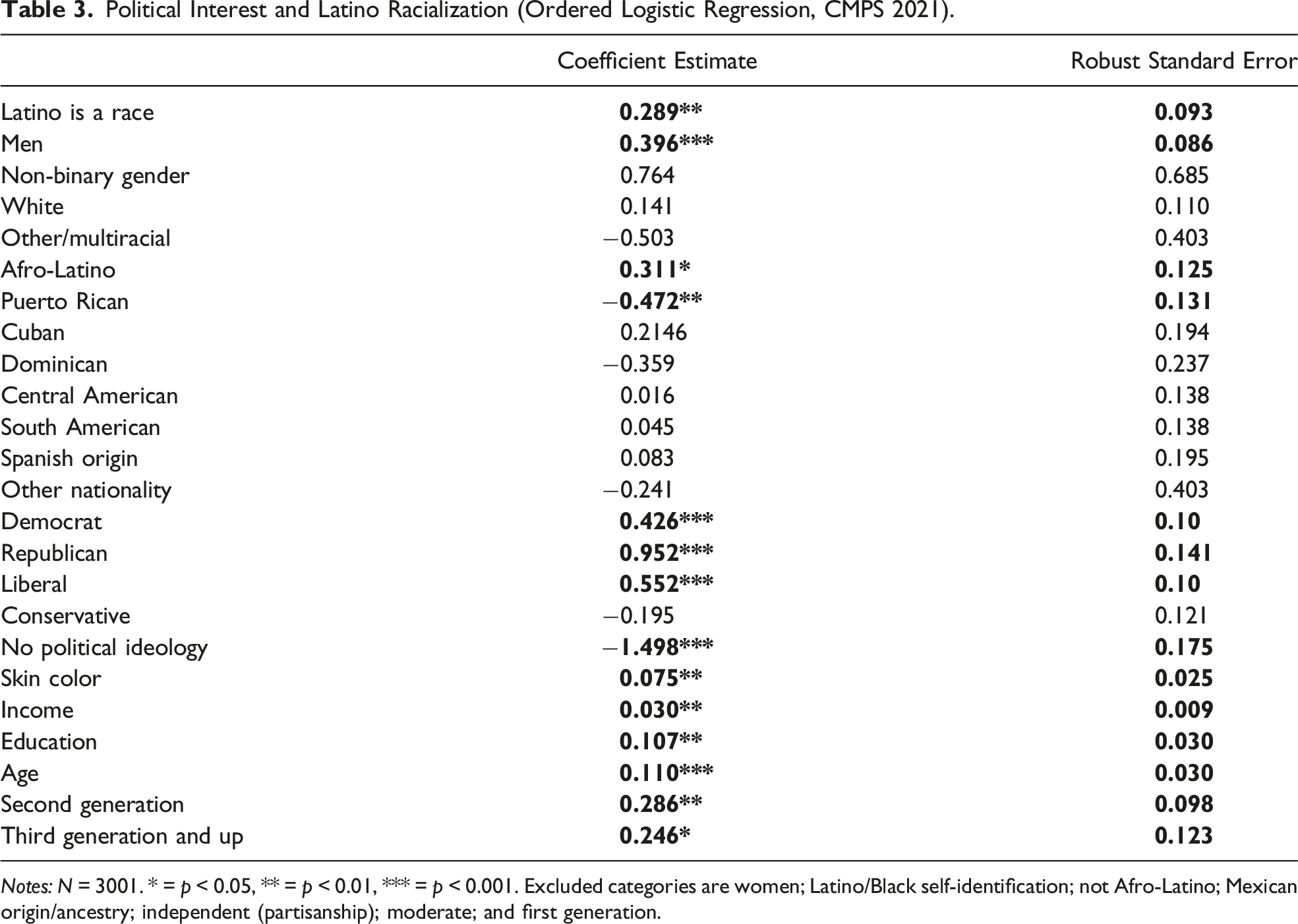
Notes: N = 3001. * = p < 0.05, ** = p < 0.01, *** = p < 0.001. Excluded categories are women; Latino/Black self-identification; not Afro-Latino; Mexican origin/ancestry; independent (partisanship); moderate; and first generation.
Consistent with existing research, political interest is higher among respondents with higher socioeconomic status (Verba et al. 1995), later generation immigrants, older respondents, and Latino men (Silber Mohamed 2017). Individuals who identify as Afro-Latino as well as those who report having darker skin tones also report greater political interest. While we discuss the importance of the skin color variable in greater detail below, we note the inherent challenges and subjectivity of using a self-reported measure, as skin color and racial identity do not always align within the Latino community; for instance, while Latinos with dark skin often identify as Black, this is not always the case (Dowling 2014, Ostfeld and Yadon 2022). In comparison to respondents who say that they are non-partisan, we find that political interest is also greater among respondents who identify as members of a political party. Additionally, in comparison to ideological moderates, self-described liberals are much more likely to be interested in politics, while people who decline to share their political ideology are less likely to express political interest.
Political Participation
Perceptions of Latino as a Race and Political Participation (CMPS 2020).
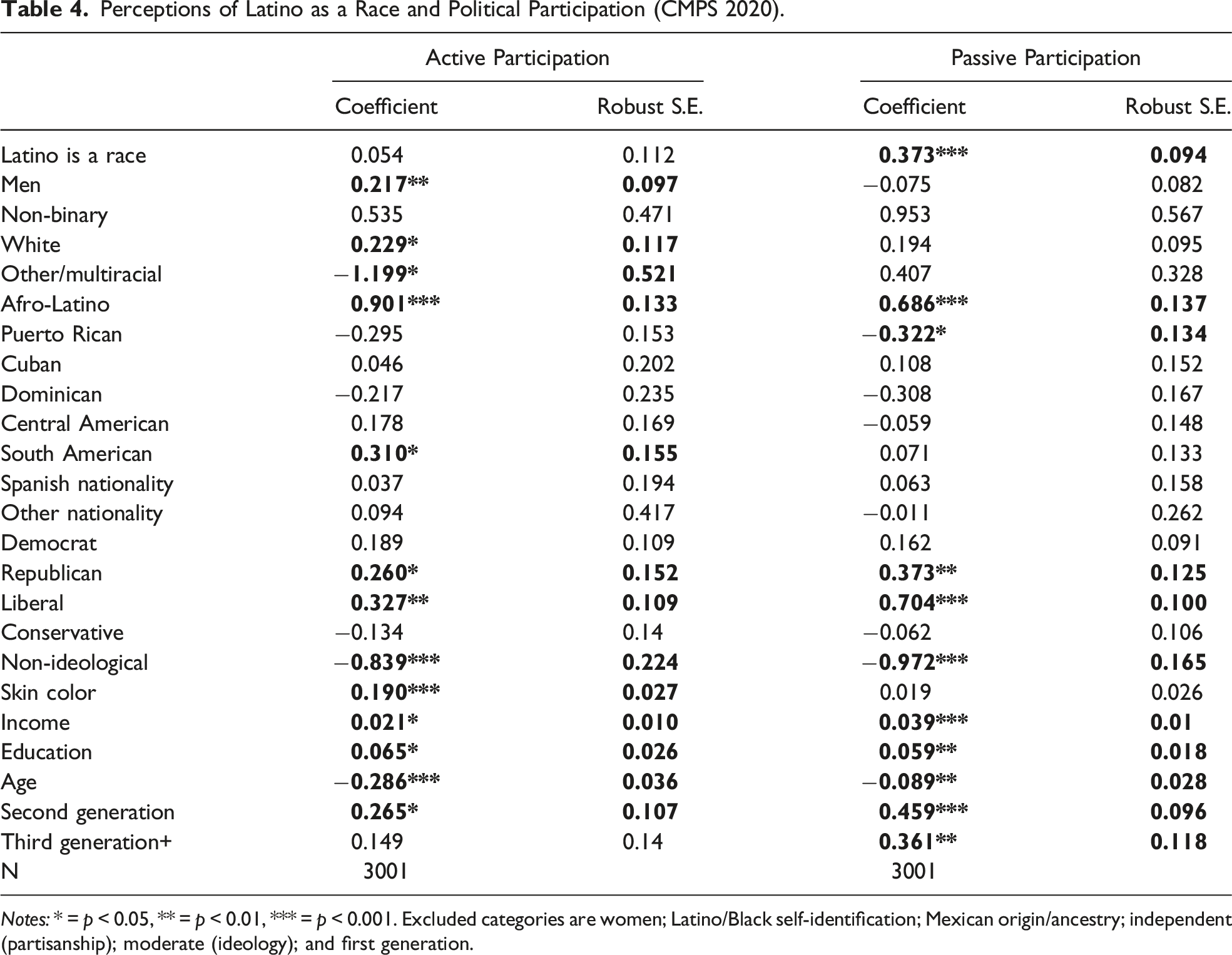
Notes: * = p < 0.05, ** = p < 0.01, *** = p < 0.001. Excluded categories are women; Latino/Black self-identification; Mexican origin/ancestry; independent (partisanship); moderate (ideology); and first generation.
Looking across the first row, we find mixed support for H2. While respondents who believe Latinos are a distinct race are more likely to engage in passive political participation, they are not more likely to engage in the active participation activities included in our first scaled measure. In some sense, we might consider the passive participation measures to be more closely related to political interest than the active participation measure. Thus, the combined findings in Tables 3 and 4 suggest that respondents who believe Latinos constitute a separate race are generally more engaged with political ideas, even if they are not participating actively.
Republicans and liberals (but neither Democrats nor conservatives) are more likely to report having engaged in active and passive participation, while respondents who report that they are non-ideological are significantly less likely to participate in any capacity. The variables for socioeconomic status and immigrant generation are generally significant in the expected direction for both of our scaled variables, but third generation and up is not statistically significant in our active participation model. The age variable is significant in the opposite direction than we anticipated, such that older respondents are less likely to participate. Notably, however, many of the participation items imply in-person participation, particularly in the active participation scale. Given that the survey focuses on participation between spring 2020–spring 2021, at the start of the COVID-19 pandemic and a time of heightened fears and when vaccines for COVID were not widely available, it is perhaps less surprising that older respondents would score lower on measures of political participation. Our analysis in Table 3 suggests a correlation between (self-reported) darker skin tone and greater political interest; here, we see that reporting darker skin is also correlated with a higher score on our active participation scale, but not for the passive participation measures. Identifying as Afro-Latino is associated with higher levels of participation using both of our scales, and white respondents are also more likely to report active participation.
Attitudes about Race and Racism
Perceptions of Latino as a Race and Broader Racial Attitudes in the United States (CMPS 2021).
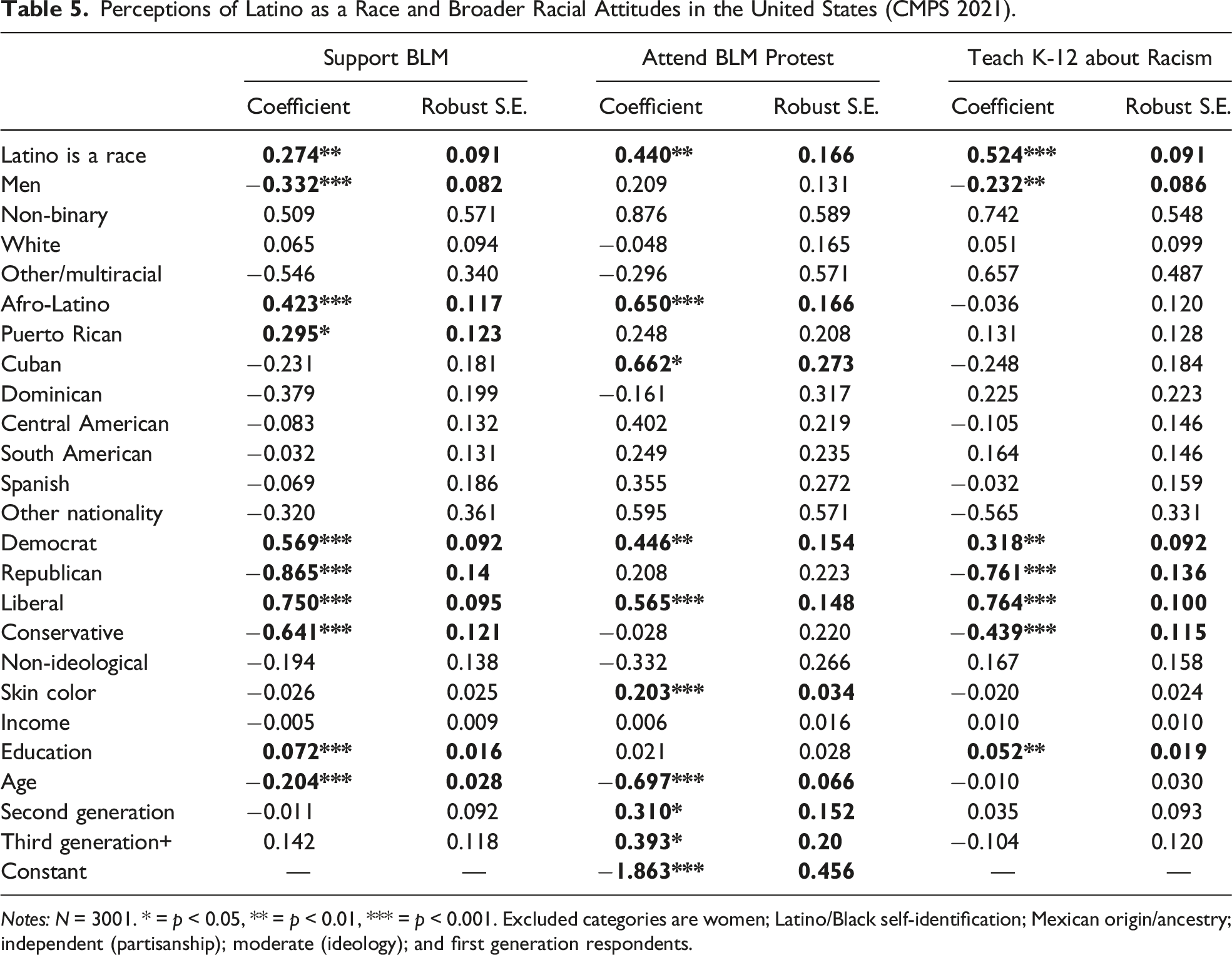
Notes: N = 3001. * = p < 0.05, ** = p < 0.01, *** = p < 0.001. Excluded categories are women; Latino/Black self-identification; Mexican origin/ancestry; independent (partisanship); moderate (ideology); and first generation respondents.
Looking across the first row, we find consistent support for our third hypothesis: respondents who believe Latinos constitute a separate race are significantly more likely to support the Black Lives Matter movement generally, more likely to report having attended a protest in support of BLM over the past year, and more likely to emphasize the importance of teaching children in K-12 schools about racism. Overall, our results indicate that respondents who believe Latinos represent a separate race have a greater awareness of racialized inequalities in the United States and may be stronger coalitional partners in the fight against social injustice.
Our control variables also yield some interesting results. Latino men are less likely to support the BLM movement and are less likely to endorse teaching about racism than are Latinas. Identifying as white or other/multiracial is not significant in any of our models. Respondents who identify as Afro-Latino are more likely to express support for the BLM movement and to protest in support of the movement, but are not more likely to support teaching about race and racism. Respondents who report having darker skin color are more likely to report attendance at a protest in support of BLM, but skin color is not significant for the other dependent variables. We also find strong effects of partisanship and ideology in the expected directions, with self-identifying Democrats and liberals demonstrating more awareness about racial issues compared to Republicans and conservatives. Although there is no correlation between income and any of the racism variables, more educated respondents are significantly more likely to be supportive of the BLM movement and to express support for teaching children about the history of racism in the United States. While there is no significant relationship between age and attitudes about teaching race and racism, there is a negative relationship between age and both of our BLM variables, indicating less support for the movement among older respondents. Our results are consistent with the findings in Terriquez and Milkman (2021), who find that women and nonbinary youth are disproportionately represented in solidarity movements with Black lives.
Discussion
The sociopolitical status of Latinos in the United States is complicated by the designation of Latino as an ethnicity and not a race. This status contrasts with the increasingly popular public attitude that Latinos are uniquely racialized as evident in discriminatory attitudes and policies. Latinos want to be recognized as a distinct racial group, possibly in order to receive recognition for the discrimination they face and to align themselves in solidarity with fellow racialized groups in the United States (but see Hernández 2021). Yet, solidarity with other racialized groups is not a given, as some members of the Latino community have responded to marginalization with anti-Black attitudes and actions (Benson and Clealand 2021, Pérez et al. 2023). Moreover, the quest among Latinos for recognition as a separate racialized group is inextricably bound with other social justice struggles.
We revisit these questions by first re-examining, with new and more comprehensive survey data, the question of who within the Latino community is most likely to think that Latinos constitute a separate race. We contribute to this literature by finding that the belief Latinos constitute a separate race is more common among Latinos who are more incorporated into the United States, including later generation respondents and those with higher income, as well as respondents who identify as liberal, as Democrats, and those who report more group-level (but not individual-level) discrimination.
We also hypothesized that Latinos who believe Latino is a distinct racial category in the United States would hold distinct political behaviors and attitudes from those group members who do not, with the expectation that attitudes about whether Latino is a racialized identity would be associated with increased political interest and participation, as well as progressive racial attitudes. We evaluate these hypotheses across multiple political outcomes, including political interest, active and passive political participation, support for the BLM movement (including political views and protest participation), and broader views about racial dynamics in the United States, captured by the extent to which respondents believe that K-12 students should be taught about issues relating to race and racism.
Overall, we find positive support for our hypotheses. Respondents who believe that Latinos represent a separate race are generally more interested and engaged in politics and racial justice issues, including having a higher basic level of political interest; ranking higher on a scale of passive participation (including discussing politics with friends/family, posting about politics on social media, signing a petition, boycotting a company, or wearing a campaign button or sticker/posting a sign); and expressing greater support for the Black Lives Matter movement (in attitudes and protest participation) as well as teaching about the U.S. history of racism in K-12 schools. However, we do not find a significant difference between attitudes about whether Latinos represent a distinct race and our scaled measure of active political participation (working or volunteering for a candidate; participating in political organizations; attending a campaign rally or meeting, protest march, or community meeting). These results suggest that attitudes about whether Latinos comprise a unique racial group are politically consequential and carry coalitional implications for cross-racial solidarity, but that there also may be some limits in the extent to which these attitudes have consequences for political mobilization.
The belief that Latino is a race is a fundamentally politicized view in that individuals who share it are consciously rejecting constructed distinctions between ethnicity and race because these distinctions fall short in capturing the racialization processes shaping Latinos’ experiences. It is thus not surprising that this view is also associated with unique political behaviors like increased political interest, some increased political participation, and solidarity with cross-racial justice efforts that illustrate an active reclaiming of power and representation. However, because of the correlational nature of our survey research design, we acknowledge that this relationship could be bidirectional. Latinos who believe Latino is a race are more likely to have a progressive, anti-racist orientation, but it might also be the case that Latinos who hold more progressive attitudes in general are thus more likely to adopt the belief that Latinos should be designated as a racial group in the United States. Future research should deploy a causal inference approach to eliminate endogeneity. As the debate over measuring racial categories in the United States continues to evolve, additional research is needed to better understand both a growing subgroup within the Latino community, and the broader dynamics within and between racial groups in the United States.
Conclusion
Focusing on the inherent tension that exists between the way Latino identity is designated by government officials and the way it is experienced by many within the Latino community, we analyze data from the 2020 CMPS to evaluate whether group members who believe Latino represents a distinct race engage differently in politics than those who do not. We find that respondents who understand Latino to be a separate race generally hold distinct political views, including greater political interest, greater awareness of and support for policies related to race and racism, and increased passive political participation. However, we find no significant relationship with active participation, suggesting that these views do not always translate into distinct political behaviors. Grassroots youth organizations in particular have been critical in training and mobilizing Latino young people in advancing Black Lives Matter causes and also fighting for related struggles (Terriquez and Milkman 2021), suggesting these are significant channels of politicization and mobilization around cross-racial solidarity.
Our analysis also underscores additional demographic differences within the Latino population based on whether a respondent identifies as Afro-Latino and reported skin color. These findings underscore the importance of ongoing research about the relationship between self-reported skin color and racial self-identification (Dowling 2014, Ostfeld and Yadon 2022) as well as the need for further study about the distinct views and experiences of Afro-Latinos (Clealand and Gutierrez 2022, Hernández 2021).
An ethnic designation by the government does not fully capture the persistent racialized discrimination experienced by Latinos at the hands of politicians, policies, and society writ large. In contrast, a Latino racial designation adopted by Latinos emphasizes a recognition of such discrimination by aligning itself in relation to and in solidarity with Black experiences in the United States. Corral (2020) shows that Latino racially identifying Latinos, while less likely to have heard of BLM, are more likely to support it, compared to white racially identifying Latinos. We find that individuals who believe Latinos represent a separate race are more likely to support the BLM movement, more likely to report attendance at a protest in support of BLM, and more likely to support teaching children about the history of racism in the United States. Our analysis extends Corral’s findings by showing that a belief that Latino is a race is likely to be politically consequential for Brown–Black solidarity politics.
Our results indicate that respondents who believe Latinos represent a separate race may be more oriented towards cross-racial solidarity struggles than those who do not since they may be more likely to see their experiences as shared with Black Americans, who have experienced long, historical systemic discrimination. Important questions remain, however, about the connection between holding different views and the extent to which those views motivate active political participation. Over time, increased numbers of Latinos embracing a racialized identity, combined with the increasing size and political power of the Latino community, will affect their participation in U.S. politics and their support for cross-racial movements like Black Lives Matter.
Supplemental Material
Supplemental Material - The Political Consequences of Racialized Ethnic Identities
Supplemental Material for The Political Consequences of Racialized Ethnic Identities by Kimberly Cardenas, Heather Silber Mohamed, and Melissa R. Michelson in Political Research Quarterly
Footnotes
Acknowledgements
The authors thank Sean Long for his excellent research assistance, and to Jana Morgan for her helpful feedback on an earlier draft shared at the 2022 annual meeting of the Western Political Science Association.
Declaration of Conflicting Interests
The author(s) declared no potential conflicts of interest with respect to the research, authorship, and/or publication of this article.
Funding
The author(s) received no financial support for the research, authorship, and/or publication of this article.

Supplemental Material
Supplemental material for this article is available online.
Notes
References
Supplementary Material
Please find the following supplemental material available below.
For Open Access articles published under a Creative Commons License, all supplemental material carries the same license as the article it is associated with.
For non-Open Access articles published, all supplemental material carries a non-exclusive license, and permission requests for re-use of supplemental material or any part of supplemental material shall be sent directly to the copyright owner as specified in the copyright notice associated with the article.
