




Abstract
Differential police conduct may be attributed both to residential racial segregation and more general discriminatory attitudes and policies. We draw upon ethnographic and other studies of everyday policing to propose that police, in the context of racially segregated neighborhoods, intensively surveil individuals who are “out of place” in terms of their race and the local geographical context in which they are found. We then use statistical evidence from the New York City Police Department to compare stops in different neighborhoods. We find that the NYPD indeed carries out “stops” that differentially target African Americans and Hispanics present in predominantly white precincts, with the degree of surveillance increasing as precincts become more white, and as stops become more generic and less about specific, identifiable crimes.
Keywords
Over the last two decades, political scientists have studied the racially skewed way in which laws are enforced and public policies administered. A recurring finding is that policing varies considerably depending on the race of the person interacted with: individuals identified as minority are more likely to be stopped, arrested, or even die as a result of an encounter with police officers (Baumgartner et al. 2021; Knox, Lowe, and Mummolo 2020; Shoub 2022). Nor is this simply a U.S.-specific phenomenon: around the world, police encounters covary with racial or ethnic status. 1 One explanation is that police officers harbor and act on racial stereotypes (Goncalves and Mello 2021; Shoub, Stauffer, and Song 2021).
However, many jurisdictions marked by racially differential policing are also marked by residential segregation along racial lines. Examples are rife, from “sundown” towns in the Jim Crow South to African-American professors being arrested while entering their own homes in predominantly white suburbs (Heussler 2010; Loewen 2018). Institutionalist studies (Alexander 2010; Katznelson 2013; Rothstein 2017; cf. King and Smith 2005) indicate that this segregation was underpinned by racially biased legislators, state administrators, and private lenders. It is therefore tempting to see the connection between segregation and differential policing as indirect, with racial prejudice underlying both phenomena. Such a view, though, is at odds with literature on how segregation both mediates prejudice and has multiple direct consequences through the daily interactions it facilitates, or the access to resources it impedes (e.g., Do, Locklar, and Florsheim 2019; Isik et al. 2018; Peterson and Krivo 1993). This suggests that both racial prejudice and residential segregation may have direct effects on racially differential policing. To explore this possibility, we present statistical evidence from a specific jurisdiction in support of that claim. Notably, we find that New York City police carry out intrusive surveillance, namely “stops,” that differentially target African Americans and Hispanics present in predominantly white precincts.
The paper begins with a review of the literature which, as indicated above, shows a clear indirect correlation between residential segregation, racial prejudice, and differential police conduct. In the second part of the paper, we propose a causal mechanism by which police act differently toward persons belonging to racially segregated groups depending on their race and the local geographical context in which they are found: African Americans and Hispanics seen as “out of place” in predominantly white areas as opposed to their presence in predominantly African-American areas. The proposed mechanism, which jibes with ethnographic studies of police behavior, is arguably manifested in the reasons recorded by police officers for each “stop” they make.
The third part of the paper presents the design of the study, including data sources and variable measurement, and the fourth part reports on the results of our estimations. We find a strong relationship supporting our argument, sufficiently robust across statistical tests to indicate a direct, and not only attitudinally mediated, causal effect of segregation on police conduct. We conclude that day-to-day differential policing is premised on residential segregation and discuss the implications of our finding both substantively and for future research
Segregation, Racial Prejudice, and Policing: What the Literature Shows
Scholarship on the segregation-differential police link can be divided into studies about policing responses to problems associated with segregation, about policing aimed at maintaining segregation, and about policing responses triggered by perceptions of racial threats in highly segregated areas. However, as we shall see, none of these literatures advances a mechanism directly linking segregation to differential policing.
Problem-focused studies note that urban areas with high concentrations of disfavored racial or ethnic groups exhibit high rates of crime and other problems such as endemic poverty, low educational attainment, substandard housing, and high unemployment (e.g., Hess et al. 2019; Peterson and Krivo 2010; Sampson et al. 2018). In much of this research, the crime-policing connection is left implicit. However, other studies (Fagan 2017; Kirk 2008; Smith 1986; Weitzer 2010) argue either that police respond to violent crime and the social ills conducing to it, or, by their response, create a trap which residents cannot escape (e.g., a criminal record makes it difficult to continue education or find good jobs afterward). Even these studies, however, say little about mechanisms connecting segregation across an entire urban area to differential police responses: one has the impression that if, somehow, residential segregation diminished without affecting social ills, violent crime, and hence strong police reactions, would still obtain. Thus, the link is not so much between policing and segregation as between policing and social ills.
The maintenance-of-segregation literature posits a more direct link, claiming that incarceration is a tool for segregation (Arvanites 2014; Burch 2014; Smith and Hattery 2008; Wacquant 2001). But precisely how differential policing, as distinct from other aspects of the justice system, contributes to segregation is rarely specified; and even when the focus is specifically on racially differential police aggressiveness, it tends to highlight, rather than to explain, the stark and pervasive nature of that phenomenon (e.g., Alexander 2010; cf. Gaynor, Kang, and Williams 2021). A notable exception here is Bell (2020), who argues that differential policing is a principal means of maintaining segregation, for example by harassing individuals from racially disfavored groups within and at the borders of areas into which they have been concentrated. Even in this study, though, the implications of harassment for disfavored individuals elsewhere—notably where they are even more “out of place”—in highly segregated settings remains unexplored.
A third literature revolves around the triggering of racial attitudes. The claim is that police feel threatened by disfavored groups, with this feeling being heightened in residential areas where those groups are disproportionately present (first Key 1949, then Blalock 1967 introduced the term “racial threat”; see also 1 ; and Feldmeyer and Cochran 2018). Racial attitudes among the police thus not only underlie residential segregation, explaining its link to differential arrests (Parker, Stults, and Rice 2005) and the use of force (Mesic et al. 2018; Siegel et al. 2019), but are triggered in segregated areas with high concentrations of disfavored groups (O. Johnson et al. 2019; Smith and Holmes 2014; see also Richardson 2017 and, on threat heuristics, Fagan and Campbell 2020).
However, even for the racial threat studies, the tie between differential policing and segregation remains indirect. As with the other two literatures, segregation is a jurisdiction-wide phenomenon, and the fact that police officers are wary of disfavored groups, with this wariness accentuated in areas with large numbers of disfavored group members, says nothing about how the geographical separation of groups itself conduces to differential policing. For triggered attitudes to connect segregation to differential policing, those attitudes have to come into play across the range of residential areas. To exaggerate somewhat, the racial threat studies suggest that it is much safer for an African-American male to be in the same vicinity as a police officer in a primarily white area than in a primarily African-American one—an implication which runs contrary to much of the second literature discussed above and to the notion of segregation as long-term differential concentration. At least for predominantly white areas, then, the racial threat argument is insufficient; and thus, what emerges from this literature overview more generally (see the top half of Figure 1) is a need to specify explanatory mechanisms connecting differential policing to both racial prejudice and differential concentration, a subject to which we now turn and which, schematically, is depicted in the bottom half of Figure 1. The direct effect of racial prejudice and segregation on differential policing.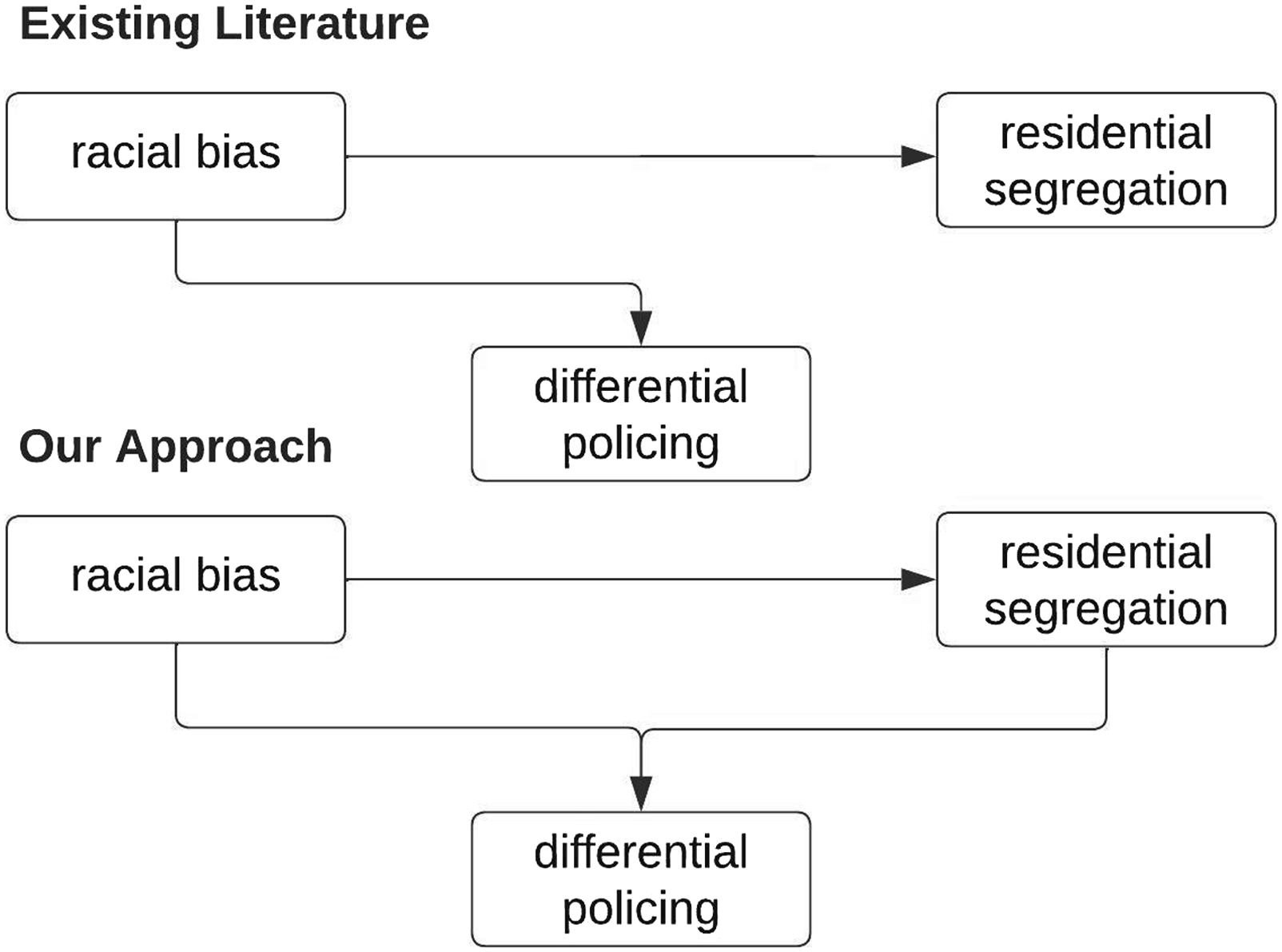
Argument: “Out-of-Placeness”
To examine race and place effects, we need a sense of how police “read” or otherwise react to differences in racial concentration. Here, we draw on three groups of studies about how police officers behave routinely in different kinds of neighborhoods. First, ethnographies indicate that police officers attend to particular types of information in their daily patrols. The starting points are Bittner’s study of “Skid Row” policing, demonstrating that “coercive control [was] exercised as a means of coming to grips with situational exigencies,” such that “the person whose presence is most likely to perpetuate the troublesome development [would be] removed” (1967, 712–13; see also Bittner 1970) and Skolnick’s participant-observation research on how police discretion involved the localized identification of persons as “symbolic assailants” (1966: ch. 3; cf. Bell 2018). These findings on how police officers’ heuristics are place-specific were further developed in ethnography (Van Maanen 1978) about how individuals were categorized, in situ, as “suspicious,” “assholes,” and “know nothings”; and how officers’ accounts of arrests were informed by place-specific accounts (Gaston 2019).
From the racial threat literature discussed above, one might imagine that the police focus is on settings that are dangerous and persons who are to be expected there. In fact, though, a second strand of literature on routines highlights the “disorder,” or lack thereof, on which police attention is focused, with the particularly attention-grabbing combination being a problematic type of person in an unproblematic setting. 2 The canonical text here is that of Klinger (1997), in which the key idea is that persons, or the acts they appear to be performing, stand out against the in situ backdrop of the place. If that place is one in which “deviant” activities are considered typical, then persons apparently engaged in those activities will, ceteris paribus, not be considered as disorderly and are less likely to be the object of “vigorous” police intervention (Klinger 1997, 296).
In this way, police heuristics, in conjunction with the discretion officers enjoy (Alpert, MacDonald, and Dunham 2005; Moskos 2008; Skolnick 1966: ch. 4), lead to officers reacting in different ways to the same behavior, depending on the place where it occurs and on the presumed characteristics of the person engaging in that behavior. That, in the eyes of the police, a key feature of both those characteristics and of the place in which the behavior occurs is race should not be a surprise: canonically, an African-American male dressed in a hoodie and “casing” a store in a primarily white area is a paradigmatic example of a situation the police consider to be disorderly (Capers 2009; Huq 2017; Vito, Higgins, and Vito 2021). In this way, differential policing is precisely a localized, in situ response to racial segregation.
But what aspect of policing? The answer, from a third set of studies, is what might be called intrusive surveillance. For some decades, police officers in numerous cities have employed a tactic known in New York as SQF: “stop question, and frisk.” As officers would drive or walk through a neighborhood, they would spot one or more persons who, in context, were considered sufficiently suspicious to be stopped and questioned. Depending on the suspicions and the (non)responses to the questions, the police might then proceed to a search (“frisk”) and, possibly, to an arrest. This kind of activity, sanctioned legally in the U.S. since Terry v Ohio (392 U.S. 1) in 1968, is, for many cities, ubiquitous and unremarkable (obviously not for the persons stopped). Indeed, although SQF was carried out in a racially skewed fashion (Gelman, Fagan, and Kiss 2007; Kramer and Remster 2018), so much so that police departments in New York and elsewhere were forced to cut down on it, the tactic is still widely resorted to by police.
We characterized SQF as a form of intrusive surveillance, which it is by definition. For officers to perceive a person-place combination as suspicious, they have to be surveilling that person and/or place, at least briefly; when they carry out a stop, they are intruding on the person. The “out of place” literature suggests that racial characteristics of both person and place jointly determine stops, and this is supported by studies of SQF, albeit not on person-place combinations per se (Fagan et al. 2016; Kramer and Remster 2018; Levchak 2017). Note that the paradigmatic combination (African American in a predominantly white area) is a matter of degree: the more a person is viewed as having attributes—skin color, dress, or behavior—at odds with expectations for a specific place, the more that person will be perceived as “out of place.” If we assume, per the segregation and ethnographic literature, that certain persons’ presence in white neighborhoods is seen as a sign of disorder, then we should expect that in those neighborhoods, such persons will be particularly surveilled. 3 Residential segregation is thus a baseline datum for police officers’ inferences.
In this sense, race enters the picture in two ways. On the one hand, in the context of residential segregation, the police are particularly sensitive to what goes on in white areas; on the other hand, in those areas, the police are particularly likely to characterize nonwhite individuals as promising targets of intrusive surveillance. This does not mean, of course, that the police pay no attention to what happens in nonwhite areas, particularly areas with high levels of crime. But it does mean that if we take as a baseline a neighborhood with a certain level of crime and ask under what circumstances the police will intrusively surveil individuals relative to that baseline, our argument can be depicted schematically as per Figure 2. Degrees of “out-of-placeness”.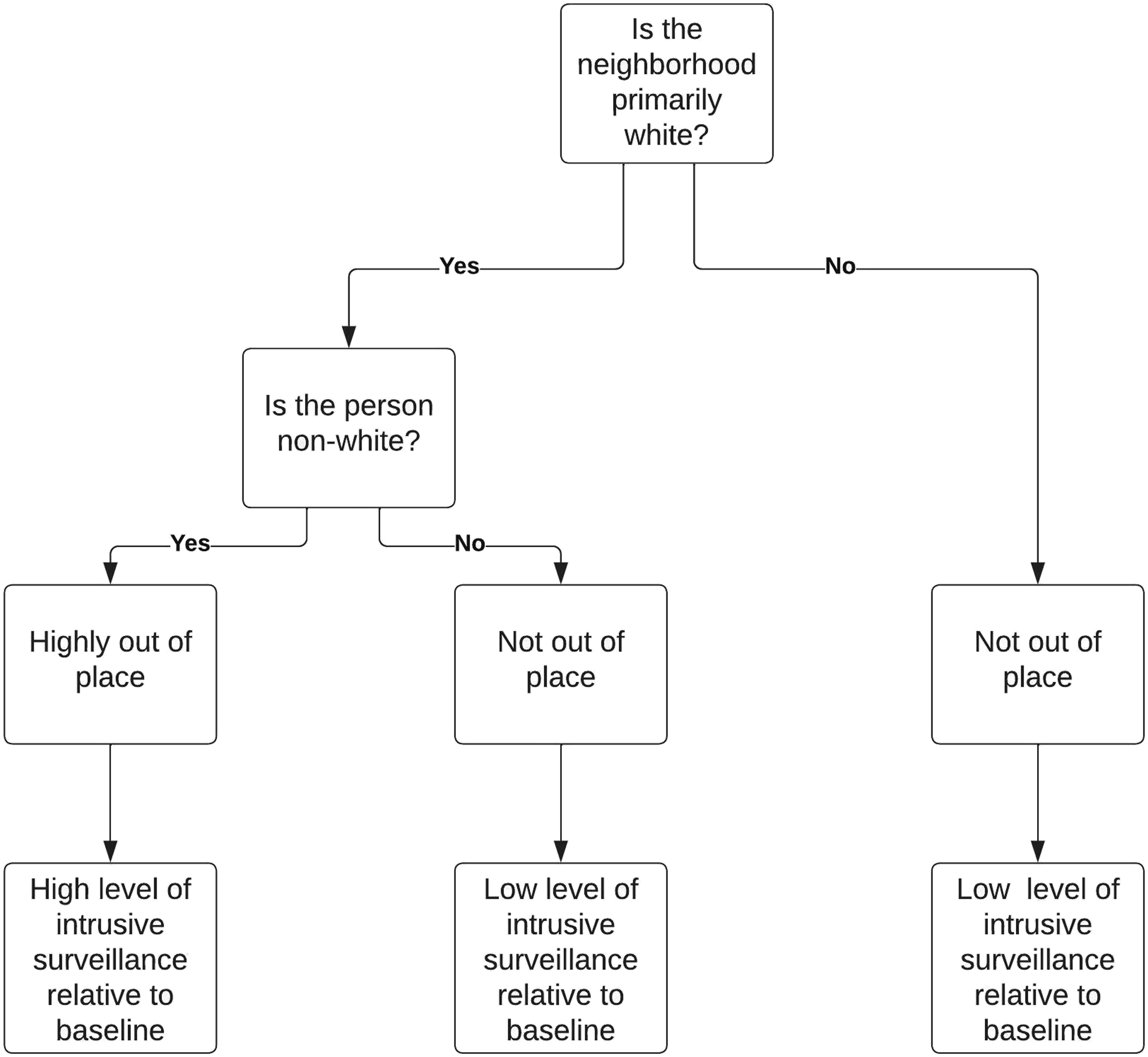
“Out-of-placeness” is largely a matter of applying police-specific heuristics to combinations of persons and places. Those heuristics may stem from general racial stereotypes but as practical rules of thumb by which officers rapidly and matter-of-factly assess circumstances on a daily basis, we ought not expect them to be used only by white officers (cf. Enos and Celaya 2018; cf. Fryer 2019 and the controversy surrounding D. Johnson et al. 2019).
Research Design
In order to assess our argument, we focus on intensive surveillance in a particular jurisdiction, namely, New York City, between 2003 and 2020 (see www1.nyc.gov/site/nypd/stats/reports-analysis/stopfrisk.page). Following a consent decree in 2003, the city created categories for why the police had performed a stop and made available stop data for every year since then. This resulted in an enormous (over 5 million stops up to 2013, when a new court order, in Floyd v. City of New York [959 F. Supp. 2d 540] went into effect), two-decade-long data base, unmatched by other compendia. However, as we discuss in the conclusion, New York is certainly not an outlier as regards police stops. 4 Theoretically, the scope of our analysis relates to American as well as non-American cities, or at least fairly dense residential areas, where the basis for segregation is clearly and directly observable by officers patrolling the streets.
If, per our argument, the police read individuals against the backdrop of places, then the latter are likely to be categorized by expectations about the prevalence of individuals with certain segregation-related attributes such as race. That categorization can most easily be tapped by looking at the percentage of individuals with those segregation-related attributes. For New York, given that residential segregation has for well over a century been directed primarily at African Americans via mortgage underwriting, school district boundaries, gerrymandering, and direct political pressure (Purnell and Theoharis 2019), we thus look at the percentage of the population of a given police precinct that is African American. 5
We turn now to the stop data. As indicated above, the New York Police Department has since 2003 required its officers to record the rationale for every street stop they make. Those recorded reasons may look arbitrary or palpably false: the use of “Criminal Possession of Marijuana” as a way of looking for guns (Geller and Fagan 2010); the use of “Furtive Movement” (Floyd; Morrow and Shjarback 2019), as a general fishing license for performing a stop. However, lack of correspondence between what a stopped person was actually doing and the reasons indicated for the stop does not mean that the latter were simply ticked randomly. Quite the contrary: officers list specific reasons as a way of accounting for the stops they perform and do so in a highly systematic fashion, akin, as one pair of authors put it, to following a script (Fagan and Geller 2015) used across the police force (Meares 2015).
These considerations suggest that reasons for stops can be used as a measure of the extent to which intrusive surveillance is oriented around out-of-placeness.
Specific “Stop” Categories on the NYPD UF-250 Form.
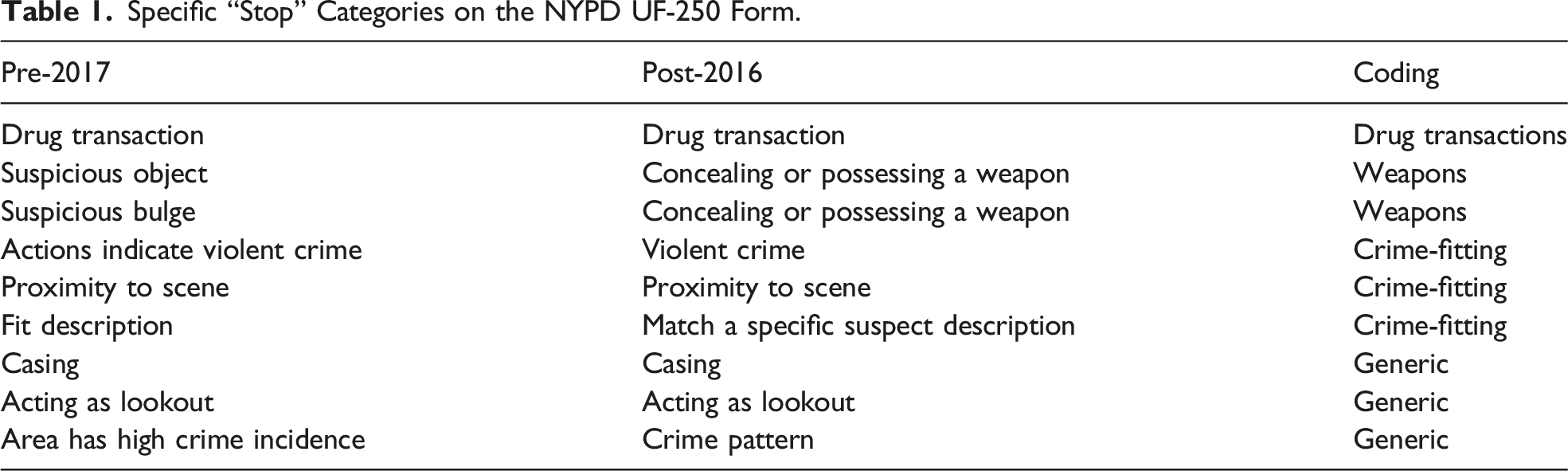
This gives us our dependent variable, the level of suspected crime specificity of police stops, measured by the number of the four different categories of stops, per 100,000 persons, per precinct, per quarter, for the period 2003–20. On the righthand side, we look both at our measure of segregation and (from the stop archive) at the recorded race of each male stopped, distinguishing between stops of three racial categories. 6 Since Floyd in 2013 led to dramatic changes in the number, if not the racial disparity, of stops (Zimroth 2021, 16), we further differentiate between stops before and after that date.
Of course, there are numerous covariates that might also affect stop rates. The most obvious, per our argument on baseline levels of surveillance, is the prevalence of violent crime in the precinct (Fagan et al. 2010): even if police officers inaccurately assess general neighborhood crime rates, this need not apply to violent crimes. A high number of violent crimes might also lead to greater numbers of officers patrolling and performing stops (this was the logic behind the “Compstat” program in New York City). Accordingly, from the NYPD’s Historical New York City Crime Data Web site (statistics/historical.page), we extracted and aggregated incidents of murder and non-negligent manslaughter, forcible rape, robbery, and aggravated assault to come up with a violent crime index, for each precinct, per capita (multiplied by 100,000). Other potential covariates, such as the race of the officer performing the stop (see the discussion at the end of the previous section) or, more surprisingly, the number of officers in the precinct, were unobtainable. Still other potential covariates, such as transience, poverty, or education levels, are not available at the precinct level; however, our estimation strategy of precinct-specific random effects permits us to take account, at least indirectly, of such factors.
The basic linear specification is as follows. Let i denote precincts and t quarters. Let Dt<2013 = I
t
[t < 2013] be a dummy variable equal to one if the quarter precedes January 2013, and zero otherwise. Then the basic panel specification is given by:
In intuitive observational terms, the hypothesis we are estimating can therefore be thought of as a simple regression in which: (i) intrusive surveillance should be positively correlated with “out-of-placeness” for non-white racial categories (i.e., percent African American in the precinct should be negatively correlated with intrusive surveillance for African Americans and black Hispanics, and for white Hispanics); (ii) for non-white racial categories, the magnitude of this negative correlation should be decreasing (in absolute value terms) with the specificity of the intrusive surveillance per se (i.e. the absolute value of the correlation should be lower for intrusive surveillance associated with a specific form of crime than for generic crimes); and (iii) there should be a difference in the size of the negative effects for the two time periods, with the earlier time period showing stronger results than the later one.
Results
Descriptive Statistics
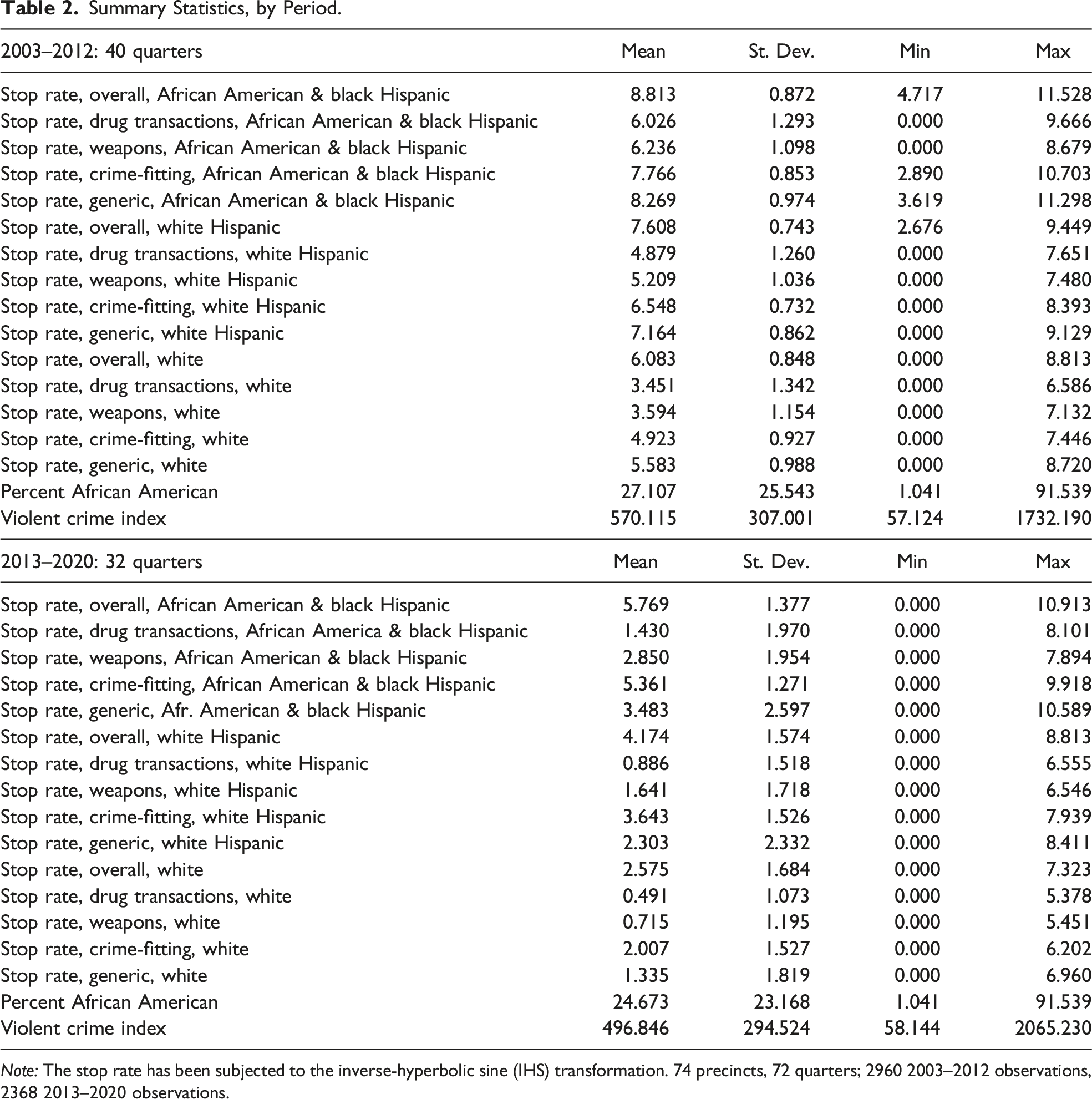
To begin with, consider stop rates. They are both highly skewed (with most precinct-quarter combinations having low rates) and exhibit significant racial disparities, with African Americans and black Hispanics, on the one hand, and white Hispanics, on the other, experiencing much higher stop rates than whites.
Figure 3 below display histograms for the four types of stop rates (with the unit of analysis being the precinct-quarter). It was necessary to transform the stop rates, as the raw numbers were extremely skewed, with most precinct-quarter combinations having very low rates and with higher rates being concentrated in a relatively limited combination of cases. But what does come through after the transformation, both in Figure 3 and Table 2, is the clear and marked difference between stop rates for non-whites and for whites.
8
In every case, the white Hispanic distribution is to the right of the white one, with the combined African American and black Hispanic one still further to the right. As regards time period, even though the 2013 court order significantly reduced the number of stops, African Americans and black Hispanics, as well as white Hispanics, continued to be stopped at much higher rates than whites. Stop rates for drug transactions, weapons, crime-fitting, and generic reasons. Note: The stop rate has been subjected to the inverse-hyperbolic sine (IHS) transformation. Summary Statistics, by Period. Note: The stop rate has been subjected to the inverse-hyperbolic sine (IHS) transformation. 74 precincts, 72 quarters; 2960 2003–2012 observations, 2368 2013–2020 observations.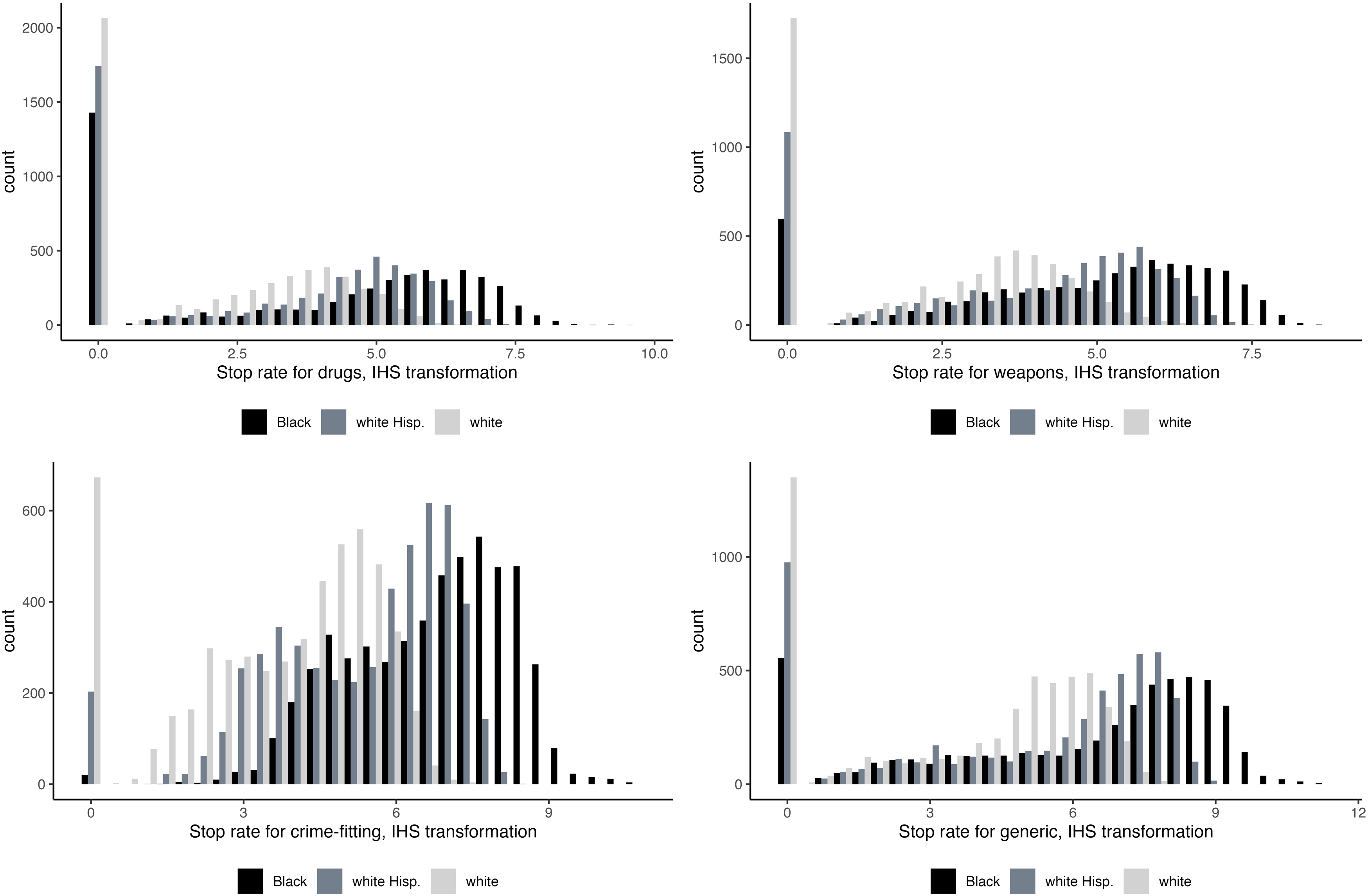
As regards the independent variables, Figure 4 shows that the main covariate, violent crime rates per quarter and per precinct, is distributed in a moderately skewed fashion. By contrast, percent African American for each precinct quarter, which is the segregation-related variable, is interestingly clustered at the left hand side of the histogram: not only do precincts differ markedly in their racial composition, but large proportions of African Americans are concentrated in a relatively small number of precincts, which, as discussed earlier, is another aspect of segregation. We will return to this issue below when we discuss robustness checks. Percent of African-American population and violent crime index.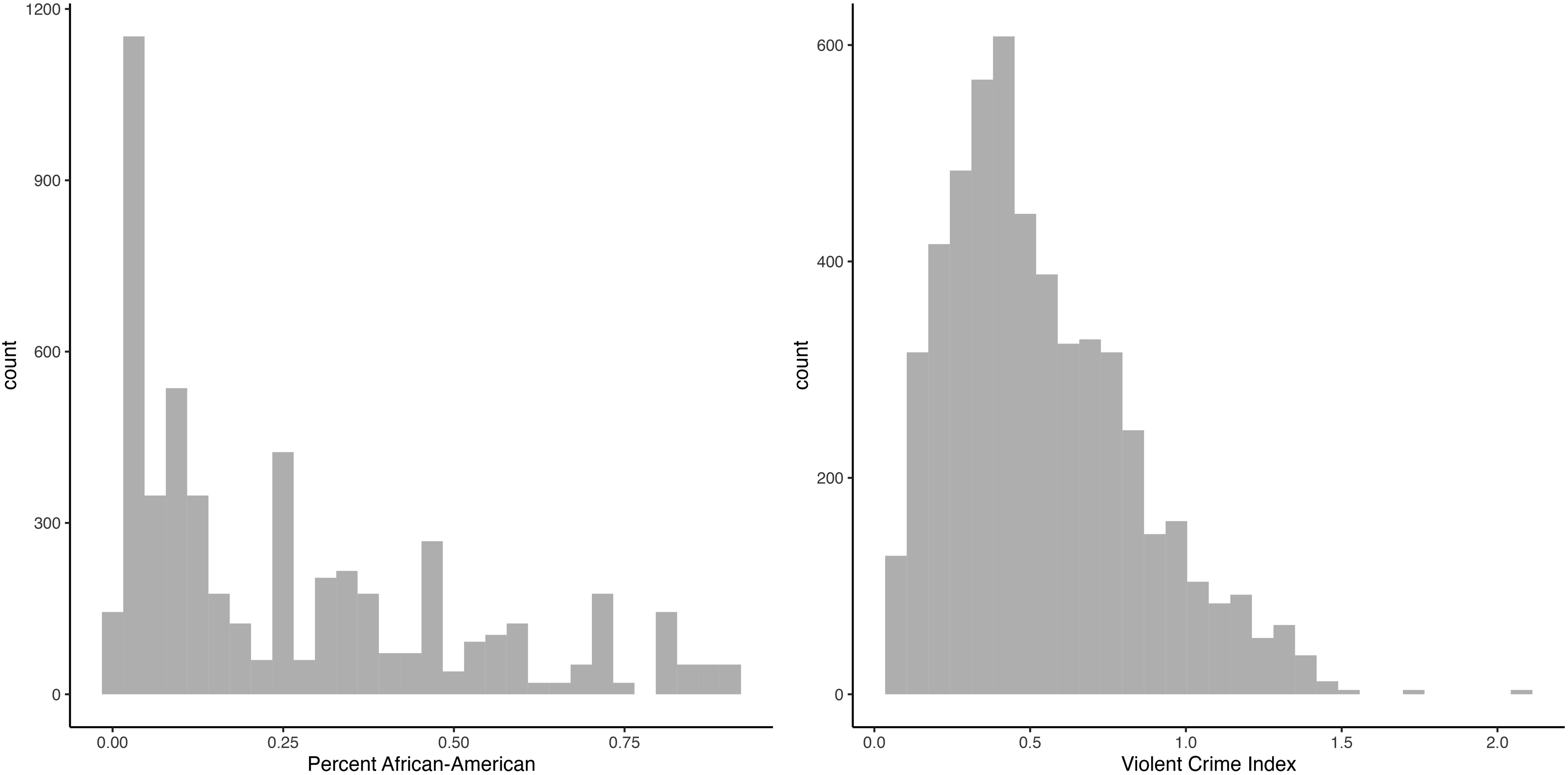
Empirical Analysis
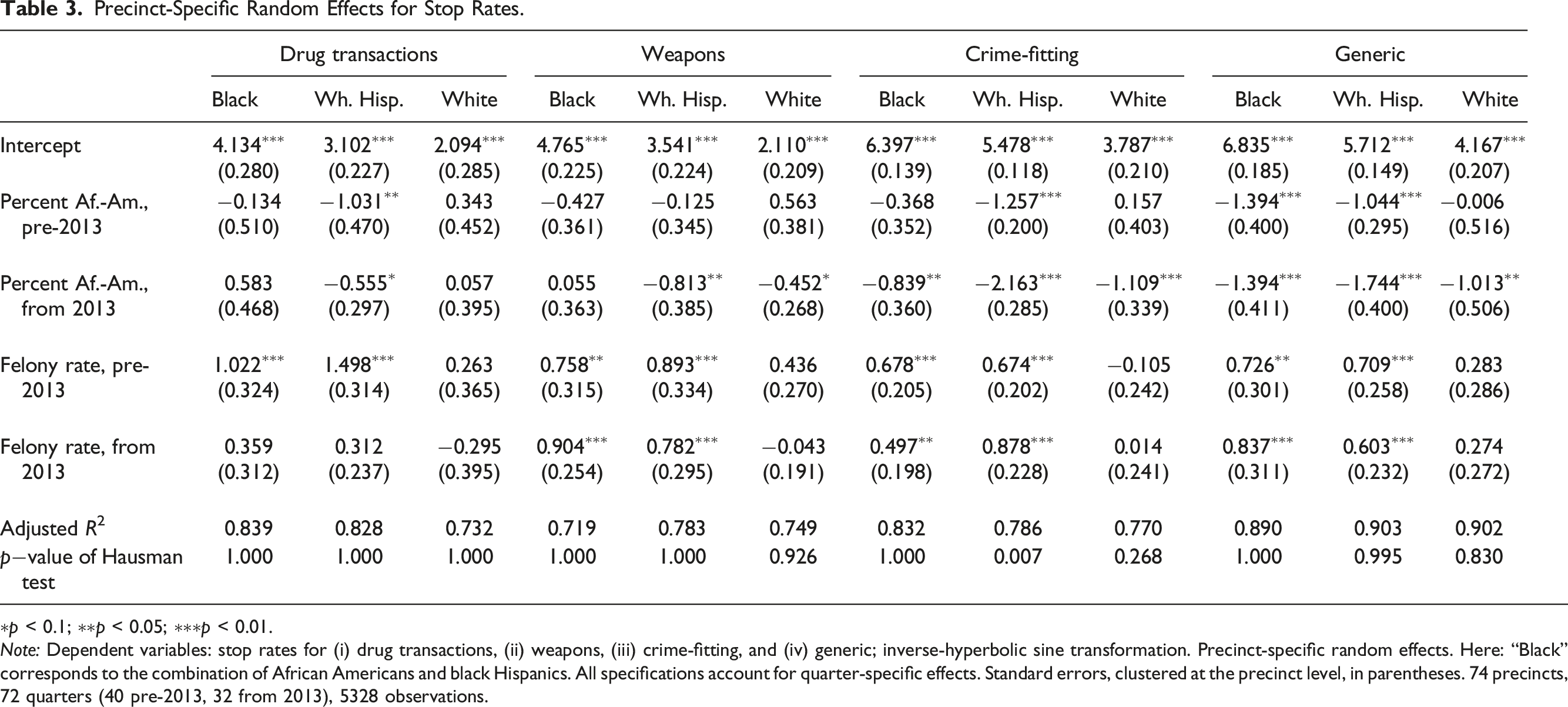
We turn now to the estimations. The idea, given our “out-of-place” argument about segregation, is to determine whether, as precincts become less African American, stop rates go up—with the strongest such relation holding for the combination of generic stops, nonwhite (African American and black Hispanic, and white Hispanic) males, and the period prior to the Floyd ruling. In general, the results accord well with the hypothesis, with the notable exception of the time period claim.
Precinct-Specific Random Effects for Stop Rates.
∗p < 0.1; ∗∗p < 0.05; ∗∗∗p < 0.01.
Note: Dependent variables: stop rates for (i) drug transactions, (ii) weapons, (iii) crime-fitting, and (iv) generic; inverse-hyperbolic sine transformation. Precinct-specific random effects. Here: “Black” corresponds to the combination of African Americans and black Hispanics. All specifications account for quarter-specific effects. Standard errors, clustered at the precinct level, in parentheses. 74 precincts, 72 quarters (40 pre-2013, 32 from 2013), 5328 observations.
Two additional observations are worth noting. First, contrary to expectations, the significance and size of the negative coefficients is greater following the consent decree. We know that the police, under fire for civil rights violations, drastically reduced the number of stops; but our results indicate that the reduction was, if anything, concentrated in African-American areas, that is, that the police devoted more effort to policing white areas, so much so that they even began sweeping up whites. Second, in general, the absolute value of coefficients is higher for white Hispanics than for the combination of African Americans and black Hispanics. This is not so much contrary to expectations, as the literature says little to nothing about that contrast, but, along with the finding on whites, it does suggest that policing of white areas is less a matter of acting on highly differentiated racial biases pertaining, say, to African Americans as opposed to white Hispanics, and more a matter of protecting white areas from a variety of individuals seen (mostly on racial grounds) as not belonging in those areas. However, neither observation should be interpreted as calling into question the primary finding in Table 3, namely, that intrusive surveillance of nonwhite males on out-of-placeness grounds is concentrated in neighborhoods where they are less likely to be found—a straightforward effect of residential segregation on differential police behavior.
To assess the robustness of our results, we consider one possible threat to causal validity and three to statistical validity (results in sections A, B, C, and D of the online appendix). As regards causal validity, the mechanism underlying our hypothesis involves the police driving down city streets and observing the skin color, clothing, and behavior of individuals. In principle, this should operate more strongly during daytime than at night, at least in the absence of strong street lighting. In fact, though, when we divide stops by the hour at which they take place, there are no significant differences between day and night.
As regards statistical robustness checks, we start with the possibility that precincts near each other may have similar unobservables affecting stop rates, thus biasing estimates of the impact of racial composition. This type of spatial correlation can be understood as officers attending to the general geographical area. In other words, there may be proximity effects, in which police act not on the basis of a precinct’s racial composition but rather on how close it is to other precincts of interest. For example, in cases of extreme segregation, a mostly white neighborhood bordering on a heavily African American one may be perceived as different from a mostly white neighborhood surrounded by others of the same sort. To test for these effects, we took the estimating equation, added a spatial lag term for the stop rates in neighboring precincts (arbitrarily weighting each such neighboring precinct the same), and estimated it via maximum likelihood. The results show, first, that precinct-specific effects are orthogonal with respect to the covariates and thus that the random effects estimates presented above in our baseline model give consistent and efficient parameter estimates. Second, the general pattern of coefficients for percent African American, as also for violent crime rates and the intercept, is almost identical to that in the baseline estimate without spatial lag; and the size of the coefficients is equally similar. Third, the size of those spatial lag coefficients is extremely small, thereby indicating that stop rates are geographically uncorrelated with each other and that police are more likely to attend to precinct-specific characteristics rather than to those of wider geographical areas. This laser-like precinct focus by the police in a racially segregated city where neighborhoods with highly disparate racial composition are sometimes cheek by jowl with each other, is counterintuitive and quite interesting.
For the second statistical check, recall our argument that for segregation to affect differential policing, officers have to “read off” neighborhood racial composition across the range of neighborhoods, from those with extremely low percentages of African-American residents to those with extremely high ones. Accordingly, we ran generalized additive models (again with quarter dummies) to check for non-linearity in the precinct racial composition variable. The results show that even though, over the entire range of precincts, the effect of racial composition on stop rates is decidedly nonlinear, when we look at less specific types of intrusive surveillance (crime-fitting and generic), by far the largest number of precincts, that is, those with relatively few African-American residents, are marked by a consistent, and fairly linear, negative relationship between that variable and the stop rates for both nonwhite categories of males. This is exactly what the baseline estimation results show, and is in line with our argument.
A third possible threat to statistical validity involves neither the racial composition of the precincts nor the stop rates of precincts near them, but the stop rates themselves. To see if the effect of racial composition holds across the range of stop rates, we carried out quantile regressions for the 0.25, 0.50, and 0.75 quantiles. The key issue is whether the coefficients associated with the conditional medians approximate their counterparts in the baseline regressions (based on conditional means and, given the large number of quarter-precinct combinations with zero stops, therefore heavily left-skewed). In fact, for nonwhites above all, the vast majority of the quantile regression coefficients are reasonably close in sign and magnitude to their baseline regression counterparts, with both the magnitude and significance of the coefficients generally increasing, for both time periods, for lower-specificity types of stops. As we would expect, for whites, the results are further attenuated with respect to the core regression, with only crime-fitting for T2 holding up.
In short, statistical evidence in support of the argument is robust. Police officers in New York appear, for a number of years and across the city, to have surveilled areas more intensively the less non-African American those areas were, to have done so for nonwhite males, and to have justified their actions by fairly generic suspicions. This suggests that segregation does indeed conduce directly to racially differential policing, in this case, via a sense that persons identified as either belonging to (a) certain racial categories and/or dressing/behaving in certain ways (b) deemed as nontypical of different racial categories, are (c) out of place in neighborhoods where relatively few such persons of those racial categories happen to live.
Conclusion
We have demonstrated that “out-of-placeness” is a plausible and statistically robust mechanism by which residential segregation directly affects racially asymmetric policing. This suggests that the police are indeed keying off of their expectations about where nonwhites do and do not belong in a context of racial segregation. That, in turn, means that racial biases, and perhaps the perception of racial threat, are complemented by direct effects of segregation; it also means, substantively, that police officers de facto act as enforcers of segregation.
Three sets of conclusions are in order. First, the out-of-placeness mechanism is a pervasive one. Although our findings are based on analysis of NYPD activities during the 2003–2020 period, there is every reason to suspect that, were data available for earlier or later years, the story would be the same. The 2003 consent decree was sparked by a 1999 lawsuit on racial profiling, following years of stops and searches directed disproportionately at African Americans. In response, the NYPD codified its SQF. The idea that this codification suddenly brought about out-of-placeness heuristics is farfetched. Nor does out-of-placeness reasoning appear to have disappeared. One of the first actions taken by the newly elected mayor of New York, Eric Adams (himself a former police officer), was to bring back a specialized plainclothes unit known for aggressively pursuing African American and Hispanic males. While that unit may well patrol most intensively in predominantly nonwhite areas, the logic behind its revival—namely, that officers, driving through neighborhoods, will be able to spot persons carrying guns or otherwise likely to commit crimes—is the same as that analyzed in this paper. By the same token, it is highly unlikely that the segregation-differential policing connection only holds in New York. The Terry decision, discussed above, permitted intrusive surveillance across the entire country; and SQF rapidly became common in numerous cities: Philadelphia, Los Angeles, Chicago, Boston, San Francisco, and New Orleans, to name just a handful Jones-Brown et al. (2013, 4). Each of those cities has seen political and legal battles over racially differential use of SQF, with several of them entering into consent decrees similar to that in New York. The data produced by those decrees, and the cases that gave rise to them, suggest strongly that out-of-placeness is every bit as much a causal mechanism in those cities (e.g., Chicago: ACLU of Illinois 2015; Hickey 2021) as in New York. In short, the segregation effect analyzed in this paper seems common, at least as regards pedestrian stops, and it may well dovetail closely with work, cited earlier, on automobile stops and, arguably, on the use of force, lethal or otherwise.
A second conclusion pertains to extensions. It would clearly be useful to study other time periods and municipalities, both within and outside of the United States (In some jurisdictions, such as France, data restrictions on racial information may limit such inquiries). It is also possible to imagine extending this research in other ways. One might ask whether the police differently perceive and act on combinations of persons and places not only for African Americans and Hispanics, but, as mentioned earlier, for other racial and ethnic groups. In particular, it would be helpful to see if work on Hispanics (e.g., Baumgartner, Epp, and Shoub 2018: ch. 17) could be extended to other groups, for example native Americans or certain groups characterized as Asians; and, beyond that, perhaps, to groups with identifiable clothing stereotypes (Mythen et al. 2009; Ware 2015). A further follow-up would entail looking at the specific spatial layout of different segregated jurisdictions. For example, if racial composition varies gradually across space, does that result in different heuristics than if highly disparate areas are immediately adjacent, or if majority enclaves are nested within minority-dominated neighborhoods?
Beyond the domain of policing, we can imagine extending the spirit, if not the letter, of out-of-placeness as a causal mechanism connecting geographic characteristics to individual behaviors. At its most fundamental level, segregation implies that individuals are sorted, not once but repeatedly, into geographical areas on the basis of how well, or poorly, their personal characteristics fit with those presumed to be true of the typical residents of those areas. Such (mis)matches between individuals and geographical areas presumably apply not only to racial segregation but to a broad range of politically relevant phenomena, from targeted subsidies to irredentist nationalism.
A third and final conclusion has to do with policy correctives. The results presented and discussed above imply that, over and above whatever prejudicial or discriminatory attitudes may be prevalent among police officers, the heuristics used by those officers on an everyday basis conduce to differential policing. Certainly, a clear line taken by the chief of police (Shoub and Christiani 2022) or a court order may attenuate or worsen the effect of discriminatory attitudes on differential policing (cf. Fryer 2019; Goncalves and Mello 2021), just as those attitudes very likely contributed to high levels of segregation in the first place; but even if the content of racial attitudes or their prevalence were to change (as a result of sensitivity training or changed police recruitment practices, such that greater numbers of officers came from previously discriminated-against groups), it is difficult to see how they would significantly alter the effects of out-of-place perceptions on intrusive surveillance. We speculated earlier that perhaps, at the margin, a higher number of African-American officers might somewhat attenuate out-of-place reasoning, but it is difficult to imagine, for example, that officers markedly switch their “disorder” antennae depending on whether or not their partner is the same race as they are. If anything, both the ethnographic works discussed earlier in this paper, as well as the post-Floyd history of stop-and-frisk, suggest that as long as residential segregation persists, police officers will de facto enforce those segregated boundaries. Or, to put the matter formulaically, it will continue to be the case that place criminalizes race.
Supplemental Material
Supplemental Material - Segregation and “Out-of-Placeness”: The Direct Effect of Neighborhood Racial Composition on Police Stops
Supplemental Material for Segregation and “Out-of-Placeness”: The Direct Effect of Neighborhood Racial Composition on Police Stops by Laura Schenker, David Sylvan, Jean-Louis Arcand, and Ravi Bhavnani in Political Research Quarterly
Footnotes
Declaration of Conflicting Interests
The author(s) declared no potential conflicts of interest with respect to the research, authorship, and/or publication of this article.
Funding
The author(s) received no financial support for the research, authorship, and/or publication of this article.
Data Availability

Supplemental Material
Supplemental material for this article is available online.
Notes
References
Supplementary Material
Please find the following supplemental material available below.
For Open Access articles published under a Creative Commons License, all supplemental material carries the same license as the article it is associated with.
For non-Open Access articles published, all supplemental material carries a non-exclusive license, and permission requests for re-use of supplemental material or any part of supplemental material shall be sent directly to the copyright owner as specified in the copyright notice associated with the article.
