




Abstract
In contexts where social cleavages are universally salient, how can political alliances across social identity groups be forged? A wealth of research examines the effects of either electoral rules or social identity on electoral behavior, but the interplay between these two factors is understudied. This article leverages original datasets of tribal voting coalitions, parliamentarian constituent casework logs, and a national survey in Jordan to demonstrate how institutions interact with social identity to shape distributive politics. Within single non-transferable vote districts (SNTV), representatives win their seats based on tribal support and practice tribal favoritism in service provision. On the contrary, elected officials in single member plurality districts (SMDs) cobble together more diverse coalitions to win their seats and distribute state benefits more evenly between in-group and out-group members. Bolstering these findings, data from a 2014 nationwide survey show that a history of having tribal connections with parliamentarians’ augments voter turnout in SNTV districts, whereas it has no relationship with voter turnout in SMDs. This article offers an understanding of why politicians build electoral coalitions and distribute clientelistic benefits within or across social identity groups with important implications for the consideration of electoral institutional design in developing countries.
Keywords
Introduction
Identity based clientelism—the distribution of particularistic goods and services to members of a shared social identity group 1 in exchange for political support—plagues the politics of developing countries around the world (e.g., Chandra, 2004; Posner, 2005; Ferree, 2006; Lust, 2009; Corstange, 2016). In these settings, clientelistic connections through membership in a social identity group affect mundane daily tasks such as getting a license renewed; opportunities for corruption like having a speeding ticket wiped from one’s record; as well as important life outcomes including access to healthcare services, limited quota seats in public universities, and job opportunities. Politicians expect their ingroup members to repay these favors with support at the ballot box and voters often comply. Identity based clientelism is pervasive in the developing world, especially in polities where social cleavages are salient in all aspects of life. Yet even in these contexts, we sometimes see politicians building political coalitions that cut across social cleavages. Why?
Focusing on sub-national variation in legislative electoral institutions, this article provides insights into the conditions under which parliamentarians mobilize turnout among a diverse group of voters and target private inducements to voters outside of their social identity groups. Variation in the types of linkages that bind clients to patrons is understudied because social identity is usually conceived of as a binary concept: it is either salient in politics or not. Moreover, a major obstacle to investigating the reasons behind why different forms of clientelistic relationships form is that usually, only one form of clientelism (identity based or not) dominates a single political environment. Switching between political environments can provide important insights, but fails to hold many other socio-economic factors steady, introducing potential confounders to cross-country studies.
Jordan offers an excellent case for examining the question of why social identity gains salience in some clientelistic settings and not others. First, clientelism is rampant in Jordanian politics (Lust, 2009). Second, attachments to social identity groups, in the form of tribalism, run deep throughout the country. 2 Third, Jordan employed two different types of voting systems simultaneously between 2003 and 2013, providing leverage in understanding how the primary independent variable that this article is interested in—electoral rules— shapes the role of tribalism in clientelistic relationships.
For four election cycles, the Jordanian regime implemented a single non-transferable vote (SNTV) system in 60% of its districts alongside a single member plurality system in the rest of the districts. Both of these systems are expected to encourage clientelism by favoring personalized candidate competition (Carey and Shugart, 1995; Cox and McCubbins, 1986). What differs between the two systems in Jordan is the role social identity plays in the targeting of this service provision.
To provide empirical evidence for its claims, this article employs an original dataset of candidate tribal affiliations, parliamentary constituency service provision logs, and a national survey in Jordan. To preview the results, it finds that in SNTV districts, representatives win their seats almost exclusively with the support of their tribes and practice more tribal favoritism in the provision of services. On the contrary, elected officials in single member districts (SMDs) with first-past-the-post (FPTP) rules cobble together more diverse electoral coalitions and distribute state benefits more evenly between members of their social in-group as well as those of out-groups.
This article makes three main contributions to the existing literature. First, it offers novel evidence from a variety of perspectives and methods; it combines election data analyses with survey responses from voters on the ground. Moreover, it investigates tribal favoritism in an original dataset of parliamentary service provision records across different types of electoral institutions. Mixing such a wide array of data sources is both rare in the field of comparative electoral studies and advantageous, strengthening the reliability and validity of the findings. Second, its findings challenge a large body of literature on ethnic clientelism positing that because politicians have no credibility outside of their own social identity groups, cross-ethnic coalitions are nearly impossible to forge (Chandra, 2004; Posner, 2004, 2005). This work sheds new light on conditions that might weaken voting along social identity lines. Third, it demonstrates that the interactive effects of electoral institutions and social diversity during elections shape enduring patterns of service provision long after the last ballot is cast.
I argue that in plural societies it is not just the depth of attachment to social identities (Lijphart, 1990) and the size of the electoral coalition (Chandra, 2004; Posner, 2004, 2005) needed to win an election that matters, but also the type of institutions governing the elections that change the calculus of strategic behavior and thereby influence the role of social identity in citizen-representative linkages. In particular, where electoral institutions simplify the calculus of strategic voting, inter-tribal political coalitions and service provision should be more likely. On the other hand, where it is difficult for constituents to vote strategically in elections in plural societies, social identity will play an important role in voting and distributional patterns.
The next section discusses the extant literature on electoral institutions, clientelism, and social identity. The particulars of the case of Jordan follow. Then, I develop a theory of how differing electoral rules affect whether electors vote sincerely on a social identity basis or practice strategic voting behavior during the elections. The next two sections present analyses of multiple types of original qualitative and quantitative data gathered from more than three years of fieldwork in Jordan including over 150 in-depth interviews, 3 counts of tribal voters, parliamentary casework logs, and the results of a national survey of almost 1500 eligible voters (Lust, Kao and Benstead, 2014) to support the theory. 4 I provide with further evidence of the mechanism of strategic voting at play across SNTV versus SMDs systems in Jordan. Then the article concludes.
Electoral Institutions, Social Identity, and Clientelism
This work sits at the nexus of three rich bodies of literature, positing that more careful consideration of how rules governing electoral competitions, clientelistic practices, and social identity work in tandem to shape enduring citizen-state linkages is needed for understanding politics in the developing world. Much of the extant work focuses more narrowly on each of these three pieces to the puzzle, ignoring the others.
A wealth of research compares the extent to which different electoral systems result in party versus personal linkages between representatives and their constituents. One prominent example can be found in seminal work by Carey and Shugart (1995) which ranks electoral systems by their tendency to incentivize the cultivation of a personal vote, but others abound (e.g., Taagepera and Shugart, 1989; Shugart et al., 2005). Systems in which candidates rely on the personal vote are likely to be dominated by clientelism (Cox, 1997). However, this work largely overlooks the role of social identity cleavages in distributive politics.
The rich literature on identity based clientelism tends to assume that intergroup coalitions are nearly impossible. Scholars posit that in contexts where party institutionalization is weak and social cleavages run deep, shared social identity motivates support for candidates for a variety of reasons. Such arguments are made in places as varied as South Asia, (Chandra, 2004) Sub-Saharan Africa, (Ferree, 2006; Posner, 2004), and the Middle East (Lust, 2009; Corstange, 2016; Cammett, 2014). Some scholars argue that having an ingroup member elected to office provides psycho-social benefits like increased respect and social status for the group (Chandra, 2004; Horowitz, 1985). Many also posit that identity serves as a primary source of information about where candidates will target service provision once in office (Chandra, 2004; Ferree, 2006; Posner, 2005). Others demonstrate that ingroup members are better able to track one another down through social ties and therefore, to hold one another accountable (Habyarimana et al., 2009). After all, ethnic conflicts in post-colonial states are, at their core, competitions over access to the collective goods of the state (Wimmer, 1997). Where social cleavages dominate, the current thinking among political scientists favors an instrumental understanding of identity in elections.
Yet, the wealth of research on identity based voting and clientelism tends to hold electoral institutions constant, preferring instead to focus on variances in the success of either one or more social identity groups in a given context. Posner (2005), for instance, analyzes how the relative size of the voter pools a group can draw from determines which type of social identity is selected as a basis for competition in Zambia. It is not a question of whether social identities play a role in politics, but rather, which identity becomes most salient. Chandra (2004) considers the conditions under which ethnic parties should succeed in Indian elections. In both of these influential works and many more, SMDs are dominated by identity voting.
By contrast, this article examines the differential effects of electoral institutions within a single country—holding social identity cleavages relatively constant—and finds that SMDs encourage voting coalitions that cross social cleavages. Allowing electoral institutions to vary provides insight into the other side of the story: given an environment in which social cleavages are highly salient, how can coordination and cooperation across social identity cleavages be encouraged in politics?
This research contributes empirical evidence to an ongoing debate in the electoral behavior literature. In line with the findings presented here, conventional wisdom has been that electoral systems which are more permissive (i.e., have higher district magnitudes) result in higher numbers of competing parties (social identity based or not) (e.g., Cox, 1997; Ordeshook and Shvetsova, 1994). Conversely, SMDs should lead to a prevalence of strategic voting, thereby reducing the number of parties (social identity based or not) in the election (Cox, 1997; Clark and Golder, 2006). Yet more recent work provides empirical evidence to the contrary, demonstrating that SMDs encourage the proliferation of identity based parties in elections (Ferree et al., 2019), especially in unstable systems characterized by weak party institutionalization (Moser and Scheiner, 2012). These studies demonstrate that there is an interactive relationship between social diversity, electoral institutions, and the number of parties competing in elections. Consensus remains to be reached, however, as to how exactly this interaction plays out on the ground with respect to clientelism. I demonstrate that SMDs can make politicians less likely to engage in identity based clientelism even in contexts where social cleavages are universally salient, and I propose an explanation of why.
Social Identity, Electoral Institutions, and Strategic Voting
This study focuses on comparisons between two types of electoral institutions: SNTV versus SMD. The single technical difference between these two systems is district magnitude. If we take m to represent the number of seats in the district, then in an SMD m=1 and the single candidate to win the most votes takes the seat. In an SNTV district, the top 1 to m candidates win seats. Being systems based on plurality rules, both are expected to encourage clientelism by favoring personalized candidate competition (Cox, 1997; Carey and Shugart, 1995). In general, voters aim to cast their votes for 1) candidates who have a good shot at winning, and 2) share their views—in this case, those who will target service provision to them. Sacrificing support for a candidate who perfectly fulfills this second condition in favor of one who satisfices both the conditions of electability and some degree of aligned preferences is known as strategic voting (Cox, 1997; Duverger, 1959; Lijphart, 1994; Taagepera and Shugart, 1989).
More broadly, the logic behind why electoral institutions can be expected to have a large impact on the role of social identity in the relationships between representatives and their constituents requires consideration of the interdependent motives and actions of both voters and candidates. Differing electoral institutions determine how difficult strategic voting is for voters to practice. These institutions also affect the calculations of candidates, who must decide whether to target their promises and eventual service provision towards their in-group, at the expense of out-groups. Decisions by candidates over whether to stay in the race or drop out are also affected by electoral institutions. This last point is particularly important in societies characterized by strong social identity cleavages. Ideally, a given social identity group should aim to put forth as many candidates as it can realistically win seats for in an election; putting forward too many candidates will split its votes too thinly and potentially lead to no wins (Cox, 1997, 232). Where elites are unable to control their ingroup’s pool of candidates, strategic voting becomes difficult (Buttorff, 2015; Gao, 2016).
Single member plurality districts tend to produce a system in which just a couple of popular parties dominate the elections (Droop, 1869; Duverger, 1959). Under this system, when a voter knows that her most preferred candidate has a small chance of winning, she is more likely to abandon that candidate for one that may not be quite as preferable, but is still better than the alternatives (Cox, 1997). Elites can facilitate this process by organizing a primary among their voters. Thus, the number of viable candidates in the race is reduced by encouraging weak candidates to drop out, promoting compromise among voters resulting in broader-based electoral coalitions for a single elected representative for the district. Inter-group coalitions should be expected in SMDs, particularly where a single social identity group does not dominate a district.
By contrast, strategic voting in SNTV districts is difficult because multiple candidates win seats within a given district. Assessments of the comparative popularity of m candidates across different groups become more cognitively burdensome for voters. Attempts by elites to control voter pools are also made more complicated. First, as m increases, more candidates are tempted to enter the elections as the chances of winning seem higher. Elites must work harder to convince the m + 1 weakest candidates to drop out. Second, voters must follow a strict system designed by elites for splitting their votes properly; the chances for failure are high should elites miscalculate voters’ discipline or turnout rates on election day. Hindered political coordination among both politicians and voters was a common feature of other political environmental that historically employed SNTV, such as Japan pre-1994 (Cox, 1996; Rosenbluth and Thies, 2010) and Taiwan pre-2008 (Batto and Kim, 2012). These political environments were not divided by strongly salient social identities and voters who are honor-bound to elect their closest kinsmen though, which exacerbate the difficulties of strategic voting.
The resulting mechanisms tying patrons to constituents thus differ in SMD versus SNTV districts. In SMDs, the mechanism is similar to that used by clientelistic political party machines, in which elites send brokers out to coordinate behavior among small communities of voters who are not necessarily connected by social identity (Stokes et al., 2013). Accounts of clientelism in Argentina, for example, explain that each broker can have no more than a hundred or so clients reliant on them due to the limits of their capacity to maintain strong ties with each individual (Auyero, 2000, 74). Once all the brokers are added together strong candidates are able to create a large coalition of supporters. In places where social identity is salient, the brokers tend to be the various heads of different identity communities (tribes, clans, religious groups, etc.). In such settings, voters can still expect to gain from participating in elections and contributing to the success of a patron who does not share their social identity. Single member plurality districts offer an electoral environment in which strategic voting is more prevalent, and elites are better able to coordinate their voter blocks with a larger subset of the community to elect a single consensus candidate (Cox, 1997; Droop, 1869; Duverger, 1959).
Such coordinated behavior is not as common in SNTVs, particularly as m gets larger (Cox and Rosenbluth, 1994; Reynolds, 2006). The system leads to a multiplication of candidates and coordination failure within social identity groups. Even where a single tribe dominates a given district, it is difficult to prevent “renegade” candidates from running, leading the tribe to break down along smaller internal fault lines, such as clans (Buttorff, 2015). These coordination failures extend to tribal elites, who face weakened control over their voter blocks and inabilities to make credible electoral coalitions with other tribal leaders. Voters will not flock to top candidates who do not share their social identity in this situation; instead, they will vote sincerely for their closest kinsmen.
If this theory holds, the data should show social identity playing an important role in determining political behavior in SNTV districts. By contrast, the more transparent electoral environment of SMDs will encourage voters from multiple social identity groups to form inter-tribal political alliances; thus, the outcome of the SMD system is more intertribal cooperation in political mobilization during elections and service distribution in the post-election period.
Observable Implications of the Theory
Much of the rest of this article is dedicated to empirically establishing that in five Jordanian elections between 1993 and 2013, despite deeply ingrained identity cleavages throughout the country, SNTV competitions were characterized by a high degree of social division, whereas political coalitions crossed identity cleavages in SMDs. That Jordan employed two different electoral systems simultaneously for four consecutive electoral cycles allows for analysis of how rules governing elections interact with social identity cleavages while holding constant other factors commonly cited as important for understanding identity politics and clientelism such as economic development, information about elections, culture, level of democracy, and salience of social cleavages. I provide evidence of three observable implications of what we would expect to see if the theory presented in this article holds true, which taken together, should offer a convincing defense.
The theory laid out above suggests the following two observable implications:
Additionally, multivariate regression analysis of the survey results should reveal heterogeneous effects of district type on voter turnout depending on whether or not the voter has a tribal connection in the parliament. If MPs and voters favor their tribal members in SNTV districts, we should expect higher turnout among tribal voters in these districts; voters in SNTV districts who lack tribal connections in the parliament should be less likely to vote in elections. On the contrary, if tribal voting and favoritism in service provision are occurring at lower rates in SMDs, we would not expect tribal connections with MPs to matter for voter turnout.
The Socio-Political Context of Jordan
Jordan is a competitive authoritarian regime with an elected lower house of parliament. Its Members of Parliament (MPs) face significant hurdles to creating programmatic legislation and distributing public goods (Hourani et al., 2004; Kao, 2016). 5 Instead, almost all MPs focus their efforts on providing particularistic benefits to constituents in exchange for political support (Lust, 2009; Kao and Benstead, 2021).
Such services have come to be expected from MPs by their constituents, as is common in many developing contexts. Across the Arab world, preferential access to government services, benefits, and employment is often governed by personal networks, often referred to as wasta (Buehler, 2016). Colloquially, wasta is dubbed “vitamin wow” being such a necessary part of life that it is likened to an essential nutritional supplement, with the word “wow” serving as a double entendre being both the name of the first letter of the word wasta in Arabic and the English word for a sensational success. Among survey respondents, more than two-thirds of the sample see wasta as being “essential” or “very useful” in obtaining a job in the public sector. Beyond jobs, 54% of participants consider wasta to be “essential” or “very useful” in obtaining a building permit, driver’s license, school registration, etc. In this sense, Jordan fits in the same category as numerous other cases of competitive authoritarian and developing democracies around the world that have clientelistic electoral systems in which officials are elected based on their ability to distribute the resources of the state in the form of particularistic services to personal networks rather than their legislative agendas. 6
Clientelism through tribal ties has roots in the very founding of the country (Alon, 2007, 16). Still today, tribes are considered to be the backbone of support for the Jordanian monarchy and tribal parliamentarians are favored by the regime (Ryan, 2002: Ch.5). The survey finds that 77% of Jordanians identify with tribes. When applied to politics, tribalism means that the dividing lines between tribal identity groups matter for citizen-state interactions. For instance, if tribal “head counts” (Horowitz, 1985) can predict vote outcomes during elections or tribal identity determines a citizen’s access to state resources, then tribalism can be said to be prevalent in the political arena. Important to note is that unlike in some settings in Sub-Saharan Africa where tribal groupings across the nation may number less than 10, Jordanian tribes’ number in the many hundreds (Al Rawabdeh, 2010). Thus, the formation of large national parties dominated by one tribe is unlikely.
The modern Jordanian experience with elections began in 1989, when a decades-old parliamentary hiatus was broken by the regime to quell political unrest. Unexpectedly, Islamists—who make up the staunchest opposition to the regime—did very well in this election gaining significant political power (Baaklini et al., 1999). To counter this threat, the regime introduced the SNTV system in 1993 to favor tribes (Baaklini et al., 1999; Lust, 2009; 1 Yom, 2009). As one former Speaker of the Parliament and Muslim Brotherhood leader, Abdul-Latif Arabiyat, explained: “the SNTV system is nonsensical, working against those in the country who seek to organize political coalitions beyond just their tribe.” 7 A decade later, the regime created a number of new SMDs such that from 1993 to 2013 approximately 60% of Jordan’s districts were SNTV and 40% were SMDs. 8 In Jordan during this time period, m was 1 in the SMDs and between 2 and7 in SNTVs.
Data and Methods
To track variances in social identity-based favoritism in Jordan, I employ a multi-method strategy using three different data sources. First, I examine tribal favoritism in parliamentarian service provision employing a novel dataset of parliamentary casework logs and local tribal dictionaries. I investigate whether tribal favoritism drives voting patterns in these districts employing voter registration lists. Finally, I run a multivariate regression analysis on reported voter turnout in a national survey to check if a history of having a tribal connection in the parliament correlates with electoral participation in SNTV districts versus SMDs.
In-Group Favoritism in Service Provision and Voting
Due to the clientelistic nature of the political system, Jordanian MPs receive a very high number of constituent requests and they spend the majority of their time fulfilling these requests. For example, if a voter has a sick relative in the hospital and cannot afford to pay the bill, she may go to her parliamentarian to seek a waiver of the fees. The parliamentarian may write a letter to the Minister of Health, who will then stamp the letter with his approval if the government is willing to cover the debt. The survey underscores how common personal requests to MPs are: 38% of the sample tried to contact an MP within the five years prior to the survey. Of these contacts, 79% of the requests were about a personal problem, as opposed to a community problem or to express an opinion.
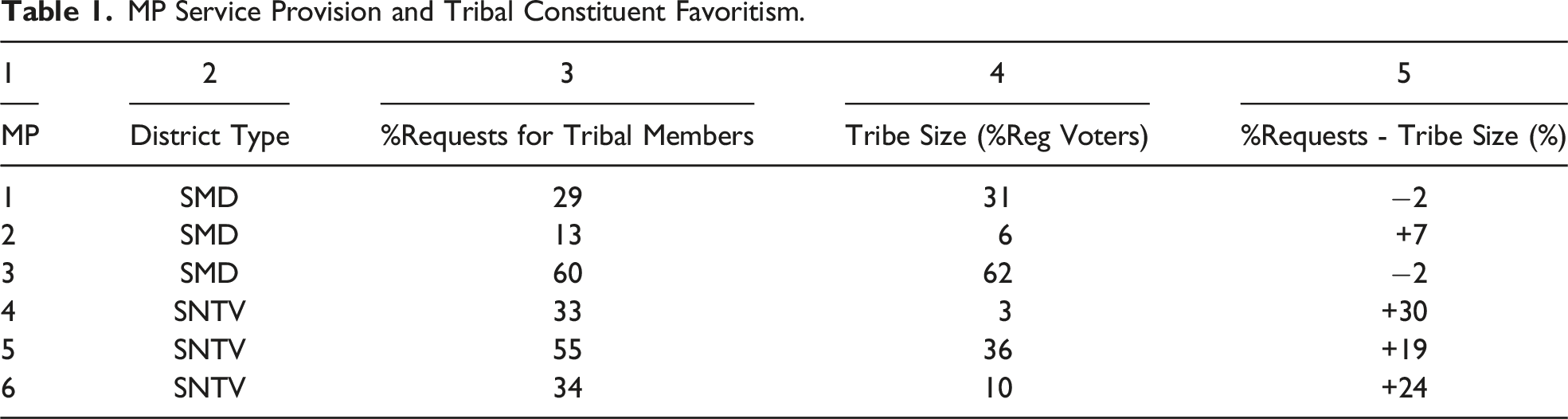
My fieldwork in Jordan suggests that nearly every MP has either physical or electronic records of these constituent service letters. The dataset I collected comprises more than 3000 requests from six MPs on topics ranging from getting a son a job to connecting electricity to a home to freeing a tribal member from jail. 9 Three of these MPs were elected in SMDs and three in SNTV districts. All six allowed me free access to the folders in their file cabinets or computer so that openness in record sharing should not be biased. These data provide a rare firsthand glimpse into the clientelistic interactions between parliamentarians and their constituents. The overwhelming majority of requests in the dataset were for employment and for outright financial aid. 10
To find evidence of in-group favoritism in MP service provision, it is necessary to estimate the size of the MP’s tribe within the district. Last names offer a pretty accurate estimation of tribal origins in Jordan, once one breaks down the tribe (al-qabila) into its various segments including al-batan, al-fakhth, al-‘ashirah, al-khams receding in size down to the nuclear family (al-usra or al-‘a’ila). I gathered information on the structures of the MPs’ tribal groups from the tribal sheikhs and other reliable sources within each MP’s electoral district. In order to construct the most accurate family tree for each tribe, I cross-referenced this information with scholarly texts (Al Rawabdeh, 2010; Al Azizi, 2001) and then had local sources verify the accuracy of the finalized tribal tree. 11 Sizes of the MPs’ tribes within the electoral district were estimated by counting how many registered voters are in each family that make up the MP’s tribe 12 and figuring out what proportion of the potential electorate they make up. I then calculate the proportion of all the requests the MP made to the government that were on behalf of members within his tribe and his clan. Using these figures, I check whether a disproportionately high amount of services are requested for the MP’s tribal members in comparison to the proportion of voters his tribe has registered within the district.
Since I was limited to gathering data from MPs who were willing to provide me with their casework logs, this sample cannot be said to be representative of all MPs in the country. There may exist non-random selection bias between MPs who are willing to share such data and those who are not. It may be that these MPs provide more services to their constituents than others, which could explain why they were willing to share their files. Yet, this should not bias the main purpose of this analysis: whether MPs favored their tribes. I had open access to the files once they were offered, so MPs did not have time to alter them once they agreed to share them. There is no reason to believe that the sample is unrepresentative, even though it is a small sample. 13 Importantly, these data provide rare fine-grained insights into clientelistic service provision.
MP Service Provision and Tribal Constituent Favoritism.
Tribal Voting in Jordan.
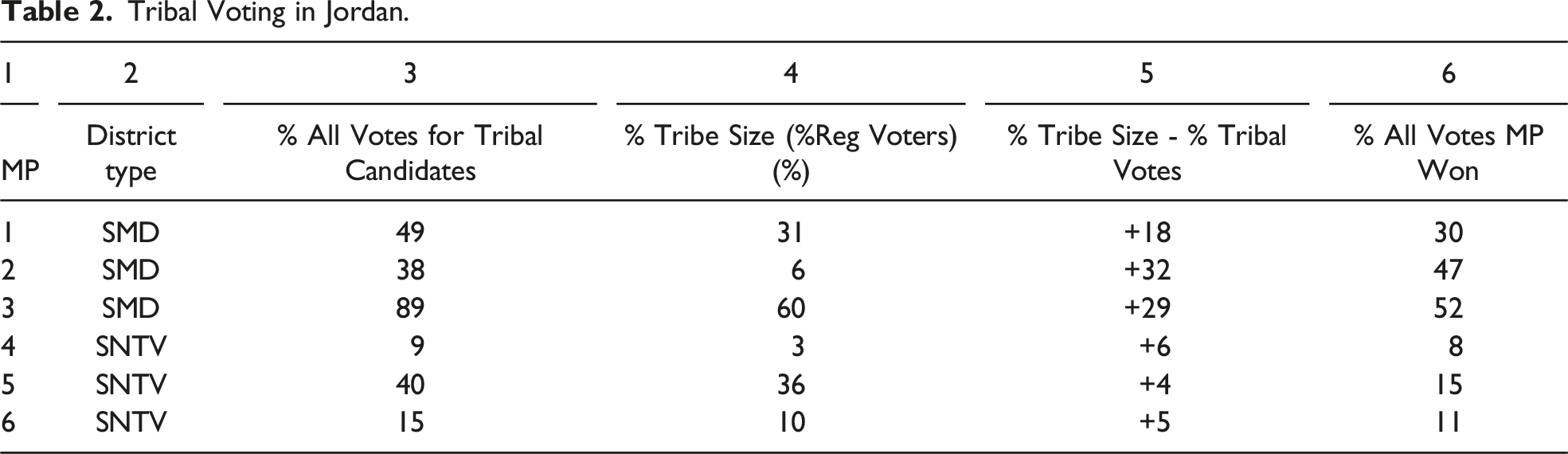
Column 6 of Table 2 shows that all candidates won a higher share of the district’s popular vote than their tribe’s share of registered voters. This indicates that members of other tribes must have voted for them. Importantly, SMD MPs were able to create inter-tribal alliances and convince out-group members to vote for them to a much higher extent than MPs elected in SNTV districts. MP 2 won almost 10,000 votes more than the number of registered voters belonging to his tribe in the district. To sum up, SMD MPs constructed more diverse voting coalitions than SNTV MPs, who appear to rely almost exclusively on a tribal political base for votes.
Taking this analysis further, we can compare the last columns of both tables. The last column in Table 2 provides a measure of the size of the MP’s electoral coalition, while the last column in Table 1 shows how much in-group favoritism occurred in service provision. MPs who won their seats in SMDs not only won them with a much larger voting coalition than the other candidates (double the percentage or higher) but they also tended to provide services to their tribal constituents at proportions that are less than or almost equal to their tribe’s share of the registered voters in the district. In other words, they did not practice out-group discrimination. Likewise, tribal voting occurs at lower rates in SMDs compared with the SNTV districts. The MPs who ran under SNTV rules (MPs 4, 5, and 6) won their seats with much lower percentages of the total votes cast in their districts and grossly favored their tribal members over other constituents in the district when providing personal services.
Electoral Institutions, Tribalism, and Voter Turnout
One might question: do these findings extend to electoral behavior on a national level? In this section, I analyze data from a survey the GLD Jordan survey (Lust et al., 2014) that included a stratified sample of 12 electoral districts across the country to empirically test another observable implication of this theory. Having a history of a tribal connection in the parliament should drive up turnout in SNTV districts, whereas not having such a connection should depress turnout. On the contrary, having a tribal member in parliament should not determine turnout in SMDs, where a social identity linkage with an MP is less important for service provision.
To examine who turns out in Jordanian elections, I run multivariate regression analysis on the following question: did you participate in the last parliamentary elections? Given the dichotomous nature of the dependent variable, I employ logistic regression to estimate the extent to which registration to vote in an SNTV district versus an SMD district predicts voter participation. 14
The two primary independent variables the theory I lay out above focuses on most in this analysis are 1) the type of electoral district the respondent is registered to vote in; and 2) whether the respondent has a tribal MP. The first variable was coded at the beginning of the survey once the person responded which electoral district he or she is registered to vote in. The second variable is derived from a question asking the respondent if he or she has ever had a tribal MP. From the data I presented above on tribal censuses in SNTV districts, we should expect the interaction between a respondent having a tribal MP and being registered in an SNTV district to predict a higher likelihood of turnout compared to a respondent being registered in an SNTV district who is without a tribal connection to the state. On the contrary, a tribal source of wasta in the parliament (or lack thereof) should not determine turnout for voters registered in SMDs because benefits are not distributed through exclusively tribal channels.
In addition to these two independent variables of interest, I control for other variables that are believed to be associated with turnout in Jordan to rule out alternative explanations for the findings including support for the regime’s main opposition (Islamists), marginalization in politics due to being of Palestinian origin, and standard demographic controls for age, educational attainment, gender, and socio-economic status included in any standard analysis of survey-based data. A control for a possible confounder of the coordination mechanism that encourages strategic voting is also taken into consideration: number of voters per representative. It should be more difficult to coordinate and organize collective behavior when there are more people involved. To conserve space, I present only the results of the interaction between a respondent having had a tribal MP in the past and the type of district that respondent is registered in affect her likelihood of turning out in the elections. (Please see the Appendix for more information on the outcomes of these control variables).
Figure 1 shows the relationship between a history of a tribal MP and turnout across SNTV districts versus SMDs. Dashed lines rather than solid ones indicate that this figure is not showing a continuous relationship. Supporting the theory, I derive from the MP constituent casework logs and confirming observable implication 3, for citizens registered in SNTV districts the predicted average marginal effect of having a tribal MP on voter turnout is about 11 percentage points higher holding all other factors at their means—a substantial increase in electoral participation. Further, a respondent without a tribal MP in an SNTV district is about 15 percentage points less likely than a respondent without a tribal MP in an SMD district to turn out to vote. The interaction is significant at the p < .01 level. Average marginal effects of district type and tribal MP on turnout.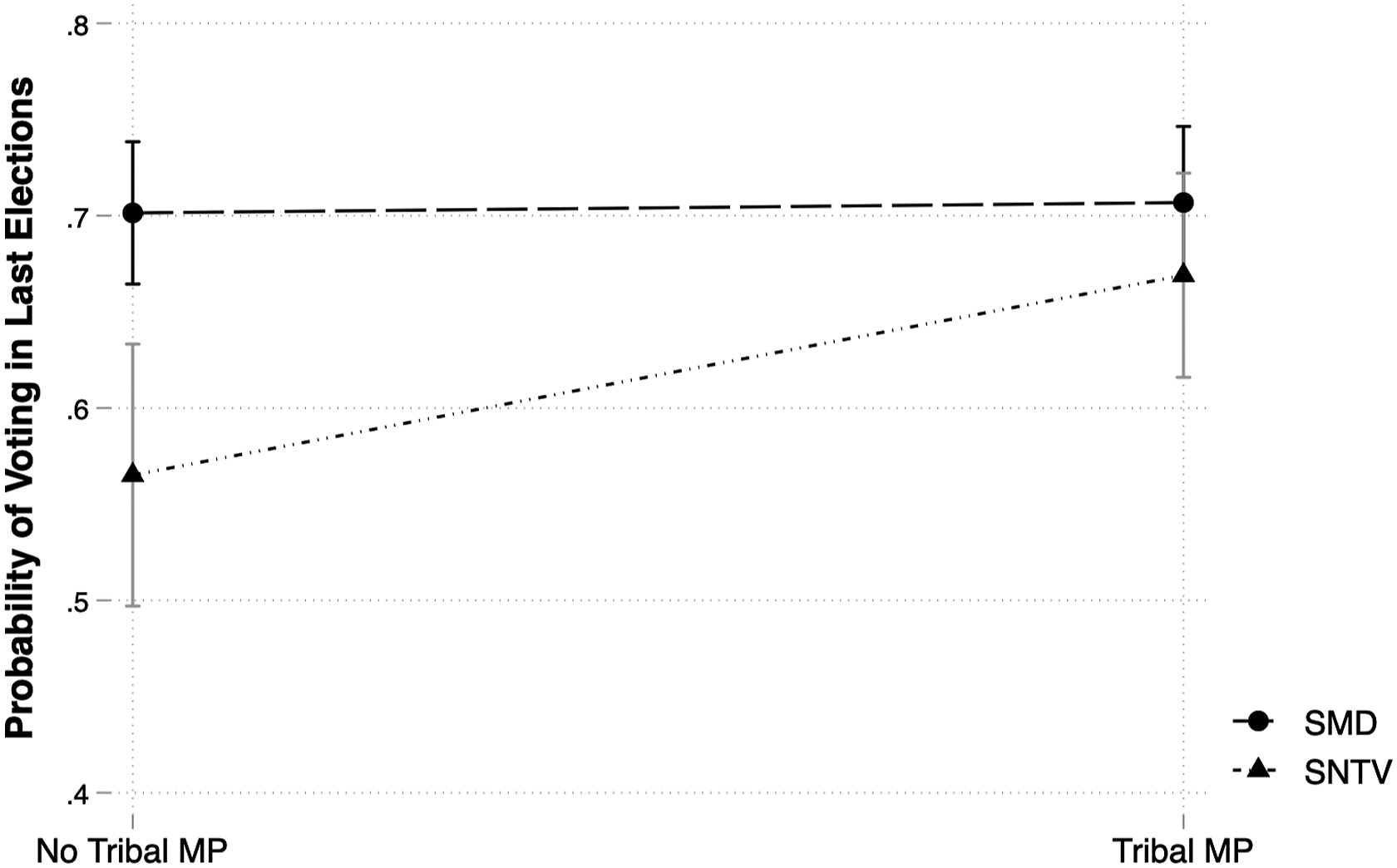
Figure 1 further illustrates how turnout converges across the two electoral systems for respondents who have tribal MPs. The difference in predicted probabilities of turnout for the point estimates on the right side of the figure is one percentage point. In line with the constituent casework data analysis above, this finding suggests that voters without a tribal MP in an SMDs district expect to gain benefits from participating in elections as much as those with ingroup representation. The effect this has on overall turnout is also notable. Overall reported turnout rates in SMDs are almost 14 percentage points higher than those in SNTV districts, on average.
Alternative Explanations
In this section, I seek to rule out alternative explanations that could confound the theory I lay out above. The theory that electoral institutions can sometimes moderate, rather than reinforce, the impact of social cleavages on clientelistic politics relies on the assumption that there are no systematic differences between SMDs versus SNTV districts that alternatively explain tendencies for electoral politics to revolve around tribal identity groups or not. I consider three major threats to the validity of this argument in this section: the distribution of district type, possible differences in degrees of tribalism or reliance on clientelism across the two types of districts, and finally, that the size of the minimum winning coalition does not explain the differential patterns of voter behavior and service provision in Jordan.
Distribution of Districts
The main independent variable driving my theory—electoral system type—was not randomly assigned to districts. Unfortunately, sensitive political decisions in Jordan are made behind closed doors. Thus, we cannot know how the regime decided where to place these new SMDs. Personal interviews with local analysts of the country’s politics indicate that the decision of where to place these new SMDs was done either at random or to favor tribes. 15 Official sources at the Ministry of Interior (MOI) and a former Speaker of Parliament, Abdul Monem Odat, insist that electoral districting is decided on the basis of three factors: geography, demographics, and development. By this, officials mean that they try to balance between the physical distance a district spans, the numbers and types of people living in the district, and the level of development the district has experienced, in order to “ensure equal representation of all the segments of the Jordanian society and... that the political scene is not monopolized by one particular group or segment.” 16 Although the favoring of tribes is not the official line, other analyses of districting in Jordan have found underdeveloped, tribal-dominated areas are grossly overrepresented in the Jordanian parliament (Hourani et al., 2004; Lust-Okar, 2006) in terms of seats-per capita. Regardless, there is no reason to believe that the regime could have assessed or would have cared about inter-tribal relationships when creating these districts. If anything, the regime would have favored areas where broad-based electoral coalitions are difficult to achieve, as fractionalized electorates are easier to control by the monarchy (Lust-Okar and Jamal, 2002; Kao, 2012, 2015).
Degree of Tribalism and Clientelism
We should be concerned about the validity of the argument if eligible voters in SMDs tend to exhibit lower tendencies towards tribalism, and therefore forging alliances that cross social cleavages is less difficult because these divides are simply not salient in the community or its politics. An array of reported political and social behaviors and perspectives related to tribalism do not vary significantly across SNTV districts and SMDs. Where there are significant differences, they indicate that respondents in SMDs exhibit higher degrees of tribalism than their counterparts in SNTVs, which should be expected to discourage inter-tribal cooperation.
Tribalism can be measured in numerous different ways. I divide measures into social tribalism versus political tribalism. Social tribalism measures included: reported membership in a tribe; preference for tribal law versus state law; whether one should worry about cheated when dealing with non-tribal members; attendance at tribal ceremonies or events once a month or more frequently; agreement that tribes are influential in economic, social, and political issues in the area; and reliance on tribal funds to pay for a funeral or other family need in the past. Political tribalism measures comprised of questions abouton: importance of whether one’s tribe supports a parliamentary candidate for their vote; having participated in a tribal primary election; and psycho-social benefits of having a tribal MP including increased societal respect for and status of the tribe.
Tribalism and Services Across District Type.
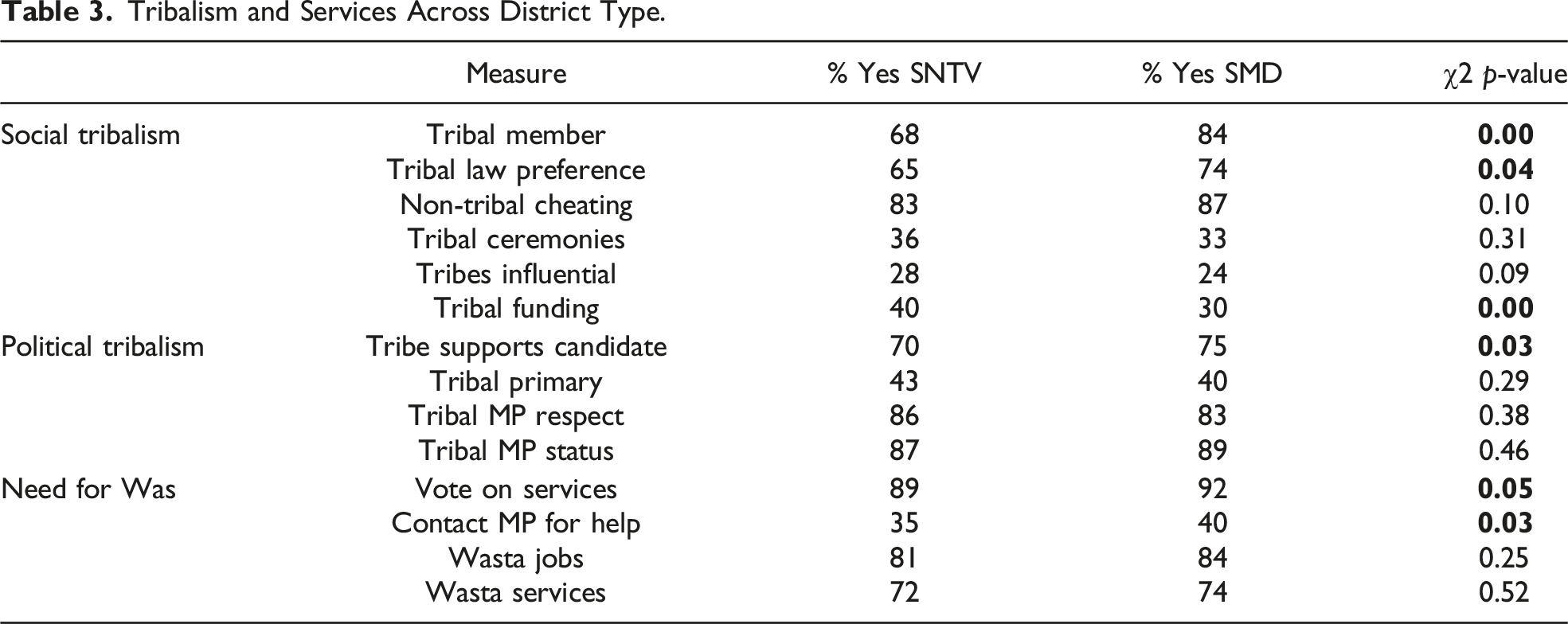
Respondents are significantly more likely to report tribal membership (a notable 16-point difference), preference for tribal law, considering their tribe’s support for a parliamentary candidate when casting a ballot, and to vote on service provision records in SMDs. The last two of these measures support the notion that tribes still matter in SMDs, but that brokers (in the form of tribal leaders) are coordinating their voters to ensure access to services even from outgroup representatives. The only tribalism measure that is significantly higher for respondents in SNTV districts is reported reliance on a tribal fund in the past (a 10-point difference). On all other measures, the analysis did not find significant differences based on electoral institutions governing the district.
One might also be concerned that voters in SNTV districts are simply more reliant on wasta and particularistic benefits than those in SMDs, which would explain a greater tendency towards instrumental identity voting. Table 3 also considers whether perceived need for wasta to obtain services or jobs is balanced across the two districts. Voters in SMDs were more likely to consider service provision to the area when casting a ballot and to contact their MPs for help. Perceived need for wasta to obtain jobs or services from the public sector did not differ significantly between the two types of districts.
The argument proposed here is not that the daily life in SMDs in Jordan is less tribal because as the statistics in Table 3 indicate, it certainly is not. The Table indicates that degrees of tribalism, organizational capacity of tribes during elections, and importance of connections for service provision either does not vary strongly across district type or, if anything, is more important in SMDs. These findings suggest there should be a bias against my findings that there are more tribally based voting and tribal favoritism in service provision in SNTV districts compared to SMDs.
Size of the Minimum Winning Electoral Coalition
Seminal works on identity voting tend to include the condition that for social cleavages to be salient in elections, they must split the population into groups that are large enough to win office. Posner (2004) proposes that “the political salience of a cultural cleavage will depend on the sizes of the groups that it defines relative to the size of the arena in which political competition is taking place” (Posner, 2004, 529). Similarly, Chandra (2004, 2) argues that for a social identity-based party to succeed, the social identity group it seeks to mobilize must be large enough to exceed the “the threshold of winning or leverage imposed by the electoral system.” Could it be that tribes match the size of the minimum winning coalition (MWC) in SNTV districts, but do not in SMDs?
Although I am unable to completely rule out this explanation, there is evidence to suggest that the size of MWCs does not fully explain variation in the politicization of social identity in Jordan. The size of the electoral coalition needed to win a seat in parliament did not differ considerably between SMDs and SNTV districts in 2013, the election year for which the majority of the empirical data of this study is derived from. The difference in average winning coalition in that year was just 275 voters. Moreover, Table 2 indicates that tribal size is not clearly associated with tribal voting. In two of the SMDs, a single tribe is large enough to win the seat based solely on tribal voting, and yet candidates still courted outgroup voters. Tribes in SMDs learn that attempts to win a seat solely on their MWCs are likely to encourage strategic voting among other, smaller tribes within their districts and might risk their loss of the seat if others are able to gather enough votes to defeat them. (See Appendix Section 3 for evidence from an in-depth case study of this process occuring in reality.) Therefore, it is necessary that the size of a social identity group must be larger than the MWC required by a system for social identity voting; but having an MWC is not sufficient to ensure identity voting. Social identity voting also takes coordination, which electoral system design greatly impacts.
Analysis of the survey provides further compelling evidence that electoral system type drives differential voting behavior. In the 2013 elections, the Jordanian government decided to allow voters to cast a second vote in a proportional representation (PR) national list system to elect 10% of the parliament. This mixed-system allows us to examine the counterfactual: whether the same voters can coordinate their behavior better under different electoral rules. The post-elections survey asked voters whether their votes were cast for successful candidates across these two systems and also allows for identification of whether the respondent’s local district is SNTV or SMD. The survey results reveal that voters residing in SNTV districts were more likely than those in SMDs to “waste” their vote on a losing candidate. The difference is about 8 percentage points and is statistically significant at the p < .01 level. Yet, wasted votes did not differ significantly for voters living in SNTV districts versus SMDs according to their reported voting behavior in the national PR list system. This single national district with PR rules encouraged strategic voting, even among those living in SNTV districts.
Concluding Remarks
Using SMDs as a foil to SNTVs, this article demonstrates how social identity has differential effects on the political behavior of voters, parliamentary candidates, and social identity groups in different institutional settings. The evidence suggests that under SNTV rules, strategic voting for a consensus candidate diminishes while sincere voting on the basis of social identity increases. By contrast, the use of single member plurality rules encourages the abandonment of weaker candidates for those with support among voters from more diverse backgrounds. Thus, this research provides empirical evidence of Ordeshook and Shvetsova (1994, 122)’s argument that “if the effective number of ethnic groups is large, political systems become especially sensitive to district magnitude. But ... if district magnitude equals one, then the party system is relatively ‘impervious’ to ethnic and linguistic heterogeneity.”
More broadly, this research suggests that in divided societies, the choice is not only between this social identity or that one (Posner, 2004) but also whether or not to make electoral coalitions that cross social cleavages. Inter-tribal political coalitions exist in one type of electoral system in Jordan but not the other, suggesting an important relationship between electoral institutional design and variations in the types of connections that link patrons and clients which is understudied or even argued against Kitschelt and Wilkinson (2007). This study joins the call for a deeper and more empirical understanding of the importance of the interaction between social context and electoral institutions (Ferree et al., 2014; Moser and Scheiner, 2012). Further, it complements seminal works arguing that some electoral institutions should diminish social identity divisions in elections better than others (Cox, 1997; Horowitz, 1985; Ordeshook and Shvetsova, 1994), bringing these works into conversation with one another.
The findings are also substantively important. Research shows that both clientelism and the politicization of social identity are detrimental to society and in particular, to democracy. Identity based clientelism is particularly pernicious because it entrenches inequalities between those born into the “winning” identity group and those who are not. Studies find that social diversity—and implicitly identity based clientelism—is associated with weak economies, underdevelopment, poor governance, and conflict or violence (Hicken, 2011).
By linking trends at the ballot box with service provision spanning years after the last ballot has been cast, this research suggests that the type of clientelistic relationship established during elections—tribally or cross-tribally defined—holds over the long term. A tragic implication of this finding is that constituents who are not born into the right tribe lack a government representative and suffer inequality in access to government resources for years after the elections. The article provides strong evidence that the use of the SNTV system in Jordan resulted in an electorate fractured along tribal lines and in-group favoritism among elected representatives. These findings are particularly relevant for other cases like Afghanistan (adopted in 2005), Kuwait (adopted in 2012), and Iraq (adopted in 2019), which currently employ the SNTV system to elect their parliaments in contexts characterized by salient social cleavages with similar outcomes as those in Jordan. Thus, this article provides insights for other developing democracies and non-democracies where social identity is highly fractionalized and salient.
Finally, this research demonstrates the complexity surrounding the challenge of structuring electoral institutions that discourage both social strife and clientelism in elections, which is unlikely to be solved by a single universal policy prescription. Unfortunately, one case is simply not enough to provide firm grounding upon which to make broader theoretical claims. Much further study is needed to sort out the various interdependencies between electoral rules, social diversity, and clientelism. Such relationships are not often examined from both top-down and bottom-up perspectives at the same time. Within this research agenda, attention should be paid both to the formal institutions governing elections from above as well as the shapes and structures of social identity groups on the ground to understand how interactions between the two shape service provision. The data presented here is novel in filling this gap.
Supplemental Material
Supplemental Material - Electoral Institutions and Identity Based Clientelism in Jordan
Supplemental Material for Electoral Institutions and Identity Based Clientelism in Jordan by Kristen Kao in Political Research Quarterly
Footnotes
Acknowledgements
I gratefully acknowledge the National Science Foundation, the American Center of Oriental Research, the UCLA Political Science Department, the Program on Governance and Local Development Program, and the National Security Education Program for funding various aspects of this research project. For helpful comments and guidance, I would like to thank Ellen Lust, Barbara Geddes, Daniel Corstange, Mark Tessler, Melanie Cammett, Karen Ferree, Kyle Marquardt, Adam Harris, and Anna Luherman. I am indebted to Eleanor Gao, who was kind enough to share her tribal coding data with me, to Tony Sabbagh for his wisdom on survey methods in Jordan, and Walid Al Khatib at the Center for Strategic Studies in Jordan. And finally, credit is due to my many, varied research assistants including Mu’ath Qawabeah and Randa Ruhi Nadimi for data collection and coding, and Iman Abu Zueiter for editing.
Declaration of Conflicting Interests
The author(s) declared no potential conflicts of interest with respect to the research, authorship, and/or publication of this article.
Funding
The author(s) disclosed receipt of the following financial support for the research, authorship, and/or publication of this article: This work was supported by the University of California, Los Angeles, American Center of Oriental Research, National Science Foundation (grant no. 1122843), the Boren National Security Education Program, and the Program on Governance and Local Development.

Supplemental Material
Supplemental material for this article is available online. Kao, Kristen, 2022, “Replication Data for: Electoral Institutions and Identity Based Clientelism in Jordan”, https://doi.org/10.7910/DVN/S0YNI0, Harvard Dataverse
Notes
References
Supplementary Material
Please find the following supplemental material available below.
For Open Access articles published under a Creative Commons License, all supplemental material carries the same license as the article it is associated with.
For non-Open Access articles published, all supplemental material carries a non-exclusive license, and permission requests for re-use of supplemental material or any part of supplemental material shall be sent directly to the copyright owner as specified in the copyright notice associated with the article.
