




Abstract
Concern about antisemitism in the U.S. has grown following recent rises in deadly assaults, vandalism, and harassment. Public accounts of antisemitism have focused on both the ideological right and left, suggesting a “horseshoe theory” in which the far left and the far right hold a common set of anti-Jewish prejudicial attitudes that distinguish them from the ideological center. However, there is little quantitative research evaluating left-wing versus right-wing antisemitism. We conduct several experiments on an original survey of 3500 U.S. adults, including an oversample of young adults. We oversampled young adults because unlike other forms of prejudice that are more common among older people, antisemitism is theorized to be more common among younger people. Contrary to the expectation of horseshoe theory, the data show the epicenter of antisemitic attitudes is young adults on the far right.
Introduction
Antisemitism has become a growing concern in the United States. Antisemitic hate crimes are frequent (Feinberg 2020). Perceived concerns about the seriousness of antisemitism are high (Smith and Schapiro 2019). According to a 2020 poll, 62% of Americans and 88% of Jewish Americans consider antisemitism a problem. Over 80% of Jewish identifiers agreed in 2020 that antisemitism had increased over the previous 5 years. 1
The relationship between ideology and antisemitism—whether the prejudice exists primarily on the political left or right, or both—has long been debated. 2 Recent public-facing accounts continue to examine both the right and the left as hotspots for antisemitism (Weiss 2019; Lipstadt 2019).
Right-wing antisemitism in the U.S. has driven incidents like synagogue shootings in 2018 and 2019. White nationalists were seen in Charlottesville in 2017 chanting “Jews will not replace us,” and in the 2021 siege on the Capitol they were seen with pro-Holocaust paraphernalia. 3 Violent right-wing antisemitism has also been resurgent in Europe. 4 Violent antisemitic attacks have also come from the ideological left. For instance, during a period of warfare between Israel and Palestine in the spring of 2021, pro-Palestinian activists in the U.S. violently attacked Jewish American diners and pedestrians in Los Angeles and New York, shouting messages including “Fuck Jews.” 5
Recent incidents of violent antisemitism could be unrepresentative of views in the broader public, but they could also be extreme manifestations of attitudes commonly held among those on ideological extremes. The recent prevalence of non-violent antisemitism from the ends of the ideological spectrum may suggest the latter. On the right, there are many reports of antisemitic harassment of journalists. 6 On the left, there are reports that extreme negative views toward Israel are socially acceptable guises for antisemitic attitudes (Marcus 2007; Cohen et al. 2011, 2009). Democratic President Joe Biden himself, when he was his party’s nominee for President in 2020, claimed, “Criticism of Israel’s policy is not anti-Semitism, but too often that criticism from the left morphs into anti-Semitism.” 7 Anti-Israel activism on college campuses has been the focus of several accounts of left-wing antisemitism (Marcus 2007). Donald Trump issued an executive order in 2019 to combat antisemitism and drew particular attention to antisemitism on college campuses, presumably driven by students and faculty on the left. 8
Accounts of antisemitism on the left and the right have led scholars to ask about the shared and distinctive roots of this form of prejudice across the ideological spectrum (Lipstadt 2019). Do the left and right converge on an “antipathy based on a faulty and inflexible generalization,” as Allport (1979) defined prejudice? In popular writing, commentators debate the “horseshoe theory” notion that the far left and far right both have an intense dislike of the capitalist status quo, leading to shared fascistic attitudes including out-group hatred toward Jews. By this theory, antisemitism emerges on the ideological poles but not in the ideological center. 9
Despite anecdotal evidence and pop theories, there is little quantitative evidence, especially in the U.S., on the relationship between ideology and antisemitic attitudes. In a UK study, Staetsky (2020) finds higher rates of antisemitic views among British respondents who identify as far right. In Europe, Cohen (2018b) finds lower support for Jewish immigration on the right than on the center or left. But no such studies have measured anti-Jewish prejudice across the ideological spectrum on a representative sample of U.S. adults.
In the fall of 2020, we conducted an original survey of 3500 U.S. adults, including a representative oversample of 2500 adults ages 18–30. Following research on racial prejudice that investigates overt attitudes as well as subtler forms of antipathy (Huddy and Feldman 2009), we examine both overt and subtle antisemitic attitudes.
The survey focuses on young adults because on both the left and the right, we expected young adults to have distinctly negative views of Jews. Many of the allegations of left-wing antisemitism have focused on young people for whom anti-Israel attitudes are suspected of being tied to antisemitic attitudes. Likewise, many of the allegations of right-wing antisemitism focus on the alt-right, an identity associated with young white men. 10 As we will confirm—and consistent with past work—antisemitism is an unusual form of prejudice in the United States in that it is more common among young adults than older adults.
While we find evidence consistent with theories of both left-wing and right-wing antisemitism, the results show that antisemitic attitudes are far more prevalent on the right, particularly on the young far right. Along with providing new discoveries about antisemitism and its relative force on the political left and the political right, this study also offers a contribution to political science literature through quantitative evidence of an out-group prejudice that has both commonalities and differences compared to other, more frequently studied, forms of prejudice.
Antisemitism on the Left and Right
Past survey research in the U.S. has not focused primarily on differences in antisemitic attitudes along a left-right ideological spectrum. Negative affect toward Jews (measured by thermometer scales) has previously been found to be about as common among Republican identifiers as Democratic ones (Cohen 2018a). 11 Prior survey research focuses mostly on demographic groups rather than ideological groups that exhibit high rates of antisemitism. The research has pointed to higher rates of antisemitism among young people, old people, Black and Latino identifiers, and non-college educated Americans, as well as those who live in close proximity to Jewish populations (Smith and Schapiro 2019; Cohen 2018a; Feinberg 2020).
The ideological left and right in the United States are associated with different policy preferences and different social cohorts. But scholars such as historian Deborah Lipstadt (2019) suggest a commonality between them in attitudes toward Jews. The left and the right, she argues, “rely on the same stereotypical elements....something to do with money, something to do with finance, that Jews will do anything and everything, irrespective of who it harms or displaces or burdens.” 12 These attitudes towards Jews are theorized to come from the far left’s and the far right’s shared appetite for populism, making them more skeptical of power and ruling elites than those in the ideological center. Extremists on both sides may see Jews as an out-group because of a perception of Jews as wielding power and upholding unjust capitalistic power structures (Nirenberg 2013). In the framework of social identity theory, Jews could be perceived as an out-group on both the left and right, and each extremist group would focus on negative aspects of this shared out-group in order to raise their group esteem (Tajfel et al. 1971; Mason 2018; Klar, Krupnikov and Ryan 2018).
The Right
Right-wing antisemitism and left-wing antisemitism are not identical. In the far-right mentality, Jews are viewed as people pretending to be white—“a faux-white race that has tainted America” 13 —or disloyal white people—“the ultimate betrayers of the white race” (Weiss, 2019, 68). American Jews are distinctive in that they are high in socioeconomic status and mostly identify as white, but unlike others with those attributes, they are liberal in their social views and supportive of racial equality and immigration (Smith and Schapiro 2019; Smith 2013). Prior work has argued that American Jewish liberalism is not a coincidence, but in fact a political manifestation of Jewish identity—the distinct history of Jewish oppression may have led to prioritizing equality and support for marginalized groups (Forman 1998; Brodkin 1998). Conservatives might feel negatively towards Jews if they perceive Jewish religious values to be in direct conflict with their preferred conservative policy stances.
Antisemitism has also been theorized to be rooted in status threat and competition for being seen as a victim (Antoniou, Dinas and Kosmidis 2020). Status threat has been one explanation for the turn to Donald Trump’s brand of politics, particularly for lower-SES white voters (Mutz 2018). These voters may direct negative attitudes about immigration, diversity, and globalization toward the scapegoating of Jews, who they perceive as disloyal whites and supporters of globalization and diversity (Weiss 2019; Lipstadt 2019).
Right-wing antisemitism may also be religious in nature. Christian orthodoxy has led some American Christians to become religiously hostile towards Jews (Glock and Stark 1966; Quinley and Glock 1979). Beliefs such as that Jews are responsible for the death of Jesus can spill into secular hostility. Given that strongly identified Christians (particularly White Christians) are overwhelmingly Republican, it may be that antisemitism on the right actually derives from this type of Christian religious antisemitism. 14
The Left
Research on left-wing antisemitism suggests some commonalities with antisemitism on the right. As mentioned, populism and anti-capitalism may trigger anti-Jewish tropes and scapegoating on the left just as on the right. The political left—typically sympathetic to oppressed minorities—may see Jews not as an oppressed religious group but instead as oppressors due to stereotypes of Jews’ involvement in capitalism or to solidarity with Palestinians in the Israel/Palestine conflict (Lerner 1992).
Prior research on left-wing antisemitism has tended to focus on the left’s changing views on Israel. Over the last 20 years there has been a partisan shift in attitudes toward Israel (Cavari 2012; Cavari and Freedman 2019). The left, and particularly the young left, no longer sympathizes with Israel in the Israel/Palestine conflict. 15 Support for Palestine and criticism of Israel has become commonplace in recent left social movements. 16
Theoretically, negative attitudes toward Israel can be unrelated to antisemitism, but prior studies have shown a relationship between the two. In a study of Europeans, Kaplan and Small (2006) asked one battery of questions about Israel/Palestine and a separate battery about Jews. Respondents who held strongly anti-Israel views (e.g., believing that Palestinian suicide bombers against Israeli civilians are justified) were also likely to hold antisemitic beliefs that are completely unrelated to the Israel/Palestine conflict (e.g., believing Jews have too much power in finance). Other studies have found a similar relationship (Beattie 2017; Smith and Schapiro 2019; Cohen et al. 2009; Shenhav-Goldberg and Kopstein 2020).
To the extent that liberals seek to identify with the oppressed over the oppressor and believe that Israel is an oppressor, they might hold negative attitudes toward Jews, who they associate with the oppressor. Just as liberals might express dislike toward evangelical Christians if they identify evangelical Christians as a group that holds a set of policy views they deem oppressive (e.g., anti-LGBTQ), liberals might similarly dislike Jews as a group for holding a set of pro-Israel views they deem to be oppressive. In the extreme, liberals may begin to hold all Jews collectively responsible for Israel.
Antisemitism may also lead to anti-Israel attitudes. Consider an analogy to research on the relationship between policy views (e.g., about affirmative action) and racism. As Federico and Sidanius (2002) write, white Americans’ opposition to affirmative action “may simply mask desire for group dominance” (see also Tesler (2012)). Research on the relationship between anti-Zionism and antisemitism considers a similar possibility: strong opposition to the Jewish state can be a socially acceptable way to express anti-Jewish attitudes (Smith and Schapiro 2019; Cohen et al. 2011).
In addition to left-wing antisemitism related to populism and anti-Zionism, there are theories of antisemitism on the left that stem from racial group conflict. Past scholarship has noted high rates of antisemitic views among racial minority groups, especially African-Americans (Smith and Schapiro 2019). Because African-Americans tend to be Democrats, antisemitism stemming from racial group conflict may appear to map onto a left-right spectrum. As an historical example, the Crown Heights riot in 1991 in New York was mainly a story of Black-Jewish conflict in a neighborhood, but it also shaped a close election between an incumbent African-American Democratic mayor, David Dinkins, and his Republican opponent, Rudy Giuliani, and was wrapped up in tough-on-crime political rhetoric (Shapiro 2002). An event that was not initially about politics was mapped onto an ideological conflict.
The theories that help explain minority-group antisemitism are sufficiently distinct from the ideology-based framework of this article that we are focusing an entire separate article on race and antisemitism (Hersh and Royden 2022). There, we address theories of geographic-based conflict, competition over “victimhood status,” Black/Hispanic religious antisemitism, anti-Jewish attitudes as a manifestation of anti-White attitudes, and minority-group affinity for Palestinians as an oppressed group. In that research, we find clear evidence that minority-group antisemitism (specifically antisemitic views among Black and Latino Americans) is a separate phenomenon from ideology-based antisemitism. For example, we find that among both self-identified liberals and self-identified conservatives, minorities are more likely than whites to hold antisemitic views. In this paper, we focus on the ideological spectrum, tabling the detailed analysis of race, but account for racial differences through multivariate regression analysis.
Focusing just on the ideological dimensions of antisemitism, the theories suggest that antisemitic attitudes stemming from populism and from discontent with the status quo, from white nationalism and from anti-Israel attitudes may emerge on both ideological extremes more so than in the ideological middle, hence the “horseshoe theory” label.
Young Adults and Antisemitism
The pathways to antisemitism may be different for young people than for older cohorts. The American left has long had a commitment to supporting the oppressed (Ellis 1996). With the increased activism on college campuses surrounding the Israel/Palestine conflict, Israel and Jews may now be viewed as oppressors by many young adults (Marcus 2007; Lipstadt 2019; Lerner 1992). This may lead young liberals to have a more negative view of Jews compared to older generations. On the other side, the young far right exhibits reactionary attitudes toward tolerance and political correctness. 17 The growth of the alt-right movement has occurred mostly online and primarily attracted young adults. The movement may induce antisemitic attitudes in young people who are particularly exposed to alt-right messages.
Young people—college students in particular—typically exhibit more tolerant and cosmopolitan attitudes than older people. This might suggest lower levels of antisemitism (Shenhav-Goldberg and Kopstein 2020; Federico and Sidanius 2002). However, unlike other prejudicial attitudes that have been found to be more common in older adults than younger adults, such as sexism and racism (Stewart, von Hippel and Radvansky 2009; Janmaat and Keating 2017), several prior studies have shown that antisemitism is actually more common among young people. Prior studies have theorized higher antisemitic attitudes in young adults may result from factors such as declining salience of the Holocaust as well as increasingly negative attitudes toward the state of Israel (Cohen 2018a; Smith and Schapiro 2019). We will pay special attention to young adults in the study, reflected in a design with a large representative oversample of 18–30 year olds.
Definitions
Definitions of antisemitism are contested. Consider a statement defining antisemitism that was developed by the International Holocaust Remembrance Alliance (IHRA) and adopted by the U.S. Department of State during the Obama Administration: antisemitism includes, among other things, “holding Jews collectively responsible for actions of the state of Israel;” “accusing Jewish citizens of being more loyal to Israel, or to the alleged priorities of Jews worldwide, than to the interests of their own nations,” “applying double standards by requiring of [Israel] a behavior not expected or demanded of any other democratic nation;” and “making mendacious, dehumanizing, demonizing, or stereotypical allegations about Jews as such or the power of Jews as collective.” 18
Some of these categories of antisemitism are associated with the political right (e.g., claims of disloyalty) while others are associated with the political left (e.g., holding Jews collectively responsible for the state of Israel). Critics on the left argue that the IHRA definition leads to inappropriately construing criticisms of Israel as antisemitic. 19 On the other hand, U.S. conservatives, unlike liberals, do not believe that accusing Jews of being more loyal to Israel than America counts as antisemitism. 20
We measure antisemitism in two main ways. First, we investigate the public’s agreement with overt claims that U.S. Jews are disloyal, have too much power, and should be penalized for the actions of Israel. These claims are considered antisemitic both under the IHRA definition as well as by Jewish organizations, such as the Anti-Defamation League. 21 In the Supplementary Information (SI), we also confirm in our own data that approximately 90% of Jewish American respondents believe the statements we study to be antisemitic.
In addition to overt claims about Jews, we also measure antisemitism through a set of experiments that gauge double standards and litmus tests, in which U.S. Jews are held accountable for the actions of Israel in ways not expected of other Americans of different faiths or with different religious/cultural homelands. Double standards are a common manifestation of prejudice, such as when racial minorities or women are held to different standards of behavior than whites or men (Foschi 2000; Teele, Kalla and Rosenbluth 2018). 22
Hypotheses
Our first set of hypotheses focuses on overt measures of antisemitism, in which respondents are asked three agree/disagree questions about their views on Jewish people:
23
1. Jews are more loyal to Israel than to America. 2. It is appropriate for opponents of Israel’s policies and actions to boycott Jewish American owned businesses in their communities. 3. Jews in the United States have too much power.
The first and third of these questions were assessed by King and Weiner (2007) and are taken from a battery developed by the Anti-Defamation League (ADL).
Hypothesis 1 is that agreement with these statements is higher on the left and right than in the political center. As noted in our planning document (SI), we expected this U-shaped relationship for the “boycott” measure and the “power” measure but not the “loyalty” measure, as we did not expect loyalty to America to be a particularly salient value on the far left in the Trump era (see Levendusky (2020)).
Hypothesis 2 relates to a priming experiment. Respondents were randomly assigned to one of two conditions. In the first condition, the three survey items above were prefaced by this statement:
In the second condition, the questions were prefaced by the same sentence, but then, on a separate webpage, respondents saw an additional sentence:
The prime emphasizes that Jewish Americans are supportive of Israel, though notice the language makes no mention of support for Israeli policy or politics. For respondents who are opposed to Israel and/or its policies, we expected this prime to emphasize that Jews are an out-group with respect to their positive affect toward the state of Israel. As such, we expected higher agreement on the three questions on the ideological left following the prime.
We designed our study with a 2500-person representative oversample of 18–30 year olds. We did so based on the expectation, taken from past research, that young adults harbor more negative attitudes toward Jews than older adults. Hypothesis 3 is that young adults will have higher levels of agreement with these statements than older adults.
Hypothesis 4 is that young adults’ support for antisemitic statements, compared to older adults, is attributable to the young ideological left and right having more agreement with these statements than the ideological center. That is, we expect more of a U-shaped, or horseshoe, relationship between ideology and antisemitism among young adults than among older adults.
Next, we test hypotheses related to litmus tests and double standards. The theoretical premise of these items is that, to some people, Jews are deemed as both powerful and as an out-group (Lipstadt 2019). Jews are associated with, seen as able to control, and therefore morally responsible for a foreign government (Israel) in ways not expected of other groups.
In the first double-standards experiment, respondents were randomly placed into one of two conditions. In order to participate in social justice activism,
Hypothesis 5 is that respondents on the political left would be more likely to agree that Jews should denounce the Jewish country than Muslims should denounce Muslim countries. We expected to find that respondents on the political right would exhibit the opposite pattern. 25
Why would the left and right have different expectations for Jews versus Muslims? It could simply be out-group dislike: anti-Muslim attitudes on the right and anti-Jewish attitudes on the left. Alternatively, it could be in-group affinity. That is, the left (right) may believe that Muslims (Jews) should not be forced to take positions because those groups are especially deserving of one’s sympathies. Another explanation is that American Jews and American Muslims are perceived by the left and the right, respectively, as having outsized moral responsibility for or political power over foreign sovereigns. Any of these explanations is consistent with out-group prejudice.
Our last hypothesis relates to a second double-standard experiment. Respondents were divided into three conditions:
The order in which respondents saw the two questions was randomized. The first question’s wording suggests that U.S. subgroups should take actions regarding foreign sovereigns. The second question’s wording suggests that U.S. subgroups are culpable for the actions of foreign sovereigns.
There is no perfect analogous relationship to the relationship between Jewish Americans and the state of Israel. India, like Israel, is a democracy, a U.S. ally, and has laws that discriminate against Muslims. 26 Indian Americans share with Jewish Americans very high income and education levels. To the extent that Jewish Americans have the socioeconomic resources to exert influence over U.S. policies, Indian Americans have similar resources. 27 The relationship is not perfectly parallel. Indian Americans are immigrants or descendants of recent immigrants from India, whereas most Jewish Americans do not have this relationship to Israel. Also, we do not know whether Indian Americans have an affinity for India to the same extent that Jewish Americans have an affinity for Israel. Nevertheless, we include this comparison because Indian Americans have socioeconomic resources and an ancestral connection to a democratic U.S. ally that has discriminatory policies against Muslims.
For another comparison, we include Catholics, for whom the Vatican provides a different kind of analogy to Israel. Though not exactly a homeland, the Vatican represents a religious-oriented sovereign. The U.S. has a history of accusing Catholics of dual loyalty to the Vatican. 28 The Catholic Church has also been the subject of a major scandal. Respondents, we reasoned, might hold U.S. Catholics responsible or culpable for the Vatican’s actions and inactions as they might hold U.S. Jews responsible for Israel’s actions and inactions.
Hypothesis 6 is that both the political left and the political right (relative to moderates) would hold Jews more responsible for Israel than they would hold Catholics or Indians responsible for the Vatican or India, under the theory that Jews are seen as especially responsible for Israel and as having outsized power. We expected a particularly large difference in the left’s treatment of Indians versus Jews. We reasoned that the left would consider Indian Americans as more of an in-group on account of Indian Americans being non-white. 29
In testing these hypotheses, we ordered the questions in the survey from those that are least overt in asking respondents about attitudes toward Jews to most overt, though we report on the analysis here in a different order. Throughout the analysis, we include control variables for the exact survey path respondents followed through various randomizations. This accounts for any average differences in responses based on respondents seeing different conditions from one another. The ordering of the questions is described in the SI.
Data
We fielded an original YouGov survey in November 2020 (Nov 9–25). For description of sample and weights, consult the SI. The study was determined exempt from IRB review by the Tufts University IRB, IRB ID: 00000710, and it conformed to all IRB standards of informed consent.
Because our interest is largely focused on the far left and far right, we utilize a 7-point measure of ideology (instead of a 3-point or 5-point measure), so that we can examine nuances on the ends of the ideological spectrum. Because we expect a non-linear relationship between ideology and measures of antisemitism, we utilize dichotomous variables for each point on the ideology scale, with the middle category (moderate) serving as the excluded category.
As an alternative measure of ideology, we asked respondents if they identify with any of the following labels: leftist, socialist, progressive, libertarian, Christian conservative, and alt-right. This list includes three identities associated with the left and three associated with the right. Respondents could check more than one.
Summary Statistics.
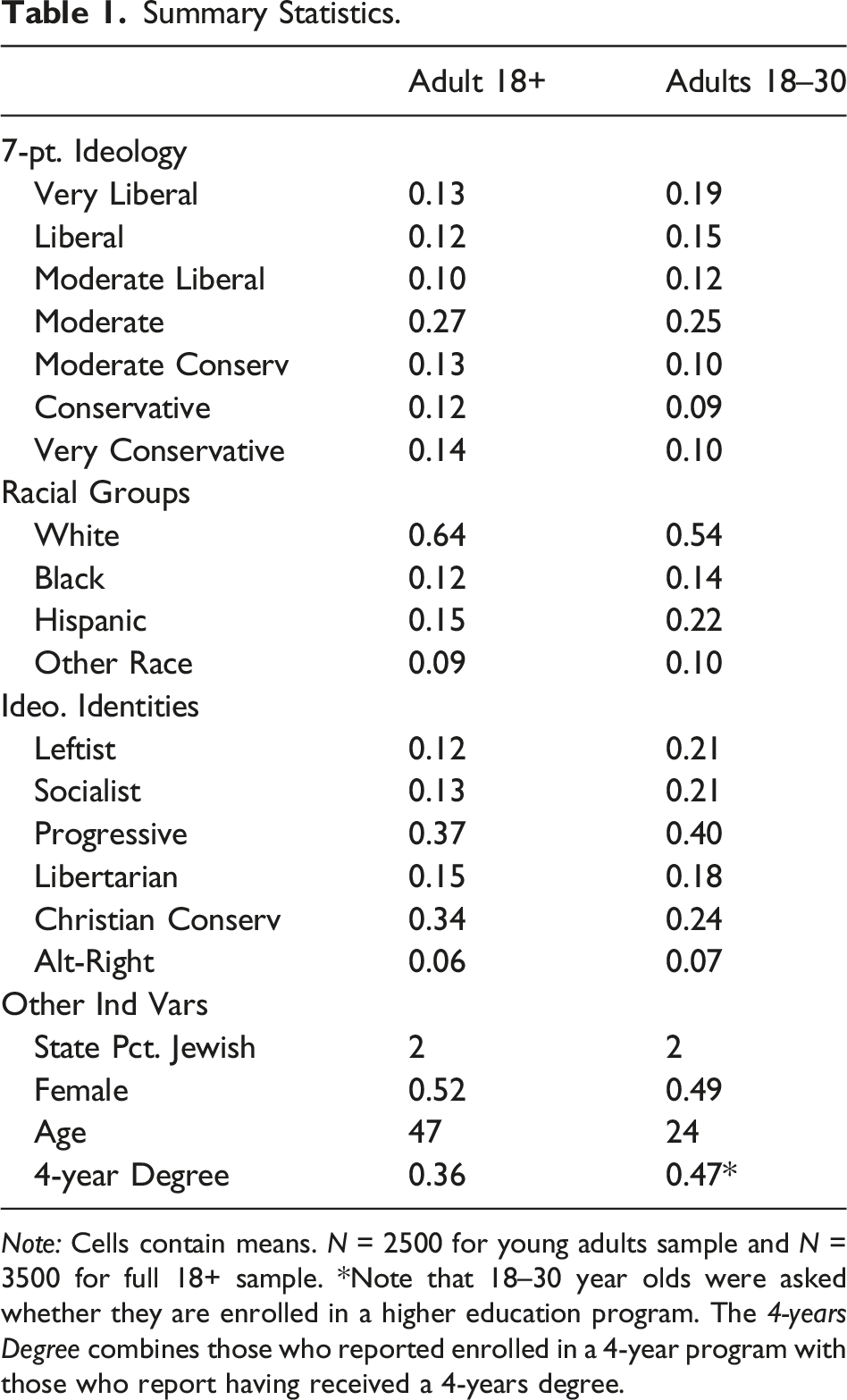
Note: Cells contain means. N = 2500 for young adults sample and N = 3500 for full 18+ sample. *Note that 18–30 year olds were asked whether they are enrolled in a higher education program. The 4-years Degree combines those who reported enrolled in a 4-year program with those who report having received a 4-years degree.
Results I: Overt Antisemitism
Hypothesis 1 is that antisemitic attitudes are common on left and right and lowest in the center. In the gray squares in Figure 1, we look at the full-adult sample in the condition in which respondents were not primed about Jewish affinity for Israel. The data are inconsistent with the hypothesis. Agreement with the statements increases from ideological left to right. On all three measures, agreement is higher (2–3 times higher) on the far right than on the far left.
30
Overt antisemitic attitudes, prime versus no prime. Note: Means with 95% confidence intervals are shown.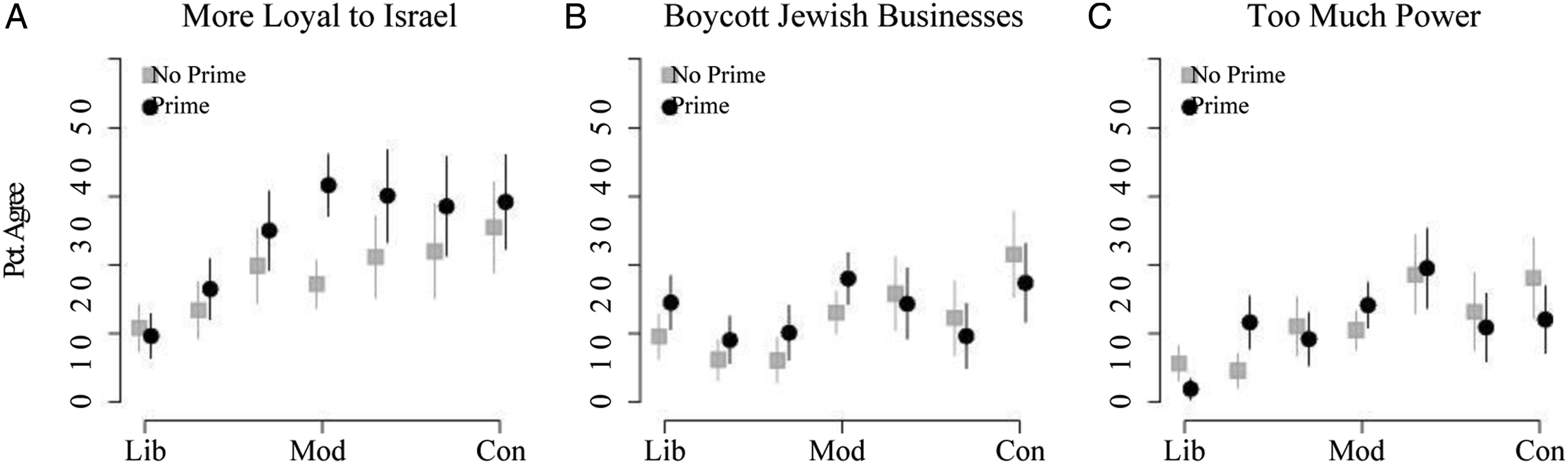
Overt Measures of Antisemitism and Ideological Position.
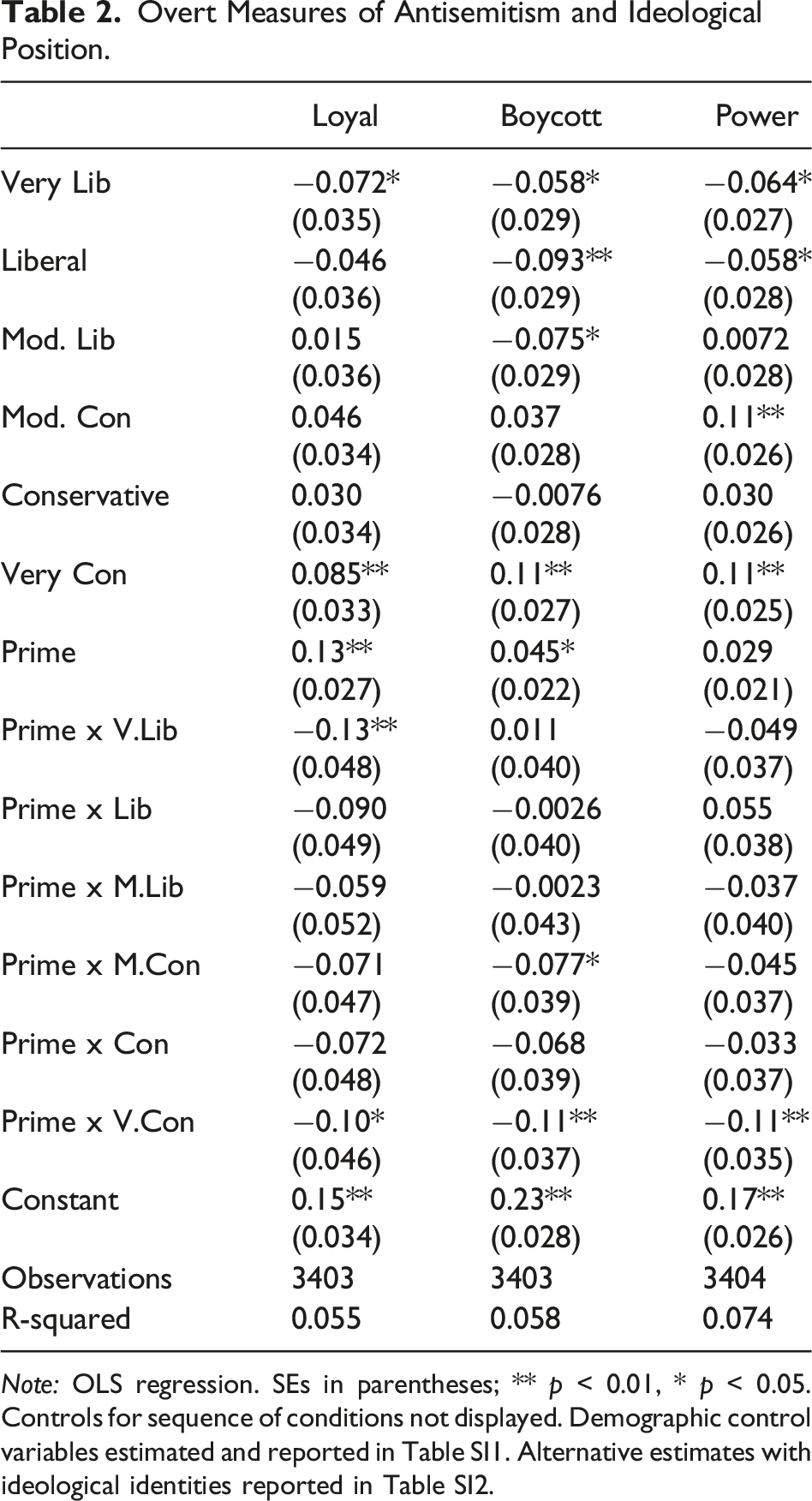
The first six rows of coefficients in Table 2 reveal the relationship between ideology and antisemitic views in the condition without the prime. On all items, the far left has lower agreement with these statements relative to moderates, and the far right has higher agreement with these statements compared to moderates. Contrary to a “horseshoe” theory, the evidence reveals increasing antisemitism moving from left to right. Table SI2 implements the seven-point ideology measure as a scale rather than a set of dummy variables. It also includes measures for extreme identities such as leftist, socialist, and alt-right. Moving from liberal to conservative is associated with higher antisemitic views; however, socialist identifiers appear to have higher agreement with the antisemitic statements than others on the left. Alt-right identifiers stand out with the highest rate of support for antisemitic statements.
Hypothesis 2 holds that priming respondents about Jewish American affinity for Israel would increase support for the antisemitic statements on the left. The black circles in Figure 1 and the remainder of Table 2 show that here, too, the data are inconsistent with the hypothesis. The prime has a modest impact on respondents. The most notable impact is that ideological moderates in the primed condition have higher support for claiming Jews are more loyal to Israel (Panel A). The prime does not affect the ideological left. Why not? One possibility is that it is common knowledge that Jews tend to have a favorable view toward Israel, and thus, the prime did not provide additional information. Moderates may be different insomuch as they may know less and care less about foreign policy related to Israel and the political attitudes of American Jews toward Israel. As such, the prime may have affected moderates more than those at the ideological poles.
Agreement with Antisemitic Statements, by Age Cohort.
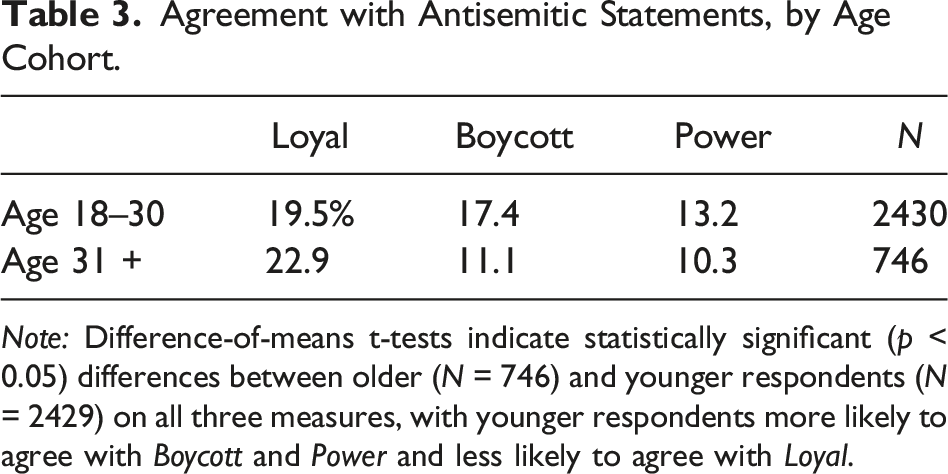
Note: Difference-of-means t-tests indicate statistically significant (p < 0.05) differences between older (N = 746) and younger respondents (N = 2429) on all three measures, with younger respondents more likely to agree with Boycott and Power and less likely to agree with Loyal.
Is the higher rate of antisemitism in 18–30 year olds attributable to higher rates of antisemitism on the young left and young right? The horseshoe effect among young people is predicted by Hypothesis 4. Figure 2 shows that the reason young adults have higher rates of agreement with the boycott and power items relative to older adults is because the young far right, not the young far left, has unusually high rates of agreement with these antisemitic statements. Overt antisemitic attitudes, prime versus no prime. Note: Means with 95% confidence intervals are shown. Graph combines prime and non-prime conditions; 2430 respondents 18–30 and 746 respondents 31 and older.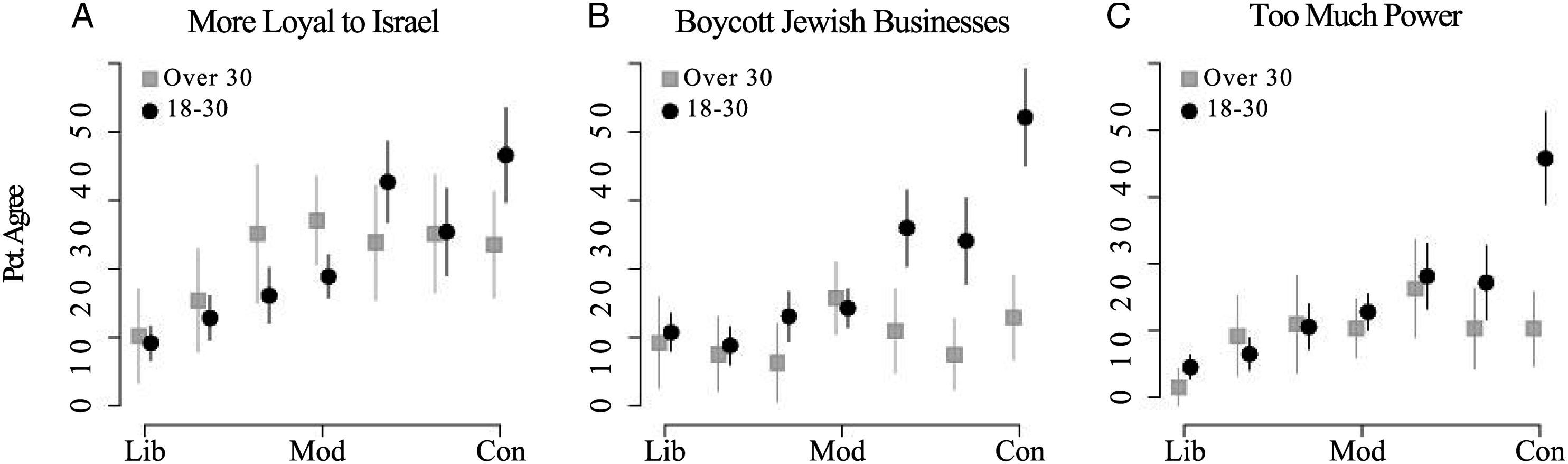
Overt Measures of Antisemitism and Ideological Position, Young Adults versus Older Adults.
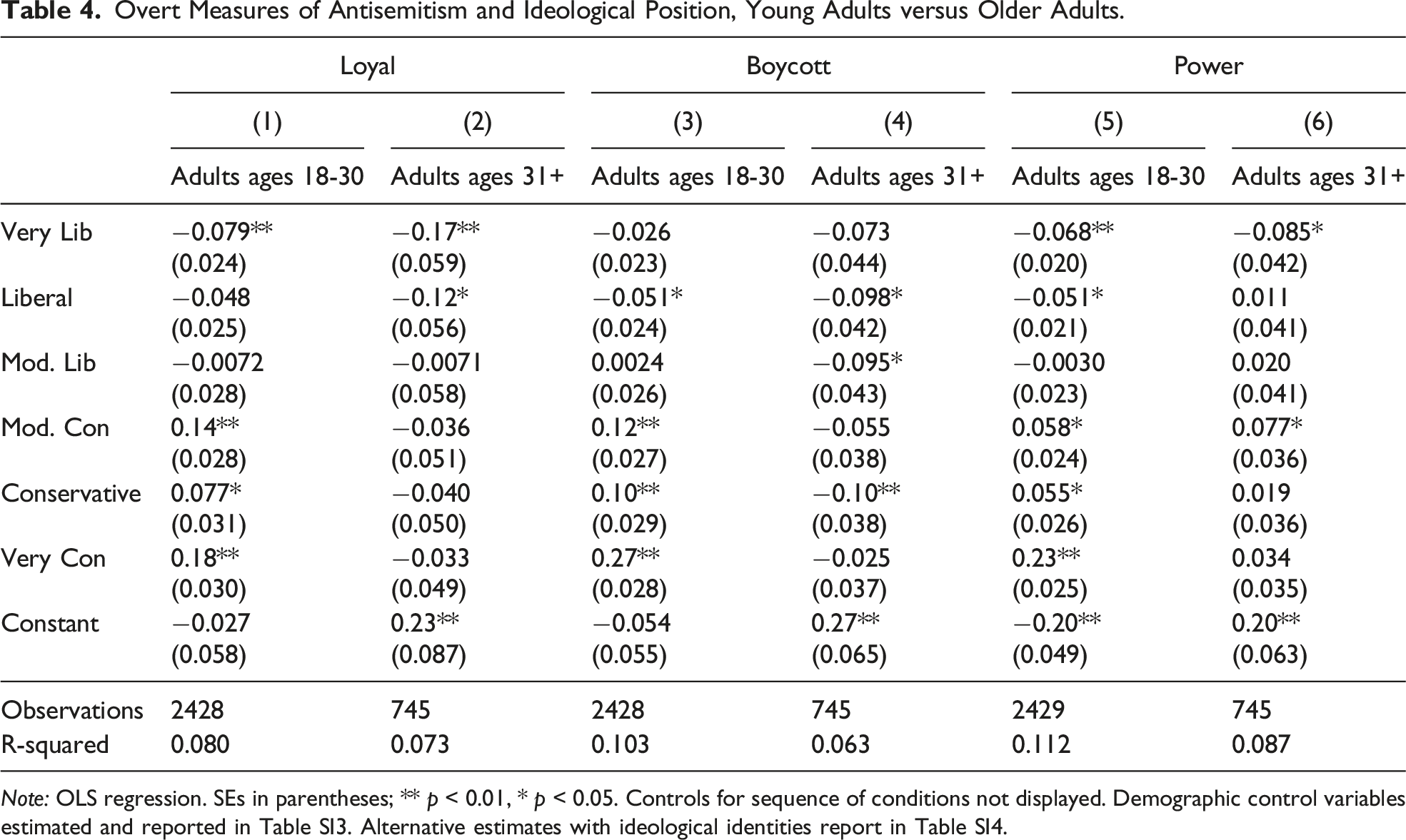
Three supplemental analyses are worth briefly mentioning. First, we run analysis restricting the sample to current 4-year college students (N = 674), because of the theory that college campus activism surrounding Israel/Palestine may yield antisemitic attitudes. We see the same pattern of lowest agreement with antisemitic statements on the left and highest agreement on the right. See Table SI5.
Second, we look at religiosity. Perhaps, the antisemitic views on the right are connected to religion given the history of theological-oriented antisemitism (Nirenberg 2013). We subset the analysis in Table 4 among those for whom religious is important and among those for whom it is not important. We also run the analysis among those who attend services at least once a month and among those who attend seldom or never. In all of these subsets, the religious and the non-religious, the far right has the highest rates of antisemitic views on these measures.
Third, we measure rates of antisemitism by party affiliation rather than by ideology. While in contemporary American politics, ideology and party are closely related, they are different with respect to this analysis, mainly on account of race. Whereas only about a third of Black and Hispanic respondents in our sample identify as liberal, 44% of Hispanics and 63% of Blacks identify as Democrats. As noted above, controlling for ideology, we find Black and Latino identifiers (especially in the young adult sample) are more likely than White identifiers to agree to antisemitic statements. When partisanship is measured rather than ideology, a greater share of minority respondents appear on the political “left,” which mutes the differences between left and right compared to the analysis of ideology.
To see this, consult Table SI6, which is a version of Table 4 in which a 7-point party identification measure is used instead of a 7-point ideology measure. On all three measures, young adults who are strong Republicans are the group most likely to agree to antisemitic statements (parallel to the “very conservatives”), but the differences between left and right are more muted when party is measured in place of ideology. An alternative way to summarize the muted effect is as follows. Among young people, 20% of liberals, 30% of independents, and 47% of conservatives agree with at least one of the three antisemitic statements. Among the same group of young people, 30% of Democrats, 28% of Independents, and 39% of Republicans agree with at least one statement. The difference between Democrats and Republicans is still substantively and statistically significant (p < 0.01), but it is less of an extreme difference compared to across ideological cohorts.
Results Part II: Double Standards
We now turn to the two survey experiments gauging double standards. The first asks about Jewish Americans and Muslim Americans denouncing foreign countries in order to participate in social justice activism. We expected to find that respondents on the political left would be more likely to agree that Jews should denounce Israel than Muslims should denounce Muslim countries. We expected to find that respondents on the political right would exhibit the opposite pattern.
Looking at Panel A of Figure 3, for all adults, we see an anti-Jewish double standard on the ideological left and a larger anti-Muslim double standard on the political right, consistent with the hypothesis. Thirty-one percent of very liberal identifiers think Muslim Americans should denounce Muslim countries, whereas 47% think that Jewish Americans should denounce Israel. On the right, it is the opposite: 27% think Jews should denounce Israel and 65% think Muslims should denounce Muslim countries. When looking at just 18–30 year olds (Panel B), the pattern for demands on Jews is different than in the full population. Specifically, relative to moderates, the young left and the young right believe Jews should denounce Israel. Unlike in the overt measures of antisemitism where prejudicial attitudes were low on the left and high on the right, in this double-standard measure, we see a U-shaped relationship (black squares, panel B) that is consistent with a horseshoe theory expectation. Denouncing Israel or Muslim countries as a litmus test for social justice activism? Note: Means with 95% confidence intervals are shown.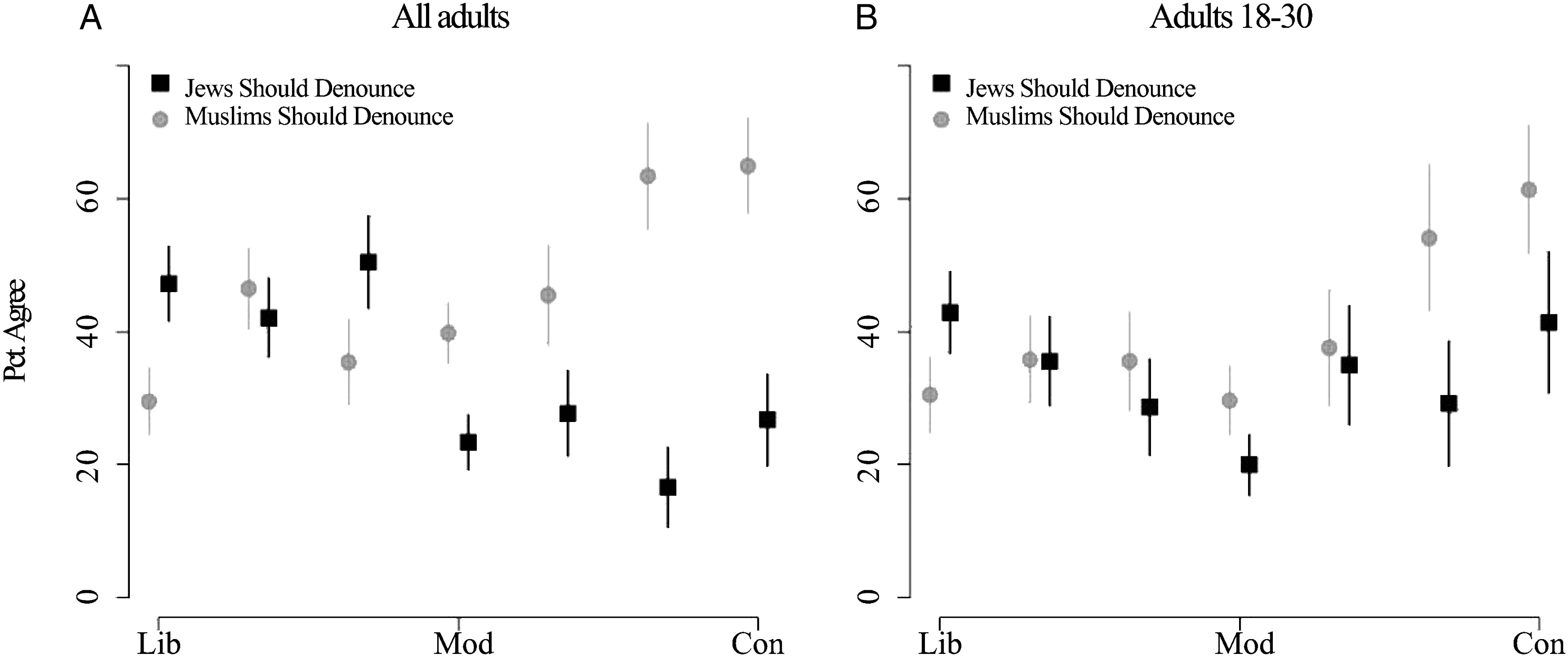
Estimates of Double Standards from Jewish/Muslim Experiment and the Catholics/Indians/Jews Should Do More to Make Countries Responsible Experiment.
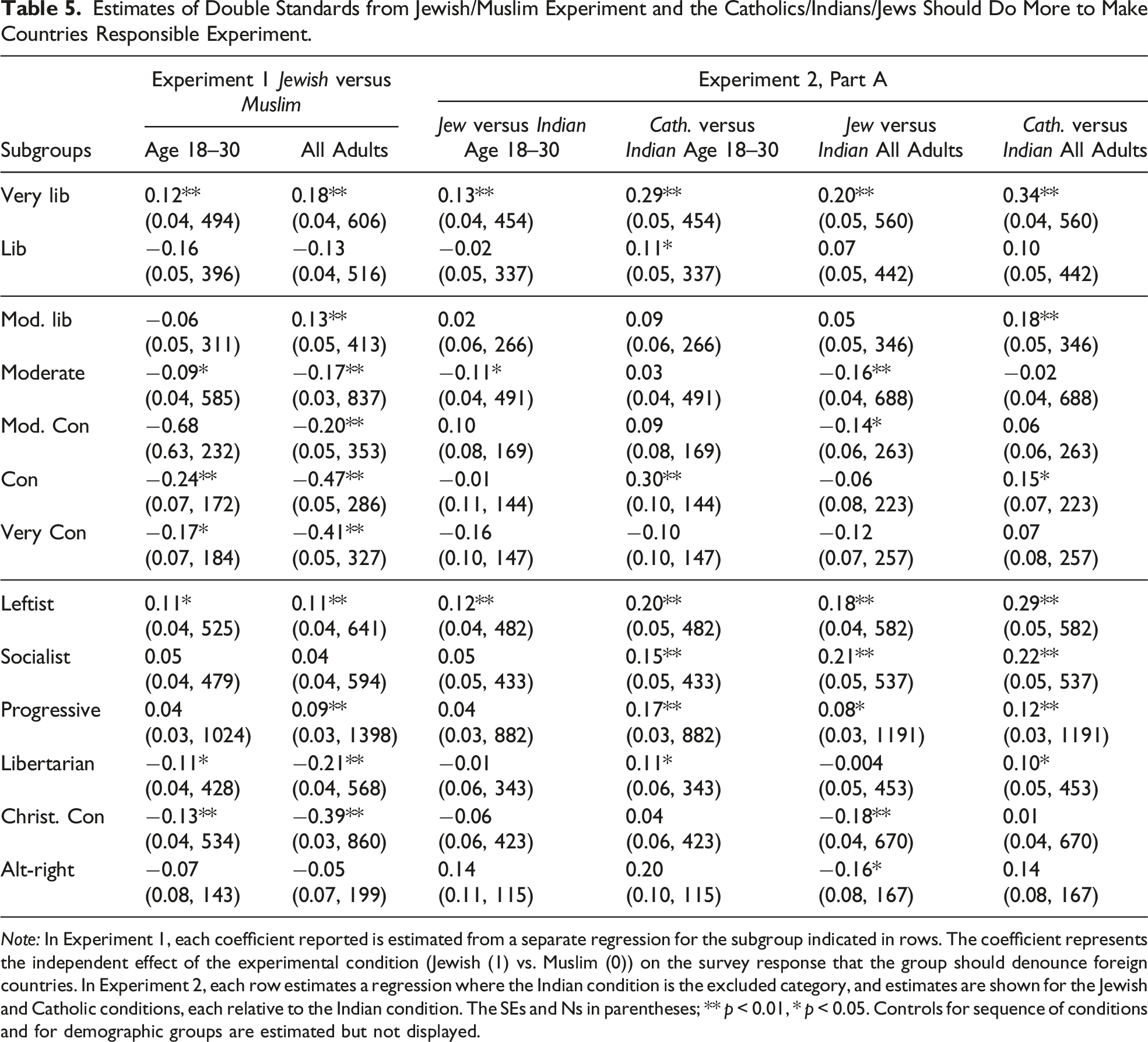
Note: In Experiment 1, each coefficient reported is estimated from a separate regression for the subgroup indicated in rows. The coefficient represents the independent effect of the experimental condition (Jewish (1) vs. Muslim (0)) on the survey response that the group should denounce foreign countries. In Experiment 2, each row estimates a regression where the Indian condition is the excluded category, and estimates are shown for the Jewish and Catholic conditions, each relative to the Indian condition. The SEs and Ns in parentheses; ** p < 0.01, * p < 0.05. Controls for sequence of conditions and for demographic groups are estimated but not displayed.
The table shows that several of the left-leaning cohorts exhibit an anti-Jewish double standard. The conservatives exhibit an anti-Muslim double standard. The anti-Muslim effects are much bigger for all adult conservatives than for 18–30 year old conservatives, consistent with Figure 3. In the ideological identities, leftist identifiers exhibit an anti-Jewish bias. Libertarians and Christian Conservatives exhibit an anti-Muslim bias. Alt-right identifiers appear to hold Jews and Muslims in similar regard.
Finally, we turn to the second experiment, gauging how respondents hold responsible Jewish Americans, versus Indian Americans and Catholic Americans, for foreign sovereigns. Hypothesis 6 stated that the political left and the political right (relative to moderates) would hold Jews more responsible for Israel than they would hold Catholics or Indians responsible for the Vatican or India, under the theory that Jews are seen as especially responsible for Israel and as having outsized power. We expected a particularly large difference in the left’s treatment of Indians versus Jews.
The graphical results are in Figure 4.
32
The ideological right applies similar standards to Jews, Indians, and Catholics, with a somewhat pro-Jewish double-standard. This is reflected in the black squares, most clearly in Panel A, being somewhat lower than circles and triangles for conservatives. The ideological left applies different standards to the three religious/ethnic cohorts, especially in the do more question wording (Panels A and B). Very few far-left identifiers agree that Indian Americans should do more to make Indian a responsible country. In contrast, the far left is much more likely to agree that Jews and especially Catholics should do more to make Israel/the Vatican responsible. Particularly in Panel A of Figure 4, the U-shape relationship emerges as it did in the previous experiment, where the far left and the far right have similar rates of agreement that Jews should do more to make Israel responsible. This pattern is present for Catholics but not for Indian Americans. Note that in the more ominous version of this experiment (Panels C and D), the far left is least likely to say that U.S. Jews should be held to account for Israel (only 4% agree). In contrast, among the young far right 28% agree with the statement, seven times higher than for the far left. U.S. Catholics, Indians, Jews should do more/should be held accountable for foreign countries Note: Means with 95% confidence intervals are shown.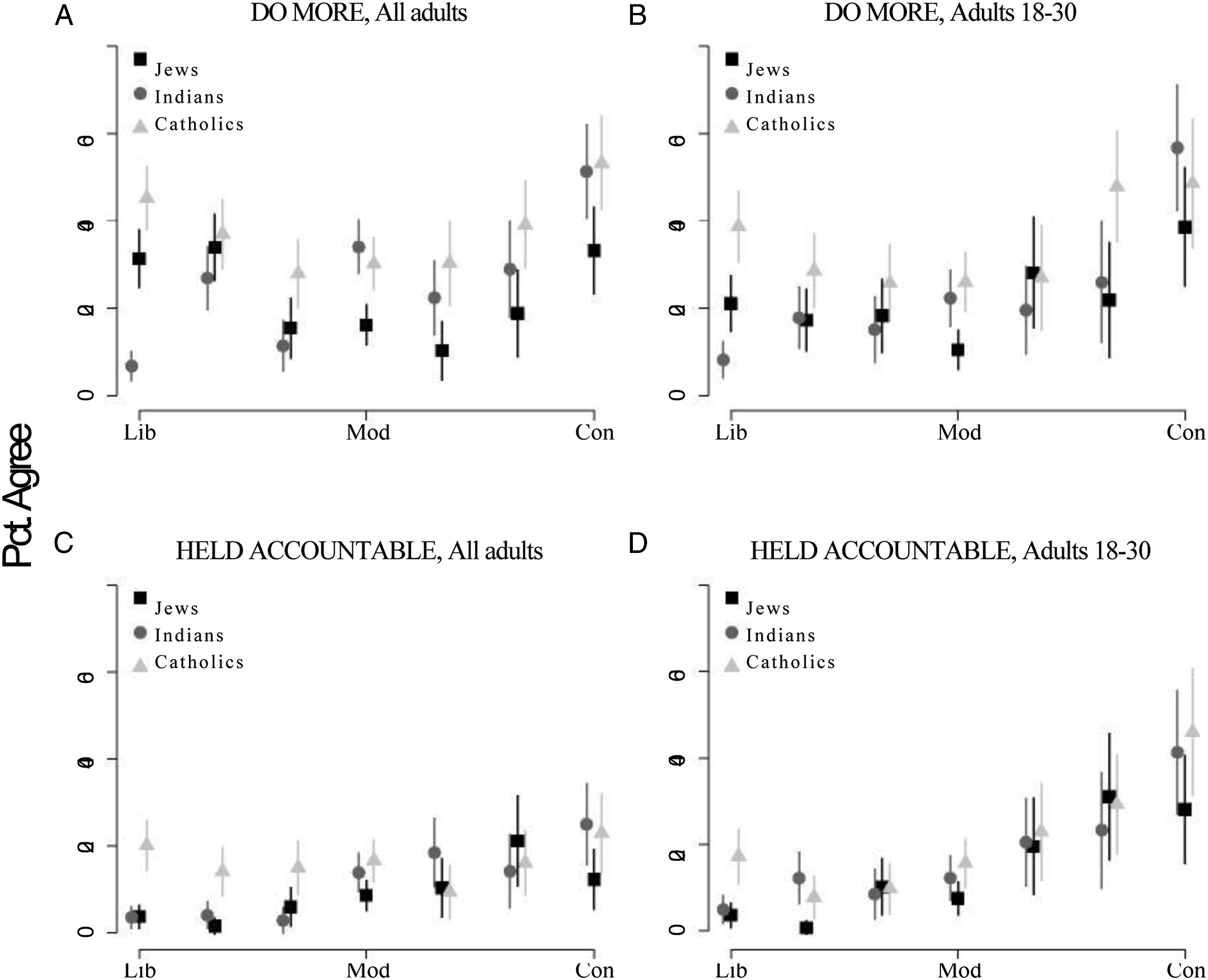
Table 5 shows the formal version of Panels A and B of this graph. The held accountable version is displayed in Table SI7. In each row, we run a regression for respondents in the indicated ideological subpopulation. The dependent variable is agreement with the statement that the group should do more to make the foreign country responsible. In this regression, we create a dummy variable for respondents in the Jewish/Israel condition and a dummy variable for respondents in the Catholic/Vatican condition. The Indian/India condition is the baseline category. Each regression also includes the same set of control variables used throughout the article. As an example for interpretation, consider the first row, third and fourth columns of data. In a regression for the cohort of 18–30 year olds who identify as most liberal (N = 454), those in the Jewish condition were 13 percentage points more likely to agree that the group should do more to make the foreign country responsible than those who were in the Indian condition. Similarly, those in the Catholic condition were 29 percentage points more likely to agree that the group should do more than those who were in the Indian condition.
The table shows that left-leaning identities (very liberals, leftists, socialists) apply a double-standard to Jews and to Catholics relative to Indian Americans. The right-leaning identities tend to treat the three groups similarly. The table and figure show a double standard on the left but places that double standard in context of the views on the ideological far right. The view that Jews are responsible for Israel is more common overall on the right than the left, particularly among 18–30 year olds. Moreover, while the left shows a double standard toward Jews (versus Indians) on the question of whether groups should do more to make a foreign country responsible, the right is more supportive of the claim that U.S. Jews should be held accountable for Israel’s actions.
Discussion
We have explored several manifestations of antisemitic attitudes, including overt antisemitic claims as well as double standards in which Jews are held morally responsible for Israel or must pass moral litmus tests unlike other Americans. There are many other manifestations of antisemitism beyond what we have studied here, but they must be left to future research.
We find overt antisemitic attitudes are rare on the left but common on the right, particularly among young adults on the right. Even when primed with information that most U.S. Jews have favorable views toward Israel—a country disfavored by the ideological left—respondents on the left rarely support statements such as that Jews have too much power or should be boycotted.
We find evidence on the left of anti-Jewish double standards compared to Muslim Americans and Indian Americans. The right exhibits strong anti-Muslim double standards. However, in these measures too, the anti-Jewish attitudes on the left are small in magnitude compared to the anti-Jewish attitudes on the right. The right does not have an anti-Jewish double standard, but they nevertheless attribute to Jews substantially more responsibility and culpability for Israel than the left does. Indeed, young far right identifiers are seven times more likely to believe that Jewish Americans should be held to account for Israel compared to young far-left identifiers.
No one study is definitive. Future scholarship may further test the measures we have used. For instance, one may test whether the survey responses on the right are reflective of sincerely held prejudice or reflective of a desire to assert anti-politically correct statements. Or one may test whether the left-right divide here is at least partially a reflection of less inhibition on the right in asserting widely held prejudicial views.
There is a large and growing body of research in political science on prejudicial attitudes. Antisemitism has been studied much less frequently, despite research showing the lasting impact of antisemitic stereotypes on politics including among voters who purport to reject the stereotypes (Berinsky and Mendelberg 2005). An important reason for political scientists to continue to study antisemitism is that many theories of antisemitism are closely tied to political ideology. The articulation of a “horseshoe theory” and the empirical strategy developed in this article can help scholarship on a range of topics beyond antisemitism. For instance, this work may inform scholarship on other forms of prejudice, such as anti-Asian prejudice, which may also have left-wing and right-wing manifestations. The work can also shed light on mass opinion on complex issues such as the 2022 Russia–Ukraine war, where antiwar attitudes have emerged in pockets of the far left and far right.
Overall, the evidence in this paper suggests that antisemitic views are far more common on the right than the left. The antisemitism that has been on prominent display in white nationalist protests is not merely confined to a tiny group of extremists; antisemitic attitudes appear quite common among young conservatives, and much more so than among older conservatives or among liberals of any age.
Supplemental Material
Supplemental Material - Antisemitic Attitudes Across the Ideological Spectrum
Supplemental Antisemitic Attitudes Across the Ideological Spectrum by Eitan Hersh and Laura Royden in Political Research Quarterly
Footnotes
Acknowledgments
For comments on our research proposal, we thank: Marina Bers, Mijal Bitton, Stacy Burdett, Julie Cooper, Mia Costa, Ryan Enos, Josh Kalla, Alexander Kaye, Yanna Krupnikov, Tali Mendelberg, Yehudah Mirsky, Jonathan Sarna, Gregory Smith, Brian Schaffner, Debbie Schildkraut, Daniel Schwartz, Shayna Weiss, and Dov Waxman. We also thank Bernard Fraga, Shana Gadarian, and Ezra Sivan.
Declaration of Conflicting Interests
The author(s) declared no potential conflicts of interest with respect to the research, authorship, and/or publication of this article.
Funding
The author(s) disclosed receipt of the following financial support for the research, authorship, and/or publication of this article: For funding support, we thank the Klarman Family Foundation and One8 Foundations.

Supplemental Material
Supplemental material for this article is available online.
Notes
References
Supplementary Material
Please find the following supplemental material available below.
For Open Access articles published under a Creative Commons License, all supplemental material carries the same license as the article it is associated with.
For non-Open Access articles published, all supplemental material carries a non-exclusive license, and permission requests for re-use of supplemental material or any part of supplemental material shall be sent directly to the copyright owner as specified in the copyright notice associated with the article.
