




Abstract
Preference voting threatens the power of party leaders in PR contexts to enforce party unity and pursue policy by encouraging candidates to groom personal reputations. This study posits that party leadership might be able to enforce party discipline through other means at their disposal even as their control over candidates’ election ranks weakens. These include access to the party label and distribution of senior legislative- and party positions. Using original data from the Czech flexible-list PR context covering the period between 1996 and 2021, this study shows that the MPs who are elected thanks to preference voting are no more likely than their colleagues to individualize their legislative behavior or cast a dissenting roll-call vote. What is more, these popular MPs face a more restricted access to reelection and senior positions that come with agenda-setting power and exposure. This evidence suggests that political parties take active steps to limit the autonomy of the MPs who owe their positions to voters.
Keywords
Introduction
Does preference voting in proportional-representation (PR) contexts produce undisciplined political parties comprised of unreliable mavericks? In a classical—closed-list (CL)—PR setup, party organizations determine the order in which their candidates are elected from the parties’ multicandidate ballots (Carey and Shugart 1995; Renwick and Pilet 2016). This feature incentivizes candidates to take on the role of loyal party soldiers and produces party groups that are exceptionally cohesive (Borghetto and Lisi 2018; Yildirim, Kocapınar, and Ecevit 2017). Preference voting is an electoral innovation that enables voters to alter the composition of their chosen party’s parliamentary delegation by expressing preference for one or more candidates listed on the party’s ballot (André et al. 2017; Crisp et al. 2013). The possibility of getting elected from anywhere on the ballot incentivizes individual candidates to become more concerned about their individual reputations among voters and more independent in their campaign- and/or legislative behavior (Andeweg and Thomassen 2011; Bouteca et al. 2019; Carroll and Nalepa 2020; Crisp et al. 2013; Tavits 2009). While conditions like these might give rise to MPs who are more attentive to the demands of their constituents, they also threaten the pursuit of party policy objectives in fragmented, multiparty PR contexts (Carey 2007). This study posits that senior party officials in PR contexts where preference voting is permitted will use their remaining gatekeeping roles, like control over candidate selection or appointments to senior positions, to prevent the rise of independent mavericks (Carroll and Nalepa 2021; Rich 2014).
The veracity of this claim is tested in the flexible-list (FL) PR context of the Czech Republic where a non-negligible number of MPs owe their positions to preference voting (Däubler, Christensen, and Linek 2018; Stegmaier, Marcinkiewicz, and Jankowski 2016). A FL system is a middle ground between the classical CL system and the so-called ‘open lists’ where the order in which individual candidates are elected is determined by their respective preference-vote tallies (Carey and Shugart 1995). In a FL context, only those candidates who attract more personal votes than a predefined quota gain priority over their copartisans in seat allocation (Crisp et al. 2013). This study examines whether those candidates who get elected from what would otherwise be non-electable ballot spots are able to act more autonomously than their colleagues who owe their incumbency status to their party-predetermined election ranks. This is done by analyzing whether there are any tangible differences between these two legislator cohorts in terms of legislative activity or propensity to cast a dissenting vote at roll call. The study further investigates whether political parties take active steps to limit the autonomy of MPs with popular mandates by mapping out the flows of valuable resources under party control. An original dataset on Czech MPs elected between 1996 and 2021 is used to conduct these analyses.
Why is this inquiry important? Preference voting is an electoral innovation that aims to make voters more directly involved in determining the composition of their legislature. Voters can use preference voting to remove from office incumbent MPs whose conduct they disapprove of, empower a particular faction within their party, or thrust into office champions of a particular cause. By introducing a direct connection between voters and individual MPs, preference voting might make the latter more sensitive and responsive to voters’ demands (André et al. 2017; Buisseret and Prato 2020; Carroll and Nalepa 2020; Meserve, Robbins, and Thames 2017). However, this link can only work if individual MPs can use their individual popularity as a platform from which to pursue their personalized policy goals (Folke, Persson, and Rickne 2016). The results of this study indicate that political parties might be able to neutralize some of the effects of preference voting on legislative behavior (Carroll and Nalepa 2021; Rich 2014). The Czech ‘ballot jumpers’—MPs who on their path to office “jump over” their better-placed copartisans—are actually more likely than their party colleagues to support the party line at roll call and no more likely to personalize their legislative behavior. While this might be a selection effect, the study also finds that the same MPs are less likely than their colleagues to be promoted into senior legislative- or party positions and face a more restricted access to reelection. These findings suggest that party organizations are taking active steps to limit the legislative autonomy of popular ballot jumpers by restricting their access to agenda-setting power and visibility. Taken together, this study questions the feasibility of introducing candidate-centered features into party-centered electoral systems by demonstrating that some of their intended effects might successfully be counteracted by political parties.
Personal Voting and Legislator Autonomy
In a CL setting, office-seeking candidates have more to gain from remaining in the good graces of their party superiors who decide on their election ranks than from being popular or even known among voters (Borghetto and Lisi 2018; Carey and Shugart 1995). The introduction of preference voting weakens party control over election ranks and thus changes the incentive structure faced by individual candidates (Carey 2007; Crisp et al. 2013). The prospects of getting elected from an otherwise hopeless ballot spot or boosting their intraparty standing encourage candidates to create personal reputations and compete with their copartisans for voter favor (Carey 2007; Carey and Shugart 1995; Crisp et al. 2013). Past literature shows that institutional arrangements where party organizations and voters share the role of gatekeepers to elected office produce legislators who are more independent in their activities and more likely to challenge party unity when such an action promises to boost their personal credit among their constituents (Carey 2007; Carroll and Nalepa 2021; Meserve, Robbins, and Thames 2017). Candidates’ preference-vote tallies have been linked to a greater proclivity to hold speeches (Marcinkiewicz and Stegmaier 2019; Poyet and Raunio 2020), table interpellations (Louwerse and Otjes 2016), or sponsor bill proposals (Bouteca et al. 2019; Crisp et al. 2013). By producing MPs who are at least as attentive to the interests of their electorates as those of their party superiors, preference voting might have a capacity to give rise to party groups that less cohesive, more internally democratic and more programmatically varied (André et al. 2017). Voters benefit on two fronts: they get to maximize the representation of their interests and can contribute to a more dynamic elite renewal, if necessary.
Some of the existing literature suggests that incumbent political party elites will embrace preference voting as an additional vote-maximization tool, even if the measure comes at the price of weaker party unity (André et al. 2017; Crisp et al. 2013). Preference voting provides party organizations with useful data about each candidate’s popularity among voters which they can use to design ballots that broaden the party’s electoral appeal (André et al. 2017; Crisp et al. 2013; Folke, Persson, and Rickne 2016). What is more, candidates who are popular in their own right are a potentially potent source of extra votes which no political party can turn a blind eye to (Carey and Shugart 1995; Crisp et al. 2013). While this study does not question these expectations, it posits that the purported effect of preference voting on legislator autonomy and party discipline is likely to be a source of concern for incumbent party elites. If preference voting enables sitting MPs to act more autonomously, the pursuit of party policy might be in jeopardy (Buisseret and Prato 2020; Carey 2007). This is likely to hurt the party at the ballot box and cost the incumbent party elites their positions of power. The main issue is that—in multiparty contexts which PR seat-allocation formulas normally produce—political parties need to cooperate with their rivals to accomplish their policy goals. Where voting majorities are thin, any expressions of disunity—whether they take the form of dissenting public statements or social media posts, rogue bill proposals or interpellations or dissenting votes at roll call, might damage the party’s reputation as a reliable political partner (Baumann, Debus, and Klingelhöfer 2017; Carey 2007). This is why, it is reasonable to expect that the sitting party elites will try to limit the measure’s impact on legislator behavior.
Recent research offers some crucial evidence in support of this expectation (Buisseret and Prato 2020; Carroll and Nalepa 2021; Folke and Rickne 2020; Däubler 2021). Put et al. (2019), for instance, show that while there indeed is a robust, positive correlation between preference-vote tallies and candidates’ subsequent ballot placement, popular candidates are seldom promoted from hopeless to safe ballot spots by political parties. Wauters et al. (2019) find no evidence of growing personalization of legislative behavior in the FL context of Belgium, despite using multiple measures of the concept. In a similar vein, Carrol and Nalepa (2021) show that incidence of disloyalty in FL- and OL PR systems is related to the parties’ costs of enforcing discipline (see also Rich, 2014). What is more, this relationship is conditional on legislators’ policy preferences: the more homogenous they are, the less “disciplining” is needed to enforce party unity. Using this evidence as a springboard, this article argues that senior party officials will make use of two primary instruments to ensure that preference voting does not affect their ability to enforce party unity: candidate selection and strategic allocation of valuable resources under party control (see also Ceron 2015).
In the presence of preference voting, all ballot ranks are potentially electable. This incentivizes party recruiters to make certain that their entire candidate body is comprised of properly-vetted party loyalists whose policy preferences do not diverge from those of their party superiors (Carroll and Nalepa 2021; 2020; Ceron 2015). Political parties can use different strategies to keep the costs of candidate screening at a reasonable level (Carroll and Nalepa 2021). First, strict membership requirements might disqualify or disadvantage those aspirants who are yet to internalize important party norms of party loyalty (van Vonno 2019). What is more, the bottom section of the ballots can be filled with the party’s long-term regional- or local office holders who lack the aspirations of pursuing a political career at the national level. If these candidates are elected, it is unlikely that they will pose a threat to party discipline. Second, political parties can demand formal pledges of loyalty from their candidates, which might even include stiff penalties for non-compliance. Third, to minimize the risk of ballot reshuffles, party organizations will strive to design candidate ballots that their voters find appealing. This might involve placing their most popular party insiders on the top of their ballots as a form of voter enticement (Nagtzaam and van Erkel 2017; Put, Smulders, and Maddens 2019). If this strategy works, the lion share of preference votes will be concentrated around the party’s topmost candidates and will therefore have no impact on the seat-allocation order (Beblavý and Veselková 2014).
In the parliamentary arena, political parties can use their role as gatekeepers to various valuable political resources to enforce unity within their ranks (Andeweg and Thomassen 2011; Rich 2014; van Vonno 2019). In PR settings, senior party officials control access to peer mentoring, financial- and material resources, experienced assistant staff, public-opinion data or know-how (Carey 2007). What is more, senior party representatives decide on committee appointments and often play an active role in determining who will submit important legislative proposals on the party’s behalf (Sieberer 2006). Many of these resources come with agenda-setting power and name recognition and political parties can use them strategically to empower dependable loyal soldiers and marginalize those who might threaten party discipline. Preference voting incentivizes political parties to expand their “A-team”: a cohort of trusted insiders who are given responsibility over a particular policy domain and authorized to pursue party policy within this domain. These policy “spokespersons” are provided with resources that allow them to enhance their reputations among voters and might even be granted a degree of voting autonomy on issues that fall within their policy domain. This strategy might allow political parties to reap the benefits of preference voting in terms of vote maximization without risking losing control over party discipline. What is more, if true, this strategy would also explain—at least in part—the robust correlations between individual legislators’ preference-vote tallies and different aspects of their legislative behavior, including the proclivity to cast a dissenting vote at roll call.
Ballot Jumpers: Mavericks or Party Soldiers?
Ballot jumpers are candidates who are elected from what would otherwise be non-electable ballot spots only thanks to preference voting. Studying the political behavior and fortunes of these candidates can help to improve our knowledge about the relationship between individual popularity and legislative behavior as well as the strategies political parties use to minimize the effect of preference voting on legislator autonomy. The existing theory suggests that legislators elected on personal mandates are less likely to be team players in legislative contexts (Crisp et al. 2013; Zittel 2015). Ballot jumpers, who truly owe their incumbency status to voters, should epitomize this mechanism. But if the party recruiters did a thorough job at the ballot-creation stage, then the likelihood should be low that the ballot jumpers will turn out to be mavericks once in office. Some ballot jumpers might have received votes in virtue of a particular group identity (e.g. place of residence, age or profession) without necessarily having taken part in the campaign. These individuals might be ill-equipped or simply uninterested in capitalizing on their popular mandates. However, among the ballot jumpers are bound to be those who ran personalized campaigns and need to make good on their promises. The threat these individuals pose to party discipline can be neutralized through strategic resource allocation. Starved of both material and non-material political resources under party control, the legislative impact of these potential mavericks is likely to be limited. Whether it is due to selection or strategic resource allocation, this article does not expect the ballot jumpers to stand out from the crowd of their party colleagues, neither in terms of their proclivity to cast a dissenting vote at roll call nor legislative activity. It is therefore expected that: H1. Ballot jumpers will be no more likely to challenge the party line at roll call than their colleagues. H2. Ballot jumpers will be no more likely than their colleagues to personalize their legislative behavior.
Examining the flows of political resources is an effective way of investigating whether senior party officials take active steps to marginalize the ballot jumpers and limit their access to visibility-enhancing assignments. This article anticipates that the ballot jumpers will have a more limited access to senior legislative- and party positions that come with agenda-setting power and/or exposure and whose distribution is under party control. Hence, it is expected that: H3. Ballot jumpers will be less likely than their colleagues of being promoted to senior party- and legislative positions.
The electoral success of ballot jumpers is a threat to senior party officials regardless of whether or not they intend to capitalize of their popular mandates. The party officials’ failure to sense the mood of the electorate might cost the party a dependable vote or a competence that is in a short supply and weaken the party’s position in the new legislature. What is more, the election of ballot jumpers depreciates the value of safe ballot spots as a reward for loyal party service and is likely to disincentivize competent party members from engaging in party activities. To protect the established ways of doing within the party and regain their standing, senior party officials might to want to delegitimize getting elected out of order as a viable pathway to power and harm the ballot jumpers’ long-term political-career prospects. They can achieve this by restricting the ballot jumpers’ access to reelection. It is therefore expected that: H4. Ballot jumpers will face bleaker odds than their colleagues of being placed in safe ballot spots at the next election.
To further nuance these expectations, it is important to make a conceptual distinction between two types of ballot jumpers: those elected from marginal ballot spots and those who were thrusted into office from hopeless ballot spots. The electoral success of candidates placed in marginal spots, close to the zone of electability, is less problematic. These candidates are likely to be thoroughly screened because political parties can never be completely sure how many seats they will get. This might often be returning MPs whose “usual” spot became marginal because of voter volatility and whose eventual electoral success is unlikely to have an impact on party discipline. It is those elected from the hopeless section of the ballot who represent the greatest threat to their party superiors, even if they intend to take on the role of party soldiers. This is because these ballot jumpers embody the rejection of the party-proposed order of candidates by voters. For the party leaders’ own political survival, it is important to marginalize these ballot jumpers, in particular.
The Czech Republic and its (truly) flexible lists
The flexible-list (FL) PR system is the most common electoral arrangement in Europe, used in Austria, Belgium, Croatia, the Czech Republic, Denmark, Estonia, the Netherlands, Norway, Slovakia, Sweden and beyond (André et al. 2017). However, there is a considerable variation in terms of the impact preference voting has on who gets elected (Renwick and Pilet 2016). This heterogeneity appears to be driven by a number of factors, including the share of party votes needed for a popular mandate, district magnitude or the number of personal votes available to each voter (André et al. 2017; Buisseret and Prato 2020; Crisp, Jensen, and Shomer 2007; Nagtzaam and van Erkel 2017). The case of the Czech Republic shows that, when the conditions are right, preference voting can have a strong impact on the electoral fortunes of individual candidates (Beblavý and Veselková 2014; Stegmaier, Marcinkiewicz, and Jankowski 2016). While preference voting was part of the Czech electoral system since the country’s return to democracy in the early 1990s, the measure was made more potent in 2006 when the quota for getting elected on a personal mandate was lowered from seven to five percent of the party’s district vote and the number of personal votes available to each voter increased from two to four. In this first post-reform election (2010), 50 MPs were elected from hopeless ballot spots and thirteen ballot leaders from five major parties lost their seats (Beblavý and Veselková 2014). Strong anti-elite sentiments are seen as partly responsible for the sudden activation of preference voting in the Czech case. The 2006 reform coincided with a number of corruption scandals that undermined voters’ confidence in the political elite (Stegmaier, Marcinkiewicz, and Jankowski 2016). Many of the ballot jumpers elected in 2010 were candidates from the very bottom of the ballots who were as taken aback by their surprise election as their party superiors (Dvořák and Zahradníková 2013). This means that the initial surge in the number of ballot jumpers was more of a vote no confidence in the sitting party elite than an expression of a genuine preference for those candidates who got elected. Regardless of the nature of the initial impulse that helped to activate the measure, the popularity of preference voting did not abate in the subsequent electoral contests and the number of candidates pursuing personalized campaigns has grown. All in all, roughly one in five MPs elected in the four elections held in the last decade (2010–2021) were ballot jumpers. Owing to the popularity of preference voting, the Czech Republic is as near to the theoretical ideal of a FL system as it gets: both voters and parties take an active part in determining the composition of the legislative assembly.
In other aspects that are of relevance to this study, Czech Republic is a typical representative of the PR family (Mansfeldová 2011). The country has a party-centered electoral system that is becoming increasingly fragmented and polarized. The current coalition government (2021–), for instance, consists of five political parties. In these conditions, rock-solid party discipline is a necessary precondition for policy influence and opposition parties use every opportunity at their disposal to sink government-backed bill proposals. Crucially for this study, Czech political parties retain a strong position as gatekeepers to both the party label and valuable political resources, which they might be able to use for the purposes of enforcing party discipline. First, senior party officials control the processes of candidate recruitment and ballot creation (Outlý and Prouza 2013). The country is subdivided into fourteen electoral districts and candidate ballots are put together at regional party conferences attended by local party bosses (Ibid.). These actors are likely to have a good collective knowledge of all the aspirants and push for the most dependable ones, especially in light of the recent ballot reshuffles. In their efforts, the recruiters are likely to be helped by the relatively low district magnitude (Crisp, Jensen, and Shomer 2007; Shugart, Valdini, and Suominen 2005). The median district magnitude is twelve seats and the mean number of candidates per ballot was 25 in the 2021 election. Past research on candidate selection suggests that exclusive forms of candidate selection, like this one, tend to produce loyal party soldiers (Hazan and Rahat 2010). Second, political parties enjoy wide discretionary powers over political appointments within the legislative arena and can use these to empower trusted party insiders (Hájek 2019; 2017). What is more, political parties often serve as gatekeepers to those bill proposals that are likely to attract majority support and the know-how concerning both the drafting and timing of a successful bill proposal (Däubler, Christensen, and Linek 2018; Mansfeldová 2011). There is evidence that many of the ballot jumpers elected in 2010 quickly realized that their access to agenda setting was vastly limited, mainly because they lacked the necessary intraparty standing (Dvořák and Zahradníková 2013; Vosáhlo 2013). While some seem to have responded to this challenge by taking on the role loyal party soldiers, others left politics after only one term citing disillusionment and lack of support from their superiors (Přibil 2017). While any legislator is allowed to submit a bill proposal or table an interpellation, only a fraction of “hopeless” bill proposals attract attention (Däubler, Christensen, and Linek 2018; Hájek 2019).
Taken together, the Czech Republic harbors the kind of conditions that enable an efficient testing of this study’s hypotheses. On the one hand, there is a non-negligible number of MPs whose popular mandates represent a threat to party discipline. On the other, political parties enjoy a privileged position as gatekeepers to many valuable political resources, including senior legislative posts and/or privileged access to the party label/safe ballot positions, which they can use to enforce party unity.
Who are the Czech Ballot Jumpers?
Before moving on, it is important to introduce the Czech ballot jumpers in a greater detail. As already mentioned, ballot jumpers have become a much more common occurrence in Czech politics following the 2010 election. In the last decade, no fewer than 17% of all the Czech MPs have been ballot jumpers. Overall, ballot jumpers comprise roughly one tenth of our sample (N = 108). Of these, 60 are elected from uncertain ballot spots and 48 from hopeless ballot spots. A complementary analysis of the bios of a stratified sample (N = 55) of Czech ballot jumpers reveals a number of common characteristics. First, the bulk of ballot jumpers are party insiders with local/regional office experience. Many of these have enjoyed long and successful careers as mayors, local MPs or regional governors. The second category are returning MPs who were either on their ‘way out’ or whose ballot spots became marginal due to declining support for the party. Only after these two categories come newcomers with no previous experience with elected office. Note that this is evidence of strategic candidate selection. Knowing that virtually any candidate can, in theory, be thrusted into office, political parties need to make sure that their ballots do not feature any potential troublemakers (see also Tavits, 2009).
Data, Operationalization and Model Specification
Czech Legislator Database (1996–2021)
This study uses an original dataset containing rich data about Czech lower-chamber legislators elected between 1996, the first election held in an independent Czech Republic; and 2021, the most recent election. As a way of ensuring that the analysis only includes political parties that have institutionalized their internal ways of doing, we do not use data on those parties that were never reelected during the period under study. 1 Legislators who died or resigned before the end of the term are also dropped from the analysis. This results in a dataset containing 1227 legislator-term observations and 968 observations if only those who reappear on the party ballot in the next election are included. The data has been collected from publicly available sources, such as the Czech Statistical Office, the Czech Parliament’s digital library or personal websites of individual MPs. Roll-call voting records have been purchased from the think tank kohovolit.eu.
Key Variables and Descriptive Statistics
Descriptive statistics.
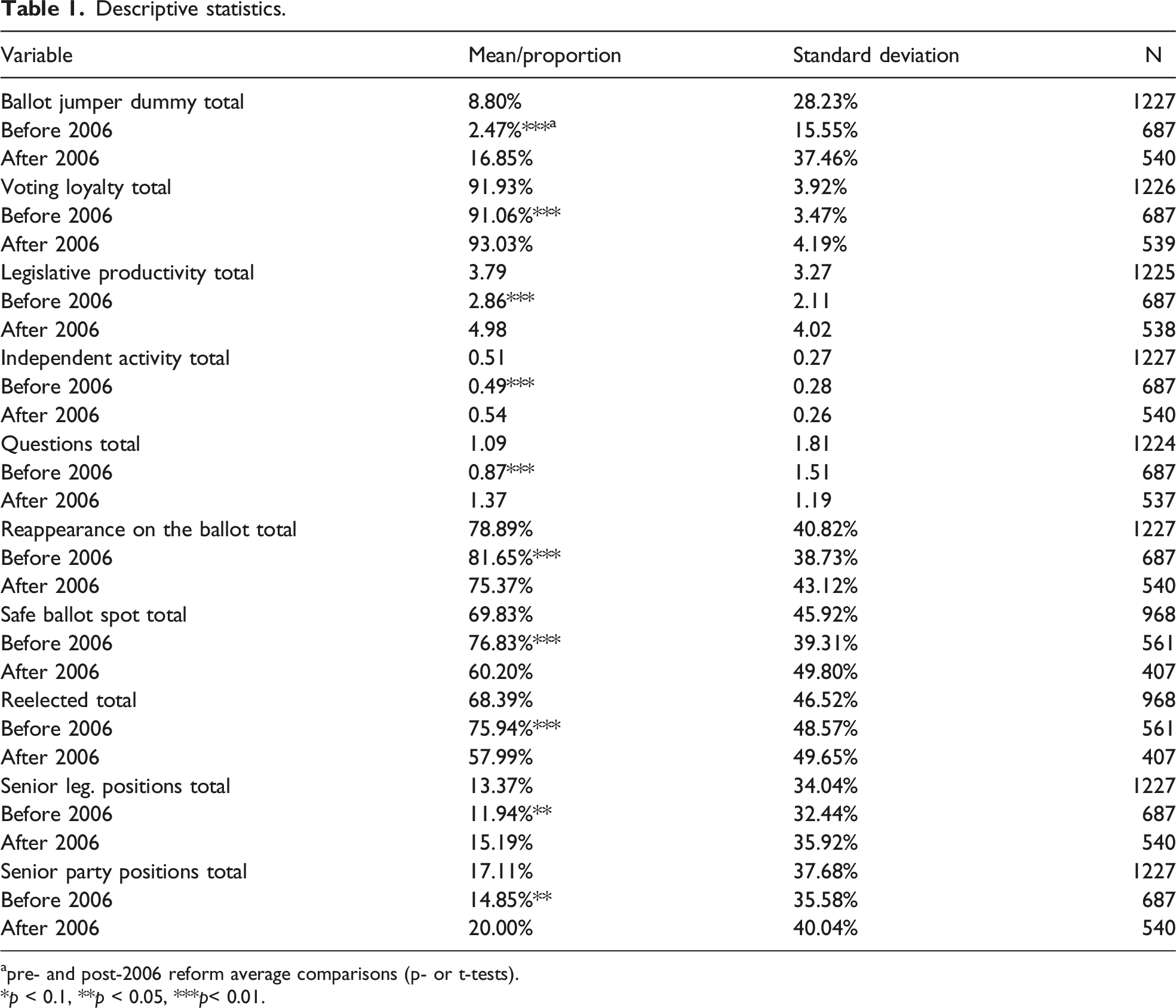
apre- and post-2006 reform average comparisons (p- or t-tests).
*p < 0.1, **p < 0.05, ***p< 0.01.
The article will now proceed with a concise overview of how the key variables of interest were operationalized. The dummy variable ballot jumper, this study’s main independent variable, takes on the value of “1” if a legislator has been elected from what would otherwise be a non-electable ballot spot, solely thanks to preference voting. The ballot jumpers comprise roughly nine percent of the sample. Within the ballot jumper cohort, we further distinguish between those who have been elected from hopeless- and marginal ballot spots. To be on the conservative side, we define hopeless seats as those that are at least three spots below the last spot that was allocated a seat.
To enable a thorough investigation of the ballot jumpers’ behavior in office, four different measures of legislator behavior are used in this study. Legislator productivity is measured the total number of bill proposals submitted or sponsored by a legislator per term. This is not necessarily a measure of independent legislative activity but rather an indicator of how active each MP is in the legislature. Past literature shows that those MPs who feel that their own position is insecure submit or sponsor more bill proposals than their colleagues as a way of signaling to their primary principal that they are hard workers (Borghetto and Lisi 2018; Poyet and Raunio 2020). Independent legislative behavior is measured as a ratio between the number of submitted and successful bill proposals (Wauters, Bouteca, and de Vet 2019). Senior party officials usually know which of their party’s bill proposals will attract majority support and are therefore involved in deciding who will get to submit these proposals on behalf of the party. The higher this ratio, the more hopeless bill proposals a legislator submitted or sponsored during the term, which is considered here to be a measure of independent brand building. Questions is a sum of oral and written interpellations tabled by a legislator per term. Interpellations are always tabled individually and – as evidenced by past research, sometimes used by legislators to promote their personal policy positions (Louwerse and Otjes 2016; see also Däubler et al., 2018). Since two parliamentary terms were cut short by an early election, these three measures are standardized by term length, measured in years. Finally, roll call loyalty is measured in terms of congruence between a legislator’s voting records and the average vote of their parliamentary group for each term, measured in percent.
To investigate whether political parties use their roles as gatekeepers to agenda setting and reelection to shape the behavior of their MPs, this study examines the allocation of senior legislative- and party positions and safe ballot spots. To examine whether political parties are likely to use their control over candidate selection and ballot creation to thwart the ballot jumpers’ reelection prospects, three measures are used. The dummy variable ballot reappearance takes on the value of ‘1’ if a legislator appears on the same party’s ballot at the next election. The dummy variable “reelected” takes on the value of “1” for those MPs who successfully defended their incumbency status. Finally, the dummy variable “safe spot” takes on the value of “1” if a legislator is placed in a safe ballot position by their party at the next election. There are different ways of measuring which ballot spots can be considered safe. This study uses Put et al. (2019)’s operationalization which accounts for both the election result and district magnitude. 2 Finally, there are two dummy variables measuring access to senior positions. The dummy variable ‘senior party post’ takes on the value of ‘1’ if a legislator has a leadership position within their parliamentary group. Those holding these posts are in a good position to affect party positions on various issues. Finally, the dummy variable ‘senior parliamentary post’ takes the value of “1” if a legislator serves as a committee chair, speaker or deputy speaker of the house or party group chair in the current term. All these positions come with agenda-setting power and name recognition.
To account for as many alternative explanations of legislators’ activity and political fortunes as possible, a battery of control variables is included. Differences in legislators’ background characteristics or legislative experience may explain some of the variation. This is why, we control for legislator sex, age and college education and previous legislative experience, measured in years. We also account for each legislator’s ballot rank in the previous election, which is also a good indicator of their within-party standing. Finally, we control for each MP’s preference-vote share in the previous election to ensure that the ballot jumper dummy only captures the act of getting elected on a personal mandate and not their relative popularity among voters. Relevant descriptive statistics on the control variables are presented in the online appendix (Table A3, p. 3).
Model Specification
All four hypotheses are subjected to a thorough empirical scrutiny using linear regression analysis with fixed effects for party, electoral term (H1–2 and 4) and electoral district (H3). What this means in practice is that the estimates are based on comparisons between legislators belonging to the same party and term and, when relevant, running on the same party ballot. This approach makes it possible to hold constant important time-invariant factors such as party culture, government status, or district- and party-based differences in candidate selection. Despite the fact that not all the response variables are continuous, linear modeling is used to make the interpretation of the coefficient as straightforward as possible. Robust standard errors are clustered at party-term or party-district-term level, where applicable.
Alternative model specifications, such as logistic regression for binary outcomes (Table A4, p. 4), are presented in the appendix. The results of these are consistent with those found in the main text. The appendix also includes important robustness checks – like estimating a series of model specifications with fixed effects for the 2006 reform of preference voting (Table A6, p. 6) or those in which only the post-reform observations are included (Table A7, p. 6).
Empirical Analysis
Mavericks or Party Soldiers? The Latter
Ballot jumpers’ legislative behavior.
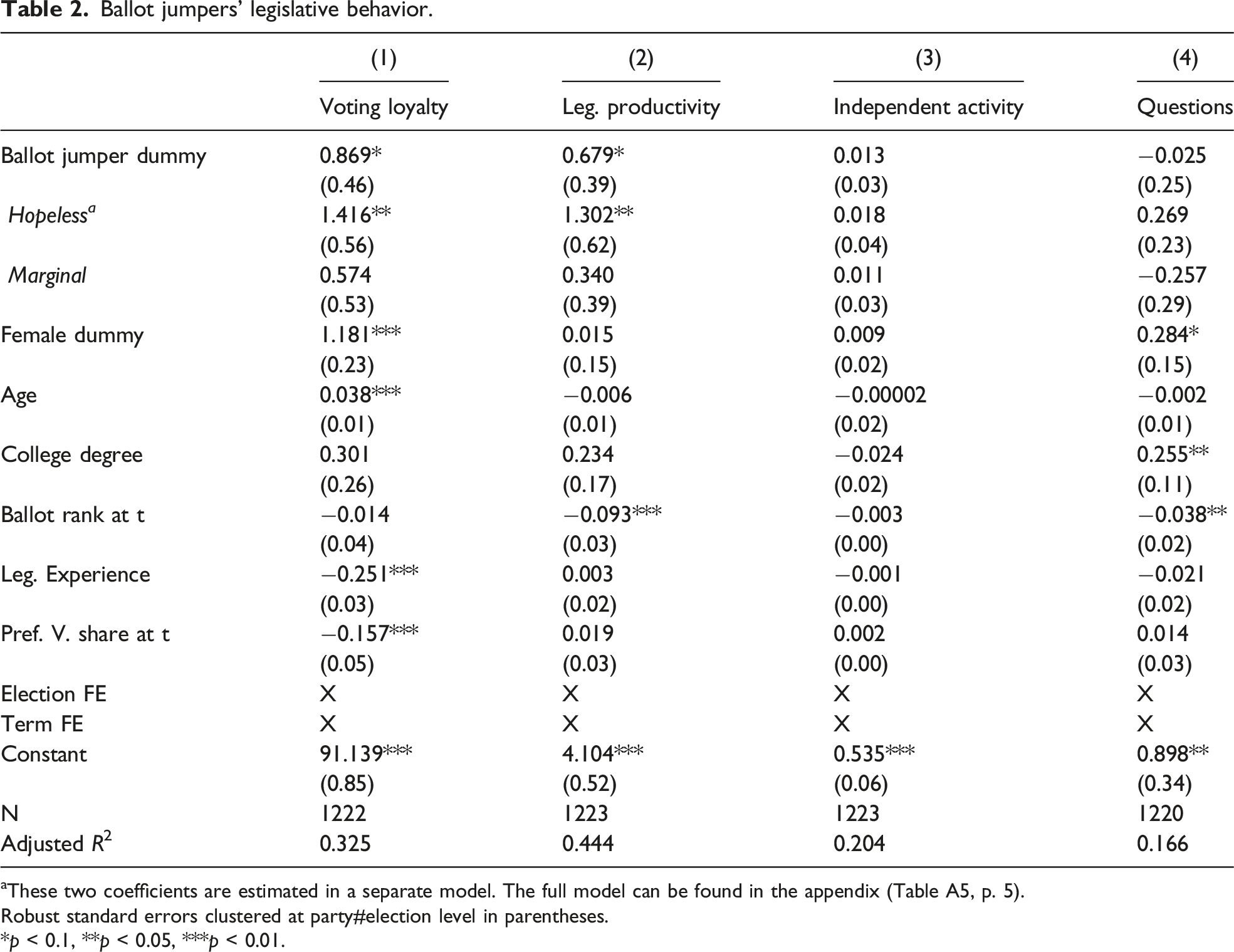
aThese two coefficients are estimated in a separate model. The full model can be found in the appendix (Table A5, p. 5).
Robust standard errors clustered at party#election level in parentheses.
*p < 0.1, **p < 0.05, ***p < 0.01.
It is worth noting that the association between legislators’ preference-vote tallies and loyalty at roll call is negative and statistically significant, which is in line with previous research (Andeweg and Thomassen 2011; Crisp et al. 2013; Tavits 2009). However, the results make it clear that this association is not driven by those who are elected thanks to preference voting. On the contrary, the association applies to those MPs who would have been elected even in the absence of preference voting, which indicates that popular party insiders placed on the top of the ballot enjoy a greater voting autonomy. This might either be because their individual popularity enhances their intraparty standing (Folke, Persson, and Rickne 2016) or because they are authorized by their party to cultivate individual popularity as part of the party’s effort to make sure that the bulk of all the preference votes end up in trustworthy hands.
The results capture in Table 2 are subjected to fierce robustness testing, the results of which are summarized in an online appendix. First, the appendix contains a series of alternative model specifications in which the fixed effects for electoral term are replaced with those for the 2006 reform of preference voting (Table A6, p. 6). We also run a series of restricted model specifications—excluding all the pre-2006 observations (Table A7, p. 6). Both these sets of specifications yield results that are in line with those presented here. Finally, the legislative behavior of ballot jumpers is compared to that of their fellow colleagues who owe their positions solely to their party-determined ballot rank (Table A8, specifications 1–4, p. 7). Finally, we also run a model (Table A11, p. 11) in which we control for those MPs who hold senior legislative- and executive positions and have therefore a privileged access to agenda setting. The results are in line with those reported here.
Ballot Jumpers and Distribution of Political Resources Under Party Control
Access to senior positions and reelection.
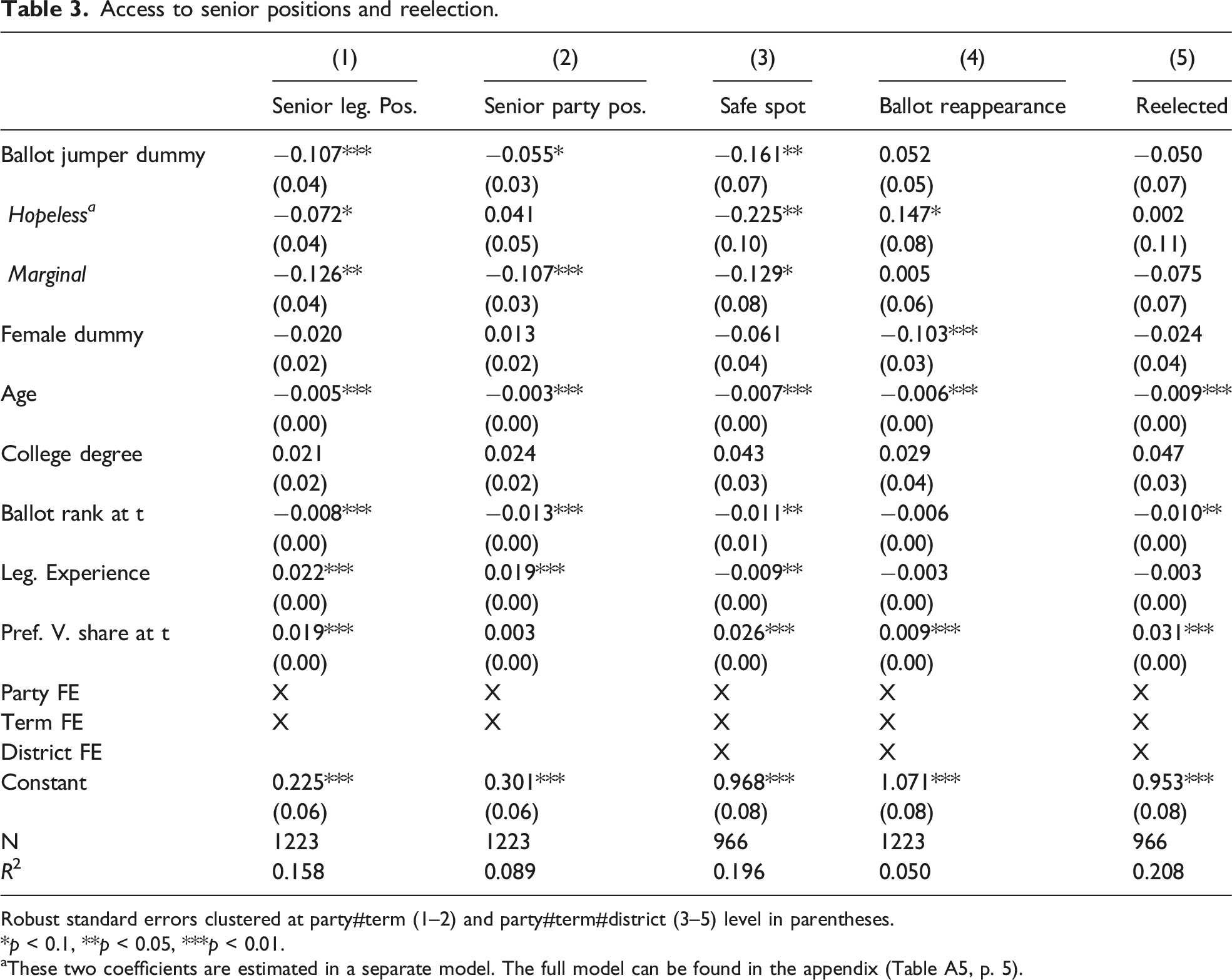
Robust standard errors clustered at party#term (1–2) and party#term#district (3–5) level in parentheses.
*p < 0.1, **p < 0.05, ***p < 0.01.
aThese two coefficients are estimated in a separate model. The full model can be found in the appendix (Table A5, p. 5).
Note that, even in this case, the associations between individual preference-vote tallies and all the outcomes of interest are positive and statistically significant, which is in line with previous findings. However, these associations are not driven by popular ballot jumpers but rather those MPs who would have been elected even in the absence of preference voting.
The robustness of these results is fiercely tested in the online appendix. First, we run the same set of checks as above (Tables A6–A8, specifications 5–9). To account for the potentially unaccounted for cases of voluntary retirement, we remove those legislators who reached the retirement age before the end of the term (Table A9, p. 9). The results are in line with those reported here. Finally, the results hold even if logistic regression is used (Table A4, p. 4).
Discussion
On paper, the institution of preference voting in list-PR settings is an ingenious electoral innovation (Crisp et al. 2013; Renwick and Pilet 2016). It gives voters a greater power to remove from office corrupt incumbents and shape the composition of their party’s parliamentary delegation in a way that maximizes the representation of their interests (Carey and Shugart 1995; Folke, Persson, and Rickne 2016). What is more, it makes individual MPs more concerned about their personal popularity among voters and more inclined to pursue their own policy agendas (Carey 2007). However, there is a catch. Political parties need all their votes to maximize their influence over policy and satisfy the expectations of their core electorates. Recent findings indicate that preference voting might not have as strong an influence on the internal functioning of the PR system as previously believed (Buisseret and Prato 2020; Carroll and Nalepa 2021; Folke and Rickne 2020; Put, Smulders, and Maddens 2019; Wauters, Bouteca, and de Vet 2019). Emboldened by this evidence, this article put forward an argument that senior party officials will try to limit the effect of preference voting on their ability to enforce party discipline within their ranks.
The context of the Czech Republic served as a good testing ground for the thesis proposed by this article. Due to a combination of favorable institutional conditions and deep-rooted anti-elite sentiments, preference voting is popular among voters and ballot reshuffles as a result of preference voting are common (André et al. 2017; Beblavý and Veselková 2014). In the last decade, following a successful reform of preference voting, one in five legislators have been elected from what would otherwise be non-electable ballot spots. This means that there is a non-negligible group of MPs with truly popular mandates in a fragmented, multiparty context where political alliances are fragile and rock-solid party discipline is a necessary precondition for policy influence. The results suggests that while there indeed has been an overall increase in independent legislative activity following the 2006 reform of preference voting, this development is not driven by legislators who owe their incumbency status to preference voting. On the contrary, these MPs behave as one would expect of loyal party soldiers, both in terms of their legislative activity and propensity to support the party line at roll call. These results show that the MPs who owe their positions to voters do not necessarily take on the role of unreliable mavericks. While this might be a selection effect, the study also found that the ballot jumpers face bleaker odds, compared to their party colleagues, of being granted access to agenda setting, visibility and reelection. These results suggest that political parties use their gatekeeping roles to minimize the threat the ballot jumpers – and their popular mandates – pose to party discipline.
While it is not possible within the scope of this study how much of the ballot jumpers’ behavior and political fortunes is due to selection and active marginalization, respectively, a complementary analysis of the bios of 55 ballot jumpers offers important clues suggesting that both mechanisms might be at play. Speaking in favor of selection is the image of a typical Czech ballot jumper: a long-serving local politician who, upon entering office, assumes the role of a loyal party soldier (contrary to what Tavits (2009) finds). Many of these ballot jumpers have not taken an active part in the campaign and were at least as taken aback by their electoral success as their party superiors (Černý 2013; Dvořák and Zahradníková 2013; Vosáhlo 2013). However, there are also those who did actively campaign for getting elected and who do challenge party discipline through their activities. Common to these are complaints about lack of support from their party superiors, which lends support to the marginalization mechanism. Aleš Roztočil (TOP 09) left his party before the end of his first term, citing his failure to gain support from within the party for his policy ideas (Vosáhlo 2013). Marie Benešová (ČSSD) left her party after finding out that her party intended to deselect her for being unreliable in her roll-call voting (Přibil 2017). There is also evidence that the regional party selectors do not take the electoral success of popular ballot jumpers lightly (Černý 2013; Součková 2013). When Jaroslav Martinů (ODS) got elected, his regional superiors asked him to cover the party’s campaign bill (Šilar and Dubský 2017). What is more, the ballot jumper Jaroslav Borka (KSČM) faced calls for immediate resignation from his superior whom Borka unseated. The regional party leader argued that Borka gained an unfair advantage by running an unsanctioned personalized campaign (Zeman 2013).
Taken together, this study contributes by nuancing our understanding of the impact preference voting has on the internal functioning of the PR system (Beblavý and Veselková 2014; Louwerse and Otjes 2016; Wauters, Bouteca, and de Vet 2019). Preference voting does not appear to weaken the power of political parties to enforce discipline within their ranks. The results show that the correlations between candidates’ preference-vote tallies and various political outcomes found here and in previous literature mostly apply to those MPs who would have been elected even in the absence of preference voting. The results suggest that political parties in PR systems, through their senior representatives, might be able to adjust to the new conditions brought about by the introduction of preference voting in ways that allow them to counteract some of the measure’s intended effects. This study identifies three distinct avenues for future research. First, future studies should strive to establish how much of the ballot jumpers’ behavior is attributable to candidate selection, on the one hand, and marginalization, on the other. While this study’s results show that the ballot jumpers’ access to political influence and reelection is limited, they might be driven by a lack of ambition among the ballot jumpers. Second, it is important to examine what explains the overall increase in legislator activity and the widening of the circle of MPs who are entrusted senior posts in the Czech case. Is this part of a conscious, party-managed strategy for attracting preference votes or rather a sign that preference voting contributes to a growing internal democracy within the parties’ highest echelons? Finally, this investigation should be extended to OLPR systems where voters alone determine the priority with which candidates are elected from their party’s ballots. Past literature shows that, even in these contexts, the evidence of a connection between individual popularity and lower party unity is dubious (Buisseret and Prato 2020; Carroll and Nalepa 2021; Depauw and Martin 2008; Sieberer 2006). It is therefore important to investigate whether evidence of similar strategies for containing preference voting’s impact on legislator autonomy can also be found in OL contexts.
Supplemental Material
Supplemental Material - Mavericks or Loyalists? Popular Ballot Jumpers and Party Discipline in the Flexible-List PR Context
Supplemental Material for Mavericks or Loyalists? Popular Ballot Jumpers and Party Discipline in the Flexible-List PR Context by Michal Smrek in Political Research Quarterly.
Footnotes
Acknowledgements
I thank Elin Bjarnegård, Sven Oskarsson, Pär Zetterberg, Pär Nyman & Giulia Mariani for helpful feedback on earlier versions of this study; Kamil Gregor, Kristína Korčeková and Simona Žiaková for help with data and Angela Terrill for copy-editing an earlier version of the manuscript. Furthermore, I would like to express my heartfelt gratitude to the three anonymous reviewers and editor Frank C. Thames for competent advice and an excellent peer-review process. All errors are mine.
Declaration of Conflicting Interests
The author(s) declared no potential conflicts of interest with respect to the research, authorship, and/or publication of this article.
Funding
The author(s) disclosed receipt of the following financial support for the research, authorship, and/or publication of this article: Funding from the Swedish Research Council for Health, Working Life and Welfare grant 2019–00,986-Forte “Strategic inclusion? The promises and pitfalls of diversity initiatives in Swedish party politics.”

Supplemental Material
Supplemental material for this article is available online.
Notes
References
Supplementary Material
Please find the following supplemental material available below.
For Open Access articles published under a Creative Commons License, all supplemental material carries the same license as the article it is associated with.
For non-Open Access articles published, all supplemental material carries a non-exclusive license, and permission requests for re-use of supplemental material or any part of supplemental material shall be sent directly to the copyright owner as specified in the copyright notice associated with the article.
