



Abstract
Research on the effectiveness of negative campaigning offers mixed results. Negative messages can sometimes work to depress candidate evaluations, but they can also backfire against the attacker. In this article, we examine how humor can help mitigate the unintended effects of negative campaigning using data from three experimental studies in the United States and the Netherlands. Our results show that (1) political attacks combined with “other-deprecatory humor” (i.e., jokes against the opponents) are less likely to backfire against the attacker and can even increase positive evaluations of this latter—especially when the attack is perceived as amusing. At the same time and contrary to what we expected, (2) humor does not blunt the attack: humorous attacks are not less effective against the target than serious attacks. All in all, these results suggest that humor can be a good strategy for political attacks: jokes reduce harmful backlash effects against the attacker, and humoros attacks remain just as effective as humorless ones. When in doubt, be funny. All data and materials are openly available for replication.
Introduction
Negative information is likely to matter for political judgments about competing parties and candidates. A great deal of evidence supports the existence of a “negativity bias” (Hibbing, Smith, and Alford 2014), that is, the tendency to be more attuned and to respond more strongly to negatively valenced information (Rozin and Royzman 2001). Indeed, voters have been shown to base their decisions more strongly on voting against given candidates and parties (Jasperson and Fan 2002) in line with theories of “negative partisanship” (Medeiros and Noël 2014). Yet, the wealth of existing studies has up until now failed to reach a consensus regarding the electoral effectiveness of negative campaigning (Lau, Sigelman, and Rovner 2007; Nai and Walter 2015). Does going negative help win elections? Do candidates that “go negative” against their opponents gain an edge over them? We do not yet fully understand to what extent negative messages have the power to harm the target—as intended—or, instead, “backfire” against the attacker and reduce its support in the eyes of the voters. This “backlash effect” (Fridkin and Kenney 2004; Roese and Sande 1993) is especially likely to take place if voters perceive the attack as ungrounded, inappropriate, or too outrageous for their taste, which is quite frequent (Fridkin and Kenney 2011).
Under which conditions are attacks more likely to be effective? Recent research suggests that this is a function of individual differences, so that deeply rooted personal characteristics of those exposed to negativity determine the extent to which they perceive, process, and accept (or discount) the persuasive messages. For instance, Weinschenk and Panagopoulos (2014) show that negative messages are more likely to decrease civic participation in individuals who score high in agreeableness; in a similar fashion, Fridkin and Kenney (2011) argue that the effects of negative messages depend on respondents’ “tolerance towards negativity,” whereas Nai and Otto (2020) show that individuals scoring high on schadenfreude are more likely to adjust their assessments of candidates after exposure to negative (vs. positive) messages. All in all, these studies suggest that some individuals might be more likely to be “seduced by negativity” than others. Yet, it is not only differences in those exposed to the messages that matter, as differences in the nature of negative messages are also likely to determine their fate. Much attention in this sense has been devoted to the difference between issue-based and person-based attacks (e.g., Benoit and Harthcock 1999; Lau and Pomper 2001). Attacks against the person or character of the rivals have been shown to be more effective than issue attacks (Brooks and Geer 2007), but are at the same time riskier as they are more likely to backfire against the attacker (Carraro, Gawronski, and Castelli 2010). Indeed, personal attacks are particularly disliked by the public, and are more likely to depress participation and turnout than policy attacks (Min 2004).
We focus on one characteristic of (negative) campaign messages that has received little attention so far: the use of political humor (Baumgartner and Morris 2012; Meyer 2000). Most of the research of humor in politics deals with satire (Boukes et al. 2015; Compton 2012), spearheaded by the popularity of shows such as Last Week Tonight, The Daily Show, and Saturday Night Live (Becker 2012; Duffy and Page 2013; Hoffman and Young 2011). In this sense, most studies on political humor deal with humor about politics, while much less attention has been devoted to humor within the political game itself—that is, the use of humor by competing candidates while addressing each other, for instance, in the context of an election campaign. Yet, politicians themselves often make use of political humor and know the value of it within the political discourse. Indeed, it is a truism that humor is an effective tool for politicians to either make themselves more accessible to the public or their opponents less attractive, especially on television. In other words, candidates are not simply the unwilling foils of the mass media’s humor, but also may define themselves and their opponents through the use of humor on the campaign trail. (Stewart 2011, 202)
From the standpoint of competing candidates, “humor can be used to define political concepts, to disarm critics, to establish détente, to establish a position or make a point” (Nilsen 1990, 35). Humor can also be used to express opposition, signal political identification, and promote civic support for a cause (Davis, Love, and Killen 2018) and can be effective to change the topic of a debate, lighten up the mood, or relieve anxiety (Bippus 2007). Like stand-up comedians, politicians can also invoke an observable audience response (OAR) that can consist of visual and/or audible indicators such as laughter, applause, cheering, and whistling (Wells and Bull 2007). In the context of a political debate, the use of humor that invokes an audience response can serve as an expression of support and approval for a politician (Stewart 2015). 1
Even when there is no audience to signal a reaction or to spread laughter (Provine 2001), humor pervades politics. Observers of the 2019 U.K. general election will have no trouble remembering Boris Johnson’s “Love Actually” spoof ad 2 that asks the British public to give the Conservatives a majority to get Brexit done—a rather indicative example of humor in politics. While the previous example did not take aim at the Labour Party, there are many examples of humor being used to attack political opponents. Earlier that same year, leading up to the European Union (EU) Parliamentary elections, Dutch “Spitzenkandidat” Frans Timmermans was parodied in a widely circulated spoof ad as the Eurocrat “Hans Brusselmans.” 3 In the United States, Donald Trump’s use of nicknames for political adversaries such as “Pocahontas” (Senator Elizabeth Warren), “Sleepy Joe” Biden, “Lyin Ted” Cruz, and most famously “Crooked Hillary” Clinton are examples of the use of humor to typecast political rivals in memorable ways. An example of an amusing negative campaign advertisement in a U.S. presidential campaign aired in 2004. It was sponsored by President George W. Bush and featured John Kerry windsurfing in different directions, opening with the following question: “In which direction would John Kerry lead?” and ends with, “John Kerry: whichever way the wind blows.” The ad was successful in portraying John Kerry as a flip-flopper, an image that he could not escape from while also playing to the notion that Kerry was an East Coast elitist.
Humor makes political messages more accessible to an audience, because it “open[s] them to judgement that they may otherwise be unwilling to accept” (Caufield 2008, 52), and thus good reasons exist to assess its effectiveness as a persuasive campaign strategy. Yet only a handful of studies have addressed the issue, and even fewer have done so within the framework of competing candidates attacking each other (for exceptions, see Baumgartner 2013; Stewart 2011).
In this paper, we examine the role of humor in political discourse. We focus specifically on the question of how humor can be used in the context of negative attacks, which as the discussion above suggests, carries some risks. We use data from three original experiments carried out in the Netherlands and the United States to examine how statements that seek to undermine the integrity of a political opponent, when combined with humor, can mitigate the risks associated with going negative. In this way, humor can play an important role in political campaigns in ways that have not been fully recognized.
Political Humor and the Effectiveness of Negative Campaigning
Can humor be used by politicians to reshape their competitive standing in the eyes of the voters? That is, is humor a useful way to enhance the effectiveness of political attacks? Observing the behavior of Greek MPs, Tsakona (2009) notes that humor was used to damage the public image of rival MPs, attacking them without violating parliamentary rules in a “mitigated” way. This suggests that matching political attacks with humor or satiric elements can potentially “take the edge off” the attacks and mitigate any potential negative effects against the attacker. A great deal of evidence exists that attacks on political opponents can backfire because the public perceives them as “untruthful or unjustified” (Garramone 1984, 251), and in this sense humor might reduce their perceived harshness. Moreover, humor may distract the audience from the true purpose of the attacker (Kaid and Postelnicu 2005), thus reducing the risk that the message is perceived as an attack as such.
Satire is a unique form of humor in politics that can influence how citizens consume and process political information. Not only can it help to simplify complex issues (Brewer et al. 2018) but it may also make citizens less likely to think about and scrutinize information (Nabi, Moyer-Gusé, and Byrne 2007). Experimental studies suggest that exposure to certain forms of satire can make a political message very persuasive (LaMarre et al. 2014). When used in the context of negative advertising, humor can make it easier for citizens to process and accept damning information about an opponent’s character or policy positions.
It is important to note that humor is highly subjective and varies from one person to another and from one culture to another. Benign violation theory helps to explain why some people find jokes funny while others do not. Humor emerges when something seems threatening, wrong, or unsettling but is actually benign (Warren and McGraw 2015). The example of the Kerry flip-flop advertisement discussed above was successful because it makes him appear foolish but not in an overtly mean way. Similarly, Trump’s use of nicknames breaks social norms but are relatively tame. The theory can also explain why some jokes backfire. According to the theory, jokes can fail when they are either too tame (i.e., no violation) or too aggressive (i.e., not benign). Psychological distance also helps humor by transforming a threat into a comedy (McGraw, Williams, and Warren 2014). Thus, those who are most receptive to the joke might also be those who are further away from the target’s party affiliation and closer to the attacker’s party. 4 Given this, we can derive the following hypothesis:
Is humor a silver bullet for political attacks? Even if we ultimately find support for the first hypothesis, a second set of considerations should make us more cautious about its overall effectiveness. Indeed, if humor can be useful to mitigate backlash effects against the attacker, it may also take the edge off its persuasive power against the target as well. Evidence suggests that satirical messages are taken less seriously (Boukes et al. 2015) and can be less persuasive (Compton 2012), which makes them more likely to be discounted. When political messages are seen as “just a joke,” people tend not to invest a lot of cognitive effort in thinking further about message or arguments put forward (Innocenti and Miller 2016). Other studies suggest that humor may have asymmetric effects. Young et al. (2019) note that most satire is used by the Left and that those on the left side of the ideological continuum may appreciate satire more than those on the Right who might fail to understand it.
There are other reasons to doubt the effectiveness of humor as a device in campaign strategy (Burgoon 1993). According to the expectancy violation theory (EVT), people hold expectations regarding the “normal” or typical behavior of social agents, and the violation of these perceptions—that is, behaviors that are at odds with such expectations—can lead to a more negative assessment of these agents. Within electoral dynamics, the use of informal language and humorous messages by competing candidates has been associated with such expectancy violations (e.g., Becker 2012; O. M. Bullock and Hubner 2020). Politicians “are expected to be serious and competent” (O. M. Bullock and Hubner 2020, 88), and the use of excessive humor can violate such expectations. Humor can, thus, be a risky business and when viewed as inappropriate, it can signal a lack of competence and status (Bitterly, Brooks, and Schweitzer 2017). The consequences of expectancy violations are often reflected in a marked decrease in the credibility of the transgressor (e.g., Gomulya and Mishina 2017), which, in our example, should lead to a decreased persuasiveness of the message. In sum, humor in political messages can be perceived as violating the expected “sober” image projected onto politicians, leading to decreased credibility and, thus, decreased persuasiveness of their message. The link between use of informal language, expectancy violation, and decreased credibility has been convincingly shown in O. M. Bullock and Hubner (2020) via experimental evidence where respondents were exposed to the social media profile of a fictive candidate manipulating the content of information provided (formal vs. informal language). This leads to the following hypothesis:
Together, these hypotheses suggest that the use of humor might present something of a trade-off. On one hand, humor can take the edge off an attack, which makes going negative a less risky proposition. On the other hand, the use of humor may ultimately prove to be less effective. We test these assumptions with three separate experiments in the Netherlands (study 1; N = 140) and the United States (studies 2 and 3, respectively, N = 803 and N = 1,408). The Netherlands and the United States differ fundamentally on the pervasiveness of negative campaigning strategies. In the United States, negativity is endemic to the political game—a phenomenon “as American as apple pie” (Scher 1997, 27), whereas in the Netherlands, it is substantially less common (Walter and Van der Brug 2013). Indeed, strong reasons exist to expect a weaker effect of attacks in a multiparty system (like the Netherlands) than in a context characterized by two-party competition and a majoritarian electoral system. In the Netherlands, it is not at all certain whether negative attacks are effective as the competition is not a zero-sum game (Ridout and Walter 2015), and hasty attacks could potentially lead to difficulties in post-election bargaining (Walter and Van der Brug 2013). In a multiparty system with proportional representation such as the Netherlands, humor in campaigns could be an effective tool to mitigate aggression whereas in a winner-take-all system such as the United States, humor may be more ridicule-based to reflect greater political competition. 5 Beyond these differences in context, the three experimental studies also diverge in terms of the issues at stake and actor involved.
In all three experiments, we randomly exposed respondents to (negative) political messages that contained satirical elements in the form of “other-deprecatory humor” (Meyer 2000)—that is, humorous comments that act “through disparagement of someone or something through sarcasm, teasing, ridicule and derision” (Stewart 2011, 205). After exposure to the political messages, participants were asked to evaluate both the target and the attacker, to assess the presence of persuasive and backlash effects. All three studies use mock messages, created for the needs of the studies; respondents were informed afterward about the deceptive nature of the protocols and were given the chance to comment on their survey experience. 6
Study 1: The Netherlands
The first experiment, which served as an initial pilot study, features the reporting of a televised debate between two Dutch politicians representing competing parties. The experiment varied the comments that were reported to have been made by Jessica van Eijs (from the social-liberal centrist party D66) about Aukje de Vries (from the conservative-liberal party VVD). Both Van Eijs and De Vries are relatively unknown figures in the Dutch political system. All of the statements highlighted the exchange as one of the most important in the evening and also included the same audience reaction to signal that the comment provoked discussion (see Supplemental Appendix B for the full text of the treatments). The sample is based on a small convenience sample of undergraduate students at the University of Amsterdam, the Netherlands (N = 140, after exclusion of forty-three respondents who failed an attention check). Convenience samples, especially when composed of such a narrow segment of the population (students), cannot be expected to be representative of the whole population. That being said, this type of sample has been shown to pose less problems than expected in terms of external validity (Druckman and Kam 2011). Student samples (and other nonprobabilistic samples) can potentially be problematic for experimental inference when “the size of an experimental treatment effect depends upon a characteristic on which the convenience sample has virtually no variance” (Druckman and Kam 2011, 41)—in the case of a student sample, education level. In other words, if education is expected to substantively moderate the magnitude of the effects of different experimental groups, then student samples have a problem of external validity when compared with generalizability toward the general population of the effects found. This is unlikely to be the case in our study, as education should not particularly moderate the effectiveness of negativity (with and without humor) on candidate perception. Furthermore, working with student samples does offer some specific advantages. For instance, due to their younger age, students tend to have more ductile opinions and predispositions (Lau and Erber 1985; Pinkleton, Um, and Austin 2002) and, thus, are good subjects for studies about persuasion. Furthermore, for students, age and education effects should cancel each other out (Garramone 1984).
Protocols
Respondents were randomly exposed to either a positive message, a statement from Van Eijs (D66) promoting her party (control group: N = 49); or a negative message, a political attack by Van Eijs (D66) against De Vries (VVD): N = 91; this latter message was either coupled with a joke (N = 49), or not (N = 42). 7 We also conducted manipulation checks; respondents exposed to a negative message (vs. positive) were significantly more likely to evaluate the message as being “an attack,” and respondents exposed to the negative message that included a joke (vs. negative message without a joke) were significantly more likely to perceive the message as “funny” (see Supplemental Appendix A for details).
Measures
After exposure to the treatment, respondents had to separately evaluate the two Dutch political figures (Van Eijs and De Vries) via a list of nine character statements. We asked respondents whether they agree or disagree that these two figures are warm, competent, professional, honest, inspiring, experienced, share their values, are easy to like, and provide strong leadership (from 1 “Strongly disagree” to 10 “Strongly agree”). Answers to these questions were used to measure evaluation of the attacker (Van Eijs) and target (De Vries); reliability of the two indexes is very high. 8 Furthermore, for both candidates, all character statements load into a unique underlying dimension of principal component analysis (PCA), indicating that respondents evaluated the two candidates along a general factor (general likability; see Tables D1a to D2c, Supplemental Appendix D).
Results
Figure 1 illustrates the results of four t tests. The two top panels estimate differences in perceptions of the attacker, and the two bottom panels perceptions of the target. In both cases, the left-hand panel compares respondents exposed to positive vs. negative messages, and the right-hand panel respondents exposed to negative messages with and without a joke. Results of the t tests are provided in each panel.
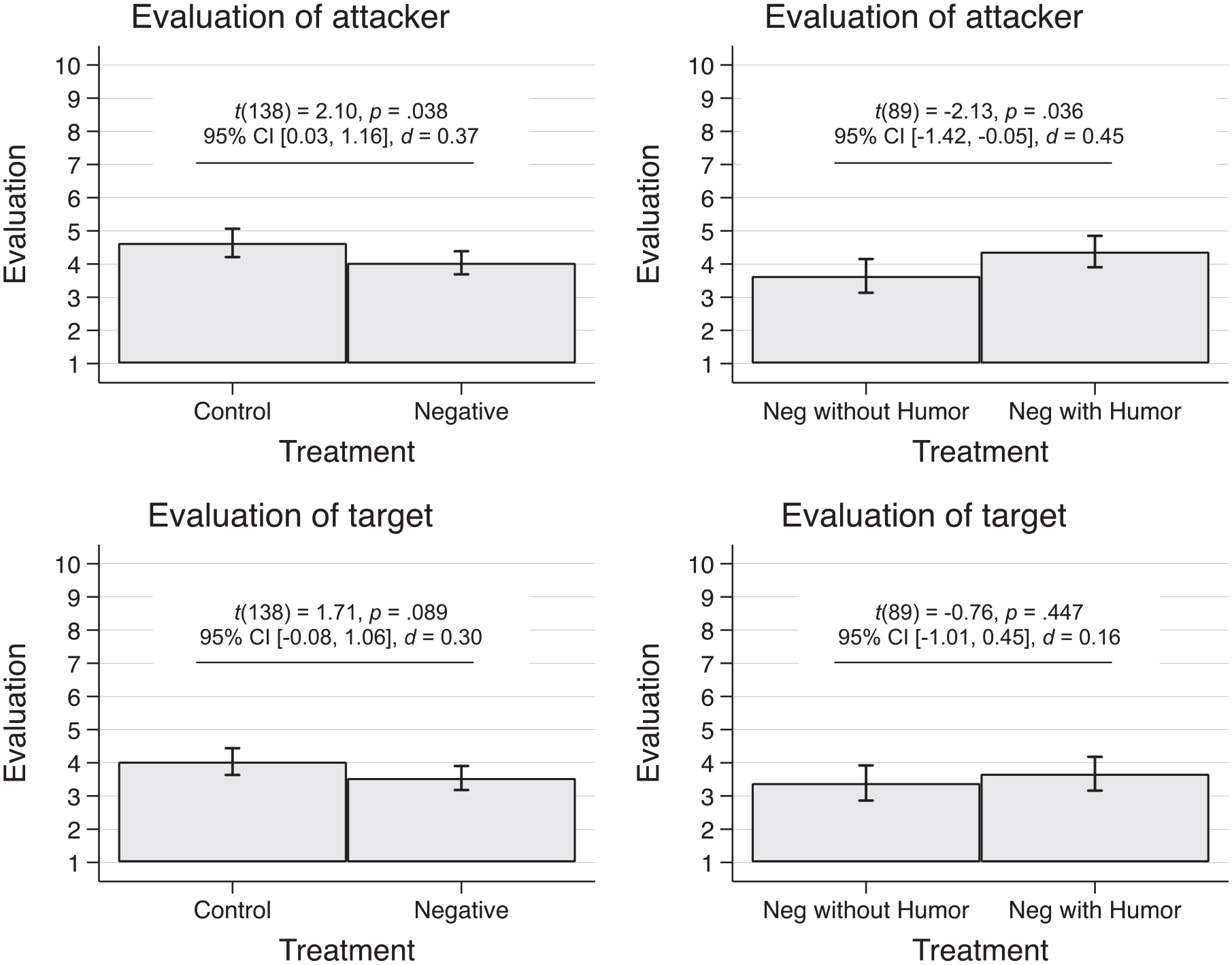
Study 1: Evaluation of attacker and target.
Exposure to a negative message significantly reduces the positive evaluation of the attacker (top left) but also reduces positive evaluations of the target (bottom left). Importantly, exposure to an attack with humor increases the positive evaluation of the attacker when compared with exposure to an attack without humor (top-right panel). This indicates that humor can compensate for the backlash associated with attacks, confirming H1. However, we must reject H2 as we find no effect of exposure to an attack with humor on evaluation of the target when compared with exposure to an attack without humor (bottom-right panel). In other words, funny attacks do not appear to make any difference. The magnitude of the effect sizes (Cohen’s d), also reported in the figure, coupled with the small sample size, makes the achieved power for study 1 rather low, so the results should, thus, be treated cautiously. 9
Study 2: The United States (Party Figures)
In November 2018, following the midterm elections, we gathered information from a convenience sample of U.S. respondents (N = 803). The experimental setting played out in the form of an unnamed Democrat leader attacking the Republican Party in a speech for their handling of health care reform, with and without jokes. We used Amazon’s Mechanical Turk (MTurk), a crowdsourced data platform, to recruit respondents by offering a small incentive to complete a brief survey. Respondents were initially screened for U.S. citizenship. Although there is no guarantee that the samples are fully representative of the U.S. population, a number of studies have found that MTurk produces results that are similar to more traditional surveys. For instance, Berinsky, Huber, and Lenz (2012) find that MTurk samples tend to be more representative of the U.S. population than other types of convenience samples. Clifford, Jewell, and Waggoner (2015) report that MTurk samples tend to mirror the psychological divisions of liberals and conservatives in the U.S. general population, and Buhrmester, Kwang, and Gosling (2011) show that compensating respondents does not affect the overall quality of the data gathered with this method.
Protocol
Respondents were randomly exposed to either a positive message where a nondescript “leading figure from the democratic party” defends their party record on health care (control group; N = 201) or a negative message attacking the Republican Party on that same issue (N = 402); this latter was either coupled with a joke (N = 201), or not (N = 201). 10 On top of the humorous content (joke), the treatment also used written modifiers (“I’m kidding, I’m kidding”) and in the attack, “enough joking” to indicate that the statement was a joke that was designed to take the edge off of the attacks. The use of these verbal stimuli was also designed to substitute for an OAR.
Randomization checks show that the experimental groups used in our comparisons are not significantly different in terms of gender, education, or ideological leaning (how much they like the Democratic Party). Manipulation checks were successful; respondents exposed to a negative message (vs. positive) were significantly more likely to evaluate the message as being “negative,” and respondents exposed to the negative message that included a joke (vs. negative message without a joke) were significantly more likely to perceive the message as “amusing” (see Supplemental Appendix A for details).
Measures
After exposure to the treatment, respondents were asked to evaluate both Democrats and Republicans (in general) in terms of their competence to handle the issue of health care, trustworthiness, and seriousness (from 1 “Strongly disagree” to 7 “Strongly agree”). Answers to these questions were used to measure evaluation of the attacker (Democrats) and target (Republicans); reliability of the two indexes is very high. 11
Results
Figure 2 illustrates the results of four t tests. The two top panels estimate differences in perceptions of the attacker, and the two bottom panels perceptions of the target. In both cases, the left-hand panel compares respondents exposed to positive vs. negative messages, and the right-hand panel respondents exposed to negative messages with and without a joke. The figure shows the complete absence of direct effects of exposure to political attacks for both evaluations of the party of the attacker and the target, both in general and comparing attacks with and without humor. 12 Such an absence of direct effects is likely to reflect the rather impersonal nature of the protocol, which puts into play generic actors (a nondescript Democrat attacking the Grand Old Party; GOP), perhaps indicating that negativity and humor are more impactful when specific persons are involved: the third study examines this question (see below).
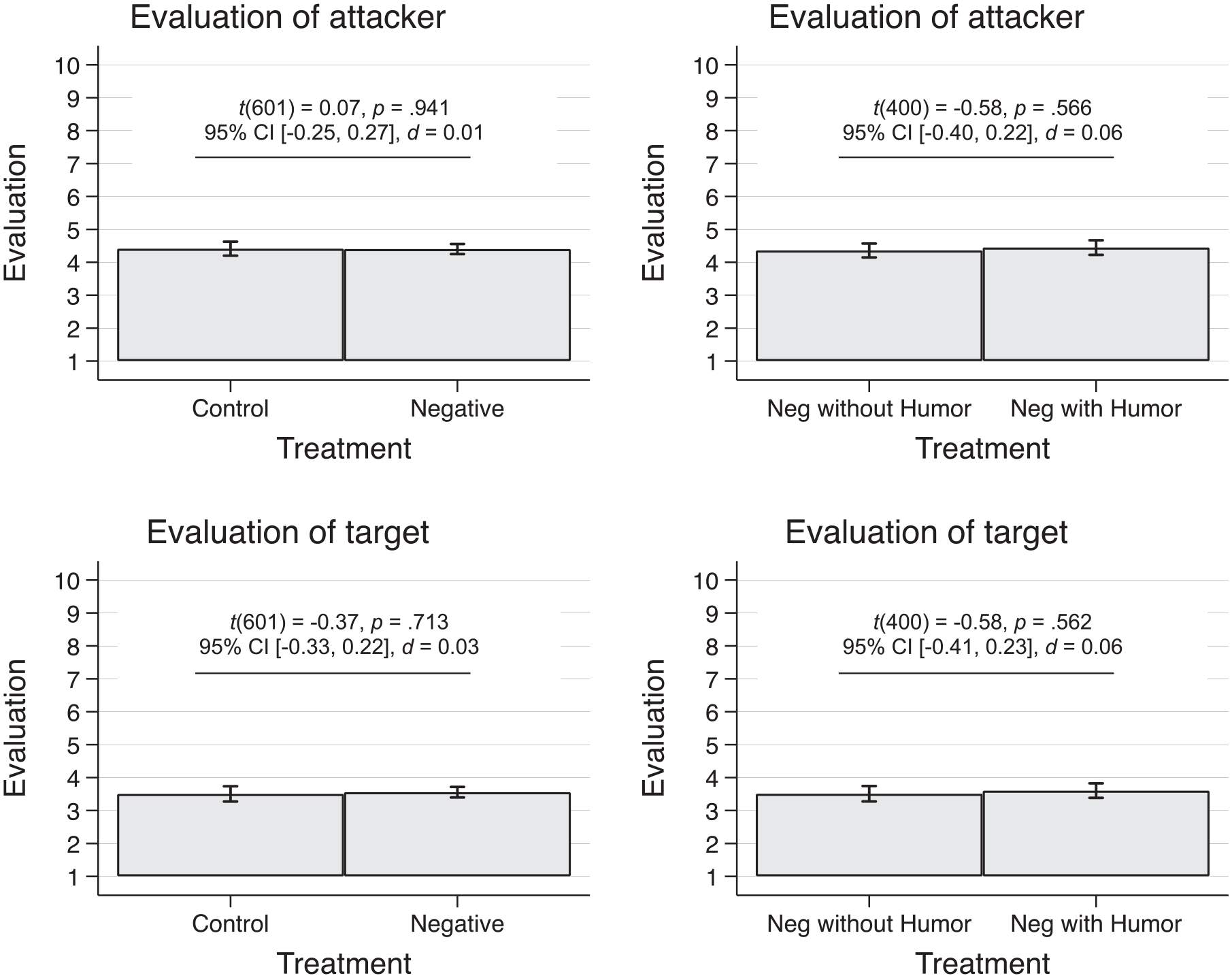
Study 2: Evaluation of attacker (Democratic Party) and target (Republican Party).
Humor is, however, in the eye of the beholder, suggesting that the effects of attacks that contain a humorous element could be stronger when the attack is, indeed, perceived as such. To explore this further, Figure 3 presents the results of two mediation analyses where the effects of exposure to negative messages with a joke (vs. without) on evaluation of the party of the attacker (top diagram) and the target (bottom diagram) are mediated by the perceived humor of the message. The top diagram shows that a significant indirect path exists, connecting exposure to an attack with humor to a more positive evaluation of the attacker via perceived humor of the message. If the indirect effect is rather weak overall, it exists above and beyond a nonsignificant direct effect. Its direction is generally in line with our first expectation (H1; jokes reduce the backlash against the attacker). This suggests that in some circumstances, it is not mere exposure to jokes that matter—those jokes need to be perceived as amusing for them to reduce the backlash of negative messages against the attacker. No significant indirect path is shown for evaluation of the target, rejecting again H2.
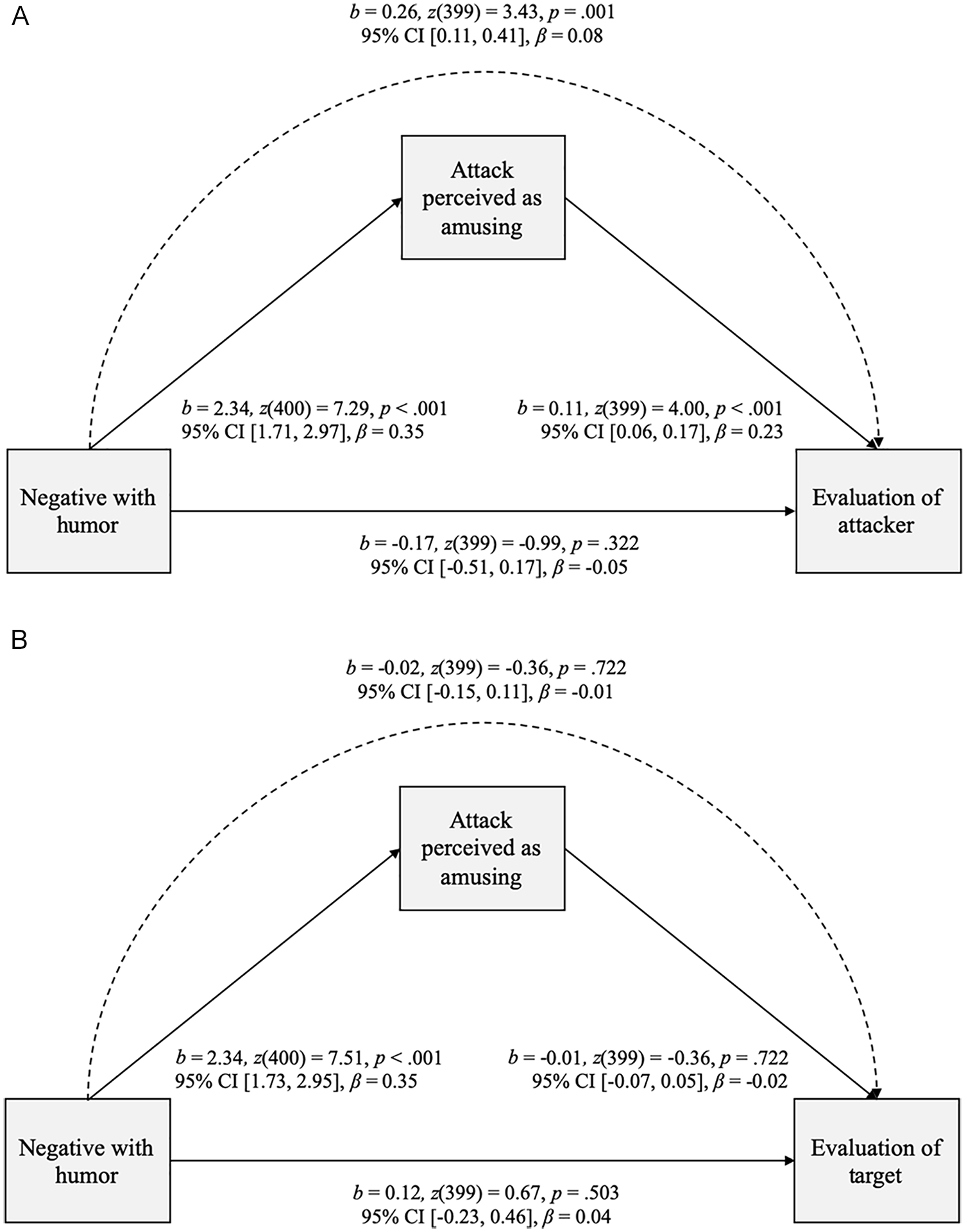
Study 2: Evaluation of attacker (Democratic Party) and target (Republican Party), effects mediated by message perception. (A) Evaluation of attacker. (B) Evaluation of target.
To be sure, the fact that perceived humor of the message (the mediator) is measured, logically, after exposure to the experimental treatment could raise issues of posttreatment biases (Montgomery, Nyhan, and Torres 2018), most notably in terms of sequential ignorability—that is, the fact that unmeasured confounders could possibly exist and bias the mediation coefficients (Imai et al. 2011). We have performed a sensitivity analysis to assess “how strong an unmeasured confounder would have to be related to both the mediator and to the outcome to substantially change conclusions being drawn about the direct and indirect effects” (VanderWeele 2016, 25). Results (Table C1 and Figure C1 in Supplemental Appendix C) reveal that the magnitude of the correlation between the residual variances for mediator and outcome necessary for the Average Causal Mediation Effect (ACME) to disappear is not excessively high for the attacker (ρ = .22) and is very low for the target (ρ = −.02), indicating that the presence of confounders cannot be excluded. While sequential ignorability issues are frequent in mediation analyses, the results above should nonetheless be taken with caution, especially for the target.
Finally, because political satire has been shown to be especially effective for liberals (e.g., Young et al. 2019), we explore how the effects of party orientation are moderated by negativity and humor. Table 1 presents the results of four models. Model 1 and model 2 estimate evaluations of the attacker, while model 3 and model 4 estimate evaluations of the target. The first model investigates the effects of exposure to a negative message (vs. positive), while the second model examines negative ads only, comparing the effects of exposure to a negative message with a joke and one without. All models include an interaction term between the treatment and respondent’s party orientation (how much they like the Democratic Party, 0–10, measured prior to the experimental component). Only one significant interaction appears, between party orientation and exposure to a negative message that included a joke on evaluation of the target (M4). Figure 4 illustrates this effect with marginal effects. As the figure shows, exposure to an attack from a Democratic candidate (attacker) generally produces increasingly more negative evaluations of the Republican Party (target) as respondents have an increasingly positive opinion of the Democratic Party. This effect simply reflects motivated reasoning and is not particularly surprising per se. More importantly, the figure shows that strong Democrats have a better opinion of the target after being exposed to an attack that includes humor (shown in Figure 4 with black diamonds) when compared with exposure to an attack without humor (shown in Figure 4 with white circles). Humor, in other words, seems to take away the sting of political attacks, which is in line with what we anticipated (H2). Because this effect is only present for a specific subpopulation (strong Democrats), we cannot confidently conclude that this provides support for our hypothesis, which is, thus, again rejected.
Study 2—Evaluation of Attacker (Democratic Party) and Target (Republican Party), Effects Moderated by Partisan Attitudes.
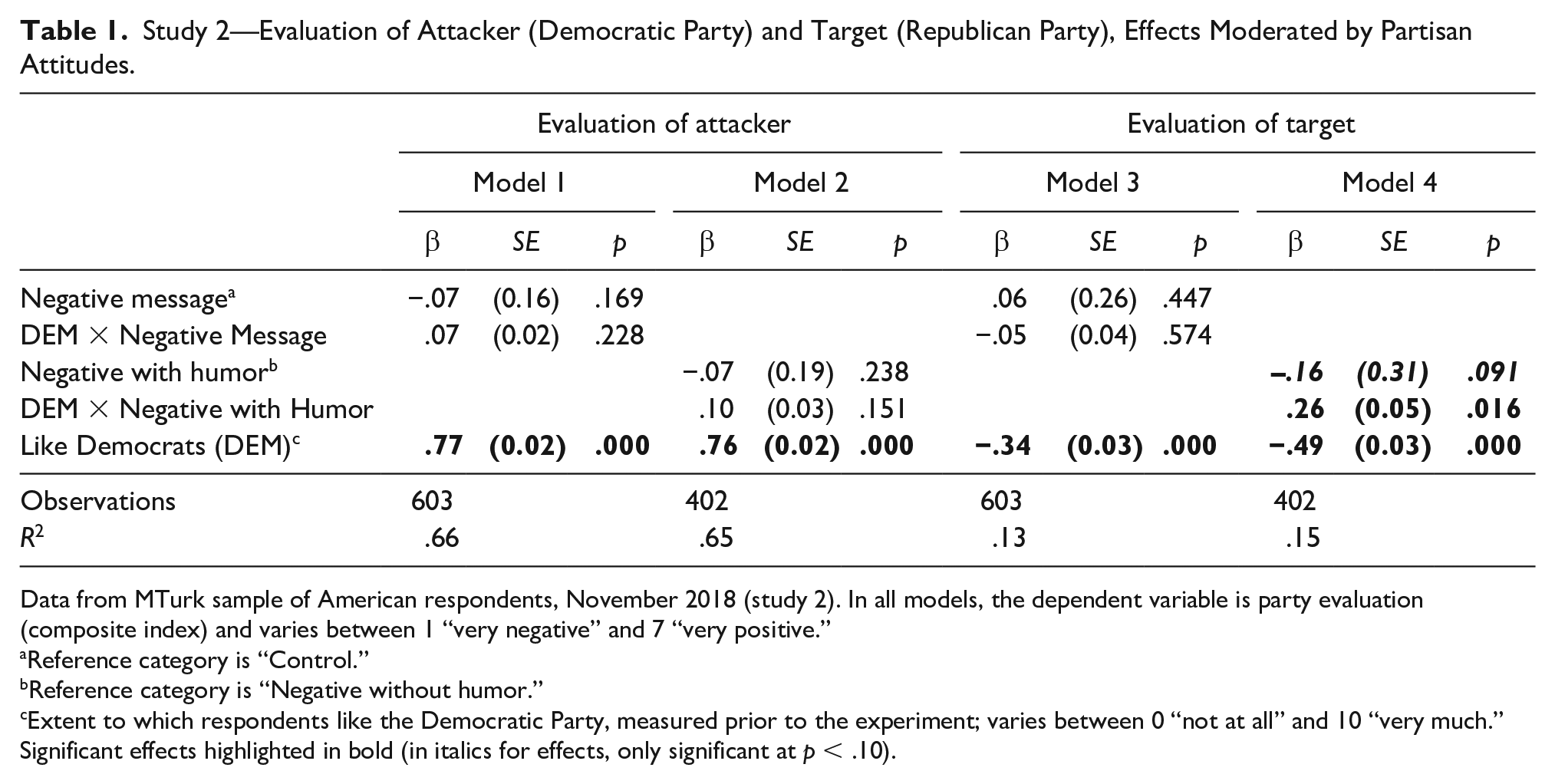
Data from MTurk sample of American respondents, November 2018 (study 2). In all models, the dependent variable is party evaluation (composite index) and varies between 1 “very negative” and 7 “very positive.”
Reference category is “Control.”
Reference category is “Negative without humor.”
Extent to which respondents like the Democratic Party, measured prior to the experiment; varies between 0 “not at all” and 10 “very much.”
Significant effects highlighted in bold (in italics for effects, only significant at p < .10).
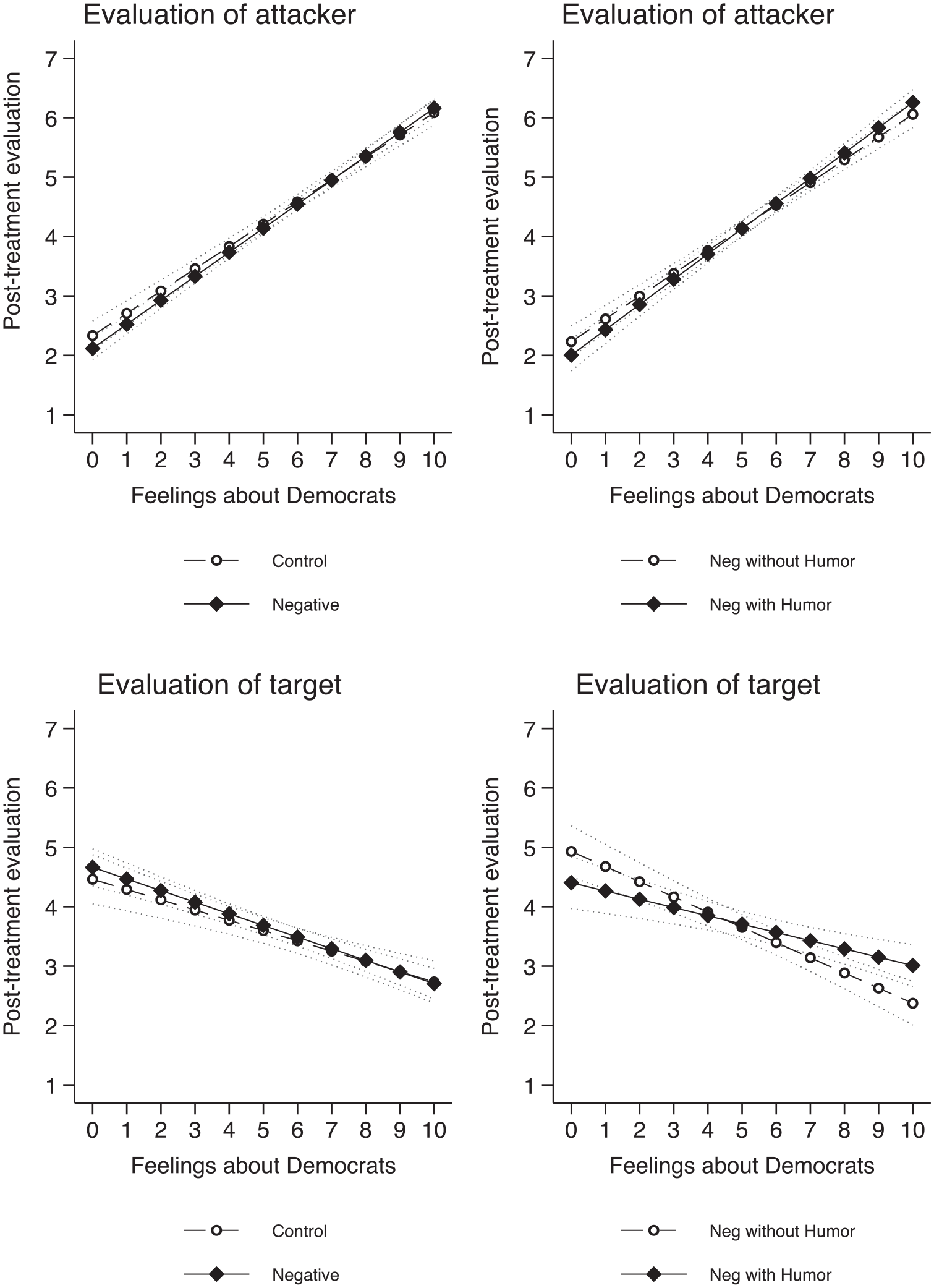
Study 2: Effects of partisanship moderated by negative advertising and humor.
Study 3: The United States (Explicitly Named Actors)
The third experiment, fielded in May 2019, which was also on a convenience sample of U.S. respondents (MTurk; N = 1,408, after exclusion of one hundred respondents who failed an attention check), expands and develops the previous protocol. In this experiment, we explicitly named the attacker and the target of the message.
Protocol
All messages were sponsored by Pete Buttigieg, who had announced his candidacy for the Democratic nomination for president a month earlier. Respondents were randomly exposed to either a positive message from Buttigieg (control group; N = 200) or a negative attacking Mitch McConnell, at that time, the Republican Senate Majority Leader (N = 1,208); this latter was either coupled with humorous content, or not (respectively, N = 605 and N = 603). 13 As in the previous experiment, the treatment also used written modifiers (“I’m kidding” and “enough joking”) to indicate that the statement was a joke that was designed to take the edge off of the attacks.
Randomization checks show that the experimental groups used in our comparisons are not significantly different in terms of gender, education, or ideological leaning (on a 5-point scale from strong Republican to strong Democrat). Manipulation checks again were successful; respondents exposed to a negative message (vs. positive) were significantly more likely to evaluate the message as being “negative,” and respondents exposed to the negative message that included a joke (vs. negative message without a joke) were significantly more likely to perceive the message as “amusing.” See Supplemental Appendix A for details.
Measures
After exposure to the treatment, respondents were asked to independently evaluate Buttigieg and McConnell in terms of six characteristics (competent, likable, funny, disagreeable, knowledgeable, qualified) from 1 “Strongly disagree” to 7 “Strongly agree.” After reversing one item (disagreeable), answers to all questions were used to measure positive evaluations of the attacker (Buttigieg) and target (McConnell); in this case as well, the reliability of the two indexes is very high. 14 As for study 1, for both candidates, all character statements load into a unique underlying dimension (PCA), indicating that respondents evaluated the two candidates along a general factor (general likability; see Tables D3a to D4c, Supplemental Appendix D). As for study 2, the two measures are negatively correlated, r(1,406) = −0.25, p < .001.
Results
The results are presented in Figure 5. As with the first study, where the two candidates were also explicitly identified, exposure to attacks significantly reduces positive evaluations of both the attacker and the target (both left-hand panels). Exposure to humorous attacks, however, does not seem to have specific direct effects. 15 The effect of exposure to humorous attacks has, however, a significant—and substantial—effect on evaluations of the target when perceived humor of the messages is accounted for. Figure 6 illustrates this indirect effect via mediation models. As already discussed in study 2, because humor is in the eye of the beholder, it is only when the (negative) message is perceived as funny that its effects are exerted. Unlike study 2, however, the magnitude of the mediated effect is now substantial. Furthermore, this substantial positive indirect effect exists above and beyond an equally substantial and negative direct effect. We find here, in other words, strong support for H1: adding humor to the attacks reverses the backlash effects against the attacker caused by simple exposure to the negative message. Of course, an important caveat, which we did not explicitly formulate in our expectations, is that this is the case when the humorous messages are perceived as such. No mediated effect is found for perceptions of the target; we, thus, again reject H2.
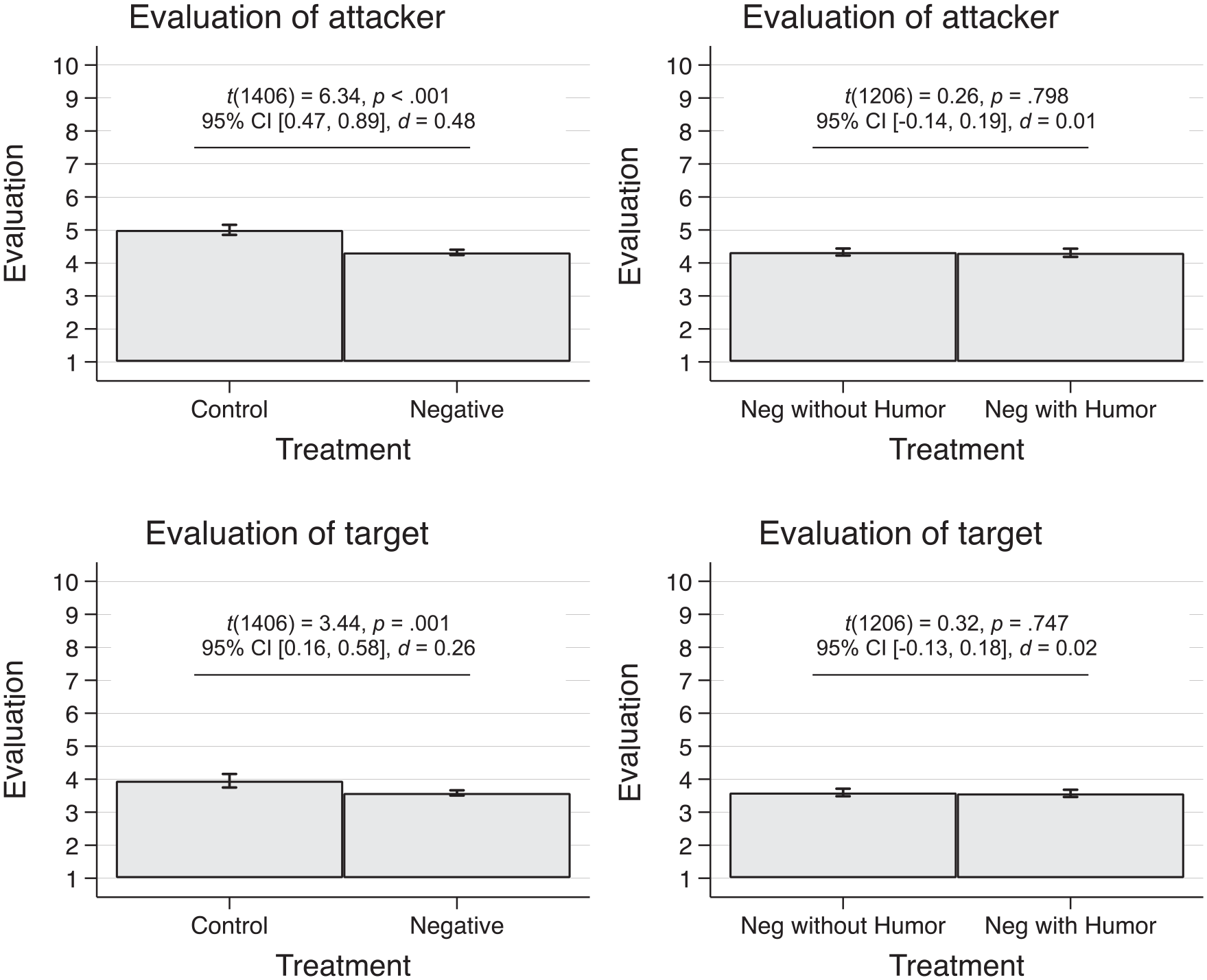
Study 3: Evaluation of attacker (Pete Buttigieg) and target (Mitch McConnell).
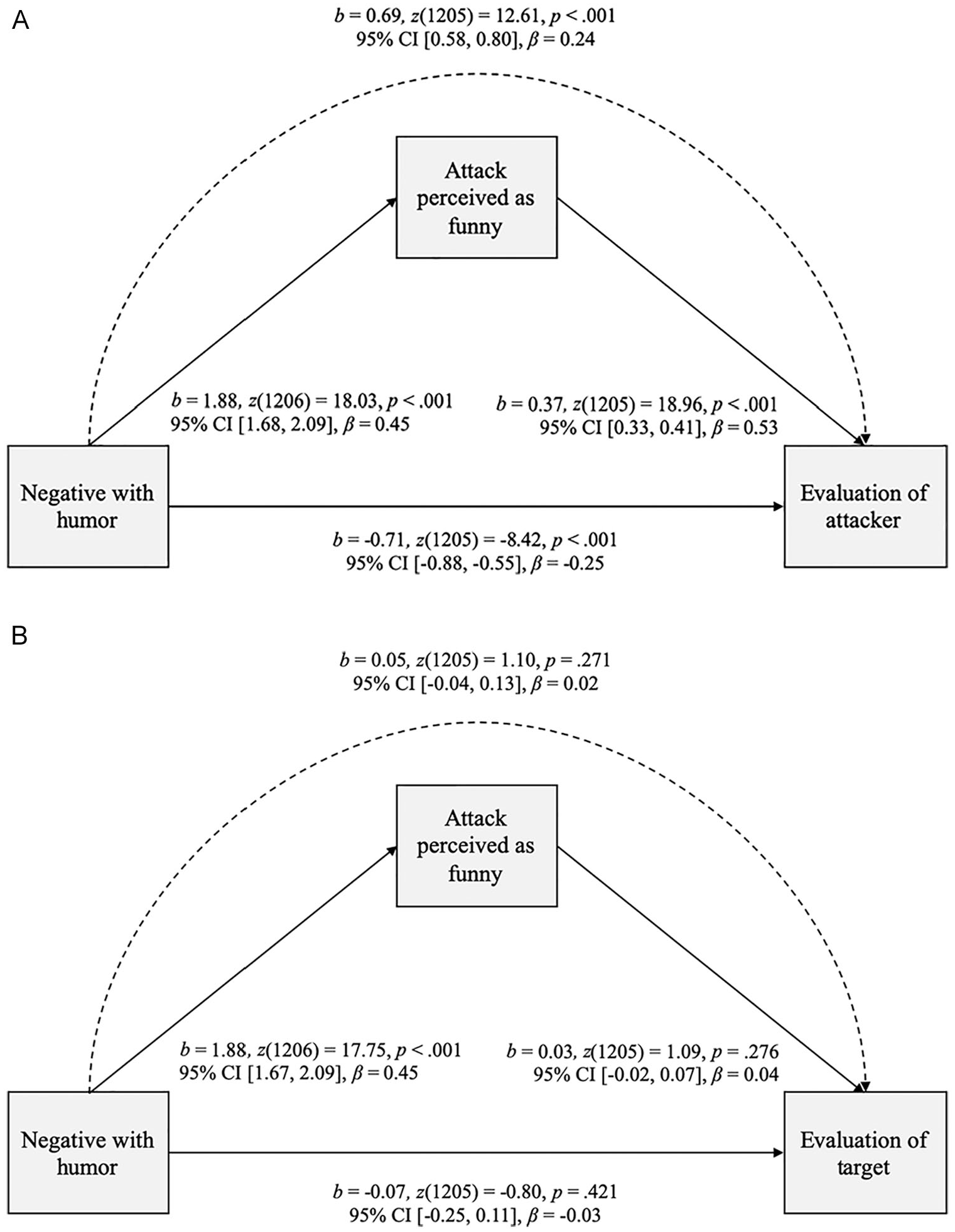
Study 3: Evaluation of attacker (Pete Buttigieg) and target (Mitch McConnell), effects mediated by message perception. (A) Evaluation of attacker. (B) Evaluation of target.
As for study 2, sensitivity analyses (Table C2 and Figure C2 in Supplemental Appendix C) reveal that the magnitude of the correlation between the residual variances for mediator and outcome necessary for the ACME to disappear is not excessively high for the attacker (ρ = .47) and is rather low for the target (ρ = .07), indicating in this case as well that the presence of confounders cannot be excluded.
Finally, as with the second study, we explore how partisan effects may be moderated by negativity and humor. The results are reported in Table 2, and the marginal effects are illustrated in Figure 7. As the figure shows, evaluation of the attacker is a positive function of respondents’ partisan identification. On top of this generalized effect, attacks (left-hand panel) and attacks with humor (right-hand panel) are more effective than their counterparts (respectively, positive messages and attacks without humor) to increase positive perceptions of the attacker. The greater effectiveness for humorous attacks, as compared with attacks without humor, reflects again the idea that political satire is more effective among liberals; the effect is not particularly substantial, even if the interaction is significant.
Study 3—Evaluation of Attacker (Pete Buttigieg) and Target (Mitch McConnell), Effects Moderated by Partisan Attitudes.
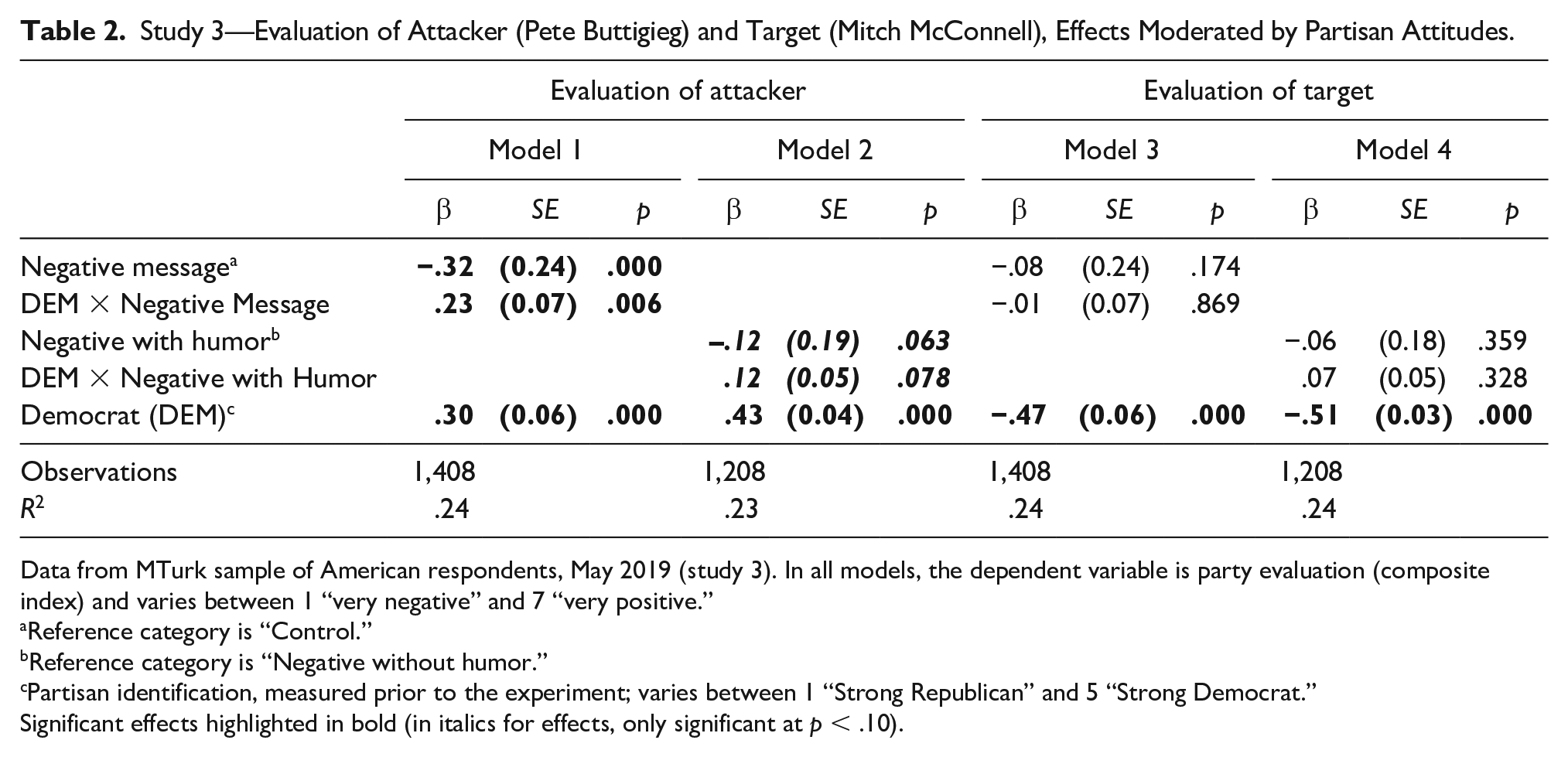
Data from MTurk sample of American respondents, May 2019 (study 3). In all models, the dependent variable is party evaluation (composite index) and varies between 1 “very negative” and 7 “very positive.”
Reference category is “Control.”
Reference category is “Negative without humor.”
Partisan identification, measured prior to the experiment; varies between 1 “Strong Republican” and 5 “Strong Democrat.”
Significant effects highlighted in bold (in italics for effects, only significant at p < .10).
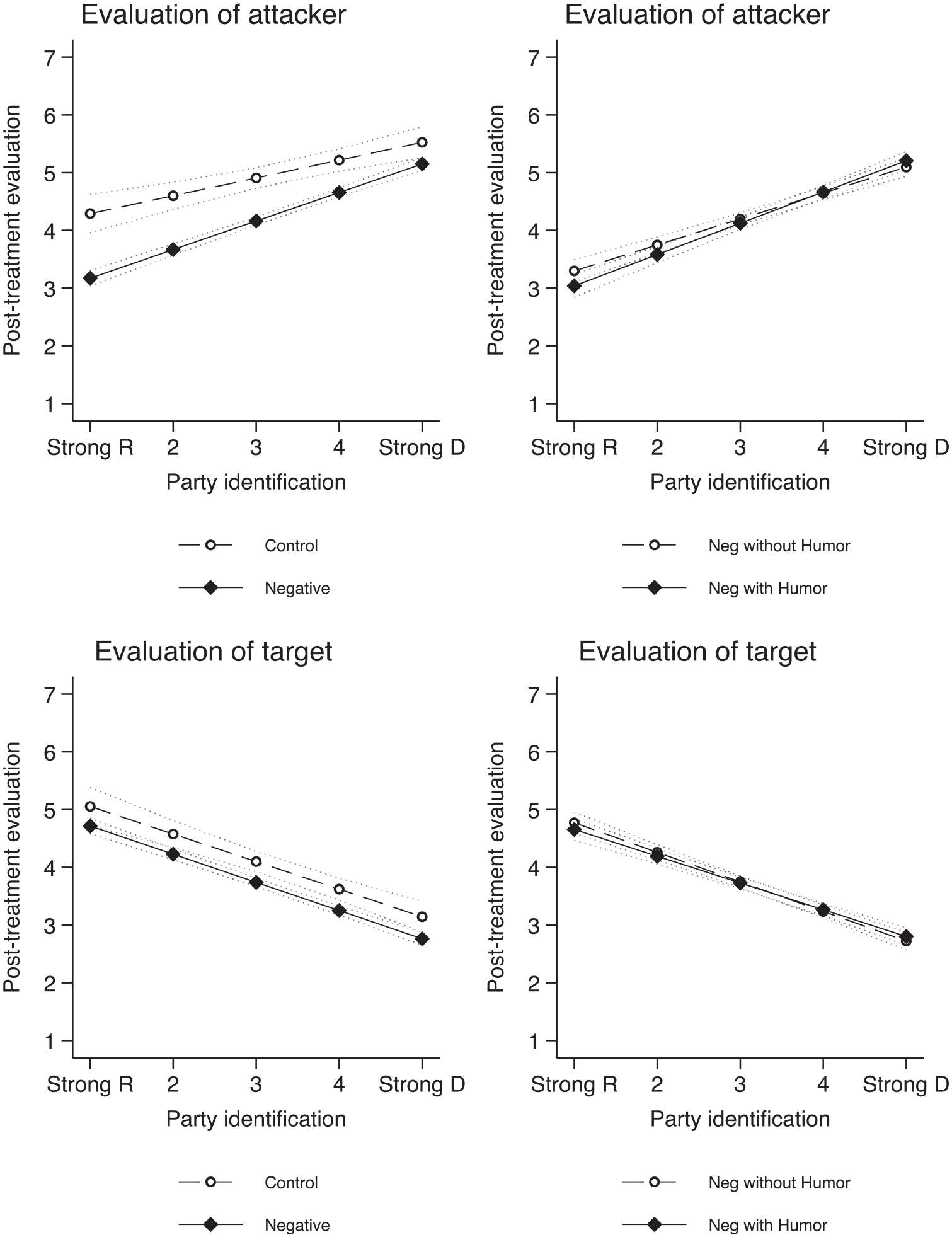
Study 3: Effects of partisanship moderated by negative advertising and humor.
Discussion and Conclusion
The evidence from all three experiments suggests support for our first hypothesis (H1): Combining political attacks with jokes against the opponents reduces the chances that the attacks backfire against the attacker (backlash effect). We find evidence of this effect in all three experiments, in different contexts, ranging from the Dutch multiparty system to the highly polarized current American system. The effect is particularly evident in the first experiment with Dutch students but is also apparent in the United States when the perceived humor of the message is taken into account as mediator. Especially when looking at perceptions of explicitly mentioned candidates (as in study 3), exposure to attacks combined with political humor strongly increases positive perceptions of the attacker—as long as respondents perceive the attack as humorous.
In contrast, we did not find much evidence supporting the second hypothesis, that humor takes away the edge of political attacks in such a way that reduces their overall effectiveness. We did find one instance in which this was the case: in study 2, strong Democrats have a better opinion of the Republican Party after being exposed to an attack from a generic Democrat that also included a joke (compared with the same attack without the joke). But given the absence of generalized effects, including in models that include indirect effects via perceived humor of the message, we generally have to reject H2: funny attacks do not work less well against the target than non-funny attacks.
Taken together, the results presented above suggest that humor can be a silver bullet for political attacks: it reduces harmful backlash effects against the attacker, but does not lower their effectiveness against the target. The fact that these results converge across studies in different contexts, with respondents as different as undergraduate students and the wider general population, and across different issues and competing actors, suggests that the findings have high external validity.
The implications of these results are important. First, from a normative standpoint, our results suggest that the increase in political negativity observed by many scholars and pundits alike (e.g., Geer 2012) has much to gain from being coupled with more lighthearted and amusing messages. A great deal of evidence suggests that political humor has beneficial effects, for instance, in terms of its capacity to boost political participation (Hoffman and Young 2011) and promote political self-efficacy (Hoffman and Thomson 2009; Holbert et al. 2007). This being said, caution is required when concluding that humor can just have positive effects. On one hand, very often, the effects found are rather minimal (Holbert 2013); on the other hand, some scholars have remarked that political humor also has a darker side and can, under some circumstances, increase selective exposure and entrench us in our preconceived ideological stances (Stroud and Muddiman 2013). Recent research shows, furthermore, that in authoritarian contexts, humor can reduce trust, discourage participation, and overall boost political cynicism (Shao and Liu 2019).
Second, from a theoretical standpoint, our results suggest two novel ways forward to solve the conundrum of inconclusive findings regarding the electoral effectiveness of negative campaigning (Lau, Sigelman, and Rovner 2007). As already noted by Lau and Pomper (2004, 19) nearly two decades ago, “it would appear, à la Newton’s third law, that for every research finding about the effectiveness of negative advertising, there is an equal and opposite research finding.” Our results suggest, on one hand, that research should focus on the content of attacks beyond differences in tone and scope (e.g., policy vs. personal attacks) and consider the use of humor and its implications; on the other hand, our results suggest indirectly that individual differences are likely to matter even more in this context. Appreciation for satirical content is in the eye of the beholder, and a great deal of evidence exists that the “sense of humor” strongly correlates with personality traits and other dispositional constructs (e.g., Ruch 2010; Thorson and Powell 1993).
Finally, from the practitioners’ standpoint, our results appear to support the idea that negative campaigning works, in line with what is usually claimed by modern political consultants and other modern campaign managers (e.g., Francia and Herrnson 2007; Geer 2012). To be sure, the public dislikes excessive attacks; yet, the end goal of consultants and spin doctors is not to please the masses but, more prosaically, to get ahead of their competitors—often no matter what, especially in electoral systems characterized by a winner-takes-all logic. Our results in this sense come, however, with a (perhaps major) caveat: practitioners should be careful in concluding that humor is a boon for negative campaigning across the aisle. Results presented in this paper, and especially those for the U.S. case, only apply to political attacks from Democrats against Republicans—for example, Buttigieg attacking McConnell—and not the other way around. For pragmatic reasons related to sample size, it was not possible to test for all the configurations of attack and humor for both Democrats and Republicans as attackers (and, respectively, as targets). We also explored whether the effects of humorous attacks would matter more to Independents than those who strongly identify with either the Democrats or Republicans but found no significant differences. 16
Importantly, recent research suggests that liberals and conservatives may react differently to certain forms of humor. Liberals are more appreciative of ambiguous humor or irony, as exemplified by Stephen Colbert’s portrayal of a conservative pundit stating arguments that are the opposite of what he means. In comparison, conservatives tend to react more to exaggeration-based humor or hyperbole (Young et al. 2019). This could help to explain the success of the Lincoln Project, which featured a series of hyperbolic ads sponsored by Republicans attacking President Trump (Young 2020). Although our analysis does not deal directly with humor about politics, this could suggest that our results may be less generalizable to “other-deprecatory humor” from conservatives against liberals. More research is needed to establish whether conservatives are just as likely as liberals to react to these types of humorous attacks.
Similarly, further research should strive to model the mediating effect of message perception in a more sophisticated way. As mentioned earlier, the issue of precise identification of causal mechanisms in experimental research is tricky when posttreatment factors are involved—in our case, the mediating role of message perception. The probable existence of confounders on both the effect of the treatment on the mediator and the mediator on the final outcome likely biases the direct effects of experimental treatment (Imai et al. 2011), and, as such, causality becomes again muddled. Unfortunately, “there is no free lunch when analysing mediators in an experiment” (Montgomery, Nyhan, and Torres 2018, 772), and solutions to these potential unwanted influences—for instance, two-stage mediation models where the effect of the experimental treatment is only supposed to alter the mediator but not the final outcome, itself only driven by the mediator (J. G. Bullock, Green, and Ha 2010)—are not easily implemented. With this in mind, further research should nonetheless strive to disentangle the complex mechanisms between exposure to negative message, perceived humor, and candidate perception—perhaps investigating the moderating role of individual differences driving a differential perception of (negative) messages and preferences for more aggressive types of humor, such as dark personality traits (Nai and Maier 2021; Veselka et al. 2010).
Supplemental Material
sj-pdf-1-prq-10.1177_10659129211023590 – Supplemental material for Are Political Attacks a Laughing Matter? Three Experiments on Political Humor and the Effectiveness of Negative Campaigning
Supplemental material, sj-pdf-1-prq-10.1177_10659129211023590 for Are Political Attacks a Laughing Matter? Three Experiments on Political Humor and the Effectiveness of Negative Campaigning by Iris Verhulsdonk, Alessandro Nai and Jeffrey A. Karp in Political Research Quarterly
Footnotes
Acknowledgements
We are very grateful to the anonymous reviewers and Political Research Quarterly editors for their critical but constructive comments and encouragements during the publication process. Any remaining mistakes are, of course, our responsibility alone. Previous versions of this article were presented at the 2019 annual meeting of the International Society of Political Psychology (ISPP) in Lisbon, the 2020 annual meeting of the Netherlands-Flanders Communication Association (NeFCA) in Amsterdam, and the 2020 (virtual) annual meeting of the International Communication Association (ICA). Our sincere thanks to all participants at these events for their inputs.
Declaration of Conflicting Interests
The author(s) declared no potential conflicts of interest with respect to the research, authorship, and/or publication of this article.
Funding
Alex Nai acknowledges the financial and logistic support from the Amsterdam School of Communication Research (ASCoR).

Supplemental Material
Notes
References
Supplementary Material
Please find the following supplemental material available below.
For Open Access articles published under a Creative Commons License, all supplemental material carries the same license as the article it is associated with.
For non-Open Access articles published, all supplemental material carries a non-exclusive license, and permission requests for re-use of supplemental material or any part of supplemental material shall be sent directly to the copyright owner as specified in the copyright notice associated with the article.
