




Abstract
Does the process of making a constitution affect the expansiveness of rights protections in the constitution? In particular, is more participation in constitution-making processes better for minority rights protections? While the process of constitution making and its impact on various outcomes have received significant attention, little is known about the impact public participation or deliberation in this process has on the scope and content of minority rights. Using a wide variety of data to empirically assess the relationship between constitution-making processes and the protection of rights for minorities, we find a positive relationship between participatory drafting processes and the inclusion of minority protections in constitutions under some conditions. The article’s findings have important implications for understanding political representation and lend support to core arguments about the role of the public in constitutional design.
Introduction
Public participation in constitution-making processes potentially raises one of the central problems for liberal democracies: the difficulty of protecting the interests of minorities through majoritarian political processes. Does more public involvement in the constitution-making process lead to more protection of minority rights in constitutions, or do majorities protect their privileged status? Although the process of constitutional design and its effect on democratic performance, horizontal and vertical accountability, and the management of conflicts, are part of a well-established research agenda, we know very little about the link between public participation and minority protection in constitution making and constitutional design. Scholars largely agree that the selective use of participatory elements in the constitution-making process is an important instrument of legitimation (Chambers 2004; Hart 2003, 2010; Tekin 2016). However, there is still disagreement about the effect that public involvement has on the outcome, both in terms of the text itself and the larger political system (Ackerman 1998; Horowitz 2000; Saati 2017).
We can usefully divide the literature on the effects of constitution-making processes (separately from the effects of constitutions themselves) into works that inquire into the relationship between the drafting process and larger systemic outcomes (e.g. democracy), and works that consider the way in which the drafting process may or may not influence the content of the formal constitution. In the second group, we find works that consider both the overall quality of the constitutional text (Elster 1995; Fruhstorfer 2019; Horowitz 2000; Voigt 2004), and works that consider the relationship between individual provisions and the drafting process (Hudson 2018; Maboudi 2019; Maboudi and Nadi 2016).
The larger body of research in this area has a system level focus. Authors who have contributed to this literature seek to understand the role direct democratic processes have on a broader set of political outcomes, for example, democratic development (Eisenstadt, LeVan, and Maboudi 2017a), peace, or political legitimacy (Wallis 2014). Here, scholars argue that more direct citizen participation will lead to better democratic outcomes (Eisenstadt, LeVan, and Maboudi 2015; Eisenstadt, LeVan, and Maboudi 2017a). More recent research in this area has softened the implicit majoritarian aspect of the theory, as Eisenstadt and Maboudi (2019) have turned to inclusion as the key variable to predict a successful constitution-making process. Although there are by now a significant number of scholarly engagements with related questions, we are not aware of any studies of the effects of public participation in constitution-making processes on the inclusion of minority rights. Furthermore, theoretical and empirical research has rarely focused on this potential relationship. We still know surprisingly little about how the dynamics of direct democratic input and majority representation influences the accommodation of minority rights in the constitution.
This study therefore addresses both systemic and textual outcomes by studying the way in which participatory drafting processes may help or hinder efforts to include minority rights protections in national constitutions. We argue that the manner and timing of public involvement in the constitution-making process influence whether and to what extent minority rights are protected in the constitution. Due to the inherent danger that majoritarian processes support the development of something approaching the tyranny of the many, and the various traps direct democratic processes can create, participatory constitution-making processes present a real danger that the constitution they create will provide only for the majority, or even worse to discriminate against the minority.
Despite these expectations about political participation and minority rights, we find evidence of a positive association between some forms of public participation in the constitution-making process and broader protections for minority rights. Public participation in a comprehensive and undifferentiated sense (which includes diverse forms of participation, from public deliberation to ratifying referenda) has only a tenuous connection to the provision of minority rights. However, we probe further and find that public participation has a positive and significant effect when it occurs at the earliest (convening) stage of the process. Participation seems to have no effect if it occurs in later stages of the constitution-making process. Even after controlling for the level of minority rights protection in the respective previous constitution, we find that higher levels of participation predict more minority rights protections. This suggests that the timing of participation matters a great deal, and our research here has important implications for how constitution-making processes are designed. In the paragraphs that follow, we summarize the expectations that one can draw from the existing literature, outline our hypotheses, describe our data and statistical models, and discuss what the statistical analysis presented here can teach us about this vital relationship between participatory constitution-making processes and minority rights protections.
Participatory Drafting and Minority Rights
Constitutions have immense symbolic, legal, and political roles in both democratic and authoritarian states. They in some sense constitute the political community (Jacobsohn 2010, 8). Most directly, constitutions serve to create “substantive limitations and obligations” in the exercise of the power of the government (Murphy 2007, 6). To fulfill these roles, constitutions must achieve a high level of popular legitimacy, and direct public involvement in the preparation of the constitutional text or at least its ratification through a referendum is seen to accomplish this purpose (Hart 2003). Seeking to increase public acceptance of constitutional reforms, politicians in both democratic and authoritarian systems have embraced public participation in processes of constitutional change. Yet, as referenced above, the impact that public participation in the drafting process has on both textual and systemic outcomes is as yet unresolved.
Any concept of political participation includes a broad range of activities. In its most basic sense, political participation is defined as “citizens’ involvement in political will-formation and decision-making” (Geissel and Michels 2018, 129). In this formulation, a contrast is developed between activities that involve deliberation, and more classic forms of political decision making like voting and lobbying (della Porta 2013; Dryzek 2002). Public participation in constitution-making processes also takes various forms. It increasingly involves public consultations (that can involve both deliberation and majoritarian democratic decision making) prior to or during the drafting of the text. However, historically the most common form of public participation has been the simple act of ratification via referendum (Elkins and Hudson 2019).
Despite increasing enthusiasm for participation among both scholars and international organizations (Brandt et al. 2011; Gluck and Brandt 2015), the average aggregate level of public participation through all stages of the drafting process has remained relatively steady over the past few decades—though the data show a great deal of variation from year to year (see Figure 1). It is also difficult to discern a clear trend regarding participation at the convening stage that is of most interest to us (see the second panel in Figure 1). Perhaps diversification is a real trend, as in recent cases we also find a multitude of constitution-building institutions and groups with different mandates and points of involvement, that might function more as a forum of deliberation or with a mandate of majoritarian decision making.
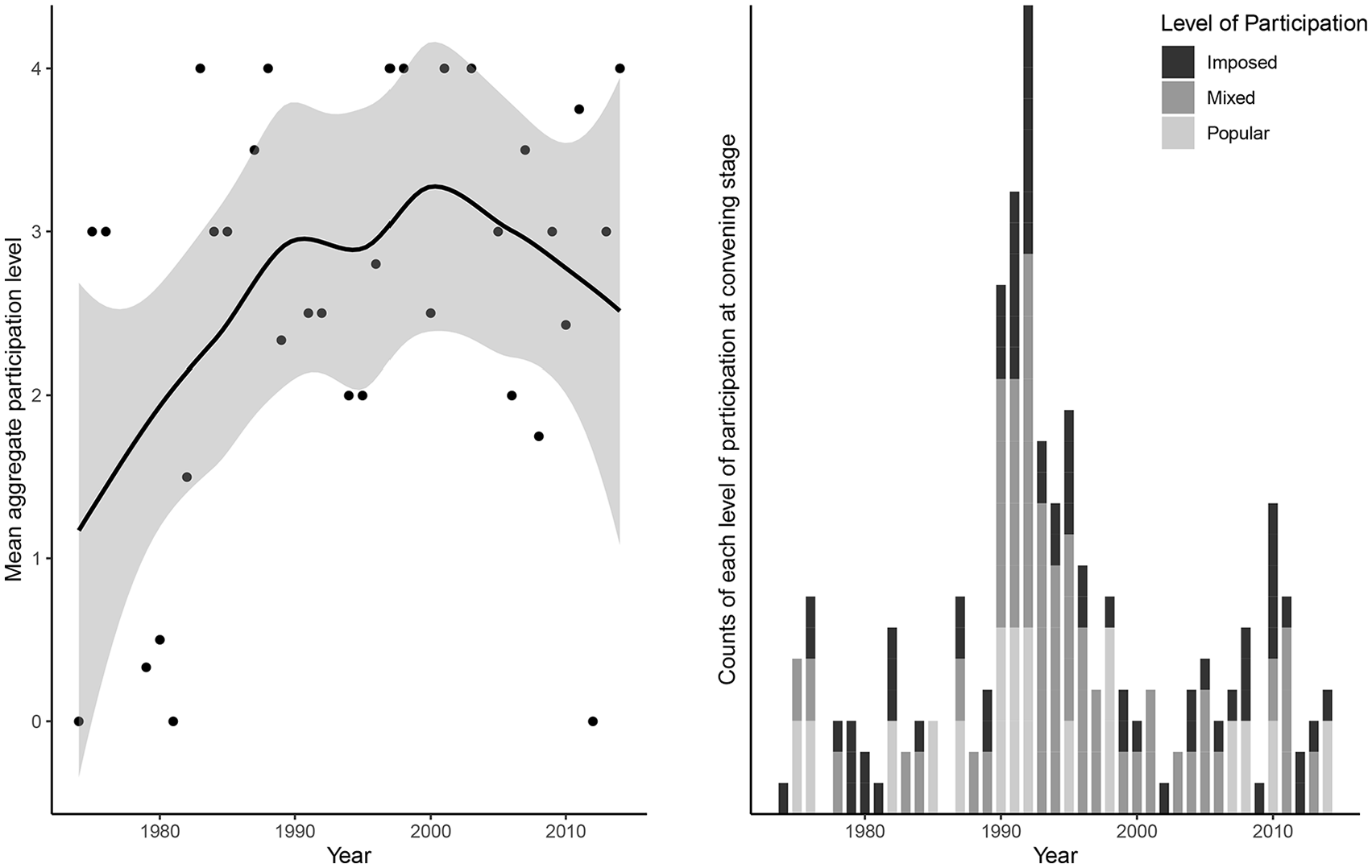
Levels of public participation by year.
When considering the effects of public participation in the drafting process, we differentiate between the various elements and stages. Among others, Widner (2008) and Banting and Simeon (1985) have created well-developed conceptualizations of the stages of the constitution-making process. Yet we argue that these conceptualizations with five or six stages are cumbersome when applied to a broader comparative study. Hence, we adopt a three-stage conceptualization with mutually exclusive categories following Eisenstadt, LeVan, and Maboudi (2017b). They divide the constitution-making process into convening, debating, and ratifying stages. In both theory and practice, individuals and civil society organizations (CSOs) can be involved every step of the way.
The potential links between the process of constitution making and the outcome (both in terms of the text and the political system) are quite significant, yet our understanding of these dynamics is still developing. Some scholars have emphasized the potential positive effects of plebiscitary engagement in constitutional design on democratic development and consolidation (Carey 2009; Eisenstadt, LeVan, and Maboudi 2017a; Samuels 2005). In particular, some of the practitioner literature has highlighted the potential benefits from increased participation and deliberation (Brandt et al. 2011; Gluck and Brandt 2015; Hart 2003, 2010), while others writing for scholarly audiences caution that participation may not have the positive effects on democracy that are hoped for (Saati 2015, 2017; Wheatley and Germann 2013).
When we consider, for example, the post-communist space, scholars started to warn about the damaging long-term effects of popular referenda and extra-parliamentary activities on the substantive role of constitutionalism in politics quite early (Holmes and Sunstein 1995, 290). Studies of these cases illustrate how elites appealed to the constituent power as a revolutionary and ultimate legitimizing force. At the first moment of challenge after the initial transition these same elites used the established populist rhetoric to protect their rule from contenders and ultimately establish an autocratic rule. Also, the inclusion of misinformed citizens or the dominance of a populist agenda can make the constitution a toy in an unworthy game (Chambers 2001, 238).
Yet, “constitution-making is a continuation of politics by other means” (Banting and Simeon 1985, 17), and in polarized societies, when politics is extremely contested and not consensual, deliberation about fundamental principles of social organization might easily be turned into struggles between majorities and minorities. In these cases, majorities often aim to impose a large part of their vision of societal organization onto minorities. Greater participation, following Elster (1995), makes a process more public and thus potentially more majoritarian in nature. There is a small step from majoritarianism to what de Tocqueville (1876, 340) famously called the tyranny of the majority. Horwitz (1966) noted that the prevention of this form of tyranny had been a preoccupation for American political theorists for decades before de Tocqueville’s visit, and constitutional designers as early as James Madison were wary of the role of majority factions in a society (Federalist No. 10). This remains a vital concern worldwide, and in more recent years, scholars have added more theoretical and empirical analyses of the effect of direct legislation on the protection of disadvantaged groups (Donovan and Bowler 1998; Gamble 1997).
The largest study of the effects of participatory constitution making to date has been conducted by Eisenstadt, LeVan, and Maboudi (2015; Eisenstadt, LeVan, and Maboudi 2017a). In an impressively broad statistical analysis of the relationship between participatory constitution-making and democracy, they set out to address the effects of constitution-making processes on levels of democracy. They also make some claims about the relationship between public participation and the protection of human rights, but do not empirically test the relationship (although they include the provision in a constitution of a human rights commission as a control variable). In that analysis, they do not find any significant effect between human rights protections and the level of democracy (Eisenstadt, LeVan, and Maboudi 2017a, 41–45).
It is surprising that none of these studies have sought to understand the impact of public participation in constitution-making processes on the inclusion of minority rights. Perhaps that lends support for the H0 that the inclusion of minority rights in a constitution is unrelated to procedures of the drafting process. We think this is an important concern in constitution-making processes, and one that deserves a rigorous evaluation. Of course, concerns about the relationship between minority rights protections and direct democratic decision making are not restricted to constitutions. In ordinary legislation, direct democratic procedures (often referenda or plebiscites) convey the message of unfiltered and unblemished popular choice. The idea of this clear responsibility without the blurring lines of representative democracy of course raises the prospect of majoritarian tyranny. While Gamble (1997) found clear signs of minority rights repudiation and hostility when the demos decides on civil rights initiatives, others have specified the argument on various influences on a minority supporting versus opposing outcome (for example, the size of the district), presumably in combination with a well-educated population (Donovan and Bowler 1998, 1023). We define minority rights in relation to groups experiencing “a pattern of disadvantage or inequality” (Healey 2011, 16) in comparison with more dominant societal groups. This means “belonging to national or ethnic, religious and linguistic minorities” and explicitly exclude the citizenship component used by Capotorti (1991). Hence, minority rights should offer “the best possible accommodation of the ethnic, religious and linguistic population diversity in these societies” (Koubi 1994, 182) as well as protections of other disadvantaged groups (women or members of the lesbian, gay, bisexual, transgender, and queer/questioning community).
When defending those who belong to a disadvantaged group, minority rights protections range from inclusive institutions to socioeconomic rights (Hart 2001). Minority rights can be defined as “the cultural, linguistic, and wider social and political rights attributable to minority-group members, usually but not exclusively, within the context of nation-states” (May 2006, 255). And, while it is clear that human rights are a substantive part of modern constitutions, the protection of the individual against majoritarianism is not. These measures are of significant importance for democratic development and also obviously to protect minorities from unfair treatment, open hostility, or outright racism (Anagnostou 2005; De Mesquita et al. 2005; Hailbronner 2015). Examples of the disenfranchisement of minority groups or systemically disadvantaged people via direct democratic decision-making tools are manifold (Osiatynski 1994), and we can fully see how this hostility is nurtured by majoritarian dominance and how meaningful it is to constrain it. Despite the dominant tone of pessimism (or at least caution) in studies of direct democracy and minority rights, the comparative study of constitutional content suggests a close relationship between participatory democracy and minority rights protections. Given the larger dynamics of when and where participation happens, and the larger democratic commitments that this implies, we should expect to often find minority rights protections and participatory drafting in the same cases. Yet, the literature is united in emphasizing the negative effect of public participation on minority rights (Christmann and Danaci 2012; Lewis 2011). Be it same-sex marriage, naturalization, or religious rights, the critique of direct democracy as an instrument of majoritarian hegemony is empirically justified. However, we think that this conventional wisdom may overemphasize the potential problems with participatory democracy. Particularly in the context of participatory constitution-making processes, we argue that there are opportunities for minority groups to improve their legal and political position through the addition of minority-protecting rights. Thus, in our first hypothesis we propose the following:
However, public participation is a multifaceted process and some of the authors mentioned earlier subsume theoretically different acts under the concept of public participation and that weakens the clarity of impact (Elkins, Ginsburg, and Blount 2008; Widner 2008). Furthermore, public participation can conceptually include direct or representative decision making, as well as deliberative processes. While some constitution-making processes have their origins in social movements and involve public participation throughout the process, others only involve the public in the final steps of ratification. Hence, we find different ways to involve citizens in the constitution-making process, not only as a constraint as Elster (1995, 373) describes it, but as a source of ideas, inspiration, and empowerment for citizens themselves (Arato 1995; Moehler 2008). Furthermore, the mere prospect of public participation influences how legislative institutions map majority preferences and influence them preemptively in their decision making (Gerber and Hug 1999). The looming downstream constraint of popular ratification through a referendum could influence the drafting of the constitutional text (Elster 2012, 169–70). Depending on the majority’s position on minority issues, this has positive or negative effects on minority rights protections in the constitution.
Previous research has shown that when we distinguish between different steps of the constitution-making process, we see the influence of the process on the subsequent success or failure in democratization (Eisenstadt, LeVan, and Maboudi 2017a). However, a potentially confounding finding is that once started, public involvement often continues through all stages of the constitution-making process using all tools available in these different stages (Eisenstadt, LeVan, and Maboudi 2017a, 115). Our view of the logic of public participation in constitution-making processes suggests that the majoritarian veto possible in ratifying referenda is most likely to harm minority interests. In contrast, the opportunity for minority groups to ensure adequate representation and add issues of concern to the drafting agenda through participation in the convening stage represents the best opportunity for the protection of minority rights. In large part, we build here on the finding in Eisenstadt, LeVan, and Maboudi (2017a) that the convening stage was most important in predicting when public participation in the drafting process will have effects on the subsequent level of democracy. Engaging in the start of a broadly participatory constitutional debate to some degree challenges the idea of representative democracy, but a referendum is just the formal end to a noninclusive drafting process. It is exactly this timing that we argue matters for its effect on the outcome: the earlier in the process the better. Following this sequence argument, we propose the following:
Research Design
To empirically test our theoretical expectations, we draw on existing datasets. 1 We especially rely on the Constitutionalism and Democracy Dataset (CDD) created by Eisenstadt, LeVan, and Maboudi (2017b). Most importantly for our purposes, this dataset codes both the overall (or aggregate) level of public participation in most constitution-making processes between 1974 and 2014 and the level of participation in each of the three phases of the constitution-making process as those researchers define them. We also use data on polyarchy, civil liberties, and various other political institutions from the Varieties of Democracy (V-Dem) project (Coppedge et al. 2020). For data on the content of constitutions (our outcome of interest), we turn to the Comparative Constitutions Project (CCP) dataset (Elkins, Ginsburg, and Melton 2014). We use these data to create a number of statistical models that estimate various aspects of the potential relationship between participatory constitution-making and the inclusion of minority rights in national constitutions.
Dependent Variable
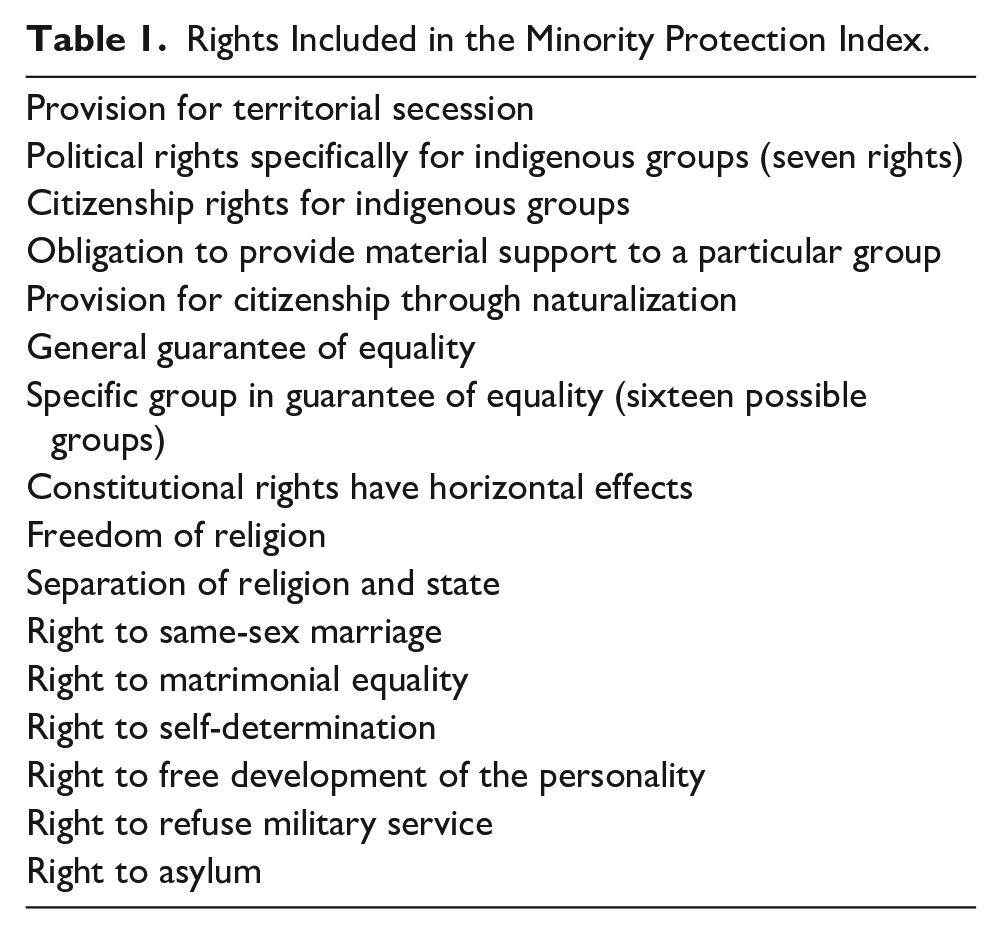
Building on data collected by the CCP (Elkins, Ginsburg, and Melton 2014), we created an index of minority rights protections in constitutions. 2 The selection of the variables forming this additive index is based on the earlier described definition of minority rights as rights aimed to protect groups experiencing “a pattern of disadvantage or inequality” (Healey 2011, 16) in comparison with more dominant societal groups. This approach toward minority rights as not only cultural or linguistic but also in a broader social sense determines the selection of rights included in the minority rights index. The substantive rights included in our minority rights index are listed in Table 1.
Rights Included in the Minority Protection Index.
To determine the impact of public participation in constitution making on minority rights, we use the minority rights index as the dependent variable in our statistical models. The distribution of both the minority index, and the change in the minority index between constitutions are shown in Figure 2. While there is a long tail to the right (more minority rights in the new constitution), the modal value is 0, with mean difference of 0.12. The biggest positive movers in our data were Portugal’s constitution of 1976 (following democratization), Colombia’s constitution of 1991 (responding to a period of democratic renewal and peace negotiations), and the Bolivian constitution of 2009 (drafted after a tumultuous period of political mobilization). The largest negative value in our data is Rwanda’s 1995 constitution (also known as the Rwandan Patriotic Front Declaration), which removed all of the minority rights that had been protected in the constitution of 1991. A number of the post-Soviet constitutions (Moldova, Kazakhstan, Russia, and Georgia) also reduce the number of minority rights as compared with the laws that governed them during the communist period. The only case where a highly participatory drafting process removed some minority-protecting rights from the constitution was Benin’s 1990 constitution, which dropped the number of minority rights from eight to six. We return to several of these cases in the discussion that follows the statistical analysis. However, continuity is clearly the major trend across the sample. This accords with what we should expect about constitutional replacement more generally, that new constitutions often follow the pattern set by the constitution that they replace (Elkins, Ginsburg, and Melton 2009, 55–59).
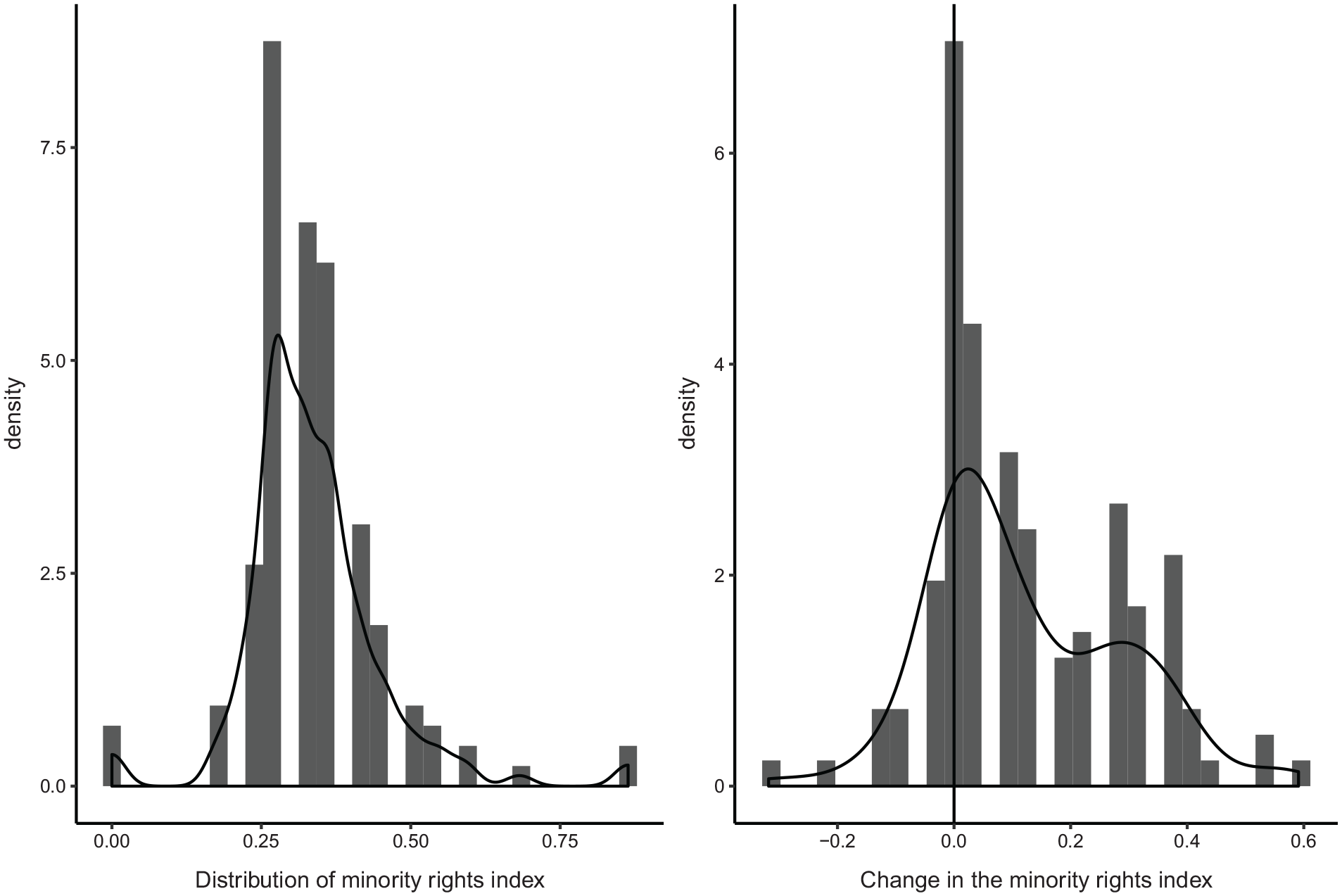
Distribution of the minority rights index (and change therein).
There are some rights (or provisions at least) that have the undeniable intention of protecting minorities. For example, a guarantee of equal treatment under the law for either named or unnamed minorities would be an uncontroversial pro-minority provision. We might also consider gender equality provisions to fall under this category (though women are not a numerical minority). We are also concerned about the possibility that a given provision may have different practical effects than what the text appears to imply. For example, while we include general guarantees of equality under the law in our list of minority-protecting rights, it is possible that such a provision could be applied in a manner that would actually protect the interests of majority groups, as at times happens with religious freedoms. Nonetheless, a guarantee of equal treatment under the law is at the core of most conceptions of minority rights protection.
Independent Variables
Our main predictors of interest are the level of public participation and the timing of participation. As noted above, we turn to Eisenstadt, LeVan, and Maboudi (2017b) for data on public participation in constitution-making processes between 1974 and 2014. Their dataset includes a three category measure of the level of public involvement in the constitution-making process at each of the three stages (convening, debating, and ratifying). We also use their aggregate measure of the participatory nature of the constitution-making process, which varies between 0 and 6. The categorical measure of the level of participation at each stage of the process warrants some critical explanation. The level of participation is measured as imposed, mixed, or popular (Eisenstadt, LeVan, and Maboudi 2015). An imposed level of participation in the convening stages entails either a strong executive, executive appointed committee, or the party as central committee. A mixed level combines a strong elite influence with a special body or legislature involvement. We agree with the distinction between these three categories, but a key deficiency is here the characterization of the popular level of public participation as either of systemic civil society input or strong transparency or specially elected drafters. While this certainly reflects a variety of different forms of input, what is measured here includes shades of representative systems of public involvement and does not necessarily indicate direct participation of citizens. Popular convening in some cases signifies only that the process was representative, a fact we will discuss in more detail when we explain the empirical results. Furthermore, we have to consider that a certain drafting process establishes a path on which the following process usually follows: both in terms of procedure and text. That means, once on the path established during the convening stage, the chances of a certain outcome established at this moment are more likely.
To test our theoretical expectations, we control for the following variables that might potentially confound the hypothesized effects. In particular, we control for variables that previous research suggests can be expected to directly impact voters’ attitudes toward minorities. First, we consider the domestic context in which constitution making takes place, in particular the level of democracy and the existing societal cleavages. We therefore account for the level of democracy in the political system, or more concretely the level of polyarchy as measured by the V-Dem project (Coppedge et al. 2020). This popular measure is based on Dahl (1971) as a mid-range conception of democracy by including classic components as free and fair elections but also inclusive citizenship. Most importantly, we control for the relationship between minority and majority population in the respective country by assessing the level of ethnolinguistic fractionalization (Alesina et al. 2003). This index measures ethnic, linguistic, and religious heterogeneity within a society and is created as one minus the Herfindahl index, reflecting the probability that two individual randomly selected belong to different groups. This gives us a control for the existing level of ethnic fragmentation in a given country. We assume the distribution of minority and majority groups within the population might have an effect on the constitutionalization of minority rights. In addition, the relationship between minority and majority population in the respective country is relevant for the level of possibilities to participate and for the existing societal cleavages.
We also include some control variables that account for international factors. Using data from the Uppsala Conflict Data Program (UCDP) and International Peace Research Institute, Oslo (PRIO), we add a variable that records the mean level of conflict intensity in the drafting year and the two prior years (Gleditsch et al. 2002). In addition, we created a variable using World Bank data to estimate the mean level of official and development aid as a share of gross domestic product (GDP) in the year of drafting and the two prior years. To account for more direct international intervention in the drafting process, we coded a dummy variable that records whether or not there was an official presence from the United Nations Department of Peace Operations (UNDPO), United Nations Department of Political and Peacebuilding Affairs (UNDPPA), or a mission from a regional governance organization. 3 Summary statistics for all the variables described here are found in the supplemental materials.
Before we proceed, we also have to address two potential problems with endogeneity. First, past research has shown that the content of the previous constitution is the most important determinant of the content of a new constitution (Elkins, Ginsburg, and Melton 2009, 55–59). Thus, we may encounter a situation in which our estimates of the relationship between participation and a textual outcome are biased by an omitted measurement of the previous constitutional situation. To address this potential problem, we add a control in some of our models for the content of the previous constitution. Second, we more systematically test for endogeneity in the form of simultaneity through a two-stage least squares model. We discuss this in more depth later in the Analysis section, and do not find that there is a significant problem with endogeneity between the level of participation and the inclusion of minority rights.
Analysis
Aggregate Effects of Public Participation
As one might expect, there is a simple correlation (r = .27, p = .005) between the Eisenstadt, LeVan, and Maboudi (2017b) aggregate measure of public participation in the constitution-making process and the comprehensiveness (according to our index) of minority rights protection. This potentially reflects the fact that the countries that prioritize public participation in the drafting process are also often interested in comprehensive rights provisions, but we can be much more precise in our specification of this relationship.
Recall that in our first hypothesis, we proposed that more participatory constitution-making processes would include more minority rights in comparison with constitutions that were drafted in mixed or imposed processes. As shown in Table 2, we find that despite the basic correlation shown in Figure 3, the minority rights index we created is not associated with the aggregate level of public participation in the constitution-making process when we add relevant controls in a linear regression. In the models shown in Table 2, we progressively add control variables that have a plausible connection to the outcome of interest. Of particular note is a variable recording the level of the minority rights index in the previous constitution. As some of the observations in our data come from new states, or states that had a suspended constitution during the previous years, including this variable reduces our number of observations considerably. However, we would highlight the fact that the coefficients for our other controls are not significantly different between models 2 and 3. Model 2 introduced control variables for the level of polyarchy, ethnolinguistic fractionalization, the presence of international organization missions, foreign aid as a percentage of GDP, and the mean level of conflict intensity in the drafting year and the two previous years. We thus cannot yet reject the H0 that participation is unrelated to the protection of minority rights.
Aggregate Participation and Minority Rights Index (Ordinary Least Squares).
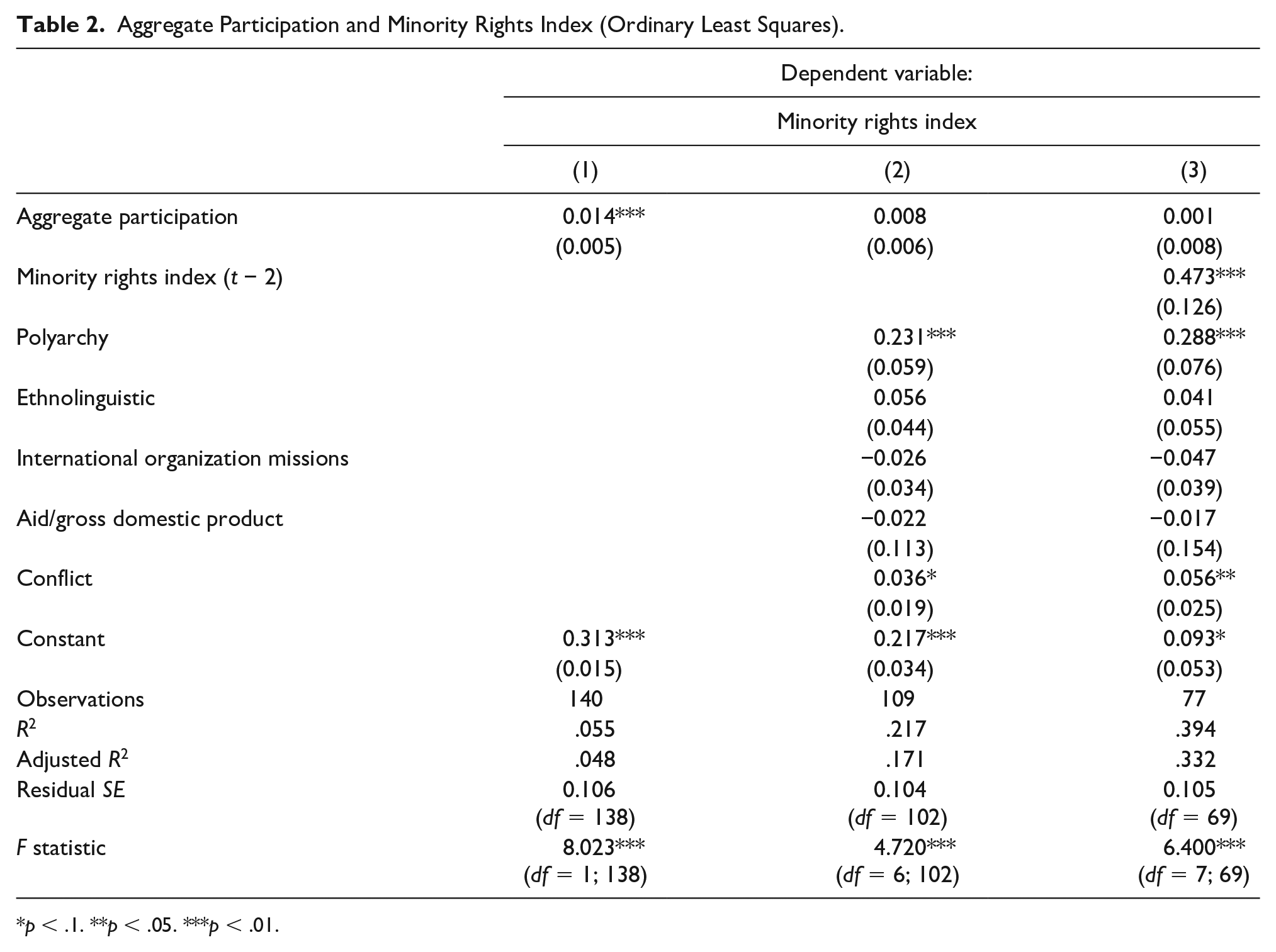
p < .1. **p < .05. ***p < .01.
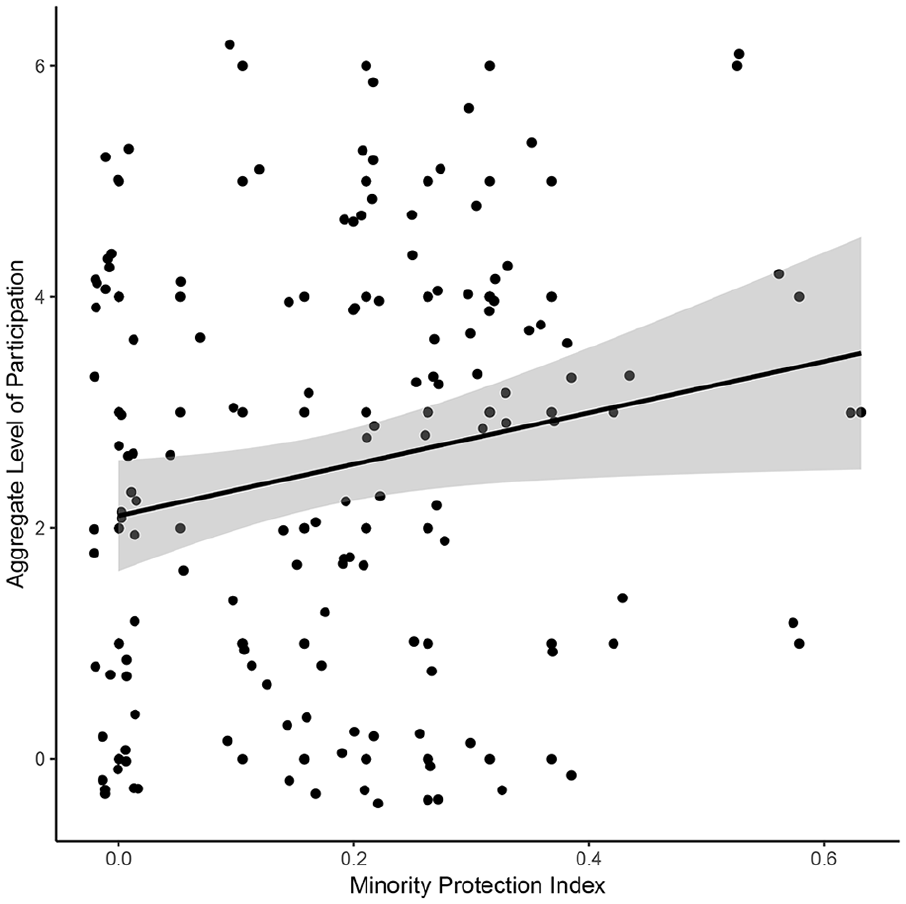
Participatory drafting and minority rights.
Even with our control for the prior content of the constitution, we might still face an endogeneity problem in terms of simultaneity between the level of participation in the drafting process and the inclusion of minority rights. To address this, we develop a two-stage least squares (2SLS) model to check for problems with simultaneity in our original specification (Table 3). Few interesting aspects of political and social life are completely disconnected from minority rights protection at some level. However, the total population of a country is at best tangentially related to minority rights protections. Population size is not even predictive of a more diverse population (as measured through ethnolinguistic fractionalization). It is, however, related to the likelihood that a constitution will be drafted in a highly participatory process. In our data, total population in the year of drafting is negatively correlated with participatory constitution making (r = −.172, p = .045). This is to be expected, as we know (at least anecdotally) that while countries with large populations have used referenda as a means of ratification, the kinds of participation in the earlier stages of drafting in which we are particularly interested have been less common in larger countries. We also find that population size is unrelated to the protection of minority rights (r = .015, p = .857). Both intuitively and mathematically, then, population size can be understood to be “plausibly random” as it relates to minority rights protections in constitutions (Sovey and Green 2011).
Two-Stage Least Squares Model.
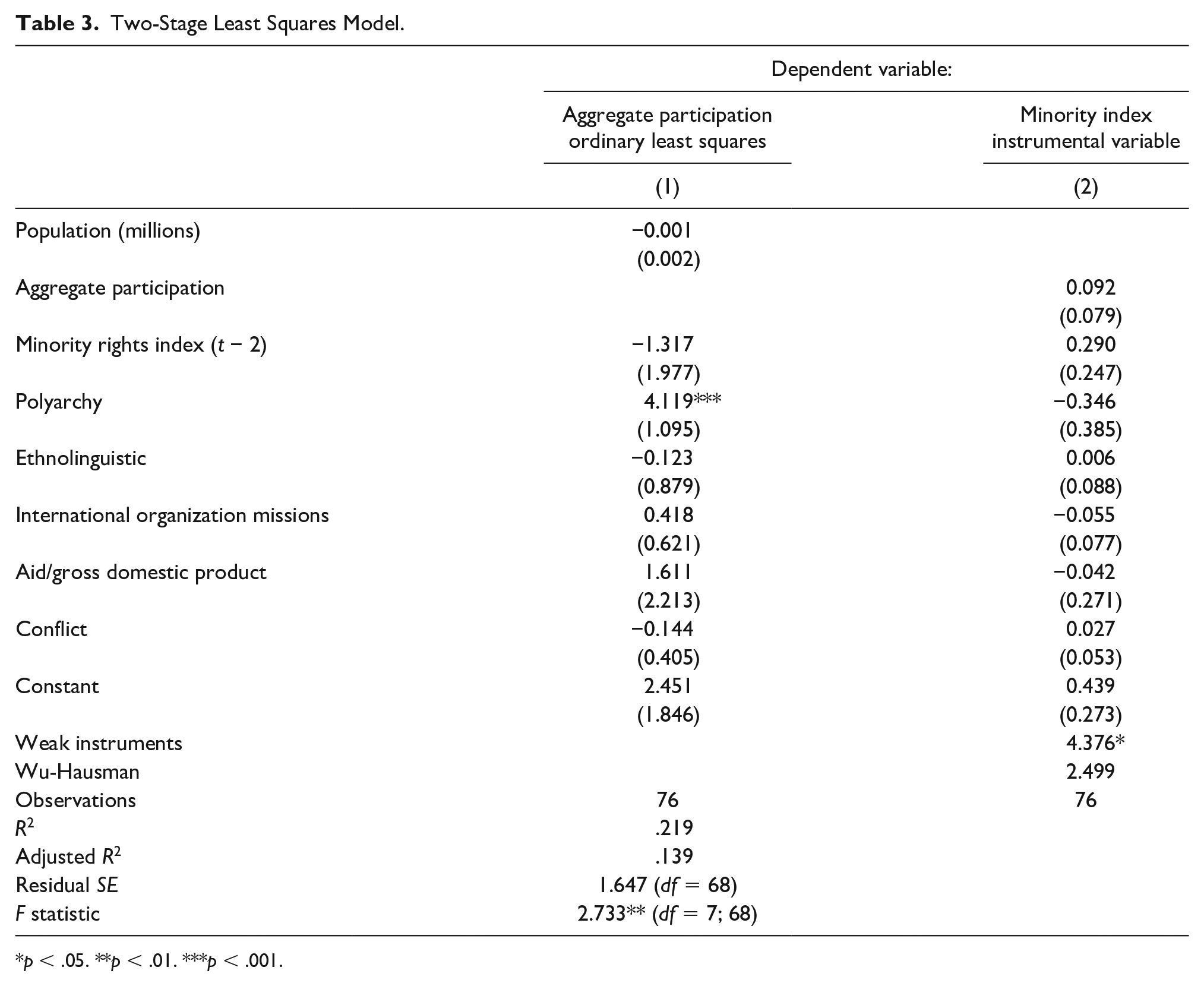
p < .05. **p < .01. ***p < .001.
This 2SLS approach confirms our finding above that there is no systematic relationship between the aggregate level of participation in the constitution-making process and the inclusion of minority rights. However, and more usefully, this model allows us to determine how concerned we should really be about simultaneity. We find that population is not a weak instrument, and more importantly that endogeneity is not a concern in the original specification. The Wu-Hausman test shows that we cannot reject the null hypothesis that our measure of participation is uncorrelated with the error term. We thus proceed on the assumption that endogeneity (at least in this guise) is not a problem in our analysis. To further satisfy ourselves that the relationship between participation and minority protection is not endogenous, we include three more 2SLS models in the supplemental materials, testing the effects of other factors that range in the plausibility of their randomness from the extent of arable land to the range of consultation in policy making, and the fairness of local elections. None of these instruments (nor any others we have tested) suggest that there is a problem with simultaneity. We next treat the participation process in a more detailed way, investigating the differential effects of participation at each stage of the process.
Effects of Participation in Different Stages
We proposed in Hypotheses 2a and 2b that the timing of public participation would matter for minority rights protection. In Table 4, we present three regression models 4 that estimate the relationship between our minority rights index and the level of public participation at each of the three stages of the process. Here, we find that when public participation occurs at the convening stage of the drafting process, there is a small but significant positive effect on the comprehensiveness of the minority rights protected in the constitution. This is in line with the findings of Eisenstadt, LeVan, and Maboudi (2017a) in their larger study of democratic outcomes. In that analysis, they find that the convening stage is the most important to supporting a democratic outcome (Eisenstadt, LeVan, and Maboudi 2017a, 41). Although the strongest predictors of the inclusion of minority rights remain our controls for the previous level of minority rights protection and the larger level of polyarchy, this positive effect from participation at the convening stage remains. Therefore, we can confirm Hypothesis 2a. More substantively, model 1 in Table 4 indicates that in comparison with the reference category of a nonparticipatory convening stage, a popular process is predictive of an almost 7 percent increase in the minority rights index (roughly one and a half more rights on average).
Participation at Each Stage and Minority Rights.
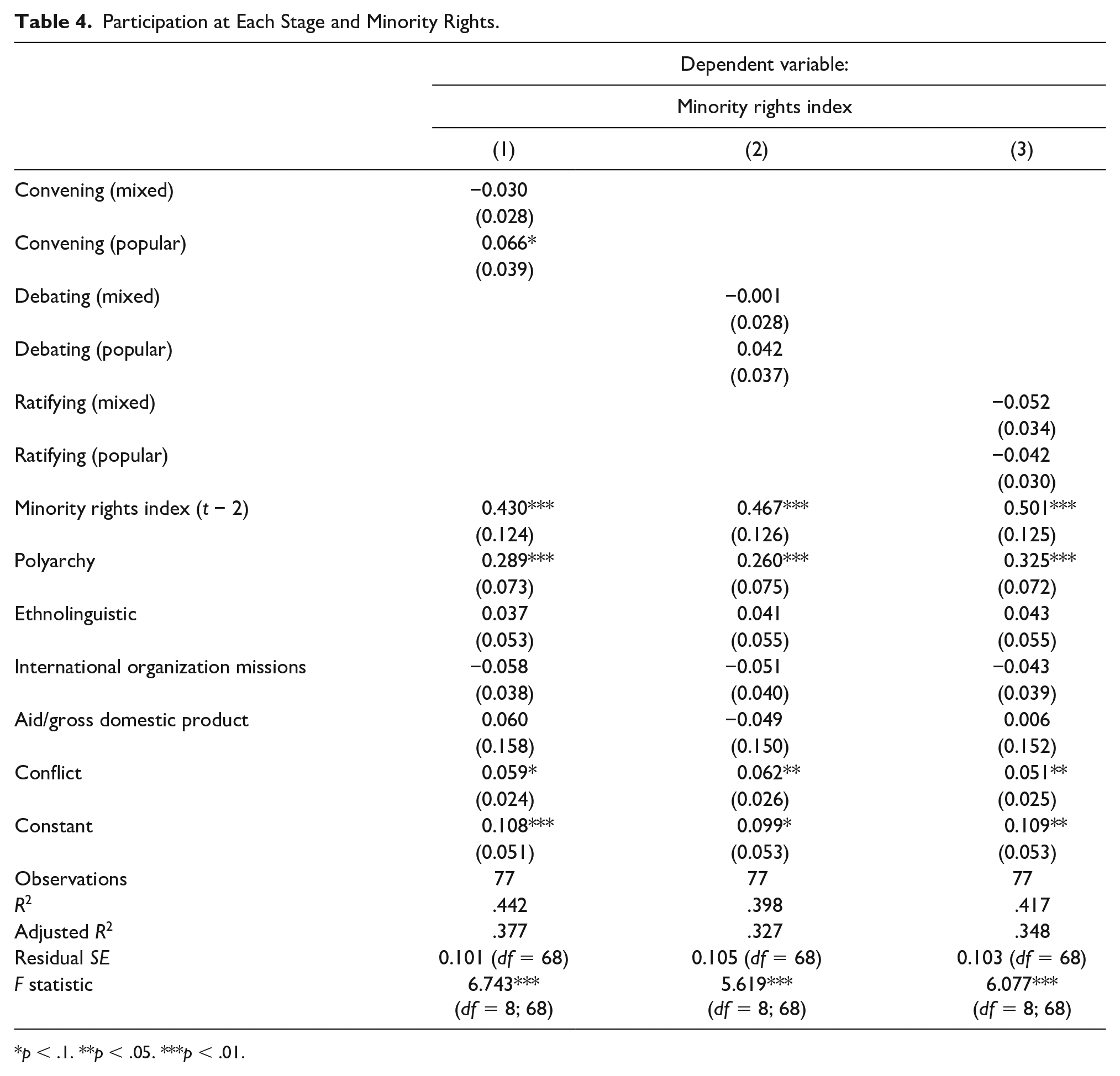
p < .1. **p < .05. ***p < .01.
Yet, from this follows an important caveat. As described earlier, a “popular” convening stage could include consultations, elections, or other forms of participation. This indicates that both the direct involvement and the inclusion of minority groups through a high level of representation could lead to more minority rights. While the literature emphasizes the relation between majoritarianism and public participation, the data suggest a different mechanism for minority rights. We see that there will be more minority rights provisions if the drafting process is public. And this puts a new light on the relation between participation and representation in the drafting stage, showing that they are closely related and not mutually exclusive categories.
The second of that pair of hypotheses (H2b) proposed that participation at the ratifying stage would lead to fewer minority rights protections. While the relevant coefficients were negative, as expected, they did not reach standard levels of statistical significance, and we cannot reject the null hypothesis. The noneffect of referenda in this regard may not be too surprising given the fact that referenda on new constitutions almost invariably pass (Elkins and Hudson 2019). Whatever the theoretical relationship between direct democracy and the preservation of majority privilege, it may not be worked out in ratifying referenda.
Discussion
The empirical analyses reported in this article demonstrate the difficulty of achieving two normatively important goals: both involving the public in the constitution-drafting process, and producing a constitution with robust protections for minorities. Our various statistical models probe many facets of this relationship, testing a number of plausible ways in which public participation could affect the interests of minorities. While we could not reject the null hypotheses regarding either aggregate participation or participation in ratification, we find support forH2a, which proposed that public participation at the convening stage of the drafting process would lead to greater protections of minority rights. While there is limited theoretical heft from a null result, our negative findings may also have something to teach us. Our finding that there is no relationship between the change in the level of minority rights protection when a constitution is replaced and the aggregate level of public participation in the drafting process, suggests that all good things do not necessarily go together, and public participation programs require more careful planning.
A more careful look at the cases that are outliers in terms of both positive and negative change in the level of minority rights protection can help us understand the relationship between participatory drafting processes and the protection of minority rights. We identified several cases earlier in this article when we introduced our index of minority rights.
Turning first to the case with the largest negative value, Rwanda’s 1995 constitution is atypical of both constitutions and constitution-making processes. What we term the new constitution of 1995 was essentially a unilateral declaration of a new system of basic laws by the party that ruled Rwanda following the genocide (Reyntjens 1996). Data from the CDD code the process as having an imposed convening stage, and mixed drafting and ratifying stages. If anything this coding underestimates the level of single party domination in this period of constitutional change. The data from the CCP essentially code this as a suspension of the 1991 constitution; however, the 1991 constitution remained part of the constitutional dispensation of 1995, so the constitutional rights included in that document pertained to some degree. In all senses, this is a singular case.
A more productive case for theory building is the 1990 constitution of Benin. In this case, we have high levels of popular participation, and yet the new constitution inaugurated by this process includes fewer minority-protecting rights than the one that preceded it. What could explain this difference? The constitution-making process in Benin in 1990 transpired during a period of democratic transition, as the financially exhausted regime of Mathieu Kérékou allowed a number of steps to be taken that led to a transformation of the legal and political system. For our purposes, the most notable events were Kérékou’s solicitation of written submissions from the public, and the convening of a national conference that included representatives of most unions and civil society organizations (Heilbrunn 1993). The constitution was drafted later that year by a council selected by the national conference and was approved through a referendum (Brandt et al. 2011, 332). The 1990 constitution differed from the 1979 constitution that it replaced in that it did not include a provision for citizenship by naturalization, equality regardless of nationality, separation of religion and the state, matrimonial equality, and right to asylum, while adding some new equality rights. These changes do not read as a conscious effort to undercut minority rights, but rather as an adjustment of an expansive system of minority rights protection. Notably, most of the rights that were removed relate to the status of foreigners, and their omission could relate to the larger geopolitical context as the Cold War wound down in Africa.
We have included a measure of conflict intensity in our models as a control, but the consistent positive relationship between conflict intensity and the inclusion of minority rights is also noteworthy, and suggests a potentially important area for further research. We would expect that cases in which there is significant international involvement in the drafting process would include more minority rights, and that these cases would often be cases of post-conflict reconstruction. However, we find that the involvement of United Nations agencies or regional governance organizations is not predictive of the inclusion of minority rights. Conflict has a significant effect on minority rights on its own.
Conclusions
Is more participation in constitution-making processes better for constitutional minority rights protections? Building on previous research, which has demonstrated both the promises and perils of participatory constitution making and its effects on various outcomes, we find a significant difference between the overall level of minority rights protection and the gains that can be achieved through a participatory process. Although our work here does not fully settle the question of whether or not public participation in constitution-making processes is to the benefit or detriment of minority rights protections, it seems that these two normatively good and potentially competing goals can be achieved together, though the two may not always have a causal relationship.
Our findings have important implications for understanding the role of participatory democracy and the salient issue of protection of individual and collective rights. First, while much of the literature on participatory democracy and minority rights suggests a negative relationship, and we argued the opposite would be true in the context of constitution making, we found no evidence of a systematic relationship. Instead our analysis suggests that the matter is more complicated. Second, our focus on the temporal element points to the importance of the convening stage (building on earlier research; Eisenstadt, LeVan, and Maboudi 2017a) and indicates that public input during early stages is substantive, while at later stages largely cosmetic. This suggests that public participation programs deserve more forethought and planning than they sometimes receive. For participation to have a meaningful effect on the constitution (rather than being a tool for legitimation), participation must be part of the process from the very beginning.
This study offers a crucial next step toward understanding the linkage between public involvement during constitution making and minority rights protections. In particular, we have shown that while this relationship is conditioned by the constitution that is being replaced and other characteristics of the constitution-making process, participation can make a real difference in this aspect of the constitutional text. However, there are still important questions that remain unanswered—in particular, what does a historical perspective on constitution-making processes tell us about minority rights protections? And moreover, are certain minority rights strategically emphasized during the different stages and thus become more or less salient issues for the public? Further research should thus explore this interaction with a specific focus on the historic development of the minority rights sections to more fully understand these complex relations.
Supplemental Material
sj-pdf-1-prq-10.1177_1065912920984246 – Supplemental material for Majorities for Minorities: Participatory Constitution Making and the Protection of Minority Rights
Supplemental material, sj-pdf-1-prq-10.1177_1065912920984246 for Majorities for Minorities: Participatory Constitution Making and the Protection of Minority Rights by Anna Fruhstorfer and Alexander Hudson in Political Research Quarterly
Footnotes
Acknowledgements
The authors thank Christina Bambrick, Todd Eisenstadt, Zachary Elkins, Ran Hirschl, Carl LeVan, Tofigh Maboudi, Abrak Saati, and Mark Tushnet for their comments and suggestions on earlier versions of this article. We also thank the Department of Government at the University of Texas at Austin for their feedback when this paper was presented in the Comparative Politics Speaker Series. Thanks also to the three anonymous reviewers and the journal editors for their concrete suggestions for improvements to the analysis.
Declaration of Conflicting Interests
The author(s) declared no potential conflicts of interest with respect to the research, authorship, and/or publication of this article.
Funding
The author(s) received no financial support for the research, authorship, and/or publication of this article.

Notes
Supplemental Material
Supplemental materials for this article are available with the manuscript on the Political Research Quarterly (PRQ) website.
References
Supplementary Material
Please find the following supplemental material available below.
For Open Access articles published under a Creative Commons License, all supplemental material carries the same license as the article it is associated with.
For non-Open Access articles published, all supplemental material carries a non-exclusive license, and permission requests for re-use of supplemental material or any part of supplemental material shall be sent directly to the copyright owner as specified in the copyright notice associated with the article.
